








































Article Contents:
- What is wall molding and why is it really needed
- Visual geometry and wall scale
- Decorative frames and wall panels
- Space zoning
- Unity of the entire interior
- Types of wall moldings: material determines character
- Wooden Wall Molding
- Solid wood moldings: durability as an argument
- MDF moldings: precision and practicality
- Polyurethane moldings for decorative walls
- How to choose wall molding by material: when each works best
- When to Choose Wood
- When to choose MDF
- When to choose polyurethane
- How to match moldings to interior style
- Classic interior: symmetry and completeness
- Neoclassical: balance of relief and restraint
- Modern interior: geometry instead of ornament
- Interior with slatted panels
- Wall moldings in different rooms: where and how they work
- In the living room
- In the bedroom
- In the entryway
- In the study
- In commercial interiors and public spaces
- How to choose molding size and shape: proportion decides everything
- Narrow molding (10–25 mm)
- Medium molding (25–50 mm)
- Wide molding (50 mm and more)
- Straight Profile
- Classical Relief Profile
- How to Avoid Overloading Walls with Mouldings
- What to Combine Wall Mouldings With: A Systematic Approach to Interior Design
- With baseboards
- With Cornices and Ceiling Decor
- With Stucco and Polyurethane Decor
- With slatted panels
- With decor for moldings
- With Door and Furniture Decor
- Where to Buy Wall Mouldings in Saint Petersburg
- What Determines the Price of Wall Mouldings in Saint Petersburg
- Material
- Profile Width and Height
- Complexity of relief
- Finishing
- Decorative Solution
- Common mistakes when choosing wall moldings
- Too massive a profile for a small room
- Mismatched material and style
- Conflict with baseboard and cornice
- Overloaded frames
- Choosing based only on price
- FAQ: Popular questions about wall moldings in Saint Petersburg
- Wall molding is architecture, not decor
- About the company: STAVROS — manufacturer of decorative profiles from solid wood

Saint Petersburg is a city with a special attitude towards architectural detail. Here, historical facades with stucco and profile cornices set an aesthetic standard that is not customary to ignore, whether in a classic mansion or a modern apartment. That is why wall moldings in Saint Petersburg are not a decorative whim, but a conscious tool for shaping space.
Wall molding does three things simultaneously: it structures the plane, sets the scale, and creates a sense of completeness. Without it, even an expensive renovation looks unfinished — like a page without the last line. With it, even a budget interior reads as thoughtful and cohesive.
If you're looking for where to buy wall moldings in St. Petersburg — this page has everything you need: types, materials, styles, selection logic for the room, and direct links to the catalog. No unnecessary text — only what helps you choose correctly.
What you'll find below:
-
Classification of wall moldings by material and purpose
-
Selection by style: classic, neoclassical, modern interior
-
Application by rooms — living room, bedroom, hallway, study
-
Sizes, shapes, common mistakes
-
FAQ with answers to popular questions
-
Direct links to the catalog and delivery in St. Petersburg
Ready to choose?
Go toMoldings from solid wood or go straight to Polyurethane moldings, cornices, and skirting boards— current assortment with prices available there.
Why choose here:
-
Wooden moldings, solid wood, polyurethane — all in one catalog
-
Profiles for any task: frames, belts, transitions, decor
-
Delivery to Saint Petersburg and Leningrad Region
-
Selection for interior projects — comprehensively




What is wall molding and why it's actually needed
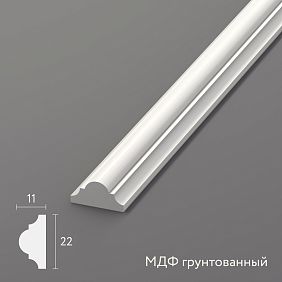
To put it in one phrase: molding is a profile strip that gives the wall architectural structure. But that's too dry for what we're talking about.




Visual geometry and wall scale
A bare wall is a flat plane without hierarchy. Molding cuts it horizontally or forms closed rectangles — frames, panels, zones. This creates visual rhythm: the wall stops being a background and becomes part of the room's architecture.
In St. Petersburg apartments with high ceilings, a horizontal molding at a height of 90–120 cm from the floor breaks the monotony of a tall wall and makes the space proportionate to a person. In apartments with low ceilings, a narrow vertical profile or a neutral frame, on the contrary, adds height.
Our factory also produces:


Decorative frames and wall panels
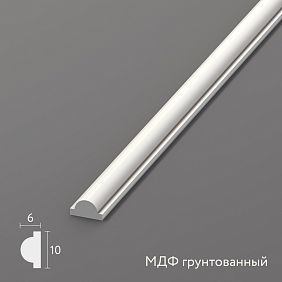
One of the most popular techniques in modern interiors is creating rectangular or square frames on walls using moldings. This works everywhere: in the bedroom above the bed, in the living room along an accent wall, in the hallway instead of expensive panel cladding.
Frames made ofof wooden wall moldingscreate the effect of an English paneled interior without complex installation and high costs. Simple geometry, three or four profiles per wall — and the space is transformed.
Get Consultation
Space Zoning
Moldings are used as a zoning tool: a horizontal belt divides the wall into a lower paneled part and an upper 'picture' zone. Especially effective in studios and open-plan layouts, where walls serve as visual dividers without physical partitions.
Unity of the entire interior
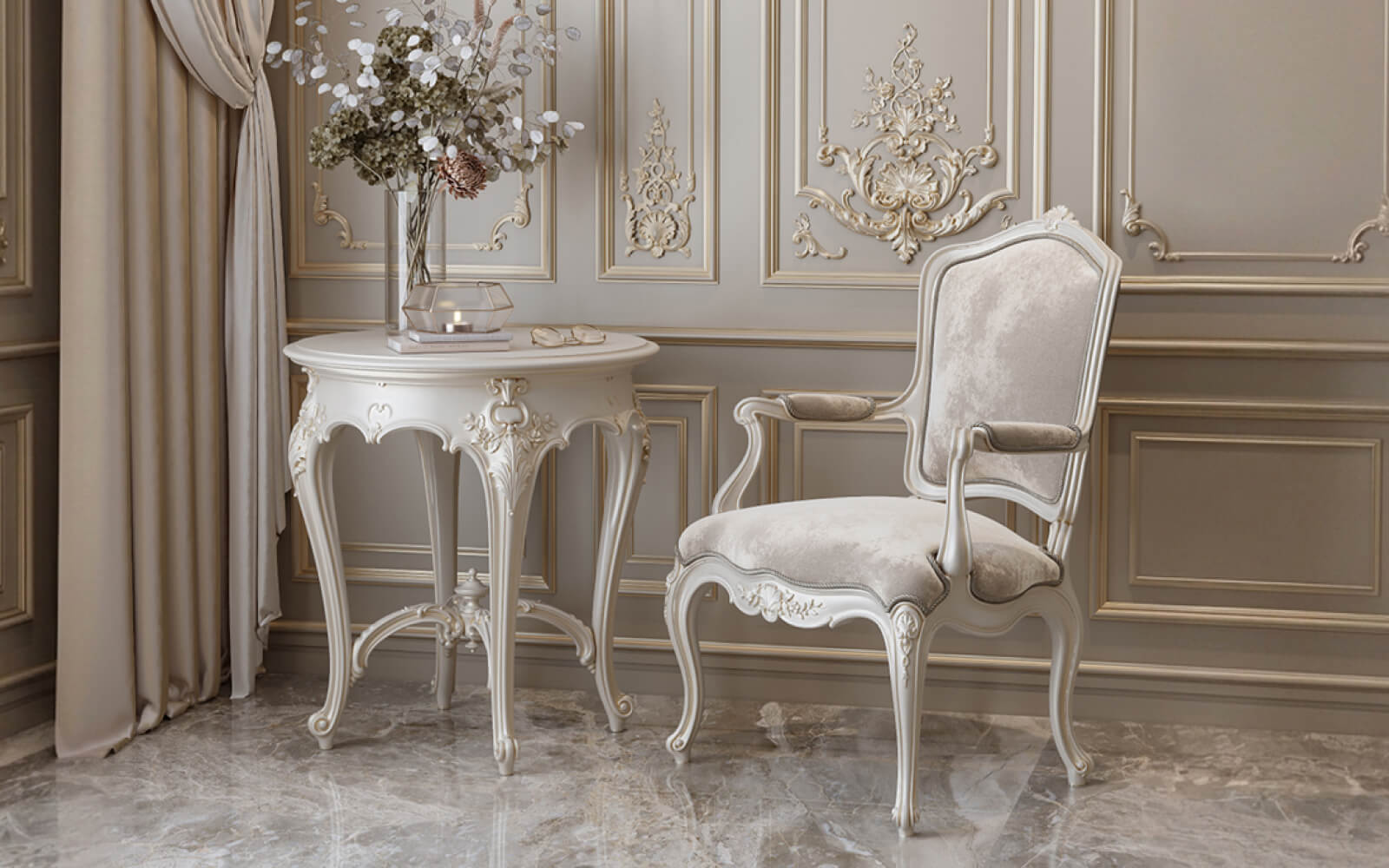
This is perhaps the main function of wall moldings in St. Petersburg and any other city. When the baseboard, wall molding, ceiling cornice, and door casing belong to the same profile system — the interior reads as a cohesive architectural object, not a random collection of finishing materials.
Types of wall moldings: material determines character
The question 'what is the molding made of?' is not technical, but aesthetic and practical at the same time. The material determines the texture, weight, flexibility, ability to be painted, and, of course, the visual class of the product.
Wooden wall moldings
Wood is a living matter. A wooden molding carries warmth, tactility, and naturalness that cannot be imitated by synthetics. In an interior with wooden doors, parquet floors, solid wood furniture — a wooden molding completes the system, rather than introducing a foreign element.
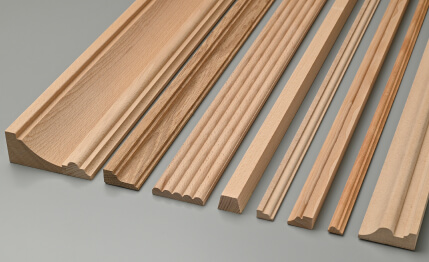
Wooden moldings are made from oak, beech, and pine. Oak is dense, with characteristic medullary rays, and durable. Beech is even, with a fine texture, and takes paint perfectly. Coniferous species are affordable, lightweight, and work well in country houses and spaces with a natural character.
Wooden wall molding is particularly appropriate:
-
In interiors with natural materials — stone, parquet, wood
-
In classic and neoclassical apartments
-
In country houses with wooden structures
-
In studies, libraries, living rooms with a prestigious spatial feel
Detailed information — in the article Wooden moldings.
Solid wood moldings: durability as an argument
Moldings from solid wood — this is the next level in the wood category. Solid wood without adhesive layers, gluing, or artificial fillers. The profile is milled, with precise geometry and a stable surface for any finish.
The main advantage of solid wood is repairability. Sanding removes scratches. Repainting restores freshness. Service life under normal conditions is several decades. For St. Petersburg with its humid climate, it is important to choose the right species and treatment: oak and beech, treated with oil or varnish with sufficient moisture resistance, behave stably.
Solid wood wall molding is the choice of those who are settling in not for three years, but for the long term.
MDF Moldings: Precision and Practicality
MDF is high-density pressed wood fiber. Its main value is stable geometry. MDF profile does not warp, does not react to humidity fluctuations as painfully as solid wood, and maintains its shape for many years.
For painting — one of the best options. The smooth surface takes enamel well, sands easily, and is ready for any tinting. MDF wall moldings are a practical and honest choice for modern St. Petersburg apartments.
Read more in the article wall moldings: wood, MDF, or polyurethane.
Polyurethane moldings for decorative walls
Polyurethane moldings, cornices, and skirting boards — a special material with unique relief possibilities. Polyurethane allows reproduction of complex classical profiles with beads, ornaments, bas-reliefs — what was once made from plaster or carved wood.
Advantages of polyurethane over plaster: lightness (does not overload the wall), moisture resistance (works in kitchens and bathrooms), ease of installation (glue + additional fastening), full paintability.
For St. Petersburg, where classical and neoclassical aesthetics in interiors are in demand like nowhere else in Russia, Polyurethane products for finishing — an organic and practical choice. A relief molding on the wall in the living room with a stucco cornice near the ceiling — this is not archaic, it is tradition.
How to choose wall molding by material: when each works best
When to choose wood
If wood is already present in the interior — in the floor, doors, furniture, slatted panels — wooden wall molding will become a natural continuation of this theme. Unity of material in the interior is one of the signs of good taste.
Wood is appropriate where naturalness, tactile value, and durability are important. For classic St. Petersburg apartments with parquet and wooden doors — it's the first choice.
Read more:wall moldings — wood, MDF, or polyurethane.
When to choose MDF
If the priority is a neat profile for painting, modern design, neutral geometry — MDF wall moldings will do their job excellently. They work well in minimalist apartments, restrained Scandinavian interiors, and modern classic styles with white walls.
MDF is an honest compromise between budget and quality of result. White MDF molding in a white room creates an architectural outline without extra effort.
When to choose polyurethane
If the project leans towards classic, neoclassical, or historicism — polyurethane provides relief that neither wood nor MDF can reproduce with the same ease. Complex profiles with coves, meanders, acanthus ornament — all of this is realized in polyurethane and installed in one day.
For St. Petersburg, this material is especially relevant: a classic interior with plaster moldings on the walls, a cornice near the ceiling, and a baseboard near the floor — this is a city tradition that is pleasant to continue.
How to choose moldings to match the interior style
Style is the main coordinate of choice.moldings in interior designwork differently depending on the language spoken by the entire space.
Classical interior: symmetry and completeness
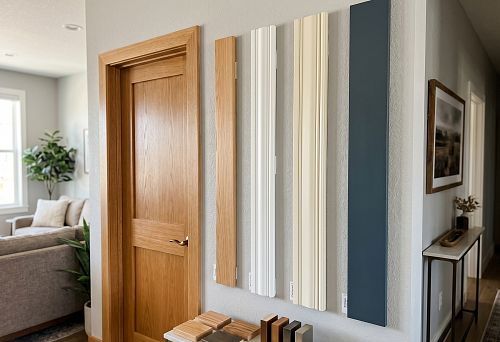
Classical style demands one thing from wall molding: scale compatibility. An expressive profile with several beads or roundings, width from 40 mm, white color or varnished. Walls are divided into a lower paneled part with frames and an upper part for paintings or neutral finishing.
In classical St. Petersburg interiors, wall moldings work in ensemble with cornices at the ceiling, baseboards at the floor, and door trims. A break in this chain is a mistake. Everything should speak the same language of profiles.
Neoclassical: balance of relief and restraint
Neoclassicism is a style of compromise between historical heritage and modern spatial requirements. Molding here: moderate relief, one or two roundings, neutral white or cream color. Wall frames are neat, not overloaded with details.
In neoclassical apartments of St. Petersburg, both wooden moldings with a laconic profile and polyurethane ones work well — if a bit more decorativeness is needed with minimal labor costs.
Modern interior: geometry instead of ornament
In a modern interior, wall molding works as an architectural element, not as a decorative one. Straight profile, minimal relief, clean lines of rectangular frames — this is a technique that has long gone beyond classicism and confidently lives in minimalism, Scandinavian style, and modern classicism.
The main rule for a modern interior: molding should not 'shout.' It should create structure — and remain in the background. White MDF or wooden molding for painting to match the wall color is a working formula.
Interior with slatted panels
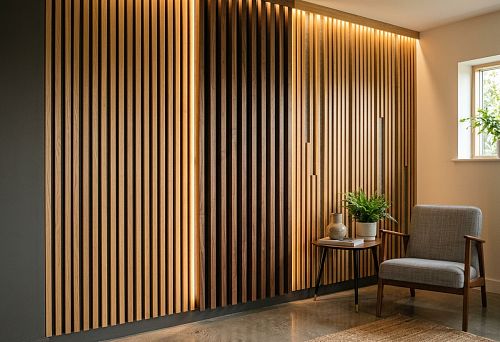
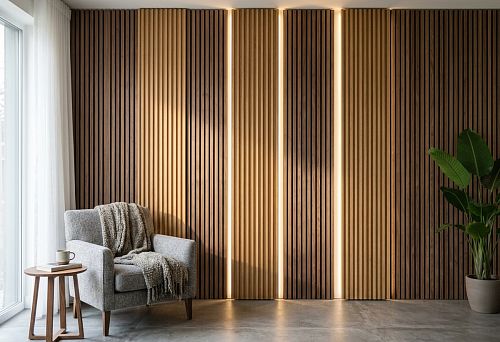
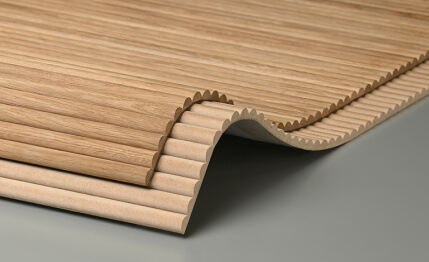
slatted panels for walls— one of the key trends in recent years. Vertical wooden slats create rhythm and texture. Moldings in such an interior act as framing: a horizontal belt that sets the boundary of the slatted zone from below or above, or vertical profiles separating a textured area from a smooth one.
Unity of wood species is the main rule. Oak slats with oak molding. Ash with ash. Pine with pine.
Wall moldings in different rooms: where and how it works
In the living room
The living room is the main space of the apartment, a place for receiving guests and where the interior 'looks' first. Moldings are justified here in any style.
Classic: symmetrical panels on all four walls with profile frames. Neoclassical: an accent wall behind the sofa with frames. Modern interior: a thin horizontal belt at windowsill level or simple rectangles above the sofa. Everywhere — different character, but a unified logic: molding structures the space.
Related material: wall moldings: how to choose.
In the bedroom
In the bedroom, moldings create a cozy feeling of security and tranquility. The technique of a 'headboard made of moldings' works especially well: a rectangular or arched frame behind the bed forms a decorative accent without furniture and without complex installation.
Frames can be painted to match the wall color — then they create volume without contrast. Or choose a color with a slight difference — then a delicate accent appears.
Read more in the article Wall moldings in the bedroom.
In the hallway
The hallway sets the first impression. A narrow space with high or medium ceilings — there, a horizontal molding belt at a height of 90–100 cm from the floor makes the interior proportionate and not boring. Below — a painted or paneled part, above — a light background.
Wooden molding under varnish in an entryway with wooden doors and parquet flooring is a logical and beautiful solution.
In the study
A study is a space for concentration and status. Solid wood wall moldings in a study create a sense of seriousness and thoughtfulness. Dark wood species (fumed oak, wenge), relief profiles, shelves in wall niches with framing moldings—this is a library, 'study' aesthetic that never goes out of style.
In commercial interiors and public spaces
In hotels, restaurants, and representative-class offices, wall moldings are standard practice for professional designers. They quickly and relatively inexpensively create a sense of status for the space. Polyurethane moldings are often preferred here: lightweight, moisture-resistant, and easy to install over large areas.
How to choose the size and shape of molding: proportion is everything
The size of molding is not just a number in centimeters. It is a proportion that either works with the space or conflicts with it.
Narrow molding (10–25 mm)
For delicate outlines, thin frames, modern minimalist interiors. Almost invisible in a neutral color—creates structure without overloading the wall. Works well in small spaces where a wide profile would visually 'eat up' the area.
Medium molding (25–50 mm)
A universal format. Noticeable enough to be read in the interior. Restrained enough not to dominate. For apartments with ceilings 2.6–2.8 m high—an optimal solution for most styles. Wooden and MDF moldings in this range are the most in-demand in St. Petersburg apartments.
Wide molding (50 mm and above)
For accent walls, high ceilings, classic and neoclassical interiors. The wide profile is visible from a distance, creating a powerful decorative outline. In a small room — use with caution: it can overwhelm the space.
Straight profile
One or two roundings — maximum. For modern, Scandinavian, minimalist interiors. Takes paint well, creates clear geometry.
Classic relief profile
Multiple roundings, coves, stepped transitions. For classic, neoclassical, historicist styles. Works in an ensemble with cornices and baseboards, forming a full-fledged architectural wall system.
How not to overload a wall with moldings
The main mistake is 'more means richer'. No. A wall overloaded with moldings loses air and turns into an ornament that tires. The rule: moldings should accentuate the structure, not replace it. One or two levels of decor per wall is enough.
What to combine wall moldings with: a systematic approach to interior design
With baseboards
Solid wood moldings, cornices, and baseboards— a unified system of profiles that must be coordinated. Wall molding and floor baseboard from the same line, made from the same wood species, with the same finish — this is a sign of a professional approach to interior design.
When the baseboard and molding conflict in profile (one straight, the other baroque) — the space loses integrity. Coherence is the main principle.
With cornices and ceiling decor
Wall molding is often the middle part of a vertical architectural system: baseboard → wall molding → ceiling cornice. In a classic interior, all three elements should belong to the same decorative system.
With stucco and polyurethane decor
Polyurethane moldings— corner blocks, rosettes, medallions, overlay ornaments — are a natural extension of the polyurethane molding system. When wall molding frames are complemented by decorative corner blocks at joints, the interior achieves true classical completeness.
With slatted panels
Molding as a horizontal divider between a paneled zone and a smooth wall section is one of the most relevant techniques in modern interiors.slatted panels for wallsin combination with a wooden belt molding create an interior with pronounced material and visual culture.
With molding decor
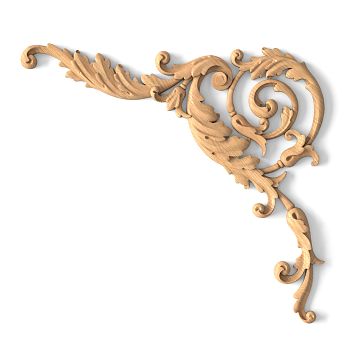
Decor for Molding— are corner and central overlay elements that finish profile joints. Without them, installing molding at frame corners requires precise 45° cuts. With them — the corner is covered with a decorative block, and the result looks flawless.
With door and furniture decor
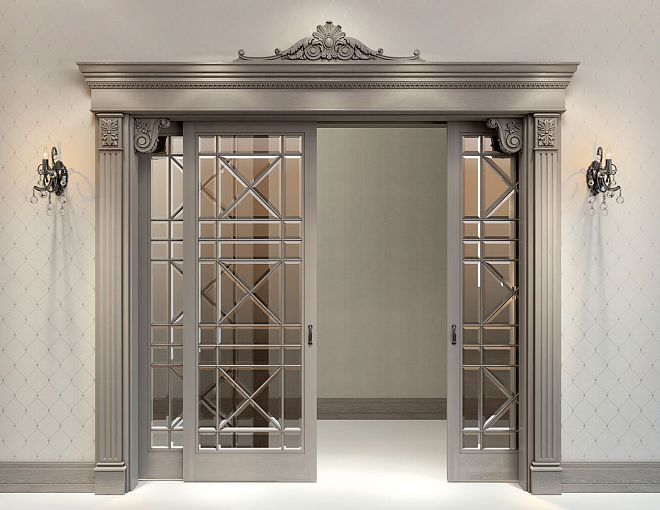
Wall moldings create a context in which doors, cabinets, and furniture appear as part of the architecture. Molding frames on walls alongside molding cabinet fronts is already a design solution, not just finishing.
Where to buy wall moldings in Saint Petersburg
Buying wall moldings in St. Petersburg means not just 'finding something similar at the nearest store,' but selecting a profile that suits a specific interior in terms of material, size, profile, and finish.
What to consider before purchase:
Material. Determine your priority: the naturalness of wood, the precision of MDF, or the relief of polyurethane. Each material requires its own approach to installation and care.
Profile. The cross-section of the molding should match the interior style. Straight — for modern. Classic — for neoclassical and historicism. Relief — for decorative accents.
Size. The width of the molding is about proportion. Measure the ceiling height, wall area, and consider the scale of the furniture. Only then choose the profile width.
Finish. Unfinished — if you plan to paint it yourself. With oil or varnish — if you want the natural look of wood. With ready-made enamel — if you need a white or colored molding 'turnkey.'
Availability and quantity. Check stock levels for large orders. For non-standard projects — the possibility of ordering an additional batch.
Delivery to St. Petersburg. Moldings are long goods (2–2.5 m). Transportation conditions should be clarified in advance.
Selection for the project. If the interior includes moldings, cornices, baseboards, and decorative elements — it's more convenient to choose everything from one catalog. Unity of source guarantees unity of style.
Buy wall moldings in St. Petersburg— go to the catalog, filter by material and profile.
Select decorative wall profile— wide selection of moldings, cornices, and baseboards made from solid wood.
What determines the price of wall moldings in Saint Petersburg
The price range for wall moldings is wide. Understanding the pricing logic means paying for what you really need.
Material
Coniferous species are the most affordable category. Oak and beech are more expensive: more complex in harvesting, processing, and drying. MDF is lower than oak with the same profile. Polyurethane ranges from affordable to expensive depending on the complexity of the relief.
Width and height of the profile
Direct dependence: more material — higher price. A narrow molding 15×8 mm and a wide one 80×20 mm from the same species differ in price multiple times.
Complexity of relief
Simple straight profile — minimal milling cost. Classic profile with three to four elements — more complex, more expensive. Decorative relief (cavettos, ornament) — maximum labor intensity.
Finishing
Without coating — base price. With oil-wax — 15–20% more expensive. With white enamel — more expensive, but the profile is ready for installation without additional painting.
Decorative quality of the solution
Set "molding + corner decorative blocks +"Decor for Molding» costs more than a single profile. But the result is a fundamentally different level of finish.
Common mistakes when choosing wall moldings
Too massive a profile for a small room
A wide, relief molding in a small room with low ceilings makes the space cramped and overloaded. Proportionality is the key principle. In small St. Petersburg apartments, a narrow, delicate profile works better.
Mismatched material and style
A wooden molding with natural varnish in a white minimalist interior is a conflict. An MDF molding for painting in a "Petersburg classical" interior with parquet is a missed opportunity. Material and style must speak the same language.
Conflict with the baseboard and cornice
Three different profiles in one room — a straight molding, a Baroque cornice, and a simple baseboard — create visual chaos. Consistency of profiles throughout the room is not pedantry, it's professionalism.
Overloaded Frames
Frames placed too close together, too many layers of molding, mixing narrow and wide profiles in one scheme — all of this overloads the wall. Concision here is a virtue.
Choosing based on price alone
Cheap molding with an uneven profile, crooked ends, and unstable geometry will require extra effort during installation and result in unsightly joints. Reworking costs more than making the right choice from the start.
FAQ: Popular Questions About Wall Moldings in Saint Petersburg
What is wall molding and how is it different from a cornice?
Molding is a decorative profile for wall decoration: creating frames, horizontal bands, decorative transitions. A cornice is a similar profile, but installed in the ceiling area, at the wall/ceiling transition. Molding and cornice are often chosen from the same product line.
Which molding is best to buy for an apartment in Saint Petersburg?
Depends on the style. For classic and neoclassical apartments — wooden or polyurethane molding with a relief profile. For modern ones — wooden or MDF with a straight section. For interiors with natural materials — solid wood.
Can wooden molding be installed in an apartment independently?
Yes. Wooden and MDF moldings are attached with liquid nails or finish nails with a nail set. Corner joints are made at 45° — using a miter box or miter saw. Polyurethane moldings are glued with polyurethane-based construction adhesive.
How to calculate the number of wall moldings?
For horizontal belts: the perimeter of the room (or specific walls) divided by the length of one strip (usually 2 m), plus 10–15% for trimming. For frames: the total perimeter of all frames, taking into account corner trimming.
Which molding is best for living room walls?
For the living room — a medium-width profile (25–50 mm), coordinated with the baseboard and cornice. In a classic living room — embossed wood or polyurethane. In a modern one — straight MDF or wood for painting.
Where to buy wall moldings in St. Petersburg with delivery?
In the catalog —wall moldings in St. Petersburgwith current prices and delivery to St. Petersburg and the Leningrad region. Long goods are delivered by specialized transport.
What is better — wooden or polyurethane wall moldings?
This is not a question of 'better/worse,' but of purpose. Wood — naturalness, warmth, durability, repairability. Polyurethane — complex relief, moisture resistance, easy installation, affordable price with rich profiles. In an interior with wood — wood. In an interior with stucco — polyurethane.
Can solid wood molding be painted white?
Yes. Wood accepts primer and enamel well. Preparation: sanding, insulating primer (to prevent resin bleed-through in coniferous wood), enamel in 2–3 coats. The result is a white molding indistinguishable in appearance from MDF but superior in durability.
What size molding should I choose for an apartment with 2.7 m ceilings?
A profile width of 25–40 mm is the optimal range. For a horizontal wall band, you can go slightly wider (up to 50 mm). For frames, 20–30 mm is sufficient.
Wall molding is architecture, not decoration.
There is one word that most accurately describes what moldings do to an interior: structure. Not 'decoration,' not 'ornamentation,' not 'expensive' — but precisely structure. A line that gives the wall scale. A frame that turns a plane into an architectural element. A contour that connects the floor, walls, and ceiling into a unified whole.
In Saint Petersburg, where historical architecture has set the aesthetic standard for centuries, wall moldings are not a trend or a fashion. It is a continuation of the tradition of a conscious attitude towards the details of space.
Buy wall moldings in St. Petersburg— go to the catalog and choose according to your interior.
Select decorative wall profile— moldings, cornices, and baseboards made of solid wood in a single section.
Wall moldings | Decor for Molding | slatted panels for walls
About the company: STAVROS — a manufacturer of decorative profiles from solid wood.
Behind every profile in the catalog stands real production with a full cycle: from wood blank to milling, kiln drying, and final finishing.
STAVROS is a Russian manufacturer of solid oak and beech products, as well as polyurethane decorative profiles. Its own range includes wall moldings, cornices, baseboards, slatted panels, molding decor, trim, and furniture profiles—everything needed for professional systematic space finishing.
Over 4000 items, stable warehouse, ability to order from one piece, project-specific selection. Delivery to Saint Petersburg, Moscow, and across Russia.
If you need not just moldings, but a complete system of decorative profiles for walls, ceilings, and floors—STAVROS knows how to implement it.