Article Contents:
- Why wall moldings are needed: real tasks
- What types of wall moldings exist: wooden and polyurethane
- Wooden Wall Molding
- Polyurethane wall moldings
- Comparison table
- How to choose the width and profile of a wall molding
- Thin molding: 20–35 mm
- Medium molding: 35–60 mm
- Wide molding: 60–100 mm and more
- Matching the profile to the baseboard
- Wall moldings for painting: how it works
- Three color solutions
- Installation and painting technology
- Where to best use moldings on walls
- Living room: three main places
- Bedroom: restrained rhythm
- Hallway: practicality and aesthetics
- Study: classic and dignity
- Commercial interior: image for reasonable money
- How to calculate wall moldings: step-by-step guide
- Step 1. Measure the wall
- Step 2. Determine the number of frames
- Step 3. Set the indents
- Step 4. Calculate the perimeter of each frame
- Step 5. Add a margin
- Step 6. Account for joints with sockets and switches
- Wall moldings in different interior styles
- Classic
- Neoclassicism
- Art Deco
- Modern minimalism
- Country house
- What to Buy Together with Wall Moldings
- Mistakes when buying wall moldings
- How to buy wall moldings without mistakes: the final algorithm
- About the Company STAVROS
- FAQ: Answers to Popular Questions
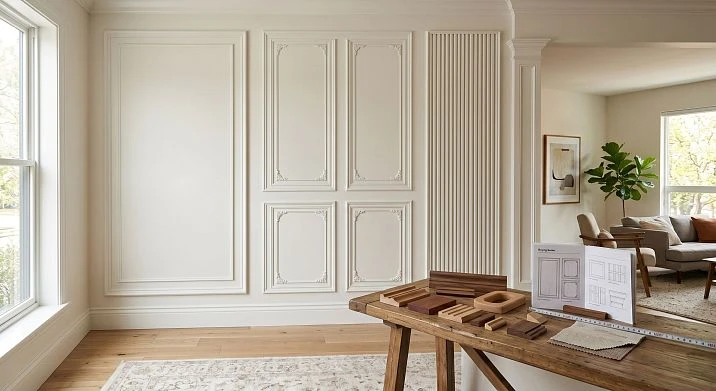
Imagine two identical rooms. One — with painted walls, furniture, and lights. The other — the same furniture, the same paint, but neat molding frames run along the walls, dividing the wall space into proportionate sections. The difference between these rooms is not in the furniture or the color. The difference is that the second room looks like an interior. The first — like a space.
Wall moldings are not "additional decor." They are an architectural tool that gives a flat painted surface structure, scale, and character. That is why the question "which decorative wall moldings to buy" is not a question about a beautiful profile. It is a question about an interior solution: style, proportions, material, connection with the baseboard, cornice, doors, and furniture.
Let's break it down in detail — from the first step to the final choice.
Why wall moldings are needed: real tasks
Before buying, it's worth honestly answering: what exactly for? A wall molding is not an end in itself. It solves specific visual and architectural tasks.
Create frames and panels. Rectangular frames made of molding are the most popular scenario. They divide a large wall into proportionate 'pictures,' creating depth and rhythm that a bare painted surface lacks.
Designate an accent zone. The wall behind the sofa, the TV wall, the headboard — areas you want to visually highlight without radically changing the color. A molding frame or decorative strip solves this task with minimal means.
Divide the wall by height. A horizontal molding belt at 90–110 cm from the floor is a classic way to separate the lower and upper zones of the wall. Below — a different color or texture, above — the main one. This makes a tall wall proportionate to a person.
Connect the wall with the baseboard and cornice. Wall moldings work as visual connectors: they create horizontal lines that 'rhyme' with the cornice under the ceiling and the baseboard near the floor.
Create a classic or neoclassical rhythm. Alternating frames, vertical and horizontal moldings — this is the architectural program of the wall. This is how walls were decorated in houses of the classicism era, and this is how it works in modern neoclassical interiors.
Protect the lower part of the wall. In the hallway and corridor, a lower belt of molding plus a painted lower part of the wall is a practical and beautiful solution. The wall doesn't get dirty, scratches are not visible, and the space looks neat.




What types of wall moldings exist: wooden and polyurethane
This is a key choice. The two main materials — wood and polyurethane — yield different results and suit different interiors. Let's break it down honestly.
Our factory also produces:


Wooden wall moldings
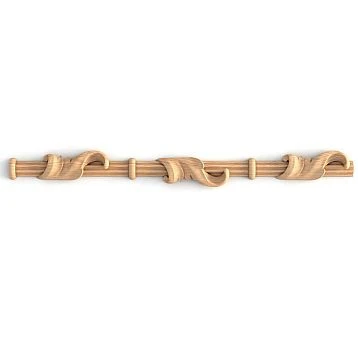
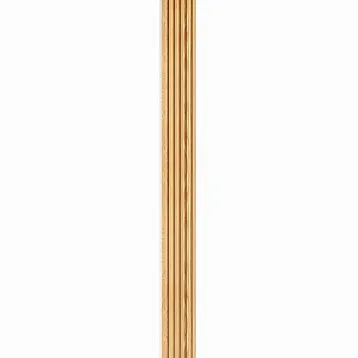
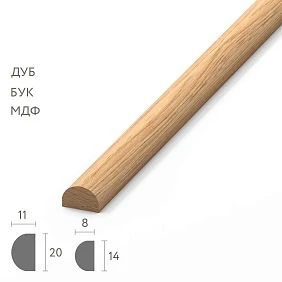
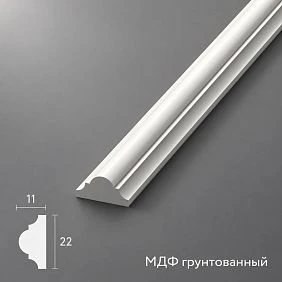
Wooden moldings — this is natural solid oak or beech, processed on a milling machine. The profile can be simple (rectangular cross-section) or complex (with several breaks, bevels, shelves).
Where wooden moldings work best:
-
Classic interior with wooden doors, solid wood furniture, parquet. An oak molding matching the flooring or trim — that's a unified interior language.
-
Country house. Here wood is the main architectural material: beams, stairs, doors. A wooden molding on the walls fits organically into this context.
-
Study. Wooden moldings give the study a sense of a serious, traditional space. Especially if the interior has Wooden baseboard и Wooden casings.
-
Russian style. Solid wood moldings with a pronounced wood texture under clear varnish — a fitting choice for interiors with character.
Important: wooden molding is attached with specialized glue or hidden fasteners, requires a finish coating — oil, wax, or varnish. Tinting must be coordinated with other wooden elements in the room.
Get Consultation
Polyurethane moldings for walls
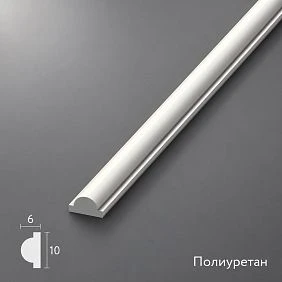
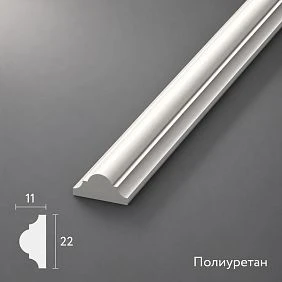
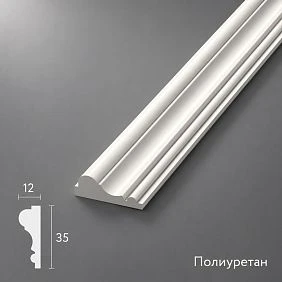
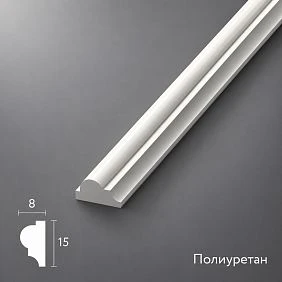
Moldings made of polyurethane — precisely molded profiles made of foamed polyurethane. Lightweight, geometrically accurate, with a consistent profile along the entire length. Accept any paint without special preparation.
Where do polyurethane moldings work best:
-
Wall frames for painting. This is the main use case. The molding is installed, joints are puttied, the entire surface is painted in a single tone — the frame becomes part of the wall, not a glued-on detail.
-
Neoclassicism and modern interior. A thin, geometrically precise profile, painted in the color of the walls or slightly lighter — an expressive minimalist technique.
-
Apartment and urban housing. Polyurethane moldings do not load the walls, are installed quickly, and painting is standard.
-
Commercial interior. For a salon, restaurant, hotel, showroom — polyurethane moldings allow you to quickly create an "expensive" look for the space.
Key difference from wood: a polyurethane molding is, as a rule, an element "for painting." It does not carry the tactile value of natural material, but provides precise geometry and ease of installation.
Comparison table
| Parameter | Wooden Molding | Polyurethane molding |
|---|---|---|
| Material | Natural solid wood | Foamed polyurethane |
| Texture | Lively, with wood grain pattern | Smooth, uniform |
| Painting | For tinting, oil, varnish | For any paint |
| Weight | Medium | Lightweight |
| Installation | Glue or hidden fastening | Glue |
| Application | Natural interiors, classic, wood | Wall frames, neoclassical, painted solutions |
| Combination with baseboard | Wooden skirting board | Polyurethane or MDF baseboard |
How to choose the width and profile of wall molding
This is more important than it seems at first glance. The wrong profile scale ruins the whole idea.
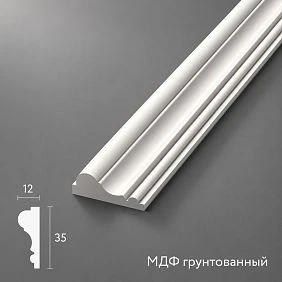
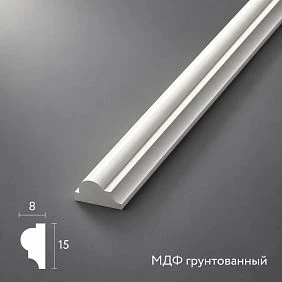
Thin molding: 20–35 mm
Light, unobtrusive. For small rooms and apartments with standard ceilings (2.5–2.7 m). For modern interiors where decor should be barely noticeable. For wall frames in a bedroom or study where a calm rhythm without accents is desired.
Profile: smooth section with one or two breaks. No ornaments.
Medium molding: 35–60 mm
A universal format for most living spaces. Expressive enough to create noticeable frames, restrained enough not to overload the space. Works in both neoclassicism and moderate classicism.
Profile: can have several breaks, a slight bevel, or a shelf. Decor for Molding — corner rosettes, diamond-shaped inserts — pairs well with a medium profile.
Wide molding: 60–100 mm and more
For high walls (from 3 m), for classic interiors with a rich decor system. A wide molding is no longer just a frame, but an architectural statement. Complex profile, deep bevels, pronounced shelves.
Important: wide molding requires high ceilings. In a standard apartment with 2.7 m ceilings, a wide profile creates a feeling of crampedness.
Matching the profile to the baseboard
Wooden baseboard sets the 'weight' of the room's lower line. The wall molding should be comparable in 'heaviness' to the baseboard: a light baseboard — a light molding, a powerful wide baseboard — the molding can be wider. If the molding is significantly heavier than the baseboard, the wall will look 'inverted' in scale.
A similar rule for the cornice: the cornice under the ceiling, the molding belt at the level of 1–1.2 m, and the baseboard at the floor form three horizontal lines that must be coordinated in terms of profile 'weight'.
Wall moldings for painting: how it works
A separate and very popular scenario: installing moldings on walls followed by a single paint of the entire surface. This is one of the most beautiful ways to use polyurethane molding.
Three color solutions
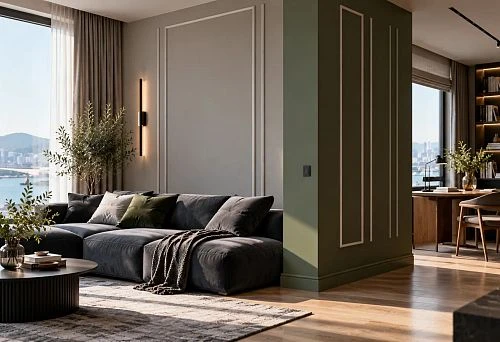
Monochrome: molding in the color of the wall. The molding and wall are painted with the same compound. The frame is perceived as a relief of the wall itself — architectural volume without color contrast. This is a subtle, elegant technique. It works well in bedrooms, studies, restaurants with delicate styling.
Molding slightly lighter or darker than the wall. A slight tonal shift — 1–2 shades of the same color — creates a soft contrast. The frame is readable but does not 'scream'. This is the most common and safe solution.
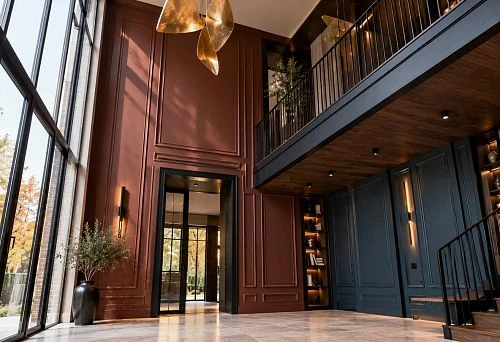
Contrast molding. White molding on a dark blue or green wall is already a design statement. Requires a precise stylistic solution and coordination with furniture and textiles. Works well in classic and neoclassical interiors with pronounced color contrasts.
Installation and painting technology
Before painting, the joints between the molding and the wall must be carefully puttied and sanded — until completely invisible. Otherwise, when painting, the gaps will become noticeable stripes. More details on this in the material about installing polyurethane moldings.
Paint — acrylic or water-based. Applied in 2–3 layers for even coverage. Frame joints at corners — strictly at 45 degrees, without gaps.
Where is the best place to use moldings on walls
Living room: three main places
Wall behind the sofa. This is the "main wall" of the living room — the one everyone sitting looks at. A molding frame or frame system here creates a visual center of the room. For a large living room — a large frame or several frames in a row. For a small one — a single frame the width of the sofa.
TV zone. A TV on the wall without framing is a technical object. A TV in a molding frame or in a decorative niche with molding framing is an architectural element. decorative polyurethane elements allow you to design the area around the screen without construction work.
Zone with a fireplace. A fireplace is a natural architectural center. A molding portal around it or a frame system on the wall above the fireplace enhances its role in the interior.
Bedroom: restrained rhythm
In the bedroom, moldings work in two main places. The first is the headboard: a frame or molding panel behind the bed that creates an "architectural headboard." The second is symmetrical frames on the side walls that create a sense of cocoon and order.
In the bedroom, symmetry is fundamentally important: an asymmetrical arrangement of frames disrupts the peace of the space.
Hallway: practicality and aesthetics
In the hallway, moldings serve a dual function. A horizontal belt at a height of 90–100 cm divides the wall into a lower zone (darker, more practical) and an upper zone (main color). The lower zone with a more durable coating is easy to clean. Vertical frames on the hallway walls create a sense of "real" space even in a narrow corridor.
Wooden casings on the hallway doors and moldings on the walls in a coordinated style are a sign of an interior where details are thought through.
Study: classic and dignity
A study is a space where moldings work particularly convincingly. Wooden moldings on the lower half of the walls, decorative frames, shelving in niches with molding framing — this is an interior that literally speaks of seriousness and tradition.
Wooden moldings and cornices in a study, they pair well with wooden baseboards and solid wood doors.
Commercial interior: image for reasonable money
Restaurant, hotel, beauty salon, showroom, meeting room — spaces where a "luxurious image" is part of the business task. Molding frames on the walls create this image without expensive finishing materials. Polyurethane moldings for walls — quick installation, precise geometry, easily painted to match any concept.
How to calculate moldings for walls: step-by-step guide
This is a practical section that many avoid — and then either there isn't enough material, or there's leftover.
Step 1. Measure the wall
Write down: the width of the wall and the height from floor to ceiling. If the wall has openings (windows, doors), note their position and dimensions.
Step 2. Determine the number of frames
One large frame spanning the wall width? Two frames in a row? Three frames — a lower tier and an upper one? It depends on the wall width and the desired rhythm. A wall 3.5–4 m wide — usually two frames. A wide wall 5–6 m — three frames or one large frame in the center with two narrow ones on the sides.
Step 3. Set the indents
Standard indents:
-
from the floor to the bottom side of the frame — 15–25 cm (depends on the baseboard height);
-
from the ceiling to the top side of the frame — 15–25 cm (depends on the cornice);
-
from the corners to the side edges of the frames — 5–15 cm;
-
between frames — 8–15 cm.
These parameters can be adjusted for a specific space. The main thing is symmetry.
Step 4. Calculate the perimeter of each frame
Frame perimeter = 2 × (width + height). For example, a frame 800×1200 mm: perimeter = 2 × (800 + 1200) = 4000 mm = 4 m of molding.
If there are multiple frames, sum all perimeters.
Step 5. Add margin
For trimming, for corners (each corner is a small waste when cutting at 45°), for possible errors. Standard margin is 10–15% of the total calculated quantity.
Step 6. Account for junctions with sockets and switches
If there are sockets or switches on the wall, they should not fall inside the frame. This must be considered at the frame layout design stage. Molding can run close to the socket, bypassing it horizontally or vertically — but not covering it.
Wall moldings in different interior styles
You cannot choose molding outside the style. The right molding enhances the style, the wrong one destroys it.
Classic
Wide profiles with multiple breaks. Frame system on the entire wall. Corner rosettes are mandatory. Decor for Molding — rosettes, diamond inserts, brackets are actively used. Color: white molding on a warm wall color.
Neoclassicism
Thin, clear profiles without ornaments. Neat frames with correct proportions. Symmetry is mandatory. Color: monochrome or soft tonal shift. Polyurethane moldings with a clean geometric cross-section — an ideal choice.
Art Deco
Strict rectangular frames without rounding. Repeating geometric rhythm. Contrasting color of the molding is possible. Horizontal stripes with a clear step. Decor is geometric, not floral.
Modern minimalism
One thin horizontal molding belt at a height of 90 cm. Or a simple frame at the head of the bed. Or molding as a border between two color zones of the wall. No ornaments, no rosettes, no brackets.
Country house
There is more freedom here. Wooden moldings with a pronounced profile, frames on the walls in the dining room and study, a horizontal belt in the hallway. Wooden moldings and cornices made of solid wood coordinated with wooden architraves, baseboards and doors.
What to buy together with wall moldings
Molding alone is an incomplete solution. Buy the system.
-
Wooden baseboard — the lower horizontal line of the room. Must be coordinated with the molding in terms of profile 'weight'.
-
MDF Skirting Board — for interiors for painting, goes well with polyurethane moldings in a single painted system.
-
Moldings made of polyurethane — ceiling cornices that will create the upper horizontal line of the room in coordination with wall moldings.
-
Decor for Molding — corner sockets, inserts, diamond-shaped elements for corner transitions of frames.
-
Polyurethane decorative appliques — for accent details inside frames or between frames.
-
Wooden casings — for coordinated design of doorways in the same style.
-
Polyurethane Items — a complete catalog of decorative elements for creating a cohesive system.
-
Wooden moldings and cornices made of solid wood — for natural interiors with a wooden theme.
Mistakes when buying wall moldings
An honest list — so you don't repeat others' mistakes.
-
Buying molding without measuring the wall. “I’ll take a couple of meters, take a look” — that doesn’t work. You need a frame layout and an accurate calculation of linear footage.
-
Choosing a profile that is too thin for a large room. A 20 mm molding in a living room with 3 m ceilings is practically invisible. The result is money and effort with no effect.
-
Making frames without considering furniture. A frame that is hidden by a sofa or wardrobe is pointless work. Frame placement is planned together with furniture arrangement.
-
Do not ignore the baseboard. The bottom side of the frame should have a proper gap from the baseboard. If the frame "sits" on the baseboard, it looks sloppy.
-
Forget about outlets and switches. An outlet in the middle of a frame is a mistake that is hard to fix without complete dismantling.
-
Mixing different profiles. A wooden molding with one profile character and a polyurethane one with another in the same room creates visual chaos.
-
Do not account for cutting waste. Minimum 10%. Better 15%.
-
Buy moldings separately from the cornice and baseboard. The three lines of the room — baseboard, wall belt, cornice — should be purchased as a system, with profile compatibility checked.
-
Do not plan painting. Molding for painting requires joint putty. If this is not done, gaps will become obvious after painting.
How to buy wall moldings without mistakes: final algorithm
1. Determine the room and specific wall or walls.
2. Choose a style: classic, neoclassical, modern, art deco, country character.
3. Decide on material: wood for natural interiors, polyurethane for frames to be painted.
4. Choose the profile width based on ceiling height and space scale.
5. Develop a frame layout considering wall dimensions, furniture, outlets, and windows.
6. Calculate the linear footage with a 10–15% margin.
7. Select baseboards, cornices, and decorative moldings in a unified system.
8. Determine the color scheme: monochrome, tonal shift, or contrast.
9. Study the installation technology in the article about installing moldings.
10. Go to the catalog STAVROS wall moldings and buy wall moldings of the desired profile, size, and style — for wooden or polyurethane solutions.
About the company STAVROS
Choosing decorative wall moldings correctly means getting an interior that works for a long time. STAVROS produces decorative moldings and cornices from polyurethane и Solid wood moldings Since 2002. Own production in Saint Petersburg — milling and injection molding workshops, geometry control, over 4000 models in the catalog.
The STAVROS range includes everything for systematic interior decor: moldings, cornices, baseboards, Decor for Molding, Decorative Inserts, Wooden baseboard, Wooden casings and the full catalog polyurethane products. Shipment from 1 piece. Delivery across all of Russia. Showrooms in Saint Petersburg and Moscow.
FAQ: Answers to popular questions
Which wall moldings are best to buy?
For natural interiors, classics, and wooden houses — wooden moldings made of solid wood. For wall frames under paint, neoclassics, and modern apartments — polyurethane moldings. In both cases, the profile width should match the ceiling height and wall scale.
Can wall moldings be painted?
Yes. Polyurethane moldings accept acrylic and water-based paint. Wooden moldings are painted, tinted, or oiled. Before painting, the joints between the molding and the wall need to be puttied.
How to calculate the number of wall moldings?
Draw a diagram of the frames. Calculate the perimeter of each frame. Sum them up. Add 10–15% margin for cutting and possible errors.
What to buy together with moldings?
Baseboard, ceiling cornice, corner elements, overlays, rosettes, and decor for moldings. A system of three horizontal lines (baseboard — molding belt — cornice) looks much stronger than a molding by itself.
Where is it best to use wall moldings?
In the living room (wall behind the sofa, TV area), in the bedroom (headboard, symmetrical frames), in the hallway (horizontal band), in the study (wooden moldings), and in commercial interiors (creating a 'luxurious look').
Wall moldings in an apartment — where to start?
Start with measurements and style. Record ceiling heights, wall width and height. Determine the interior style. Choose the material. Draw a frame layout. Then — browse the catalog.