











































Article Contents:
- Carved wooden overlay N-498: what exactly will come in the order
- Why wooden decor N-498 is better to order before the final enamel
- What changes if you paint the facade first
- Can N-498 be glued onto an already painted furniture facade
- If a single painted facade is needed
- If N-498 should remain contrasting
- What is the size of N-498?
- What ornament does the overlay have?
- What wood species is N-498 made from?
- How much does beech Standard cost?
- How much does beech Prestige cost?
- How much does oak Standard cost?
- How much does the Prestige oak cost?
- What is the production time?
- Do I need to install N-498 before painting the facade?
- Can N-498 be glued onto already painted furniture?
- What to choose for enamel?
- When to choose oak?
- How do I attach N-498 to a wooden base?
- Do I need to putty the attachment points?
- Can I paint the overlay separately first?
- What should be the last thing to check before payment?
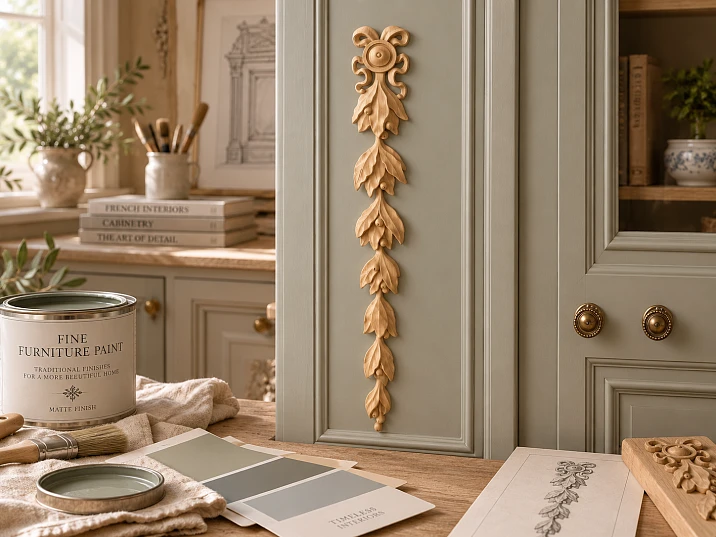
A cabinet or dresser is already assembled. The facades are prepared for enamel, the painter has scheduled the painting day, and at the last moment a carved wooden overlay N-498 is added to the project. A logical question arises: can I finish the facade first and glue the decorative piece on later, or is it better to stop the finish, order N-498, install it, and paint everything together?
If the goal is to achieve a single painted surface without a noticeable boundary between the facade and the carved decor, it is more reasonable to order and install N-498 before the final painting. The current product card directly describes the sequence: mark the position, secure the overlay, additionally fasten it if necessary, putty the attachment points, sand, prime, and paint to match the base. After the overall painting, the seam visually disappears.
But this does not mean that installation on already painted furniture is always prohibited. If the oak N-498 is meant to remain a separate natural accent—for example, under oil, stain, or clear lacquer—the facade and the overlay initially have different finishes. Then installation after separate finishing can be part of the project. It is only important to agree in advance on the surface, adhesive, and method of fixation.
The main mistake is to start the final painting before the location of N-498, its material, finishing method, and installation technology are decided.
Carved wooden overlay N-498: what exactly will arrive in the order
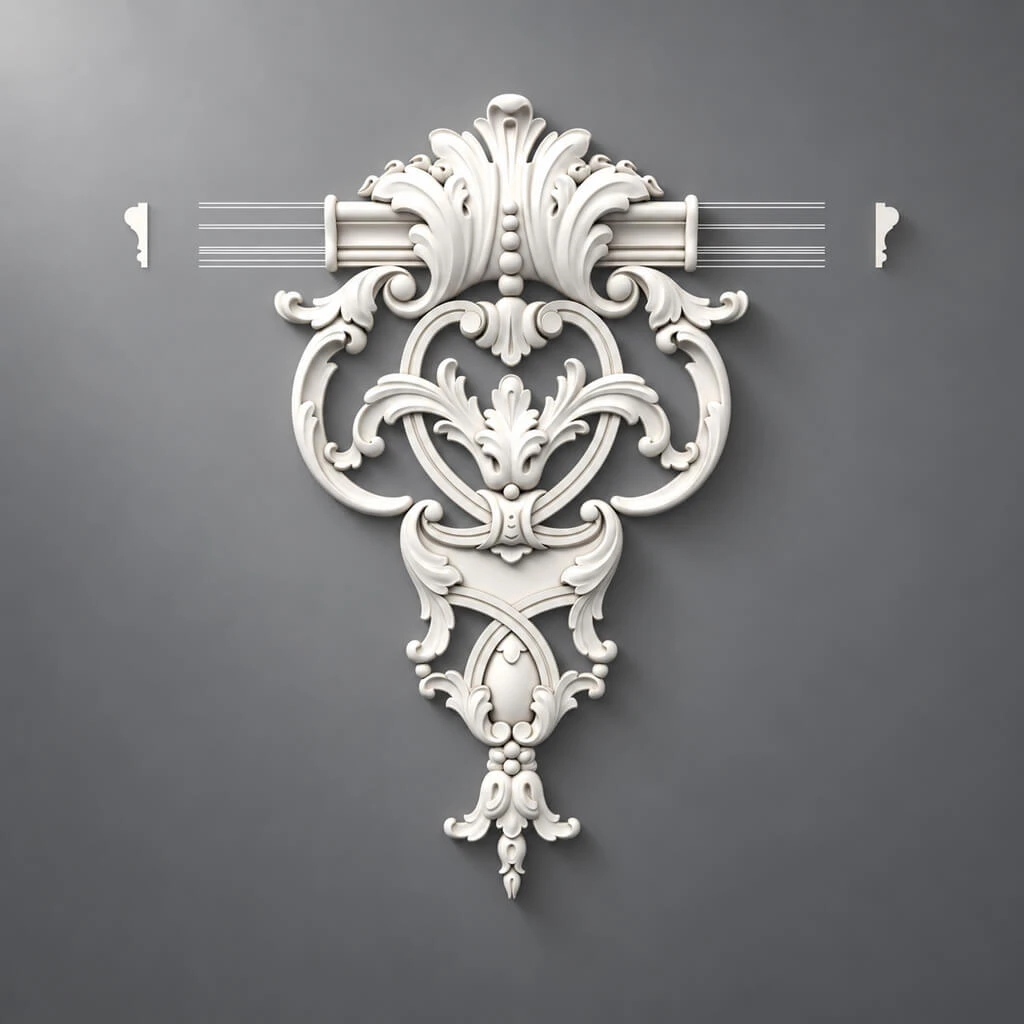
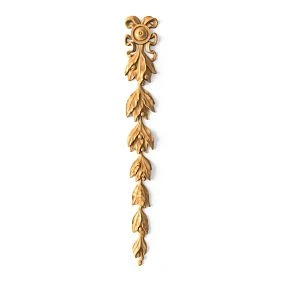
N-498 is a vertical decorative overlay made of solid wood with a laurel garland and a cartouche. Its current size is 41 × 307 × 11 mm.
| Execution | Standard | Prestige |
|---|---|---|
| Beech | 1 390 ₽ | 2 210 ₽ |
| Oak | 1 510 ₽ | 2 290 ₽ |
The card also confirms:
- beech and oak;
- grinding "Standard" and "Prestige";
- basic configuration "Under enamel";
- average production time for custom orders is 5–10 days;
- possibility to order from one piece.
If the model is already approved, buy carved wooden overlay N-498 better before starting the final painting stage, so as not to adjust the finished coating to an already late decor.



Why wooden decor N-498 is better to order before the final enamel
For a solid-colored painted facade, the most logical sequence is:
- approve the composition;
- mark the position of N-498;
- perform a dry fit;
- secure the overlay;
- conceal visible mechanical fixation points, if used;
- sand down transitions;
- prime;
- paint the facade and overlay in one system.
Thus, the painter works not with two finished products, but with one assembled decorative surface.
This is especially important for white, gray, cream, and other covering enamels, where a slight difference in gloss or tone between the facade and the overlay can be more noticeable than the relief itself.
Our factory also produces:

What changes if you paint the facade first
After the finished enamel, installation becomes a separate operation on top of an already accepted surface.
Additional risks arise:
- the finish needs to be protected from scratches;
- the junction area cannot be freely sanded;
- puttying the attachment points will require local restoration of the coating;
- the new layer of enamel may differ from the old one in gloss;
- solvent or degreaser may affect the finished coating;
- the adhesive must be selected taking into account the painted base.
Therefore, the phrase "we'll glue it later" must be accompanied by precise technology, not be a fallback solution on the day of installation.
Get Consultation
Can N-498 be glued onto an already painted furniture facade
The possibility depends on what result is needed and what the existing coating is.
If a single painted facade is needed
Late installation is inconvenient. The overlay will still have to be integrated into the overall finish, which means locally affecting the already finished surface.
If N-498 should remain contrasting
The scenario is different. For example:
- painted facade + oak overlay under oil;
- white enamel + dark-toned oak;
- colored facade + natural wood.
Then a separate finish on the overlay is a design intent, not a defect.
On the finished coating, the compatibility of the adhesive with the specific enamel, varnish, or other system must be separately confirmed. It cannot be automatically assumed that a composition for wood works equally well on any painted surface.
N-498 before painting: what needs to be approved before the painter
Before the facade goes to the painting booth, the following must be known:
- exact article number of N-498;
- vertical position;
- position relative to the central axis;
- handle and its mounting area;
- frame profile;
- panel;
- adjacent decor;
- pad material;
- final color and gloss;
- method of fastening.
If at least one of these lines remains "approximately," it's too early to start the finishing stage.
Paper template 41×307 mm: the cheapest check before ordering
Before purchasing, cut out a 41×307 mm rectangle from paper or cardboard.
It doesn't show the relief, but it helps to check:
- overall scale;
- the height of the decor;
- free margin at the top and bottom;
- proximity to the handle;
- distance to the frame;
- the position on the narrow facade;
- the need for a single overlay or a symmetrical pair.
On the finished cabinet, it's useful to attach the template with masking tape and look at the furniture not only up close, but also from the usual point of entry into the room.
If the rectangle already feels visually cramped, a real carved detail will not make the situation calmer.
Why the position of N-498 cannot be determined during painting
The painter is responsible for the surface, not for the composition of the furniture.
If an overlay appears during the painting process, a dangerous chain arises:
"let's quickly attach it, seems centered."
But the center of the facade is not always the best center for decor.
Nearby may be:
- handle;
- panel;
- decorative frame;
- two doors;
- vertical milling;
- plinth line.
The composition must be approved by the designer, furniture maker, or the client himself before the finish, when the position can still be easily changed without redoing the coating.
Beech N-498 under enamel: when facade and decor materials can differ
Beech N-498 is especially logical for opaque enamel.
The STAVROS card describes beech as a dense, fine-porous wood often used for painted products. In the "Under enamel" configuration, wood lamellas are not matched by tone or pattern, because the texture will still be covered by an opaque coating.
This means that the facade and the overlay do not have to be made of the same wood species if the project is based on a common enamel and the mounting unit is calculated correctly.
For example:
MDF facade + beech N-498 + unified primer/enamel — a technically clear scenario for coordination with the painter.
Oak N-498: when wood texture does not need to be hidden under a common enamel
Oak has a pronounced natural texture and is often chosen precisely for it.
If the goal is to keep the carved overlay as a wooden accent, the unified enamel cycle is no longer needed.
Then you can design:
painted facade + separately tinted oak N-498.
But in this option, you need to decide in advance:
- the oak shade;
- gloss level;
- how the boundary will look;
- what adhesive to use for attaching to the finished surface;
- whether mechanical fixation is needed;
- What will remain visible after installation.
This is a deliberate contrast, not an attempt to "match the color."
Standard or Prestige: What Matters Before Painting
N-498 offers two levels of sanding.
Standard — machine finish treatment.
Prestige — more detailed manual sanding of complex areas.
Price difference:
- beech: 820 ₽ per overlay;
- oak: 780 ₽.
If the painter still includes manual finishing of the carved element before enamel, this stage should be compared with the cost of the chosen preparation before ordering.
If the part needs to arrive with a more finely processed relief, "Prestige" should be discussed in advance.
Why you can't just choose the cheapest "Standard" option
Price is not the only parameter.
For one facade, additional manual preparation may be insignificant.
For a series of eight identical facades, the painter's work is repeated eight times.
Therefore, the right question is:
What volume of preparation is included in the painting estimate and what surface quality is expected from the supplier?
Only after this compare 1,390 ₽ and 2,210 ₽ for beech.
How STAVROS describes the installation of wooden N-498
The current card recommends:
- Degrease the base and the back side;
- apply wood glue or PVA in a thin, even layer;
- Attach the part according to the preliminary markings;
- fix it for the time of setting;
- On a vertical surface, use additional thin headless nails if necessary;
- then fill the attachment points, sand, prime, and paint.
This again shows why, for a uniform finish, installation is naturally included before the final coat.
How to glue a carved overlay without disrupting the painting schedule
Before the scheduled painting date, four issues need to be resolved:
1. Is N-498 available in the required configuration, or does it need to be manufactured.
If the product is unavailable, the average time is 5–10 days.
2. Who installs the overlay.
A carpenter, furniture maker, or painter must understand their responsibility.
3. What adhesive is used.
On a wooden base, the card indicates wood glue/PVA. For other surfaces, compatibility must be confirmed separately.
4. When the final painting occurs.
It should happen after the installation and joint preparation are completed.
If a separate universal installation compound is needed, you can look at TYTAN Prof. Classic Fix mounting adhesive, but the specific compatibility with the facade and coating is still checked according to the compound's instructions.
Why TYTAN should not be considered mandatory for any N-498
TYTAN is sold alongside N-498 as an accompanying mounting material, but the current instructions for the wooden trim itself describe carpenter's glue or PVA for a wooden base.
Therefore, you cannot write:
"N-498 is always installed only with TYTAN."
Conditions differ for bare wood, MDF, primed facades, and fully painted enamel.
The base material must be identified before choosing the adhesive.
If the facade is already primed but not yet painted
This is an intermediate case.
Do not automatically glue over the primer.
First, you need to understand the technology of the chosen system:
- whether the primer remains in the adhesive joint area;
- whether the base needs to be locally exposed;
- Is the adhesive compatible with the primer?
- how the preparation is restored after installation.
The main advantage is that the finish enamel has not yet been applied, so after proper installation, the surface can be brought to a single system without local gloss matching.
If the facade is already fully painted and accepted by the client
Here, the cost of a mistake is higher.
Before installation, you need to answer:
- Does the coating allow local treatment?
- What can be used to degrease it without damage?
- Can the selected adhesive be used?
- Will the fasteners be hidden?
- whether local touch-up painting is needed;
- whether a noticeable boundary around N-498 is acceptable.
Do not start with acetone or another solvent just because it is listed in the general installation instructions. On a specific decorative enamel, compatibility testing is required first.
What to pass to the painter along with N-498
Minimum installation and finishing passport:
| Field | Value |
|---|---|
| Article number | N-498 |
| Size | 41×307×11 mm |
| Material | Beech / Oak |
| Sanding | Standard / Prestige |
| Position | facade No. ___ |
| Center / reference | ___ |
| Finish | solid / contrasting |
| Color | ___ |
| Gloss | ___ |
| Glue | ___ |
| Mechanical fixation | Yes / no |
| Subsequent primer/enamel | ___ |
This way, the painter receives not a box with decor, but a clear task.
Control facade before the entire series
If N-498 is installed on several identical facades, do not glue the entire batch at once.
First, make one control facade:
- template;
- markup;
- installation;
- joint preparation;
- soil;
- finish;
- full drying;
- acceptance.
After that, check:
- whether the relief is readable;
- whether the joint has disappeared;
- whether the patch is positioned correctly;
- whether the handle is in the way;
- Does the gloss match?
- Is the depth of shadows acceptable.
Only after approval is the technology transferred to the remaining facades.
How not to lose the N-498 relief under enamel
N-498 has thin leaves, depth variations, and a cartouche.
A too heavy layer of primer and enamel can visually "blur" the carving.
Therefore, the painter's task is to achieve an opaque color while preserving the geometry.
A test coat on a single part or a control facade is useful.
This is not a reason to reduce the number of technological layers contrary to the paint manufacturer's system. You need to choose a proper technology, not "apply less so the leaves are visible."
When order N-498 can no longer be postponed
If the facades are only being prepared for painting, the order becomes urgent not because of marketing, but because of technology.
N-498 should be ordered when:
- the position is approved;
- the template is verified;
- the material is selected;
- Standard/Prestige is agreed upon;
- finish defined;
- the painter knows that the decor is included in the total surface;
- painting date is already scheduled.
With an average production time of 5–10 days, a late purchase can shift the painting schedule.
When the overlay, on the contrary, can be ordered after painting
A late order makes sense if the project is initially based on separate decor.
For example:
- oak under oil over a white facade;
- dark wood N-498 on green enamel;
- contrasting decor that should not blend with the base;
- a replaceable decorative element where a seam is visually acceptable.
Then the overlay does not have to go through the common primer and enamel together with the facade.
But the installation technology of the finished surface still must be agreed upon in advance.
If N-498 is placed on a frame facade: a real flat contact area is needed
The 41×307 mm template shows only the external dimension. For installation, the rear area that actually contacts the facade is also important.
On a frame or paneled facade, part of the overlay may fall:
- on the profile transition;
- onto the edge of the panel;
- for milling;
- onto the decorative frame;
- onto an area with a noticeable radius.
If the N-498 bridge covers two different planes, you cannot automatically assume that it can simply be "pulled" with glue.
Before ordering, it is useful to attach a flat template and run your hand over the intended contact area. If the base has a difference in level, the installation issue should be resolved with the cabinetmaker before painting.
This is another reason not to postpone choosing the overlay until the facade is already fully finished.
One N-498 or a symmetrical pair: this needs to be checked before drilling holes for handles.
On a wide double-door wardrobe, two different solutions are possible:
one overlay on each door, or one central decorative axis in the overall composition.
The handles can still occupy the same central zone.
Therefore, paper templates N-498 are laid out first, then the handles are approved, and only after that the facades are drilled.
If the handles are already installed, the template should be applied to the actual furniture and checked:
- whether a normal grip remains;
- whether the thread falls under the fingers;
- does the handle not look accidentally embedded in the cartouche;
- whether the symmetry of the pair of doors is preserved.
A late change of composition after painting may require covering already made holes.
Production calendar: how N-498 affects the scheduled painting day
If the required configuration is not in stock, the card indicates an average production time of 5–10 days.
Therefore, it's better not to build the calendar like this:
Monday — painting of facades, decor will arrive sometime later.
But like this:
| Stage | Status |
|---|---|
| Layout 41×307 approved | Yes / no |
| N-498 ordered | Yes / no |
| Part received and accepted | Yes / no |
| Dry fitting completed | Yes / no |
| Installation completed | Yes / no |
| Mounting points prepared | Yes / no |
| Final painting is scheduled | date ___ |
If the painter has already booked the booth, and N-498 is just going into production, sometimes it is cheaper to postpone the painting than to restore the finish twice later.
What to check when receiving N-498 before handing it over to the painter
Before installation and priming, inspect each overlay separately.
Check:
- article number;
- size 41×307×11 mm;
- beech or oak;
- Standard or Prestige;
- integrity of leaves and cartridge;
- edge condition;
- absence of transport damage;
- number of parts.
If the decor goes in pairs on symmetrical facades, place both parts side by side and determine their position in advance.
There is no need to distribute the parts across the facades for the first time only after the primer has been applied.
Any question about the product is better to record before painting work: after sanding, puttying, and painting, it is harder to determine the original condition of the part.
If a contrasting oak on finished enamel is needed: first do a trial assembly without glue
The contrasting scenario does not require common enamel, but still requires early checking.
Place a fully finished or trial oak N-498 on the facade without glue and look:
- the color of the wood next to the enamel;
- gloss;
- the thickness of 11 mm in a side view;
- shadow from the relief;
- the position of the handle;
- the boundary between two materials.
If the contrast is liked, only then is the installation technology approved.
If not, changing the oak tint at this stage is still possible. After gluing to the finished facade, the room for adjustment becomes significantly smaller.
Solution in 30 seconds: before painting or after
Before ordering, you can use a simple filter.
Should the overlay be the same color and gloss as the facade?
Yes → order, install, and prepare before final painting.
Should the oak remain a separate natural accent?
Yes → the overlay can be finished separately, and installation to the finished facade should be coordinated as an independent unit.
It is not yet known which of the two options is needed?
It is better not to start the final painting.
Is location N-498 not yet approved by the template?
Do not drill handles and do not complete the facade.
Is the adhesive for the specific base not selected?
Do not proceed to final installation.
So the solution is built not around the general rule of "always before" or "always after," but around the desired final appearance of the furniture.
Which wooden overlays for furniture to buy if N-498 is not suitable
If the 41×307 mm template turned out to be too tall, too narrow, or compositionally conflicts with the handle, there is no need to trim the finished ornament without confirmation.
Better to move to the category and Buy wooden overlays for furniture of a different size or pattern.
For a broader search, you can look at Carved furniture decor.
Thus, N-498 remains a specific model with a complete composition, not a blank that has to be salvaged after an unsuccessful fitting.
How to order carved wooden decor N-498 without reworking finished facades
Before the "Buy" button, check seven points:
- the 41×307 mm template is approved;
- Position relative to handle and frame approved;
- beech or oak was chosen;
- Standard or Prestige is selected;
- Decided: single color or contrast;
- Installation coordinated with painter;
- finish painting date accounts for N-498 delivery time.
After that, you can Order wooden overlay N-498 already as part of a specific furniture unit.
If a general technical reference is needed, it is useful to check current tips for installing and finishing wooden decor before starting work.
Main conclusion:
if N-498 should visually become part of a painted facade, its place is before the final enamel.
First, composition and assembly, then joint preparation and overall painting. After the finished coating, the overlay is installed only when a separate finish or late installation is truly specified by the project.
Questions before ordering N-498
What is the size of N-498?
41 × 307 × 11 mm.
What is the ornament on the overlay?
Vertical laurel garland with a cartouche.
What types of wood is N-498 made from?
made of beech and oak.
How much does Standard beech cost?
1,390 RUB as of September 9, 2026.
How much does Prestige beech cost?
2 210 ₽.
How much does Standard oak cost?
1 510 ₽.
How much does Prestige oak cost?
2 290 ₽.
What is the production lead time?
On average 5–10 days for custom production.
Should N-498 be installed before painting the facade?
If you need a single painted facade without a visible seam, this is the most logical sequence.
Can N-498 be glued onto already painted furniture?
This scenario can be considered, but the adhesive and preparation must be tested specifically for the existing coating. For a single enamel surface, later installation is less convenient.
What to choose for enamel?
Beech N-498 is one of the main scenarios for opaque painting.
When to choose oak?
When natural wood texture or a separate transparent/translucent finish is important.
What should I use to attach N-498 to a wooden base?
This card describes wood glue or PVA; on a vertical surface, additional mechanical fastening is allowed.
Do I need to putty the attachment points?
If mechanical fixation was used and a single painted facade is needed, the card provides for sealing points, sanding, priming, and painting.
Can the overlay be painted separately first?
Yes, if the project specifies a separate finish. For a uniform facade color and N-498, it is more convenient to assemble the assembly first.
What should be checked last before payment?
Size, material, Standard/Prestige, position on the facade, handle, finish, adhesive, painter's schedule, and current price.