
































Article Contents:
- Why it's important to choose not only the stucco but also the store
- Decor is a system, not a separate detail
- What gets lost when buying on random platforms
- What a good stucco catalog should have
- Structure is the first sign of a professional store
- Product card: what it must include
- Filters and navigation
- What determines the price of moldings
- Price formula: five components
- Table: What causes the price of stucco molding to rise and fall
- What is a "fair" price for polyurethane stucco molding
- Which stucco molding to choose: for walls, ceiling, or facade
- Three zones — three logics
- Molding for Walls
- Ceiling stucco molding
- Facade Molding
- Why polyurethane stucco molding is convenient for purchase
- Modern standard of decor
- What does "stucco molding for painting" mean
- How to avoid mistakes when choosing stucco molding from photos
- A photo is only half the information
- Checklist for inspection before purchase
- Which stucco elements are most often bought
- Top demanded items in the catalog
- How to compare stucco websites before purchase
- Evaluation criteria: eight parameters
- What does “stucco in St. Petersburg” and “stucco in Moscow” mean
- Common mistakes before buying stucco
- Mistake 1: Buying only by picture
- Mistake 2: Forgotten corner elements
- Mistake 3: Lack of reserve
- Error 4: Different styles in one room
- Error 5: Cornice without considering hidden lighting
- Error 6: Ignoring joints during installation
- Error 7: Profile incompatibility when joining
- Where to buy polyurethane stucco
- Full catalog for any task
- FAQ: Popular questions about buying stucco
- STAVROS: Catalog of stucco and polyurethane decor with a systematic approach

When a person decides to buy stucco, they face an unobvious problem: there is a lot of decor, many offers, many websites — but no clarity. Beautiful photos of rosettes and cornices flash across dozens of pages, but when it comes to a specific choice — questions arise that most sellers do not answer. What size? What is the depth of the relief? Does this cornice match that rosette? Will the molding suit the ceiling height? Can it be painted? How many meters are needed for the room?
Correct Moldings shop it differs from a mere “site with pictures” precisely in this: it provides not only an assortment but also a system — a structure that helps the buyer make an informed decision. This article provides a complete breakdown of what to look for when choosing a catalog, what determines the price of stucco molding, which elements are needed for different interior zones, and how to avoid mistakes when purchasing.




Why it’s important to choose not only the stucco molding but also the store

Decor is a system, not a separate detail
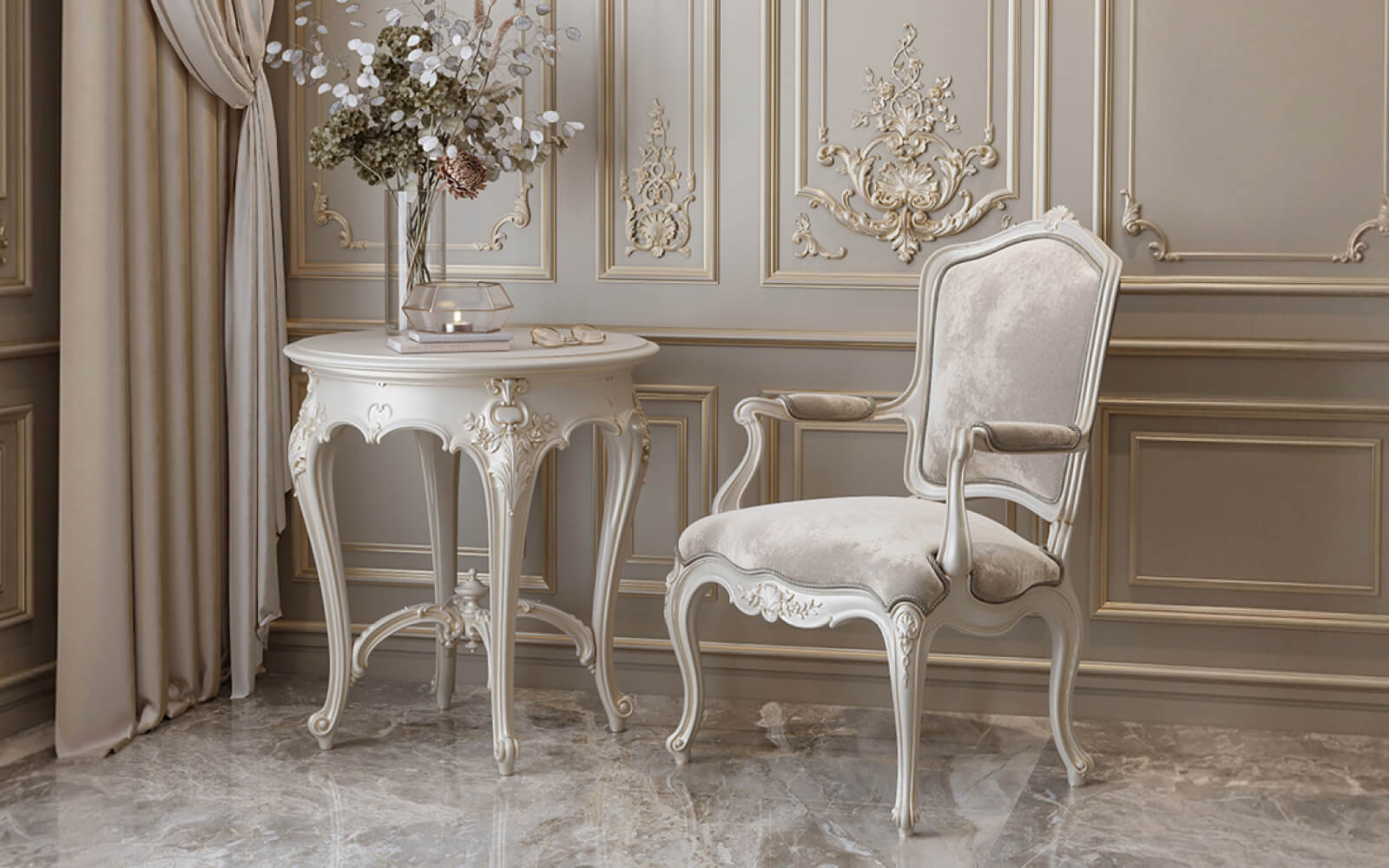
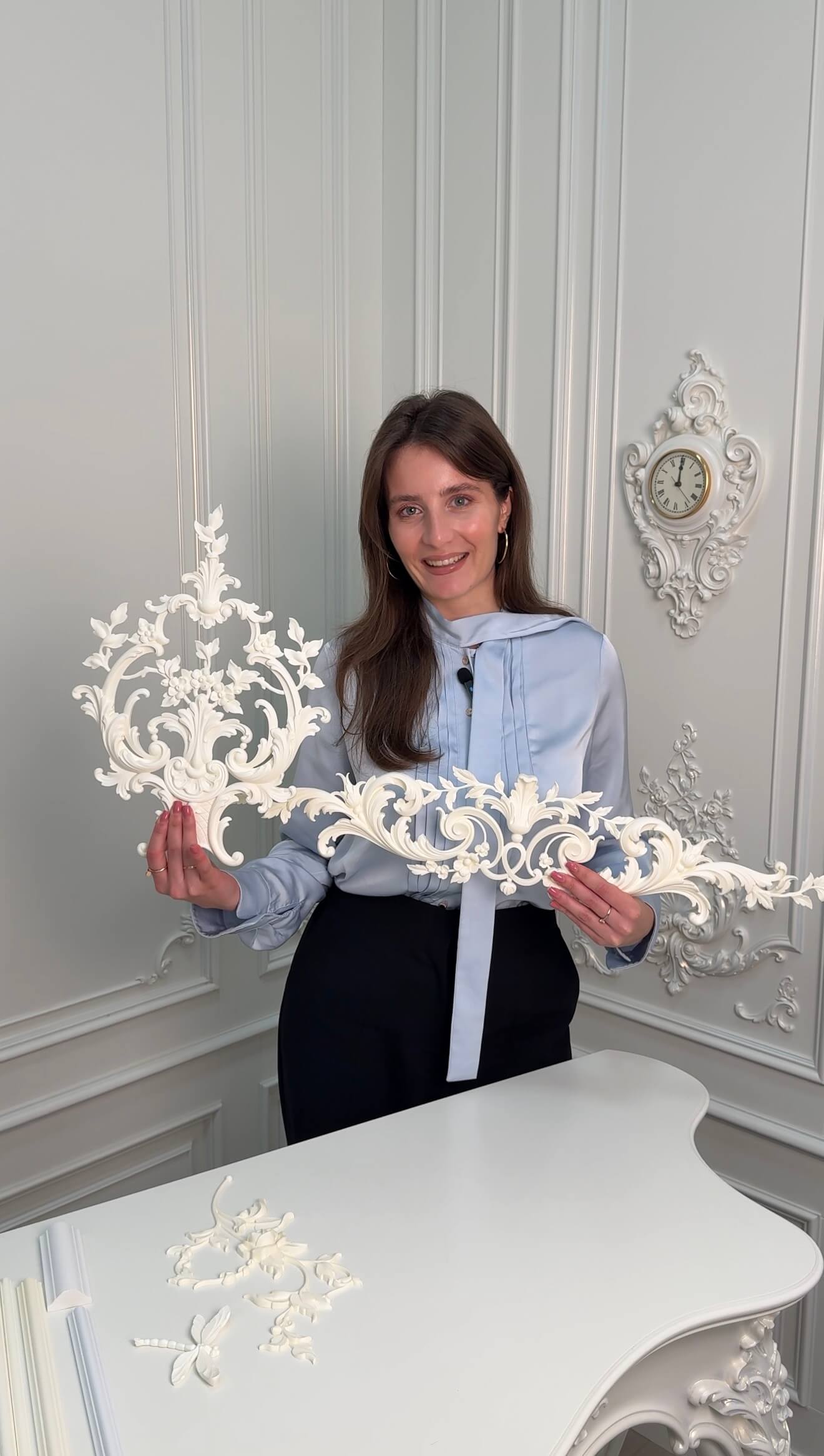
Stucco molding works when it forms a system: cornice, molding, rosette, corner elements — all coordinated in style, scale, and relief depth. Buying a cornice in one place, a rosette in another, and a molding in a third is theoretically possible, but in practice almost always ends in visual conflict. Different manufacturers, different profile height standards, different relief depths — and the finished interior looks like a random collection of parts rather than a well-thought-out decor.
A good Moldings shop solves this problem structurally: it has collections in which all elements are pre-coordinated. The buyer chooses a collection and gets a guaranteed ensemble.
Our factory also produces:


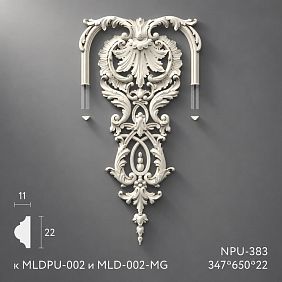


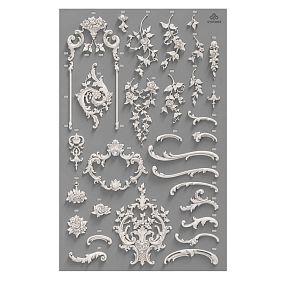
What is lost when buying on random platforms
Marketplaces and non-specialized platforms provide access to a large number of items but deprive the buyer of crucial context:
-
No collection system — elements are incompatible with each other.
-
No architectural recommendations — it’s unclear which style or ceiling height they suit.
-
No quantity calculation — the buyer picks "by eye" and then either buys more or throws away the excess.
-
No information about relief depth and actual sizes — the photo doesn't convey scale.
-
No understanding of compatibility: will the selected cornice fit this molding.
Specialized moldings catalog covers all these issues structurally — through filters, collections, cards with full specifications and related products.
Get Consultation
What a good stucco catalog should have
Structure — the first sign of a professional store
Open the catalog of any specialized polyurethane stucco store — and you'll immediately understand its level by one criterion: structure. If everything is lumped together under the name "stucco" — that's a bad sign. If the catalog is clearly divided by product type, purpose, style, and size — it means the manufacturer understands the logic of using their product.
Categories that should be in a professional catalog:
-
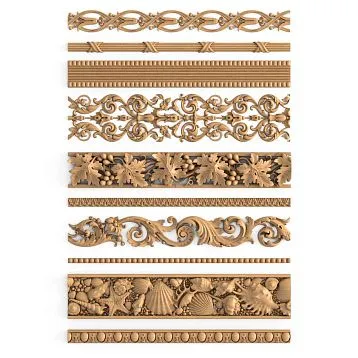
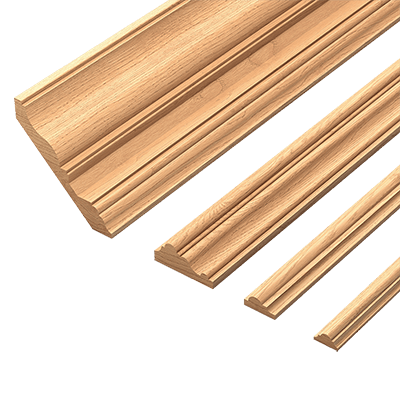
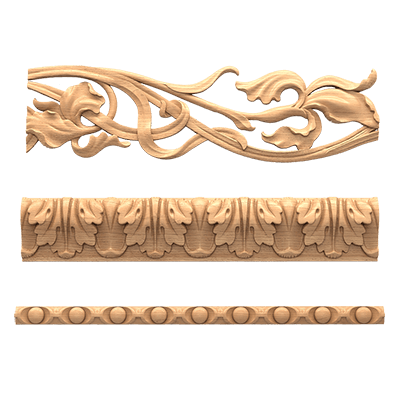
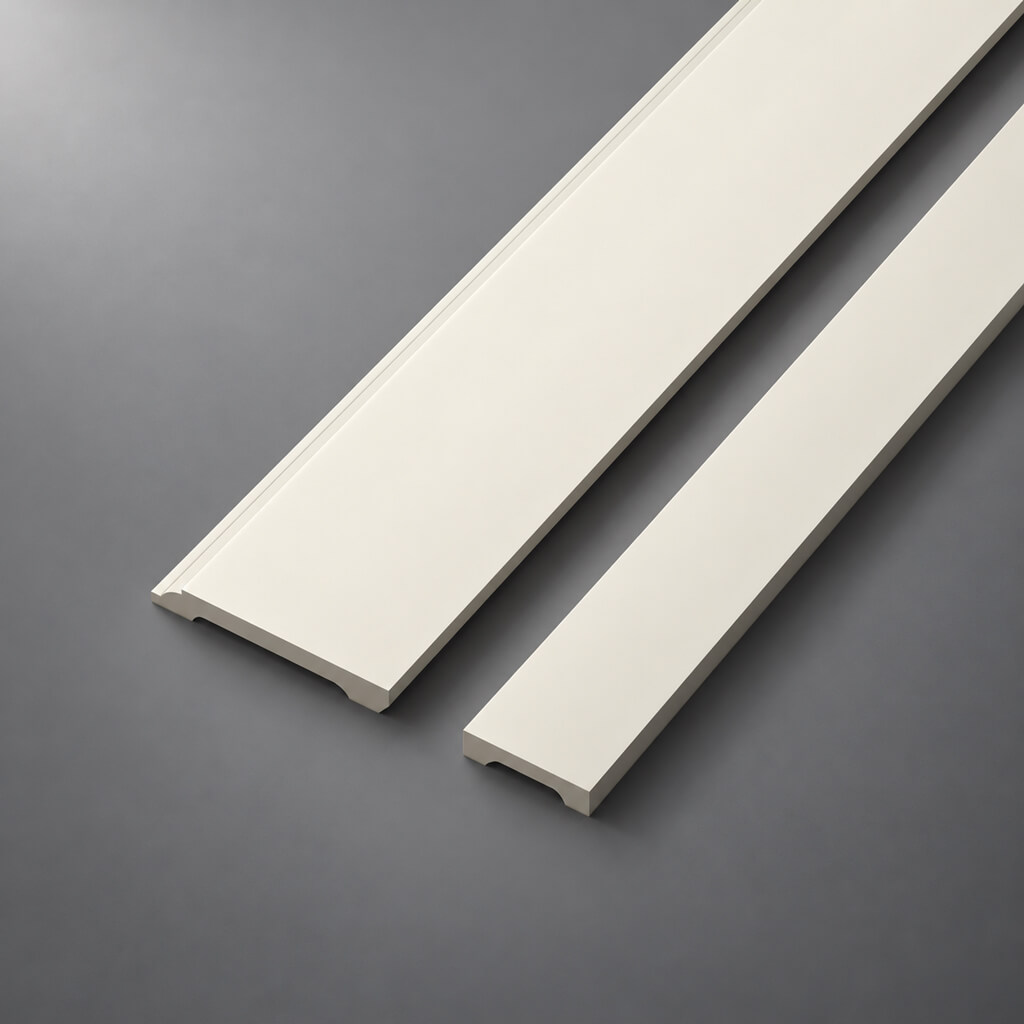
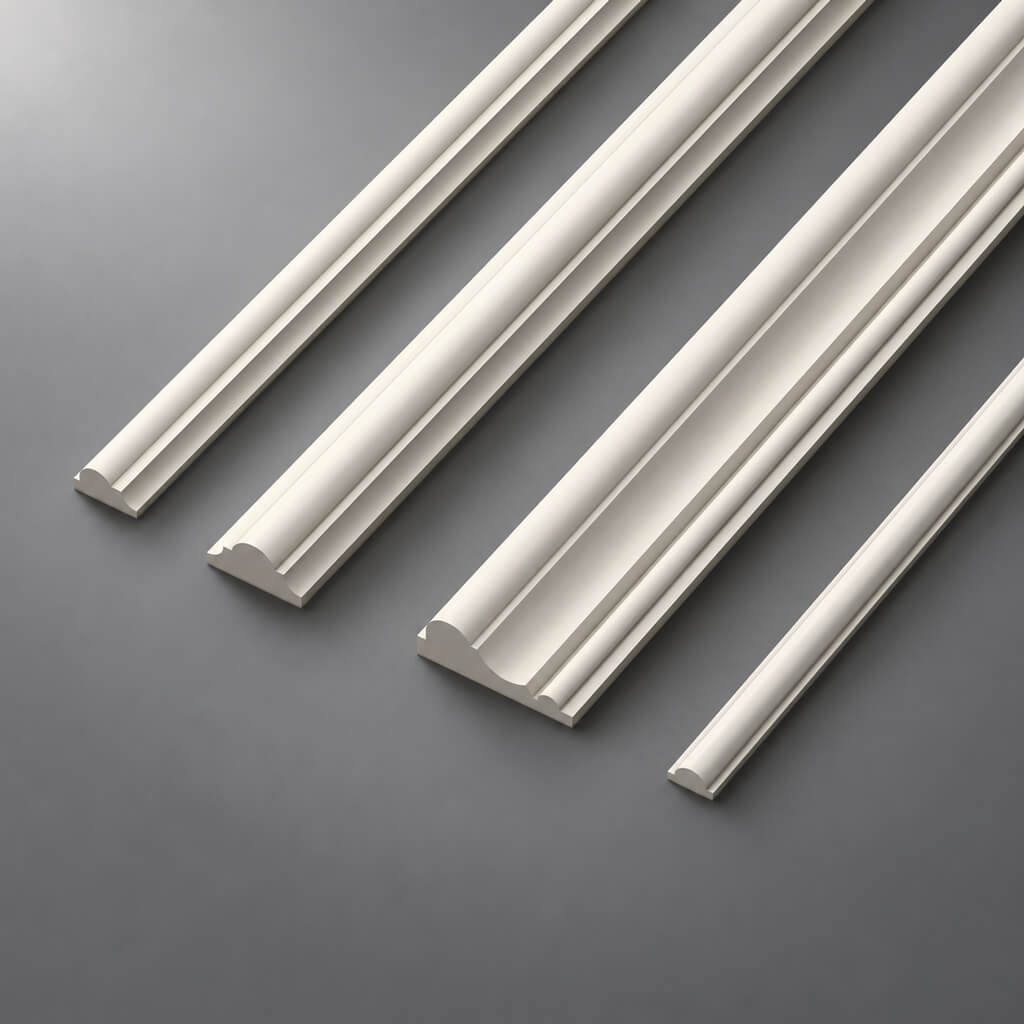
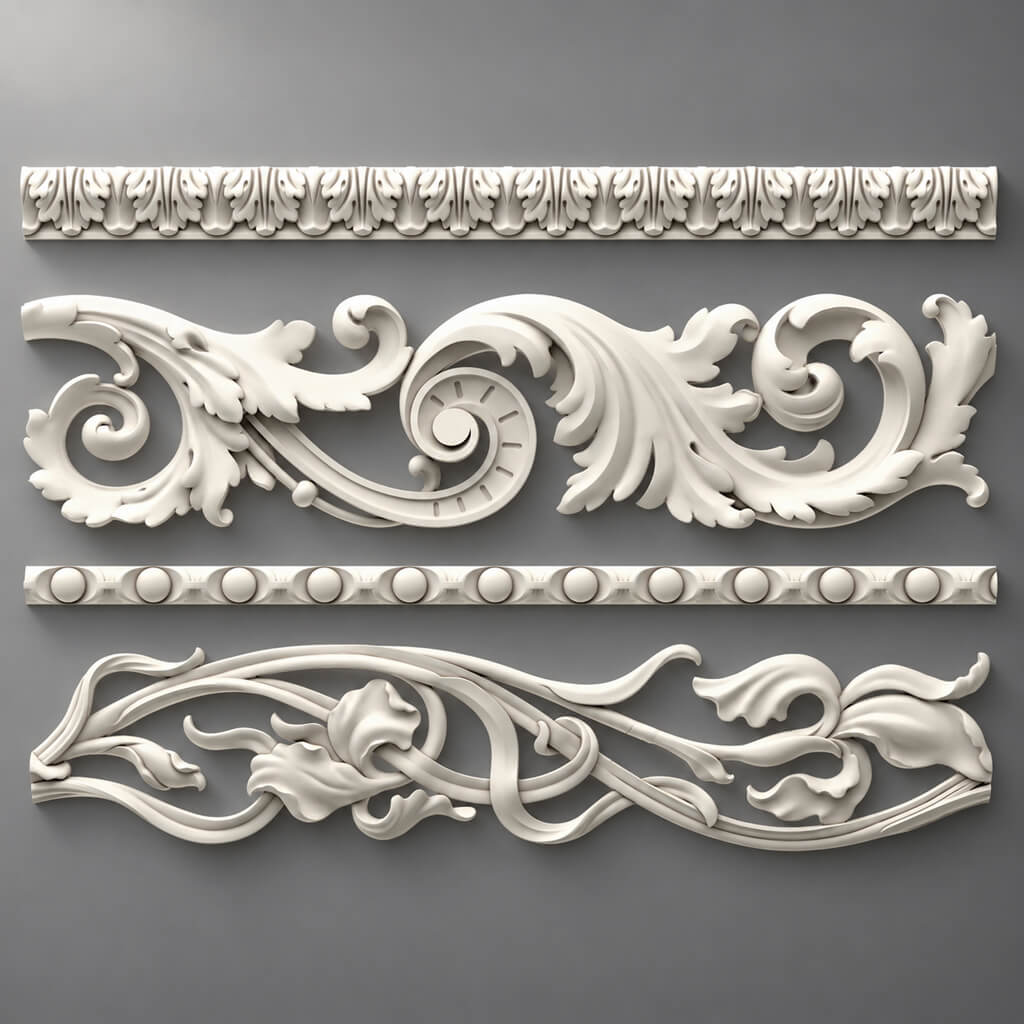
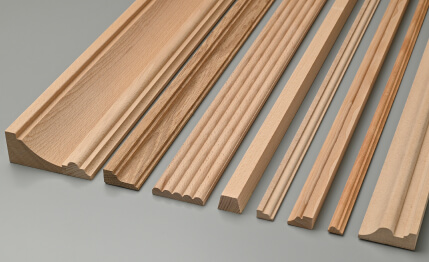
Moldings and trims are profile elements sold by linear meter. They are divided by width, height, and profile type: flat, with a fillet, with ornament, frieze.
-
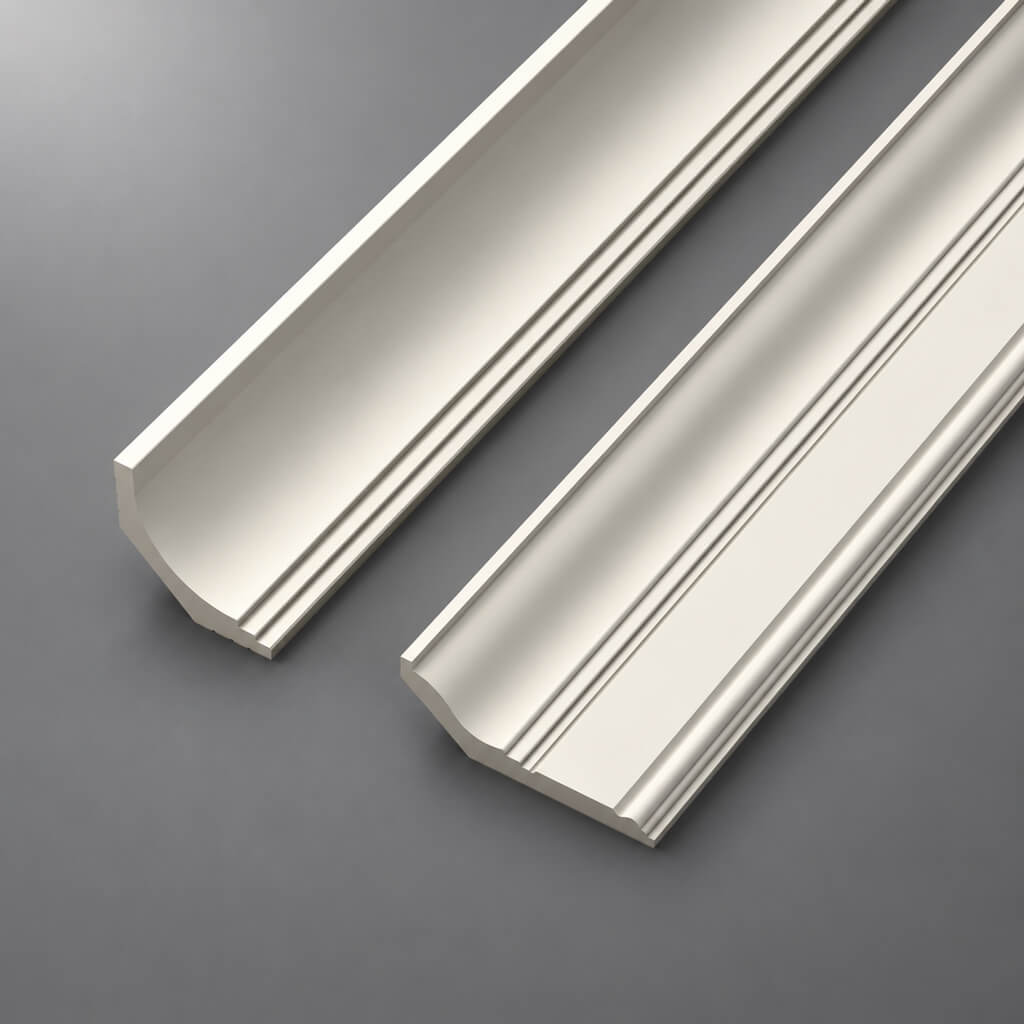
Cornices are large profile elements for the upper horizontal line of a room or facade. They are divided by projection and height.
-
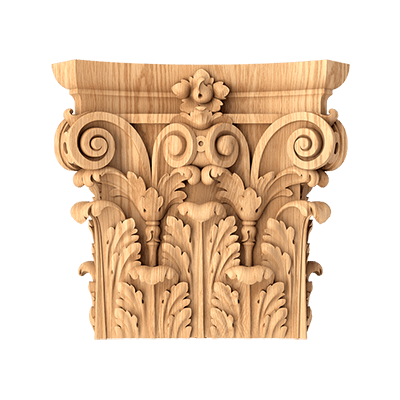
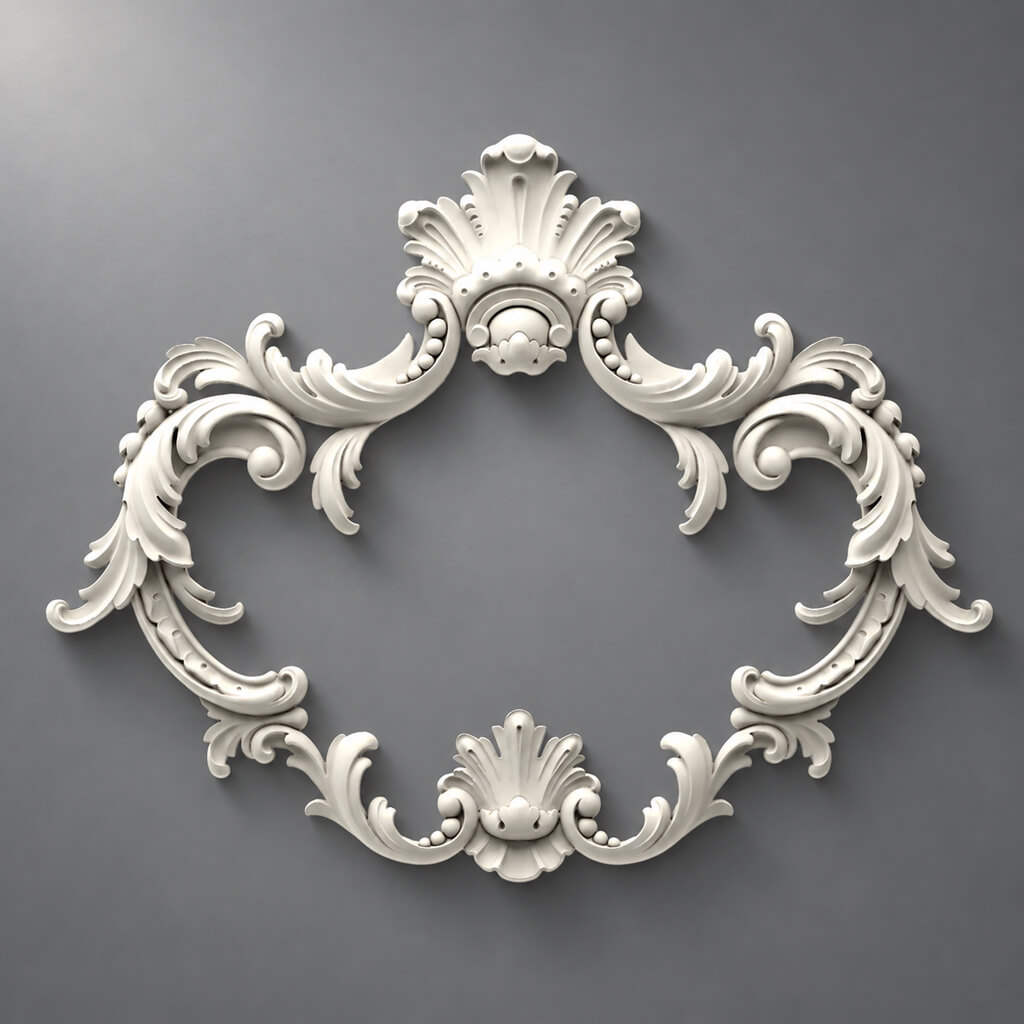
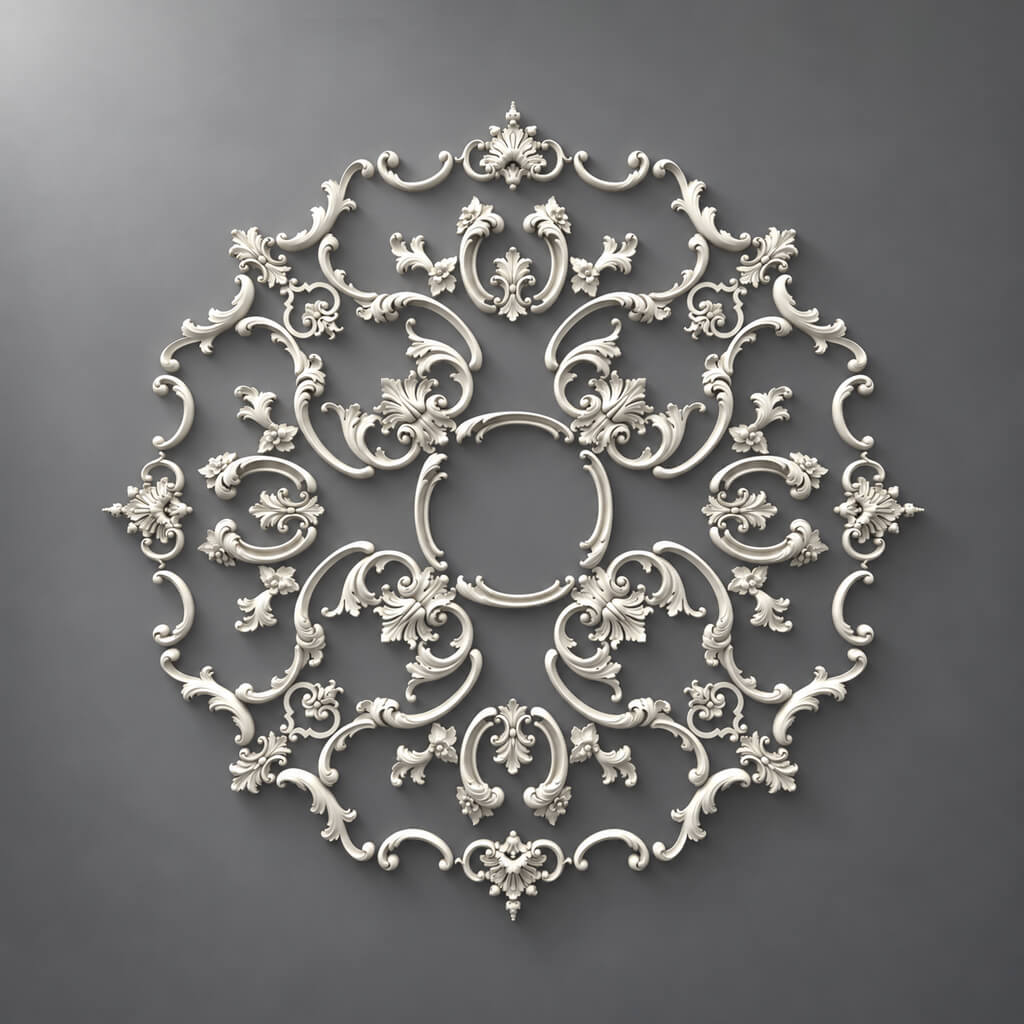
Rosettes are round ceiling decorations with a relief ornament. They are divided by diameter and style.
-
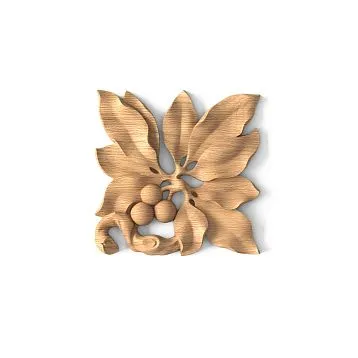
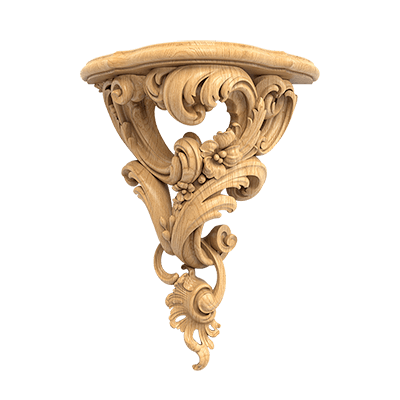
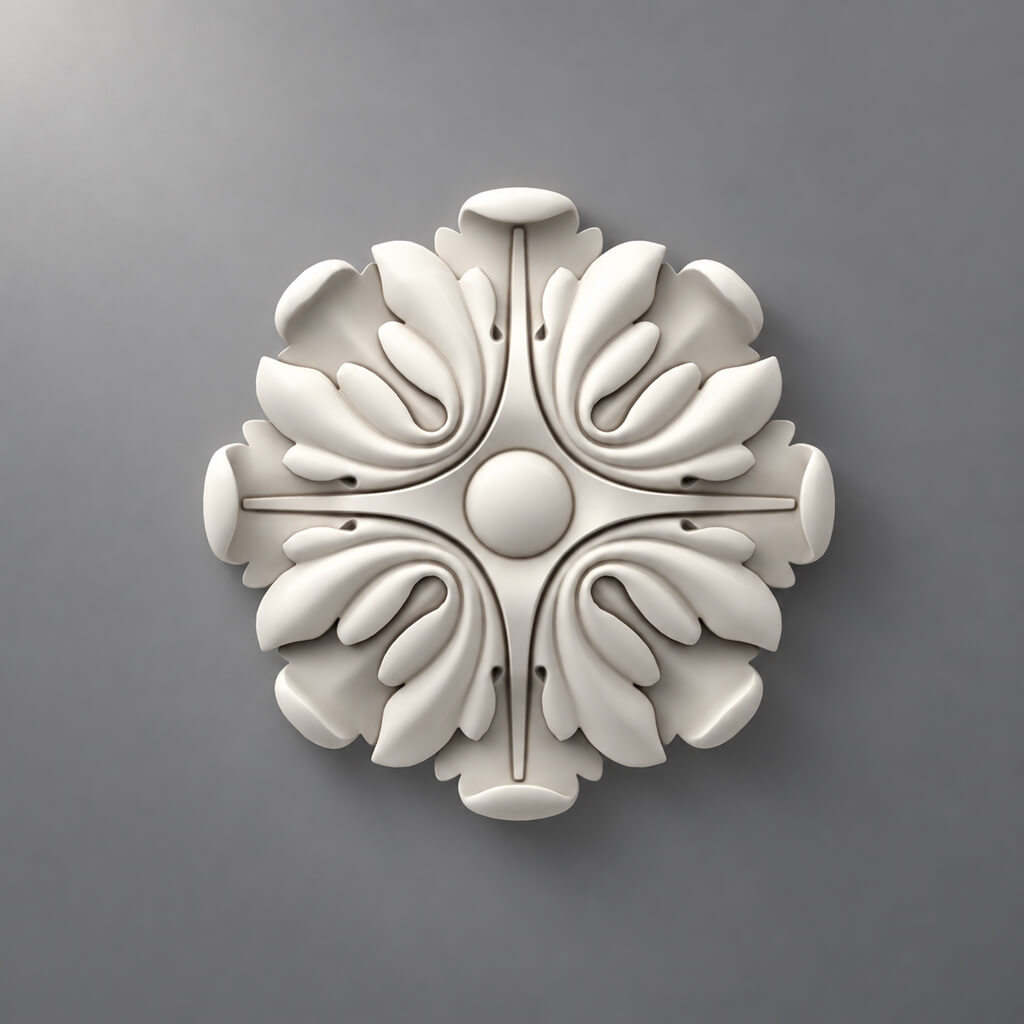
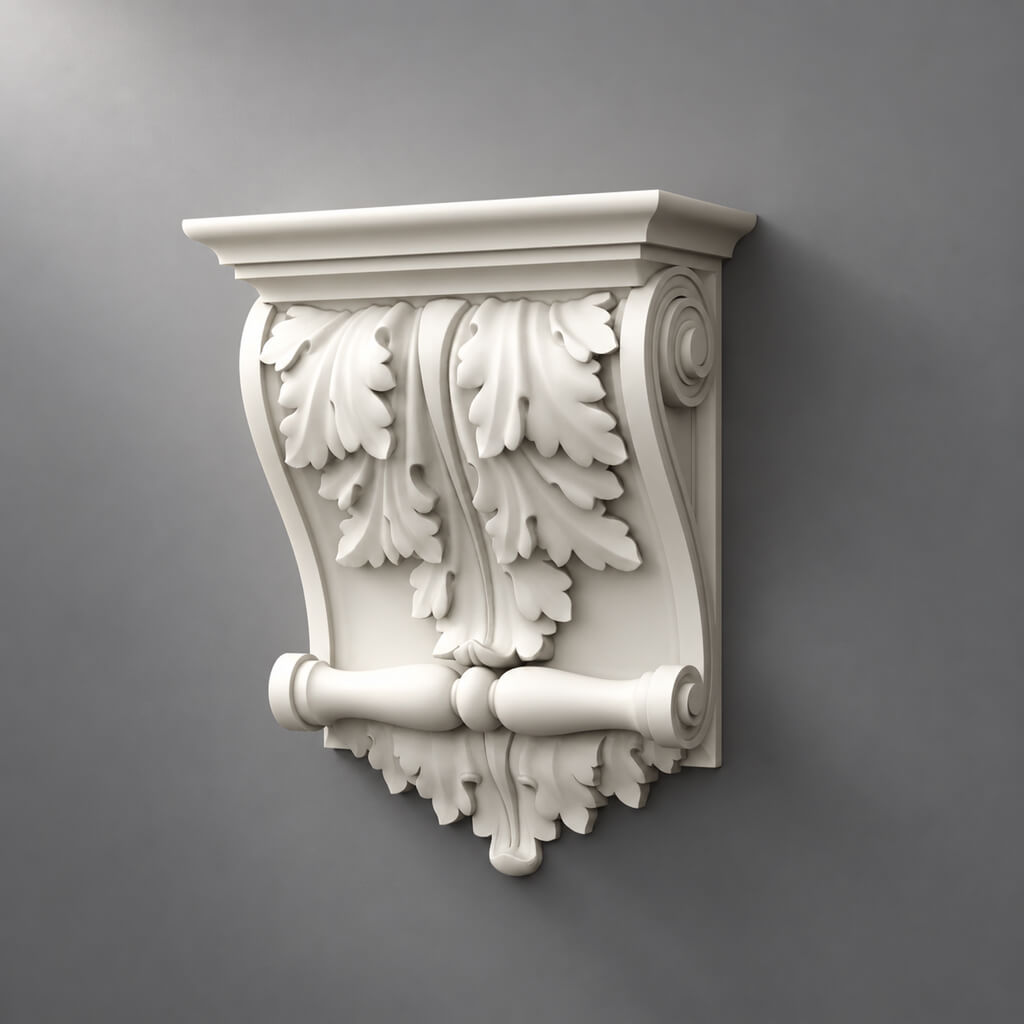
— everything must correspond to the chosen era. — applied piece decorative items: keystones, cartouches, mascaron, corner elements, brackets.
-
Frames and surrounds — for window openings, niches, mirrors, doors.
-
Facade decor is a specialized assortment for outdoor use.
-
Corner elements — for finishing internal and external corners when installing trims.
Product card: what must be included in it
A good product card in a stucco catalog is not just a photo and price. It is a complete information passport of the product that allows the buyer to make a decision without calling a manager.
Required parameters in the card:
-
Overall dimensions — length, width, height (for moldings — cross-section), diameter (for rosettes). Without this, it's impossible to calculate quantity or assess scale.
-
Relief depth/height — how much the element protrudes from the surface. A key parameter: 10 mm relief looks delicate, 40 mm — expressive and theatrical.
-
Material — type of polyurethane, density, presence of coating (for painting or ready-made).
-
Purpose — for ceiling, walls, facade, internal corners.
-
Style — classic, baroque, empire, modern classic, neutral.
-
Installation method — glue, dowels, combined.
-
Photo in interior — not only studio photo of the product, but also an example of use in a real room.
-
Related products — what this element pairs with within the collection.
Filters and navigation
Professional moldings catalog must have working filters — otherwise searching through hundreds of items turns into chaos. Filters by: purpose (ceiling / walls / facade), size, style, stock availability.
What determines the price of stucco
Price formula: five components
One of the most common questions when choosing decor is: "Why do similar cornices cost differently?" The answer lies in the specific technical parameters of the product and production logic.
1. Product size. This is the most obvious factor. A cornice 150 mm high with a 100 mm projection contains significantly more material than a molding 40 mm high. A large rosette with a diameter of 500 mm costs several times more than a 200 mm rosette. Molding price directly depends on the volume of polyurethane used in the product.
2. Profile and relief complexity. A profile with multiple levels, fillets, chamfers, and rich ornamentation requires more complex tooling and a more labor-intensive production process. A simple straight pull without ornamentation is cheaper than a cornice with modillions and dentils.
3. Material density and quality. High-density polyurethane (from 200 kg/m³) is more expensive and better than low-density polyurethane foam. It is stronger, more geometrically accurate, holds paint better, and does not deform during installation. The price difference between budget and high-quality stucco is primarily a difference in density and material composition.
4. Application format — interior or facade. Facade stucco, designed for outdoor use, undergoes additional testing for frost resistance and moisture resistance. Requirements for geometry and surface quality are higher. Accordingly, the price is higher than for an interior analog of the same size.
5. Collection and production volume. Products from popular, widely produced series are cheaper than rare or custom items. The logic is simple: large-scale production reduces the unit cost. A rare or custom element costs more.
Table: what increases and decreases the price of stucco
| Factor | Affects the price | Comment |
|---|---|---|
| Product size | Strong (up) | More material — higher price |
| Relief saturation | Moderate (up) | Complex tooling is more expensive |
| Polyurethane density | Moderate (up) | Material quality |
| Purpose (facade) | Moderate (up) | Additional material requirements |
| Serial production | Moderate (down) | Edition reduces cost |
| Coverage availability | Slightly | Painted ones are slightly more expensive |
What is a 'fair' price for polyurethane stucco molding
Too cheap is a signal. A very low price for polyurethane stucco molding almost always means one of the following compromises: low material density (brittleness, deformation during installation), unstable geometry (joints separate, angles don't match), poor surface quality (porous, with flash, requiring additional putty before painting).
By purchasing polyurethane molding at a reduced price, you save on material — and overpay with time, nerves, and the cost of rework.
Which stucco molding to choose: for walls, ceiling, or facade
Three zones — three logics
This is a fundamental question that determines the entire choice. Stucco molding for walls, stucco molding for the ceiling, and facade stucco molding are not just different catalog items. They are different materials, different shape requirements, and different principles of arrangement in space.
Wall molding
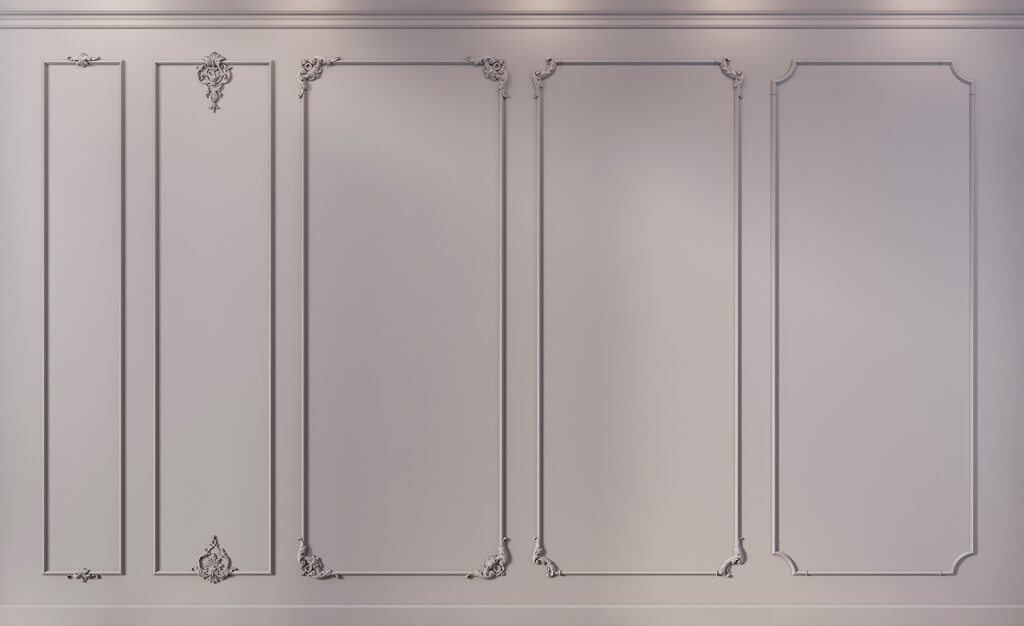
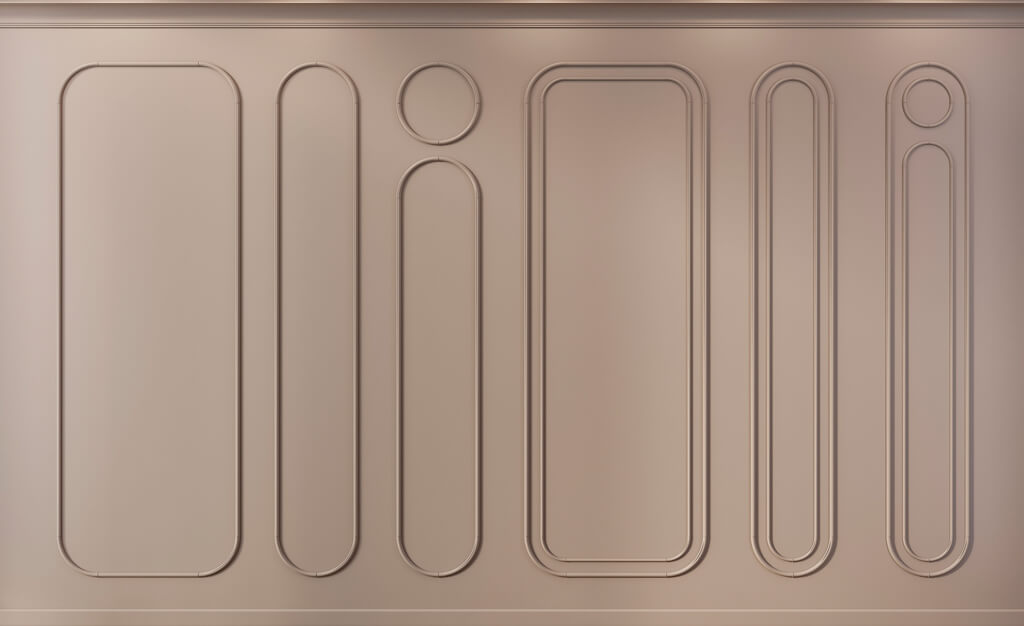
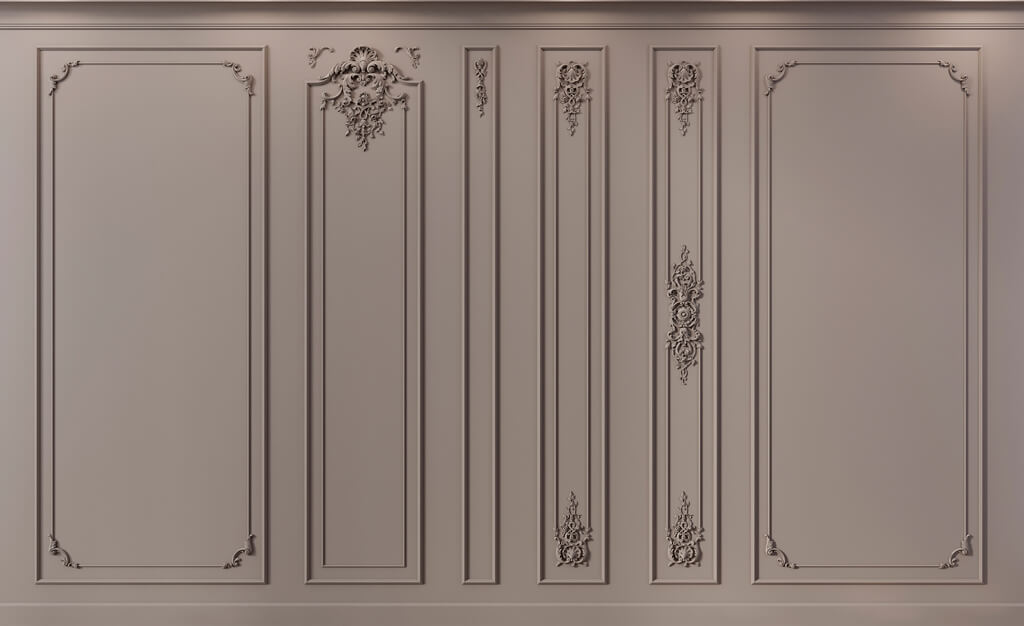
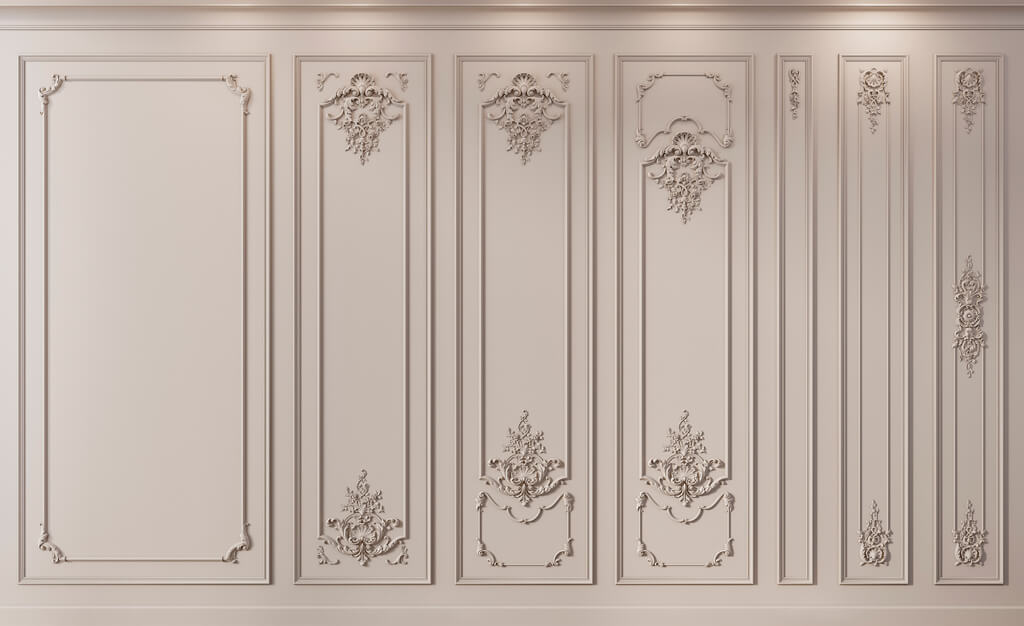
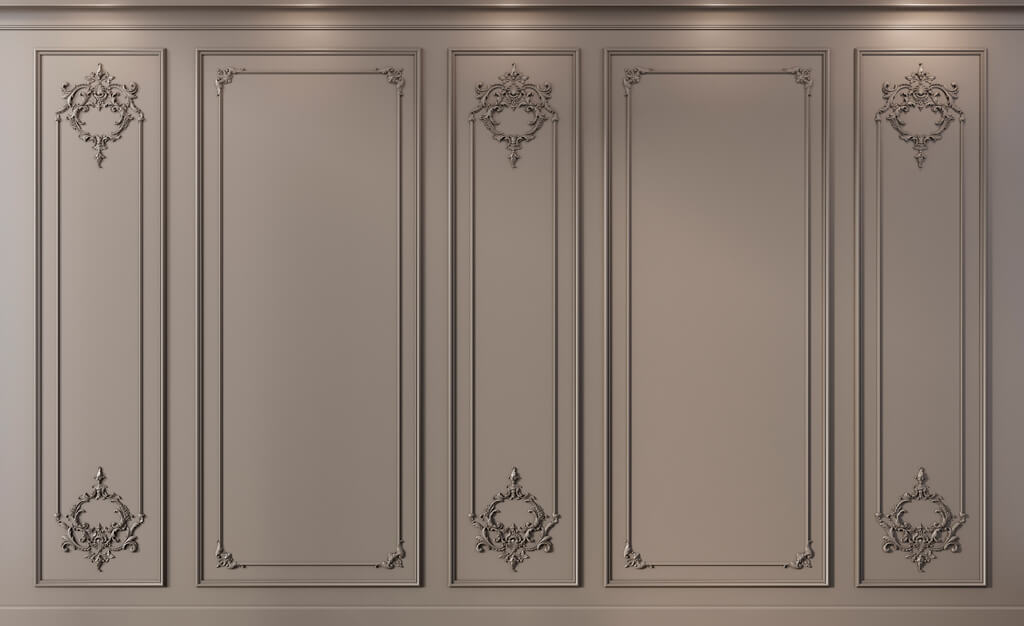
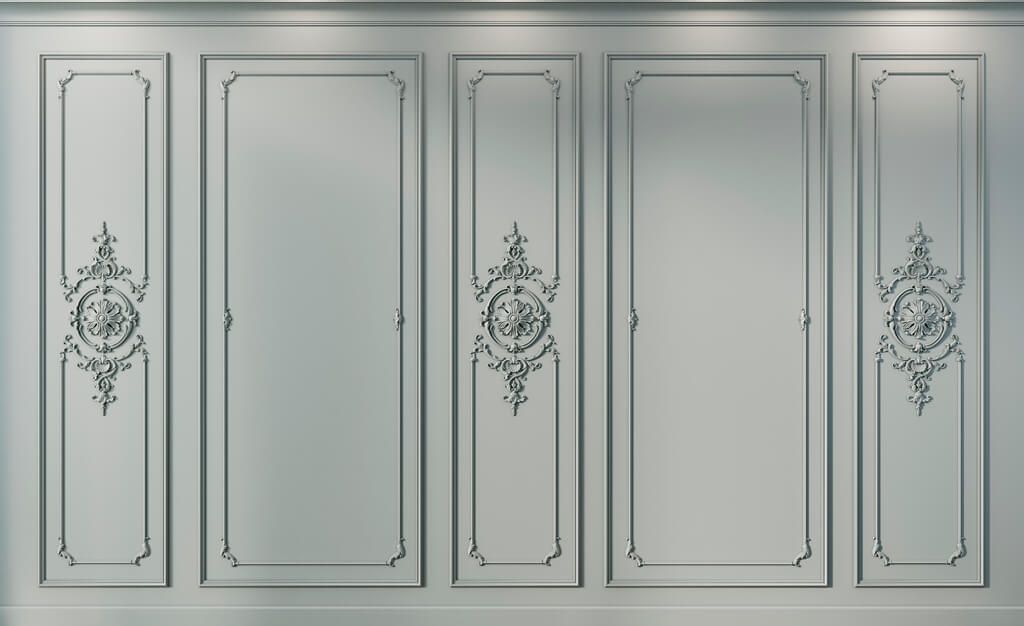
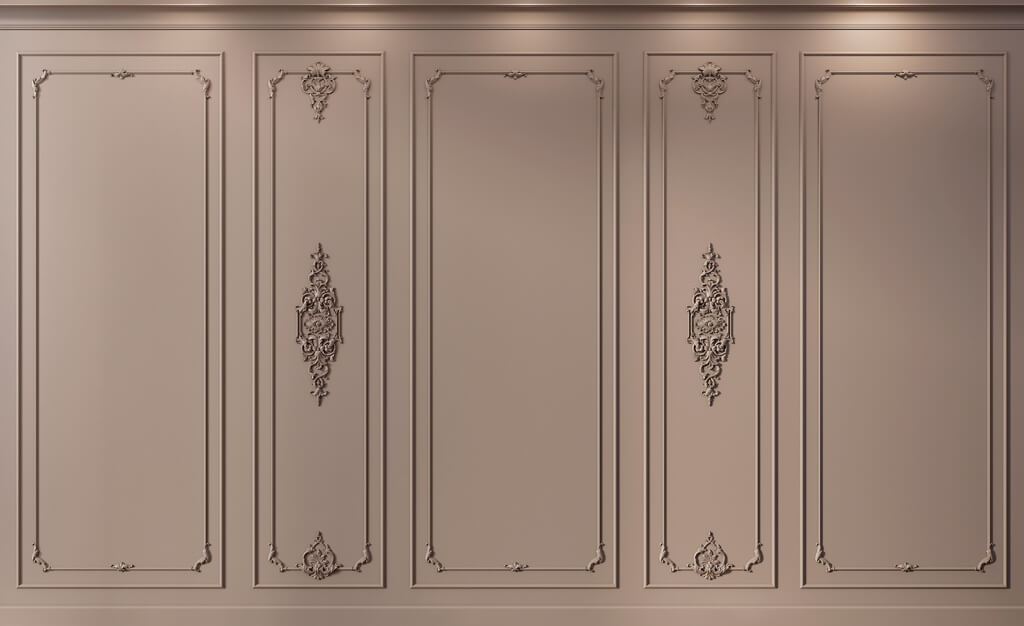
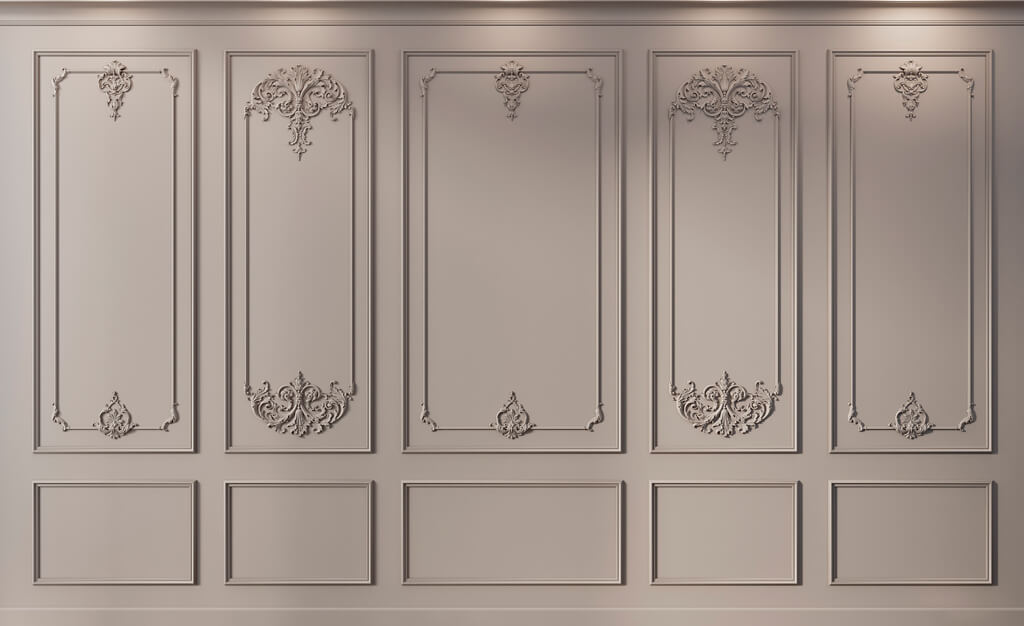
Wall molding solves three main tasks: decorating wall panels, creating decorative frames, and adding accents in the wall area.
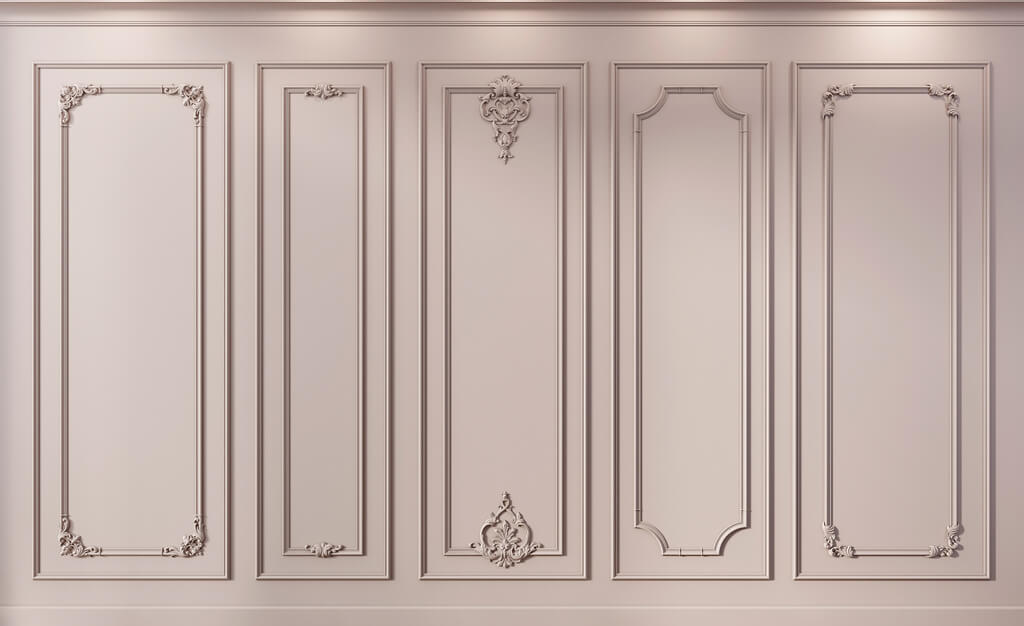
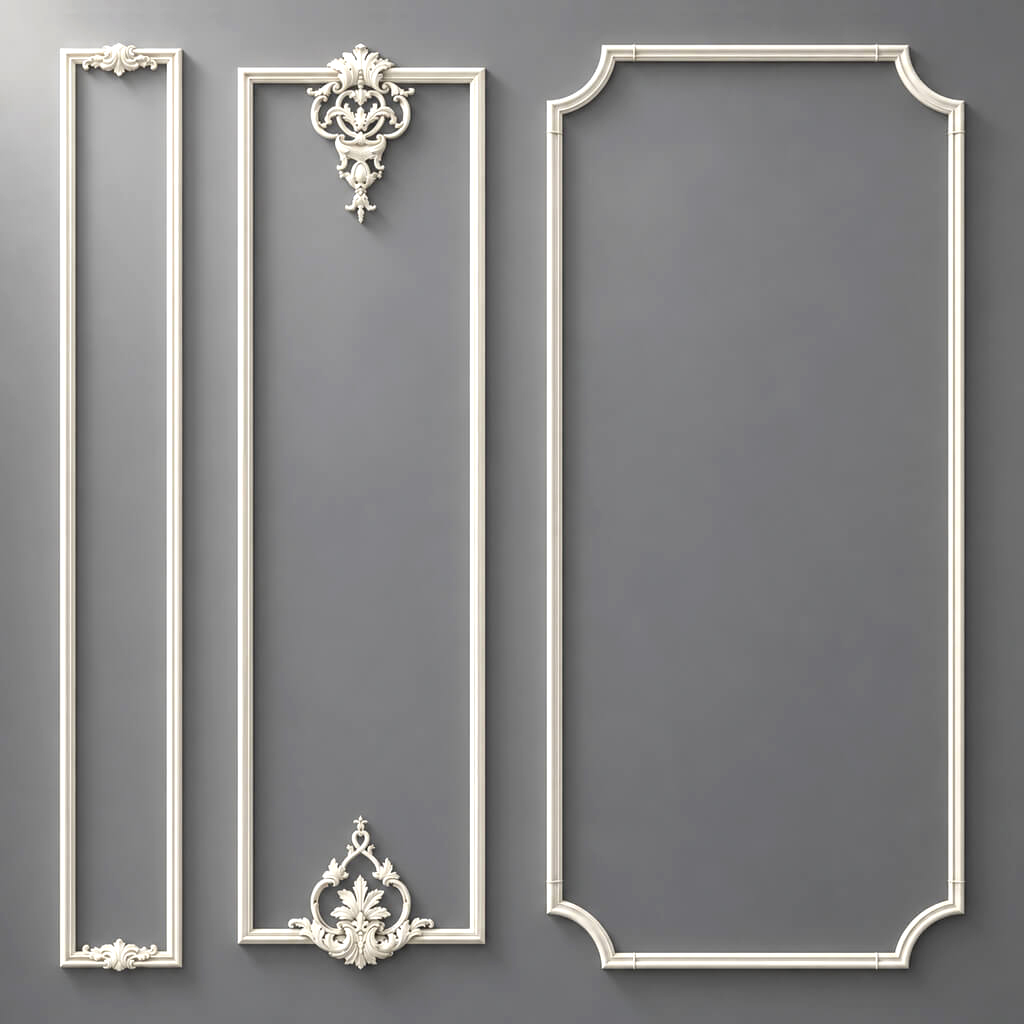
Wall moldings are horizontal or vertical profile elements that create frames, divide the wall into zones, and transition between colors and textures. The height of a wall molding is typically 20–80 mm. The projection is small: 10–25 mm, so as not to protrude at eye level.
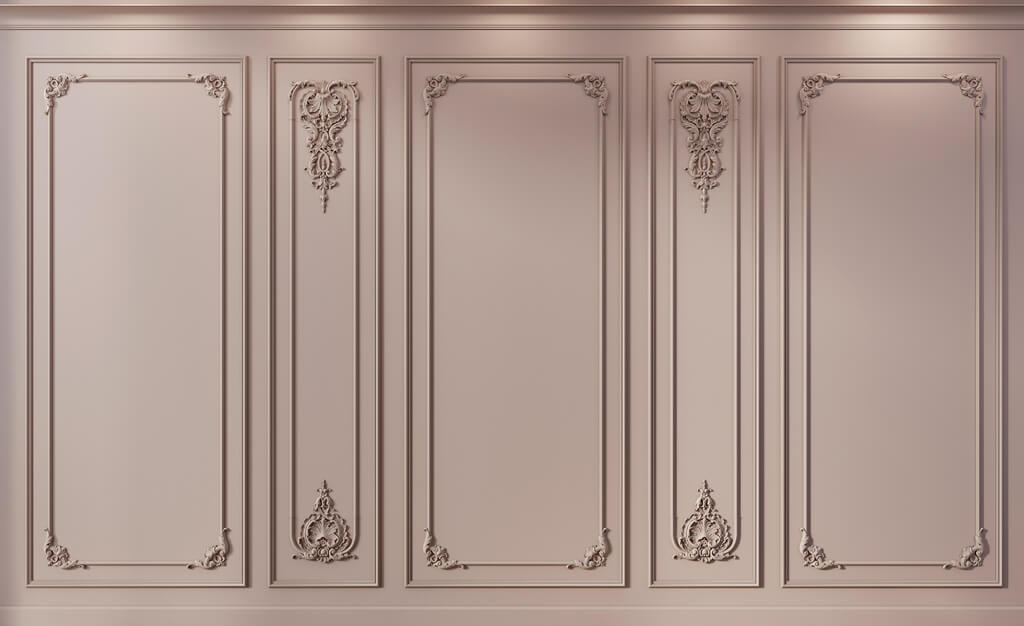
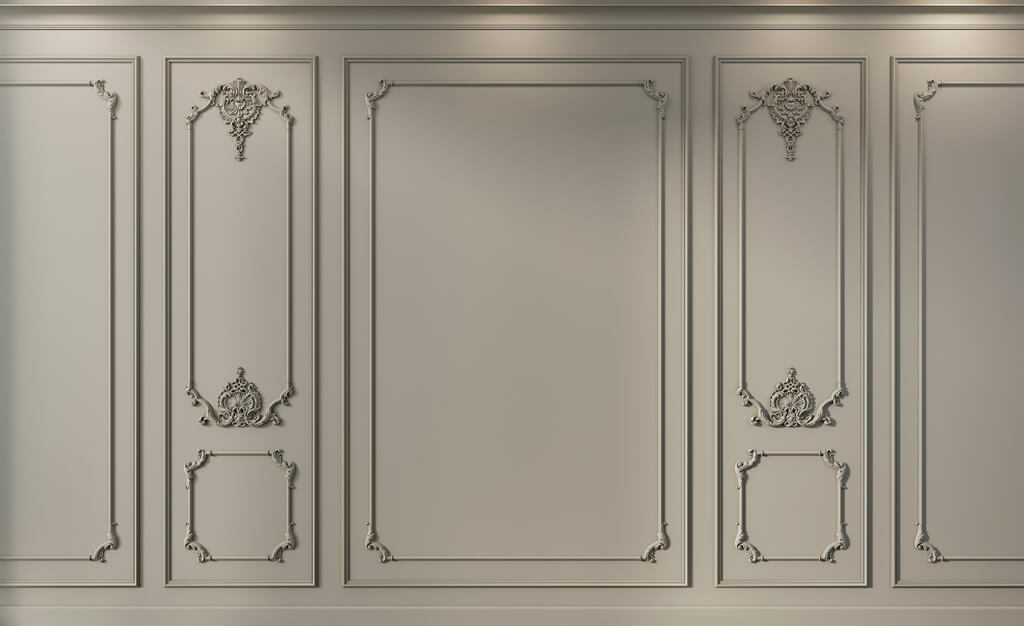
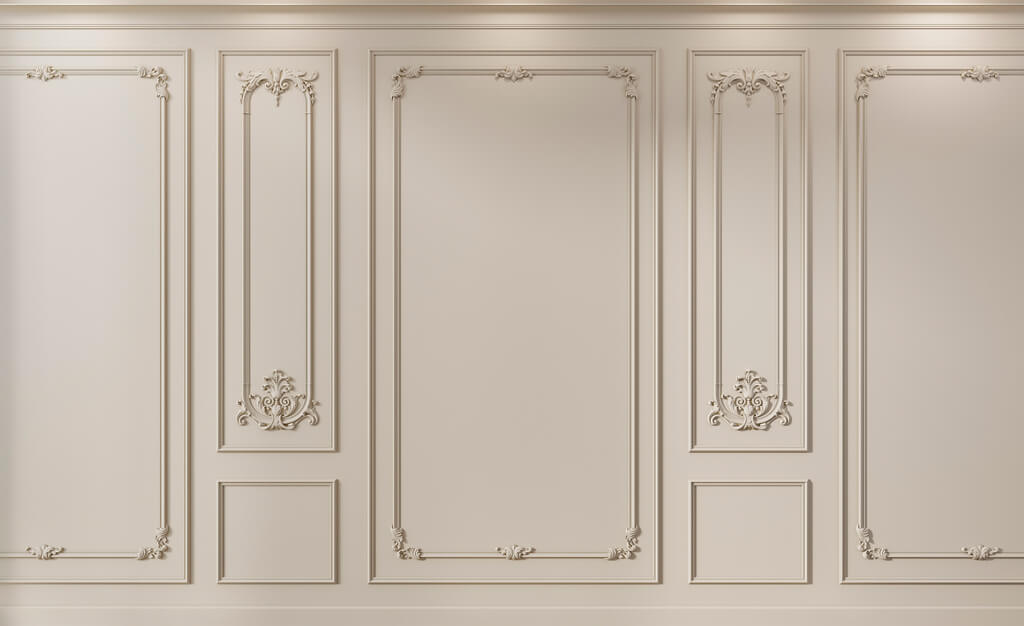
Overlay decorative elements on walls — cartouches, mascaron, medallions, rosettes, inserts in the center of panels. They are installed as accents above the sofa, above the dresser, in niches, and in symmetry zones.
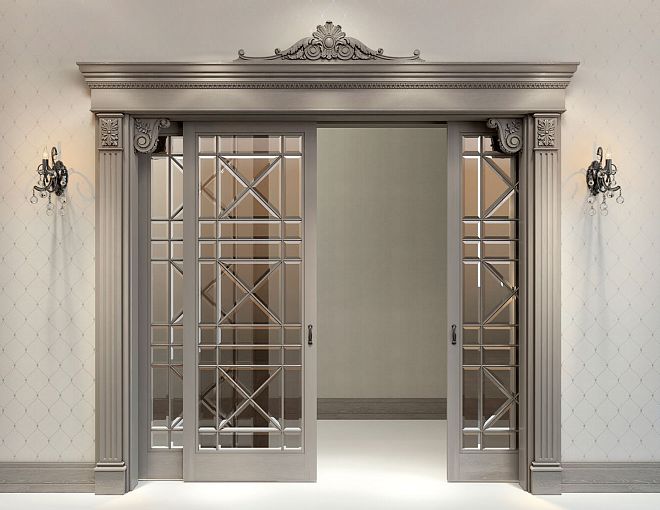
Frames and trims — for decorating decorative niches, mirrors, paintings, and doorways. They create an "architectural" frame around an object or opening.
An important nuance for wall stucco: the scale of the decor should match the room height. For a room with a 2.5 m ceiling — moldings no higher than 60 mm, moderate relief. For rooms with a 3.5 m ceiling or higher — larger elements can be used.
Ceiling stucco
ceiling molding is a separate genre. The ceiling is the most noticeable horizontal surface that a person sees when entering a room. And it is the ceiling decor that creates the first impression of the interior.
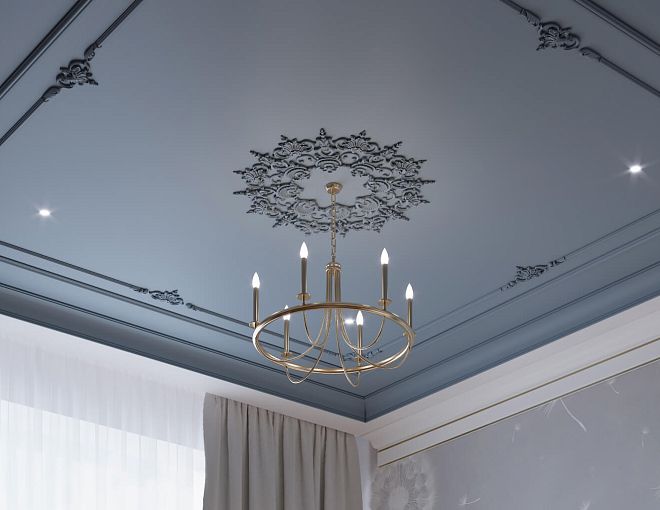
Ceiling cornices — the transition between the wall and the ceiling. They are mounted in the corner at the ceiling, creating a horizontal line and eliminating the "joint" between the wall and the ceiling. The height of a ceiling cornice ranges from 50 to 200+ mm — depending on the room height and style richness.
Scale rule for cornices: cornice height ≈ 1/20 — 1/25 of the room height. For a 2.7 m ceiling: cornice height 110–135 mm. For a 3.5 m ceiling: 140–175 mm.
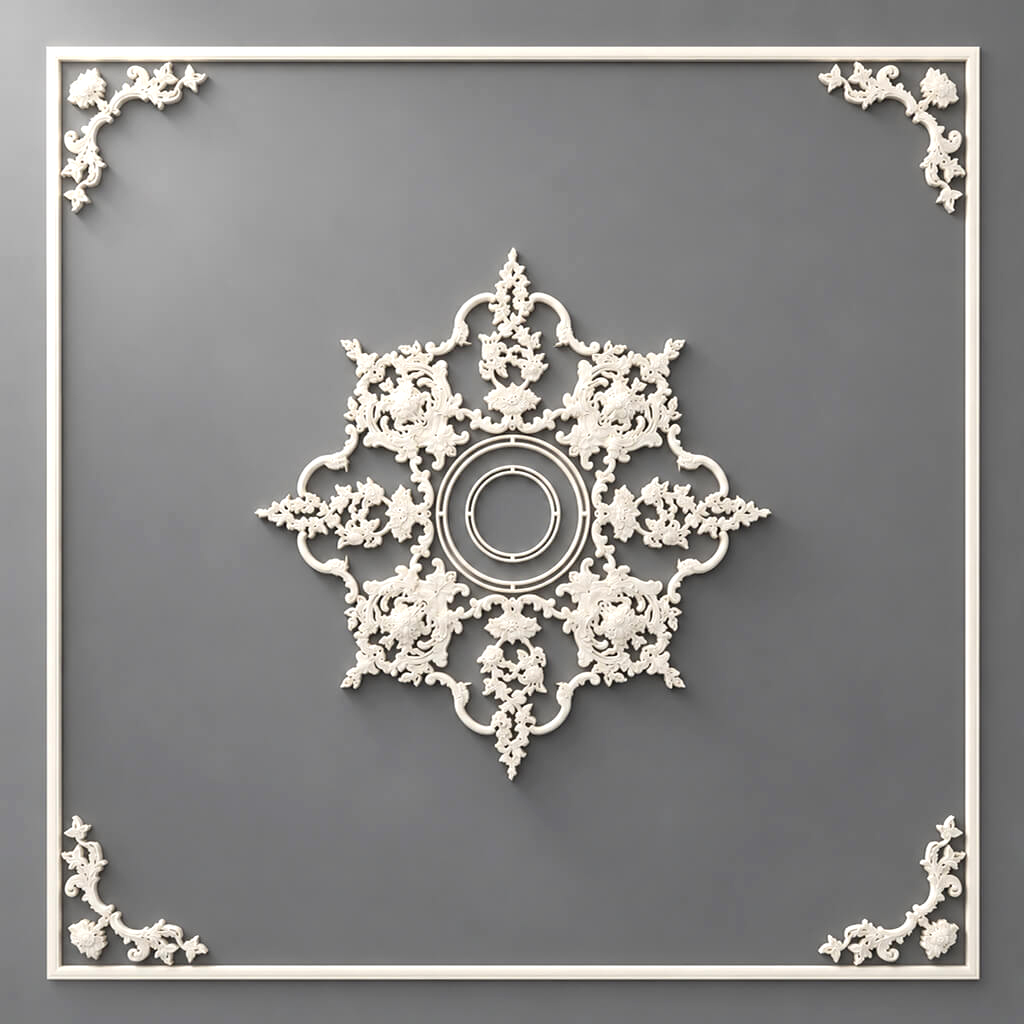
Ceiling rosettes — round relief medallions installed in the center of the ceiling, typically under a chandelier. Diameter from 150 mm (miniature accent) to 1000 mm or more (for grand halls). For a standard room of 15–20 m²: rosette diameter 300–500 mm.
Decorative ceiling beams — imitation of wooden beams on the ceiling. They are mounted horizontally or in a grid pattern, creating a visual image of an "antique" or country-style interior.
Types of moldings made of polyurethane — more details in a separate article covering all types of elements with characteristics and application examples.
Facade moldings
Polyurethane molding allows creating a stylish and presentable exterior of a house, while the material retains its qualities in any weather conditions. — a separate, strictly specialized category. It must withstand outdoor conditions: moisture, frost, temperature fluctuations, ultraviolet.
Key differences between facade products and interior ones:
-
Higher material density.
-
Surface designed for repeated outdoor painting.
-
Mounting holes for dowels — in addition to adhesive installation.
-
Geometry with expansion gaps for thermal expansion.
Facade cornices, moldings, architraves, keystones — all require a special facade assortment, not adaptation of interior products.
Why polyurethane stucco is convenient for purchase
Modern standard of decor
The stucco market today offers several materials: plaster, cement, polystyrene, and polyurethane. Each has its own niche, but polyurethane has taken the leading position in most segments — and there are specific reasons for that.
Precise geometry right out of the box. polyurethane moldings buy — means getting a product with exact dimensions, even angles, and a consistent cross-section along the entire length. Injection molding ensures the identity of each product in a batch — critically important when installing long runs and symmetrical ensembles.
Lightweight. Polyurethane stucco weighs 5–8 times less than plaster and 15–20 times less than cement. This means: no load on the surface, no need for reinforced fasteners, installation can be done by one person without scaffolding or heavy tools.
Surface ready for painting. All decorative wall moldings made of polyurethane, intended for painting, have a smooth, slightly porous surface that accepts acrylic paint well. Apply primer, two coats of paint — and the product is indistinguishable from painted plaster to a professional eye.
Moisture resistance. Polyurethane does not absorb water. This makes it suitable for kitchens, bathrooms, and outdoor use — unlike plaster, which loses strength when wet.
Installation without special tools. Polyurethane stucco is mounted using liquid nails or special polyurethane adhesive. The main tools are a miter saw or hacksaw, painter's tape for fixation while drying, and acrylic sealant for joints.
What does "molding for painting" mean
About a third of the listings in the catalog of polyurethane molding are "for painting" items, i.e., without a final color coating. This is the most flexible option: the buyer chooses the color and paints at a convenient time — before or after installation.
Advantages of molding for painting:
-
Ability to choose any color by RAL or NCS code.
-
Painting to match the wall or ceiling color — for a monochrome, restrained effect.
-
Contrast painting — to accentuate the decor.
-
Possibility to repaint during renovations without replacing the items.
How to avoid mistakes when choosing molding from photos
A photo is only half the information
Most mistakes when buying stucco online happen because the buyer relies solely on the photo. The photo looks nice — so I'll take it. But the photo doesn't convey several critically important parameters.
Real scale. A cornice that looks "neat" in a professional photo may actually be 25 cm high — a monumental element suitable for a grand hall, but not for a standard apartment. And vice versa: a delicate molding in the photo — in reality, 15 mm high, getting lost on the wall.
Scale check rule: always compare the height (or diameter) of the product with the height of your room. A ceiling cornice 200 mm high in a room with a 2.5 m ceiling will take up 8% of the wall height — that's a lot. The same cornice in a hall with a 4 m ceiling — organic and proportionate.
Relief depth. In studio lighting, the relief looks more expressive in the photo than in reality under diffused interior light. And vice versa: with side lighting, even a shallow relief gives an expressive shadow. Always check the technical parameter: relief depth in mm.
Compatibility of elements. A rosette from one collection and a cornice from another — they don't always match. Profile height, ornament character, relief scale — all must be coordinated. Buy elements from the same series or check compatibility via "related products" in the card.
Room style. A Baroque mascaron in a Scandinavian interior is a mistake. A minimalist molding in a Baroque living room is an even bigger mistake. Before choosing, decide on the style — and look for a collection that matches it.
Checklist for verification before purchase
Before adding a product to the cart, go through this list:
-
I know the ceiling height and room size
-
I checked the actual overall dimensions of the product
-
I checked the depth of the relief
-
I determined the interior style direction
-
I checked which collection the product is from
-
I made sure the cornice, rosette, and molding are from compatible series
-
I calculated the required quantity with a 10–15% margin
-
I accounted for corner elements and joints
Which stucco elements are most often purchased
Top demanded items in the catalog
Demand for decorative molding varies by item. Some products are bought in tens of linear meters, others are ordered individually. Understanding the demand structure helps a beginner navigate the assortment.
1. Ceiling cornices. The most popular item. Almost any renovation aiming for a "finished" interior includes a ceiling cornice. This is a basic element that radically changes the perception of a room with minimal investment. They are sold by linear meters — with extra for trimming.
2. Wall moldings. The second most popular type. Wall frames made of moldings are one of the most replicated interior trends of recent years. A simple molding with a straight profile, painted to match the wall, creates the effect of a "stucco panel" in any room.
3. Plaster ornament for walls and ceilings — Overlay individual elements: rosettes, cartouches, corner overlays. They are bought selectively as accents.
4. Ceiling rosettes. Typically, one per room — under the chandelier. They are chosen by diameter and style.
5. Corner elements. They are bought as an addition to moldings and cornices for decorating corners. Often forgotten during the first purchase — and then bought separately.
6. Polyurethane trim — Polyurethane linear elements for decorating transitions, zoning, wall panels. One of the fastest-growing segments in demand.
How to compare stucco websites before purchasing
Evaluation criteria: eight parameters
Open several stucco websites in the browser and compare them is the right strategy. But you need to compare based on specific parameters, not the beauty of the main page.
1. Catalog structure. Is there a division by product type, purpose, style, collection? Or is everything lumped into one page? A clear catalog hierarchy is the first sign of a professional supplier.
2. Product cards. Do the cards include all necessary parameters: full dimensions, relief depth, material, purpose? Or just a photo and price?
3. Availability of collections. Does the store offer elements in collections where the cornice, molding, and rosette are pre-matched? This is a sign of a systematic approach.
4. Real assortment. How many items in the catalog are actually available for order? Many items "to order" with long lead times are a risk for those planning installation within specific deadlines.
5. Material information. Are the technical characteristics of polyurethane specified: density, operating temperature range, coating application method?
6. Photos in interiors. Are there photos of products in real use — on walls, ceilings, facades? This helps assess the actual scale and aesthetics.
7. Calculation and consultation. Does the store offer help with quantity calculation or element selection? This is a serious indicator of expertise.
8. Delivery conditions. Does the store work with your region? What is the delivery time? Is there packaging that protects the stucco during transportation?
What does "stucco in St. Petersburg" and "stucco in Moscow" mean
For customers looking for stucco in Saint Petersburg or in Moscow, a key question is whether the supplier works with your city, how quickly they deliver, and whether there is an option for self-pickup or viewing samples in person.
Manufacturers operating across Russia typically offer transport delivery to a transport company — this is standard practice for long-length goods. Moldings and cornices 2–3 meters long are shipped in special packaging to prevent deformation.
Common mistakes before buying stucco
Mistake 1: Buying only from a picture
We've mentioned this before — but it's worth repeating. Photos don't convey scale. Decor that looks delicate on screen may turn out to be a large architectural element disproportionate to an ordinary apartment. Always check the dimensions.
Mistake 2: Forgotten corner elements
Moldings and cornices require corner finishing. Straight 90° joints without corner elements look unfinished, and miter cutting without special tools is a task for an experienced installer. Always add corner elements to your order list.
Error 3: Lack of margin
A "tight" calculation is a risky strategy. Molding is trimmed during installation, and some goes to waste. The standard margin is 10–15% of the calculated quantity. For linear elements with corner cuts — up to 20%.
Error 4: Different styles in one room
A baroque cornice with lush relief + a modest geometric rosette + a modern molding without ornament — such a combination creates chaos. All elements in a room should belong to the same stylistic "family."
Error 5: Cornice without considering hidden lighting
If backlighting behind the cornice is planned, choose a cornice with a shelf for an LED strip. Not all cornices have this design. Clarify this parameter before purchase.
Error 6: Ignoring joints during installation
Unsealed joints between elements are gaps that look like cracks after painting. Acrylic sealant on joints is a mandatory step that is often skipped "to save time."
Error 7: Incompatibility of profiles when joining
Two cornices from different series, even with a similar pattern, do not always join correctly. If joining is needed, ensure the products are from the same series with an identical cross-section profile.
Where to buy polyurethane stucco
Full catalog for any task
Choosing a stucco store is choosing a project partner. Not a one-time supplier, but someone who will help you understand the assortment, select compatible elements, and calculate the quantity.
For each task, its own category:
-
moldings catalog polyurethane — full assortment: cornices, moldings, rosettes, overlays, linear elements.
-
Buy moldings — ready-made items in stock with current prices.
-
polyurethane decor — piece overlay elements: rosettes, cartouches, keystones, corner overlays.
-
Polyurethane trim — profile linear elements for walls and ceilings.
-
Facade molding — specialized assortment for outdoor use.
FAQ: popular questions about buying stucco
How to calculate the amount of ceiling cornice for a room?
Measure the perimeter of the room along the cornice installation line. Subtract the width of the doorway (if the cornice does not extend above the door). Add 15% for trimming and joints. The result is the required number of linear meters. Don't forget corner pieces — one for each corner of the room.
Can polyurethane molding be painted together with the walls?
Yes. Pre-prime the surface with acrylic primer for better adhesion. Then paint with the same paint as the walls — the molding will take on the color and look like a single whole.
What is the difference between polyurethane molding and polystyrene molding?
Polyurethane is stronger, heavier, more precise in geometry, and holds relief better. Polystyrene is cheaper but fragile, with unstable geometry, and difficult to paint. For a quality interior — only polyurethane.
How much does a polyurethane cornice cost per meter?
The price depends on the profile size and complexity of the relief. Current moldings catalog prices — on the STAVROS website.
How to check the quality of molding before purchasing?
Request a sample or look at the characteristics: polyurethane density (from 200 kg/m³ for quality products), cross-section accuracy, surface description (smooth, paintable). Customer reviews are an additional guide.
Can I buy stucco molding in Saint Petersburg with delivery?
Yes. STAVROS delivers throughout Russia, including decorative molding in St. Petersburg and other regions. Delivery terms are on the website.
Do I need to soak or prepare the stucco molding before installation?
No. Polyurethane stucco molding is installed without prior preparation: the surface must be clean, dry, and sufficiently level. The adhesive is applied to the product immediately before installation.
How should I store the stucco molding before installation?
In a horizontal position in a dry room. Long linear elements should not be stored vertically or supported on one end — they may deform under their own weight during prolonged storage.
STAVROS: catalog of stucco molding and polyurethane decor with a systematic approach
Choosing a stucco molding store is not about finding the lowest price. It is about finding a system: an assortment where all elements are coordinated; a catalog that is easy to navigate; information that helps make the right decision.
STAVROS is a manufacturer and supplier of polyurethane decor for interiors and facades with many years of practice and a structured catalog. Here polyurethane moldings buy means not just choosing a position and placing an order — it is access to the full range of approved collections, precise specifications of each product, a wide selection of moldings, overlays, and facade decor.
STAVROS works with private customers, designers, and construction companies across Russia — delivery to Moscow, Saint Petersburg, and other regions. If you need Decorative stucco with a clear catalog, real sizes, and professional selection support — you are already on the right website.