Article Contents:
- The problem isn't the stucco — the problem is randomness
- Mistake one: buying a beautiful detail without a place
- How to choose a place before buying
- Mistake two: a small overlay on a large empty wall
- Three ways to 'fit' small decor into a large wall
- Small overlays that work in a system
- Mistake three: stucco without a molding frame — decor without architecture
- How the molding + overlay system works
- Where to install overlays inside the molding system
- Mistake four: symmetry without a center
- How to properly build a symmetrical composition
- Mistake five: too many motifs in one space
- Motif for the task: how to choose the right image
- Mistake six: color that makes the molding feel foreign
- Five painting strategies — from simple to subtle
- What definitely not to do
- Ready-made scenarios: what to buy to make the molding look built-in
- Scenario 1: accent wall behind the sofa
- Scenario 2: mirror or console in the hallway
- Scenario 3: furniture facade
- Scenario 4: fireplace and portal
- Selection table: task — solution — link
- Practical checklist before buying stucco decor
- Frequently asked questions about polyurethane decorative overlays
- About the company
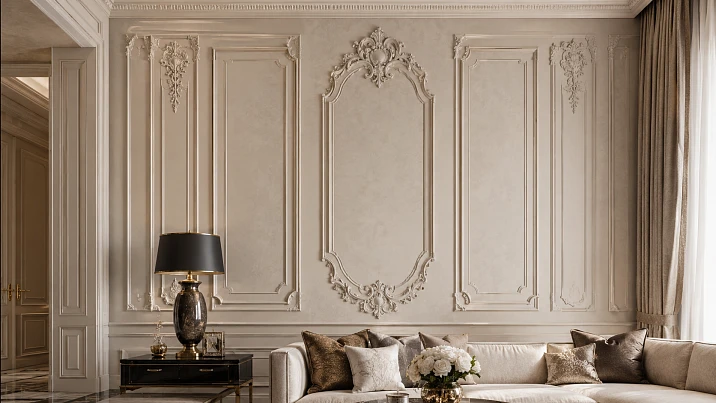
Correctly chosen Decorative polyurethane molding is not "glued" to the wall — it becomes part of it. It does not jump out of the interior but blends in as if it was planned by the architect from the project stage. And this is not a matter of the product's price. It is a matter of how exactly you chose it, where you placed it, and what you combined it with. This is what this article is about: not about what to buy, but about how to buy correctly so that it Relief Decoration looks expensive, organic, and truly beautiful.
The problem is not the stucco — the problem is randomness
Any experienced designer will tell you one thing: it's not the material that looks cheap, but randomness. A randomly chosen location. A random size. A random relationship with the rest of the decor. When a decorative element appears in an interior "because I liked it," without a thought-out role and position, it will always look out of place. It doesn't matter what it's made of: plaster, wood, or polyurethane.
Polyurethane as a material for moldings has undeniable advantages over plaster and wood: it is lightweight, moisture-resistant, can be cut with a knife, glued without drilling, painted any color, and does not crack with temperature fluctuations. But none of these advantages will save decor placed without a plan. And conversely, even the cheapest polyurethane overlay, properly integrated into a system of moldings with a unified color, will look many times more expensive than an expensive plaster product glued "somewhere in the middle of the wall."
The entire difference between "expensive" and "cheap" in interior decor comes down to six principles. It is through these that we will analyze the main mistakes — and ways to avoid them.




Mistake one: buying a beautiful detail without a place
Let's start from the very beginning — from the moment when you are just thinking about Buy molding. You open a catalog, see a beautiful overlay with birds or an ornament, and think: "This is nice, I'll take it." The question is: where exactly will you put it? On which wall? At what point on that wall? Next to what?
If there is no answer to these questions, the purchase will most likely be a disappointment. Not because the product is bad, but because without a place, the decorative element loses its meaning. It is the place that determines everything else: size, relief, orientation, color, the need for a pair or a molding frame.
Our factory also produces:
How to choose a place before buying
The professional approach looks like this: first, the zone is chosen, then the format of decor suitable for it. Not the other way around. Here are the main zones and the logic of choice for each:
Furniture facades
— cabinet doors, dresser drawers, bed side panels. Here you need overlays with a slight relief (no more than 15–20 mm) and a compact size. The task of the decor is to turn mass-produced furniture into "custom-made" without hindering the opening of the doors. Mirror
— a zone with a clear axis of symmetry. Here, paired L/R overlays work on the sides of the mirror frame, facing the decor inward. The size of the overlays is proportional to the height of the mirror: for mirrors up to 100 cm — overlays 12–20 cm high, for mirrors from 120 cm — 20–35 cm. Accent wall
— a large plane that requires scale. A small overlay on a large wall will get lost if not supported by a molding frame. A large overlay on a small wall will feel oppressive. Rule: the height of the decor should be no more than 1/6 of the wall height. Fireplace and portal
— a formal zone that requires strict symmetry and a large relief. Here, a mascaron on the axis and a pair of overlays on the sides are appropriate. Small decor on a fireplace portal looks ridiculous — scale is crucial here. Ceiling — a zone for rosettes, cornices, and ceiling decor. Ceiling molding has its own specifics: it must be proportionate to the chandelier and the height of the room, otherwise it either gets lost or feels oppressive.
Doorway
— a space for pilaster decor, architraves, and paired overlays at the level of the upper third of the opening. Here, vertical rhythm is important. Go through this list and find your zone — before you open the catalog. Then, searching for a product will turn from "choosing what I like" into "choosing what fits."
Get Consultation
Mistake two: a small overlay on a large empty wall
Here's a classic picture: a large wall in the living room, 4 by 2.7 meters. In the center of this wall — one small decorative overlay with a diameter of 15 cm. Around it — emptiness. Does it look expensive? No. Does it look like "design"? No. Does it look like "bought something and stuck it somewhere"? Exactly that.
The problem is not the overlay. The problem is the scale mismatch. A small element on a large surface without context does not decorate the space, but emphasizes its emptiness. It's like one earring in a big box: you don't see the earring, but the emptiness around it.
Three ways to "fit" small decor on a large wall
Method one: molding frame. Surround the overlay with a frame made of molding. The overlay inside the frame immediately gains scale and meaning. The frame sets boundaries, and the small element inside it becomes the "center" of these boundaries, rather than a random point on the plane.
Method two: rhythmic repetition.
Several identical overlays arranged in a specific rhythm — horizontally, diagonally, or in a pattern — create an ornament. Three elements in a strict line with equal spacing are already a frieze, not "stuck-on details." Method three: connection with another object. A small overlay near a mirror, a painting, on the sides of a lamp, or by a shelf is decor with a clear role. It serves as a "frame" or "accent" for a specific object, and this is immediately obvious.
Small overlays that work in a system
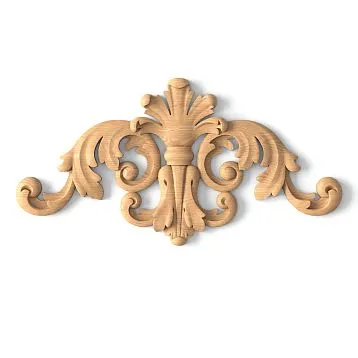
Molded decor NPU-479 for 770 rubles — a compact single overlay with a laconic relief. In rhythmic repetition (three to five pieces with equal spacing) it creates an elegant horizontal accent on the wall. In a molding frame, it works as a central medallion.
Molded decor NPU-481 for 290 rubles — the most affordable element in the line. These overlays work especially well in serial ornaments and rhythmic friezes: five pieces horizontally with a step of 40 cm — and the wall gains character.
Molded decor NPU-482L и NPU-482R for 590 rubles each — a new pair. Compact, with a delicate relief, ideal for corner accents inside a molding frame or for furniture facades where mirror symmetry is needed without a large scale.
NPU-476L и NPU-476R for 1,360 rubles each — a mirror pair of medium format with a detailed ornament, which in a molding frame looks like a full-fledged wall sculpture. On the sides of a mirror, above the headboard, or inside a decorative panel — this option gives an expressive result with a moderate budget.
NPU-477L и NPU-477R 980 RUB — a compact pair for furniture and small wall accents. Works well on furniture facades and in small spaces where large decor would be excessive.
NPU-489 610 RUB — a new item with a laconic relief for delicate accents. Good for children's rooms, bedrooms, and feminine spaces in diagonal or free rhythmic compositions.
The main principle: when buying Polyurethane decorative appliques small format, immediately think about the system they will live in. An overlay is not the final point of purchase, but a central element that needs context.
Mistake three: stucco without a molding frame — decor without architecture
This is perhaps the most fundamental mistake — and at the same time the most easily fixable. Imagine a painting without a frame: canvas attached to the wall. It might even be beautiful on its own. But in a frame, the same painting looks different — more serious, more complete, more significant. The frame does not cover the painting, it explains it: 'look, this is important.' Molding does exactly the same for stucco.
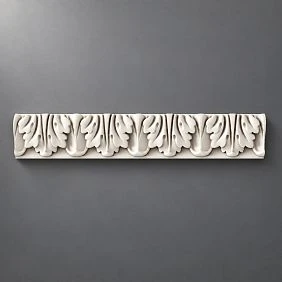
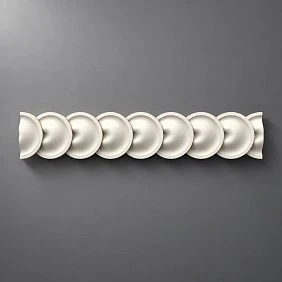
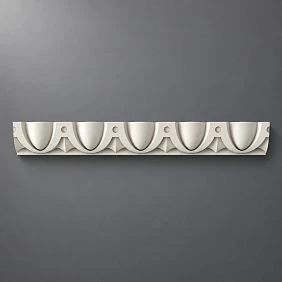
Moldings made of polyurethane — cornices, architraves, friezes, pilaster strips — create architectural boundaries on the wall. A rectangular frame made of molding defines a zone within which the overlay acquires a role and scale. Without a frame, the overlay is a guest on an empty wall. Inside the frame, it is the master of the architectural space.
How the molding + overlay system works
When buy polyurethane moldings correctly means choosing them proportionate to the overlay. The connection works according to the following logic:
-
Molding forms a frame — rectangular, arched, or more complex
-
The overlay occupies a key position inside or on the border of the frame
-
The center of the frame can be filled with a mirror, painting, color rectangle, lamp, or simply a contrastingly painted surface
-
Corner joints of moldings are covered decor for moldings — with corner rosettes and keystones that hide the joints and add completeness to the system
The result is not an "overlay on the wall," but a full-fledged decorative panel — like in expensive hotel rooms and executive interiors.
Where to install overlays inside the molding system
Different types of decor behave differently in the molding system — and this is important to consider when planning:
Birds
work best in the upper part of the frame or along the upper corners — they "look" down and inward, creating a feeling that the space below is guarded. On the sides of the frame, birds are installed in pairs L/R, facing the center. Butterflies and dragonflies
allow for a freer arrangement: they can be in the corners of the frame, in the middle of the sides, or even extend beyond the frame — as if they "flew" into the decorative zone. This is the only motif for which strict axial symmetry is not required. Fish and marine decor
they look good in horizontal panels — in wide rectangular frames, where the horizontal movement of the silhouette matches the format of the zone. A pair of L/R fish in a horizontal frame is a ready-made wall panel for a bathroom or restaurant. Mascaron and lion
require a strict central axis. The mascaron is always installed exactly along the axis of symmetry of the frame or architectural element: above the center of the fireplace portal, in the arch keystone, along the horizontal axis of symmetry of the decorative panel. Any deviation from the axis immediately destroys the sense of intentionality and luxury. Plant ornament and acanthus
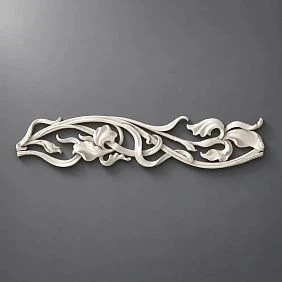
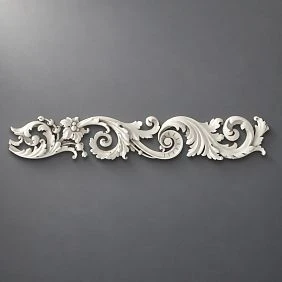
are the most "disciplined" motifs that organically fit into any molding system, from strict classicism to neoclassicism with a modern interpretation.Polyurethane wall decor in a system with moldings — it is not a set of elements, but a well-thought-out decorative architecture. And it is this architecture that makes the interior expensive.
Mistake four: symmetry without a center
Symmetry is a tool, not an end in itself. A pair of identical overlays on the wall creates order, but not meaning. Meaning appears when there is a center between them — an object for which the symmetry was built. It is the absence of this center that turns a beautiful pair into "two things on the wall."
The best centers for symmetrical stucco are a mirror, a sconce (or a pair of sconces), a console, a bed, a fireplace, a door, a painting. Anything that has its own visual axis and can become a semantic anchor for decor on the sides.
How to build a symmetrical composition correctly
Step one: determine the central object and its visual axis (vertical for a mirror and bed, horizontal for a fireplace and console).
Step two: choose a pair of L/R overlays — left and right. They should be oriented towards the center with their ornament or figure inward.
Step three: determine the placement height — it should align with the visual center of gravity of the central object. For a mirror — at the level of its middle third. For a bed — at the height of the upper third of the headboard. For a fireplace — at the level of the mantelpiece.
Step four: if necessary, add a molding frame that ties the central object and the side overlays into a single composition.
Molded decor NPU-492L и NPU-492R 1,490 rubles each — a pair with expressive relief and a clear silhouette direction. They work equally well above the headboard, on the sides of a fireplace portal, and in a decorative panel with a mirror. The large scale of the pair is readable from a distance of 3–4 m, making it suitable for spacious rooms and high ceilings.
NPU-493L и NPU-493R 1,430 rubles each — a slightly smaller format with the same detailing. A versatile option for standard apartments and medium-sized rooms. Works well with mirrors 80–120 cm high and standard-sized beds.
Fundamentally important: paired decorative stucco molding without a well-thought-out center — it's an unfinished phrase. Like two adjectives without a noun. Define the center — and symmetry will work.
Mistake five: too many motifs in one space
Here's a scene you might encounter in certain interiors: on one wall — birds on one side, butterflies on the other, a fish in the center, and somewhere on the side — a lion's mask. All beautiful individually, in the catalog. On the wall — a zoological mess. No motif has dominance, none works as an accent, because all are simultaneously competing for attention.
A luxurious interior is built on one main motif — or, at most, on two closely related ones. This is a principle that works in fine art, architecture, and decor: the fewer 'signals' in a space, the cleaner each one reads.
Motive for the task: how to choose the right image
Different spaces require different images — and this is not a coincidence, but a matter of matching the image to the context:
Light, airy spaces
— bedroom, children's room, women's study, beauty salon, winter garden. Best choice: birds, butterflies, dragonflies. These motifs bring lightness, movement, tenderness. They do not weigh down or create a feeling of heaviness. Marine theme
— bathroom, country house by the water, seafood restaurant, yacht club interior. Motif: fish, shells, wave pattern. Polyurethane is indispensable in this area — it is the only decorative material that is not afraid of moisture and steam. Formal and prestigious areas — study, library, fireplace living room, entrance hall of a country house, executive office. Motif: lion, mascaron, heraldic ornament. Polyurethane decor MPU-002 — a lion mascaron works here as a visual anchor for the entire space. One element, placed precisely, speaks of status more than a dozen small details.
Classic and neoclassical
— floral ornament, acanthus, cartouche, molding profile. Here, the animal motif appears as a historically justified accent: an eagle on a pilaster, a laurel wreath on a frieze, a mascaron on a keystone. Everything else is vegetation. Modern interior with a neutral palette — Molding in the wall color. Without color contrast, only relief. This is the quietest and at the same time the most visually expensive technique: decor works through light and shadow, not through contrast of form.
The rule of one motif does not prohibit combinations — it prescribes hierarchy. There is one main motif. The additional one is as close as possible in spirit and scale. The third and fourth motifs in one zone are chaos, not design. buy decorative moldings The right way is to choose a motif for a specific space, not based on the principle 'I liked them all, I'll take everything.'
Mistake six: the color that makes the molding look foreign
Here's a paradox: the same overlay, painted in a different color, can look like a detail from an expensive project — or like a souvenir from a market. Painting is the last and perhaps the most influential step that determines whether the decor will 'blend in' with the interior or remain hanging on it.
The most common mistake is to leave the molding white on a white wall, without tinting the wall to a deeper shade. White on white sounds right in theory, but in practice, in diffused daylight, the relief 'washes out,' and the overlay loses all its volume. The second most common mistake is to apply glossy paint. Gloss on the relief 'glints' unevenly and makes the decor look cheaper than it is.
Five painting strategies — from simple to subtle
Matte monochrome matching the wall tone
— the undisputed leader among professional solutions. The overlay disappears 'into the wall' and reveals itself only through light and shadow. This requires good lighting (side or directional light source is mandatory), but gives the most expensive result possible. Suitable for any space with a neutral palette. White decor on a dark background
— contrasting classic. Works flawlessly, but requires the right scale: the overlay must be large enough not to 'drown' on the dark plane. A white bird on a dark blue wall is a statement. A small white ornament on a black wall is a dot that no one will notice. Decor in the color of furniture
— for furniture facades. When the overlay and the cabinet facade are painted the same color (e.g., dusty green or anthracite), the detail is perceived as originally intended structurally. This is the principle of 'built-in' we discussed at the beginning: decor as part of the object, not an addition to it. Patina on the relief
— for classic, neoclassical, art deco, vintage. The dry brush method: a decorative compound with metallic pigment is applied only to the raised parts of the relief, leaving the recesses dark. Gold, bronze, copper, dark silver — each metal creates its own character. Gold patina on a white classic overlay is one of the most elegant techniques in working with stucco decor. Important: the patina should be accentual, not continuous — otherwise the effect is lost. Gold only as an accent, on details
— the most delicate way to apply gold color. Only the tips of the wings, only the peaks of the ornament, only the upper contour of the relief are gilded. The rest of the surface matches the tone of the wall or furniture. Result: the stucco "shimmers" at certain lighting angles but does not constantly scream for attention. More details on installation and finishing practices moldings from polyurethane read in the article about installation of polyurethane molding — it covers all stages from surface preparation to final painting.
What you definitely should not do
-
Glossy paint on relief — never: highlights destroy the volume
-
Different shades of white on the overlay and wall: "milky" decor on a "cold" white background will look dirty
-
Too dark coloring of the overlay on a light wall without sufficient scale of decor
-
Solid gilding without patination: looks like New Year's decor, not palace stucco
Ready-made scenarios: what to buy so the stucco looks built-in
The most practical thing is specific lists. Here are four scenarios with a list of what you need to purchase for a finished result.
Scenario 1: accent wall behind the sofa
This is one of the most common tasks in modern interiors — and one of the most frequently solved incorrectly. "Hanging something over the sofa" is not design. "Creating a decorative panel above the sofa" is architecture.
What to buy:
-
Moldings made of polyurethane for a horizontal frame (frame width = sofa width + 20–30 cm on each side, height = 60–80 cm)
-
Decorative corner elements for molding joints — Decor for Molding
-
One central overlay (on the axis of symmetry inside the frame) or a pair L/R at the corners of the frame
-
Mounting acrylic adhesive
-
Paint in the color of the wall (matte)
Principle: the frame is mounted first, the overlays last, after the final drying of the glue and putty of the joints. Everything is painted in one go, including the wall inside the frame — or a contrasting color is applied inside the frame.
Scenario 2: mirror or console in the hallway
The hallway is the first impression of the apartment. It is here that the "integration" of decor works especially strongly: if the wall near the mirror looks well-thought-out, the entire rest of the interior is automatically perceived as more serious.
What to buy:
-
Thin molding for a frame around the mirror (if the mirror is frameless) or for a decorative frame on the wall around the mirror area
-
Mounting adhesive, primer, paint
Principle: overlays are installed strictly symmetrically on the sides of the mirror, with the decor facing inward. The center height of the overlay is at or slightly above the horizontal axis of the mirror. The distance from the edge of the overlay to the edge of the mirror frame is 5–8 cm. Buy Molded Decoration for this scenario, it is better to use molding right away — and select them proportionally.
Scenario 3: furniture facade
Serial furniture with decorative overlays is not a budget technique, it is a smart use of resources. Many designer brands build entire furniture lines based on this principle.
What to buy:
-
A pair of small-format L/R overlays — NPU-477L + NPU-477R or NPU-476L + NPU-476R
-
Decorative corner moldings for a frame around the door perimeter
-
Mounting adhesive, paint matching the facade color
Principle: a molding frame is glued along the door perimeter with a 2–3 cm indentation from the edge. Overlays are placed in the upper corners of the frame or symmetrically along the vertical axis of the door. Everything is painted in the facade color — as a single layer, without highlighting the decor with color. Moldings for Furniture In this execution, it looks like a structural detail rather than a sticker.
Scenario 4: fireplace and portal
The fireplace area is a monumental task requiring a monumental solution. Small decor doesn't work here. Scale and strictness are needed.
What to buy:
-
Polyurethane decor MPU-002 — lion mascaron. Price 10,340 rubles. Sizes: from 49×49 mm to 208×208 mm, relief depth up to 69 mm. For a standard portal — medium or large formats
-
Moldings made of polyurethane for the architrave and side pilasters
-
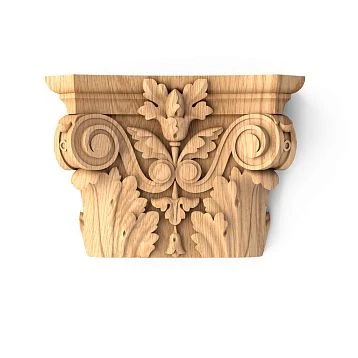
Corner elements and decorative capitals
-
Finish — matte, monochrome or patina in gold/bronze
Principle: the mascaron is mounted strictly along the portal's axis of symmetry — above the center of the hearth, at or slightly above the mantel level. Pilaster moldings run vertically on both sides of the portal. The architrave runs horizontally above the portal. Together, this creates a full architectural element, not just a "decorated fireplace."
Selection table: task — solution — link
| Task | What to buy | Where to look |
|---|---|---|
| Stucco on accent wall | Moldings + overlays + decor for moldings | Wall Decor |
| Small accent for mirror or furniture | Decorative overlays NPU small/medium format | PU overlays |
| Wall frame for panel or headboard | Polyurethane moldings + corner decor | Moldings and cornices |
| Accent near chandelier or on ceiling | Ceiling rosettes, cornices | ceiling decor |
| Status portal or fireplace | Mascaron MPU-002 + moldings + pilasters | PU overlays |
| Custom-made furniture facade | Small-format pairs NPU-477L/R, NPU-476L/R | PU overlays |
Practical checklist before buying stucco decoration
Before placing an order, go through this list — it will take no more than five minutes and protect you from disappointments:
-
I have chosen a specific area (wall, furniture, mirror, fireplace, ceiling)
-
I have measured the size of this area and know what scale of decor I need
-
If the area involves symmetry — I order a pair L/R, not a single element
-
I know what central object will be 'between' the paired overlays (mirror, bed, fireplace, etc.)
-
I have selected moldings for the frame or frieze to match the chosen overlays
-
I have determined the painting strategy: monochrome, contrast, patina, or furniture color
-
I bought assembly adhesive, primer, and paint along with the stucco molding.
If all items are checked — You can buy ready-made stucco matching the Baroque style. Calculate the quantity: linear meters of cornices and moldings, number of rosettes, pilasters, consoles, corner elements. Add a ten to fifteen percent allowance for trimming. you can be confident: the result will be exactly as intended.
Frequently asked questions about decorative polyurethane overlays
Why does stucco molding sometimes look cheap?
The reason is almost always one of six: the element's scale is too small relative to the wall, lack of a molding frame, broken or incomplete symmetry (no center), too many different motifs in one area, incorrect painting (gloss or unsuitable color), or simply the absence of a well-thought-out place. Eliminate any of these reasons — and the result will change dramatically.
How to choose stucco molding so it looks expensive?
First, determine the location and zone. Then, the scale and motif that match the character of the space. Next, select moldings to create a frame. Finally, decide on the painting. Stucco molding in the color of the wall with a matte finish looks the most expensive in most interiors.
Can small stucco molding be used on a large wall?
Yes, but only inside a molding frame, in a rhythmic repeat, or next to another object (mirror, shelf, light fixture). Without context, a small element on a large plane gets lost and emphasizes emptiness rather than filling it.
What color of molding looks more expensive?
In most interiors, matte monochrome matching the wall tone. Contrasting white on a dark background is also expensive, but requires sufficient scale of the overlay. Gold only works selectively, on the relief, using patination technique. Glossy coating of any color is the "cheapest" visual result.
What to buy together with decorative molding?
Standard set: overlay (or a pair L/R) + moldings for the frame + decor for moldings (corner rosettes) + mounting acrylic glue + primer + paint. For wet rooms, additionally moisture-resistant acrylic sealant for joints.
Can polyurethane molding be painted after installation?
Yes, without restrictions. Polyurethane can be sanded (grit 180–220), primed, and repainted an unlimited number of times. The material does not absorb paint deeply and does not delaminate with proper surface preparation.
How to choose a molding for a decorative overlay?
Focus on a 1:3 ratio — the profile height of the molding should be about one third of the overlay height. Thin molding 20–30 mm is for small-format overlays and furniture. Wide cornice 60–100 mm is for large decor and formal areas.
How is polyurethane molding different from plaster molding?
Polyurethane is 5–8 times lighter than plaster, is not afraid of moisture, does not crack from impacts or temperature changes, can be cut with a knife and glued without dowels using mounting adhesive. Plaster is heavier, more fragile, requires professional installation, and is incompatible with wet rooms. In terms of relief quality, modern polyurethane is not inferior to plaster at comparable prices.
About the Company
Full range polyurethane decorative overlays, molding, wall decor и ceiling decoration — this is STAVROS products, a Russian manufacturer with many years of expertise in interior polyurethane decor.
STAVROS produces items with precise geometry, accurate relief, and detailing that is preserved under any type of painting — from monochrome to patina. All items are available for order from a single piece, with Contact us to confirm shipping to your destination. The assortment is regularly updated with new products, including paired series and specialized collections for various types of interiors.
STAVROS is not just a supplier of stucco decor. It is an opportunity to buy not one beautiful element, but a ready-made system: an overlay, a molding, decor for moldings, and the entire necessary set to make Polyurethane moldings it look not glued on — but built-in.