























Article Contents:
- When square balusters are the right choice
- Modern house with minimalist finishes
- Interior in high-tech, minimalism, loft style
- House made of timber or glued laminated timber with an emphasis on material structure
- Strict classic without baroque opulence
- Railings for terraces, balconies, platforms
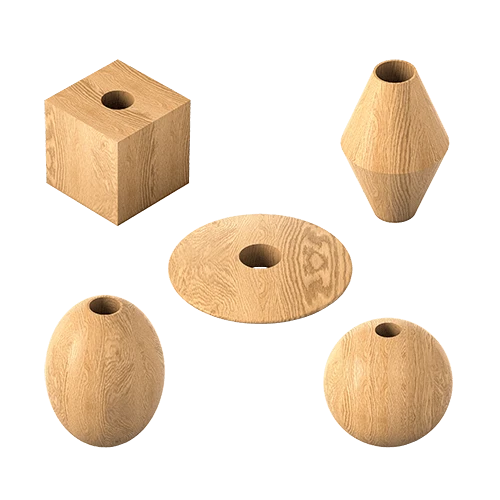
- How square balusters differ from turned and carved ones
- Form as philosophy
- Visual Weight
- Installation and maintenance practice
- Which stairs are suitable for square balusters: scenario analysis
- Straight single-flight staircase
- Staircase to the second floor in a country house
- Staircase with landing (two-flight)
- Railing for an open area or terrace
- Interior railings for mezzanines and galleries
- How to choose the size of a square baluster: four key parameters
- Parameter one: working height
- Parameter two: cross-section (thickness)
- Parameter three: tenon
- Parameter four: installation spacing
- Which wood to choose for square balusters
- Beech: precision, uniformity, flexibility in finishing
- Oak: texture, status, durability
- Solid wood: what it means and why it matters
- Moisture content: why 8–12% is not marketing, but a necessity
- Choosing the species: a quick decision matrix
- How to choose handrails and posts for square balusters
- Handrail: the shape that supports the geometry
- Handrail groove and baluster tenon: technical compatibility
- Posts: cross-section, shape, proportions
- Principle of unified geometry
- How many square balusters to buy
- Basic formula for a straight flight
- Accounting for posts
- Two balusters per step
- Landing
- Reserve
- Summary table: calculation examples
- Price of square wooden balusters: what determines the cost
- Wood species — the main pricing factor
- Cross-section and height
- Surface treatment
- Complexity of shape
- Order volume
- Estimated prices (2026)
- Mistakes when buying square balusters: learning from others' experience
- Mistake one: too thin balusters on a wide staircase
- Mistake two: handrail with a soft rounded profile with square balusters
- Mistake three: posts from a different style
- Mistake four: buying exactly as many as needed — without a reserve
- Mistake five: choosing only by photo, without measurements
- Mistake six: mixing square balusters from different manufacturers
- Mistake seven: ignoring material moisture
- Where to buy wooden square balusters: a practical guide
- STAVROS: square balusters and a complete set for a wooden staircase
- Frequently Asked Questions
- Where to buy square balusters for stairs?
- What type of stairs are square balusters suitable for?
- Which is better: square or carved balusters?
- Can I buy square balusters together with handrails and posts?
- What does the price of square balusters depend on?
- What cross-section of a square baluster should I choose for a standard staircase?
- Do I need a reserve when ordering balusters?
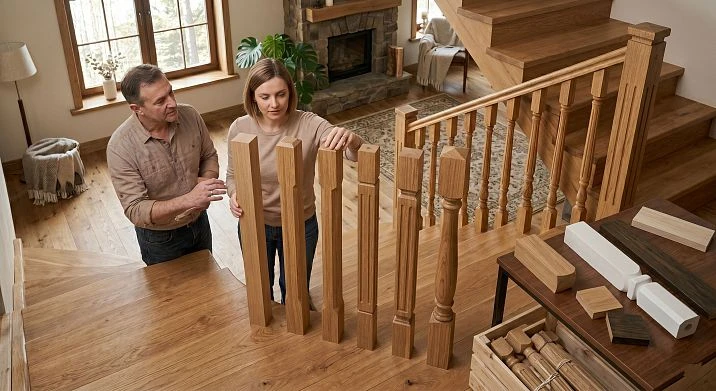
There are interiors where the staircase speaks softly — but speaks precisely. Without intricate curls, without ornamental pomp, without classical theatricality. Just clear vertical lines, strict geometry, a sense of order and confidence. That is the language of square balusters.
square balusters for stairs — this is not simplification, it is a choice. Conscious, stylistically mature. Such balusters are chosen by those who understand: beauty lies in proportion, not in the number of details. In this article, we break down everything: when the square shape is appropriate, which wood to choose, how not to make a mistake with size, handrails, and quantity. And — most importantly — how to make the purchase correctly, without unnecessary expenses and alterations.
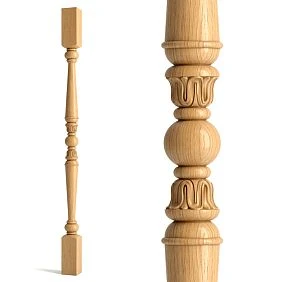
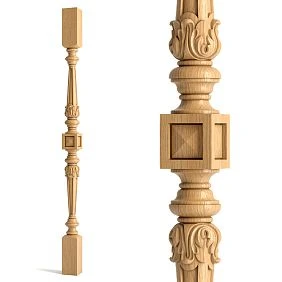
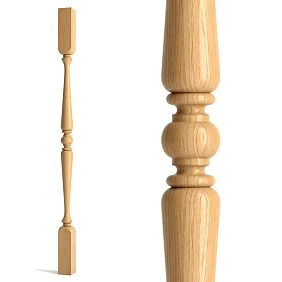
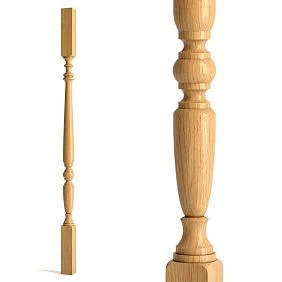
When square balusters are the right choice
There is no universally 'best' type of baluster. There is the right choice for a specific interior, a specific staircase, a specific character of the home. The square shape is organic where strictness, purity of lines, and geometric certainty are valued.
Modern house with laconic finishing
Light walls, open space, minimal decor, furniture with straight edges — in such a house, a staircase with square balusters looks like part of the overall concept. Round turned balusters would create dissonance: a soft form against the sharp angles of the interior. Square ones are a continuation of this language.
Our factory also produces:
Interior in high-tech, minimalism, loft style
In these styles, any decorative excess is an enemy. Square wooden balusters provide the warmth of natural material without ornamental overload. Wood softens the geometry, geometry disciplines the wood. Balance.
Get Consultation
House made of timber or glued laminated timber with an emphasis on the structure of the material
In a timber house, wood is the main character. Here, square balusters do not compete with the material but complement it: the same rectangular geometry, the same principle — beauty through form, not through decoration.
Strict classic without baroque pomp
Not every classic staircase requires carving. English style, Scandinavian classicism, restrained country — these are contexts where square balusters painted white or with light tinting look absolutely appropriate.
Fencing for terraces, balconies, platforms
Where fencing is primarily a functional element rather than a decorative accent, square balusters work perfectly: easy to install, reliable, do not collect dust in complex profiles.
How square balusters differ from turned and carved ones
Understanding the difference means making the right decision.
Form as philosophy
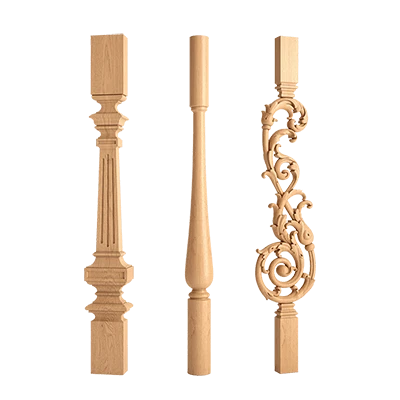
A turned baluster is movement. Its profile is built on alternating narrowings and widenings, on smooth transitions between diameters. It is dynamic even in stillness — the eye glides up and down it, following the curves.
A square baluster is stability. Constant cross-section along the entire height (or with minor changes at the base and under the handrail). The eye goes straight up. Nothing extra.
A carved baluster is complexity. Ornament, details, decor. It requires space for perception and an interior ready for such a conversation.
Visual weight
Square balusters with the same cross-section look more massive and dense than turned ones. This is not a flaw — it is a characteristic to consider when selecting. In a spacious hall or on a wide flight, square balusters look weighty and solid. In a narrow corridor, they can weigh down the space.
Installation and maintenance practice
Square balusters are easier to install: they are easier to align along the axis, easier to achieve a precise vertical position. The surface without complex profile is more convenient to process — the brush goes evenly, without needing to paint intricate recesses.
Which stairs are suitable for square balusters: scenario analysis
Straight single-flight staircase
The most common configuration in private homes. Square balusters on a straight flight create an even rhythm of verticals — clear, predictable, calm. They work especially well with a spacing of 150–160 mm: enough gap remains between balusters so the railing doesn't look like a solid fence.
Staircase to the second floor in a country house
A staircase in a country house is often the main visual object in the space. Square oak balusters with oil finish, a rectangular profile handrail, and 120×120 mm posts create a solid, reliable, 'grown-up' look. Without pretension, but with character.
Buy wooden balusters in a square design for a country house — a solution that won't go out of style in ten years.
Staircase with a landing (two-flight)
Here it's important that the balusters on the flight and on the landing are from the same batch — uniform tone, uniform cross-section, uniform appearance. Square wooden balusters for staircases are purchased for both flights plus the landing — in one order.
Railing for an open platform or terrace
Wooden square balusters for outdoor use require a moisture-resistant coating — exterior oil or weather-resistant varnish. Oak is preferable to beech in such conditions: it has higher natural moisture resistance. A terrace railing with square oak balusters under oil is a classic of country architecture.
Interior railings for mezzanines and galleries
Second-level railing — when balusters are placed not on a stair flight, but along the perimeter of an open floor. Here, square balusters work especially well: they create a clear vertical grid that does not overwhelm the perception of the open space below.
How to choose the size of a square baluster: four key parameters
Size is not "about the same as the neighbor's." Size is precise numbers that determine the reliability, safety, and appearance of the railing.
Parameter one: working height
Working height is the distance from the top plane of the step to the bottom plane of the handrail. This is the space the baluster body occupies, excluding tenons.
How to measure: vertically from the step surface to the lower edge of the handrail. Typically, this is 850–960 mm.
Important: the working height of the baluster may vary slightly on different steps of the flight due to installation tolerances. Measure at several points and take the maximum value.
Parameter two: cross-section (thickness)
For square balusters, this is the side of the square. Standard sizes: 40×40, 45×45, 50×50, 60×60 mm.
40×40 mm — lightweight, visually airy baluster. Suitable for railings of small platforms, low flights.
45×45 and 50×50 mm — universal sizes for most residential stairs. Good balance between visual weight and strength.
60×60 mm — for massive stairs with wide flights, grand railings, situations where emphasized monumentality is needed.
Practical rule: for a flight width up to 900 mm — section 40–45 mm. For a flight 900–1,200 mm — 45–50 mm. For a flight wider than 1,200 mm — 50–60 mm.
Parameter three: tenon
The lower tenon fits into the step or stringer, the upper one into the groove of the handrail. Standard for square balusters: lower tenon 32–40×50–60 mm, upper tenon 28–35×30–40 mm. When ordering, specify that the tenon dimensions match the groove of your handrail.
Parameter four: installation spacing
Center-to-center spacing — distance between axes of adjacent balusters. Standard range: 130–170 mm.
Clear spacing (distance between baluster faces) — no more than 150 mm for safe railing (requirement per norms for residential homes with children). With a 45×45 mm baluster and clear spacing of 120 mm — center-to-center spacing = 120 + 45 = 165 mm.
To create a feeling of a dense, solid fence — choose a clear spacing of 100–120 mm. For an airy, light look — 130–150 mm.
Which wood to choose for square balusters
Wood species is not just a material. It is the character of the product, its durability, behavior under coating, and ultimately, how the staircase will look in 15 years.
Beech: precision, uniformity, flexibility in finishing
Beech is a hard, dense wood with a uniform structure without a pronounced grain. Density 680–750 kg/m³. Due to its uniformity, beech accepts staining perfectly: the stain applies evenly, without spots or variations. Want a dark staircase in "wenge"? Beech will give an ideal result. White enamel? Beech will not show any spots through the paint.
Buy beech balusters In a square design — an optimal choice for staircases for painting, staining in any color, as well as for projects with a limited budget without sacrificing quality.
Service life: 25–30 years with proper coating.
Suitable for: staining, painting with enamel, stain + varnish.
Not recommended: for open outdoor areas without a protective canopy — beech is less resistant to constant moisture than oak.
Oak: texture, status, durability
Oak is a different story. Open porous structure, pronounced annual ring pattern, natural golden-brown tone. Density 720–800 kg/m³. Oak is richer in texture and heavier in weight.
Under clear oil or varnish, a square oak baluster reveals all the beauty of the wood: the pattern on the flat faces of the square is more visible than on the rounded surfaces of turned products. This is an argument in favor of the square shape made of oak.
Buy oak balusters — the choice of those who build a staircase once and for all. Oak ages beautifully: it darkens, gains depth of tone, and becomes only more expressive.
Service life: 50 years or more.
Suitable for: natural oil, clear varnish, light tinting while preserving the texture.
Advantage for outdoor use: oak contains natural tannins that increase its resistance to moisture and biological decay.
Solid wood: what it means and why it matters
Buy solid wood balusters — means purchasing a product from a single piece without gluing. For square balusters, this is especially valuable: on flat faces, a glue seam would be clearly visible. Solid wood is both aesthetics and structural reliability.
Moisture content: why 8–12% is not marketing, but a necessity
A raw baluster (moisture content 15–20%) will fit into the groove normally. But then it will start to dry out, shrink in cross-section, and develop play in the tenon joint. After a year — it wobbles. After two — reinstallation is needed.
Kiln drying to a moisture content of 8–12% is the only way to obtain a stable product that will not "move" after installation.
Wood species selection: quick decision matrix
| Task | Recommended Wood Species |
|---|---|
| White enamel, any paint color | Beech |
| Dark tinting "walnut", "wenge" | Beech |
| Open texture for oil finish | Oak |
| Outdoor railing | Oak |
| Grand staircase, natural tone | Oak |
| Budget option with decent quality | Beech |
How to choose handrails and posts for square balusters
A square baluster is a solo instrument. But a staircase is an orchestra. And for it to sound good, all parts must be in harmony.
Handrail: a shape that supports geometry
Square balusters pair well with handrails that have straight or nearly straight edges. Ideal options:
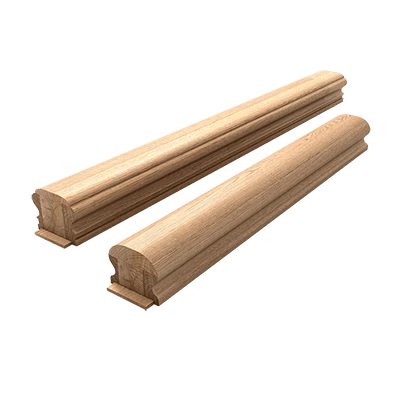
Rectangular handrail — flat top face, rounded or sharp bottom edges. Strict, simple, geometric. Width: 50–70 mm, height: 35–50 mm.
"Rail" profile — a handrail with a flat horizontal top and a teardrop-shaped bottom section. Combines grip comfort with a linear character.
D-shaped handrail — rounded, comfortable in hand. Slightly softer in character, but quite compatible with square balusters, especially for painting.
What definitely does not work: a handrail with a twisted, ornamental, or baroque profile. It will conflict with the geometric strictness of square posts.
Handrail groove and baluster tenon: technical compatibility
The width of the handrail groove on the bottom should match the size of the baluster's top tenon. For a 45×45 mm square baluster, the top tenon is usually 30–35 mm. Check with the manufacturer before ordering — this is a critical parameter.
buy balusters and handrails in one order from one manufacturer — guaranteed compatibility.
Posts: cross-section, shape, proportions
Posts for square balusters should support the overall rectilinear concept. Recommended options:
-
Square posts 100×100 or 120×120 mm without decoration — the most strict option
-
Posts with chamfers on edges — add a neat geometric accent without transitioning to a "carved" style
-
Posts with a small rectangular cap — concise and complete
Cross-section ratio: the post should be 2–2.5 times wider than the baluster. For a 45×45 mm baluster — a 100×100 or 120×120 mm post. For a 50×50 mm baluster — a 120×120 mm post.
Buy balusters and posts for a wooden staircase from one manufacturer — the right strategy: a single wood species, a single tone under the coating, a coordinated style.
Principle of unified geometry
Square baluster + rectangular handrail + square post = a geometrically connected ensemble. Each element enhances the other. This is not a coincidence — it is a principle that interior designers call "motif repetition."
handrails and balusters made of wood in a unified system — what turns a set of wooden elements into a railing with character.
How many square balusters do I need to buy
Calculating the quantity is an arithmetic task, but with a few nuances.
Basic formula for a straight flight
N = (L / S) − 1
Where:
-
L — horizontal length of the flight (mm)
-
S — center-to-center spacing (mm)
-
Result — number of balusters between posts
Example: flight 3,200 mm, center-to-center spacing 160 mm: N = (3,200 / 160) − 1 = 19 balusters.
Accounting for posts
Posts are separate elements, not balusters. They are not included in the N calculation. Standard layout: post at the start of the flight, post at the end, balusters between them.
Two balusters per step
For decorative or child-safe railings — two balusters per step. With 16 steps in a flight: 32 balusters. This creates a dense, reliable railing with minimal gap between posts.
Landing
Landing railing length (mm) / center-to-center spacing = number of landing balusters. Calculated separately from flights.
Reserve
For square balusters, the recommended reserve is 10%. If the calculated quantity is 40 pcs., take 44. Reasons: trimming of end balusters, possible defects during installation, need for angle adjustment at turns.
Summary table: calculation examples
| Configuration | Flight length | Step | Balusters per flight | 10% margin | Total |
|---|---|---|---|---|---|
| 1 flight, no landing | 3,000 mm | 160 мм | 18 | 2 | 20 |
| 1 flight + landing 1,200 mm | 3,000 + 1,200 mm | 160 мм | 18 + 7 | 3 | 28 |
| 2 marches, no platform | 2×2 800 mm | 150 мм | 18×2 | 4 | 40 |
Price of square wooden balusters: what makes up the cost
An honest talk about money. Not "cheap" and "expensive" — but a clear price structure.
Wood species — the main pricing factor
Beech is 30–60% cheaper than oak — depending on the product size. For 40 balusters, the difference can be 15,000–25,000 rubles. Balusters price — is primarily a choice of species.
Cross-section and height
The larger the cross-section and height, the greater the material consumption, the higher the price. The difference between a 40×40×900 mm and a 60×60×900 mm baluster is approximately 40–60% in cost.
Surface treatment
A baluster "for coating" (sanded, without final application) is cheaper. A baluster with factory primer or oil impregnation is more expensive. For most buyers, the basic "for coating" option is optimal: the final treatment is still done after installation.
Shape complexity
A plain square baluster is easier to manufacture than a square one with chamfers, inserts, or turned elements at the top and bottom. Accordingly, a simple shape is more affordable in price.
Order volume
Manufacturers typically offer better pricing for batches of 20–30 pieces. A single order for 3–5 balusters will cost more per piece. This is an argument in favor of calculating with a margin and ordering the entire batch at once.
Approximate prices (2026)
| Size | Species | Price per piece |
|---|---|---|
| 40×40×900 mm | Beech | 320–480 rub. |
| 45×45×900 mm | Beech | 380–560 rub. |
| 50×50×900 mm | Beech | 450–680 rub. |
| 45×45×900 mm | Oak | 600–900 rub. |
| 50×50×900 mm | Oak | 700–1,100 rub. |
For 40 square balusters made of beech 45×45 mm: 15,200–22,400 rubles. For the same volume of oak: 24,000–36,000 rubles. The difference is significant, but oak lasts many times longer.
Mistakes when buying square balusters: learning from others' experience
These errors occur regularly — and each one costs money, nerves, or rework.
Error one: too thin balusters on a wide flight
Balusters 40×40 mm on a flight 1,200 mm wide look like matches in a wide frame. Visual imbalance: the railing seems flimsy, even if it is actually strong. Rule: the width of the flight dictates the minimum cross-section of the baluster.
Error two: a handrail with a soft rounded profile paired with square balusters
A 'soft' handrail — and strict square balusters. This pair creates a feeling of incompleteness: as if the elements were chosen from different sets. Rule: for square balusters, choose a handrail with straight or geometrically defined edges.
Error three: posts from a different style
Square balusters — and turned patterned posts in the Baroque style. The stylistic difference is immediately apparent: the elements literally argue with each other. Rule: Wooden stair posts choose them in the same geometric logic as the balusters.
Error four: buying exactly as many as needed — without a reserve
Ordered 38 balusters, needed 40 (didn't account for the landing). Buy more — and the new batch from a different moisture group is slightly lighter. Under tinting, the difference is minimal, but under clear varnish, it is noticeable. Rule: always plus 10%, always from the same batch.
Error five: choosing only by photo, without measurements
A beautiful photo in the catalog. But the baluster size is 900 mm of the working part, while the staircase needs 980 mm. Or the cross-section looks large in the photo, but in reality it's 40×40 mm, which is too small for this staircase. Rule: photos are for inspiration, dimensions are for decision-making.
Error six: mixing square balusters from different manufacturers
Bought 20 balusters from one seller, 20 from another. They look similar. But the cross-section of the first is 44×44 mm, of the second is 46×46 mm. The spacing didn't match, the mounting holes don't align. Rule: the entire volume from one manufacturer, in one order.
Error seven: ignoring material moisture content
Bought balusters "cheap" without specifying moisture content. After six months — play in the joints, microcracks along the grain, darkening at the tenon points. Rule: only kiln-dried wood with 8–12% moisture.
Where to buy square wooden balusters: a practical guide
The market for wooden staircase components is a specialized market. Finding high-quality square solid wood balusters at a nearby hardware store is difficult: they typically have standard turned pine balusters in the low price segment.
For a proper purchase, you need a manufacturer that has:
-
Square balusters — a separate line with several cross-section and shape options
-
The breed is clearly indicated for each item, the humidity as well
-
Handrails and posts are matched with balusters in terms of groove dimensions
-
It is possible wooden balusters for stairs buy individually or in the required batch without a minimum order in packaging
-
The consultant helps with quantity calculation and selection of related elements
Ask questions before purchasing:
-
What is the humidity of a specific batch?
-
What are the dimensions of the tenons?
-
What is the groove of a standard handrail from your assortment?
-
Are these balusters compatible with your posts in terms of the fastening system?
Answers to these questions immediately show who you are dealing with — a professional manufacturer or a reseller of standard products.
For a proper installation, it is also important to correctly design the connections — details in the article about installing wooden railings and balusters and in the material about How to attach railings to balusters.
STAVROS: square balusters and a complete set for a wooden staircase
STAVROS is a Russian manufacturer of solid wood products. Specialization — components for wooden staircases: balusters of all shapes, support posts, handrails, under-rail strips, finials, fasteners.
In the STAVROS catalog — a separate line of square balusters for staircases in several cross-section and shape options: from clean square posts to square ones with chamfers and geometric accents. Beech and oak, kiln-dried, moisture content 8–12%, precise tenon dimensions coordinated with handrails and posts.
buy balusters with STAVROS — means doing it with a manufacturer who is responsible for the compatibility of all elements. buy staircase components — in one order: balusters, posts, handrails, fasteners, decorative overlays.
Permanent warehouse stock. Delivery across all of Russia. Professional consultation on quantity calculation and selection of elements for your staircase.
STAVROS — this is when the staircase turns out exactly as you envisioned it.
Frequently asked questions
Where to buy square balusters for a staircase?
In the STAVROS catalog — a line of square wooden balusters made of beech and oak in several cross-section options. Permanent availability, Contact us to confirm shipping to your destination., consultation on selection.
What staircase are square balusters suitable for?
For wooden staircases in private homes with modern or strict classic interiors, for staircases in timber houses, for fencing terraces and platforms. The square shape is especially good where geometric purity and conciseness are valued.
Which is better: square or carved balusters?
This is a matter of style, not quality. Square ones are stricter, more modern, easier to maintain. Carved ones are more decorative, more elegant, suitable for classic and baroque interiors. Buy carved wooden balusters It is worth it when the staircase should be the main visual accent. Square ones — when the staircase should organically fit into the interior without dominating.
Can I buy square balusters together with handrails and posts?
Yes, that's exactly right. balusters for staircase to buy Included with handrails and posts from one manufacturer — this guarantees size compatibility, a unified style, and the same tone under the coating.
What determines the price of square balusters?
It depends on the wood species (beech or oak), cross-section (40×40, 45×45, 50×50, 60×60 mm), height, surface treatment option, and order volume. A large batch from one manufacturer is always more profitable than buying individually.
Which cross-section of a square baluster should I choose for a standard staircase?
45×45 mm is a universal choice for most residential staircases. For a flight width up to 900 mm, it's sufficient. For a wide flight from 1,000 mm, consider 50×50 mm.
Do I need a reserve when ordering balusters?
Always — 10% above the calculated quantity. This is insurance against installation errors, the need for trimming, and possible discrepancies in counting.