








































































Article Contents:
- Main fork: flat decor on a column or decor that follows the radius
- Project one: NPU-157 remains flat
- Project two: decor should go directly along the radius
- Can NPU-157 be glued directly onto a round column?
- Is NPU-157 flexible because it is made of polyurethane?
- What sizes of NPU-157 are available?
- What size is best for a column?
- Can the NPU-157 be bent by hand during gluing?
- What to do if the center of the NPU-157 touches the column, but the edges pull away?
- Can a flat platform be made specifically for the NPU-157?
- How to check the platform size before ordering?
- What is better for a thin round column?
- Will the large NPU-157 500 × 379 mm fit a column?
- Can the NPU-157 be installed on a half-column?
- And on a multi-faceted column?
- Can two NPU-157s be used on opposite sides of a column?
- Do you need four overlays for a freestanding column?
- Can NPU-157 be installed without a molding frame?
- When is molding needed around NPU-157?
- Can the molding be continued from a flat area around a round column?
- How does flexible molding differ from NPU-157?
- Can flexible molding and NPU-157 be combined?
- What to do if you like the acanthus pattern specifically, but NPU-157 is not suitable?
- Is NPU-157 suitable only for columns?
- Can NPU-157 be used on a radius wall with a large radius?
- Is it necessary to know the exact radius of the column?
- Can the voids behind the edges of NPU-157 be filled with mounting adhesive?
- What adhesive is needed for NPU-157?
- What should be checked before purchasing NPU-157?
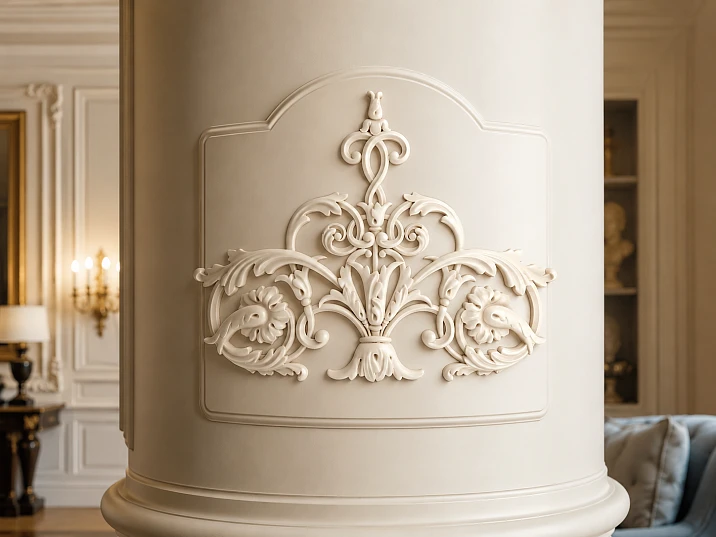
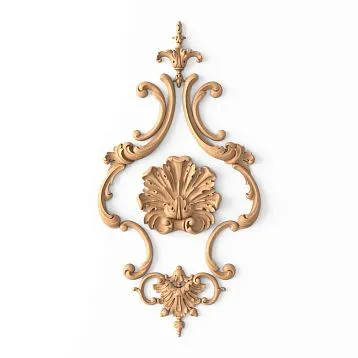
There is already a round column in the interior — structural or decorative, noticeable, and clearly visible from all sides. You want to add a classic relief to it, and your eye stops at the carved central decorative overlay NPU-157 made of polyurethane. The ornament fits, two sizes allow you to choose the scale, but before ordering, a question arises that is more important than color and pattern: will a regular NPU-157 lie on a cylindrical surface, or does it still need a flat area?
Let us immediately state a safe selection principle. NPU-157 cannot automatically be considered flexible just because it is made of polyurethane. For this specific overlay, no allowable bending radius is declared, there is no indication of a flexible version, and there is no basis to promise the buyer that the finished carved piece can be wrapped around a round column without consequences. Therefore, for a regular NPU-157, it is reasonable to assume installation on a suitable flat or nearly flat surface, and evaluate the curved base separately.
This does not mean that the carved overlay and a round column are incompatible. On the contrary, there are several options. The column may have a flat decorative insert. The overlay can be placed on an adjacent straight section. Sometimes the column architecture is specially designed so that the central carved element is on a local flat surface, and the radius around it is decorated with other decor. If the task is specifically to make the decorative line follow the cylinder, a different principle is needed — for example, flexible moldings for radius walls and columns, designed to work with curved geometry.
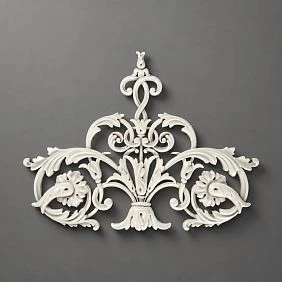
NPU-157 has two confirmed sizes: 250 × 190 × 11 mm and 500 × 379 × 21 mm. In the current catalog listing, the price starts from 2,240 ₽. Size here has a dual meaning. It determines not only how noticeable the ornament will be, but also how demanding the overlay will be regarding the geometry of the base. The wider the piece is attempted to be applied to a cylinder, the more the surface curvature manifests at its edges.
Therefore, before buy carved overlay NPU-157, first you need to research not the catalog, but the column itself: its diameter, available width, finish shape, and the ability to form a flat platform.
Main fork: flat decor on the column or decor that follows the radius
A round column has a feature that a regular wall does not. On a wall, a decorative overlay meets a flat surface. On a column, it meets an arc.
While the overlay is small and the column diameter is very large, the curvature over a small area may visually seem almost imperceptible. But "almost flat" and "flat" are different installation conditions.
Imagine a book being pressed with its cover against a large cylinder. The center touches the surface, while the edges start to pull away. The smaller the cylinder, the more noticeable the gaps. The wider the book, the larger they become.
With a decorative overlay, the problem is fundamentally similar. Only instead of a simple flat cover, we have a relief ornament of a certain thickness and shape.
Hence two different projects.




Project one: NPU-157 remains flat
A sufficiently flat platform is created on the column or already exists. The overlay is installed without attempting to forcibly follow the cylinder.
This is the most understandable logic for using NPU-157.
Our factory also produces:
Project two: the decor should go directly along the radius
In this case, one cannot assume that a regular NPU-157 can simply be bent by hand and glued on.
An element is needed that is structurally designed to work on a curved surface, or a specially designed solution.
These two scenarios look similar externally — in both cases we are decorating a column. Technically, they are completely different.
Get Consultation
What exactly is NPU-157
NPU-157 is a carved central decorative overlay made of polyurethane. The central nature of the shape is important for the interior composition: the piece can be aligned along the axis of a panel, a wall section, a door, a furniture facade, or a specially prepared section of a column.
The product exists in two sizes.
| Parameter | NPU-157, smaller size | NPU-157, larger size |
|---|---|---|
| Type | Carved central decorative overlay | Carved central decorative overlay |
| Material | Polyurethane | Polyurethane |
| Size | 250 × 190 × 11 mm | 500 × 379 × 21 mm |
| Width by main dimension | 250 мм | 500 мм |
| Second overall dimension | 190 мм | 379 мм |
| Thickness | 11 мм | 21 мм |
| Ornament | Acanthus | Acanthus |
| Category | Central overlays | Central overlays |
| Confirmed application | Walls, furniture, doors | Walls, furniture, doors |
| Declared flexible version | Not confirmed | Not confirmed |
| Declared minimum bending radius | Not specified | Not specified |
| Logic for round column | First, the flat area is checked | Requires particularly careful area inspection |
| Price | In the current search results, the product is shown from 2,240 ₽ | The current price for the selected size should be checked in the product card |
None of these sizes should be perceived as "small flexible decor" or "large flexible decor." The scale of NPU-157 differs, but the purpose remains decorative.
If you need to compare NPU-157 with other products of the same type, you can buy central polyurethane overlays after checking suitable dimensions and patterns.
Why the word "polyurethane" does not yet mean that any molding can be bent
A common logical error arises here.
The buyer knows that flexible polyurethane profiles exist. Then they see a carved polyurethane overlay and conclude: "The material is the same, so the overlay will also bend a little."
But the choice of a decorative product cannot be based solely on the material name.
The shape of the part is no less important.
A thin linear profile and a wide carved overlay work completely differently.
For molding, the length is significantly greater than the width, and the cross-section repeats along the entire line. Therefore, for special flexible versions, controlled bending can be calculated.
NPU-157 has a large decorative surface with an ornament. The central part, leaves, curls, edges, and areas of varying thickness all work together.
Attempting to bend such a shape means that different zones must change their geometry unevenly.
Without a manufacturer-declared capability for such deformation, it cannot be planned.
So the rule is simple:
we take the material into account, but make the decision based on the specific product.
If the product does not specify a radius and no flexible modification is declared, we do not turn an experiment into the basis of a project.
What happens when a flat overlay is applied to a round column
Imagine a cylindrical column.
A template 250 mm wide is applied to its front part.
The most central zone touches the surface. As it moves toward the left and right edges, the column curves backward along an arc, while the flat template continues straight.
Side gaps appear.
With a size of 500 mm, the effect is even stronger.
This is the first problem—geometric.
The second is installation-related. If the back surface of the decorative element must have proper contact with the base, large unplanned voids at the edges can no longer be ignored.
The third is visual. Even if one tries to secure the center in some way, the receding edges will reveal the shape mismatch.
The fourth is structural for the decor itself. Attempting to forcefully press the edges against the column means forced bending of the product, the feasibility of which for NPU-157 has not been confirmed.
Therefore, the question "will it stick?" should be replaced with a more precise one:
"Does the geometry of the back surface of NPU-157 match the surface onto which we want to install it?"
If not, first change the platform or concept.
The small NPU-157 does not automatically become suitable for a cylinder.
The size 250 × 190 × 11 mm is indeed more convenient for local decorative tasks than the 500 × 379 × 21 mm option.
But this does not give the right to consider it flexible.
A smaller width only means that on a large-diameter column, the difference between the plane and the arc over a 250 mm section may be less pronounced than over a 500 mm section.
How much less?
This depends on the column diameter.
On a very large column, a small central sector is visually closer to a plane.
On a thin column, even 250 mm covers a significant part of the circumference.
Therefore, the recommendation "take the small NPU-157 for a column" is insufficient by itself.
Need to know the diameter.
The large NPU-157 500 × 379 mm requires even more free surface area.
The large version creates a completely different scale.
Half a meter in one dimension is already a significant decorative field.
On a regular wall, such an element can become a large central accent. On a round column, it will require either a truly large flat area or a very large architectural form where the local curvature in that section is small.
But even a large column does not eliminate the need for verification.
The 500 × 379 mm template needs to be applied at full scale.
Not a printout at 1:10 scale.
Not an image on a phone.
Not a mental estimate.
It is precisely the physical template.
The large overlay also has a thickness of 21 mm, so its relief and side profile are visually more noticeable. If the edges do not sit on the base, the gap will be perceived even more clearly.
Make a template before purchasing — this is the most useful test
For NPU-157, you can prepare two paper or cardboard mock-ups:
-
250 × 190 mm;
-
500 × 379 mm.
First, only the external dimension is needed.
Apply the template to the column in the place where you want to see the decor.
Do not press the edges with force.
Look at how much the column surface "runs away" from the plane of the template.
For a more visual check, use thick cardboard that maintains a flat shape.
If the center touches the column and the side edges noticeably hang in the air, a regular flat installation of NPU-157 on this area requires different base preparation.
After that, look at the scale.
It may turn out that a geometrically small option can still be placed on the prepared site, but visually it gets lost.
Or vice versa: a large NPU-157 is impressive, but the site for a half-meter piece completely changes the character of the column.
The template answers two questions at once—technical and design-related.
How to determine if there is a suitable flat area on the column
Not every round column has to remain round around its entire circumference.
In interior projects, you may encounter:
-
cylindrical shafts;
-
half-columns;
-
columns with decorative panels;
-
supports partially embedded in the wall;
-
square or rectangular inserts on a round base;
-
pilaster sections;
-
columns with local flat medallion fields.
If such a platform is already provided, NPU-157 can be assessed as a regular wall-mounted overlay: size, proportions, and surface quality matter.
If there is no platform, a separate design question arises: should it be created specifically for this overlay?
Sometimes yes.
For example, the column plays a prominent classical role, and a small flat decorative insert fits organically into the overall concept.
Sometimes no.
If the interior is based on a pure cylindrical form, a rectangular or oval flat addition can destroy its lightness.
The product should not force the architecture to do what does not suit it.
Flat insert on a column: when it looks natural
The flat platform should be perceived as part of the architecture, not as a construction patch under a decorative overlay you liked.
A good situation:
the column has a pronounced base, shaft, and capital; a decorative field is provided in the central zone; NPU-157 becomes its ornamental center.
Bad situation:
a thick rectangular block is suddenly attached to a smooth modern cylinder only because otherwise the carved overlay does not hold.
In the first case, the architecture explains the plane.
In the second, the plane is explained only by the purchase of decor.
The difference is noticeable.
Therefore, first design the shape of the platform, even if NPU-157 has already been chosen.
What size platform is needed
You should not make a flat field exactly matching the outer dimensions of the overlay.
Then the edge of the platform and the edge of the ornament will almost coincide, and any slight deviation will become noticeable.
It is advisable to leave visual space around NPU-157.
The exact size of this field depends on the project, so inventing a universal margin in millimeters without knowing the column would be incorrect.
But the principle is clear:
the platform should be larger than the decorative element and be perceived as an independent architectural field.
For NPU-157 250 × 190 mm, a compact central area is needed.
For the 500 × 379 mm version, the flat zone will be significantly larger and may become one of the main details of the column.
A half-column offers more possibilities than a fully round support
A half-column protrudes from the wall, meaning its architectural connection to the plane is already stronger.
In some projects, the central decorative element can be tied to the straight wall behind it or a frontal platform can be formed more naturally than on a freestanding cylinder.
But even here, the front part of the half-column cannot be considered flat if it is semicircular.
The shape remains curved.
Therefore, the template check remains.
In some cases, a better solution would be not NPU-157 on the actual radius, but an overlay on the flat section between the half-column and adjacent decor.
A column with facets is a different task
Not every column that appears round from a distance is a perfect cylinder.
There are polygonal supports.
If one facet is wide enough, it already provides a flat base.
Then the question of bending disappears, but the question of size arises.
For example, the width of the face is 220 mm.
NPU-157 with a size of 250 mm along one dimension may extend beyond its limits.
So, formally, a flat base does not yet guarantee a fit.
Need to measure:
-
the width of the face;
-
the height of the free zone;
-
adjacent edges;
-
the position of other decorative elements.
A radius wall and a round column are similar only at first glance.
Both surfaces are curved.
But the nature of the curvature can vary greatly.
A radius wall with a large radius sometimes bends so gently that over a short section it appears almost straight.
A small-diameter column produces a much more pronounced arc.
Therefore, the phrase "the overlay fit on the radius wall" does not prove its suitability for another column.
Each surface must be evaluated independently.
It is precisely for projects where a decorative profile must follow a curve that it is useful to study in advance flexible moldings for radius walls and columns. There, the task itself is formulated differently: not to attach a flat medallion, but to run a profile along a curve.
When a flexible molding is needed instead of NPU-157
Suppose a customer likes the classic idea of column decor, but a flat platform is not needed.
The column should remain round.
Then you can abandon the large central overlay and work with lines.
A flexible molding can:
-
decorate a horizontal belt;
-
emphasize the upper part of the shaft;
-
create a decorative ring;
-
divide the column by height;
-
continue the line from the wall onto a curved surface;
-
decorate a half-column.
This is a different aesthetic.
NPU-157 — central ornament.
Flexible molding — an extended line.
They are not interchangeable, but each better solves its own geometric task.
Can NPU-157 and flexible decor be combined in one project?
Yes, and this very option may turn out to be the most interesting.
Let's imagine a large column.
A flat decorative field is formed on its front side.
In the center — NPU-157.
Above and below, thin horizontal molding lines wrap around the cylinder.
The result is a clear architectural hierarchy:
-
The central overlay acts as an ornament;
-
The flexible profile emphasizes the radius;
-
The column itself retains its cylindrical character.
This way, the NPU-157 doesn't have to be bent.
Each element performs the task for which it is chosen.
Small and large NPU-157: comparison for the column
| Criterion | 250 × 190 × 11 mm | 500 × 379 × 21 mm |
|---|---|---|
| Visual scale | Local accent | Large central ornament |
| Required free space | Relatively compact | Significant |
| Sensitivity to column curvature | Lower than the larger version, but verification is required | Higher due to large width |
| Suitable for a slender column | Only after verification; not automatically considered suitable | Usually particularly difficult to place without a large platform |
| Suitable for a massive column | May look delicate | May match the scale |
| Thickness | 11 мм | 21 мм |
| Role in the composition | Complementary | Can become the main decorative center |
| Need for a paper template | High | Very High |
| Attempt to bend along a cylinder | Do not plan without confirmation | Especially do not plan |
| Flat platform | Most understandable scenario | Practically a key question of choice |
The main idea of the table: a large option is not just "twice as effective." It requires a fundamentally different architectural environment.
NPU-157 with acanthus ornament: style also influences the choice of placement
NPU-157 belongs to the category of overlays with acanthus ornament.
Acanthus relief is traditionally perceived as an expressive plant motif. It is better revealed when there is enough calm background around the ornament.
If a large NPU-157 is pressed against adjacent moldings, edges, or a capital, the decorative pattern will lose clarity.
Therefore, the question of a flat surface is not only technical.
It is also a question of "air" around the carving.
If you need exactly this character of the plant motif, you can overlays with acanthus ornament to buy after comparing NPU-157 with other sizes and shapes.
Sometimes a smaller acanthus element will be more precise for the column.
Where to place the central overlay on the column
If a flat field is provided, the question of height remains.
Too low — the ornament will be perceived almost as furniture decor.
Too high — the connection with eye level and the overall wall composition will be lost.
There is no universal height.
You need to look at:
-
the room height;
-
the height of the column itself;
-
the position of the capital or upper termination;
-
the plinth or base;
-
adjacent doorways;
-
molding belts;
-
furniture;
-
the level of other wall decorative elements.
The main thing is not to place NPU-157 exactly "in the middle by meters" automatically.
The geometric center of the trunk and a visually convincing point may not coincide.
One NPU-157 or several around the column
On a freestanding column, there is a temptation to repeat the overlay on all sides.
Four sides — four NPU-157.
But a round column has no sides as such.
To create a repeat, you will have to artificially form several flat platforms around the circumference.
This already significantly changes the architecture.
For a large ceremonial support, such a solution can be designed specifically.
For a small interior column, four large overlays can make it heavy.
It is often wiser to choose one main front side — the one visible from the main entrance direction or from the main area of the room.
If the column is equally visible from all directions, it is better to consider whether a flat central decor is needed at all, or whether it is more natural to shape the radius with moldings.
Two opposite overlays: a compromise for a pass-through column
Sometimes a column separates two functional zones.
For example, a kitchen-living room.
On one side it is seen from the dining area, on the other — from the living room.
Then two opposite flat platforms can have architectural meaning.
But both must be verified:
-
same height;
-
same size NPU-157;
-
same orientation;
-
coordinated finish.
If a large NPU-157 is used on one side and a small one on the other without a design reason, the column will lose its integrity.
What happens if you still try to press the edges to the radius
Such an experiment should be excluded at the design stage.
The logic of "it will bend a little" is dangerous precisely because of uncertainty.
How much is a little?
At what radius?
What will happen to the relief?
Will the back side remain in normal contact?
Will internal stress arise?
Since there are no confirmed answers for NPU-157, forced bending cannot be assumed as standard installation.
The buyer must make a decision before payment, not check the product's properties on an already finished column.
Curvature cannot be compensated with a thick layer of adhesive.
There is another tempting idea.
If the edges do not fit, the void can be "filled" with mounting compound.
But the adhesive layer should not become a substitute for a geometrically suitable base.
The more noticeable the gap, the less this scheme resembles a proper fit of a decorative trim.
The issue must be resolved through the platform architecture, not by attempting to fill an undefined cavity.
When choosing a compound for a properly prepared base, it is useful to study in advance adhesive for polyurethane molding. But good adhesive does not fix incorrect geometry.
The flat area must be truly flat.
Sometimes the builder says: "We leveled it."
The buyer applies a ruler — the area still slightly follows the cylinder.
For a small decorative element, this may be sufficient or insufficient depending on the actual shape.
Therefore, before installation, a rigid straight edge or template is applied.
The contact is checked.
Especially at the edges of the future NPU-157.
If the base noticeably recedes, the issue is not resolved.
The larger the selected overlay, the stricter this check.
A recess in the column surface is more interesting than a protruding platform.
The flat zone can not only be built up.
In the decorative shell of a column, a shallow frontal field or niche is sometimes designed.
The NPU-157 is placed inside it, while the external round shape is preserved on the sides.
This option looks architecturally thinner, but it must be planned at the stage of manufacturing the shell or finishing the column.
If the column is already finished, redoing it for a single overlay may prove unjustifiably complex.
Then it is better to choose a different decor.
A finished column after renovation: is it worth redoing it at all for the NPU-157
Let's imagine the most realistic scenario.
The renovation is complete.
The column is painted.
She seems a bit empty.
NPU-157 is very appealing.
But there is no flat area.
Do we need to build a new decorative panel over the finished cylinder just for this detail?
The answer depends on the scale of the task.
If the column is truly the main architectural center of the room and its design has long seemed unfinished, the project is justified.
If it's only about the desire to use a trim piece you like, it's wiser to keep the column and choose decor that matches its geometry.
Design should not start with the phrase "where to put an already chosen item."
It starts with the surface and the task.
Column under construction: the best moment to plan NPU-157
If the finishing is not yet complete, there are many more possibilities.
You can in advance:
-
determine the main side;
-
choose the NPU-157 size;
-
make a template;
-
calculate the field;
-
form a flat insert;
-
align it with the base and top of the column;
-
provide for adjacent molding lines;
-
after that, finish the trim.
Then NPU-157 does not look like a late applique.
It becomes part of the original architecture.
It is at this stage that it is especially useful in advance Decorative elements for the wall made of polyurethane to consider them not as separate beautiful products, but as elements of a system.
A round column in a classic interior
Classical architecture readily accepts decorative articulation.
A column may have a base.
Shaft.
Upper termination.
Bands.
Ornamental fields.
Therefore, the local flat insert with NPU-157 here has a clear stylistic explanation.
Especially if the acanthus motif is already repeated in other details of the room.
But it is not necessary to repeat it everywhere.
One noticeable element is often enough.
Neoclassicism: less is more, but more precise
In a neoclassical interior, large acanthus decor needs to be dosed more carefully.
If the room is built on calm molding frames and clean surfaces, a small NPU-157 250 × 190 mm can become the only ornamental center of the column.
A large 500 × 379 mm one will noticeably change the character of the space.
Therefore, a full-size mockup is especially useful here.
While the element exists on the screen, it seems that 500 mm is not that much.
Half a meter of carved ornament on a column is perceived differently.
Modern interior with a round column
In modern layouts, the column is often left as minimalist as possible.
Its form itself is an architectural gesture.
Adding acanthus NPU-157 will create a deliberate stylistic contrast.
It can be interesting, but it must be intentional.
If the entire apartment is based on minimalism and smooth surfaces, a single classical medallion on the cylinder can look random.
In that case, it is better to keep the column clean or use more subdued linear decor.
Large hall and grand column
This is where a large NPU-157 achieves its most natural scale.
High ceilings.
Wide passages.
Large supports.
Significant perception distance.
In such a space, the 250 × 190 mm version may seem too delicate, while 500 × 379 mm may match the architecture.
But even a large column retains a round shape.
The scale allows for large ornamentation but does not eliminate the need for a flat base.
Narrow corridor and half-column
In a cramped space, a person passes close to the decor.
The 21 mm depth of the large version becomes visually noticeable.
A large acanthus ornament is visible almost point-blank.
Therefore, a smaller NPU-157 or another compact element is often more interesting.
If the semi-column has a small radius, the fitting issue becomes even more complicated.
In such a situation, the catalog polyurethane decorative overlays is useful primarily for finding a different scale.
A column next to a door portal
When a column is directly next to a door, its decor cannot be chosen separately.
NPU-157 must correlate with:
-
the door height;
-
with the architraves;
-
the upper completion of the portal;
-
with adjacent moldings;
-
with ornament on the door leaf.
If there is already large carved decor nearby, a big NPU-157 may create competition.
A small one can support the motif.
Or vice versa: on a large grand column, a small element will get lost next to a massive portal.
Therefore, we measure not only the column.
We measure the surroundings.
Column next to furniture
NPU-157 can also be used on furniture, so the same decorative language can theoretically link architecture and interior items.
But repetition should be moderate.
If a large NPU-157 is on a column, and the exact same element is repeated on each cabinet door, the ornament may lose its accent status.
Sometimes it's better to use a related motif of a different scale.
This is why you need to browse the category, where you can Buy decorative polyurethane overlays and compare several items.
How to combine NPU-157 with moldings
The central overlay works especially well when there is a clear frame architecture around it.
On the flat surface of the column, you can provide:
-
a central NPU-157;
-
free space around it;
-
a thin frame;
-
transition to the radius section.
If the frame should only go along the flat area, a regular straight profile will suffice.
If the line should continue around the cylinder, the project already involves curved decor.
Therefore buy polyurethane moldings follows after understanding where the straight sections are and where the radius begins.
Can a frame be made around NPU-157 on a round column
If the frame is rectangular and itself is on a flat surface — yes, the geometric idea is clear.
If you want to "wrap" a rectangular frame around a cylinder, a regular straight molding already faces the same problem as the overlay.
The surface curves along an arc.
Therefore, straight and radius sections need to be separated.
Do not mix two geometries in one element without prior design.
What to buy together with NPU-157
The accompanying elements depend on the selected scenario.
If the column receives only one flat decorative insert, perhaps nothing more is needed.
If the project is built wider, central overlays, moldings, and overall wall decor appear.
| What to consider | For which task | When it makes sense | Link |
|---|---|---|---|
| NPU-157 | Main carved ornament | There is a suitable flat surface | buy carved overlay NPU-157 |
| Central overlays | Find another scale or shape | NPU-157 does not fit in size | buy central polyurethane overlays |
| Overlays with acanthus ornament | Keep the plant motif at a different size | Like the acanthus, but not the specific dimensions of NPU-157 | overlays with acanthus ornament to buy |
| Decorative overlays | Expand the selection of individual decor | Need a different geometry | Buy decorative polyurethane overlays |
| Moldings | Make a frame or linear division | There are straight sections around the overlay | buy polyurethane moldings |
| Flexible molding | Work specifically along the radius | The line should follow the column | flexible moldings for radius walls and columns |
| General wall decor | Connect the column with adjacent surfaces | The project extends beyond a single part | Buy polyurethane wall decor |
| Stucco decor | Assemble a broader system | Several architectural zones are being defined | You can buy ready-made stucco matching the Baroque style. Calculate the quantity: linear meters of cornices and moldings, number of rosettes, pilasters, consoles, corner elements. Add a ten to fifteen percent allowance for trimming. |
| Mounting solution | Secure the decor on a suitable base | After site inspection | adhesive for polyurethane molding |
The point of the table is not to assemble the maximum set. Sometimes the best order is a single NPU-157.
NPU-157 or another central element
The buyer may become so accustomed to the chosen article that they start reworking the column to fit it.
This is the wrong order of priorities.
First the surface.
Then the available field.
Then the scale.
And only after that, the specific product.
If 250 × 190 mm doesn't fit, and 500 × 379 mm is even more impossible to place, the idea of a central overlay remains, but NPU-157 ceases to be the only candidate.
In the category you can buy central polyurethane overlays of a different scale.
NPU-157 or only moldings
Here, the choice is between an ornament and an architectural line.
NPU-157:
-
creates a specific central motif;
-
attracts the eye;
-
requires space around itself;
-
works better on a flat surface.
Molding:
-
forms a line;
-
can split a column;
-
in flexible execution, can follow curvature;
-
not
Mistake #8: decorate only one side where the column is visible from all sides
Sometimes this is normal — if there is a main direction of perception.
But if the support stands in the center of the room and is walked around, the sharp contrast between the decorated front side and the empty back side requires explanation.
Perhaps it is better to use circular linear decor.
Mistake #9: repeat NPU-157 too many times
Four large acanthus overlays around one support can overload it.
The repetition should be calculated, not based on the idea of "the same on all sides".
Mistake #10: not taking into account the neighboring decor
The column does not exist separately from the room.
If there is a complex cornice, ornamental doors, carved furniture, and wall panels nearby, another large motif may be superfluous.
Mistake #11: mixing acanthus with unrelated ornaments
The NPU-157 itself has a pronounced decorative character.
If geometric Art Deco, another floral pattern, and several unrelated motifs are used nearby, the column becomes a collection of different languages.
It is better to choose one line.
Mistake #12: deciding the installation issue after purchase
This article's topic exists precisely for the reverse order.
Before ordering, you need to understand:
- plane or radius;
- platform size;
- NPU-157 size;
- method of combining with adjacent decor;
- base preparation.
After purchase, the solution should remain executable, not a search for a way to save an incompatible part.
Practical scenario: thin round column in an apartment
The column has a relatively small diameter.
The owner likes NPU-157 250 × 190 mm.
First test — cardboard template.
If it is already noticeable on it that the edges go far from the surface, you should not place a carved overlay directly on the cylinder.
There are three ways.
The first is to abandon the central medallion and use a flexible line.
The second is to form a small frontal platform, if it matches the style.
The third is to move NPU-157 to the adjacent flat wall, and decorate the column with a connected molding.
Often the third option is the cleanest: the favorite ornament is preserved, and the geometry is not broken.
Practical scenario: a massive column in a large living room
The diameter is significant.
The shaft is wide.
The column is perceived almost as a separate architectural wall.
Here, the small NPU-157 can get lost.
The large 500 × 379 mm one already looks more logical in scale.
But before ordering, a flat template is used again.
If the curvature is noticeable on a half-meter section, a special frontal field is formed.
The large size requires especially careful connection of the platform with the base and top of the column.
Practical scenario: half-column against a wall
Here, you can build a composition together with the wall.
For example, a rectangular molding panel on the wall visually continues toward the half-column, and the NPU-157 is placed on a flat section nearby.
It is not necessary to place the overlay directly on the radius just because the project theme is a column.
Sometimes it is more correct to make it part of the overall framing.
Practical scenario: a column between the kitchen and the living room
The support is visible from both sides.
If one NPU-157 is created, the main direction needs to be determined.
If both directions are equal, two identical platforms are possible.
But before doubling the decor, look at the column in the plan.
Will it not become visually too massive?
In a small open space, two large medallions can change the perception of the support more than expected.
Practical scenario: a classic hall with several columns
When there are two or four columns, it is no longer a single decorative point but a system.
If NPU-157 is used on each, the height, size, and orientation must be repeated.
You cannot choose 250 mm on one support and 500 mm on the adjacent one without an architectural reason.
The series requires strict discipline.
But it is precisely repetition that can make the interior feel cohesive.
Practical scenario: the column is already painted and you don't want construction work
Then the main criterion is minimal intervention.
If there is no suitable flat area, creating a complex addition after final finishing may be impractical.
It's better to move to decor that works with the existing form.
In this scenario flexible moldings for radius walls and columns deserve attention before attempting to adapt NPU-157.
Practical scenario: the decorative column cladding is not yet done
The best time for NPU-157.
You choose the size before the surface is even formed.
A field is designed underneath it.
Under the field — the overall plasticity of the shell.
Moldings and other lines are tied to the same axis.
As a result, there is neither a random protrusion nor a compromise fit.
Practical scenario: you want acanthus, but NPU-157 doesn't fit.
The task is formulated correctly: what's needed is not a specific part number at any cost, but an acanthus motif.
Then you can overlays with acanthus ornament to buy after choosing a more suitable size.
This preserves the stylistic idea without fighting the geometry.
How to prepare the base for NPU-157
Once the flat area is determined, its condition becomes the next filter.
The surface must be suitable for decorative installation.
Do not glue the overlay over a layer that itself adheres poorly.
Need to check:
- evenness;
- strength;
- absence of peeling coatings;
- cleanliness;
- axis position;
- actual field size;
- ability to press the overlay normally against the surface.
The mounting compound itself is selected after this check.
First fitting, then painting
If the NPU-157 and the platform are to be painted in one color, there is a temptation to finish all painting work and only then apply the decor.
It is better to confirm the composition first.
The actual overlay has not only an external rectangular footprint.
It has a shaped contour.
It can visually occupy the field quite differently than a simple paper rectangle.
Therefore, the verification scheme is two-stage:
- paper template before ordering;
- fitting the actual part before final installation and finishing.
NPU-157 in column color
The calmest option.
The relief is read through light and shadow, not color contrast.
This is especially useful on a large column, where the carved form itself is already quite noticeable.
A monochromatic solution also helps to unify the flat platform with the cylindrical part.
If the boundary of the platform is executed neatly, the entire structure can be perceived as a single architectural form.
Contrast NPU-157
Contrast makes the flat insert even more noticeable.
This needs to be taken into account.
If the platform stands out through geometry, and the overlay itself also through color, two levels of accent appear on the column at once.
Such a technique may be justified in a formal interior.
In a calm room, it can draw all attention to itself.
Therefore, it is better to check the color in a visualization after choosing the size.
Small or large: we focus on the viewing distance
NPU-157 250 × 190 mm is well readable at close and medium distances.
500 × 379 mm is designed for a much larger visual presence.
If the column stands in a small living room and a person is constantly two meters away from it, large carving may be perceived as excessive.
If the support is visible through a large hall, the small version may get lost.
The correct size is determined not only by the column's centimeters, but also by the space around it.
Do you need to use NPU-157 on every column
If the room has a row of identical supports, the choice should be systematic.
You can make one column accent and leave three identical empty ones if the first one is truly an accent — for example, marking the entrance area.
If all supports are equal, the difference requires a reason.
It is often better to repeat the same technique across the entire group, but make the decor more restrained.
NPU-157 as a separate accent without moldings
The central overlay does not have to be inside the frame.
On a sufficiently large flat field, it can work on its own.
This option is simpler and lighter.
Especially for the size 250 × 190 mm.
The main thing is the position along the axis and free space around it.
If you want to understand more broadly how things work in general Decorative elements for the wall made of polyurethaneit is useful to first choose a principle — a single accent or a composite composition.
When the NPU-157 truly deserves attention
The purchase makes good sense if several conditions are met simultaneously:
- the acanthus ornament matches the interior;
- one of the two suitable scales is selected;
- there is or is planned a flat platform on the column;
- the overlay does not require forced bending;
- enough free space remains around it;
- the neighboring decor does not compete with it;
- installation can be performed on a suitable base.
Then NPU-157 solves a clear task: it creates a central carved accent.
When it's better to choose another product
Different decor is needed if:
- it is required to repeat the cylindrical shape;
- a flat platform is architecturally inappropriate;
- both sizes of NPU-157 are too large;
- the acanthus motif is not supported by the interior;
- the column is too thin;
- the room is too small for a large ornament;
- we only want to emphasize the horizontal divisions;
- a flexible profile is needed, not a central overlay.
Rejecting NPU-157 in an unsuitable place is not a loss for the project. It is a good choice.
How to buy NPU-157 on STAVROS without the risk of incorrect geometry
The commercial route here should not start with the cart button.
First, measure the column.
Record the diameter or actual width of the surface.
Make a template of the required size.
For the 250-millimeter variant — 250 × 190 mm.
For the large one — 500 × 379 mm.
Apply it to the intended area.
Look at the gaps.
Then determine whether a flat platform will be created.
Only after this does it make sense order the central overlay NPU-157.
This way the buyer knows where the product will be delivered and what it is for.
What to check in the product card right before ordering
Since NPU-157 has two sizes, do not place an order based only on the article name.
Check the selected modification.
Size.
Thickness.
current price.
Material.
Drawing, if available in the product card.
Current information on finishing and ordering.
Pay special attention to which size is in the cart.
The difference between 250 and 500 mm is too large for a random error.
Price "from 2,240 ₽": why you should look at the specific size
The wording "from" means that the cost is tied to the selected modification.
Therefore, you cannot automatically apply the minimum price to the large NPU-157.
In the article, it is correct to focus on the price from 2,240 ₽, and check the specific cost of the needed size directly before purchasing.
This way, the buyer compares not the abstract price of the product, but the price of the variant that actually fits the column.
FAQ: NPU-157 on a round column and a radius wall
Can NPU-157 be glued directly onto a round column?
You should not automatically count on such installation. For NPU-157, a flexible version is not confirmed, and the allowable bending radius is not specified. First, you need to check the column geometry and the presence of a suitable flat area.
Is NPU-157 flexible because it is made of polyurethane?
There is no basis for drawing such a conclusion from the material alone. The ability of a specific decorative product to work on a radius must be confirmed for the model itself, not assumed from the word "polyurethane."
What size does NPU-157 come in?
Two variants are confirmed: 250 × 190 × 11 mm and 500 × 379 × 21 mm.
Which size is better for a column?
It depends on the column diameter, the size of the flat area, the ceiling height, and the viewing distance. The smaller NPU-157 is simpler in scale, but that does not automatically make it suitable for bending.
Can NPU-157 be bent by hand during gluing?
Such installation should not be planned without confirmed flexibility of the product. If the surface requires bending, it is better to choose a special solution for radius geometry.
What to do if the center of NPU-157 touches the column but the edges pull away?
This is a sign of a mismatch between a flat part and a cylindrical base. Do not compensate for a noticeable gap with force or a thick layer of adhesive. A flat area or a different type of decor is needed.
Can a flat area be made specifically for NPU-157?
Such an architectural technique can be considered if it matches the style of the column and the room. The platform should look like part of the project, not a random pad under the product.
How to check the platform size before ordering?
Make a full-size rigid template of NPU-157 and apply it to the future installation site. The platform should provide proper support for the entire decorative element and leave a visually sufficient field around it.
What is better for a thin round column?
If a flat field looks inappropriate, it is more rational to consider decor that can work along the radius, such as flexible molding. The specific choice depends on the required pattern.
Will the large NPU-157 500 × 379 mm fit a column?
It may suit a large column with a corresponding flat platform. But the large size is especially sensitive to the curvature of the base, so a template is mandatory.
Can NPU-157 be installed on a half-column?
Installation on a suitable flat area can be considered. If the front of the half-column remains semicircular, the radius problem does not disappear.
And on a polygonal column?
If a single facet is truly flat and wide enough for the selected NPU-157, the conditions are much simpler. You need to match the width of the facet with the dimensions of the overlay.
Can two NPU-157s be used on opposite sides of a column?
Yes, if the two sides have suitable flat areas and both are equally significant in the interior. Before ordering a pair, you need to check that the column does not become visually too heavy.
Do you need four overlays on a freestanding column?
No. The quantity is determined by the architecture, not by the number of conventional sides. On a round column, four large flat areas may be excessive.
Can the NPU-157 be installed without a molding frame?
Yes, the central decorative overlay can work as a standalone accent on a suitable surface.
When is a molding needed around the NPU-157?
When the flat area of the column should be perceived as a decorative panel, or when the overlay needs to be connected to adjacent architectural lines.
Can the molding be continued from the flat area around a round column?
If the line must follow a radius, you need to choose a solution designed for a curved surface. A regular straight profile cannot automatically be considered suitable for such a section.
How does a flexible molding differ from NPU-157?
A flexible molding is an extended profile for forming a line on a curved surface. NPU-157 is a central carved overlay for creating a local ornamental accent.
Can a flexible molding and NPU-157 be combined?
Yes. NPU-157 can be placed on a flat decorative platform, and flexible moldings can be used to finish the radius sections of a column. This approach separates the functions of the elements.
What to do if you like the acanthus pattern specifically, but NPU-157 is not suitable?
You can look at other polyurethane overlays with acanthus ornamentation and choose a more suitable size or shape.
Is NPU-157 suitable only for columns?
No. The product's initial specifications provide for use on walls, furniture, and doors. A column is a separate scenario that requires additional geometric verification.
Can NPU-157 be used on a radius wall with a large radius?
You cannot draw conclusions just because the radius is large. First, apply a flat full-size template and assess the actual fit. If necessary, use a flat field or other decor.
Do you need to know the exact radius of the column?
It is very useful to measure the diameter or radius, especially if the designer needs to assess the curvature and form the platform. For a simple preliminary check, a rigid full-size template additionally helps.
Can voids behind the edges of NPU-157 be filled with assembly adhesive?
You should not design the installation so that a thick layer of adhesive replaces suitable base geometry. First, ensure a proper platform, then select the mounting material.
What adhesive is needed for NPU-157?
The specific composition should be selected for polyurethane molding and the actual base. Before work, it is useful to study the recommendations on adhesive for polyurethane molding.
What should be checked before purchasing NPU-157?
Five things: the selected size, diameter and shape of the column, the presence of a flat platform, the scale of the ornament relative to the room, and the possibility of proper installation without forced bending.
Plane or radius: the decision must be made before purchase, not during installation.
A round column itself possesses strong geometry. That is why it cannot be treated like an ordinary wall.
The carved central decorative overlay NPU-157 is interesting for such a project due to the acanthus ornament and two scales — 250 × 190 × 11 mm and 500 × 379 × 21 mm. The smaller version can become a delicate central motif. The larger one can form a grand ceremonial accent. The current catalog listing shows a price from 2,240 ₽.
But the main property that cannot be invented for a product is flexibility.
If no bending radius is specified for NPU-157 and it is not declared as a special flexible product, the project cannot be based on the assumption that the finished carved overlay will simply follow the cylindrical surface.
First, apply a rigid template.
Look at the edges.
Determine whether there is a flat zone.
If there is one, you can proceed to size, style, and Buy NPU-157 made of polyurethane already for a specific place.
If there is no suitable flat surface, but the acanthus ornament is essential, compare other products and Buy decorative polyurethane overlays after searching for a more suitable shape.
If the interior idea itself requires keeping a clean cylinder and applying decor directly along its curvature, there is no need to force the central overlay to do the work of another product. For radius surfaces, it is more logical to design a corresponding flexible profile.
And if the column design is only part of a larger architectural composition, you can You can buy ready-made stucco matching the Baroque style. Calculate the quantity: linear meters of cornices and moldings, number of rosettes, pilasters, consoles, corner elements. Add a ten to fifteen percent allowance for trimming. already after coordinating the column with walls, doorways, moldings, and adjacent decorative fields.
This is exactly the approach STAVROS offers: not trying to adapt any liked detail to any surface, but selecting a decorative element to match the actual geometry of the project.
NPU-157 is good where its carved pattern can unfold on a suitable base. A round column is good when its shape remains meaningful. They should be connected not by force or hope for accidental flexibility, but through a properly designed flat platform or through a combination of the central overlay with special decor for the radius.
Before ordering, only one honest answer is needed: is there a place for NPU-157 where it can remain the detail it was intended to be — a carved central decorative overlay, not a forcibly bent element?
If yes, you can proceed to choosing the size and making the purchase.
If not, it's better to change the decorative solution now than to discover incompatibility on an already finished column.