









































































Article Contents:
- What is a round wooden batten: a profile with character
- Physical properties that determine application
- How round batten differs from other wooden profiles
- Where round wooden battens are used: complete application map
- Furniture: crossbars, posts, inserts, handles
- Slatted partitions with round profile
- Shelving and display cases
- Rails and holders
- Decorative inserts and art objects
- Furniture Restoration
- Frame constructions
- Commercial interiors: restaurant, showroom, hotel
- How a round batten fundamentally differs from a rectangular one: a comparison for practitioners
- How to choose the diameter of a round wooden batten
- Small diameter (8–15 mm)
- Medium diameter (16–30 mm)
- Diameter 30–50 mm
- Large diameter (50 mm and more)
- Diameter table by task
- Round batten for furniture: commercial analysis
- Closet rod
- Decorative cabinet and sideboard fronts
- Chair and armchair backs
- Bed: headboard and legs
- Children's Furniture
- Round rod for partitions and zoning: "airy" architecture
- Why a round rod creates a "different" partition
- Structural diagram of a partition made of round rods
- Spacing and diameter for the partition
- Round rod for decor and restoration: mastery of detail
- Decorative Frames and Panels
- Three-dimensional decor perpendicular to the wall
- Furniture restoration: precise diameter matching
- Author's interior decor
- Material and coating: from wood species to finish
- Wood species
- Coating of round slats
- Painting round slats: practice
- Mistakes in choosing and using round wooden slats
- Where to buy round wooden slats
- FAQ: Answers to Popular Questions
- About the manufacturer
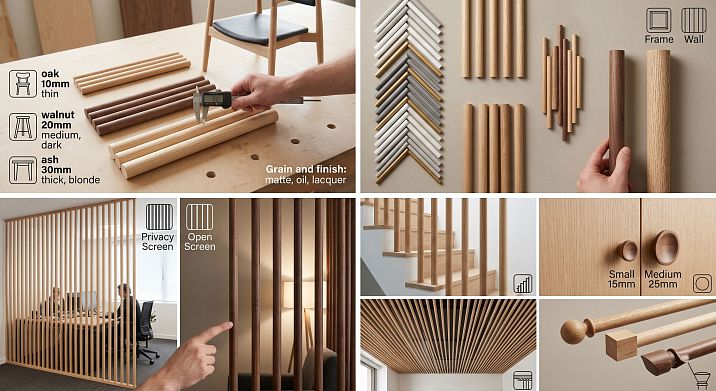
Shape has character. A rectangular slat is clarity, plane, architectural line. A round wooden slat is a completely different story. The cylinder is softer, it has no sharp edges, you can wrap your hand around it, it looks equally beautiful from any viewing angle. That is why round wood profiles occupy a special niche in interior design: not wall cladding, not decorative molding, but a detail that is held, seen in volume, and works under bending and load.
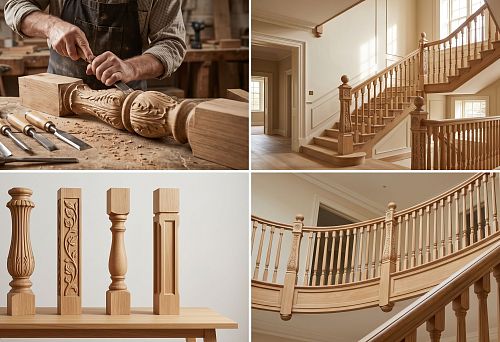
round wooden rail — is a cylindrical profile made of solid wood. Its diameter can vary from 10 to 80 mm or more. There are dozens of applications: furniture crossbars, verticals of slatted partitions, handles and holders, display stands, decorative inserts, frames, rails. Everywhere where a profile that looks good from any angle and is pleasant to the touch is needed, round slats are unrivaled.
This article is a detailed breakdown: what a cylindrical wooden slat is, where and how it is used, how to choose the diameter and coating, what mistakes to avoid, and where to buy a quality profile.





What is a round wooden batten: a profile with character
First of all — a precise definition. A wooden batten of round cross-section is a long cylindrical profile made of solid wood with a constant round cross-section along its entire length. It is produced by turning or milling — from a solid workpiece by removing material to a specified diameter.
Unlike a rectangular batten, a round one has no "front" or "back" side — it is uniform around its entire circumference. This is a fundamental difference: such a profile works where the product is visible or tangible from all sides.




Physical properties that determine application
No sharp edges. The cylindrical surface is a continuous curve without corners. The hand glides over it without risk of catching. That is why round battens are used as handles, crossbars, rails — everything that is grasped by hand.
Uniform load. The cylinder distributes bending load symmetrically. A shelf or partition crossbar made of a round batten is a mechanically more balanced part than a rectangular plank of the same cross-sectional area.
Visual lightness. With the same material "volume," a round profile visually appears lighter than a rectangular one. This is important for partitions and decorative structures: they look airier.
Tactility. The hand naturally wraps around the cylinder — this is an anatomically correct grip. No other profile provides such comfort upon touch.
Our factory also produces:




How a round batten differs from other wooden profiles
It is important not to confuse a round batten with other similar parts.
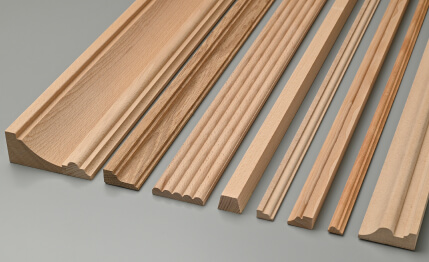
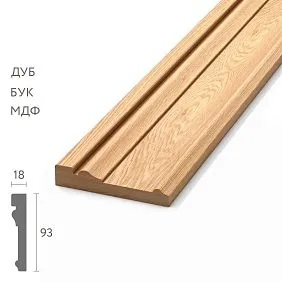
Wooden trim — a narrow flat profile of triangular or rectangular cross-section. Its task is to fix glass in frames and other mounting functions. A round batten is an independent structural and decorative element.
Wooden angle — an L-shaped profile for finishing internal and external corners. Here the shape is fundamentally different.
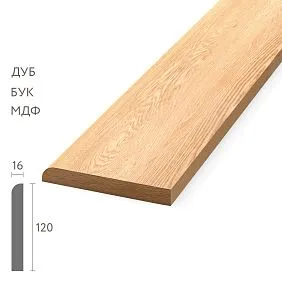
wooden planks on the wall — a rectangular or square profile for wall cladding and accent zones. It works on the plane of the wall.
A round wooden batten is a separate class: a cylinder that is visible and tangible in volume.
Get Consultation
Where round wooden battens are used: a complete map of applications
Furniture: crossbars, posts, inserts, handles
This is historically the main area of application for round wooden battens. Classic chairs with backs made of vertical round rods. Cabinets with crossbars for hangers. Sideboards with round posts between sections. Rocking chairs. Beds with balusters made of round posts.
A crossbar-hanger in a cabinet is almost always a cylindrical profile. Diameter 25–35 mm is optimal for hangers: sufficient strength and a comfortable grip.
Decorative inserts in furniture fronts — round slats placed vertically or horizontally in door openings. This is a lightweight "see-through" front without glass.
Round slat handles — custom furniture handles made from cylindrical wooden segments. Natural grip, warm material, natural look.
Slatted partitions with round profile
Partitions made of wooden slats are a popular architectural technique. Usually, they use rectangular slats on the wall. But a partition made of round slats is a completely different visual effect.
Cylinders in the partition create an "airy" rhythm: there are no flat edges, only rounded surfaces that reflect light softly and create a volumetric play of shadows. Such a partition looks lighter, more natural, more sculptural.
Especially organic — in eco-interiors, Japanese style, Scandinavian minimalism. Where a natural form without strict geometry is appropriate.
Shelving units and display cases
Vertical round shelving posts instead of rectangular supports — this changes the visual character of the piece. A shelf on round posts looks more delicate, "handcrafted", more designer.
In display cases — round poles for shelf holders, horizontal cylindrical crossbars. In retail spaces, this creates an expensive, natural look.
Rails and holders
A rail in a walk-in closet — a horizontal pipe or wooden rod for hanging clothes. A round wooden rod as a rail brings warmth, naturalness, and gentle contact with items. A diameter of 30–40 mm is optimal for a clothing rail.
Towel holders in the bathroom and kitchen. A horizontal round rod mounted on two bracket holders — a natural alternative to a metal rail. In Scandinavian and eco-interiors, it's an impeccable choice.
Holders for kitchen accessories: hooks, rails for oven mitts and towels above the stove. A wooden cylindrical profile fits organically in a kitchen with wooden fronts or open shelves.
Decorative inserts and art objects
Round rods in decorative inserts — this is custom interior decor. A frame with parallel cylindrical profiles, mounted at varying intervals and protruding at different depths — this is already a sculptural detail, not just a profile.
Decorative panels made of round rods on the wall — not wall cladding in the usual sense, but a three-dimensional art installation. Cylinders oriented perpendicular to the wall create a three-dimensional relief.
Furniture Restoration
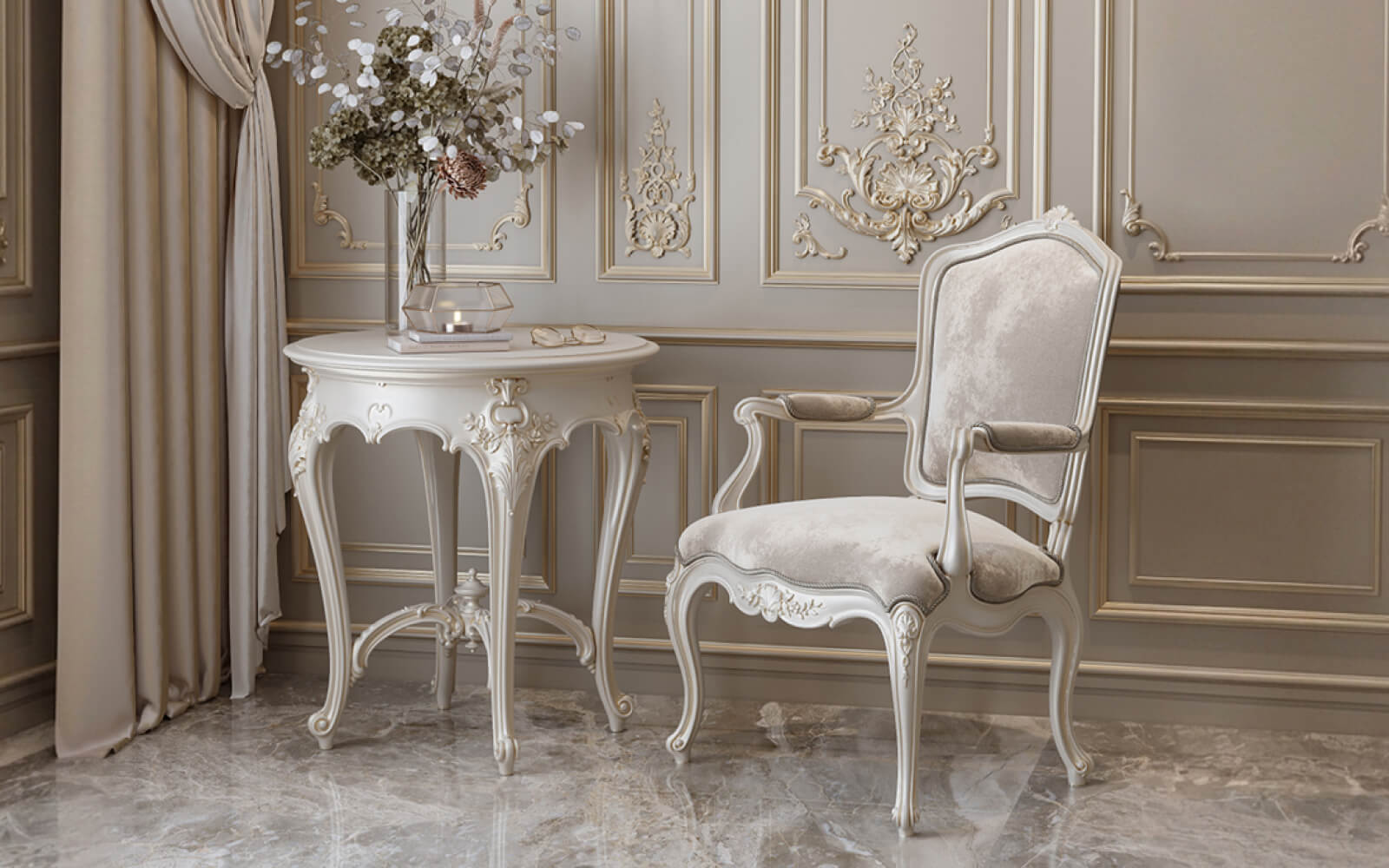
Restoration of antique furniture often requires replacing lost parts: chair rungs, balusters, turned posts. Wooden round batten — the source material for restoring such elements. It is turned according to a sample, adjusted for diameter and length.
Frame structures
Round wooden battens are used as frame elements in lightweight wooden structures: awnings, gazebos, decorative arches, frames for climbing plants. The cylindrical profile is convenient for joining: the hole is drilled exactly to the diameter of the batten, resulting in a tight connection.
Commercial interiors: restaurant, showroom, hotel
In a restaurant — round wooden posts at the bar counter or semi-zoning partitions. In a showroom — shelving systems with round verticals. In a hotel — decorative elements at the reception, wooden handrails in corridors. Everywhere — natural material, organic shape, tactile appeal.
How a round batten fundamentally differs from a rectangular one: a comparison for practitioners
It's not a question of "what's better." It's a question of "what's suitable for a specific task."
| Parameter | Rectangular batten | Round batten |
|---|---|---|
| Application | Walls, panels, partitions | Furniture, holders, partitions, decor |
| Overview | One face side | Same from any side |
| Tactile | Flat, with edges | Rounded, easy to grip |
| Load | Good in plane | Good for bending in any direction |
| Installation | On the wall, with glue or nails | Inserts into a hole, fastened with staples |
| Visual lightness | Clear silhouette | Soft, "airy" look |
| Surface treatment | Flat faces — simply sanded | Cylinder requires turning |
Practical conclusion: if the part will only be visible from one side and is attached to a plane — choose a rectangular strip. If the part is visible in volume, is held in the hand, or performs a load-bearing function in space — a round strip is the right choice.
How to choose the diameter of a round wooden strip
Diameter is the key parameter. It determines everything: strength, visual weight, applicability, type of fastening.
Small diameter (8–15 mm)
Thin cylinders for decorative inserts, small furniture parts, decorative grilles, ornamental elements. They do not carry significant load — only decorative or light fixing function.
Application:
-
decorative inserts in frames and frame facades;
-
small crossbars in decorative structures;
-
artistic decor elements;
-
models and mock-ups.
Medium diameter (16–30 mm)
The most versatile range. Here the batten carries a moderate load while remaining visually light.
Application:
-
partitions with an airy rhythm;
-
towel holders and rails;
-
crossbars in furniture (decorative fronts, chair backs);
-
furniture handles;
-
display and shelving posts for light-duty use.
Diameter 20 mm — a delicate partition or grille where lightness is important.
Diameter 25–30 mm — chair rungs, medium-load partitions, furniture handles.
Diameter 30–50 mm
A slat with pronounced volume. Visually significant, well readable in the interior. Carries a moderate structural load.
Application:
-
clothing rails in a walk-in closet;
-
vertical posts of decorative partitions;
-
holders in the bathroom;
-
decorative display case stands;
-
custom art objects.
Diameter 35 mm — classic size for a closet hanging rod. Reliable under the load of hung clothes.
Large diameter (50 mm and more)
Expressive, architectural profile. This is no longer a "strip" in the usual sense, but a wooden post or baluster. It bears significant load and creates a powerful decorative accent.
Application:
-
load-bearing posts of furniture structures;
-
support elements of open shelving;
-
decorative columns in partitions;
-
balusters and posts.
Table of diameters by task
| Diameter | Task | Example |
|---|---|---|
| 8–12 mm | Decorative inserts, small decor | Inserts in frame facades |
| 14–20 mm | Light decorative structures | Grilles, art objects |
| 22–30 mm | Furniture, handles, partitions | Chair rungs, handles |
| 30–40 mm | Railings, holders, partitions | Wardrobe, display case |
| 40–60 mm | Racks, supports, balusters | Shelf, balustrade |
Round furniture rod: commercial breakdown
Furniture topic requires a separate detailed block. This is the richest application scenario for cylindrical wooden profiles.
Closet hanging rod
This is the first thing that comes to mind when you hear "round wooden rod". A standard wardrobe with a clothes rail: a wooden rod with a diameter of 30–40 mm, length equal to the section width minus 20–40 mm for fitting into holder cups.
A wooden crossbar offers warmth and naturalness compared to a metal pipe. Hangers slide more smoothly on a wooden surface, without metallic squeaking. Wood does not condense moisture and does not heat up when in contact with leather items.
Important when choosing: for a long section (over 800–1000 mm), select a diameter of at least 35 mm to prevent the rod from sagging under the weight of hung clothes.
Decorative facades for cabinets and sideboards
Vertical round rods placed at a certain spacing in door openings create a decorative lattice facade. Instead of a solid door or glass, a translucent "grille" of cylinders is used.
Effect: the contents of the cabinet are slightly visible but not fully exposed. A sideboard with such a facade looks like both closed storage and a display case simultaneously.
Technically: holes of precise diameter are drilled at a set spacing in the horizontal crossbars (top and bottom), the cylinders are inserted into the holes and fixed with glue.
Chair and armchair backs
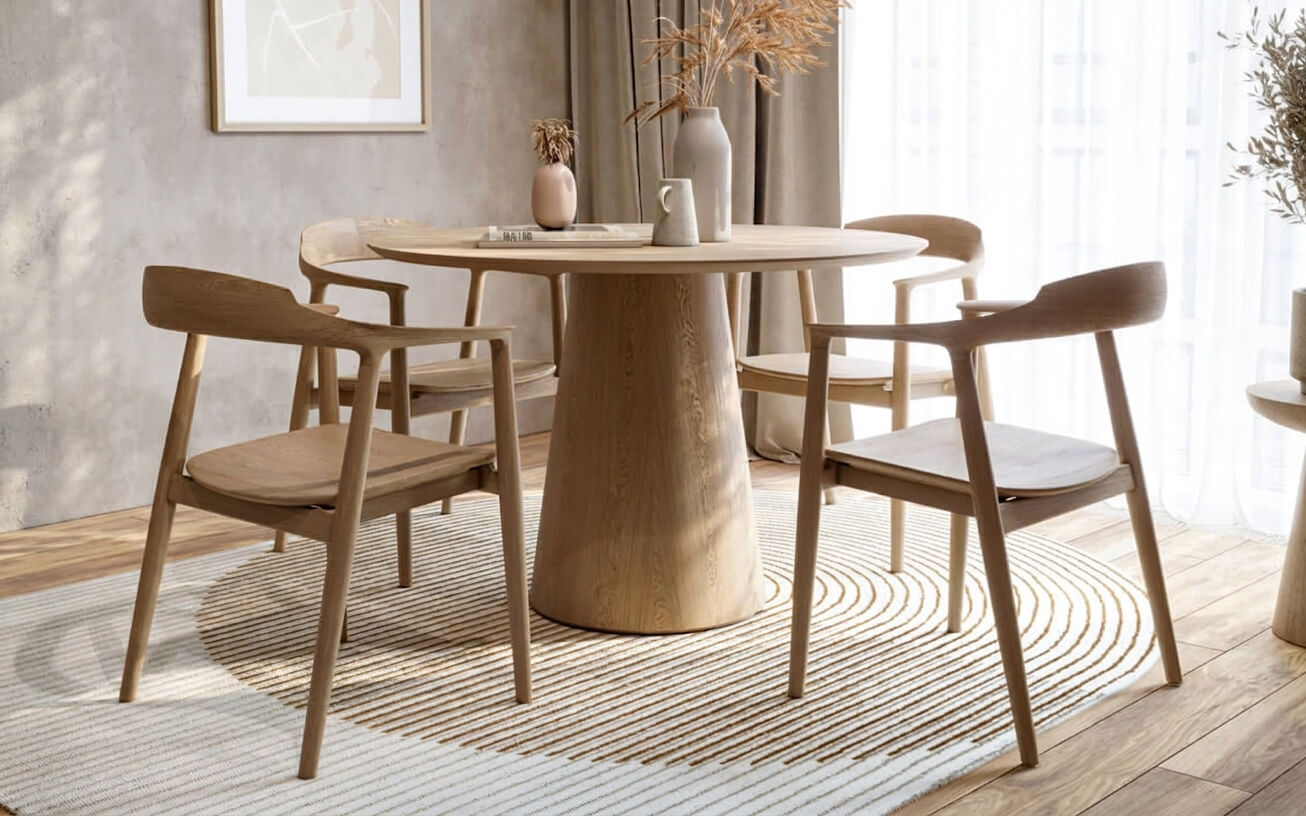
A classic chair with a back made of vertical wooden spindles uses round rods with a diameter of 16–22 mm. This design is common in traditional furniture across cultures: the Windsor chair, the Russian kitchen chair, Shaker furniture.
No other profile achieves the same effect: a lightweight back made of spindles—openwork, airy, and functional.
Bed: headboard and legs
A bed headboard made of vertical round slats is a popular designer solution. Slats of varying lengths creating a rhythmic pattern are already an art object in the bedroom. The round profile in the headboard looks softer than a rectangular one: no sharp edges, a smooth silhouette.
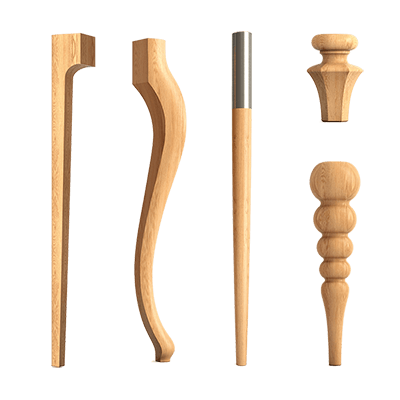
Bed legs made of cylindrical wooden posts are turned legs in the classic furniture tradition. A round cross-section with a variable diameter (turning) is already a full-fledged baluster.
Children's furniture
In children's furniture, round slats are used especially actively — precisely because of the absence of sharp edges. Crib grilles, ladder rungs, drawer handles, railing bars. Everything that children's hands touch should be without sharp edges. Buy a round wooden slat for children's furniture means choosing a safe, tactilely pleasant, and natural material.
Round slat for partitions and zoning: "airy" architecture
Slatted partitions are one of the main trends of recent years. They are usually made from rectangular profiles. But a partition made of round wooden rails is a completely different visual language.
Why a round slat creates a "different" partition
A rectangular slat in a partition is clear lines, strict geometry, an architectural accent. A round slat is a soft rhythm, a natural form, a minimum of geometric strictness.
Light passing through such a partition scatters differently: there are no flat edges that cast straight shadows. Each cylinder casts a soft curved shadow — the partition "lives" in the light.
Structural diagram of a partition made of round slats
Basic diagram:
-
horizontal load-bearing beams (or metal pipes) at the top and bottom — with holes drilled to the diameter of the slats;
-
cylindrical slats of the required diameter and length are inserted into the holes with a given pitch;
-
fastening — with glue, a dowel, or mechanically (a pin).
Variation: slats of different lengths, creating a wave-like top contour — a "forest" partition with an uneven silhouette. This is especially organic in eco-interiors and restaurants with a natural theme.
Pitch and diameter for the partition
For the partition, it is recommended:
-
slat diameter: 20–40 mm depending on the structure height;
-
spacing: 30–80 mm (distance between slat centers);
-
height: from floor to ceiling or partial (zoning).
Dense spacing (30–40 mm) — the partition is almost opaque but airy. Sparse spacing (60–80 mm) — there is a lot of space, the partition works as a visual reference rather than a barrier.
Round slat for decoration and restoration: the art of detail
Decorative frames and panels
A frame made of solid wood with horizontally stretched round slats is a decorative wall object. In principle, it is like a stained glass window, but with wood instead of glass. The slats can be of different diameters, arranged with different spacing, painted in different colors, or left natural.
Three-dimensional decor perpendicular to the wall
Short round slats (50–150 mm long) fixed perpendicular to the wall in a staggered pattern create a three-dimensional decorative relief. Each cylinder casts its own shadow depending on the lighting angle. As the lighting changes, the wall "transforms."
This technique is popular in designer interiors and commercial spaces — restaurants, art galleries, showrooms.
Furniture restoration: precise diameter matching
When restoring antique furniture, it is often necessary to replace a broken or missing part: a chair rung, a lattice rod, a baluster. Buy a wooden round rod of the required diameter, cut to length and glue into the holes — this is a classic restoration technique.
Important: when restoring antique furniture, matching the wood species is crucial. If the cabinet is oak, the rod must be oak. If the chair is beech, it must be beech. This affects subsequent finishing: tinting and varnish will only produce a matching color with the same species.
Author's interior decor
Designers and craftsmen use wooden round profile as a source material for custom objects: lampshades, light fixtures, mirror frames, decorative display cases, floor sculptures. Here, the only limit is imagination.
The round rod is easy to cut, glue, sand, and paint. It is a basic element from which you can assemble anything you want.
Material and coating: from species to finish
Wood species
Pine. The most accessible species for round battens. Lightweight, easy to work with, accepts any coating. Downside: soft — load-bearing rungs may develop dents. For decorative applications, an excellent choice.
Birch. Hard, uniform, sands well. A classic for furniture parts: chair rungs, partitions. Color — light, almost white, with a delicate texture.
Beech. Even harder than birch. High bending strength — ideal for load-bearing rungs (coat racks, rails). Color — warm, light pinkish.
Oak. Hard, durable, with a pronounced texture. Oak round batten — a premium option. Takes stain well, rich color. For high-end furniture and decor.
Ash. Light wood with a clear texture. Strong, resilient. For partitions and rails — one of the best options.
All of these are part of a wide assortment solid wood moldings.
Coating of round batten
Uncoated (sanded): the batten surface is smooth but exposed. Suitable for items that will be painted or stained on site. Before coating — be sure to degrease and prime.
Varnish: matte, semi-matte, or glossy. Protects the wood, preserves the texture. For rails and holders — varnish with a hard finish to prevent surface scratches.
Stain + varnish: tints to the desired shade. The most popular option for furniture parts and partitions. Allows matching the color to existing furniture.
Enamel or acrylic paint: hides texture, gives an even opaque color. Round slats painted in white or pastel tones — for Scandinavian and modern interiors.
Oil or wax: for open surfaces (holders, rails) where tactile naturalness is important. Oil penetrates the wood, does not create a film — the slat remains alive to the touch.
Painting a round slat: practice
A round profile is easier to paint than a rectangular one: there are no corners or edges where paint accumulates or is missed. The brush rotates around the cylinder — the coating is even.
For a small batch — brush + acrylic paint.
For a large batch or a thin even layer — spray gun.
For decorative finishing (patina, wear, craquelure) — brush + special techniques.
Mistakes when choosing and using round wooden slats
These mistakes are common among beginners and not only. Let's break down each one specifically.
Choosing a diameter without understanding the load. A thin slat with a diameter of 16 mm as a clothes rail will sag under a load of 5–10 kg. For a hanger, a minimum of 30–35 mm is needed. Load calculation — before choosing the diameter.
Confusing a round rod with a regular glazing bead or trim. Wooden trim — a flat profile for glass. A round rod is a cylinder. These are fundamentally different products in shape, application, and installation.
Not considering end fastening. A round rod must either be inserted into a hole of precise diameter or secured in special bracket holders. "Simply nailing" the end to a flat surface is unreliable. Plan the end fastening method before purchase.
Not planning the coating before installation. After installing the rod into a structure—especially in a partition or furniture facade—it is more difficult to paint the entire surface evenly. Paint before installation: full coating, drying, then installation.
Choosing a profile that is too thin for a partition. A partition 2700 mm high made of rods with a diameter of 12 mm is a structure that will vibrate when touched. For a floor-to-ceiling partition, the diameter should be at least 25–30 mm.
Not calculating the quantity and length. Calculation: (width of structure ÷ spacing between rod centers) × height = linear meters. Add 10–15% reserve.
Not accounting for trimming allowance. Each rod is cut to exact size. Errors during cutting, angled cuts, end defects—all go into trimming. Without a reserve, you risk not having enough for several elements.
Mixing different wood shades from different batches. Rods from different batches of the same species may have different shades—due to different wood age or drying conditions. In one structure, purchase from the same batch.
Using raw rods without acclimatization. Wood is a living material that reacts to humidity. A raw rod installed in a warm, dry room will dry out and decrease in diameter—the fastening will loosen. Acclimatization for 3–5 days in the installation room is mandatory.
Ignoring sanding before coating. Even a factory rod requires light sanding before painting (grit 180–220). Without sanding, the coating lays unevenly, and "raised grain" creates roughness.
Where to buy a round wooden rod
Buy wooden batten of the required diameter and length is best from a manufacturer with clearly specified product characteristics. Diameter, wood species, length, coating — all parameters must be indicated.
In the Stavros catalog — solid wood millwork и Wooden rails with delivery throughout Russia. Nearby in the catalog — Wooden moldings, Wooden angle for designing corner zones and all Wooden products for interior — a full range for working with wood.
FAQ: Answers to popular questions
What is a round wooden rod?
This is a cylindrical profile made of solid wood with a constant round cross-section. Used in furniture, partitions, holders, decor, and restoration.
Where are round wooden rods used?
In furniture (crossbars, handles, decorative inserts), partitions, wardrobe rails, towel holders, decorative structures, custom decor, and furniture restoration.
How is a round rod different from a regular one?
A rectangular batten works on a flat wall surface. A round one is used where the part is visible or tangible from all sides: furniture parts, holders, partitions, decor.
How to choose the diameter of a round batten?
For decorative inserts — 8–15 mm. For furniture parts and handles — 20–30 mm. For hangers and rails — 30–40 mm. For load-bearing posts — from 40 mm.
Is a round batten suitable for furniture?
Yes. It is a classic material for furniture crossbars, lattice facades, chair backs, handles, and decorative inserts.
Can a round batten be used in a partition?
Yes. A partition made of cylindrical battens creates a softer, more "airy" visual effect than a partition made of rectangular profiles.
Can a round wooden batten be painted?
Yes. Acrylic paint, stain, varnish, or oil — all options work. Paint before installation for better coating quality.
How to attach a round batten?
Inserted into holes of precise diameter (for crossbars and partitions) or mounted on bracket holders (for rails). End gluing is only for additional fixation.
How to calculate the number of round slats?
Structure width ÷ spacing between slat centers = number of slats. Multiply by the length of each slat. Add 10–15% reserve.
Where to buy a round wooden slat?
In the STAVROS catalog: Wooden plank with delivery across Russia.
About the manufacturer
STAVROS is a Russian manufacturer of wooden profiles and solid wood products for residential and commercial interiors. The catalog includes — Round wooden battens, solid wood millwork, Wooden moldings, Wooden angle and a full range wooden products for interiors. If you are looking round wooden slat for furniture, partitions, holders, or custom decor — STAVROS offers solid wood quality, precise profile, and delivery across all of Russia.