Article Contents:
- What are interior window casings and why are they needed
- Types of interior window casings
- Smooth interior window casings
- Carved and decorative casings
- Classical casings with a pronounced profile
- Solid Wood Casings
- Casings as part of linear window trim
- Why wooden interior casings are one of the best solutions
- How to choose interior window casings
- By material
- By interior style
- By width and profile
- By color and finish type
- By matching with the windowsill, slopes, doors, and baseboard
- In which interiors do interior architraves look especially good
- What to add to interior architraves to make the window look more expensive
- Interior architraves for different types of windows
- For wooden windows
- For plastic windows
- For windows in a wooden house
- For classic interiors with decorative finishes
- Mistakes when choosing interior architraves for windows
- Where to buy interior architraves for windows
- Why STAVROS is a strong solution for interior window decoration
- Conclusion
- Frequently Asked Questions (FAQ)
A window opening without interior trim is an unfinished sentence in the room's space. Something feels unsaid: the joint is visible, the boundary between the frame and the wall looks bare, and the entire potential of the interior remains unrealized. It is precisely interior window casings that transform a technical mounting node into a full-fledged architectural element, which contributes to the room's image no less than the choice of furniture or wall color.
If you are looking for interior window casings — not for the facade, not for exterior finishing, but specifically for decorating the window from the inside — you are in the right place. Below, in detail, without fluff and generalities: what to choose, how to select, what to combine with, and where to buy wooden interior window casings so that the result is truly expensive, cohesive, and stylish.


What are interior window casings and why are they needed
In short: interior window casings are decorative linear or overlay profiles that are installed around the perimeter of the window opening on the room side. They are placed at the boundary between the frame and the reveal or wall, covering the mounting gap and creating a visually finished frame.
But the function of interior casings has long gone beyond technical necessity. Today, interior window casings are a full-fledgedinterior decoration, which:
-
covers the mounting seam between the PVC or wooden frame and the wall — without visible cracks, foam, or gaps;
-
completes the window opening as an architectural element — the window gets a finished 'contour,' like a picture frame;
-
visually connects the window with other finishing elements: baseboards, door casings, moldings, window sills;
-
sets the stylistic direction of the entire interior — a carved casing in the Russian style and a smooth profile in the spirit of neoclassicism will say absolutely different things about the space.
-
Enhances the perception of finishing quality: where good wooden trims are installed, the renovation always looks more expensive than it actually is.
Interior window trims are not a designer's whim, but a conscious choice by those who understand: details create atmosphere. Interior window trims transform an ordinary opening into an architectural accent that captures the eye and creates a sense of well-maintained space.




What types of interior window trims are available
The variety of interior trims today is vast. Let's break them down by type—so the choice is conscious, not random.
Our factory also produces:


Smooth interior window trims
The most laconic solution. A flat profile without relief or with minimal beveling—for interiors in minimalist, Scandinavian, or contemporary styles. Smooth interior window trims are made from wood for painting or staining, allowing for an exact match to the wall color or, conversely, creating a contrasting frame. Such profiles work well in pairs with similar door trims: the space feels unified, without 'random' elements.
Get Consultation
Carved and decorative trims
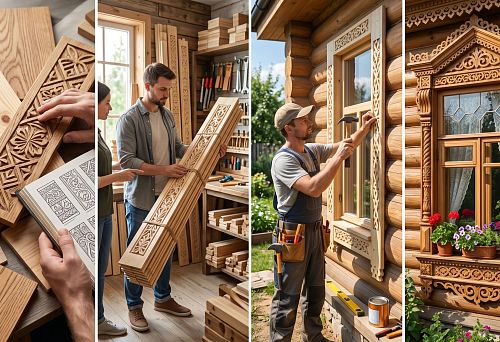
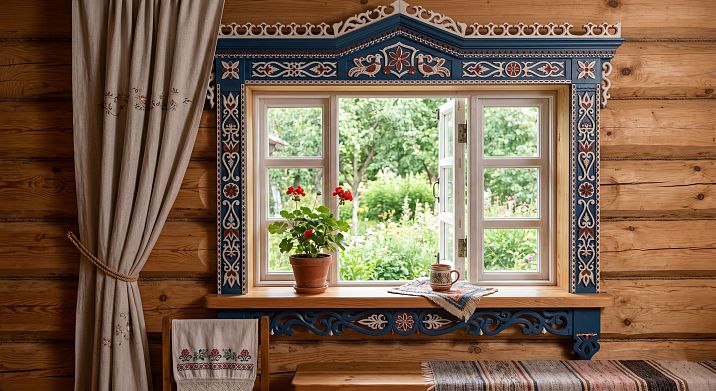
This is a statement. Carved interior window trims with ornamentation, floral patterns, geometric designs, or traditional Russian motifs—an element that immediately becomes an interior accent.Wooden patterns on windowshave long moved beyond rustic aesthetics: in modern neoclassical or custom-designed apartments, a carved trim looks luxurious and organic. Decorative interior window trims with pronounced carving give a sense of an expensive, handmade, non-standard solution—even if the room itself is quite ordinary.
Classical trims with a pronounced profile
Between smooth and carved lies a wide range of classic profiled millwork. Figurative sections with shelves, beads, rolls, or stepped relief create an expressive play of light and shadow on the surface. Classic interior window casings are the foundation for interiors in the styles of classicism, empire, neoclassicism, pompadour, or Provençal chic. The more complex the profile, the richer the trim appears.
Solid wood architraves
A separate category—not by shape, but by material. Solid wood window casings are made from solid or laminated wood: oak, beech, pine, ash. This is a fundamentally different story compared to MDF, laminated profiles, or foamed PVC.Wooden itemsSolid wood casings are alive: they have their own texture, tactility, scent—and they bring into the interior a warmth that no synthetic material can reproduce. Oak casings are a choice for decades, beech casings offer perfect geometry, pine casings provide affordability and ease of processing.
Casings as part of millwork window trim
The most competent solution. Not just a casing on its own, but part of a system: casing +Wooden moldingabove the opening +wooden cornice + Wooden baseboardbelow. Millwork for window trim in a unified style and material transforms the opening into a full-fledged architectural composition. This is precisely how windows are finished in classic interiors, in homes with serious finishes, in projects where quality matters more than savings.
Why wooden interior casings are one of the best solutions
The market offers casings made of MDF, PVC, polystyrene, and gypsum. Each material has its place. But wooden window casings remain the first choice where the result matters, not just the price. Why?
Noble appearance. Wood grain is not an imitation. It is a living pattern, unique to each board. Oak or beech casings in an interior look different from any synthetic counterparts: more voluminous, warmer, richer. When light falls on a profiled wooden casing, a play of shadows emerges that cannot be reproduced with cheap materials.
Repairability. A scratch on a wooden casing is not a death sentence. It can be painted over, sanded, or the finish can be renewed. This isn't possible with PVC or polystyrene.
Tinting and painting. Wooden casings for painting are an excellent base for any color solution. Want a white casing in the Provencal style? No problem. Dark walnut to resemble oak? Easy. The wall color plus two shades? Elementary. Wood holds any coating and doesn't lose its shape over time.
Integration with the decorative ecosystem.wooden elements for interiors— moldings, cornices, rosettes, overlays, trim — everything is made from the same wood species, using the same technique, with the same finish. The result is a cohesive interior, not a collection of random parts.
The feel of an expensive renovation. This is subjective but logical: in a room with wooden casings, a wooden cornice above the window, andWooden moldingsaround the perimeter of the walls, the renovation is perceived as expensive and well-thought-out — regardless of the furniture budget.
If you want to buy wooden window casings and achieve a truly finished result — solid wood is unequivocally the choice. You can buy wooden window casings today with a wide selection of wood species, profiles, and finishes — and the price doesn't necessarily have to be astronomical.
How to choose interior window casings
The question 'how to choose interior window casings' seems simple but hides several levels of decision-making. Let's examine each.
By material
The key choice — wood or its substitutes. If the budget allows and the interior aims for quality — only solid wood. For rooms with high humidity (bathroom, kitchen) — treated wood with moisture-resistant impregnation or specialized profiles. For budget solutions in neutral spaces, paintable MDF is acceptable.
Among the wood types: oak architraves — maximum hardness and durability, pronounced texture, prestigious appearance; beech architraves — slightly lighter, perfect geometry, holds shape well; pine architraves — affordable price, easy installation, well-suited for painting.
By interior style
This is critically important — and this is where mistakes are most often made. How to choose architraves by style:
-
Classic, Empire, Neoclassical — a wide profiled architrave with several relief steps; carving on the end or across the entire surface is possible;
-
Provence, country, rustic — a textured profile with rounded shapes, for light or tinted painting;
-
Scandinavian style, minimalism — a smooth rectangular profile, strict and clean;
-
Modern classic — a restrained profile with one or two steps, without excessive decoration;
-
Ethnic, Russian style — a carved architrave with ornament,Patterns wooden window casingswith traditional symbolism.
By width and profile
How to choose architraves by width — the rule is simple: the width of the architrave should cover the mounting gap with a margin of at least 10–15 mm on each side. The standard width of interior architraves is from 40 to 100 mm. For wide slopes in brick houses, a wider profile is required. For narrow joints in panel apartments, 40–50 mm is sufficient.
The profile (cross-sectional shape) defines the character: straight — modern, profiled with several steps — classic, with a semicircular edge — soft and warm.
By color and finish type
Casings are available in several options: for painting (primed or unsanded), tinted (to match a specific wood species or color), with varnish coating (ready for installation). The choice depends on the task: if you want to precisely match the tone of doors or window sills, it's better to choose ones for painting and paint them together with the rest of the trim.
By combination with window sill, slopes, doors, and baseboard
Here lies the main secret of an expensive interior. How to combine casings with baseboard and cornice:
-
The window casing and door casing should be from the same profile or at least from the same 'family' (similar proportions and style);
-
Wooden baseboardon the floor, it's desirable to choose from the same wood species and with the same finish as the casings;
-
Wooden window sill + wooden casing is an ideal pair; if the window sill is made of stone or PVC, a solid wood casing is still appropriate and will only elevate the level;
-
wooden window cornicesabove the opening — the top point of the window composition that ties everything together;
-
Moldings around the perimeter of the wall — if they exist, the casings should echo them in profile.
In which interiors do interior casings look especially good
Honest answer: everywhere. But in some spaces, wooden interior casings reveal themselves with particular power.
Classic interior. Here, the casing is not an addition but an architectural element. Window casings in classic style with a pronounced profile, shelves, and possible gilding or patina are part of the ensemble, which includes cornices, moldings, rosettes.Decorative Wooden PatternsWithout a good casing, classic looks unfinished.
Neoclassicism. A more restrained version of classic. Interior casings for a classic interior here are a clean profile without excessive decoration, made of oak or beech, under light paint or matching the wall color. Light relief, quality material, precise installation.
Wooden house. Interior window casings in a wooden house are a return to tradition. Wood is everywhere in a wooden house: walls, ceilings, floors, doors. Solid wood casings fit organically into this context, andWooden patterns on mouldingswith traditional patterns add atmosphere and a connection to the history of the place.
Apartment with an emphasis on natural materials. Stone, wood, metal, linen — if the interior is built on natural textures, wooden casings are a must. They do not stand out from the overall logic but enhance it. Wooden window decor in such a space is the consistency that is valued.
Interior with decorative elements and moldings. If the walls already havewooden wall moldings, wooden ornamentin the form of overlays or rosettes — an interior window casing becomes a logical continuation of this line. Decorative elements for window decoration form a composition that you want to look at.
How to complement interior casings to make the window look more expensive
One casing is good. A casing within a system is something else entirely. Here's what is added to interior window casings to make the result truly impressive.
Molding.Decorative wooden moldingsAbove the window opening or along the perimeter of the reveal, they set a horizontal rhythm and create a sense of framed space. Molding above the window is like a frieze above a column: it completes, accentuates, and adds a 'tier'.Wall wood molding — horizontal arrangement that can run at the level of a chair back, window sill, or mid-wall. Molding divides walls into horizontal zones, creates rhythm, and structures space.In the same window area, it creates a panel effect—a very popular technique in modern classic style.
Cornices.wooden corniceAbove the window opening—one of the most effective ways to give the window monumentality.wooden window cornicesCan be simple profile or complex—with carving, multi-tiered cross-section, decorative inserts.wooden corniceAbove the window is especially good in classical and neoclassical interiors: it lifts the gaze, creates a vertical accent, and completes the window composition.
Molding.Trimming Items—glazing beads, friezes, corner pieces, battens—work at joints and transitions. A correctly chosenWooden trimAllows covering all the 'unsightly' places around the window: joints of the windowsill with the wall, transitions from the reveal to the casing, corner connections.
Decorative overlays and patterns.Decorative Wooden Patterns—overlay elements with carved or milled ornamentation—can decorate the corners of the window opening, the center of the upper lintel, the area under the windowsill. These are small details, but they are precisely what turn an ordinary window into a custom one.
Carved elements and rosettes. CornerCarved wooden decoration— rosettes, connecting corner elements — a traditional technique in the design of classic window trims. Where the trim changes direction (at corners), a wooden rosette with an ornament is placed. This both technically solves the issue of joining and visually enriches the decor.
Baseboard in a unified system.to buy wooden baseboardmade from the same wood species as the window trims — means achieving unity between the lower and side lines of the space. The eye glides around the room without 'breaks' or 'foreign' materials.
Interior window trims for different types of windows
Windows are different — and the approach to interior finishing is also different.
For wooden windows
Interior trims for wooden windows — a classic and organic combination. Here, solid wood trims work as a single material ensemble with the frame. You can use an identical species (oak to oak, pine to pine) or a contrasting one — the main thing is that the finish (staining, varnish, paint) matches. The joint between the frame and the reveal in wooden windows is usually neat — but a trim is still needed: it completes the transition and creates a frame.
For plastic windows
Paradox: interior trims for plastic windows are especially needed. A white plastic frame and a PVC reveal are functional, but visually cold and bland. A wooden trim next to a plastic frame doesn't look strange — on the contrary, it brings liveliness, warmth, and makes the window interesting. The main thing is to choose the right style: a smooth or profiled profile made from a light wood species (beech, ash, pine for white painting) pairs well with white PVC.
For windows in a wooden house
Interior window casings in a wooden house are already a tradition. Log or timber walls, wooden ceilings — and right there, an elegant solid wood casing with carving: the space gains character and soul.patterns on wooden house mouldings— is a separate topic: these include traditional ornaments, modern geometric motifs, and plant-based decor. Inside a wooden house, a carved casing looks absolutely appropriate.
For classic interiors with decorative finishes
When the space already has stucco,wooden ornamentcarved doors, complex millwork — the window casing must match the level. Here you cannot economize and place a simple rectangle next to ornate moldings. The casing is chosen with an equally complex profile, from the same wood species, with the same finish — otherwise a 'weak link' will arise, which immediately catches the eye.
Mistakes when choosing interior window casings
Over years of working with interior wooden products, a stable list of mistakes has crystallized. They are made again and again — let's break them down so you don't repeat them.
Too narrow a profile. A casing 30–35 mm wide on a large window opening looks like a hardware detail, not a decorative element. Rule: the larger the opening — the wider the casing should be. For a standard window in an apartment, a minimum of 50 mm, for tall classic openings — from 70 mm and more. How to choose casings by width — focus on proportions: the casing should look substantial, not glued on.
Mismatch with the interior style. A carved casing with a traditional ornament in a minimalist interior with concrete walls — this is a clash. The opposite is also true: a smooth rectangular strip in a lavish classic hall looks poor and random. How to choose casings by style — first determine the stylistic vector of the interior, then select.
Poor combination with baseboards, doors, and window sills. White doors, brown baseboards, gray slopes, and beige casings—this is chaos, not an interior. All elements should speak the same language: material, color, profile style.
Saving on material. Polystyrene or foam casings under wood—temptingly cheap. But in a year or two, they will start to yellow, crumble, and peel. Wood lasts for decades. How to choose casings for the interior with long-term results—choose solid wood or high-quality MDF.
Disconnect between casings and other decor. Buying casings and forgetting about moldings, cornices, and trim means getting a 'lonely' decorative element without context. A window decorated systematically looks many times richer than the same window with just a casing.
Where to buy interior window casings
The question 'where to buy interior window casings' is not trivial. Today, the market is overloaded with offers of varying quality, and navigating it without knowledge of the criteria is difficult.
What to look for when choosing, where to order casings for interior window finishing:
Material and manufacturer. Look for products made of solid wood with transparent information about the species. The manufacturer should be able to explain what exactly the casing is made of: pine, beech, oak? Glued panel or solid wood? Moisture content of the blank? This is important for product stability.
Assortment in a unified style. The best option is to buy solid wood window casings where there are simultaneouslywood trim items, moldings, cornices, and decorative elements. This will allow you to assemble a cohesive design in a unified style and from one wood species—without compromises and 'matching something similar.'
Possibility of complete set. A good supplier will offer not just a casing, but a full set: side profiles, top crosspiece, corner rosettes, or connecting elements. This is convenient and guarantees that everything will fit without adjustment.
Price and availability. The price of interior window casing depends on wood species, width, profile, and length. Standard wooden casings range from 500–700 rubles per linear meter for pine to 2000–3500 rubles and above for oak with a figured profile. The price of window casings from manufacturers is typically lower than in small wholesale stores. It's better to clarify the price of wooden window casings for a specific profile and wood species.
Ready-made solutions vs. custom manufacturing. Ready-made interior window casings are quick and convenient if the standard size fits. Custom orders to individual parameters are more expensive and take longer, but allow for an exact fit in size and profile. Most manufacturers offer both options.
Why STAVROS is a strong solution for interior window decoration
STAVROS is a manufacturer with a wide catalogof solid wood: from classic casings and millwork to carved decorative elements, moldings, and cornices. Why is this important for those decorating windows inside?
A unified collection in one style. Here you can chooseWooden casingand immediately match it withWooden moldings, buy wooden cornicefor the window andWooden elementsfor the final trim. All products are from a single source, made from the same wood species (oak, beech, pine), with a unified approach to quality and finishing.
Carved decor is a separate strength. No synthetic manufacturer can provide whatCarved DecorMade of solid wood.Buy Wooden Patternsfrom STAVROS provides — it means getting a product milled on professional equipment and hand-sanded. No corner is left unattended.
Molding for system design.Wooden trimThe STAVROS assortment includes dozens of profiles of varying widths and shapes: from thin glazing beads to robust multi-level cornice profiles.Finishing with millwork productsIt allows you to decorate not only the window, but also walls, transitions, and corners — all with a unified system.
Ready-made solutions and custom manufacturing. Part of the assortment is in stock in Moscow and St. Petersburg. Non-standard profiles and sizes are made to order. This is convenient for those with non-standard openings or a custom interior with special requirements.
Expert support. STAVROS is not just a store, but a manufacturer with its own workshop. Here you can get a consultation ontypes of millworkand combinations, on how toframe a window opening with woodintegrate it into a specific interior.
Conclusion
Interior window casings are not a 'final touch' in renovation that can be postponed. They are a structural element of space design that determines whether an interior looks finished or not. Buying window casings for an apartment correctly means making a choice considering style, material, profile width, and harmony with all other decor.
Wood remains the best choice for those who want a result that never goes out of style. Wooden casings for interior window trim last for decades, can be restored, pair well with any other natural material, and give a space that sense of warmth that synthetic alternatives cannot replicate.
Maximum effect is achieved when the architrave is not a separate element, but part of a system:Wooden moldings, wooden cornice, decorative elements, Decorative wooden stripandWooden baseboardthey form a unified interior context. It is this approach that turns an ordinary room into a space with character.
STAVROS offers a complete arsenal for solving this task: frompatterned wooden window architraveswith carved decor to strict smooth profiles, from thin glazing beads to monumental cornice complexes. Everything is made of solid wood, everything is in the catalog, everything is delivered across Russia.
Frequently Asked Questions (FAQ)
How do interior architraves differ from exterior ones?
Interior architraves are installed from the room side and serve the purpose of decorative interior design. Exterior ones are facade elements that function outdoors and perform protective-decorative functions. These are fundamentally different products: different requirements for material, finish, and profile.
Can wooden architraves be installed on plastic windows?
Yes, and it's an excellent solution. A wooden architrave does not require the frame to be wooden. It is mounted on the reveal or directly on the frame, covers the joint, and brings warmth to the cold plastic aesthetic. The main thing is to properly prepare the surface and use quality fasteners.
How much do interior wooden window architraves cost?
The cost of interior window casings depends on the wood species, profile, and width. Approximately: pine — from 400–700 rub./linear meter, beech — from 800–1500 rub./linear meter, oak — from 1200–3500 rub./linear meter, depending on the complexity of the profile. Carved casings are a separate category with prices starting from 2000 rub. per element.
How to properly join casings at corners?
Two options: miter cut at 45° (classic method) or using wooden corner rosettes (the casing is cut straight, and the corner is covered with a decorative overlay). The second method is easier to install and provides a more decorative result.
Is it necessary to purchase casings and moldings from the same manufacturer?
Not necessary, but highly advisable. Only from a single manufacturer can you guarantee consistency in wood species, profile geometry, shade, and finish. This is crucial for the final result.
What is the best way to attach wooden casings?
With liquid nails (adhesive) or finishing nails (which can be concealed with putty and paint). For a removable option — special hidden fasteners. Screws are rarely used — they require filling the holes with putty.
How to care for wooden thresholds?
Dry or slightly damp cleaning. Every few years — renewal of the varnish or oil coating. For mechanical damage — local sanding and touch-up painting. Wood is repairable — this is its huge advantage over any synthetic alternative.