Article Contents:
- What is confirmed about NPU-135
- Why this article does not duplicate general STAVROS materials about staircases
- Geometry of the slanted frame: which angle needs to be measured before ordering NPU-135
- Option 1. Rectangle rotated to follow the flight
- Option 2. Long sides slanted, ends vertical
- Option 3. Mixed trapezoid
- Why the angle needs to be measured on the finished frame layout, not by the staircase angle
- How to measure the actual frame angle without complex surveying
- Method 1. Bevel or protractor
- Method 2. Digital protractor
- Method 3. Cardboard transfer
- Method 4. Two template strips
- What exactly to compare on the NPU-135 with the measured angle
- How to get the angle from rise and horizontal run if the frame is not yet marked
- Why the angle from steps cannot be automatically transferred to the molding
- The width of the molding does not change the angle, but it changes where the NPU-135 actually lies
- The same angle does not guarantee the same orientation of the ornament at four points
- Why there is no point in setting a "tolerance for angle" without the manufacturer's drawing
- What the 200 × 200 mm layout shows
- What the 280 × 280 mm layout shows
- Size 200 × 200 mm: when it makes more sense
- Size 280 × 280 mm: when it can be stronger
- 200 and 280 mm cannot be chosen only by the molding width
- Slat panels are an adjacent system, not a base for NPU-135
- How slats change the perception of the 200 and 280 mm sizes
- At the bottom of the stairs
- From the middle of the march
- From the upper landing
- When four NPU-135s really make sense
- Four NPU-135s 200 × 200 × 9 mm
- Four NPU-135s 280 × 280 × 12 mm
- When two NPU-135s can be better than four
- How to change the frame if you like the NPU-135 but the corner doesn't match
- Make the entire frame a rotated rectangle
- Make a local rectangular node
- Leave the corner without a patch
- Choose a different corner decor
- How to check if the NPU-135 conflicts with the handrail
- Sconces and switches can exclude a large size even at the correct angle
- If the frame corner is close to the slat panel, measure not to the edge of the molding, but to the NPU dimensions
- Relief of 9 or 12 mm is important next to a thin molding
- Color helps unify the NPU-135 with the molding, but does not fix incorrect geometry
- The inner corner of the frame and the molding cut angle are not the same thing
- Another geometry: the slanted side meets the horizontal
- Geometry matrix: one stair slope — three different frame angles
- Worksheet of four angles
- When it's worth ordering one NPU-135 first instead of four at once
- Mistake 1. Assuming that any slanted frame has non-standard angles
- Mistake 2. The opposite mistake — assuming that four angles are always 90°
- Mistake 3. Using the stair flight angle instead of the frame angle
- Error 4. Comparing only the 200/280 mm size
- Error 5. Considering L = 273 or 381 mm as the finished corner diagonal
- Error 6. Buying 280 mm just because the wall is tall
- Error 7. Trimming the pattern after delivery to "still install it anyway"
- Error 8. Checking only the top corner
- Error 9. Gluing NPU partially onto the battens
- Error 10. Choosing glue before checking the base
- What to check in 15 minutes before ordering NPU-135
- Step 1. Mark out the frame
- Step 2. Determine the type
- Step 3. Remove the four corners
- Step 4. Sign them
- Step 5. Prepare the NPU-135 template
- Step 6. Compare the angle
- Step 7. Apply 200 × 200 mm
- Step 8. Apply 280 × 280 mm
- Step 9. Move down the stairs
- Step 10. Check the middle of the flight
- Step 11. Look from above
- Step 12. Calculate the quantity
- Step 13. Calculate the budget
- Step 14. Check the base
- Step 15. Only after this, place the order
- Full algorithm from stair flight to cart
- Decision matrix: angle, size, quantity
- Can the NPU-135 be installed only in one corner of the stair frame?
- Do I need to measure the angle after gluing the moldings?
- If the frame angle differs from the NPU template by only a few degrees, can the polyurethane be "pressed"?
- Can I rely on L = 273 and 381 mm when constructing the angle?
- If the frame is rotated by 35°, do its angles become 55° and 125°?
- What is more important for choosing 200 or 280 mm — the wall height or the frame size?
- Can I place a large NPU-135 in the upper corners and a small one in the lower ones?
- What to do if the slats start right after one corner of the frame?
- Can I use NPU-135 without a molding frame?
- Where to look for other options if NPU-135 does not match the corner?
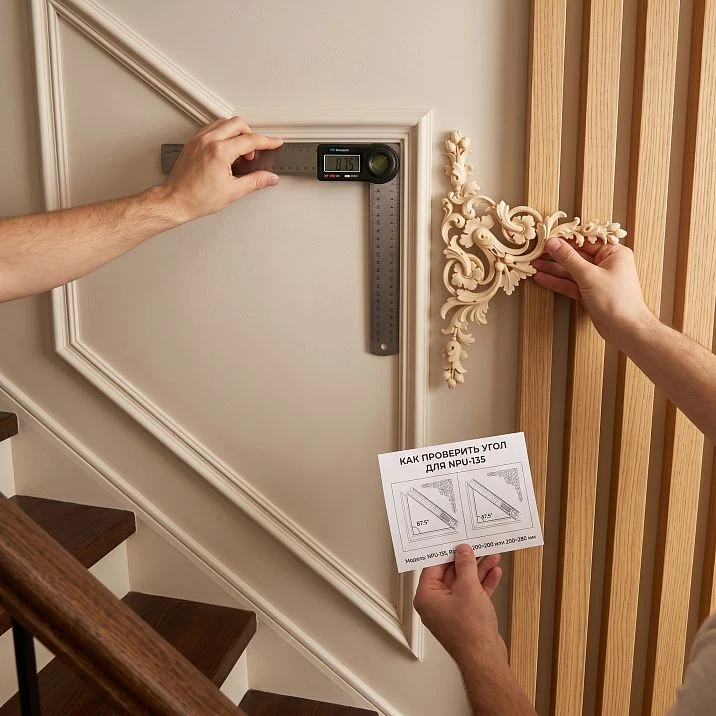
A slanted molding frame along the stairs often looks in the sketch almost like a regular rectangle that is simply "tilted to follow the flight." This is where a dangerous assumption arises: if NPU-135 is a corner decorative overlay, then you can buy four identical elements and place them in four corners.
You cannot count on this before ordering.
A stair frame can have at least two fundamentally different geometries.
First: the entire frame is rotated as a rigid rectangle. The long sides run along the stair flight, the short sides remain perpendicular to them. In this case, the inner corners of the frame itself are still 90°, although the entire composition is positioned diagonally.
Second: the long sides run parallel to the flight, while the end moldings are left vertical. Then the frame becomes a parallelogram, and its corners are no longer 90°: two become acute, two become obtuse.
For NPU-135, this is a decisive difference.
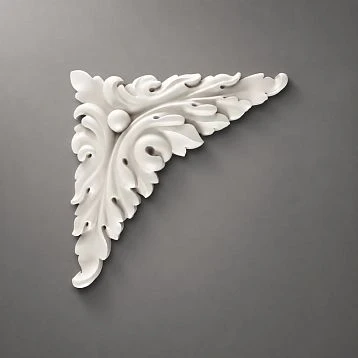
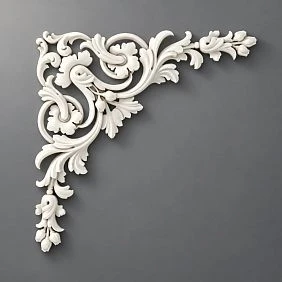
According to the current STAVROS product card, two variants of the carved decorative polyurethane overlay are confirmed:
-
200 × 200 × 9 mm, price 1,940 ₽ per piece;
-
280 × 280 × 12 mm, price 4,820 ₽ per piece.
The product card also provides an additional parameter L: 273 mm for the smaller variant and 381 mm for the larger one. Using L as a "frame diagonal," side length, or any other calculated dimension without clarification is not allowed. For selection in this article, the confirmed A, B, and C are sufficient, and the exact factory contour of the overlay should be taken from the drawing/3D model and a full-size template.
Therefore, the main commercial question is not about which size is "more beautiful."
The correct sequence is as follows:
determine the frame geometry → measure the actual angle → transfer it to the template → check the NPU-135's own geometry → only if they match, compare 200 × 200 and 280 × 280 mm → determine the quantity → order.
If the angle does not match, do not automatically trim the carved ornament.
If it matches, but the 280-millimeter version overlaps the slats, handrail, sconce, or adjacent molding, choose the smaller scale.
If even 200 × 200 mm doesn't fit, the correct result is 0 × NPU-135 and a different corner decor or a different frame scheme.
After such a check, you can buy carved corner overlay NPU-135 already for a confirmed corner, not "for fitting after delivery."
What is confirmed for NPU-135
| Parameter | Small variant | Large option |
|---|---|---|
| Type | Carved decorative overlay | Carved decorative overlay |
| Category | Corner | Corner |
| Material | Polyurethane | Polyurethane |
| A | 200 мм | 280 мм |
| B | 200 мм | 280 мм |
| C | 9 мм | 12 мм |
| L in the card | 273 мм | 381 мм |
| Current price per 1 pc. | 1 940 ₽ | 4 820 ₽ |
| 2 pcs. | 3 880 ₽ | 9 640 ₽ |
| 4 pcs. | 7 760 ₽ | 19 280 ₽ |
For both options, A and B are equal, so the dimension along the two main axes is symmetrical: 200 × 200 or 280 × 280 mm.
But this fact does not automatically prove the value of the internal structural angle of the ornament. The category says that NPU-135 is a corner overlay; the card does not state that it adjusts to any acute or obtuse angle of the stair frame.
Therefore, the Dimension Orientation Gate for dimensions 200 × 200 and 280 × 280 mm is closed, and corner compatibility is checked separately using a drawing, 3D model, or template of the actual product.
This is a fundamental safeguard against the most expensive mistake of the topic: ordering four overlays and then discovering that the molding frame has a different geometry.




Why this article does not duplicate the general STAVROS materials about stairs
STAVROS already has a detailed article on how to decorate a staircase with molding. It covers diagonal moldings along the flight, straight sections, the landing, the double-height space, pilasters, decorative elements, and cutting moldings for non-standard angles.
This is a broad guide to the staircase area.
There are also materials about the stair hall, where different molding schemes are discussed: framed panels, horizontal bands, diagonal lines, and combinations with other elements.
The new page is needed for a more specific solution:
there is a specific angled frame, a specific corner overlay NPU-135, and the risk of ordering the wrong geometry.
It does not answer the following questions anew:
-
which style to choose for the staircase;
-
how many frames to make on the wall;
-
which moldings to use along the entire flight;
-
how to design the area;
-
how to design a double-height space.
It answers one pre-order question:
whether the actual angle of your frame matches the NPU-135 geometry and which of the two dimensions physically fits.
For general context, it makes sense to refer to the STAVROS material how to decorate a staircase with stucco molding, and this article remains a specialized product review.
Our factory also produces:
Geometry of an angled frame: which angle needs to be measured before ordering NPU-135
The phrase "the frame goes diagonally" is not enough.
You need to look at how its sides are connected.
Get Consultation
Option 1. A rectangle rotated to follow the flight of stairs
Imagine an ordinary rectangular frame.
Now rotate the entire rectangle by the angle of the staircase.
The long sides will be parallel to the flight of stairs.
The short sides will be perpendicular to the long ones.
The inner angles of the frame will remain:
90° / 90° / 90° / 90°.
The tilt of the entire composition relative to the floor does not affect the angle value.
This is an important conclusion.
The very fact that the frame is slanted on the wall does not automatically mean that its angles are acute or obtuse.
Option 2. Long sides slanted, ends vertical
This is a common geometrically different scheme.
Two long lines run parallel to the flight.
The left and right short sides remain vertical.
The frame turns into a parallelogram.
If we denote the angle of the long molding to the horizontal α, then an acute angle appears between the inclined side and the vertical:
θ₁ = 90° − α
and the adjacent obtuse angle:
θ₂ = 90° + α.
For example, with a 35° tilt of the long side:
θ₁ = 90 − 35 = 55°
θ₂ = 90 + 35 = 125°.
This results in two angles of 55° and two of 125°.
If the factory NPU-135 is designed for a different geometry, four identical overlays cannot be considered suitable for such a frame without verification.
Option 3. Mixed trapezoid
On the stair wall it gets even more complex:
-
the bottom line follows the flight;
-
the top line is horizontal;
-
the ends are vertical or aligned with other axes.
Then the angles can be of four different types or differ in pairs.
For such a frame, the thought "let's buy four identical corner trims" is especially dangerous.
First, you need to measure each corner separately.
Why the angle should be measured on the finished frame layout, not by the stair angle
The angle of the flight and the angle of the decorative frame are related only when the frame is actually built from the flight line according to the chosen geometric scheme.
But the actual project may differ.
For example:
-
the molding is not exactly parallel to the stringer;
-
the designer slightly reduced the incline;
-
the end face is not vertical;
-
the frame is aligned with the platform;
-
the bottom edge is attached to the handrail;
-
the wall has a bend.
Therefore, you cannot see that the staircase is "approximately 35°" and order corner decor based on that.
You need the angle between the two actual molding lines at the NPU-135 installation point.
This is one of the cases where it is better to measure the decorative system after marking on the wall, but before final installation.
How to measure the actual frame angle without complex surveying
For NPU-135, a theodolite is not needed. What is needed is an accurate transfer of the geometry of exactly the point where the overlay will be placed.
There are several practical methods.
Method 1. Bevel gauge or protractor
The bevel gauge is applied to the two future molding lines.
One arm runs along the first side of the frame.
The second runs along the adjacent side.
After fixing, the tool transfers the actual angle to the table, cardboard, or a working template.
The advantage of this method is that you don't need to know the angle of the stair flight in advance.
The angle of the decorative frame is measured directly.
Method 2. Digital protractor
Suitable if the lines are already marked accurately enough.
First, measure the direction of one molding.
Then the second one.
The difference in directions gives the angle between them.
But you need to keep track of which angle the device shows: acute, external, internal, or supplementary.
For a decorative overlay, you need exactly the internal angle of the area where NPU-135 should lie inside the frame.
Method 3. Cardboard transfer
For a non-standard stair wall, this is one of the most reliable methods.
You need to:
-
take a sheet of cardboard larger than the future NPU-135;
-
apply it to the corner of the frame;
-
transfer two molding lines;
-
mark the vertex;
-
cut out the corner;
-
check the template back against the wall.
This results in a physical copy of the corner.
It is convenient to compare it with the NPU-135 printout.
Method 4. Two template strips
If the moldings have not been purchased yet, you can use two straight strips of the same intended width.
They are used to model the sides of the frame on the wall.
At the intersection point, the angle is fixed.
This method is especially useful when the frame itself still exists only in the project.
What exactly to compare in NPU-135 with the measured angle
You need to compare not the outer rectangle of 200 × 200 or 280 × 280 mm, but the own geometry of the corner ornament.
The overall size answers the question:
does the overlay fit by size?
The contour answers another one:
does its decorative corner match the frame's corner?
These are two independent checks.
For example, NPU-135 200 × 200 mm may fit perfectly between the rails and the handrail, but its inner pattern may not match the 55° angle.
And vice versa: the angle geometry may match, but the 280 × 280 mm version may be too large and extend beyond the free field.
Therefore, the correct sequence is:
ANGLE PASS → SIZE PASS → VISUAL PASS → BUY.
Not the other way around.
How to get the angle from rise and horizontal run if the frame is not yet marked
Sometimes the stair wall is not yet ready for physical marking, but there is a working drawing.
Then the slope of the long side can be obtained from two measurements:
-
horizontal run
X; -
rise
Yover this run.
Angle to horizontal:
α = arctan(Y / X).
Example:
-
the line runs 1000 mm horizontally;
-
for this distance it rises by 700 mm.
Then:
α = arctan(700 / 1000) ≈ 35°.
Further, the solution depends on the second side of the frame.
If the ends are vertical:
90 − 35 = 55°
и
90 + 35 = 125°.
If the short sides are perpendicular to the long sides, the angle remains 90°.
If the diagonal meets the horizontal, 35° and 145° appear.
The same tilt calculation therefore does not give a ready answer for NPU-135. It only determines the direction of the first side.
This method is useful for preliminary design, but the final check is still better done on the wall. The actual molding line may differ from the drawing due to the size of the landing, the position of the handrail, or composition adjustments.
Why the angle from the steps cannot be automatically transferred to the molding
The staircase has a geometric rise angle related to the riser height and tread depth. But the decorative molding does not have to repeat it mathematically exactly.
The designer can:
-
raise the line above the railing;
-
make it a bit calmer;
-
attach to the upper platform;
-
change the slope to ensure equal gaps between the frames.
Therefore, calculating the angle by steps is only acceptable as a preliminary check.
Final θ for NPU-135, take it from the frame's own markup.
The width of the molding does not change the angle, but it changes where the NPU-135 actually sits.
If two sides of the frame are parallel to the given lines, the profile width does not change the angle between them.
But it changes:
-
position of the inner edge;
-
position of the outer edge;
-
the actual apex of the visible field;
-
the overlap area with the decorative trim.
This is especially noticeable on the large NPU-135 280 mm.
Let's imagine that the angle was measured along the central axes of two moldings. Geometrically, everything is correct. But the trim itself is installed not on abstract axes, but over the actual profiles and wall. If the molding is wide, its outer edges may approach the carved pattern differently than expected.
Therefore, on the final template, you need to draw the full width of the moldings, not two thin lines.
Then you can see:
-
how much of the ornament is covered by the profile;
-
whether any random gap remains;
-
isn't the NPU going too far inside the frame;
-
is the visible molding line preserved after installing the overlay.
This is a separate SIZE/FIT test after checking the angle.
An equal angle does not yet guarantee the same orientation of the ornament at four points
Even if all four corners of the frame are equal, the NPU-135 needs to be virtually rotated into all intended positions.
Carved decor may have a pronounced pattern direction:
-
a larger leaf on one side;
-
an accent central part;
-
different character of the outer and inner edges.
Therefore, in a full-size layout, it is useful not to copy the same template without rotation, but to place it as the real element will be oriented in each corner.
Check:
-
lower left corner;
-
upper left;
-
upper right;
-
bottom right.
If the card/3D shows that the same SKU allows the required rotations and the pattern remains logical, the set can be considered consistent in orientation.
If there is doubt, you cannot independently invent a mirrored version that is not in the catalog. You need to clarify with the manufacturer or choose another decorative element.
Why it makes no sense to set an "angle tolerance" without the manufacturer's drawing
In a construction joint, a slight discrepancy is sometimes acceptable, which is hidden by sealant or putty.
The situation is different for a carved decorative overlay.
The angle affects not only the technical seam but also the pattern.
If decorative branches should run along the moldings, the error may manifest as:
-
different indentation on left and right;
-
a skewed top;
-
one branch falls on the profile, the other moves away from it;
-
a noticeable asymmetry appears.
Therefore, the article deliberately does not introduce a value like "±3° is acceptable."
There is no such confirmed tolerance in the NPU-135 card.
The correct check is to overlay the real contour on the actual angle and see whether the composition matches as intended.
Choosing the NPU-135 size: full-size templates 200 × 200 and 280 × 280 mm
The two NPU-135 sizes are convenient to compare without the product.
You need to prepare two sheets:
-
square/contour 200 × 200 mm;
-
square/contour 280 × 280 mm.
If you have access to a blueprint or a high-quality image of the product, it is better to print the silhouette itself at a 1:1 scale.
If not, a dimensional mockup is sufficient for a start.
What the 200 × 200 mm mockup shows
It answers:
-
whether there is enough space;
-
whether the overlay is too close to the rails;
-
whether it conflicts with the handrail;
-
whether it overlaps the adjacent molding;
-
whether the ornament is readable at the staircase scale.
What the 280 × 280 mm mockup shows
He is now checking a different scale.
The area of the overall square increases not by 40%, but almost doubles:
200 × 200 = 40,000 mm²
280 × 280 = 78,400 mm².
Ratio:
78 400 / 40 000 = 1,96.
That is, the overall field of the 280 mm version is almost 1.96 times larger.
This explains why the large variant is perceived as noticeably more massive than it seems from the difference of "only 80 mm per side."
The relief also increases:
-
9 mm;
-
12 mm.
On a tall stair wall, the additional depth can be useful.
On a narrow frame — on the contrary, making the corner too heavy.
Size 200 × 200 mm: when it is more logical
The smaller NPU-135 more often becomes the first candidate if:
-
the frame is narrow;
-
a slat panel runs close nearby;
-
the handrail is not far away;
-
the molding itself is not wide;
-
the stair flight is small;
-
the decor should be noticeable but not dominate.
Price of one piece — 1,940 ₽.
Four — 7,760 ₽.
This makes a full-size check especially useful: if the geometry doesn't match, the error immediately affects not just one purchase, but a potential set of four elements.
But the smaller size isn't "safe by default."
If the angle is wrong, 200 mm won't save you.
Size 280 × 280 mm: when it can be stronger
The large NPU-135 suits a different scale.
It's worth checking if:
-
the wall is high;
-
the frame is large;
-
the molding is wide;
-
the viewing distance is large;
-
there is no close proximity to rails nearby;
-
the stair hall itself is spacious.
The price of one piece is 4,820 ₽.
Four pieces — 19,280 ₽.
Therefore, switching from a small size to a large one changes not only the visual density, but also the budget.
The cost difference for four elements:
19 280 − 7 760 = 11 520 ₽.
This is a sufficient amount to base the size choice on a real mockup, rather than on the principle "larger looks more expensive."
200 and 280 mm cannot be chosen only by the width of the molding
The width of the molding is important, but it does not determine the size of the overlay by itself.
Additionally, the following factors come into play:
-
dimensions of the entire frame;
-
length of the flight;
-
wall height;
-
viewing distance;
-
free space up to the slats;
-
adjacent sconces;
-
handrail;
-
decor color.
For example, a wide molding in a small frame already creates a strong architectural line. A large NPU-135 can overload the corner.
Conversely, on a double-height wall, a small overlay can get lost, even if the molding is formally not very wide.
Therefore, the size is chosen based on the entire composition.
Free space around the corner: slats, handrail, sconce, relief, and color
For each installation point, it is useful to measure not just one number, but at least four directions.
From the vertex of the angle:
-
along the first side of the frame;
-
along the second;
-
outward to the slat panel;
-
to the nearest external object.
For NPU-135, the external space is especially important.
The ornament must not accidentally extend:
-
onto the slats;
-
onto the handrail;
-
onto the sconces;
-
on the switch;
-
on the adjacent frame;
-
on the architectural break of the wall.
A universal "correct gap" in millimeters cannot be specified.
You need to compare two templates and choose the one that leaves a clear visual pause.
Slat panels are an adjacent system, not a base for NPU-135
In this article, NPU-135 is considered on the smooth part of the wall inside or at the corner of the molding frame.
The slat finish is nearby.
This is important both technically and visually.
If the overlay partially extends onto the relief of the slats:
-
the back plane may not fit;
-
a level difference appears;
-
the ornament crosses the vertical slats;
-
installation becomes more complicated.
Therefore, it is better to design the corner so that the NPU-135 remains on one smooth plane.
If the slat zone itself is still being selected, you can buy slat panels for walls for interior finishing separately, without mixing their installation technology with the installation of the corner trim.
How slats change the perception of size 200 and 280 mm
The vertical rhythm of slat panels is visually active.
Next to it, the carved corner trim is perceived more strongly than on a completely smooth wall.
Therefore, the 280 mm version may look even larger.
Need to check three types:
At the bottom of the stairs
This is the main far point.
Here you can see if the 200 mm is lost.
From the middle of the flight
The decor becomes closer.
The relief is especially noticeable here.
From the upper landing
The angle may be read from a different perspective.
On a staircase, one frontal point is not enough.
That is why a large size cannot be chosen based only on a photo of the wall from below.
Quantity and budget: when 4, 2, 1, or 0 NPU-135 are needed
This is one of the most important commercial conclusions.
A regular rectangle has four equal angles.
A parallelogram has two acute and two obtuse angles.
A trapezoid can have an even more complex picture.
Therefore, purchasing "4 × NPU-135" is only acceptable after checking all four points.
For example, the frame has:
-
two angles of 90°;
-
one 60°;
-
one 120°.
If the actual geometry of NPU-135 matches only the 90° corner, four identical elements are not a correct set.
Other solutions are possible:
-
use NPU-135 only in two suitable corners;
-
leave the remaining corners with clean molding cuts;
-
change the frame shape;
-
choose a different corner decor.
That is, the commercial choice in reality is not always limited to 0 or 4.
There can be 2 pieces if the composition remains deliberate and symmetrical.
But such a solution needs to be seen on a full frame mockup, not assembled from leftovers.
When four NPU-135s are truly logical
Four identical overlays are a strong option if:
-
all four corners have the same compatible geometry;
-
the ornament allows the necessary rotations;
-
there is enough free space at all four points;
-
no NPU overlaps the rails;
-
the scale reads equally well from top and bottom;
-
the molding frame is large enough.
Then the calculation is simple.
Four NPU-135 200 × 200 × 9 mm
4 × 1 940 = 7 760 ₽.
Four NPU-135 280 × 280 × 12 mm
4 × 4 820 = 19 280 ₽.
The difference is 11,520 ₽.
Therefore, two paper templates provide not a decorative trifle, but a solution check with a noticeably different budget.
When two NPU-135 can be better than four
On a staircase, there is often a visually dominant diagonal.
You can consider two overlays, for example:
-
only in the upper corners;
-
only in the corners on the landing side;
-
only in a pair of geometrically identical points.
This works if the pair has architectural logic.
Bad scenario:
two were placed only because the other two didn't fit.
Good:
two identical points deliberately mark the beginning or end of the frame.
For a size of 200 mm, two pieces cost:
2 × 1 940 = 3 880 ₽.
For 280 mm:
2 × 4 820 = 9 640 ₽.
The quantity should be a result of composition and angular compatibility, not a way to use part of a purchased set.
If the angle doesn't match: why it's better to change the frame or decor rather than cut the ornament blindly
If the molding doesn't match at the angle, its end can be trimmed.
With carved NPU-135, the logic is different.
Trimming the decorative overlay can:
-
cut off part of the ornament;
-
disrupt the symmetry of the pattern;
-
make one side shorter;
-
expose an unattractive end grain;
-
change the proportion relative to the molding.
It is especially risky to try to turn an element designed for one geometry into another by merely cutting off the top.
The article does not claim that NPU-135 cannot be processed at all.
It claims something else:
The card does not claim it as an adjustable corner element for arbitrary acute and obtuse angles.
Therefore, serious trimming should be considered an individual modification, not a standard installation method.
If the trim does not fit without such modification, it is safer to first change the frame layout or choose a different element.
How to change the frame if you like the NPU-135 but the angle does not match
There are several architectural ways to keep the product itself without ruining the ornament.
Make the entire frame a rotated rectangle
If the short sides are made perpendicular to the long sides, the angles become 90° again.
The entire frame will remain tilted relative to the floor, but its internal geometry will become rectangular.
This is a good example of how the problem can be solved by the shape of the molding frame rather than by the trim.
Create a local rectangular joint
Sometimes a decorative corner can be moved to a small local area, and the diagonal line can be brought to it with a separate joint.
But such a node requires a sketch: it's easy to get an extra kink.
Leave the corner without an overlay
A cleanly trimmed molding joint can look better than a decorative element that is forcibly forced in.
Choose a different corner decor
In the category you can buy polyurethane corner overlays and compare other contours.
The main thing is to change the decision for a reason.
If the problem is in the corner, we look for a different geometry.
If the problem is in size, a different scale.
If the problem is overload, without an overlay.
How to check if the NPU-135 conflicts with the handrail
The stair frame often runs close to the handrail.
Due to perspective in the drawing, the distance may seem sufficient, but on the wall, a large ornament drops too close.
You need to measure:
-
distance from the corner of the frame to the handrail line;
-
the actual area occupied by the NPU template;
-
hand position on the handrail;
-
visual shadow.
The overlay should not create a feeling that the decor "lies" on the handrail or accidentally touches its line.
However, there is no universal standard in millimeters.
For 200 and 280 mm, you need to make two real templates.
Sconces and switches can eliminate a large size even at the correct angle
Sconces are often placed on the stair wall.
If the NPU-135 is nearby, consider:
-
lamp housing;
-
lampshade;
-
light cone;
-
lamp replacement location;
-
switch or sensor.
The 280 × 280 mm version takes up much more space.
Even if it geometrically fits the frame, the lamp can make a large ornament feel cramped.
Side lighting is especially important.
A 12 mm relief will produce a more pronounced shadow than the 9 mm on the smaller version.
Therefore, the size is checked with the sconces turned on.
If the frame corner is close to the slat panel, you need to measure not to the edge of the molding, but to the NPU overall dimension.
Suppose the frame top is 240 mm from the edge of the slat panel.
The molding itself fits perfectly.
But the NPU-135 280 × 280 mm can extend far beyond its limits.
You cannot automatically use the number 280 mm as the exact "overhang from the top," because the actual contour of the overlay must be taken from the drawing.
But the overall template already shows the risk.
If the 280 × 280 mm square crosses the slats, that is a CHECK zone.
Then the real contour is opened.
If the ornament itself intersects, the large size is not suitable.
With NPU-135 200 × 200 mm, the same point may be free.
This is a good example where choosing 200/280 is decided not by style, but by physical proximity.
A relief of 9 or 12 mm is important next to a thin molding.
Size C differs among the options:
-
9 mm;
-
12 mm.
These 3 mm seem small, but the relief of the corner pad can visually be stronger than the molding itself.
If the frame is assembled from a very thin flat profile, a large NPU-135 may seem like a separate massive object.
If the molding is carved and expressive, 12 mm can support the overall character.
Therefore, during a full-size fitting, it is useful to make not only a flat paper contour, but also a simple three-dimensional mock-up.
For example, place cardboard of the required thickness under it.
This way, side lighting will show the difference.
Color helps unify the NPU-135 with the molding, but does not fix incorrect geometry.
The calmest scenario is when the overlay and molding are painted the same color.
Then the NPU reads as part of the frame.
If the NPU is made contrasting, its own geometry becomes more noticeable.
This can be beautiful, but the angle error will also become more obvious.
Therefore, the sequence is important again:
geometry → size → color.
There is no need to try to "hide" the angle mismatch by painting it the color of the wall.
If the contour doesn't work, color won't fix it.
Installation on a stair wall: base, adhesive, and safe access
NPU-135 made of polyurethane — decorative overlay.
The card shows KUDO HIGH TACK among related products, and the catalog has separate Materials for installing stucco molding.
But this doesn't justify using one adhesive for any stair wall.
The substrate can be:
-
durable painted plaster;
-
drywall;
-
decorative plaster;
-
other finishes.
Need to check compatibility of the mounting compound simultaneously:
-
with polyurethane;
-
with the actual wall finish.
On stairs, a third factor is added — access.
If the point is high above the march, you cannot work while balancing on a random stepladder or steps.
For high areas, a safe work platform, scaffolding, or another professional access system is needed.
The inner corner of the frame and the angle of the molding cut are not the same thing
When working with a stair frame, it is easy to confuse two different numbers.
The first is the inner angle of the decorative frame, where the NPU-135 is intended to be placed.
The second is the cut angle of the molding end, which is needed so that two profiles meet each other.
For example, if two moldings form an inner angle of 90°, with a symmetrical cut, each end is usually cut at half of that turn relative to the joint line. But for a non-standard angle, the specific saw setting depends on the cutting scheme and the profile shape.
To select the NPU-135, you need not the angle setting of the miter saw, but the full geometry of the finished frame corner.
Therefore, you cannot ask the craftsman:
"At how many degrees do you cut the molding?"
and take this number as the NPU angle.
It is better to ask:
"What internal angle do the two finished frame lines form at the overlap point?"
It is this one that we transfer to the template.
Another geometry: the slanted side meets the horizontal one
On a stair landing, the frame may transition from diagonal to horizontal.
If one side goes at an angle α to the horizontal, and the other remains horizontal, an acute angle arises between the directions α, and the additional internal angle is:
180° − α.
When α = 35° We get:
-
acute angle — 35°;
-
obtuse — 145°
This is a completely different geometry than the "sloped + vertical" scheme, where at the same 35° you got 55° and 125°.
Therefore, the phrase "march angle 35°" by itself says nothing about NPU-135 compatibility.
You need to know which second line the diagonal molding meets.
This way the article gains practical meaning: the same stair flight can produce different frame angles depending on how the designer built the ends.
Worksheet of four angles: how to check the entire frame before the basket
Geometry matrix: one stair slope — three different frame angles
The march angle can only be used as an initial variable. The angle itself for NPU-135 depends on how the adjacent side of the frame is drawn.
| Frame scheme | Direction of the long side | Direction of the adjacent side | Interior angles at α = 35° | What this changes |
| Rotated rectangle | 35° to the horizontal | perpendicular to the long side | 90° and 90° | tilting the frame does not change the angles |
| Parallelogram with vertical ends | 35° | 90° to the horizontal | 55° and 125° | two different types of angles are needed |
| The diagonal meets the horizontal | 35° | 0° | 35° and 145° | the angle is even more acute/obtuse |
This table does not claim that the NPU-135 is designed for any one of the listed angles. It shows why you first need to determine your own factory bracket angle, and then compare it with the actual scheme.
It is convenient to denote the NPU-135 angle as β.
Then the pre-order check looks simple:
θ frame = β NPU → ANGLE PASS
θ frame ≠ β NPU → CHECK/FAIL, do not automatically proceed to purchase.
Here you cannot assign a universal allowable difference of 2°, 3°, or 5°. The product card does not set such a mounting tolerance. On a carved ornament, even a small discrepancy can manifest differently depending on where the outer edges run, how the overlay overlaps the molding, and how noticeable the joint is.
Therefore, instead of a made-up tolerance, a physical template is used.
Working table of four angles
Before the cart, it is convenient to fill in one table for the entire frame.
| Frame angle | Measured angle θ | NPU geometry matches | 200 mm fits | 280 mm fits | Adjacent obstacles | Solution | ||||||||||||||||||||||||||||||
| Bottom left | ___° | Yes / no | Yes / no | Yes / no | handrail / slats / none | ___ | ||||||||||||||||||||||||||||||
| Top left | ___° | Yes / no | Yes / no | Yes / no | wall lamp / slats / none | ___ | ||||||||||||||||||||||||||||||
| Top right | ___° | Yes / no | Yes / no | Yes / no | slats / none | ___ | ||||||||||||||||||||||||||||||
| Bottom right | ___° | Yes / no |
yes / noWhen it's better to order one NPU-135 first rather than all four at onceIf time allows, a single test purchase can be reasonable for complex stair geometry. Especially when:
One NPU-135 200 mm costs 1,940 ₽, the larger one costs 4,820 ₽. This approach is more expensive in terms of time and delivery, but cheaper than the mistake of four unsuitable elements. However, if the project is precisely drawn, the angles are checked, and the 3D and templates match, buying one "for testing" is no longer necessary. This is not a universal recommendation, but a risk reduction strategy for a non-standard object. Commercial decision before ordering: when NPU-135 is suitable, and when it is better to refuseDeclining is a legitimate commercial outcome. It's better not to order NPU-135 if:
In such a situation order decorative polyurethane overlays it can be done after choosing a different geometry, rather than to preserve the original idea at any cost. Mistakes that cause the angular NPU-135 to be ordered "by picture"Mistake 1. Assuming that any oblique frame has non-standard anglesWhy it happens: the entire composition is tilted. Consequence: a suitable rotated rectangle is mistakenly considered incompatible. Check: measure the short and long sides. How to avoid: separate the tilt of the frame from its internal angles. Mistake 2. The opposite mistake — assuming that all four angles are always 90°Why it occurs: the word "frame" is associated with a rectangle. Consequence: four NPUs are purchased for a parallelogram with acute and obtuse angles. Check: remove each corner. How to avoid: determine the geometric type before ordering. Error 3. Using the stair flight angle instead of the frame angleWhy it occurs: the flight sets the diagonal. Consequence: the calculation does not account for the direction of the second side. Check: measure both frame lines. How to avoid: transfer the finished angle using a bevel or template. Error 4. Comparing only the 200/280 mm dimensionWhy it occurs: these dimensions are visible in the card. Consequence: everything fits in place, but the decorative corner does not match. Check: compare the actual NPU contour. How to avoid: separate ANGLE PASS and SIZE PASS. Error 5. Consider L = 273 or 381 mm as the finished diagonal of the corner.Why it occurs: the parameter is present in the card table. Consequence: extra geometry is built on an unverified value. Check: find the explanation of L in the technical drawing. How to avoid: do not use an unverified parameter in calculations. Error 6. Buy 280 mm just because the wall is high.Why it happens: on a staircase, large decor often reads better. Consequence: the corner turns out to be too heavy next to the slats and molding. Check: template 280 × 280 mm at three viewing points. How to avoid: compare with 200 mm on the same wall. Mistake 7. Trim the ornament after delivery to "still install it"Why it happens: the product has already been purchased. Consequence: the pattern and symmetry are disrupted. Check: make a cardboard corner before ordering. How to avoid: change the frame or model before purchasing. Mistake 8. Check only the top cornerWhy it occurs: it is better visible on the wall. Consequence: the lower NPU conflicts with the handrail or switch. Check: full drawing of the four corners. How to avoid: form the set only after four checks. Error 9. Glue the NPU partially onto the slatsWhy it occurs: a few centimeters are missing. Consequence: there is no normal contact plane and the rhythm of the lamellas is broken. Check: template contour relative to the edge of the slat. How to avoid: leave the overlay on a smooth surface. Error 10. Choose glue before checking the baseWhy it occurs: the card shows the accompanying KUDO HIGH TACK. Consequence: the mounting system may not match the actual wall finish. Check: determine the substrate and material requirements. How to avoid: first the technology, then the specific composition. What to check in 15 minutes before ordering NPU-135Step 1. Mark out the frameNot just the diagonal side, but all four lines. Step 2. Determine the typeRotated rectangle, parallelogram, trapezoid, or mixed shape. Step 3. Measure the four cornersWith a bevel gauge, digital protractor, or cardboard. Step 4. Label themFor example:
Step 5. Prepare the NPU-135 templateFirst, the actual outline or technical drawing. Step 6. Compare the angleDo not proceed to the size if the geometry does not match. Step 7. Apply 200 × 200 mmCheck the battens, handrail, sconce, and molding. Step 8. Apply 280 × 280 mmCompare the scale. Step 9. Step down the stairsLook from a distant point. Step 10. Check the middle of the flightThe relief is visible here. Step 11. Look from aboveMake sure the decor does not look skewed. Step 12. Count the quantity0 / 2 / 4. Step 13. Calculate the budget200 mm: 1,940 ₽/pc. 280 mm: 4,820 ₽/pc. Step 14. Check the baseThe overlay must be mounted on a smooth prepared part of the wall. Step 15. Only after this, place the orderNone of the previous steps require damaging the wall or trimming the product. Full algorithm from the stair flight to the cart
If the project requires an accompanying compound, the NPU-135 card shows KUDO HIGH TACK adhesive among related products. But it should only be used after checking the requirements for the specific substrate and the material's instructions. Decision matrix: angle, size, quantity
Result: in this topic, the angle is more important than the sizeNPU-135 is a carved decorative overlay made of polyurethane, available in two current sizes: 200 × 200 × 9 mm — 1,940 ₽; 280 × 280 × 12 mm — 4,820 ₽. But size is the second stage of selection. The first is geometric compatibility of the angle. An oblique frame along the staircase can be a regular rectangle, just rotated to follow the flight. Then its angles remain 90°.
It can be a parallelogram with vertical ends. Then, when the flight is inclined, It can transition from diagonal to horizontal. Then another pair of angles arises. Therefore, buying four NPU-135 just because there are four angles in the project is the wrong sequence. First: measure four angles. Then: compare them with the actual contour of NPU-135. Only after ANGLE PASS: check 200 and 280 mm with full-size templates. If both sizes fit, the choice depends on the frame scale, proximity of slat panels, handrail, lighting, and viewing distance. If the geometry does not match, it is better to change the frame shape, leave a clean molding joint, or buy polyurethane corner overlays another shape. If a wider alternative is needed, you can You can buy ready-made stucco matching the Baroque style. Calculate the quantity: linear meters of cornices and moldings, number of rosettes, pilasters, consoles, corner elements. Add a ten to fifteen percent allowance for trimming. and reassemble the composition without trying to force a specific NPU-135 to work at an unsuitable angle. The commercial result of the article is therefore not promotional but measurable: angle matches + 200 mm fits → order NPU-135 200 mm; angle matches + large scale needed → order NPU-135 280 mm; The angle does not match → do not buy NPU-135 until the scheme is changed. FAQCan NPU-135 be installed only in one corner of the stair frame?One element can be considered a local accent if it is a deliberate asymmetric composition. For a symmetrical classic frame, a single overlay usually requires separate design justification. Is it necessary to measure the angle after gluing the moldings?No. It is better to take the geometry at the marking or dry layout stage, so as not to buy decor after irreversible frame installation. If the frame angle differs from the NPU template by only a few degrees, can the polyurethane be 'pressed'?The NPU-135 card does not declare adjustable angular geometry. A rigid carved overlay should not be considered an element that normally changes angle during installation. Manufacturer/specialist verification or another solution is needed. Can one rely on L = 273 and 381 mm when constructing the angle?Without confirmed decoding of the L parameter — no. In this article, calculations are based on confirmed A, B, C and the actual product template. If the frame is rotated by 35°, do its angles become 55° and 125°?Only if the long sides go at 35° to the horizontal, and the short sides remain vertical. If the entire rectangle is rotated as a whole and the short sides are perpendicular to the long sides, its angles remain 90°. What is more important for choosing 200 or 280 mm — the wall height or the frame size?Both factors. A high wall requires a readable scale, but the free field of a specific corner, a handrail, a sconce, and slats can limit the larger option. Can I place a large NPU-135 in the upper corners and a small one in the lower ones?Technically, this is already a mixed composition of two scales. It requires a separate sketch; such a solution cannot be automatically considered harmonious. What to do if the slats start immediately behind one corner of the frame?First, apply the real contour of the NPU-135. If the ornament extends onto the slat surface or a plane transition, it is better to reduce the size, change the frame position, or choose a different decor. Can I use NPU-135 without a molding frame?The card describes it as an independent decorative element for walls and other surfaces, but this is a different user scenario. In this article, it is evaluated specifically as a corner frame decor. Where to look for other options if NPU-135 does not match the angle?In the section polyurethane corner overlays you can compare other models and check their outline the same way. |