Article Contents:
- Geometric furniture leg MN-210: which dimensions are actually confirmed by the product card
- MN-210 120×122×122×24 mm
- MN-210 140×122×122×24 mm
- Beech furniture leg MN-210
- Oak furniture support MN-210
- Why parameters B and C are more important than height for an already finished body
- Do not call B×C a mounting plate without checking
- Find the actual contact surface
- Find mounting points
- Check how much of the 122×122 area the top of the leg occupies
- Compare with the finished bottom
- What to check instead of a simple comparison
- Why 6 mm is sometimes not a problem
- Why 6 mm is sometimes critical
- Bottom thickness
- Corner brace size
- Distance to cabinet edge
- Internal partitions
- Soffit height
- Drawer position
- Access for fasteners
- Four-corner table
- Actual support area fits on the reinforcement
- Fastener lands on the structural base
- Leg does not dangerously protrude beyond cabinet edge
- Assembly confirmed by furniture designer
- Fasteners extend beyond the reinforcement bar
- The bottom is too thin for the designed fastening
- Only a thin panel is located in the corner
- The load is transferred to a place not accounted for by the cabinet structure
- After reinforcement, the position of the leg itself will change
- Reinforcement material
- Fiber direction
- Reinforcement fasteners
- Adhesive
- Access from the inside
- Guide position
- Load transfer
- Both versions have B=122 and C=122
- Height changes by 20 mm
- The mounting problem does not disappear with the choice of height
- Front left corner
- Front right
- Rear left
- Rear right
- Actual assembly deviations
- Step 1. Cut out 122×122 mm
- Step 2. Mark the center
- Step 3. Mark the expected contact area
- Step 4. Mark the fasteners
- Step 5. Apply from below to the bottom
- Step 6. Repeat four times
- Why then calculate the area
- When 6 mm is visually acceptable
- When 6 mm already interferes
- When 6 mm is structurally critical
- Why this matters visually
- MN-210 made of beech for opaque finish
- Oak MN-210 with pronounced texture
- The species does not fix an incompatible size
- Structure first, then decorative material
- If the node does not fit
- If the oak is already tinted
- Compare other geometric models
- Look for smaller B/C
- Check the height separately
- First compatible geometry, then design
- The foot pad is not part of the 122×122 check
- For four legs, the quantity is checked according to the project
- Count hardware reserve separately
- 1. Printout B×C
- 2. Template
- 3. Apply to the bottom
- 4. Mark the fasteners
- 5. Check four corners
- 6. Confirm with the furniture maker
- 7. Only then buy
- Body #0
- One MN-210
- Node check
- Freeze the drawing
- Only then the batch
- Do not paint the four legs before checking the fit
- Dry assembly
- Labeling
- Then enamel or tinting
- Load path
- Why one large block is not enough
- Why a small block sometimes works
- Why this is better than words
- Oak
- Oak
- Overall dimension zone
- Contact zone
- Mounting area
- Structural load zone of the cabinet
- Why "centered on the amplifier" can be a wrong rule
- What this difference buys
- Mistake 1. Calling 122×122 a mounting area without a drawing
- Mistake 2. Deciding that 110×110 is definitely too small
- Mistake 3. Deciding that 6 mm protrusions are definitely safe
- Mistake 4. Switching from 140 to 120 hoping to reduce B/C
- Mistake 5. Checking only the front corners
- Mistake 6. Gluing an extra square "for reliability"
- Mistake 7. Buying oak before a dry fit
- Mistake 8. Painting the legs before checking
- Error 9. Confusing FUR-023 with the top fastener
- Error 10. Not checking the drawer guides
- Error 11. Assuming the finished cabinet is perfect
- Error 12. Not accounting for the finish after reinforcement
- Error 13. Buying four legs for a trial fit
- Error 14. Not checking the external offset
- Error 15. Assuming a larger leg is always more stable
- Scenario A — keep MN-210
- Scenario B — choose a different support
- What are the dimensions of MN-210?
- What is the size B of MN-210?
- What is the size C of MN-210?
- Does B×C differ between the 120 and 140 mm versions?
- Can MN-210 be installed on a ready-made dresser?
- What to do if the corner brace is smaller than 122×122 mm?
- Is it mandatory to redo the bottom at 110×110 mm?
- Can the cabinet body be reinforced for a furniture leg?
- How to check the four corners of the cabinet body?
- What to choose — beech or oak?
- How many MN-210 are needed for a dresser?
- Which floor glide is recommended for MN-210?
- What size is FUR-023?
- How much does FUR-023 cost?
- Where to buy FUR-023?
- Where to buy wooden furniture legs?
- Where to buy legs for a dresser?
- Where to buy MN-210?
- How to order MN-210?
- How to check the current price?
- Why can't B×C be considered a mounting plate?
- Is it normal if the leg protrudes 6 mm beyond the amplifier?
- Will choosing 120 mm instead of 140 mm help?
- Can the leg be shifted inward?
- Can a large plate be screwed to the bottom?
- Do I need to buy one test leg?
- When to paint MN-210?
- Can oak be used under enamel?
- Why should every corner be checked separately?
- What to do if the back corners don't fit?
- Do I need to take the weight of the dresser into account?
- Does the article include a permissible load of 110×110?
- Do I need to secure a tall dresser to the wall?
- Can the MN-210 be used on a nightstand?
- How can I tell that reinforcement is needed before purchasing?
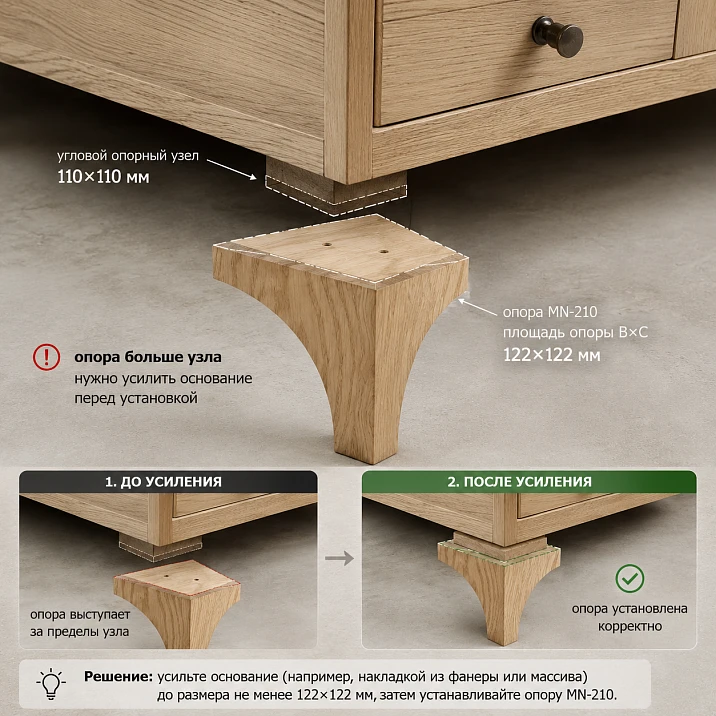
The dresser body is already assembled. The bottom is installed, internal reinforcements are glued in, and the drawers and back panel are tied to the finished geometry. At the leg selection stage, the customer liked the geometric furniture leg MN-210. The product card has two heights — 120 and 140 mm, but for both options B and C are the same: 122×122 mm.
At the same time, the existing corner support assembly of the dresser in our design case has a size of 110×110 mm.
At first glance, the conflict seems minor:
122 − 110 = 12 mm.
If we conditionally center the leg relative to the amplifier:
12 / 2 = 6 mm protrusion on each side.
A natural question arises: can these 6 mm be considered insignificant, order four MN-210s and attach them to the already finished enclosure? Or is 110×110 mm too small an area and the bottom needs reinforcement first?
There is no direct universal answer based on just two numbers.
The reason is that B×C 122×122 mm cannot automatically be called a mounting area, contact surface, or fastener placement zone without checking the MN-210 drawing. The card confirms parameters B and C, but for the finished enclosure, you need to separately understand:
-
what actual area of the top part of the leg is in contact with the furniture;
-
where the mounting points are located;
-
through which part of the leg the load is transferred;
-
where the screws go relative to the 110×110 mm amplifier;
-
what the bottom is made of;
-
is there an internal block or double bottom;
-
how close the edge of the housing is;
-
whether the fasteners conflict with the drawer rails, partition, or back wall.
Therefore, the correct order of solving is as follows:
-
obtain or open the MN-210 drawing;
-
transfer the contour B=122 and C=122 to the bottom at a 1:1 scale;
-
separately mark the actual contact and fastening zone;
-
check the four corners of the housing;
-
understand where the load is actually transferred;
-
if reinforcement is needed — design it before buying the legs;
-
only after that choose beech or oak, height 120/140 mm, and FUR-023.
Main thesis of the article:
if B and C of MN-210 are 122 mm, switching from 120 to 140 mm height does not resolve the conflict with the 110×110 mm node — both versions have the same B×C geometry.
That is, this task is not about choosing the height. A separate article may compare MN-210 120 and 140 mm by the final furniture height, but here the commercial intent is different: whether a specific leg fits an already assembled cabinet.
If after the drawing and dry fitting the actual contact area fully rests on the load-bearing part of the cabinet, the fastener enters the reinforcement, and the furniture designer confirms the joint, 110×110 mm may prove to be a sufficient design solution. If the screws extend beyond the block, the load falls on the thin bottom or part of the leg hangs outside the calculated area, the cabinet structure is changed first.
Before this check, do not buy four expensive supports “for trial.” At the time of the check, the MN-210 card shows a price of 2,730 ₽ for beech and 4,780 ₽ for oak. Four legs are already 10,920 ₽ or 19,120 ₽ for the product alone, without finish, glides, and possible cabinet rework.
Once the geometry is confirmed, you can buy the MN-210 furniture leg already as a compatible part, not as a decorative element that the workshop will later try to adapt to the finished bottom.
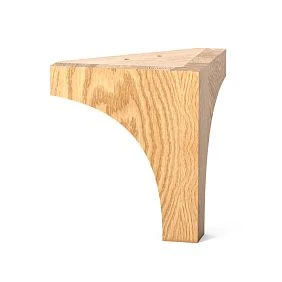
Geometric furniture leg MN-210: which dimensions are actually confirmed by the product card
For MN-210, the current product card shows two heights.
| Option | A | B | C | F | Material |
|---|---|---|---|---|---|
| MN-210 | 120 мм | 122 мм | 122 мм | 24 мм | Beech / Oak |
| MN-210 | 140 мм | 122 мм | 122 мм | 24 мм | Beech / Oak |
This is an important feature of the model: the height changes by 20 mm, but B, C, and F remain the same.




MN-210 120×122×122×24 mm
The low version is suitable for furniture where a smaller lift of the body is required.
But for our unit of 110×110 mm, its height advantage changes nothing: B×C remains 122×122 mm.
Our factory also produces:
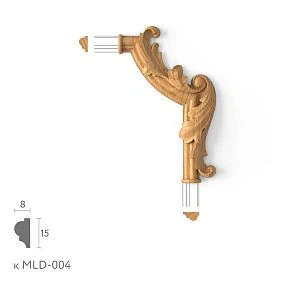
MN-210 140×122×122×24 mm
The high version raises the body by another 20 mm.
But dimensions B and C are the same.
If the conflict is indeed related to the upper geometry of the leg, the transition 120 → 140 does not help.
Get Consultation
Beech furniture leg MN-210
Beech is logical for covering trim if the project wants the same color as the body.
But the wood species does not change B/C.
Oak furniture support MN-210
Oak is needed when the natural texture must remain visible or when it is coordinated with the rest of the furniture.
It also does not solve the geometric conflict of 122 versus 110.
Why parameters B and C are more important than height for an already finished body
If the body is still being designed, the designer simply lays out a suitable force zone for MN-210.
If the body is already assembled, the situation is reversed: the leg has to be checked against the existing geometry.
Therefore, for a finished dresser, the priority of parameters is:
contact/fastener → B/C → amplifier → body edges → only then A=120/140.
Buy furniture legs after assembling the body: first determine what exactly B and C mean on the MN-210 drawing
If the buyer is going to buy furniture legs after manufacturing the body, the most dangerous mistake is to take 122×122 mm as the exact size of the mounting area without looking at the drawing.
Do not call B×C the mounting area without checking
In the product table, B and C are dimensional parameters of the item.
To make an engineering conclusion, you need to understand which points of the drawing they refer to.
This could be:
-
overall dimension of the top part;
-
width of the decorative body;
-
size of a specific element;
-
another structural dimension.
Without a drawing, it cannot be asserted that the entire 122×122 area must fully lie on the amplifier.
Find the actual contact surface
The foot may have an upper part where not the entire footprint actually contacts the bottom.
If the contact area is smaller than 110×110 mm and falls on the amplifier, the B/C conflict may be only visual-dimensional.
If the contact truly occupies almost the entire 122×122, the situation is different.
Find the mounting points
For strength, it is especially important where the screws land.
Even if part of the foot body protrudes 6 mm beyond the amplifier, the fasteners may be entirely within the structural beam.
And vice versa: visually everything fits, but the outermost screw hits a thin panel.
Check what part of 122×122 the top of the leg occupies
On the full-size template, it is advisable to mark:
-
outer contour;
-
contact zone;
-
fasteners;
-
leg axis.
These are four different layers of information.
Compare with the finished bottom
On the body, mark:
-
amplifier 110×110;
-
edge of the bottom;
-
material thickness;
-
internal partitions;
-
guides;
-
Housing fastener.
After applying, it becomes clear what exactly conflicts.
Housing node 110×110 mm and MN-210 122×122 mm: why you can't just compare two numbers
Difference in width:
12 mm.
With ideal centering:
6 mm on each side.
This arithmetic is only useful for a preliminary estimate.
It does not answer the question of strength.
What to check instead of a simple comparison
Actual support area.
Which part of the leg actually transfers the load to the housing.
Screw location.
At what distance from the edges are the mounting points.
Bottom material.
Array, plywood, MDF, laminated chipboard and other materials have different fastener performance. The article does not assign allowable loads without calculation.
Reinforcement block.
110×110 mm is the design size of the case. It is important whether it is actually a structural element, not a decorative overlay.
Distance to the edge of the body.
The leg may visually protrude beyond the dimensions of the dresser or reduce the overhang.
Internal structure.
Even a good block is useless if it is poorly connected to the bottom and side.
Why 6 mm is sometimes not a problem
if:
-
contact area is smaller;
-
fastener is completely inside the amplifier;
-
the block is properly connected to the body;
-
the designer confirms load transfer.
Why 6 mm is sometimes critical
if:
-
the screw ends up at the very edge;
-
the amplifier is thin;
-
the body edge is close;
-
part of the load goes to a weak panel;
-
The guide rail is in the way.
Therefore, "only 6 mm" is not an argument either for or against.
Wooden leg MN-210 on a finished dresser: what to measure before buying four supports
You need to measure not one conditional square 110×110, but the entire corner joint.
Bottom thickness
The actual thickness is recorded.
Corner brace size
Not according to the old drawing, but according to the finished cabinet.
Distance to the cabinet edge
In two directions.
Internal partitions
They can reinforce the angle or, conversely, interfere with the fastening.
Base height
If the base remains, the leg may conflict with it visually or physically.
Drawer position
Fasteners must not extend into the working space of the guide or drawer.
Access for fastening
Sometimes the geometry allows the leg to be attached, but the tool physically does not fit.
Table of four corners
| Parameter | FL | FR | RL | RR |
|---|---|---|---|---|
| Reinforcement, mm | ___ | ___ | ___ | ___ |
| Bottom thickness | ___ | ___ | ___ | ___ |
| To the side panel | ___ | ___ | ___ | ___ |
| To the front/back panel | ___ | ___ | ___ | ___ |
| There is a partition | Yes/No | Yes/No | Yes/No | Yes/No |
| There is a guide rail | Yes/No | Yes/No | Yes/No | Yes/No |
| Access to fasteners | Yes/No | Yes/No | Yes/No | Yes/No |
This is how body asymmetry that is not present in the CAD drawing is quickly detected.
Buy wooden furniture legs MN-210: when an existing component may be sufficient
If you need Buy wooden furniture legs for an already assembled dresser, one cannot declare a 110×110 mm component insufficient in advance. It is necessary to check how exactly MN-210 works in a specific cabinet.
The actual support area fits on the reinforcement plate
If the upper contact part of the leg is smaller than the external B×C and fits entirely within the reinforcement plate, the problem may be only dimensional.
This means that at the edges, the leg visually extends beyond the contour of the block, but the actual load transfer remains within the force zone.
Such a conclusion is possible only after checking the drawing and the actual part.
The fastener falls into the force base.
This is one of the main conditions.
The screw, tie, or other design fastener must work not in a random thin panel, but in that part of the body that is designed to bear the load.
If all fastening points are located within 110×110 mm and the designer confirms the joint, reinforcement may not be required.
The leg does not extend dangerously beyond the edge of the body.
The dresser must maintain normal support geometry.
If 122×122 mm leads to the leg noticeably protruding beyond the side panel or front line, this creates not only a strength but also a visual problem.
The joint is confirmed by the furniture designer.
This is the final filter.
The template shows the geometry.
The constructor confirms:
-
load transfer;
-
fasteners;
-
body material;
-
amplifier acceptability;
-
absence of conflicts with internal elements.
After this, the purchase of four MN-210 becomes justified.
When the dresser needs to be reinforced BEFORE ordering MN-210
Reinforcement is needed not because 110 is less than 122, but because the actual node does not provide the required load transfer or fastening.
The fastening extends beyond the reinforcement block.
For example, the extreme attachment point falls into an area where there is no structural element under the floor.
Then the solution "let the screw just hold in the panel" needs to be evaluated separately.
The floor is too thin for the designed mounting.
The article does not specify a minimum thickness universally.
It depends on:
-
material;
-
of the fastener type;
-
mass of the dresser;
-
dynamic loads;
-
reinforcement structures.
If the fastener works only in a thin sheet, the joint needs to be reconsidered.
In the corner, there is only a thin panel.
Sometimes the designed "110×110 reinforcement" is actually a small decorative or mounting part, not a structural beam.
Then comparing it with MN-210 is pointless without understanding the entire structure.
The load is transferred not where the body is designed for.
The leg can stand under the bottom, but the load must go further:
-
into the side panel;
-
into the partition;
-
into the frame belt;
-
into the structural base.
If the new component is not connected to these elements, a local large patch does not guarantee strength.
After reinforcement, the position of the leg itself will change.
The added block may shift:
-
axis;
-
indent from the edge;
-
height;
-
Position relative to the base.
Therefore, the reinforcement is designed before ordering.
Why can't you simply attach a wider platform on top of the finished bottom?
It seems like a simple solution:
"Let's add a 130×130 mm square on top or bottom, and the MN-210 will definitely fit."
But such a plate only makes sense as part of a structural assembly.
Reinforcement material
It must match the housing design.
You cannot automatically choose any piece of plywood or timber.
Grain direction
For solid wood and plywood, orientation affects the part's performance.
Amplifier mounting
The amplifier itself also needs to be securely connected to the housing.
If the plate is held by two weak screws, a large area doesn't change anything.
Glue
The adhesive bond depends on the material, area, and preparation.
The article should not present a universal scheme.
Access from inside
In an assembled dresser, the amplifier may interfere with the drawer.
Position of the guides
The guide could be exactly where the leg screw is needed.
Load transfer
The amplifier should redistribute the load onto the housing, not just cover the hole.
Therefore, the correct result is a drawing of the reinforced node, not a makeshift patch.
MN-210 120 or 140 mm: why the new topic is NOT about height
For MN-210, choosing the height is already a separate task.
Only one thing matters here:
| Parameter | 120 мм | 140 мм |
|---|---|---|
| A | 120 | 140 |
| B | 122 | 122 |
| C | 122 | 122 |
| F | 24 | 24 |
Both versions have B=122 and C=122
Therefore, if the housing issue is related specifically to the top geometry B/C, choosing 120 or 140 mm changes nothing.
The height changes by 20 mm
This affects the final mark of the dresser.
But not our 110/122 conflict.
The landing problem does not disappear from the choice of height
It cannot be solved this way:
"Let's take 120 mm instead of 140 — it's probably smaller on top."
According to the card, this is incorrect.
Both have the same B/C/F.
Four furniture legs MN-210: why each corner of the cabinet is checked separately
The CAD project of the dresser is usually symmetrical.
The finished cabinet is not always.
Front left corner
There may be fasteners for the facade part.
Front right
May differ due to the guide.
Rear left
May intersect with the rear wall.
Rear right
May be a cable entry, mounting, or partition.
Actual assembly deviations
Even a few millimeters matter if the fastener is located close to the edge of the amplifier.
Therefore, the MN-210 template must be applied to all four points.
How to make the MN-210 template 122×122 mm
The simplest tool is a square made of thick cardboard or plastic.
Step 1. Cut out 122×122 mm
This is the external dimension B/C for preliminary verification.
Step 2. Mark the center
It helps maintain an equal margin.
Step 3. Mark the intended contact area
Only after it is confirmed by the drawing.
Step 4. Mark the fasteners
Based on actual product data.
Step 5. Apply from below to the bottom
And note:
-
output from the amplifier;
-
edge of the housing;
-
guides;
-
other obstacles.
Step 6. Repeat four times
Do not transfer the result of one corner to all.
Practical area calculation: 110×110 vs 122×122
Area of the design amplifier:
110 × 110 = 12,100 mm².
Overall square B×C:
122 × 122 = 14,884 mm².
The difference:
14,884 − 12,100 = 2,784 mm².
Relative to 110×110:
2 784 / 12 100 ≈ 23%.
But this does not mean that the MN-210 support surface is "23% larger than the amplifier" in an engineering sense.
We are only comparing two rectangular dimensions.
For strength, actual contact and mounting geometry is needed.
Why then calculate the area
To visually understand the scale of the difference.
122×122 is not "almost 110×110".
Linearly, the difference is 12 mm, but the area of the outer square is noticeably larger.
How much does MN-210 protrude when centered on 110×110
If the axes coincide:
Along X:
(122−110)/2 = 6 mm.
Along Y:
Also 6 mm.
This is a convenient template reference.
When 6 mm is visually acceptable
If the leg is within the body dimensions and only protrudes beyond the internal stiffener.
When 6 mm already interferes
If they extend beyond the side panel or front line.
When 6 mm is structurally critical
If a screw falls into this strip.
How to measure the actual offset of the leg from the dresser side
Need to determine the design axis MN-210.
Let the 110×110 amplifier be located in the corner and offset 20 mm from the outer edge.
If the leg is centered on it, its outer square will widen by 6 mm.
So, the conditional offset will decrease:
20 − 6 = 14 mm.
This is only a geometric example.
If the leg center shifts, the result is different.
Why this is important visually
MN-210 has an expressive geometric shape.
Positioning too close to the edge can make the leg look like an accidentally placed part.
What to check regarding the facade and doors
The dresser may have:
-
an overhanging facade;
-
base;
-
a side frame;
-
a bottom rail.
MN-210 must be aligned with this architecture.
Buy wooden furniture legs: choose beech or oak only after confirming the joint
If you need Buy wooden furniture legswood species — second stage.
MN-210 made of beech for covering finish
Beech is convenient if the legs are painted to match the body color.
Oak MN-210 with pronounced texture
Oak is chosen if the texture should be visible.
The species does not fix an incompatible size
B/C are the same for beech and oak.
First the structure, then the decorative material
Correct sequence:
node → size → fastener → height → material → finish.
The cost of a mistake: why buying four oak MN-210 before checking the base is especially unprofitable
According to the current card:
-
beech — 2,730 ₽/pc.;
-
oak — 4,780 ₽/pc.
Four beech ones:
10 920 ₽.
Four oak ones:
19 120 ₽.
These are just the legs.
If the node doesn't fit
Added:
-
return or storage;
-
new delivery;
-
body rework;
-
new finish;
-
simple production.
If the oak is already tinted
Returns and resale become more complicated.
Therefore, a dry check is especially important before finishing.
Buying legs for a dresser, wardrobe, and nightstand: what to do if MN-210 is structurally unsuitable
There's no need to force a specific item to work at any cost.
Can be opened buy legs for a dresser, wardrobe, and nightstand and compare other supports.
Compare other geometric models
Need a similar style, but with smaller top geometry.
Search for smaller B/C
If the filter and product card provide such parameters.
Check height separately
You cannot reduce B/C at the cost of an unsuitable height without recalculating the furniture.
First compatible geometry, then design
This is especially important for a finished cabinet body.
FUR-023 for MN-210: why the foot pad is considered after the leg itself is approved
The MN-210 card recommends FUR-023.
The foot pad itself is 25×25×5 mm and is a separate item.
The foot pad is not part of the 122×122 check
It is located at the bottom.
The 110/122 conflict occurs in the upper joint.
For four legs, the quantity is checked according to the project.
If each MN-210 receives one FUR-023, four pieces are required.
Count the hardware reserve separately.
A small stock may be reasonable, but it should not be mixed with the quantity of the legs themselves.
If the hardware is approved, it is possible. buying the FUR-023 foot.
How to check MN-210 before purchasing the entire batch.
For one dresser, a "batch" is four supports, but the mistake is still expensive.
1. Printout B×C
122×122 mm at 1:1 scale.
2. Template
Hard square.
3. Apply to the bottom
Taking into account the selected offset.
4. Mark the fasteners
According to the drawing.
5. Check all four corners
Not just one.
6. Confirm with the cabinetmaker
In writing or on the drawing.
7. Only then buy
So the risk is minimized.
If there are ten dressers: why first assemble one reference cabinet
For one dresser, a mistake costs four legs and one rework.
For ten dressers, it scales tenfold.
Therefore, a serial project cannot be launched with the logic:
"It should probably fit on the first one, so we order 40 MN-210."
Cabinet No. 0
First, assemble one fully real cabinet.
Not a sample from scraps, but a structure with:
-
a real bottom;
-
with the same amplifier;
-
with the same guides;
-
with the same side panels;
-
with the same holes.
One MN-210
If technically and commercially convenient, one test pin allows checking the actual contact geometry.
If buying one is not rational, use a precise template and drawing.
Node check
In the reference, the following are fixed:
-
axis;
-
indent;
-
fasteners;
-
access;
-
FUR-023;
-
The height.
Drawing freeze
After successful verification, the body gets a version, for example:
KMD-MN210-R01.
Then the series repeats exactly that version.
Only then the batch
40 legs are ordered after the first one is confirmed.
Unpainted wooden legs MN-210: finishing is planned after a dry fit
If the project needs Buy unpainted wooden legs, it's important not to start with painting.
Do not paint four legs before checking the fit
Until the body geometry is confirmed, finishing increases the cost of errors.
Dry assembly
First, the leg or exact template is checked without irreversible operations.
Marking
If the four corners differ, the legs can be temporarily marked:
-
FL;
-
FR;
-
RL;
-
RR.
Then enamel or tinting
Only after the joint is confirmed.
For beech, an opaque finish is possible.
For oak, a finish that preserves the texture is often chosen, if it matches the project.
How to check where the load from MN-210 is actually transferred
The dresser has vertical load:
-
own weight;
-
contents of drawers;
-
countertop;
-
dynamic forces when opening.
The leg transmits it to the body.
In a good assembly, the load should not stop at a random thin section of the bottom.
Load path
Need to trace:
leg → fastener/contact → reinforcement → bottom/side/partition → body.
If the chain breaks on a thin panel, the assembly needs to be reconsidered.
Why a single large block is not enough
A block can be 150×150 mm, but if it is poorly connected to the body, it does not automatically become a strong assembly.
Why a small block sometimes works
If the contact and fasteners are completely inside, and the block is well connected to the side and bottom, 110×110 may be sufficient.
This is confirmed by the designer.
What does "strengthening the base" mean in a professional project
There is no single universal operation.
Strengthening can mean:
-
increasing the area of the structural element;
-
changing its thickness;
-
connection with the side;
-
adding a frame belt;
-
relocating the fasteners;
-
local modification of the bottom.
The article does not specify a particular option.
The main thing is that the reinforcement should be part of the structure, not a cosmetic overlay.
When it makes sense to make the amplifier larger than 122×122 mm
Not because "you need a margin by eye."
And if the designer wants:
-
to fully place the contact area;
-
to provide sufficient fastener clearances;
-
to connect the assembly with adjacent elements.
The size is determined by the project.
When the amplifier can remain 110×110 mm
If after checking:
-
the contact is smaller;
-
fastening inside;
-
the edges have sufficient design clearance;
-
the load is correctly transferred.
This is one of the possible results of the article.
Why you cannot derive the allowable load from the 110×110 area
The area itself says nothing about strength.
Required:
-
material;
-
thickness;
-
fasteners;
-
connection;
-
load direction.
Therefore, the article deliberately does not write:
"110×110 will withstand X kg."
We do not have such a number.
Practical scenario 1. The 110×110 amplifier is completely inside 122×122, and the mounting hardware is also inside
The template shows 6 mm of the leg body protrusion.
But all the screws are, for example, inside the central part.
The designer confirms the contact.
In this case, the leg may be compatible without modifying the amplifier.
This is a good example of why comparing squares is not equivalent to an engineering conclusion.
Practical scenario 2. One screw extends beyond the edge of the amplifier by 4 mm
Visually, MN-210 looks almost suitable.
But the mounting works in a different zone.
Here, the solution is no longer "just 4 mm."
Need to change:
-
position;
-
fasteners;
-
or the amplifier.
Practical scenario 3. Front angles fit, rear ones don't
In the front, the 110×110 amplifier is free.
In the back, there's a rear wall and a partition nearby.
The template conflicts.
You can only buy four legs after resolving the rear angles.
Practical scenario 4. The leg fits but protrudes beyond the side panel of the dresser
Technically, the contact is good.
The design is bad.
The leg visually becomes wider than the body.
Then you can:
-
Shift the axis inward;
-
change the cabinet;
-
Choose a different SKU.
Each option requires a new drawing.
Practical scenario 5. Shifting inward solves the outer edge but interferes with the drawer
The axis is shifted by 10 mm.
The outside looks nice.
Inside, the fastener enters the guide.
This shows why every change needs to be checked in two planes at once.
Practical scenario 6. Double bottom
If the dresser already has a sturdy double base, a separate 110×110 block may not be the only structural part.
Then the actual joint can be significantly stronger than it appears from the size of the local patch.
Practical scenario 7. Thin bottom without reinforcement
If 110×110 is just a marked area on a thin panel, the situation is different.
The leg should not be attached "by square" without a project.
Practical scenario 8. MN-210 is needed only for design
If the body doesn't fit and rework is expensive, it's worth comparing alternative legs.
The design does not require using a specific article at any cost.
Practical scenario 9. Height 120 is suitable, 140 is not needed
Then there is no need to discuss 140 at all.
120 is selected, but B/C are still checked.
Practical scenario 10. Height 140 is needed for the robot vacuum cleaner
This is already a separate functional reason.
But even if 140 mm provides the required clearance, the 122×122 geometry remains.
How to check the dresser height after MN-210
Formula:
H of the finished dresser = H of the body + actual MN-210 addition in the mounting scheme + tabletop/top part, if it is counted separately.
If the body is already ready, the easiest way is to measure its height without legs and add the design lift.
But you shouldn't automatically assume that A=120/140 is completely equal to the clear space under the dresser.
The actual geometry depends on the design of the leg and the body.
What to check for a robot vacuum
If the height choice is related to cleaning:
-
body clearance;
-
protrusions;
-
base;
-
FUR-023;
-
lower parts.
This is a separate check.
Why F=24 also cannot be ignored
In the MN-210 table, F is the same — 24 mm.
Even if the article focuses on B/C, this parameter should be kept in the specification.
You cannot order a leg with an incomplete set of sizes.
How to create a drawing of overlaying 122×122 on 110×110
The simplest scheme:
-
square 110×110 — amplifier;
-
square 122×122 — external B/C;
-
common axis;
-
real contact area;
-
fasteners;
-
edge of the housing.
Why this is better than words
Phrase:
"The leg is slightly larger than the amplifier"
does not provide a solution.
The layout shows exactly what goes beyond the limits.
How to calculate the fastener offset from the edge of the amplifier
The article does not specify a minimum safe offset.
But it needs to be measured.
If the screw coordinate is known, the distance to the edge 110×110 is marked on the template.
This number is passed to the designer.
What to do if the manufacturer does not publish fastener coordinates
Request them from the manager or take them from a test part.
Do not make them up.
Why FUR-023 hardware is not a fastener for attaching the leg to the body
FUR-023 is a bottom support pad.
He is not responsible for the upper connection MN-210 with the dresser.
It is important not to mix these.
How to store the test template after the project
Label:
MN-210 / B122 / C122 / KMD-R01 cabinet.
If the workshop uses MN-210 again, the template saves time.
If the node size on the drawing is 110×110, but actually 112×108
Use the actual size.
Assembled furniture is always more important than the old design figure.
Why you need to measure the diagonals of the amplifier
The square may be skewed.
110×110 on the sides do not guarantee perfect geometry.
If the contact is close to the edge, misalignment matters.
How to check flatness
The foot must rest on a flat surface.
If the amplifier has a step or misalignment, a dry fit will show the gap.
What to do if the foot wobbles during a dry fit
First, understand the cause:
-
uneven base;
-
part defect;
-
debris;
-
Node geometry.
Do not tighten screws harder to eliminate the gap.
How to check four legs on one plane
After the nodes are approved, the housing is placed on a flat control surface.
Check for absence of rocking.
Why you don't need to paint FUR-023 together with the leg
The foot cap is installed as functional hardware.
Finishing the leg and the foot cap are different operations.
Price of FUR-023 and overall budget
On the current card, FUR-023 costs 110 ₽.
If four are used:
4×110 = 440 ₽.
Compared to four oak MN-210 legs, this is a small item.
But it should still be included in the specification.
Base budget for four legs with FUR-023
Beech
4×2730 + 4×110 = 11 360 ₽.
Oak
4×4780 + 4×110 = 19 560 ₽.
This is the current benchmark for the product before delivery and finishing.
How to calculate the cost of reinforcement
Formula:
C reinforcement = material + designer + carpentry work + fasteners + disassembly/assembly + finish restoration.
If the body is not yet painted, the last item is smaller.
If it is already fully finished — larger.
Why reinforcing before ordering saves money
If the node still needs to be redone, its final geometry may change:
-
leg offset;
-
height;
-
model selection.
Better to find out before purchasing.
What to do if the MN-210 turns out to be visually too wide after reinforcement
This is a normal result.
The structure is compatible, but the design is not satisfactory.
Then a different support is chosen.
How to distinguish technical compatibility from design compatibility
Technical: it attaches and transfers the load.
Design: proportional to the body and placed in the right spot.
Both are needed.
When four oak MN-210 are justified
if:
-
natural texture is visible;
-
the body supports oak;
-
the node is confirmed;
-
the finish is approved;
-
the price matches the furniture class.
When beech is more rational
If the legs are painted opaque and solid oak is not needed visually.
What to do if the body is made of MDF
The leg material does not have to match the body.
Beech can be stained to the same color.
The main thing is that the mounting structure to the MDF body must be designed separately.
What to do if the body is made of solid wood
The reinforcement unit may be designed differently.
Again, 1
Reinforcing one area may create a conflict in another.
What to do if reinforcement is only possible outward
Then the external offset of the leg changes.
Need to check:
-
protrusion beyond the side panel;
-
facade line;
-
base;
-
visual proportion.
What to do if B/C legs are smaller than the body, but the fasteners still don't fit
This is a good counterexample.
Compatibility is determined not only by the overall size.
Even a small leg can have inconveniently located mounting points.
Therefore, the article does not make B/C the only filter.
How not to confuse the "support zone," "contact zone," and "fastening zone"
It is useful to distinguish these concepts.
Overall zone
The total size occupied by the top part of the leg in plan view.
Contact zone
The part that actually touches the body.
Mounting zone
The area where the mounting points are located.
They may not coincide.
Structural zone of the body
The part of the body designed to bear the load.
The designer's task is to align the contact and mounting with the structural zone.
Why the 122×122 template is only the first level
It answers:
-
whether the overall outline fits;
-
whether the leg extends beyond the edge.
But he doesn't answer:
-
where are the screws;
-
where is the contact;
-
what is inside the case.
Therefore, after the template, a second layer is needed.
The second template is the mounting one
On transparent plastic or paper, the following is applied:
-
outer 122×122;
-
the center;
-
mounting holes;
-
contact.
So you can see the amplifier underneath it.
How to check the fastening without irreversible drilling
Use the marking.
Do not drill until the assembly is approved.
Mark the points with a pencil or awl without damaging the structure.
When a dry fit of one MN-210 is especially useful
if:
-
the drawing is incomplete;
-
the housing is expensive;
-
the oak legs are already liked by the client;
-
the amplifier almost matches the size.
One real detail can quickly resolve geometric questions.
When one test leg is not enough
If the problem is related to:
-
load;
-
rigidity;
-
stability of four supports;
-
different angles.
Then a full project is needed.
How to check centering of legs at four corners
Need to choose a single coordinate system.
For example:
-
from the side of X;
-
from the front plane of Y.
All four legs receive the same offsets if the structure is symmetrical.
Why "centered on the amplifier" may be an incorrect rule
The amplifier could have been glued with a slight offset.
If you center on it, the legs will appear visually asymmetrical.
Therefore, the design axis is determined first, then the load-bearing zone is checked.
How to align the design and load-bearing axes
This is a typical compromise.
The designer wants the leg closer to the edge.
The designer wants the fastener deeper inside.
The solution is being sought through:
-
amplifier size;
-
different fastener;
-
different leg;
-
a change in the offset.
What to do if the dresser is very narrow
A narrow body is more sensitive to a wide base.
MN-210 122 mm can take up a large share of the depth.
Then you need to check:
-
rear offset;
-
facade;
-
internal guides.
What to do if the dresser is very wide
A wide body creates a different challenge: the distance between supports and the sagging of the bottom.
Even good corner joints do not solve the sagging of a long body.
Additional supports or reinforcement are possible, but that requires a separate calculation.
What to do if the dresser is heavy
A massive body, a stone countertop, or heavy contents increase the load.
The article does not specify a maximum weight for the MN-210 or the joint.
A calculation for the specific piece of furniture is needed.
What to do if the dresser is tall
A tall body imposes requirements for stability and wall anchoring.
Legs are only the lower part of the system.
MN-210 should not be used as a substitute for anti-tip measures.
What to do if a chest of drawers with drawers
When drawers are opened, the center of gravity shifts forward.
This affects stability.
The position of the legs relative to the front becomes important.
Why a leg protruding forward sometimes helps stability but may look bad
A larger support base can increase geometric stability.
But if the leg extends beyond the front, the furniture looks bulky and creates a risk of tripping.
Therefore, a technical plus is not always a design plus.
What to do if the cabinet is against the baseboard
The rear legs should account for the wall baseboard.
If the cabinet needs to be flush against the wall, the rear offset MN-210 may be important.
What to do if the floor has a high baseboard
The dresser may move away from the wall.
This needs to be checked before selecting the rear leg axes.
What to do if the floor is uneven
FUR-023 is not an adjustable support.
If compensation for significant level differences is needed, a different structural solution is required.
How to check the height after FUR-023
FUR-023 has a dimension of 5 mm in height.
But the actual addition to the finished furniture depends on the seating of the support foot.
Therefore, you should not automatically add all 5 mm to A.
If you need exactly 140 mm of clearance
MN-210 A=140 mm does not guarantee a clean clearance of 140 mm.
You need to measure the actual assembly:
-
housing protrusion;
-
thrust bearing;
-
lower parts.
Why the old 120/140 article does not solve the new question
It can help choose the height.
But even after choosing 120 mm, the 122×122 conflict remains.
Therefore, the new article has its own purpose and does not cannibalize the old one.
How to use internal linking without semantic repetition
In this article, it is enough to briefly say:
if the choice is specifically between 120 and 140 mm in height, use a separate article about the height of MN-210.
There is no need to rewrite a large chapter about the ergonomics of the dresser.
Material and quality of wooden products: why read after the construction
After MN-210 is recognized as compatible, you can compare materials and quality of wooden products.
Until then, choosing oak and beech is premature.
Fittings for furniture legs: when to open the category
after selecting the leg.
If the project requires a footrest, Furniture leg hardware allows you to check related items.
Price of the current set: beech vs oak
At the time of checking:
| Set | Price of legs | FUR-023 ×4 | Product total |
|---|---|---|---|
| 4×MN-210 beech | 10 920 ₽ | 440 ₽ | 11 360 ₽ |
| 4×MN-210 oak | 19 120 ₽ | 440 ₽ | 19 560 ₽ |
The difference:
19 560 − 11 360 = 8 200 ₽.
What this difference buys
Mainly the material and its visual properties.
It does not buy a better B/C ratio or a more suitable node.
When oak MN-210 is economically unjustified
If the legs are fully painted with dense enamel and the customer does not require oak.
Then the natural texture is not visible.
Beech may be more rational.
When oak MN-210 is justified
if:
-
transparent finish;
-
oak tabletop;
-
natural interior;
-
texture is part of the design.
How to calculate the cost of rework before choosing the wood species
First, get a reinforcement estimate.
For example:
-
reinforcement of four corners;
-
repainting;
-
dismantling of drawers.
If the rework costs, say, 15,000 ₽, the difference between beech and oak becomes a secondary item.
What to do if reinforcement costs more than the legs themselves
Compare another model.
Sometimes it's cheaper to buy four other supports than to rebuild the finished cabinet for MN-210.
How to choose an alternative model correctly
Need to preserve:
-
the required height;
-
style;
-
material;
-
smaller top dimension;
-
suitable fasteners.
Don't choose only by photo.
Why a category page is more useful than a random recommendation
on buy legs for a dresser, wardrobe, and nightstand You can compare several supports, and then open their drawings.
This is a more reliable path than trying to make MN-210 work at any cost.
Mistakes when buying MN-210 for a ready-made enclosure
Mistake 1. Calling 122×122 a mounting area without a drawing
Why it happens: the table is perceived too literally.
Consequence: incorrect conclusion about the need for reinforcement.
How to prevent: check the purpose of B/C.
Mistake 2. Deciding that 110×110 is definitely too small
Why it occurs: 110 < 122.
Consequence: unnecessary rework of the housing.
How to prevent: find the contact and fasteners.
Mistake 3. Deciding that a 6 mm protrusion is definitely safe
Why it occurs: the difference seems small.
Consequence: fasteners may extend beyond the structural element.
How to prevent: fastener template.
Mistake 4. Switching from 140 to 120 hoping to reduce B/C
Why it occurs: a low leg seems more compact.
Consequence: the problem remains.
How to prevent: read the full size chart.
Mistake 5. Check only the front corners
Why it happens: they are available.
Consequence: the rear partition interferes with installation.
How to prevent: four corners.
Mistake 6. Glue an extra square "for reliability"
Why it happens: you want to quickly increase the area.
Consequence: the overlay may not transfer the load.
How to prevent: design of the load-bearing joint.
Mistake 7. Buy oak before a dry fitting
Why it occurs: the material is selected first.
Consequence: 19,120 ₽ on unsuitable legs.
How to prevent: geometry → material.
Error 8. Painting the legs before checking
Why it occurs: the desire to speed up production.
Consequence: returns and rework are more difficult.
How to prevent: dry assembly.
Error 9. Confusing FUR-023 with the top fastener
Why it occurs: the card calls it necessary hardware.
Consequence: the top joint remains unengineered.
How to prevent: separate the foot pad and leg mount.
Error 10. Not checking the drawer guides
Why it occurs: they only look from below.
Consequence: the screw or amplifier interferes with the mechanism.
How to prevent: check from the inside.
Error 11. Assuming the finished cabinet is perfect
Why it occurs: the CAD is symmetrical.
Consequence: one corner is different.
How to prevent: actual measurement.
Error 12. Not accounting for the finish after reinforcement
Why it occurs: rework is only counted for wood.
Consequence: the budget grows.
How to prevent: full estimate.
Error 13. Buying four legs for fitting
Why it occurs: it seems like the fastest way.
Consequence: expensive risk.
How to prevent: template or one test piece.
Error 14. Not checking the external offset
Why it occurs: all work is focused on strength.
Consequence: the legs look too wide.
How to prevent: bottom view and facade view.
Error 15. Assuming that a larger leg is always more stable
Why it occurs: visual massiveness.
Consequence: the actual structure is ignored.
How to prevent: assessment of the entire body.
If the body is already painted: how to make a decision without unnecessary risk
A finished finish makes rework more expensive.
Therefore:
-
template;
-
a drawing;
-
consultation with a designer;
-
only then opening or reinforcement.
Do not drill "to check".
If the body is still in draft form
This is the best moment to change the node.
If reinforcement is really needed, it is easier to do it before finishing.
If the dresser is already installed at the client's
Any rework becomes a service operation.
Need to consider:
-
site visit;
-
dismantling of drawers;
-
floor protection;
-
local finishing.
In such a case, an alternative leg is often more economically attractive.
If legs are needed for serial production
After the first successful build:
-
freeze the node;
-
save the template;
-
save the mounting coordinates;
-
add MN-210 to the BOM.
This way, the following products are assembled repeatably.
BOM for MN-210
Example:
| Position | Article | Quantity |
|---|---|---|
| Leg | MN-210 | 4 |
| Thrust bearing | FUR-023 | 4 |
| Top mounting | As per project | ___ |
| Amplifier | As per project | 4 |
This helps procurement not forget related components.
When MN-210 is better not used at all
if:
-
reinforcement is impossible;
-
the body is too narrow;
-
the leg protrudes beyond the facade;
-
the fastener conflicts with the guides;
-
another model solves the task without modification.
This is not a project failure.
This is the correct compatibility check result.
When MN-210 becomes a strong choice
if:
-
the geometric shape suits the design;
-
B/C compatible;
-
the node is confirmed;
-
height fits;
-
material agreed;
-
hardware is complete.
Then the customer receives a specific, verified support.
Passport of the dresser support unit before ordering MN-210
For a finished body, it is useful to record not only the size 110×110 mm, but a full passport for each corner. This is especially important if one person performs the check and another later installs the legs.
| Parameter | FL | FR | RL | RR |
|---|---|---|---|---|
| Actual amplifier | × | × | × | × |
| Bottom thickness | ___ | ___ | ___ | ___ |
| Bottom material | ___ | ___ | ___ | ___ |
| To the side panel | ___ | ___ | ___ | ___ |
| To the facade line | ___ | ___ | ___ | ___ |
| To the back wall | ___ | ___ | ___ | ___ |
| Guide nearby | Yes/No | Yes/No | Yes/No | Yes/No |
| Partition nearby | Yes/No | Yes/No | Yes/No | Yes/No |
| MN-210 fastener falls into the power zone | Yes/No | Yes/No | Yes/No | Yes/No |
| Contact zone confirmed | Yes/No | Yes/No | Yes/No | Yes/No |
| Axial offset X | ___ | ___ | ___ | ___ |
| Axial offset Y | ___ | ___ | ___ | ___ |
Such a passport makes the decision verifiable. If in one corner the amplifier is actually 110×110, and in another 106×112, this is visible before purchase.
How to compare MN-210 with an alternative leg without a new general search
If MN-210 does not fit the joint, there is no need to re-select a furniture leg only by style. A short comparative matrix is compiled.
| Parameter | MN-210 | Alternative |
|---|---|---|
| Height A | 120/140 | ___ |
| B | 122 | ___ |
| C | 122 | ___ |
| F | 24 | ___ |
| Material | Beech/oak | ___ |
| Contact zone | Check | ___ |
| Fastening | Check | ___ |
| Outer margin | ___ | ___ |
| Compatibility with 110×110 | Conditionally | ___ |
Then the new model should win not just by a smaller B or C, but by the entire node.
Why reducing the foot is easier than enlarging the finished housing — not always correct logic
Intuitively, it seems that if the MN-210 is too large, you need to find a small foot. But a more compact support can:
-
have different mounting;
-
look disproportionate;
-
have a smaller height;
-
visually shift the housing;
-
require a different finish.
Therefore, both the body reinforcement and the model change should be counted as two full scenarios.
Comparison of two scenarios before the reinforcement decision
Scenario A — keep MN-210
Expenses:
-
4 legs;
-
FUR-023;
-
reinforcement;
-
cabinetmaker's work;
-
restoration of the finish.
Advantages:
-
the chosen design is preserved;
-
height 120/140 is available;
-
The model is already visually approved.
Scenario B — choose a different support
Expenses:
-
4 different legs;
-
possibly different hardware;
-
new sample/approval.
Advantages:
-
rework of the body may disappear;
-
lower risk of interference with the finished product.
The decision is made based on full cost and design.
What to do if the dresser has a stone or very heavy top plate
In such a project, it is especially dangerous to evaluate the joint by a single size of 110×110 mm.
You need to pass to the constructor:
-
the mass of the top plate;
-
body mass;
-
the expected load;
-
the distance between the legs.
The article does not assign a load-bearing capacity to MN-210 for such a combination without calculation.
What to do if the dresser stands on a soft carpet
FUR-023 is designed for sliding contact with hard surfaces. On soft flooring, the behavior will be different.
If the furniture constantly stands on a carpet, you need to check whether the selected foot is suitable for the actual floor.
This does not affect B/C from above, but it affects the order set.
What to do if four MN-210 have already been purchased, but the assembly did not fit
First, do not modify the legs themselves.
It is necessary to sequentially:
-
stop the finishing;
-
preserve the packaging and the product appearance;
-
check the possibility of return/exchange according to the seller's terms;
-
obtain a reinforcement project;
-
compare its cost with an alternative support.
Unauthorized trimming or drilling may deprive you of the ability to return the product and at the same time may not solve the structural issue.
What to do if one leg fits only after shifting it 8 mm inward
Do not automatically apply this shift to all corners.
Need to check whether it is preserved:
-
symmetry;
-
outer offset;
-
internal access;
-
position relative to the boxes.
If all four legs can be shifted equally, this could become a new design solution.
How to fix the final position of MN-210 before drilling
After the assembly is approved, a mounting template with two bases is made:
-
X from the side panel;
-
Y from the front or rear control line.
The template must show the axis and mounting points.
This way, all four legs are installed identically.
Why final markup is more important than "approximately centered on the corner block"
The center of the block may differ from the designer center of the leg.
For example, the block is glued deeper inward by 3–4 mm.
If each leg is centered on its local reinforcement, the supports may visually diverge.
The final coordinate system must be based on the body.
When can project MN-210 be considered closed
The project is ready not when the leg fits on paper, but when there is:
-
confirmed drawing;
-
passport of four corners;
-
contact zone;
-
fasteners;
-
installation axis;
-
height;
-
material;
-
hardware;
-
product specification.
After this, procurement and installation become two different but manageable operations.
Control cost of the solution before purchasing four legs
Before ordering, it is useful to place three sums side by side.
Sum 1 — MN-210 kit.
For beech at the time of verification, this is 10,920 ₽ for four legs, for oak — 19,120 ₽. If four FUR-023 are used, 440 ₽ is added.
Sum 2 — cost of preparing the cabinet body.
If 110×110 mm is sufficient and only standard fastening is needed, this line can be small. If reinforcement, removal of drawers, restoration of finish, or a new structural belt is required, it can become the main expense.
Sum 3 — cost of an alternative model.
If another leg fits the finished body without modification, its higher price is sometimes more cost-effective than reworking for MN-210.
This gives a correct comparison:
C MN-210 = legs + hardware + reinforcement + installation + finish restoration
versus
C alternative = other legs + their hardware + installation.
This is especially useful for an already painted dresser. The buyer sees that "the leg is cheaper" and "the solution is cheaper" are not the same thing.
Check after the first installed MN-210
If the project allows installing one support before the others, the first installed leg is used as a reference point.
Check:
-
actual offset from the front;
-
position relative to the side;
-
contact with the bottom;
-
access to fasteners;
-
absence of conflict with the box;
-
visual scale 122×122 relative to the body.
If the result differs from the drawing, the remaining three legs are not installed by inertia. First, the template is adjusted, and only then continue.
For serial production, the first installed unit is photographed, measured, and attached to the body's work card. This turns a one-time successful fitting into a repeatable standard.
What to save after project completion
After successful installation of MN-210, it is worth saving a set of working data: 122×122 mm template, photo of the unit, fastener coordinates, body version number, selected height, material, and type of foot pad. If in a few years a single leg needs to be replaced or the dresser repeated, the workshop will not have to re-determine why the 110×110 mm unit was acceptable or why it had to be reinforced.
For one-off furniture, this is a convenient archive. For a series, it is essentially a process card. It is especially valuable because the main conclusion of this project is based not on the general assumption that "122 is greater than 110," but on actual verification of the contact area, fasteners, and the structural part of the body.
FAQ
What are the dimensions of MN-210?
The card shows 120×122×122×24 mm and 140×122×122×24 mm for A×B×C×F.
What is the B dimension of MN-210?
122 mm for both heights.
What is the size of C on MN-210?
122 mm for both heights.
Does B×C differ between the 120 and 140 mm versions?
No. B and C are the same.
Can MN-210 be installed on a ready-made dresser?
Yes, if the actual contact and mounting areas are compatible with the structural node of the body.
What to do if the corner bracket is smaller than 122×122 mm?
Do not make a conclusion based only on size. You need to check the drawing, contact, and mounting.
Is it mandatory to redo the bottom at 110×110 mm?
Not automatically mandatory. The decision depends on the actual geometry.
Can the body be reinforced for a furniture leg?
Yes, if the reinforcement is designed as a load-bearing unit. There is no universal plate.
How to check the four corners of the housing?
Take actual measurements of each and apply the 122×122 template with mounting points.
What to choose — beech or oak?
After checking the design. Beech is rational under a covering finish, oak — when natural texture is needed.
How many MN-210 are needed for a dresser?
If the design is four-legged — four. The quantity is determined by the design.
Which foot cap is recommended for MN-210?
FUR-023.
What size is FUR-023?
25×25×5 mm.
How much does FUR-023 cost?
At the time of checking — 110 ₽ per piece.
Where to buy FUR-023?
In the FUR-023 foot cap card.
Where to buy wooden furniture legs?
In the general section of STAVROS furniture legs.
Where to buy legs for a dresser?
In the category by application for dresser, wardrobe, and nightstand.
Where to buy MN-210?
In the MN-210 card.
How to order MN-210?
Select height, material, and quantity after checking the cabinet.
How to check the current price?
Open the card before payment. At the time of check, beech — 2,730 ₽, oak — 4,780 ₽.
Why can't B×C be considered the mounting area?
Because B and C are drawing parameters. The actual contact area needs to be confirmed separately.
If the leg protrudes beyond the amplifier by 6 mm, is that normal?
It may be normal, or it may be critical. It depends on the contact and fastening.
Will choosing 120 mm instead of 140 mm help?
No, if the issue is specifically with B/C: they are the same.
Can the leg be shifted inward?
Only after checking the appearance, guides, and fasteners.
Can a larger plate be screwed to the bottom?
Only if it is designed as structural reinforcement. A random plate does not guarantee strength.
Is it necessary to buy one test leg?
This may be useful if the template and drawing do not provide sufficient information.
When to paint MN-210?
After a dry fit check.
Can oak be used under enamel?
Technically, different finishes are possible, but economically, oak under a dense opaque coating needs justification because its texture is not utilized.
Why should each corner be checked separately?
The finished cabinet may have slight differences and internal conflicts.
What to do if the back corners do not fit?
Redo the rear joints or choose a different support; the front check cannot be considered sufficient.
Do I need to consider the weight of the dresser?
Yes, when calculating the force node.
Is there an allowable load of 110×110 in the article?
No. Such a load cannot be correctly assigned based on a single area.
Do I need to secure a tall dresser to the wall?
The issue of protection against tipping depends on the furniture design and manufacturer requirements. Legs alone do not replace stability measures.
Can MN-210 be used on a nightstand?
The application category includes dressers, cabinets, and nightstands, but the specific assembly must be checked.
How to know that reinforcement is needed before purchase?
If the contact or fastener does not fall within the 110×110 force zone, or the designer does not confirm the assembly.
Final verification algorithm for MN-210 on a finished dresser
-
Record the actual size of the 110×110 mm assembly.
-
Obtain the current drawing of MN-210.
-
Confirm the values of B and C.
-
Determine the actual contact area.
-
Determine the mounting points.
-
Make a 122×122 template.
-
Draw the axis.
-
Draw the reinforcement.
-
Draw the housing edges.
-
Draw the guides and partitions.
-
Check FL.
-
Check FR.
-
Check RL.
-
Check RR.
-
Check the load power path.
-
If needed, design reinforcement.
-
Re-check the leg position after reinforcement.
-
Select height 120/140.
-
Select beech/oak.
-
Do a dry fit.
-
Select FUR-023.
-
Calculate the merchandise budget.
-
Check current availability.
-
Only after this, order four MN-210.
Conclusion
The dresser body with a support unit of 110×110 mm cannot be automatically declared either compatible or incompatible with MN-210 just because the card specifies B=C=122 mm.
The difference is indeed 12 mm along each axis, or conditionally 6 mm on each side when centered. But these 6 mm by themselves do not answer the main question.
It is necessary to establish:
-
what exactly B and C describe;
-
which part of the leg actually contacts the body;
-
where the mounting points are located;
-
where the load is transferred;
-
what is inside each corner.
If the actual support and mounting zones fully operate within the structural element, 110×110 mm may prove sufficient. If the screws extend beyond the reinforcement or the load falls on a weak bottom, the body is reinforced before ordering.
The MN-210 transition 120 → 140 mm does not solve the problem: both versions have B=122, C=122, and F=24. Therefore, the height is selected separately.
At the time of checking, four MN-210 cost:
-
beech — 10,920 ₽;
-
oak — 19,120 ₽.
With four FUR-023, the product set totals approximately 11,360 ₽ or 19,560 ₽ before delivery and finishing.
This is a fairly noticeable amount, so it's not worth using four legs as an experimental template.
The rational path is cheaper:
drawing → template 122×122 → fasteners → four corners → reinforcement if necessary → dry fit → material → order.
If after this check the MN-210 is structurally suitable, it can be buy the MN-210 furniture leg already as a confirmed part of the finished dresser.
If it doesn't fit — the profile category buy legs for a dresser, wardrobe, and nightstand will allow you to choose a different geometry without expensive violence to the already assembled body.