Article Contents:
- Treat a small purchase as several related product groups
- First, build a set for one item
- If there are variants within the series
- Moldings
- Recessed Outlets
- Brackets and other paired parts
- Why sixteen planks are not enough
- How to link the calculation to a product
- When it is useful to assemble one item first
- Subtract only the truly free remnants
- Which components to consider when the cabinet is already finished
- What counts as a small batch for a supplier
- How to count parts for different models in one purchase
- How to account for the legs and handles of a sample item
- Can the left overlay be replaced by flipping the right one
- Will leftover trim from another order work
- Is a new sample needed for a familiar part in a different finish
- How to determine the reserve for the first release of a model
- Is a stock of handles needed for future repairs
- Can furniture be assembled with components during assembly
- How to check completeness without special software
- Can the carcass be finished before the decor arrives
- How to repeat an order when the product page has disappeared
- Where to order several product groups for a trial set
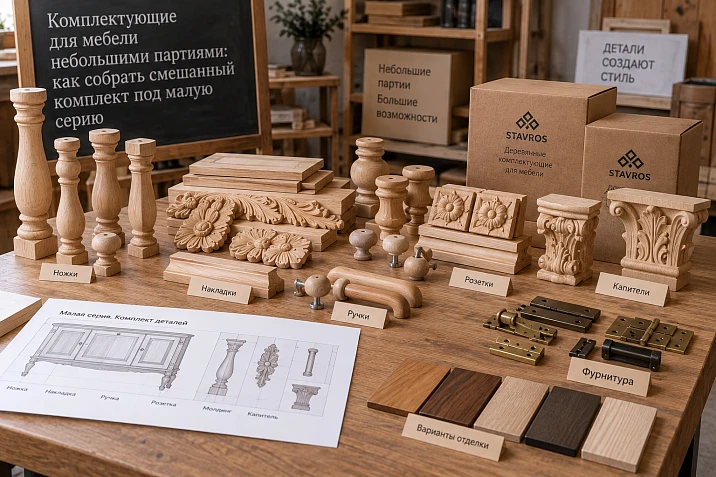
Seven dressers are ready, but the eighth is waiting for a single right-hand carved overlay. All the legs are in place, the handles are already painted, and the moldings are cut. However, the missing element keeps one item in unfinished production. For a small workshop, this situation means an occupied space, delayed packaging, and one more operation to return to.
When ordering furniture components in small batches, it is useful to calculate two things at once: the requirement for each SKU and the number of fully supplied furniture items. The first calculation is for the buyer. The second shows what can actually be sent to assembly and finished by the required deadline.
The starting point is an approved set for one item: supports with fasteners, handles, overlays, sockets, cut lengths of molding, and related materials. It is consistently linked to the material, finish, and production route. Then different product groups come together into a specific dresser or nightstand, and the leftovers do not turn into a set of similar but incompatible parts.
Treat a small purchase as several related product groups
In a mixed order, each group has its own unit of account. Legs are counted by supports, handles by the accepted facade scheme, overlays by pattern and orientation, and molding by finished cut lengths and source strips. Fasteners are tied to the joints. The total number of pieces says almost nothing about the readiness of the series.
For example, twenty identical legs can supply five items with four supports each. But producing these items will also require handles, decor, mounting parts, and a finished surface. An excess of legs does not compensate for a shortage of handles, and an extra central overlay does not replace the right half of a mirrored ornament.
Small batches here mean purchasing for a limited workshop series — for example, several nightstands or eight dressers. This is the working scale of the project, not a promise of a specific wholesale rate. The supplier's terms and custom manufacturing requirements are clarified separately.
For such an order, it is convenient to select ready-made wooden elements for furniturewhile keeping each item linked to its place in the construction. Hinges, runners and other mechanisms must also be present in the overall furniture bill of materials if the project requires them. The wooden part of the procurement does not replace the entire carcass kit.
Formulate the result of the procurement work concretely: supply eight identical kits of a specific version. This helps discuss substitution, partial delivery and lead times without the vague "almost everything is already bought".




First, compile a kit for one item
Let's take a conditional series of eight chests of drawers. All numbers below refer to a training example, not to a finished STAVROS set. The composition is defined by the project: four legs, six handles, two mirrored overlays, one socket and eight moulding sections per item.
| Position | Unit | Per chest of drawers | For eight chests of drawers |
|---|---|---|---|
| Leg of the selected finish | pcs. | 4 | 32 |
| Handle of the selected finish | pcs. | 6 | 48 |
| Left overlay | pcs. | 1 | 8 |
| Right overlay | pcs. | 1 | 8 |
| Central socket | pcs. | 1 | 8 |
| Moulding section 900 mm | pcs. | 4 | 32 |
| Moulding section 300 mm | pcs. | 4 | 32 |
| Support fastening set per drawing | kit | 1 | 8 |
| Handle fastening set according to the drawing | kit | 1 | 8 |
The requirement for each line is obtained by multiplying the quantity per one item by the number of items. The linear stock required in the finished sections here is 4.8 m per dresser, or 38.4 m per series. This is still the net length of the parts; it is too early to buy the strips based on this number alone.
In the working document, the fastening set is broken down into specific components. The instruction “one set” is convenient for the assembler, but the purchaser needs separate items with dimensions, finish, and quantity. Otherwise, the completeness of the wooden parts will be ensured, but the fasteners will be left to the discretion of the contractor.
Our factory also produces:



If there are variants within the series
A four-drawer dresser and a two-door model may use the same legs but different handles and decorative elements. First, compile a set for each variant, then combine the matching items into a single request. Averaging the consumption here creates errors: an average number of handles does not describe any real item.
In the bill of materials for one model, the quantity must correspond to the latest approved design. If the number of fronts has changed, the associated handles, fasteners, and decor are recalculated, even when the overall dimensions of the cabinet have remained the same.
Get Consultation
Specify the part variant before calculating the purchase
The entry “wooden leg, 32 pieces” does not allow an order to be placed unambiguously. A SKU, size, material, surface preparation, and delivery condition are required. If the model has several variants, a single name is also insufficient.
For each item, save:
- the full SKU, including letter and number suffixes;
- a clean link to the product card;
- all dimensions according to its drawing;
- the wood species and the selected blank preparation;
- the sanding quality, if options are provided;
- whether a finish is included or supplied without one;
- the installation location and the finish sample designation;
- the consumption rate for the specific furniture version.
The letters on dimensional diagrams should not be interpreted the same way for all product groups. For a handle, the mounting dimensions also matter; for an overlay, the contour and protrusion; for a profile, the cross-section and length. Use the section drawings and modelsto transfer exactly the required parameters into the project.
The workshop's internal designation is convenient for assembly kits, but it does not replace the factory article number. An unambiguous link must be maintained between them. If the assembler uses the item "upper drawer handle", the purchaser must see exactly which product is hidden behind that name.
After the sample is approved, changes are made through a new version of the specification. This is especially true for parts that determine hole positions, support height or moulding position. An unnoticed substitution in an order may require reworking a cabinet that has already been manufactured.
Check the legs together with the fastening and the cabinet body
In the conditional example, four supports on a chest of drawers create a requirement for thirty-two legs. But such a norm cannot be transferred to other furniture automatically. The design may provide for additional supports, different front and rear parts, or a separate version for the central section.
Before deciding to buy furniture legs in a small batch, check the selected model against the cabinet design. Height, mounting plate, fastener location and how the support works as part of the whole structure all matter. The permissible load cannot be derived only from the wood species or the external thickness of the leg.
You can start your selection in the section furniture legs. If the finishing is done by a workshop, consider separately from STAVROS open boundless possibilities for designers, furniture makers, and anyone striving to create unique high-quality furniture., immediately fixing the requirements for surface preparation.
One trial leg allows you to evaluate the shape, processing, coating and the specific mounting assembly. To test the whole item, you need a full set of supports on a control cabinet. A single part cannot tell you about how four fastenings work together or about the stability of the assembled furniture.
Include the fastening in the same approval route. Compare the threads, mounting dimensions and base thickness against the selected solution. In the section hardware for legs and handles suitable products can be selected, but their compatibility with the specific support and cabinet must be confirmed.
When receiving the supports, it is useful to lay them out in complete sets per item, especially for a transparent finish. This makes it easier to notice differences that seem insignificant individually but become visible side by side.
Count handles by fronts and grip points
In the example, the chest of drawers has two doors and four drawers, with one handle provided on each. That gives six handles per item and forty-eight per series. This is a consequence of the specific front layout, not a fixed standard for a chest of drawers.
On a wide drawer, the design may call for two handles, while another front may use a different opening method. Therefore, count grip points after the construction is approved. If two models or two handle sizes are used, create a separate line for each version.
Before buying wooden furniture handles, determine what must match across the entire series: shape, dimensions, mounting holes, finish, and position on the front. The catalog wooden furniture handles helps you choose the initial options; the final sample is evaluated on the actual front.
For a handle with two mounting points, the center-to-center distance and installation pattern are important. For a single-point handle, check its own fastening and resistance to turning in the adopted assembly. The screw length must be coordinated with the front thickness and the handle design: random fasteners from a general box may turn out to be unsuitable.
Also check the product's packaging unit. In purchasing, the number of handles, the number of fastening kits, and the number of packages, if used by the supplier, must be distinguishable. When recalculating, the batch must not imperceptibly turn from pieces into sets.
For a working check, it is not enough to look at the handle from the front. Make sure it is comfortable to grasp, that it does not collide with the adjacent front, and that the fasteners are accessible during assembly. These issues are resolved before all identical holes are drilled.
Separate carved decor by component and orientation
In a single box, decorative elements may look similar but serve different purposes. For mixed sets, it is important to preserve their assignment to a specific location: the upper corner, the center of the facade, the left side of the console. Then the correct total quantity becomes sets ready for assembly.
Plates
If a mirrored pair is specified for one dresser, eight items require eight left and eight right overlays. The entry "overlays, 16 pieces" hides this condition. Nine left and seven right also give sixteen, but allow only seven pairs to be assembled.
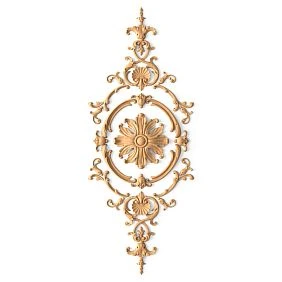
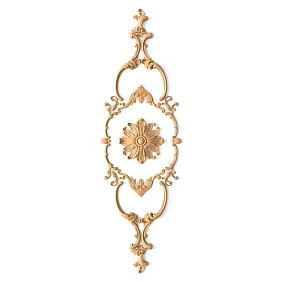
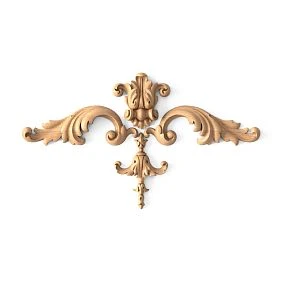
Select Carved decorative inserts for furniture while preserving the L and R designations when they are present in the article number. Record central parts separately. A shared pattern does not make them a substitute for side elements.
Along with orientation, specify the size and placement method. Even a correct mirrored pair will not fit if its design is intended for a different area of the facade. After selecting the molding, check the space for carving once more: the profile occupies part of the area.
Outlets
Wooden sockets are counted by decorative components. In our example, one central rosette per dresser gives eight pieces. If the project changes and four corner elements appear on each item, the requirement will be different — it cannot be kept out of habit.
Different sizes of the same model require separate lines. Specify the installation location: "center of the upper panel" and "frame corner" are clearer to the kit assembler than a general list of similar article numbers. The thickness and reverse side of the rosette must match the selected component, especially near a protruding profile.
Brackets and other paired parts
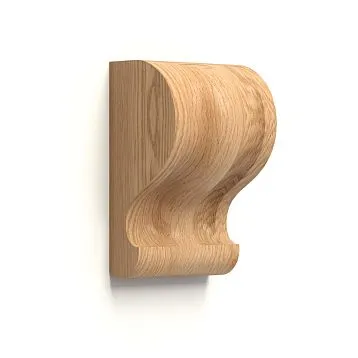
Wooden Brackets are included in the schedule only if they are present in the construction. If a specific model is produced in left and right orientations, these versions are counted separately. If it is symmetrical and used on both sides, there is no need to invent designations it does not have.
Thus, for a conditional series of six consoles with one mirrored pair, six left and six right brackets will be required. This example refers to a separate furniture model and does not add brackets to the eight dressers calculated above. The decorative purpose of an item also cannot be automatically equated with confirmed load-bearing capacity.
Calculate linear footage using the cutting map
In a mixed order, linear footage often becomes a hidden source of shortages. The total length adds up, but the last long section cannot be produced: the offcuts are too short. Therefore, finished segments are determined first, then placed on the stock strips.
For the eight dressers in the example, 32 segments of 900 mm and 32 segments of 300 mm are needed. Their net total length is:
32 × 900 + 32 × 300 = 38,400 mm, or 38.4 m.
Why sixteen strips are not enough
Suppose strips of 2400 mm are selected. Dividing 38.4 m by 2.4 m gives sixteen. But this quantity leaves zero allowance for end trimming and kerf, and also does not account for which combinations of segments actually fit into one strip.
For the training map, we will assume straight cuts, 10 mm trimming at each end, and 3 mm consumption for each separated segment. After end trimming, the working length of one strip is 2380 mm. These are conditional parameters for the example; the workshop uses the actual kerf width and its own technology.
A working cutting plan looks like this:
| Strip group | Number of planks | Segments from one strip | Group result |
|---|---|---|---|
| Primary | 16 | 900 + 900 + 300 mm | 32 long and 16 short |
| additional | 2 | Seven segments of 300 mm | 14 short |
| Final | 1 | Two segments of 300 mm | 2 short |
| Total | 19 | According to the specified diagrams | 32 long and 32 short |
The first diagram takes up 2100 mm of usable length and 9 mm for three cuts. The second — 2100 mm and 21 mm for seven cuts. Both fit within the working 2380 mm.
For these initial conditions, eighteen planks are also insufficient. Each can accommodate a maximum of 2100 mm of usable cut lengths: all specified lengths are multiples of 300 mm, while 2400 mm already exceeds the working length. Even without accounting for the distribution of sizes, eighteen planks will yield no more than 37.8 m of usable parts. The requirement is 38.4 m.
Therefore, in this example the purchase length is 19 × 2.4 = 45.6 m. This is the requirement according to the cutting map, without a separate safety reserve. The remaining usable offcuts are accounted for separately: some of them may serve as material for samples or the next job. If planks of a different length are available, also compare a combined cutting plan; the scheme given here is calculated specifically for a supply of 2400 mm.
How to link the calculation to a product
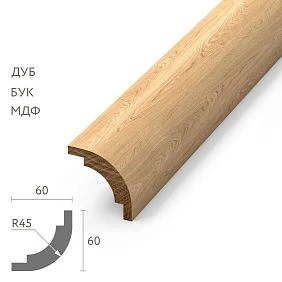
The initial length is chosen according to the specific profile version. For example, in the product card of molding MLD-002 variants in beech and oak with lengths of 1000 and 2400 mm are listed, while the MDF variant has a length of 2600 mm. The cross-section in the table is indicated by dimensions A = 22 mm and C = 11 mm. These data allow you to calculate the purchase of the selected version, but do not confirm its suitability for any furniture project.
Before buying wooden mouldings for furniture, agree on the supply length, material and profile in the specification. For angled cuts, ornament matching or selective grain selection, a separate map will be required. The calculation given here with square ends cannot be transferred to such assemblies without changes.
In the order for Wooden trim the number of initial planks is entered, while the chest of drawers' picking list contains the finished cut lengths. These two levels of accounting are related but must not substitute for each other.
Agree on the material and a single finishing system
Different product groups appear on a single piece of furniture. Therefore, the leg, handle, overlay and moulding must be consistent with the intended appearance. The mere match of the word “oak” or “beech” in the order does not yet guarantee the same result after the coating is applied.
At the sample stage, define the overall finishing system and assign it a clear designation, for example "O-01". This is the workshop's internal code. It must be backed by specific materials, preparation, application sequence, color, sheen, and an approved surface sample.
If an item intentionally combines two types of finish, use two codes tied to specific parts. The single-system rule means project consistency, not mandatory finishing of all elements with one composition. Legs with visible texture and painted handles can work together if such a decision is made in advance.
For a transparent coating, compare samples from different groups side by side. Texture, grain direction, and relief affect color perception. In deep carving, the same tinting technique may look different than on a smooth handle. A matching shade name is not sufficient for accepting a set.
Verify the requirements for blanks against the section product quality. Preparation for enamel or tinting and the finished topcoat are different characteristics. They must be recorded separately so that a delivered part is not considered ready for installation prematurely.
For wooden parts in small batches, it is more convenient to send them to finishing after a control layout by item. This allows you to notice combinations that will require separate approval in advance, rather than discovering them during final assembly.
Choose a supply with or without a coating
If the workshop finishes wooden elements itself, unfinished parts can be the basis of the purchase. Then legs, handles, and decor go through an agreed route within production. A separate section is provided for handles unfinished products.
This scheme makes it possible to match the surface of different components, but it requires time for preparation, painting, curing and inspection. The receipt date of unpainted parts is not the same as the furniture readiness date. The production schedule must include real operations between them.
Another option is to use a ready-made finish where it matches the project. For example, you could consider Wooden handles with coating. This is a way to remove some operations from the workshop if the specific model, color and surface quality have already been agreed.
A mixed strategy is also acceptable: ready-painted handles and self-finished supports can be part of the same item. But they are matched against real samples, and the bill of materials clearly notes the delivery condition of each item. The availability of a ready-made coating for one group does not mean that the same finish is available for all the others.
For operations inside the workshop, account separately for Mounting and finishing materials, as well as the necessary compounds and consumables according to the adopted technology. Receiving all the wooden parts does not help if the work is stopped by a missing installation material.
Separate the sample from the trial item and the main series
A sample answers a specific question: is the texture suitable, can the required color be achieved, does the fastening match the project. A trial piece of furniture tests how all components work together. These are different levels of verification, so a single separately purchased handle does not replace a control assembly of a chest of drawers.
The following are available for preliminary selection Product samples. But a small profile fragment shows only part of the properties. To check the full length, mounting holes or the operation of a support, you will need the corresponding item of the required size.
When it is useful to assemble one item first
Split the purchase into a trial and a main order if the combination of parts is being used for the first time, the finish has not yet been worked out, or the fastener dimensions affect the processing of the carcass. The trial order should include all groups that interact with one another. Buying only the carved decor will leave the connection with the handle and the molding untested.
After the control assembly, approve the item codes, versions, and technology. Then recalculate the remaining requirement based on the new version. Sometimes the trial item becomes part of the overall series, and sometimes it remains a display or test piece — its status is recorded separately.
If one fully usable chest of drawers is included in an order of eight, the further production requirement is calculated for seven. If, however, the trial item is not intended to be handed over to the customer, the main series still consists of eight. Such a decision cannot be left implicit: the difference applies to all product groups.
Do not automatically consider parts used for trial painting, drilling, or joint testing as available for series assembly. They can be returned to the production kit only after verification and a recorded decision. Otherwise, the sample will simultaneously be listed on the shelf and inside future furniture.
Calculate the reserve separately for each position
A single ten percent addition poorly describes a mixed order. One spare right overlay, four supports, and an extra long strip solve different tasks. The reserve must have a purpose: trial, possible replacement, restoring pairing, correcting a cutting error, or subsequent servicing.
For legs, it sometimes makes sense to keep the full agreed set, especially if a future replacement of one part would be noticeable. For handles, a smaller quantity may be sufficient. It is convenient to calculate the reserve of mirrored ornament as a pair if it is important for the workshop to be able to replace the entire unit. But a known-in-advance shortage of a specific side requires exactly that part, not the mandatory purchase of another pair.
Below is a conditional solution for the same series. The workshop allocated samples for separate checks and accepted the specified reserve. These numbers show the accounting method, not a stock norm for any orders.
| Detail | Samples, pcs. | Eight chests of drawers, pcs. | Reserve, pcs. | Total requirement, pcs. |
|---|---|---|---|---|
| Leg | 1 | 32 | 4 | 37 |
| Handle | 2 | 48 | 2 | 52 |
| Left overlay | 1 | 8 | 1 | 10 |
| Right overlay | 1 | 8 | 1 | 10 |
| Rosette | 1 | 8 | 1 | 10 |
Linear stock is not included here: a cutting map must first be approved for it. The cuts and cross-cutting already accounted for in the map are not free contingency stock. An additional strip is added by separate decision, assessing possible rework and the suitability of the remaining offcuts.
Subtract only genuinely free remaining stock
The quantity for a new purchase is determined as follows: total requirement minus suitable free remaining stock and confirmed receipt by the required deadline. Parts already allocated to another project are not free remaining stock.
For example, the requirement is 37 legs, eight suitable parts are available in stock, and four more will arrive under a previously placed order before the required operation begins. Then the quantity for a new purchase is:
37 − 8 − 4 = 25 legs.
The four expected legs are counted only once. When they arrive, their status will change, but the requirement will not be reduced again. This simple procedure protects against the error of subtracting the same item first as ordered and then again as received.
Agree on deadlines based on readiness for the required operation
Different components may have different lead times for manufacturing, preparation, delivery, and finishing. For production, what matters is the date by which a specific item becomes ready for its operation. Arrival at the warehouse is only one stage of this path.
For each line of the schedule, mark the confirmed delivery date, the time for incoming inspection, and the remaining work in the workshop. For unfinished handles, this may be preparation and coating; for mouldings, cutting; for supports, the agreed modification of the mounting assembly. The coating curing time is taken from the selected technology and is not assigned for the sake of a convenient assembly date.
The most sensitive items are those on which other operations depend. Changing a handle may require different drilling of the fronts; replacing a support may require a different mounting point; a different profile may require recalculating the decor. Such elements are selected and agreed upon before the related cabinet parts are launched.
Request lead times for exact specifications and quantities. The wording "the model is in stock" does not confirm that the required number of items in the selected size, material, and preparation is available. For mirrored pairs, both sides are checked.
Also agree on the delivery procedure: whether to wait for the entire order or to send ready items in parts. Partial delivery is useful when it allows a specific stage to be completed or several complete sets to be assembled. If it only increases the number of unfinished items, it is worth comparing its benefit with the additional receiving and transportation.
Accept the delivery by specification and condition of the parts
Counting the boxes does not replace checking the contents. For each line, verify the item code, dimensions, material, orientation, preparation, and quantity. For mouldings, the length of the strip and the suitability of its sections for the approved cutting plan are additionally important.
Do not mix three states: received, accepted, and ready for installation. A part may be delivered but not yet inspected. An accepted unfinished handle is still awaiting finishing. Only after the specified operations does it become available for the final set.
Set aside items with unclear specifications or those requiring approval, with a note of the reason. The assembler must not accidentally pick them from the common box. For a small order, this is especially important: one incorrect right overlay reduces the number of possible pairs.
For a transparent finish, check the combination of parts within the item. This is not about requiring absolute uniformity of natural wood, but about compliance with the agreed sample and design intent. It is easier to lay out the set and evaluate it next to the front before installation.
Transfer the incoming inspection results to the register. Instead of the general note "delivery received", record the actually usable quantity for each item and the reason for the discrepancy. This will immediately show what exactly is preventing the series from being completed and what replacement or additional delivery needs to be agreed.
Create a picking card for each item
After acceptance and preparation of components, create eight cards: for example, "K-01, item 1 of 8" and so on in order. Each repeats the composition of the approved model, but the actual issue of parts is recorded separately.
For the chest of drawers from the example, the card must include four legs, six handles, left and right overlays, one rosette, four molding pieces of 900 mm and four of 300 mm. Fasteners are recorded according to the expanded list. Reserve and test samples are not transferred to production cards.
It is convenient to place small parts in labeled cells or sealed bags. Long profiles may be stored on a separate rack, but must have the same item number and a clear association with the set. One set does not have to physically fit in one box.
Unpainted and finished surfaces require suitable storage and protection during handling. Marking must maintain the link to the register and must not damage the face side. The packaging method is chosen taking into account the shape and condition of the coating.
Picking by item is a controlled workshop operation. If you need the supplier to perform it, separately agree on the composition of the packaging units, marking and verification. A mixed order by itself does not mean that the parts will automatically arrive sorted by chest of drawers.
The card accompanies the item until completion. The issue of a replacement is recorded in it and in the reserve accounting simultaneously, so that the next assembly does not discover a missing spare part.
Assess readiness by the number of complete sets
The percentage of received items may look encouraging even when assembly cannot be completed. For the same model, a simple calculation is more useful: divide the available usable quantity of each part by its norm for one item, discard the fractional part and choose the smallest result.
Suppose that in our series all supports are prepared, 36 of the 48 production handles have been finished, and one right overlay has not yet arrived. The remaining required parts are ready. Reserve stock and samples are not included in these quantities.
| Position | Ready to use | Needed for the dresser | How many dressers it covers |
|---|---|---|---|
| Legs | 32 pcs. | 4 pcs. | 8 |
| Handles | 36 pcs. | 6 pcs. | 6 |
| Left overlays | 8 pcs. | 1 pc. | 8 |
| Right overlays | 7 pcs. | 1 pc. | 7 |
| Rosettes | 8 pcs. | 1 pc. | 8 |
| 900 mm molding segments | 32 pcs. | 4 pcs. | 8 |
| 300 mm molding offcuts | 32 pcs. | 4 pcs. | 8 |
| Support mounting kits | 8 sets | 1 set | 8 |
| Handle mounting kits | 8 sets | 1 set | 8 |
Six dressers are fully covered. Once the finishing of the remaining twelve handles is complete, there will be seven complete sets. To cover the eighth, the missing right overlay will be required — or an agreed use of the corresponding part from reserve stock, with its balance updated.
This calculation shows the limiting item. Purchasing additional sockets in this situation will not increase output: there are already enough sockets. The useful action is to finish preparing the handles and resolve the issue with the right overlay.
Counting must be done within the same furniture configuration. Handles in a different color, legs of a different height, or parts allocated to a neighboring order cannot be included in the available quantity merely because the main item code matches.
A complete set does not mean a finished item: assembly and furniture inspection still remain. However, it confirms that the necessary components are available. To start individual operations, you can use intermediate sets if the further route and the missing items are clear.
Plan your work when individual items are delayed
First determine which operation the delay affects. A late delivery of an overlay may not interfere with assembling the carcass, but it may prevent the joint finishing of the front. A missing mounting plate can stop the installation of the legs, even though the supports themselves are ready.
Consider three practical options. The first is to assemble and pass on several fully supplied items. The second is to perform independent operations for the entire series and stop before the stage that requires the delayed part. The third is to agree on a replacement with a re-check of the affected assemblies.
When choosing, consider not only the schedule but also the condition of the unfinished furniture. Eight partially assembled carcasses require more space and movement than two items brought to packaging. If the workshop is cramped, producing finished sets in small batches may be more convenient than launching the entire order at once.
Do not make a replacement based on external similarity alone. A different handle may change the holes, a profile may change the free field, and an overlay may change the need for a mirrored pair. After approval, update the bill of materials, the set card, and the sample if the appearance has changed.
Splitting the delivery into two parts helps only when the first part has independent production meaning. For an already verified project, these could be components for the first three fully supplied items. For a new one, a complete trial set before purchasing the rest of the series.
Keep the specification for reordering
A repeat series starts from the saved furniture version. It must retain factory item codes, clean links, dimensions, material, preparation, coating condition, finish code, and quantity per item. Additionally, keep the assembly diagram, cutting map, and approved sample data.
It is useful to separate the fixed specification from the details of a specific purchase. The four legs on a dresser belong to the model. The number of items, the remaining stock, the delivery date, and the number of samples belong to an individual production order. With this structure, the next batch is recalculated without rewriting the entire design.
Before reordering, check that the selected finish and delivery terms are still current. An old link and a previous invoice confirm the purchase history, but not that the required quantity is available now. If the parameters on the product page have changed, compare them with the saved drawing before placing an order.
Also begin checking the remaining reserve before use. The part may have been issued for repair, used for a sample, or assigned to another product. For a clear finish, assess how it combines with a new delivery on a test finish.
The fixed parameters of the model are covered in more detail in the article on furniture parts in small batches. In a mixed purchase, the current task is added to these: to provide all product groups for each item in the new order.
Compare buying ready-made parts with making them in the workshop
Ready-made solid wood parts for furniture can reduce repetitive operations, but their benefit depends on the project. Compare the cost of a part that is ready for installation, including delivery, preparation, modification, and finishing. The price of the raw blank or a single purchased item gives only part of the picture.
| Component | What can be taken out of the workshop | What still needs to be checked |
|---|---|---|
| Turned leg | Repeating shaping | Fastening and performance within the structure |
| Carved overlay | Ornament production | Contour, orientation and surface condition |
| Wooden handle | Producing a repeatable shape | Grip and installation parameters |
| Rosette | Producing a uniform relief | Location and method of installation |
| bracket | Processing of a complex shape | Joints and purpose of the element |
| Molding | Producing a profiled section | Cutting, joints and finish matching |
If the workshop already produces a simple part consistently on existing equipment, buying it may offer no advantage. But if eight items require new tooling and mastering complex machining, a ready-made component is worth a closer look.
Assess the modifications separately. Trimming, changing the mounting point and additional preparation can take longer than expected. In small-batch furniture parts, this labor intensity is especially noticeable: setup costs are spread over a small number of items.
It is convenient to decide by groups. The workshop can make the carcass and simple strips itself, while buying legs, handles and carved elements ready-made. All of them remain on a single bill of materials regardless of origin.
Where to buy furniture components in small batches
At STAVROS you can select wooden furniture components across several sections: legs, handles, mouldings, overlays and rosettes. For a mixed order, move from your bill of materials to the categories while keeping the exact specification of each item.
If you need to buy wooden furniture elements with a repeating ornament, compare wooden decorative elements. Those planning to buy carved wooden decor will find useful Catalog of carved decor. Handles and legs are selected together with fasteners, and mouldings with the original length and cutting plan.
On the page conditions for manufacturers STAVROS indicates shipment from one piece. This allows you to first consider individual items for verification, then components for a series. For the terms of a specific configuration, lead times, cost and the possibility of custom manufacturing, please check against the submitted request; piece-by-piece shipment of catalog products does not determine the terms of any non-standard order.
To request a price, attach a list of item codes with material, dimensions, preparation and quantity. This is exactly the product information provided in the description of order placement and delivery. Supplement them with requirements for samples, reservation, lead times and the agreed delivery sequence.
When comparing offers to buy furniture parts in a small batch, look at the full composition. Getting some decorative items cheaper does not yet mean it is cheaper to supply all the items. For a workshop, what matters is the cost of the sets from which an order can be completed, taking into account the remaining finishing and possible repeat deliveries.
Before paying, check the request for one chest of drawers, then for the whole series. In the first case, the components and compatibility must match; in the second, the quantity, cutting, samples, reservation and readiness dates. After that, the mixed order becomes a clear set of actions for the buyer, finisher and assembler.
Questions about purchasing and outfitting a small series
Which components to consider when the carcass is already finished
Check against the actual condition of the item: supports, handles, decor, fasteners and remaining installation materials. If hinges or runners are already installed and accepted, there is no need to purchase them again. But they remain part of the structure with which the new parts must be compatible, including overlays near opening fronts.
What is considered a small batch by the supplier
There is no universal quantity. For a workshop, it may be a set of three items, and the supplier's commercial terms depend on the specific order. The term "small wholesale" by itself does not confirm a discount, a minimum amount, or identical lead times across all groups. In your request, specify the actual item codes and quantities.
How to calculate parts for different models in one purchase
Multiply the norm for each model by the number of its units, then add up the requirement for fully matching versions. For example, three chests of drawers with six handles each and two cabinets with two handles each require 22 handles if the item code, size, and finish are the same. Keep different variants as separate lines.
How to account for the legs and handles of a sample item
If the sample product is accepted into the main series, the parts installed on it are considered already used for its production. They are not free warehouse stock. Calculate the remaining items or keep a single consumption balance, but do not reduce one requirement twice in different ways.
Can a left overlay be replaced by flipping the right one
This is permissible only when the geometry, face side, and ornament direction actually allow the required position to be achieved. For a purpose-made mirrored pair, such a solution cannot be assumed in advance. Compare the drawings and the layout; identical external dimensions do not confirm interchangeability.
Are leftover moldings from another order suitable
First check the profile, material, surface condition, and usable length after the necessary trimming. Then include suitable offcuts in the cutting plan. A leftover with sufficient total length may not be suitable due to the ornament, pattern direction, or the required undamaged section.
Is a new sample needed for a familiar part in a different finish
Yes, if the agreed finishing system changes. Familiar geometry does not show how a new color, sheen, or carving highlight will look. The sample is checked next to the components and body surface that the part will meet on the finished furniture.
How to determine the reserve for the first release of a model
Assign it based on specific possible rework and reorder availability. Test an unknown technology on samples first: buying a large stock does not replace working out the process. After release, record the actual use of the reserve and the reasons for replacements so that the next batch can be calculated from your own experience.
Is a stock of handles needed for future repairs
Such a stock can be provided separately from the production stock. Keep the exact specification and coating information, determine the storage location and the purpose of the parts. Even a spare handle is compared with the installed ones by appearance before replacement. It must not be quietly used for another order without updating the records.
Can furniture be assembled directly during assembly
Yes, if the issue of each item is tied to the product number and the remaining shortage is visible. However, freely selecting parts from shared boxes makes control difficult. For a small workshop, pre-allocating kits is often more convenient: before work begins, it is clear which items are fully supplied.
How to check completeness without special software
A table with the norm per item, the number of accepted good parts, the processing status, and the distribution by product is sufficient. Mark the reserve and expected deliveries separately. One person should maintain the current balance after issue; several uncoordinated lists create discrepancies even with a small order.
Can the body be finished before the decor arrives
This depends on installation and finishing. If late installation does not require access to areas being closed off, drilling through a finished surface, or joint painting, part of the work can be completed in advance. If the decor affects these operations, premature assembly will create the need for disassembly or the risk of damaging the coating.
How to repeat an order when the product card has disappeared
Use the saved article number, dimensions, material, drawing and details of the previous purchase to clarify with the supplier. A photograph helps identify the item but does not confirm its specification. Compare the proposed replacement with the working assemblies and register it as a version change if the parameters differ.
Where to order several product groups for a trial set
For the wooden part of the project, use the relevant STAVROS sections and send the supplier a single schedule. Agree on each item, its delivery condition and lead times. Separately clarify the completeness of fasteners and marking if you expect to receive pre-distributed sets. The trial order should allow you to check the entire selected assembly or piece of furniture.