























Article Contents:
- What is included in the components for a wooden staircase: complete set
- Balusters
- Support columns
- Handrails and balustrades
- Decorative elements
- Flat balusters
- Baluster plank and mounting board
- Balusters: the basis of staircase fencing
- Types of balusters by shape
- Baluster sizes: what you need to know
- Baluster Installation Spacing
- Why the rhythm of balusters is important
- Support posts for stairs: anchors of the railing
- Where posts are installed
- Support post sizes
- Post finials: decorative top
- Post and baluster: from the same family
- Handrails and railings: shape, height, comfort
- Handrail Profile
- Handrail height
- Handrail angle
- Handrail and tinting
- Decorative elements for stairs: from carved balusters to ornamental overlays
- Carved balusters as the main accent
- Post body overlays
- Decorative elements under the handrail
- Flat ornamental inserts
- How to choose material: beech, oak, and other hardwood species
- Oak
- Oak
- Ash
- Spruce
- How to choose components in one style: eight scenarios
- Classic staircase
- Neoclassicism and Modern Classicism
- Country house in Russian style
- Scandinavian and minimalist style
- Art Deco style staircase
- Staircase in a double-height hallway
- Staircase for commercial interiors: restaurant, hotel, showroom
- Attic staircase in a country house
- How to calculate the number of elements: precise algorithm
- Calculation of Baluster Quantity
- Calculation of the number of support posts
- Calculation of handrail length
- How to avoid mistakes with quantity
- Installation of stair railings: what to know before buying
- Ways to mount balusters
- Connecting the handrail to the posts
- Handrail swivel joints
- Mistakes When Choosing Components for a Wooden Staircase
- Buying balusters without handrail and posts from the same series
- Mixing different styles
- Not considering the railing height
- Choosing elements that are too thin for a large staircase
- Not counting the quantity in advance
- Not planning the coating before installation
- Forgetting about turning sections
- Not considering the color of steps and floor
- Staircase as a system: a project-based approach to purchasing components
- FAQ: answers to the main questions about components for a wooden staircase
- STAVROS: a wooden staircase that serves generations
A staircase in a house is not just a transition from floor to floor. It is an architectural object visible from several points at once: from the hall, from the landing, from the living room, from the balcony of the second floor. It works around the clock — even when no one is walking on it, it shapes the image of the home.
That is why choosing components for a wooden staircase is not a utilitarian task of "buying balusters." It is a design task: to select a system of elements that will work together as a single whole, in one material, one style, one tint.
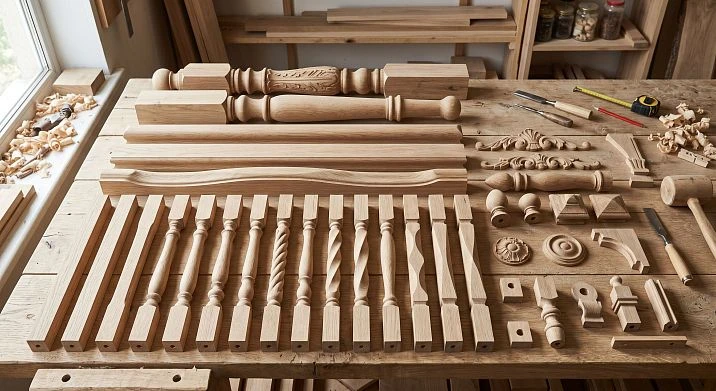
staircase components made of wood — these are balusters, support posts, handrails, railings, decorative overlays, and carved elements. Each of them performs its function. Together, they make up the staircase railing — what makes it not only safe but also beautiful.
This article is about how to read a staircase as an architectural system, how to correctly select each element, and how to avoid mistakes that are only discovered after installation.
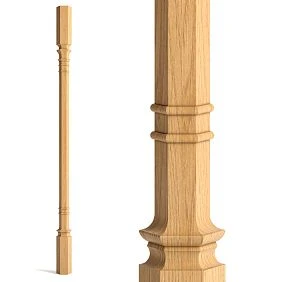
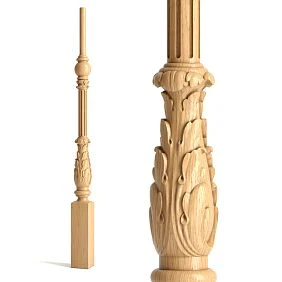
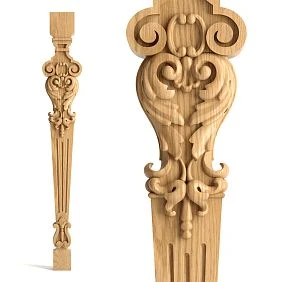
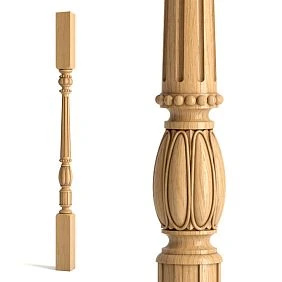
What is included in the components for a wooden staircase: full composition
Before going to the catalog, it is important to understand: staircase railing is not a "set of balusters." It is a system in which each element depends on the others.
Balusters
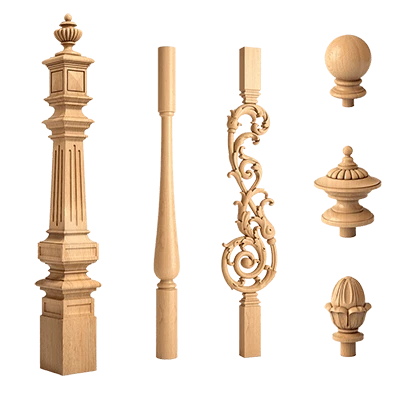
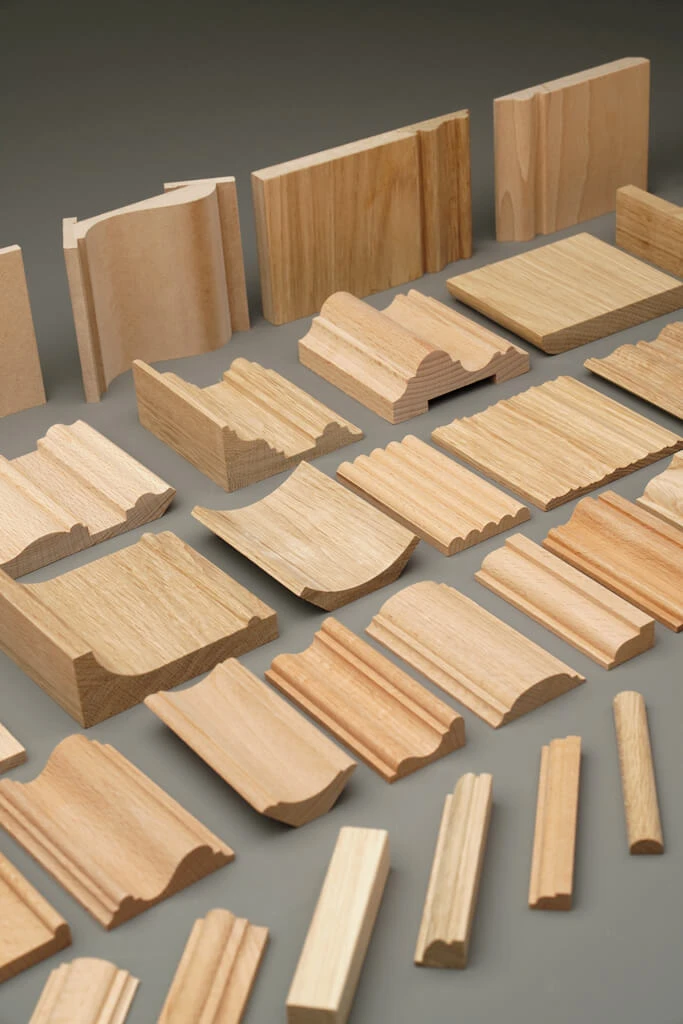
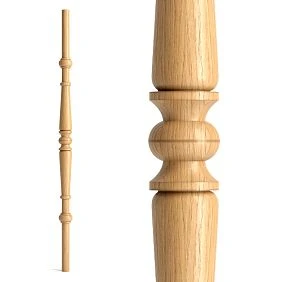
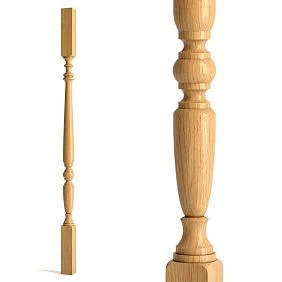
Balusters for staircase — vertical railing posts. They are installed on steps or on the stringer, hold the handrail from above, and create a decorative rhythm for the railing. The baluster is the most "noticeable" element of the staircase: the style of the railing is determined by the shape of the balusters.
Our factory also produces:
Supporting posts
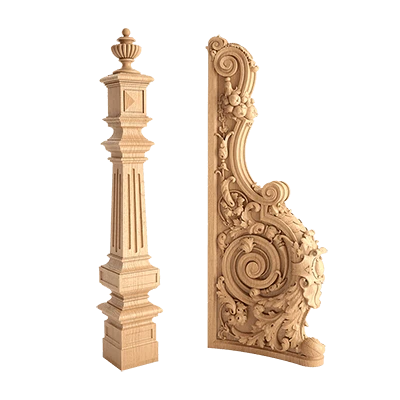
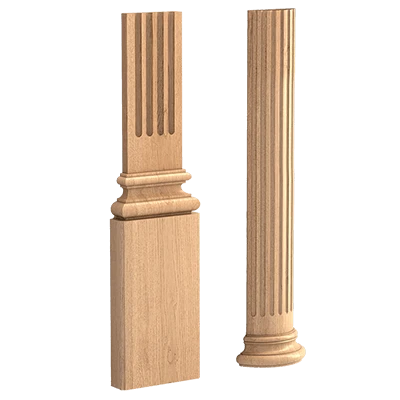
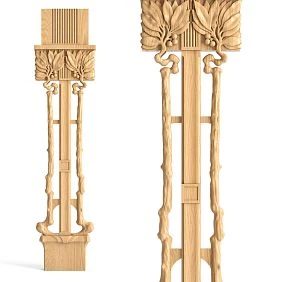
Support posts are more massive vertical elements at key points of the railing: at the beginning of the flight, at the end, at turns, on landings. The post visually "holds" the railing and is the structural anchor of the entire system.
Get Consultation
Handrails and balustrades
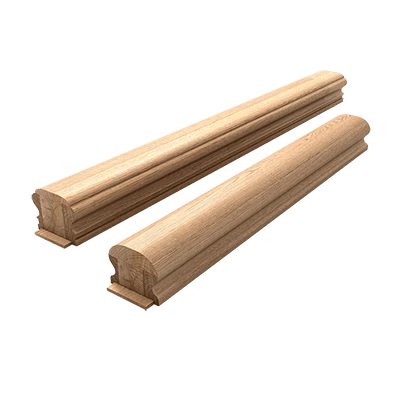
Handrail — a horizontal (or inclined along the flight) profile that is placed on balusters and posts. It is the handrail that is held by hand when ascending and descending. Railing is a broader concept: the entire assembly (balusters + posts + handrail).
Decorative elements
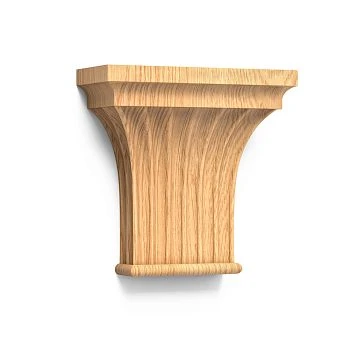
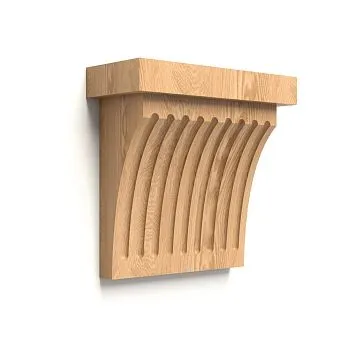
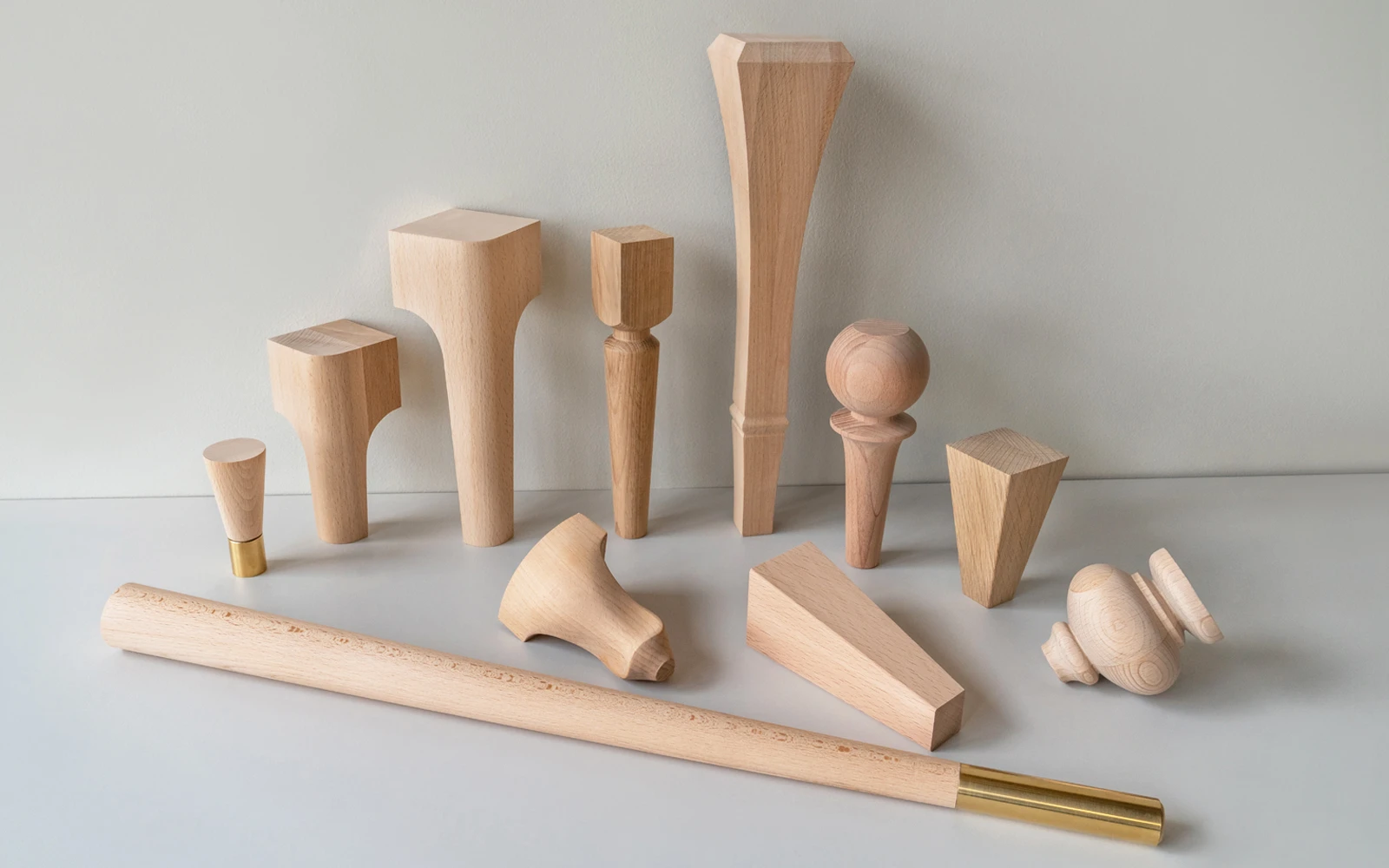
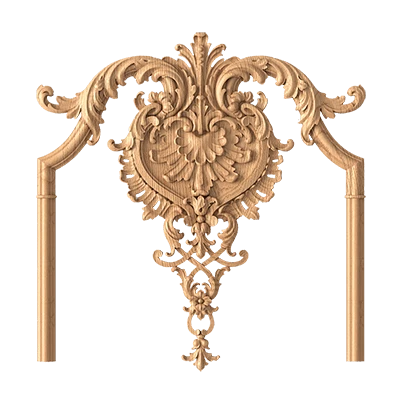
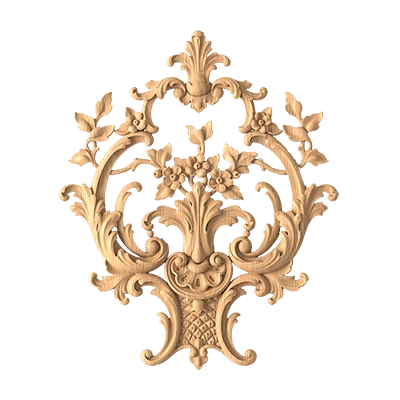
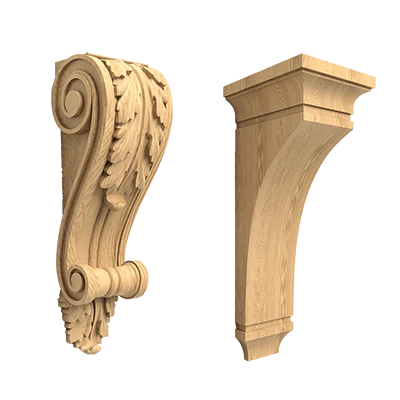
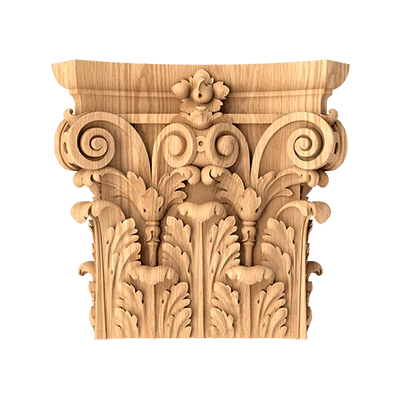
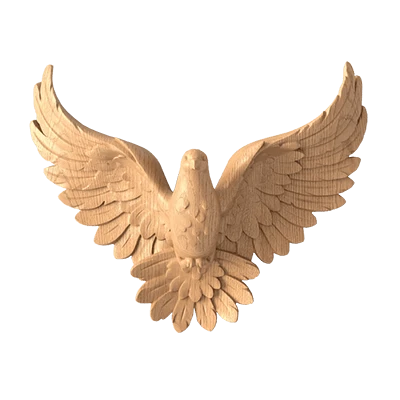
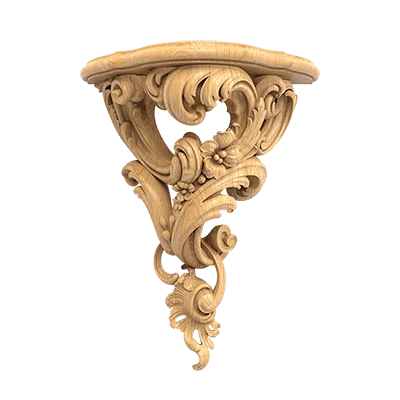
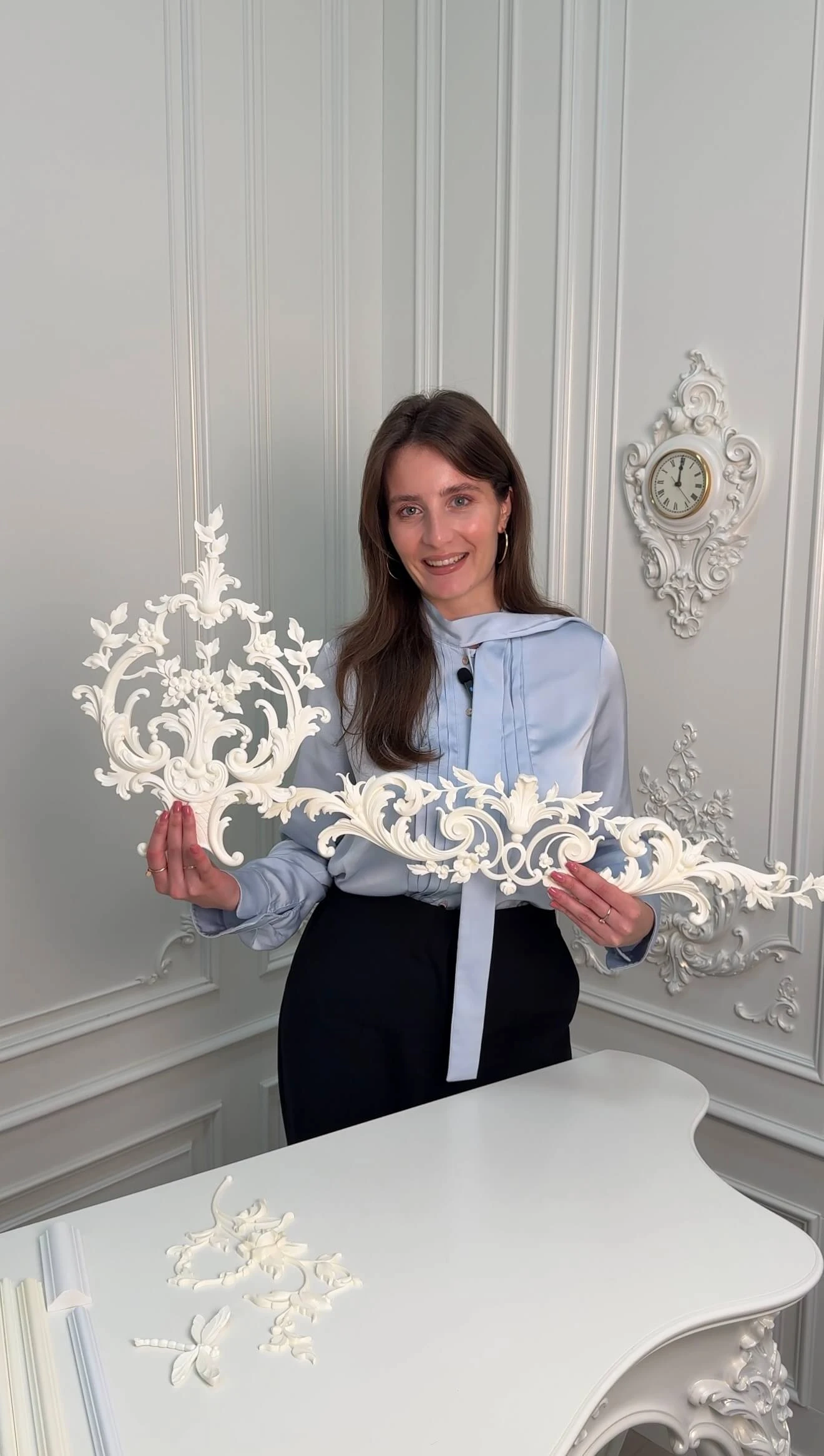
carved balusters, overlays, rosettes on posts, decorative post finials (spheres, cones, lanterns), carved decorative details for the railing — additional elements that give the staircase an individual character.
Flat balusters
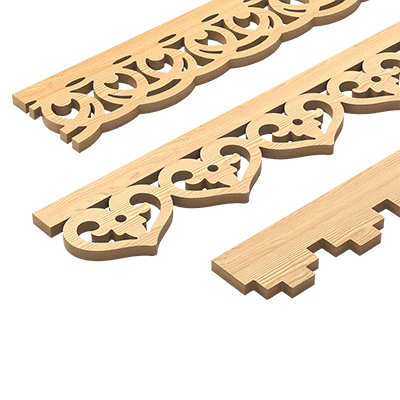
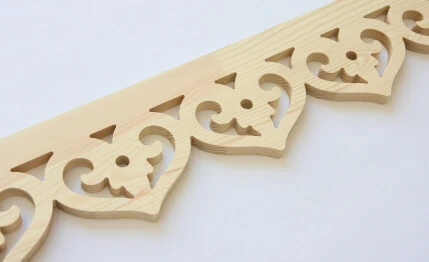
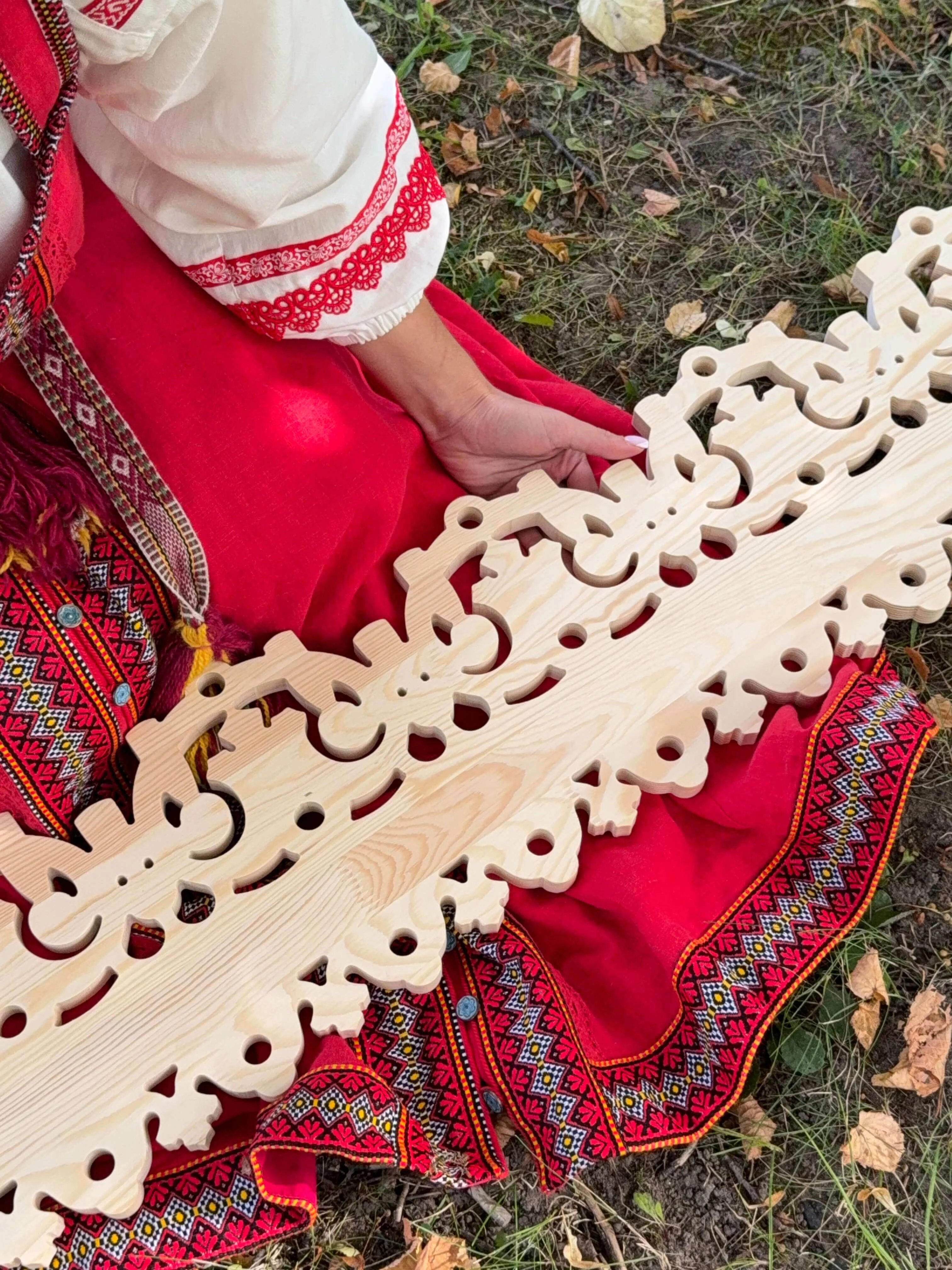
Flat balusters — cut from a flat board, with an ornamental silhouette. An alternative to turned round balusters: the silhouette reads as a pattern when viewed from the side. Used in classic interiors and in styles with more planar decoration.
Under-baluster rail and mounting board
Technical elements on which the balusters rest: the lower under-baluster rail on the step or stringer, the upper one under the handrail. They create an even base for installing balusters at one level.
Balusters: the foundation of stair railing
Wooden balusters — this is the main visual element of the railing. It is by their shape, spacing, and tinting that the entire image of the staircase is built.
Types of Balusters by Shape
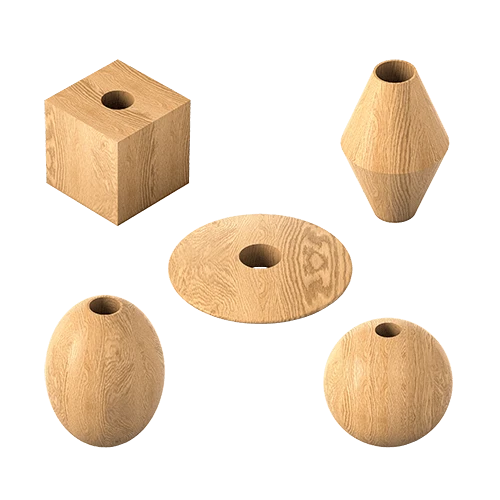
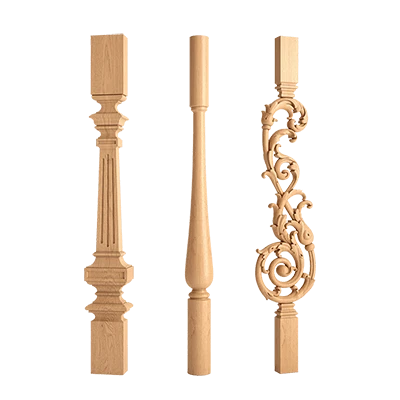
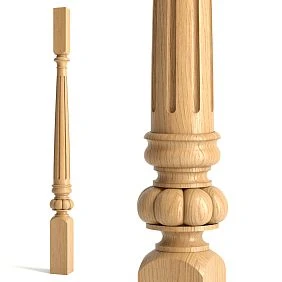
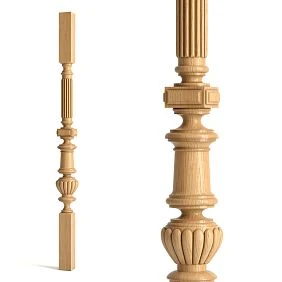
Turned balusters — a classic. Made on a lathe: spheres, vases, barrels, cones, and their combinations. Suitable for classic and neoclassical interiors.
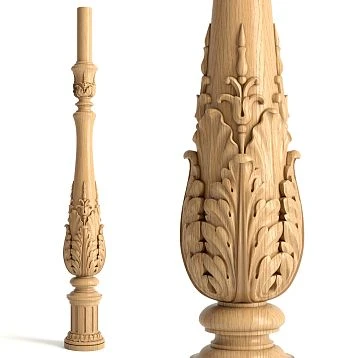
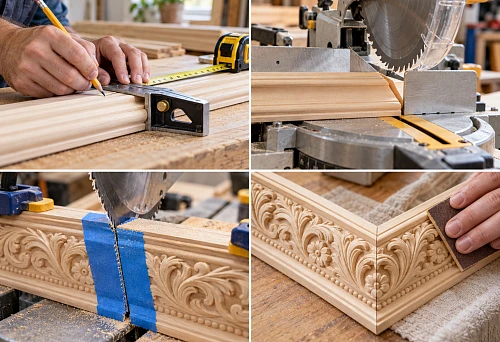
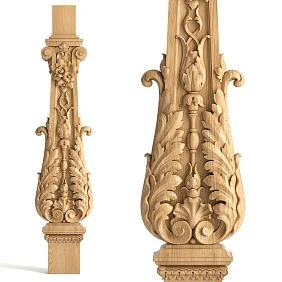
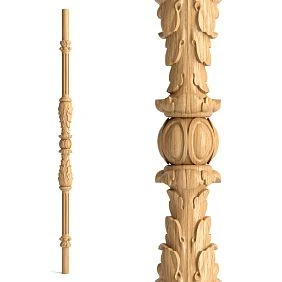
Carved and turned-carved balusters. carved balusters — this is a combination of a turned form with hand or CNC carving. Ornamental belts, leaves, spirals, geometric notches. The most expressive option — for classic interiors, country houses, halls with high ceilings.
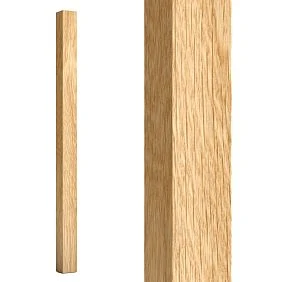
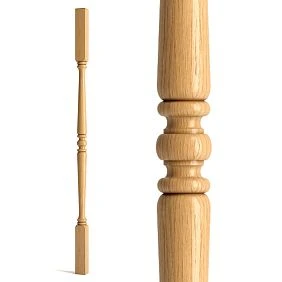
Straight (square) balusters. A straight wooden post with a square or rectangular cross-section. A strict, minimalist look. For modern classic, loft, Scandinavian style.
Flat shaped balusters. Flat balusters With a silhouette cut from a board: when viewed from the side — an ornament, when viewed from the front — a flat post. Used in classic and traditional interiors, often in combination with turned elements in pillars.
Baluster sizes: what you need to know
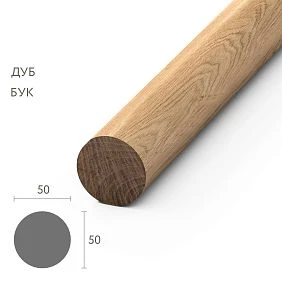
Standard baluster height: 900–1,000 mm (of which 50–100 mm is the lower tenon for attachment to the step and the upper tenon for attachment to the handrail). Working height (from step to handrail): 850–950 mm.
Cross-sectional size (diameter or side): 35–55 mm for residential houses, 55–80 mm for grand staircases and halls with high ceilings.
Baluster installation spacing
Spacing between balusters — distance between axes of adjacent posts. In residential houses — recommended spacing: 100–150 mm (clear). This is due to safety requirements: a child should not be able to squeeze between balusters.
Practical rule: 2 balusters per step (for step width 250–300 mm). For a wide step (over 320 mm) or a more sparse rhythm — 1 baluster per step, but then posts are installed more frequently.
Why baluster rhythm is important
The rhythm of balusters is the rhythm of the staircase itself. A frequent rhythm creates a feeling of density, security, and solidity. A sparse rhythm creates a feeling of lightness, transparency, and modernity.
For a classic staircase in a high hall — a dense rhythm of turned or carved balusters creates that very image of a "grand staircase." For a modern loft — a sparse rhythm of straight square posts looks more appropriate.
Stair support posts: railing anchors
If balusters are the rhythm, then support posts are the accent. They place "support points" in the railing and define its structural logic.
Where posts are installed
Starting post — at the base of the first flight of stairs, on the bottom step or on the floor. The first post is the most noticeable: it stands at eye level when entering the hall. It is often used to judge the staircase as a whole.
Turn post — on the landing or at the point where the flight changes direction. Here the handrail changes direction, and the post serves as the structural node of this transition.
Finishing post — at the top point of the railing, on the top step or at the floor level of the second floor. Symmetrical to the starting post.
Intermediate posts — on long straight flights (more than 8–10 balusters without a post) to increase railing rigidity. Installed every 4–6 balusters.
Support post dimensions
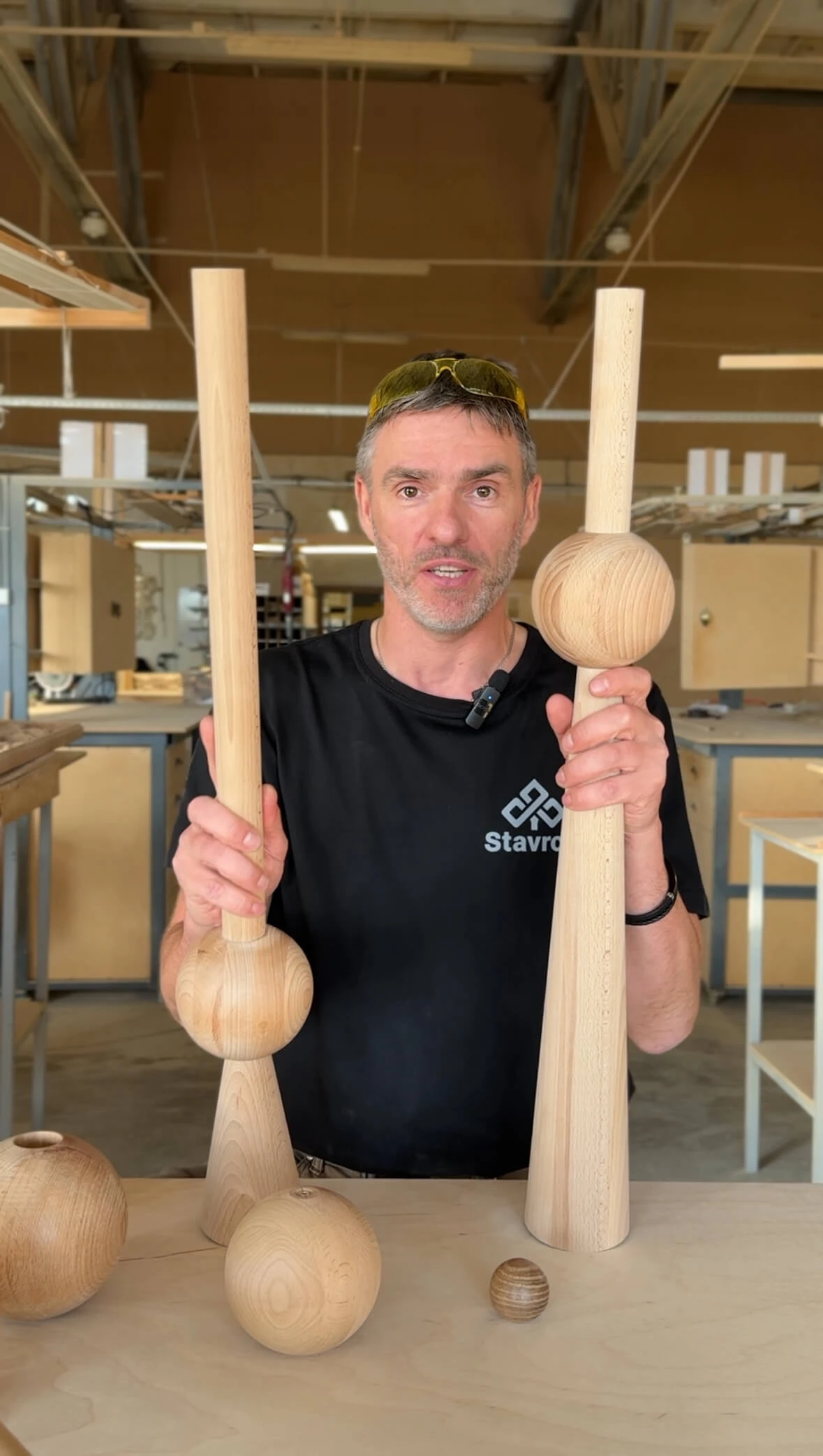
A post is significantly more massive than a baluster. Standard cross-sectional sizes: 80×80, 100×100, 120×120 mm. Height: from the step level to the handrail level + finial (50–150 mm above the handrail).
Important: the diameter or side of the post should be one and a half to two times larger than the diameter of the baluster. Baluster 45 mm → post 80–100 mm. Baluster 55 mm → post 100–120 mm.
Pillar tops: decorative finial
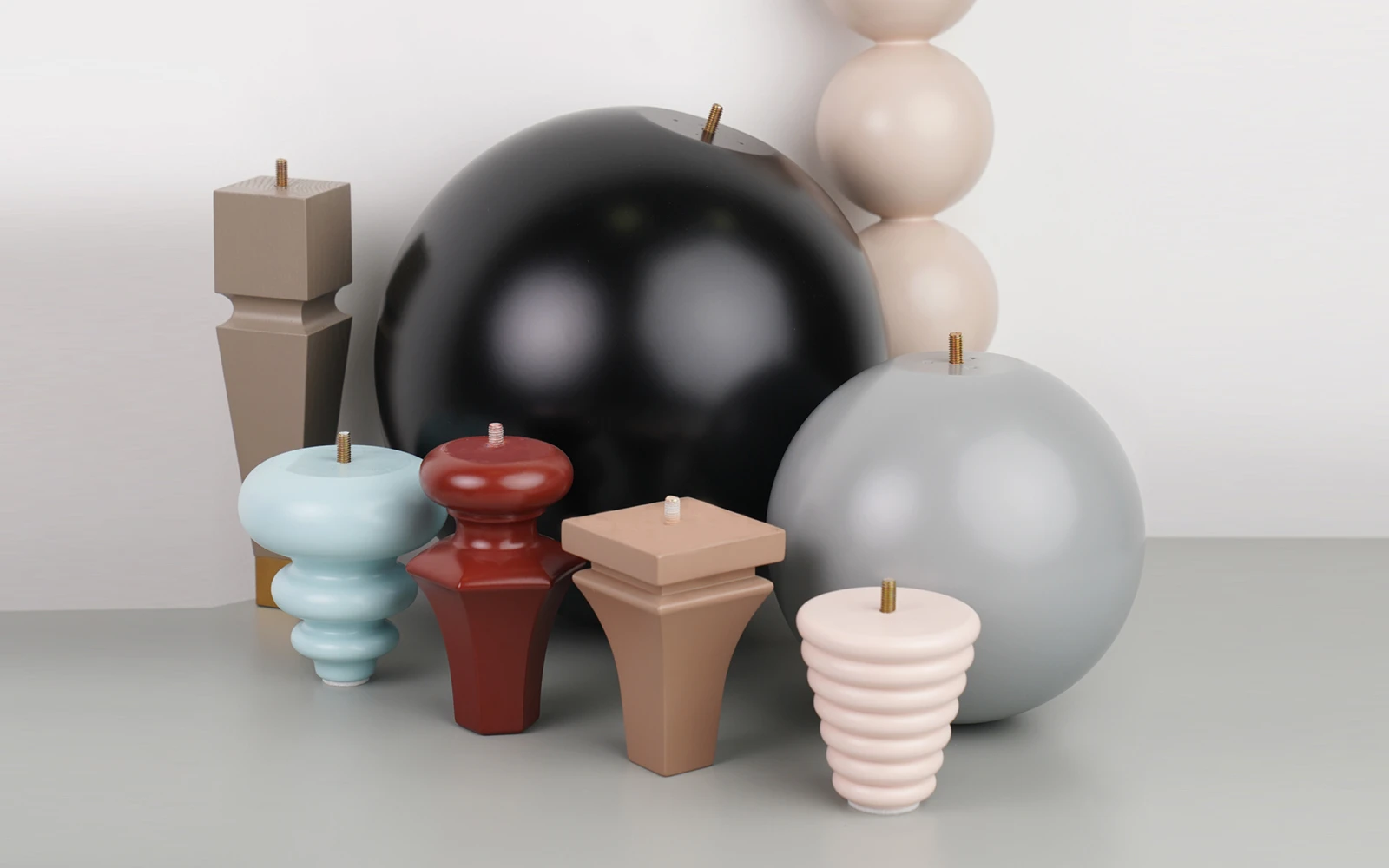
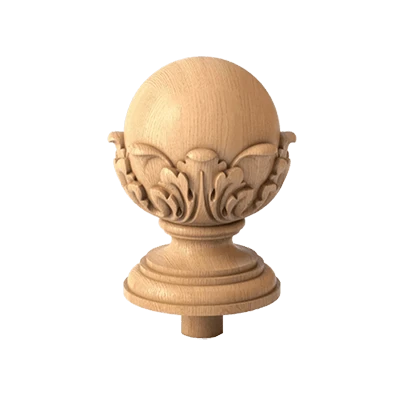
The upper part of the pillar is the finial. It is a separate decorative element: a sphere, cone, "onion dome", lantern, pyramid. The finial is installed on top of the pillar body and serves as the architectural completion of the fence.
For classic style — a sphere or "onion dome" with a carved belt. For modern classic — a cone or flat pyramid. For minimalism — no finial is needed, the pillar ends with a flat cut.
Pillar and baluster: from the same family
A critically important rule: pillars and balusters must be from the same series or, at least, stylistically coordinated. A turned baluster with spheres and a straight square pillar — a style conflict. A straight square baluster and a turned pillar with carving — the same. All vertical elements of the fence — from one style.
Handrails and railings: shape, height, comfort
The handrail is an element that a person physically contacts with every use of the stairs. This makes it both functional and decorative.
Handrail profile
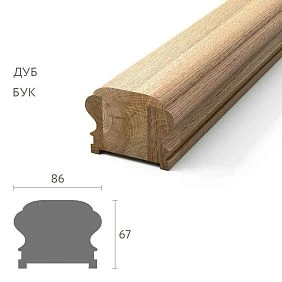
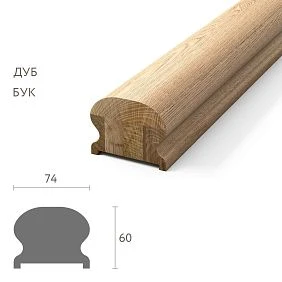
The handrail should fit comfortably in the hand. This means: grip diameter or width — 40–55 mm. Too thin a handrail (25–30 mm) — the hand does not fixate. Too wide (70 mm or more) — uncomfortable to grip.
Main handrail profiles:
-
Round (oval) — classic, simple, universal. Grip is comfortable for most
-
Rectangular with rounded corners — more modern, strict
-
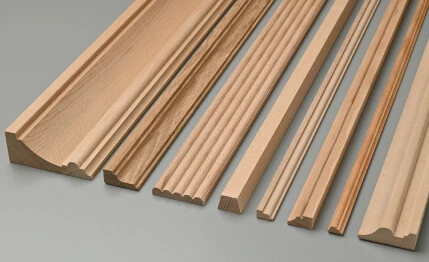
Shaped with profile — ogee, fillet, stepped — for classic interiors
The handrail profile must match the baluster profile. Turned balusters with spheres + a strict rectangular handrail = stylistically incompatible.
Handrail height
Standard handrail height above the step: 900 mm (according to norms for residential buildings — from 900 to 1000 mm). For children's areas, homes with small children — 850–900 mm.
Measured vertically from the front edge of the step to the top point of the handrail.
Handrail inclination angle
The handrail on a flight of stairs runs at an angle corresponding to the staircase's rise angle. Residential staircase rise angle: 30–45°. Connection of the inclined handrail with the horizontal one (on the landing) — through a connecting element: a "knee", curved turn, or a special turning block.
Handrail and tinting
The handrail is the most "tactile" element of the staircase, so its surface must be perfectly smooth after applying the finish coating. Varnish or oil without rough fibers. Handrail tinting — to match or slightly darker than the balusters and posts: the handrail creates the "line" of the railing and should be readable.
Decorative elements for the staircase: from carved balusters to ornamental overlays
Decorative details are what turn a standard fence into a custom one.
Carved balusters as the main accent
Carved and turned-carved balusters — this is the highest level of decorativeness for a staircase railing. Carving on a turned base: ornamental belts, leaves, spirals, geometric flutes. Each baluster becomes a small sculpture.
Such balusters are appropriate in classic interiors, halls with high ceilings, country houses in Russian or European classical style. They create the image of an "expensive staircase" without needing to increase the number of elements.
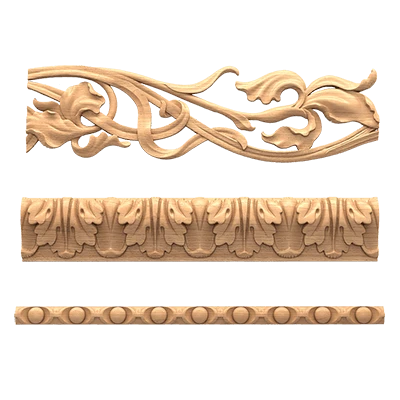
Overlays on the post body
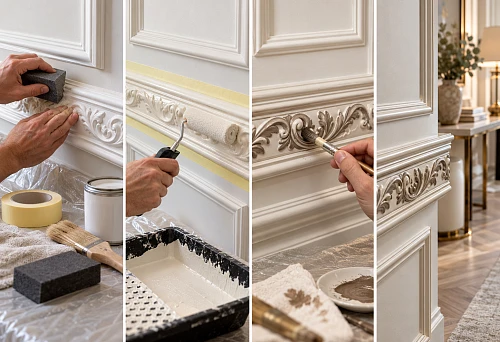
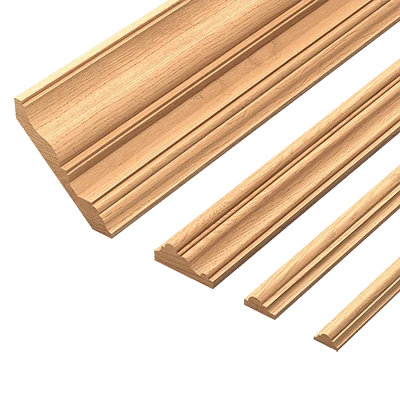
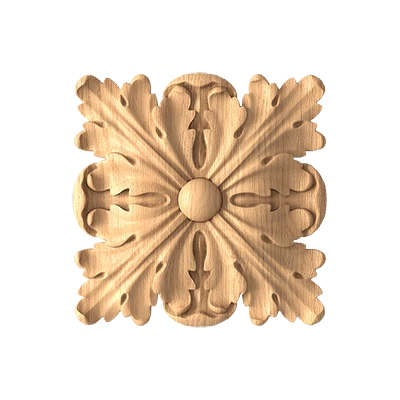
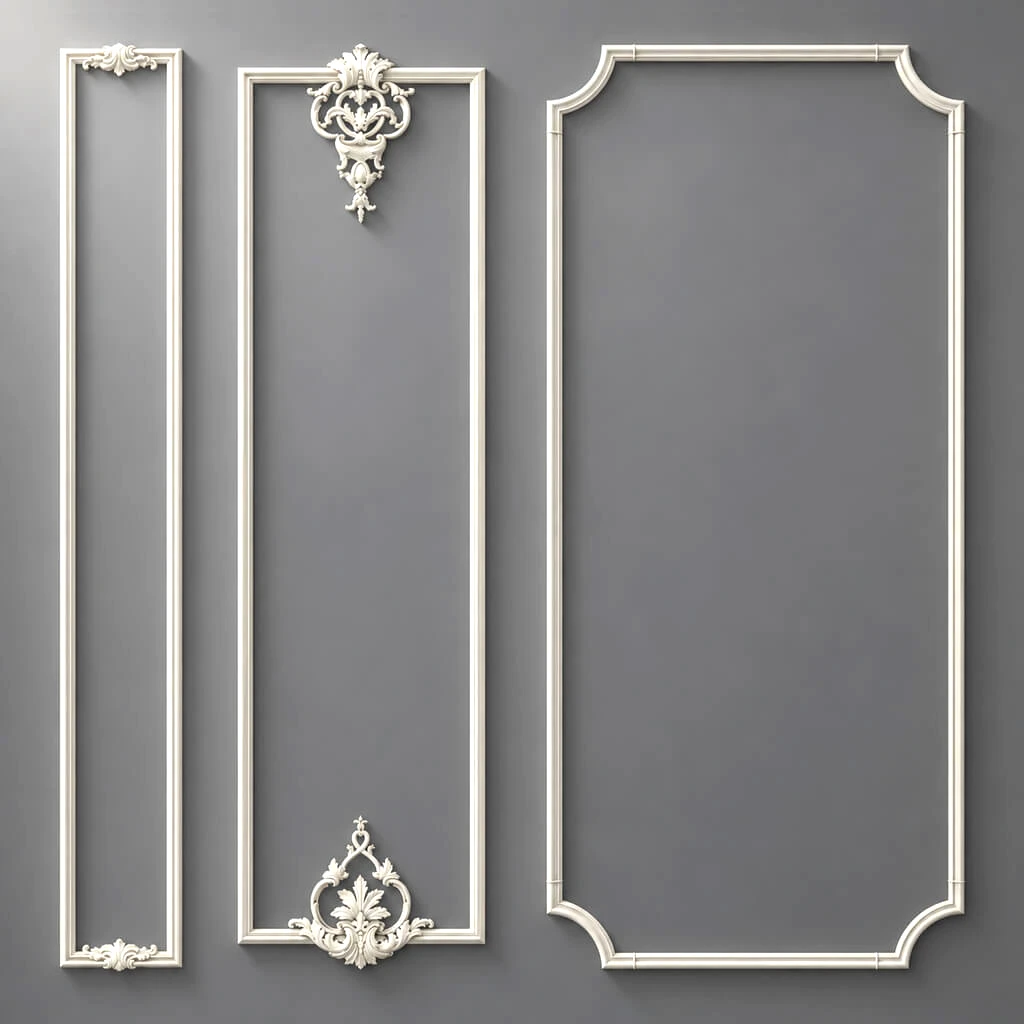
Decorative overlays are installed on the body of the support post — on the flat faces of a square post: carved ornaments, geometric frames made of wooden trim, profile frames made of of wooden moldings. This turns a simple rectangular post into a voluminous "column" with frame decor.
Decorative elements under the handrail
A decorative sub-baluster rail with a profile — a kind of "cornice" under the handrail — is sometimes installed between the lower part of the handrail and the upper ends of the balusters. It creates a horizontal line and "hides" technical gaps.
Flat ornamental inserts
In the railing, you can combine turned balusters with flat ornamental inserts: every other turned baluster — a flat ornamental one. This creates a variable rhythm, a richer decorative effect.
How to choose material: beech, oak, and other hardwood species
All components for wooden staircases are made from solid wood. The main question is which species.
Beech
Beech is a dense, homogeneous, fine-grained wood. It turns excellently: turned elements from beech have a clear relief, sharp edges, a neat shape without fuzz. It accepts any coating: stain, enamel, oil, varnish.
The texture of beech is restrained, without large pores or expressive grain. This is a plus when staining in dark shades or white enamel: there is no texture "noise," the shape of the element is clearly readable.
Beech is the best choice for classic turned balusters under any stain, for handrails under enamel or varnish, for posts with applied frame decor.
Oak
Oak is harder, with an expressive large texture, characteristic "mirrors" in the cut. Oak does not hide its nature — it showcases it. Oak staining is always expressive: dark oak, tobacco oak, natural oak with oil — each option creates a powerful image.
For grand staircases in country houses, for study interiors, for halls with oak parquet — oak is the obvious choice.
Disadvantage: oak is harder to work with, more expensive, and requires more powerful tools for carving. Therefore, carved oak balusters are more expensive than beech ones.
Ash
Ash — similar to oak in texture expressiveness, but lighter and slightly softer. Straight grain, good elasticity. For light interiors in natural wood — ash is preferable to oak.
Spruce
Pine — the most affordable option. Soft, easy to work with, but less durable. Not recommended for stairs with heavy use. Acceptable for cottages, budget projects with white enamel paint.
| Species | Strength | Texture | For tinting | For enamel | Price |
|---|---|---|---|---|---|
| Beech | High | Quiet, fine | Excellent | Excellent | Medium |
| Oak | Very High | Expressive | Excellent | Good | High |
| Ash | High | Expressive | Excellent | Good | Medium–high |
| Spruce | Medium | Resinous | Satisfactory | Good | Low |
How to choose components in one style: eight scenarios
The staircase reads as a single whole or not at all. This means: all elements are in one style.
Classic staircase
Turned or carved balusters with expressive relief. Massive support posts with a ball or "onion" finial. Handrail with a shaped profile. Toning: dark walnut, "antique" oak, white enamel with gold patina. Overlays on posts made of molding.
Neoclassicism and modern classicism
Turned balusters with moderate relief (fillet + neck + fillet). Square posts or with a light turned part. Handrail with an "oval" or "rounded rectangle" profile. Toning: white enamel or natural oak.
Country house in Russian style
Balusters with ornamental carving: floral motifs, traditional Russian ornaments. Posts with carved overlays. Handrail made of solid wood in natural toning. Toning: light wood (pine, ash) without staining, oiled or waxed.
Scandinavian and minimalist style
Straight square balusters 40×40 mm with minimal or wide spacing. Straight, square posts without finials. Handrail with a "rectangle with rounded edges" profile. Toning: natural light ash or white enamel. No carving, no overlays.
Staircase in Art Deco style
Straight balusters with geometric elements: stepped bands, faceted transitions. Straight posts with flat geometric-pattern overlays. Handrail with a clear rectangular shape. Toning: dark — wenge, chocolate, black enamel.
Staircase in a double-height hall
A staircase with a double-height ceiling — visible from all levels and from several points in the space. This requires a maximally thought-out style and high quality of execution. Here, the winners are carved balusters With expressive relief, massive pillars with decorative finials, a wide oak handrail.
Staircase for commercial interior: restaurant, hotel, showroom
Durability is important: high-density oak or beech. Balusters — with moderate decor (not overloaded). Handrail — wide, comfortable for grip. Tinting — coordinated with the brand color of the interior.
Staircase to the attic in a country house
More compact dimensions, often a steep angle of ascent. Balusters — minimal width, spaced in compliance with safety requirements. Handrail — comfortable, with a secure grip. Tinting — to match the wooden beams and rafter system, if they are exposed.
How to calculate the number of elements: precise algorithm
Correct calculation is half the success of a purchase.
Calculation of the number of balusters
Method 1: by steps.
Number of steps × 2 (2 balusters per step) = number of balusters.
Example: 14 steps × 2 = 28 balusters.
Method 2: by span length.
Span length (mm) / (baluster width + distance between balusters) = quantity.
Example: span 3,500 mm. Baluster 45 mm, clear spacing 100 mm. 3500 / (45 + 100) = 24 balusters.
Choose the method that gives the larger quantity — for safety.
Don't forget: balusters on horizontal landings are calculated separately — by the length of the landing, using the same method.
Allowance: +5–10% for possible defects and trimming.
Calculation of the number of support posts
Number of posts = number of installation points:
-
Bottom starting post: 1 pc.
-
Top finishing post: 1 pc.
-
At each turn: 1–2 pcs.
-
At each landing: 1–2 pcs.
-
Intermediate on long spans (more than 10 balusters): as needed
Example for a U-shaped staircase with two flights and a landing:
Lower (1) + landing (2) + upper (1) = 4 posts minimum.
Handrail length calculation
Handrail length = length of each flight (along the slope, not horizontal) + length of horizontal sections on landings + 10% allowance for cutting and connections.
Length along slope = √(horizontal length² + flight height²).
Example: horizontal flight length 2,800 mm, flight height 2,100 mm. Length along slope = √(2800² + 2100²) = √(7,840,000 + 4,410,000) = √12,250,000 ≈ 3,500 mm.
Handrail is sold by linear meters — order with a 15% allowance.
How to avoid mistakes with quantity
Draw a staircase diagram: all flights, landings, turns. Mark the installation points of the posts. Count the balusters for each section. Sum them up. Add a reserve.
Installation of stair railing: what is important to know before purchasing
When purchasing components, you need to understand how they are installed — this affects the selection of specific elements.
Ways to Mount Balusters
Tenon into the step. The lower end of the baluster has a rectangular or round tenon that fits into a hole in the step. The most reliable method. Requires precise drilling of holes in the steps.
On a sub-baluster strip. Balusters are attached to a horizontal strip installed on the step or stringer. The strip hides the base of the balusters and creates a neat appearance.
On the stringer. If the staircase is on a stringer (side load-bearing board) — balusters are attached to the stringer via tenons or metal studs.
Connection of the handrail to the posts
The handrail is attached to the posts using special bolts (mounting anchor) or with glue + screws. Important: the attachment point of the handrail to the post must be perfectly level — otherwise the handrail will "wobble."
Turn connections of the handrail
On the landing and when changing direction, the handrail is connected via turn elements: corner inserts at 90°, smooth curved transitions, "knee." This is not a standard product — they need to be ordered separately and for a specific turn angle.
Mistakes when choosing components for a wooden staircase
The staircase is built once for many years. Mistakes here are especially painful.
They buy balusters without a handrail and posts from the same series.
The most common mistake: first bought balusters, then looked for a handrail, then posts. As a result, three different styles, three different stains. One rule: all elements are from the same series or from the same catalog, in the same stain.
Mixing different styles
Carved turned balusters + straight square posts + handrail with a classic profile = 'architectural market'. The style should be one. If unsure, choose the most neutral option (moderately classic turned balusters + square posts with overlays).
Not considering the height of the railing
The standard handrail height is 900 mm — this is a safety requirement. Lowering (800 mm) is a violation. Raising (1,100 mm or more) is functional but changes the proportions of the railing.
Choosing too thin elements for a large staircase
A 35 mm baluster on a staircase with a hall height of 6 m and a span width of 1,500 mm visually disappears. The scale of elements should match the scale of the staircase and the room.
Not calculating the quantity in advance
"I'll order as much as roughly needed" — in the end, either there's not enough (and the new batch is a different shade), or too much (overpayment). Calculate exactly using the algorithm + 10% reserve.
They don't plan the coating before installation
The finish coating (varnish, oil, enamel) is applied before installation or immediately after — this is important to plan. Varnishing an already installed railing is inconvenient: the brush can't reach the joints.
They forget about turning sections
A staircase turn requires special connecting elements for the handrail and properly installed turning posts. If you don't order them in advance, installation will stop.
They don't consider the color of the steps and floor
The tinting of balusters and handrails should be coordinated with the tinting of the steps, hall floor, and wooden trim. The entire wooden ensemble of the staircase unit should be in one color or in a deliberate two-tone solution (e.g., white handrail + dark oak steps).
Staircase as a system: a project-based approach to purchasing components
Proper purchase of components for a wooden staircase starts not with choosing a baluster, but with understanding the entire system.
Step 1. Determine the style of the staircase and the interior as a whole.
Step 2. Choose the wood species — uniform for all elements.
Step 3. Choose the type of balusters (turned, carved, flat, straight).
Step 4. Select posts from the same series.
Step 5. Choose the handrail profile, coordinated with the style of the balusters.
Step 6. Determine decorative additions: post finials, overlays, turning elements.
Step 7. Calculate the quantity of all elements with a reserve.
Step 8. Choose the finish coating — before ordering.
Step 9. Order everything at once, from the same batch.
Only this way you get a staircase, not a "set of similar parts".
FAQ: answers to the main questions about components for a wooden staircase
What is included in the components for a wooden staircase?
Balusters, support posts, handrails, decorative post caps, under-baluster strips, handrail turn connectors, and decorative overlays. Full assortment in the section staircase components.
Which balusters to choose for a staircase?
Depends on the interior style. For classic — turned or carved balusters. For minimalism — straight square ones. For a country house in Russian style — turned-carved with ornament. For a non-standard solution — flat shaped balusters.
How is a support post different from a baluster?
A post is a more massive structural element at key points of the railing (start, end, turn). A baluster is a post in the rhythmic row between posts. The post holds the handrail as an "anchor"; the baluster creates rhythm and railing.
How to choose a handrail for balusters?
The handrail profile is stylistically consistent with the baluster profile. Turned balusters — handrail with a shaped or oval profile. Straight balusters — handrail with a rectangular profile. Tinting: one for all elements.
What is better for a staircase: beech or oak?
Beech is neat, dense, with a quiet texture, ideal for any tinting and enamel. Oak has an expressive texture, a status material, for grand staircases and natural tinting. Both are strong and durable. The choice depends on style and budget.
Can I buy all staircase elements in one style?
Yes. In the catalog wooden staircase components coordinated series are assembled: balusters in one style and material — for posts and handrails.
How to calculate the number of balusters?
Number of steps × 2 = minimum number of balusters. Or: span length / (baluster width + clear spacing). Add 10% reserve. Count balusters for horizontal landings separately.
What components are needed for a staircase railing?
Full set: balusters + support posts + handrail + post caps + under-baluster strips + handrail turn connectors. Additional: decorative post overlays, carved elements.
Are carved elements suitable for a wooden staircase?
Yes. carved balusters — an excellent choice for classic, neoclassical, and traditional interiors. They create the most expressive staircase design.
Where to buy components for a wooden staircase?
In the STAVROS catalog: full range of components for wooden staircases — Wooden balusters, carved balusters, Flat balusters and accessories for assembling the railing. Contact us to confirm shipping to your destination.
STAVROS: a wooden staircase that serves generations
A wooden staircase in a house is an object that survives renovations, furniture changes, and style shifts. Well-chosen and properly installed components will last 30–50 years without loss of quality. Poorly chosen ones will require rework in 5–7 years.
That is why the selection of staircase elements should be approached systematically: not "I'll buy balusters," but "I'll choose a set where each element is coordinated with the others."
STAVROS offers a full range wooden staircase components made from premium solid wood: balusters of all types, including Carved и Flat, support posts, handrails, and decorative elements — in coordinated series, made of beech, oak, and ash. All — with Contact us to confirm shipping to your destination.
STAVROS — because a staircase in a house is built once, and it must be right.