Article Contents:
- CPU-11-1 and CPU-11-2: key features in one table
- Why CPU-11-1 is narrower but noticeably more expensive than CPU-11-2
- What the buyer actually gets for the price difference
- The role of the large panel NPU-276
- Why the set needs NPU-221L and NPU-221R
- Why CPU-11-1 works well on its own
- How MLDPU-4U-2.1L and MLDPU-4U-2.1R angles work
- Why 820 mm width is convenient for furniture zones
- Why CPU-11-2 is convenient to repeat
- Practical check before ordering
- CPU-11-1 above a console
- CPU-11-2 behind a dresser
- Fireplace area
- What to check in the electrical plan
- One CPU-11-1 between two CPU-11-2
- Formula for multiple sets
- How to determine edge margins
- Height and bottom line
- Approval sequence
- Painting to match the wall
- Contrasting interior field
- Can individual elements be painted differently
- Wall base
- Joints and painting
- Why you cannot install elements one by one without an overall layout
- How to distinguish product tasks
- Living room behind the sofa
- Entry Hall
- Office
- Restaurant, hotel, salon, or reception area
- Bedroom
- Mirror area
- How not to turn a wall into a catalog
- Mistake 1: Choosing by width and considering a wider set more valuable
- Mistake 2: Comparing the price of one card without considering the entire wall
- Mistake 3: Not accounting for furniture
- Mistake 4: Placing CPU-11-1 next to another large center
- Mistake 5: Trying to trim decor around sockets
- Mistake 6: Confusing left and right orientation
- Error 7. Mounting on an unprepared wall
- Error 8. Choosing finishing after installation
- Error 9. Repeating too many CPU-11-1
- Error 10. Not checking the current price and completeness
- CPU-11-1 should be considered if:
- CPU-11-1 may not be suitable if:
- CPU-11-2 should be considered if:
- CPU-11-2 may not be suitable if:
- Why is CPU-11-1 more expensive even though it is older?
- Which set is better for a narrow wall?
- Which option should I choose for behind the headboard?
- Can I install one CPU-11-1 between two CPU-11-2?
- Is CPU-11-2 suitable for the wall behind the sofa?
- Can I place a mirror inside CPU-11-2?
- Can I place a mirror inside CPU-11-1?
- How is NPU-221L different from NPU-221R?
- What are MLDPU-4U-2.1L and MLDPU-4U-2.1R used for?
- Do I need to paint the entire set in one color?
- Can the set be installed on an uneven wall?
- How many CPU-11-2 are needed for one wall?
- Can I buy a separate NPU-276 instead of CPU-11-1?
- Which is more cost-effective: one CPU-11-1 or two CPU-11-2?
- Can CPU-11-1 be used in a modern interior?
- Which set is better for a reception area?
- Do I need to buy NPU-221L/R elements separately?
- What should you check right before ordering?
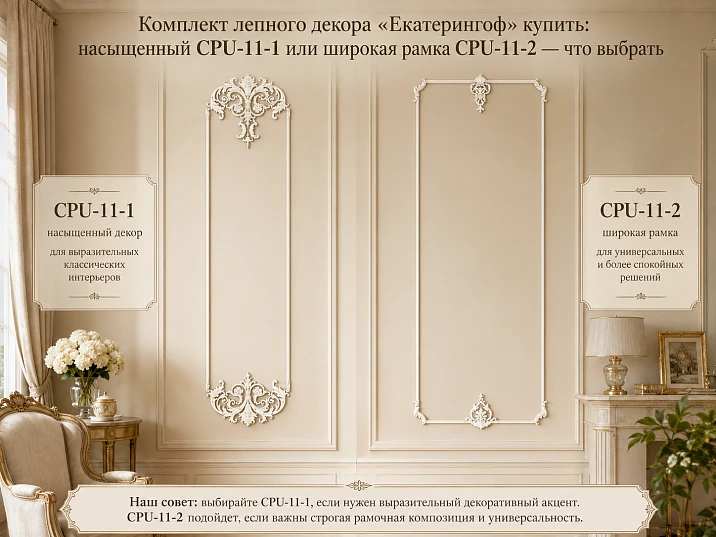
The choice between CPU-11-1 and CPU-11-2 seems simple only as long as the buyer looks at the width. The first set takes up 540 mm on the wall, the second — 820 mm. It is logical to expect that a wider composition will be more expensive. In practice, the opposite is true: at the time of preparing the material, CPU-11-1 was listed in the card at a price of 29,180 rubles, and CPU-11-2 — 13,440 rubles. The reason is not an error or a formal markup for the collection. The narrower set contains a large independent panel NPU-276 and additional mirror overlays NPU-221L/R, while the wide option is built as a calmer frame system.
Therefore, the question "which set of stucco decor “Ekaterinhof” to buy" cannot be reduced to choosing between 540 or 820 mm. You need to understand what the wall requires: one strong vertical center that is noticeable even without repetition, or an architectural frame capable of organizing a large plane, supporting a headboard, sofa, chest of drawers, or a series of identical piers. The difference in composition changes not only the price. It affects visual saturation, the number of semantic centers, distances to furniture, the lighting scheme, and the entire character of the room.
CPU-11-1 and CPU-11-2 belong to the same collection, have the same height of 2300 mm, and combine polyurethane with primed MDF. However, the buyer receives two different tools. CPU-11-1 works as a decorative panel: the eye first encounters a large ornament, then reads the vertical frame. CPU-11-2 acts more architecturally: it outlines the wall field and completes the corners with paired elements, without drawing all attention to the central overlay.
Below is a detailed comparison of composition, dimensions, pricing logic, application options, and installation. It will help decide whether you need a rich set of stucco decor CPU-11-1, whether it is more rational to buy a wide frame CPU-11-2 or better combine both formats in one composition.
Short answer. CPU-11-1 is chosen when a expressive single accent is needed for a narrow pier, an area above a console, mirror, or fireplace. CPU-11-2 is suitable for a wider and calmer frame behind a chest of drawers, headboard, sofa, or in a series of repeating modules. The higher price of CPU-11-1 is primarily due to the large panel NPU-276 and additional paired overlays, not the width of the set.
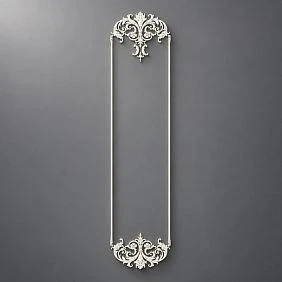
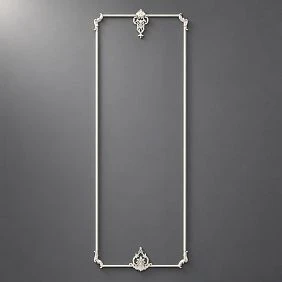
CPU-11-1 and CPU-11-2: main characteristics in one table
| Criterion | CPU-11-1 | CPU-11-2 |
|---|---|---|
| Collection | "Ekateringof" | "Ekateringof" |
| Size | 540 × 2300 × 18 mm | 820 × 2300 × 18 mm |
| Format | Rich vertical panel | Wide decorative frame |
| Main decorative accent | Large element NPU-276 | Paired corner elements MLDPU-4U-2.1L/R |
| Additional decor | Mirror pair NPU-221L and NPU-221R | Left and right frame corners |
| Kit materials | Polyurethane and primed MDF | Polyurethane and primed MDF |
| Character | Ornamental, expressive, centered | Architectural, calm, framed |
| Price at the time of verification | 29 180 ₽ | 13 440 ₽ |
| Main scenario | Single panel, wall section, mirror, console, fireplace | Accent wall, headboard, series of frames, area behind furniture |
About the price. The values of 29,180 and 13,440 rubles are taken from verified cards at the time of preparing the SEO scheme. Before publishing the article and before placing an order, they need to be rechecked: the current price, availability, configuration, and terms of receipt are displayed on the STAVROS website.
The total height of 2300 mm makes both solutions almost full-format: this is not a small overlay above the furniture, but a vertical system that forms a significant part of the wall. Therefore, when measuring, it is important to consider not only the width of the set, but also the height of the baseboard, the position of the ceiling cornice, the actual height of the finished wall, the top line of the furniture, and technological gaps. Even at the same height, the two sets are perceived differently. CPU-11-1 draws the eye more to the center, while CPU-11-2 works more with the contour.
For a first introduction to the entire style of the series, it is useful to view the entire collection of stucco decor "Ekaterinhof". The category shows that CPU-11-1 and CPU-11-2 are not random individual frames, but parts of one decorative system. The article helps solve a narrower purchasing problem: what exactly the wall owner is paying for and which format will give the desired result without unnecessary overload.




Why CPU-11-1 is narrower but noticeably more expensive than CPU-11-2
The price of a finished set is not determined by the area of the rectangle on the wall. The width shows how much space the composition takes up, but says almost nothing about the complexity of the decorative details inside. CPU-11-1 with a width of 540 mm includes a large relief center NPU-276 measuring 517 × 323 × 18 mm. In the verified card, this single element cost 11,270 rubles. It is complemented by two mirror overlays NPU-221L and NPU-221R measuring 100 × 116 × 10 mm, profile elements, and the frame base. As a result, the narrow vertical gets several levels of ornament.
CPU-11-2 with a width of 820 mm uses a different logic. It does not try to fill the center with a large panel. The main role is played by the frame and decoratively finished corners MLDPU-4U-2.1L/R measuring 145 × 90 × 16 mm. At the time of verification, each corner element cost 1,440 rubles. This system takes up more space but contains less expensive central relief. The wall area increases, while the decorative concentration decreases.
This difference is reminiscent of choosing between a large architectural frame and a smaller painting with intricate carvings. The frame may be wider, but it is the content that determines value and visual density. The CPU-11-1 is bought not for its narrowness, but for its large NPU-276, symmetrical side overlays, and a more theatrical impression. The CPU-11-2 is bought not because it is a "simplified version," but because the wall needs a different rhythm — calm, repeatable, and convenient for connecting with furniture.
Do not consider the CPU-11-2 a compromise just because of its lower price. In an interior that already has an expressive headboard, paintings, sconces, textured textiles, or active furniture, a wide frame set can look more precise. It organizes the field without creating a competing central subject. Conversely, the CPU-11-1 can replace a painting or a standalone panel, so additional wall decorations are often unnecessary.
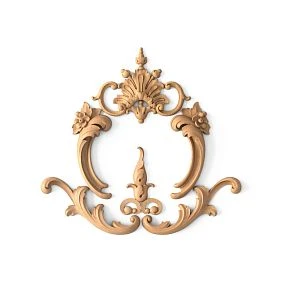
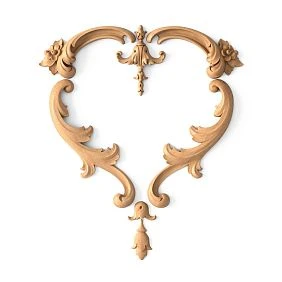
Our factory also produces:
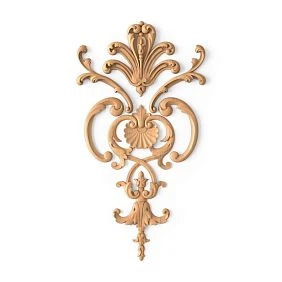
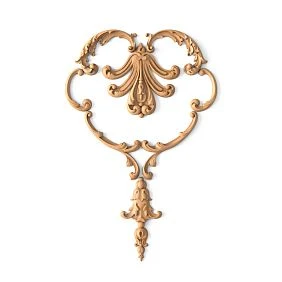
What the buyer actually gets for the price difference
With the CPU-11-1, you pay not only for the set of parts but also for a ready-made compositional hierarchy. The large panel immediately sets the center. The NPU-221L/R overlays support symmetry and connect the center with the frame. The owner gets a solution that can be installed alone and does not need to be repeated on adjacent wall sections. This independence is especially valuable for narrow wall sections where a wide series of frames cannot be placed.
With the CPU-11-2, the buyer gets an architectural module. Its strength is revealed not so much in one expensive element, but in the proportion and the possibility of repetition. Two or three identical frames can form an entire wall, while a single module can highlight a furniture zone. The more affordable price of one frame simplifies multiple uses, but the total estimate still needs to be calculated based on the number of kits, painting area, and installation work.
Therefore, comparing only the prices of two items is incorrect. For a small wall section, one CPU-11-1 may be a complete solution. For a large wall, two or three CPU-11-2 may be needed. The final cost of the project in this case will depend on the number of modules, materials, base preparation, and installation. It is important for the buyer to consider not the "price of one box," but the cost of the finished wall.
Get Consultation
What is included in the decorative logic of CPU-11-1
CPU-11-1 is a vertical composition of 540 × 2300 × 18 mm, designed for a strong central accent. It is convenient to perceive it as a ready-made wall panel built into a frame. This design suits a buyer who does not want to separately select moldings, a central overlay, and symmetrical side parts, but seeks to get a pre-agreed set.
The role of the large NPU-276 panel
The key element of CPU-11-1 is the NPU-276, measuring 517 × 323 × 18 mm. It is almost equal to the width of the entire composition, so it forms not a small ornament in the corner, but an independent relief field. Before ordering, it is useful view large decorative panel NPU-276 separately: the card helps evaluate its shape and understand why the set feels richer CPU-11-2.
In the interior, NPU-276 can replace a painting, medallion, or complex central rosette on the wall. It does not need additional support from many small accessories. On the contrary, it is advisable to leave a calm space around the panel. If you place bright paintings, a large mirror in an active frame, several sconces, and contrasting furniture nearby, the wall will lose hierarchy. CPU-11-1 works best where it is given the main role.
The large relief also affects light. Side lighting makes shadows deeper and enhances the ornament, while frontal diffused light softens the pattern. When placing between sconces, it is important to ensure that the lights do not overlap the edges of the panel and do not create random shadows. The centers of the sconces should be tied to the overall axis and height of the furniture, not just to the decorative overlay.
Why the set includes NPU-221L and NPU-221R
The paired elements NPU-221L and NPU-221R have dimensions of 100 × 116 × 10 mm and mirror orientation. They help the composition not to fall apart into a frame and a separate central panel. The left and right elements direct the ornament inward, create symmetry, and support the transition between the large form and vertical lines.
If necessary, the composition can be studied using individual cards: buy left decorative overlay NPU-221L и buy right decorative overlay NPU-221R. This does not mean that the parts must be ordered separately. The links are useful for checking the shape, orientation, and understanding why the left and right overlays cannot be accidentally swapped.
The mirror pair is especially important during marking. Before gluing, the craftsman must lay out the elements on the floor or temporarily attach them to the wall, check the direction of the pattern, and only then transfer the axes. An orientation error can disrupt symmetry even with a perfectly level frame. The richer the pattern, the more noticeable such a mismatch.
Why CPU-11-1 works well alone
The kit already includes a center, supporting overlays, and a vertical contour. It does not require a neighboring frame to look complete. This is an important advantage for a hallway, foyer, wall between doors, wall above a console, or fireplace area. One kit can become the main decorative feature without repetition.
The single format simplifies the compositional solution but does not eliminate the need for precise measurement. Margins must remain around the 540 mm width. If the wall section is 600–650 mm wide, the frame may technically fit but will visually appear cramped. It is useful to draw the outline with painter's tape in advance and look at it from the distance from which the wall is visible upon entry.
What is included in the decorative logic of CPU-11-2
CPU-11-2 measures 820 × 2300 × 18 mm and is built as a wide frame composition. It does not have a large central panel that immediately draws attention. The main effect is created by the proportions of the rectangle, the lines of the moldings, and the decoratively designed corners. Thanks to this, the kit is easier to subordinate to furniture, lighting, and the overall rhythm of the wall.
How the MLDPU-4U-2.1L and MLDPU-4U-2.1R corners work
The left and right corner elements, measuring 145 × 90 × 16 mm, complete the frame and make the transitions more expressive than a regular straight connection of moldings. Before purchasing, you can view the left corner of the MLDPU-4U-2.1L frame и view the right corner of the MLDPU-4U-2.1R frameSeparate cards are useful for understanding the orientation and nature of the relief.
Corners serve two purposes at once. First, they eliminate the feeling of a technical rectangle assembled only from profile strips. Second, they support the collection language of "Ekaterinhof", connecting the frame with other elements of the series. At the same time, the central area remains free: you can place a chest of drawers there, position a headboard, hang a mirror, or leave a clean painted surface.
The free center makes CPU-11-2 flexible. In a classic interior, the frame can be monochrome with the wall and work as a relief. In a more contrasting solution, the inner field can be highlighted with color, but the boundaries and combination of shades should be determined before installation. In a commercial space, a logo, mirror, or decorative lighting can be placed inside the frame if the project accounts for dimensions and does not damage the elements.
Why a width of 820 mm is convenient for furniture zones
820 mm is no longer a narrow wall section, but not a giant panel either. Such a module can be tied to a chest of drawers, bedside table, part of a headboard, or a small sofa. It is important not to automatically make the frame equal to the width of the furniture. Sometimes it is better when it is slightly narrower and gathers the center, and sometimes when it is wider and creates an architectural background. The decision depends on neighboring objects and free fields.
For a wide bed, one CPU-11-2 often becomes a local module rather than the design of the entire headboard. Then you can use two or three frames, maintaining equal intervals. On the wall behind a sofa, one module can support the central part, but for long furniture, a series is often required. Such a calculation should be done for the entire wall, not for a single product card.
Why CPU-11-2 is convenient to repeat
The calm frame structure does not create competing large panels. If you place two CPU-11-2 next to each other, the eye perceives rhythm, not two separate pieces. This is useful in a bedroom, restaurant, corridor, hotel room, and other spaces where a consistent architectural grid is required.
Repetition requires particularly precise marking. The top and bottom lines of all frames must match, intervals must be identical, and edge fields must correspond to the length of the wall. A small error, unnoticeable on a single module, becomes a visible misalignment in a series. Therefore, before purchasing multiple sets, a complete layout plan must be drawn up.
Panel or frame: two different results on the wall
| Buyer's task | When CPU-11-1 is stronger | When CPU-11-2 is stronger |
|---|---|---|
| Create a main accent | A large NPU-276 immediately forms a center and can replace a separate wall panel | Suitable if the center should remain furniture, a mirror, a painting, or light |
| Decorate a narrow wall space | Width 540 mm fits more easily between doors, windows, or furniture | Width 820 mm requires more free space |
| Create a background behind furniture | Works as a separate vertical center above a console or narrow chest of drawers | Better outlines the area behind the dresser, headboard, or part of the sofa zone |
| Repeat the module several times | Repetition is possible, but several large panels may overload the wall | Frame logic is more convenient for a series of two or three modules |
| Maintain a calm interior | Requires a restrained environment and neat monochrome finish | Easier to combine with active furniture, textiles, and wall lighting |
The difference is convenient to formulate as follows: CPU-11-1 itself becomes the content of the wall, CPU-11-2 creates a frame for other content. In the first case, the large relief is the reason for purchase. In the second, the reason for purchase may be furniture, a mirror, lighting, or the need to organize an empty plane. This leads to a different approach to the project.
If the interior is already saturated with decor, CPU-11-1 should be used carefully. It may compete with carved furniture, active curtains, patterned wallpaper, and a massive chandelier. CPU-11-2 is usually easier in such conditions: the frame supports the architecture but does not add another large narrative. In a minimalist room, the situation is reversed: one CPU-11-1 can provide the missing character without filling the entire wall with many objects.
Before making a final decision, it is useful to look not only at the cards but also at interior examples. For the frame scenario, you can view the ready-made design idea "Ekateringof"; for a composition with more pronounced decor — view the interior with CPU-11-1 elementsSuch pages do not replace measurements, but help assess the scale of details in a real space.
How to choose a set for a narrow wall space
A narrow wall space is one of the most obvious scenarios for CPU-11-1, but the word "narrow" cannot be understood abstractly. First, measure the clear width between trims, window slopes, furniture, or corners. Then subtract the desired side margins. If you leave only 20–30 mm, the composition will look cramped, even if it technically fits. The richer the panel, the more breathing room it needs.
For a wall between two doors, it is important to consider the door swing and the location of switches. The frame should not fall under the handle, and decorative elements should not interfere with electrical cover plates. Sometimes a wall space 700–750 mm wide is suitable for CPU-11-1 because noticeable margins are preserved. But if a switch occupies the center of the side margin, the composition will have to be shifted or another wall section chosen.
CPU-11-2, 820 mm wide, often turns out to be too large in a narrow wall space. The mistake occurs when a buyer compares only the dimensions of the wall and the set: "wall 900 mm, frame 820 mm — so it fits." Formally yes, but only 40 mm remain on each side. For an architectural frame, this is insufficient. It will be perceived as randomly crammed between boundaries.
If the wall space is tall and narrow, CPU-11-1 supports the vertical. The large NPU-276 prevents the frame from looking empty, and the height of 2300 mm connects the lower and upper parts of the wall. In a hallway, this can replace a painting that protrudes from the plane and risks being bumped. The stucco decor remains part of the wall and does not require a deep frame.
Practical check before ordering
Apply a width of 540 mm with painter's tape, then mark the height of 2300 mm. Step back to the entry point and assess whether the top of the frame hits the cornice, the bottom conflicts with the baseboard, and whether there are margins on the sides. After that, mark the approximate size of NPU-276 — 517 × 323 mm. This layout shows the actual saturation better than viewing an image on a phone.
If the layout seems too dense, do not automatically switch to CPU-11-2: it is even wider. In that case, consider other ready-made solutions and choose other ready-made wall decor sets. The goal is not to place the selected item at any cost, but to find a composition that suits the architecture.
What to install above a console, dresser, or fireplace mantel
CPU-11-1 above the console
A console usually has a relatively small depth and emphasizes the vertical axis of the wall. CPU-11-1 supports this logic: a narrow composition lifts the gaze, and the large panel becomes the center above the tabletop. In this scenario, it is important to coordinate the width. The set does not have to exactly match the console, but too large a difference will create a sense of randomness. A narrow console and a 540 mm frame are often perceived as a single column.
It is better to leave a limited number of items on the tabletop. Tall vases, large lamps, and several frames can overlap the lower part of the stucco composition. CPU-11-1 already contains strong relief, so furniture styling should support, not compete. One mirror or a pair of lights are acceptable if their axes are included in the drawing in advance.
CPU-11-2 behind the dresser
A wide 820 mm frame is more often suitable behind a dresser, especially when the central role is played by the furniture itself, a mirror, or a painting above it. CPU-11-2 outlines the field and makes the group cohesive. The frame can be narrower than the dresser, equal to it, or slightly wider — each option gives a different effect. The exact solution is best checked on a front sketch.
If the chest of drawers is wide, one CPU-11-2 sometimes looks too narrow. Then a pair of frames or a central CPU-11-1 with side CPU-11-2 is possible. You cannot simply add a second set without calculation: you need to consider the total width, intervals, and margins to the wall corners.
Fireplace Area
CPU-11-1 is logical above a narrow portal or in a wall section next to a fireplace when an ornamental center is needed. CPU-11-2 is suitable for a wide background if the frame should emphasize the portal's geometry. However, any solutions near an active heat source require checking materials, temperature conditions, and specialist recommendations. The provided diagram has no data on permissible temperatures, so compatibility with any fireplace design cannot be guaranteed.
You also need to consider the TV if it is located above the portal. A large NPU-276 panel and the screen should rarely compete for the same central zone. In such a case, a calm CPU-11-2 frame or moving the stucco accent to an adjacent wall section often looks more rational.
How to design a wall next to a mirror and between two sconces
The mirror adds reflection, shine, and an active boundary. CPU-11-1 can work next to it as an independent panel, especially if the mirror is on an adjacent axis. In this case, two vertical elements—the mirror and the stucco composition—create a paired rhythm. They do not have to be the same width, but the upper and lower levels should be coordinated.
Placing the mirror directly inside CPU-11-1 should only be done after checking dimensions: a large NPU-276 already occupies the central spot. Trying to keep the panel and add a large mirror at the same time can lead to overlapping meanings. CPU-11-2 is better suited when the mirror is meant to be the content of the frame. The free central field allows such integration, but the exact placement is determined by the drawing.
The situation is similar with a pair of sconces. For CPU-11-1, sconces can be placed outside the frame or on the sides of the central panel if the wall width allows. The light should reveal the relief, not create harsh shadows from randomly positioned fixtures. For CPU-11-2, sconces can be inside the frame, supporting the furniture axis. But electrical outlets are laid before the stucco installation.
What to check in the electrical plan
- centers of sconces relative to the axis of the set and furniture;
- height of switches and sockets;
- direction of door opening near the wall;
- areas of concealed wiring passage;
- possibility of subsequent access to electrical trims;
- sufficient distance from relief details to the luminaire body.
Decorative elements must not be trimmed after installation just because the electrician ran the cable at a random point. This approach ruins the pattern and makes the joint visible. First, the wall layout is approved, then the stucco, furniture, and electrical elements are coordinated. If the renovation is already complete, the composition is adjusted to the existing outlets, not hidden without verification.
CPU-11-1 or CPU-11-2 for the bedroom and the wall behind the headboard
In the bedroom, the main object is usually the bed. The stucco decor should support its width, headboard height, and placement of bedside tables. CPU-11-2 is more suitable for a frame grid: one module can highlight the central part, two can support symmetry, three can frame a wide wall. The calm contour does not compete with textiles and the upholstered headboard.
CPU-11-1 is appropriate if a vertical center is needed above a narrow headboard, chaise lounge, or console in the bedroom. Above a wide bed, a single narrow set may look random if unsupported. In such a case, it is used as a central panel between two CPU-11-2 frames or linked with a vertical headboard that matches the composition's width.
A large NPU-276 above the bed requires visual breathing room. The top of the panel should not press against the ceiling cornice, and the bottom should not conflict with a high backrest. If the headboard covers a significant part of the frame, the decorative system loses its purpose. Before ordering, not only the stucco contour but also the actual height of the bed with mattress and pillows must be marked.
One CPU-11-1 between two CPU-11-2
This combination creates a hierarchy: the central saturated module becomes the main one, while the side wide frames support the rhythm. The scheme is suitable for a long wall behind a bed, sofa, or console group. However, it requires significant width. The sum of nominal sizes alone is 540 + 820 + 820 = 2180 mm. To this, two internal intervals and outer margins must be added.
For example, with intervals of 120 mm and margins of 180 mm, the total required width would be 2180 + 240 + 360 = 2780 mm. This is just a calculation example, not a universal standard. In a specific room, intervals depend on height, furniture, doors, and overall scale. Too small gaps will cause the three sets to merge, while too large gaps will break the unity.
For a detailed calculation, it is useful to study the material on how to assemble a composition from several sets. It covers the general task of rhythm and quantity, while the current article helps choose the roles specifically for CPU-11-1 and CPU-11-2.
How to calculate wall width and distance between frames
The calculation starts with the finished wall width. From it, subtract areas that cannot be occupied: door trims, slopes, built-in cabinets, radiators, switches, protrusions, and technical zones. The resulting number is the working field. Within it, sets and intervals are distributed.
Formula for multiple sets
For a simple scheme, the expression can be used: total width of compositions + sum of internal intervals + two outer margins. If two CPU-11-2 are installed, the nominal width is 1640 mm. With an interval of 140 mm and outer margins of 200 mm each, 2180 mm of working wall is required. If CPU-11-1 and CPU-11-2 are installed, the base is 1360 mm, to which one interval and two margins are added.
The formula helps check if the layout fits, but does not guarantee good proportions. On a wall 3.5 m high, small intervals may look cramped, while in a compact room, overly wide margins may appear empty. Therefore, the numerical calculation is supplemented with a front-scale sketch. It is enough to draw the wall, furniture, and frames on graph paper or in any graphic editor.
How to determine outer margins
Outer margins do not have to equal internal intervals. Often, more space is left at the edges so the series does not press into corners. But if a tall cabinet or door is nearby, the margin may be tied to their boundary. The main thing is that the solution looks intentional.
With asymmetrical furniture, geometrically equal fields do not always provide visual balance. For example, a heavy cabinet on the left may require more empty space than a light curtain on the right. In such cases, it is useful to evaluate the wall together with the entire interior, rather than as an empty rectangle.
Height and bottom line
Both sets have a height of 2300 mm. If the finished wall height is 2700 mm, a total of 400 mm remains at the top and bottom. These fields are distributed considering the baseboard, cornice, and furniture. You cannot automatically center the frame by height: above a chest of drawers or bed, the lower part may be partially covered. Sometimes the composition is raised, but then the top approaches the ceiling.
Before ordering, draw horizontal lines: the top of the baseboard, the top of the furniture, the center of the sconce, the bottom of the cornice, and the boundaries of the set. Such a drawing immediately shows a conflict that cannot be noticed by the width of the product alone.
How to account for outlets, switches, sconces, and other technical elements
Stucco decor is installed on a real wall where electrical wiring, ventilation grilles, sensors, and furniture mounts already exist. The mistake of many projects is to first choose a beautiful composition and then try to "bypass" existing outlets with it. The result looks random: the frame is interrupted, the overlay shifts, and the switch ends up right next to the relief.
For CPU-11-1, the central pattern is critical. NPU-276 cannot be mindlessly trimmed to fit a sconce or cable outlet. Paired NPU-221L/R must also maintain orientation. If electrical elements are already in the panel area, it is easier to shift the entire set or choose CPU-11-2, in whose free center it is easier to place a functional element.
CPU-11-2 has more internal space, but the frame still cannot be broken by a random outlet. Outlets behind a chest of drawers usually remain below the visible area, and switches are better placed outside the decorative contour. If sconces are planned inside the frame, their mounting bases must fit without contacting the molding and corners.
Approval sequence
- Determine the furniture and its actual dimensions.
- Apply to the wall layout CPU-11-1 or CPU-11-2.
- Place sconces, sockets and switches considering the frames.
- Check the opening of doors, curtains and furniture fronts.
- Coordinate wiring routes and drilling locations.
- Only after this approve the installation of stucco molding.
If wiring is already laid, the master must check its location before drilling. The provided data does not contain a specific fastening scheme for each base, so the installation method and work safety are determined by the specialist on site. The article helps plan the layout but does not replace a technical wall inspection.
Kit materials and finish selection
Both kits combine polyurethane and primed MDF. For the buyer, this means the composition is assembled from parts with different bases but should be perceived as a single whole. Before painting, coordinate preparation, primer, glue, joint sealing, and compatibility of the topcoat with each material.
Do not transfer recommendations for one surface to another without verification. A polyurethane overlay and primed MDF may react differently to sanding, humidity, glue composition, and paint layer. Therefore, materials for installation and finishing are selected as a system. On the website you can select materials for installing stucco decorbut the specific set should be coordinated with the wall base and the manufacturers' instructions.
Painting in wall color
Solid coloring makes the relief part of the architecture. For CPU-11-1, this option softens the saturation of NPU-276: the panel remains noticeable due to light and shadow, but does not turn into a separate contrasting picture. For CPU-11-2, painting in the wall color emphasizes the geometry of the frame and allows the furniture to retain the main role.
The darker and more matte the color, the more shadows and small irregularities may appear. Light shades usually make the composition lighter, but do not hide poorly processed joints under side lighting. Before the main painting, it is useful to do a test on a separate area or sample.
Contrasting inner field
For CPU-11-2, the free center can be highlighted with a different shade. Then the frame becomes the border of the color field. This technique is suitable behind the headboard, chest of drawers, or in the reception area. But contrast requires perfectly straight lines and careful painting preparation. If the color goes beyond the frame or the geometry deviates, the error becomes more noticeable.
For CPU-11-1, contrast is used more cautiously. A large panel already creates an active center, and a second color can overload the composition. Often one tone and directional light are enough. The decision is best made on a visualization where furniture, textiles, and the overall palette are visible.
Can individual elements be painted differently
Technically, the project may include several shades, but the article does not have confirmed manufacturer recommendations for a specific painting system. From a compositional point of view, multi-colored finishing increases decorativeness. For CPU-11-1, this is especially risky: NPU-276, side trims, and the frame may fall apart into separate parts. A monochrome solution usually looks more cohesive.
Installation: why a ready-made kit does not replace the project and layout
A ready-made kit eliminates the problem of random selection of parts, but does not turn installation into mechanical gluing from a photo. CPU-11-1 and CPU-11-2 have a height of 2300 mm, so even a slight deviation from vertical is noticeable. First, check the wall, then transfer the central and extreme axes, do a dry layout, and only then fix the elements.
CPU-11-1 requires special attention to the large NPU-276 and mirrored NPU-221L/R. The central panel must be on the approved axis, and the paired overlays must face the correct directions. If the center is shifted by a few millimeters relative to the frame, the ornamental composition may appear skewed even with straight external lines.
CPU-11-2 is simpler in decorative hierarchy, but the 820 mm width and corner elements require precise geometry. The left and right parts MLDPU-4U-2.1L/R must form consistent angles. When repeating multiple frames, any difference in height and intervals becomes obvious.
Wall base
The quality of the result depends on the flatness. Stucco is not intended to hide serious unevenness. On an uneven wall, long lines may pull away, and joints may open. Before installation, the craftsman evaluates the coating's strength, evenness, humidity, and compatibility with the adhesive system. If necessary, the base is leveled and primed.
Joints and painting
Joints must be treated so that after painting, the frame appears seamless. Connections are especially noticeable under side lighting. It is useful to study the material on how to install moldings without visible joints. It helps to understand the general principles of clean corners, preparation, and painting, but the exact technology depends on the chosen materials and base.
Why you cannot install elements one by one without a general layout
If you glue the first part and then adjust the rest, the error accumulates. By the end of the frame, the corner may not match, the interval may change, or symmetry may be broken. A dry layout allows you to check completeness, orientation, and dimensions before irreversible fixation. For the complex CPU-11-1, this is especially important.
What to buy and check together with the kit
The finished composition is the central purchase, but a completed wall requires a prepared base, installation materials, finishing, and coordination with furniture. Related products cannot be selected automatically: the composition depends on the wall, the chosen paint, and the skill of the craftsman. However, the buyer can prepare a list of questions in advance and avoid discovering missing items on the day of installation.
| What to add to the project | Why this is needed | For which scenario | What to Check |
|---|---|---|---|
| Mounting and finishing materials | Fixing elements, joint treatment, preparation for painting | For CPU-11-1 and CPU-11-2 | Compatibility with the wall, polyurethane, primed MDF, and the chosen paint |
| Panel NPU-276 | Check the main element CPU-11-1 and assess its scale | For a rich single accent | Dimensions 517 × 323 × 18 mm, position on the wall, lighting |
| NPU-221L и NPU-221R | Understand the operation of the mirror pair in CPU-11-1 | For a symmetrical ornamental composition | Left and right orientation, dry layout sequence |
| MLDPU-4U-2.1L и MLDPU-4U-2.1R | Check decorative corners CPU-11-2 | For wide frame and series of modules | Orientation, corner alignment, symmetry of multiple frames |
| Collection «Ekaterinhof» | Match both sets with other elements of the series | When not just one pier is decorated, but an entire room | Unity of scale, ornament, and amount of decor |
| Other wall decor sets | Find an alternative if 540 or 820 mm do not fit | For non-standard width, different style, or lower saturation | Actual dimensions, composition, material, and purpose of each model |
There is no need to purchase individual elements "just in case" if they are already included in the kit or not provided for by the project. Before ordering, check the card, composition, and quantity. If a non-standard frame extension or part replacement is planned, compatibility should be clarified with the STAVROS manager and the craftsman who will perform the marking.
How not to confuse a ready-made kit with individual moldings and overlays
CPU-11-1 and CPU-11-2 are ready-made composite solutions. Their advantage is that the buyer does not need to determine the length of each profile from scratch, select the scale of overlays, or design corner connections. Individual elements offer more freedom but require a project, precise calculation, and understanding of compatibility.
An error occurs when a ready-made kit is perceived as a set of random parts that can be rearranged without consequences. In CPU-11-1, NPU-276 and NPU-221L/R form a specific hierarchy. In CPU-11-2, the corners MLDPU-4U-2.1L/R set the direction of the frame. A significant change in proportions can destroy the original pattern.
Another mistake is considering the individual NPU-276 card as a complete analog of CPU-11-1. The panel is an important part, but the kit includes a frame structure and supporting elements. Buying one overlay solves the task of local relief, not a ready-made vertical composition 2300 mm high.
The same applies to the corners of CPU-11-2. Two decorative corners do not form a full frame without the remaining elements and precise calculation. If the project involves an individual composition, it is useful to read the material ready-made kit or individual moldings — what to choose. It helps to understand when freedom is justified and when a ready-made solution reduces the risk of mismatches.
How to distinguish product tasks
- A ready-made vertical accent with a large panel is needed — choose CPU-11-1.
- A broad architectural framework is needed — choose CPU-11-2.
- Only a separate overlay is needed — study NPU-276 or NPU-221L/R.
- Only decorative corners for your own project are needed — study MLDPU-4U-2.1L/R.
- A fully custom size is needed — calculate a composition from individual elements and check compatibility in advance.
This separation helps avoid overpaying for a set when only one part is needed, and not buying one part when the wall requires a complete system.
Practical choice for different rooms and tasks
Living room behind the sofa
For a long sofa, the CPU-11-2 series is often more suitable. The frames create a background and do not compete with pillows, tables, and paintings. One CPU-11-1 can be used in the center if the sofa and wall have a pronounced axis, but a large panel should be connected to the furniture. A random narrow vertical above a long sofa may look insufficient.
Hallway
In the hallway, there are many doors, switches, and narrow walls. CPU-11-1 is more convenient in width and can replace a protruding painting. However, you need to check that the relief does not come into contact with outerwear and door handles. CPU-11-2 is suitable for a free wall behind a console or bench.
Cabinet
CPU-11-1 creates an expressive background for a desk, armchair, or small library. CPU-11-2 better supports the symmetry of shelves and cabinets. If the study has many books and dark furniture, a calm frame usually looks lighter, while a large NPU-276 requires free space.
Restaurant, hotel, salon, or reception area
In a commercial interior, repeatability, maintainability, and photogenicity are important. CPU-11-2 is convenient to use in a series along a wall or in several identical zones. CPU-11-1 is suitable for a key point: behind the reception desk, at the end of a corridor, in a waiting area. Saturated panels should not be placed in every area — repetition reduces the effect and increases visual noise.
Bedroom
Behind the headboard, the framed CPU-11-2 often works better. CPU-11-1 is appropriate above a narrow chaise lounge, vanity table, or on the central axis of a tall bed. Before installation, consider soft panels, mattress height, bedside lamps, and curtains.
Mirror area
If the mirror is the main object, CPU-11-2 creates an architectural field for it. If the mirror is placed separately, CPU-11-1 can become an equal decorative partner. Their sizes and top lines need to be coordinated so that the wall does not look like it is assembled from random verticals.
When one set is better, and when a composition of several is needed
A single CPU-11-1 is almost always considered a complete panel. Adding another identical set next to it is only worthwhile in a spacious room with two equivalent axes. In an ordinary room, repeating a large NPU-276 may be too assertive. Much more often, the central CPU-11-1 is combined with calmer CPU-11-2 units.
A single CPU-11-2 works well behind a small chest of drawers, mirror, or in a separate niche. For a long wall, it is often insufficient. In that case, a series of two or three frames forms a regular grid. The quantity is determined not by the desire to fill all the space, but by the architecture: doors, furniture, centers of windows and light fixtures.
The mixed composition «CPU-11-2 — CPU-11-1 — CPU-11-2» creates a classic hierarchy. The central module is richer and narrower, while the side ones are wider and calmer. This scheme is especially convincing if the furniture also has a central axis: a bed, sofa, fireplace, or console. On an asymmetrical wall, it may look artificial.
How not to turn a wall into a catalog
You don't need to use all the elements of the collection at once just because they match. A good composition is built on repeating a few rules, not on the maximum number of SKUs. If CPU-11-1 is chosen, the side areas can be left empty. If a series of CPU-11-2 is used, a large additional panel may be unnecessary.
A useful guideline is to define one main, one supporting, and one background level. For example, the main level is CPU-11-1; the supporting level is two CPU-11-2 frames; the background is a solid color. If each level becomes equally active, the hierarchy disappears.
For a general understanding of formats, you can study the material on how to choose a ready-made set of stucco decor. It helps to compare ready-made compositions as a whole, while the current analysis remains focused on the «Yekaterinhof» pair.
Typical mistakes when buying CPU-11-1 and CPU-11-2
Error 1. Choosing by width and considering a wider set more valuable
Width does not reflect composition. CPU-11-1 is more expensive due to the large panel and additional overlays. The buyer must decide if such a decorative center is needed. If not, overpaying for richness will not provide benefit. If needed, comparing only by wall area will lead to the wrong choice of CPU-11-2.
Error 2. Comparing the price of one panel without considering the entire wall
One CPU-11-2 is cheaper, but for a long wall, two or three sets may be needed. CPU-11-1 sometimes covers the task alone. The estimate is calculated by quantity, materials, preparation, painting, and installation, not just by unit price.
Error 3. Not accounting for furniture
A frame 2300 mm high may be blocked by a headboard, dresser, or tall console. Before ordering, furniture should be placed on the wall layout. If a significant part of the molding is hidden, the composition is raised, changed, or a different format is chosen.
Error 4. Placing CPU-11-1 next to another large center
NPU-276 already functions as a panel. A large painting, TV, or active mirror nearby may compete with it. The wall looks more expensive not from the number of centers, but from a clear hierarchy.
Error 5. Trying to cut decor around sockets
Electrical elements must be included in the project before installation. Accidental cutting damages the frame and ornament. If the outlets cannot be moved, choose a different position or format.
Error 6. Confusing left and right orientation
NPU-221L/R and MLDPU-4U-2.1L/R form mirror pairs. Before fixing, the parts are laid out, the marking and pattern direction are checked. The error is especially noticeable in a symmetrical composition.
Error 7. Mounting on an unprepared wall
Long lines emphasize unevenness. Stucco molding does not replace leveling and should not be held on a peeling coating. The base is assessed in advance.
Error 8. Choosing the finish after installation
The color and material system affect the preparation of joints and the order of work. Monochrome and contrasting painting require different solutions. It is better to approve the palette before fixing the elements.
Error 9. Repeating too many CPU-11-1
Several large panels make the wall heavy. If rhythm is needed, the calm CPU-11-2 is usually more convenient. CPU-11-1 is left as the main module.
Error 10. Do not check the current price and completeness.
The prices in the article reflect the moment the diagram was prepared. Before publishing and ordering, you need to open the cards, check the cost, availability, composition, and terms of receipt. You cannot make a decision based on a saved number without re-checking.
Who is CPU-11-1 suitable for, and who is better off choosing CPU-11-2
CPU-11-1 should be considered if:
- there is a narrow vertical wall and a finished accent is required;
- you need to replace a painting or an independent wall panel;
- the interior has enough calm space around a large NPU-276;
- the composition is installed above a console, next to a mirror, or in a fireplace area;
- the buyer values ornamental richness rather than maximum width;
- one set should solve the problem without repetition across the entire wall.
CPU-11-1 may not be suitable if:
- the wall is already occupied by a TV, a large painting, or an active mirror;
- a series of identical calm frames is needed;
- the headboard or furniture covers a significant part of the composition;
- the interior is overloaded with ornament and requires a more architectural background;
- there is not enough free space around the width of 540 mm.
CPU-11-2 is worth considering if:
- you need to highlight a furniture area with a wide frame;
- the center remains a mirror, headboard, chest of drawers, sofa, or light;
- a repetition of two or three modules is planned;
- a calmer classical geometry is important;
- the customer wants to organize a large wall without several large panels;
- a reasonable cost for one frame module is required.
CPU-11-2 may not be suitable if:
- the wall section is already 820 mm or leaves no side margins;
- the wall needs an independent ornamental center;
- one empty frame will look unfilled without furniture or a mirror;
- switches, sconces, or doors intersect the wide contour;
- the project has no ability to precisely align a series of frames.
An honest choice does not always mean buying a more expensive CPU-11-1. Sometimes the wide frame CPU-11-2 solves the problem better, even if the budget allows both options. Conversely, trying to save on a rich center may lead to purchasing additional paintings, overlays, and decor, which in total will be more expensive and less cohesive.
How to buy CPU-11-1 or CPU-11-2 on STAVROS
Start not with the order button, but with a wall layout. Record the final dimensions, furniture, baseboard, cornice, doors, sockets, and light fixtures. Then apply two options: CPU-11-1 size 540 × 2300 × 18 mm and CPU-11-2 size 820 × 2300 × 18 mm. Compare not only the fit but also the function: panel or frame.
After pre-selection, open the card and check the current details. For the rich option, you need to view the composition of CPU-11-1 and ensure that the large NPU-276 matches the room scale. For the wide format — view the CPU-11-2 kit and evaluate the frame geometry, angles, and actual width.
Before placing an order, check:
- the article number and name of the kit;
- dimensions 540 × 2300 × 18 mm or 820 × 2300 × 18 mm;
- current price;
- completeness and materials;
- availability and terms of receipt;
- installation plan;
- compatibility of adhesive, preparation, and painting;
- number of kits for the entire wall.
If multiple modules are selected, it is better to provide the manager with the wall dimensions and layout in advance. This does not replace design, but helps verify the quantity and avoid a situation where, after installing one kit, it turns out that a second one is needed for symmetry, but the distances have already been set incorrectly.
Ordering a ready-made solution is more convenient than a random set of parts because the compositional logic is already defined. CPU-11-1 pre-links the panel and mirror overlays; CPU-11-2 links the frame and paired corners. The buyer only needs to correctly choose the format, check the parameters, and ensure high-quality installation.
Frequently asked questions about CPU-11-1 and CPU-11-2
Why is CPU-11-1 more expensive even though it is narrower?
The price is related not to width, but to composition. CPU-11-1 includes a large NPU-276 panel measuring 517 × 323 × 18 mm and additional mirror overlays NPU-221L/R. CPU-11-2 is wider but is built as a calmer frame with corner elements. Before publishing and ordering, current prices should be checked in the product cards.
Which kit is better for a narrow wall section?
CPU-11-1 with a width of 540 mm is often suitable. But you need to leave side margins and check switches, doors, and furniture. If the wall section is only slightly wider than 540 mm, the composition may look cramped.
Which option to choose for the headboard of the bed?
CPU-11-2 is more convenient for a grid pattern and repetition. CPU-11-1 works as a central panel if its width relates to the headboard and there is enough free space around it.
Can I install one CPU-11-1 between two CPU-11-2?
Yes, this layout creates a central dense module and calm side frames. You need to calculate the total width of 2180 mm, intervals, and edge margins, and also tie the composition to the furniture axis.
Is CPU-11-2 suitable for the wall behind the sofa?
Yes, especially in a series of two or three frames. One module may not be wide enough for a long sofa, so the layout is done across the entire wall.
Can a mirror be placed inside CPU-11-2?
The free center of the frame allows this scenario if the dimensions and mounts are coordinated in advance. The mirror should not overlap the moldings and corner elements. The exact fit is checked on the drawing.
Can a mirror be placed inside CPU-11-1?
CPU-11-1 already contains a large central NPU-276, so a large mirror often conflicts with the panel. Usually, the mirror is placed nearby or CPU-11-2 is chosen, where the center is freer.
How is NPU-221L different from NPU-221R?
These are mirror-image left and right overlays. They have the same size 100 × 116 × 10 mm, but different pattern orientation. During dry layout, it is important not to swap them.
What are MLDPU-4U-2.1L and MLDPU-4U-2.1R for?
They decoratively finish the left and right corners of CPU-11-2. The paired orientation helps assemble a symmetrical frame and distinguishes the set from a simple rectangle of moldings.
Do I need to paint the entire set in one color?
A single-color finish usually makes the composition more cohesive and emphasizes the relief with light and shadow. Multiple colors are only possible as a deliberate design decision. The preparation system and paints must be selected considering polyurethane and primed MDF.
Can the set be installed on an uneven wall?
Serious irregularities are corrected first. Long verticals and horizontals emphasize unevenness, and joints may open. The condition of the base is assessed by the craftsman before installation.
How many CPU-11-2 are needed for one wall?
The quantity depends on the working width, furniture, intervals, and edge margins. For calculation, add up the widths of all frames, internal intervals, and two external margins. Then check the proportions on a sketch.
Can I buy a separate NPU-276 instead of CPU-11-1?
Yes, if you only need a local decorative element. But one overlay does not replace a finished composition 2300 mm high with a frame and paired parts. The tasks of the products differ.
What is more profitable: one CPU-11-1 or two CPU-11-2?
You need to compare not only the price, but also the result. One CPU-11-1 gives a strong center, two CPU-11-2 give a wide rhythm. The final estimate includes the number of kits, materials, preparation, painting and installation.
Can CPU-11-1 be used in a modern interior?
Yes, if the surroundings are calm, the finish is monochrome, and the panel becomes the only large ornament. In an interior with many active details, CPU-11-2 is usually easier to fit in.
Which kit is better for a reception area?
CPU-11-1 is suitable for the main point behind the counter or at the end of the room. CPU-11-2 is more convenient for repeating frames along the wall. The choice depends on whether you need a single symbolic center or an architectural rhythm.
Do I need to buy NPU-221L/R elements separately?
First, check the composition of the finished CPU-11-1. Do not duplicate parts without reason. Separate cards are useful for studying the shape and replacement only after agreeing on completeness and compatibility.
What should be checked right before ordering?
Check the article number, size, current price, composition, number of sets, furniture and electrical layout, wall condition, installation plan, and finishing system. For a complex composition, prepare a wall elevation and pass it to the manager and the master.
Result: which "Ekaterinhof" set your wall really needs
CPU-11-1 and CPU-11-2 cannot be ranked by the principle "expensive is better, affordable is simpler." These are two different formats. CPU-11-1, 540 mm wide, is purchased for the large NPU-276, mirror overlays NPU-221L/R, and the ability to work as an independent vertical panel. CPU-11-2, 820 mm wide, is chosen for its calm frame architecture, free center, and the ability to repeat the module on a large wall.
If you need a narrow but rich accent above a console, between doors, next to a mirror, or in a fireplace area, start with CPU-11-1. If you need a wide field behind a chest of drawers, headboard, or sofa, and the main object remains furniture, a mirror, or light, CPU-11-2 is more rational. For a long symmetrical wall, both formats can be combined: the central panel will create hierarchy, the side frames will create rhythm.
The right choice starts with measurement and function, not price. Mark the dimensions 540 × 2300 and 820 × 2300 mm on the wall, add furniture, sconces, sockets, and edge fields. After that, it will become clear whether the wall needs decorative richness or an architectural frame. This approach prevents two opposite mistakes: buying an expensive panel where it overloads the interior, and buying a calm frame where the wall remains empty without a central accent.
On the STAVROS website, you can open both product cards, check current prices and completeness, compare individual elements, and select materials for installation. The ready-made set helps to assemble a cohesive composition without accidentally mixing overlays and moldings. The buyer only needs to choose the right role: CPU-11-1 as a meaningful center or CPU-11-2 as the frame base of the wall.