Article Contents:
- Wooden capital KL-007: what is actually confirmed by the product card
- Carved capital on a cabinet: why the frontal sketch hides the corner problem
- Capital for furniture at 90°: can one KL-007 decorate two planes
- External corner of a bookcase: three honest ordering schemes
- Scheme 1. Two wooden capitals only on the facade
- Scheme 2. Four carved capitals for the facade and side panels
- Scheme 3. Two KL-007 plus a calm corner finish
- What sizes are available for KL-007?
- What type of wood is the carved capital made from?
- Can one KL-007 be used to finish an external 90° corner?
- How many capitals are needed for two corners of a cabinet?
- Can the capital be cut at a miter?
- What does "Standard" sanding mean?
- What does the "Prestige" sanding finish mean?
- What should I choose for white enamel — birch or oak?
- Is oak suitable for tinting?
- Is KL-007 a load-bearing part of the cornice?
- Can I first order one capital?
- How can I check if the decor will interfere with the door?
- Why can't I choose a variant based only on a photo?
- What should I attach to a design project request?
- Where can I check the current price for KL-007?
- When is it better to refuse four capitals?
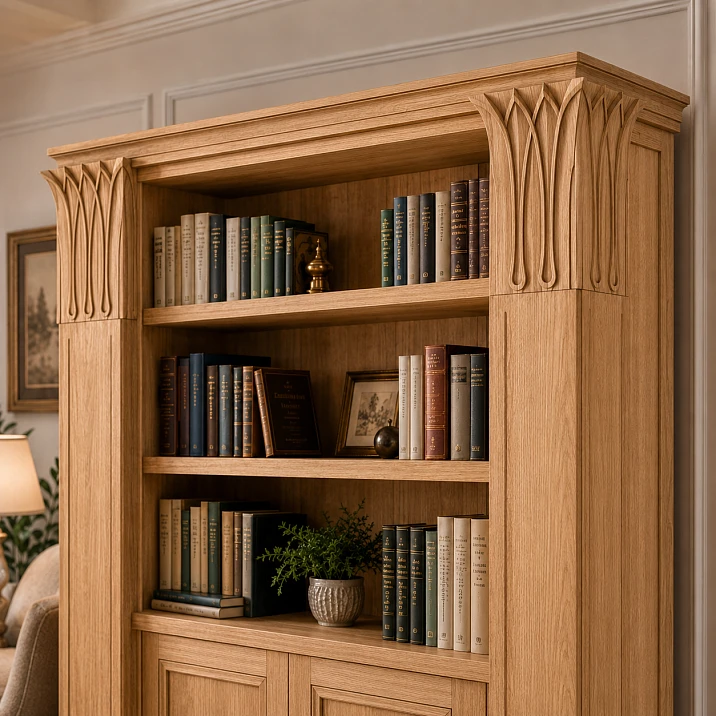
A bookcase can look convincing in a frontal sketch and unexpectedly unfinished in a room. This happens when its cornice ends with two outer corners, and the sides are visible from a door, sofa, or passage. On the facade, the carved accents are placed correctly, but when viewed from the side, the ornament breaks off. A practical question arises: is it enough to order two KL-007 pieces, or will four be needed to turn the pattern on both sides?
The answer cannot be obtained by simply multiplying the width of the bookcase. First, you need to determine which planes will be decorative, how the product is shown in the DWG drawing, where its back surface is, and whether two capitals can be visually joined at one corner. Only after that does it make sense to buy a wooden capital KL-007 in the selected size, material, and sanding quality.
This check is especially important for a finished cabinet. An error in one small carved detail affects the cornice, finish, symmetry, and budget. Two missing capitals will have to be re-ordered, and a new batch may require separate preparation and re-matching of the finish. Excess details also do not solve the problem if they cannot be neatly joined at the outer corner.
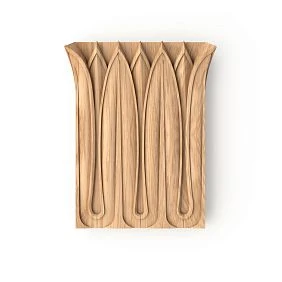
Wooden capital KL-007: what is actually confirmed by the product card
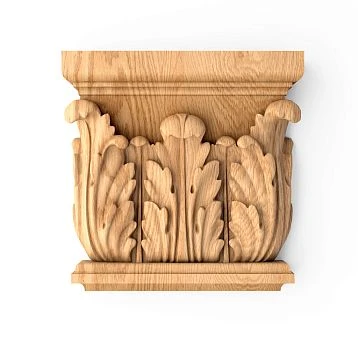
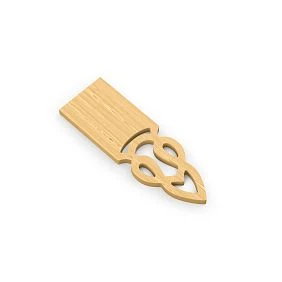
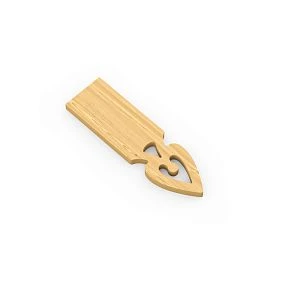
KL-007 is not an abstract "standard-size capital." The card offers five options A × B × C × F × G: from 74 × 60 × 13 × 9 × 52 to 173 × 140 × 30 × 20 × 121 mm. These letters refer to the product drawing. You cannot choose an option based only on the first number and consider the other parameters secondary. For a corner composition, not only the width along the facade matters, but also the depth of the relief, the seating part, the edge of the ornament, and the position of the detail relative to the cornice.
The material is beech or oak. For each, sanding "Standard" or "Prestige" is provided. As of the check date, the minimum configuration — beech 74 × 60 × 13 × 9 × 52 mm, "Standard," for enamel — cost 1,950 rubles. Other prices depend on size, wood type, and preparation. Most options in the card table are marked as made-to-order with an average lead time of 5–10 days.
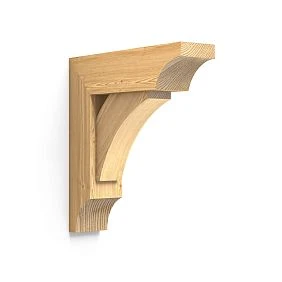
The page also has a DWG file. It is this, not the reduced photo, that should be used in design. The photo conveys the pattern but does not answer the main question of the outer corner: what surface the detail has on the back and what a person will see if they approach the cabinet from the side.
You can choose other shapes and sizes in the section Buy wooden capitals. The link leads to a category, not a substitute for the KL-007 card: a category query should help compare models, an article query should help order a specific item.




Carved capital on a cabinet: why the frontal sketch hides the corner problem
The facade layout shows the cabinet as a flat composition. The designer sees two verticals, a top cornice, and a pair of carved accents. In this image, two KL-007s look sufficient: one completes the left side, the other the right.
In the room, the viewer moves. If the cabinet stands between walls, the sides may be completely closed, and the frontal pair is indeed enough. If the body protrudes from a niche or stands separately, the outer end of the cornice becomes a visible part of the furniture. Then the composition has at least three significant angles: straight, left, and right.
The problem is not that the side panel is "empty." An empty plane can be intentional. The error occurs when the front ornament promises continuation but abruptly stops exactly at the edge. The break is especially noticeable on the wide upper belt and contrasting trim, when dark oak or gilded relief is visible from a distance.
Before ordering, an artistic decision must be made:
-
The decor works only on the front, while the side panels are deliberately calm.
-
The ornament turns onto each side panel as a separate piece.
-
The corner receives a special composition of a capital and another carved element.
-
Instead of piece-by-piece joining, an individual corner element is developed if there is a suitable production run and manufacturer approval.
Each option is acceptable. It is unacceptable to consider them interchangeable after the pieces have already been paid for and finished.
Our factory also produces:
Capital for furniture at 90°: can one KL-007 cover two planes
The name "capital" does not automatically mean the piece is corner-specific. The KL-007 card describes decorative use on furniture, columns, doors, and cornices, but does not state that one piece simultaneously covers the front and side. It contains no confirmation of a finished external 90° corner.
Therefore, the working rule is simple: one KL-007 counts as one front decorative piece until DWG and manufacturer consultation prove otherwise. You cannot mentally bend solid wood around a cabinet edge. You also cannot assume that the side surface of the relief is as decorative as the front.
If two full planes must be visible on each of the two corners, the preliminary specification contains four capitals: two for the facade and two for the sides. This is not yet a final order. It is necessary to check whether two separate parts can meet at the edge without overlap, gaps, or disruption of the pattern.
Sometimes it is more correct not to bring both parts all the way to the edge. An architectural pause is left between them — a smooth corner block, a panel, or a section of cornice. This solution allows preserving the intact edges of the carving. But the size of the pause is determined by the sketch and the actual contours of KL-007, not by a universal norm.
Get Consultation
External corner of a bookcase: three honest ordering schemes
Scheme 1. Two wooden capitals only on the facade
This is an economical and technically clear scheme. The left and right KL-007 form a frontal pair. The sides remain without carved continuation or receive a smooth cornice. The solution works well if the cabinet is built into a niche, stands close to walls, or is perceived primarily from the front.
Before purchase, the symmetry of the pattern is checked. The card does not divide KL-007 into left and right modifications, so one cannot arbitrarily declare two identical parts as mirror images. On the mockup, it is necessary to see whether repeating one pattern looks like a pair or whether a different composition is required.
Scheme 2. Four carved capitals for the facade and sides
Two parts work on each external corner. The first faces forward, the second faces the side. The scheme is suitable for a freestanding cabinet, a library island, a display case, or a body visible from several zones.
The main risk is the joint. Two front surfaces cannot simply be pushed together by their edges. The relief may protrude, and its ornament may have an unfinished line at the end. Before ordering four items, the craftsman must overlay the contours from DWG onto the corner plan and determine where each part ends.
Scheme 3. Two KL-007 plus a calm corner finish
The front gets a pair of capitals, and the turn is executed with a smooth corner element, molding, or another overlay. This approach is useful when the sides are visible, but repeating large carving overloads the furniture. Suitable parts are searched for in the section to buy carved wooden decor, then their compatibility in scale and thickness is checked.
This scheme should not turn into a random set of decorations. The capital, cornice, and side element must have matching visual axis, relief character, and finishing logic.
How to read the dimensions of a wooden capital without assigning invented meanings to letters
The card provides parameters A, B, C, F, and G. Without the drawing itself, one cannot confidently call A the overall width, B the height, or C the depth: letters only gain meaning in the manufacturer's scheme. An error occurs when a buyer transfers familiar notations to someone else's drawing.
The correct sequence is as follows:
-
download DWG KL-007;
-
open the file in a program that preserves scale;
-
find all five dimension lines on the diagram;
-
determine the front contour and the back plane;
-
measure the mounting field;
-
check the maximum relief protrusion;
-
apply the contour to the facade and side of the cabinet;
-
mark the doors, hinges, cornice, and ceiling;
-
only then select the row in the size table.
If the workshop does not work with DWG, you can request a print-ready drawing from the manager or export the file to PDF at 1:1 scale. The scale must be checked with a control dimension. Automatic page fitting by the printer will make the template useless.
Full-size mockup of the carved capital: check before payment
A paper template shows the outline but not the volume. For an external corner, it is better to make a two-step mockup. First, cut out the front contour from thick cardboard. Then add thickness using foam board or wooden slats. On the mockup, mark the back side and the edge of the relief.
Two identical mockups are applied to one corner: one to the facade, the other to the side. After that, the cabinet is inspected from the points where it will be seen daily. You need to answer specific questions:
-
do the decorative contours meet neatly;
-
does the side part cover the end of the facade part;
-
does a dark gap appear;
-
does the relief protrude into the passage;
-
does the decor interfere with opening the top door;
-
is access to the cornice fasteners maintained;
-
does the corner seem heavier than the central part of the cabinet.
The mockup does not confirm the installation technology, but it reveals a compositional error before purchase. For four capital parts, this is especially beneficial: the difference between schemes is measured in thousands of rubles and additional finishing work.
Wooden capital and cabinet doors: where the conflict arises
The top door can open flush against the cornice. A carved element located on the side panel can fall into the trajectory of the frame, handle, or protruding hinge. You need to check not the closed facade, but the full opening angle.
On the mockup, the door is opened to the design position and the minimum clearance is measured. If the furniture is not yet assembled, the trajectory is built according to the hinge technical data. The allowance is set by the designer taking into account facade adjustment, not by the author of SEO text.
The second risk zone is the ceiling. A tall cabinet is sometimes lifted assembled. A protruding capital can reduce the installation gap and hinder the rotation of the body. In such a project, the decor is installed after fixing the cabinet, or the assembly sequence is revised. The solution must be included in the installation map before delivery.
Carved capital or systematic completion of a pilaster
KL-007 can be considered as an independent furniture accent, but not every cabinet should be assembled from disparate elements. If the verticals are decorated with PLM pilasters, it is logical to check a specially related system. For example, you can compare the capital KL-014.02 for pilasters.
This does not mean that KL-014.02 is automatically better. It has a different pattern, dimensions, and purpose. The comparison is needed to answer the question: does the project require a free decorative accent KL-007 or the upper part of a specific vertical system.
A system capital can simplify coordination with a pilaster, but the outer corner is still checked separately. Compatibility by series does not turn a flat part into a corner one.
Capital made of beech for enamel or oak for tinting
The choice of wood species cannot be made separately from the entire furniture. Beech has a calmer structure and is often chosen for opaque enamel. Oak has a noticeable texture and is suitable for semi-transparent finishes when the wood grain should remain visible. The manufacturer's page explains the preparation options — before ordering, it is useful check the material and sanding quality.
For a corner composition, a single batch is important. Four parts are visible side by side and under different lighting angles. In oak, texture differences are more noticeable on the side plane; in painted beech, unevenly prepared edges and joints become more visible. The specification fixes the wood species, sanding quality, and preparation type for all KL-007 items at once.
"Standard" means machine sanding and may require additional finishing before the final coat. "Prestige" means detailed hand sanding; according to the card, the product does not require such refinement. But even a well-prepared capital needs to be coordinated with the painting technology of the entire cabinet. Primer, stain, enamel, and varnish are checked for compatibility with the wood and adhesive joint.
How much do two and four KL-007 capitals cost
The estimate is calculated based on the selected line in the card, not the "from" price. Below is the cost of only the products themselves as of 31.08.2026, excluding delivery, glue, finishing, and installation.
| Size A × B × C × F × G, mmMaterial, sanding1 pc., RUB2 pcs., RUB4 pcs., RUB | ||||
|---|---|---|---|---|
| 74 × 60 × 13 × 9 × 52 | Beech, Standard | 1 950 | 3 900 | 7 800 |
| 74 × 60 × 13 × 9 × 52 | Oak, Standard | 2 000 | 4 000 | 8 000 |
| 99 × 80 × 17 × 12 × 69 | Beech, Standard | 2 320 | 4 640 | 9 280 |
| 99 × 80 × 17 × 12 × 69 | Oak, Standard | 2 420 | 4 840 | 9 680 |
| 124 × 100 × 21 × 14 × 86 | Beech, Standard | 2 870 | 5 740 | 11 480 |
| 124 × 100 × 21 × 14 × 86 | Oak, Standard | 3 240 | 6 480 | 12 960 |
| 151 × 122 × 26 × 18 × 105 | Beech, Standard | 3 590 | 7 180 | 14 360 |
| 151 × 122 × 26 × 18 × 105 | Oak, Standard | 4 110 | 8 220 | 16 440 |
| 173 × 140 × 30 × 20 × 121 | Beech, Standard | 4 110 | 8 220 | 16 440 |
| 173 × 140 × 30 × 20 × 121 | Oak, Standard | 5 140 | 10 280 | 20 560 |
For "Prestige", the calculation is done separately based on the current price of the required line. For example, for the minimum size, beech "Prestige" cost 2,770 rubles: a pair — 5,540, four pieces — 11,080 rubles. Oak of the same size in "Prestige" cost 2,870 rubles: a pair — 5,740, four — 11,480 rubles.
The table shows the commercial price of the solution: transitioning from a frontal pair to finishing four planes almost doubles the cost of the capitals themselves. But saving by ordering two pieces before approving the angle is risky. Repeated delivery and repeated finishing may cost more than a timely design check.
Order capitals in one batch or first buy one
One test KL-007 is useful as a physical sample. It allows you to see the real depth of the relief, attach the piece to the corner, and check the finish. The card allows shipment from one piece. This approach is reasonable if the project is still changing and the cost of an error is high.
After approving the scheme, visible parts should preferably be ordered as an approved batch. This simplifies material selection and surface preparation. If the first test capital is to be included in the final set, it must be stored under proper conditions and not covered with a finish until the overall technology is approved.
For a complex cabinet, you can order a design project for furniture decor. The manufacturer asks to attach a drawing or photo of the object with dimensions, a reference, and desired article numbers. In the request, you should directly write: "two external corners, the facade and both sides are visible; it is required to check the KL-007 composition at a 90° turn."
Installation of a wooden capital on the facade and side
The card suggests mounting adhesive as a related product and contains general recommendations for gluing decor. However, the choice of adhesive depends on the base, finish coating, weight, and area of the back surface. Painted furniture board, solid wood, veneer, and primed cornice are different bases.
Before starting work, you need to study the tips for finishing and installing carved decor and coordinate the technology with the adhesive manufacturer. A test is performed on a technological sample. The adhesive should not dissolve the finish, seep through the edges, or interfere with subsequent coating.
On the external corner, the sequence is especially important:
-
Mark the axes of the facade parts.
-
Install dry mock-ups without adhesive.
-
Check the joint with the side parts.
-
Secure control marks with painter's tape.
-
Prepare surfaces according to the technological card.
-
Assemble the parts in a sequence that allows control of the edge.
-
Do not load the decor and do not use it as a handle when moving the cabinet.
KL-007 is a decorative item. It does not replace the corner joint of the body and should not hold the cornice. First, the furniture receives its own rigid structure, then the carved decor is installed.
When it is reasonable to buy the wooden capital KL-007
KL-007 suits the project if its pattern supports the style of the cabinet, the chosen size is confirmed by DWG, all visible angles are checked with a mockup, and the quantity is determined after decisions on the side panels. The base material, finishing technology, and assembly sequence must also be known.
A good scenario looks like this: a freestanding bookcase has two outer corners; the designer builds a front pair and a calm continuation on the side panels; the carpenter checks the contours; the client compares quotes for two and four pieces; all participants approve one sketch and specification.
When it is too early to buy the carved capital KL-007
The order is premature if the decision is made only from a photo, letters A–G are interpreted without a drawing, the side panels of the cabinet are not shown in the layout, the trajectory of the doors is unknown, or it is assumed to trim the finished carving "on site." It is also worth stopping when one KL-007 is mistakenly considered a ready-made corner element.
Do not buy four pieces "just in case." Excessive repetition can make the corners visually heavy. First, compare three schemes: only the facade, the facade plus side panels, and the facade plus a calm corner finish.
Mistakes when ordering wooden capitals for a cabinet
-
Look only at the frontal image of the cabinet.
-
Count the side edge KL-007 as a second decorative side without confirmation.
-
Order two pieces without deciding the fate of the side panels.
-
Order four pieces without checking the joint on the edge.
-
Call the first dimension the width without opening the DWG.
-
Scale the printout automatically.
-
Trim the relief before agreeing with the manufacturer.
-
Mix beech and oak in one visible composition.
-
Buy "Standard" and "Prestige" for adjacent parts without a technological reason.
-
Paint the test part separately from the main batch without a control color sample.
-
Glue the capital onto an unstable or dirty surface.
-
Use decor as a structural attachment for the cornice.
-
Do not check the opening of the upper doors.
-
Forget about the installation gap to the ceiling.
-
Consider the price "from" as the cost of the selected set.
-
Order a repeat batch without verifying the current configuration.
How to place an order for KL-007 without unnecessary details
In the request, it is not enough to write "need four capitals." The supplier and the joinery workshop receive a single package:
-
article KL-007;
-
exact variant A × B × C × F × G;
-
material — beech or oak;
-
sanding quality — "Standard" or "Prestige";
-
preparation for enamel or translucent finish;
-
quantity;
-
marking of each position on the facade and side panels;
-
plan of the external 90° corner;
-
unfolded view of the front and two side panels;
-
photo or visualization of the wardrobe in the room;
-
marks for doors, hinges, cornice, and ceiling;
-
solution for the joint or smooth corner gap;
-
finishing and installation technology;
-
need for a physical sample.
Before payment, you need to check payment and delivery of wooden capitals, current price, availability, and production time. The card indicates that the data is updated, so the figures in the article serve as a control calculation as of 31.08.2026, not as a perpetual offer.
Result: two or four capitals for two external corners
Two KL-007 units are sufficient if the capitals work only on the facade and the sides are intentionally left plain. Four become a working hypothesis if each external corner requires a separate front and side decorative plane. But four items can only be ordered after checking the DWG and the joint: the quantity does not guarantee the correct rotation of the pattern.
The most reliable path is to start not with the cart, but with a corner plan. Download the drawing, make two 3D mockups, open the doors, inspect the cabinet from the room, and compare three compositions. After that, choose the size, material, finish, and exact quantity. Then the wooden capital will truly complete the furniture, rather than create an expensive problem on its most visible edge.
Frequently asked questions about the wooden capital KL-007
What sizes are available for KL-007?
The card contains five variants A × B × C × F × G: 74 × 60 × 13 × 9 × 52; 99 × 80 × 17 × 12 × 69; 124 × 100 × 21 × 14 × 86; 151 × 122 × 26 × 18 × 105; 173 × 140 × 30 × 20 × 121 mm. The meaning of each letter is verified against the DWG.
What wood is the carved capital made from?
Beech and oak are specified for KL-007. The wood species is chosen together with the type of finish coating for the entire furniture.
Can one KL-007 be used to decorate a 90° external corner?
The card does not confirm a ready-made corner configuration. The possibility of a specific installation is checked against the drawing and agreed upon before ordering.
How many capitals are needed for two corners of the cabinet?
For the facade pair — two. For separate decor on the facade and two side panels, four are preliminarily counted, but the final quantity is confirmed after checking the joints.
Can the capital be cut at a miter?
Planning the cutting of a carved product independently is not allowed. The manufacturer does not provide cutting-to-size services; the admissibility of processing and preservation of the pattern must be agreed with a specialist in advance.
What does "Standard" sanding mean?
On the website, it is described as machine sanding with a more affordable price. Before finishing, the product may require touch-up.
What does "Prestige" sanding mean?
This is detailed hand sanding; according to the manufacturer's information, such products do not require additional surface refinement.
What to choose for white enamel — beech or oak?
For opaque enamel, beech and preparation "under enamel" are often chosen. The final choice depends on the workshop's technology and project requirements.
Is oak suitable for tinting?
Oak is chosen when it is necessary to preserve the noticeable wood texture under a semi-transparent coating. All adjacent parts are coordinated by batch and color sample.
Is KL-007 a load-bearing part of the cornice?
There is no confirmation of such a purpose. In the project, it should be considered a decorative element; the cornice and the body must have their own structural fastening.
Can I order one capital first?
Yes, the card indicates shipment from one piece. One part can serve as a physical sample for the mock-up and trial finishing.
How can I check that the decor won't interfere with the door?
You need to model the full opening angle of the upper facade and place a 3D mock-up of KL-007 in the design position.
Why can't I choose a variant based only on a photo?
The photo does not show the exact fit, the rear plane, the maximum relief depth, and the nature of the joint between two parts at the corner.
What should I attach to the design project request?
A drawing of the cabinet with dimensions, unfolded views of the facade and side panels, a photo of the room, the desired article KL-007, and a note that both outer sides are visible.
Where can I check the current price of KL-007?
In the canonical product card. The price depends on the size, wood species, and quality of polishing and may change after the article's publication date.
When is it better to avoid four capitals?
If the joint disrupts the pattern, the relief interferes with doors or passage, and the side panels become overloaded. Then it is wiser to keep the front pair and create a calm side finish.