Article Contents:
- Confirmed specifications of KL-003.01
- Size range of KL-003.01
- How to read dimensions A, B, C, F and G
- What is the Corinthian capital KL-003.01
- Why the Corinthian character is important when choosing
- Why KL-003.01 cannot be chosen only by photo
- How to make a cardboard mock-up of the capital
- How to check the lower seating part
- Should the capital be wider than the pilaster
- What to do if the capital is wider than the finished post
- How to measure a pilaster before ordering
- How to measure a decorative column
- Can KL-003.01 be placed on a round column
- KL-003.01 above a wooden pilaster
- KL-003.01 for a door portal
- How to calculate a pair for a doorway
- Distance from the capital to the ceiling
- How to connect the capital to the upper frieze
- How to connect a capital to a casing
- How to check full door opening
- KL-003.01 for double door
- KL-003.01 for built-in door
- KL-003.01 for bookcase
- Capital for furniture portal
- Capital for built-in library
- Capital for kitchen pilaster
- Capital for sideboard and display case
- Capital for TV portal
- Capital for decorative niche
- One capital or a symmetrical pair
- How to check the symmetry of a pair
- Is a base needed for the pilaster
- How to choose a base
- Can KL-003.01 be combined with another collection
- How to combine volutes with other details
- How to combine plant ornament with moldings
- When active carving is appropriate
- When it's better to choose a calmer model
- Beech for enamel
- Oak for tinting
- "Standard" or "Prestige"
- Why grinding quality is especially important for threads
- White enamel for KL-003.01
- Ivory capital
- Dark capital for the cabinet
- Patina on the plant ornament
- Gilding and golden accents
- How not to flood small elements with paint
- Test swatch
- Paint the capital before or after installation
- How to protect the thread during finishing
- Installation on a wooden pilaster
- Installation above a doorway
- Installation on a furniture body
- Can it be attached only with glue
- How to hide the installation seam
- How to mark the central axis
- How to install two capitals symmetrically
- Is a mounting plate needed
- How to check the horizon of the top part
- Can the capital be dismantled
- How to pack a capital with volutes
- How to check the delivery route
- How to accept the product
- How to store before installation
- Error: choose size by overall width
- Error: consider F and G as decorative details
- Error: consider the model as beech only
- Error: consider beech as already primed
- Error: consider oak as ready stained
- Error: buy one capital for a symmetrical portal
- Error: automatically order two
- Error: consider pilaster and base as a set
- Error: consider capital as load-bearing
- Error: use on facade without approval
- Error: fasten through volutes
- Error: not checking side view
- Error: mixing different sizes in a pair
- Error: not considering ceiling cornice
- Error: overloading portal with ornament
- Who KL-003.01 suits
- Who KL-003.01 may not suit
- Where to use KL-003.01: scenario comparison
- How to choose between KL-003.01 and KL-014.02
- How not to confuse a capital with an overlay
- How not to confuse a wall-mounted and full-volume model
- How not to confuse size and fit
- What to check before painting a pair
- What to check before installing a pair
- How to order one capital
- How to order a symmetrical pair
- How to buy KL-003.01 on STAVROS
- What to check on the card before payment
- When a manager is needed
- When a design project is needed
- Why a finished capital is better than manual improvisation
- What not to do from scratch
- How to save project data
- How to choose size without a ready-made pilaster
- How to choose size for a ready-made pilaster
- How to account for portal depth
- How to account for installation seam in finishing
- How to match color to the door leaf
- How to match color to the built-in wardrobe
- How to match color to the wall
- How to check the capital under evening light
- How to use KL-003.01 in neoclassical style
- How to use in a palace interior
- How to use in modern eclecticism
- How to calculate the kit budget
- How to calculate project timelines
- How to check completeness upon delivery
- Final check before ordering
- What to buy together with KL-003.01
- How to check the capital on an already painted wall
- How to choose a capital for one side of the portal
- How to check the pair under different lighting
- How to choose a capital for a tall cabinet
- How to choose a capital for a small sideboard
- How to match the capital with handles and hardware
- How to determine the main decorative element
- How to check the finish on the side edges
- How to accept a symmetrical pair before painting
- Why the project is more important than the individual price
- How to check the capital next to the mirror
- How to check the view from below
- How to choose a capital for a series of openings
- Why you cannot trim the thread on site
- How to check the color match of the pilaster
- How to choose between buying a single part and a full set
- Control sample before purchase
- FAQ: questions about capital KL-003.01
- What material is KL-003.01 made of?
- Why is the capital classified as Corinthian style?
- What are the dimensions of KL-003.01?
- What do F and G mean?
- Where can I see the drawing?
- Is KL-003.01 suitable for a pilaster?
- Can the capital be installed on a round column?
- Will it fit a door portal?
- Can KL-003.01 be used on furniture?
- Do I need one capital or two?
- Is the pilaster included in the set?
- How to choose the lower base?
- Can I order the beech KL-003.01 in white enamel?
- Can I choose oak?
- Which is better — "Standard" or "Prestige"?
- Can patina be used?
- Is gilding allowed?
- How to paint the floral ornament?
- How to attach the capital above the door?
- Can it be attached only with glue?
- Is the capital a load-bearing part?
- Can it be used on the facade of a house?
- How to check the product upon receipt?
- What is the production time?
- Where to buy KL-003.01?
- What to check before payment?
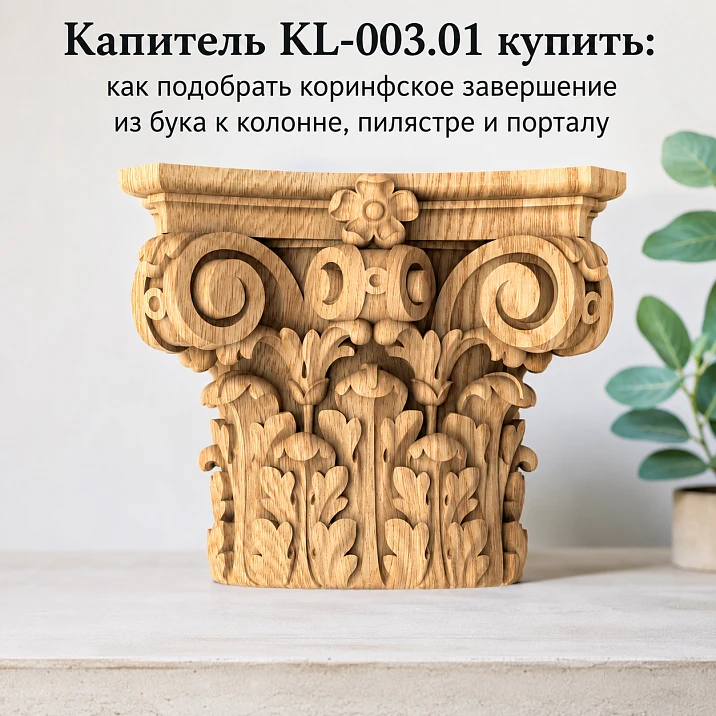
It is worth buying the KL-003.01 capital for a project where the upper part of a column, pilaster, door or furniture portal should become a noticeable architectural completion. The plant ornament and volutes create a Corinthian character, but the external pattern is only half the choice. Before ordering, you need to compare the height, width, depth, lower seating part, visibility of side edges, and distance to the ceiling.
Buy capital KL-003.01 currently available in seven size versions. The card specifies dimensions in the format A × B × C × F × G: from 114 × 140 × 48 × 22 × 76 mm to 276 × 340 × 117 × 54 × 184 mm. Beech and oak are available, with sanding "Standard" or "Prestige", beech for enamel and oak for tinting. The main scenario of this article is a Corinthian capital made of beech for opaque finishing, but the current oak configuration should also be considered when choosing.
The name "capital for a column" does not imply compatibility with any round, square, or wall-mounted vertical. For KL-003.01, you need to open the drawing, understand the purpose of dimensions F and G, check the shape of the back surface, and match the fit with a specific pilaster. If the element is installed on the sides of a door opening, a symmetrical pair is usually considered, but the exact quantity is determined by the project.
A ready-made carved capital eliminates the need for manual cutting of complex ornamentation, but does not replace the composition calculation. The buyer still needs to select a pilaster or column, base, architraves, upper frieze, finishing, and installation scheme. With this approach, KL-003.01 becomes part of a complete architecture, not a random overlay above a vertical strip.
Short answer. KL-003.01 is suitable for a classic door portal, furniture pilaster, built-in library, and decorative column, if the seating part and depth are confirmed by the drawing. For a portal, a pair of identical elements is usually needed; for a single furniture vertical, one capital may be used.
Beech is chosen for enamel, oak for tinting with visible texture. Before purchasing, make a cardboard mockup of the selected size, check the protrusion on the sides, distance to the ceiling, and mounting base.
Buy capital KL-003.01 View all wooden capitals Select a wooden pilaster See portal solutions Order composition calculation
Confirmed characteristics KL-003.01
| Parameter | Confirmed data | What to check before ordering |
|---|---|---|
| Article number | KL-003.01 | Full SKU and selected size |
| Type | Carved wooden capital | Scenario: pilaster, portal, furniture or decorative column |
| Stylistics | Corinthian style, floral ornament and volutes | Compatibility with other decor |
| Size range | 7 options A × B × C × F × G | All dimensions as per drawing |
| Material | Beech or oak | Beech under enamel, oak under tinting |
| Sanding | "Standard" or "Prestige" | Required amount of manual preparation |
| Regluing quality | Beech — for enamel; oak — for tinting | Finish coating is not automatically included |
| Production time | Average lead time 5–10 days | Additional time for finishing, delivery, and installation |
| Completeness | One capital as a separate item | Pilaster, base, frieze, and fasteners are ordered separately |
| Load-bearing function | Not confirmed | Use as a decorative, not structural element |
| External use | Not confirmed for standard configuration | Do not promise facade use without special approval |




Size range KL-003.01
| Option | A × B × C × F × G, mm | Preliminary scale | What to check |
|---|---|---|---|
| 1 | 114 × 140 × 48 × 22 × 76 | Compact furniture or small portal vertical | Seating area and ornament readability |
| 2 | 130 × 160 × 55 × 25 × 86 | Small pilaster or cabinet | Vertical width and side projection |
| 3 | 146 × 180 × 62 × 29 × 97 | Medium furniture composition | Distance to cornice and frieze |
| 4 | 162 × 200 × 69 × 32 × 108 | Expressive pilaster or door portal | Symmetry of the pair and depth |
| 5 | 195 × 240 × 83 × 38 × 130 | Large portal, library, hall | Free field and upper frieze |
| 6 | 227 × 280 × 97 × 44 × 151 | Large interior vertical | Room scale and mounting support |
| 7 | 276 × 340 × 117 × 54 × 184 | Monumental portal or architectural composition | Ceiling, weight, delivery route and fastening |
Our factory also produces:
How to read dimensions A, B, C, F and G
The card provides five dimensions, but the letter designation must be read together with the DWG. In the SEO scheme, A is used as height, B as width, C as depth. Dimensions F and G refer to the additional geometry of the product, but their function cannot be guessed from the table.
Before designing, download the drawing and mark on it the lower seating part, the maximum protrusion, and the back plane. These parameters show whether the capital will align with the pilaster and whether the carving will extend beyond the portal.
Get Consultation
What is the Corinthian capital KL-003.01
KL-003.01 is a carved top of a vertical element. Plant leaves and volutes create a richer silhouette than a laconic geometric model. Therefore, the capital immediately becomes a noticeable part of the portal, cabinet, or interior column.
The buyer chooses not a separate ornament, but the top point of the architectural system. Below should be a pilaster or column, at the bottom a base, and nearby architraves, a frieze, or furniture facades. If these parts are not connected in scale, even high-quality carving looks random.
Why the Corinthian character is important when choosing
Corinthian style implies developed plant plasticity and expressive curls. It is best revealed in a classic, palatial, and rich neoclassical interior, where there are cornices, panels, carved frames, or furniture architecture nearby.
In a minimalist room, an active ornament may be too heavy. Then the capital is used as a single accent on a calm vertical, or a more restrained model from the category is chosen.
Why KL-003.01 cannot be chosen only by photo
The card shows the design but does not convey the real scale. A version 140 mm wide and a model 340 mm wide may look almost the same on the screen, although in the interior they solve completely different tasks.
The photo also does not show the depth of 48–117 mm and the side protrusion. A large capital may approach the ceiling cornice, interfere with the door leaf, or extend beyond the furniture portal.
How to make a cardboard model of a capital
Transfer dimensions A, B, and C onto cardboard. For the first check, a front rectangle is sufficient, but it is more accurate to make a three-dimensional box showing the depth.
The model is attached above the pilaster or to the wall with masking tape and viewed from a distance. For a paired portal, two identical templates are needed: only then can you see whether the upper terminations become too massive.
How to check the lower seating part
The lower part of the capital must rest on the vertical without accidental displacement. If it is noticeably wider than the pilaster, the projection must be symmetrical and provided for by the design.
Dimensions F and G may relate to the internal or seating geometry, so they are checked against the DWG. The width of the pilaster cannot be determined solely by the overall width B.
Should the capital be wider than the pilaster
A small symmetrical projection often forms the classical logic of transition from the shaft to the upper termination. But the size of the projection depends on the specific model and vertical.
An element that is too wide looks heavy, covers the adjacent casing, and requires a greater portal depth. One that is too narrow does not complete the vertical and is perceived as a random overlay.
What to do if the capital is wider than the finished post
First, check if such a protrusion is provided for in the drawing. Sometimes a transition platform, an additional top rail, or another pilaster is needed.
You should not simply center the part and fill the gaps with putty. A misalignment in fit is a structural issue that must be resolved before painting and installation.
How to measure a pilaster before ordering
Record the overall width, depth, and height of the vertical, as well as the dimensions of the top platform. If the pilaster is already installed, measure it at several points.
Separately note the thickness of moldings, panels, and overlays. They can reduce the actual surface on which the capital should rest.
How to measure a decorative column
For a square or rectangular column, measure the sides of the top cross-section. For a round one, measure the diameter and the shape of the transition joint.
Without confirmation of the back and bottom geometry of KL-003.01, compatibility with a round column cannot be guaranteed. The model may be designed for a wall-mounted or flat vertical surface.
Can KL-003.01 be installed on a round column
Such use is only permissible after checking the DWG and fabricating a transition element if necessary. A frontal photograph does not show whether the bottom part follows the radius.
If the capital has a flat back surface, on a freestanding column it may look unfinished from the sides and back. In that case, it is better to choose a full-volume model.
KL-003.01 above a wooden pilaster
A pilaster is the most straightforward scenario for a front-facing carved capital. The vertical element adjoins the wall, so the back surface is not visible.
Before selecting, you can Buy a wooden pilaster and compare its top cross-section with the chosen size of KL-003.01.
It is advisable to provide a base at the bottom so that the vertical element has a finish on both sides and does not look like a single decorative strip.
KL-003.01 for a door portal
In a classic portal, two capitals usually complete the side verticals. They support the upper frieze and connect the architraves with the architectural frame.
The quantity cannot be assigned automatically: an asymmetrical portal, a single side pilaster, or a complex niche may require a different solution. The project must show every detail.
How to calculate a pair for a door opening
Measure the width of the opening, architraves, and side pilasters. Then mark the maximum projection of the two capitals and the distance to adjacent walls.
If the capitals approach each other above a narrow opening, the upper frieze may lose its free field. In a wide portal, conversely, a pair that is too small looks weak.
Distance from the capital to the ceiling
A visual pause should remain between the top of the carving and the ceiling cornice. There is no universal value: it depends on the height of the model and the entire composition.
A cardboard mock-up shows whether the capital looks pressed. For variants with a height of 227 or 276 mm, this check is especially important.
How to connect the capital with the upper frieze
The frieze can be located between a pair of capitals or above them. Its height should support the scale of the carving, not overlap the volutes.
If the top rail is too narrow, a large KL-003.01 looks heavy. An overly developed frieze together with an active capital can overload the portal.
How to connect the capital with the architrave
The architrave is usually narrower and calmer than the capital. It leads the line along the opening, and the capital completes it from above.
Compare thickness, material, and finish. If the trim has its own large ornament, plant motifs may compete.
How to check full door opening
The depth of the capital and side volutes should not fall into the path of the door leaf, trim, or door closer.
Open the door to the maximum angle with the installed cardboard mockup. The error is especially likely if the portal is located close to a perpendicular wall.
KL-003.01 for double door
A wide opening better accommodates a large capital, but the choice still depends on the height and width of the side verticals.
The pair must be strictly symmetrical relative to the center of the doors. A difference in height or offset will be noticeable on a large facade.
KL-003.01 for built-in door
If the door is built into a furniture or wall system, the capital is connected to the panels and the upper cornice.
In this section you can view carved door design and evaluate how the top elements work in the full portal.
Installation must account for concealed hinges, ventilation, and technical gaps.
KL-003.01 for a bookcase
A built-in library often has side pilasters that can be finished with a pair of capitals. The Corinthian ornament suits a study and a classic living room.
The size is chosen based on the width of the uprights and the height of the top cornice. A small model gets lost on a tall cabinet, while a large one overlaps the facades.
Capital for a furniture portal
A furniture portal can frame a cabinet, display case, sideboard, or niche. KL-003.01 works as a decorative top of the vertical and does not bear the load of the body.
Fastening is done to a calculated panel or upright. Do not use thin carving as a point for a self-tapping screw.
Capital for a built-in library
In a library, an active plant ornament supports carved cornices, panels, and oak or beech furniture.
A pair of capitals should be fully visible and not obscured by books, lamps, or the top shelf.
Capital for kitchen pilaster
In the classic kitchen KL-003.01, it can complete the side vertical of a cabinet or a decorative portal.
You need to check the height to the ceiling, adjacent doors, and the hood. The finish must be compatible with kitchen conditions, but the specific coating durability is determined by the chosen system.
Capital for buffet and display cabinet
On freestanding furniture, the capital should match the overall width and height of the piece. A large element can make a compact buffet visually heavy.
It is especially important to check the side view: furniture is not always placed flush against the wall, and the back shape of the capital may be visible.
Capital for a TV portal
Carved verticals can frame the TV area, but active decor should not distract from the screen.
KL-003.01 is best used at a sufficient distance from the display and linked to the upper cornice. Cables, ventilation, and equipment maintenance remain accessible.
Capital for decorative niche
In a niche, one or two capitals can complete the vertical sides and highlight the central object.
The depth of the carving should not eat up usable space or block the backlight. The layout is checked inside the finished niche geometry.
One capital or a symmetrical pair
One piece suits a single furniture stand, an asymmetrical composition, or a central decorative vertical.
A pair is needed for two identical sides of a portal, cabinet, or library. Both items are ordered in the same size, material, sanding, and finish.
How to check the symmetry of a pair
Mark a common horizontal line and two vertical axes. The capitals should be at the same height and have equal offsets from the opening.
Before final fixation, take a frontal photo. The camera quickly shows a misalignment that the eye might not notice up close.
Is a base for the pilaster needed
The base completes the vertical from below and helps balance the developed capital above.
The exact compatibility of the base, pilaster, and KL-003.01 is not set automatically. Each element is checked for width, depth, and style.
How to choose a base
The width of the base can be close to the capital or slightly smaller, but both parts must work as a single architectural system.
A base that is too small makes the top heavy, while one that is too large draws attention downward. A full-size layout helps compare proportions.
Can KL-003.01 be combined with another collection
Mixing is acceptable if the material, carving character, or finish are repeated. Corinthian leaves can be supported by a plant overlay or cornice.
However, a random combination of several historical motifs creates visual noise. One element should be dominant.
How to combine volutes with other details
The curl can be repeated in a furniture leg, bracket, handle, or upper frieze. The repetition should not be literal.
A general direction of the lines and the same depth of finish are sufficient. If each element has large volutes, the portal looks overloaded.
How to combine floral ornament with moldings
It is better to choose calmer moldings so that they create a frame rather than compete with the leaves.
A thin line connects the capital to the door or furniture facade and leaves the carving as the main accent.
When active carving is appropriate
KL-003.01 unfolds in a study, library, hall, classic living room, formal entrance hall, and representative commercial interior.
The room must have sufficient scale, and there should be free space around the capital. The larger the size, the more important the viewing distance.
When it is better to choose a calmer model
In a small room, narrow portal, or modern furniture, the Corinthian ornament may be excessive.
You can buy a symmetrical capital for a pilaster either buy an extended capital for the portal and compare the geometry.
The comparison is made based on actual dimensions, not just the style of the photo.
Beech under enamel
Beech has a dense and relatively calm texture, so it is well suited for opaque finishes. In the card KL-003.01, the beech version is marked as prepared for enamel.
This does not mean that the product is already primed or painted. The primer, enamel, color, and gloss level are selected separately.
Oak under tinting
The current card also offers oak for tinting. This option is needed when the natural texture should remain visible.
The oak capital looks more substantial and may better match a library, doors, or furniture made of oak. The tint is tested on a sample.
'Standard' or 'Prestige'
"Standard" means machine sanding and may require additional manual finishing of complex ornamentation before the final coat.
"Prestige" includes more detailed manual sanding. For a capital with leaves and volutes, this reduces the amount of preparation but does not replace inspection before painting.
Why sanding quality is especially important for carving
On a flat surface, a small scratch is easily removed, but in a deep sheet or curl, access is limited.
After applying enamel, the defect becomes more noticeable due to glare and shadow. Therefore, the surface is checked under side lighting before priming.
White enamel for KL-003.01
White finish emphasizes the Corinthian silhouette and suits a classic portal, library, or kitchen.
The shade must match the pilaster and adjacent details. Even two white colors can differ in warmth and gloss level.
Ivory capital
Warm light enamel softens active carving and pairs well with patina.
The specific shade is not automatically included in the card. It is approved based on a test swatch together with the pilaster.
Dark capital for the study
Black, graphite, or dark brown enamel makes the relief more graphic and suits a study or library.
In a small room, a dark large capital looks heavier, so a scale model is especially important.
Patina on the plant ornament
Patina emphasizes the recesses and makes the leaves more expressive. On a too small size, an intense effect can look dirty.
The patina recipe is tested on a sample. It is better to finish the capital, pilaster, and base in one workshop.
Gilding and golden accents
A golden finish can highlight leaves, volutes, or individual protrusions, but is not standard equipment.
Such an effect should be supported by hardware, frames, or cornices. Random gilding of one detail often looks alien.
How not to flood small elements with paint
Too thick primer and enamel smooth out the carving and fill the recesses.
The coating is applied in thin, even layers with interlayer drying. After each layer, the leaves and inner lines are checked.
Test swatch
The sample is made from the same material and with a similar carving depth. A flat board does not show how patina or enamel behave in recesses.
The color sample is examined next to the pilaster, door, furniture, and room lighting.
Paint the capital before or after installation
It is more convenient to apply the main finish before installation: side edges, the lower part, and deep carving areas are accessible.
After installation, the joint and attachment points are touched up. Painting the entire product above the door is more difficult and riskier for adjacent surfaces.
How to protect the carving during finishing
The capital is placed on a soft, stable support, and thin leaves are not pressed down.
Tools and cans are not placed on the front side. The product is turned over by sturdy areas, not by volutes.
Installation on a wooden pilaster
The capital must rest on a flat top surface. Before installation, check the center, protrusions, and absence of wobbling.
The adhesive can be part of the connection, but mechanical fixation and its placement depend on size, weight, and design.
Installation above a doorway
The base must be connected to the wall or portal, not just to a thin trim.
For a large pair, embedded anchors or rigid mounting plates are provided in advance. The specific fasteners are chosen by a specialist.
Installation on a furniture body
The capital is attached to the post, top panel, or a special platform designed for its depth.
Screws must not protrude to the front side or enter thin areas. The furniture panel must support the selected assembly.
Can it be mounted only with adhesive
The universal recommendation of "adhesive only" is unsafe. A small capital on a sturdy wooden platform and a large model above a door require different solutions.
The composition, contact area, and mechanical support are determined by the design.
How to hide the installation seam
The seam between the capital and the pilaster should be minimal due to precise geometry.
A small technological gap is filled with a compatible material after fixing. A large gap cannot be masked with a thick layer of putty.
How to mark the central axis
On the pilaster, mark a vertical line, and on the capital, mark the center of the lower seating part.
For a pair, additionally draw a common horizontal line. Measuring from the ceiling without a level may result in different heights.
How to install two capitals symmetrically
First, temporarily secure both mock-ups, then the actual parts. Check the distance from the opening, height, and side projection.
Final fastening begins only after a frontal check of the entire composition.
Is an anchor needed
An anchor is useful for a large element or installation on a hollow wall. Its necessity depends on the base and weight.
If the wall finish is complete, the possibility of secure fastening should be assessed before purchasing the largest model.
How to check the horizon of the top part
The top platform of the capital must support the frieze or cornice and look level.
Even a slight slope is noticeable near the doorway. Check with a level before fixing and after tightening the fasteners.
Can the capital be dismantled
A hidden mechanical scheme may allow the element to be removed for repair or repainting.
A fully adhesive connection complicates dismantling and may damage the pilaster. This issue is resolved at the design stage.
How to pack a capital with volutes
The carved element is protected with soft pads and a rigid base. Thin protrusions should not touch the walls of the box.
When receiving, the packaging is opened without a deep knife to avoid damaging the wood.
How to check the delivery route
For large sizes, you need to measure doors, stair turns, elevator, and the path to the installation site.
A capital with a width of 340 mm does not seem large compared to furniture, but the packaging increases the dimensions.
How to accept the product
Check the article number, five dimensions, material, sanding, and preparation. Inspect the leaves, volutes, corners, and the seating part.
Inspection is performed before priming, drilling, and installation. After modifying the product, claims are harder to prove.
How to store before installation
Store the capital in a dry room on a soft, flat support. Do not place it on thin threads or press it with heavy objects.
Protect beech and oak from sharp humidity changes before finishing.
Mistake: choosing size by overall width
Width B does not show the seating part and depth. The capital may formally fit but not rest on the vertical.
Use the full set A × B × C × F × G and DWG.
Error: consider F and G as decorative details
Additional dimensions may define important internal or seating areas.
They cannot be ignored when designing the pilaster, transition platform, and mounting.
Error: consider the model only as beech
The article topic focuses on beech, but the current card also offers oak.
If the project requires a transparent finish, the oak configuration may be more suitable.
Error: consider beech already prepared with primer
The designation "for enamel" refers to the quality of lamination, not to the finished primer.
Before painting, the product is dusted, primed, and finished according to the selected technology.
Error: assuming the oak is ready tinted
"Under tinting" means selecting slats by color and texture, but not a finished coating.
The shade, varnish, and patina are ordered or done separately.
Error: buying one capital for a symmetrical portal
Two side pilasters usually require two identical finishes.
Before ordering, check the project composition, because one detail will not create symmetry.
Error: automatically ordering two
Not every project is symmetrical. A single furniture post or niche may require one capital.
The quantity is determined by the drawing, not by a general rule.
Error: considering the pilaster and base as a set
Card KL-003.01 describes a single capital.
Pilaster, base, frieze, fasteners, and finish are included in the specification as separate lines.
Error: consider the capital load-bearing
The carved element completes the architecture but should not bear the load of the ceiling, furniture, or door structure.
Load-bearing work is performed by the frame, post, and wall.
Error: use on facade without approval
The standard card does not confirm outdoor use of KL-003.01.
Rain, sun, and temperature changes require different gluing, coating, and installation scheme.
Error: fasten through volutes
Thin decorative parts are not intended for structural fastening.
The fixation is placed in durable hidden areas confirmed by the project.
Error: not checking side view
On furniture and a freestanding column, the capital is visible not only from the front.
If the back surface is flat or the ornament is designed for frontal viewing, this will affect the choice.
Error: mixing different sizes in a pair
Even close options of 140 and 160 mm will result in noticeable asymmetry.
The pair must match in full size, material, and finish.
Error: not considering the ceiling cornice
The capital may intersect with the cornice or leave too small a gap.
The wall layout must include both details before ordering.
Error: overloading the portal with ornament
The Corinthian capital already contains leaves and volutes. A large carved architrave and a rich frieze can compete.
It's better to leave one main motif and support it with calm lines.
Who KL-003.01 is suitable for
The model is suitable for a classic portal, library, built-in wardrobe, study, hall, and formal living room.
The buyer should be ready to check dimensions and assemble the capital with the pilaster, base, and frieze.
Who KL-003.01 may not suit
In a small minimalist interior, active carving may be excessive.
The model is also not suitable for a project where a confirmed round full-volume capital without additional transition is needed.
Where to use KL-003.01: scenario comparison
| Scenario | How many capitals | Main check | Main risk | |||||||||||||||||||||||||||||||||||||||||||||||||||||
|---|---|---|---|---|---|---|---|---|---|---|---|---|---|---|---|---|---|---|---|---|---|---|---|---|---|---|---|---|---|---|---|---|---|---|---|---|---|---|---|---|---|---|---|---|---|---|---|---|---|---|---|---|---|---|---|---|
| One furniture stand | Usually 1 | Landing and side view | Too large scale | |||||||||||||||||||||||||||||||||||||||||||||||||||||
| Door portal | More often 2 | Symmetry, ceiling, frieze | Overload and conflict with door | |||||||||||||||||||||||||||||||||||||||||||||||||||||
| Built-in library | 1 or 2 per project | Connection with cornice and facades | Door overlap | |||||||||||||||||||||||||||||||||||||||||||||||||||||
| Kitchen portal | Usually a pair | Height to ceiling and finishing | Complex care and excessive relief | |||||||||||||||||||||||||||||||||||||||||||||||||||||
| Wall pilaster | KL-001.02 or KL-014.02 — choose the capital shape.
If the main element should be a floral ornament, choose KL-003.01 after checking the dimensions. How to choose between KL-003.01 and KL-014.02KL-014.02 has a more horizontally developed geometry and is oriented towards the corresponding PLM pilasters. KL-003.01 is chosen for its Corinthian leaves and volutes, but the fit cannot be transferred from another model. How not to confuse a capital with an overlayThe capital completes the vertical and has a seating geometry. The overlay is attached to the surface as an independent decoration. It's useful to learn how to combine capitals with applied decoration, without replacing one function with another. A random overlay will not create an architectural transition from the pilaster to the frieze. How not to confuse a wall-mounted and a full-volume modelA wall-mounted capital may have a flat back side and be designed for frontal viewing. A full-volume column requires a finished appearance from all sides. This feature is confirmed by drawings and photographs. How not to confuse size and fitA total width of 240 mm does not mean the vertical should be 240 mm. The seating part may be smaller, so a full drawing with dimensions F and G is used. What to check before painting a pairBoth capitals are laid out side by side and the thread, material, and sanding are compared. Then one test paint is approved and the set is painted in one batch. The difference in gloss is especially noticeable above a symmetrical portal. What to check before installing a pairThe overall horizontal alignment, distance from the opening, and depth of the projection are checked. The mounting points must be mirrored and fall into the same solid zones of the base. How to order one capitalOne position fits a single pilaster, furniture stand, or asymmetrical composition. In the application, specify the full size, material, sanding, and intended installation location. How to order a symmetrical pairOrder two items of the same configuration and fix them as a pair for one portal. After receiving, do not separate parts between different finishing batches. How to buy KL-003.01 on STAVROSOpen the card, select one of seven sizes, beech or oak, and sanding quality. Before payment, attach a vertical drawing and clarify the fit. For a complex composition, it is better to order a project. What to check in the card before paymentCheck A × B × C × F × G, material, "Standard" or "Prestige", gluing, and deadline. The price depends on the size and configuration, so it is checked directly in the product card. When a manager is neededConsultation is especially important when selecting for an existing column, non-standard portal, or furniture from another manufacturer. The manager is provided with a drawing, photos, dimensions, and desired finish, not just the style name. When a design project is neededA project is necessary for a pair of capitals, pilasters, base, frieze, and doorway. You can order selection of capital, pilaster, and base, to get an approved layout. This reduces the risk of ordering the wrong size and unnecessary parts. Why a ready-made capital is better than manual improvisationCorinthian ornament requires precise repetition of leaves and volutes. It is difficult to carve a symmetrical pair on your own. The finished KL-003.01 provides a uniform shape, allowing the buyer to focus on the project, finishing, and installation. What not to do from scratchThere is no need to model the ornament, create templates, or manually repeat the carving on two elements. There is also no need to select a random furniture overlay instead of an architectural capital. The finished product has a confirmed size range. How to save project dataSave the article number, full size, material, sanding, finishing recipe, and installation photos. For a pair, specify the portal number and the position of each part. Before reordering, the card is checked again. How to choose a size without a finished pilasterIf the vertical element has not yet been manufactured, first select the overall scale of the portal and the intended size of the capital. Then design the pilaster to match the confirmed mounting geometry. This order is more convenient than trying to match a carved part to a randomly set width. How to choose a size for a finished pilasterMeasure the top platform and compare it with the drawing of each KL-003.01 option. If there is no exact match, consider a transition piece or another capital, rather than cutting the thread. How to account for portal depthDepth C increases from 48 to 117 mm. The larger version protrudes more from the wall plane. Check the side view, adjacent doors, and furniture. A frontally suitable model may be excessively deep. How to account for the installation joint in finishingIt is better to dry-fit the capital, pilaster, and frieze before finishing. This shows where the joint will remain and what adjustments are needed. Enamel should not be used as a thick filler for mismatches. How to match the color to the door leafThe capital can be painted in the color of the door and trim or made contrasting. A single color emphasizes the architecture as a whole. Contrast requires repetition in other details, otherwise it looks random. How to choose a color for a built-in wardrobeFor beech furniture, enamel allows you to match the shade of the facades. Oak under tinting connects the capital with natural frames and shelves. The test sample is compared after the coating has completely dried. How to choose a color for a wallA capital in the color of the wall looks calmer and is perceived through shadow. Contrasting trim emphasizes the Corinthian ornament more strongly and requires more precise symmetry. How to check the capital in evening lightSide lights enhance the depth of the leaves and volutes. A large model may appear heavier than during the day. The layout and finish sample are examined under a real evening scenario. How to use KL-003.01 in neoclassicismIn a neoclassical interior, an active capital is combined with a calm pilaster and a simple frieze. Solid-color enamel reduces historical saturation and leaves carving as the main accent. How to use in a palace interiorLarge sizes are suitable for tall rooms with developed architecture, cornices, and panels. In such a system, the capital can receive patina or golden accents, but the finish must be repeated in other elements. How to use in modern eclecticismCorinthian carving can be placed next to minimalist furniture if color and scale are controlled. One expressive pair works better than many small historical details. How to calculate the kit budgetThe budget includes capitals, pilasters or columns, bases, frieze, finishing, fasteners, packaging, delivery, and installation. The price of one carved detail does not show the cost of the finished portal. All items are calculated before placing an order. How to calculate project timelinesTo the average production time of 5–10 days, add time for approval, manufacturing of other elements, finishing, and drying. If the portal must be ready by a specific date, the schedule is built around the longest stage. How to check completeness upon deliveryFor a paired portal, check two identical capitals and all associated elements against the list. Photograph the packaging of each item before unpacking, and record any damage immediately. Final check before orderingThe buyer must know the selected size A × B × C × F × G, material, sanding, quantity, and installation location. If the fit, back shape, or mounting has not been checked, the order should be postponed until the drawing is received. What to buy together with KL-003.01The capital is only revealed within a complete architectural assembly. For the portal, you will need verticals, a base, an upper frieze, and finishing materials. The exact compatible part numbers are determined by dimensions and the project; the links below lead to confirmed categories and alternative capitals.
How to check the capital on an already painted wallIf the portal is installed after finishing, use a cardboard mockup and painter's tape that does not damage the coating. Large KL-003.01 can overlap a molding, switch, or edge of a cornice. All conflicts must be seen before drilling. How to choose a capital for one side of the portalAn asymmetrical interior may have one pronounced vertical and one calm side. In such a case, one KL-003.01 is acceptable if the composition looks intentional, not like an incomplete set. How to check a pair under different lightingOne side of the opening may receive more daylight, so the same carving looks different. Test swatches and mockups are viewed simultaneously. If the difference is significant, additional lighting is helpful, rather than changing the color of one capital. How to choose a capital for a tall cabinetA tall cabinet requires a noticeable finish, but the width of the capital must match the side stile and top cornice. Sizes 200–280 mm may be suitable for a large bookcase, while the largest option is only checked on a full-size layout. How to choose a capital for a small sideboardCompact sizes 140–180 mm are usually easier to fit into furniture architecture. A large ornament can overlap the door or make the top heavier than the base. A front mockup helps avoid this mistake. How to coordinate the capital with handles and hardwareVolutes and leaves can be supported by the smooth shape of the handles, but they do not have to be repeated literally. Gold-plated hardware works well with patina or local gilding if the effect is approved on the sample. How to determine the main decorative elementIn the portal, the main element can be the capital, the upper frieze, or the carved door leaf. If KL-003.01 is chosen as the main accent, the adjacent elements are made calmer. This helps preserve the readability of the floral ornament. How to check the finish on the side edgesA depth of up to 117 mm makes the side surfaces noticeable, especially on a large model. They need to be sanded and painted as carefully as the front. An unpainted side part reveals an unfinished installation. How to accept a symmetrical pair before paintingPlace two capitals side by side, compare the sizes, pattern direction, and quality of sanding. If the wood or carving differs noticeably, the position of the parts is determined before finishing, not after installation. Why the project is more important than the individual priceThe cost of the capital is only part of the budget. A size error leads to reworking the pilaster, frieze, and installation. Checking the DWG and cardboard mockup is cheaper than replacing two already painted items. How to check the capital next to a mirrorIf the portal or cabinet includes a mirror, the reflection doubles the active ornament. The mockup should be viewed together with the reflection so that two volutes do not create an overloaded upper zone. How to check the view from belowThe capital above the door is often viewed from below, so the bottom geometry and installation seam are noticeable. Before painting and installation, inspect the product from the actual eye level. How to choose a capital for a series of openingsIn a long corridor or hotel, identical portals require a uniform size and finish. First, assemble one control opening, then replicate the specification. Why you cannot cut threads on siteRandom cutting can damage the leaves, symmetry, and seating part. If the size does not fit, choose another option from seven or change the vertical design. How to check color matching with the pilasterEven the same enamel code can look different on a flat post and deep carving. The capital and pilaster are painted with the same system and compared after full drying. How to choose between buying a single part and a full setOne capital is suitable for replacing or supplementing an existing vertical if the dimensions are confirmed. For a new portal, it is more rational to immediately calculate a pair, pilasters, bases, frieze, trim, and installation. Test layout before purchaseBefore ordering the selected size, assemble a full layout on the wall: pilaster, capital, base, casing, and top frieze. This test shows not only the dimensions of one part but the entire silhouette from floor to ceiling. For a paired portal, both sides are checked simultaneously. If one capital appears larger due to light or an adjacent wall, the problem is solved with lighting and composition, not by ordering different sizes. Save photos of the layout and exact dimensions: they will be needed by the manager, designer, finisher, and installer when coordinating the order. Checking the full assembly is especially important for large sizes because a scale error is immediately repeated in the pilaster, base, frieze, and fastening. This protects the project budget. FAQ: questions about the KL-003.01 capitalWhat material is KL-003.01 made of?The current card offers beech and oak. Beech is specified for enamel, oak for tinting. The article focuses on the beech configuration, but the oak version can also be selected. Why is the capital attributed to the Corinthian style?The design is based on plant ornament and volutes, characteristic of the Corinthian decorative tradition. In the interior, this creates a richer image than a geometric capital. What are the dimensions of KL-003.01?Seven variants A × B × C × F × G are confirmed: from 114 × 140 × 48 × 22 × 76 to 276 × 340 × 117 × 54 × 184 mm. What do F and G mean?Their exact purpose should be checked in the DWG of the product. Do not guess the mounting part from a single dimension table. Where can I see the drawing?The link "Product Drawings" is in the KL-003.01 card. The drawing is needed to check the bottom geometry, back surface, and mounting. Is KL-003.01 suitable for a pilaster?Yes, the model can be considered as a pilaster top if the bottom mounting part matches the upper section of the vertical. Can a capital be installed on a round column?Only after checking the full-scale geometry and DWG. A frontal model with a flat back side may require a transition element or may not fit. Will it fit a door portal?Yes, especially a classic portal with two side verticals. The size, pair, and distance to the ceiling need to be checked on the layout. Can KL-003.01 be used on furniture?Yes, as a decorative finish for a cabinet post, bookshelf, display case, or kitchen portal. The capital should not perform a load-bearing function. Do you need one capital or two?For a symmetrical door or furniture portal, a pair is usually needed. For a single post or asymmetrical composition, one may be sufficient. Is the pilaster included in the set?There is no confirmation that the pilaster, base, frieze, or fasteners are included in the set. They are selected and ordered separately. How to choose the lower base?Compare the width, depth, and styling of the base with the pilaster and capital. The top and bottom should balance the vertical, but exact compatibility is determined by the project. Can I order beech KL-003.01 for white enamel?The beech configuration is designated as for enamel. The specific white shade, primer, gloss, and painting are agreed upon separately. Can I choose oak?Yes, the current card contains an oak version for tinting. It suits a project with visible wood texture. Which is better — "Standard" or "Prestige"?"Standard" is machine sanding, "Prestige" is more detailed hand preparation. For complex carving, "Prestige" reduces the amount of finishing before the final coat. Can patina be used?Yes, as a separate finishing effect after a test coat. Patina highlights the leaves and volutes, but is not considered included in the standard package. Is gilding allowed?Golden accents are possible as a project finish. They need to be coordinated with other portal details so that the capital does not look like a random bright spot. How to paint the plant ornament?Apply thin layers of primer and enamel without filling the recesses. Before full painting, make a test coat on a similar carved sample. How to secure the capital above the door?The method depends on the wall, portal, size, and weight. Usually, a sturdy mounting platform is required; universal fasteners cannot be assigned without a project. Can it be attached only with glue?Such a recommendation cannot be given for all sizes. Glue may supplement mechanical fixation, but the decision depends on the base and contact area. Is the capital a load-bearing part?There is no confirmation of a load-bearing function. KL-003.01 should be used as a decorative finish for a calculated post or portal. Can it be used on the facade of a house?Standard outdoor use is not confirmed. For the street, special re-gluing, a protective system, and separate approval are needed. How to inspect the product upon receipt?Check the full size, material, sanding, and regluing quality. Inspect the volutes, leaves, corners, and seating area before painting and installation. What is the production lead time?The current product card indicates an average production time of 5–10 days for custom orders. Finishing, delivery, and installation increase the overall project timeline. Where to buy KL-003.01?On the main product page at STAVROS. Before ordering, select the size, material, and sanding, and attach a vertical drawing. What should I check before payment?Full dimensions A × B × C × F × G, quantity, material, finish, pilaster, base, frieze, mounting base, timeline, and delivery. Summary: when to buy KL-003.01KL-003.01 is suitable for projects requiring an expressive Corinthian capital with floral ornamentation and volutes. Seven sizes allow you to choose the scale for furniture, pilasters, door portals, or large interior verticals. The main check is not just the overall width, but the entire geometry A × B × C × F × G. The drawing must confirm the seating area, back surface, and mounting. For a symmetrical portal, a pair is usually considered; for a single post, one piece. Beech is chosen for enamel, oak for staining. 'Standard' and 'Prestige' determine the sanding quality, but not the final finish. Pilaster, base, frieze, and fasteners are not automatically included. On the STAVROS website, you can open the KL-003.01 product card, compare other wooden capitals, select pilasters, and order a design project. This approach helps assemble a complete portal without accidental mismatches in size, style, and finish. |