























Article Contents:
- A staircase is a rhythm. And balusters set it.
- What is a baluster and why is it needed: without architectural complexities
- Why it's better to buy balusters wholesale rather than individually
- Different batches — different shade
- Shortage in the middle of installation
- Individual price is higher than wholesale
- It's impossible to control the rhythm without a complete set
- Who benefits from buying balusters wholesale: real scenarios
- How to calculate the number of balusters for a staircase
- Step one: determine the length of the flight
- Step two: choose the spacing between balusters
- Step three: calculate the quantity
- Step four: add landings and turns
- Step five: add the second-light railing
- Step six: add a margin
- Table: approximate number of balusters by flight length
- Why the spacing between balusters matters not only for aesthetics
- Visual rhythm
- Safety
- Handrail load
- Balusters for wooden stairs: shapes and their character
- Turned balusters
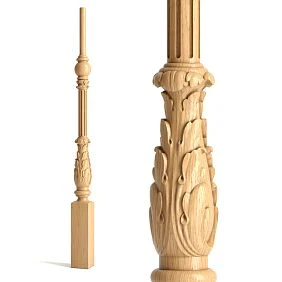
- Carved newels
- Flat balusters
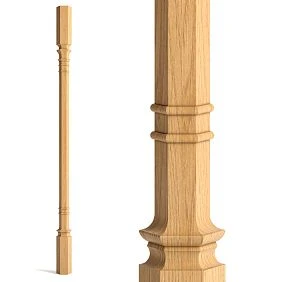
- Straight (simple) balusters
- Shaped balusters
- Carved or turned balusters: which to choose for an expensive look
- In favor of turned balusters
- In favor of carved balusters
- Comparison Summary
- Balusters, handrails and posts: why they should be chosen together
- What is included in a complete staircase railing set
- Why a unified style is important
- How to choose a wood species for balusters
- Oak
- Oak
- Spruce and pine
- Blanks for painting
- Baluster height: how to choose the right size
- Standard railing height
- How to calculate baluster height
- Standard baluster heights
- Balusters for a cottage: the staircase as the architectural center of the home
- What matters for a staircase in a cottage
- Balusters for hotels, resorts, and commercial properties
- What matters for a commercial order
- Installation of wooden balusters: what you need to know before buying
- Ways to mount balusters
- What to consider during installation
- Mistakes when buying balusters wholesale
- Not counting the quantity in advance
- Not taking a spare
- Buying balusters separately from the handrail and posts
- Mixing styles
- Not considering the height of the railing
- Choosing too thin balusters for a massive staircase
- Taking overly complex carving for a small staircase
- Buying different batches without controlling the shade
- Forget about fasteners
- Where to buy wooden balusters wholesale for stairs
- STAVROS: balusters wholesale — a unified system for a solid staircase
- FAQ: Answers to Popular Questions
- How many balusters are needed for a staircase?
- Can I buy balusters wholesale?
- Which balusters are better: carved or turned?
- What should balusters match?
- Why can't you buy balusters without a spare?
- How are wooden balusters attached?
- Which wood species is best for balusters?
A staircase is rhythm. And balusters set it
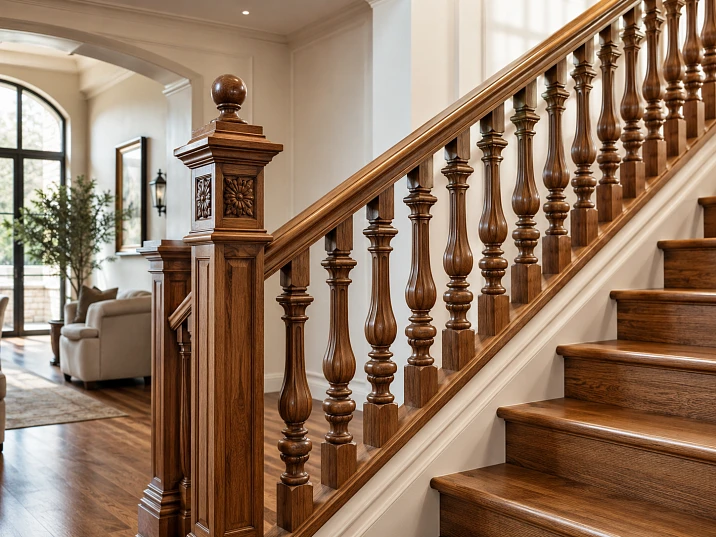
There is an element in the interior of a country house or cottage that is visible immediately — from the hall, from the living room, from the doorstep. The staircase. It rises through the entire volume of the room, crosses the space vertically and horizontally, draws the eye. And it is the railing that balustersHandrails, posts — they determine how the staircase looks: expensive and solid or random and cheap.
A baluster is a small detail. But when there are twenty, thirty, forty of them — it becomes a rhythm. A repeating pattern that reads along the entire length of the flight. If the elements match in shape, wood species, finish, and color — the staircase looks like an architectural object. If not — like a construction site that someone forgot to finish.
That is why balusters wholesale — it's not just about saving money. It's the only correct way to get a uniform set: from one batch, one material, one color, one manufacturer. And in this article — details on how to calculate, choose, and avoid mistakes.
What is a baluster and why is it needed: without architectural complexities
Before calculating and choosing, it's worth clearly understanding what we're talking about.
Baluster — a vertical element of the stair railing. It stands between the lower support (stringer, step, or sub-rail plank) and the handrail. The main function is safety: balusters prevent a person from falling off the open edge of the stairs. But the safety function is just the foundation.
The decorative function is no less important. wooden balusters set the visual rhythm of the railing. They determine the character of the entire staircase — classic or modern, grand or country-style, heavy or light. Shape, height, diameter, spacing — each parameter affects the final look.
And the third function is structural. The baluster takes the lateral load from the handrail, evenly distributes it across the steps, and ensures the stability of the entire railing. Weak or too sparsely placed balusters — a wobbly handrail that is inconvenient and unsafe to use.
Our factory also produces:
Why it's better to buy balusters wholesale rather than individually
It's not about greed — it's about logic. Let's figure out why buying balusters individually for a large staircase is a mistake that becomes apparent during installation.
Get Consultation
Different batches — different shades
Wood is a living material. Even the same species in different batches can differ in color, texture saturation, and how varnish or oil applies. If you buy balusters at different times and from different suppliers, the staircase will turn out patchy. This cannot be hidden with coating.
Shortage in the middle of installation
Buying additional balusters during installation risks not finding the same article, height, or shape. Production programs change. Articles are discontinued. Instead of a uniform rhythm, you get a patchwork.
The unit price is higher than the wholesale price
This is obvious, but important: when buying balusters wholesale the price per unit is lower. For a project with 30–50 balusters, the difference is noticeable.
It is impossible to control the rhythm without a full set
The correct step between balusters is calculated for the entire flight at once. If you buy in parts, the calculation is thrown off, requiring adjustments, cutting, or adding. This looks untidy and takes extra time.
Who benefits from buying balusters wholesale: real scenarios
Buy balusters wholesale — this is not only a solution for large projects. Here are specific situations where wholesale is beneficial and logical.
Construction of a cottage with multiple flights. A large house — stairs to the second floor plus, possibly, to the attic. Two flights, a landing. Dozens of balusters are needed. Plus railing for the second light. Everything from one batch is the only way to get a uniform look.
Staircase workshop. Professionals who make custom stairs purchase balusters for staircases in batches — for several projects or for stock. This allows them to guarantee the client a specific look and not depend on availability at the moment.
Hotel, resort, restaurant. Multiple staircases, balconies, terraces, external railings — all require a unified style. wooden balusters for staircases wholesale is a way to make the entire project stylistically consistent.
Restoration of an old staircase. Some balusters are worn, cracked, or damaged. You need to replace 10–15 elements but preserve the overall look. If you find a similar shape wholesale, the replacement will be unnoticeable.
Design project with balustrade. A balustrade is not only a staircase, but also balcony railings, terrace fencing, and a decorative element of the second light. For an approved project. wooden balusters purchased as a set for the entire volume.
How to calculate the number of balusters for a staircase
This is the most practical question that starts any real purchase. Let's calculate together — without unnecessary math, but with real parameters.
Step one: determine the length of the flight
The length of the flight is the horizontal projection of the staircase from the first step to the last. Measured in millimeters or centimeters.
Step two: choose the spacing between balusters
Standard spacing is 100–150 mm between centers of balusters. There are several guidelines:
-
100–120 mm — dense rhythm, the railing looks rich and filled.
-
130–150 mm — standard rhythm for residential staircases.
-
150–180 mm — light rhythm, visually airier, but requires stronger balusters.
According to safety standards in residential premises, the gap between balusters should not exceed 150 mm — so that a child cannot stick their head through.
Step three: calculate the quantity
Number of balusters = flight length (mm) ÷ spacing (mm) + 1
Example: flight 3,600 mm, spacing 120 mm → 3,600 ÷ 120 = 30 + 1 = 31 balusters per flight.
Step four: add landings and turns
Balusters are also installed on the landing between flights. Add the number of elements along the perimeter of the landing.
Step five: add the second-light railing
If the staircase leads to a hall with a second light and a railing is planned there — calculate the length of that railing and add balusters in the same way.
Step six: add a reserve
Mandatory reserve — 10% of the calculated quantity. During installation, balusters sometimes require trimming. Some may be damaged. The reserve protects against the need to purchase from a different batch.
Table: approximate number of balusters per flight length
| Flight length | Spacing 120 mm | 140 mm pitch | Step 160 mm |
|---|---|---|---|
| 2,000 mm | 17–18 pcs. | 15–16 pcs. | 13–14 pcs. |
| 3,000 mm | 26–27 pcs. | 22–23 pcs. | 20–21 pcs. |
| 4,000 mm | 34–35 pcs. | 29–30 pcs. | 26–27 pcs. |
| 5,000 mm | 43–44 pcs. | 37–38 pcs. | 32–33 pcs. |
Why the spacing between balusters matters not only for aesthetics
Spacing is not just the distance between vertical slats. It is the rhythm of the railing. And this rhythm works on several levels.
Visual rhythm
Uniform spacing creates an orderly pattern. The eye moves along the flight and 'reads' the rhythm — like meter in poetry. If the spacing is precise, the staircase looks expensive. If it's off, it looks sloppy.
Too wide spacing makes the railing look sparse — too much empty space between balusters. Too narrow spacing overloads the staircase, making it visually heavy.
Safety
A rare step is a gap that a child can stick their head through. This is not just an aesthetic problem, but a safety issue. The norm for residential premises: gap no more than 150 mm.
Load on the handrail
The larger the step, the greater the span of the handrail that falls on each baluster. Under lateral load (a person leans on the handrail), a rare step causes more deflection. Optimal step: 120–150 mm.
Balusters for a wooden staircase: shapes and their character
The shape of the baluster is the first thing noticed on a staircase. It is the shape that sets the style of the entire railing. Let's break down the main options.
Turned balusters
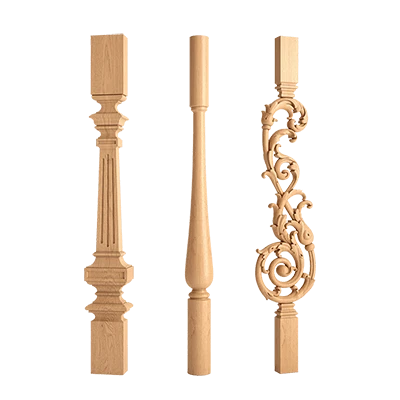
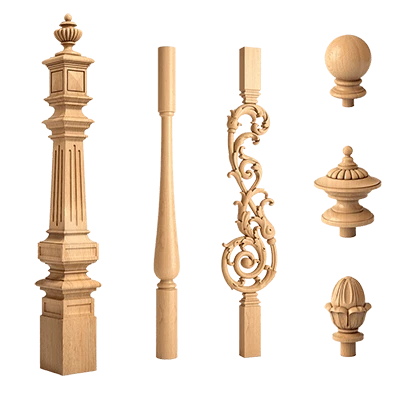
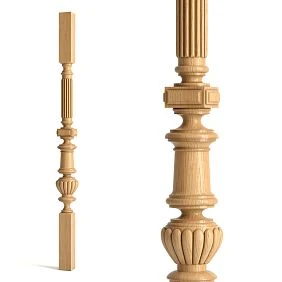
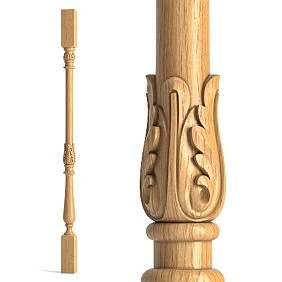
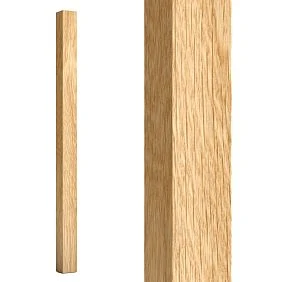
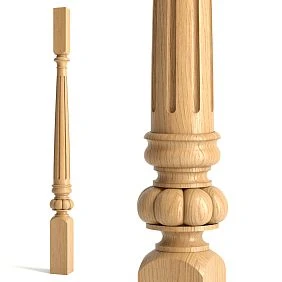
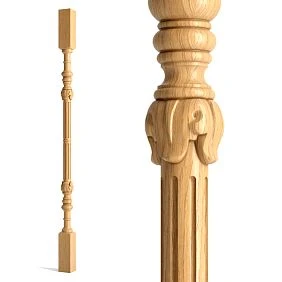
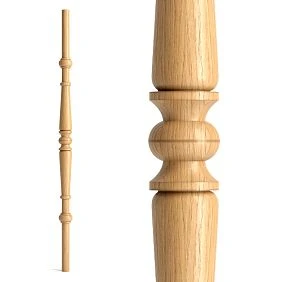
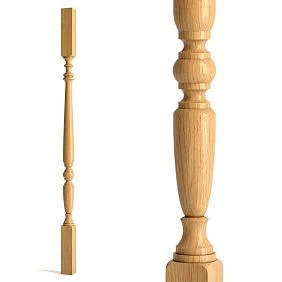
Turned Baluster — a classic of turned production. Smooth rounded shapes: cones, spheres, transitions, tapers — create a regular pattern. They look clean, neat, and traditional.
Suitable for: a country house with wooden interiors, a dacha, a classic apartment, a staircase in a warm natural style.
Main advantage: uniformity. In a wholesale batch, turned balusters provide a perfectly repeating rhythm — each is identical to its neighbor.
Carved balusters
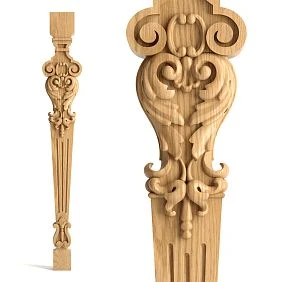
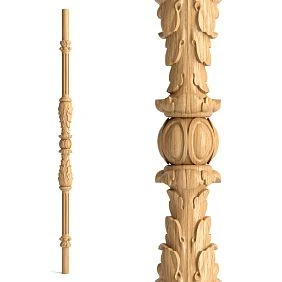
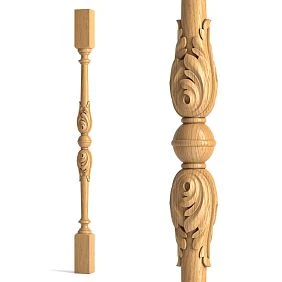
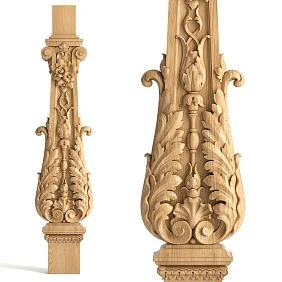
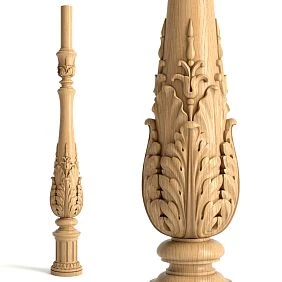
Carved Staircase Baluster — this is already a decorative statement. A more complex pattern: leaves, curls, geometric elements, profile details. A carved baluster looks richer and more formal.
Suitable for: classic halls, grand staircases, representative-class cottages, restaurants in a country style.
Nuance: carved shapes require support. There are pillars next to them, stair railings and the steps must also be of a corresponding level. A carved baluster looks out of place in a simplified environment.
Flat balusters
Flat balusters — planks with a decorative milled profile. Less "rounded" than turned ones, more graphic. They create a calmer, more modern rhythm.
Suitable for: stairs in modern, Scandinavian, or transitional style, for interiors with clear geometry.
Straight (simple) balusters
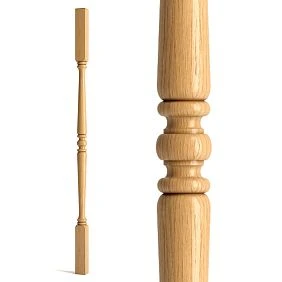
A straight baluster is a square or rectangular beam without a profile. Minimalistic, concise. The eye does not linger on the shape — only on the rhythm.
Suitable for: modern minimalist stairs, industrial style, interiors with clear lines.
Figural balusters
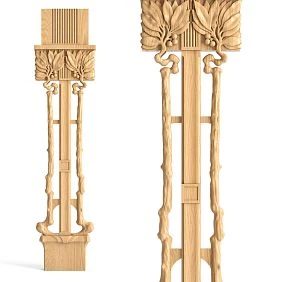
Complex figural shapes — when the railing becomes the main decoration of the staircase. Such balusters can imitate classical architectural elements: vases, columns, profiled pilasters.
Suitable for: grand staircases in mansions, hotels, restaurants with historical design.
Carved or turned balusters: which to choose for an expensive look
This is the most common question when choosing balusters wholesale for a project. And there is no clear answer — there are several strong arguments on each side.
In favor of turned balusters
Batch predictability. A lathe produces identical items. When purchasing wooden balusters wholesale, the batch will be uniform — which is critical for a long flight.
Versatility. The turned shape pairs well with any style — from classic to modern country house. It is neutral enough not to clash with the interior, and decorative enough to look beautiful.
Variety. Among turned balusters, there is a huge selection of profiles: from simple vase-shaped to complex multi-step ones. For example, wooden baluster L-021-1 or stair baluster L-048-1 — these are specific solutions for specific tasks.
In favor of carved balusters
Decorative richness. A carved baluster is more complex. It attracts more attention and creates a richer visual image.
Uniqueness. The carved pattern can be unique for a specific project. This is especially important for private mansions and hotels.
Ceremonial character. If the staircase is the center of the hall and should make an impression, carved balusters solve this task more convincingly than turned ones.
Comparison Summary
| Parameter | Turned | Carved |
|---|---|---|
| Uniformity of the batch | High | Medium |
| Decorativeness | Medium | High |
| Style versatility | High | Limited |
| Compatibility with simple surroundings | Good | Demanding |
| Wholesale price | Below | Higher |
Balusters, handrails, and posts: why they should be chosen together
One of the most common mistakes when ordering stair components is buying balusters separately, handrails separately, and posts — later, when "we'll figure it out." The result: three different styles, three different shades, three different manufacturers.
A staircase is an architectural system. Its components should be designed and purchased as a single set.
What is included in a complete stair railing set
Balusters. wooden balusters for staircases — the rhythm-forming element of the railing. Their shape sets the style of the entire set.
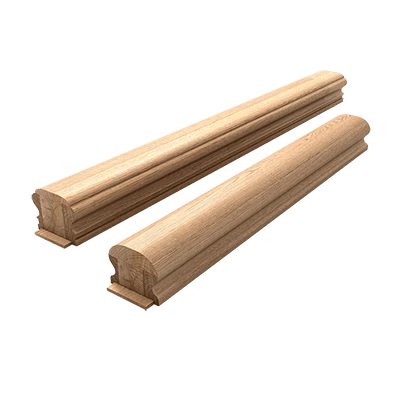
Handrails. stair railings — the horizontal element of the railing. The handrail profile should match the style of the baluster profile. A classic handrail — for classic balusters. A rectangular one — for minimalist ones.
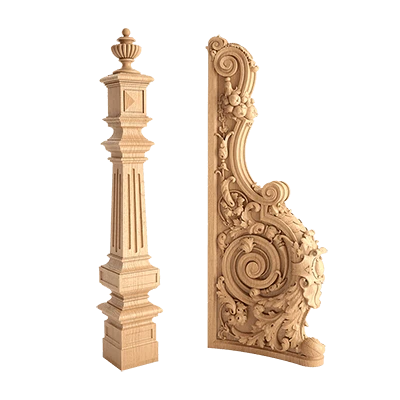
Posts. Posts for staircase — supporting elements of the railing. Entry posts at the beginning and end of the flight bear the main load. Intermediate posts — on landings and turns. The post should be proportionate to the balusters in diameter and proportions.
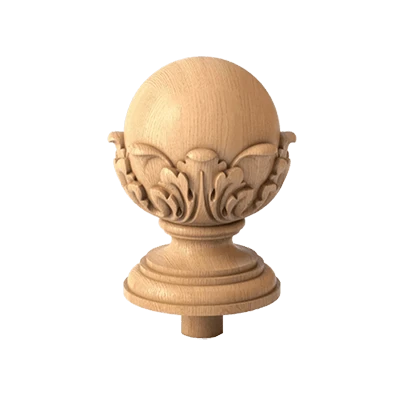
Finial. The upper decorative element of the post. A ball, cone, or shaped detail — completes the post and adds decorativeness.
Handrail brackets. Brackets between the balusters and the handrail or string — depending on the staircase design.
Treads and risers. The color, wood species, and finish of the treads should match the tone of the balusters and handrail.
Fastening elements. Studs, bolts, mounting plates for attaching balusters to the string or tread.
Why a unified style is important
A gaze moving along the staircase evaluates everything at once. If the balusters are turned and the posts are rectangular — that's a mismatch. If the handrail is lighter than the balusters — that's a break. If the finial on the post is in one style and the balusters in another — that's a feeling of randomness.
To achieve a cohesive look, the entire staircase set is ordered in solid wood from one manufacturer.
How to choose a wood species for balusters
Material — not only aesthetics, but also durability and installation complexity.
Beech
Beech is a hardwood species with a fine, uniform texture. Dense, it lends itself well to turning and carving, and holds its shape. Beech balusters balusters are neat in profile and accept staining and varnish well. The not very expressive texture is an advantage for balusters: the wood grain does not distract from the shape.
Oak
Oak is a wood with character. Dense, durable, with an expressive texture. Oak balusters look solid and expensive. They require proper coating — oil or varnish that highlights the texture.
Disadvantage: oak is more expensive than beech and more difficult to work with. But for grand staircases in cottages and mansions, it is a justified choice.
Spruce and pine
Softwood species — a warm, rustic, country character. Balusters made of pine or spruce are cheaper, easy to work with, and accept impregnation, stain, and varnish well. Soft wood — higher risk of mechanical damage, requires careful handling.
Suitable for: country and suburban staircases with a warm wooden look, staircases for painting.
Blanks for painting
If the staircase will be completely painted white, gray, or another color — the wood species takes a back seat. Geometry, absence of knots, and a smooth surface are more important. In this case wooden balusters Made from MDF or softwood for painting — a practical choice.
Baluster height: how to choose the right size
The height of a baluster is not an arbitrary value. It is determined by the height of the railing and the staircase design.
Standard railing height
For residential staircases — 900–1,000 mm from the step level to the top edge of the handrail. For staircases in public buildings — from 1,050 mm.
How to calculate the baluster height
Baluster height = railing height − handrail thickness − mounting plate thickness
If the railing is 900 mm, the handrail is 60 mm, and the mounting plate is 20 mm:
900 − 60 − 20 = 820 mm — the required baluster height.
Standard baluster heights
The most common sizes in catalogs:
-
900–1000 mm — for standard height railings.
-
700–800 mm — for lowered railings or non-standard structures.
-
600 mm and less — for decorative elements, balustrades, low handrails.
Specify the height when ordering a batch — especially when buying wholesale, where replacement is not possible.
Balusters for a cottage: the staircase as the architectural center of the house
In a large country house, the staircase is not just a way to go up to the second floor. It is an architectural element visible from several rooms at once: from the hall, from the living room, from the kitchen, from the open gallery of the second floor.
In this context, the stair railing is part of the interior concept of the house. And that is why balusters for a wooden staircase in a cottage, they choose not based on the principle of 'what is cheaper', but on the principle of 'what will create a cohesive image'.
What is important for a staircase in a cottage
Completeness. Balusters, posts, handrail, steps — from one system, in one material, from one manufacturer.
Scale. In a large space, thin balusters look weak. A form with sufficient visual weight is needed: medium or large diameter.
Wood species. In a country house with oak parquet and wooden doors — oak or beech Wooden balusters continue the theme of natural wood.
Second light railing. In cottages with an open second-floor gallery, the balcony railing is a continuation of the staircase railing. A unified style of balusters on the flight and on the balcony is mandatory.
Balusters for hotels, resorts, and commercial properties
A commercial property is a special case. Here it is important not just to buy beautiful balusters, but also to ensure reproducibility: the ability to purchase identical elements in a year, two, or five years.
What is important for a commercial order
Batch consistency. A hotel with ten staircases must have identical railings. For this Buy balusters wholesale from a manufacturer who keeps the SKU in constant production.
Finish durability. In a commercial space, the staircase experiences higher load — people walk constantly, handrails are used intensively. The coating must be wear-resistant.
Unified style for different areas. Stairs, balcony, terrace, bridge over the lobby — all railings in one facility must use the same balusters and handrails.
Possibility of gradual ordering. A large facility is built in stages. The manufacturer must guarantee that after six months it will be possible to purchase additional balusters from the same series.
Installation of wooden balusters: what you need to know before purchasing
Buying balusters in bulk requires understanding how they will be installed. This affects the choice of shape, size, and fasteners.
Ways to Mount Balusters
On a stud. A hole is drilled in the end of the baluster, into which a stud is screwed. The baluster is attached to the step or stringer through the stud with a nut. Reliable, neat.
On a bolt. Similar to a stud, but with a bolt and nut — for heavier balusters.
On a wooden dowel. Traditional method: a dowel (wooden pin) connects the baluster to the step. Suitable for turned balusters.
On assembly adhesive. Additional fixation — not primary, but auxiliary.
What to consider during installation
-
The cut angle of the lower end of the baluster must match the slope angle of the flight.
-
Step uniformity is controlled by a template or markings.
-
Verticality of each baluster is checked with a level.
-
The top end is attached to the handrail via a sub-rail strip or notch.
Mistakes when buying balusters in bulk
This is not theory — these are real cases discovered during installation.
Not calculating the quantity in advance
The most common mistake. Bought "approximately" — not enough in the middle of the flight. Buy from another batch — shade doesn't match.
Solution: accurate calculation for the entire volume + 10% reserve.
Not taking a reserve
During installation, balusters may require trimming. Sometimes they crack during installation. Without a reserve, any loss is a problem.
Buying balusters separately from the handrail and posts
Balusters from one manufacturer, handrail from another, posts from a third. Different profiles, different diameters, different shades. The staircase looks disjointed.
Mixing styles
Carved balusters next to simple straight posts — a mismatch. A classic handrail with flat balusters — a conflict.
Not accounting for the railing height
Bought balusters 900 mm, but need 820 — each will require trimming. Inconvenient and time-consuming.
Choosing too thin balusters for a massive staircase
Thin balusters on a wide flight with heavy steps and massive posts look weak and visually "sag".
Choosing overly complex carving for a small staircase
Rich carving in a small space overloads the interior. Complex Staircase Baluster requires appropriate scale around.
Buying different batches without shade control
Two runs — two different shades. This is a mistake that is immediately visible.
Forgetting about fasteners
Studs, dowels, mounting plates — need to be ordered simultaneously with balusters.
Where to buy wooden balusters wholesale for stairs
Buy wooden balusters wholesale means choosing the shape, wood species, height, quantity and simultaneously selecting compatible handrails, posts and fasteners. Everything from one source, in one system, from one batch.
Buy wooden balusters for a cottage, country house, hotel or staircase project — in the catalog staircase components balusters of various shapes, heights and wood species are available, as well as handrails и posts for a complete set.
STAVROS: wholesale balusters — a unified system for a complete staircase
STAVROS — manufacturer and supplier of solid wood for private and commercial projects. Wooden balusters, handrails, posts, staircase components — all made from solid wood and supplied as a unified system.
balusters wholesale at STAVROS — this is a stable batch from one wood species, in one shade, with the ability to select the entire staircase set in a unified style. For cottages, hotels, staircase workshops — and for those who want a staircase that looks like an expensive architectural object, not a set of separately purchased parts.
FAQ: Answers to popular questions
How many balusters are needed for a staircase?
The quantity depends on the length of the flight and the spacing between balusters. Basic formula: flight length (mm) ÷ spacing (mm) + 1. Plus balusters for landings, second-light railings, and a 10% reserve.
Can I buy balusters wholesale?
Yes. balusters wholesale — the right choice for a large staircase, cottage, hotel, workshop. Wholesale purchase guarantees batch uniformity and reduces the unit price.
Which balusters are better: carved or turned?
Turned balusters for staircases — a versatile choice with a neat rhythm. Carved ones are richer and more decorative, suitable for grand staircases in a classic style.
What should the balusters match?
With handrails, posts, treads, risers, and the overall interior style. The entire staircase set must be from one system, made of one material, and in one shade.
Why can't you buy balusters without a reserve?
During installation, trimming, damage, or replacement of a defective element is possible. If you buy more later, the batch may differ in shade. A 10% reserve protects against this problem.
How are wooden balusters attached?
With a stud, dowel, or bolt — through the end of the baluster into the tread or stringer. The type of fastening depends on the staircase design and the size of the baluster.
Which wood species is best for balusters?
Beech — neat texture, easy to work with. Oak — durable, expressive. Pine — warm country character, cheaper. The choice depends on the staircase style and budget.