Article Contents:
- Two materials, one idea: why this combination works
- Why stucco and wood should be combined wisely
- Role separation: a fundamental principle
- What happens when there are no roles
- Where the combination of stucco and carved decor is appropriate
- Living Room
- Home office and library
- Hall and Foyer
- Classic bedroom
- Doorways
- Polyurethane moldings: a calm architectural foundation
- Wall frames as an architectural background
- Horizontal belt: dividing the wall by height
- Cornice as the upper boundary of the system
- Carved wooden decor: a warm accent with character
- Wooden wall ornaments: where and how
- Wooden overlays for furniture facades
- Wooden decor on door portals
- Mirror in a wooden frame with molding trim
- How to avoid overloading the interior: practical rules
- Rule one: one material — one type of decor
- Rule two: scale must match
- Rule three: color unifies
- Rule four: the space between elements is more important than the elements themselves
- Rule five: one main accent per room
- Specific combinations: practical solutions for different zones
- Living room: fireplace + moldings + wooden ornament
- Hall: mirror + console + wooden panels
- Study: shelving + wooden panels
- Bedroom: headboard + molding belt
- Color and finish: how to properly paint both materials
- Option one: all in one color
- Option two: stucco — monochrome, wood — natural
- Option three: contrasting scheme
- Materials up close: what to buy and why
- Polyurethane moldings: why this material
- Carved wooden decor: advantages of natural material
- Mounting adhesive
- What to buy for different tasks: summary table
- Five mistakes when combining stucco and wooden decor
- Frequently Asked Questions
- STAVROS: two directions, one interior
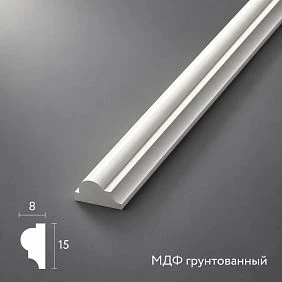
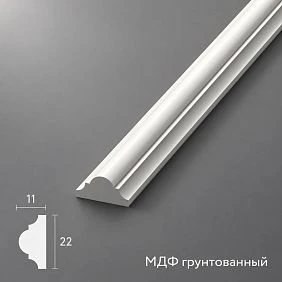
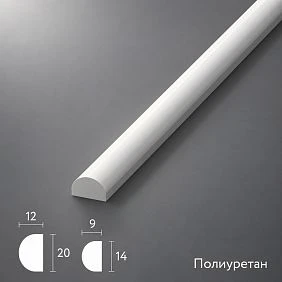
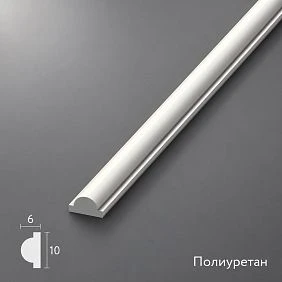
Two materials, one idea: why this union works
There are interiors that are not just beautiful — they are alive. They simultaneously convey architectural logic and human warmth. This is a rare combination, and it is achieved not by expensive furniture or a random set of decorations. It is achieved by the correct distribution of roles between materials.
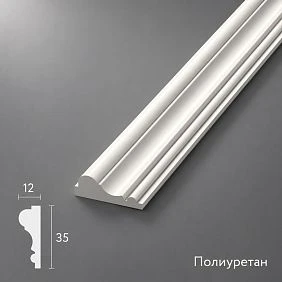
Stucco and carved wooden decor — two materials with different characters. Polyurethane Moldings precise, geometrically exact, architectural. It knows how to hold a line, set a rhythm, assemble a wall into a system. Wood is alive, warm, with texture, with the memory of the master's hand. It knows how to stop the gaze, create an accent, add that very 'soul' that perfectly smooth surfaces lack.
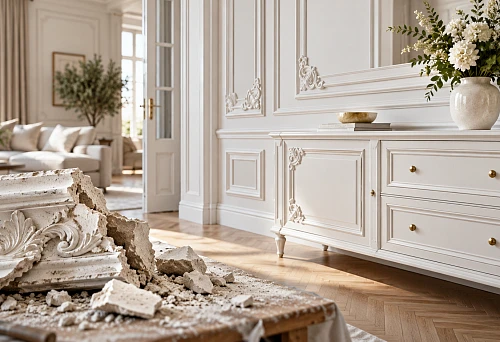
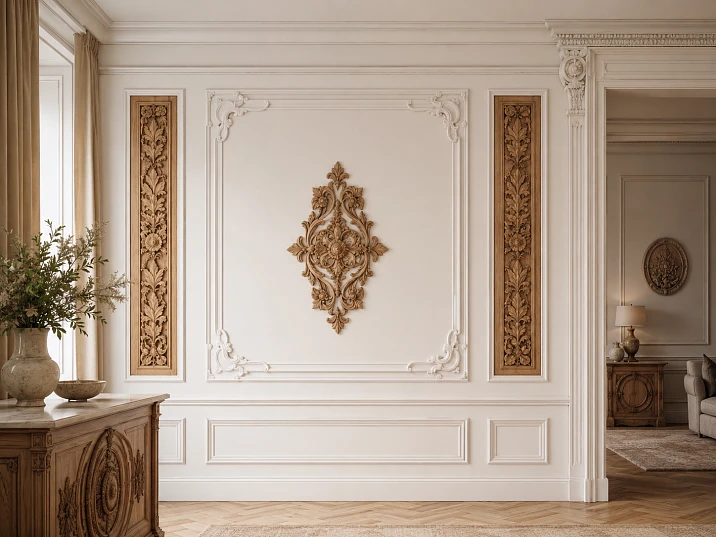
Stucco sets the architectural frame, Moldings made of polyurethane collect lines, and Carved wooden decoration adds a warm, expensive accent: if the roles are distributed correctly, the interior looks cohesive rather than cluttered.
That is exactly what this article is about. How to make two different materials speak with one voice. How not to overload the space, but make it truly rich.




Why stucco and wood should be combined wisely
Let's start with an honest talk about the most common mistake. A person sees beautiful stucco. Adds it to the walls — cornices, moldings, rosettes. Then sees a beautiful carved wooden ornament. Adds it to furniture, doors, a console. And at some point realizes: the space has become heavy. The eye has nowhere to rest. Every element screams for itself, and in this chorus, no one hears anyone.
This is not a problem with the materials. It's a problem with roles. When both materials claim to be the main decoration — they compete. When each has its own role — they cooperate.
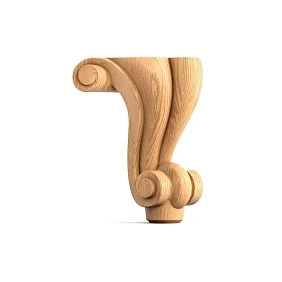
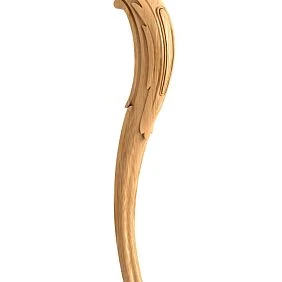
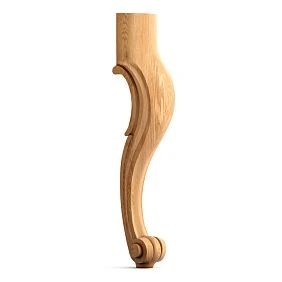
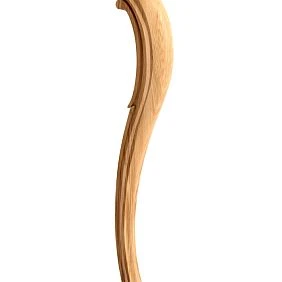
Our factory also produces:
Role separation: a fundamental principle
Here's how proper distribution works:
Polyurethane stucco is the architectural foundation. It creates the structure of the space: horizontal belts, vertical dividers, wall frames, cornice under the ceiling, baseboard at the floor. Stucco is the "skeleton" of the decorative system.
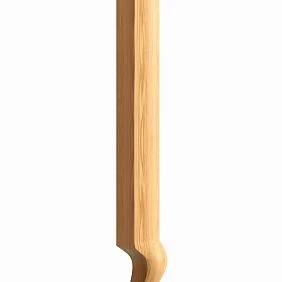
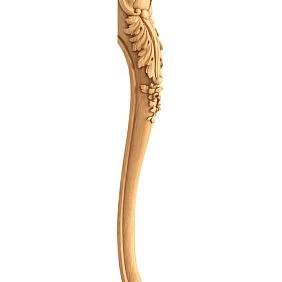
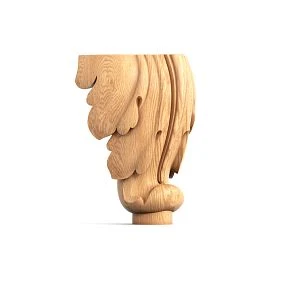
Carved wooden decor is the accent. It appears in one or two points where the eye needs to stop. On a door portal. On a furniture facade. In the center of a decorative frame made of moldings. Wood is the "heart" of the system.
Moldings — a connecting thread. They create zone boundaries, set the rhythm, and serve as a transition between stucco and wooden decor.
Decorative stucco — a focal point. One or two accent elements that work like punctuation marks in text.
When these roles are clearly distributed, the interior reads as a single statement, not as a collection of quotes from different sources.
Get Consultation
What happens when there are no roles
If the walls have dense molding frames, an ornamented cornice, and ceiling rosettes, this is already a rich system. Adding active carved wooden ornaments on furniture and doors creates visual noise. No element becomes an accent because they are all equal.
Conversely, if stucco is used minimally—only thin molding frames on the walls—the carved wooden decor can be richer and more saturated. A calm background + an active accent. This always works.
Where the combination of stucco and carved decor is appropriate
Before discussing specific solutions, it's worth understanding in which spaces this duo works best.
Living Room
The living room is the main space of the house. A full architectural language is appropriate here: molding frames on the walls, cornice, baseboard. And one or two wooden accents—above the fireplace, on the console, on the door portal to the adjacent room.
The wall with a TV or fireplace is an ideal area for the combination: a molding frame made of polyurethane moldings sets the field, and the central wooden ornament or overlay becomes an accent within this field.
Study and home library
A study is a space of concentration and status. Wood is especially organic here: warm texture, a sense of solidity, connection with books and wooden shelves. Stucco sets the architectural framework (shelf cornice, wall moldings), and carved wooden ornaments accents are placed — above shelf sections, on door portals, in the desk area.
Hall and Entrance
The hall is the first space guests see. It is the "calling card" of the home. Here, the combination of stucco and wood works especially expressively: molding frames on the walls create architectural character, and wooden decor on the mirror or console adds a warm human accent.
Classic bedroom
In the bedroom, restraint is important. Stucco here is delicate: thin molding frames, a small cornice. Wood is one element above the headboard or on the furniture facade of the bedside table.
Door Portals
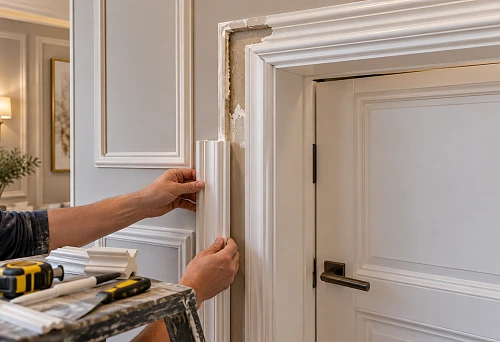
A door portal is one of the best areas for combining two materials. Vertical polyurethane moldings on the sides of the opening + a horizontal cornice above it = an architectural frame. decor for furniture made of wood on the door leaf — an accent within this frame.
Polyurethane moldings: a calm architectural foundation
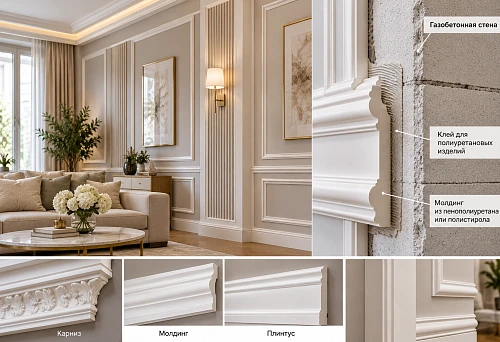
Let's start with what creates the structure. Moldings made of polyurethane — this is a linear decorative profile that is mounted on walls, ceilings, and furniture surfaces. Their task in the "stucco + wood" system is to create a calm, rhythmic framework against which the wooden accent will read cleanly and expressively.
Frames on walls as an architectural background
Molding frames on walls are one of the most powerful techniques in classical interiors. Rectangular or vertically elongated frames made of molding, evenly distributed across the wall, create a "panel" structure. The wall ceases to be just a plane — it becomes an architectural surface.
Once such a surface is created, wooden ornamentation gets an ideal context. It is placed inside one of the frames like an exhibit in a picture frame. Or it stands at the central point of the frame system — where the gaze concentrates.
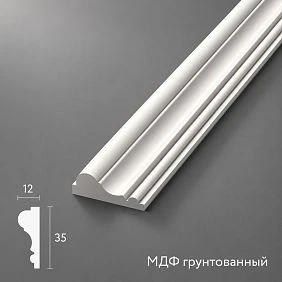
Width of molding for wall frames:
-
15–20 mm — delicate, light. For small rooms and modern neoclassicism.
-
25–35 mm — standard classical format.
-
35–50 mm — for high walls from 280 cm and large spaces.
Horizontal belt: dividing the wall by height
A horizontal molding belt at a height of 90–120 cm from the floor divides the wall into lower and upper zones. This is a traditional classical technique: the lower zone — "base", darker or finished with a different material; the upper — "field", wallpaper or paint.
In the "stucco + wood" system, the horizontal belt is the boundary of zones. Below — wooden panels or decorative trim with wooden elements. Above — stucco molding frames and polyurethane decor. Each material in its own zone, clearly separated.
The cornice as the upper boundary of the system
Buy molding Creating a ceiling cornice means forming the upper "lid" of the entire decorative system. The cornice sets the overall scale: if it is large, 80–120 mm, the moldings on the walls should be proportionate, and the wooden accents should be substantial in size.
If the cornice is delicate, 40–60 mm, the moldings are thin, and the wooden ornament is small. All elements must be in the same scale register.
Carved wood decor: a warm accent with character
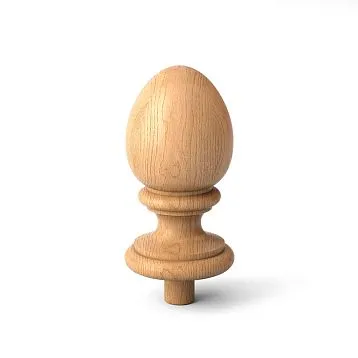
Now, about what gives the interior a soul. Carved wooden decoration These are overlays, ornaments, wooden patterns, frames, furniture inserts, and hand-carved reliefs. Unlike polyurethane stucco, wood carries natural heterogeneity: the texture of the fiber, the warmth of the surface, the feel of a living material.
This is what makes it an indispensable accent. Where stucco might seem too "factory-made," wood adds a human dimension.
Wooden ornaments on the wall: where and how
Wooden patterns for the interior on the wall work as independent decorative objects. This is not a functional element—it is an art object. Placed at the right point on the wall, it becomes a "painting" with volume and texture.
Best positions for a wooden ornament on the wall:
-
Center of the accent wall — between molding frames or above a console.
-
Above the bed — at the headboard, as a headboard panel.
-
In a niche — a wooden ornament in a niche works like an exhibit in a display case.
-
On the wall above the fireplace — the traditional "fireplace zone" is ideal for wooden decor.
The size of the wooden ornament should match the molding frame. If the frame is 50×80 cm, the ornament should fit within it with a margin of 10–15 cm on each side. An ornament pressed tightly against the molding looks cramped.
Wooden overlays on furniture fronts
decor for furniture made of wood — overlays, relief inserts, carved medallions — are one of the most effective ways to make furniture look more expensive. Especially when the furniture is painted in a monochrome color: white, cream, gray.
On a white front, a wooden overlay reads as a sculptural relief. This is a completely different feeling than a polyurethane overlay of the same profile: wood "breathes," its surface is always slightly more alive.
Application scheme:
-
On the doors of the lower part of the cabinet — a central medallion overlay.
-
On the dresser drawers — one overlay per drawer, strictly centered.
-
On the front of the vanity cabinet in the bathroom — a wooden ornament along the perimeter or in the central area.
-
On the door panels — an insert in the upper third of the door.
Wooden decor on door portals
A door portal with wooden decor is a classic of 19th-century Russian and European architecture. Wooden inserts in the portals of noble mansions, wooden decor in doorways of classic interiors — this is a centuries-old tradition that never goes out of style.
Modern interpretation: vertical polyurethane moldings on the sides of the opening set the geometry of the portal, and a carved wooden insert in the horizontal "above-portal" zone — above the cornice — adds a lively accent. Or wooden overlays directly on the door panel in the "blind" part of the door.
Mirror in a wooden frame with molding trim
A mirror is a special story. If a mirror simply hangs on the wall, it "hangs." If it is set into a molding frame and surrounded by wooden decor, it "lives" in the interior.
Scheme: a rectangular molding frame on the wall — wider, 35–50 mm. Inside the frame — a mirror. At the corners of the frame or in the center of the horizontal parts — wooden patterns in the form of corner overlays or central medallions. This creates an "integrated" mirror portal — architectural and warm at the same time.
How not to overload the interior: practical rules
Here is the main point. Not a theory of compatibility, but specific rules that work in practice.
Rule one: one material — one type of decor
On each wall, there should not be both active stucco and active wooden decor at the same time. If the wall is decorated with dense molding frames, there should be only one small wooden element on it. If the wooden ornament is large and rich, the stucco around it should be calm: only a simple molding without ornament.
Rule two: scale must match
Large stucco + small wooden details = imbalance. Small moldings + huge wooden ornament = the same imbalance. All elements in the room should exist in the same scale range. If the cornice is 100 mm — moldings 30–40 mm — wooden overlay 150–200 mm. The scale decreases from the ceiling to the furniture.
Rule three: color unifies
The simplest way to avoid a visual conflict between two materials is to unify them with color. Paint both Relief Decorationand wooden overlays in one color. Then the textural difference between the materials becomes an interesting nuance, not a conflict.
If the wooden decor is left in its natural color, the stucco should be monochrome and not attract excessive attention. One material "speaks" through color, the other through form.
Rule four: the space between elements is more important than the elements themselves
This is the most counterintuitive rule, but the most important one. There should be enough "empty" space between the molding frame and the wooden ornament. Between two decorated zones, there should be a neutral field. It is the emptiness that allows the elements to "breathe" and be readable.
If you remove all pauses and fill the surface with decor "from edge to edge," you will get a carpet, not architecture.
Rule five: one main accent per room
Each room should have one main decorative accent. One. Not three or five. It is this element that will be remembered, photographed, and "holds" the space.
If it is a wooden carved ornament above the fireplace, everything else, including decorative molding, should be quieter. If it is a magnificent polyurethane ceiling medallion, the wooden decor in this room should be restrained.
Specific combinations: practical solutions for different zones
Living room: fireplace + moldings + wooden ornament
The most advantageous zone for combining two materials. The fireplace portal is framed with moldings — a horizontal cornice above the shelf, vertical posts on the sides. Above the fireplace shelf, at wall level — a molding frame with a wooden ornament inside. Or: wooden carved decor directly on the fireplace portal as a relief insert.
The remaining walls of the living room: molding frames without wooden decor. Baseboard and cornice made of polyurethane. Wooden accent — only near the fireplace. This maintains balance.
Hall: mirror + console + wooden overlays
Mirror in a molding frame. Under it — a console. On the console — wooden overlays on the drawer fronts or along the perimeter. Side walls of the hall — molding frames, without additional decor.
Buy Moldings for the hall — means choosing one accent element: a small medallion above the mirror or corner overlays on the frame.
Study: shelving + wooden overlays
In the study, a built-in shelving unit is the main architectural detail. Cornice on the top line of the shelving made of polyurethane, moldings on the vertical posts. Lower facades of the shelving with closed doors — Wooden Inlays in the form of frame inserts or central ornaments. Wooden decor only on the lower closed facades — open shelves remain clean.
Bedroom: headboard + molding belt
Accent wall behind the bed: horizontal molding belt at a height of 90–100 cm from the floor. Above the belt — paint or wallpaper. In the headboard area — wooden ornament or wooden frame panel. Below the belt — wooden panels or solid color paint without decor.
This is a concise solution that creates a full architectural character without overload.
Color and finish: how to properly paint both materials
Option one: everything in one color
И Decorative stucco, and the wooden overlays are painted in a single color together with the wall or furniture. Monochrome. Relief works only through shadow. This is the most elegant result — but it requires precise installation, perfect joints, and good putty.
Best colors for a monochrome system: white, cream, gray, pearl.
Option two: stucco — monochrome, wood — natural
The wall and Moldings are painted in a single color. The wooden decor is in the natural color of wood or in a tinted transparent coating. A warm wooden accent on a neutral monochrome background. This is one of the most beautiful results: a cool background + a warm accent.
Option three: contrast scheme
Dark background — dark wall, anthracite, green, blue. White or cream Relief Decoration and moldings. Wooden decor in white or in the color of the moldings. All three elements in one light palette on a dark background — they 'glow' and are clearly readable.
Materials up close: what to buy and why
Polyurethane moldings: why this material
buy polyurethane moldings for interior use means choosing a material with the optimal combination of price, profile accuracy, and ease of installation.
Rigid polyurethane:
-
Precise profile without deformation — joints fit perfectly.
-
Lightweight — installation without helpers.
-
Cut with a regular miter saw.
-
Painted with any alkyd or acrylic paint.
-
Does not warp from humidity.
This is a fundamental advantage over wooden moldings when used as an "architectural base": geometry is precise, lines are straight, joints are neat.
Carved wooden decor: advantages of natural material
wooden patterns and carved items — a material with different qualities. Here, the main thing is not geometric precision, but natural texture. Wood fiber, the living relief of the surface, warmth to the touch — all this creates a feeling that polyurethane cannot reproduce.
Wooden decor requires:
-
Preliminary priming before painting.
-
Thorough sanding — especially on the ends.
-
For outdoor use — antiseptic and facade paints.
-
For interiors — alkyd varnish or acrylic paint.
Adhesive for installation
For polyurethane moldings: acrylic construction adhesive (PL Premium or equivalent). For wooden furniture overlays: woodworking PVA + clamps. For wooden elements on walls: construction adhesive + temporary fixation with tape or pin nails.
What to buy for different tasks: summary table
| Task | What to purchase |
|---|---|
| Make the wall architectural | Moldings made of polyurethane — frames and belts |
| Add a warm accent | Carved wooden decoration — ornament or overlay |
| Finish a furniture front | Wooden Inlays + frame moldings |
| Make a classic hall | Moldings + wooden ornament at the mirror |
| Do not overload the interior | Smooth Moldings + one carved accent |
| Design a door portal | Moldings around the opening + wooden insert on the panel |
| Assemble an expensive set | Buy molding + moldings + Relief Decoration + wooden decor + glue + paint |
Five mistakes when combining stucco and wooden decor
Mistake one: same scale of ornaments. If stucco and wooden decor have the same pattern size, they "argue." One should be noticeably larger than the other.
Mistake two: different styles. Baroque stucco + Scandinavian wooden ornament. These languages are incompatible. Both materials must exist in the same style register.
Mistake three: different color temperatures. Warm ochre stucco + cool gray wooden decor — a temperature conflict. Either a single color or a nuanced transition within one temperature.
Mistake four: decor everywhere. Every wall, every facade, every detail — covered with ornament. No pause, no air. Maximum 30–40% of the surface under decor, the rest is a clean field.
Mistake five: inconsistent finishing. Buy decorative stucco and wooden decor require uniform finishing. If the stucco is perfectly painted in gloss and the wood in matte, it will read as a mistake.
Frequently asked questions
Can polyurethane stucco and wooden decor be combined?
Yes, and it is this combination that gives the interior both architectural structure and living warmth. The main rule is to divide the roles: Polyurethane Items as an architectural framework, Carved Decor as a point accent.
What is better to choose: stucco molding or carved wood decor?
They do not compete, but complement each other. For lines, frames, cornices, and system elements — Moldings and trim. For accents, furniture decor, and focal points — wooden ornament and overlays.
Where are wooden ornaments appropriate alongside stucco molding?
Best areas: above the fireplace, in the mirror and console area, on door portals, on furniture facades of the lower part of the shelving unit, at the headboard, in the center of a molding frame on the wall.
What to buy for an interior with stucco molding and wood?
Moldings made of polyurethane for wall frames and cornice, decorative molding for accent points, Wooden Inlays for furniture and doors, Carved Decor for ornamental inserts. Plus glue, primer, paint and a 10–15% reserve.
How to paint both materials so they look unified?
The most reliable method is a single color for all elements: walls, moldings, Relief Decoration and wooden overlays. The relief works through shadow, not color contrast. The result is an elegant monochrome with rich texture.
Is special preparation needed for wooden overlays?
Yes. Sanding 120–180 grit, two coats of acrylic primer, two coats of finish paint. The ends require special attention — they absorb paint more intensively and may need three coats of primer.
STAVROS: two directions, one interior
The combination of stucco and wooden decor is a combination of two production directions that STAVROS develops in parallel and at a high level.
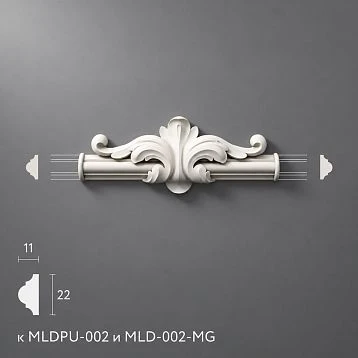
Polyurethane Items STAVROS — moldings, cornices, baseboards, decorative overlays — this is precise profile, perfect joint geometry, a wide range of profiles for any style. Buy Moldings in the STAVROS catalog means choosing from a large collection of medallions, rosettes, cartouches, and ornamental overlays.
Carved wooden decoration, wooden furniture appliqués is a separate production direction where living material and precise carving give products that unique character that cannot be obtained from any other material.
Two directions — one source. This means stylistic consistency, a unified scale of profiles and elements, and the ability to assemble a complete set for one interior in a single catalog.
STAVROS. Contact us to confirm shipping to your destination. Pickup in Moscow and St. Petersburg.