Article Contents:
- NPU-485 "Dragonfly": what is confirmed by the product card
- What exactly a small dragonfly changes in a strict slat rhythm
- First choose the surface: a smooth field, the wide front part of a slat, or the relief between slats
- One NPU-485: when a single accent is stronger than a group
- Three dragonflies: how to achieve movement rather than a triangle of identical pieces
- Five NPU-485: when a group becomes an independent panel
- Do not place with equal spacing: how to build a free composition
- Full-size mockup: how to resolve the composition before purchase
- How to align 96 × 82 mm with a slat wall without invented proportions
- What color to choose for NPU-485 next to slats
- Light and shadow: why 15 mm of relief can matter more than color
- Dragonfly orientation: identical, mirrored, or free
- Composition around a TV, console, bed, or lamp
- Why three elements are often more convenient than a pair — and when a pair is still better
- Five elements: how to avoid the 'dragonfly wallpaper' effect
- What to buy together with NPU-485 for installation
- Installation on an existing slat wall: what to check before gluing
- Painting before or after installation: what is more convenient for a small carved overlay
- How NPU-485 works in different slat wall styles
- When it's better to place NPU-485 next to the slats rather than on them
- How much to buy: quantity is determined by the approved module, not the wall area
- When you shouldn't buy NPU-485
- Alternatives to NPU-485 if the dragonfly motif turned out too literal
- What happens to the composition in a year: cleaning, repainting, and local replacement. Should NPU-485 be repeated on the second slat wall
- Should NPU-485 be repeated on the second slat wall
- How to avoid turning a natural motif into a children's or themed decoration
- Mistakes that turn a light accent into random decor
- Practical algorithm: from a strict wall to a finished group
- Decision matrix: one, three, five, or none
- Bottom line: NPU-485 should break the rhythm, not replace it with a new pattern
- FAQ
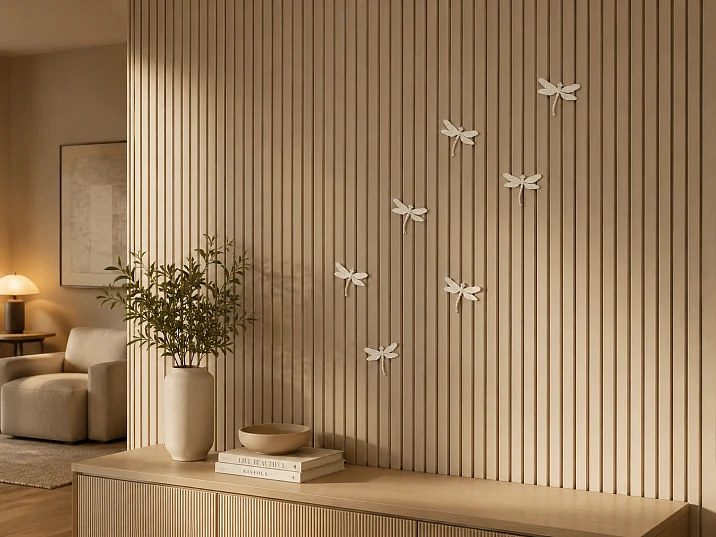
A strict slat wall can be assembled technically flawlessly and still seem too disciplined. Vertical lines repeat at equal intervals, chiaroscuro is predictable, the large plane looks architecturally assembled — but it sometimes lacks a small irregular accent. Adding another molding frame in such a situation is not necessary. The frame will reinforce the geometry that the wall already has enough of.
For a different effect, you can use the carved decorative overlay NPU-485 "Dragonfly" made of polyurethane. The current STAVROS card shows dimensions of 96 × 82 × 15 mm, material — polyurethane, and the current price of 660 ₽ per piece. The manufacturer directly allows decorating a wall with one or several such overlays, including in an arbitrary or symmetrical composition.
The main question here is not "how many dragonflies are needed per square meter." Such a norm does not exist and should not exist. The task is different: to make a small lively accent that will break the monotony of the slat rhythm but not turn the wall into a thematic panel of dozens of identical figures.
For one wall, three basic commercial scenarios are possible:
-
1 NPU-485 — 660 ₽: one noticeable point;
-
3 NPU-485 — 1 980 ₽: a small free group;
-
5 NPU-485 — 3 300 ₽: a more pronounced composition with a direction of movement.
But these quantities cannot be chosen only by budget. On a narrow slat insert, one overlay may be sufficient. On a wide accent wall, three elements can look more precise than five. On a complex wall with a TV, sconces, shelves, and natural wood texture, even one dragonfly may be superfluous.
Therefore, the correct order is this: first, full-size paper silhouettes 96 × 82 mm, then selection of the zone, direction, and quantity, after that — ordering the real NPU-485.
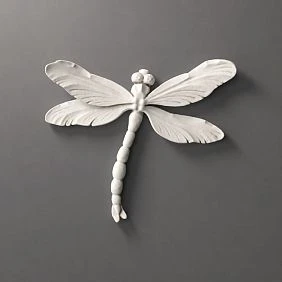
NPU-485 "Dragonfly": what is confirmed by the product card
The official card calls the product "Stucco decor NPU-485", and the item itself is in the polyurethane overlays section. For the article, it is correct to use the phrasing carved decorative overlay NPU-485 "Dragonfly" made of polyurethane or stucco decor NPU-485.
| Parameter | NPU-485 |
|---|---|
| Type | carved decorative overlay / stucco decor |
| Motif | dragonfly |
| Material | Polyurethane |
| Size A × B × C | 96 × 82 × 15 mm |
| Current price | 660 ₽/pc. |
| Application on the wall | one or several overlays |
| Paintability | provided by the product card |
Current card: buy stucco decor NPU-485 "Dragonfly".
An important limitation concerns the orientation of dimensions. The card indicates A × B × C and shows a drawing, but the sequence of numbers itself should not become an automatic rule "96 mm is always horizontal width, 82 mm is always vertical height." The dragonfly can be compositionally rotated, so for wall marking it is better to use a full-size silhouette from the drawing, not just a 96 × 82 mm rectangle.
15 mm should not be ignored either. This is not a flat vinyl sticker. NPU-485 has relief, which means under side lighting it creates its own shadow and adds a third level of plasticity to a slat wall: the plane of the base, the depth of the slats, and the relief of the dragonfly itself.
If the motif fits, but you want to compare it with other shapes, you can Choose decorative polyurethane overlays in the general category.




What exactly does a small dragonfly change in a strict slat rhythm
A slat surface relies on repetition. It is repetition that makes it strong: the eye quickly reads identical verticals and perceives the wall as a single architectural field.
NPU-485 works on the opposite principle. It is a local figure with a recognizable natural silhouette, asymmetric plasticity of wings, and its own axis. It introduces a small event into the linear system.
The effect arises for three reasons.
First is a change of scale. A slat wall is perceived as large stripes and a general plane. The dragonfly is an object you want to look at closer.
Second is a change of geometry. Vertical slats are straight. The wings and body of NPU-485 create a more organic contour.
Third — breaking the absolute repetition. If the entire wall is built on the same step, one irregular point makes the composition less mechanical.
That is why NPU-485 does not need to be evenly distributed across the entire surface. If the dragonfly repeats at the same interval from floor to ceiling, it itself turns into a new rigid pattern and returns to the wall the regularity that was meant to be avoided.
A broader principle of combining these materials is covered in the article STAVROS about slat panels and polyurethane decor without visual heaviness. Here the task is already narrower: not a system of all types of molding, but a specific free composition of NPU-485 without moldings.
Our factory also produces:
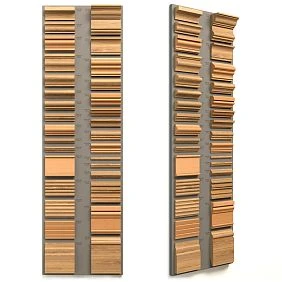
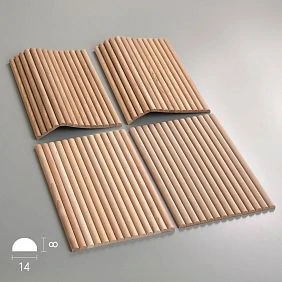
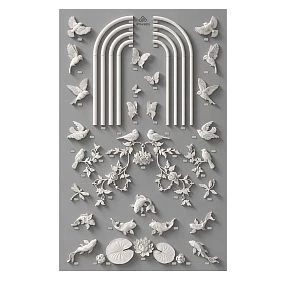
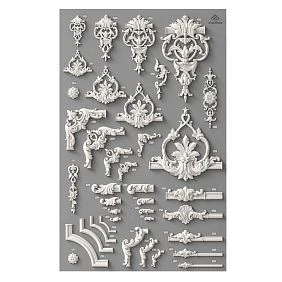
First, choose the surface: a smooth field, the wide face of a slat, or the relief between slats
The phrase "glue a dragonfly onto a slat wall" hides several completely different bases.
A smooth insert next to the slat zone
The most predictable option.
For example, slats occupy most of the accent wall, and near the edge a painted wall section is left. NPU-485 can be placed on this smooth area so that the dragonfly visually interacts with the slats but does not physically lie on the relief.
Advantages:
-
full contact of the rear plane with the base;
-
the silhouette reads clearly;
-
the wings do not intersect with the vertical grooves;
-
easier to paint and repair;
-
the composition is easier to change without interfering with the panels.
For the first implementation, this scenario is the safest.
The flat front surface of the slat system itself
Some panels have individual slats with a fairly wide flat face. Theoretically, a small overlay can rest on one or more of these surfaces.
But this cannot be decided from a photo. You need to apply a real NPU-485 or a rigid mock-up with its actual rear plane and check:
-
how much material actually touches the base;
-
is part of the wing not hanging over a deep groove;
-
is the element not wobbling;
-
can the mounting compound be applied without getting into open gaps;
-
will the product remain removable without damaging several slats.
Overlapping several grooves at once
This is the riskiest option.
If the rear plane of the NPU-485 must cross deep gaps between slats as a "bridge," contact becomes fragmentary. This may look interesting externally, but installation cannot be considered reliable without checking the support area and the recommended fastening method.
Therefore, the article does not promise that NPU-485 can simply be glued over any slatted surface. The card confirms use on walls, but does not certify a specific assembly of "overlay on top of a deep relief of any slatted panel."
If the wall is still being designed, you can choose slatted wall panels and decide in advance where the smooth decorative zone will be.
Get Consultation
One NPU-485: when a single accent is stronger than a group
One dragonfly is not an "insufficient composition." On a strict wall, it is precisely the singularity that can make it more noticeable.
A single element works especially well in four situations.
Narrow wall section. If the slat insert runs between the door and the corner, a group of three figures can turn a small area into a decorative showcase. One NPU-485 provides a point without overload.
The wall already has a large object. A TV, mirror, console, or sconce is the main accent. The dragonfly should appear nearby as a secondary detail, not create a second center.
Expressive natural wood. If the slats have an active texture, knots, contrasting patterns, or deep tinting, the surface itself is already rich. One small polyurethane element may be the limit.
Only need to break perfect symmetry. For example, the wall is assembled very strictly, and the interior lacks one unexpected point. In such a case, three identical figures may already be too literal a technique.
Commercially, this is the simplest scenario: 1 × 660 ₽ = 660 ₽. But deciding that one is enough should be based on the layout of the entire wall, not on a large photo of the NPU-485.
Three dragonflies: how to achieve movement rather than a triangle of identical pieces
A group of three is a convenient format for free composition, because it gains direction but doesn't yet have a sense of a "swarm."
Price:
3 × 660 = 1 980 ₽.
At the same time, the phrase "three look better than two" is not a universal rule. A pair works perfectly if the wall is symmetrical and two dragonflies deliberately connect two objects. The advantage of three only shows in free composition: the third point allows moving away from a simple bilateral axis.
To prevent three identical NPU-485s from turning into a geometric triangle, it's useful to assign them different roles.
Leading element. It is located closer to the semantic center — a lamp, mirror, or edge of the slat zone.
Supporting. It continues the direction but doesn't literally repeat the position of the leading one.
Finishing. It places the final point and usually has more free space around it.
It's not necessary to rotate all three dragonflies at different random angles. It's better to choose a limited set of close directions so the group is perceived as a single movement.
A full-size mockup allows comparing three different patterns: a soft diagonal, a compact cloud, and a composition that seems to emerge from the slat zone onto the smooth wall.
Five NPU-485s: when the group becomes an independent panel
Five items stand:
5 × 660 = 3 300 ₽.
With this number of NPU-485, it ceases to be a random detail. The group already becomes a separate wall narrative.
This changes the requirements.
First, it needs more space. If five silhouettes are compressed into an area that barely fits three, the wings visually stick together.
Second, a hierarchy needs to be built. Five identical figures cannot just be "scattered nicely." There must be a clear direction or center of gravity.
Third, the group begins to compete with the slat surface. If the slats cover the entire wall and also have an active color, five white or contrasting dragonflies can become the main object of the room.
Five NPU-485s are appropriate when:
-
the wall is wide;
-
there is not much large furniture on it;
-
there is no rich wall art nearby;
-
the slat pattern is calm enough;
-
you want precisely narrative movement.
If all these conditions are not met, three elements or one dragonfly can produce a more mature result.
Don't place with equal spacing: how to build a free composition
The main risk of NPU-485 is turning a natural motif into a decorative cliché.
Equal intervals work well for slats, because slats are meant to create rhythm. Dragonflies have a different task.
Instead of a scheme:
100 mm → dragonfly → 100 mm → dragonfly → 100 mm → dragonfly
it's better to assemble a group using different types of distances:
-
one closer contact;
-
one noticeable gap;
-
one element standing separately;
-
height change;
-
change of direction.
At the same time, "chaotic" does not mean "random."
Each NPU-485 must have a reason to be exactly there.
Diagonal movement
The group rises through the wall diagonally.
Works well when vertical slats are too static: the diagonal provides a counter direction.
Local cluster
Three or five elements are gathered in a limited area, for example above a console.
Suitable for a large wall where you don't want to spread decor across the entire area.
Exit from the edge of the slat zone
One dragonfly is closer to the rails, the rest gradually transition to the smooth wall.
This scenario is especially useful if physically attaching the NPU to the textured rails is inconvenient, but you want a visual connection.
One "random" accent on a large flat surface
The most minimalist scenario: one dragonfly disrupts the perfect repetition of the wall.
There's no need to add a second one just for symmetry.
Full-size mockup: how to solve the composition before purchasing
The NPU-485 is inexpensive, but that's not a reason to buy five "just in case." It's faster to do a paper test.
It doesn't require an artistic drawing. Just print or cut out a silhouette to the actual dimensions of the product and repeat it as many times as needed.
Step 1. Take a straight-on photo of the wall
The photo isn't for a pretty visualization, but to control the overall scale.
Shoot from the point where the wall is most often visible:
-
from the entrance to the room;
-
from the sofa;
-
from the hallway;
-
from the bed;
-
from the work area.
If you choose the composition only while standing half a meter from the panel, the small NPU-485 will seem larger than it actually is.
Step 2. Make 5 paper silhouettes
Even if you plan to buy three, it's useful to have extra templates. This way you can check at what point the wall starts to look overloaded.
Step 3. Attach with painter's tape
First one. Then three. Then five.
Don't try to immediately "guess the ideal position." What matters more is comparing three different levels of density.
Step 4. Look not only from the front
Step aside. Walk along the wall. Check whether the composition disappears between the shadows of the slats.
Step 5. Turn on evening light
A 15 mm relief under directional light looks different from a flat paper template. Therefore, after choosing the quantity, it is advisable to attach at least one real NPU-485 or a rigid mockup with thickness.
Step 6. Fix the layout
After approval, take a photo and record distances to stable landmarks:
-
edge of the slat zone;
-
the floor;
-
ceiling;
-
luminaire;
-
TV;
-
furniture.
This is more important than measuring distances “between the wings” of each pair. The layout must be tied to the wall architecture.
After such a test, you can order NPU-485 "Dragonfly" in the calculated quantity.
How to correlate 96 × 82 mm with a slat wall without invented proportions
There is no universal formula "the overlay should occupy 10% of the panel width." On one project, NPU-485 will stand out noticeably, on another it will almost disappear.
Several variables influence this at once.
Width of the entire accent wall
On a narrow section, a single dragonfly can become a full-fledged centerpiece. On a wall several meters long, the same element will be perceived as a small detail.
Slat pitch and width
The finer and more frequent the repetition, the easier it is for a small silhouette to stand out. On very large slats, NPU-485 may seem almost miniature.
Color contrast
A white dragonfly on a dark panel reads more strongly than an element painted in the same shade.
Viewing distance
In the hallway, the wall is often seen from 1–2 meters. In a large living room, from 4–6 meters. The same size works differently.
Quantity
One NPU-485 is a point. Five identical items are perceived as a collective silhouette, so the overall scale of the composition grows sharply without increasing the size of an individual overlay.
To avoid inventing "ideal percentages," use two tests.
Visibility test: from the main viewing point, you should understand that there is a separate decorative motif on the wall.
Dominance test: if the group of dragonflies is noticed first, and the slat wall becomes a background for them, ask yourself if you really want that.
If the task is just to enliven a strict surface, the middle between these two states is often needed.
What color to choose for NPU-485 next to the slats
The product card allows painting, so color can be used as a separate composition tool.
In the color of the wall or slat panel
The calmest option.
NPU-485 will be read primarily through relief and shadow. This approach works if you like the motif but don't want to make the "dragonfly" a literal thematic symbol of the room.
On a light painted panel, a white or close-in-tone element looks more architectural and less like a separate figurine.
On a dark wall, monochrome also works, but the shadow may become deeper and the silhouette more noticeable than expected.
If you want the decor to be the main accent of the room, paint it in a contrasting color relative to the walls. For example, white decor on dark gray or beige walls looks very striking.
If NPU-485 contrasts sharply with the background, each overlay becomes a graphic sign.
This is useful when:
-
the composition should be the main decorative accent;
-
the slat wall is calm in color by itself;
-
the room already has the same accent shade;
-
the motif is repeated in small details.
But five contrasting dragonflies are already a strong theme. Before such painting, a mockup is mandatory.
In the color of metal or hardware
Bronze, brass, graphite, and black can connect NPU-485 with handles, lamps, or furniture legs.
There is a risk of decorative literalism here. If polyurethane is simply painted "gold" without connection to the rest of the interior, a small element can easily start to look like a souvenir.
Different colors for several dragonflies
This is possible, but it sharply complicates the composition.
If the article's task is to enliven a strict wall without moldings, the same color for a group is usually simpler and more mature. A multicolored series turns the wall into a more thematic art object.
Light and shadow: why 15 mm of relief can matter more than color
Slat panels already create strong chiaroscuro. NPU-485 adds a second system of shadows.
Frontal diffused light
The dragonfly reads softly. In monochrome coloring, it can be almost invisible from afar and only appear upon closer approach.
Side lighting
The relief becomes stronger. The wings and body cast separate shadows.
If the NPU-485 is placed directly on the rails, the shadow from the overlay itself may blend with the vertical shadows of the panel.
Lighting from below or above
The group begins to look more sculptural. This is especially noticeable on five elements.
LED backlighting for a slat wall
If the lighting is already built in between the slats or along the edge, first check the paper and three-dimensional mockup with the light turned on.
A bad option is when one dragonfly falls into a bright strip, the second into deep shadow, and the third reads normally. The group ceases to be a single object.
A good option is either all elements receive similar light, or the differences are built into the composition in advance.
Orientation of dragonflies: identical, mirrored, or free
The NPU-485 has its own longitudinal axis. Rotating this axis changes the sense of movement.
If all elements are placed strictly identically, the group resembles an ornamental repeat.
If each one is deployed randomly, it creates a sense of chaos.
It's better to choose 2–3 close directions and distribute them within the group.
For example:
-
the first sets the main diagonal;
-
the second deviates slightly;
-
the third supports the movement again;
-
the fourth and fifth do not introduce new radical directions.
This creates naturalness without the feeling of random editing.
It's not necessary to rotate the product for variety
If the real silhouette of NPU-485 works well in one position, you can keep several identical orientations and vary only the distance and height.
Check whether the dragonfly axis conflicts with the rails
An almost vertical dragonfly on vertical slats can dissolve into the rhythm. A more transverse or diagonal position sometimes reads better.
This is not a rule. The decision is made on the layout.
Composition around the TV, console, bed, or lamp
NPU-485 should not ignore existing items on the wall.
TV zone
The TV is a strong black rectangle.
Dragonflies are better placed not evenly around it, but in one local area: for example, near the outer edge of the slat wall or above a low cabinet.
If you place two on each side of the screen, you get a symmetrical decorative frame, although the original idea was precisely "without moldings and a rigid frame."
Console
One or three NPU-485 can work above the console instead of a small poster.
Here it's important not to place the group strictly in the center of the furniture out of habit. A slight offset can better support a free motif.
Headboard
On the wall behind the bed, the slat rhythm is often already very active.
NPU-485 is better used to the side of the central axis, so as not to turn the dragonfly into an analog of a medallion above the bed.
Sconce
If the sconce has its own expressive silhouette, the overlays should not be placed too close to it.
Be especially careful with shadows: the NPU relief can create an additional pattern around the light fixture.
Why three elements are often more convenient than a pair — and when a pair is still better
A group of two automatically creates a relationship between two points.
If they are identical and placed at the same height, the eye almost inevitably sees symmetry.
If one is higher than the other, a diagonal emerges, but the composition still reads as "first + second".
The third point removes this rigidity. Therefore, in a free composition, three elements are indeed often easier to organize.
But a pair is better if:
-
two dragonflies should emphasize the two edges of the object;
-
the wall is symmetrical;
-
two lamps already set a paired pattern;
-
the space is narrow;
-
there is simply no place for a third figure;
-
the motif should be as calm as possible.
So "an odd number is always better" is a bad rule. The number is chosen based on the structure of the wall.
Five elements: how to avoid the "wallpaper with dragonflies" effect
Five identical figures is the upper limit, after which a group easily turns into a pattern.
To prevent this:
-
do not repeat identical intervals;
-
do not place all elements at the same height;
-
do not use the same rotation angle for each;
-
do not distribute five dragonflies across the entire wall from edge to edge;
-
leave one large empty zone;
-
choose one local center of movement.
The emptiness here is not an "unfilled space." It is needed so that each NPU-485 remains a separate figure.
If after the layout you want to add a sixth and seventh just because "there's still room," it's better to stop and look at the wall the next day. More often the problem is not a lack of decor, but the absence of a compositional center.
What to buy together with NPU-485 for installation
The specific composition depends on the base, so the article should not present one universal adhesive as mandatory for all slat panels.
Minimum project list:
-
the NPU-485 units themselves in the approved quantity;
-
installation compound compatible with polyurethane and your base;
-
painter's tape for temporary fixation;
-
primer and paint, if the elements are to be painted;
-
material for local joint finishing if necessary;
-
paper templates;
-
a level or laser for basic alignments, even if the composition is free-form.
For a smooth painted wall, the choice of mounting compound is one.
For MDF, wood, a lacquered panel, or another coating, it is different.
Therefore, before buying glue, you need to know the actual surface material, not just the word "slat panel."
If you need a wider selection of molded decor for walls, you can You can buy ready-made stucco matching the Baroque style. Calculate the quantity: linear meters of cornices and moldings, number of rosettes, pilasters, consoles, corner elements. Add a ten to fifteen percent allowance for trimming. in the general catalog and immediately select elements and materials for one finishing system.
Installation on an already finished slat wall: what to check before gluing
The article scenario starts with a finished wall. This is fundamental: redoing the slat layout is already too late or undesirable, so NPU-485 must adapt to the existing surface, not the other way around.
Check the actual mounting plane
Conventionally, a "slat wall" can mean:
-
individual wooden slats on a painted base;
-
finished panel with protruding slats;
-
MDF panel with relief;
-
flexible panel on a base;
-
painted slat system;
-
natural oak with oil or lacquer finish.
For each base, contact with the polyurethane trim will be different.
If the NPU-485 is to be attached to a smooth painted area between slat zones, the question is simpler. If it is to be attached to the face of a slat, the width of the support needs to be checked. If part of the product will overhang the groove, the solution requires separate verification.
Do not use the visual mockup as an installation test
The paper silhouette answers the question 'is it beautiful here'.
He does not answer the question of whether there is a real overlap here.
After approving the location, a second test is needed:
-
attach the real NPU-485 without glue;
-
view from the side;
-
determine the actual contact points;
-
check that the product does not wobble;
-
make sure the wings do not press against adjacent protrusions;
-
only then choose the mounting compound.
Do not overlap technological panel joints unnecessarily
If the NPU-485 is glued to two adjacent slat panel modules at the same time, future repair of one panel will require removing the decor as well.
On a smooth wall this is not a problem, but on a modular system it is better not to create unnecessary connections between individual modules.
Consider possible movement of the wooden base
If the slats are made of natural wood, the finishing system itself may react to changes in humidity. A small polyurethane trim must not be turned into a rigid "bracket" that binds elements that should structurally remain independent.
Therefore, installation on natural wood should be coordinated with the actual type of coating and the recommendations for the specific panel.
Painting before or after installation: which is more convenient for a small carved trim
NPU-485 allows painting, but the order of work depends on where it is installed.
Painting before installation
Suitable if:
-
the slat wall is already completely finished;
-
the slats are natural or have a complex tint;
-
you don't want to bring the brush close to the grooves;
-
NPU-485 should be contrasting;
-
the group consists of several elements.
Advantage — all dragonflies can be painted identically on the table and compared before installation.
Disadvantage — after installation, local touch-ups may be required in the contact area.
Painting after installation
Suitable for a monochrome wall under a common enamel.
If slat panels and NPU-485 are to become a single color relief, joint final painting can yield a more cohesive result.
But you need to check in advance:
-
whether the thin relief will be clogged with paint;
-
whether it is convenient to paint between the wings and slats;
-
whether unpainted areas will remain behind the element;
-
whether adjacent surfaces can be protected.
Do not turn the texture into a random "antique"
Patina, gold, bronze, and other complex finishes can be appropriate, but for a strict slat wall they sharply change the style.
If the article's idea is to enliven the geometry with a light natural figure, sometimes one color and quality chiaroscuro are enough.
How NPU-485 works in different slat wall styles
The same product can look modern or decorative depending on the surroundings.
Minimalism
Here, NPU-485 is best used as a single piece or in a very small group.
Color — close to the wall. Placement — local, with a large empty field.
The motif should be discovered on a second glance, not become the center of the room.
Japandi
Slats made of natural wood, calm plaster, and a natural dragonfly motif can work organically.
But it's important not to slip into literal "nature themes": if branches, birds, butterflies, and botanical prints are already nearby, NPU-485 will become just another illustrative element.
Neoclassicism
A dragonfly can serve as a small carved accent against painted slat panels.
Here, a more cohesive composition makes more sense: one or three figures aligned with the overall axis of the furniture and lighting.
Modern Eclecticism
You can allow a contrasting color and a freer grouping.
This is exactly where five identical NPU-485 units can work as a small sculptural panel.
Children's Room
The dragonfly motif itself fits the aesthetic, but the quantity and color need to be chosen carefully. Five bright figures can quickly turn architectural decor into a thematic appliqué.
If the interior is meant to "grow" with the child, a neutral color and a less literal composition are more practical.
When it's better to place NPU-485 next to the slats rather than on them
Physically attaching decor to the relief isn't always necessary.
Sometimes visual interaction is stronger precisely on a smooth field.
Placement next to the panel is better if:
-
the slats have deep grooves;
-
the surface of natural wood is too active;
-
the NPU is painted contrastingly;
-
the overlay is easy to replace;
-
the composition seems to "fly out" of the slat zone;
-
there is little flat support on the panel itself.
This is a good way to preserve the purity of the slat rhythm: the slats remain untouched, and the dragonflies create movement on the adjacent smooth section.
For such a solution, you can combine two categories in one project: Buy decorative polyurethane overlays for local accent and buy wall slat panels for the main architectural field.
How much to buy: the quantity is determined by the approved module, not by the wall area
NPU-485 is a piece decor. It is not calculated by linear meters and is not tied to the area.
| Scenario | Quantity | Cost at 660 ₽ | What to check before ordering |
| Single accent | 1 | 660 ₽ | visibility from the main point |
| Small free group | 3 | 1 980 ₽ | direction and intervals |
| Pronounced composition | 5 | 3 300 ₽ | hierarchy and empty zones |
| Two identical groups of 3 | 6 | 3 960 ₽ | doesn't the motif become too frequent |
The last line is needed not as a recommendation to buy six. It shows that repeating one successful group on the second wall dramatically changes the scale of the motif in the room.
Reserve is usually not related to cutting
NPU-485 is not cut as a linear product. Therefore, the standard "waste allowance percentage" is not needed here.
An additional piece only makes sense if:
-
the object is commercial;
-
the decor may be damaged during use;
-
you need to keep a reserve for future repairs;
-
the batch is large;
-
delivery to the region makes a repeat order inconvenient.
For an ordinary residential wall, it is better to first precisely confirm the quantity rather than buying an extra element "just in case."
When not to buy NPU-485
A commercial article is only useful if it helps to refuse an unsuitable product.
NPU-485 should be excluded in several cases.
The slat wall is already saturated
It has:
-
TV;
-
lighting;
-
shelves;
-
plants;
-
paintings;
-
wall sconce;
-
a large furniture composition.
Adding dragonflies will not enliven the wall, but will add another layer of information.
The rhythm of the slats itself is quite expressive
Natural oak with bright texture, complex tinting, or a deep profile may not need additional ornament.
Need a strict architecture
In a study, minimalist office, or masculine interior, a natural figurine may contradict the concept.
The wall is too small
If one NPU-485 fills a significant part of the free space, a group is even less needed.
There is no proper mounting surface
If the product has to be "bridged" across several deep grooves and it barely touches the base, it's better to choose another spot or skip it.
There is already another figurative motif
Birds, leaves, flowers, insects, and plant ornaments rarely improve a wall when combined.
The composition relies only on a close-up view
If a dragonfly looks beautiful in a close-up photo but turns into a small speck from a normal distance, the purchase value is low.
In such cases, you can view other polyurethane molding decor or leave the slat wall without additional decoration.
Alternatives to NPU-485 if the dragonfly motif turned out too literal
Rejecting NPU-485 does not mean rejecting the very idea of local decor.
A more abstract overlay
If you like the format of a small separate element but don't want a recognizable insect, it's worth choosing an ornamental or geometric overlay.
Another shaped series
The catalog has other motifs with animals and natural forms. It's useful to compare them not by the beauty of a large photo, but by the actual size and silhouette on your wall.
A separate review of motifs is in the STAVROS article "Stucco with animals: how to choose decorative polyurethane overlays for the interior".
One painted geometric zone
Sometimes a strict slat wall is better enlivened not by a separate figure, but by a color spot on a smooth insert.
Light instead of decor
Directional sconce or backlighting can change the rhythm of the slats more than several small overlays.
Leave the wall as is
This is a full-fledged option.
If after the paper mockup NPU-485 seems unnecessary, there is no need to look for a way to "use the product anyway." An empty zone can be the best compositional solution.
What will happen to the composition in a year: cleaning, repainting, and local replacementDo I need to repeat NPU-485 on the second slat wall
After a successful first group, there is often a temptation to repeat it opposite. This does not always improve the interior.
If two slat walls are in the same room, they can have different roles.
The first is an accent wall and is clearly visible at the entrance. The second is a background wall, for example behind a sofa or in a passage. Identical groups of three dragonflies turn a local technique into a theme for the entire room.
Repetition is justified if:
-
the two walls truly form a pair;
-
the compositions are visible simultaneously;
-
the motif should become part of the overall identity of the interior;
-
there is a comparable free area on the second wall;
-
the number of decorative elements does not overload the space.
It is better not to repeat if the second wall already has a TV, a large painting, a mirror, shelves, or rich furniture.
There is also an intermediate option: use three NPU-485 on the main wall and only one on the second. Then the motif connects the interior but is not copied literally.
The cost of such a solution:
3 + 1 = 4 overlays = 2,640 ₽.
This calculation gives a different commercial conclusion than the 1/3/5 table: four elements here are not "another group," but are distributed between two different surfaces.
How not to turn a natural motif into children's or thematic decoration
The dragonfly is a recognizable figure. This is its advantage and at the same time its limitation.
An abstract ornament is perceived by a person as part of the architecture. A dragonfly is immediately named as a specific object. If many other literal natural motifs appear around it, the interior quickly becomes thematic.
To maintain the adult character of the composition, it is useful to limit the number of direct images.
For example, a slat wall + three NPU-485 + neutral furniture is enough.
A slat wall + five dragonflies + birds + leaves + floral textiles + a botanical poster is already a different design language.
NPU-485 works most calmly when its shape is the only literal natural sign, and the remaining materials support the theme indirectly: wood, natural shades, fabric, stone, soft light.
Color also changes perception here. An overlay in the color of the wall reads as a relief detail. A bright gold, green, or blue dragonfly becomes a symbolic object and requires support in the interior.
If after the mockup the motif seems too literal, it's better not to try to "save" it by reducing the quantity. Perhaps a geometric or floral overlay from the same category suits the specific interior better.
Mistakes that turn a light accent into random decor
Mistake 1. Evenly distributing dragonflies across the entire wall
Why it happens: the desire to use the entire area.
Consequence: the natural motif turns into a repeating pattern, similar to wallpaper.
Check: remove every second element in the mockup and compare.
How to avoid: localize the group.
Mistake 2. Buying five pieces before trying them out
Why it happens: the price of 660 ₽ seems small.
Consequence: some elements will have nowhere to be placed later.
Check: five paper templates before ordering.
How to avoid: fix the quantity after the layout.
Error 3. Glue NPU-485 through deep grooves without checking the support
Why it occurs: visually the element "fits".
Consequence: unpredictable contact with the base.
Check: dry fit of the actual part from the side.
How to avoid: smooth field or confirmed support surface.
Error 4. Place all dragonflies at random angles
Why it occurs: attempt to create naturalness.
Consequence: the group looks chaotic.
Check: leave only 2–3 directions and compare.
How to avoid: set one common movement.
Mistake 5. Making the NPU the main color accent without support
Why it happens: you want the small figure to be more noticeable.
Consequence: it looks pasted on separately from the interior.
Check: find the same color in at least one significant object in the room.
How to avoid: monochrome or a related accent color.
Mistake 6. Ignoring evening light
Why it happens: the composition is assembled during the day.
Consequence: shadows from the slats and the 15mm relief conflict.
Check: mockup in the evening.
How to avoid: make decisions under working lighting.
Mistake 7. Using NPU to fix a boring wall where the problem is in the furniture or lighting
Why it happens: decor seems like the fastest solution.
Consequence: one more item is added, but the composition doesn't improve.
Check: photograph the wall without decor and identify the real visual imbalance.
How to avoid: first solve the large relationships, then the small decor.
Practical algorithm: from a plain wall to a finished group
-
Photograph the slat wall from the main viewing point.
-
Determine why it seems too strict: repetition, empty edge, lack of local accent, or too large a uniform plane.
-
Choose a physical mounting zone: smooth insert, face of the rail, or adjacent painted wall.
-
Make five full-size silhouettes of NPU-485 according to the product dimensions.
-
Check one dragonfly.
-
Assemble a group of three.
-
Check five and compare whether the emptiness has disappeared.
-
Choose one common direction for the composition.
-
Check the connection with the TV, furniture, sconce, and door.
-
Look at the mockup in the evening.
-
Attach the real NPU-485 and check the mounting plane.
-
Determine the color.
-
Record the layout with a photo and dimensions relative to stable reference points.
-
Count the exact number.
-
After that, place the order.
If the final layout is confirmed, you can buy NPU-485 "Dragonfly" made of polyurethane in the required quantity.
Decision matrix: one, three, five, or none
| Wall condition | What to check | Reasonable start |
| Narrow slat insert | whether one element overloads | 1 NPU-485 |
| Wide calm surface | Is a diagonal or local group needed? | 3 NPU-485 |
| Large empty accent wall | Does a standalone panel hold up? | 5 NPU-485 |
| TV and sconces are already active | Does a second center appear? | 0–1 NPU-485 |
| Natural slats with bright texture | Is an additional figure needed at all? | 0–1 NPU-485 |
| Smooth field next to slats | Can the group be made to 'protrude' from the panel? | 3 NPU-485 |
| Deep relief without flat support | is the installation reliable | better to move the group |
| Strict minimalism | isn't the motif too literal | 0–1 NPU-485 |
This table does not replace the layout. It only helps choose the quantity to start checking from.
Result: NPU-485 should break the rhythm, not replace it with a new pattern
NPU-485 "Dragonfly" is a compact polyurethane molding decor with a confirmed size of 96 × 82 × 15 mm and a current price of 660 ₽ per piece. The manufacturer's card directly allows the use of one or more overlays on the wall, so a free composition is not a made-up application.
But a successful slat wall is built on a strong vertical rhythm. If you simply glue several identical dragonflies evenly, this rhythm won't become livelier — another repetition will appear on top of it.
The best scenario for NPU-485 is a local intervention:
-
one figure as a small unexpected point;
-
three as free directional movement;
-
five as a separate panel on a truly large calm zone.
The cost is easy to calculate:
1 pc. = 660 ₽;
3 pcs. = 1,980 ₽;
5 pcs. = 3,300 ₽.
The harder part is different: choosing a place where the figure won't dissolve among the slats or fight with them.
Therefore, before ordering, you need to check full-size templates, the main viewing distance, evening light, composition direction, and the actual mounting surface.
If NPU-485 physically has to be mounted through deep grooves with minimal contact, it's better to move the group to a smooth part of the wall. If one dragonfly already gives the desired effect, don't add two more just for the sake of a "correct odd number." If five figures become the main theme of the room, make sure that was indeed the goal.
After such a check, you can order NPU-485 stucco decor or choose other decorative polyurethane overlays.
If slat paneling is still only planned, it is useful to simultaneously buy slat panels for walls for interior finishing and plan in advance a smooth zone for the future composition.
For general selection, available Polyurethane moldings, Decorative Inserts and an informative article about combining slat panels and stucco decor.
FAQ
Can NPU-485 be mixed with other insects or animals from the same series?
Yes, but then the purity of repeating a single motif disappears. A mixed group works better as a separate thematic panel and requires a new layout. For a strict slat wall, one type of figure is usually easier to control.
Is NPU-485 suitable for horizontal slats?
Even if the base is suitable for installation, the composition will be perceived differently: the dragonfly's diagonal no longer contrasts with the vertical rhythm. You need to re-check the direction of the group, not automatically transfer the scheme from a vertical wall.
Can one dragonfly be placed directly above the switch?
Physically, it is only possible after checking the base and free space, but visually the switch becomes part of the composition. If this is not intended, it is better to separate the technical element and the decorative accent.
What to do if the NPU-485 looks good on paper, but the actual part seems heavier?
Check the effect of the 15 mm relief and shadows. A real polyurethane element is always more plastic than a paper silhouette. You can reduce the quantity, move it to a smoother background, or paint it closer to the wall color.
Can the dragonfly be placed partially on the slats and partially on the painted wall?
Such a transition is only possible after checking the actual support. If one part of the back plane remains without contact or you have to bridge a difference in level, it is better not to use this joint.
Is symmetry relative to the center of the wall needed?
No. A free composition can be offset. But the offset must work with the furniture, light, and the edge of the slat zone, not be random.
Can the NPU-485 be used in a commercial interior?
The product card allows wall decoration in interiors. For a commercial facility, you additionally need to consider the intensity of use, cleaning, the risk of mechanical contact, and the possibility of replacing individual elements.
How to preserve the composition when repainting the wall?
Take a photo of the finished layout and save the dimensions of the anchors to the floor, panel edge, and furniture. Then the NPU can be removed or replaced and restored to its position after repairs.
What is better for a small wall: one NPU-485 or three smaller elements of another model?
This is already a comparative choice by scale. Make two full-size mockups. If one NPU-485 looks too self-sufficient, smaller elements can provide a soft rhythm; if three small ones create noise, one dragonfly will be better.
Where can I see other natural motifs if the dragonfly does not suit the style?
В catalog of polyurethane decorative overlays and in the STAVROS article about stucco molding with animals.