Article Contents:
- Why animal ornament is at its peak again
- Birds in stucco: lightness, symmetry, movement
- Where to install birds
- Styles where birds work
- Butterflies and dragonflies: spaces with a feminine character
- Where butterflies are appropriate
- The principle of rhythm
- Fish and marine theme: bathroom, restaurant, country house
- Why polyurethane for marine decor
- Restaurant and public space
- Country house and cottage
- Lion and mascaron: power, status, ceremonial zones
- Mascaron MPU-002: details and scale
- Where to install the lion
- How to choose size, L/R pair, relief, and installation location
- Size relative to the wall and room
- L/R pair: why mirroring is not optional
- Relief and thickness
- Installation location: height and axis
- How to combine with moldings, rosettes, frames, and paint
- Moldings as framing
- Sockets and accent decor
- Painting: three strategies
- Installing animal-themed stucco: step-by-step logic
- Surface Preparation
- Marking and Fitting
- Adhesive and Fixation
- Finishing seams and painting
- New additions to the line: what's new in the assortment
- Systematic approach: how to build room decor around an animal motif
- Scenario 1: Bedroom with birds
- Scenario 2: Study with a mascaron
- Scenario 3: Bathroom with a marine theme
- Scenario 4: Children's room with butterflies
- Frequently asked questions about animal stucco: expert answers
- Can polyurethane stucco be installed in a bathroom?
- Do I need to order both parts of a pair (L and R) at the same time?
- How to properly paint stucco to look like patina?
- Can stucco be repainted after installation?
- What Adhesive to Use?
- How to calculate the number of overlays?
- How much does it cost to buy stucco with animals?
- About the company
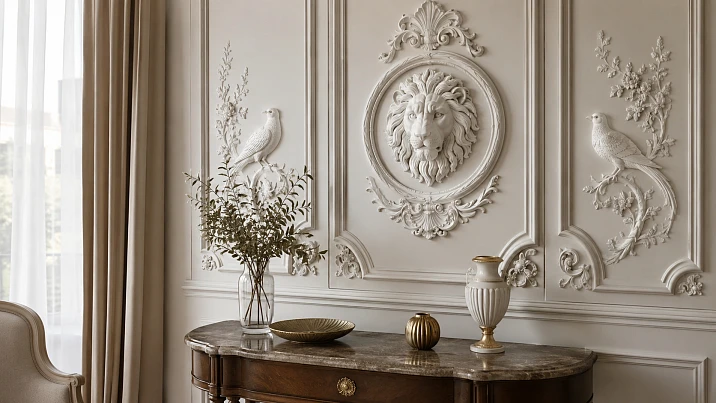
Animal ornament in decor is not a whim or a tribute to fashion. It is a language that space speaks: a bird above the headboard promises lightness and peace, a lion mascaron on the fireplace portal conveys strength and status, a fish in the bathroom reminds of freedom and depth. When such an image is executed precisely, in moderation, and in the right material, the interior turns from a set of objects into a story. Polyurethane moldings today is the best tool for this story: lightweight, durable, flawless in detail, and affordable without compromising quality.
Why animal ornament is at its peak again
Let's be honest: the trend for animal decor never went away. It went underground, quieted against the backdrop of ultraminimalism — but it never disappeared. Ancient friezes with eagles, Renaissance coats of arms with lions, Art Nouveau with curved dragonflies, Art Deco with deer — each era found its animal and inscribed it into architecture. Today, neoclassicism with its symmetry and meaning has returned to us, and with it — a demand for decor with character.
The difference between "expensive" and "tasteless" in animal ornament is not a matter of budget. It's a matter of choice: one large element with a precise relief versus a dozen small trinkets. A pair of mirror-image bird overlays on either side of a portal is an architectural gesture. A scattering of pseudo-animal motifs throughout a room is chaos. Polyurethane decorative appliques provide exactly what is needed: clear relief, correct scale, and the ability to build a composition precisely as intended.
Polyurethane as a material is also a practical answer to the question "why not plaster." Plaster is heavy, fragile during transport, requires professional installation, and is afraid of moisture. Polyurethane weighs several times less, can be cut with a knife, glued with construction adhesive to any prepared surface, and does not react to steam in the bathroom. That's why today, to buy stucco decor means to choose polyurethane.




Birds in stucco: lightness, symmetry, movement
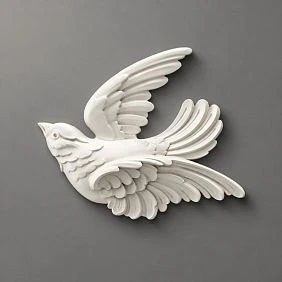
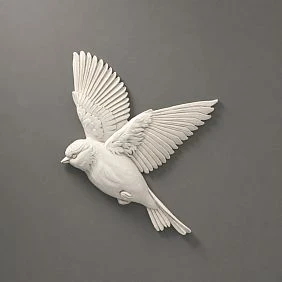
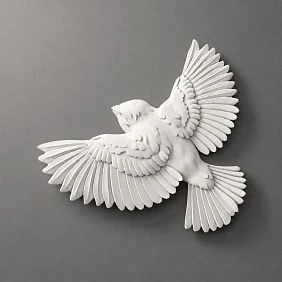
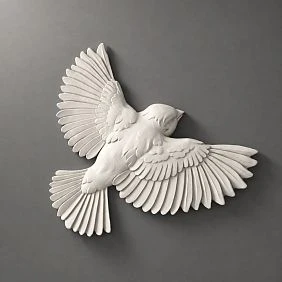
The bird is one of the oldest and most universal decorative motifs in interior history. In Egypt — the ibis and falcon as symbols of gods. In Rome — the eagle as a sign of power. In rocaille bedrooms — doves as an image of tenderness. In a neoclassical interior, a bird with spread wings is primarily visual lightness: the silhouette of a flying figure literally lifts the gaze upward, makes the wall "breathe," removes the feeling of heaviness even in small rooms.
Our factory also produces:
Where to install birds
A pair of symmetrical bird overlays works in several key scenarios:
-
Above the headboard — creates the feeling of a canopy without fabric, forms a "frame" for the head end, gives the bedroom solemnity without bulkiness
-
On either side of the fireplace portal — frames the main accent of the living room, fits into the classical axis of symmetry above the hearth
-
On pilasters and door slopes — emphasizes verticals, highlights the height of the room
-
As part of a panel — in a frame of polyurethane moldings the bird turns into a full-fledged relief painting on the wall
-
On furniture facades — small-format overlays look organic on cabinet doors, dresser drawers, side walls
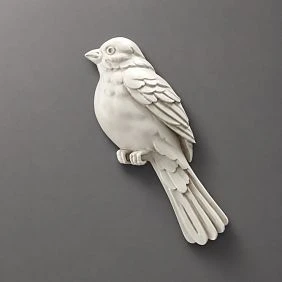
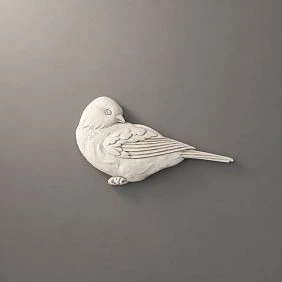
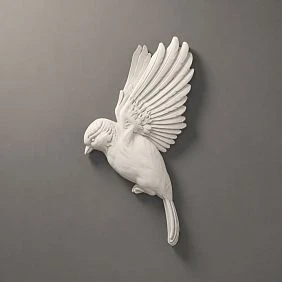
Molded decor NPU-492L и NPU-492R — this is a pair with pronounced relief and clear wing detailing, price 1,490 rubles per piece. This is a case where detail works at a distance: the element is readable from three meters without losing expressiveness. A similar story with a pair NPU-493L и NPU-493R at 1,430 rubles — a slightly smaller scale, the same level of detail, ideal for medium walls and furniture accents. If you need a compact option for narrow piers or door trims — NPU-497L и NPU-497R at 1,010 rubles will provide the needed accent without overload.
Get Consultation
Styles in which birds work
A bird in stucco is organic in neoclassicism — here it participates in a symmetrical system of decor along with cornices and moldings. It is appropriate in Art Deco — there the bird is often stylized, with geometric wings and clear contours. It even works in a modern interior with minimalist furniture: one bird overlay on an accent wall creates that very "author's" touch that many sterile spaces lack.
In terms of color — two options. Monochrome: the overlay matches the wall tone, the relief appears only in the play of light and shadow — this is subtle, almost invisible, very expensive-looking. Contrast: a white bird on a dark blue or graphite wall — this is a direct statement, a museum presentation. Gold patina — for those who choose between these two paths and want warmth.
Butterflies and dragonflies: spaces with a feminine character
A butterfly is an image of transformation, tenderness, and movement. A dragonfly is an image of lightness, elegance, and water themes. Both motifs historically belong to the Art Nouveau style with its cult of natural forms, but today they have gone far beyond a single direction. In modern interiors, butterflies and dragonflies primarily create spaces with a distinctly feminine character or a children's room where you want to create a fairy-tale atmosphere without kitsch.
Where butterflies are appropriate
Bedroom
— the best place for stucco with butterflies. Above the headboard, in a niche behind the bed, on the sides of a mirror — the overlays create a feeling of light fluttering, making the space airy. It's important not to overdo it here: two or three overlays in the right spots are better than a continuous pattern. Children's room
— another obvious choice. Butterflies and dragonflies work well in children's rooms for ages five and older, especially in girls' rooms with a pastel palette. For a children's room, stucco decor is chosen to match the wall tone or slightly lighter — bright contrasting execution looks rough. Beauty salon, nail studio, spa zone — the butterfly here reads as a signature image of lightness and transformation, which perfectly matches the concept of such spaces. Polyurethane wall decor with motifs of butterflies and dragonflies harmoniously fits into the decor system along with moldings and rosettes — this is no longer just an element, but part of a well-thought-out visual concept.
Balcony or loggia — glazed spaces with plant motifs: dragonflies next to decorative elements imitating leaves or stems create a botanical corner right in the apartment.
The principle of rhythm
Butterflies and dragonflies work well in rhythmic repetitions. Three overlays of different scales, placed diagonally on the wall — from large at the bottom to small at the top — create a sense of flight. This solution visually increases the height of the room and adds dynamics where straightforward symmetry would be boring.
A pair NPU-482L и NPU-482R at 590 rubles each — a new item with a laconic relief that works especially well in such diagonal compositions. NPU-481 at 290 rubles each — the most affordable single element in the line, suitable for rhythmic patterns or a point accent on a small section of wall.
Fish and marine theme: bathroom, restaurant, country house
Fish in decorative ornament — a motif with a thousand-year history. Early Christian catacombs, Mediterranean mosaics, Art Nouveau with carp and pike, Japanese style with koi — the image of a fish carries the symbolism of movement, depth, abundance, and elusiveness. In modern interiors, fish and marine themes are experiencing a true renaissance — especially in bathrooms, seafood restaurants, houses by the water, and country residences with a natural context.
Why polyurethane for marine decor
A bathroom is an environment with constant steam, temperature fluctuations, and high humidity. Plaster is unacceptable here: it gets wet, cracks, and develops mold at the joints. Wood without special protection behaves similarly. Polyurethane is the only available material that is completely moisture-resistant, does not absorb water, does not deform from steam, and can be painted in any color, including marine shades: turquoise, dark indigo, pearl gray, patina like aged silver.
Molded decor NPU-494L и NPU-494R 1,290 rubles each — a pair of overlays with a curved silhouette that works symmetrically in the bathroom: on both sides of the mirror, above the bathtub, in shower niches. Symmetrical L/R placement is a basic principle of architectural decor: a pair creates an axis, an axis creates order, order creates the feeling of an expensive interior.
Restaurant and public space
A restaurant with seafood cuisine, a fish bar, an oyster bar — these are spaces where decor directly works for the establishment's concept. Fish on the walls here are not just decoration: they are a narrative. The guest sees stucco overlays with fish silhouettes on columns or portals — and is already immersed in the theme even before opening the menu. Buy Molded Decoration For a restaurant, it is advantageous specifically in polyurethane: it is easy to clean, not afraid of wet cleaning, and holds paint for a long time.
In a restaurant context, fish overlays are patinated to look like old silver or bronze — this adds a touch of an "aged port city" and works in the interiors of a bistro, tavern, or yacht club.
Country house and cottage
In a country house with a view of a body of water or in a house by a river, the marine theme is not a stylization but a continuation of the context. Fish on stucco overlays in the hallway or living room become part of the same narrative as wooden floors, linen curtains, and views from the window. Here, natural shades are appropriate: linen, sand, ivory — the overlays "blend" into the wall, creating a soft volumetric accent.
Lion and mascaron: strength, status, formal areas
The lion's head as an architectural element is one of the oldest forms in European decor. It can be found above the entrances of medieval castles, on the capitals of Renaissance palaces, on the fireplace portals of Baroque mansions, and on the keystones of Classicism arches. A mascaron — a decorative mask with expressive facial features, facing directly at the viewer — is a special form of stucco decor that does not decorate the surface but gazes out from it. It is always a focal point, a dominant, a center of attention.
Mascaron MPU-002: details and scale
Polyurethane decor MPU-002 — a mascaron in the form of a lion's head with detailed rendering of the mane, brow ridges, and facial expression. Price 10,340 rubles. Available in several sizes: from compact 49×49 mm to monumental 208×208 mm with a relief depth of up to 69 mm. This allows you to choose the scale for a specific task: a small mascaron — on a chest of drawers drawer, on a cabinet door, in the center of a furniture panel; a medium one — above a doorway or on a pilaster; a large one — on a fireplace portal, an arch keystone, the central axis of a grand hall.
Where to install the lion
-
Fireplace and portal — a classic location. A lion mascaron above the hearth is the heraldic dominant of the entire living room or study. It sets the tone for the space, and no other decorative element can compete with it in significance.
-
Entrance group — above the front door of a house or in the grand hall of a cottage, a lion mascaron signals the owner's character even before the guest crosses the threshold.
-
Columns and pilasters — on the capital or in the center of the pilaster shaft, the lion integrates into the architectural system, becoming its organic part.
-
Study and library — masculine spaces with books, wood, and leather. Here, the mascaron is an element of heraldry in the most literal sense.
-
Dressing room
— a mascaron on mirrored doors or above the entrance to a dressing room turns a functional space into a room with character. It is important to understand: a lion mascaron is a single element. It does not need a pair. Its strength lies in axial placement: strictly in the center of the surface it crowns. All other decoration around it should be restrained, otherwise the mascaron will be lost in ornamental noise.
How to choose size, L/R pair, relief, and installation location
Choosing a decorative overlay is not just about aesthetics. It's about a system of parameters, each of which affects the final result. Let's break them down in detail.
Size relative to the wall and room
Basic rule: the height of the decorative element should not exceed 1/6 of the wall height. In a room with a 2.7 m ceiling, this means an overlay no higher than 45 cm. In a room with a 3.5 m ceiling, up to 58 cm. Violating this rule creates a 'sunken' wall effect, where the decor overwhelms the space instead of decorating it.
Small rooms (up to 12 sq.m.) — a maximum of two or three small-format overlays (up to 20 cm) or one medium one. Large spaces (from 25 sq.m.) — allow large elements and complex symmetrical compositions. High ceilings (from 3.2 m) — directly call for vertically oriented overlays or pairs arranged by height.
L/R pair: why mirroring is not an option
Most overlays with animals are produced in mirror pairs L (left) and R (right). This is not a coincidence — it's the architectural logic of symmetry, without which any classical and neoclassical composition falls apart. A bird flying in one direction is a glance left or right. Two birds flying towards each other is an axis, a center, a semantic point. That's why decorative polyurethane elements with animals should always be considered in pairs: NPU-492L + NPU-492R, NPU-493L + NPU-493R, NPU-494L + NPU-494R, NPU-497L + NPU-497R.
A single element is appropriate only in two cases: it is a central mascaron (like MPU-002) or it is a deliberately asymmetrical, authorial composition where breaking symmetry is an artistic technique, not an accident.
Relief and thickness
Relief — the depth to which an element protrudes from the wall plane — determines how the overlay will be "read" depending on distance and lighting.
-
Deep relief (from 25 mm) — clearly visible from a distance of 3–5 m, creates pronounced chiaroscuro, suitable for large rooms and formal areas. The MPU-002 mascaron with a relief of up to 69 mm is a sculpture, not an overlay.
-
Medium relief (15–25 mm) — a versatile option for medium-sized living rooms, readable from 2–3 m, does not overwhelm the space.
-
Flat relief (up to 15 mm) — for furniture facades, narrow wall sections, accent walls with side lighting. Under frontal light, it is almost invisible — which is why such overlays require directional lighting or a contrasting background.
Installation location: height and axis
The height of the overlay placement is critical for perception:
-
170–200 cm from the floor — the "above head" level. Birds here appear to be flying upward, which visually raises the ceiling. A mascaron at this height — above a door, above a fireplace — works as an architectural crown.
-
130–160 cm — the eye level of a standing person. Butterflies, fish, small overlays here are perceived as "alive," close. This is the level for accent walls, bedside areas, niches.
-
Below 100 cm — furniture level. Overlays here work on cabinet facades, drawers, bed panels. A small mascaron on a dresser drawer is an aristocratic touch.
How to combine with moldings, rosettes, frames, and paint
The animal motif in decor looks complete only when included in a unified system. A separately hanging overlay is a souvenir. An overlay in a system is architecture.
Moldings as framing
Moldings made of polyurethane — cornices, baseboards, friezes — create horizontal and vertical axes into which animal decor is organically integrated. A bird or butterfly inscribed in a rectangular frame of molding turns into a panel. A lion mascaron flanked by a pair of pilasters with a cornice on top becomes a portal. A fish installed in a niche framed by an archivolt molding is a full-fledged architectural element.
Practically: the molding should be chosen proportionate to the overlay. Thin molding (20–30 mm) for small overlays with butterflies, wide cornice (60–80 mm) for a large mascaron. Mismatch of scales is the most common mistake during DIY installation.
Rosettes and point decor
Ceiling rosettes and decorative PU overlays with floral and geometric motifs — an addition that completes the system. A rosette above the center of the fireplace, next to which stands a mascaron, is a vertical axis running through the entire room from top to bottom. Corner overlays at the joints of moldings are details that "close" the corners and give the system completeness.
Painting: three strategies
Monochrome
— the overlay is painted exactly the color of the wall. The relief is revealed only through the play of light and shadow. Effect: subtle, intelligent, "hidden luxury." Suitable for restrained interiors in a neutral palette. Contrast
— white overlay on a dark wall (blue, graphite, emerald) or dark on a light one. Effect: strong visual accent, "museum" presentation, decor as an independent object. Suitable for spaces with an author's concept. Patina
— applying aged gold, silver, bronze over a white or cream base. Effect: noble antiquity, materiality, historical depth. Suitable for classic, neoclassical, art deco. A lion mascaron in gold patina on a white wall is one of the most "expensive" techniques in working with stucco decor. Technically, painting does not require special skills: polyurethane perfectly accepts water-based acrylic and latex paints, holds them without peeling, and does not absorb into the depth. For patina, decorative compounds with metallic pigment are used, applied over the dried base paint with a soft brush using "blending" — a technique mastered in one evening.
Installation of stucco with animals: step-by-step logic
Proper installation is 90% of success. A beautiful overlay installed crookedly or with gaps loses all its power. Let's break down the process from start to finish.
Surface preparation
The wall must be dry, clean, without peeling coatings. If the wall is covered with wallpaper, make sure the wallpaper is securely attached. Glossy surfaces should be lightly sanded to improve adhesion. Cracks and significant unevenness are filled with putty in advance — polyurethane will not hide depressions in the wall, but will only emphasize them with its contour.
Marking and Fitting
Marking is half the work. Spend 20 minutes on marking with a level and tape measure, and installation will go without rework. Key points: axis of symmetry (for L/R pairs), height of the overlay center, distance from nearby architectural elements. Before applying glue, be sure to hold the overlay against the wall dry — make sure everything fits exactly as intended.
Adhesive and fixation
For polyurethane products, assembly glue is used — acrylic or a special compound for PU. Glue is applied to the back side of the overlay in a "snake" pattern or in dots with a step of 5–7 cm. The element is pressed against the wall and held for 30–60 seconds. For heavy elements (large mascaron), additionally secure with painter's tape until the glue is completely dry (1–2 hours).
Finishing seams and painting
Gaps between the overlay and the wall, as well as between adjacent elements, are filled with acrylic sealant, which after hardening is rubbed with putty and sanded. After sanding — priming and painting in two to three thin layers. Result: the overlay looks like part of the wall, not like an attached object.
New additions to the line: what has appeared in the assortment
Assortment buy stucco decor regularly updated with new items. Among the current novelties are several positions that deserve special attention:
NPU-479 for 770 rubles — a single element with a concise relief that works well in rhythmic patterns and modern interiors.
NPU-480 for 660 rubles and NPU-485 for 660 rubles — compact novelties for accent areas with limited space.
NPU-489 for 610 rubles — another novelty in the lower price segment, suitable for children's rooms, bedrooms, and feminine spaces.
NPU-484 for 1,600 rubles — the largest single element in the group of carved overlays, designed for formal areas and accent walls with high ceilings.
NPU-486 for 1,140 rubles, NPU-487 for 1,470 rubles and NPU-488 for 1,170 rubles — three medium-format items with pronounced relief that work well both in independent compositions and in a system with moldings.
NPU-476L и NPU-476R for 1,360 rubles each, as well as NPU-477L и NPU-477R 980 rubles each — mirror pairs for symmetrical solutions.
NPU-483L и NPU-483R 1,340 rubles each — a pair with expressive relief for medium and large walls.
Systematic approach: how to build room decor around an animal motif
Animal stucco works most powerfully when it is not a separate 'decorative' element, but the semantic center of a well-thought-out system. Here's how it looks in practice.
Scenario 1: Bedroom with birds
Above the headboard — a pair of NPU-492L/R in a symmetrical arrangement, birds facing each other. A frame of thin of polyurethane moldings frames the headboard area. On the sides of the bed — sconces with warm light, which in the evening creates soft chiaroscuro on the relief of the overlays. Everything matches the wall tone — cream or soft gray. Effect: a boutique hotel-level bedroom with minimal investment.
Scenario 2: Study with a mascaron
A fireplace with a portal in the center of the wall. Above the portal on the axis of symmetry — MPU-002 large format in gold patina. Pilasters on both sides of the portal, whose capitals are decorated with corner decorative elements made of polyurethane. Shelves with books, dark wood, leather armchair — all of this is already there. The mascaron completes the image, puts the finishing touch. No other element in the study competes with it — that's the rule.
Scenario 3: Bathroom with a nautical theme
A mirror framed with molding. On both sides of the mirror — NPU-494L/R in a patina of smoked silver. Walls in deep blue or petrol color. Floor tiles with a sea stone texture. Polyurethane wall decor as a horizontal frieze with a nautical ornament under the ceiling. Everything works in a unified theme, fish are its visual anchor.
Scenario 4: Children's room with butterflies
Accent wall behind the bed — soft mint or lilac. On the wall — three butterfly appliqués of different scales: a large one in the center, two smaller ones on the sides and slightly higher. A thin molding horizontally divides the wall into two zones — the lower (solid color) and the upper (with appliqués). NPU-481 for 290 rubles in this composition gives maximum visual impact with a minimal budget.
Frequently asked questions about animal moldings: expert answers
Can polyurethane moldings be installed in a bathroom?
Yes, polyurethane is the only material for decorative moldings that is fully compatible with a humid environment. It does not absorb water, does not deform from steam, and is not prone to mold. Important: all joints between the appliqué and the wall must be sealed with moisture-resistant acrylic sealant.
Do I need to order both parts of a pair (L and R) at the same time?
Always. Even if you think one appliqué is enough, order a pair. Reasons: first, shades and texture of the material may slightly differ between production batches; second, symmetry is a basic principle of quality interior decor, and one appliqué without a pair looks incomplete.
How to properly paint stucco molding with a patina effect?
The base layer is white or cream acrylic paint in two coats. After drying, apply a decorative compound with metallic pigment (gold, bronze, silver) using a dry brush technique: dip the brush slightly into the compound, remove most of it on paper, then apply it with light strokes to the raised parts of the relief. The recesses remain dark, creating an aged effect.
Can stucco molding be repainted after installation?
Yes, this is one of the key advantages of polyurethane. The surface is sanded with fine-grit sandpaper (180–220 grit), primed, and repainted. The color and type of coating can be changed an unlimited number of times without removing the overlay.
Which adhesive to use?
Use acrylic mounting adhesive like liquid nails or a special compound for PU. Do not use two-component epoxy adhesives — they create a rigid joint without compensating for thermal expansion, which leads to cracks at the seams.
For a symmetrical area (fireplace, headboard, portal): always a pair. For rhythmic ornament: an odd number (3, 5) for centrally symmetrical compositions. For framed panels: calculate the panel perimeter, divide by the length of one molding element, and add 10% for trimming.
For a symmetrical zone (fireplace, headboard, portal): always a pair. For a rhythmic pattern: an odd number (3, 5) for centrally symmetrical compositions. For framed panels: calculate the perimeter of the panel, divide by the length of one molding element, add 10% extra for trimming.
How much does it cost to buy stucco molding with animals?
The range is wide: from 290 rubles (NPU-481, single compact element) to 10,340 rubles (MPU-002, large-format lion mascaron). A pair of medium overlays with birds costs about 2,860–2,980 rubles per set. This is comparable to the cost of a good mirror frame, but with an incomparably greater visual impact.
About the Company
Decorative overlays with animals, moldings, cornices, baseboards, rosettes, and the entire assortment moldings from polyurethane — это продукт, за которым стоит многолетняя экспертиза. STAVROS — российский производитель и поставщик декоративных изделий из полиуретана, ориентированный на профессиональный рынок и частных покупателей, которые ценят качество. Компания выпускает изделия с чёткой геометрией, выверенным рельефом и точной прорисовкой деталей — именно то, что отличает профессиональный декор от массовой продукции неизвестного происхождения.
STAVROS производит и поставляет полный спектр изделий для декорирования интерьеров: Decorative Inserts, Moldings and cornices, Wall Decor из полиуретана — от компактных акцентов до монументальных маскаронов. Все изделия доступны к заказу с доставкой по всей России.