










































































Article Contents:
- A niche without design is just a hole in the wall
- Typology of decorative niches: different tasks — different decor
- Type one: vertical niche for a vase or figurine
- Type two: horizontal niche for a shelf
- Type three: large accent niche
- Type four: symmetrical pair of niches
- Type five: niche for a TV
- Moldings around the niche: how to build a frame
- Perimeter frame: basic solution
- Double frame: molding + indent + molding
- Molding on the side edges of the niche
- Molding along the top edge of the niche: cornice inside
- Horizontal molding belt on the main wall
- Selection of molding profile to match the niche style
- Decorative stucco above and inside the niche: four working positions
- Position one: above the niche, on the main wall
- Position two: 'lock' at the top of the frame
- Position three: corner elements on the outer corners of the frame
- Position four: on the back wall of the niche
- Lighting and molding: how they work together
- Where to place lighting in a niche
- Why smooth joint preparation is important
- Calm molding profile for niches with lighting
- Warm or cool light: which to choose
- Color and painting of a decorative niche: three working schemes
- Scheme one: solid monochrome — niche in wall color
- Scheme two: contrasting back wall
- Scheme three: niche darker than the main wall
- Space for a niche: living room, hall, bedroom, bathroom
- Living room: accent niche on the wall behind the sofa
- Hall: a pair of symmetrical niches
- Bedroom: niche at the headboard
- Bathroom: niche in the shower wall or above the bathtub
- Three ready-made sets for a decorative niche
- Set «Minimalist niche»
- Set «Classic niche»
- Set «Modern neoclassicism»
- Complete shopping checklist for a decorative niche
- Step-by-step installation of moldings around a niche
- Step one: preparing the base
- Step Two: Marking
- Step three: cutting the molding
- Step four: installation
- Step five: priming and painting
- Common mistakes when decorating decorative niches
- Frequently Asked Questions
- STAVROS: everything for a decorative niche in one place
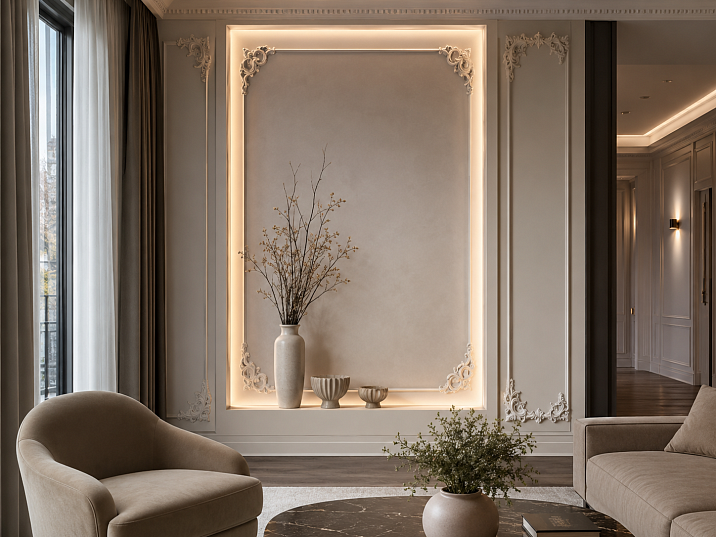




A niche without framing is just a hole in the wall
Let's be direct: a decorative niche in the wall is one of the most underestimated architectural opportunities in interior design. Builders made it, you got it, and it stands — empty, with smooth plastered walls, without a frame, without depth, without character. You placed a vase inside. You looked. Something is off.
The problem is not the vase. The problem is that the niche is not framed. It has no frame, no architectural completion, no connection to the rest of the wall. It exists as a technical fact, not as a decorative element.
What changes the situation? Stucco molding for a niche — moldings around the perimeter, a decorative accent above the opening, neat painting, thoughtful lighting. Three hours of work, one day off — and the niche turns into a full-fledged architectural object.
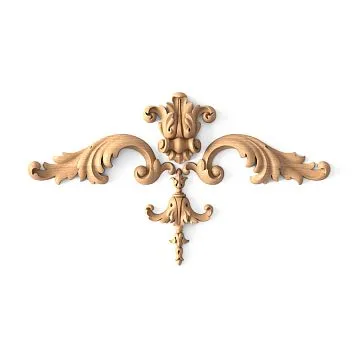
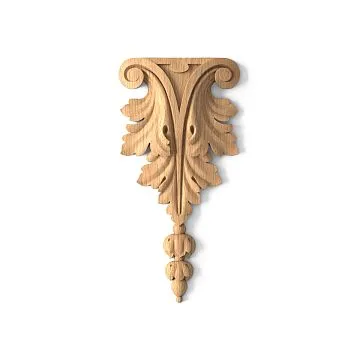
A decorative niche looks expensive when Moldings made of polyurethane they assemble the frame, Relief Decoration emphasizes the top and side lines, lighting shows the relief, and uniform painting turns the recess into a full-fledged architectural accent.
Let's break down exactly how this works in detail, with dimensions, logic, and specific solutions.




Typology of decorative niches: different tasks — different decor
Before talking about moldings and stucco, you need to understand what type of niche you are working with. This determines the scale of the decor, the choice of molding, and the placement of decorative accents.
Our factory also produces:


Type one: vertical niche for a vase or figurine
A tall narrow niche: width 30–60 cm, height 80–150 cm, depth 15–25 cm. This is a "sculptural stand" in the wall — a classic architectural technique rooted in antiquity.
Such a niche is designed for one item: a tall vase, sculpture, decorative object. The stucco here is a frame around the perimeter of the opening and one decorative accent above it.
Get Consultation
Type two: horizontal niche under a shelf
Wide low niche: width 80–200 cm, height 30–60 cm, depth 15–30 cm. Essentially a recessed shelf. Placed above a sofa, above a bed, in the fireplace area.
Decor: molding frame around the perimeter, horizontal border under or above the niche, possible central accent along the middle axis.
Type three: large accent niche
Full-height or large-format niche: width 80–150 cm, height 200–250 cm. This is almost an "arch without a door" — a portal space.
Decor: molding frame, decorative elements in the "keystone" of the arch or above the rectangular opening, side vertical accents, possible lighting inside the niche.
Type four: symmetrical pair of niches
Two identical niches on either side of a fireplace, sofa, bed, or TV. Each receives identical decor — mirror symmetrical.
Decor: identical molding frames, paired decorative accents. Symmetry is mandatory.
Type five: TV niche
Wide deep niche: width 100–200 cm, height 60–120 cm, depth 10–20 cm. Functional but requiring decorative finishing.
Decor: molding frame around the perimeter, horizontal molding belt above the niche, minimal accent — no floral ornament.
Moldings around the niche: how to build a frame
Moldings for a niche — is the main structural element of the design. They create a clear boundary between the niche and the main wall, giving the opening an architectural character.
Perimeter frame: basic solution
Molding along the entire perimeter of the niche opening: top, bottom, and both side edges. This is a frame that 'frames' the niche like a picture.
Parameters:
-
The molding is mounted on the main wall along the edge of the opening.
-
Molding offset from the opening edge: 0–5 mm (flush or with minimal gap).
-
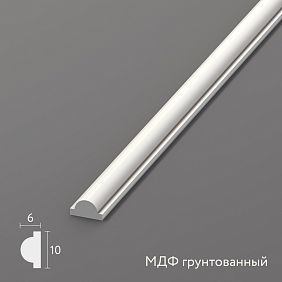
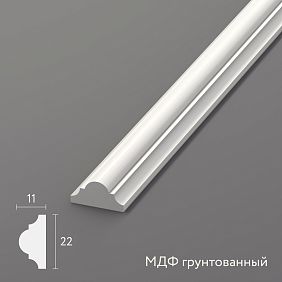
Molding width: 25–45 mm for most niches. Small niches — 20–30 mm, large portal niches — 35–50 mm.
-
Profile projection: 12–20 mm. Smaller projection — for niches with lighting (molding shadow does not block the light), larger — for niches without lighting (relief reads well).
Frame corners: cut at 45°. Miter box or miter saw. Joints — acrylic sealant.
Double frame: molding + gap + molding
Richer solution: two molding frames with a gap between them. Outer frame — along the main wall, inner frame — closer to the edge of the opening.
Parameters:
-
Gap between frames: 50–120 mm.
-
Outer frame width: 30–45 mm.
-
Inner frame width: 20–30 mm (slightly narrower).
-
The field between frames can be painted in a contrasting or darker tone — this creates additional depth.
Double frame is suitable for large accent niches and portal openings. For small niches, it looks overloaded.
Molding on the side faces of the niche
The inner side walls of the niche are vertical faces 15–30 cm deep. A vertical molding along the front edge of each face creates a "trim" — an architectural framing that turns the boundary between the niche and the wall from a mere geometric line into a decorative detail.
The width of the molding for the side edges: 15–25 mm — narrower than the perimeter molding. This helps maintain proportions and avoids "squeezing" the side edge.
Molding on the top edge of the niche: an internal cornice
The horizontal molding on the top inner edge of the niche acts as a mini-cornice. It creates a shadow above the niche space and adds a "ceiling" finish.
Especially appropriate if lighting is planned inside the niche — the LED strip is mounted behind the molding, and then the molding simultaneously hides the hardware and creates an architectural cornice.
Horizontal molding belt on the main wall
Molding at the level of the top edge of the niche, running across the entire width of the wall — as a horizontal belt. Or molding at the level of the bottom edge. This "integrates" the niche into the overall horizontal system of the wall.
buy polyurethane moldings For a horizontal belt — it means extending the line of the niche cornice across the entire wall. This transforms the niche from a separate "island" into part of the architectural system.
Choosing the molding profile to match the niche style
The shape of the molding profile determines the stylistic character of the niche. A niche in a classic interior with a rectangular molding without a profile looks out of place — and vice versa.
| Interior style | Molding profile | Width | Projection |
|---|---|---|---|
| Classic, neoclassic | S-shaped (OGI), multi-level | 35–50 mm | 15–25 mm |
| Modern neoclassicism | Rectangular with bevel | 25–40 mm | 12–18 mm |
| Provence, shabby chic | Classic with rounded edges | 30–45 mm | 15–20 mm |
| Art Deco | Rectangular stepped | 30–45 mm | 15–20 mm |
| Scandinavian | Narrow rectangular | 20–30 mm | 8–12 mm |
| Minimalism | Without molding or "shadow" groove | — | — |
Decorative stucco above the niche and inside: four working positions
Decorative stucco for the niche — this is an accent decor that creates a "culmination" in the architectural system of moldings. The rule is the same as for all zones: one or two elements at key points are more effective than five random ones.
First position: above the niche, on the main wall
One decorative element above the top molding of the frame — along the central axis of the niche. This is the "keystone" above the opening.
Element type: medallion, cartouche, floral overlay. Size: 120–200 mm horizontally. For large niches — up to 250–300 mm.
Distance from the top frame: 5–15 cm from the top molding to the bottom edge of the decorative element.
This technique works especially well when there is enough wall above the niche — at least 40–60 cm to the ceiling or cornice.
Position two: "keystone" in the upper part of the frame
If the niche has an arched top or if the upper horizontal molding has a central "keystone" element — the decorative overlay is mounted directly on the molding at the center of the top edge.
This enhances the architectural character of the opening. Size: 80–150 mm. Profile: cartouche, keystone (rectangular with ornament), floral central element.
Position three: corner elements on the outer corners of the frame
Decorative corner inserts on the outer corners of the perimeter frame — at four points (or only at the top two). They "cover" the corner joints of the molding while providing a decorative accent.
Size of corner inserts: 50–100 mm. For classic style — floral rosettes. For strict neoclassicism — geometric corner elements.
Decor for Molding — a separate category where you can find specifically corner and joint decorative details. They are designed specifically for installation in the corners of molding frames.
Position four: on the back wall of the niche
A small decorative element on the back wall of the niche — in the center of the upper third. This works as a "depth" accent, creating a visual focal point within the niche space.
Size: modest — 80–120 mm. A larger element on the back wall will compete with the object placed inside the niche.
Lighting and stucco: how they work together
Lighting is one of those details that either elevates a niche to the level of a true architectural object or mercilessly exposes all installation errors. Light in a niche is like an X-ray: it shows everything.
Where to place lighting in a niche
At the top inside the niche. An LED strip or spotlights behind the molding of the upper edge is the most common solution. The light is directed downward, illuminating the object inside and the side walls. The molding hides the strip and creates a "light cornice."
On the sides of the niche. Vertical light strips along the side edges — a more theatrical, accent solution. Creates a "frame of light" for the object inside. Suitable for sculptures and expensive vases.
At the bottom of the niche. Lighting from below — along the lower edge or on the floor of the niche — creates a "reverse" light pattern: light comes from bottom to top, the object "floats" in light. This is a strong, theatrical technique.
On the main wall above the niche. A directed spotlight aimed into the niche from above — a simple, practical solution without installation inside the niche itself. Illuminates the niche from the outside, at an angle.
Why smooth joint preparation is important
Backlighting inside the niche reveals any unevenness. The joint of the molding with the base, corner connections of the frame, the transition point of the stucco to the wall — all of this must be flawlessly puttied, sanded, and primed.
Algorithm for joint preparation when backlighting is present:
-
Molding installation — glue + tape until dry.
-
Sealing joints with acrylic sealant.
-
Drying — at least 2 hours.
-
Sanding joints with 320–400 grit sandpaper.
-
Priming the entire surface.
-
First coat of paint — check all joints under directed light.
-
If necessary — additional sanding and a second coat of paint.
Two to three thin layers of paint instead of one thick one is a must when there is backlighting.
A calm molding profile for niches with backlighting
When there is backlighting inside a niche, it is better to choose a molding profile without deep relief: rectangular, simple, without ornament. Why? Directional light creates a harsh shadow from the protruding relief, and a complex profile starts to 'scream' with light and shadow, competing with the object inside the niche.
Buy polyurethane moldings for niches with backlighting means choosing a profile with clear geometry and a projection of 10–15 mm without decorative ornament on the molding itself.
Warm or cool light: what to choose
For niches with decorative objects, stucco, and warm wall colors — warm white (2700–3000 K). It highlights the texture of plaster, wood, ceramics.
For niches in a modern monochrome interior with gray or white walls — neutral white (3500–4000 K). More 'architectural', clear light.
Cool light (above 5000 K) in decorative niches with stucco is almost never appropriate: it makes shadows 'bluish' and deprives the surface of coziness.
Color and painting of a decorative niche: three working schemes
Scheme one: solid monochrome — niche in the color of the wall
All elements — the molding frame, decorative overlays, the main wall, and the inner walls of the niche — are in one color. The relief is only readable through light and shadow.
This is the most modern and, from an execution standpoint, the most complex solution. Any unevenness in the joints is especially visible here — precisely because there is no color "distraction."
Best colors for a monochrome niche:
-
Warm white — a universal solution, "dissolves" the niche into the wall.
-
Deep gray-beige — neutral, architectural.
-
Dusty blue — calm, delicate.
Scheme two: contrasting back wall
The main wall and frame are in a light color, the back wall of the niche is in a rich contrasting color. This creates a "window" into another color, which makes the niche visually deeper.
Examples of combinations:
-
White walls + dark blue back wall.
-
Light gray walls + terracotta back wall.
-
Cream walls + bottle green back wall.
Polyurethane wall decor And the moldings in this scheme are painted the color of the main wall — becoming a "frame" for the contrasting "picture" of the back wall.
Scheme three: niche darker than the main wall
Gentle, unobtrusive contrast: the niche is 1–2 shades darker than the main wall. Moldings are the color of the main wall. This creates a sense of depth without sharp contrast.
This scheme works especially well in niches without lighting: the niche "recedes" into shadow, creating visual depth.
Space for the niche: living room, hall, bedroom, bathroom
Living room: accent niche on the wall behind the sofa
A niche behind the sofa — on a side wall or on the wall behind the central sofa — is one of the most common tasks.
Casing:
-
Molding frame made of polyurethane 30–40 mm around the perimeter.
-
Decorative accent above the niche — a medallion or cartouche.
-
Horizontal molding band at the level of the niche's lower edge — across the entire width of the wall.
-
Top lighting — warm white.
-
Inside the niche: a tall vase, a decorative object.
Niche width relative to sofa width: niche 40–60% of sofa width — accent element. Niche 80–100% of width — full architectural zone.
Hall: a pair of symmetrical niches
Two niches on either side of the entrance door or on either side of the fireplace — a classic solution for a hall.
Casing:
-
Identical molding frames.
-
Identical decorative elements above each niche.
-
Symmetrically placed objects inside.
-
Crown molding made of stucco along the perimeter of the hall at the level of the upper edge of the niches.
Symmetry is an absolute rule for paired niches. Any deviation in height or size of the frames is immediately noticeable.
Bedroom: niche at the headboard
A niche in the wall behind the bed — instead of or in addition to the molding frame of the headboard.
Casing:
-
Delicate molding 20–30 mm.
-
A small decorative accent at the top.
-
Lighting — soft warm light.
-
Painting: niche in a contrasting color or monochrome in the wall color.
Bathroom: niche in the shower wall or above the bathtub
In the bathroom, the niche is designed differently: here, no polyurethane stucco (humid environment), but moldings and decor made of moisture-resistant materials or polyurethane with a moisture-resistant coating.
For finishing the edges of a niche in the bathroom: ceramic molding or mosaic insert. Polyurethane Decorative stucco — only in the dry zone of the bathroom (above the mirror, on the far wall).
Three ready-made kits for a decorative niche
Kit "Minimalist Niche"
For a modern interior without historical motifs.
-
Polyurethane molding 25 mm, rectangular profile, around the perimeter.
-
Painting: monochrome in wall color.
-
Lighting: LED strip behind the molding of the top edge.
-
Decorative element: none.
Effect: neat frame, light, cleanliness.
Classic Niche Set
For a classic or neoclassical interior.
-
Moldings made of polyurethane 35–40 mm, classic S-shaped profile, along the perimeter.
-
Buy decorative stucco — cartouche or medallion above the niche 150–180 mm.
-
Corner decorative inserts in the two upper corners of the frame — from the category Decor for Molding.
-
Horizontal molding belt at the level of the lower edge of the niche — along the entire wall.
-
Painting: moldings white, back wall contrasting.
-
Lighting: spotlights in the upper edge.
Effect: architectural, solemn, finished.
Set "Modern Neoclassicism"
Balance between strictness and classical character.
-
Moldings made of polyurethane 30 mm, rectangular with bevel, double frame — outer 35 mm + inner 25 mm.
-
One geometric medallion 140 mm above the niche.
-
Molding on the side edges of the niche 15–20 mm.
-
Polyurethane wall decor — horizontal border under the niche 30 mm across the entire wall.
-
Painting: monochrome, all elements in wall color.
-
Lighting: tape behind the molding of the upper edge + spot above the niche.
Effect: modern interior with classical architectural character, without explicit historical reference.
Complete shopping checklist for decorative niche
| Task | What to buy |
|---|---|
| Frame around the niche perimeter | Moldings made of polyurethane 25–45 mm + 20% spare |
| Decorative accent above the niche | Buy Moldings — 1 medallion or cartouche |
| Corner inserts for the frame | Decor for Molding — 2–4 corner elements |
| Horizontal band on the wall | Polyurethane wall decor — border or molding |
| Mounting material | Polyurethane glue + acrylic sealant |
| Finish | Acrylic primer + acrylic paint (2 tones for contrast) |
| full set | Buy molding as a set — moldings + decor + glue + spare |
Step-by-step installation of moldings around a niche
Step one: surface preparation
Clean the surface around the niche with 180-grit sandpaper. Remove dust. Degrease the surface. If the wall is drywall, apply a deep penetration primer.
The edges of the niche opening must be straight and even. Fill and sand uneven edges to a perfect right angle. Otherwise, the molding will have a gap that sealant cannot cover.
Step two: marking
Be sure to mark the central axis of the niche. From it, equal distances to the sides of the frame. Use a level for horizontals.
If the niche is not perfectly rectangular (which happens), do not follow the niche's geometry; instead, build the frame using a level. Fill the space between the frame and the uneven niche edge with putty.
Step three: cutting the molding
All angles are 45°. For precise cutting, use a miter box with a metal stop or a miter saw. Check each angle dry before applying glue.
Allowance for trimming: 20% of the calculated footage. Corner joints result in material loss, and trimming errors require rework.
Step four: installation
Apply mounting glue in a zigzag pattern across the entire back of the molding. Press firmly against the wall strictly according to the markings. Secure with painter's tape. Leave for at least 1.5–2 hours before removing the tape.
After installing the entire frame, apply sealant to all joints. Smooth with a wet finger. Allow 2–3 hours to dry. Sand joints with 320 grit.
Step five: priming and painting
Apply primer to all system elements and the wall area around the frame. Allow 2–4 hours to dry. For the first coat of paint, check joints and evenness under directed side lighting. If necessary, perform additional sanding and priming. The final coat of paint should be thin and even.
Common mistakes when designing decorative niches
Mistake one: molding too wide for a small niche. A 50 mm molding on a 40 × 40 cm niche is like a frame larger than the picture. Scale must match: molding width no more than 10–15% of the niche width.
Mistake two: too many decorative elements. A medallion above the niche + corner inserts + a border at the bottom + overlays inside is overload. One or two accents at key points.
Mistake three: different molding profiles in one system. A niche frame made of a classic S-shaped profile and a horizontal band made of rectangular molding creates a style conflict. Use one profile for the entire system.
Mistake four: lighting before finishing installation and painting. The LED strip should be installed after the molding system and painting are completely finished — otherwise, paint will get on the strip, and the light will expose unpainted joints.
Mistake five: not accounting for cutting allowance. Buying molding without a reserve means risking that one strip won't be enough for the last corner. Always add +20% to the calculated length.
Frequently asked questions
How to design a wall niche?
polyurethane moldings around the perimeter of the opening, buy decorative molding for an accent above the niche, decor for moldings into the corner points of the frame. Paint in the color of the wall or with a contrasting back wall.
What to buy for a decorative niche?
Moldings made of polyurethane with a 20% reserve, one decorative element above the niche from the category Buy Moldings, mounting glue, acrylic sealant, primer, paint.
Can I make a niche with backlighting and stucco molding?
Yes. The key condition: the molding on the upper inner edge of the niche hides the LED strip, and the joints must be impeccably prepared — the backlighting reveals any unevenness. The molding profile is simple, without ornamentation.
How not to overload the niche with stucco molding?
One molding of one profile around the perimeter, one decorative accent above the niche. Corner inserts are optional. The rest of the wall is calm.
Is a horizontal molding belt across the entire wall necessary?
Desirable — if the niche does not occupy most of the wall. A belt at the level of the lower or upper edge of the niche 'integrates' it into the wall system and prevents it from looking like a random architectural solution.
How to choose the size of the decorative element above the niche?
The width of the decorative element is 30–50% of the niche width. For a 60 cm niche → element 18–30 cm. For a 100 cm niche → 30–50 cm. The element should not be wider than the molding frame.
STAVROS: everything for a decorative niche in one place
A niche is a small detail in a large interior. But it is precisely the small details, done correctly, that give the feeling of an expensive, well-thought-out space. A frame of molding, one decorative accent, neat painting — and the recess in the wall becomes an architectural object.
STAVROS offers a full range for decorating decorative niches: Moldings made of polyurethane in a wide selection of profiles and sections, buy decorative moldings — medallions, cartouches, floral and geometric overlays, Decor for Molding for corner inserts and connecting elements, Polyurethane wall decor for horizontal borders and belts.
All products are made of polyurethane — precise geometry, easy glue installation, painting with acrylic paint in any color.
Buy molding getting a complete niche kit means getting a system that works.
STAVROS. Delivery across Russia. Pickup in Moscow and St. Petersburg.
A niche deserves a frame. Give it one.