Article Contents:
- Short answer: when you need a wooden layout for furniture
- What is a wooden layout for furniture facades
- Where to use layout on furniture
- On cabinets
- On dressers
- On Kitchen Facades
- On display cabinets and sideboards
- On nightstands and consoles
- Flat, shaped, or corner layout: what to choose
- How to choose the size of the layout
- How to make a frame on a furniture facade
- Layout for furniture restoration
- How to combine layout with handles, legs, and overlays
- Layout for painting, varnish or stain
- Wooden profile for furniture: a separate look at solid wood moldings
- Mistakes when choosing wooden layout for furniture
- What to buy together with wooden layout
- FAQ: questions asked when choosing layout for furniture
- About the Company STAVROS

The answer is almost always the same: there is no layout. It is the wooden layout for furniture that creates a frame on the front, emphasizes the geometry of the door, adds a classic silhouette to even the simplest cabinet or chest of drawers. This is not an expensive decor or a complex modification — it is a wooden profile that, when chosen correctly, completely changes the perception of furniture.
This article is for those who want to understand: what types of layout exist, which surfaces they are suitable for, how to choose them by size, profile and style, how to combine them with handles, legs and overlays — and how to ultimately get a result that looks professional.
Short answer: when wooden molding for furniture is needed
Before diving into details — a quick guide to situations. Wooden molding for facades is needed if:
-
You want to decorate a door or drawer with a decorative frame — flat or shaped;
-
You need to cover the joint between two surfaces, hide an edge or end;
-
The furniture looks too simple and "flat", but a full replacement is not planned;
-
A wardrobe, chest of drawers, or kitchen is being transformed into a classic or neoclassical style;
-
Restoration of old furniture is being carried out without replacing the body;
-
The facades will be painted with enamel, varnish, or stain — and the molding must "blend" into a single coating;
-
You need to align the visual rhythm on paired doors or symmetrical drawers.
In all these situations Wooden molding works as a solution — inexpensive, precise, and stylistically convincing.




What is a wooden layout for furniture facades
Let's start with a definition, because confusion in terms is common here.
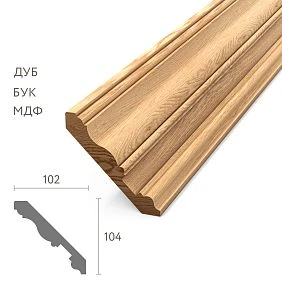
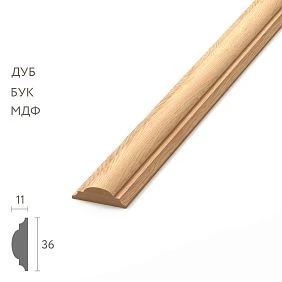
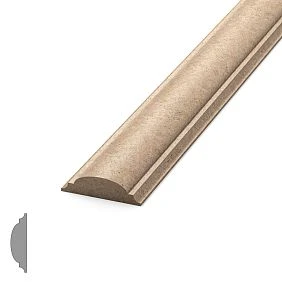
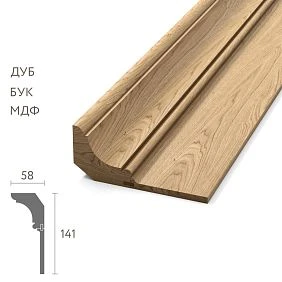
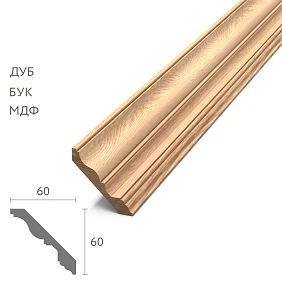
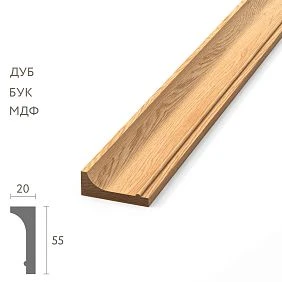
Decorative wooden molding — is a linear profile made of solid wood that is attached to the surface of the facade or its perimeter. It can be flat, shaped, corner, with a chamfer, rounding, groove, or complex cross-section. Its function is to create a frame, border, line, or transition on the furniture surface.
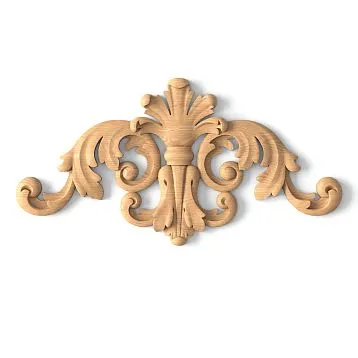
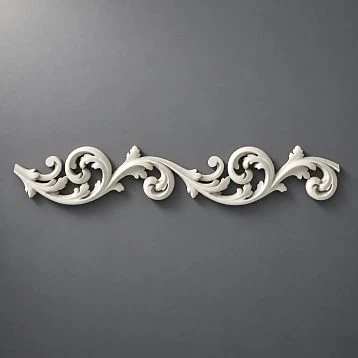
How does a layout differ from an overlay? An overlay is a separate decorative element that is attached as an accent in a specific place: a cartouche in the center of a drawer, an ornamental insert on a door, a corner element. A layout is a profile of extended shape that forms a line or a closed contour. One is a point accent, the other is a frame structure.
How does a layout differ from a glazing bead? wooden trim is primarily intended for fixing glass or a mirror in a frame — it holds the insert, pressing it against the rebate. A layout for furniture facades solves a different task: it creates a decorative line, without necessarily holding anything. Although the boundaries here are blurred — some profiles perform both functions.
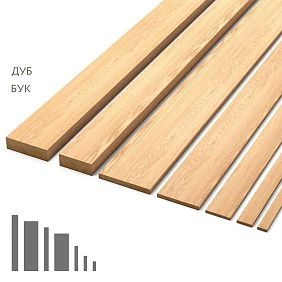
Material. The classic choice is pine, birch, oak. Pine Buy wooden trim is easy — it's the most affordable option, perfectly suitable for painting. Oak layout — for natural wood with texture. Birch is a compromise: dense, uniform, accepts tinting well.
Standard length. The layout is supplied in standard lengths: 2 m, 2.5 m, 3 m. For furniture facades, 2-meter elements are usually sufficient — the height of most doors does not exceed 1.8–2 m.
Our factory also produces:
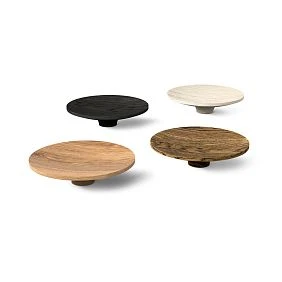
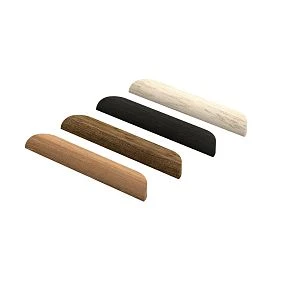
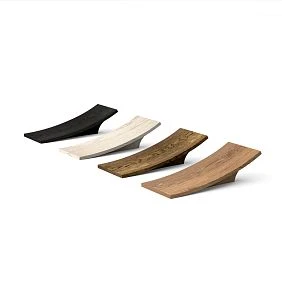
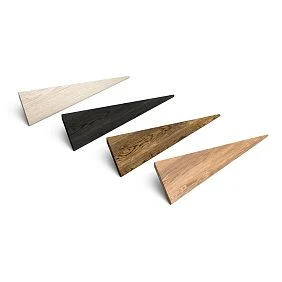
Where to use layout on furniture
Get Consultation
On cabinets
A wardrobe is the most common object for working with layout. The doors of a hinged wardrobe, the facades of a sliding wardrobe (overlay elements around the perimeter of the section), side panels — all these surfaces transform from flat rectangles into structured architectural objects when a frame of wooden profile appears on them.
For a wardrobe in a classic or neoclassical style — wooden veneer with a decorative profile with a soft profile: semicircle, stepped transition, "pear-shaped" cross-section. For modern classic — Flat wooden strip with a bevel: concise, clear, without unnecessary decor.
Important point: on a two-door wardrobe, both doors must be designed symmetrically. The same layout indentation from the edges, the same profile width, the same frame placement — this is an axiom.
On dressers
A chest of drawers is an item that stands as an independent accent in the interior and is perceived as a whole. The drawer fronts of a chest of drawers with wooden layout turn into an expressive rhythmic pattern.
Layout for a chest of drawers can work in two ways. The first is a frame around the perimeter of each drawer. The second is a central horizontal or vertical profile line dividing the drawer front into sections. The first option is more classic, the second is more modern.
Layout width for a chest of drawers: 15–25 mm for small drawers, 20–35 mm for large ones. The width should be correlated with the size of the facade — the proportion of the frame should be convincing, not a thin strip and not a band taking up a third of the drawer.
On kitchen facades
Kitchen facades with wooden layout are a classic in both the literal and figurative sense. This is exactly what a kitchen in the style of neoclassicism, Provence, English classicism, modern classic looks like: a frame facade with a decorative profile, painted white or milky.
For upper modules — a lighter profile, for lower floor cabinets — you can use a slightly more expressive one. Glass fronts require special attention: here the wooden layout performs both a decorative and structural function — it fixes the glass insert.
Wooden profile for furniture for kitchen fronts should be made of well-dried wood — the kitchen is subject to humidity and temperature fluctuations, and a raw layout after installation will warp, crack, or deform the front.
On display cabinets and sideboards
A display case with glass fronts is an item where the layout performs several roles at once. Horizontal and vertical dividers made of wooden profile make the glass surface structured, breaking it into sections. This visually lightens the structure and adds an architectural detail.
For a sideboard or display case in a classic interior — a shaped profile with a soft relief. For a sideboard in a modern classic or Scandinavian style — a flat thin profile with a neat chamfer. Pogonazh iz massiva for such products should be made of homogeneous wood without knots — they will be clearly visible through varnish or enamel.
On cabinets and consoles
A cabinet is most often a simple case item without pronounced decor. One wooden layout around the perimeter of the door — and the cabinet from a "box on legs" turns into a classic product.
This technique is especially effective on TV cabinets in classic or neoclassical interiors. A long horizontal surface of the front, divided by vertical frames of wooden profile — this is no longer just a TV cabinet, it is furniture with character.
Flat, shaped or angular layout: what to choose
Choosing the type of layout is a key decision that determines the final style of the furniture. Let's consider each option.
| Layout type | Where to use |
|---|---|
| Flat wooden strip | Frames on facades, modern classic, neoclassical, calm styles |
| Decorative Wooden Tiling | Classic and historical furniture, decorative facades, Provencal style kitchens |
| Corner layout | Edges, outer corners, side panels, 90° joints |
| Narrow layout (8–15 mm) | Small drawers, cabinets, lightweight facades, simple frames |
| Wide layout (25–45 mm) | Wardrobes, display cabinets, sideboards, large furniture panels |
Flat layout is a rectangular cross-section with minimal profiling: possibly a slight chamfer on the edge or rounding. It creates a clear frame line without decorative volume. Ideal for modern classic, neoclassical, Scandinavian interiors, and any furniture where the facade should be expressive but not overloaded.
The shaped layout has a complex cross-section: a "pear-shaped" profile, stepped transitions, semicircles, grooves. It creates shadow and volume — a facade with such a frame is perceived as three-dimensional and embossed. For classic furniture, this is exactly the profile needed. But in a small space or on small drawers, it can overload the facade — moderation is needed.
The corner layout is an L-shaped or rounded profile for edge processing. This is not a frame on a plane, but a finish for an end or corner. It is used to protect the edge of the board, process the visible end of a shelf, or finish the outer corner of a furniture body.
How to choose the size of the layout
Size is not only aesthetics but also functionality. An error in the width of the layout ruins the entire result — even with the correct profile and good wood species.
Ratio of layout width to facade size. For a small drawer 15–20 cm high and 40–50 cm wide — layout width no more than 18–22 mm. For a door 70–90 cm high — 22–30 mm is acceptable. For a large door 120–180 cm high — 28–40 mm.
Proportion rule: the frame made of the layout should occupy no more than 15–20% of the facade size on each side. If the layout is wider, the frame "eats up" the facade, and the central plane looks small.
Space for the handle. This is a critical point that is often ignored. The handle should be attached at a distance of at least 40–50 mm from the edge of the layout. If the handle ends up directly above the profile, a structural conflict arises. Determine the handle location in advance and correlate it with the width and placement of the layout.
Symmetry of paired doors. On double-door cabinets, two drawers of the same size — the layout should be mirrored. The indentation from the outer edge of the door is the same. The profile width is the same. This is non-negotiable.
Facades with glass. If there is a glass insert behind the layout, you need to consider the glass thickness (usually 4–6 mm) and the depth of the rebate. In this case, the layout works as wooden trim — secures the glass. The width should be sufficient for reliable fixation, but not so wide as to obstruct the view.
How to make a frame on a furniture facade
This is a practical algorithm used by professional carpenters and furniture makers. Follow these steps, and the frame will turn out neat, symmetrical, and convincing.
Step one: measure the facade.
Record the exact dimensions of the door or drawer in millimeters. For example: height 720 mm, width 400 mm.
Step two: determine the indents from the edge.
The standard indent from the outer edge of the facade to the inner edge of the molding is from 25 to 50 mm. Choose a specific value: for example, 35 mm. This means the molding is placed 35 mm from the edge along the entire perimeter.
Step three: choose the width of the molding.
For example, 20 mm. Then the outer edge of the molding will be 35 mm from the edge, the inner edge will be 55 mm from the edge. Dimensions of the inner space of the frame: (720 − 55 × 2) × (400 − 55 × 2) = 610 × 290 mm.
Step four: calculate the lengths of the elements.
For a rectangular frame, four pieces are needed: two vertical and two horizontal. The corners of the frame can be cut at 45° (more complex but beautiful) or into a groove (horizontal pieces overlap the ends of the vertical ones or vice versa).
Step five: check the handle placement.
Draw the layout outlines and handle location on paper or directly on the facade (with a pencil). Make sure the handle does not overlap the layout and is not too close to it.
Step six: consider the corners and joints.
45° joints require precise cutting — it's better to use a miter box or a miter saw. Overlap or tongue-and-groove joints forgive small errors but look less refined.
Step seven: decide on painting before installation.
If the facade and layout will be painted the same color, it's more convenient to first apply primer and the first coat of paint to the facade, then attach the layout, putty the attachment points, and apply the finishing coats. This gives a smooth result without a 'step' at the edges.
Layout for furniture restoration
Here's a topic that is no less interesting than new furniture. An old cabinet inherited or bought for pennies on a classifieds site can become a real accent in the interior — if you approach its renovation wisely.
Updating an old cabinet. The flat facades of a Soviet or post-Soviet cabinet are an ideal surface for applying wooden layout. You clean and sand the facade, apply the layout around the perimeter with an indent, secure it with glue and finishing nails, putty the holes, prime and paint. The result is a cabinet that looks like a new classic piece.
Transforming a dresser into a classic. A simple Soviet dresser with flat drawers after working with decorative wooden layout and replacing the handles gives it a completely different look. Particularly striking is the layout matching the facade (painting in a single color) combined with wooden knob handle of a contrasting color.
Renovation of kitchen facades. The most common restoration scenario is old kitchen facades made of MDF or chipboard with peeling film. We clean the surface, apply new primer, install wooden layout for facades around the perimeter of each module, paint in a single color. The cost of such restoration is many times less than replacing the set.
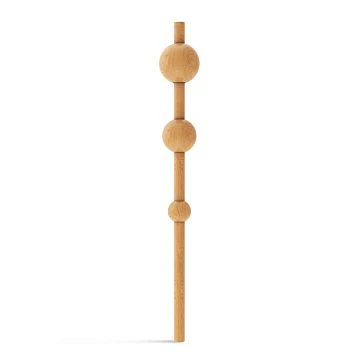
What else is bought during restoration. The layout is just the beginning. Wooden legs to raise the body above the floor, wooden furniture handles in a classic style, decorative elements for furniture — overlays in the center of drawers or on doors. A comprehensive approach yields a qualitatively different result than simply applying the layout.
How to combine the layout with handles, legs, and overlays
This is the most valuable section for those who want to achieve a professional result, not just a set of random details.
Layout and handles. The main principle is stylistic unity. If a wooden veneer with a decorative profile with a soft classic profile is chosen, the handles should be appropriate: wooden hook handle with a smooth curve or wooden button handle with a dome shape. A flat layout — a more concise bracket or a minimalist button.
Handle and layout color: two approaches are possible. The first is a unified finish (layout and handles in the same tone, both under enamel or both with a natural texture). The second is contrast (a light facade with layout and dark handles). Contrast requires confidence in the choice — it must be intentional, not accidental.
Layout and legs. Wooden legs for a chest of drawers, cabinet, or wardrobe made from the same wood species as the layout — this ensures visual coherence of the furniture. When the legs and layout are in the same tone, the furniture is perceived as a single piece, not as a set of elements.
For a classic shaped layout — turned shaped legs. For a flat minimalist layout — tapered legs with a straight silhouette. This is not a strict rule, but a working guideline.
Layout and decorative overlays. Wooden decoration in the form of overlays can be placed inside a frame made of layout — in the center of the facade. This is a classic solution: a frame + a medallion or cartouche in the center. Or the overlays are placed in the corners of the frame — this enhances the classic relief.
But there is a limitation here: do not overload one facade with different types of decor. Layout + overlay = enough. Layout + overlay + carved inserts around the entire perimeter = chaos. Decor works when it is in moderation.
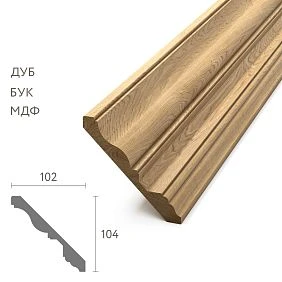
Layout and cornice. wooden cornice along the upper horizontal edge of a cabinet, sideboard, or kitchen set completes the vertical decorative system. If the facades have a layout and the top of the cabinet ends with a flat end without a cornice, it feels unfinished.
Layout and wall moldings. If moldings are used in the interior Moldings from solid wood on the walls, the profile of the furniture layout should be in the same style system as them. This does not mean identical. But the principle is similar: if the wall molding is shaped, the furniture layout can be slightly more restrained, but not a flat geometric strip.
Layout for painting, varnish, or stain
The finish coating determines what requirements are placed on the choice of layout even before its installation.
Layout for enamel. Enamel is a covering coating that hides the texture of the wood. For work under enamel, the species is not critical in terms of appearance — geometry and sanding are important. Pine Wooden molding without large knots, well sanded to 180–220 grit, accepts enamel evenly and without bleeding. Knots under white enamel cause "dark spots" over time — they need to be isolated with a shellac-based primer or a special insulator.
Layout for varnish. Varnish is transparent — it shows the texture of the wood. This means the species and grain of the wood become part of the decor. For varnishing, it is better to choose a layout made of oak, ash, or birch with a beautiful uniform texture. Pine under varnish is also good — especially with a warm golden tint of oil or tinted varnish.
Layout for stain. Stain changes the color of the wood without hiding the texture. The result depends on the species: pine stains unevenly — due to different fiber densities. Birch and alder accept stain more evenly. Oak and ash give a rich, expressive result.
If the facade and layout are painted in one color — it creates the feeling of a solid product. The wooden layout "dissolves" into the facade and is perceived as the relief of the facade itself, rather than a separate overlay.
Contrasting layout — a dark profile on a light facade or vice versa — requires precision. This is a strong design solution that works well in a modern style and poorly in random combinations.
Wooden profile for furniture: a separate look at Pogonazh iz massiva
Layout is part of a broader category of wooden moldings. And it is important to understand the entire system so as not to miss the necessary element.
Wooden moldings for furniture facades include: layouts (flat and shaped), wooden trim for fixing glass, Wooden Mouldings for framing frames and mirrors, Moldings from solid wood for decorative horizontal lines, wooden cornice for finishing the top of cabinets and sideboards.
Each of these elements has its own function. But they are united by one thing: they create architectural logic in furniture. Without them — just a body. With them — a product.
For those who work with furniture systematically — for themselves or as a furniture maker — it is important to understand the entire range of moldings in order to apply each element where it is needed, without substituting one for another.
Mistakes when choosing wooden moldings for furniture
Let's be honest — without softening. These mistakes occur regularly and ruin the result even with good material.
Choosing moldings without the size of the facade. "I'll buy something suitable" — the path to the unsuitable. Always have the exact dimensions of the facade in front of you and calculate the frame proportions before purchasing.
Using a profile that is too wide on a small drawer. A 35 mm molding on a drawer 30 cm wide — the frame will take up more than half of the facade. The proportion is broken, the result is absurd.
Forgetting about the placement of handles. This has already been discussed — and it still happens regularly. Draw a diagram on paper, check if the handle conflicts with the molding.
Do not ignore the symmetry of paired doors. If the left door has a frame with a 30 mm offset, and the right door has a 40 mm offset (because it didn't match "by eye"), it is immediately visible and instantly ruins the impression of the work.
Confusing the layout with the glazing bead. If you need to fix the glass, you need wooden trim with the corresponding profile, not a decorative layout.
Putting a lot of different decor on one facade. Layout + three types of overlays + a carved cornice on one door is not richness, it is visual noise. Furniture with fewer details, but in the right system, looks more expensive than an item cluttered with decor.
Not planning the painting before installation. The question "how do we paint this" should be resolved before installing the layout, not after. Otherwise, uneven joints, paint drips in corners, and visible seams occur.
Not matching the layout with legs and handles. Modern layout + antique metal handles + massive turned legs is a style conflict. The furniture decor system should be unified.
What to buy together with the wooden layout
A complete list for those planning comprehensive work with furniture.
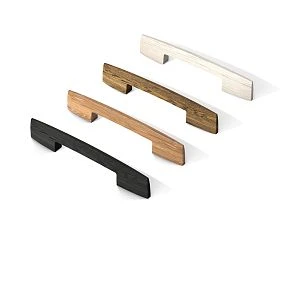
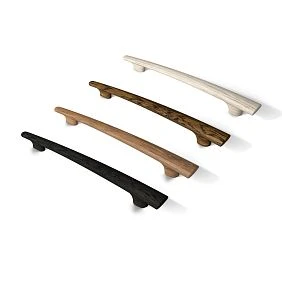
wooden furniture handles — brackets, buttons, rails. Selected in a unified style system with the layout.
wooden button handle — for an accent on the facade of a drawer or cabinet.
wooden hook handle — classic option for cabinet doors and upper kitchen modules.
Wooden legs — to lift the body above the floor and create a classic silhouette.
decorative elements for furniture — overlays, medallions, cartouches. Work within a frame or as a standalone accent.
Decorative Bracket — for shelves, cornices, decorative consoles.
wooden cornice — finishing the top of a cabinet, sideboard, or kitchen unit.
Moldings from solid wood — for decorative horizontal lines on furniture and walls.
Wooden Picture Frame — for framing mirrors, frames, panels in the same style as the furniture.
wooden trim — for fixing glass inserts in display cabinet and sideboard doors.
Pogonazh iz massiva — full range of wooden profiles for comprehensive furniture and interior decoration.
FAQ: questions asked when choosing molding for furniture
What is the purpose of a wooden molding on furniture?
wooden layout for furniture helps to decorate the facade with a decorative frame, cover a joint, emphasize the geometry of the door, give the furniture a classic or neoclassical character. It works both as a decorative element and as a structural one — depending on the task.
How does molding differ from an overlay?
Decorative wooden molding is an elongated profile that creates a line or frame. decorative elements for furniture in the form of overlays are individual point accents: medallions, cartouches, corner elements. Different tasks, different application formats.
Can molding be used for kitchen facades?
Yes. Wooden molding for facades works great on kitchen modules — especially for creating frame facades in a classic style. It is important to choose well-dried wood and a high-quality coating resistant to humidity.
Which molding is best for classic furniture?
Decorative Wooden Tiling with a soft profile: pear-shaped or stepped cross-section, semicircle. For neoclassicism — Flat wooden strip with a slight bevel.
Can you paint a wooden layout?
Yes, and this is one of the main use cases. Wooden molding It accepts enamel, varnish, stain, and oil-wax perfectly. Key conditions: high-quality sanding (180–220 grit), priming, and the correct sequence of coating application.
How to avoid mistakes with the layout width?
Use the proportion rule: the frame width should be no more than 15–20% of the smaller side of the facade. For a drawer 40 cm wide, the maximum layout width is 18–20 mm. Also always check compatibility with the handle placement.
Layout or overlay: which to choose for a furniture facade?
It depends on the task. If you need a frame, use a layout. If you need a central accent, use decor for furniture an overlay. If you want both, use a frame made of layout with an overlay inside. This is a classic combination.
About the company STAVROS
Wooden layout for furniture facades is a carefully designed element that requires the right manufacturer. STAVROS produces wooden molding made from solid pine, birch, oak, and ash — in a wide range of profiles and sizes. In the STAVROS catalog: flat and shaped moldings, Pogonazh iz massiva, Moldings, Crown Molding, Decorative Inserts, Wooden handles, Legs и Brackets.
STAVROS is a manufacturer that understands: furniture decor only works as a system. That's why all elements are designed in a unified style and can be combined without conflicts in profile, size, or tone. One source — one result.