Article Contents:
- First, separate the size of the overlay from the size of the place where it is planned to be installed
- Full dimensions of IKN-013
- Overall panel plane
- Clean decorative field
- Visible field after furniture installation
- Free clearance around the thread
- Why empty space has a decorative function
- Why a field that is too large also requires checking
- Calculation for vertical orientation
- If the overlay is offset
- This is geometry, not a standard
- External panel size
- Clear width inside the frame
- Clear height
- Panel depth
- Frame width and profile
- Handles and lock elements
- Hinges and hidden fasteners
- Adjacent decor
- Wide frame
- Deep chamfer
- Protruding molding
- Bagette with inner pattern
- Narrow smooth trim
- Shadow
- Distance to moving parts
- Cleaning and maintenance
- Painting
- Visual Mass
- Prepare an exact rectangle
- Mark the central axes
- Apply the field boundaries
- Center the template
- Check horizontal and vertical orientations
- Look from the working distance
- Take photos
- Trace the approved position
- The first stage is the outer dimension
- The second stage is the contour image
- The third stage — physical sample
- When horizontal orientation supports the panel
- Where tightness occurs
- Influence of the handle
- Connection with adjacent verticals
- When the vertical scheme makes sense
- What to Check
- Formula for the vertical position
- Signs of deliberate offset
- Signs of random error
- How to calculate the offset position
- Common horizontal axis
- Equal side margins
- Uniform orientation
- One batch
- Labeling
- One overlay per panel
- Two overlays on one panel
- Different types of panels
- Is a reserve needed
- Beech for opaque finishing
- Oak for preserving texture
- Beech or oak are not chosen only by price
- Overlay in the color of the panel
- Contrasting overlay
- Transparent finish
- Toning
- Gilding
- Surface Preparation
- Option 1. Printout
- Option 2. Colored cardboard
- Option 3. Control part
- Find the boundaries of the clean field
- Draw diagonals
- Check the vertical and horizontal axes
- Transfer the axes to the template
- Check the margins with a tape measure
- Fix the control points
- Repeat with the template
- What to Check
- Why the template should have thickness
- Handle as a visual element
- Hinge screws
- Frame connections
- Base thickness
- Disassemblable Construction
- Overlay and cross
- Overlay and columns
- Overlay and capitals
- Overlay and sockets
- Overlay and baguette
- First, determine the direction of narrowness
- Narrow zone along the length
- Low zone
- Shaped field
- Field with deep frame
- What to check at home
- Why you can't reduce the field just for placement
- What to compare
- Why size isn't the main thing
- What should be in the specification
- Don't use the old duplicate address
- Photo doesn't replace the article number
- Size does not replace the pattern
- Example for a tight field
- Verify the article number
- Measure the control part
- Inspect the thread
- Check the material
- Lay out the entire batch
- Repeat the fitting
- Mark it
- Color
- Gloss
- Clarity of carving
- Ends
- Fit into the field
- Ready for Installation
- Error 1. Measuring the entire door panel instead of the insert
- Error 2. Comparing only the 421 mm length
- Error 3. Considering a zero remainder as a valid field
- Error 4. Accepting 5 mm as a sufficient margin without fitting
- Error 5. Assigning a universal minimum
- Error 6. Not accounting for the chamfer
- Error 7. Not accounting for the 20 mm thickness
- Error 8. Using an empty rectangle as the final layout
- Error 9. Rotating the overlay vertically without checking the ornament
- Error 10. Centering by the outer edge of the door
- Error 11. Centering each overlay separately in a row
- Error 12. Not checking the handle
- Mistake 13. Not checking the hinges from the back side
- Mistake 14. Choosing glue only by the word "transparent"
- Mistake 15. Applying too much glue
- Mistake 16. Pressing the thread with a clamp without protection
- Mistake 17. Painting without a control sample
- Mistake 18. Considering gilding as standard equipment
- Mistake 19. Mixing beech and oak
- Mistake 20. Ordering products in several stages
- Mistake 21. Not marking the overlays
- Mistake 22. Evaluating only one overlay
- Error 23. Leaving too large a field unchecked
- Error 24. Adding another carved element nearby after the field has been approved
- Error 25. Using a church overlay solely because of its size
- Error 26. Installing before finishing work on the panel
- Error 27. Treating a photograph as an exact blueprint
- Error 28. Not checking the field after painting
- Error 29. Buying mounting materials without information about the base
- Error 30. Starting a series with installation on the main product
- Check the main product card
- Compare church overlays
- Assemble the overall composition
- Prepare the layout
- Choose the material and finish
- Coordinate the installation
- Check logistics
- What is the full size of IKN-013?
- What is the overlay made of?
- Does IKN-013 belong to church decor?
- Does IKN-013 have other sizes?
- Will IKN-013 fit in a field of 421 × 164 mm?
- Is a field of 430 × 175 mm sufficient?
- How to calculate the side margin?
- How to calculate the top and bottom margins?
- What should be the minimum margin?
- Why can't one standard be specified?
- Is a field of 450 × 200 mm suitable?
- Is a field of 500 × 250 mm suitable?
- Can IKN-013 be rotated vertically?
- How to calculate margins in a vertical position?
- Does the plate need to be placed strictly in the center?
- What is considered the boundary of the field?
- Can measurements be taken to the outer edge of the frame?
- Why account for the 20 mm thickness?
- Will a flat paper template work?
- How do I make a template?
- Do I need to transfer the drawing onto the template?
- Where can I get the technical drawing?
- Can the size be confirmed from a photograph?
- Why is the free margin important?
- Can the margin be too large?
- How do I check if the margin is too large?
- What reduces the available area?
- Do I need to consider the handle?
- Why check the loops from the back side?
- Can IKN-013 be installed on a painted panel?
- What Adhesive to Use?
- Will any transparent glue work?
- Is adhesive included with the overlay?
- Can mechanical fasteners be used?
- Does IKN-013 need priming?
- Can the overlay be painted with enamel?
- Can oak IKN-013 be tinted?
- Can gilding be ordered?
- What to choose: beech or oak?
- Can beech and oak be mixed in one composition?
- Should overlays be ordered in one batch?
- How many IKN-013 are needed for four doors?
- Is a spare part needed?
- Can IKN-013 be used on regular furniture?
- What to choose if the church pattern doesn't fit?
- How to install several overlays at the same height?
- What is more important: the center of each panel or the common line?
- Is a trial installation necessary?
- When to do the finishing: before or after installation?
- Can the overlay be glued and then painted all together?
- What to check upon receipt?
- What to check after painting?
- Where can I see the current price?
- How to record a product in an invoice?
- Do I need to specify the field size in the order?
- What question to ask a designer?
- What question should be asked to the carpenter?
- What question should I ask the finisher?
- What question should be asked to the installer?
- What question to ask a manager?
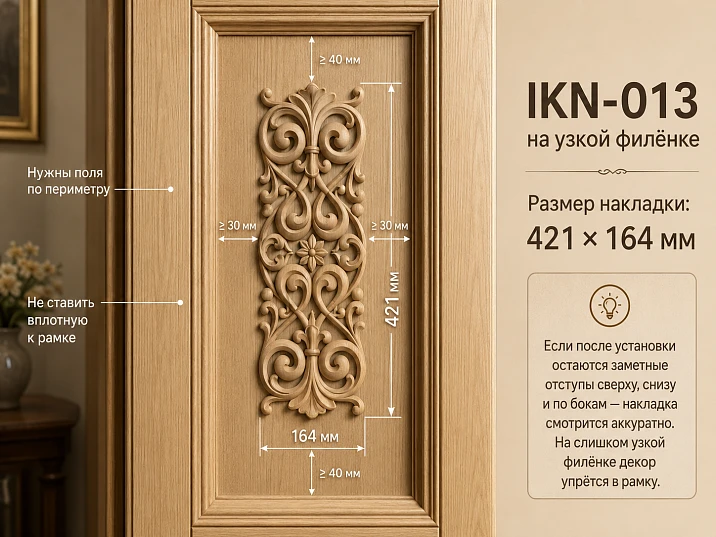
The overlay fits into the panel. It passes in length and width. There is no intersection on the drawing. Can we order it? Don't rush. For carved decor, physical placement is only the first check. If IKN-013, measuring 421 × 164 mm, almost completely occupies the free plane, the wooden ornament will be squeezed between the frame, molding, or panel edge. The product will fit into the allotted space, but the composition will look cramped, heavy, and random.
This problem is especially noticeable on narrow panels of church furniture and decorative panels. The buyer compares the overall field size with the overlay dimension and gets a positive result: 421 mm is less than the available length, 164 mm is less than the height. However, the viewer perceives not arithmetic, but the ratio of carving to empty space. The overlay needs air around its contour. Free margins separate the ornament from the frame, preserve the readability of the pattern, and help accurately align several identical pieces.
IKN-013 has a fixed overall dimension of 421 × 164 × 20 mm and is made of beech or oak. It is a carved overlay for church decor. The size cannot be chosen: it is fixed. Therefore, the buyer solves the reverse problem—checking whether the existing decorative field fits the product.
Before buy carved overlay IKN-013, you need to determine:
-
clear surface size inside the frame;
-
orientation of the carved element;
-
side, top, and bottom margins;
-
distance to molding, baguette, chamfer, and panel edge;
-
position of handles, hinges, and adjacent decor;
-
visible area after installation;
-
base material;
-
beech or oak;
-
future finishing;
-
fixation method;
-
number of identical overlays;
-
ability to check the composition with a 1:1 template.
The main answer is simple: matching dimensions is not enough. A field measuring exactly 421 × 164 mm allows physically placing IKN-013, but leaves no free space around the threads. Even a small positive remainder does not prove that the composition will look convincing. The minimum decorative offset cannot be assigned a universal number: it is approved based on a full-size mockup, drawing, and the overall pattern of the product.
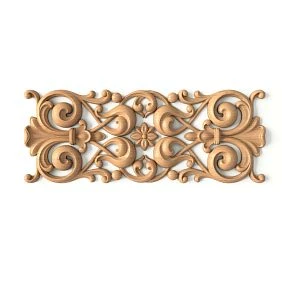
First, separate the size of the overlay from the size of the place where it is intended to be installed.
In conversations between the client, designer, and carpenter, the word "size" can mean different things. One person refers to the width of the entire door, another to the inner plane of the panel, and a third to the distance between moldings. Because of this, IKN-013 formally fits in the project table but does not fit in the actual clean area.
Five values need to be separated.




Full dimensions of IKN-013
Confirmed product size:
421 × 164 × 20 mm.
The first two values describe the outer rectangle of the overlay. The thickness is 20 mm. Paper fitting starts with the 421 × 164 mm rectangle.
The full dimensions do not show:
-
the length of the continuous carved contour;
-
the position of protruding fragments;
-
the visual center of the ornament;
-
the mounting area on the reverse side;
-
the recommended offset;
-
fixation method;
-
the allowable overlap zone.
These questions require a drawing and the actual part.
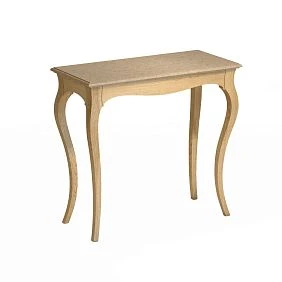
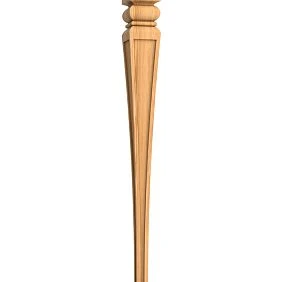
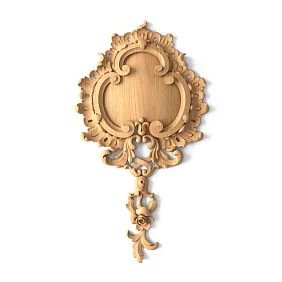
Our factory also produces:

Overall panel plane
This is the size of the entire door, shield, facade, or other surface. It is almost never equal to the usable space for the overlay. Part of the plane is occupied by frames, stiles, edging, bevels, and structural zones.
The panel may be 600 × 300 mm, but only 450 × 200 mm remains inside the frame. It is the second value that needs to be compared with IKN-013.
Get Consultation
Clean decorative field
The clean field is considered the surface where the product can actually be placed without intersecting with other parts. The size is measured between the inner boundaries of the frame, molding, baguette, or other constraint.
If the plane has an irregular shape, a single measurement at the center is not enough. Width and height are checked at multiple points.
Visible field after furniture installation
Part of the surface may physically exist but become covered after installation:
-
by an adjacent door;
-
protruding handle;
-
column;
-
frame;
-
shelf;
-
another carved element;
-
structural belt;
-
decorative molding.
Therefore, the template is placed not only on a separate part in the workshop, but also in the overall layout of the product.
Free margin around the carving
This is the distance between the outer dimension of IKN-013 and the nearest visual constraint. It creates a pause between the ornament and the surroundings.
The indent can be:
-
the same on all sides;
-
larger horizontally;
-
larger at the top and bottom;
-
intentionally asymmetrical;
-
aligned with the central axis of the church furniture.
Asymmetry is acceptable only as a design decision. An accidental shift of a few millimeters will look like a mistake.
IKN-013 characteristics that must not be lost in the order
| Parameter | Confirmed value | Practical significance |
|---|---|---|
| Article number | IKN-013 | Distinguishes the product from other church overlays |
| Type | Carved overlay | Used as a separate decorative element |
| Stylistic group | Church decor | The drawing needs to be coordinated with other project elements |
| Full size | 421 × 164 × 20 mm | Defines the minimum physical dimension of the surface |
| Material | Beech or oak | Affects the wood grain pattern and future finishing |
| Orientation | Determined by the project | Horizontal and vertical layouts require different calculations |
| Finish | Agreed upon during ordering and finishing | Gilding or painting cannot be considered a standard part without confirmation |
| Installation | Depends on the base and the project | The fixing method is approved before finishing |
| Quantity | By the number of decorative fields | It is better to order all items in one batch |
| Drawing | Required for precise layout | Shows the actual contour and installation features |
After the table, the main practical question arises: what field should be considered sufficient? There is no universal answer in millimeters. For one composition, a 20 mm margin may look acceptable, for another — too tight. The perception is influenced by the size of the panel itself, the width of the frame, the depth of the carving, the color, the viewing distance, and neighboring details.
Therefore, the calculation gives numbers, but the decision is made by the full-size composition.
"Fits" and "looks right" are two different results
Let the clear field inside the frame be 430 × 175 mm. IKN-013 fits:
-
9 mm remains along the length;
-
11 mm along the height.
If the overlay is centered, the side margin will be 4.5 mm, and the top and bottom margins will be 5.5 mm each. Technically, there is no overlap. Visually, the thread almost touches the frame.
On a light surface, such a narrow gap may look random. After painting in a dark color, it will turn into a sharp shadow line. With a slight marking error, one side will be narrower than the other. If the frame has a chamfer, the visible margin will be further reduced.
This is a typical case where the product physically fits, but the chosen field for it is not convincing enough.
Why empty space has a decorative function
The free field performs several tasks at once.
It separates the carved motif from the surrounding frame. The eye understands where one element ends and another begins.
It allows the outer contour of the overlay to be read. If the carving almost touches the molding, the two patterns merge.
It compensates for minor installation and perception features, without turning every millimeter of displacement into a noticeable error.
It preserves hierarchy. The overlay remains the central motif, and the frame is its surroundings.
It helps to repeat several details at the same height and with the same margins.
Why a field that is too large also requires checking
There is no need to strive to leave the maximum possible space around IKN-013. On a very large panel, the overlay can get lost and look randomly glued in the middle.
The task is not to give the carving as much empty space as possible, but to choose the right proportion:
-
the overlay should be noticeable;
-
the field should be readable;
-
the frame should be connected to the ornament;
-
the composition should be cohesive.
Therefore, the buyer checks both the minimum and maximum visual field.
Formula for side and vertical margins
For a preliminary calculation, it is enough to know the net size of the area and the dimensions of IKN-013.
If the overlay is installed horizontally, with the long side of 421 mm along the width of the field:
Side margin = (clean field width − 421 mm) / 2
Top and bottom margin = (clean field height − 164 mm) / 2
The formulas assume strictly central positioning.
If the result is negative, the overlay does not fit.
If the result is zero, the outer dimension of the product coincides with the field boundary.
If the result is positive, physical space exists, but its visual sufficiency still needs to be checked.
Calculation for vertical orientation
If IKN-013 is rotated with the long side up:
Side margin = (clean field width − 164 mm) / 2
Top and bottom margin = (height of the clean field − 421 mm) / 2
Rotation changes not only the calculation but also the direction of the ornament. Vertical placement cannot be considered acceptable just because the rectangle fits. The pattern must be designed for such orientation or approved by the designer.
If the overlay is offset
When offset intentionally, margins are calculated separately:
Left margin = coordinate of the left edge of the overlay relative to the field
Right margin = field width − left margin − 421 mm
For vertical distances:
Top margin = coordinate of the top edge
Bottom margin = field height − top margin − 164 mm
Such calculation is useful when the composition follows a common axis, a neighboring cross, column, or other element. But asymmetry must be recorded on the drawing.
This is geometry, not a standard
The obtained millimeters are not a mandatory STAVROS standard. The formula only shows free space. The sufficiency of the field is determined by the layout.
Example: field 500 × 250 mm
IKN-013 is positioned horizontally and centered.
Side fields:
(500 − 421) / 2 = 39.5 mm
Top and bottom fields:
(250 − 164) / 2 = 43 mm
The result is an almost uniform surround:
-
left — 39.5 mm;
-
right — 39.5 mm;
-
top — 43 mm;
-
bottom — 43 mm.
This ratio looks promising. The overlay occupies a significant part of the field but does not touch the frame. The difference between horizontal and vertical margins is small.
However, before ordering, you need to check:
-
the actual outer contour of the thread;
-
frame width;
-
the depth of the chamfer;
-
the future color;
-
the position of adjacent parts;
-
the viewing distance.
If a wide carved frame runs around the field, even 40 mm can feel tighter than next to a smooth border.
Example: field 450 × 200 mm
Calculation:
(450 − 421) / 2 = 14.5 mm
(200 − 164) / 2 = 18 mm
IKN-013 fits, but the free space is small:
-
left and right — 14.5 mm each;
-
top and bottom — 18 mm each.
On an empty drawing, the composition may look neat. In reality, thread depth, shadows, and the frame visually reduce this gap.
Such a variant cannot be immediately rejected, but it must be checked with a 1:1 template. If the ornament has protruding ends, the distance from their outline to the frame may be less than the calculated rectangular field.
Example: field 421 × 164 mm
Calculation:
(421 − 421) / 2 = 0 mm
(164 − 164) / 2 = 0 mm
The overlay exactly matches the clear field. There is no free margin.
Additional issues are possible:
-
outer thread sections will be directly at the frame;
-
a slight shift will become noticeable;
-
the actual field shape may be imperfect;
-
the finish layer and chamfer will change perception;
-
the overlay edge will be hard to separate from the surrounding profile;
-
installation will require precision without visual reserve.
Such a layout cannot be considered successful just because of a mathematical coincidence.
Example: field 480 × 230 mm
Side margins:
(480 − 421) / 2 = 29.5 mm
Top and bottom:
(230 − 164) / 2 = 33 mm
The overlay occupies a noticeable part of the field, and the margins are close to each other. This is a good basis for a layout.
If the frame has an internal protrusion of 8 mm, you need to understand whether it is included in the measured 480 × 230 mm. If the measurement is taken along the outer boundary, the actual field is smaller:
-
the useful width may be reduced to 464 mm;
-
the useful height — to 214 mm.
Then the indents will change:
(464 − 421) / 2 = 21.5 mm
(214 − 164) / 2 = 25 mm
One incorrectly chosen measurement line reduced the free space by almost a third.
Example: field 600 × 300 mm
Calculation:
(600 − 421) / 2 = 89.5 mm
(300 − 164) / 2 = 68 mm
The free space is significant. Now the reverse question arises: doesn't the IKN-013 look too small?
The answer depends on the overall design. If the field is surrounded by a massive carved frame, the overlay can retain its significance. On a large smooth surface, a single element is sometimes perceived as isolated.
Instead of automatically enlarging the product, you can:
-
leave a wide field as part of a calm composition;
-
connect IKN-013 with other details;
-
change the position;
-
choose a different overlay;
-
reconsider the size of the inner frame.
For comparison, it is useful choose a wooden overlay for church furniture among other models and assess whether IKN-013 matches the panel scale.
What measurements to take before the paper fitting
One number for the panel width is not enough. Prepare a surface diagram.
Panel outer size
It is needed for a general understanding of proportions, but is not used directly as space for the overlay if a frame is present.
Clear width inside the frame
Measure between the nearest inner boundaries on the left and right. If the frame is shaped, take measurements:
-
from the top;
-
in the center;
-
from the bottom.
The minimum width determines the physical possibility of installation.
Net height
Take the distance:
-
at the left edge of the intended overlay;
-
in the center;
-
at the right edge.
On a wooden panel, deviations are possible, and a shaped frame may narrow the field.
Panel depth
IKN-013 has a thickness of 20 mm. It is necessary to understand how this relief will protrude relative to the frame and adjacent parts.
If the panel is deeply recessed, the overlay may approach the face plane of the frame or extend beyond it. If the surface is almost flat, the 20-millimeter volume will become a noticeable accent.
Frame width and profile
A wide frame enhances visual density. A narrow and smooth one leaves more air.
Separately note the inner bevel. It is its edge, not the outer side of the frame, that often serves as the real visual boundary.
Handles and lock elements
The overlay may not intersect with the handle on the plane, but it can interfere with the grip. Check the volume of the hand and the movement of the hardware.
Hinges and hidden fasteners
The hinge is located on the reverse side, but its screws or mounting area may coincide with the attachment point of IKN-013. You cannot drill or fix the overlay without knowing the internal structure of the panel.
Adjacent decor
Apply to the diagram:
-
crosses;
-
sockets;
-
columns;
-
capitals;
-
baguettes;
-
moldings;
-
other overlays;
-
inscriptions;
-
icon fields.
The distance between two carved elements is perceived differently than the offset from a smooth frame.
A frame, baguette, and molding reduce the field more than it seems.
The buyer can measure the flat central part up to the base of the frame and get 470 × 220 mm. But the inner edge of the baguette protrudes above the field and creates a shadow. Visually, the boundary moves closer to the overlay.
Wide frame
The more massive the framing, the more space is required between it and IKN-013. Two rich patterns should not compete for one narrow strip.
If both the frame and the overlay are carved, the mockup must show both ornaments.
Deep chamfer
The chamfer may not occupy the horizontal plane, but its shadow line works as a visual boundary. The offset is measured to the edge that the viewer actually perceives.
Protruding molding
The molding creates a separate volume. An overlay 20 mm thick next to it may end up at the same height or deeper. The side view is needed just as much as the front view.
Bagette with internal pattern
The baguette ornament is directed inward into the field. Even with sufficient geometric distance, it can visually "compress" IKN-013.
Narrow smooth trim
In such a situation, a smaller offset may look calmer, since there is no second complex pattern nearby. But the decision is still verified with a natural template.
A thickness of 20 mm changes the impression of the overlay
In the frontal drawing, IKN-013 appears as a contour of 421 × 164 mm. In reality, the part protrudes above the base by a thickness of up to 20 mm across the full dimensions of the product.
This affects several parameters.
Shadow
Side lighting creates a shadow around the overlay. The closer the product is to the frame, the more tightly the shadows of the two elements merge.
The light field may visually narrow in the evening when directional lights are turned on.
Distance to moving parts
The sash, adjacent door, or handle may pass near the front plane. You need to check not only contours but also volume.
Cleaning and maintenance
A too-narrow gap between the overlay and the frame is harder to clean neatly. This is not a reason to automatically increase the field, but it is a practical factor.
Painting
If IKN-013 is installed before the overall painting of the panel, the narrow space makes it difficult to work evenly around the threads. If the overlay is finished separately, a neat boundary must be ensured during installation.
Visual mass
A 20 mm thick part is perceived as more active than a flat design of the same size. Therefore, a mockup made of thin paper sometimes underestimates the volume.
It is useful to supplement the paper outline with a cardboard or foam mockup of the appropriate thickness, especially for a narrow field.
Paper template 421 × 164 mm: a check that saves the entire order
A full-size template is the most accessible way to understand whether there is enough space around IKN-013. It does not replace a drawing, but it quickly reveals an inappropriate scale.
Prepare an exact rectangle
Draw 421 × 164 mm on thick paper or cardboard. After printing, be sure to measure the template: the printer may automatically reduce the page.
The rectangle shows the outer dimension, but not the design. For a more accurate assessment, transfer the thread silhouette from the technical image.
Mark the central axes
Draw:
-
a horizontal line through the center;
-
a vertical line;
-
the center point.
Such marks help align the template with the panel's axes.
Mark the field boundaries
On the panel, temporarily indicate:
-
the inner edge of the frame;
-
chamfer;
-
molding;
-
the adjacent decor;
-
handle;
-
the hinge zone;
-
the intended mounting points.
Do not apply the template to an empty surface if there will be other elements around it in the finished product.
Place the template in the center
Measure the four margins separately:
-
from the left;
-
on the right;
-
from the top;
-
from the bottom.
Even if the formula gives equal values, the actual frame may have deviations.
Check the horizontal and vertical orientations
Rotation is allowed only if the pattern matches, but at the compositional search stage it is useful to see both schemes.
Look from the working distance
Up close, the accuracy of the margins is assessed. From the usual viewing point, the overall proportion.
For church furniture, it is important to check the composition:
-
directly in front of the item;
-
from a distance of a few steps;
-
from a side angle;
-
under main lighting;
-
next to other elements.
Take photos
Measure:
-
frontally;
-
slightly from the side;
-
overall view;
-
close-up of the fields.
A photo helps compare several options without relying on memory.
Circle the approved position
After selection, transfer the coordinates to the working drawing. Do not leave the installer only a photo with an approximate layout.
For a complex panel, you can order a layout of the church decor, to check the field, orientation, and connection of IKN-013 with the other parts before finalizing the batch.
A paper rectangle does not show the actual ornament
A simple template has a limitation: it shows the occupied space, but not the distribution of the carving within it.
Two products of the same size can be perceived completely differently. One has a dense pattern up to the very edges, the other has a more airy outline with empty zones.
Therefore, the check is carried out in two stages.
The first stage is the external dimension
The empty rectangle answers the questions:
-
does the product fit;
-
what margins remain;
-
does it not intersect with the frame;
-
is the orientation suitable;
-
is there enough space to the handle.
The second stage is drawing the outline
A photograph or scaled drawing shows:
-
where the extreme carved fragments are;
-
how dense the pattern is;
-
where the visual center is;
-
how the ornament interacts with the frame;
-
doesn't one side seem heavier.
For preparation, you can download the current drawing IKN-013 and pass it to the designer, carpenter, and installer.
The third stage is a physical sample
For a large order, one control overlay gives the most accurate idea of:
-
thickness;
-
shadows;
-
the wood texture;
-
the scale of the carving;
-
finishing;
-
the installation;
-
in the actual indentation.
Ordering one sample is more reasonable than redoing a series of panels.
Horizontal orientation: the natural scheme must be confirmed by the pattern
The dimension 421 × 164 mm defines an elongated rectangular shape. Horizontal placement most often comes to mind first, but the decision should still take the pattern into account.
When horizontal orientation supports the panel
It is suitable if the decorative field is wider than it is tall, and the overall composition is built along the horizontal axis.
The overlay may:
-
occupy a central position;
-
connect two vertical elements;
-
work above or below another element;
-
support a wide panel;
-
create a prolonged accent.
Where tightness occurs
On a panel that is narrow in height, the top and bottom margins may be minimal. Even if the length allows for large side margins, the carving will be squeezed between the horizontal boundaries.
Therefore, you cannot evaluate only the long side.
Influence of the handle
On a door, the handle is often located on the side. A horizontal overlay may come close to the grip area. Not only the distance to the hardware is checked, but also the movement of the hand.
Connection with adjacent verticals
If columns or pilasters are nearby, the side margins of IKN-013 should be compared with the distance to their outer contours, not just with the edge of the panel.
Vertical orientation: rotating the geometry does not always mean a permissible rotation of the product
When placed vertically, the dimensions become:
-
164 mm in width;
-
421 mm in height.
This may solve the narrow panel issue, but create another: the ornament is perceived differently.
When a vertical layout makes sense
It may be considered if:
-
the field is tall and narrow;
-
the pattern allows rotation;
-
the composition is built along a vertical axis;
-
the overlay is associated with a column or post;
-
side margins matter more than top ones.
What to check
-
ornament direction;
-
position of the conditional top and bottom;
-
symmetry;
-
visual center;
-
connection with other church motifs;
-
project requirements;
-
location of the attachment.
If the design has a pronounced orientation, arbitrary rotation is not allowed.
Formula for vertical position
For a field of 250 × 500 mm:
Side margins:
(250 − 164) / 2 = 43 mm
Top and bottom:
(500 − 421) / 2 = 39.5 mm
The result is an almost uniform field, similar to the horizontal example of 500 × 250 mm. But geometric beauty does not confirm the stylistic correctness of the rotation.
Asymmetric field: error or deliberate composition
IKN-013 does not always have to stand strictly in the center if the project is built around a different axis. For example, there may be a large element nearby that requires visual shifting.
But asymmetry must be measured.
Signs of deliberate offset
-
it is connected to the adjacent part;
-
it is repeated on several panels;
-
it is recorded in the drawing;
-
it does not conflict with the frame;
-
it supports the overall composition;
-
it is approved on the mockup.
Signs of random error
-
indents differ by a few millimeters without reason;
-
each overlay is installed slightly differently;
-
the center was determined by eye;
-
the frame has its own skew;
-
the installer was guided by the edge of the panel, not by the clean field.
How to calculate the offset position
Suppose the field is 500 × 250 mm. The overlay was decided to be shifted to the right so that the left margin is 30 mm.
Right margin:
500 − 30 − 421 = 49 mm
Top and bottom with vertical centering:
(250 − 164) / 2 = 43 mm
The layout becomes deliberately asymmetric: 30 and 49 mm. Such a solution must have a compositional explanation.
Several IKN-013: equal height is more important than the exact center of each individual panel
On a single panel, an error is harder to notice. In a row of four or eight elements, even a slight discrepancy forms an uneven line.
Common horizontal axis
If overlays are placed on several doors, first set one height across the entire composition, then check the position within each panel.
Sometimes panels have slight dimensional differences. Strictly centering each overlay can create a jumping overall line. The designer chooses a priority:
-
single axis;
-
equal margins;
-
center of each panel;
-
connection with adjacent decor.
Identical side margins
On a series of identical panels, side margins should be repeated. For this, use a template or a coordinate map.
Single orientation
All IKN-013 overlays turn the same way. Even a pattern that looks symmetrical at first glance may have a grain direction or slight shape differences.
One batch
To order identical IKN-013 overlays, specify the quantity, material, and finish for the entire group in advance.
Wood retains natural variations, but a single batch makes selection and processing easier.
Marking
Each piece is assigned a location:
-
P-01;
-
P-02;
-
P-03;
-
P-04.
If the overlays are fitted or finished individually, they should not be swapped after fitting.
How many IKN-013 to order
The quantity is counted not by the number of furniture items, but by the number of approved decorative fields.
One overlay per one panel
If the project includes four identical doors, each with one IKN-013:
4 fields × 1 overlay = 4 pcs.
Two overlays per one panel
If a tall panel has top and bottom fields:
number of panels × 2.
For three panels:
3 × 2 = 6 pcs.
Different types of panels
Create a report:
| Field type | Number of fields | IKN-013 per field | Total number |
|---|---|---|---|
| Wide central panel | 2 | 1 | 2 |
| Narrow side panel | 4 | 1 | 4 |
| Top decorative zone | 2 | 1 | 2 |
| Total | 8 | — | 8 |
But before confirming the quantity, make sure IKN-013 is truly suitable for each field type. One model may look good in the central zone but be too large for the side one.
Is a reserve needed
An additional overlay may be needed for:
-
trial finishing;
-
installation check;
-
of the remote object;
-
of the future replacement;
-
of a large series;
-
of a complex decorative coating.
The allowance is assigned as a whole piece, not as a mechanical ten percent.
Beech or oak: the field is the same, the impression is different
The size of IKN-013 does not change when choosing the wood species. The character of the surface and future finish changes.
Beech for opaque finishing
Beech can be considered if the overlay will be painted with enamel and should merge with the panel.
For a solid-color finish, the following are especially important:
-
clarity of carving;
-
layer uniformity;
-
joint color;
-
end preparation;
-
match of panel and overlay gloss.
If IKN-013 almost touches the frame, a solid color can further unify the elements and make the composition dense.
Oak to preserve texture
The oak overlay more actively reveals the wood grain. On a painted or smooth panel, it can become a separate material and visually appear larger.
Free space around the oak carving is especially important when:
-
the texture remains visible;
-
toning is used;
-
the frame is made of a different material;
-
there are additional carved elements around it.
Beech or oak are not chosen only by price
Need to consider:
-
the material of the panel itself;
-
other wooden parts;
-
the future color;
-
transparent or opaque finish;
-
lighting conditions;
-
number of elements;
-
the possibility of getting one batch.
To order overlays made of oak or beech, first determine the overall finishing scenario.
The finish affects the required visual field
The same IKN-013 can look different after painting.
Overlay in panel color
A monochromatic composition looks calmer, but shadows from the carving remain. If the offset is small, the outer contour may visually merge with the frame.
For such a solution, a sample is checked under side lighting.
Contrasting overlay
Dark carving on a light field or light carving on a dark one becomes visually larger. Contrast enhances the outer contour, so narrow offsets are perceived as even tighter.
Transparent finish
Visible wood texture makes the overlay independent. The field should separate it from the surrounding decor.
Staining
The tone affects the depth of the carving. In recesses, the shade may appear more saturated. Before processing the entire batch, a test paint-out is needed.
Gilding
Gilding cannot be considered a standard part of the order unless it is confirmed separately. This is an independent finishing technology.
If the project involves a gilded or partially gilded overlay, the following must be approved:
-
wood preparation;
-
coating boundaries;
-
preservation of fine carving;
-
compatibility with the base;
-
technological sequence;
-
final gloss;
-
test sample.
A gilded element is perceived as brighter and may require a larger visual field than natural-colored wood.
Surface preparation
Before choosing the finish, it is useful to learn about sanding beech and oak productsThe actual preparation and finishing system are approved for a specific project.
How to check color and field at the same time
An empty paper template does not show the effect of the finish. For a final decision, it is useful to make a color mockup.
Option 1. Printout
Overlay the image IKN-013 in the intended shade onto a photo of the panel.
Such a mockup does not convey the exact color, but allows comparison:
-
light and dark versions;
-
contrast;
-
the width of the margins;
-
connection with the frame.
Option 2. Painted cardboard
Prepare a rectangle 421 × 164 mm in the color of the future overlay. Place it on the actual panel.
It does not show the thread, but helps to assess the visual mass.
Option 3. Control part
Order one overlay, apply the agreed finish, and attach it to the panel before final installation.
Marking the center of the panel without offset
Even a correct margin will not save the composition if IKN-013 is installed crookedly.
Find the boundaries of the clean field
Do not rely on the outer edge of the door if the frame is offset or has different widths. The basis for marking is the specific decorative zone.
Draw the diagonals
For a rectangular field, the intersection of the diagonals shows the center. This method works only with correct geometry of the zone itself.
Check the vertical and horizontal axes
Align the center of the field with the overall axis of the furniture item. Sometimes they do not match due to structural asymmetry.
Transfer the axes to the template
Align the center lines of paper IKN-013 and the panel.
Check the margins with a tape measure
Measure four distances. Do not rely only on your eyes.
Fix the reference points
Instead of tracing the entire carved part, mark clear coordinates that will not disappear during installation.
Repeat with the template
For a series of panels, use one rigid template. It helps to install several IKN-013 at the same height.
Detailed recommendations for installing carved overlays should be matched with the selected base and finish.
Handle near IKN-013: measure movement, not just distance
On the door of church furniture, the handle may be located near the decorative field. Formally, a free zone remains between its base and the overlay, but the hand moves wider when opening.
What to check
- palm position;
- finger movement;
- handle rotation;
- lock travel;
- door opening;
- overlay protrusion of 20 mm;
- possibility of surface care;
- symmetry of the left and right doors.
Why should the template have thickness
Flat paper will not show that the carved overlay protrudes. To check the grip, add a three-dimensional mockup or a temporary spacer layer.
Handle as a visual element
Metal hardware and carving can compete. A narrow distance between them creates a feeling of random tightness, even if the door is convenient to use.
Hinges and fasteners on the reverse side
IKN-013 is placed on the front plane, but installation cannot be designed without the reverse side.
Hinge screws
They may fall into the intended area of additional fastening.
Frame connections
Inside the panel, there may be tenons, ties, or other structural elements. Their placement must be obtained from the carpenter.
Base thickness
20 mm is the thickness of the overlay itself, not the panel. The possibility of mechanical fastening depends on the base.
Demountable construction
If the door is to be serviced, the overlay must not block access to the necessary connections.
IKN-013 near crosses, columns, and capitals
A church composition rarely consists of a single overlay. Other carved elements may be used nearby.
To understand, what types of carved church utensils exist, it is useful to consider the project as a system, not a set of individual cards.
Overlay and cross
Between two independent symbolic and decorative motifs, a clear hierarchy is required. If the cross is the main element, IKN-013 should not compete with it in scale.
Overlay and columns
Columns form a vertical rhythm. Horizontal IKN-013 can connect the space between them, but the side fields are measured to the actual contour of the columns.
Overlay and capitals
A rich upper zone requires caution. If the capitals are placed close together, IKN-013 may overload the composition.
Overlay and rosettes
Multiple elements must have a common step and consistent distance. Random equality of distances does not replace a layout.
Overlay and baguette
The baguette can create a frame around IKN-013. In that case, the offset becomes part of the intended design and must be repeated on all panels.
Narrow panel of church furniture
The term "narrow" is relative. A field 460 mm wide seems significantly larger than a 421 mm long overlay, but leaves only 19.5 mm on each side. For a carved product, this can be tight.
First, determine the direction of narrowness
The panel can be:
- narrow in width;
- low in height;
- tall and elongated;
- limited on one side;
- tapering due to a shaped frame.
Narrow area along the length
With horizontal installation, the difference between the field width and 421 mm is critical.
Low zone
Critical difference between height and 164 mm.
Shaped field
The rectangle may fit in the center but intersect rounded or beveled edges. A contour template of the entire overlay is needed here.
Field with deep frame
Even sufficient front clearance may look small due to shadow.
Home prayer corner: room scale changes perception
IKN-013 belongs to church decor, but in a suitable project, carved elements can also be used in a home prayer space.
For a small room, scale is especially important. An overlay of 421 × 164 mm on compact furniture appears larger than in a spacious temple interior.
In this section you can choose decor for a home prayer cornerby comparing overlays, crosses, columns, and other elements.
What to check at home
- viewing distance;
- furniture height;
- lighting;
- neighboring icons;
- wall color;
- amount of carving;
- ease of opening;
- free space around IKN-013.
Why you can't reduce the field just to fit it in
In a small interior, dense carving is perceived even more actively. If the piece almost touches the frame, the composition can become heavy.
When church styling doesn't fit
The buyer may like the rectangular carved shape, but the symbolism or character of IKN-013 doesn't match the furniture.
In this case, you shouldn't use a church overlay just because its dimensions fit.
You can buy wooden decorative overlays and choose a different pattern for the panel or furniture.
What to compare
- dimensions;
- carving density;
- the material;
- stylistics;
- orientation;
- thickness;
- finish;
- Purpose.
Why size isn't everything
Two overlays 421 × 164 mm with different patterns will be perceived differently in the same field. First, the meaning and style are established, then the geometry.
In the general catalog you can to buy carved wooden decor and assemble a composition from elements compatible in scale.
How not to confuse IKN-013 with another church overlay
The customer may save the image without the article number or send only the dimensions to the contractor. As a result, a different item ends up on the invoice.
The specification must include
- IKN-013;
- full name;
- 421 × 164 × 20 mm;
- beech or oak;
- quantity;
- finishing;
- orientation;
- panel number;
- link to the main card.
Do not use the old duplicate address
For article transitions, the main product URL in the carved decor section is used. Do not distribute links and internal documents between two addresses of the same product.
Photo does not replace the article
Image scale depends on cropping. Size and model are fixed by text.
Size does not replace the drawing
Another article may have a similar dimension. The appearance and technical drawing are checked.
What to buy together with IKN-013
| Position | What it is for | How to choose |
| IKN-013 | Central carved element | By field size, material, and style |
| Other church overlays | For adjacent panels and additional zones | By overall layout |
| Crosses, columns, capitals, bases | For complex composition | By scale and project |
| Mounting compound | For fixation on the base | By panel material and instructions |
| Finishing materials | For enamel, tinting, or other agreed finish | By beech or oak and project |
| Paper or rigid template | To check the field | At 1:1 scale |
| Control overlay | For trial finishing and installation | For large batches or complex finish |
| Drawing | For marking and approval | Pass to all executors |
| Protective packaging | For storage after finishing | Based on surface condition |
| Spare part | For a sample or future replacement | Regarding project risks |
The table shows that purchasing one overlay does not complete the project. A field, installation technology, finishing, and overall decorative context are required.
Full order record
It is not enough to write:
IKN-013 — 6 pcs.
Such a line does not answer key questions.
Working version:
Carved overlay IKN-013 — 6 pcs.
- Full size: 421 × 164 × 20 mm.
- Material: oak.
- Orientation: horizontal.
- Finish: according to the approved sample.
- Clear field of each panel: 500 × 250 mm.
- Side margins: 39.5 mm each.
- Top and bottom margins: 43 mm each.
- Placement: centered on the panel.
- Total axis height: according to the attached layout.
- Base: specify material and coating.
- Mounting method: to be agreed before finishing.
- Make and process all overlays in one batch.
- Mark each item according to the panel.
Example for a tight field
IKN-013 — 2 pcs.
- Field: 450 × 200 mm.
- Calculated indents: 14.5 and 18 mm.
- The solution is not approved.
- Before ordering the batch, make a paper template and check it on the panel.
- If the result is unsatisfactory, choose a different overlay or change the frame.
Such a record honestly shows that the physical placement has not yet undergone compositional approval.
Acceptance of IKN-013 before finishing
After receiving the goods, do not immediately hand them over to the painter or installer.
Check the article number
All items must have IKN-013.
Measure the reference part
Check the overall dimension and compare it with the drawing.
Inspect the thread
pay attention to:
- edges;
- thin fragments;
- relief;
- reverse side;
- absence of transport damage.
Check the material
Beech and oak must not be mixed accidentally.
Lay out the entire batch
Compare the items side by side. Natural wood has variations, but the overall character of the batch should match the project.
Repeat the fitting
The actual part may be perceived differently than the paper template due to thickness and shadows.
Mark
Distribute the overlays across the panels before the trial finish.
Acceptance after finishing
Color
Compare all items under the same lighting.
Gloss
The relief may reflect light differently, but the finish itself should match the sample.
Clarity of carving
The finishing layer should not hide small transitions.
Ends
Check the borders and visible side surfaces.
Fit into the field
The painted part is applied to the panel again. Contrast may have changed the perception of the offsets.
Ready for installation
Fixation begins after the specified technological hold time.
Errors that cause IKN-013 to look tight or install incorrectly
Error 1. Measuring the entire door instead of the panel
The frame reduces the usable surface.
Fix: measure the clear size between inner boundaries.
Error 2. Compare only the length of 421 mm
At a height of 164 mm, there may be no margin left.
Fix: count both directions.
Error 3. Consider a zero remainder as an acceptable field
Physical coincidence does not create a decorative pause.
Fix: prepare a layout of a larger area.
Mistake 4. Accepting 5 mm as a sufficient gap without fitting
On real thread and near the frame, the distance may visually disappear.
Fix: check with a 1:1 template.
Mistake 5. Assigning a universal minimum
The same gap looks different in different compositions.
Fix: approve per project.
Mistake 6. Not taking the chamfer into account
Measurement is taken to the outer edge, and the visible field starts further.
Fix: determine the actual visual boundary.
Error 7. Not accounting for the 20 mm thickness
The overlay catches on the adjacent sash or handle.
Fix: do a volumetric fitting.
Error 8. Using an empty rectangle as the final layout
The dimensions fit, but the pattern conflicts with the frame.
Fix: add the thread outline.
Error 9. Rotating the overlay vertically without checking the ornament
The composition loses its direction.
Fix: align the turn.
Error 10. Center on the outer edge of the door
The panel is positioned differently.
Fix: mark the clear field.
Error 11. Center each overlay separately in the row
The common horizontal line starts to jump.
Fix: set a single axis.
Error 12. Do not check the handle
The hand touches the thread.
Fix: perform an operational fitting.
Error 13. Not checking the loops from the reverse side
The attachment zone intersects with the hardware.
Fix: study the panel structure.
Error 14. Choosing glue only by the word "transparent"
The composition is not suitable for the base.
Fix: check the instructions.
Error 15. Applying too much glue
It comes out onto the front surface.
Fix: practice a trial installation.
Error 16. Pressing the thread with a clamp without protection
Thin elements are damaged.
Fix: coordinate temporary fixation.
Error 17. Paint without a control sample
The shade changes the visual mass of the overlay.
Fix: check the finish before the batch.
Error 18. Consider gilding as standard equipment
The estimate does not include the required work.
Fix: coordinate the technology separately.
Error 19. Mix beech and oak
After transparent finishing, the parts differ.
Fix: one breed in the group.
Error 20. Order products in several stages
Wood batches and processing differ.
Fix: place the full volume at once.
Error 21. Do not mark overlays
After fitting, parts change places.
Fix: assign a number to each panel.
Error 22. Evaluate only one overlay
The series shows an uneven rhythm.
Fix: make a common layout.
Error 23. Leaving too large a field without checking
IKN-013 looks lost.
Fix: assess the scale from a distance.
Error 24. Adding another carved element nearby after approving the field
The composition becomes overloaded.
Fix: mock up all the decor at once.
Error 25. Using a church overlay only because of its size
The style does not match the object.
Fix: compare other overlays.
Error 26. Installing before finishing work on the panel
Subsequent processing damages the thread.
Fix: align the sequence.
Error 27. Treating a photo as an exact drawing
Scale and perspective are distorted.
Fix: use dimensions and diagram.
Error 28. Not checking the field after painting
Contrast altered perception.
Fix: re-fit.
Error 29. Buying mounting materials without information about the base
The system turns out to be incompatible.
Fix: describe the surface before ordering.
Error 30. Start the series with installation on the main product.
The error repeats on the expensive panel.
Fix: control unit.
When IKN-013 fits a narrow panel.
The overlay can be confidently considered if:
- the clear field is larger than 421 × 164 mm;
- visible margins remain around;
- the 1:1 template looks proportional;
- the pattern matches the church composition;
- thickness of 20 mm does not interfere with adjacent parts;
- handle and hinges do not conflict;
- panel material allows the selected mounting;
- beech or oak are agreed upon with the finish;
- all overlays are placed along a common axis;
- quantity is calculated;
- drawing has been handed over to the contractors.
When it's better to choose a different decor
Another model should be considered if:
- field is smaller than the full dimension;
- offsets almost disappear;
- overlay touches the frame;
- the rotation disrupts the pattern;
- the relief hinders opening;
- IKN-013 looks lost on the large panel;
- the church styling does not match the task;
- the base does not allow secure fastening;
- the adjacent decor overloads the composition;
- the frame size cannot be changed.
In that case, you can choose a decor of a different size instead of trying to squeeze IKN-013 into an unsuitable field.
How to place an order for STAVROS
Check the main product card
Open the product and Check the current price, availability, and ordering conditions for the selected material and quantity.Current price, availability, and order terms are checked for the selected material and quantity.
Compare church overlays
If the field is questionable, do not change the frame automatically. First compare IKN-013 with other overlays.
Assemble the overall composition
In this section you can buy wooden church decor and coordinate IKN-013 with crosses, columns, capitals, and other details.
Prepare the layout
Record the clean dimensions of the field, the margins around the overlay, and the position of all adjacent elements.
Select the material and finish
Beech or oak is indicated for the entire batch. The finish is approved according to the sample.
Coordinate installation
The base, adhesive, temporary fixation, and sequence of work must be clear before painting.
Check the logistics
After approval of the specification, you can order IKN-013 with Contact us to confirm shipping to your destination. along with accompanying materials.
Frequently asked questions about IKN-013 and the free field
What is the full size of IKN-013?
421 × 164 × 20 mm.
What is the overlay made of?
in beech or oak.
Does IKN-013 belong to church decor?
Yes, it is a carved overlay for church decor.
Does IKN-013 have other sizes?
In the transmitted product scheme, one fixed dimension of 421 × 164 × 20 mm has been confirmed.
Will IKN-013 fit in a field of 421 × 164 mm?
Physically, the dimensions match, but there will be no free space left around the plate.
Is a field of 430 × 175 mm sufficient?
The plate fits, but the calculated margins will be only 4.5 mm on the sides and 5.5 mm on the top and bottom. This option requires a full-size check.
How to calculate the side margin?
For horizontal orientation:
(field width − 421 mm) / 2.
How to calculate the top and bottom margins?
For horizontal orientation:
(field height − 164 mm) / 2.
What should be the minimum margin?
There is no universally confirmed number. The minimum is determined according to the drawing and template.
Why can't one standard be specified?
The result depends on the frame, relief, finish, lighting, and adjacent decor.
Is a field of 450 × 200 mm suitable?
The overlay fits. There remains 14.5 mm on the sides and 18 mm on the top and bottom. The composition may look cramped.
Is a field of 500 × 250 mm suitable?
The calculated fields are 39.5 and 43 mm. This is a promising proportion, but the final decision is made based on the layout.
Can IKN-013 be rotated vertically?
Only after checking the direction of the ornament and approving the project.
How to calculate indents in a vertical position?
Subtract 164 mm from the field width and 421 mm from the height, then divide the remainders in half.
Does the overlay need to be placed strictly in the center?
Not always, but any offset must be justified and recorded.
What should be considered the field boundary?
The nearest visible edge of the frame, molding, chamfer, or other constraint.
Can measurements be taken to the outer edge of the frame?
No, if the inner part of the frame reduces the usable space.
Why take into account the 20 mm thickness?
It affects the shadow, protrusion, interaction with the handle, and the adjacent sash.
Will a flat paper template work?
For a preliminary check — yes. For an accurate assessment of the volume, a thickness mockup is useful.
How to make a template?
Draw a rectangle 421 × 164 mm, check the scale, mark the axes, and place the real field inside.
Do I need to transfer the design onto the template?
It is advisable. An empty rectangle does not show the density of the ornament.
Where can I get the technical drawing?
In the card and the technical materials section of STAVROS.
Can the size be approved based on a photo?
No. A photo distorts the scale and perspective.
Why is the free field important?
It separates the thread from the frame, preserves readability, and helps accurately replicate the composition.
Can the field be too large?
Yes. On a large surface, IKN-013 may look lost.
How to check if the field is too large?
Look at the overall layout from the working distance and compare other overlays.
What reduces the available area?
The frame, bevel, molding, handle, hinge, adjacent decor, panel edge, and mounting area.
Do I need to consider the handle?
Yes. Not only the handle base is checked, but also the movement of the palm.
Why check the hinges from the back side?
Their fasteners may coincide with the mounting area of the overlay.
Can IKN-013 be installed on a painted panel?
The possibility depends on the strength of the coating and the compatibility of the mounting system.
Which glue should I use?
The one that is confirmed for wood, the specific substrate, and the project conditions.
Will any transparent adhesive work?
No. Transparency does not prove compatibility.
Is glue included in the pad kit?
The order contents need to be checked in the product card. Mounting materials are selected separately.
Can mechanical fasteners be used?
The solution depends on the construction, panel thickness, and the drawing. It is coordinated with the carpenter.
Does IKN-013 need priming?
Preparation depends on the chosen finishing system.
Can the overlay be painted with enamel?
This option is possible after agreeing on preparation and a test coat.
Can oak IKN-013 be tinted?
Yes, if the selected system and sample are approved for the project.
Can gilding be ordered?
Such finishing cannot be considered standard. The technology and scope of work are agreed separately.
What to choose: beech or oak?
Beech is often considered for opaque finishing, oak for visible texture, but the final choice depends on the project.
Can beech and oak be mixed in one composition?
Only as a deliberate decision. For identical panels, one wood species is better.
Should the overlays be ordered in one batch?
For coordinated material and finish, this is preferable.
How many IKN-013 are needed for four doors?
If there is one overlay on each door — four pieces.
Is a spare part needed?
It can be useful for trial finishing, installation, or future repairs.
Can IKN-013 be used on regular furniture?
First, you need to assess whether the church style matches the purpose of the item.
What to choose if the church pattern is not suitable?
Another model in the general section of decorative overlays.
How to install several overlays at the same height?
Set a common axis and use a rigid template.
What is more important: the center of each panel or the overall line?
It depends on the project. With minor differences in panels, the design layout takes priority.
Is a trial installation necessary?
For a large batch, complex base, or expensive finishing — it is advisable.
When should finishing be done: before or after installation?
The order depends on the finishing and installation technology. It is approved in advance.
Can I glue the overlay and then paint everything together?
This method is only possible after checking access to the threads, the joint, and material compatibility.
What to check upon receipt?
Article number, size, material, quantity, relief, edges, and absence of damage.
What should be checked after painting?
Color, gloss, preservation of carving, edges, and compliance with the reference sample.
Where can I see the current price?
In the main card IKN-013.
How to record a product in an invoice?
IKN-013, 421 × 164 × 20 mm, beech or oak, exact quantity.
Do I need to specify the field size in the order?
This is useful for checking the project and avoiding errors.
What question should you ask the designer?
"Are there enough free fields around IKN-013 after accounting for the frame and adjacent decor?"
What question should be asked to the carpenter?
"What is the clear zone inside the frame, and does the installation intersect with the panel's internal connections?"
What question should you ask the finisher?
"How will the carving be prepared and the clarity of the pattern preserved after applying the finish?"
What question to ask the installer?
"Along which axes and control points will each IKN-013 be installed?"
What question should you ask the manager?
"Confirm the size, breed, quantity, and current terms of the IKN-013 order."
You should buy IKN-013 not after checking the dimensions, but after checking the composition
An overlay measuring 421 × 164 × 20 mm can physically fit into a narrow panel and still turn out to be too large. The difference between the product and the field should become visible, meaningful margins. If only a few millimeters remain around it, the carving almost touches the frame. If the free area is excessive, the overlay loses its scale.
Before ordering, perform three steps:
- measure the clear field between the actual visual boundaries;
- calculate the four margins;
- place the IKN-013 template at full scale together with the frame, handle, and adjacent decor.
After that, choose beech or oak, agree on the finish, installation method, and quantity. For multiple panels, prepare a common layout and a single axis, and order all items in one batch.
STAVROS allows you to assemble the project sequentially: choose IKN-013, compare church overlays, select other carved decor, get drawings, add installation materials, and arrange delivery. This approach protects against the most unpleasant mistake — when an expensive carved overlay fits on the panel, but in the finished composition it literally lacks breathing room.