








































































Article Contents:
- Short answer: when you need a wooden decorative bracket
- What is a furniture bracket
- Where wooden brackets are used
- For shelves
- For furniture
- For Kitchen
- For cornices and top elements
- For interior
- Furniture or decorative bracket: what's the difference
- How to choose a bracket by size
- How to choose the shape of a bracket
- Simple smooth bracket
- Figural bracket
- Carved bracket
- Corner bracket
- Large decorative bracket
- Bracket for painting
- Load: what to check before buying
- Wooden brackets for classic furniture
- Brackets for kitchen and open shelves
- How to combine brackets with other wooden decor
- Bracket for painting, varnish or stain
- Mistakes when choosing a wooden bracket
- What to buy together with wooden brackets
- FAQ: questions about wooden brackets
- About the Company STAVROS
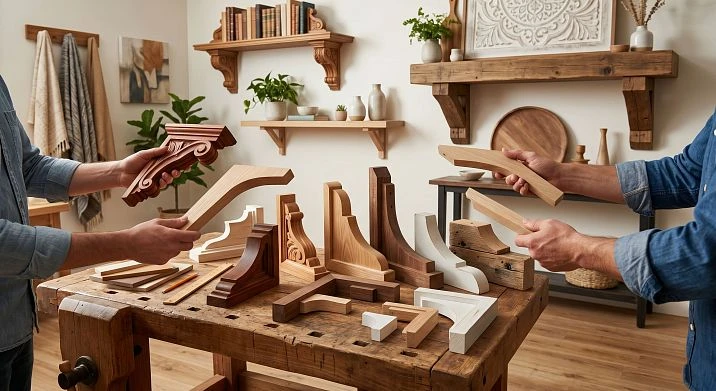
There are details that don't catch the eye immediately — but they are what hold the interior together. A bracket under a shelf in the kitchen, a carved support under a sideboard cornice, a figured corner element at a cabinet — all these are details without which a classic interior loses its completeness. A decorative wooden bracket is both a structural element and an expressive accent at the same time.
Choose Furniture Bracket correctly means understanding what task it solves: to bear a load, to decorate a surface, or to work in a system with other wooden elements. This article is an honest and complete breakdown: from purpose to coating, from load calculation to combination with handles, legs, and moldings.
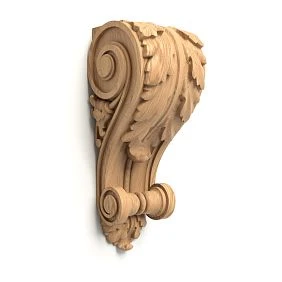
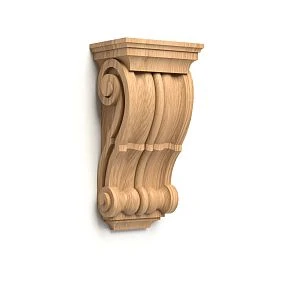
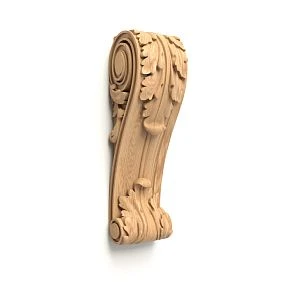
Short answer: when you need a wooden decorative bracket
If you need an entry point into the topic — here it is. wooden bracket — the right choice in the following situations:
-
You need to support an open shelf — in the kitchen, living room, study, hallway, or bathroom.
-
The furniture looks too plain — a sideboard, display cabinet, wardrobe, or kitchen without decorative supports looks unfinished.
-
You need to design the top of the furniture — the transition zone from the body to the cornice, where the bracket acts as an architectural accent.
-
A classic decorative accent is needed — a carved or figured element that immediately shifts the furniture into a classic or neoclassical register.
-
You need to connect the furniture with the interior — brackets matching the cornices, moldings, handles, and legs create a unified style system.
-
The interior is designed in classic, neoclassical, Provence, or country style — these are spaces where the bracket as a detail works to its full potential.
Each of these scenarios requires its own approach. We'll analyze them sequentially — from general to specific.




What is a furniture bracket
The word "bracket" is technically precise. In architecture and construction, it is a protruding support element that bears the load from the structure above. In furniture production, this concept is broader.
wall mount for furniture — it is a wooden part that attaches to the side plane of the body or to the wall and serves two purposes simultaneously: functional (to support a shelf, cornice, console) and decorative (to decorate the transition, create a silhouette, add depth).
It can be purely technical — without decoration, with a simple straight profile. It can be purely decorative — figured, carved, with ornamentation that does not bear serious load but shapes the furniture's appearance. And it can be combined — functional and beautiful at the same time.
The wooden bracket is made from birch, alder, or pine solid wood. The shape ranges from a simple angle bracket to a complex carved profile with floral ornamentation. Sizes range from small (80×80 mm) to large console elements (200×200 mm and more). The surface is unfinished, for independent painting or tinting.
In classical furniture Decorative Bracket it works not as a separate part, but as part of a visual program: together with the cornice on top, moldings on the facades, carved overlays around the perimeter, and legs at the bottom, it forms a unified architectural image of the object.
Our factory also produces:
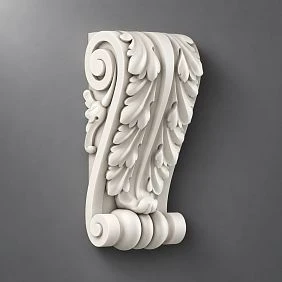
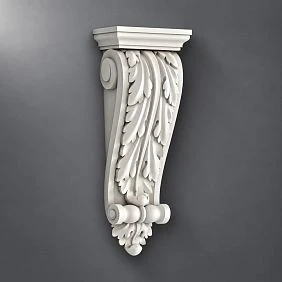
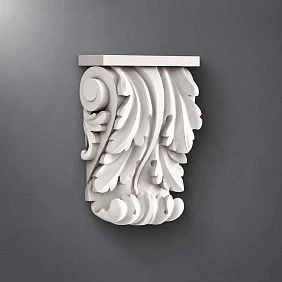
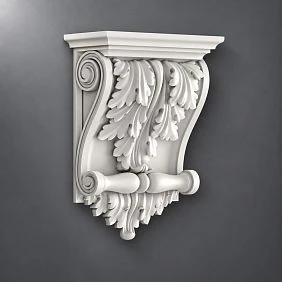
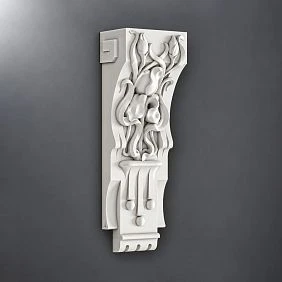
Where wooden brackets are used
Get Consultation
For shelves
An open shelf without brackets is just a board on the wall. An open shelf on wooden brackets is an interior element that carries style.
bracket for shelf solves several tasks at once: holds the load, creates a visible support, adds a vertical decorative element. In the kitchen — under an open shelf with dishes. In the living room — under a bookshelf in a niche. In the study — under a horizontal console with books and decor. In the hallway — under a shelf for keys or small accessories.
For shelves, it's important to understand: a decorative bracket and a load-bearing bracket are different things. A decorative element without a metal duplicate fastening is not intended for loads over 5–10 kg. If the shelf is intended for books, dishes, or heavy items, the load should be distributed to a hidden metal fastening, and the wooden bracket works as a visual accent.
For furniture
This is the widest area of application. Wooden decorative bracket Applied:
-
On a sideboard and display cabinet — in the transition zone from the lower body to the upper one, on the side edges.
-
On a cabinet — in the cornice area, under the upper horizontal plane, between columns.
-
On a chest of drawers — as a decorative accent under the tabletop or on the sides of the body.
-
On the console — as a support and decorative element, supporting the protruding plane.
-
On the cabinet — as side decor when creating a neoclassical look.
When the bracket appears on furniture — it ceases to be a "box" and comes to life. Architecture emerges.
For Kitchen
A classic kitchen is the space where kitchen bracket feels at home. Under the cornice of upper modules, under open shelves with spices and dishes, on the sides of decorative portals — everywhere where a transition from a vertical surface to a horizontal one is needed.
For the kitchen, not only decorativeness is important, but also practicality. A wooden bracket in the kitchen must have a coating resistant to moisture and temperature changes. Varnish is the preferred option. Enamel is a good option with regular care.
Brackets in a classic kitchen work in conjunction with with wooden cornices above the upper modules, with wooden furniture handles on the facades and with solid wood moldings in frame inserts. This is a system where each element supports the other.
For cornices and top elements
wooden cornice above a cabinet or furniture — it is a horizontal protruding profile. It sets the upper boundary of the furniture. But where the cornice makes a corner or rests on a side surface, a part is needed that visually "holds" this protrusion. This is exactly where the bracket appears.
In architectural tradition, a bracket under a cornice is a mandatory element. It is what makes the transition from the wall (or body) to the cornice architecturally correct. Without a bracket, the cornice "floats" — protrudes without visible support. With a bracket, it reads correctly.
For interior
Wooden brackets can work not only on furniture but also in the interior itself. On niche walls — as a decorative accent with a vase or lamp. In openings — as an element of architectural design. In fireplace areas — under the mantel shelf. In console areas of the hallway or library — as a support for a wall console.
A bracket in the interior is a small architectural element. It works as a detail that communicates: form was considered here, there was intent here.
Furniture or decorative bracket: what is the difference
Let's break down the table — this is the most visual way.
| Type of bracket | Main task | Where to use |
|---|---|---|
| Furniture bracket | Functional and decorative | Cabinets, shelves, cornices, kitchens, display cases |
| Decorative bracket | Primarily decorative | Interior accents, classic trim, portals |
| Carved bracket | Decorative with load-bearing elements | Classic, sideboards, fireplaces, country houses |
| Simple wooden bracket | Functional | Calm furniture, shelves, neoclassical |
| Massive bracket | Load-bearing and decorative | Large shelf, portal, tall cabinet |
Key distinction: not every beautiful bracket is load-bearing. A thin carved element with an openwork profile is primarily a visual accent. If real load is planned under such a bracket, a hidden metal shelf attachment to the wall is needed. The decorative wooden bracket then works as a "wrapper" that hides the technical fasteners and creates aesthetics.
Rule of smart choice: first determine the load, then decorative preferences. Never the other way around.
How to choose a bracket by size
Size is the first technical decision made before everything else.
Matching the shelf depth or overhang. The bracket must support the shelf along its entire depth or at least 2/3 of the depth. If the shelf has a depth of 25 cm, the bracket must be at least 18–20 cm along the horizontal arm. A small bracket under a deep shelf is not only aesthetically poor but also structurally dangerous.
Proportionality of furniture. Large carved Decorative Bracket a 200×200 mm item on a small kitchen shelf 15 cm deep is a disproportion. An 80×80 mm bracket on the cornice of a massive cabinet 220 cm high is a lost element. The bracket size should be proportionate to the furniture.
Height of the vertical arm. The vertical arm of the bracket is the part that attaches to the vertical surface. The higher it is, the more securely the shelf holds under load. For heavy shelves, the vertical arm should be at least 15–20 cm. For light decorative ones, 8–12 cm.
Paired symmetry. Brackets are always installed in pairs (and sometimes in threes for long shelves). Important: both brackets must be exactly the same size and profile. Asymmetrical placement or different sizes is a gross mistake that immediately catches the eye.
Distance between brackets. The longer the shelf, the closer to the center an additional bracket is needed. For a shelf up to 80 cm long, two brackets. For a shelf 80–120 cm, three brackets. This prevents sagging under load.
Bracket and furniture body. If the bracket is installed on the side of a cabinet or sideboard, its height should not exceed 1/3 of the visible side height. Otherwise, it visually "eats up" space and disrupts proportions.
How to choose the bracket shape
Shape wooden bracket is its "character" and its ability to fit into a specific interior style.
Simple smooth bracket
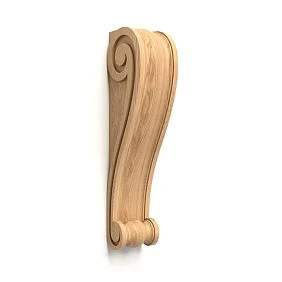
An angular element without decoration, with straight edges and a slight chamfer. A minimalist shape without carving or relief. Ideal for calm, laconic furniture — shelves in modern interiors, nightstands in neoclassicism, consoles in Scandinavian style.
A simple bracket is not a "poor" option. It is a precise choice for interiors where order and the absence of unnecessary decor are valued. The detail works through proportion and material, not through ornament.
Figural bracket
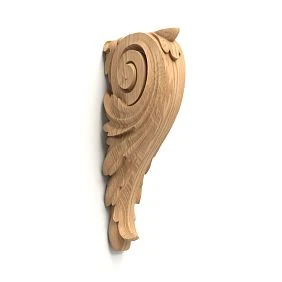
Profile with smooth curves, rounded edges, and soft transitions. More expressive than a smooth one, but without complex carving. This is the middle register — for neoclassical, modern classic, and Provence styles. Works well on kitchen fronts, under cabinet cornices, and on buffet sides.
The figural bracket is versatile: it is beautiful enough for a classic interior and restrained enough not to overwhelm calm furniture.
Carved bracket
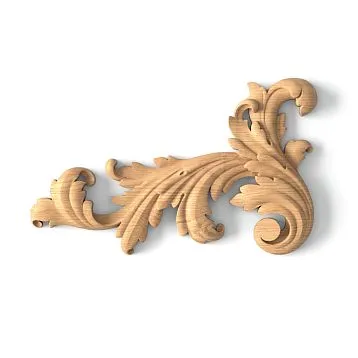
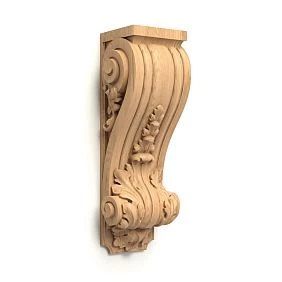
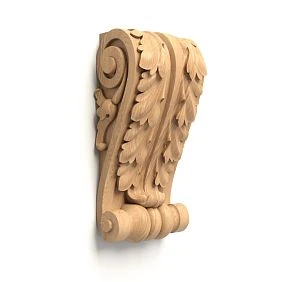
Ornamental profile with pronounced relief — a floral, geometric, or architectural motif. This is the maximum decorative level. carved bracket — for classic furniture, buffets with glass display cases, fireplace portals, and formal cabinets in country houses.
Important: the carved bracket requires an appropriate context. It must be surrounded by details of the same complexity level — carved overlays, profiled cornices, and facades with paneling. On a simple body, a carved bracket will look like a random detail.
Corner bracket
Equal arms with a diagonal insert element — a classic corner profile. Works well in niches, in areas where shelves meet walls. Installed in internal and external corners. The shape is universal — without a pronounced stylistic accent.
Large decorative bracket
Large size — 150×200 mm and larger. Massive profile, often with carving. Used for fireplace portals, large sideboards, cabinets taller than 200 cm, consoles in halls. The element works as an architectural detail — it is visible from afar and must maintain aesthetics at a distance.
Bracket for painting
An unfinished wooden bracket is a semi-finished product ready to accept any color. decor for furniture for enamel — that's exactly the case. The bracket is sanded, primed, and painted together with the furniture body. The result is a monolithic, seamless look: the bracket does not appear "attached" but becomes part of the piece.
Load: what to check before purchase
This is the most "engineering" section of the article. But this is where decisions are made that later determine the safety of the structure.
Shelf weight. An empty wooden shelf 80 cm × 25 cm made of solid wood weighs 2–3 kg. Made of chipboard — 1.5–2 kg. This weight is already taken into account when calculating the load on the bracket.
Weight of items on the shelf. Dishes — 5–15 kg. Books — 10–20 kg per linear meter. Decorative items — 1–5 kg. The total load on an 80 cm shelf with dishes can reach 20–25 kg.
Load-to-bracket ratio. A wooden bracket made of birch solid wood with a cross-section of 40×40 mm and an arm length of 150 mm can withstand a static load of about 15–25 kg (provided proper wall mounting). A thin carved bracket with an openwork profile — significantly less.
Number of brackets. The load is divided by the number of supports. Two furniture supports under a shelf 80 cm — each carries half the weight. With a larger load — three supports.
Wall material. Brick, concrete — a reliable base for anchor bolts. Drywall — a weak spot: heavy shelves cannot be attached to it only through brackets; special anchors or fastening to the metal profile behind the drywall are needed.
Fastening method. The bracket is attached with self-tapping screws through mounting holes. The diameter and length of the screws must match the base material. For wood — screws at least 50 mm long, for brick — anchor dowels.
Distance between brackets. The optimal distance is 1/4 of the shelf length from each edge. This distributes the load evenly and prevents the shelf from sagging.
Decorative ≠ load-bearing. Once again — a fundamentally important point: if the bracket is chosen as a decorative accent, do not load it as a load-bearing one. For shelves with real load, use hidden metal supports, and install the bracket as a decorative element on top or nearby.
Wooden brackets for classic furniture
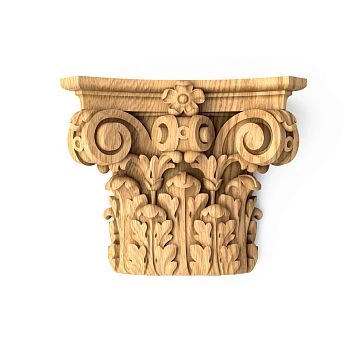
Classic furniture is a special case. Here, details decide everything. A turned leg, a carved bracket, a profiled cornice — remove any detail, and the image falls apart.
Bracket for a cabinet in a classic style — it is primarily an architectural detail. It works in a system with a cornice on top and moldings on the facades. The right bracket visually "holds" the cornice, creating the illusion of support, and elevates the furniture from the category of "box" to the category of "object with architecture".
for classic furniture choose figured or carved brackets that match other decorative elements:
-
С with wooden cornices — in shape and scale.
-
С solid wood moldings — in the same tone and finish.
-
С decorative inlays on facades — in a unified carving style.
-
С wooden legs — in a consistent turned decor character.
When all these elements are chosen in a unified system, the furniture ceases to be "painted particleboard" and becomes an item with character — warm, recognizable, and expensive.
An important practical rule: brackets for classic furniture are best purchased together with other wooden parts, before painting the entire furniture. This way, everything can be painted in one color, in one go — achieving a seamless result.
Brackets for kitchen and open shelves
The kitchen is a space where every element is on display. There is no opportunity to hide a failed detail behind a sofa or rug. kitchen bracket must be both beautiful and practical.
Open shelves in a classic kitchen. An open shelf with dishes or spices above the work area is a traditional element of a classic kitchen. Two wooden brackets with a shaped profile, painted in the color of the facades, support the shelf and create an accent.
Brackets under the cornice of the upper modules. wooden cornice above the upper kitchen modules is already a classic technique. But a cornice without supports visually 'hangs'. Small brackets at the ends of the upper modules complete this structure.
Decorative portals. In classic kitchens, decorative portals are found around the hood or work area. Brackets as part of the portal are supporting elements that shape the architecture of this area.
Care and coating. In the kitchen, wooden elements require a durable coating. Enamel is the best choice: easy to wipe, does not absorb odors, does not darken from steam. Varnish is possible, but varnish in the kitchen requires more frequent renewal.
The bracket in the kitchen works in conjunction with furniture handles on the facades. A single tone and a single style of details — brackets or knobs — create a system. By the way, wooden hook handle on kitchen facades and wooden brackets under shelves are a ready-made style pair.
How to combine brackets with other wooden decor
This is a key section for those who want a result, not a set of details. The bracket does not work alone. It is part of a system. And this system has its own logic.
Brackets + wooden cornice. Bracket and cornice are a classic pair. wooden cornice crowns the cabinet or kitchen from above, and brackets support it on the sides. Together, they form the architectural top of the furniture. In shape: the bracket should not be more complex than the cornice — they can be of equal complexity, but should not compete.
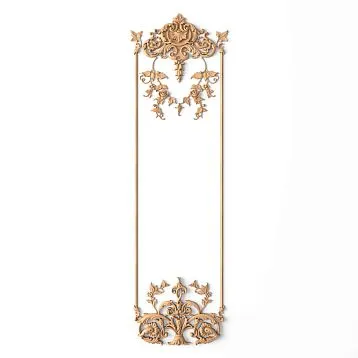
Brackets + decorative overlays. Wooden decoration in the form of overlays on the facades and brackets at the ends — this is a unified system of ornamental furniture design. The carving style must match: you cannot install a bracket with a floral ornament and overlays with a geometric pattern.
Brackets + furniture handles. wooden furniture handles and brackets should be in the same tone and with the same coating. If the handles are painted white — the brackets are also white. If the handles are under natural varnish — the brackets are under the same varnish.
Brackets + legs. Wooden legs at the bottom of the furniture and brackets at the top — these are the upper and lower decorative accents. Together they create a vertical rhythm: the furniture is "lifted" by the legs from below and "decorated" by the brackets from above. This is what distinguishes a well-thought-out piece from a random one.
Brackets + moldings and trims. Moldings from solid wood on the facades, wooden floor In frame inserts and brackets at the ends — a complete decorative program for furniture. This technique turns any cabinet into a classic piece.
Brackets + baseboard and baguette. with a classic profile creates a sense of solidity, reliability. around the perimeter of the room, Wooden Picture Frame on the walls and brackets on furniture — this is wooden decor that covers the entire space. Furniture ceases to be a separate item in the room and becomes part of the interior.
Main idea: the bracket should be part of the overall style system, not a random carved detail. One bracket without context is just a wooden corner piece. A bracket in a system with a cornice, moldings, handles, and legs is an element of interior design.
Bracket for painting, varnish, or stain
The choice of finish coating for a wooden bracket determines how it will work in the interior — and for how long.
For enamel. The most common option for classic and neoclassical furniture. Sanding the bracket (P150, then P220), primer, two coats of enamel — and you get a smooth colored surface identical to the furniture body coating. White, cream, gray, pastel — any shade.
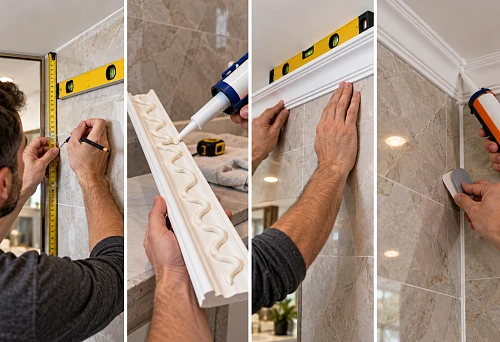
Important: enamel on a wooden bracket is applied before installation. After installation, painting is inconvenient, paint gets on adjacent surfaces, quality is lower. decorative elements for furniture for painting — the same principle.
Under varnish. If the furniture is designed to look like natural wood, the bracket is coated with clear varnish. The wood grain is preserved, the tone is natural or slightly emphasized. For classic interiors with warm tones — an excellent solution.
Under stain. If you need to match the bracket tone to the floor or other furniture — stain before varnish. Birch and alder take stain evenly. Important: test on a small inconspicuous area before full treatment.
Contrast brackets. Rare, but justified: the furniture body is painted, and the brackets are under natural varnish. Or vice versa — a white body, dark brackets. This is a strong design technique. Requires confidence and appropriate context.
Sequence rule. The finish coating is determined BEFORE purchase and installation. Not "we'll paint later" — but "chose the color, bought all parts, painted everything in one go". This is the only way to get a monolithic result.
Mistakes when choosing a wooden bracket
Let's list them honestly. Each of these mistakes occurs regularly — and each costs money.
Choosing a bracket only by appearance. Beautiful in the catalog, but the wrong size, with an unsuitable profile for the given furniture — a common story. Start with size and load, then aesthetics.
Not considering the load. A decorative openwork bracket under a shelf with books — a structural mistake. First determine the load, then choose the shape.
Installing a small bracket under a deep shelf. Disproportion and risk. The bracket should support the shelf at 2/3 of its depth.
Using too massive an element on light furniture. A large carved bracket on a compact nightstand is overwhelming decor. The scale of details should match the scale of the item.
Do not check the mounting method. Buy a wooden bracket without understanding how it attaches to your furniture or wall means risking a poor result. Clarify the mounting holes and type of fastener.
Mixing different carving styles. A bracket with baroque ornamentation next to Art Nouveau-style overlays is a visual conflict. The carving style of all decorative elements must be consistent.
Not matching brackets with handles, legs, and overlays. A natural wood bracket with a lacquer finish + painted metal handles + plastic legs. These are three different 'languages' — the furniture will not look cohesive.
Forgetting about painting. You installed the bracket without a coating, then tried to paint it in place — the result is worse than it could have been. Paint before installation.
Buying a decorative bracket as a load-bearing one. Again — these are different things. Check the load-bearing capacity before purchasing if real load is planned.
What to buy together with wooden brackets
For a systematic approach to furniture design — a complete list of related elements:
wooden bracket — the main decorative and support element, selected by size, shape, and load.
Wooden decoration — overlays on facades to create a frame or ornamental effect.
decorative elements for furniture — the full range of applied wooden details for classic design.
wooden furniture handles — matching the brackets, for a unified look.
wooden button handle — for lightweight facades of cabinets and small cupboards.
Wooden legs — for raising the body and creating a lower decorative accent paired with brackets.
wooden cornice — the upper horizontal element that the brackets visually support.
Moldings from solid wood — for decorating facades, stringers, and transition zones.
wooden floor — for frame inserts on furniture facades and doors.
Wooden Picture Frame — for decorating niches, walls, and architectural transitions.
with a classic profile creates a sense of solidity, reliability. — for completing the wooden system around the perimeter of the space.
Classic Furniture — if you are looking for a finished item, not just components for it.
FAQ: questions about wooden brackets
What is a wooden bracket used for?
Decorative Bracket used as a support or decorative element for shelves, furniture, cabinets, sideboards, kitchen cornices, consoles, and interior accents. It can bear weight or work exclusively as a visual element — depending on the type and method of attachment.
How is a furniture bracket different from a decorative one?
furniture bracket is connected to the structure of furniture or a shelf and can bear actual load. A decorative bracket works primarily as a visual accent. It is fundamentally important not to confuse these functions when calculating load.
How to choose a bracket for a shelf?
You need to consider the depth of the shelf, its weight and the expected load, the number of brackets, the wall material, and the type of fasteners. The size of the bracket should correspond to at least 2/3 of the shelf depth. For heavy shelves — hidden metal fastening plus a decorative wooden bracket for shelf.
Can a wooden bracket be painted?
Yes. Wooden Brackets without coating can be painted with enamel, tinted with stain, or coated with clear varnish. It is better to paint before installation — this gives a cleaner and more even result.
What to pair decorative brackets with?
They are best combined with wooden handles, legs, overlays, cornices, moldings, trims, and baseboards in a unified tone and style. It is the system of details that creates a cohesive furniture image.
How many brackets are needed for a shelf?
Two — for a shelf up to 80 cm. Three — for a shelf 80–120 cm. Placement: indent 1/4 of the shelf length from each edge, add a central element if necessary.
For which interior styles are wooden brackets suitable?
First of all, for classic, neoclassical, Provence, and country style. Simple smooth brackets — also for Scandinavian and modern minimalism. Carved figured brackets — for Baroque and Empire style.
About the company STAVROS
A good interior is not one expensive detail, but dozens of properly selected elements that speak the same language. STAVROS produces a full range of wooden decor for furniture and interiors: furniture and decorative brackets, Moldings from solid wood, Wooden cornices, overlays and decorative elements, Handles, Legs, Baseboards и Trim.
STAVROS is a manufacturing where details are created as a system. Not a set of disparate products, but an interconnected assortment where a bracket, handle, leg, and cornice match each other in proportion, style, and character. Because an interior is not the sum of individual purchases. It is a decision made once but lasting a long time.