





























Article Contents:
- First, answer the main question: is this a finish defect or already damage to the base itself?
- When the idea with NPU-237 seems reasonable
- When base repair is needed first
- To the nearest edge of the facade
- To the handle
- To the existing relief
- Small central damage
- Damage above or below the center
- Narrow door
- Long scratch
- Large door
- Not just close, but rethink the facade
- Strategy 1. One overlay
- Strategy 2. Two identical NPU-237
- Strategy 3. Full restoration of one door
- Mistake 1. Measure only the length of the scratch
- Mistake 2. Not measuring the distance to the handle
- Mistake 3. Centering on the defect
- Mistake 4. Buying 495 mm "for reliability"
- Mistake 5. Not making a template
- Mistake 6. Gluing onto peeling coating
- Error 7. Forgetting about the paired door leaf
- Mistake 8. Buying two overlays automatically
- Mistake 9. Not accounting for thickness
- Error 10. Deciding that the overlay must replace any repair
- For one damaged door
- For two symmetrical doors
- For four identical facades
- Can NPU-237 really cover a scratch without repainting the entire door?
- What size of NPU-237 should I choose for damage about 50 × 200 mm?
- Will a small NPU-237 fit for damage of 60 × 250 mm?
- When should I choose NPU-237 110 × 495 mm?
- Can NPU-237 be placed off-center on the door?
- What matters more — the center of the damage or the center of the front?
- Is a second NPU-237 needed on the adjacent door?
- If one of four doors is damaged, do I need to buy four overlays?
- Can a deep chip be closed without preliminary repair?
- What to do if the coating is peeling around the scratch?
- Can NPU-237 be placed next to a furniture handle?
- What to do if the damage is almost at the edge of the facade?
- How does the small NPU-237 differ from the large one besides length?
- Can a large NPU-237 be chosen for a small scratch?
- How to make an NPU-237 template?
- Do I need to print the ornament itself?
- Can NPU-237 be glued immediately after receipt?
- What adhesive is provided for such installation?
- How much does KUDO HIGH TACK cost?
- How long does one tube of KUDO last?
- Do I need to remove the door before installing NPU-237?
- Can I use NPU-237 on an already painted facade?
- Do I need to repaint NPU-237 itself to match the door color?
- Can NPU-237 be made contrast?
- What to do if the scratch is slightly longer than 315 mm?
- What if the defect is longer than 495 mm?
- Can NPU-237 hide holes from an old handle?
- Is NPU-237 suitable only for furniture?
- What to do if NPU-237 doesn't match the style?
- Where to look for wider polyurethane molding if the renovation turns into furniture remodeling?
- What should be checked right before placing an order?

The furniture is already assembled. The facades are aligned, handles are installed, the interior is almost finished — and it's at this very moment that a long scratch, chip, or scraped-off area of the coating appears on the most noticeable door. The damage may cover only a few centimeters, but on a smooth painted surface it catches the eye more than a much larger imperfection elsewhere. The first thought is to remove the facade and repaint it entirely. The second, more practical one: can the damaged area be covered with a decorative overlay and made to look as if it was originally intended in the furniture design?
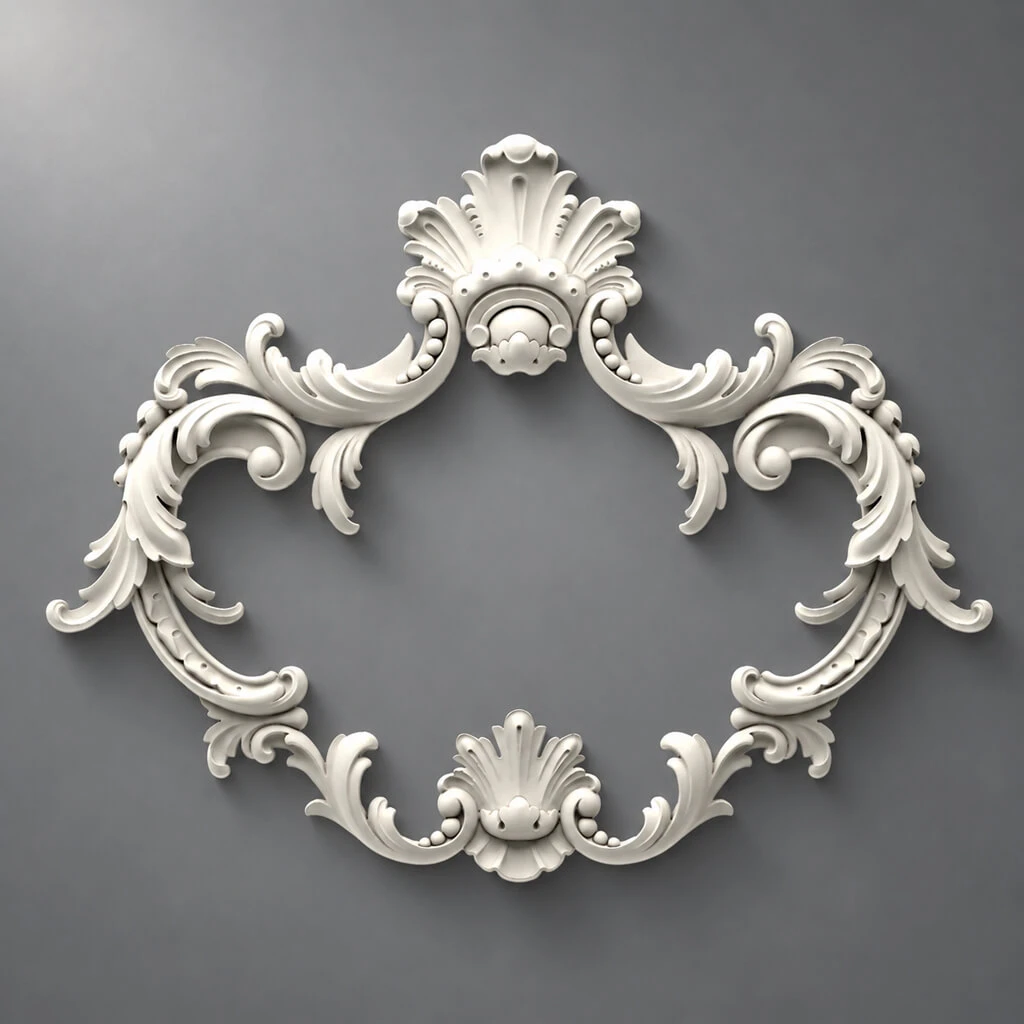
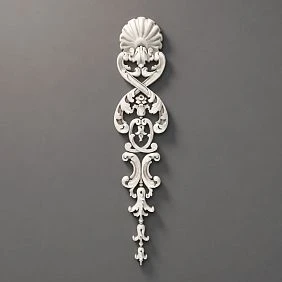
For such a task, the polyurethane molding NPU-237 is interesting. The model has an elongated shape and is available in two confirmed sizes: 70 × 315 × 15 mm and 110 × 495 × 23 mm. Therefore, it can be considered not just as a decoration for a new facade, but as a tool for local decorative remodeling of already finished furniture. The smaller variant covers a relatively narrow elongated field, while the larger one occupies a noticeably bigger part of the door.
But there is a fundamental condition here. NPU-237 should not become a "patch" placed solely because there is a defect underneath it. After installation, it should look like part of the furniture composition. If the damage can be covered, but the overlay turns out to be accidentally pressed against the edge, overlaps the handle, conflicts with the panel, or disrupts the symmetry of a pair of doors, technically covering the scratch does not yet mean a successful repair.
Therefore, before buy decorative molding NPU-237, you need to measure not just the defect itself. You'll need its extreme boundaries, the free field around it, the distance to the handle, the edge of the facade, neighboring decorative lines, and the position relative to the center of the door.
The correct sequence looks like this:
assess the condition of the facade → measure the damage → check the free field → make a template of NPU-237 → look at the composition on the facade → choose 315 or 495 mm → decide whether one overlay or a symmetrical pair is needed → prepare the base → only then order and install.
It is precisely this approach that can turn an unpleasant trace after assembly into a meaningful piece of furniture detail.
First, answer the main question: is this a finish defect or already damage to the base itself
Before centimeters, templates, and the choice of NPU-237, there is a more important fork in the road.
What exactly happened to the facade?
One thing is a superficial long scratch, a local chip in the coating, or a damaged decorative area, where the plane of the door itself remains strong and stable.
Quite different is deep destruction of the base, peeling of the coating around the defect, a loose area, a protruding fragment, or noticeable deformation of the surface.
A decorative overlay can visually cover the former. It should not be used as a way to hide the latter without repair.
This is not a matter of aesthetic strictness. The mounting element must be attached to a prepared, strong surface. If the coating under the overlay peels off along with the base, the decorative layer simply hides the problem from view but does not eliminate it.


When the idea with NPU-237 seems reasonable
You can consider a decorative overlay if:
-
The facade retains its proper shape;
-
The damage is local;
-
The main plane around it is solid;
-
The defect fits within the contour of one of the two NPU-237 units;
-
After installation, the overlay does not interfere with the handle or other functional parts;
-
it can be placed compositionally convincingly;
-
Repeating the decor on the adjacent facade is either not required, or it can be done deliberately.
In this case, you are not facing a 'repair at any cost,' but a real design fork: repaint the entire door or use the defect as a reason to add a decorative relief.
Our factory also produces:
When base repair is needed first
If the area is crumbling, the finish layer is actively peeling off the surface, there is a deep pothole, the edges of the chip protrude, or a pronounced unevenness remains under the future overlay, first bring the base into a working condition.
NPU-237 should not hold a delaminated facade.
It is not obliged to level out a deep pit either.
Its task in this scenario is to decoratively cover a local area after surface preparation, not to replace the restoration of a damaged base.
This distinction needs to be accepted before placing the order. It saves you from a situation where a beautiful overlay is purchased, but there is actually nowhere to attach it.
Get Consultation
What exactly is NPU-237: two sizes for two scales of damage
NPU-237 belongs to polyurethane molded decor and has an elongated geometry. This feature makes the model interesting for long scratches and elongated damaged areas on furniture facades.
The main confirmed parameters are as follows:
| Parameter | Small variant | Large variant |
|---|---|---|
| Article number | NPU-237 | NPU-237 |
| Size | 70 × 315 × 15 mm | 110 × 495 × 23 mm |
| Material | Polyurethane | Polyurethane |
| Width | 70 мм | 110 мм |
| Height/length of the elongated shape | 315 мм | 495 мм |
| Thickness | 15 мм | 23 мм |
| Current price | 1 940 ₽ | 5 530 ₽ |
| Main task in this article | Local elongated damage | A larger damaged or decorative area |
The price is indicated at the time of material preparation. When ordering, it should be checked in the product card.
The table shows the main thing: the two options differ not only in length.
The large NPU-237 is wider and thicker. Therefore, the transition from 315 to 495 mm is not just an increase in the area that can be covered. The visual scale of the decor itself changes.
That is why a large overlay should not be bought on the principle of "just in case it will cover more." If the small one completely covers the damage and fits the facade better, it may turn out to be much more accurate.
Measure not the entire door, but a rectangle that fully includes the damage.
Let's imagine a long scratch.
It may have uneven edges. In one place the width is 8 mm, in another — 20. A chip at the end expands the damaged area by a few more millimeters.
Measuring only the longest line is not enough.
A conditional rectangle is needed, inside which the entire damage fits completely.
Simply put, determine:
the maximum width of the defective zone;
the maximum height or length;
the extreme points at the top, bottom, right, and left.
Suppose a scratch about 240 mm long runs almost vertically, and together with a small chip its maximum width reaches 45 mm.
Then the working field can be written as:
45 × 240 mm.
After that, it makes sense to apply a small NPU-237 to the calculation:
70 × 315 mm.
Geometrically, it is larger than the damaged rectangle and can potentially cover it.
But the word "potentially" is mandatory here.
Because next, you need to check the position of this rectangle on the door.
Example: the defect occupies approximately 60 × 250 mm
This is exactly the case where a small NPU-237 looks like the first candidate.
Damaged area:
60 × 250 mm.
Small decor:
70 × 315 mm.
Formally, the damage fits.
In width, the total difference remaining is 10 mm.
In length — 65 mm.
But simply aligning the centers of two rectangles does not guarantee a successful result.
Need to check how close the damage is located:
-
to the edge of the door;
-
to the handle;
-
to the decorative frame;
-
to the panel;
-
to the adjacent leaf.
If the defect is located almost in the center of a smooth field of the facade, the situation is favorable. The overlay can be placed so that it completely covers the damage and at the same time looks like a meaningful central decoration.
If the same scratch is located 15 mm from the side edge, the geometry changes completely. NPU-237 may extend beyond the boundary of the available field or look artificially shifted.
That is, the size of the defect only answers the question "will it cover?", not the question "will it look good?".
Three measurements around the damage that are more important than the width of the entire furniture
After determining the boundaries of the defect, record three distances.
To the nearest edge of the facade
Suppose the overlay should cover a damage 50 mm wide.
The small NPU-237 has a width of 70 mm.
If the defect is almost flush with the edge, the overlay cannot be freely centered relative to it.
You will either have to shift the decor or abandon the idea.
Therefore, measure the distance from the extreme points of the damage to the side and top/bottom edges of the door.
To the handle
The handle is not a decorative trifle. It is a functional element.
NPU-237 should not interfere with gripping, overlap the mounting area, or create uncomfortable density near the handle.
Pay special attention to checking the large variant 110 × 495 × 23 mm. It occupies a significant part of the door and physically protrudes more than the small one.
Up to the existing relief
If the facade is smooth, there is more freedom.
If it already has a frame, panel, milling, or other decor, NPU-237 must be within the existing architecture, not randomly crossing it.
A successful renovation starts with answering the question:
“Where on the facade is it decoratively allowed to place an overlay?”
And only then:
"Will it cover the scratch?"
Make two templates before purchasing — this is more important than a product photo
For NPU-237, this technique is especially effective because the dimensions are known precisely.
Cut out two rectangles from paper or thin cardboard:
70 × 315 mm;
110 × 495 mm.
There is no need to try to reproduce the ornament exactly.
At the first stage, we are interested in four things:
-
the area occupied;
-
position relative to the defect;
-
distance to edges;
-
visual scale on the facade.
Apply the small template.
Is the damage entirely contained inside?
Can the template be shifted so that it looks centered relative to the door?
Is the edge getting close to the handle?
Is it not pressing against the frame?
After that, try 110 × 495 mm.
A large template can reveal an unexpected thing: it covers the defect with a huge margin, but half the door turns into a large decorative object. Perhaps it's beautiful. Or perhaps it completely clashes with the rest of the furniture.
Paper will give the answer before spending money and before applying glue.
70 × 315 mm: when the smaller NPU-237 solves the task more precisely
The small variant is especially interesting for local repairs.
It has a sufficiently elongated shape to cover a long scratch, but does not occupy an excessively large area of the facade.
A small central damage
Let's imagine a cabinet door with a fairly large smooth field.
After assembly, a vertical scratch about 200–250 mm long appeared in the center.
If it fits within a width of less than 70 mm with the necessary overlap, NPU-237 70 × 315 mm can become a natural central element.
In this scenario, two tasks coincide at once:
the defect is hidden;
a decorative center appears on the facade.
Damage above or below the center
This is more complicated.
To cover the defect, the overlay may need to be noticeably shifted.
Take your time.
See if this position looks intentional.
If not, it is sometimes more rational to place the overlay at a compositionally correct point and first locally restore the part of the damage it does not cover, or abandon the decorative path altogether.
You cannot let a scratch dictate poor composition.
Narrow door
On a relatively narrow facade, a width of 70 mm may be much more appropriate than 110 mm.
Visually, a large overlay will start to occupy the plane too actively.
Therefore, the small variant should be considered not as "cheap" but as an independent scale.
110 × 495 × 23 mm: when what is needed is no longer masking, but a full-fledged decorative remodel
The large NPU-237 significantly changes the facade.
Almost half a meter in the elongated dimension and a width of 110 mm — this is already a noticeable relief object.
This option makes sense when the damage is:
-
is longer;
-
wider;
-
occupies a large central area;
-
or the facade itself is so large that 70 × 315 mm looks insufficiently expressive.
Long scratch
If the damaged rectangle approaches 300 mm in length or exceeds the capabilities of the small element, the large option becomes a natural candidate.
But first check the width.
110 mm requires sufficient smooth field on the right and left.
Large door
On a tall cabinet or large furniture front, a 495-millimeter overlay may look more proportionate.
Here the small one is sometimes perceived as a random detail, especially if the door has significant height.
Not just to cover, but to rethink the facade
The large NPU-237 well demonstrates the important idea of the entire article.
Sometimes damage becomes a reason not just to hide a scratch, but to change the decorative logic of the furniture.
It is precisely then that 110 × 495 mm is chosen not because “the smaller one doesn’t cover,” but because the large relief works better with the facade.
315 or 495 mm: a table for practical selection
| Situation | 70 × 315 × 15 mm | 110 × 495 × 23 mm |
|---|---|---|
| Small long scratch | First option for trying on | May be excessive |
| Damage around 250 mm | Often sufficient by geometry | Check only for composition or greater coverage |
| Longer damaged area | May not cover completely | More likely option |
| Narrow facade | Usually easier to fit in | Requires especially careful fitting |
| Large tall door | Can look restrained | May better match the scale |
| A handle is located nearby | Easier to save free space | Higher risk of conflict |
| Need to design a pair of panels | Changes the original design less | Creates a strong symmetrical composition |
| The task is to intervene minimally | More natural candidate | Fits worse if the decor should be almost invisible |
| The task is to noticeably refresh the furniture | The effect is more restrained | The decorative role is expressed more strongly. |
The table does not replace the template.
It only shows the direction.
The specific door decides finally.
Why “scratch 20 mm, overlay 70 mm — so it fits” is a bad calculation
The damage width is only one dimension.
Suppose the scratch is very narrow: 15 mm.
NPU-237, 70 mm wide, covers it with a huge margin.
But the defect is located near the handle.
To completely cover it, the overlay has to be placed almost flush with the hardware.
On the other half of the facade, a large empty field remains.
Technically, the scratch is covered.
Visually, the result is an obvious explanation:
"Something was glued here because there was damage."
This is exactly what needs to be avoided.
The patch should explain itself through design, not through the origin of the defect.
Therefore, a good question sounds different:
"Can I position NPU-237 as if it was planned before the scratch appeared, while completely hiding the damage?"
If yes, the idea works.
If not, repainting or another restoration method may be more honest.
The most important test: forget about the scratch for a minute.
Cover the damage with a piece of opaque paper.
Look at the door.
Now apply template NPU-237 in the chosen position.
Ask yourself:
Would I place such decor here if the facade were not damaged at all?
If the answer is "yes," you have found a strong solution.
If the answer sounds like "no, but otherwise the scratch won't be covered," the result will almost certainly be perceived as masking.
This simple psychological test is more useful than a dozen decorative rules.
The center of the facade is more important than the center of the damage.
Let's imagine a door 600 mm wide.
The scratch is located 40 mm to the right of the central axis.
If you place NPU-237 strictly at the center of the damage, the overlay itself will also shift to the right.
What will a person see after the repair?
He no longer sees the scratch.
They see an overlay that is not centered.
The reason for the offset is unknown to them, so the composition seems wrong.
In such a situation, you need to check: whether the NPU-237 contour can fully cover the damage while remaining centered relative to the facade itself.
If it can — great.
If the edge of the defect slightly extends beyond the contour, a real fork arises between local restoration of part of the damage and full repair.
The damage center exists only during repair.
The center of the facade will always be visible.
When symmetry matters more than economy: one of two doors is damaged
A very common situation.
The cabinet has two identical doors.
The left one is intact.
The right one was scratched.
You only install the NPU-237 on the right.
What happens?
Even if the overlay is perfectly centered and beautifully covers the defect, two identical doors cease to be identical.
Sometimes it's fine. For example, one panel is indeed designed as an accent.
But more often, a pair requires symmetry.
And then a commercially very specific solution arises:
install the same NPU-237 on both doors.
The damaged right one gets a decorative overlay.
The intact left one gets the same element for composition.
As a result, no one perceives the right overlay as a repair. Both look like part of the original design.
Do you necessarily need to buy two NPU-237s for paired doors?
No.
This is exactly an option, not a rule.
One is enough if:
-
the door is independent;
-
The adjacent facade differs;
-
the composition is initially asymmetrical;
-
The overlay is connected to a different decorative logic;
-
the second leaf is in a different visual field.
Two are worth trying on if:
-
the doors are identical;
-
They stand next to each other;
-
they have the same handles;
-
They divide one cabinet symmetrically;
-
a single overlay looks like a random exception.
Before ordering the second one, cut out a second paper template and place both.
This makes the decision obvious even before the purchase.
And if there are four facades
Here the task is more interesting.
Let's imagine a cabinet with four identical tall doors.
Only one is damaged.
Options:
-
NPU-237 only on the damaged one;
-
an overlay on the two central ones;
-
an overlay on the two outer ones;
-
four identical overlays;
-
refusal of decorative masking and repair of the original door.
Which option is correct?
There is no universal answer.
But the rule is one: first, the new composition is designed as a whole, then the quantity of goods is determined.
You can't buy one overlay, install it, see the imbalance, then order a second one, then a third.
It is much more reasonable to lay out four paper templates at once.
Damage near the handle: the most common reason to reject NPU-237
The handle limits the available field not only physically.
It is already a decorative point of the facade.
If a prominent relief appears nearby, the two objects begin to interact.
There must be space between them, allowing the handle to be used and the details to be visually distinguished.
If the scratch runs directly under the handle, attempting to cover it with NPU-237 may create an overly dense area.
In this case, there is no need to force the product to fit.
Sometimes fully repainting one door is more rational than a decorative structure that interferes with opening the cabinet daily.
Damage near the edge: why a large overlay rarely saves the situation automatically
Suppose the scratch runs along the left edge.
The small NPU-237 cannot cover it while remaining properly positioned.
An idea arises:
“I'll take 110 × 495 mm. It's wider, so it will cover it.”
But the large width simultaneously brings the opposite edge of the overlay closer to the center of the facade and can make the misalignment even more noticeable.
This creates a paradox: the product physically covers the defect better, but compositionally works worse.
Therefore, increasing the size is not a universal way to fix an inconveniently located damage.
Damage crosses a panel or frame
If the facade already has pronounced geometry, be especially careful with decorative covering.
The overlay must not accidentally cover part of the frame, stop on it, or cross different surface levels, unless such placement is confirmed by the project.
NPU-237 is best evaluated within the actually available flat area.
Measure not the entire door, but the area between existing decorative borders.
It may turn out that the damage is small, but the free zone does not allow even 70 × 315 mm to be placed.
This is an honest reason to choose a different repair method.
The patch must cover the entire defect, not just its most visible part.
There is a temptation to hide 90% of the scratch.
The main chip will go under the decor, but a small tail will remain visible from the side.
At the fitting stage, it seems insignificant.
After installation, the eye may start to notice exactly it.
Why?
Because a beautiful new patch appeared nearby, which increased attention to this area of the facade.
Therefore, determine the damage boundaries as strictly as possible.
Mark the extreme points with a pencil or painter's tape.
The template must completely cover them, or you must understand in advance how the remaining part will be restored.
A small scratch does not always justify large decor.
Suppose the defect is only 25 × 80 mm.
Physically, the NPU-237 70 × 315 mm covers it easily.
But is it worth adding a 315 mm long overlay for the sake of a small scratch?
The answer depends on the facade.
On a large classic door — possibly.
On a small smooth facade of modern furniture — the relief can change the design much more than the scratch itself.
Here you need to compare the scale of the repair with the scale of the defect.
Sometimes local coating restoration will be less noticeable.
The NPU-237 is valuable not because it must cover every chip, but because in the right situation it simultaneously solves both repair and decorative tasks.
A large defect also does not mean that you need to take NPU-237 495 mm.
If the damaged area takes up almost the entire door, a decorative overlay may simply not be enough.
For example, a long chip extends 600 mm.
The largest confirmed NPU-237 has an elongated size of 495 mm.
It does not completely cover the defect.
You shouldn't buy it hoping that "most of it will be hidden."
If the size of the damage exceeds the dimensions, this is immediately recorded at the measurement stage.
That's exactly why we start not with the product card, but with the rectangle of the damaged area.
One NPU-237 versus repainting the entire door: comparing not just the cost
It's tempting to reduce the decision to money.
The small option currently costs 1,940 RUB.
Large — 5,530 ₽.
You can compare these amounts with the cost of removing, preparing, and repainting the facade.
But that's only part of the picture.
Two different outcomes need to be compared.
| Question | NPU-237 | Repainting/full facade repair |
|---|---|---|
| Local defect | May be a rational option | May turn out to be an excessive scope of work |
| Base is destroyed | Does not replace repair | Allows to restore the base |
| Decor is appropriate in style | Provides additional benefit | Restores original appearance |
| Needs a completely smooth facade | Does not fit the very idea | Preferable |
| Damage does not fit under the overlay | Does not solve the problem | Needs repair |
| Paired doors require symmetry | May require two overlays | Only the damaged leaf can be restored |
| Want to refresh the furniture's appearance | Can also update the facade at the same time | Usually preserves the previous design |
| A handle or panel nearby interferes with the decor | May not fit | Repair remains a viable option |
Therefore, NPU-237 is not a "cheap substitute for repainting." It is a different path.
It works well when a decorative redesign is desirable in itself.
Stucco molding for furniture: why the repair scenario still remains a design choice
When a person hears the word "stucco," they often imagine a wall, ceiling, cornice, or a classic portal.
But Moldings for Furniture works on a smaller scale.
The facade is just a plane where relief forms the composition.
The only difference is that there is much less room for error here.
On a wall, a shift of the overlay by a few centimeters might go completely unnoticed.
On a cabinet door, the center, handle, and edges are close together, so the geometry is read instantly.
That is why polyurethane furniture decor cannot be chosen only by pattern.
Size and position matter more than the first emotional reaction to the design.
Why NPU-237 can look more convincing than a random small "patch"
Local repair plates or small decorative elements often solve only one problem: they physically cover the stain.
But the eye still notices that a small object has appeared in a random place.
The elongated NPU-237 occupies a large enough field to be read as independent furniture decor.
This is especially important on tall facades.
The decorative element does not whisper:
There is a scratch under me.
It forms a vertical ornamental center.
Of course, this only works with the correct positioning.
If the plate is shifted, conflicts with the handle, or ends at an awkward point, its large size will, on the contrary, amplify the mistake.
NPU-237 should be matched to the door, not to a photo of the interior.
A product photo helps understand the shape.
It tells you almost nothing about your furniture.
The image may show a tall front.
Yours is low.
There is no handle nearby.
Yours runs right next to the supposed overlay.
There, the element is positioned along the axis.
In your case, the defect is shifted.
Therefore, the best "visualizer" is a regular paper template on the actual door.
Photograph the furniture from the distance you usually see it from.
Then look at the photo after a few minutes.
Very often on the screen it is easier to notice a shift or incorrect scale than standing close to the cabinet.
What to do if the small NPU-237 covers the scratch but looks too short
This is an interesting situation.
For repair, 70 × 315 mm is suitable.
For composition, more verticality is desired.
Then it makes sense to try 110 × 495 mm.
But the transition to the large option should provide a real improvement:
-
better proportion with the door height;
-
a more convincing decorative center;
-
connection with the adjacent facade;
-
a more cohesive design for the pair.
If the large NPU-237 just takes up more space but doesn't improve the facade, there's no reason to buy it.
What to do if a large NPU-237 covers a defect but looks excessive
Don't try to get used to the template.
If 110 × 495 mm visually overwhelms the facade, that's important information.
Return to 70 × 315 mm and check whether it can cover the main damaged area after local preparation, or choose a different repair scenario.
The largest overlay is not 'more correct.'
Decorative scale only works relative to specific furniture.
Paired facades: three strategies instead of one automatic solution
For two identical doors, it is useful to compare three options.
Strategy 1. One overlay
Suitable when asymmetry looks intentional or the furniture itself does not require mirror repetition.
Advantage — minimal intervention.
Risk — the repair-like nature of one highlighted door.
Strategy 2. Two identical NPU-237
The clearest way to remove the feeling of a "patch."
On the damaged door, the overlay covers the defect.
On the second one, it creates symmetry.
Strategy 3. Full restoration of one door
If new molded decor is not needed at all stylistically, there is no need to force it to appear just because of damage.
This is an honest decision.
When two overlays provide more benefit than one
Suppose the cabinet consists of two doors, each 600 mm wide.
Both are smooth.
The handles are positioned symmetrically.
On the right, there is a long chip along the central vertical line.
One small NPU-237 will cover it.
But after installation, the right door will become decorative, the left one will remain empty.
Two identical elements create a pair.
As a result, the defect completely disappears from the logic of perception.
This is exactly what constitutes a strong commercial scenario for ordering NPU-237 for a furniture facade: the buyer acquires not a "scratch remedy," but a ready-made repeatable decorative motif.
And when the second overlay is a waste of money
If the adjacent door differs in width.
If the cabinet is asymmetrical.
If the damaged facade is the central one.
If there is already another element on the second door.
If one NPU-237 is compositionally explained by the furniture's architecture.
In these cases, there is no need to buy a pair just for symmetry.
A commercial choice should increase the quality of the result, not just the number of items in the cart.
Damage to the kitchen front: fitting is especially important due to the density of parts
In the kitchen, there is rarely much empty space around the door.
Nearby:
adjacent fronts;
handles;
countertop;
cornices;
built-in appliances;
horizontal lines of drawers.
Therefore, even a small NPU-237 can noticeably change the appearance of the entire kitchen.
First, make a template on one facade.
Then look not at the door itself, but at the entire furniture row.
Perhaps one decor will require repetition on several doors.
And perhaps that is exactly why it is better to abandon the idea.
Damage on a wardrobe in the bedroom: the height of the facade works in favor of elongated decor
A tall wardrobe provides more space.
An elongated NPU-237 is easier to perceive as a vertical ornament.
Here, the large option of 110 × 495 mm can look especially convincing if the door is tall and wide.
But again, it's not just damage that is being checked.
If the handle is long and vertical, a second strong vertical appears nearby. There must be a clear connection between the two elements.
Sometimes a small NPU-237 is better at leaving the handle its independence.
A dresser and low doors: 495 mm may simply not find a place.
A large NPU-237 is almost half a meter in its elongated dimension.
On a low facade, it can take up a large part of the available field.
Even if it fits geometrically, the result can look heavy.
Here, 70 × 315 mm becomes the first option to check.
And on very small facades, it may also turn out to be large.
In that case, it is better to look at another Relief Decoration, rather than trying to use NPU-237 at any cost.
Damage on one of three identical doors
Three facades create a different compositional challenge than two.
If you place NPU-237 only on the central door, it can look completely natural — the central panel becomes the accent.
If the outer one is damaged, a single overlay can disrupt the balance.
Then you can consider:
-
two outer overlays;
-
three identical ones;
-
repair without decor.
Here, the location of the defect itself should not determine the scheme.
First, design the pattern for the entire set of three.
Then check whether one of the decorative elements can simultaneously cover the damage.
The painted facade creates a separate task: the new element must become part of the finish.
The furniture is already painted.
NPU-237 is added later.
So, after choosing the geometry, you need to think about visually unifying the new part and the existing surface.
You should not automatically assume a specific painting or primer system without checking.
The existing facade coating can vary.
Therefore, before finishing the overlay, you need to determine:
-
what coating is already on the furniture;
-
whether NPU-237 itself requires painting;
-
how visual matching will be ensured;
-
how to prepare the surface for installation;
-
whether the selected materials are compatible with each other.
If the facade shade is complex, color matching may prove harder than the installation itself.
Decor in the facade color or contrasting: repair logic suggests the answer
If the main goal is to make it look like NPU-237 was originally there, the most subdued idea is to incorporate it into the overall color scheme of the facade.
But there is also the opposite path: deliberately making the decor an accent.
Which is better?
It depends on the furniture.
For a renovation without a complete design change, it is usually wiser to minimize the sense of an added element.
If two or four overlays are introduced as a new decorative system, contrast can be part of the project.
But specific finishing options need to be determined based on the actual facade and confirmed materials, not on a universal recommendation from an article.
Thickness also changes perception
Small NPU-237:
15 mm.
Large:
23 mm.
Р
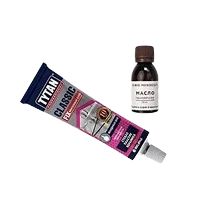
KUDO HIGH TACK adhesive: why it appears in the kit
Installing polyurethane decor requires suitable mounting material.
The scheme for NPU-237 includes a separate item — buy KUDO adhesive for molded decor.
Confirmed volume — 280 ml.
Current price — 990 ₽.
The card states that one tube is enough for up to 16 linear meters when applied in a single line.
But this figure should not be automatically converted into the number of NPU-237 units.
The consumption for a single overlay depends on the application and installation pattern. Therefore, it is more correct to use the manufacturer's specification as a reference for the cartridge itself, rather than making up: "one tube will be enough for exactly 20 overlays."
How to glue NPU-237 to an already painted facade
The key word here is already painted.
Two sides of the connection need to be considered:
polyurethane overlay;
existing coating of the furniture door.
Even a strong mounting compound will not fix the problem if the paint itself adheres poorly to the substrate.
Therefore, before installation, you need to assess the condition of the coating in the bonding area.
If a more detailed analysis of choosing compounds and preparation is required, it is useful to study the material about it in advance. molded decoration adhesive.
For the purchase itself, other items are also collected nearby. Mounting and finishing materials.
What to order together with NPU-237
You don't need to turn a local repair of one door into a huge shopping list.
The basic kit is short.
| Position | When needed | Why | What to check |
| NPU-237 70 × 315 × 15 mm | If the small option covers the defect and suits the facade | main decorative element | Damage dimensions and free space |
| NPU-237 110 × 495 × 23 mm | For a larger damaged area or a larger facade | A more extensive decorative element | Space up to the handle, edges, and adjacent relief |
| Second NPU-237 | For paired symmetry | Decorate an entire leaf in the same style | Whether symmetry is needed for your specific furniture |
| KUDO HIGH TACK | If selected for a specific installation | Securing the decorative element | Condition of the coating and requirements for the base |
| Materials for preparation and finishing | Based on the facade condition and the project | Prepare the surface and integrate the decor | Specific furniture coating |
If you need a wider selection, you can Buy Molded Decoration of a different geometry, but you should only move to adjacent models when NPU-237 is not suitable in size or location.
Why you don't need to buy random additional overlays at the same time
After deciding to install one NPU-237, excitement kicks in:
"Since we're changing the facade, let's add corners, rosettes, and a couple more elements."
Thus, repairing one scratch quickly turns into a random set of decor.
First, solve the original problem.
If NPU-237 itself looks complete — stop.
Additional decorative polyurethane elements make sense only within a pre-designed system.
The number of decorative details does not automatically make furniture richer or more interesting.
Discipline works especially well on the facade.
How not to confuse NPU-237 with "any elongated overlay"
Similar length alone does not make different products interchangeable.
When choosing, check specifically:
article number NPU-237;
material — polyurethane;
size 70 × 315 × 15 or 110 × 495 × 23 mm.
If you built a paper template using these numbers and then accidentally selected a different product, all the preliminary calculations become meaningless.
It is especially easy to make a mistake when the catalog contains many overlays with similar overall shapes.
First, the article number.
Then, the size.
Then the quantity.
What to do if NPU-237 does not fit, but you liked the idea of decorative repair
There is no need to abandon the approach entirely.
Perhaps it is the geometry of this particular model that does not fit.
For example:
- the damage is too short;
- the free field is too narrow;
- the handle is in the way;
- The relief is too large;
- the facade requires a different shape.
Then you can view the entire Relief Decoration and look for an element that fits the actual rectangle of available space.
Here it is especially important not to make the reverse mistake: choosing another overlay just for its looks.
The size of the damage and the furniture geometry remain the first filters.
Are moldings needed for repairing the facade with NPU-237
In most local scenarios — not automatically.
Yes, Buy polyurethane molding possible for more complex compositions, but a single NPU-237 does not require a mandatory frame around it.
Molding makes sense if you are deliberately reworking the entire facade architecture and want to incorporate the overlay into a larger system.
If the task is limited to a single scratch and the central NPU-237 already looks complete, there is no need to add a frame just for extra decoration.
Scenario 1. A scratch of 30 × 220 mm almost in the center.
This is a favorable situation.
The damaged area is noticeably smaller than 70 × 315 mm.
The small NPU-237 template is installed along the central axis of the door and completely covers the scratch.
The handle is far away.
There is sufficient margin to the edges.
Here, the decorative repair method has strong logic.
If there is no paired door leaf nearby, a single overlay can be considered.
If there is an identical second door, additionally try on the pair.
Scenario 2. Damage 60 × 280 mm
The small option is still potentially suitable:
70 × 315 mm.
But the width margin is small.
It is precisely in such a situation that a paper rectangle is insufficient for a final decision.
It is necessary to especially carefully check the actual form of the decor and the actual extreme points of the defect.
If damage in one place comes too close to the side contour, a large NPU-237 may provide more freedom.
But now you need to compare not just the coverage, but the scale of the two parts.
Scenario 3. Long zone 80 × 400 mm
70 × 315 mm obviously does not cover the length.
The first candidate becomes 110 × 495 mm.
By dimensions, the damage fits.
Next, check:
- location on the facade;
- field to the handle;
- centering capability;
- proportion to the door height.
If the large NPU-237 looks natural, the idea works.
If it barely fits between other parts, it's better to consider a full repair.
Scenario 4. The scratch is small, but it runs near the side edge
By size — easy.
By composition — bad.
This is an example where NPU-237 may not fit at all.
To cover the damage, the overlay will have to be shifted.
The center will be disrupted.
A heavy decorative object will appear at the edge.
You shouldn't consider such a refusal a failure.
Expert choice precisely consists in the ability to say in time: for this defect, another method is better.
Scenario 5. One of two symmetrical doors is damaged
The small NPU-237 perfectly covers the defect in the center.
But one overlay breaks the pair.
We cut out the second template.
We place it on the adjacent door.
If two overlays look like a natural furniture system, two units go into the cart.
Thus, the damage stops determining the appearance of the furniture.
Scenario 6. Large cabinet front, small scratch
For repair, 70 × 315 mm is enough.
But on a very large door, it looks lost.
Let's try 110 × 495 mm.
If a large overlay better matches the scale of the furniture, it can be chosen even for a small damage.
This is an example where the size of the defect determines the minimum, and the size of the front determines the optimal decorative scale.
Scenario 7. Damage is located right under the handle
The small template covers it, but it almost touches the handle.
The large one — even more so.
Need to check the grip comfort.
If the overlay physically or visually interferes, it is better to abandon the decorative cover.
The function of the furniture is more important than preserving the idea of the article.
Scenario 8. The coating around the scratch has started to peel off
You cannot simply apply glue and cover everything with NPU-237.
A peeling layer does not become stronger just because it is no longer visible.
First, the base is repaired.
After that, the size of the actually prepared area is assessed again.
It may have become larger.
Then the initially selected overlay size is no longer suitable.
Scenario 9. The facade is damaged, but the furniture is modern and completely smooth
Here you need to be especially honest with yourself.
The polyurethane relief NPU-237 will noticeably change the character of the door.
If the interior is built on the absence of decor, a full repaint may be aesthetically more correct.
The overlay is valuable only when the new decorative layer matches the desired appearance of the furniture.
Not every technically possible repair should be implemented.
Scenario 10. Wanted to add decor for a long time, and the scratch became a reason.
Perhaps the best case.
Even before the damage, you considered the facade too plain.
Now there is a reason to redo it.
Then NPU-237 does double work:
covers the defect;
implements a long-desired decorative idea.
Here the chance of getting a "patch" feeling is minimal, because the decor itself is truly needed by the furniture.
Ten mistakes that prevent NPU-237 from saving the facade
Mistake 1. Measure only the length of the scratch
The maximum width of the damaged area is also needed.
Otherwise, the edge of the chip may extend beyond the overlay.
Mistake 2. Not measuring the distance to the handle
It later turns out that NPU-237 overlaps the working area.
Mistake 3. Centering on the defect
After repair, the defect will disappear, but the shifted overlay will remain.
Center it relative to the facade architecture.
Mistake 4. Buying 495 mm "for reliability"
A larger size covers more, but may not suit the furniture in scale at all.
Mistake 5. Not making a template
The product is chosen from a photo, and after receiving it turns out to be unexpectedly large.
Mistake 6. Gluing onto peeling coating
Decor should work with a solid, prepared base.
Mistake 7. Forgetting about the paired door
One door becomes decorative, the neighboring one remains empty, and the cabinet loses symmetry.
Error 8. Buying two overlays automatically
Symmetry is not needed for every piece of furniture.
The second piece should improve the composition, not just increase the order.
Error 9. Not accounting for thickness
The 23-millimeter large NPU-237 appears more voluminous than a paper template.
Error 10. Deciding that an overlay must replace any repair
No.
If the defect is too large, the base is destroyed, or the relief is alien to the furniture, it is better to choose a different path.
Who NPU-237 is especially suitable for in this scenario
It is worth considering it when the damage is:
elongated;
local;
located within a sufficiently large free field;
does not affect functional elements;
can be completely covered by one of the two sizes.
The idea is especially good if the facade itself allows for decorative relief.
Even better — if you wanted to update the furniture before the scratch appeared.
Who this method is most likely not suitable for
It is not worth building a repair around NPU-237 if:
the facade must remain absolutely smooth;
the defect is located at the very edge;
the overlay interferes with the handle;
the damage is significantly larger than 110 × 495 mm;
the surface is destroyed;
the composition requires a strong shift;
the new decor is stylistically unsuitable for the furniture;
the only explanation for its appearance is the need to hide a scratch.
In these situations, refusing the purchase may be a more professional decision.
How to assemble an order without extra items
If after all checks NPU-237 is suitable, the cart is assembled very simply.
For one damaged door
1 NPU-237 of the selected size.
Installation composition and necessary preparation materials — according to the actual base.
For two symmetrical doors
2 identical NPU-237.
Materials for installation.
For four identical facades
First, the scheme is determined.
Only then the quantity: one, two, or four overlays.
There is no need to buy four just because there are four doors.
Where to look for an alternative if NPU-237 does not match the defect
The section where you can Buy Polyurethane Molded Decoration, useful as a next step.
The replacement should be searched for using the same logic:
- damage rectangle;
- free field;
- handle;
- edge;
- adjacent relief;
- desired composition;
- only then the appearance of the overlay.
A wide catalog does not cancel the discipline of choice.
Why the product card should be the final check
Before the cart, you should already know:
- need NPU-237;
- what size;
- how many pieces;
- what position;
- whether the base fits;
- whether KUDO is required;
- whether symmetry is needed.
After that, the card performs its normal function — confirming the selected modification and current parameters.
Not the other way around.
Catalog viewing should complete the selection, not replace measurements.
How to order NPU-237 on STAVROS without a size error
Before clicking the purchase button, check the recorded specification again.
For example:
NPU-237, 70 × 315 × 15 mm, 2 pcs. — two symmetrical doors.
Or:
NPU-237, 110 × 495 × 23 mm, 1 pc. — central large facade.
This way, the chance of accidentally choosing a different option is greatly reduced.
On the page you can buy NPU-237 70 × 315 or 110 × 495 mm, but the final decision should be made before opening the cart.
Is another polyurethane molding needed nearby
Not necessarily.
NPU-237 can be the only new element.
If after repair you decide to redo several facades or continue a decorative motif in the interior, then you can look at others as well. decorative polyurethane elements.
But do not mix two tasks:
cover the damage;
completely change the furniture.
The second may arise from the first, but should be an independent decision.
FAQ: NPU-237 for a damaged furniture facade
Can you really cover a scratch with NPU-237 without repainting the entire door?
Yes, such a scenario is possible if the damage is local, fits entirely under the overlay, and the base around it remains suitable for preparation and installation.
In this case, the new part must fit well into the facade. If to cover the scratch it has to be placed in a compositionally awkward spot, it is better to consider another repair method.
What size NPU-237 should be chosen for damage approximately 50 × 200 mm?
The first option for fitting will be 70 × 315 × 15 mm.
It is larger than the specified damaged area. But before purchasing, you need to check its position relative to the center of the facade, handles, and edges.
Will a small NPU-237 fit for damage of 60 × 250 mm?
In terms of rectangular dimensions, the 70 × 315 mm option is potentially suitable.
The width margin is small, so it is especially important to accurately mark the extreme points of the defect and check the actual contour of the overlay before installation.
When should you choose NPU-237 110 × 495 mm?
When the damage does not fit under the smaller option, or a larger overlay better matches the scale of the facade.
You should not choose it just because it covers the defect with a large margin.
Can NPU-237 be installed not in the center of the door?
The technical placement is determined by the specific composition, but random shifting just for the sake of a scratch often looks bad.
After repair, the defect will disappear, but the shifted decor will remain. Therefore, first look for a position that looks natural for the furniture itself.
What is more important — the center of the damage or the center of the facade?
For the final appearance, the facade is more important.
The damage is a temporary problem. The door's architecture remains after repair.
Is a second NPU-237 needed on the adjacent door?
Not always.
If two doors form a pronounced symmetrical pair, a second overlay can make the repair visually more convincing. But on asymmetrical furniture, a single piece may be quite appropriate.
If one of four doors is damaged, do you need to buy four overlays?
No.
First, make paper templates and develop a composition for all four facades. Perhaps one, two, or indeed four pieces will be enough.
Can a deep chip be covered without preliminary repair?
No, if the base is damaged or does not provide a proper mounting surface.
First, the damaged area is restored and prepared, then the possibility of decorative covering is assessed.
What to do if the coating is peeling around the scratch?
Do not apply NPU-237 over an unstable layer.
Peeling coating requires preparation. After that, you need to re-measure the actual area, because it may become larger than the original scratch.
Can NPU-237 be placed next to a furniture handle?
Only if there is sufficient free space and the handle remains easy to use.
Check this with a real template and then with a dry fit of the actual overlay.
What to do if the damage is almost at the edge of the facade?
First, try to position the template so that it completely covers the defect and looks compositionally justified.
If this is not possible, decorative masking NPU-237 is most likely not the best option.
What is the difference between a small NPU-237 and a large one besides length?
Small size — 70 × 315 × 15 mm.
Large — 110 × 495 × 23 mm.
That is, the width, elongated size, and thickness increase. The large version takes up significantly more surface area and creates a more pronounced relief.
Can you choose a large NPU-237 for a small scratch?
You can, if the large overlay itself better matches the scale of the facade and the furniture design.
But solely to cover a small defect with extra overlap, there is no need to increase the size.
How to make an NPU-237 template?
Cut out a rectangle of 70 × 315 mm or 110 × 495 mm from paper or cardboard.
It won't show the relief, but it will allow you to check the occupied field, center, distance to the handle and edges.
Do I need to print out the ornament itself?
Not necessary for initial selection.
First, the geometry is decided. If the rectangle no longer fits or looks too large, a detailed printout won't change anything.
Can NPU-237 be glued immediately after receiving it?
It's better to first do a dry fitting with the actual part.
It has a thickness of 15 or 23 mm, so the volume may be perceived differently than a paper mockup.
What adhesive is provided for such installation?
In your scheme, KUDO HIGH TACK 280 ml is listed as an accompanying product.
Before application, you need to check the condition of the existing facade coating and the requirements for the specific substrate.
How much does KUDO HIGH TACK cost?
At the time of writing, the current price of the card is 990 ₽ per 280 ml.
It is better to double-check the price on the website before ordering.
How long does one tube of KUDO last?
The card states up to 16 linear meters when applied in a single line.
But converting this value into an exact amount of NPU-237 without a specific application pattern is incorrect.
Do I need to remove the door before installing NPU-237?
A universal requirement cannot be set in this article.
The installation method depends on the furniture, the position of the facade, the base, and the adopted technology. The main thing is to ensure accurate marking, a prepared surface, and a fixed position of the part during work.
Can NPU-237 be used on an already painted facade?
The very fact of painting does not automatically provide an answer.
It is necessary to assess the strength of the existing coating and the compatibility of installation materials. If the paint is peeling, the surface is prepared first.
Do we need to repaint the NPU-237 itself to match the door color?
This depends on the intended appearance and the existing finish of the furniture.
If the goal is to integrate the new decor into the facade as much as possible, color coordination becomes an important part of the project. The specific finishing system should be selected based on the material and the existing coating.
Can the NPU-237 be made contrasting?
Such a design can be considered if the contrasting overlay is a deliberate decorative solution.
But for an inconspicuous repair of a local damage, a calmer integration with the furniture is usually required.
What to do if the scratch is slightly longer than 315 mm?
Do not try to assume that the small option 'almost covers it'.
Check the large NPU-237 110 × 495 mm or another repair method. The damage must be completely covered if masking is the goal.
And what if the defect is longer than 495 mm?
The large NPU-237 will not fully cover it along that dimension.
A different solution should be considered rather than buying a knowingly insufficient element.
Can NPU-237 hide holes from an old handle?
The main scenario of this article is deliberately not built around holes from hardware.
For those, the location of mounting points, the condition of the facade, and the appropriate repair method need to be considered separately. Do not mix two different tasks just because both relate to a surface defect.
Is NPU-237 suitable only for furniture?
In the product card, the model is classified as decorative polyurethane molded decor and can be considered for various interior surfaces, but here we deliberately focus on a furniture facade.
This way, the article remains useful for a specific purchasing task.
What to do if NPU-237 doesn't match the style?
Don't use it just for masking.
You can look at another one Relief Decoration or choose to restore the original facade without new relief.
Where to look at a wider range of polyurethane molding if the renovation turns into remodeling furniture?
If after trying it on you decide to design several facades or change the furniture more noticeably, you can open the general section where molding — buy and select polyurethane products.
First, it's still worth completing the layout project so that the catalog doesn't turn into a set of random purchases.
What to check right before placing an order?
Five things:
- exact size of the damaged area;
- selected size of NPU-237;
- position relative to the handle and edges;
- quantity — one or a symmetrical group;
- condition of the base and set of materials for installation.
If these points are defined, the product card becomes a point of purchase, not a place where a decision is made at random.
Do not mask the scratch — redesign a small section of the facade
This is the thought that best describes the correct application of NPU-237 to already finished furniture.
If you look at the overlay only as a cover over a defect, the result can easily turn into an obvious patch.
If, instead, you view the damage as a reason to re-solve a small part of the facade, everything changes.
First, the defect rectangle appears.
Then, the boundaries of the available decorative field.
After that, two real sizes are tried on:
70 × 315 × 15 mm;
110 × 495 × 23 mm.
The small option is suitable for more local intervention. The large one can become a noticeable decorative center of a big door.
But any of them must pass the same test: would this element look appropriate here if the scratch had never existed?
If yes, NPU-237 can indeed turn a repair trace into new furniture decor.
If not, full or local restoration of the facade will be more honest.
Before ordering, don't forget to evaluate the neighboring doors as well. On a pair of identical facades, two NPU-237s often look significantly more natural than one. On three or four leaves, the quantity is determined by the overall layout.
STAVROS company allows you to move from an idea to a specific product without guessing: the NPU-237 card shows two confirmed sizes, and nearby you can select mounting materials and other polyurethane decor. For local damage, first try 70 × 315 mm. If the field is larger or the facade scale requires a more expressive detail, compare 110 × 495 mm. Only after that choose the quantity and proceed to order.
A good repair in this situation ends not when the scratch is no longer visible. It ends when a person who sees the furniture for the first time doesn't even guess that the decorative overlay appeared because of damage.