




























Article Contents:
- What counts as wooden decor in a design project
- When a designer should choose solid wood rather than polyurethane or MDF
- Oak or beech: what to specify in a project
- Carved decorative elements made of wood
- Decorative wooden elements: how to choose the size
- Wooden moulding in a modern design project
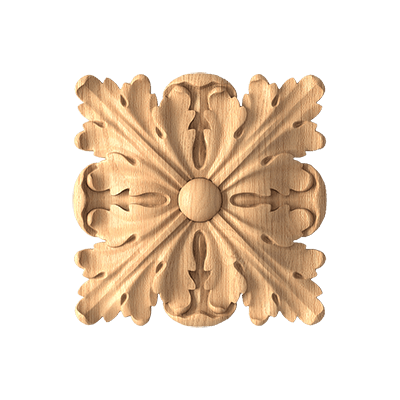
- Wooden rosettes
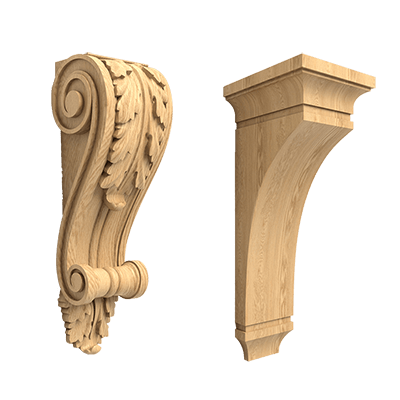
- Wooden brackets
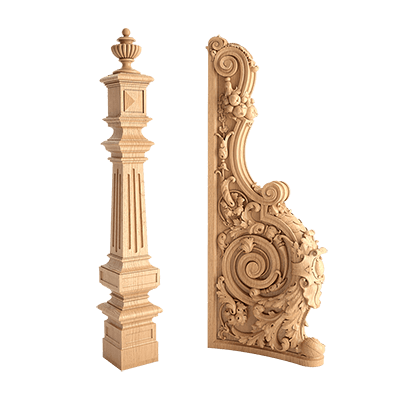
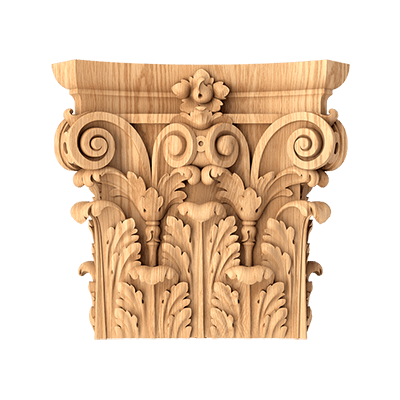
- Capitals, pilasters and columns
- Wooden decor and doors
- Wooden decor and built-in furniture
- Wood under enamel: when texture becomes secondary
- How to use wooden decor samples
- Drawings and DWG of wooden products
- What to consider when reordering
- How to use the STAVROS catalog in a project
- Professional materials for designers and architects
- How to get wooden decor approved by the client
- How to hand off wooden decor to the specifier
- Project position passport: what to store for each SKU
- How to work with a wood finish test
- How to check wooden decor on site before mass installation
- What is included in wooden decor for a design project?
- What to choose: oak or beech?
- Can wooden decor be painted with enamel?
- Do I need to order a sample?
- How to calculate wooden moldings?
- How to calculate overlays?
- How to calculate brackets?
- Can one SKU be used in multiple rooms?
- What to do if the same decor is needed later?
- Can wooden decor be used in a modern interior?
- What matters more: the ornament or the size?
- Can oak be replaced with beech after approval?
- Why are 3D models needed?
- Why is DWG needed?
- How can I avoid a discrepancy between the render and the delivery?
- Can wooden decor be purchased before the final visualization?
- What should I do if the required SKU is unavailable?
- Do I need to keep the sample after placing an order?
- How can you tell a decorative bracket from a structural one?
- Where to start the selection?

In a project, wooden decor cannot be left at the level of wording such as “carved overlay,” “wooden molding,” or “classic rosette.” Until a piece has a species, actual size, article number, finish, application area, and quantity, it is not a project item but only a visual idea.
Therefore wooden decor for a design project it should be chosen as a system of specific products:
concept → application area → element type → species → size → SKU → sample → 3D/DWG → specification → calculation → purchase.
This approach is fundamentally different from a general overview of wooden products. Here the task is not to list what exists in the assortment, but to guide a specific detail from idea to implementation without losing information between the designer, visualizer, specifier, and contractor.



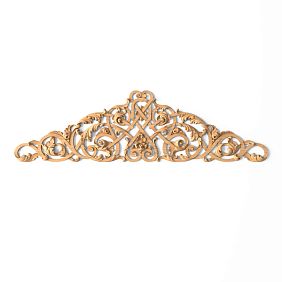


What counts as wooden decor in a design project
In an interior project, wooden decor can include different types of products:
- carved overlays;
- Outlets;
- Brackets;
- capitals;
- pilasters;
- columns;
- finials;
- Moldings;
- baguette;
- moulding;
- portal elements.
The main difference between wooden decor and the general concept of “wood in the interior” is the presence of a specific architectural or decorative function.
Parquet, a countertop, or a solid door are also made of wood, but within this topic we are talking about details that form relief, framing, an accent, or a composition.
Not the material in general, but a specific element
The phrase "use oak" alone says nothing about the project.
It is necessary to understand:
- what the product is;
- what size;
- where it stands;
- how it is oriented;
- how it is finished;
- what it adjoins.
That is why Carved decorative elements it is useful to consider it as a design system, not as individual beautiful details.
Where wooden decor works best
Typical zones:
- door portals;
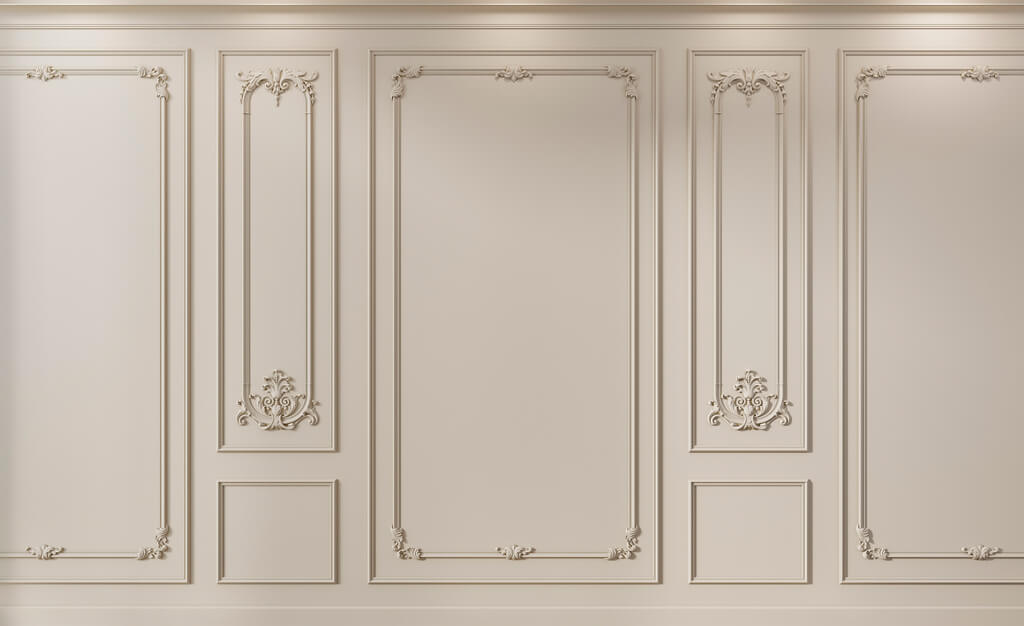
- classic wall compositions;
- Furniture facades;
- mirrored frames;
- fireplaces;
- stairwell areas;
- libraries;
- built-in furniture;
- Panels;
- Columns and pilasters.
In each zone, the scale and function will be different.
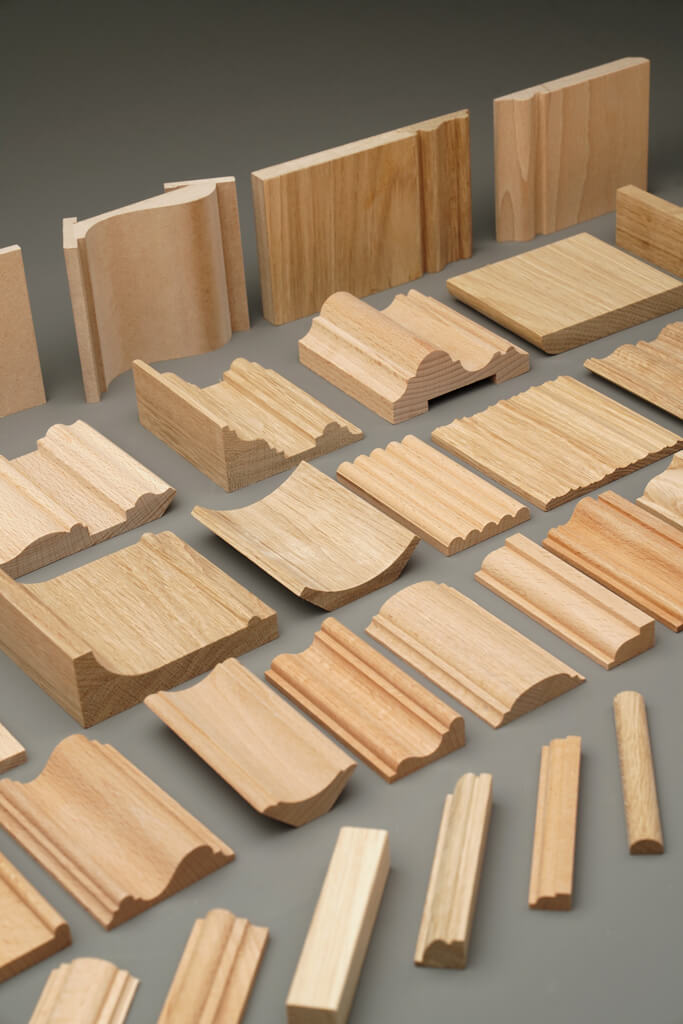
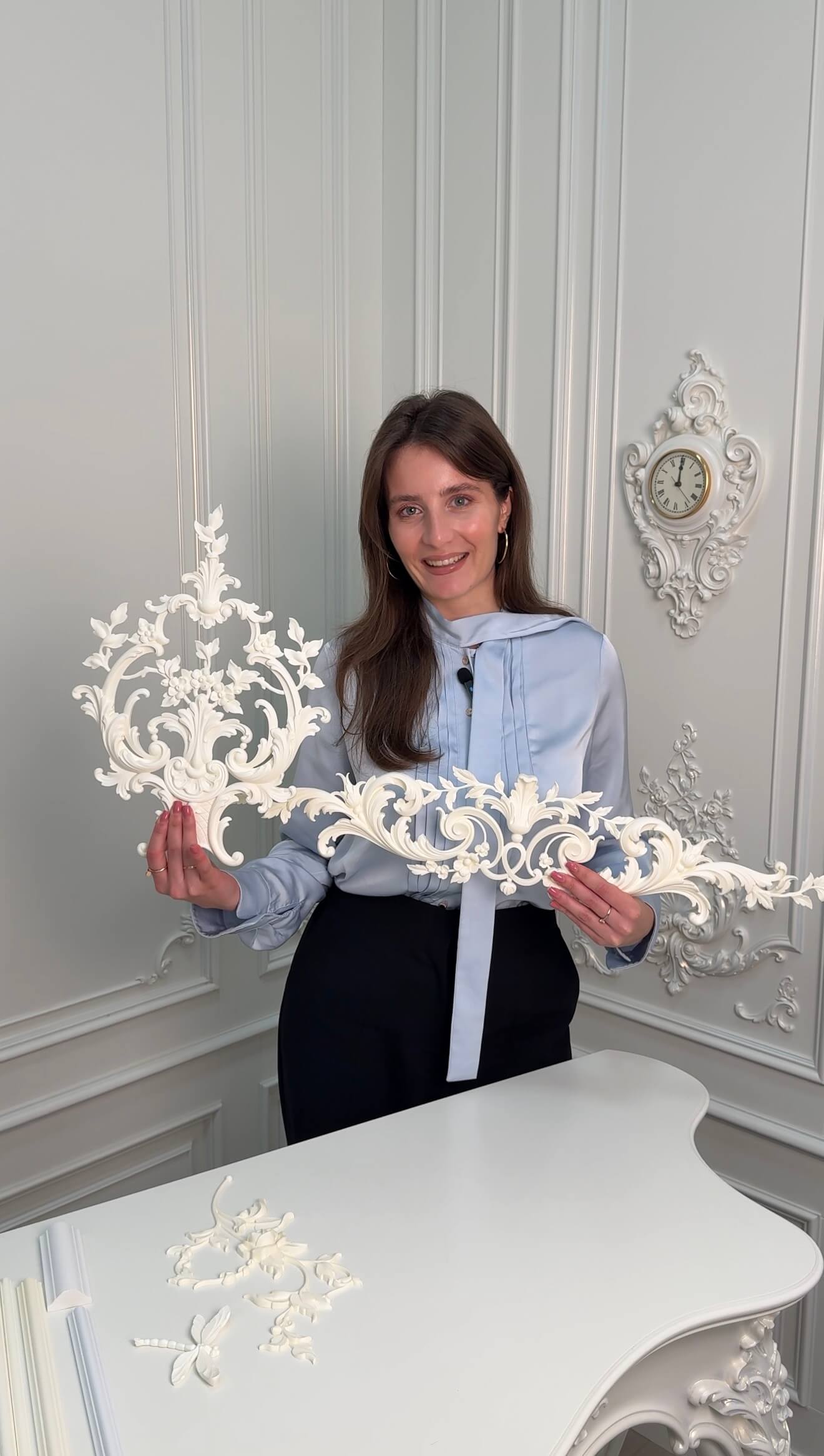
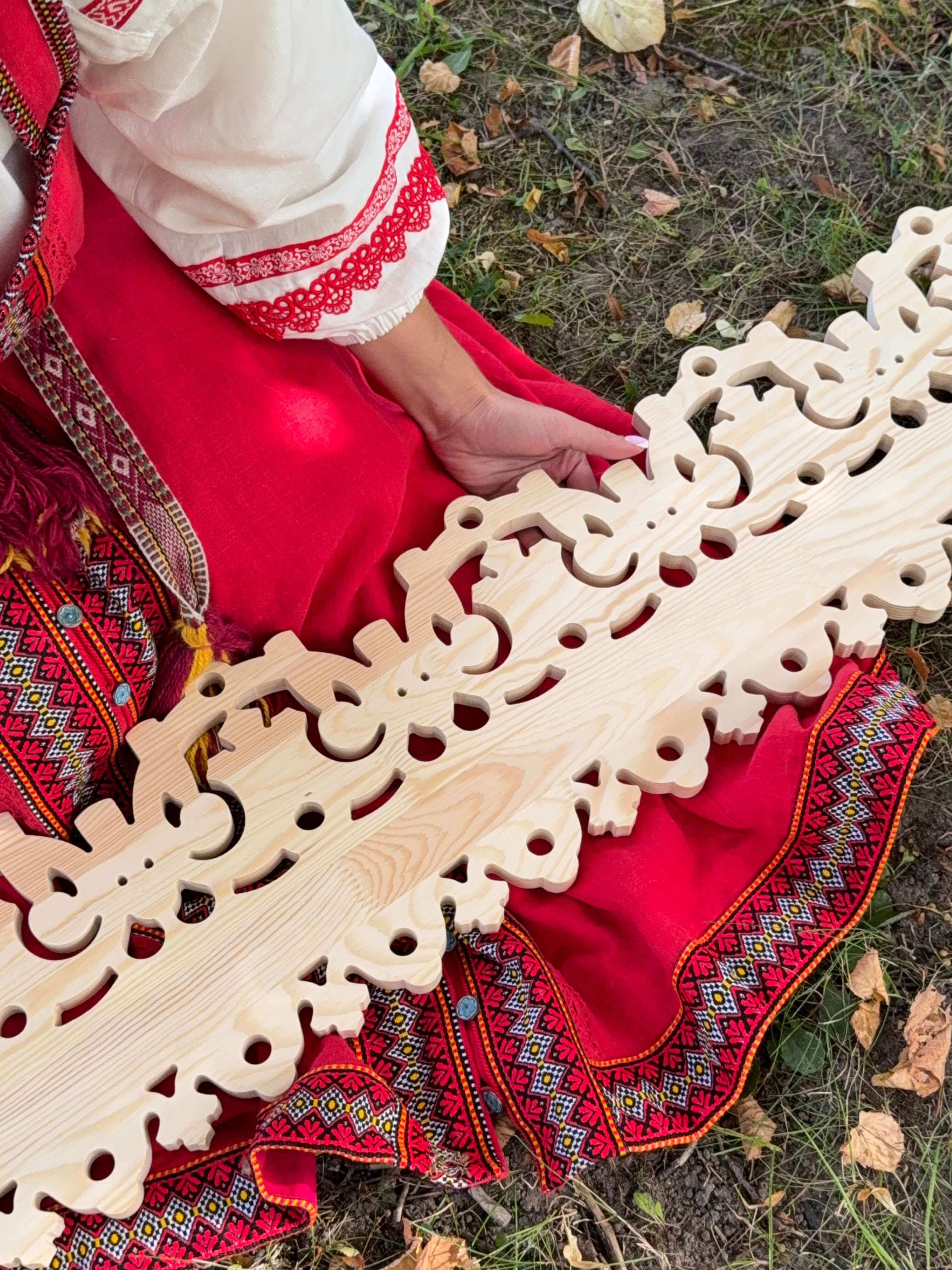
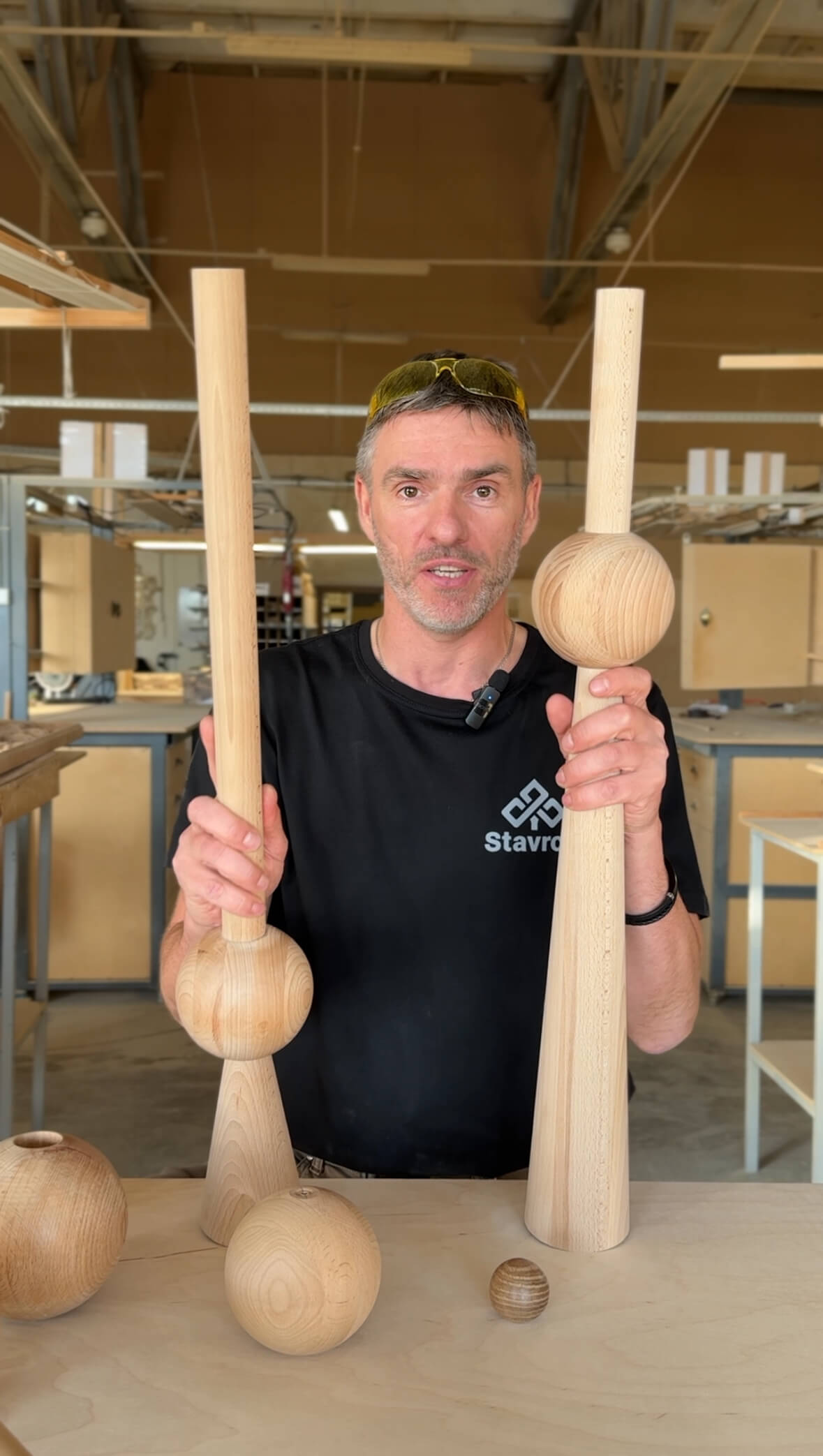
When a designer should choose solid wood rather than polyurethane or MDF
The choice cannot be reduced to the statement “wood is better because it is natural.” The material is chosen for a specific task.
Solid wood is rational when the following matter:
- natural texture;
- open grain;
- staining;
- oil;
- clear varnish;
- natural aging;
- joinery finishing;
- combination with wooden doors or furniture;
- possibility of local manual finishing.
If the decor must look exactly like wood, replacing it with painted material is pointless.
Polyurethane is more rational if
- the surface will be fully painted;
- less weight is needed;
- a repeatable complex relief is required;
- the task involves a large number of identical elements;
- fast installation on a wall or ceiling is important.
MDF is rational if
- a smooth base for enamel is required;
- natural texture is not required;
- the part is part of a larger panel or furniture system.
Where choosing solid wood may be excessive
If the entire part is hidden under a dense enamel and neither an open texture nor joinery detailing is required, the designer should check whether solid wood truly adds value to the project.
An expert choice is not maximum naturalness, but a material that is justified by function and visual result.
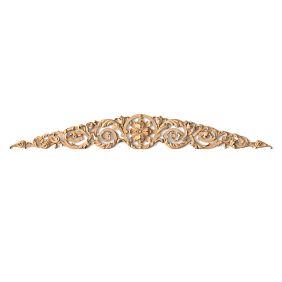
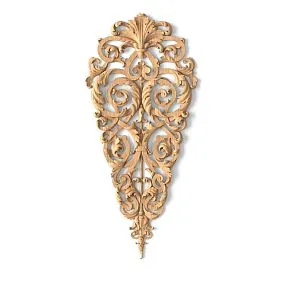
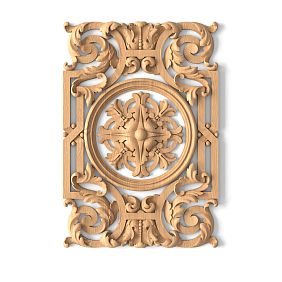
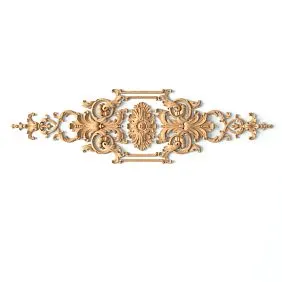
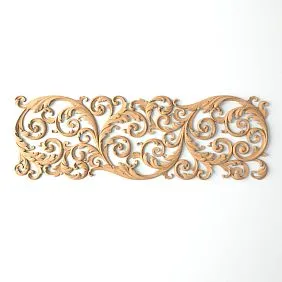
Our factory also produces:



Oak or beech: what to specify in a project
Oak and beech are often used in interior decor, but they are perceived differently.
Grain pattern
Oak is usually visually more active. Its texture can become an independent part of the project.
Beech is often perceived as calmer and more uniform.
Shade
Both species can be tinted, but the original color and grain affect the final result.
Therefore, the stain cannot be chosen separately from the species.
Transparent finish
If oil or lacquer is used, the natural texture remains visible. Here the species is especially important.
Enamel
Under dense enamel, the wood grain becomes secondary. In such a project, the choice of species may be determined by technology and the availability of a specific product rather than by the visual grain.
Combination with other wooden surfaces
If the room already has:
- oak parquet;
- beech doors;
- veneered furniture;
- wooden staircase,
new decor should be viewed next to them.
Even the same shade name does not guarantee a visual match.
Get Consultation
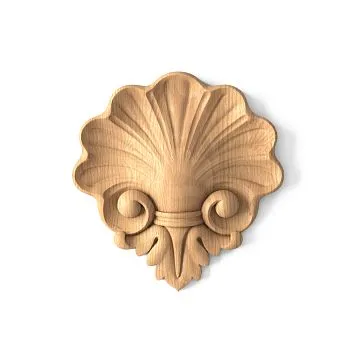
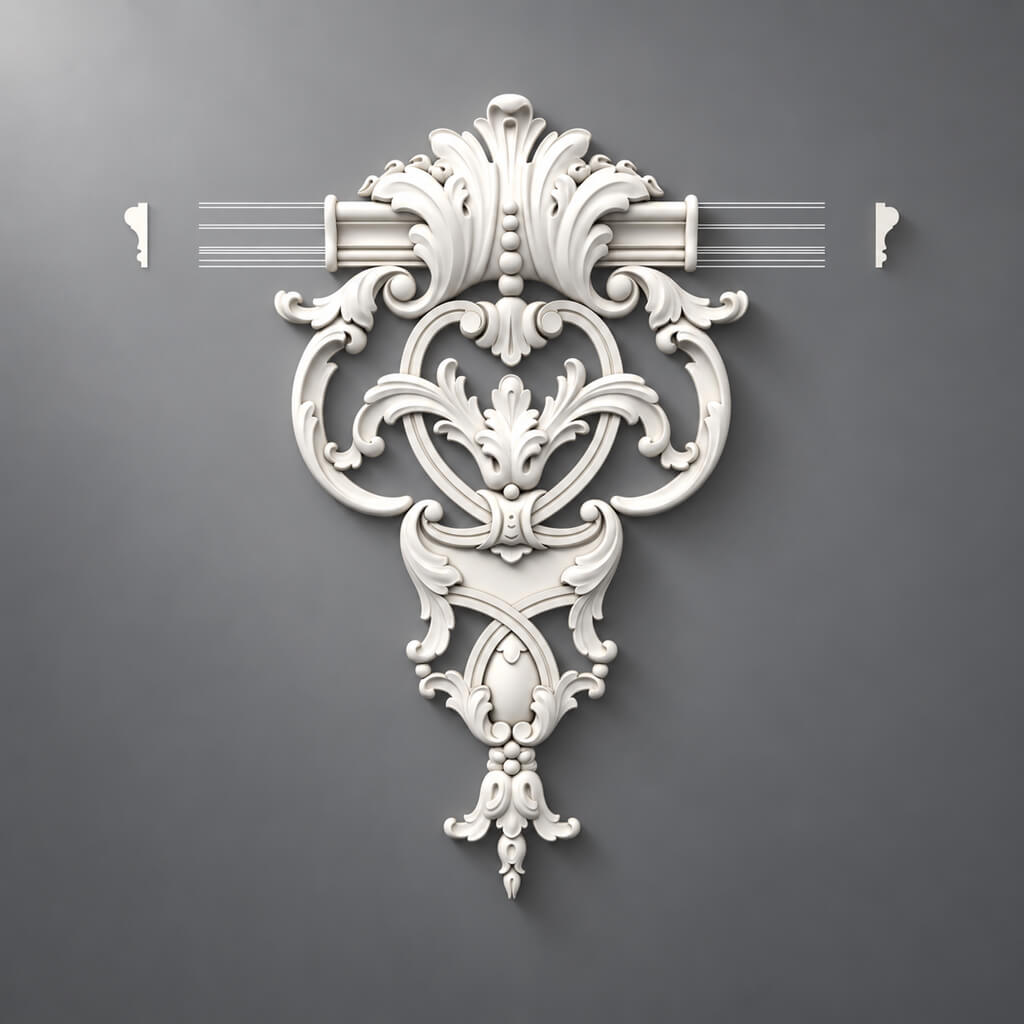
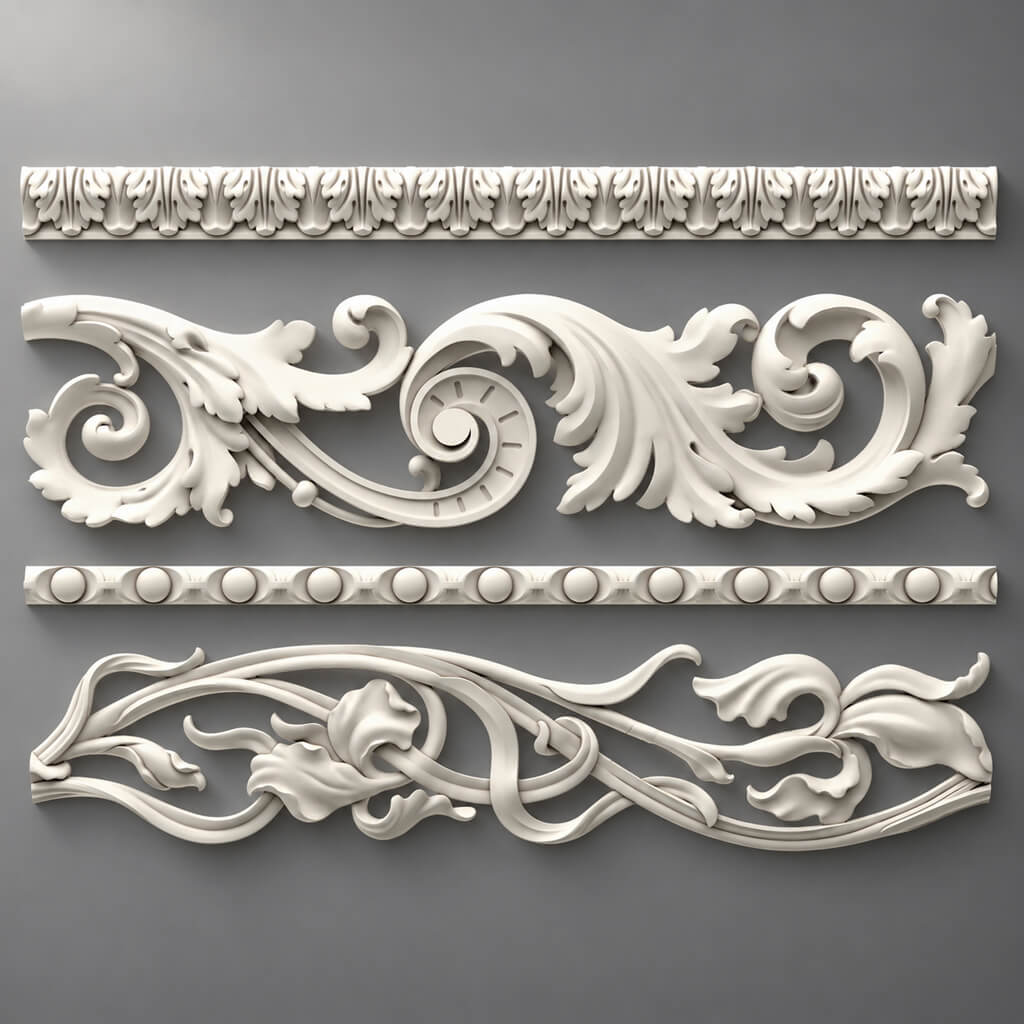
Carved decorative wooden elements
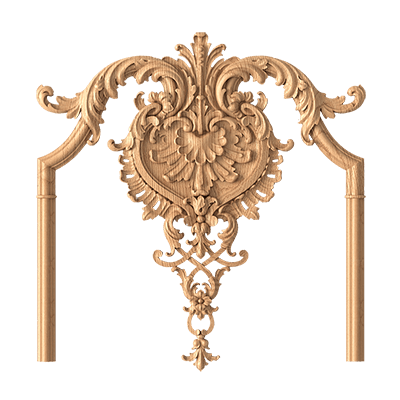
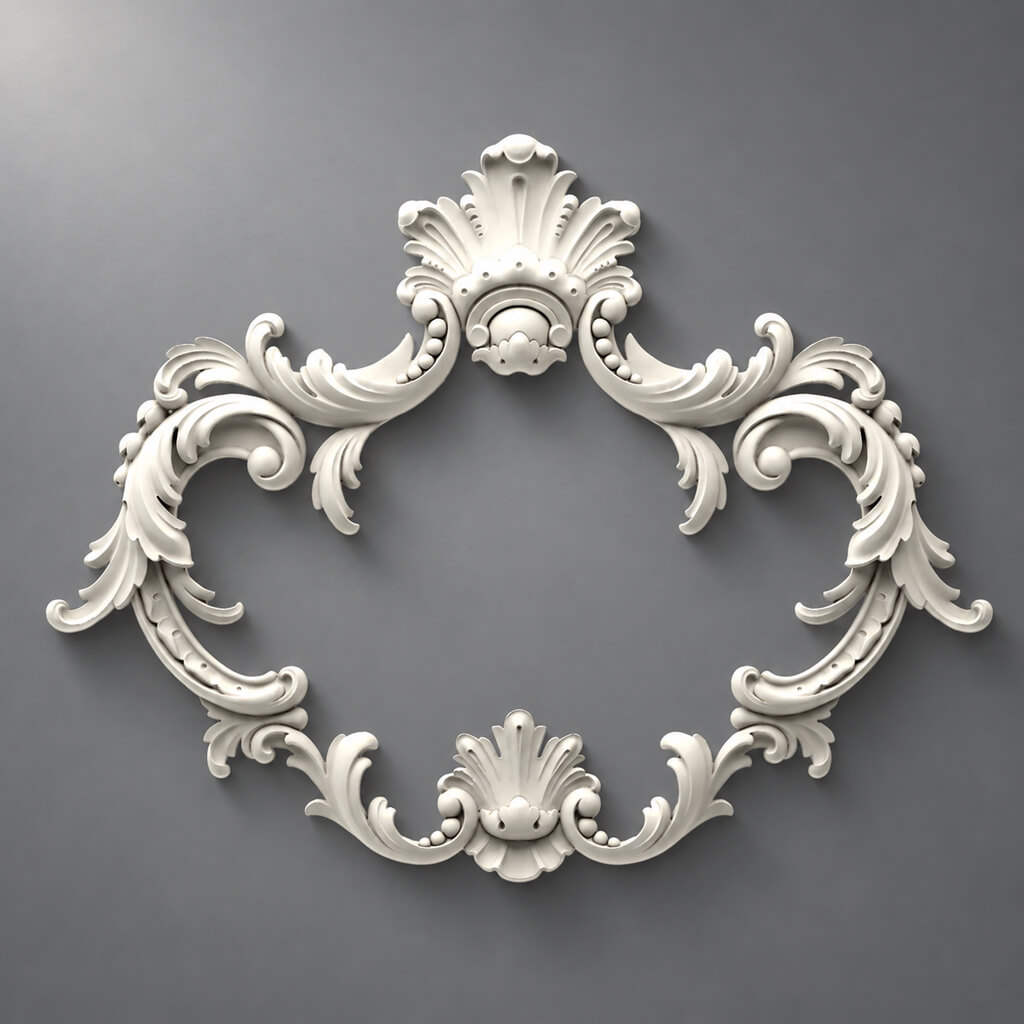
Carved wooden decoration especially useful where plasticity is needed, which is difficult to achieve with a simple profile.
Floral elements
Suitable for:
- classics;
- neoclassics;
- decorative portals;
- furniture;
- mirrors.
They need to be dosed. One strong floral motif usually works better than several unrelated ones.
Geometric
They integrate more easily into a modern interior.
They work well:
- in panels;
- on facades;
- in wall compositions;
- in frames.
Symmetrical
Suitable for the central axis.
For example, above a door, fireplace, or in the center of a furniture facade.
Corner
Used inside frames and panels.
Orientation is especially important for them.
Central
They become the visual center of the composition.
Here, the size is checked relative to the entire frame, not just the element itself.
Decorative wooden elements: how to choose the size
wooden decorative elements should be evaluated not from a close-up photo, but relative to a specific surface.
Relative to the wall
A small rosette will get lost on a large wall.
A large overlay on a narrow wall section will feel oppressive.
Relative to the door
The portal element must be coordinated with the width of the architrave and the height of the opening.
Relative to furniture
Carved decor on a wide facade and on a small drawer are different scales.
Relative to panels
If a wooden overlay is placed on a panel, its size must follow the rhythm of the panel.
Relative to molding
The thickness and relief of adjacent profiles should be perceived as a single system.
Relative to ceiling height
Large decor reads better in a tall space than in a compact room.
The main rule: the size of an item in the catalog must be checked before the final visualization, not after.
Wooden moulding in a modern design project
The term "wooden moulding" is conventional: it refers to decorative elements made of solid wood that perform functions similar to traditional moulding.
This group in search logic may include:
- Moldings;
- Plates;
- Outlets;
- cornices;
- capitals;
- decorative trim.
But the material is fundamentally different. It is not gypsum or polyurethane.
Where such decor is appropriate
- classic interior;
- Wooden panels;
- joinery portals;
- Furniture;
- study;
- library;
- fireplace area.
In modern interiors
Wooden decor doesn't have to be historical.
A smooth profile, calm geometry, and open texture can work in:
- minimalism;
- japandi;
- modern classic;
- eclecticism.
Here, the connection with other wooden surfaces is especially important.
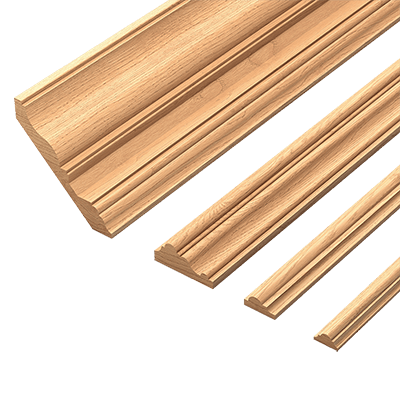
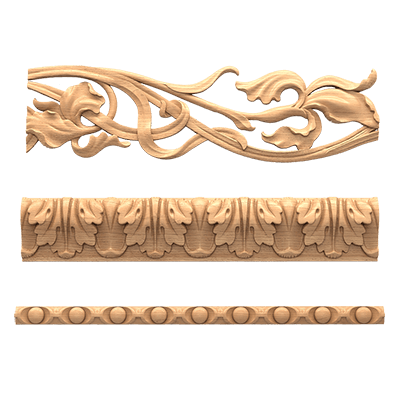
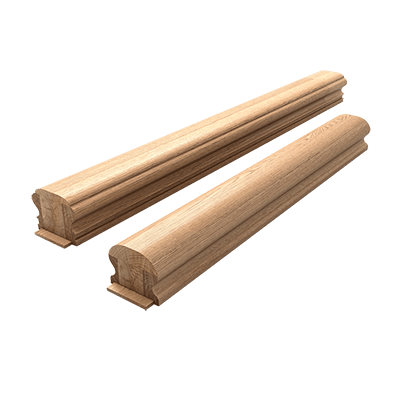
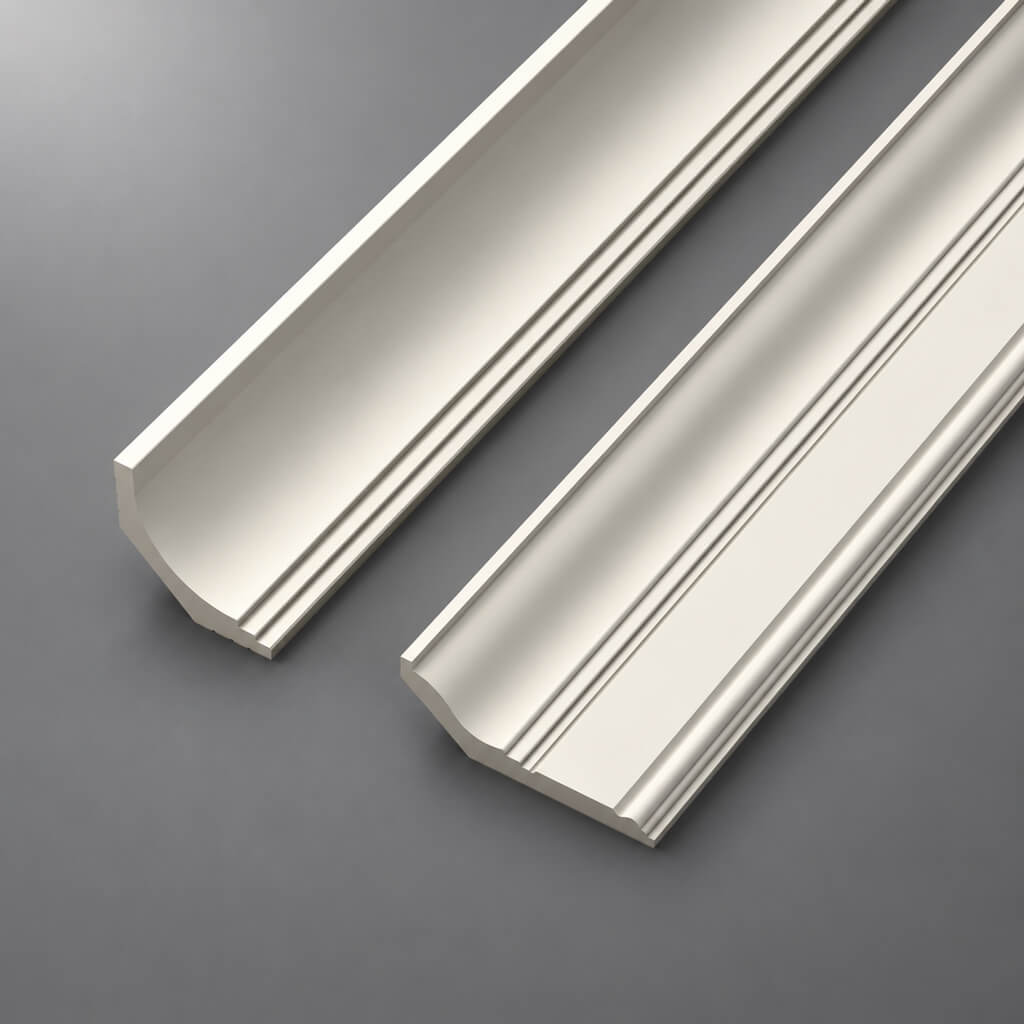
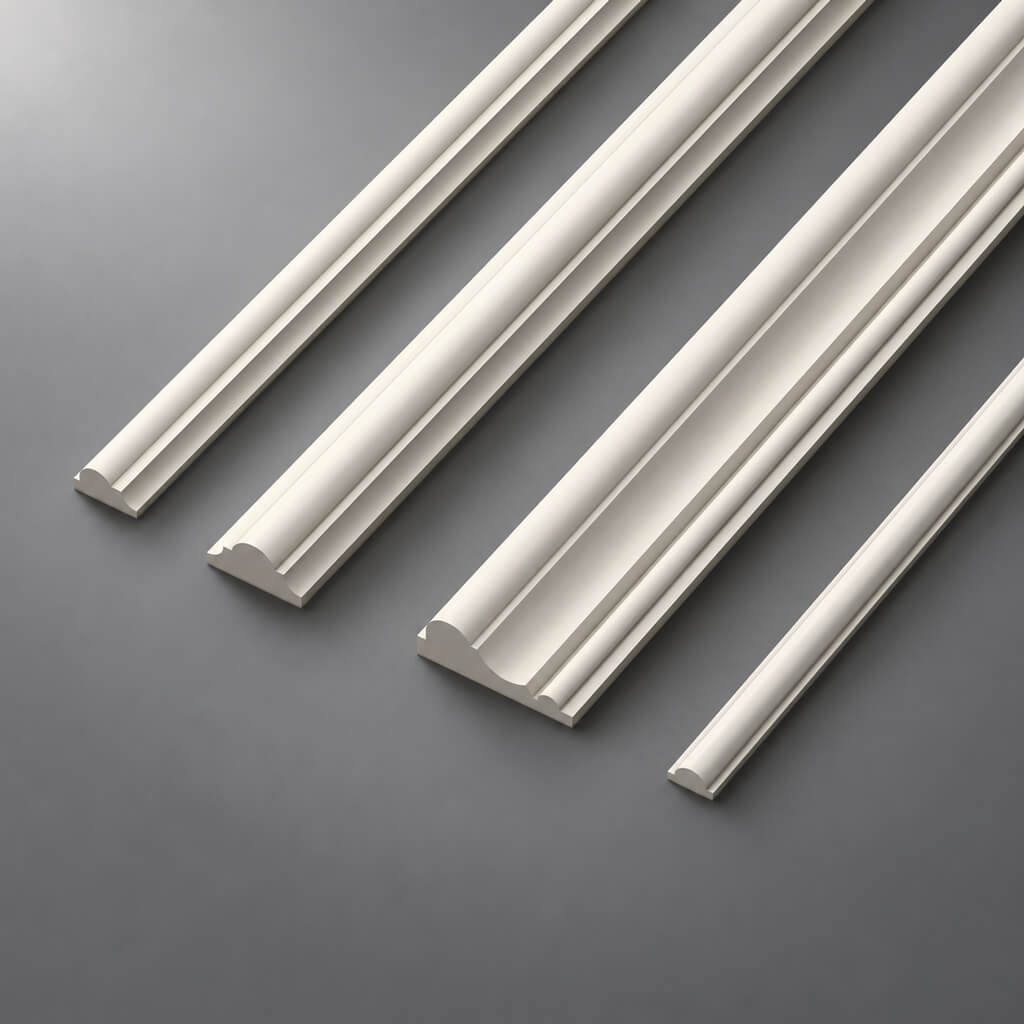
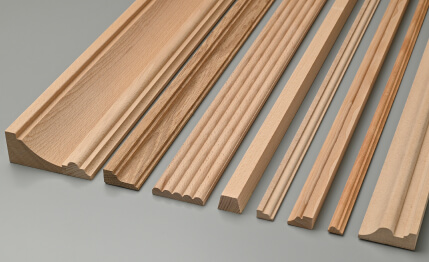
Wooden moldings and trim
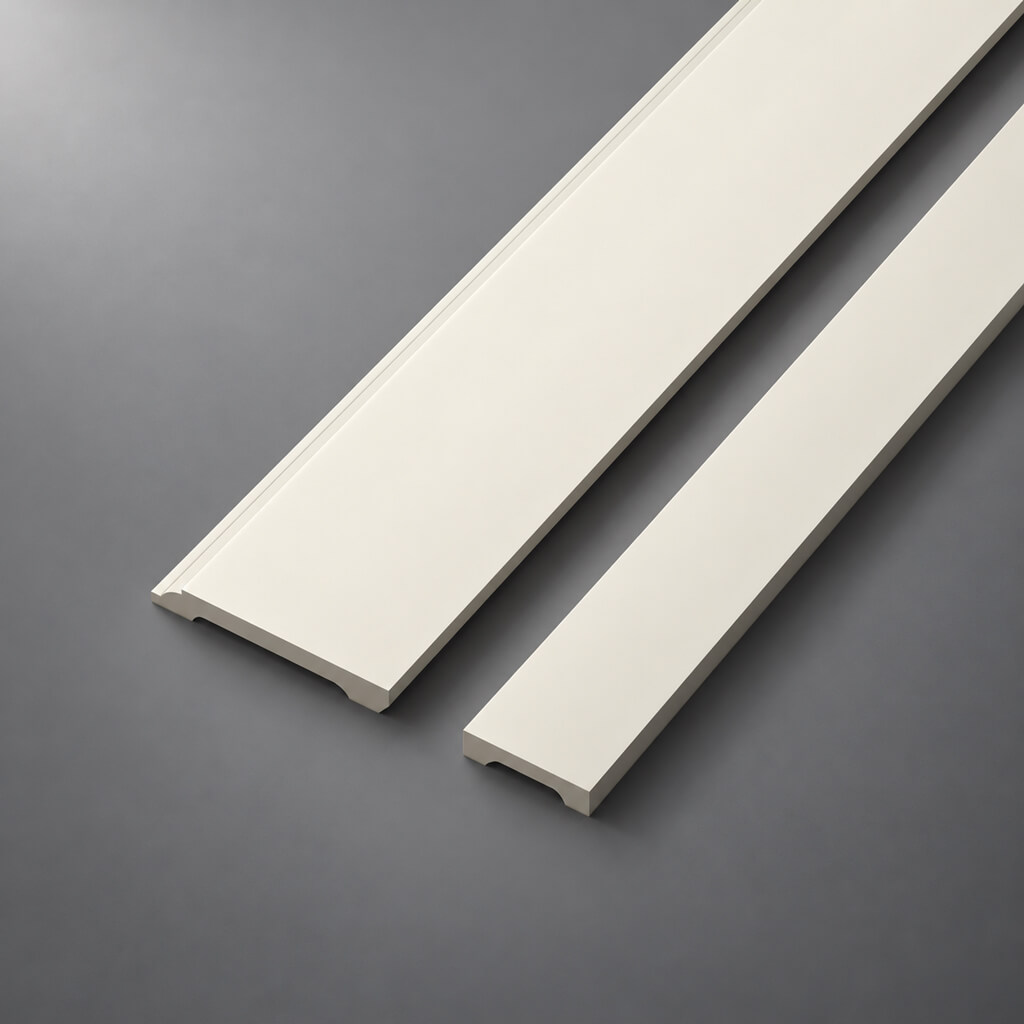
Wooden trim — one of the most functional groups of wooden decor, because it works not only as decoration but also as an architectural line.
Moulding can include:
- Moldings;
- cornices;
- skirting boards;
- Baseboards;
- baguette;
- other profile elements.
Frames and wall compositions
Wooden moldings used for:
- frame panels;
- framing mirrors;
- decorative inserts;
- door portals;
- joining different materials.
In the project, the following are important:
- width;
- height;
- profile;
- element length;
- wood species;
- finish.
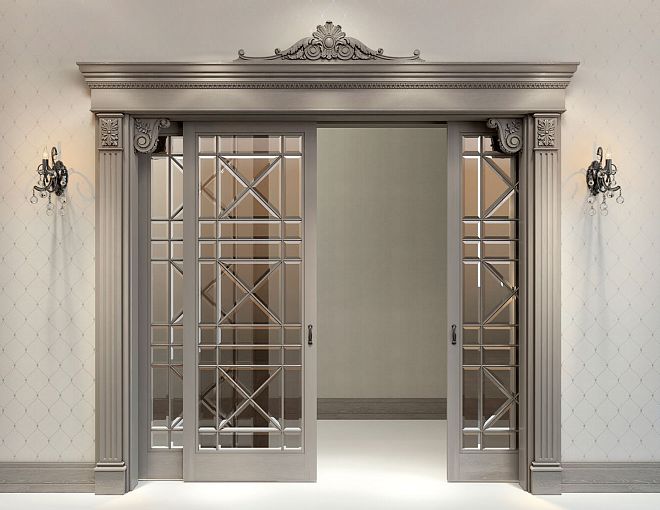
Door portals
Moulding helps connect:
skirting board → architrave → portal → cornice.
But these elements cannot be selected independently. If the casing is too thin and the molding is too massive, the system falls apart.
Transitions
A wooden profile is convenient to use at the junction of:
- panels and walls;
- mirrors and walls;
- furniture and architecture;
- two different finishes.
Mirrors
The frame can be assembled from linear moldings if the profile allows for a neat solution to the corners and scale.
Furniture
Linear moldings can be used on facades, plinths, cornices, and decorative frame systems, but the furniture scenario remains secondary in this article.
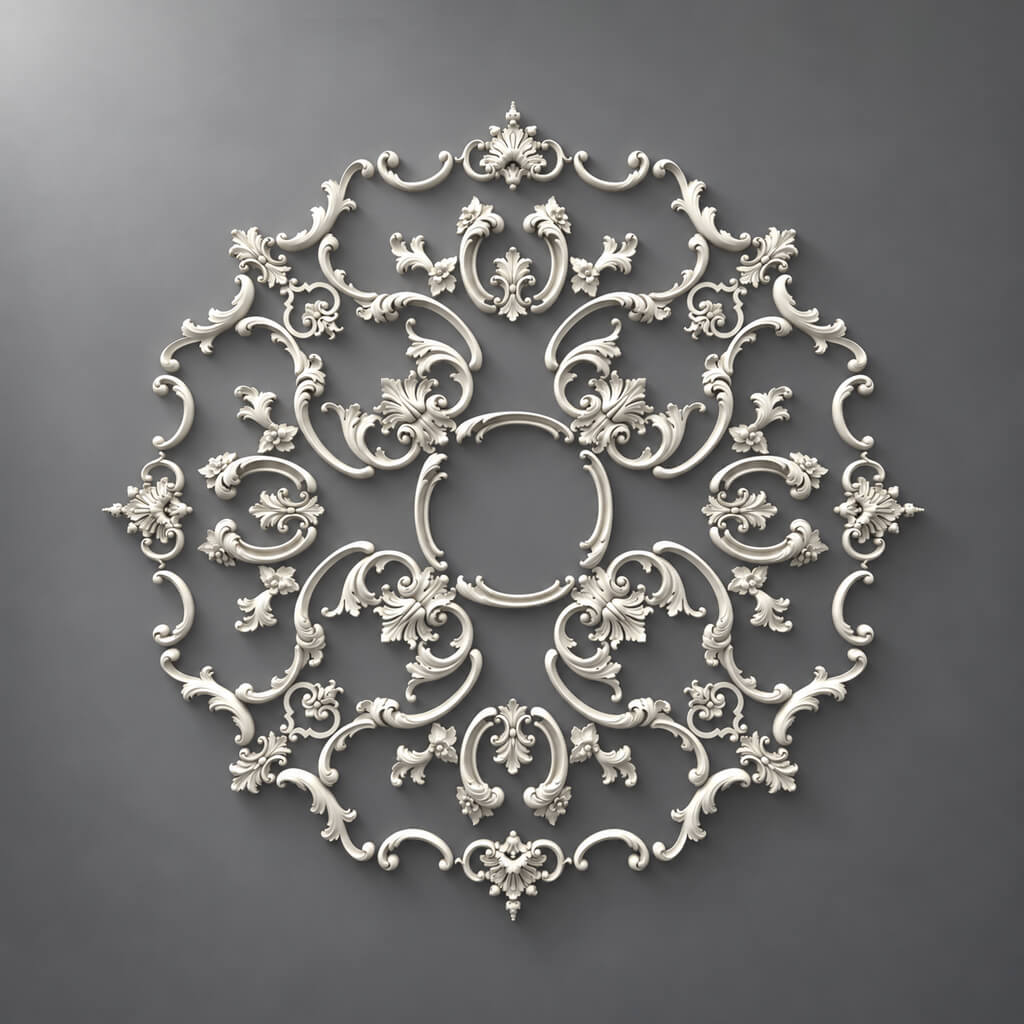
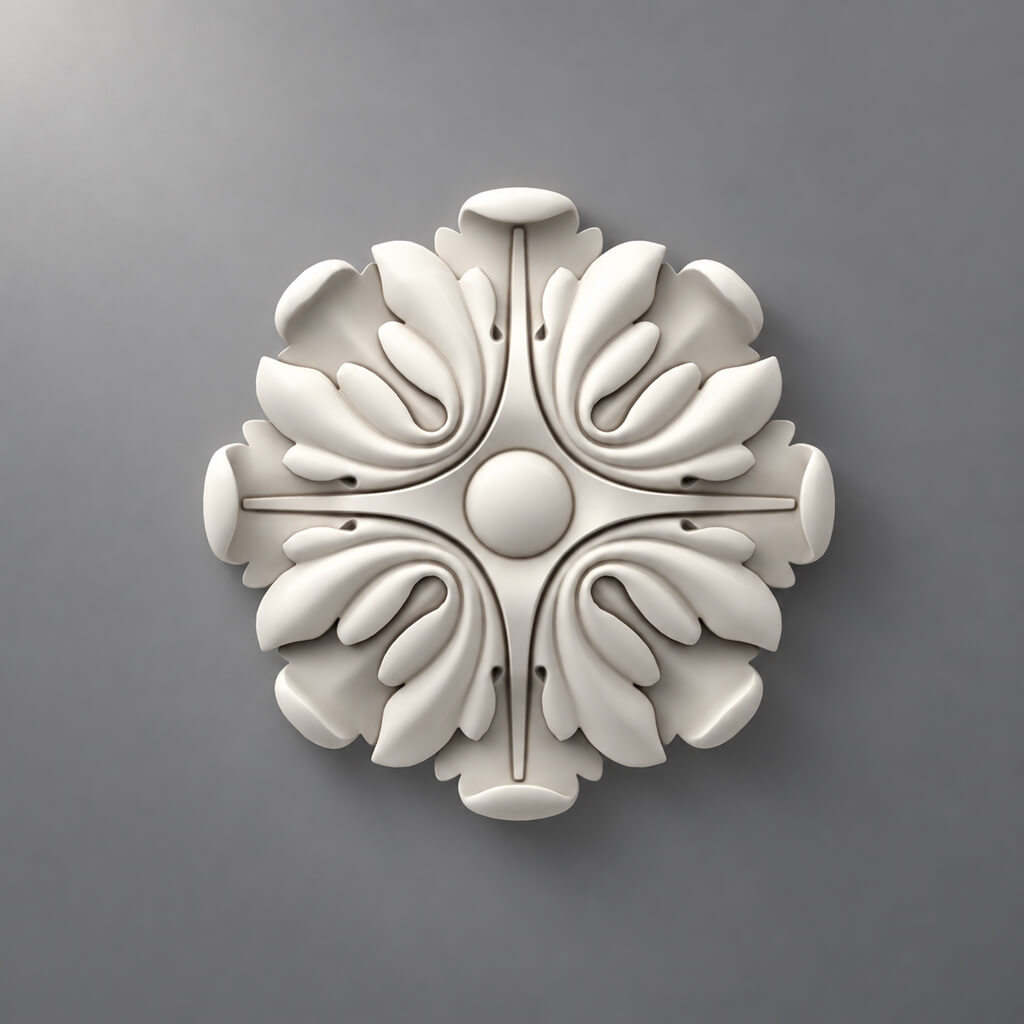
Wooden rosettes
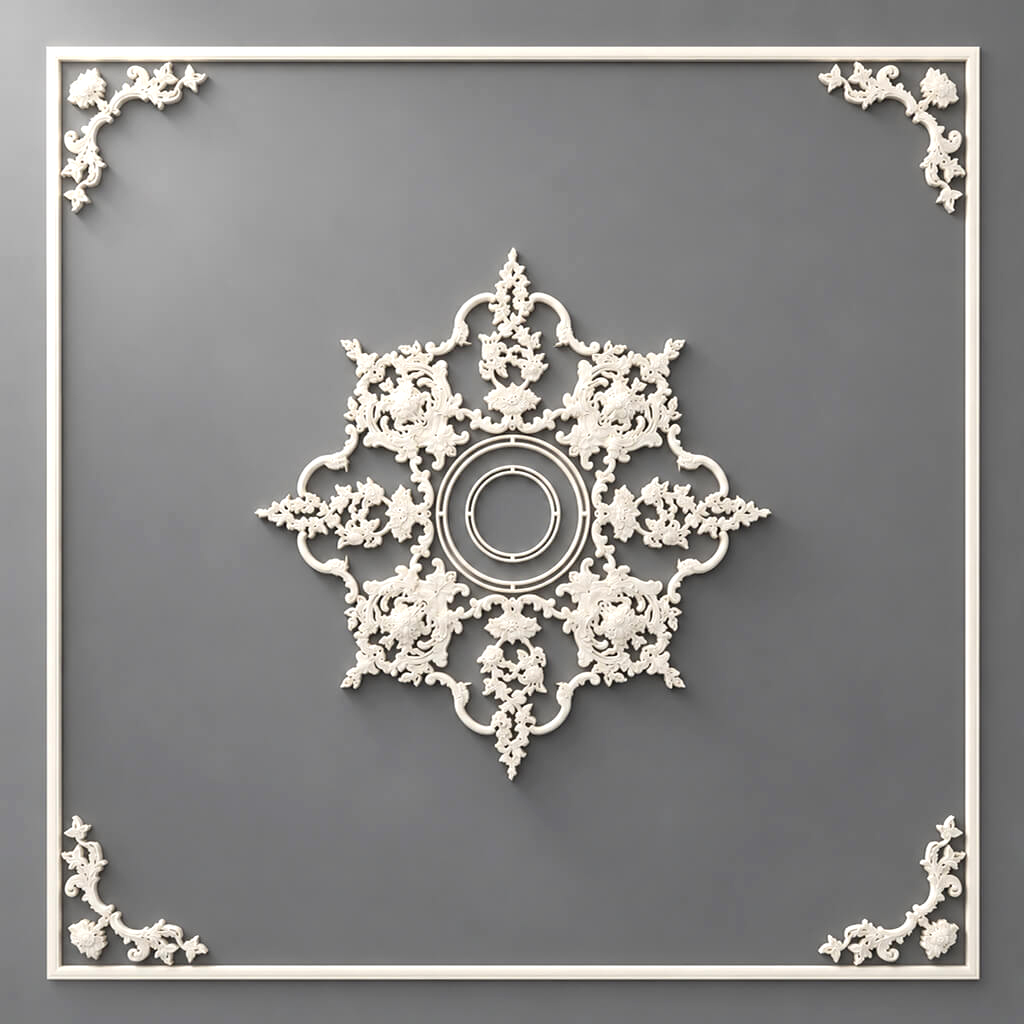
Wooden sockets — a piece of decorative trim that can be used far beyond just the ceiling.
Furniture facade
A rosette can become the central element:
- Doors;
- a cabinet;
- of a chest of drawers;
- of a kitchen facade.
Here, the scale relative to the width of the facade is especially important.
Wall panel
On a wall, a rosette works as the center of a compositional cell.
If there are several frames, the position must be repeated precisely.
Mirror
A wooden rosette can accentuate the central or corner part of a frame.
Door
In a classical system, it can be used as a decorative element of a panel or portal.
What to check
- diameter or overall dimensions;
- the depth;
- pattern;
- orientation;
- finish;
- alignment to the axis.
Individual decorative pieces are especially sensitive to placement errors: a shift of a few centimeters is more noticeable than a slight difference in the length of the molding.
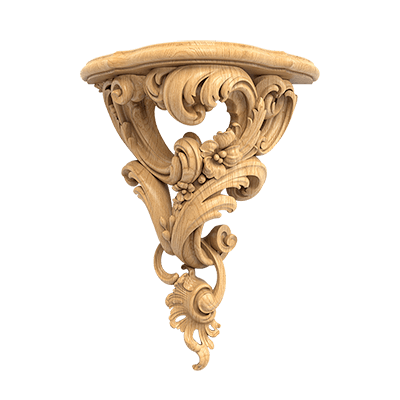
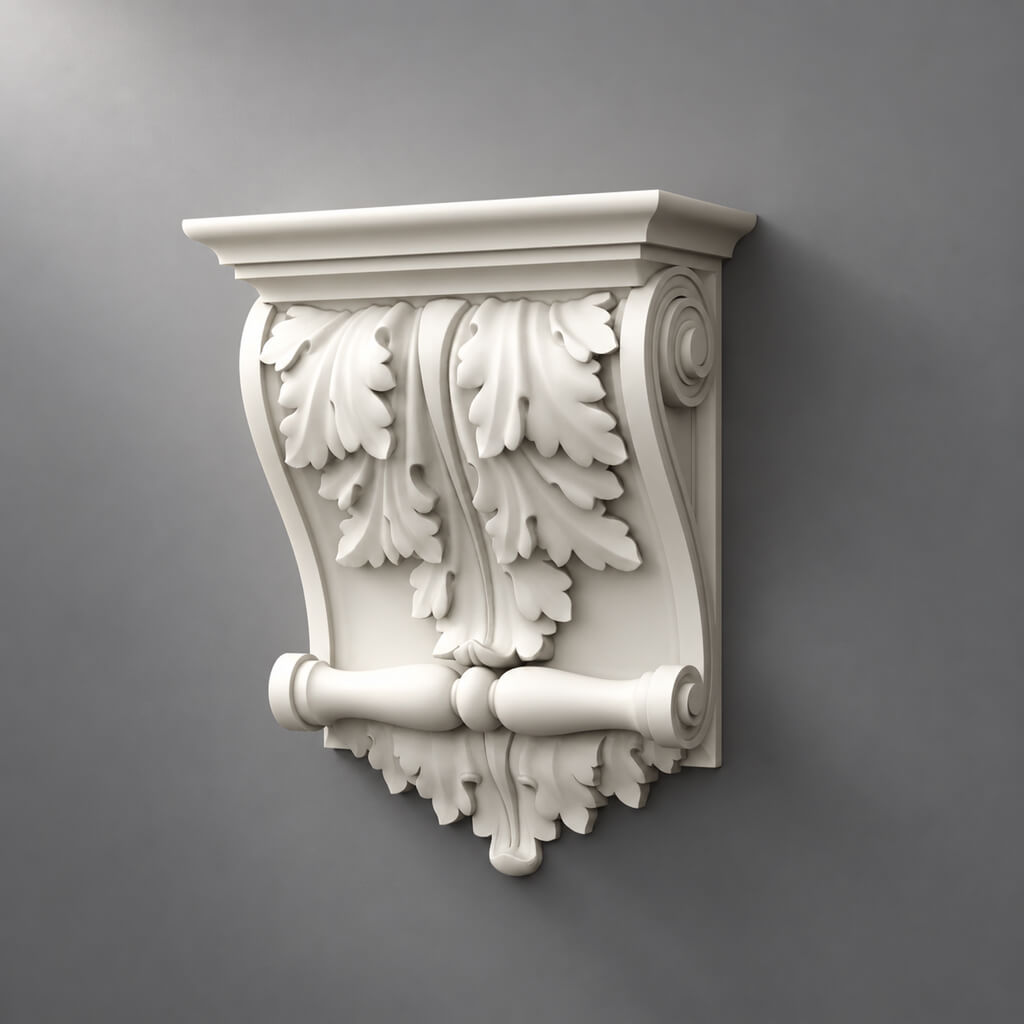
Wooden brackets
Wooden Brackets they can serve both decorative and structural functions.
These functions must not be mixed automatically.
Shelves
If the bracket actually bears a load, a structural calculation and confirmation of an acceptable scenario are required.
A decorative carved bracket must not be considered load-bearing simply because it looks massive.
Corbels
A decorative bracket can support the composition of a cantilevered area even without a load-bearing function.
Portals
In a classical interior, a bracket is used as an element of the upper or side part of a portal.
Kitchen systems
The bracket can work under:
- a tabletop;
- a wall-mounted shelf;
- a decorative cornice.
But the function must be fixed.
Decorative beams
The bracket can complete the composition of the beam and the wall.
Built-in furniture
In cabinets and libraries, brackets can maintain a stylistic connection with the wall architecture.
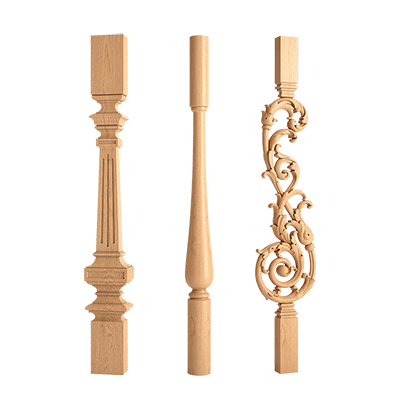
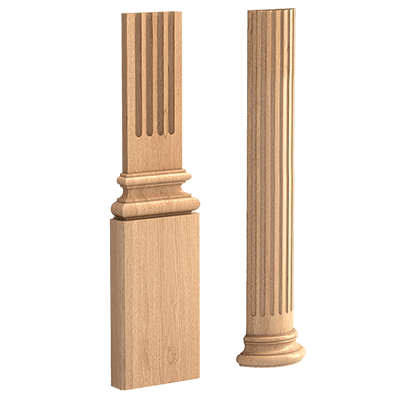
Capitals, pilasters and columns
This is no longer a separate decorative accent, but a full-fledged architectural layer of the project.
Working system:
base → pilaster/column shaft → capital → upper termination.
Why they cannot be selected separately
If the capital is wider than the pilaster shaft or does not match in style, the system looks random.
The same applies to the base and the upper termination.
Alignment with the door
A pilaster next to a doorway must account for:
- wall width;
- platband;
- cornice;
- height of the opening;
- baseboard.
Alignment with the ceiling
The capital should not accidentally "rest" against the cornice.
There should be either a joint or a noticeable gap.
Repeatability
If pilasters are used in pairs, it is important to keep the same levels and orientation.
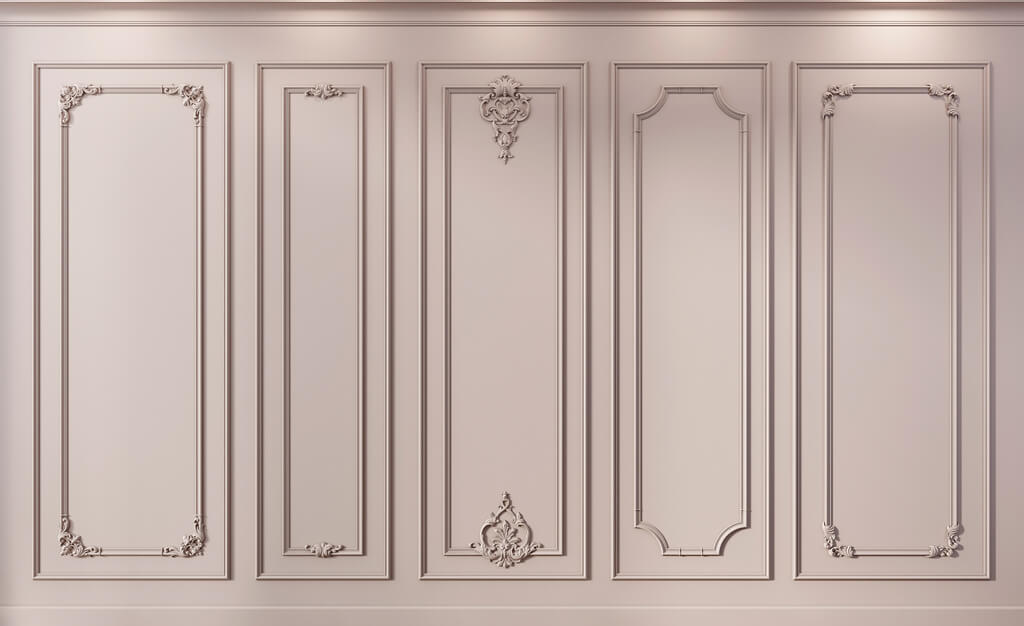
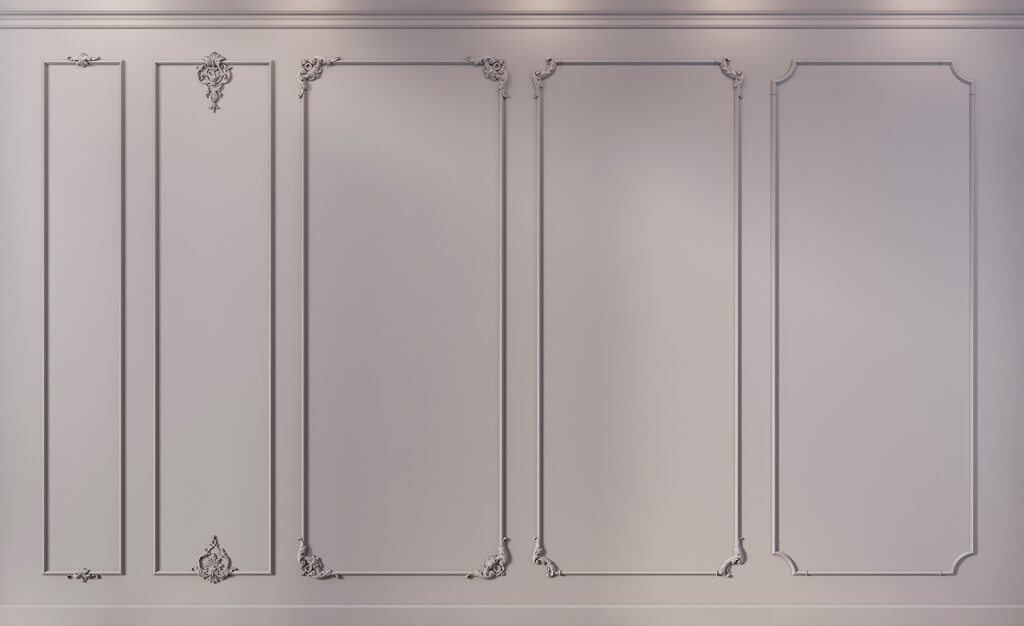
How to use wood in a wall composition
Wooden decor works best when it is subordinate to the wall's architecture.
Typical schemes:
Molding + overlays
First, a frame is built, then a decorative center or corners are added to it.
Panel + carved elements
The panel forms a large surface, while the carved decor creates an accent.
Portal
Several wooden parts are combined around a door or opening.
Mirror frame
The mirror gains its own architecture through the frame, molding, and additional elements.
Decorative vertical
A pilaster, column, or elongated overlay emphasizes the height of the room.
Accent zone
One large carved piece can be stronger than dozens of small details.
The main mistake is choosing each element separately without checking how they interact in scale and ornament.
Wooden decor and doors
The door system is especially sensitive to mismatched profiles.
Workflow:
baseboard → casing → molding → portal → decorative overlay.
Species
If the door is oak, beech decor without a finish may look out of place even with a similar color.
Color
The same stain on oak and beech does not guarantee the same result.
Coating
Lacquer, oil, enamel, and patina produce different visual effects.
Scale
The architrave, moulding, and overlay should be perceived as a single hierarchy.
Wooden decor and built-in furniture
Built-in furniture is an important but secondary scenario.
Wooden Inlays can be used on:
- facades;
- plinths;
- cornices;
- side panels;
- decorative panels.
to buy, which will allow you to transform your furniture using carved wooden elements. You can use the C-003-3 decor set to decorate furniture, walls, doors, or any other surface. The C-003-3 decor set is made of oak or beech, known for their strength, durability, and beauty. You can buy the C-003-3 decor set at the Stavros decor store, which specializes in producing and selling decorative elements and hardware for furniture and interiors. At the Stavros decor store, you will find a wide selection of decor sets of various shapes, sizes, and styles. You can choose especially useful when furniture needs to continue the architectural language of the space.
Checked:
- facade mesh;
- wood species;
- profile;
- overlay size;
- cornice;
- plinth;
- finish.
At the same time, furniture should not become the main focus of the article: here it is considered only as one of the application areas of designer decor.
How to choose wooden decor by ornament
An ornament should be evaluated not only as a pattern, but also as a system of repeats, axes, and proximity to other details.
Floral ornament
Suitable for:
- classics;
- neoclassics;
- historical stylizations;
- furniture;
- portals;
- mirrors.
It is especially sensitive to scale. A small floral motif on a large wall can get lost, while a large one on a small facade can look heavy.
Geometric
It integrates better into modern interiors.
It is convenient for repetition in:
- panels;
- facades;
- frames;
- rhythmic compositions.
Classical order
Capitals, pilasters, columns, and related elements must follow a single system.
You cannot take a capital from one stylistic language and the base from another just because the dimensions roughly match.
Minimalist profile
Modern wooden decor can be almost without ornament.
Here, the quality of proportions and finish matters more than carving.
Custom carving
If a project requires a unique motif, a ready-made catalog can be used as a guide for scale and material.
But you must not create the impression that any custom pattern necessarily exists as a serial product.
How not to mix motifs
It is useful to choose one main ornamental language.
For example:
- one floral group;
- one geometric motif;
- one type of frame profile.
If each element is beautiful on its own, but the designs are not connected, the interior looks assembled from different collections.
How to match the shade of natural wood
A screen is not sufficient for accurately matching natural wood.
The perception is influenced by:
- wood species;
- grain direction;
- stain;
- oil;
- varnish;
- gloss level;
- lighting;
- adjacent wooden surfaces.
Species
Oak and beech react differently to a clear finish.
Therefore, it is impossible to match the “stain color” separately from the material.
Lighting
A single shade changes under:
- daylight;
- warm artificial light;
- cool light;
- side lighting.
Adjacent tree
Pay especially close attention to the combination with:
- parquet;
- doors;
- furniture;
- staircase;
- wall panels.
A sample matters more than a screen
For a responsible project, it is useful to run a test:
species → sample → selected finish → actual lighting → approval.
Do not strive for absolute identity of the natural material
Natural wood has variability.
The goal is to harmonize the overall tone, pattern, and character, not to expect a complete match of every detail.
Wood under enamel: when texture becomes secondary
If a wooden part is fully painted with opaque enamel, the natural grain almost disappears.
Then the designer must ask themselves: why does the project need solid wood specifically?
Solid wood may be justified if:
- specific carved geometry is needed;
- joinery refinement is required;
- the part interfaces with other wooden elements;
- mechanical processing is important;
- the required SKU is available only in solid wood.
But if the goal is simply to achieve a smooth painted surface, it is worth comparing other materials as well.
The finish must be determined in advance
In the specification, it is useful to separate:
MATERIAL
и
FINISH.
For example:
MATERIAL: BEECH
FINISH: OPAQUE ENAMEL.
This way the specifier understands that the material and the final appearance are different parameters.
How to use wood decor samples
For natural wood, a sample is especially important.
It helps verify not only the geometry, but also what cannot be reliably assessed on a screen.
Sanding
The surface quality affects the final finish.
Under clear oil, defects are more noticeable than under enamel.
Depth of carving
In a photograph, the relief often looks more pronounced due to the lighting.
A real sample shows the actual depth.
Wood grain pattern
Even identical parts can have different grain structures.
Stain
The color of the stain depends on the wood species and surface preparation.
Oil and lacquer
They change the depth of color and the degree of gloss.
Workflow
A useful chain:
SKU → sample → finish test → approval → specification.
If the project is large, the sample must be labeled with the item code. Otherwise, after a few months it becomes impossible to tell which product the approved part related to.
3D models of wooden decor
Especially useful for complex carving 3D Decor Models.
3D helps to check:
- scale;
- the depth;
- repeat;
- composition;
- position;
- interaction with light.
Scale
A placeholder overlay from the visualizer library may look similar but have different dimensions.
Therefore, after selecting an SKU, it is better to replace the placeholder with the real model if it is available.
Depth
A carved element creates a shadow. On a furniture facade and on a wall, this shadow is perceived differently.
Repetition
If one overlay is repeated ten times, in 3D you can clearly see whether the composition becomes too busy.
Position
The model allows you to check:
- center;
- indents;
- orientation;
- adjacent elements.
After approval
The same SKU must carry over into the specification.
You cannot approve one model and buy another "similar" one without re-checking.
Drawings and DWG files for wooden products
DWG decor drawings are needed already for the working stage.
They are especially useful for:
- dimensions;
- references;
- portals;
- wall compositions;
- furniture;
- construction assemblies.
Dimensions
In the working documentation, the dimension must match the actual product.
Anchoring
The decor is positioned precisely relative to:
- the axes;
- Doors;
- Panels;
- furniture;
- the ceiling.
Portals
A complex system of multiple wooden parts requires a drawing, not just a render.
Furniture
On the facade, the following are especially important:
- central axes;
- symmetry;
- the distance to the edges.
Construction junctions
If an element adjoins plaster, a panel, stone, or another profile, the junction is best shown separately.
Do not scale the actual SKU
As with polyurethane decor, DWG cannot be arbitrarily stretched when it comes to a specific product.
If the size does not fit, you need to choose a different SKU or change the composition.
How to add wooden decor to the specification
The project position must be unambiguous.
Example:
| Code | SKU | Element | Material | Size | Quantity |
|---|---|---|---|---|---|
| WD-01 | ___ | Overlay | Oak | ___ | 4 |
| WD-02 | ___ | Molding | Beech | ___ | ___ m |
| WD-03 | ___ | Rosette | Oak | ___ | 2 |
| WD-04 | ___ | bracket | Beech | ___ | 4 |
Additionally, it is useful to store:
- URL;
- finish;
- room;
- zone;
- sample status;
- approval status;
- installation comment.
URL
The link helps you quickly double-check the current product card.
Finishing
For natural wood, this is a required field.
Room
One SKU can be used in several rooms, but it is better to split the quantity by zones.
Status
Useful values:
CANDIDATE
SAMPLE
APPROVED
ORDERED.
Surface quality
If the project requires a transparent finish, this parameter is more important than with a dense enamel.
How to calculate the quantity of wooden decor
The calculation method depends on the type of product. Linear and piece decor cannot be calculated in the same way.
Trim
Moldings, cornices, and other long-length elements are calculated by actual lines.
For a rectangular frame:
2 × width + 2 × height.
If the frame is 1.2 × 1.8 m:
2 × 1.2 + 2 × 1.8 = 6 m.
Four frames:
6 × 4 = 24 m.
But 24 m is only pure geometry.
Next, you need to check:
- commercial length;
- the number of joints;
- corners;
- Cutting;
- profile orientation;
- technological reserve.
Why the net linear footage may be insufficient
If long verticals are needed, short offcuts left after horizontals may be useless.
For example, arithmetically there is enough material, but none of the remaining pieces fits by length.
Therefore, for a complex composition, a cutting plan is useful.
| Detail | Length | Quantity | Zone |
|---|---|---|---|
| V-A | 1.80 m | 8 | Living room |
| H-A | 1.20 m | 8 | Living room |
| V-B | 1.45 m | 4 | Hall |
| H-B | 0.75 m | 4 | Hall |
Overlays
are counted individually.
If there is one overlay on four fronts:
4 × 1 = 4 pcs.
If two each:
4 × 2 = 8 pcs.
Rosettes
Individually by the actual number of compositional centers.
Brackets
May be counted:
- in pairs;
- by the number of shelves;
- by portals;
- by the furniture system.
Pilasters
It is better to count as a set of elements.
For example:
BASE × 2
PILASTER × 2
CAPITAL × 2.
This way, part of the system will not be lost in the order.
Technological allowance
There is no universal percentage for any wooden decor.
The margin is higher if:
- complex cutting;
- many angles;
- long critical lines;
- the ornament requires matching;
- a repeat order is undesirable;
- the wood will be finished on site.
For one-off decor, the reserve should also be deliberate. If you need four expensive carved overlays, buying a fifth automatically is not necessary.
What to consider when reordering
For natural wood, a repeat order is more sensitive than for a fully painted serial profile.
Need to preserve:
- breed;
- SKU;
- finish;
- shade;
- the batch, if it matters;
- grain direction;
- test color swatch.
Species
You cannot order "the same color" without specifying the wood species.
Finish
The wording "oak-like" is too vague.
It is better to keep:
- stain name;
- oil;
- varnish;
- gloss level;
- application technique.
Sample
If the project is long, the approved sample should be kept until all batches are completed.
Repeat SKU
The item code must be in the specification and the studio's internal database.
Reordering "from a photo" creates unnecessary risk.
Natural variability
Even within a single species, natural variations in the pattern are possible.
Therefore, a repeat order is best viewed as a continuation of the system rather than a guarantee of an absolutely identical pattern.
How to buy wooden decor for a design project
The commercial stage begins once the project already knows exactly what it needs.
Work sequence:
catalog → SKU → sample → finish → 3D/DWG → specification → quantity → order.
Buy wooden decor
The phrase “buy wooden decor” is too broad until the group is defined.
First, the designer decides:
- overlay;
- rosette;
- bracket;
- molding;
- pilaster;
- molding.
Decorative elements
wooden decorative elements convenient to use as a separate product group for project specification.
Here you can already compare actual sizes and types.
Carved wooden decor
Complex ornamental details require a specific SKU and a confirmed scale.
Trim
Purchased after the line drawing and cutting plan.
Rosettes
Per piece.
Brackets
Individually or in pairs according to the actual composition.
Order solid wood products
For a large project, the specifier should send a table rather than a general request:
| Article | Category | Material | Quantity | Room | Finish |
|---|---|---|---|---|---|
| ___ | Overlay | Oak | 4 | Living room | Oil |
| ___ | Molding | Beech | ___ | Office | Enamel |
| ___ | Rosette | Oak | 2 | Hall | Stain |
This way the supplier and the specifier work with the same structure.
How to use the STAVROS catalog in a project
the STAVROS catalog is useful as a general navigation layer.
For wooden decor, a designer should not stop at the top level.
Working logic:
general catalog → category → specific SKU → technical data → specification.
When a general catalog is useful
- the project is just beginning;
- you need to understand product groups;
- a stylistic direction is being sought;
- you need to compare wood and other materials;
- the studio is building an internal library.
When a general catalog is no longer enough
At the working design stage, you need:
- specific article number;
- product page;
- size;
- the material;
- finish;
- technical file.
Professional materials for designers and architects
STAVROS for designers and architects combines professional tools: 3D models, DWG drawings, catalogs, a manager, and information about showrooms.
For wooden decor, this is especially useful at the stages of:
- shortlist;
- technical review;
- samples;
- specifications;
- specification.
What remains the designer's responsibility
The manufacturer can provide the range and technical data.
But the designer is responsible for:
- scale;
- architectural composition;
- choice of finish;
- place of application;
- approval with the client.
Professional support does not replace design, but makes it more precise.
Common mistakes when working with wooden decor
Mistake 1. Choosing based only on carving
Why it happens: the ornament immediately draws attention.
Consequence: the size does not fit the surface.
How to prevent: dimensions and function first, then the pattern.
Mistake 2. Considering oak and beech interchangeable after tinting
Why it happens: it seems that the stain will even everything out.
Consequence: the texture and overall character differ.
How to prevent: test the finish on the actual wood species.
Mistake 3. Not specifying the finish in the specification
Why it happens: it seems the finishing will be decided on site.
Consequence: identical elements get different shades.
How to prevent: a separate FINISH field.
Mistake 4. Scaling the 3D model
Why it happens: there's a desire to adjust the visualization.
Consequence: a nonexistent size appears in the project.
How to prevent: choose a different SKU.
Mistake 5. Calculating linear meters only by total footage
Why it happens: the arithmetic is simple.
Consequence: the cutting plan doesn't come together.
How to prevent: parts map.
Mistake 6. Not keeping the approved sample
Why it happens: after approval, it seems it is no longer needed.
Consequence: when reordering, there is nothing to compare the finish against.
How to prevent: keep it until the project is completed.
Mistake 7. Mixing up a structural and a decorative bracket
Why it happens: a massive part looks sturdy.
Consequence: incorrect use.
How to prevent: confirm the function separately.
Mistake 8. Choosing a capital separately from a pilaster
Why it happens: each detail is pleasing on its own.
Consequence: the system doesn't match in scale.
How to prevent it: design as a complete set.
Mistake 9. Expecting natural wood to be perfectly uniform
Why it happens: expecting serial uniformity.
Consequence: natural variation is perceived as a defect.
How to prevent it: agree on the acceptable character of the material in advance.
Five design scenarios: how the choice of wooden decor changes
The same product category works differently depending on the task. It's useful to look not at "wooden decor in general," but at a specific scenario.
Scenario 1. A classic living room with portals
Initial conditions:
- tall doors;
- developed architrave;
- wall panels;
- ceiling cornice;
- natural wood in furniture.
In such a system, you first need to determine the architectural scale:
- portal width;
- height;
- pilaster;
- capital;
- Plates;
- molding.
The main risk is choosing a carved element that is too small, which will get lost next to a large portal.
Scenario 2. An office with wooden panels
Here, the natural texture becomes part of the concept.
Checked:
- wood species;
- grain direction;
- Moldings;
- cornices;
- Outlets;
- finish.
If the panels are oak, a beech overlay under clear varnish may look out of place.
In such a project, either the same species is used, or the difference is made intentional.
Scenario 3. A modern kitchen with wooden accents
The main interior can be minimalist, with wood used only in the details.
For example:
- Brackets;
- molding;
- decorative overlay;
- handles;
- cornice.
Here it is especially easy to overload the project with classic carving.
It is better to choose geometric or restrained elements.
Scenario 4. Mirror as an architectural object
The mirror can receive:
- baguette;
- molding;
- Plates;
- central decor.
First, the overall dimensions of the frame are designed, then the profiles are selected.
If you start with one beautiful overlay, the final size may turn out to be inconvenient for the wall.
Scenario 5. Hotel or restaurant
Repeatability sharply increases the SKU value.
The same decor can be used:
- in several rooms;
- in corridors;
- a restaurant;
- in the reception area.
Here, the following are especially important:
- sample;
- article number;
- finish;
- batch;
- repeat order;
- revision history.
One small scale error will be repeated dozens of times.
When wooden decor is not needed
A professional choice sometimes means forgoing wood.
If the surface is fully painted and texture is not needed
Solid wood may not provide additional visual value.
If the interior is already overloaded with natural wood
When there is:
- parquet;
- Panels;
- Furniture;
- ceiling beams;
- doors,
another carved layer can make the space feel heavy.
If the surface size is too small
A large ornament on a small facade or wall section looks random.
If there is no budget for a quality finish
Good wooden decor can be ruined by poor treatment.
If the project does not include:
- sanding;
- test paint sample;
- high-quality application;
- shade control,
it's better to simplify the solution.
If the part is covered by furniture
There's no point in buying a complex overlay that will later be completely hidden.
If absolute uniformity without variation is required
Natural wood has its own grain pattern.
If a project requires a perfectly identical surface across dozens of parts, it's worth comparing alternative materials.
How to coordinate wooden decor with the client
The client usually evaluates wood emotionally: "lighter," "warmer," "more grain."
The designer needs to translate this into project parameters.
Show a real sample
Photos and renders are useful, but a sample gives the correct scale.
Show the finish
The same species after:
- oils;
- stain;
- enamel;
- patination
looks different.
It is useful to record in the project table:
SKU
MATERIAL
FINISH
APPROVED DATE.
Then, a few months later, there is no dispute about which shade was approved.
How to communicate wooden decor to the specifier
The specifier needs not a moodboard, but an unambiguous schedule.
Minimum package:
- final visualization;
- specification;
- SKU;
- URL;
- quantity;
- room;
- finish;
- sample;
- revision number.
You cannot leave "select an analog"
If the project author has not determined an acceptable substitution, the specifier must not do this independently.
The alternative must be approved in advance
Can be written:
PRIMARY SKU: ___
APPROVED ALTERNATIVE: ___
But the second option must pass the same size and finish check.
Check before ordering
The specifier rechecks:
- SKU availability;
- availability;
- quantity;
- the material;
- finish;
- the latest revision.
Selection matrix: how to compare several wooden elements before approval
When two or three suitable products are found in the catalog, visual comparison alone is not enough. It is useful to evaluate the candidates by the same parameters.
| Criterion | Candidate A | Candidate B | Candidate C |
|---|---|---|---|
| SKU | ___ | ___ | ___ |
| Type | overlay / molding / rosette | ___ | ___ |
| Species | Oak / beech | ___ | ___ |
| Size | ___ | ___ | ___ |
| Relief | ___ | ___ | ___ |
| Finish | ___ | ___ | ___ |
| 3D | Yes / no | ___ | ___ |
| DWG | Yes / no | ___ | ___ |
| Sample | Needed / not needed | ___ | ___ |
| Impact on composition | ___ | ___ | ___ |
| Impact on cost | ___ | ___ | ___ |
Species
If the project involves a clear finish, the wood species becomes one of the main parameters. Two elements identical in geometry, one made of oak and the other of beech, will be perceived differently after oiling.
Size
Even a small difference in the width of the overlay may require changing the frame, facade, or portal.
Relief
Deep carving works more strongly under side lighting and may look heavier on a small surface.
Digital materials
If a candidate has both 3D and DWG, it is easier to carry it correctly through visualization and working documentation.
Sample
For expensive finishes and a clear finish, a sample may carry more weight than a render.
Impact on cost
You should compare not the price of a single part, but the full project effect:
product price + quantity + finishing + installation + possible rework of the composition.
If a cheaper overlay requires redoing the facade grid, the real savings may disappear.
Project position passport: what to store for each SKU
For the studio's repeatable work, it is useful to create a short passport of the approved element.
Example:
PROJECT CODE: WD-03
BRAND: STAVROS
SKU: ___
TYPE: ROSETTE
MATERIAL: OAK
SIZE: ___
FINISH: OIL / TINT ___
ROOM: HALL
ZONE: WALL-B
3D: YES
DWG: YES
SAMPLE: APPROVED
QTY: 4
URL: ___
REVISION: 05
Such a passport solves several tasks at once.
Visualizer
Understands which model to use.
Designer
Knows which block and size to place in the drawing.
Assembler
Sees the SKU, quantity, and finish.
Contractor
Receives a clear item in the working documentation.
Design supervision
Can verify the actually installed part against the approved one.
The passport is especially useful for projects that are implemented over a long period or in several phases.
How to work with a finish test on wood
For solid wood, the color cannot be approved based only on the name of the stain or a photo of the sample.
A reliable process:
- take a real sample of the same species;
- prepare the surface in the same way the main decor will be prepared;
- apply the chosen system;
- dry according to the technology;
- look at it in daylight and artificial light;
- compare with adjacent materials;
- record the result.
Why surface preparation is critical
The same stain can look different on a surface with different sanding.
The more open the pores are and the more differently the wood is prepared, the more noticeable the difference.
What to record after approval
- breed;
- coating system;
- color number or name;
- number of layers;
- gloss level;
- photo;
- physical sample.
Do not use a photograph as the only reference
The camera, screen, and lighting change the shade. A photo is convenient for the project history, but the actual sample remains the control reference.
How to check wooden decor on site before mass installation
For a repeating system, it is useful to first assemble one control unit.
For example:
- one frame;
- one portal;
- one facade;
- one pilaster;
- one bracket with a shelf.
At the control node, the following are checked:
- scale;
- joints;
- shade;
- finish quality;
- actual relief depth;
- installation;
- interaction with light.
If the system is repeated twenty times, fixing the first node is significantly cheaper than twenty finished ones.
What to do in case of a discrepancy
If the actual result differs from the visualization, first determine the cause:
- different SKU;
- incorrect finish;
- scale error;
- different lighting;
- incorrect attachment;
- installation error.
After that, the specific layer is adjusted, not the entire project at once.
Final checklist before ordering
Concept
- it is clear why the wooden element is needed;
- it does not duplicate other decor;
- its scale matches the interior.
Material
- the wood species is selected;
- it is clear why solid wood is justified;
- adjacent wooden surfaces are taken into account.
Size
- actual dimensions have been checked;
- profile matches the project;
- dimensions on the drawing are up to date.
Ornament
- motif is approved;
- no random mixing;
- repeating elements follow a single system.
Finish
- coating type selected;
- test completed if required;
- color approved;
- finishing responsible person assigned.
Digital materials
- 3D matches the SKU;
- DWG matches SKU;
- placeholder models removed.
Quantity
- moulding calculated by lines and cutting;
- overlays counted;
- sockets counted;
- brackets counted;
- complete architectural elements are not separated randomly.
Specification
- manufacturer specified;
- SKU specified;
- the room is specified;
- URL preserved;
- Status
APPROVED.
Commercial stage
- availability double-checked;
- the current price is verified;
- delivery taken into account;
- A repeat order, if needed, is clear.
If at least one critical point remains undefined, it is better not to send the order.
FAQ
What is included in wooden decor for a design project?
Carved overlays, rosettes, brackets, moldings, baguette, linear trim, capitals, pilasters, columns, and other architectural elements made of solid wood.
What to choose: oak or beech?
It depends on the visual task, the finish, and the adjacent wooden surfaces. Oak usually has a more pronounced grain pattern, while beech is more subdued. For a transparent finish, the choice of species is especially noticeable.
Can wooden decor be painted with enamel?
Yes, if the specific item and surface preparation are suitable for the chosen system. But if the natural texture is completely hidden, it is worth checking whether solid wood is justified in the project.
Is it necessary to order a sample?
For a natural finish, complex carving, a large batch, and approval with the client, it is advisable.
How are wooden moldings calculated?
By the lengths of the actual lines, then taking into account the commercial length, cutting, and technological allowance.
How to count overlays?
Individually for each SKU and zone.
How to count brackets?
By the actual composition: in pairs, by the number of shelves, portals, or furniture units.
Can one SKU be used in multiple rooms?
Yes. But it is better to count the quantity for each zone separately.
What should I do if I need the same decor later?
Save the SKU, species, finish, and approved sample. Reordering "from memory" is especially risky for natural wood.
Can wooden decor be used in a modern interior?
Yes. A modern project can use smooth profiles, geometric overlays, and natural wood without historical styling.
What is more important: ornament or size?
Function and size first, ornament second. A beautiful pattern won't save a piece that doesn't fit the scale.
Can oak be replaced with beech after approval?
Only after re-checking the finish and the visual result. This is not a neutral substitution.
Why do we need 3D models?
To check scale, relief, repeat, and light and shadow in a specific interior.
Why do you need DWG?
For precise geometry, references, nodes, and working drawings.
How can discrepancies between the render and the delivery be avoided?
Use the same SKU in 3D, DWG, and the specification.
Can wooden decor be purchased before the final visualization?
For a known repeat SKU, yes. For a new custom design, it's better to first complete the check of scale, finish, and quantity.
What should I do if the required SKU is unavailable?
Check an alternative by size, species, finish, and ornament. If the geometry changes, update the 3D, DWG, and specification.
Should the sample be kept after ordering?
For a long project and a possible reorder — yes.
How to distinguish a decorative bracket from a structural one?
By the purpose and confirmed characteristics of the specific product. You cannot judge by external bulk alone.
Where to start the selection?
You can start with STAVROS and then go to the specific category by the function of the element.
Bottom line: wooden decor becomes project-specific only after the SKU and finish are fixed
Wooden decor for interiors is valuable not only for its natural material. Its professional strength lies in the ability to precisely integrate a specific piece into the architecture, furniture, and specification.
Work sequence:
concept → application area → element type → species → size → SKU → sample → finish → 3D/DWG → specification → calculation → order.
If a designer settles on the wording "a beautiful carved overlay is needed," the next project participant is still forced to start the search from scratch.
If, however, the item receives:
- article number;
- breed;
- size;
- finish;
- position;
- quantity;
- URL;
- approval status,
it becomes a reproducible project position.
This is precisely what distinguishes a professional approach to wooden decor from a random selection of beautiful elements from a catalog.