


























Article Contents:
- What is a wooden block used for in furniture and interior design
- Block as a structural unit: broader than it seems
- How a wooden block differs from a batten, molding, and millwork
- Four terms — four functions
- Visual comparison table
- How to choose the size of a wooden block
- Size is an engineering calculation, not a random choice
- Parameters determining the choice of size
- Standard sizes of wooden bars for furniture
- Bar moisture — a parameter often ignored
- Wooden bar for furniture
- Table frame: from drawing to assembled structure
- Cabinets and shelves: bar inside the structure
- Bar for furniture legs: from blank to support
- Wooden bar for wall decor and interior
- Slat panel: when a bar becomes design
- Decorative frames and trims
- Accent wall with horizontal wooden bars
- Wooden partition made of bars
- Material: beech, oak, solid wood for painting
- Why wood species is not a matter of taste
- Beech: the gold standard of furniture bars
- Oak: a bar with character
- Birch: a workhorse for painting
- Pine: construction and budget furniture
- Ash: elasticity and sports strength
- Bar, batten, and skirting board in one interior
- System of wooden elements: from floor to ceiling
- Wooden floor baseboard as a starting point
- Wooden baguette and baguette strip in the decor system
- Wooden corner — a connecting element
- Complete wooden interior system
- Wooden block as a blank for furniture supports
- From block to leg: a professional route
- What block is needed for a furniture leg
- Overlay decor from a block
- Preparing a wooden block for work
- Three stages that cannot be skipped
- Wood block coating
- Common mistakes when choosing a wood block
- Mistake 1: Wood species too soft for load-bearing structure
- Mistake 2: Buying wet block without acclimatization
- Mistake 3: Choosing only by price without considering purpose
- Mistake 4: Incorrect cross-section for load
- Mistake 5: Ignoring surface treatment quality
- Mistake 6: Inconsistency of wood species within a batch
- Mistake 7: Not considering grain direction when sawing
- Wood block in furniture restoration
- Precise replacement of damaged elements
- Replacement of internal frame elements
- Wooden block as an investment in quality
- Why solid wood is better than substitutes
- Where to buy wooden elements for furniture and decor
- A single source for the entire wooden interior system
- FAQ: popular questions about wooden blocks
- STAVROS: wooden blocks, slats, legs, and solid wood decor

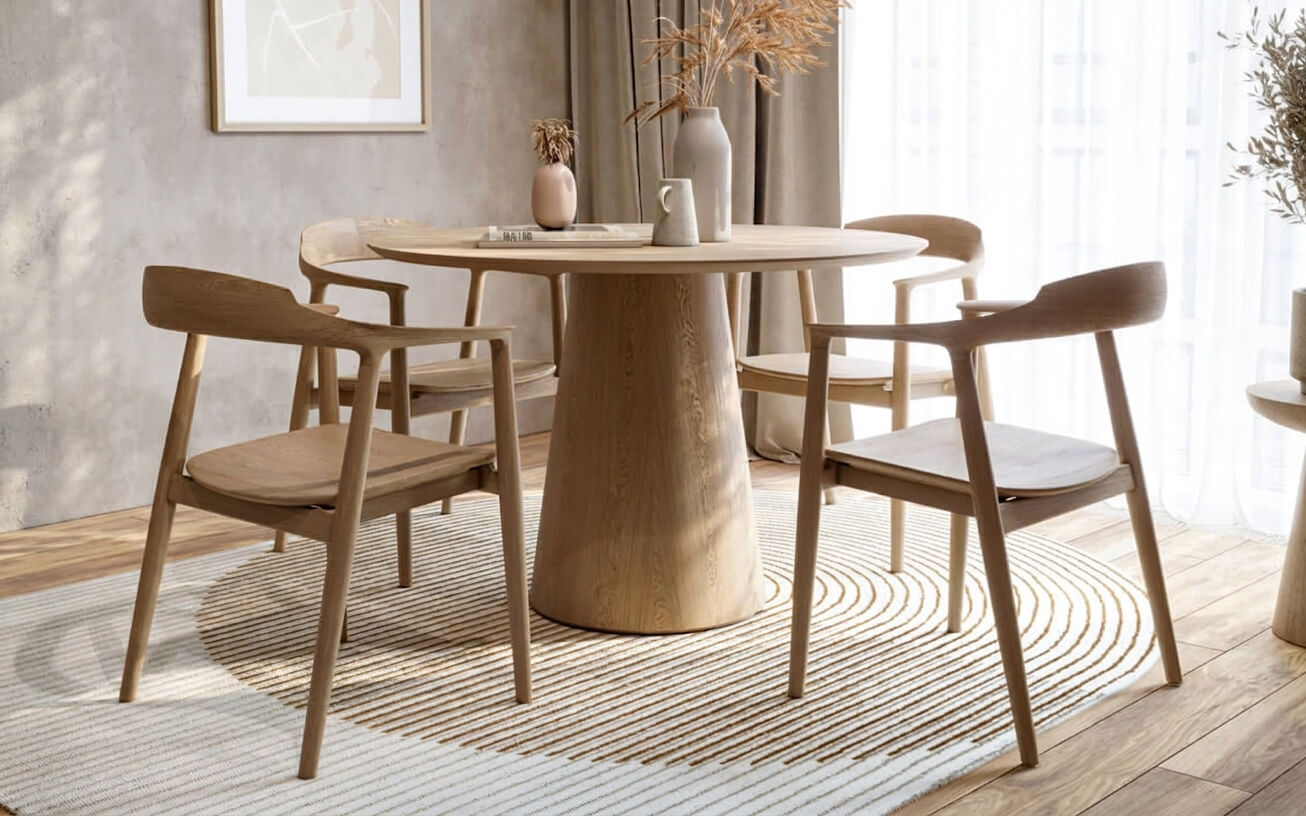
There are materials that need no introduction — they have been part of our everyday life for as long as the concept of "home" has existed. Wood is one of them. And Wooden block — its most versatile embodiment: not a board, not a panel, not veneer, but a three-dimensional rectangular blank from which a table frame is built, a cabinet support is made, a slat for a decorative panel is cut, and a dresser leg is turned.
But here's the paradox: precisely because a wooden block seems "simple," it is chosen carelessly. People grab the first one at hand. Then they encounter the workpiece warping during drying, not accepting paint, cracking when drilled, or looking out of place in the finished product.
This article is about how to choose a wooden block consciously: for furniture, for decor, for interiors. We'll break down wood species, sizes, degree of processing, purpose, and the full range of applications—from load-bearing frames to decorative details on facades.


What a wooden block is used for in furniture and interiors




The block as a structural unit: broader than it seems
When a professional carpenter says "block," they mean a precise thing: a workpiece with a rectangular or square cross-section, planed, calibrated to size, ready for work. It's not a scrap, not a log, and not a batten—it's a workpiece with a specific geometry and function.
The scope of application for wooden blocks in furniture and interiors includes:
Frames of cabinet furniture. Cabinets, shelving units, nightstands, dressers, tables—in many products, the internal frame is assembled precisely from wooden blocks. A block of 40×40, 50×50, 60×40 mm is the standard size for a load-bearing frame.
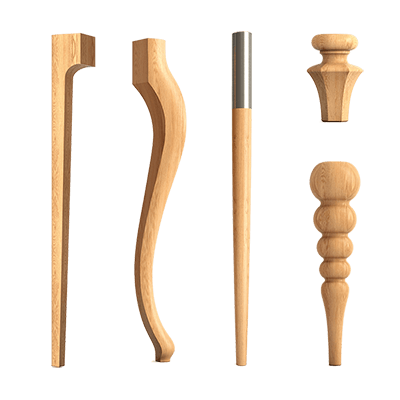
Supports and legs. A square or rectangular block is a blank for furniture legs. Turned supports are carved from it, it is processed with a router to create a profile, and it is cut into straight cubic or tapered legs.
Shelves and shelving units. The block is attached to the wall or uprights as a cantilever shelf support. A series of horizontal blocks with equal spacing forms a shelving unit with open sections.
Decorative interior elements. Wooden slats made from blocks on the wall are an extremely popular technique in Scandinavian and classic decor. Vertical slatted panels, horizontal cladding, decorative lattice—all start with a properly chosen block.
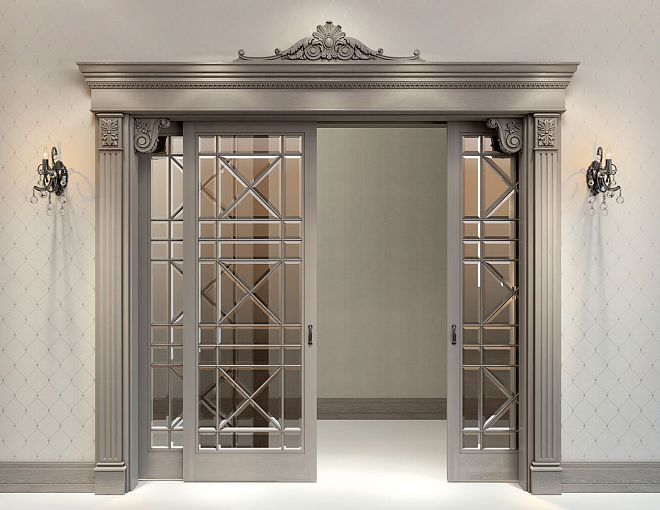
Frame structures. Door frames, arch surrounds, mirror and panel frames — a block as a base for decorative finishing.
Structural reinforcement. A block is inserted into the corners and edges of furniture panels, strengthening the ends and preventing deformation. A classic example is corner blocks inside a frame facade.
Blanks for turning. Before they Wooden legs acquire their elegant turned profile, they were an ordinary square block placed on a lathe.
Our factory also produces:


How a wooden block differs from a batten, molding, and linear trim
Get Consultation
Four terms — four functions
The professional vocabulary of a carpenter and finisher often confuses an unprepared buyer. Batten, block, molding, linear trim — they sound similar but mean different things.
A wooden block is a massive blank with a cross-section, typically at least 20×20 mm. The emphasis is on volume, mass, and load-bearing function. The block holds the load.
Wooden plank — a thin linear element, typically with a cross-section from 8×18 to 20×30 mm. A batten does not "hold" — it decorates, divides, and accentuates. It is an element of decor and finishing.
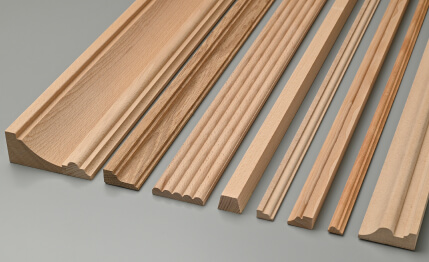
Wooden molding — a profiled linear trim element for covering joints, decorating transitions between planes, and decorative division of facades and walls. Molding has a characteristic profile: rounded, chamfered, or shaped.
Wooden trim — a general category that unites all long-length wooden profiles: baseboards, cornices, architraves, slats, trims, glazing beads, moldings. A block is technically also a molded product, but stands apart due to its role as a structural material.
Visual comparison table
| Product | Section | Main function | Typical application |
|---|---|---|---|
| Block | 20×20 — 100×100 mm and larger | Structural (load-bearing) | Frames, supports, legs |
| Rail | 8×18 — 20×30 mm | Decorative and finishing | Panels, lathing, accents |
| Layout | 10×6 — 40×15 mm | Decorative, covering joints | Facades, transitions, joints |
| Baseboard | Profile | Covering the floor/wall joint | Floor finishing |
| Molding | Profile | Decorative accent | Frames, cornices, moldings |
The block is the "skeleton". The batten is the "skin". The layout is the "clothing". Together they form a complete system of wooden finishing and furniture.
How to choose the size of a wooden block
Size is an engineering calculation, not a random choice
The most common mistake when buying a block is choosing "by eye". Grabbing a larger one seems fine. In practice, this leads to material waste, heavier construction, or, on the contrary, to its destruction under load.
Parameters determining size selection
Load. A block in a table frame bears one load, a block in a decorative slatted panel bears another. A load-bearing block is calculated for compression and bending; a decorative one is calculated only for its own weight.
Span. The longer a horizontal block without intermediate supports, the larger its cross-section must be to avoid sagging. For a horizontal block 80 cm long supporting a shelf with books, the minimum cross-section is 40×30 mm. For a span of 120 cm, it is 50×40 mm.
Visibility. If the block is hidden inside the structure, only strength matters. If the block is visible, surface cleanliness, correct geometry, and ability to accept a coating are also important.
Joining with other elements. A block that will be connected to a chipboard panel, wooden boards, or profiles must have a size coordinated with these elements.
Standard sizes of wooden blocks for furniture
| Section | Purpose |
|---|---|
| 20×20 mm | Decorative slats, lightweight decorative frames |
| 25×25 mm | Slats for panels, lightweight frames |
| 30×30 mm | Frames of small products, shelving uprights |
| 40×20 mm | Shelf supports, decorative elements |
| 40×40 mm | Standard furniture frame, corner posts |
| 50×40 mm | Heavier frames, support frames |
| 50×50 mm | Joinery frames, heavy frames |
| 60×40 mm | Table supports, door frames |
| 80×40 mm | Load-bearing elements, large furniture structures |
The moisture content of the bar is a parameter that is often ignored
A wooden block for furniture should have a moisture content of 8–12%. With higher moisture content (raw wood), the block will shrink and warp after assembly. With lower moisture content, it will be brittle.
How to check? With a professional moisture meter. Visually — a raw block feels cool to the touch even in a warm room, and is heavier than a similar dry sample. On the surface of a raw block under bright light, dark spots of high moisture are visible.
Wooden block for furniture
Table frame: from drawing to assembled structure
A table is the most "block-intensive" piece of furniture. Four legs, two side aprons, two end aprons — a minimal table frame requires 6 to 10 blocks of different cross-sections and lengths.
Table legs. For a coffee table — a block 40×40 mm. For a dining table — 50×50 or 60×60 mm. For a massive loft-style work table — 80×80 mm or more.
Apron (stretcher). Horizontal blocks connecting the legs to each other and supporting the tabletop — usually 50×30 or 60×30 mm. For a long span (over 120 cm) — 70×30 mm to prevent sagging.
Crossbars (stretchers). If the table has lower crossbars between the legs — a similar cross-section to the apron or slightly smaller.
Cabinets and shelving: block inside the structure
In cabinet production, a solid wood block is often replaced with particleboard or MDF. But in solid wood furniture and custom joinery, the block remains the main material for internal frames.
Cabinet corner posts. Bar 40×40 or 50×40 mm — carries vertical load from upper shelves and top panel.
Horizontal crossbars. Bar 40×30 mm between posts — to fix the body geometry.
Drawer guides. Bar 25×20 mm — classic wooden guide for pull-out drawers in classic furniture.
Rack uprights. Vertical bar 30×30 or 40×30 mm — for open shelving systems.
Bar for furniture legs: from blank to support
Here is the crossroads of furniture production: a square bar turns into a leg. This can happen in different ways:
-
Turning: a square bar 50×50 mm is placed on a lathe and turned into a turned furniture leg with vases, grips, conical transitions.
-
Milling: chamfers or roundings are removed from the faces of the square bar — resulting in a leg with profiled edges.
-
Straight legs without additional processing: a tapered or straight bar of the required cross-section is installed as a leg with minimal processing — typical for Scandinavian style.
for high wooden furniture legs for the classic type, the original block must be made of hardwood: beech, oak, ash. Soft pine during turning produces fibrous burrs and an uneven surface.
Wooden block for wall and interior decoration
Slat panel: when a block becomes design
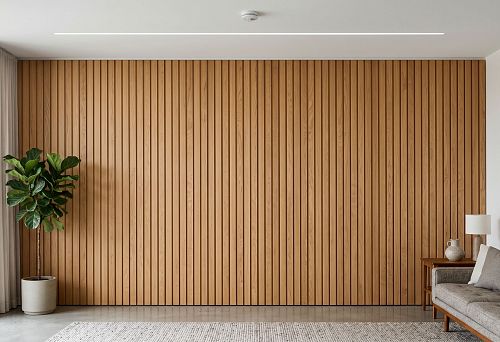
One of the strongest trends of the last decade in interior design is wooden slat panels. Vertical or horizontal slats on the wall, an accent niche decorated with wooden blocks, a decorative partition made of equally spaced slats — all this starts with the right choice of block or slat.
For a slat panel, a block or slat with a cross-section of 20×30, 25×25, 20×40, 30×30 mm is used. The spacing between slats is 40–80 mm depending on the design concept. Key requirements:
-
Perfect geometry — all slats must be identical in cross-section, without deviations in planes.
-
Surface smoothness — fine sanding, no nicks or fuzz.
-
Stable humidity — the entire batch from one supply, one storage condition.
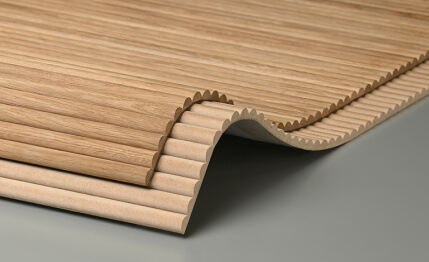
Wooden plank — a ready-made profiled element for slat panels. A block is the raw material from which such slats are cut and processed.
Decorative frames and borders
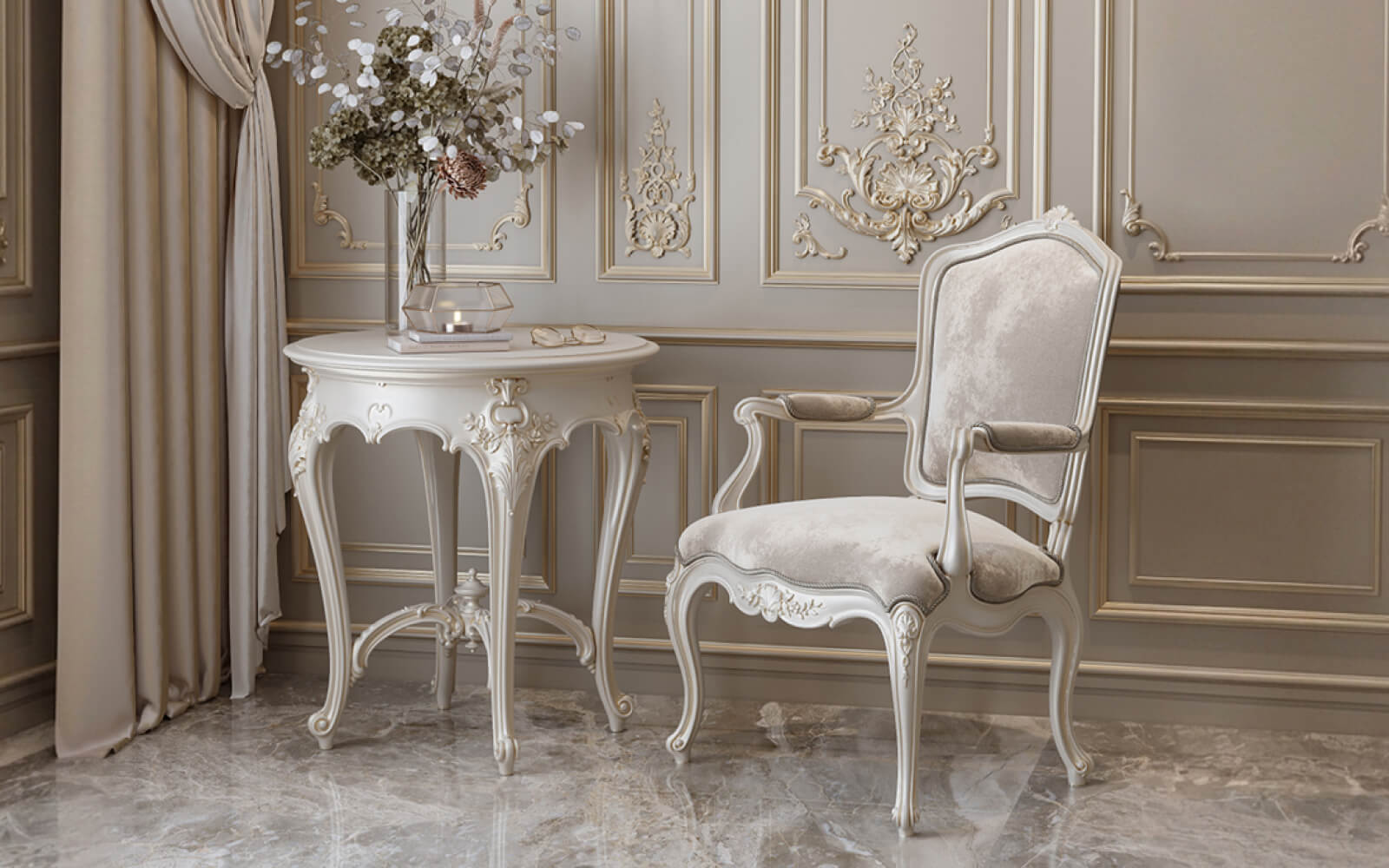
A strip becomes a frame on the wall — a rectangular or square outline forming a decorative panel. This is a characteristic technique of classic and neoclassical finishing: the wall is divided into fields framed by wooden slats or moldings, creating a "paneled" effect.
This also uses Buy wooden trim a profiled section — it creates a more expressive shadow along the edge of the frame than a flat strip.
Accent wall with horizontal wooden strips
A horizontal row of strips of the same cross-section, fixed to the wall at equal intervals — a horizontal slatted panel. Used in:
-
Bedroom behind the headboard.
-
Living room behind the sofa or along an accent wall.
-
Hallway as a decorative accent.
-
Children's room as a playful element.
Visual effect: the wall "moves", acquiring rhythm, depth, and tactile expressiveness.
Wooden partition made of bars
An open partition made of vertical wooden bars mounted on horizontal support beams — a concise zoning of space without complete separation. Popular in Scandinavian interiors, industrial lofts with wooden accents, and classic interiors with decorative wooden columns.
Material: beech, oak, solid wood for painting
Why wood species is not a matter of taste
Choosing wooden bar for furniture and decor, the species is critical — especially if the bar bears a load or will be visible in the finished product.
Beech: the gold standard of furniture bars
Beech is the most common species for furniture bars in Russia. There are several reasons.
Density about 700 kg/m³ — sufficient strength with a compact cross-section. Fine-grained, homogeneous structure without visible pores — an ideal surface for any paint and varnish coating. Beech sands well, accepts staining in any color, and does not produce resin pockets that complicate painting.
Beech block under enamel is the first choice for classic furniture, cabinets, chests of drawers, bedside tables, for everything that will be painted white, gray, cream, or any other opaque color.
The only drawback of beech is moderate water resistance. For products in damp rooms without good coating, it is less preferable than oak or ash.
Oak: block with character
Oak is the "aristocrat" among wood species for furniture. Density 700–750 kg/m³, exceptional hardness, pronounced natural pattern with radial rays, high resistance to moisture and biological impact.
Oak block under clear varnish or oil is when the wood "speaks" for itself. The texture of oak is so expressive that any opaque coating hides its main advantage.
Application: load-bearing elements of critical structures, classic furniture under oil or varnish, interior elements in the "natural wood" style, decorative blocks and slats in high-end interiors.
Birch: workhorse for painting
Birch is close to beech in density (about 650 kg/m³), but has a more pronounced pattern. Under transparent finish it looks less expressive than oak. But under opaque enamel it is an excellent budget option, close in surface to beech.
Birch block is well suited for all types of mechanical processing, resistant to chipping when drilling.
Pine: construction and budget furniture
Pine is a softwood (density ~520 kg/m³). For furniture items that bear serious loads, pine timber is less preferable. But for decorative applications, for garden furniture, for rustic-style interiors, pine is quite organic. Its visible grain, resin rings, and lively texture are part of the stylistic image.
Important: resin pockets are often found in pine. When processing for painting, they require preliminary treatment — otherwise the resin will "seep through" the paint.
Ash: elasticity and sports strength
Ash is a species with outstanding elasticity. It is used where not only strength is important, but also the ability to withstand dynamic loads (bending, vibration). For furniture, ash is used less often than beech and oak, but in products subject to lateral loads — for example, in chair and armchair legs — it is indispensable.
Timber, batten, and skirting board in one interior
System of wooden elements: from floor to ceiling
A professional approach to a wooden interior is not a set of random wooden items, but a system of coordinated elements. Timber, batten, skirting board, molding, baguette — all of them should be from the same species and in the same coating tone. Only then does the interior look like an author's work, not a random assembly.
with a classic profile creates a sense of solidity, reliability. as a starting point
A wooden skirting board is the first "wooden" element that catches the eye when entering a room: it forms the floor line, covers the joint between the wall and the floor covering. It is with the skirting board that the coordination of all wooden decor in the interior begins.
If the skirting board is made of beech with a clear varnish, the battens on the walls, decorative timbers, and moldings on the facades should be of the same species and in the same tone.
Wooden Picture Frame и Picture frame strip in the decor system
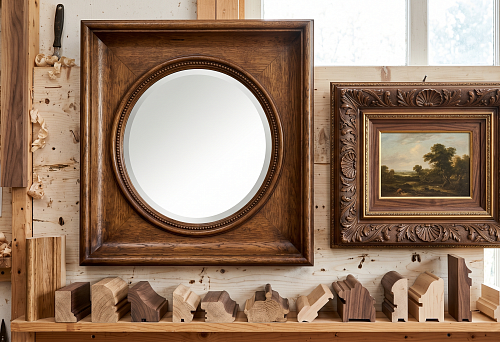
Wooden baguette is a decorative profile with an expressive shaped cross-section. It is used as a cornice, as a molding under the ceiling, as a frame for mirrors and doorways. Coordinated with wooden bars and slats in the interior, it creates a "palace" decor effect — even in a modestly sized room.
Wooden corner bracket — connecting element
Where wooden slats or bars meet at a 90° angle — internal or external corner — a wooden corner covers the joint. Without it, the corners look unfinished, technically incomplete. A wooden corner of the same wood species and finish is a small detail with a big visual impact.
Complete system of wooden interior
Ideal wooden interior from a systemic perspective:
-
Floor finishing: solid wood baseboard.
-
Walls: slatted panels made of wooden bars, decorative frames made of profiles.
-
Furniture: solid wood body on wooden legs with decorative overlays.
-
Transitions and joints: wooden corners and profiles.
-
Accent moldings: wooden baguette and baguette strip.
When all these elements are from the same species and in the same tone, the interior acquires a coherence that is hard to explain but impossible to miss.
Wooden block as a blank for furniture legs
From block to leg: a professional route
A furniture leg is not a standalone tree that grew in the desired shape. It is the result of precise processing of a square or rectangular block. Understanding this route helps in choosing the right blank.
What block is needed for a furniture leg
For a classic turned leg 150 mm high and 35–45 mm in diameter:
-
Initial block: 50×50×200 mm.
-
Wood species: beech or oak (for turned processing, a hard species is mandatory).
-
Moisture content: 8–10%.
-
Defects: zero — knots, cracks, and cross-grain will cause breakage during turning.
For a straight tapered leg in Scandinavian style:
-
Block 40×40×200 mm, planed, without deformations.
-
Wood species: beech, birch.
-
Processing: chamfer on edges with a router, final sanding.
Ready Buy furniture legs for a 200-room hotel project — this is not an ordinary deal, but a partnership requiring a special approach. — a faster solution than making it yourself from a block. But knowing the technology helps evaluate the quality of the finished leg: correct material, absence of defects, cleanliness of processing.
Overlay decor from a block
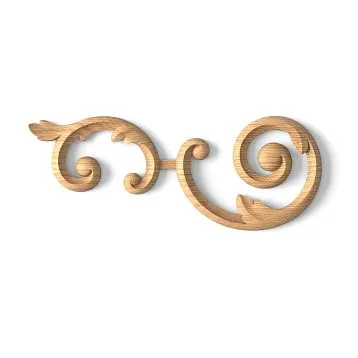
decorative elements for furniture — overlays, rosettes, cartouches — are made from small wooden blanks. A block 20×20 or 25×25 mm, 30×30 mm — small decorative elements for overlaying on facades are milled from it.
Wooden decoration for furniture — it is always a wooden blank processed by a router, lathe, or carver. And at the core — a correctly selected block of hardwood without defects.
Preparing a wooden block for work
Three stages that cannot be skipped
A purchased timber is not always ready for immediate use. Even planed timber requires several preparatory steps.
Acclimatization. Before work, the timber must stay in the room where the product will be used for at least 5–7 days. During this time, it absorbs or releases moisture until it reaches equilibrium with the room's air. Working with "non-acclimatized" timber leads to product deformations after assembly.
Sanding. Even planed timber has tool marks on the surface. Sanding with 120–150 grit along the grain removes these marks. Final sanding with 180–220 grit creates a surface ready for coating.
End cutting. Timbers are cut to length with a margin — so before assembly, the ends are cut strictly at 90° (or at the required angle). An uneven end creates a gap in the joint.
Coating wooden timber
Depending on the purpose:
-
Timber hidden in the structure: may not be coated. In living spaces, an antiseptic impregnation is sufficient.
-
Visible timber under enamel: primer + 2 coats of acrylic or alkyd enamel.
-
Visible timber under varnish: sanding — primer-varnish — sanding — finish varnish 1–2 coats.
-
Under oil or wax: degrease, apply oil in 1–2 coats, let it sit according to the manufacturer's instructions.
Common mistakes when choosing a wooden block
Mistake 1: Too soft a species for a load-bearing structure
A pine block 40×40 mm instead of beech or oak in a table leg is a saving that will backfire. A soft species under point load (e.g., a leg on a hard floor) causes dents and chips. For all load-bearing and visible elements — only hard species.
Mistake 2: Buying a damp block without acclimatization
A damp block looks great in the store. A month after assembly, the product deforms. Always check the moisture content. For furniture — 8–12%.
Mistake 3: Choosing only by price without considering the purpose
The "cheapest" block is often pine with high moisture, defects, and non-standard sawing. For rough construction work — acceptable. For furniture and interior decor — unacceptable.
Mistake 4: Incorrect cross-section under load
"I'll take a smaller block — more space." Insufficient cross-section of a load-bearing block risks sagging and failure. Don't skimp on the cross-section of structural elements.
Error 5: Ignoring surface treatment quality
A block with burrs, fuzz, or tool marks will give an uneven surface even after priming. For visible elements — only cleanly planed, sanded block.
Error 6: Inconsistency of wood species within a batch
Ordering a block as a "supplement" from another batch and expecting the same color after tinting is a typical mistake. Different batches of the same species can vary significantly in shade. Order the entire volume at once.
Error 7: Not considering the grain direction when sawing
Cross-grain — deviation of fibers from the longitudinal axis of the block — reduces strength and complicates processing. When purchasing, inspect the end: the fibers should run strictly along the axis.
Wooden block in furniture restoration
Precise replacement of damaged elements
Restoring antique furniture is a task requiring precise matching of original materials. If an old chair has a broken beech support leg — the replacement is made from a beech blank of the same cross-section. Mixing species even under the same paint is a path to visible differences after staining.
For restoration, small blocks of the required cross-section from a hardwood species are used. Before processing — comparison with the original fragment by wood color and texture density.
Replacement of internal frame elements
Old furniture often has a frame problem: it dries out, delaminates, and loses strength. Frame repair involves working with wooden blocks: old pieces are removed, new ones are cut to size and glued in with wood glue.
A wooden block as an investment in quality
Why solid wood is better than substitutes
The modern market offers many substitutes for natural wood: MDF, particleboard, wood-like plastic, laminated profiles. For some tasks, they are quite suitable. But a solid wood block is a fundamentally different material.
Strength. Solid wood of the same cross-section is significantly stronger than MDF in bending and compression.
Repairability. A scratch on a wooden block can be sanded and repainted. Damage to MDF or plastic often requires complete replacement of the element.
Durability. A properly treated wooden block made of beech or oak, under normal conditions, lasts for decades without losing its properties.
Eco-friendliness. Natural wood does not emit formaldehyde or other volatile compounds typical of board materials with synthetic binders.
Aesthetics. The natural texture of wood cannot be replicated by any substitute—neither film, print, nor plastic relief.
Where to buy wooden elements for furniture and decor
A single source for the entire wooden interior system
The smart approach is to purchase wooden bars, slats, moldings, legs, and decorative elements in one place. This ensures uniform wood species, a consistent finishing process, and coordinated dimensions.
Full catalog of wooden elements for furniture and interior:
-
Furniture and decor from solid wood — the complete range of wooden products.
-
Wooden plank — for slatted panels, shelving, and lathing.
-
solid wood millwork — glazing beads, trims, picture frame slats, moldings.
-
Wooden legs — furniture legs from solid wood.
-
decor for furniture — overlays, applied decor, rosettes.
-
Wooden baseboard — for floor decoration.
-
Wooden corner bracket — for finishing internal and external corners.
-
Flat wooden strip — for decorative frames and facades.
FAQ: popular questions about wooden bars
How does a wooden block differ from a batten?
A bar is a more massive element (cross-section from 20×20 mm and above) with a structural function. A strip is a thin linear element for decoration and finishing. The key difference: a bar bears load, a strip decorates.
Which bar to choose for a furniture frame?
Beech or oak, cross-section 40×40 mm (for light structures) or 50×50 mm (for loaded ones). Moisture content 8–12%. No knots or cracks in load-bearing areas.
Can pine bar be used for furniture?
For decorative elements and unloaded structures — yes. For load-bearing legs, table and cabinet frames — not recommended. Pine is soft and prone to deformation under load.
How to calculate the amount of timber for a slatted panel?
Calculate the total area of the panel. Determine the spacing between slats (e.g., 60 mm — 30 mm slat + 30 mm gap). Panel height ÷ spacing = number of slat rows. Row length × quantity = total linear footage. Add 10–15% reserve.
Do I need to treat the timber with an antiseptic?
For furniture in living areas with normal humidity — not necessary. For furniture in the bathroom, kitchen, hallway — antiseptic impregnation before painting will extend the service life many times over.
What glue should I use when assembling a wooden frame from timber?
PVA wood glue (for dry rooms) or polyurethane glue D3/D4 (for rooms with high humidity). Wood glue, when properly bonded, creates a joint stronger than the wood itself.
STAVROS: wooden blocks, slats, legs, and solid wood decor
wooden bar for furniture and decor — is simultaneously the simplest and the most demanding material to choose. Simple — because it is understandable to everyone. Demanding — because a mistake in species, size, or moisture content only becomes apparent in the finished product.
STAVROS produces and supplies Solid wood products — slats, legs, moldings, baseboards, decorative overlays, linear products — for professional carpenters, designers, restorers, and private customers throughout Russia. All products are made from hardwoods: beech, oak, birch — with precise geometry, clean surface treatment, and stable moisture content.
STAVROS is not just a catalog of wooden parts. It is a system where every element is coordinated with another: a leg fits a plate, a layout fits a baseboard, a rail fits a baguette. Because a good interior is built from details that know their place.