Article Contents:
- K-020 and K-029: the main difference in one minute
- What is a wooden baguette in furniture and interior finishing
- When to buy a thin baguette K-020 11 mm
- For a small furniture panel
- For a series of identical doors
- When the baguette should not dominate
- For updating existing furniture
- For a large interior door
- For a tall panel or cabinet front
- For a wall panel and niche
- For a portal and central composition
- For a Wardrobe
- For a Dresser
- For Kitchen
- For the sideboard and display case
- For a furniture panel
- Need to design a small cabinet door
- Need to design a tall floor-to-ceiling cabinet
- Need to add a frame to a chest of drawers
- Need to design one large interior door
- Need to replicate furniture decor on the wall
- Need to update an already painted facade
- Need to assemble many identical frames
- Need one central accent frame
- Select only by pattern
- Place K-020 on a too large empty surface
- Use K-029 on a small drawer
- Do not leave space for the handle
- Do not account for door opening
- Calculate only the clean perimeter
- Trim the entire set before trial assembly
- Mix different scales without hierarchy
- Order finishing before checking the sample
- Do not check the pattern direction
- Modern classicism
- Neoclassicism
- Art Deco and geometric interiors
- Country, Provence, and furniture with pronounced texture
- Minimalist interior with one decorative accent
- Commercial interior
- Which wooden baguette to buy for a furniture facade?
- How is K-020 different from K-029?
- What is a 11 mm wide baguette suitable for?
- Where to use a 100 mm wooden baguette?
- How to choose the baguette width for a cabinet?
- Will K-020 fit an interior door?
- Will K-029 be too wide for a furniture facade?
- How to calculate the amount of wooden baguette?
- What margin is needed when buying baguette by the meter?
- How to design the corners of a wooden frame?
- Can wooden baguette be painted together with the facade?
- How to combine baguette with furniture handles?
- Can wooden baguette be used on a wall panel?
- How to check the scale of the baguette before placing an order?
- Can K-020 and K-029 be combined in one interior?
- Is this baguette suitable for paintings?
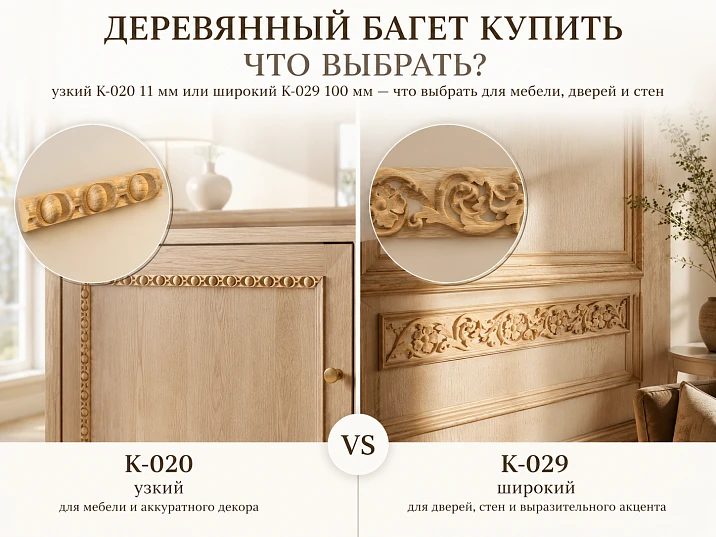
You can buy wooden baguettes for completely different tasks: draw a thin line around a small furniture panel, frame a cabinet door, assemble a noticeable frame on an interior door, or create a large framing for a wall panel. The main mistake begins when the profile is chosen only based on the ornament in the photo. The same pattern is perceived differently on a 400 mm wide facade and on a door leaf over two meters high. Therefore, this article compares two STAVROS solutions that are opposite in scale: the narrow K-020, 11 mm in size, and the wide K-029, 100 mm in size.
Wooden baguette K-020 11 mm works as a neat dividing line. It is suitable for small facades, panels, inserts, and repeating frames where the decor should support the shape of the furniture but not take all the attention. Wide wooden baguette K-029 100 mm, on the contrary, forms a noticeable architectural framing. It is chosen for large doors, tall facades, wall panels, niches, and compositions that should be clearly visible not only up close but also from the other end of the room.
The difference between 11 and 100 mm is almost tenfold, so these models cannot be perceived as two adjacent sizes of the same frame. K-020 can get lost on a large empty plane, while K-029 can overload a small drawer, leave too little free space, and conflict with the handle. The right choice depends on the scale of the base, the width of the free area, the number of frames, the placement of hardware, the direction of the ornament, and whether the frame should be a background or the main decorative element.
Below is a detailed breakdown of which wooden baguette to put in the cart for furniture, interior doors, or walls, how to check the width before ordering, how many linear meters will be needed, where to leave a margin, and how not to ruin the composition with the wrong scale. The article does not replace product cards: current options for material, length, delivery status, finish, and ordering should be checked directly before purchase. However, it helps to choose the right path in advance — thin K-020 or wide K-029.
Short answer.
K-020 is chosen when a thin decorative line is needed around a small panel, insert, or furniture facade. K-029 is suitable for large doors, wall panels, and compositions where the baguette should become a noticeable architectural framing. Before purchasing, compare the profile width with the surface size, mark the future frame with painter's tape, and calculate the total footage with a margin for cutting, corners, and pattern matching.
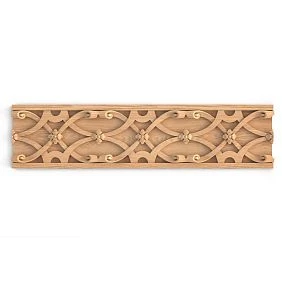
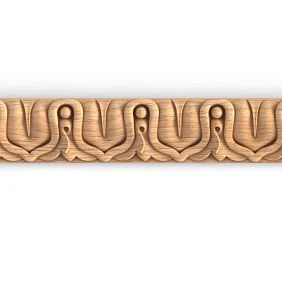
K-020 and K-029: the main difference in one minute
The visual role of K-020 is to define a border. The narrow profile can outline a panel, emphasize an insert, support a door rectangle, or create a repeating rhythm across several facades. It does not require a large free plane and coexists more easily with handles, locks, hinges, and other decorative details. Its strength lies not in massiveness, but in the precision of the line.
The role of K-029 is different. The wide profile does not just outline a surface, but creates an independent frame. On a large door or panel, it can change the perception of the entire plane: make it deeper, more expressive, closer to an architectural portal. But this effect requires space and proper proportions. If there is almost no free field left around the wide frame, the composition looks cramped.
The choice can be reduced to one question: should the frame merely support the surface or become its main element? For the first scenario, K-020 is usually suitable. For the second, K-029. If the answer is not obvious, there is no need to guess. Make two full-size templates with widths of 11 and 100 mm, apply them to the facade, and evaluate the result from a normal distance.
| Criterion | K-020 | K-029 |
|---|---|---|
| Profile size | 11 мм | 100 мм |
| Visual role | Thin decorative line | Large architectural framing |
| Suitable scale | Small facade, panel, insert, series of doors | Large door, tall panel, portal, big composition |
| Main risk | May get lost on a large empty plane | May overload a small facade |
| Proximity to hardware | Easier to leave space for handle and lock | Need to check free space in advance |
| Main question | Is a subtle accent enough? | Is a noticeable frame needed? |




What is a wooden baguette in furniture and interior trim
In this context, a wooden baguette is not just a material for a painting. It is a profiled molding used to assemble decorative lines and frames on furniture, doors, walls, panels, and niches. The profile is cut to size, aligned at corners, and placed on the surface to support its proportions. The result depends not only on the pattern itself but also on the width, side lengths, number of corners, distance to the edge, and neighboring elements.
A narrow baguette often works like a thin frame routing but remains a separate overlay piece. It allows adding relief to a smooth facade without completely reworking the structure. A wide profile is closer to independent architectural decor: it visually occupies a significant part of the panel, creates shadow, and can turn a simple panel into the center of the composition.
Molding is convenient because the frame length is tailored to a specific project. The buyer calculates the perimeter, the number of identical facades, and a cutting allowance. Therefore, the request "buy wooden baguette by the meter" is not about a single standard product but about calculating the required volume. An error in one measurement repeats across all parts if there are many frames.
Before ordering, it is important to distinguish three concepts: profile width, length of purchased molding, and final external frame size. K-020 and K-029 are compared precisely by profile scale — 11 and 100 mm. The length of each side of the future frame is determined separately for the facade or panel. The total requirement is the sum of all sides, accounting for cutting and pattern.
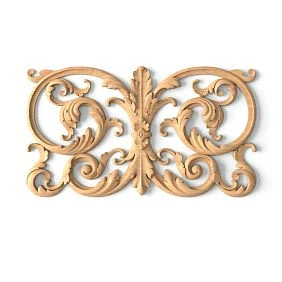
Our factory also produces:
When to buy thin baguette K-020 11 mm
Get Consultation
For a small furniture panel
Buy thin wooden baguette K-020 is worth it when the frame should neatly emphasize the inner field of the facade. The 11 mm width leaves more free space between the frame, edge, and handle. On a small door, such a line reads clearly enough but does not turn the entire facade into a heavy decorative panel.
A narrow profile is especially useful with multiple nested rectangles or repeating facades. If identical frames are on four, six, or eight doors, even a thin molding creates a noticeable rhythm. In this situation, a wide profile could make the row too dense, whereas K-020 maintains air between elements.
For a series of identical doors
In a kitchen, sideboard, or wardrobe, it's often not a single frame that matters, but repetition. A narrow profile helps carry a unified motif across different modules: a small door, a tall facade, and a drawer. The frame size changes, but the line thickness remains common. This makes the furniture look cohesive, and the decor doesn't conflict with the functional division of the body.
Before ordering, you need to check whether the margins are the same on all types of fronts. On a narrow drawer, the frame may require a smaller margin than on a door, but the visual logic must be maintained. It is better to lay out the entire group at once rather than approve K-020 based on a single sample.
When the molding should not dominate
K-020 is suitable for furniture that already has noticeable handles, carved overlays, glass inserts, expressive wood grain, or contrasting finishes. The thin line unites these details without creating another strong focal point. It can highlight the edge of glass, outline an insert, or support the shape of a handle.
On a front with active hardware, you need to check in advance the distance from the frame to the mounting points. Even a narrow molding should not go under the base of the handle or interfere with its grip. On the layout, it is useful to mark not only the profile itself but also the actual dimensions of all hardware.
For updating existing furniture
When remodeling a ready-made wardrobe or chest of drawers, K-020 is often safer in terms of scale. It requires less free surface and fits more easily between the edge, handle, and existing panel. But before installation, you still need to check the flatness of the front, the condition of the coating, and the possibility of neatly finishing the corners.
If the furniture is already painted, the finish of the molding is matched against a sample. You cannot assume that the same color name will ensure an exact match. Perception is influenced by the base, primer, gloss, and lighting. Sometimes it's wiser to make the frame deliberately contrasting than to try to achieve an almost matching but noticeably different shade.
When to buy the wide molding K-029 100 mm
For a large interior door
Buy wide carved baguette K-029 is suitable when the door leaf needs a noticeable composition that is readable at room scale. The 100 mm profile does not disappear on a tall surface and can form one large frame or several large symmetrical fields. Such decor requires a precise center, equal margins, and coordination with the architraves.
On a door, a wide frame affects not only decoration but also the balance of the leaf. Placement too close to the edges creates tightness, while too small an inner field makes the composition heavy. Therefore, before ordering K-029, you need to build the frame to full size and check it with the door both open and closed.
For a tall panel or cabinet front
A large built-in wardrobe sometimes looks like a solid wall. K-029 can turn individual doors into expressive panels, but it should be used selectively. If the wide frame is repeated on every narrow facade, the overall pattern may become too frequent. In that case, it is better to design one large central section or choose K-020 for repeating doors.
On a wide facade, K-029 is especially convincing when calm fields remain around it. The profile should not press against the edge, handle, or adjacent frame. The stronger the relief and the wider the line, the more visual space is required around it.
For a wall panel and niche
On a wall, K-029 works as an architectural framing. It can be used to highlight a panel, niche, large decorative insert, or an area that repeats the furniture design. The wide profile is well readable from a distance and creates a pronounced shadow. However, the base must be sufficiently level, and the corners carefully fitted.
K-029 should not be turned into a universal replacement for all wall moldings. Its strength lies precisely in a large scale. For a series of small frames on a limited wall, 100 mm may take up too much area. First, determine the number of fields and only then choose the width.
For the portal and central composition
A wide baguette suits a project where the frame should become the main decorative element: around a mirror, panel, doorway, or central insert. Here, K-029 is not hidden but emphasized with finish, relief, and chiaroscuro. It is important that adjacent details are calmer and do not compete with the frame.
If the interior already has a wide casing, high baseboard, or massive cornice, K-029 can be linked to them in scale and finish. But the match should not be mechanical. Before ordering, compare actual samples, room height, and the distance from which the composition will be perceived.
How to choose the width of the baguette relative to the facade
The profile width is evaluated not by itself but in relation to the free plane. For the frame, the external size of the facade, internal field, distance to the edge, handles, hinges, lock, and adjacent decor are important. If after placing K-029 around, only strips of a few centimeters remain, the wide framing may look cramped. If K-020 occupies a barely noticeable fraction of a large door, the line will be lost.
Start with the outer boundaries. Mark a safe indentation from the edge of the facade so that the frame does not intersect with the edge or fall into the fastening area. Then, mark the location of the handle. For long or large hardware, consider not only the base but also the space for fingers. The baguette should not make gripping uncomfortable.
The next step is the internal field. For K-020, it can remain quite large even on a compact door. K-029 noticeably reduces the internal area. On a small panel, this leads to a frame-without-content effect: the profile takes up almost all the space, and the central zone becomes cramped.
For testing, use paper or painter's tape. A strip 11 mm wide easily models K-020. For K-029, cut a strip 100 mm wide: a simple thin line will not convey the real scale. Assemble a whole frame, not just apply one piece. At corners and on long sides, the profile is perceived differently.
Look at the mockup from different distances. Up close, a thin relief reads more actively, but from another part of the room it may disappear. A wide profile up close seems especially massive, but on a large door from a distance it becomes proportional. Make decisions from the points where the furniture or door is usually visible.
If the project includes multiple surfaces, create a separate template for each group. A size suitable for a cabinet door does not necessarily fit a dresser drawer or wall panel. A unified style can be maintained through ornament and finish, without using the same width everywhere.
Wooden baguette for furniture: selection by facade type
For a cabinet
On a cabinet, molding can frame each door, only the central facades, or one accent section. For a row of narrow doors, K-020 is usually safer: it creates a repeating pattern and does not reduce the inner field too much. K-029 is suitable for wide and tall doors, where one large frame should be noticeable from a distance.
On paired doors, symmetry relative to the central gap is checked. The frames should be at the same height and have identical margins. If handles are located near the center, leave enough space between them and the baguette. Too close proximity complicates grip and visually merges the two details.
For a chest of drawers
A dresser consists of horizontal drawers, so the decor is repeated several times. K-020 helps emphasize each facade with a thin line. Even with a small profile width, a series of frames creates sufficient expressiveness. K-029 is only appropriate on large, tall, and wide drawers, where the profile does not take up most of the surface.
It should be considered that there are already horizontal gaps between the drawers. A wide frame adds several more strong lines and can make the facade too fragmented. Before ordering, evaluate the entire chest of drawers as a whole, not just one removed drawer.
For the kitchen
Molding for kitchen facades should match the modular grid, handles, countertop, and number of doors. In a small kitchen, many wide frames create visual density. K-020 allows maintaining decorativeness without overload. K-029 can be used on a tall cabinet, island, or separate display section as an accent.
Special attention is required near appliances and opening facades. The baguette should not interfere with hinges, adjacent doors, pull-out drawers, or handle operation. On corner modules, check the full opening angle. The decorative frame must remain intact and not fall into the area of regular contact.
For a sideboard and display cabinet
In a sideboard, the baguette often frames a glass insert. K-020 emphasizes the glass boundary and does not compete with dishes or internal lighting. K-029 can frame a large solid section or a massive display door, but its width requires sufficient area around the glass.
If a single item combines opaque and glass fronts, decide in advance whether the frame width will be the same. Sometimes K-020 on glass and K-029 on the central opaque panel create a reasonable hierarchy. But such a combination needs to be seen in the overall sketch.
For furniture panel
On a cabinet side panel, headboard, decorative backrest, or island wall, K-029 can work as a large frame. K-020 is suitable for fine division into several fields. Here it is especially important to consider the distance to the floor, countertop, and adjacent linear elements.
The panel is often visible at an angle, so the relief and profile thickness are perceived more strongly. The layout should be evaluated not only from the front. Check whether the baguette protrudes into the passage and does not create an inconvenient edge.
Wooden molding for an interior door
Wooden baguette for interior door are chosen considering the height of the door leaf, location of the handle, lock, and architraves. On a smooth door, you can assemble one large frame, two or three symmetrical panels, or a central composition. The number of fields directly affects the suitable width: the more frames, the more carefully you need to handle K-029.
K-020 is suitable for a fine pattern, especially if the door should remain light. Several narrow frames allow you to replicate the classic division of the leaf without a massive overlay. The profile can be matched in finish with the leaf, architraves, or other wooden details. The exact coating option should be verified with the product card and project.
K-029 is appropriate on a large door where one wide frame should be the main element. It works well on a tall leaf, in a spacious room, and next to expressive architraves. But if the door is narrow, a wide frame may leave too small a central field and visually reduce the passage.
Do not forget about the handle. On the door, it is in a constant working area, so free space should be left between the base of the hardware and the baguette. When opening, fingers should not touch the relief. Also check whether the baguette falls into the area of the lock and internal structural elements.
On a double door, the frames must mirror each other. Even a small difference in offsets is noticeable in the center. It is better to perform marking using a single template after checking the actual dimensions of both leaves.
If the door is already installed, evaluate the layout together with the architraves, baseboard, and wall. A wide K-029 may be proportional to the panel but conflict with a narrow architrave. A narrow K-020, on the other hand, can support the thin lines of the surroundings and look more natural.
Can K-020 and K-029 be used on a wall
Both models can be considered for decorative frames and panels if the specific card and base suit the project. But the article does not turn them into universal wall moldings. K-020 and K-029 are chosen when the wooden relief should connect the wall with furniture, doors, or other interior elements.
K-020 is suitable for several light frames, framing an insert, or repeating a thin furniture line. It leaves more free wall space and allows building a rhythm from several rectangles. In a small room, this scale is often perceived as calmer.
K-029 forms a large panel, niche, or central field. It requires sufficient wall space, a level base, and thoughtful placement relative to outlets, switches, furniture, and lighting. A wide frame must have a clear center and not intersect with random engineering elements.
If the wall decor repeats the frame on a door or cabinet, it is not necessary to use the same width. It is important to maintain the kinship of the ornament and finish, while adapting the scale to the surface. K-029 may work on the wall, while K-020 on furniture doors. Such a division creates hierarchy and does not overload small facades.
Before purchasing, outline the contours on the wall with painter's tape. For K-029, mark the full width of 100 mm, otherwise the future frame will appear visually heavier than the mockup. Check the composition in both daylight and artificial light: the relief shadow can significantly enhance the profile.
How to calculate the required footage
For a rectangular frame, a simple calculation basis is used: the frame length equals the sum of two heights and two widths. If the frame height is denoted as H and the width as W, the net perimeter is 2 × H + 2 × W. But you cannot buy exactly the resulting number without analyzing the cutting.
Basic formula: length of one rectangular frame = 2 × height + 2 × width. After that, add allowance for corner joints, test cut, pattern matching, possible rejection and part replacement.
For several identical facades, the net perimeter of one frame is multiplied by the quantity. Then a cutting map is made: which long and short sides can be obtained from the purchased elements. Sometimes the mathematical perimeter is sufficient, but the actual cutting leaves inconvenient remnants that cannot be used for the next side.
The allowance depends on the number of corners, the nature of the pattern and the master's experience. Introducing a universal percentage here is incorrect. One large frame with four corners requires one approach, while ten small ones require forty corners and more cuts. Carved ornament may require pattern matching, which reduces the usable length.
If you need choose a wooden baguette by the meter, first make a table of all frames. Specify the external or internal size, quantity, profile model and installation location. Do not mix facade and frame dimensions in one column: this is a common cause of error.
For K-029, accuracy of the external size is especially important, since a width of 100 mm significantly changes the internal field. Before calculating the footage, finally confirm the frame position. For K-020, an error of a few millimeters is also noticeable on repeated facades, but it has less impact on the center area.
After calculation, check if the entire volume can be ordered in one batch. For visible adjacent frames, this helps maintain consistency of material and subsequent finishing. The current length of elements, delivery options and ordering conditions should be clarified in the K-020 and K-029 cards or with the STAVROS manager.
How to design corners and joints
The corner is where errors in marking, cutting and ornament direction immediately become apparent. Before trimming, lay out the elements on a flat surface and determine how the pattern will approach each corner. For carved profiles, it is not enough to get geometrically accurate 45 degrees: it is desirable that the motifs do not break off randomly.
Start with a test corner on a separate piece. It shows the actual cutting line, wood behavior and alignment quality. Only after checking, trim the main set. If there are many frames, the sample becomes a reference for the rest.
K-020 requires high precision because the thin line emphasizes even a small stepped joint. K-029 is more difficult for another reason: the wide profile has a large corner joint area, and any mismatch in pattern or plane is more noticeable. It cannot be corrected only with final finishing.
For a series of small frames, predefine the ornament direction on each side. All verticals and horizontals must repeat consistently. If one piece is rotated, the pattern may run counter to the adjacent one or change direction in the middle of a furniture row.
One large frame is usually easier to evaluate as a whole composition, but long sides require a straight line and stable base. Several small frames increase the number of corners, patterns, and potential errors. Therefore, labor intensity calculation depends not only on the footage.
Before fastening, perform a dry assembly of the entire frame. Check the diagonals, outer dimensions, inner field, and alignment with the markings on the facade. If you fix individual sides immediately, the last piece may not close the contour.
How to choose a finish
The finish determines whether the molding blends with the base or stands out. The calmest option is enamel in the color of the facade or door. The relief remains noticeable due to light and shadow, but the color plane maintains integrity. This approach is especially convenient for K-029: the wide profile does not add another large shade.
Contrasting enamel turns the frame into a graphic element. K-020 creates a thin line, K-029 creates a wide color band. The stronger the contrast, the more carefully you need to check the width. What seems moderate in one color becomes significantly more active in another.
Tinting and preserving wood texture suit a project where the material should be visible. The molding can be tied to handles, countertops, trim, baseboards, or other wooden elements. But exact shade matching via screen cannot be guaranteed. A sample next to real surfaces is needed.
Patina emphasizes the relief but simultaneously enhances the ornament. On K-029, the effect will be more noticeable due to the width. On K-020, patina can make the thin profile more readable. The technology and permissible options cannot be invented: the delivery condition, material, and finishing possibilities must be checked in the specific product card.
If you want to buy unpainted wooden molding by the meter, first ensure that the selected configuration K-020 or K-029 is indeed supplied without a finish coating. Then coordinate surface preparation, primer, coating, and installation order. Do not finish the entire set until the test sample is approved.
For a door, the molding is often linked to architraves; for furniture, to the facade and handles; for a wall, to baseboards, cornices, or panels. It is not necessary to do everything in one color. More importantly, the finish should have a clear logic: background, contrast, or material repetition.
How not to confuse a wooden baguette with similar products
The word "baguette" refers to different products: picture frame profiles, furniture moldings, wall decor, and finished frames. Before ordering, you need to look not only at the name but also at the purpose of the specific item. K-020 and K-029 are compared as wooden moldings for framing furniture, doors, and interior surfaces.
If the task is to frame a piece of art, it is useful to study separately wooden picture molding. There, the image fit, glass, backing, and finished frame construction are important. A furniture frame solves a different task and is mounted on a facade or panel.
Carved molding is also not equal to flat trim. The relief affects the width, shadow, corner joint, and finish. A detailed explanation of the category can be found in the article about Molded wooden trim. The new article keeps a narrower question: which scale to choose between 11 and 100 mm.
You cannot replace a profile with a random strip just because its width is similar. The strip has a different relief, edge, visual role, and connection method. If a decorative pattern is needed, choose the confirmed card K-020 or K-029 and build the project around its actual profile.
Practical choice for specific situations
Need to frame a small cabinet door
Start with K-020. An 11 mm strip will leave room for the handle, edge, and inner field. Make a frame mockup and check if the line looks too thin from a distance. Consider K-029 only for an unusually wide facade and a large free field.
Need to frame a tall floor-to-ceiling cabinet
For one large door, you can consider K-029 if the frame should be noticeable. For a row of narrow doors, K-020 is usually more suitable. On the mockup, evaluate the entire cabinet, not just a single facade: repeating wide frames can create excessive density.
Need to add a frame to the dresser
K-020 is usually more rational because several horizontal drawers already form an active pattern. K-029 is suitable for a large central facade or one accent section. Make sure the baguette does not fall under the handle.
Need to design one large interior door
K-029 will help create an architectural frame, but requires coordination with the architraves and the height of the door leaf. K-020 is suitable for several thin panels and a lighter composition. On the full-size template, mark the handle and lock.
Need to repeat the furniture decor on the wall
It is not necessary to use one size. Thin K-020 can remain on the furniture, while wide K-029 can frame a large wall panel. The pattern and finish will create kinship. This approach preserves hierarchy.
Need to update an already painted facade
Check the surface condition, make a color sample, and determine if the profile can be carefully attached without damaging the coating. K-020 is easier to fit into a limited field. K-029 will require a large flat area and especially precise matching of the finish.
Need to assemble many identical frames
First, make one reference. After checking it, create templates for all facades. K-020 reduces the visual weight of repetitions, but an increased number of frames still requires precise marking. Calculate a margin for the number of corners, not just the total perimeter.
One central accent frame is needed
K-029 is more suitable for the task. It reads well from a distance and can become the main element of a panel, door, or cabinet. The surroundings should remain calm so that the wide relief does not conflict with handles and other decor.
What to view and select together
Buying a baguette starts with a specific card, but the project usually requires more information: calculation of footage, understanding of carved linear footage, choosing a scenario for a door, or comparing with a baguette for paintings. All links below lead only to confirmed STAVROS pages and help move from idea to precise order.
| What to open | Why | For which scenario | What to Check |
|---|---|---|---|
| Wooden baguette K-020 11 mm | Choose a thin decorative line | Panels, small facades, series of doors | Size, length, material, delivery condition |
| Wide wooden baguette K-029 100 mm | Assemble a large architectural framing | Door, panel, niche, portal | Free field and base proportions |
| buy wooden molding | Compare other category profiles | When K-020 and K-029 don't cover the task | Width, pattern, and purpose |
| wooden molding by the meter | Understand the calculation and purchase of length | Multiple frames and large order | Perimeter, cutting, and allowance |
| Decorating an interior door | Coordinate baguette with other door elements | Update or design a new door | Trims, handle, and number of fields |
Mistakes when buying a wooden baguette
Select only by pattern
Ornament matters, but width changes its impact. The same motif at 11 and 100 mm is perceived as elements of different strength. First, the scale is determined, then the pattern and finish.
Putting K-020 on a too large empty plane
A thin line may disappear on a tall door or large wall panel. The layout should be viewed from a distance. If the frame is not readable, choose K-029 or change the composition.
Using K-029 on a small drawer
A wide profile reduces the inner field and leaves little space for the handle. On a small front, it may look heavier than the furniture itself. The issue is checked with a full-size 100 mm strip.
Not leaving space for the handle
On the drawing, the handle is often marked with a dot, although its base and grip area take up more space. The molding should not interfere with fingers, fasteners, and hardware movement.
Do not account for door opening
The relief may end up next to an adjacent facade, wall, or cabinet. Check the full opening angle, especially on a corner kitchen and built-in wardrobe.
Calculate only the net perimeter
Four sides of the frame are not the entire order. You need allowance for corners, test cuts, pattern, and possible part replacement. For many small frames, allowance is usually more important than for one large one.
Trim the entire set before trial assembly
One mistake in the template will repeat on all facades. First, assemble a reference, check diagonals and alignment, then transfer dimensions.
Mixing different scales without hierarchy
K-020 and K-029 can be used in the same interior, but each must have a role. Narrow profile on repeating facades, wide on the main panel. Random alternation creates inconsistency.
Order finishing before checking the sample
Color and gloss change the visual strength of the frame. First, approve a test section next to the facade, handle, and trim, then finish the entire volume.
Not checking the pattern direction
The carved motif must flow consistently along the sides and repeat on adjacent frames. The direction is marked during layout, before cutting and fixing.
Who K-020 suits and who K-029 suits
| Situation | Selection | Why |
|---|---|---|
| Thin line on a furniture facade | K-020 | Leaves enough free field |
| Small panel | K-020 | Does not overload a compact surface |
| Series of identical doors | K-020 | Repetition itself creates a noticeable rhythm |
| Large interior door | K-029 | The wide frame reads in the scale of the panel |
| Large wall panel | K-029 | Creates an architectural frame |
| The scale is not yet clear | Make templates 11 and 100 mm | Full-size check is more reliable than a photo |
K-020 suits a buyer who wants to add relief without radically changing the facade, design several small fields, or save space for noticeable hardware. K-029 is aimed at large surfaces and projects where the frame should be the main element.
K-020 is not suitable if the line must be clearly visible on a large door from a distance. K-029 is not suitable for a small facade without sufficient margins. Both profiles require calculation of footage, checking of angles, and approval of finishing.
How to buy wooden baguette at STAVROS
First determine the scale. For a thin frame, open the card of the K-020 11 mm baguette. For a noticeable framing, open the card baguette K-029 100 mmCheck the actual specifications, material, length, delivery condition, and ordering options. Do not transfer parameters from one model to another.
Then make a full-size mockup on the actual facade, door, or wall. Mark not only the profile width but also all four sides, handle, lock, casing, and adjacent frames. After approving the external size, calculate the net perimeter and cutting plan.
If neither 11 nor 100 mm fit, go to the category where you can Buy wooden picture frame molding and compare other profiles. This is better than trying to force a too narrow or too wide model to work on an unsuitable surface.
Before final ordering, check the allowance for corners and pattern. For a large series of frames, agree on one reference. If the product is selected for ready-made furniture, door, or complex interior composition, it is better to clarify the actual parameters and compatibility with a STAVROS manager.
How to choose a baguette for the interior style
Modern Classic
In modern classics, frames are needed for order and proportions, but should not turn every facade into a heavy copy of a palace panel. K-020 helps to draw a thin line on cabinets, kitchen doors, and chests of drawers. It works well when the room already has paneled doors, high baseboards, or laconic moldings. The relief is readable, but the free planes remain noticeable.
K-029 is suitable for one or two main surfaces: a large interior door, central cabinet panel, portal, or wall insert. In modern classics, it is especially important not to repeat the wide profile on every small facade. It is better to create a hierarchy: thin frames support the furniture, a wide one emphasizes the main element.
Neoclassicism
A neoclassical interior allows for more pronounced symmetry and large scale. K-029 can become part of a tall door composition or wall panel, especially in a spacious room. But the width of 100 mm is still checked against casings, ceiling lines, and furniture dimensions. The wide frame should not seem randomly enlarged.
K-020 is suitable for repetitive facades where rhythm is important. Several identical thin frames create order and support classical geometry without overloading the surface. In one project, both profiles can work together if the wide one takes a central position and the narrow one is repeated on secondary elements.
Art Deco and geometric interiors
In interiors with graphic lines, K-020 can create a thin outline, especially with contrasting finishes. It suits facades with a clear grid, mirrored or colored inserts, and furniture where repetition is important. The narrow profile is easier to combine with prominent handles and metal details.
K-029 can be used as a wide border for a central panel, but its relief must be coordinated with other motifs. If the room already has many contrasting lines, a wide frame can make the composition overly active. Here, a full-size color mockup is especially useful, not just an outline.
Country, Provence, and furniture with pronounced texture
On furniture with noticeable wood texture or aged finishes, K-020 helps outline the panel and maintain surface calmness. The thin profile does not cover most of the material's pattern. It is suitable for sideboards, display cabinets, chests of drawers, and kitchen facades where small repeating details are important.
K-029 is suitable for a large door, headboard, or central panel if the wide carved frame is part of the intended image. But on a small piece, it may look too formal. Before choosing, compare the scale of the molding with the thickness of the countertop, height of legs, and size of handles.
Minimalist interior with one decorative accent
Minimalism does not exclude molding if it is used sparingly. K-020 can be painted in the color of the facade so that the relief is only revealed by light and shadow. This adds depth to smooth furniture without a strong ornamental effect. On a row of doors, the thin frame remains calm.
K-029 in a minimalist space works only as one large accent: for example, a frame around a panel or door. Other surfaces should be simple. Contrasting finish will enhance the profile, while painting it in the color of the wall or facade will make it an architectural rather than decorative-applied element.
Commercial interior
In a salon, restaurant, hotel, or showroom, the baguette should be clearly readable under different lighting conditions and withstand repeatability. K-020 is convenient for a series of furniture facades and display cases. K-029 is suitable for a central pillar, large door, decorative wall, or photo zone. For a commercial project, it is especially important to prepare a specification in advance, because an error in the template multiplies across dozens of elements.
When choosing, not only the appearance is considered, but also areas of regular contact. The frame near the handle, passage, or work surface should be positioned so that it is not bumped. The actual finishing and maintenance technology is coordinated with the real conditions of the room.
Preparing the base before installation
Even a correctly chosen baguette will not give a neat result on an unprepared surface. The base must be level, clean, and stable. On the facade, the plane, edges, and existing coating are checked. On the door, the geometry of the panel and the position of the hardware are checked. On the wall, local irregularities, cracks, and areas where the profile may not fit are checked.
Marking is applied only after the final approval of the external size of the frame. For a series of identical facades, a template is used that is tied to one base corner. If each element is measured anew from different edges, small errors will accumulate and the row of frames will be uneven.
K-020 requires a neat straight line: even a slight bend is noticeable on a narrow profile. K-029 places high demands on the overall plane, because a wide part cannot follow a sharp drop without a gap. The base is checked with a long ruler or template before finishing and installation.
If the surface is already painted, you need to understand whether it will withstand subsequent operations and the chosen method of fastening. You cannot assume that any baguette can simply be glued onto any coating. The specific installation technology is chosen based on the base material, delivery condition, and project requirements.
Before fixing, all elements are laid out on the surface dry. Check the diagonals, corners, distance to the handle, and free fields. For K-029, it is especially important to see how the wide frame looks together with the edge and adjacent facades. After fixing, it is no longer possible to change the width.
Storage and handling of linear elements before installation
Long elements must be stored so that they do not receive accidental bending, chipping, or contamination before cutting. Linear elements are placed on a flat support and protected from impacts. Do not lean long parts against a wall without support if this could lead to deformation or falling.
Before cutting, elements are sorted by visible sides and pattern. For adjacent frames, it is useful to pre-distribute parts that go better together. This preparation is especially important for transparent or semi-transparent finishes, when natural material differences remain visible.
After trimming, each part is marked: frame number, side, and direction. This prevents swapping similar elements. For ten identical facades without markings, it's easy to mix up sides, and a slight difference in length will only be discovered during final assembly.
Finished corners and finished surfaces are protected during transport. Wide K-029 has a large visible area, so an accidental mark is especially noticeable. Thin K-020 is easier to damage on the edge. Packaging is removed gradually, not from the entire set at once.
How to place an order for multiple facades
It's better to start a large order with a table. For each facade, specify the room, module number, external size, frame size, selected model, quantity, and finish. Separately note handles, glass inserts, and other constraints. Such a list allows you to see repeating sizes and prepare a rational cutting map.
Do not combine all frames only by total length. Two projects with the same total length may require different allowances: one large frame has four corners, while ten small ones have forty. Therefore, next to the length, indicate the number of corners and the length of each side.
For repetitive furniture, first order or manufacture a reference set, if the project schedule allows. After checking it, refine the template and only then start the entire volume. This approach reduces the risk of mass errors in offsets or corners.
When choosing between K-020 and K-029, create separate visual diagrams. A wide profile cannot be represented by a thin line on a drawing: its scale would be underestimated. The sketch should show the full width, inner field, and distance to the edge.
Before ordering, check the current product cards. The profile size is known from the SEO scheme, but lengths, materials, configuration, surface condition, lead times, and availability cannot be transferred from an old project or another model. These parameters are verified at the time of purchase.
How to match the baguette with handles, architraves, and baseboards
A frame rarely exists in isolation. On furniture, there is a handle nearby; on a door, an architrave; on a wall, a baseboard and cornice. To make the interior look cohesive, you need to determine which element is the main one. If the handle is large and expressive, K-020 often supports it better. If the hardware is restrained, K-029 can become the main accent.
Bagettes are linked to platbands by scale and finish. A wide K-029 next to a very thin platband may look disproportionate if a contrasting composition is not intended. K-020 more easily supports narrow lines. Full width matching is not necessary, but elements should belong to the same visual system.
The baseboard affects the lower part of the wall panel and door. The frame should not accidentally rest against it. If K-029 is positioned low, the distance to the baseboard is checked on a full-size layout. K-020 allows more breathing room, but repeated thin lines also require alignment.
Color connection can be direct or contrasting. A baguette in the color of the base appears embossed due to shadow. Repeating the color of handles, platbands, or baseboards makes the frame more noticeable. It is not necessary to automatically unify all elements with one shade: sometimes it is better to keep a neutral background and highlight only one group.
When it's better to choose a different profile
Sometimes the correct conclusion from comparison is neither K-020 nor K-029. If 11 mm is too thin and 100 mm is too wide, you should not choose a compromise only between these two products. In the wooden baguette category, you can look at other profiles and select an intermediate scale.
A different profile is needed when the ornament of K-020 or K-029 does not match the furniture, when the width leaves no convenient space for a handle, or when the frame conflicts with the platband. This is not a flaw of the models, but a sign that the specific surface requires a different solution.
You should also forgo the baguette if the base does not allow for clean geometry or if the chosen composition hinders usability. The decor should not cover hardware, impair opening, or create a protrusion in the walkway. First solve the functional task, then the decorative one.
An honest choice protects the buyer from expensive rework. It is better to go to the catalog and compare alternatives than to install K-020, which disappears on the door, or K-029, which takes up almost the entire facade.
Final project check before purchase
Before placing an order, it is useful to go through the project once more, not as a designer, but as an installer and user. First, check the dimensions of the base and make sure that the calculation specifies the frame, not the entire facade. Then compare the width of K-020 or K-029 with the free field. On the drawing, mark handles, locks, hinges, adjacent doors, sockets, and switches if it concerns a wall.
Next, check the quantity. For each frame, two heights and two widths should be known, and for a series, the number of repeats. Count the corners separately. This simple check often reveals that a project with a small total perimeter requires a large number of short pieces and complex cutting.
The third stage is the visual layout. A full-size frame made of paper or painter's tape should remain on the surface for at least a few hours so it can be evaluated under different lighting and from different angles. For K-029, it is especially important to see the full 100 mm strip. For K-020, you need to check whether the line disappears from a distance.
The fourth stage is finishing. Determine whether the baguette will match the base, contrast with it, or repeat another wooden element. Do not launch the entire set without an approved sample. Color, gloss, and emphasis on the relief can change the visual scale as much as the width itself.
The last stage is checking the product card. Before purchasing, confirm the current specifications, available length, material, delivery condition, and ordering terms. If at least one parameter is unclear, it is better to clarify it with a STAVROS manager before cutting, painting, and installation. This sequence turns the choice of baguette from a decorative guess into a manageable project.
FAQ: questions about K-020 and K-029
Which wooden baguette should I buy for a furniture facade?
For a small facade, panel, or series of doors, K-020 11 mm is often suitable. For a large, wide facade where a noticeable frame is needed, K-029 100 mm is considered. The decision is verified with a full-size template.
How does K-020 differ from K-029?
The main difference is the profile scale: 11 mm vs. 100 mm. K-020 creates a thin line, K-029 creates a wide architectural framing. Therefore, they are designed for different areas and compositions.
What is an 11 mm wide baguette suitable for?
For small furniture facades, panels, inserts, glass doors, and repeating frames where the decor should not dominate.
Where to use a wooden baguette measuring 100 mm?
On a large door, tall panel, wide facade, in a niche, portal, or central wall composition. There should be enough free space around the profile.
How to choose the width of a baguette for a cabinet?
Measure the facade, mark the edge, handle, and inner field. Then assemble templates with widths of 11 and 100 mm on the door. Evaluate the entire cabinet, not just one door.
Will K-020 fit an interior door?
Yes, if a thin frame or several light panels are needed. On a very large door, K-020 may not be noticeable enough, so the mockup is viewed from a distance.
Won't K-029 be too wide for a furniture facade?
It might be on a small facade. A width of 100 mm significantly reduces the central field. K-029 is better suited for large surfaces with sufficient margins.
How to calculate the amount of wooden baguette?
For one rectangular frame, add two heights and two widths. For multiple frames, multiply the result by the quantity, then add allowance for corners, test cuts, and pattern matching.
What margin is needed when buying baguette by the meter?
There is no universal percentage. It depends on the number of corners, side lengths, pattern repetition, and cutting layout. The more small frames, the more important a separate margin calculation is.
How to finish the corners of a wooden frame?
First, do the layout and a test corner, check the pattern direction and plane alignment. Then trim the main set and assemble the frame dry.
Can wooden baguette be painted together with the facade?
If the delivery condition and material of the selected model allow it, joint finishing helps match color and gloss. Exact possibilities should be checked in the product card.
How to combine baguette with furniture handles?
Leave a free zone for the base and handle grip. Thin K-020 coexists more easily with large hardware. For K-029, the handle position must be included in the layout from the start.
Can wooden baguette be used on a wall panel?
Yes, if the profile suits the project and base. K-020 is convenient for light frames, K-029 for a large panel or niche. Scale is checked with a tape in full size.
How to check the scale of the baguette before placing an order?
Make strips 11 and 100 mm wide, assemble them into full frames on the surface and view from different points in the room. This is more reliable than comparing by photo.
Can K-020 and K-029 be combined in one interior?
Yes, if there is a hierarchy. K-020 is used on small repeating facades, K-029 on the main door or panel. Commonality is supported by ornament and finish.
Is this baguette suitable for paintings?
For framing a painting, you need to separately check the frame construction and image fit. Furniture and interior moldings cannot automatically be considered ready-made baguettes for paintings.
Result: K-020 or K-029
K-020 and K-029 cannot be chosen as simply "small" and "large" options. These are two different composition tools. K-020, 11 mm in size, marks a border, supports a panel, repeats on a series of facades, and is easier to pair with handles. K-029, 100 mm in size, builds a noticeable frame for a large door, panel, niche, or central furniture section.
Before ordering, determine the role of the framing, make a full-size template, and check the free margins. Then calculate the linear footage along the perimeter, create a cutting map, and add a justified allowance for corners, test cuts, and pattern. Do not cut the entire set until one reference frame is tested.
If a thin line is needed, you can go to the product page and View wooden baguette K-020For a large architectural framing, study the wide baguette K-029. When neither scale fits, compare other options in the wooden baguette category.
STAVROS allows you to move from a general query "buy wooden baguette" to a specific product and precise calculation. A conscious choice of width protects against two opposite mistakes: a thin frame that disappears on a large surface, and a wide profile that overloads a small facade.