Article Contents:
- Where wooden carved patterns are used: complete application map
- Furniture facades: ornament as the face of furniture
- Doors: the ornament that welcomes
- Architraves: patterns that enliven the window
- House facade: ornament as an architectural tradition
- Walls and interior panels
- Mirror and Picture Frames
- Staircases
- Types of wooden ornaments: complete dictionary
- Floral ornament
- Geometric ornament
- Russian folk ornament
- Openwork wooden lace
- Symmetrical overlays and corner elements
- Wooden patterns for furniture: how to choose an ornament for the facade
- Ornament for a wardrobe
- Ornament for a chest of drawers
- Ornament for nightstands and cabinets
- Furniture ornament for painting
- Wooden patterns for facades and architraves: tradition under the open sky
- Architraves with ornament: the character of a house in one detail
- House carving: the language of the facade
- Wooden lace: openwork poetry of the facade
- Wooden ornament for interior: accents, panels, frames
- Accent wall with ornament
- Ornament above the fireplace
- Decorative frames with ornament
- Ornament in the study: seriousness through detail
- Staircase with ornament
- How to choose the size and scale of wooden ornament
- Small ornament: for furniture and details
- Medium ornament: for doors and interior panels
- Large ornament: for facades and large surfaces
- Elongated elements: for verticals and horizontals
- Corner and center elements: functional decor
- How to choose a carved ornament style: from classic to Russian house
- Classic: symmetry and floral motif
- Baroque: luxury and excess
- Neoclassicism: classic without excess
- Russian style: tradition as value
- Church decor: sacred austerity
- Modern interior with wooden accent
- Mistakes when choosing wooden carved patterns
- Mistake 1: Too small pattern on a large surface
- Mistake 2: Too large ornament on a small facade
- Mistake 3: Mixing different ornamental systems
- Mistake 4: No connection with other interior elements
- Mistake 5: Unsuitable material for facade use
- Mistake 6: Incorrect painting
- Mistake 7: Purchase without considering thickness and mounting method
- Where to buy wooden carved patterns and ornaments
- FAQ: answers to main questions about wooden carved patterns
- Where are wooden carved patterns used?
- Which wooden ornament should I choose for furniture?
- What are wooden lace patterns?
- Can wooden carved ornaments be painted?
- How to choose the size of the ornament?
- How does a floral ornament differ from a geometric one?
- How to combine wooden ornament with architraves and moldings?
- About the Company STAVROS
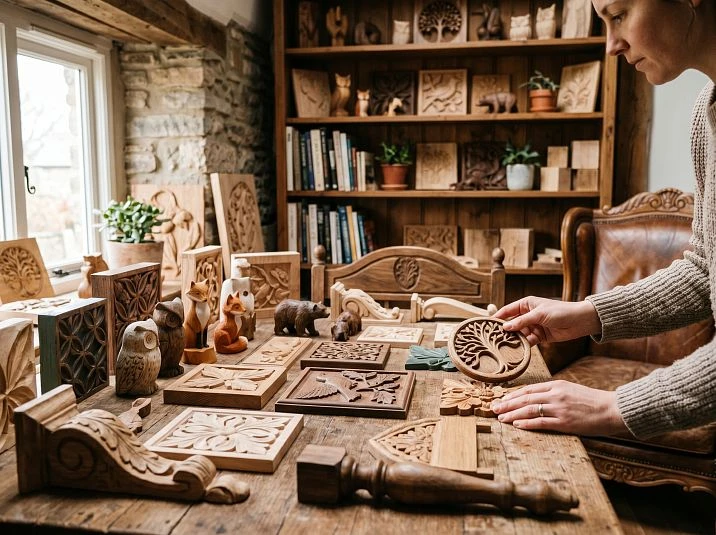
Today Carved wooden decoration is experiencing a true revival — and this is not nostalgia, but a conscious choice. Architects, designers, owners of country houses and apartments with classic interiors are returning to wooden ornamentation because it provides what no synthetic material can: living texture, natural depth, and the uniqueness of each relief element.
But choosing a carved wooden pattern is a task that requires understanding. Which ornament is suitable for furniture, and which is only for the facade? Why does a floral motif work in a classic interior, while a geometric one works in a country house with logs? How to choose the size of the overlay for a specific cabinet facade or door leaf? This article is a systematic and honest answer to all these questions.
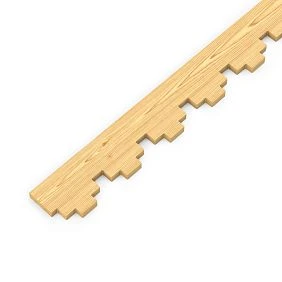
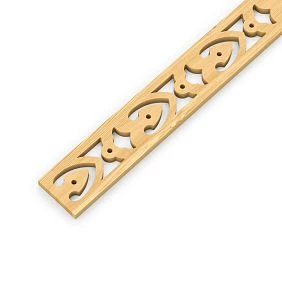
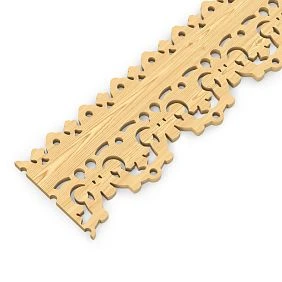
Where are wooden carved patterns used: a complete map of applications
Before talking about choosing an ornament, you need to understand where exactly it will live. Because the place of application determines everything: scale, style, depth of relief, method of fastening, and type of wood.




Furniture facades: ornament as the face of furniture
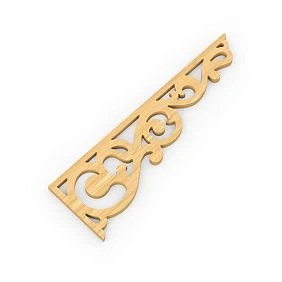
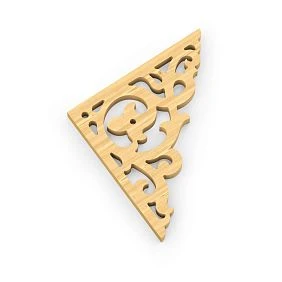
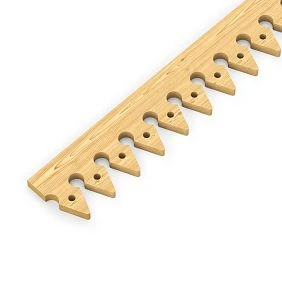
Cabinets, chests of drawers, nightstands, kitchen sets, sideboards, secretaries — a furniture facade without an ornament is one thing, with an ornament it is completely different. Decorative wooden inlays turn a serial smooth facade into a product with character: corner inserts around the perimeter, a central overlay in the form of a medallion or floral composition, an ornamental horizontal band.
It is furniture that is the most delicate context for a carved pattern. Scale is important here: the ornament must be proportionate to the facade, not overwhelm it, and not get lost.
Our factory also produces:
Doors: the ornament that greets
A door leaf is a large vertical surface that 'greets' a person at the entrance. Carved wooden ornament on the door: a central overlay in the upper third of the leaf, corner elements along the perimeter, an ornamental frieze in the lower part — all this creates the 'face' of the door, turning it from a functional element into an architectural gesture.
For classic interiors — floral and symmetrical ornaments. For doors in the Russian style — geometric and folk motifs.
Get Consultation
Window casings: patterns that bring the window to life
Carved window casings are one of the most recognizable elements of Russian wooden architecture. Wooden casings with ornamentation is not just a window frame, it is the home's calling card. The type of pattern on the casing sets the character for the entire facade.
Narrow carved inserts, an openwork upper frieze, side planks with a repeating floral motif — each of these elements creates its own image.
House facade: ornament as an architectural tradition
House Carving is an independent and extremely rich section of wooden decor. Facade patterns: gable boards, valances, through-cut carving along the cornice, figured brackets, applied rosettes — all of this creates a decorative image of a wooden house that cannot be confused with any other.
For a country house in Russian or Scandinavian style, house carving is not an option, but a necessity. It is what makes the house 'authentic'.
Walls and interior panels
wooden ornament in the interior can exist as an independent decorative element on the wall: a central panel above the fireplace, an ornamental insert in a pier, an accent pattern above the bed in the bedroom.
This is not a 'souvenir' or 'decoration' in the layman's sense — it is an architectural accent that fixes the semantic center of the space.
Frames for mirrors and pictures
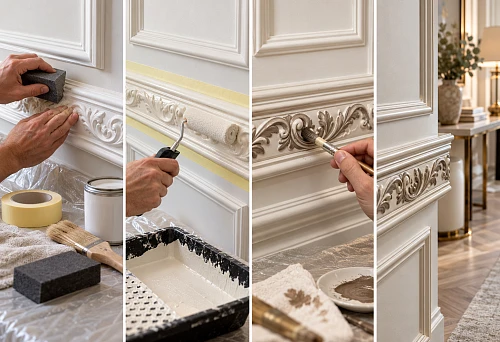
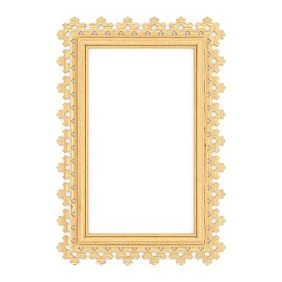
wooden frames with carved ornament — a natural continuation of the theme of wooden patterns in the interior. A frame with a floral ornament around the perimeter turns the mirror into a "work of art." This is an element that itself is a decorative object — regardless of what is reflected in it or what hangs on it.
Stairs
Wooden staircases are one of the most expressive areas for applying carved ornament. Balusters with figured carving, handrails with an ornamental belt, stair tread ends with a decorative chamfer — all this turns the staircase from a functional structure into an architectural object.
Types of wooden ornaments: a complete dictionary
Understanding the types of ornaments means knowing exactly what you are choosing, not just a "pretty picture."
Floral ornament
Floral ornament made of wood — the richest and most diverse type. It includes:
Acanthus — a classic motif of Greek and European architecture. Large, lush leaves with characteristic wavy edges. This is the "language" of classicism, baroque, renaissance. Acanthus is appropriate on furniture in a classic style, on cornices, on frames, on decorative capitals.
Grapevine — a winding stem with leaves, clusters, tendrils. A symbolically rich motif, widely used in church decor and in classic interiors. Works as a horizontal band or as a corner element.
Leaf rosette — a symmetrical floral or leaf composition, usually round in shape. Used as a central accent on a furniture facade, on a door, on a ceiling.
Bindweed, ivy, branches — lighter, airier motifs. Suitable for delicate overlays on small facades.
Floral garlands are horizontal ornamental bands with repeating floral motifs. A classic frieze for furniture and interior panels.
Geometric ornament
Geometric wooden patterns are mathematics turned into beauty. Diamonds, chevrons, triangles, meanders, weaves — all these motifs create rhythmic, perfectly symmetrical patterns.
Geometric ornament is appropriate:
-
In folk and rustic traditions — as the basis of Russian carved decor
-
In Art Deco — as a key decorative language
-
In Scandinavian country style
-
On facade elements of house carving
Geometry on a wooden surface creates a completely different mood than floral ornament: strict, rhythmic, laconic. This is a "masculine" type of ornament.
Russian folk ornament
Russian wooden ornament is a special world. Here geometric and floral motifs, zoomorphic elements (birds, fish), solar signs (wheels, spirals), and floral motifs intertwine.
Saw-cut carving with lace contours, blind carving with voluminous leaves, house carving with characteristic curls — all of this belongs to a living, continuous tradition that has a centuries-old history in Russia.
House Carving in the Russian style — this is not "ethnographics" for a museum, it is a real, living style for country houses, dachas, and wooden buildings, where the ornament carries both decorative and semantic meaning.
Openwork wooden lace
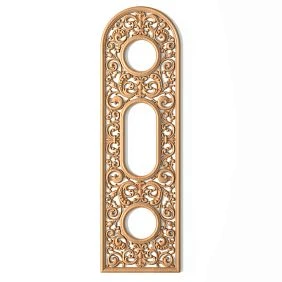
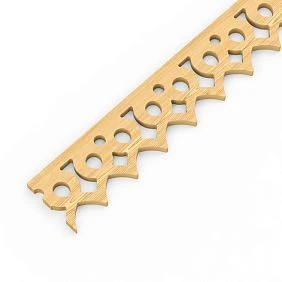
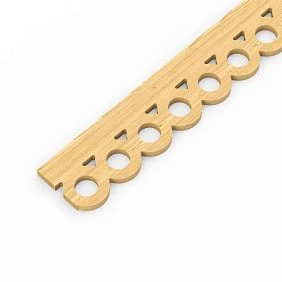
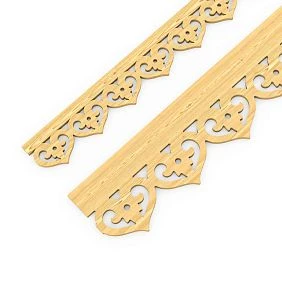
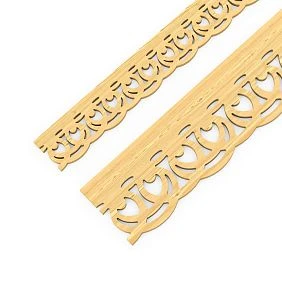
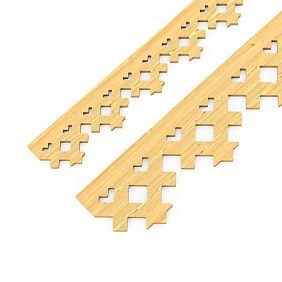
"Wooden lace" is the folk name for saw-cut carving: openwork patterns cut through a board. These are light, airy ornaments that create the effect of a lace ribbon on the facade.
Saw-cut lace is used on:
-
Prichelinas (end boards of the roof)
-
Podzors (horizontal openwork belts under the cornice)
-
Upper friezes of window casings
-
Decorative gables
This is exactly the type of ornament that makes a wooden house recognizable from a distance: an openwork silhouette against the sky — an image that is remembered forever.
Symmetrical overlays and corner elements
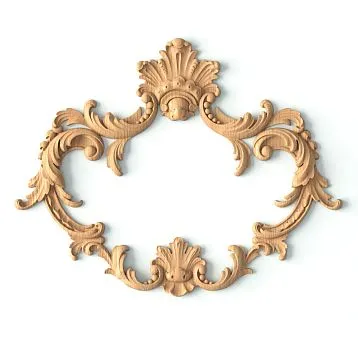
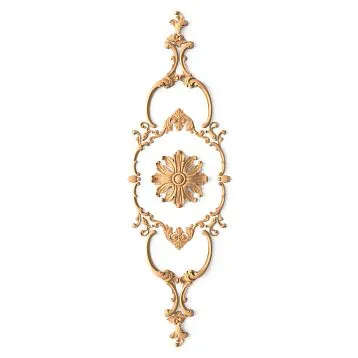
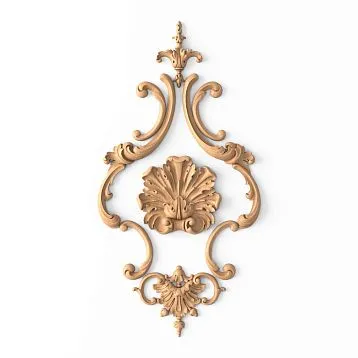
Symmetrical carved overlays are ready-made decorative elements that are mounted on the surface: in the center of the facade, at the corners of the frame, as a finishing touch for vertical molding.
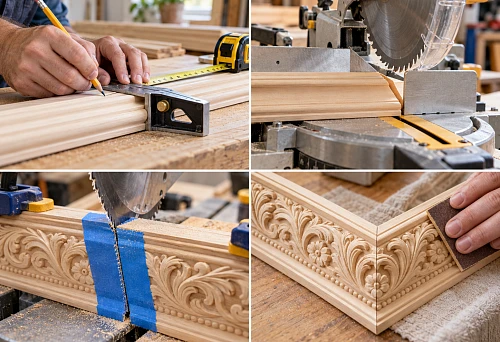
Corner elements are a special category: they work at the junctions of horizontal and vertical lines, "securing" the corners of a frame or molding border. Without corner overlays, a molding frame is just a 45° joint. With an overlay, it becomes a complete decorative element.
Wooden patterns for furniture: how to choose an ornament for the facade
Furniture decor is the most delicate work with ornament. It's easiest to make a mistake here, and it's here that the right choice yields the most impressive result.
Ornament for a wardrobe
A wardrobe is a large vertical facade. For a large wardrobe (section width from 40 cm), the following are appropriate:
-
Central overlay in the upper zone of the door — a medallion, rosette, vertical plant composition
-
Corner decorative elements on the four corners of the door
-
Horizontal ornamental band along the lower third
For a built-in sliding wardrobe with smooth sliding doors — frame moldings around the perimeter of each section + a decorative overlay in the center create a "classic wardrobe" without changing the fronts.
Furniture Decoration from Wood — overlay elements made of solid wood — mounted with glue and, if necessary, small finishing nails covered with putty.
Ornament for a chest of drawers
A chest of drawers is a horizontally oriented piece of furniture. Suitable for it:
-
Horizontal ornamental bands between drawers
-
Central overlays on each drawer (small — proportionate to the drawer front)
-
Decorative frieze along the top edge
Important nuance: the ornament on the chest of drawers should not "cover" the handles — everything must work systematically: handles, ornament, moldings, proportions.
Ornament for nightstands and cabinets
For small items — nightstands, bedside tables, consoles — the ornament should be the smallest and most delicate. One small corner insert or a thin horizontal overlay is enough. There is no need to overload a small front.
Furniture ornament for painting
If the furniture is planned to be white or painted, you can choose a smaller, more detailed pattern for the ornament: the paint will level out the tone difference between the base and the overlay, and the ornament is read solely by its relief. This is an "invisible" decor that creates texture, not a color accent.
For such a case, it is ideal decorative wooden overlay for painting: sanded surface, ready for priming and painting.
Wooden patterns for facades and trim: a tradition under the open sky
The facade is a special world. Here, the wooden ornament exists not in the protected space of the interior, but under the sky: sun, rain, wind, frost. The requirements for the material, coating, and type of carving are fundamentally different.
Trim with ornament: the character of the house in one detail
A carved trim is the face of a window. The trim reveals the character of the house: generous or restrained, folk or classic, traditional or avant-garde.
Wooden casings with ornament are:
With a sawn top frieze — an openwork "crown" above the window. The most recognizable type of Russian window casing. Creates a light, festive look.
With profiled side strips — vertical posts with a repeating pattern (floral, geometric). Create a rhythmic, strict decorative look.
With applied elements around the perimeter — ready-made ornamental overlays glued onto the casing surface. A simpler production option, but with proper selection, very expressive.
All elements for window casings must be made of hard, weather-resistant wood species and have a coating designed for outdoor use.
House carving: the language of the facade
House Carving — a system of decorative elements for a country wooden house. It includes:
Fascia boards — long patterned boards covering the ends of a log or timber gable. Sawn carving, floral or geometric pattern along the entire length.
Valance boards — horizontal openwork belts under the eaves. A "lace" border between the wall and the roof.
Ridge elements — decorative finishing of the roof ridge: shaped forms, ornamental overlays.
Facade brackets — decorative support elements under the roof overhang or balcony.
Wind boards are end decorative elements on the sides of the gable.
The entire system of house carving should belong to one ornamental language: folk, classical, Scandinavian. Mixing styles is the main mistake in facade decor.
Wooden lace: openwork poetry of the facade
Separately, let's talk about what is called wooden lace. This is fretwork carving — openwork patterns cut through a wooden board — which creates a light, airy, lace-like decorative ribbon.
Wooden lace is used where 'air' is needed in decor: under the roof overhang, along the perimeter of the veranda, in decorative arched openings. Unlike applied three-dimensional ornament, fretwork carving creates a silhouette against the light — and this is a completely special visual effect that works especially expressively in bright lighting.
Wooden ornament for interior: accents, panels, frames
In the interior, a wooden carved pattern exists on a different scale and with a different purpose than on the facade.
Accent wall with ornament
An accent wall is the main wall of a room that carries the primary visual focus. A wooden ornament on an accent wall can exist as:
-
Central decorative panel — one large symmetrical composition
-
System of ornamental overlays in a frame of wooden moldings
-
Decorative "niche" made of moldings and ornamental inserts in the corners
wooden ornament on the wall — it's not wallpaper with a print or a painting. It's an architectural element with volume and shadow that changes under different lighting.
Ornament above the fireplace
The fireplace area is a place that itself is the semantic center of the room. A wooden decorative pattern above the fireplace: a horizontal ornamental strip along the top edge of the portal, applied elements on the side pilasters, corner rosettes — all this turns the portal into an architectural object.
Decorative frames with ornament
wooden frames with carved ornament around the perimeter — an independent decorative object. In a classic interior, a mirror in a frame with acanthus ornament is not an "accessory", it is a full-fledged element of the room's architectural decoration.
A frame with ornament can be used not only for mirrors and paintings, but also as an independent wall object — a "frame without content" that organizes part of the wall.
Ornament in the study: seriousness through detail
In the study, wooden ornament creates an atmosphere of seriousness and solidity. Rich carving around the perimeter of bookshelves, an ornamental insert above the desk, a decorative panel on the cabinet door — in these details, respect for the space and what happens in it is evident.
Staircase with ornament
A wooden staircase with carved balusters, ornament on the ends of the steps, and handrails with a decorative belt is not just a functional structure. It is the first thing guests see when entering the house. The carving on the staircase sets the decorative tone for the entire interior space.
How to choose the size and scale of a wooden ornament
Scale is the most technical, but also the most important selection parameter. A beautiful ornament of the wrong size ruins everything.
Small ornament: for furniture and details
Overlays up to 50–80 mm on the largest side are furniture scale. Corner elements 40×40 mm, central overlays 60–80 mm — for drawers, nightstands, small doors.
Small ornament only works up close: it should be viewed from a distance of 50–150 cm. On a large wall or on the facade of a house, a small ornament simply disappears.
Medium ornament: for doors and interior panels
Elements 80–200 mm are a universal interior scale. They are well readable from a distance of 1.5–3 meters. Suitable for doors, accent walls, and framing openings.
Large ornament: for facades and large surfaces
Elements from 200 mm and above — facade and architectural scale. They are clearly readable from a distance of 5–10 meters. Suitable for platbands, house carving, large decorative panels on walls.
Elongated elements: for verticals and horizontals
Vertically elongated ornamental elements "stretch" the ceiling and create a rhythmic vertical accent. Used on doors, pilasters, side posts of platbands.
Horizontal friezes — ornamental bands repeating horizontally — organize the surface and create "levels" in the decor of a wall or furniture.
Corner and central elements: functional decor
Corner overlays perform a dual function: mask the joints of moldings and add a decorative accent in the corners of the frame. Central overlays — "anchor" the composition, creating a focal point in the center of the surface.
| Element type | Scale | Application |
|---|---|---|
| Corner (40–80 mm) | Furniture | Drawers, small doors, molding frames |
| Central medallion (80–150 mm) | Interior | Doors, cabinet fronts, accent walls |
| Horizontal frieze (100–200 mm) | Interior/facade | Furniture belts, architraves, molding belts |
| Openwork element (from 200 mm) | Facade | Gable boards, soffits, architraves |
| Large overlay (from 250 mm) | Architectural | Panel, fireplace portal, facade decor |
How to choose a carved ornament style: from classics to Russian house
Ornament style is what determines whether an element will feel 'native' or 'foreign' in a particular space.
Classics: symmetry and plant motifs
Classic ornament is symmetry, plant motifs, acanthus, rosettes, garlands. It is intended for classical and neoclassical interiors with high ceilings, stucco cornices, parquet flooring, classic furniture.
Carved wooden decoration in the classical style — it is not a replica of the past, it is a living language, relevant for any space where beauty expressed through form and proportions is valued.
Baroque: luxury and excess
Baroque ornament is lush, lively, asymmetrical in details while maintaining overall symmetry. There is a lot: many leaves, much movement, plenty of volume. This is a style for those who love decorative richness and are not afraid of 'too much'.
Baroque carved ornament on furniture, doors, decorative panels is a powerful decorative statement. It needs to be 'carried' — not only by furniture and finishes but also by the overall concept of the space.
Neoclassicism: classics without excess
Neoclassical ornament is calmer, drier, more geometric. Rosettes are clear, garlands are light, no lushness or excess. This is a style for modern interiors that want classical dignity without the heavy historical spirit.
Russian style: tradition as a value
For a country wooden house, Russian folk ornament is not just appropriate, it is the only organic choice. These are geometric diamonds and stars, floral rosettes, openwork lace, solar signs.
House Carving in the Russian style, this is a whole program of facade decor: from eaves boards to valances, from window casings to ridge finials. Together, it creates the image of a house that 'remembers' tradition.
Church decor: sacred austerity
Carved Decor for church use, it is strict, canonical, with floral and ornamental motifs permitted by church tradition. Grapevine, acanthus curls, geometric belts — all these are familiar elements of the church iconostasis, choir, and altar barrier.
Modern interior with a wooden accent
In a modern interior, wooden ornament works as a deliberate 'anti-minimalism'. One expressive overlay on a white wall, one frame with ornament above a neutral sofa, one decorative element on a smooth cabinet — that is enough. Restraint is important here: not a system, but a point accent.
Mistakes when choosing wooden carved patterns
Even experienced designers make these mistakes — especially when working with wooden ornament for the first time.
Mistake 1: Too small a pattern on a large surface
A 50 mm overlay on a 200×80 cm door leaf is visually nothing. From a distance of three meters, it simply cannot be read. The scale of the ornament must match the scale of the surface.
Mistake 2: Ornament too large for a small facade
The opposite mistake: a large 200 mm medallion on a dresser drawer that is 30 cm wide. The ornament "overwhelms" the facade, creating a sense of disproportion.
Mistake 3: Mixing different ornamental systems
Acanthus (classic) + folk geometric pattern + Art Deco chevron on one piece — these are three different languages that do not "speak" to each other. Choose one ornamental system and stick to it.
Mistake 4: No connection with other interior elements
An ornamental overlay on a cabinet that does not "rhyme" with wooden moldings the patterns on the walls or the profile of the architraves — a "foreign" element in the space. Everything should belong to one system.
Mistake 5: Unsuitable material for facade application
An interior overlay made of soft linden on an exterior architrave — after two to three years it will deform and crack. For facades, hard weather-resistant species are needed: oak, ash, larch.
Error 6: Incorrect painting
Oil paint on untreated wood will peel off. Acrylic without primer will apply unevenly. The correct technique: sanding → wood primer → two coats of finish paint.
Error 7: Buying without considering thickness and mounting method
A 10 mm thick overlay and a 3 mm thick overlay have completely different reliefs and different installation requirements. Thin overlays are attached exclusively with glue. Thicker, more voluminous elements require additional fastening.
Always clarify: element thickness, recommended installation method, compatibility with the base surface.
Where to buy wooden carved patterns and ornaments
It is better to buy wooden ornaments in specialized stores, where you can immediately see the full range and get advice on selection.
When choosing from a catalog:
-
Always look at the exact dimensions — not only the length, but also the width and height of the relief
-
Request information about the wood species and type of coating
-
Check the installation method
-
When ordering a large batch — request a sample before the main order
В catalog of wooden products you can find and select the entire range of carved decor: from furniture overlays to house carving, from moldings to decorative frames.
FAQ: answers to the main questions about wooden carved patterns
Where are wooden carved patterns used?
On furniture (cabinets, chests of drawers, doors, facades), on house facades (window casings, bargeboards, soffits), in interiors (accent walls, frames, doors, stairs, fireplace portals). The full range is in the you will find a variety of items capable of transforming any space and becoming the highlight of the interior..
Which wooden ornament to choose for furniture?
For furniture — compact overlays proportionate to the facade: corner elements 40–80 mm, central medallions 80–150 mm, horizontal bands. Ornament: floral for classic, geometric for folk and art deco style.
What are wooden lace patterns?
Wooden lace is a folk name for through-cut carving: openwork ornaments cut through a board. Used in house carving for decorating facades, window casings, cornices, and gables.
Can a carved wooden ornament be painted?
Yes. Technology: sanding → wood primer → painting. Use oil paints, acrylic enamels, as well as varnish, stain, or oil for an open texture.
How to choose the size of the ornament?
Based on surface scale: for furniture facades — up to 150 mm, for doors and interior panels — 80–250 mm, for facade decor — from 200 mm. The ornament should be readable from a typical viewing distance.
What is the difference between a floral ornament and a geometric one?
A floral ornament uses natural motifs (leaves, flowers, branches, vines). It is organic for classic, baroque, and church decor. A geometric ornament uses diamonds, chevrons, meanders, and weaves. It suits folk, Scandinavian, Art Deco styles, and country houses.
How to combine a wooden ornament with window casings and moldings?
All elements must belong to the same ornamental system. Wooden casings with a floral ornament + moldings with a floral frieze + furniture overlays with a similar ornament — a unified interior language.
About the company STAVROS
A wooden carved pattern is the solution. Not a random decoration, but a conscious choice in favor of natural material, handcrafted quality, and a decorative tradition that never goes out of style.
STAVROS offers a full range wooden carved decoration: wooden ornament, Decorative wooden inlays, house carving, wooden frames, Moldings and all the decorative Wooden trim — for furniture, interior, facade, and classic decor.
Choose an ornament with understanding. Buy from those who know wood. Work with STAVROS.