










































































Article Contents:
- Ready-made carved trims: not just decor, but a window frame
- Characteristics to check before purchasing
- Why ready-made trims are more convenient than custom-made
- What is included in the kit of carved trims for one window
- How to calculate the number of carved trims without unnecessary mistakes
- What determines the price of carved wooden trims
- Sizes and proportions: why you cannot choose a trim just by photo
- How to choose a carving style for a wooden house
- Material and finish: what is important to understand before ordering
- Ready-made carved trims STAVROS: which sections to look at
- How to combine trims with other facade elements
- Trims for wooden houses, cottages, and baths
- Carved trims in interiors and decorative areas
- When to choose carved trims and when to opt for a more subdued option
- Mistakes when buying ready-made carved trims
- How to approach purchasing on the STAVROS website
- Why a ready-made set is more profitable than a random set of elements
- Trims and facade appearance: how a detail changes the perception of a house
- How ready-made carved window trims differ from random counterparts
- How to use key differences between a simple and a fancy set
- The role of the top element in a window composition
- Why it's important to consider the color of the facade and windows
- Where to buy ready-made carved window trims
- Who should consider ready-made carved window trims
- Conclusion
- FAQ
- What is included in a set of carved trims for one window?
- Can you buy ready-made carved window trims instead of ordering custom-made ones?
- What does the price of carved wooden window trims depend on?
- How to know what size trims will fit my window?
- Are carved architraves only suitable for a wooden house?
- Can carved architraves be used for painting?
- Do I need to buy the top element for the side architraves?
- How are ready-made architraves more convenient than custom-made ones?
- What mistakes are most often made when buying carved architraves?
- Where to view STAVROS carved architraves for windows?
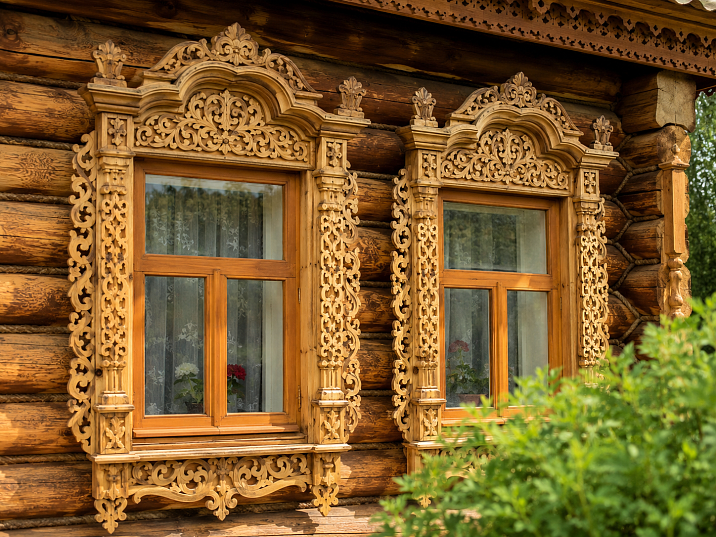
When you need to buy ready-made wooden carved architraves for windows, the price, dimensions, and kit composition become no less important than the carving pattern itself. An architrave on the facade works not as a random decorative strip, but as a window frame: it covers the transition between the opening and the wall, sets the rhythm of the facade, emphasizes the style of the house, and makes the window part of a cohesive architectural composition.
For a wooden house, bathhouse, dacha, or facade in the Russian style, a carved architrave often becomes the very detail by which the house is remembered. Without it, the window may look flat and unfinished, especially on a wooden facade where warm texture, volume, and handcrafted character are important. But choosing architraves should not be reduced to just a beautiful pattern in a photo. It is important to understand which elements are needed for one window, how the kit is calculated, what determines the price, and why ready-made products are convenient for a buyer who wants an expressive result without lengthy custom design.
In the STAVROS catalog, you can consider Carved casings STAVROS as a basis for framing a window opening. Such elements help assemble the facade neatly: the side parts support the vertical of the window, the top element completes the composition, and additional carved details make the framing more expressive. Therefore, the question of purchase here is broader than just "choose a strip." The buyer needs to understand how the architraves will look on a specific house, how many parts are needed, what parameters to check before ordering, and how not to compare the price of one part with the price of a full kit.


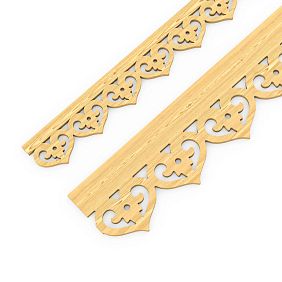
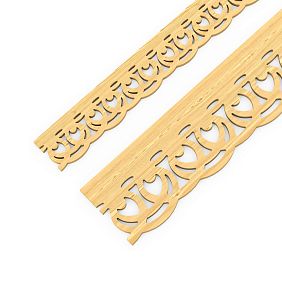


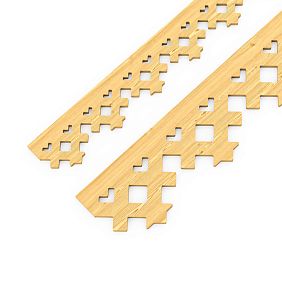
Ready-made carved window casings: not just decor, but a window frame
Carved window casings are decorative elements that frame the window opening and visually connect the window to the facade. In a wooden house, such a detail is especially noticeable because the facade itself is built on natural textures: board, timber, log, painted surface, warm wood tones. Carving adds rhythm, shadow, silhouette, and character to this base.
Ready-made carved window casings are convenient because the buyer sees the product in advance. You can evaluate the pattern, shape, proportions, choose a series, compare elements with each other, and imagine how they will work on the facade. This differs from a situation where the casing is fully ordered according to an individual sketch: there is more freedom, but also more uncertainty regarding deadlines, price, approval, and the final look.
For a home where it is important to quickly and clearly assemble window framing, ready-made elements are often more rational. They help to calculate the set for one window in advance, understand the overall budget, and avoid a situation where only side strips are purchased, but the top part, connecting elements, or decorative finish are not considered.
This is especially important for a facade with several windows. One casing may look beautiful on its own, but the house is perceived as a whole. If one window has large and expressive carving, while another has too small or stylistically different carving, the facade loses its coherence. Therefore, it is better to choose ready-made carved wooden casings not as a separate purchase, but as part of an overall facade system.




Characteristics to check before purchasing
To properly evaluate a carved window casing, it is important to look not only at the ornament. The final appearance is influenced by dimensions, material, thickness, element length, carving character, compatibility with other parts, and whether the selected product belongs to a larger group of house carving. These parameters help to understand whether the casing will look confident on the window or will turn out too small, heavy, narrow, or stylistically alien.
In the SEO plan for this topic, the main focus is on ready-made carved casings of the NL series, house carving, and STAVROS wooden elements. As a specific example, we can consider Carved architrave NL-14, and for selecting other options, the category of house carving and the section with wooden casings.
| Parameter | What is important for the buyer |
|---|---|
| Product type | Carved wooden window casing for window opening design |
| Main Scenario | Window framing on the facade of a wooden house, cottage, bathhouse, house in Russian style |
| Product focus | Ready-made carved window casings of the NL series and elements of house carving STAVROS |
| Product example | Carved window casing NL-14 |
| Material | The actual material of a specific product should be checked in the product card |
| Dimensions | Exact dimensions depend on the selected model and are specified in the product card |
| Finishing | Finishing and surface preparation options should be viewed in the product card or clarified with the STAVROS manager |
| Window set | Side elements, top part, possible finial, brackets, connecting and bottom elements are usually considered. |
| Compatible groups | House carving, wooden window trims, moldings, cornices, baseboards, carved decor |
| Where to look | Carved casings STAVROS и STAVROS house carving |
| What to clarify before ordering | Dimensions, material, coating, availability, configuration, possibility of combination with selected elements |
Such a table is not just for formality. It helps to quickly see where there is accurate data, and where the buyer should check the product card. In carved products, details are especially important: a few centimeters in width or height can change the perception of a window, and an unsuitable texture or finish can disrupt the overall style of the facade.
Our factory also produces:


Why ready-made window trims are more convenient than custom manufacturing
Ready-made carved window trims are good because they allow you to move from a clear product to a finished composition. The buyer does not start from a blank slate, does not try to explain an abstract drawing to the craftsman, and does not wait to see what the first sample will be like. He sees the shape, can compare several options, and select elements to match the scale of the house.
This is especially convenient when you need to decorate not just one window, but the entire facade. For several windows, repeatability is important: the same pattern, the same width, one rhythm, a unified logic of top and side elements. Ready-made window trims allow you to assemble a series so that the house looks cohesive, rather than like a set of disparate decorative solutions.
The price in this case also becomes clearer. When a buyer looks at ready-made carved wooden window trims, it is easier to buy ready-made products precisely because you can compare specific items. The final cost depends not on an abstract idea, but on the selected details: how many side elements are needed, which top element is used, whether a finial is added, whether brackets and a bottom decorative band are needed.
A ready-made element is easier to replace or supplement. If another window needs to be decorated in the future, finding similar decor will be easier than redoing an individual sketch. For houses that are built or finished in stages, this is an important advantage: the facade can be developed gradually without losing a unified style.
At the same time, a ready-made casing does not mean a simple or boring solution. In house carving, expressiveness comes not only from a unique pattern but also from the right combination of details. Even the same element can look different depending on the window width, facade color, top finish, wall proportions, and neighboring decor.
Get Consultation
What is included in the set of carved casings for one window
The main mistake when buying is to perceive the casing as a single plank. In fact, window framing usually consists of several parts. Even a minimal set should cover the sides and top of the opening, and a decorative facade often requires a more complex composition.
| Element | What it is for | When it is especially important |
|---|---|---|
| Side trims | Frame the vertical sides of the window, cover the transition between the opening and the facade | Almost always needed because they set the main frame |
| Top element | Completes the window from above, connects the side parts into a single composition | Important for a neat and finished look |
| Finial | Makes the top of the window more expressive, enhances the Russian style | Suitable for facades where a noticeable decorative accent is needed |
| Brackets | Add volume, support the upper part, complicate the silhouette | Appropriate on more ornate facades and large windows |
| Connecting elements | Help to connect details together and cover transitions | Needed for complex compositions or when selecting several types of decor |
| Bottom element | Completes the window from below, supports the symmetry of the framing | Used for the project, especially when it's important to frame the opening on all sides |
| Associated trim | Can complement the facade and connect windows with other lines of the house | Useful if the design extends beyond a single window |
A minimal set can be restrained, but it must look complete. If you take only side elements, the window often seems unfinished: there are verticals, but the top part is not supported. If you add a top element, a frame appears. If the composition includes a pediment and brackets, the window becomes the decorative center of the facade.
Here it's important to consider the style of the house. For a small country house, an overly complex pediment may look heavy. For a large wooden house, on the contrary, narrow and simple elements sometimes get lost on the facade. Therefore, the set should be assembled not on the principle of 'the more details, the better,' but according to the proportions of the specific window and the overall architecture.
How to calculate the number of carved window casings without unnecessary mistakes
Calculating the set starts with understanding the window opening. The buyer needs to know the height and width of the window, the width of the visible framing, the distance to the corners of the facade, slopes, the sill area, and neighboring architectural elements. The casing should not conflict with the house's structure: it should cover necessary transitions but not interfere with the opening of sashes, slope finishing, and other details.
If there is one window, the task seems simple. But even here, you need to determine in advance whether the framing will be only on the sides and top or around the entire opening. For multiple windows, another important point arises: all sets must be calculated identically, otherwise the facade will look random. Differences in height, width, or top finish can be noticeable even from a distance.
When a buyer searches for carved wooden window casings to buy ready-made at a price, they often want to quickly understand the total cost. But the price of one part and the price of a set for a window are different things. One side plank does not show the overall budget. For an honest calculation, you need to consider all elements that form the composition: side casings, the top part, possible brackets, pediment, connecting and bottom parts.
It is also better to plan a small margin in length and trimming in advance if this is related to installation specifics. Precise technical solutions depend on the specific house, foundation, chosen product, and installation method, so before ordering, it is useful to check the parameters against the product card and, if necessary, discuss the set with a STAVROS manager.
What determines the price of carved wooden window trims
The price of carved window trims consists of several factors. The most obvious is the size of the product. The larger the element, the more material and processing are required. But size is not the only parameter. The cost is influenced by the complexity of the carving, the depth of the pattern, the length of the plank, thickness, series, material, surface preparation, and the number of parts in the set.
Therefore, the request 'carved wooden window trims price buy ready-made' cannot be evaluated only by the cost of one item. For the buyer, the final price of window decoration is more important. If one window is assembled from two side trims and a top plank, that is one configuration. If a top piece, brackets, and a bottom decorative element are added, the set becomes richer, but the cost also changes.
There is another important point: a large facade often requires more expressive decor. On a small window, a light ornament may look neat, but on a large house, it will get lost. In such a case, purchasing more noticeable elements is justified not by luxury, but by proportion. The decor should be visible but should not overload the facade.
The coating and preparation for finishing can also influence the final choice. If the trim is selected for painting, it is important to understand how the product will combine with the color of the facade, window frame, and other wooden details. Current options for material, finish, availability, and price are best checked in the product card of the specific item on the STAVROS website.
Dimensions and proportions: why you cannot choose a trim only by photo
A photo helps to evaluate the pattern but does not always show the scale. A carved element in close-up may look impressive, but on the facade, it may turn out to be too narrow. The opposite situation also happens: the buyer likes an expressive top piece, but on a small window, it looks heavy and draws too much attention.
Proportions are especially important for a wooden house. A facade made of timber, logs, or painted boards has its own rhythm. The horizontal lines of the logs, window width, wall height, cornice projections, and finish color already create an architectural pattern. The trim should fit into this pattern, not argue with it.
For small windows, neat side elements and a calm top part often work better. For tall windows, you can consider a more elongated vertical and a noticeable top accent. For facades in the Russian style, more expressive carved details are appropriate, especially if the house itself has a traditional look.
When choosing sizes, you should consider not only the window but also the distance between windows. If the openings are close together, too wide architraves can visually "collide" with each other. If the windows are far apart on a large wall, too narrow a frame will look timid. That is why it is better to select ready-made carved architraves not in isolation, but taking into account the entire facade.
How to choose a carving style for a wooden house
Carving varies in character. Some elements look light and airy, others are denser and more architectural. Some are suitable for an expressive Russian facade, others fit more calmly into a modern house with wooden trim. Before purchasing, it is important to understand what image the house should have after the windows are decorated.
For a traditional-style wooden house, architraves with a noticeable silhouette work well. Here, the carving can support the image of house carving, create shadow on the facade, and make the window more elegant. Such elements look especially expressive when the upper part does not end with a simple strip but receives a decorative finish.
For a country house, a lighter solution is often chosen. A country house does not always require complex carving on every window. Sometimes, neat side architraves and a moderate top element are enough to make the facade warmer and livelier. This approach does not overload the house but adds individuality.
For a bathhouse, not only decorativeness is important, but also a feeling of strength. Here, wooden decor without excessive fragility in appearance looks good. The architrave should support the natural character of the building, especially if the facade is made of wood or painted in natural shades.
For a modern facade, you can choose a calmer ornament. Even a carved architrave can look restrained if the pattern does not conflict with the geometry of the house. In this case, the decorative detail works more subtly: it does not turn the facade into a historical stylization but adds depth and a handcrafted character.
Material and finish: what is important to understand before ordering
Carved wooden architraves are valued for their natural texture and ability to work well on the facade of a wooden house. Wood feels warmer than artificial imitation, and carving on a wooden detail creates a lively play of light and shadow. But the material should always be clarified for a specific item, because different products may have different characteristics.
If the buyer plans to paint the architraves, it is important to understand in advance the future color of the facade and window frames. A light architrave on a dark facade will become a noticeable accent. Tone-on-tone with the facade will give a calmer, more cohesive look. A contrasting option will emphasize the shape of the carving but will require careful combination with other details of the house.
The finish affects not only the appearance but also the perception of the carving. A dense opaque coating makes the silhouette cleaner and more graphic. Semi-transparent compounds can emphasize the wood texture if this is intended by the chosen material and treatment. A protective coating is especially important for facade use because the outdoor environment requires careful attention to ends, joints, and surfaces.
At the same time, you should not invent the finish in advance without checking the product card. It is better to view current options for material, surface preparation, and coating on the STAVROS website or clarify with a manager. This helps avoid mistakes when a buyer expects one type of finish, but the selected product is supplied with a different preparation.
Ready-made carved architraves STAVROS: which sections to look at
To select a window frame, it is logical to start with the section where Carved casings STAVROS. Here the buyer can consider ready-made elements precisely as the basis for a future window kit.
If a broader selection of facade wooden details is needed, it is worth looking at STAVROS house carving. This section is useful when you want to decorate not only one window but the entire facade: add top elements, select decorative details, and connect the window frame with other parts of the house.
For calmer options, you can consider Wooden casings. They are appropriate where what is needed is not so much a bright carved accent but a neat wooden frame around the opening or a connection with interior trim.
If the facade design involves additional lines, you can combine window decor with solid wood moldings, cornices, and baseboards. This approach helps avoid leaving trim as the only decorative element, instead supporting them with other details in the same wooden logic.
For more expressive tasks, the section STAVROS carved decor. It helps expand the composition if the house, interior, or facade requires not only window framing but also additional decorative accents.
How to combine trim with other facade elements
Carved trim rarely lives alone on the facade. Even if the buyer only decorates windows, there are already other elements around them: house corners, cornice, base, window sill area, gable, door, porch. The more expressive the trim, the more important it is to support them with a common decorative logic.
If the facade has a wooden cornice, the carved window top should relate to its line. If the house has simple geometry, an overly complex set of details may look separate from the architecture. If the house is built in a traditional style, a modest trim may not unlock the facade's potential.
The principle of repetition works well. One carving motif can appear on several windows. Similar proportions can be used in the upper elements. A common finish color ties different details into one system. Even if the products are not completely identical, they should speak the same visual language.
For the entrance area, more expressive decor can be used than on the side facades. Windows near the porch are often perceived as closer, so the carving there is more noticeable. On distant facades, a calmer framing can be left if it does not disrupt the overall look of the house.
Trim for wooden house, cottage, and bathhouse
In a wooden house, carved window frames are especially natural. They support the facade material and add architectural expressiveness without feeling alien. Even a simple house with straight walls begins to look more cohesive after installing window frames: the windows get a frame, the facade gets rhythm, and the entire building gets character.
At a dacha, such elements help move away from the feeling of a temporary or overly simple building. A dacha house is often built without complex architecture, so window trim takes on the decorative role. Massive details are not always needed here. Sometimes it is enough to choose ready-made carved window frames with a moderate pattern to make the house warmer and more expressive.
For a bathhouse, window frames work a bit differently. They emphasize the wooden nature of the building, make the facade cozier, and visually connect the windows with the overall appearance. In a bathhouse, it is especially important not to overload the decor if the building itself is small. It is better to choose elements that support the form but do not seem too ornate for a practical building.
If the house is painted, window frames can become a contrasting accent. White carving on a dark facade looks graphic and traditional. Warm wood tones give a softer effect. A color matching the facade makes the framing calmer but preserves volume through carving and shadow.
Carved window frames in interiors and decorative areas
Although the main topic is related to windows of a wooden house, carved window frames can also be interesting in interior tasks if it suits the project. Inside the house, such elements help decorate decorative openings, wall panels, areas around mirrors, niches, or door groups. But interior use requires different caution: indoors, the detail is perceived closer, so overly large carving may look heavy.
In the living room, carved wooden decor can support classic furniture, a fireplace area, wooden panels, or a composition around a window. In the bedroom, it should be softer and calmer to avoid overloading the space. In the hallway, window frames can emphasize the entrance group or connect doors with wooden trim. In a study, a carved element adds intimacy and solidity, especially if wood is already present in the interior.
In commercial spaces, carved window frames can be used in restaurants, salons, showrooms, hotels, and guest houses where image is important. For example, an interior in Russian style, a country restaurant, or a bathhouse complex often benefits from wooden details. They create atmosphere not through random decor but through architectural elements that look integrated into the space.
For interior use, it is especially important to check the dimensions. What seems normal on the facade may be too active inside. Therefore, before purchasing, it is worth imagining the distance from which a person will look at the detail and what materials are nearby.
When it is better to choose carved window frames, and when a calmer option is preferable
Carved window frames are not suitable for all houses equally. They are especially appropriate where the facade needs expressiveness, a warm wooden character, a connection to Russian architectural tradition, or a more elegant window design. If the house is built in the style of a dacha, bathhouse, country wooden house, or guest complex, such elements can become a natural extension of the architecture.
If the facade is very minimalist, with large glass planes and strict lines, the carving should be chosen carefully. In this case, it is better to consider calmer elements or wooden frames without overly active ornamentation. Otherwise, the window will start to conflict with the architecture, and the decor will look like it was added after the project was completed.
Carved window frames should be chosen when the buyer wants to emphasize the windows, make the facade warmer, support the wooden texture, and bring the house together into a more finished look. They are especially useful if the windows currently look flat or the transition between the opening and the facade seems rough.
Another option is better to consider if the house is already overloaded with decorative details, if the windows are located too close to each other, or if the facade requires a maximally calm design. In such cases, you can look not only at carved elements but also at more laconic wooden frames, moldings, or STAVROS millwork.
Mistakes when buying ready-made carved window frames
The first mistake is choosing only based on a beautiful photo. The carving in the image may look impressive, but without understanding the dimensions, it is difficult to imagine it on the actual facade. The frame must match the height and width of the window, the distance to neighboring elements, and the scale of the wall.
The second mistake is buying one piece instead of a set. A system is important for window framing. If only side elements are purchased and the top part is not thought out, the window may look unfinished. If there is a top element but connecting parts are missing, the composition may turn out rough.
The third mistake is comparing the price of one strip with the price of window framing. The buyer sees the cost of an individual product and thinks they already understand the budget. But one window may require several elements. Therefore, it is better to consider the price through a complete set.
The fourth mistake is not considering the style of the house. The same carved window frame can look great on a wooden dacha and strange on a strict modern facade. The ornament should support the architecture, not conflict with it.
The fifth mistake is forgetting about the finish. The frame may be beautiful in shape, but the color and coating matter a lot. If the finish does not match the facade, even high-quality carving will look random.
The sixth mistake is not checking the product card. Sizes, material, availability, finish, and order conditions may differ for different items. Without checking, it's easy to expect something that isn't in the selected position.
The seventh mistake is not thinking about installation. The trim must fit the base, slopes, and window structure. The specific installation method depends on the house and the chosen product, so it's better to discuss technical details with a specialist in advance.
The eighth mistake is mixing different carving styles without a unifying idea. If the side elements, top finish, and additional details look like parts of different facades, the window loses harmony. It's better to assemble a calmer set but in a single style.
How to approach a purchase on the STAVROS website
It's better to start the purchase by choosing the main group of products. If the task is specifically carved window frames, it's logical to look at ready-made carved window trims STAVROS. If you need to expand the facade design, it's worth exploring house carving and related wooden elements.
In the product card, it's important to check the dimensions, material, appearance, available options, availability, and order conditions. If the product is being selected for an existing facade, it's better to know the color scheme, window opening width, and desired set composition in advance. For multiple windows, it's useful to calculate the total volume at once to avoid selecting elements one by one and ending up with differences in batch or style.
If the buyer is unsure between several options, it's worth comparing not only the pattern but also the silhouette. On the facade, the overall shape is most noticeable: the width of the plank, the top finish, protruding details, and the rhythm of the carving. Fine ornament is visible up close, but from a distance, it's the silhouette that works.
For complex compositions, it's better to check compatibility with a STAVROS manager. This is especially important if you plan to add brackets, finials, connecting elements, or other carved decor to the trim. A well-assembled set looks as if it was designed as a whole, not pieced together from random parts.
Why a ready-made set is more advantageous than a random collection of elements
Ready-made carved trim reveals its full potential when the customer thinks in terms of a set. A window is not just a separate vertical line or a single beautiful top element. It's a composition where the sides, top, possible finial, and additional details must be connected.
A set-based approach helps avoid unnecessary purchases. By understanding in advance which elements are truly needed, you can avoid buying parts that will be superfluous. Conversely, you won't have to return to the order due to a missing top element or connecting piece.
This approach helps estimate the price more accurately. The final budget is formed not from the impression of a single product card, but from a clear set of items for one window. For a house with multiple windows, this is especially important: a small calculation error multiplies by the number of openings.
A set also makes the facade calmer. When elements are chosen in a unified logic, the house looks more expensive and neater, not because of the amount of carving, but due to the consistency of details. This is the power of wooden decor: it works not on its own, but within the overall architecture of the house.
Trim and facade appearance: how a detail changes the perception of a house
Windows always attract attention. A person looks at the facade and almost immediately notices window openings because they break the wall plane and create rhythm. If windows are poorly or carelessly framed, the entire facade seems unfinished. If the openings are well-framed, the house looks cohesive.
Carved trim adds depth to the facade. The relief creates shadow, and shadow makes the plane more lively. Even with a calm color scheme, the carving remains noticeable due to light. It looks different in the morning, afternoon, and evening, making the facade less flat.
This is especially valuable for a wooden house. Wood itself is a living material, but large facade planes can look monotonous. Trim breaks this monotony and connects the windows with the overall architecture. It creates the feeling of a house that was thoughtfully designed, not just one where openings were covered with standard finishing.
At the same time, a good casing should not draw all attention to itself. Its task is to emphasize the window and support the facade. If the carving is too active for a small house, it starts to conflict with the architecture. If it is too weak for a large facade, it gets lost. Therefore, the choice is always based on balance.
How ready-made carved casings differ from random analogs
A random analog is often chosen based on a single criterion: liked the pattern, the price was right, or the element was in stock. But that's not enough for a facade. The casing must match in scale, material, style, and composition of the future set. Otherwise, it may look good individually but not work on the house.
Ready-made STAVROS elements are convenient because they can be considered within the overall system of wooden decor. The buyer sees not just a single strip, but an opportunity to select related products: casings, house carving, moldings, carved decor. This helps to assemble the facade more consciously.
Another difference is predictability. A ready-made product has a card, a visual representation, and parameters that can be checked. This reduces the risk of choosing at random. The buyer knows in advance which part they are ordering, rather than waiting to see how the result will look after manufacturing based on a verbal description.
Conscious choice is especially important for the facade because casings are installed for more than one season. Their appearance will greet the homeowner, guests, and passersby every day. Therefore, it is better to spend time on selection than to later get used to a detail that doesn't fit the proportions.
How to use the key differences between a simple and an ornate set
Not every window needs the most complex set. Sometimes side elements and a neat top finish are enough. This option is well-suited for calm facades, small houses, cottages, and situations where decor should be noticeable but not dominant.
An ornate set is appropriate where the facade needs a strong accent. This could be the main facade of the house, windows near the porch, the upper floor, the gable, or the central part of the building. A pediment, brackets, and additional details help make the window expressive but require good proportion.
For a house with multiple facades, different levels of decorativeness can be used. The main facade can be decorated more richly, while the side ones can be calmer. This approach often looks natural: the entrance area gets an accent, while the other windows support the overall style without overload.
It is important not to mix calm and complex elements chaotically. If one window is decorated very richly and the neighboring one has almost no decor, the facade may look unbalanced. It is better to decide in advance which windows will be the main ones and which will be supporting.
The role of the top element in a window composition
The upper part of the casing often determines the character of the entire window. The side elements set the frame, but it is the top that completes the composition and makes it noticeable. If the upper part is weak or missing, the window may look unfinished, even if the side strips are well chosen.
The top piece adds a traditional look to the facade. It can make the window more elegant, emphasize the vertical, and create a beautiful silhouette against the wall. But the top piece must match the size of the window. Too large will be overwhelming, too small will get lost.
On a facade with several windows, the top elements should be especially coordinated. Even a small difference in shape can change the rhythm of the house. If the windows are identical, it is logical to use the same design principle. If one window is central, its top can be made more expressive, but this should be intended as an accent.
When purchasing ready-made casings, it is important to think about the upper part right away. Do not leave it 'for later', because later it may turn out that the suitable element is not selected, differs in style, or changes the kit calculation.
Why it is important to consider the color of the facade and windows
Color can enhance the carving or, conversely, make it almost invisible. White or light casings on a dark wooden facade provide a traditional contrast. This technique is easily readable from a distance and emphasizes the window pattern. Dark casings on a light facade create a more graphic, strict look.
If the casings are painted to match the facade, the composition becomes calmer. The relief remains due to light and shadow, but the overall look is not too ornate. This is a good option for houses where you want to preserve the wooden character without strong contrast.
The color of the window frame is also important. The casing connects the frame and the facade, so it should harmonize with both elements. If the frame is white, the facade is dark, and the casing is chosen in a third active color, the window may look fragmented. It is better to envision the entire trio in advance: facade, frame, casing.
For multiple windows, the color logic should be consistent. Even a beautiful trim will look random if one window is decorated in one tone and another in a different one without a clear reason. A unified color or a well-thought-out shade system makes the facade visually calmer and more expensive.
Where to buy ready-made carved window trims
If the task is to buy wooden carved trims without custom fabrication from scratch, it's worth looking at ready-made elements in the STAVROS catalog. For window framing, the following are suitable Carved casings STAVROS, and for expanding the facade composition — House Carving и Carved Decor.
Before ordering, it's better to check the dimensions and composition of the future set. The buyer needs to understand how many windows need to be decorated, what elements are included in each frame, whether a top accent is needed, and whether brackets, connecting parts, or a bottom belt will be used. This approach helps estimate the real price, rather than focusing only on the cost of one product.
If a specific example is needed, you can look at Carved architrave NL-14 and compare it with other elements of the series. However, the final choice should be made after checking the product card: dimensions, material, finish, availability, and ordering conditions must match the task.
STAVROS is useful precisely because the buyer can select not just a random element, but a system of wooden decor. This is important for the facade: the window, cornice, molding, linear elements, and carved details should form a single image.
Who should consider ready-made carved window trims
Ready-made carved trims are suitable for owners of wooden houses who want to decorate windows expressively, but without complex custom design. This is a good option for those who want to see the shape of the product in advance, compare several models, and assemble a set for one or more windows.
Such elements are worth considering for owners of dachas and bathhouses where the facade seems too plain. Trim helps add character to a home without completely changing the architecture. Sometimes it is the window framing that makes a building cozier and more complete.
Ready-made trim is suitable for those who appreciate traditional Russian style but want to approach it carefully. The carving can be vibrant, but it doesn't have to turn the facade into an overloaded composition. It all depends on the chosen set, size, and color.
Another option is better for those designing an ultra-modern facade and wanting to maintain absolute strictness of lines. In this case, carving may be unnecessary. Caution is also advised if windows are too close together or the facade is already rich in decorative details.
Conclusion
Ready-made carved window trim helps solve several tasks at once: frame the window opening, cover the visual transition between the window and facade, emphasize the wooden character of the house, and create a more expressive exterior. But such a purchase requires attention to detail. It's important to consider not only the pattern but also the dimensions, set composition, material, finish, compatibility with other elements, and the final cost of framing one window.
For a wooden house, dacha, or bathhouse, carved trim can become a strong architectural detail. It adds depth, rhythm, and completeness to the facade. But the best result is achieved when the buyer chooses not a random element but a well-thought-out frame: with side parts, a top finish, and necessary additional details.
In the STAVROS catalog, you can select ready-made carved trim, house carving, and related wooden decor for the facade. This approach helps assemble the design thoughtfully: from one window to a complete facade composition where every detail supports the overall style of the house.
FAQ
What is included in a set of carved trim for one window?
Typically, window framing is designed from side trim and a top element. For a more expressive facade, a top piece, brackets, connecting parts, and a bottom decorative element may be added. The exact composition of the set depends on the chosen design and window dimensions.
Can I buy ready-made carved trim instead of ordering custom fabrication?
Yes, ready-made carved trim is convenient because the buyer can see the shape and pattern in advance and select elements to match the facade. The STAVROS catalog offers ready-made carved trim and house carving elements that can be used for window framing.
What determines the price of carved wooden window casings?
The price depends on the size, complexity of the carving, material, length, thickness, product series, and the number of parts in the set. For a fair calculation, it's better to look not only at the cost of one strip but at the full set of elements for one window.
How do I know what sizes of window casings will fit my window?
You need to consider the height and width of the opening, the scale of the facade, the distance to neighboring windows, slopes, and corners of the house. It's better to check the exact dimensions of the selected product in the product card, and for complex compositions, clarify with a STAVROS manager.
Are carved window casings only suitable for a wooden house?
No, but they look especially natural on a wooden house. Such elements can also be used for dachas, bathhouses, guest houses, facades in the Russian style, and some interior decorative tasks, if it fits the project.
Can carved window casings be used for painting?
The possibility of painting and surface preparation options depend on the specific product. Before ordering, it's better to check the product card or clarify with a STAVROS manager what material and finish options are available.
Do I need to buy the top element for the side window casings?
In most cases, the top element makes the window look more complete. If you use only the side parts, the opening may appear unfinished. For a decorative facade, the top part is especially important because it sets the silhouette of the window.
How are ready-made architraves more convenient than custom-made ones?
Ready-made architraves are easier to compare, quicker to select, and simpler to calculate as a set. The buyer sees the product in advance and can assess whether it matches the style. Custom manufacturing offers more freedom but usually requires more approvals and uncertainty about the final look.
What mistakes are most often made when buying carved architraves?
Common mistakes include choosing only by photo, ignoring dimensions, buying one piece instead of a set, mixing different carving styles, not checking the product card, and calculating the price without considering all elements for the window.
Where can I see STAVROS carved architraves for windows?
For window design, you can start with the STAVROS carved architraves section, then look at house carving and related carved decor. If a more subdued frame is needed, consider wooden architraves and solid wood moldings.


