










































































Article Contents:
- NPU-501 in numbers: what exactly needs to be placed on the facade
- Push-to-open changes not the facade's appearance, but its working map
- What is the working area in the context of this article
- Can NPU-501 be installed on a facade without handles with push-to-open?
- What is the size of NPU-501?
- What is NPU-501 made of?
- How much does NPU-501 cost now?
- Where is the best place to install NPU-501 on a push-to-open facade?
- Can I simply place it in the center?
- What to do if NPU-501 in the center interferes with pressing?
- How high can the overlay be raised?
- Can I press directly on the relief of NPU-501?
- Can you pull the NPU-501 like a handle?
- Why open the door 10–15 times with the template?
- How to make a template?
- Does the cardboard template convey the real volume of the overlay?
- Do I need to install NPU-501 on every kitchen door?
- If two identical doors are next to each other, do both need the overlay?
- Can the NPU-501 be installed only on tall cabinets?
- Will the NPU-501 fit on an upper kitchen cabinet?
- And for a lower front panel?
- Is NPU-501 suitable for a drawer?
- What to do if the front is very narrow?
- What is a narrower alternative to STAVROS?
- Is the NPU-502 definitely better for push-to-open?
- Can NPU-501 and NPU-502 be used in the same kitchen?
- Can NPU-501 be installed on an already finished kitchen?
- Do I need to change my usual pressing spot for the overlay?
- What to do if all nice placement options overlap with the pressing zone?
- Can the NPU-501 be placed on the side?
- How to check the side position on two doors?
- What matters more: perfect symmetry or push-to-open convenience?
- Do we need to consider children?
- Can one NPU-501 be glued first, and the rest decided later?
- How to mark several identical doors?
- Why is an error in the height of the overlays especially noticeable in a kitchen without handles?
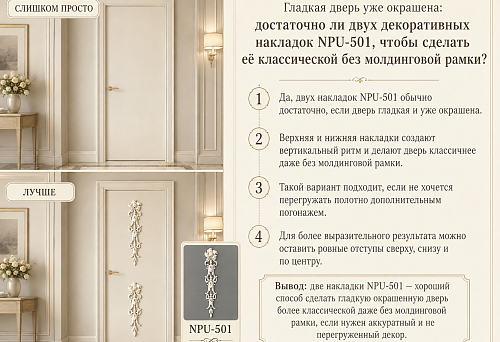
- Do I need to add a molding frame around the NPU-501?
- What to buy together with NPU-501?
- Where to look for other vertical options?
- How to understand how many NPU-501 to order?
- How much do four NPU-501 units cost at the current price?
- And six?
- Is it worth buying NPU-501 just to try it out?
- What to check right before placing an order?

A handleless kitchen looks especially clean until the desire arises to add classic decorative relief to smooth facades. Then a quite practical conflict appears: the door opens by pressing, and it is precisely on its front surface that you want to install a polyurethane overlay. Can these two ideas be combined so that the facade still opens conveniently, and the decor does not end up directly under the palm?
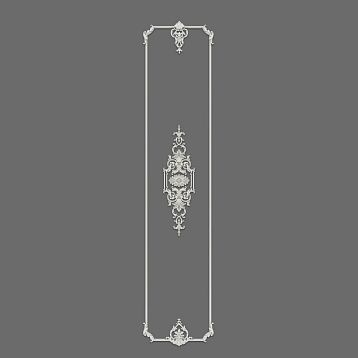
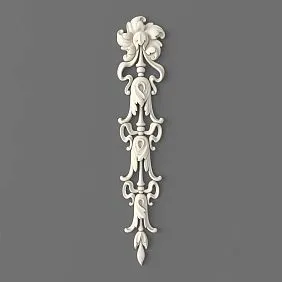
For such a project, the polyurethane overlay NPU-501 with dimensions of 58 × 300 × 11 mm is interesting. This is an elongated vertical decor that can be placed on a furniture facade as an independent ornamental accent. The current price of one NPU-501 is 1,790 ₽. But for furniture with push-to-open, the main question arises even before choosing the quantity: where exactly will the overlay be located relative to the usual pressing point on the door.
The handleless opening system changes the very principle of facade design. With a regular door, the hand goes to the handle, so the decorative field around it can be built in advance. With push-to-open, there is no visible handle: the user presses directly on the plane of the facade. If NPU-501 accidentally ends up in this working area, the relief will constantly fall under fingers or the palm. Formally, the decorative overlay fits. Practically, using the furniture becomes less convenient.
Therefore, the article's question is not phrased as "is stucco molding suitable for a kitchen." That is too broad. A specific answer is needed:
can NPU-501 be placed on a specific facade, leaving a convenient pressing zone free, and at the same time position the decor so that it looks intentional, not accidentally shifted?
For verification, only one cardboard template of 58 × 300 mm and a few minutes of normal door use are needed. If after this trial your hand does not land on the decorative field, the composition looks convincing, and the opening mechanism works as usual, there is no automatic reason to reject the NPU-501.
If on a narrow facade the overlay and the work area constantly intersect, it is better not to force a specific article to fit at any cost. You can look at a narrower vertical polyurethane overlay, change the decor scheme, or leave this particular door without relief.
That is, the correct sequence here is as follows:
first determine where you actually press → then mark the NPU-501 → open the facade several times → check the neighboring doors → only after that count the quantity and place the order.
NPU-501 in numbers: what exactly needs to be placed on the facade
First, let's separate the real product from the abstract concept of "furniture molding."
NPU-501 has one confirmed size:
58 × 300 × 11 mm.
Material:
polyurethane.
Shape — an elongated vertical decorative overlay.
Current price:
1,790 ₽ per piece
| Parameter | NPU-501 | Why this is important for push-to-open |
|---|---|---|
| Type | Vertical decorative trim | Need to determine the position by facade height |
| Material | Polyurethane | Mounting materials are selected based on the trim and the facade base |
| Width | 58 мм | These 58 mm take up part of the door's working area |
| Height | 300 мм | The decor creates a noticeable vertical zone |
| Thickness | 11 мм | After installation, a pronounced relief appears relative to the smooth plane. |
| Price | 1,790 ₽/piece | With several identical facades, the quantity directly affects the cart. |
| Main question | Position relative to the press zone. | The overlay must not accidentally end up where you constantly press with your hand. |
The last line is more important than the others.
On a regular facade, you might start with the question:
Where does the NPU-501 look better — strictly in the center or slightly higher?
With push-to-open, you first have to ask:
Where do I press when I open this door?
Only then does the design begin.
If the fitting was successful, buy the polyurethane overlay NPU-501 now with an understanding of its exact position on the furniture.




Push-to-open changes not the appearance of the facade, but its working map
A smooth door without a handle seems like a completely free decorative surface.
In reality, this is not the case.
Part of the facade is constantly used by the hand.
On one cabinet, a person habitually presses closer to the lower corner.
On another, approximately in the center of the edge.
On the top door — at the bottom.
On the pull-out facade, in one of the central zones.
The exact point depends on the furniture design, installed hardware, and user habits.
That is why you cannot take a universal scheme from the internet and say:
"Always install the NPU-501 150 mm above the center."
There is no such rule for all mechanisms.
On your kitchen, the work zone may be in a completely different place.
Our factory also produces:



What is a work area in the context of this article
This is the area on the front side of the facade that you usually touch with your hand to initiate opening.
It does not have to be a small point two centimeters in diameter.
People press slightly differently.
Today — with fingers.
Tomorrow — with the base of the palm.
In a hurry — slightly to the right.
Therefore, it is more practical to define not a point, but an area where the hand actually lands during normal use.
It is this area that is advisable not to overlap with a pronounced decorative relief without prior testing.
Get Consultation
The most useful test is done before ordering and costs zero rubles.
Take cardboard, thick paper, or a regular sheet.
Cut out a rectangle:
58 × 300 mm.
This is not an exact copy of the NPU-501.
The template does not show the relief and thickness of 11 mm.
But it clearly shows the occupied space.
Temporarily secure it with masking tape at the intended location.
Now forget that you are conducting an experiment.
Close the door.
Open it the way you usually do.
Close it again.
Repeat.
Not twice deliberately and carefully, but at least 10–15 normal openings.
Ask the second person to do the same.
It will quickly become obvious where the hand actually goes.
Why one press is not enough
When a person knows there is a template on the facade, they involuntarily try to avoid it.
This results in an incorrect test.
After several repetitions, the movement becomes more natural.
Even better — leave the paper rectangle on the facade for a while and use the door as usual.
If your hand constantly catches its edge, that is already information.
If no one even notices the template when opening, the situation is significantly more promising.
This way, the NPU-501 is tested as part of working furniture, not as a picture on the facade.
First, place a mark where you press, not where you want the decor.
You can do it the other way around.
Open the door 10–15 times without any template.
After each habitual movement, mark the conditional touch area.
No need to ruin the facade with a pencil. Use a small piece of painter's tape.
After a few repetitions, a working field will appear.
For example, it turns out that the hand almost always comes to the lower right part of the door.
Great.
Now, when designing the NPU-501, you no longer look at the facade as a clean rectangle.
It has:
a working area;
decorative area.
They can overlap.
But if there is a way to separate them, using the furniture will be more intuitive.
Why strict centering of the NPU-501 is not always the best option
For classic vertical decor, the first thought is obvious:
place it in the center.
On a regular door, this often looks logical.
But push-to-open can disrupt such a simple scheme.
Let's imagine a tall front panel.
The user presses approximately in the central lower zone.
If the NPU-501, 300 mm long, is placed strictly in the center, the lower part of the plate falls exactly into the usual touch spot.
There are several options.
The first is to keep the center and check how much the relief actually interferes.
The second is to shift the pad higher.
The third is to change the usual press zone itself, if the specific hardware and facade construction allow convenient use of another point.
The fourth is to abandon the NPU-501 on this door.
It is impossible to designate one option as correct in advance.
You need to check the actual furniture.
You can shift it up, but the decor should not look like it has "run away."
Here, functional logic meets composition.
Suppose, strictly in the center, the template interferes with the hand.
You raise it by 100 mm.
Opening becomes convenient.
Is the problem solved?
Only halfway.
Now step back from the kitchen and look at the facade.
Does the vertical overlay look meaningful?
Or does it obviously seem like it was raised for some reason?
If the offset is large and not related to the door geometry, the visual error may be more noticeable than the original issue with the press area.
Therefore, the functional position must simultaneously have a compositional explanation.
For example, the NPU-501 can be located in the upper decorative third of a tall front and be perceived as a deliberate accent.
Then the offset does not look random.
A tall front is the most convenient scenario for the NPU-501 and push-to-open
The higher the door, the more freedom to separate the work and decorative zones.
Let's imagine a tall, smooth kitchen front.
There is no handle.
The press is performed relatively low.
The upper half is practically not used by the hand.
An NPU-501 with a height of 300 mm can be placed exactly there.
As a result:
-
the vertical relief is clearly readable;
-
the opening area remains smooth;
-
the overlay does not turn into an improvised handle;
-
the facade retains clean functional logic.
It is on such doors that the idea is especially convincing.
A low facade requires a much more rigorous check
Now let's imagine the door of a small wall cabinet.
The height is limited.
NPU-501 takes up 300 mm.
On such a facade, it can cover a significant portion of the entire vertical surface.
There is less free space for distributing functions.
If the user presses approximately in the center, the decorative field almost inevitably overlaps with the working area.
Here, there is no need to say in advance that the NPU-501 is "not suitable."
But the cardboard template becomes mandatory.
If 300 mm visually takes up almost the entire door, the scale itself suggests that a more compact option should be considered.
The width of 58 mm is also important: especially on narrow facades
On a tall, wide facade, 58 mm looks like a relatively thin vertical line.
On a narrow door, the same 58 mm takes up a much larger share of the width.
Suppose the facade is 300 mm wide.
58 mm is almost a fifth of the width.
On the facade, 600 mm is less than a tenth.
The visual effect is completely different.
But for push-to-open, there is another point.
On a narrow door, the hand physically crosses the central part more often.
There are fewer free side zones.
Therefore, the probability of contact with the relief is higher.
There is no minimum facade width after which the NPU-501 is "allowed"
It would be convenient to provide a table:
300 mm — not allowed;
400 mm — allowed;
500 mm — ideal.
But such a rule would be invented.
Two facades of the same width may differ in:
height;
mechanism;
press point;
hinge position;
adjacent doors;
decorative scheme;
user habit.
Therefore, width is used not as a prohibition, but as a reason to check the template more carefully.
The narrower the facade, the more important such a test is.
NPU-501 in the center of a tall cabinet: a nice option, but we check the bottom
Tall kitchen cabinets are especially suitable for vertical decor.
Their smooth surface begs for an elongated motif.
NPU-501 with a length of 300 mm can create an accent without covering the entire facade.
There are several position options:
in the center;
above the geometric center;
in the upper decorative part;
in composition with other identical facades.
But if the door is usually opened by pressing approximately in the center, you need to check exactly this area.
Sometimes shifting the NPU-501 upward solves the issue without compromising the appearance.
On upper cabinets, the working area is often at the bottom — and this changes the layout.
The wall cabinet is located above arm level.
The user naturally reaches for the lower part of the door.
If push-to-open activates exactly there and the habitual press lands there, the lower third of the facade becomes functionally active.
Then it is more convenient to try the NPU-501 higher.
This is not a universal mounting rule.
This is the logic of a specific user movement.
Therefore, the template should be tested at the installed height of the kitchen, not on a separate facade lying horizontally in the workshop.
Lower cabinets give the opposite picture
On lower facades, a person can press higher or closer to a convenient edge without bending too much.
The scheme changes.
The position of the NPU-501 that worked perfectly on a wall cabinet may be inconvenient on a lower one.
Hence an important conclusion:
do not automatically copy one overlay coordinate to all types of kitchen fronts.
The same decorative motif can be preserved, but the work zones of different tiers need to be checked separately.
What about push-to-open drawers?
A drawer is another scenario.
The facade is usually lower and wider than the door.
The vertical NPU-501 may look completely different on it.
If the height of the front itself is close to 300 mm, the overlay practically occupies it fully vertically.
Moreover, the usual press on the drawer often lands in the central area.
This makes the NPU-501 a less obvious candidate.
There is no need to extend the successful experience of a tall cabinet to all kitchen drawers.
A separate template is made for each group of facades.
One kitchen may require NPU-501 not on every door.
This is one of the most useful commercial conclusions.
The buyer often thinks:
I have 12 facades, so I need 12 overlays.
Not necessarily.
You can only select:
-
high pencil cases;
-
the central pair of doors;
-
the upper facades of a specific group;
-
two accent doors;
-
island facades;
-
a symmetrical central composition.
This allows preserving the relief without causing the NPU-501 to conflict with push-to-open where there is insufficient free space.
The decorative system does not have to be repeated on absolutely every door.
A good interior is built not by the number of identical elements, but by a clear rhythm.
For example, the kitchen has:
two tall cabinets;
four upper cabinets;
six lower fronts.
NPU-501 works perfectly on pencil cases.
On the upper ones, it's already cramped.
On the lower ones, the hand constantly hits the center.
It's perfectly normal to limit the decor to just two tall fronts.
Two identical verticals can hold the whole composition together better than twelve overlays placed for the sake of formal repetition.
But one random NPU-501 among ten identical fronts also requires an explanation.
The opposite extreme is to place decor only where there happens to be space.
If one facade gets an overlay while the other identical ones remain smooth, ask:
why is it the decorative one?
If it's the central door, the answer is clear.
If it's a tall cabinet, also yes.
If it's the end panel completing the composition, possibly.
If the choice is explained only by the fact that "the hand doesn't get in the way here," the result may look random.
Therefore, the layout of the entire kitchen is designed together.
The strongest option is to repeat NPU-501 on a group of identical tall fronts.
Let's imagine three tall doors.
All open by pressing on the lower part.
Each has enough free top margin.
Three NPU-501 units are placed at the same height.
This creates a decorative rhythm.
Push-to-open continues to work in the familiar area.
Here, functional and aesthetic scenarios do not conflict with each other.
And in this situation, the order quantity is calculated very simply:
3 facades → 3 identical NPU-501 units.
But first, one template is transferred to all three doors.
Paired doors: one overlay or two
If the cabinet consists of two identical doors, one NPU-501 can create unwanted asymmetry.
Especially if there are no handles and the surface was absolutely symmetrical before decorating.
Make two cardboard templates.
Place them identically.
Check the opening of both doors.
If the work areas allow, two overlays often look more natural than one.
This is not a mandatory rule.
An asymmetrical interior can easily accommodate one decorative door.
But such a choice should be deliberate.
Push-to-open does not mean that the user always presses the exact same millimeter point.
This is an important everyday observation.
Furniture is not used as a laboratory bench.
Today a person pressed with an index finger.
Tomorrow with the palm.
A child reaches lower.
A tall person is higher.
Therefore, leaving some free space around the usual work area is more logical than designing the NPU-501 literally a few millimeters from the point of one test press.
We do not specify a mandatory clearance — it depends on the furniture.
But the principle is simple:
check not the geometric point, but the actual movement of the hand.
Ten to fifteen openings is not a technical standard, but a practical check.
This number needs to be understood correctly.
The push-to-open manufacturer does not set a rule of 'open 15 times before applying the decor.'
This is a practical way to see the habit.
After the first press, a person controls the movement too much.
After the tenth, they start using the door more naturally.
Therefore, such a test is useful precisely as a fitting of furniture decor.
Can you press directly on the NPU-501?
The very fact of physical contact with the decorative overlay does not provide a universal answer for all facades and all mechanisms.
The main problem of the article is different.
If the relief is located where the user is forced to press constantly, you need to check:
-
whether it is comfortable for the hand;
-
whether the relief changes the habitual movement;
-
doesn't the desire arise to use the overlay as a handle;
-
how a specific facade behaves;
-
how reliably the base is prepared and the installation is performed.
If you can leave a smooth work area, such an option is usually simpler from the user scenario perspective.
NPU-501 should not turn into a hidden handle
A very important mistake.
A person sees a protruding vertical decor and instinctively starts grabbing it.
But NPU-501 in our scenario is a decorative overlay, not a furniture handle.
There is no need to design its position so that the user constantly pulls on the relief to open it.
Push-to-open should continue to perform its function.
If the whole family perceives the established template as a future "handle," it's worth reconsidering the placement.
How to check this before installation
Secure the cardboard template.
Do not explain to another person where to press.
Ask them to open the cabinet.
If the hand goes to the template and tries to grab it, the position provokes an incorrect scenario.
Try raising the overlay higher.
Shift relative to the workspace.
Or choose a different composition.
Such a test is especially useful in a kitchen that will be used by several people.
Can the NPU-501 be shifted relative to the vertical axis?
This solution can be considered if it is compositionally justified.
For example, a decorative trim can support the asymmetry of the entire kitchen.
But shifting it just to bypass a single press point is risky.
The result will be:
the mechanism works;
the hand is free;
the decor visually "shifted."
Therefore, the first option to check is usually the symmetrical position across the width of the facade, and the functional conflict is resolved by the vertical coordinate.
If this is not possible, only then does it make sense to try other schemes.
The upper third of a tall facade is a natural place for inspection.
Not a rule, but a convenient starting point.
On a tall facade, the upper zone often participates less in everyday pressing.
A vertical NPU-501, 300 mm long, can read well there as a separate ornament.
Especially if the same position is repeated on several doors.
But with very high placement, you need to check whether the decor is detached from the rest of the furniture.
The relief should not "hang" randomly under the ceiling.
The central position is beautiful when the touch zone is located elsewhere.
If a specific mechanism is conveniently activated closer to the edge or below the center, the NPU-501 can quite well remain on the central axis.
This is the simplest decorative scenario.
The facade looks symmetrical.
The overlay is perceived as a deliberate ornament.
The hand works in its own zone.
That is why you should not fear the combination of "stucco + push-to-open" in advance.
With good geometry, they don't have to conflict at all.
Small facade: when it is better to check the NPU-502
The catalog includes a narrower vertical polyurethane overlay NPU-502 measuring 35 × 300 × 9 mm.
She does not become the second main character of the article.
But as an alternative for a narrow facade, it is very useful.
Let's compare:
| Parameter | NPU-501 | NPU-502 |
|---|---|---|
| Width | 58 мм | 35 мм |
| Height | 300 мм | 300 мм |
| Thickness | 11 мм | 9 мм |
| Material | Polyurethane | Polyurethane |
| General logic | More prominent vertical overlay | Narrower vertical |
| When to check | There is sufficient decorative field | NPU-501 takes up too much width |
On a narrow door, the difference of 58 vs 35 mm is truly significant.
If the issue with NPU-501 is specifically the width, you can buy a polyurethane overlay NPU-502 after a separate fitting of its own template.
But don't change the model automatically.
The ornament and visual character should also suit the kitchen.
Why NPU-502 doesn't solve the press zone problem automatically
It's already.
But the height remains 300 mm.
If the hand presses exactly in the center of the future vertical, reducing the width may not fundamentally change anything.
Therefore, the algorithm is the same:
template 35 × 300 mm;
10–15 openings;
comfort assessment;
overall kitchen rating.
An alternative is only useful when it actually solves the problem.
How not to confuse NPU-501 with a vertical molding
The elongated shape may give the impression that it is just a short profile.
But NPU-501 belongs to decorative vertical overlays.
It is a standalone ornamental element with a fixed height of 300 mm.
Molding works differently: it is a linear profile from which lines and frames of a given length are built.
If you want a single vertical classic accent on the facade, the NPU-501 fits this logic.
If you want to outline the entire perimeter of the door, you may need a different decor system.
For comparison, you can look at the general Relief Decoration and not mix different product tasks.
NPU-501 on a smooth door and NPU-501 inside a frame are different projects
In the first case, the overlay works on its own.
The smooth field around it emphasizes the vertical pattern.
This option is especially clear for handleless kitchens: fewer details — easier to maintain functional zones.
In the second case, the facade additionally gets a molding frame.
Then NPU-501 becomes part of a more complex classic composition.
But along with the decor, the number of lines that need to be aligned with the push point increases.
For push-to-open, simplicity often has a practical advantage.
A handleless kitchen does not have to be minimalist
This is an important semantic point.
The absence of visible handles is a functional solution.
It doesn't prohibit classic or neoclassical decor.
You can have:
a smooth furniture surface;
push-to-open;
vertical polyurethane overlays;
a symmetrical composition of facades.
The problem only arises when decorative elements ignore user mechanics.
That is, the modern way of opening and classical relief can coexist perfectly.
That is why the NPU-501 topic is practical: it's not about a conflict of styles, but about proper layout.
The color of the facade does not solve the ergonomics problem, but it affects the perception of NPU-501.
If the overlay is painted or finished in the same system as the facade, it can be perceived more calmly.
Contrasting decor will be more noticeable.
But regardless of color, the relief retains its physical thickness.
Therefore, one cannot say:
"If everything is white, you can place it anywhere."
The hand still interacts with the surface.
Ergonomics first.
Then, color.
Overlay on an already finished kitchen: first make sure you're not forcibly changing a habit
The furniture has already been in use for several months.
Everyone is used to pressing in a specific place.
Now you want to add the NPU-501.
This is a more complex scenario than designing a new kitchen.
Why?
Because the user's habit is already formed.
If the decorative overlay covers a familiar area, the person will keep hitting it for a while.
Is it possible to get used to a different place?
Possibly.
But the article should not force a person to change a convenient habit for the sake of mere decoration.
First, try to find a position that works with existing behavior.
The new kitchen is not installed yet: a mockup is still needed.
Everything seems simpler in the project.
You can draw the NPU-501 in the visualization.
But the actual press depends on the height of the cabinets and the person's position.
Therefore, after installing the facades, but before final fixing of the decorative overlays, a physical test should be conducted.
If the NPU-501 is purchased in advance, do not rush to glue it on the day of kitchen installation.
First, use push-to-open several times.
Why designer visualization does not replace a real hand
In the render, NPU-501 may be positioned perfectly in the center.
It looks great on the facade.
But the visualization does not show the movement of a person.
It doesn't matter where you press.
Therefore, when designing furniture with push-to-open, there are two layers:
visual;
functional.
A good solution passes both.
Example 1. Tall cabinet 600 mm wide
Imagine a tall smooth facade.
NPU-501 with a width of 58 mm looks quite thin relative to 600 mm.
The user usually presses closer to the bottom part of the door.
We place the template along the central axis above the pressing area.
We run the test.
The hand does not touch the decor.
From a distance, the overlay looks like a deliberate vertical accent.
This is a strong buying scenario.
If there is a second identical pencil case nearby, it makes sense to try on two NPU-501s at once.
Example 2. Facade width 300 mm
Here, 58 mm already takes up a significant portion of the width.
In the center, the overlay becomes noticeable.
When opening, the palm regularly crosses the decorative vertical line.
First, we try to lift the template.
If the composition breaks, we check NPU-502 with a width of 35 mm.
If it still interferes, perhaps this facade doesn't need vertical decor at all.
Example 3. Two wall cabinets
Both doors are identical.
The press occurs from below.
NPU-501 is placed in the middle or upper zone.
We make two templates.
We open both doors.
If the hand works freely under the decorative fields, the two overlays create a symmetrical pair.
Quantity to order:
2 pcs.
Example 4. Four upper fronts, two wide and two narrow
It is not necessary to put the same decor on all four.
On wide ones, NPU-501 works well.
On narrow ones, it takes up too much surface.
You can decorate only the central wide pair.
Or choose a narrower decor for another group, if the whole composition really needs it.
The main thing is not to create a chaotic set of models.
Example 5. Lower drawer front
The height is small.
NPU-501 almost fills it vertically.
The press lands in the central area.
This scenario looks significantly less convenient.
Here it is more reasonable to leave the front smooth or choose a different type of decorative element.
The fact that NPU-501 is in the catalog does not mean it must be used on every type of furniture.
Example 6. Kitchen island
The island often has large visible fronts and a separate compositional role.
If push-to-open is activated in a convenient zone, vertical NPU-501s can work well as rhythmic decor.
Especially if the island is visible from the living room.
But again, the side that people actually use the cabinets from is checked.
A beautiful facade should not become an inconvenient working facade.
Example 7. One tall central facade among smooth ones
Here, a single NPU-501 can be fully justified.
The tall door itself is the center.
The decor emphasizes it.
The neighboring lower cabinets remain smooth.
This option is explained by the kitchen's architecture, not by a random lack of space on other facades.
Example 8. Three identical tall doors
One overlay will almost certainly look random.
Three identical NPU-501s create a rhythm.
But before ordering, it is necessary to check the push-to-open of each door.
Especially if the middle one opens in a different zone or has different hardware.
Example 9. NPU-501 lands exactly in the usual pressing spot.
This is the most honest test.
Don't try to convince yourself that "it's not a big deal."
First, move the template higher.
If it's good, the issue is resolved.
If it is bad, try an alternative composition.
If the only beautiful position conflicts with convenient opening, it's better to abandon that specific handle on this facade.
The function of furniture is more important.
Example 10. The hand only occasionally touches the edge of the template.
Here the solution is not so obvious.
Ask several people to open the door.
Use it with the template longer.
Consider the thickness of the real NPU-501 — paper does not reproduce the 11 mm relief.
If the contact is rare and does not interfere, after a dry fitting of the real part, the solution may turn out to be acceptable.
But the final check must be done on the real overlay before gluing.
The paper template checks the field, but does not replace the dry fitting of NPU-501
This is a critically important difference.
Cardboard:
flat.
NPU-501:
has a thickness of 11 mm and relief.
Therefore, a successful paper test is only the first filter.
After receiving the product, apply the real NPU-501 to the facade without final fixation.
Repeat several openings.
See how the hand perceives the now three-dimensional part.
Only after this proceed to installation.
Why you cannot glue one overlay 'for testing'
Because after fixation, the testing ends and rework begins.
If six identical facades are planned, first one instance is tested without final installation.
After confirming the position, this coordinate is transferred to the other suitable doors.
Thus, the risk is significantly lower.
How to transfer the same position to multiple facades
After approving the first door, measure the position of the overlay relative to clear permanent boundaries:
top edge;
side edges;
central axis.
Write down the values.
Do not mark each subsequent door "by eye."
Even a small vertical misalignment between adjacent NPU-501 units will be more noticeable than on a single facade.
Especially in a handleless kitchen, where nothing else distracts from the geometry.
Why there are no handles, yet symmetry requirements become stricter
In a regular kitchen, handles create a noticeable repetition.
They set points that the eye reads on each facade.
In push-to-open, this grid is absent.
The surface is cleaner.
Therefore, any new vertical decor begins to play the role of a visual reference.
If three NPU-501 units are installed at different heights, the error will immediately catch the eye.
The absence of handles makes precise layout especially important.
What happens if the NPU-501 is placed near the edge of the facade
Placing it closer to the side border sometimes allows keeping the center free for pressing.
But such a solution changes the very character of the composition.
The vertical overlay ceases to be the central ornament and becomes a side one.
This can work, for example, on paired doors, if two overlays form a mirror rhythm near the outer or inner edges.
But placing one NPU-501 on the side just because the center is occupied by a hand, without checking the entire group of facades, is risky.
A paired side composition can solve two tasks at once
Let's imagine two identical doors.
Both open by pressing in the central areas.
Centrally located NPU-501s interfere.
You can check another option:
the overlay on the left leaf is slightly to the left;
on the right — symmetrically to the right.
The working central area remains free.
The two verticals visually explain each other.
This is already a real composition, not a forced shift of one element.
But the solution must be checked against templates.
Is NPU-501 needed on a dishwasher
Integrated appliances have their own facade and their own opening scenario.
You cannot automatically apply the layout of the adjacent cabinet to it.
You need to take into account the design of the specific appliance and furniture system.
If the facade works differently or requires
An already painted facade requires a separate assessment of the base.
If the kitchen is ready, you need to understand what surface the polyurethane overlay will be attached to.
Furniture coatings differ.
The article cannot universally assign a preparation method for absolutely all doors.
Therefore, before fixing, it is necessary to check the recommendations for the mounting material and make sure that the base in the overlay area is suitable for a reliable connection.
It is especially important not to confuse two checks:
whether it can be glued;
whether it is convenient to press later.
Both must pass successfully.
What should not be done from scratch if there is a ready-made NPU-501
If a vertical ornament is needed, there's no point in manually cutting a complex repeating relief on each facade.
Not required:
creating the design manually;
milling the same shape on each door;
assembling the ornament from many small elements;
achieving repeatability in a makeshift way.
The ready-made NPU-501 already has a fixed size of 58 × 300 × 11 mm.
In an independent project, the buyer focuses on what is more important:
layout;
fitting;
combining with push-to-open;
marking;
finishing;
installation.
Thus, a DIY task turns not into making molding, but into the proper use of a ready-made element.
When NPU-501 is truly appropriate in a handleless kitchen
The scenario is especially successful when the facade is tall and wide enough.
There is a free decorative zone.
Push-to-open is activated where the overlay does not interfere.
Several identical doors allow creating a repeat.
The ornament matches the overall style of the furniture.
The overlay is not perceived as a replacement for a handle.
In that case order polyurethane overlay NPU-501 for furniture with precise understanding of the quantity and position.
When it is better to choose a narrower vertical overlay
If the problem is specifically with the width.
58 mm takes up too much of the facade.
The hand often touches the side part of the template.
NPU-501 visually dominates the narrow door.
Then it is useful to open the section where you can buy vertical polyurethane pads, and compare other formats.
NPU-502 with a width of 35 mm is one of the specific options for such a check.
When it is better to refuse the pad altogether
This is also a normal commercial decision.
If the facade is so small that the working area takes up almost all the available space.
If any beautiful position of NPU-501 interferes with opening.
If the forced displacement looks strange.
If users start grabbing the relief as a handle.
If the decorative system does not match the rest of the kitchen well.
Then there is no need to buy a product just because it was liked separately from the furniture.
Proper selection sometimes ends with rejecting a specific item.
Mistake #1. First glue NPU-501, then check push-to-open
The order should be the opposite.
Before final fixation, it is necessary to determine the working area and conduct a dry fitting.
Otherwise, convenience is discovered too late.
Mistake #2. Check only one neat click with a finger
So a person doesn't use the kitchen every day.
A few regular openings are needed.
Better with several users.
Mistake #3: Treating the touch area as a 10 mm point.
The hand moves.
So evaluate the area, not the ideal coordinate.
Mistake #4: Placing the NPU-501 strictly in the center at any cost.
Symmetry is important.
But function is more important.
First try the central position, then look for a compositionally justified alternative.
Mistake #5. Shift the overlay randomly just for the sake of the handle
The facade will be convenient, but visually incorrect.
Any shift must be explained by the entire furniture composition.
Mistake #6. Use NPU-501 as a handle
The decorative overlay should not automatically become an element that is constantly pulled.
The push-to-open system must retain its standard usage principle.
Mistake #7. Buy overlays for all facades based on the number of doors
First, the decorative group is determined.
Perhaps NPU-501 is only needed on two tall cabinets.
Mistake #8. Placing one overlay on a random door
If among identical facades only one gets decor, it should be clear why.
Otherwise, it looks like a coincidence.
Mistake #9. Not making templates for the entire group at once
One NPU-501 can look great.
Six identical ones are too overwhelming.
You need to see the system.
Mistake #10. Not accounting for the 11 mm thickness after a paper mock-up
A flat template shows the dimensions.
A real part has volume.
After receiving the goods, a dry fitting is required.
Mistake #11. Thinking that NPU-502 will automatically solve any problem
It is narrower, but the working area may still overlap with the decor.
It also needs to be tested.
Mistake #12. Choosing NPU-502 only because it is smaller
The external pattern and proportions are also important.
You need a product that suits all the furniture, not just the hand.
Mistake #13. Ignoring the upper and lower tiers of the kitchen
The same decor coordinate can be convenient at the top and inconvenient at the bottom.
Check groups separately.
Mistake #14: Transferring the cabinet layout to a drawer
Proportions and movement are different.
A separate fitting is needed.
Mistake #15: Not accounting for different users' heights
The comfortable press point can differ among people.
If the kitchen is used by a family, let several people test the template.
Mistake #16: Not looking at the facade from the room side
Standing close, it's easy to evaluate only the relief.
Step back and check if the overlay offset looks intentional.
Mistake #17. Too much varied decor in one kitchen
NPU-501 itself can become a sufficient vertical motif.
It is not necessary to supplement it with several random overlays.
Mistake #18. Choosing a product only by the keyword "molding for furniture"
The search query leads to a category.
But the specific product is chosen based on geometry, pressing location, and facade scale.
Mistake #19. Buying first, then counting the quantity
For one door, this is not a problem.
For ten, it is already a significant basket.
First, the layout of the entire kitchen.
Mistake No. 20. Thinking that push-to-open and classic decor are fundamentally incompatible
This is also an extreme.
With proper separation of decorative and working zones, NPU-501 can be used on facades without handles quite meaningfully.
How to calculate the number of NPU-501 for a kitchen
Here the formula is simpler than for linear meters.
NPU-501 is sold per piece.
Therefore, the quantity is determined by the number of selected decorative facades.
For example:
2 tall cabinets → 2 pcs.;
4 identical upper facades → 4 pcs.;
3 central doors → 3 pcs.
But first, each door type undergoes a template check.
You cannot calculate it this way:
in the kitchen there are 14 fronts → buy 14 NPU-501.
First, the composition is determined.
What will it cost to finish two fronts
Current price of one NPU-501:
1 790 ₽.
Two:
3 580 ₽.
Four:
7 160 ₽.
Six:
10 740 ₽.
Eight:
14 320 ₽.
This is the cost of the overlays themselves at the current price, excluding mounting materials and other elements.
These figures clearly show why it's useful to first decide where decor is really needed.
Four or eight overlays: the difference is not only in price
Four NPU-501 units can highlight the central group.
Eight can change the appearance of the entire kitchen.
The more repetitions, the stronger the classical ornament influences the overall style.
Therefore, the question of quantity is simultaneously:
financial;
visual;
functional.
Each additional door also has its own push-to-open working zone.
Polyurethane furniture decor is better chosen in groups
When two tall cabinets, four upper fronts, and lower drawers are defined, it is useful to evaluate each group separately.
This makes it easier to understand:
where NPU-501 works;
where NPU-502 is needed;
where it is better to leave a smooth surface.
If you need to compare more vertical formats, the section furniture decoration made of polyurethane allows you to search for an alternative within the same logic of vertical overlays.
It is not necessary to mix NPU-501 and NPU-502 in the same kitchen
Sometimes an idea arises:
for wide fronts — 501;
for narrow ones — 502.
Technically, this can be considered.
But first, check the decorative unity.
Different widths and patterns can create a feeling that the kitchen was assembled from randomly selected parts.
If two models combine well in a specific project, the option is possible.
If not, it's better to limit NPU-501 to one group of doors, and leave the narrow ones smooth.
What to do if you really want decor on every facade
Then first develop a system of sizes.
Don't start with the purchase.
For each type of facade:
make a template;
define the work area;
check the scale;
decide whether the shape should repeat;
choose one or more consistent options.
This is already a full-fledged furniture decorative program.
In such a project decorative polyurethane elements items are selected as a system, not one beautiful article at a time.
Why a modern opening system and a classic overlay can even reinforce each other
At first glance, they belong to different aesthetic worlds.
Push-to-open is a pure modern flat surface.
Carved decor is a classic motif.
But the absence of a handle frees the facade from another noticeable object.
Instead of the combination:
overlay + handle + fasteners + relief
remains:
overlay + clean surface.
If the work area is properly left free, the result can be very cohesive.
That is, the handle is absent not in defiance of classic decor, but sometimes precisely helps it remain the main accent.
But the more expressive the overlay, the fewer additional details are required
NPU-501 already forms a vertical pattern.
If you add a complex handle nearby — it's absent thanks to push-to-open.
If you then build a heavy molding frame, add corners and a second overlay, the cleanliness of the facade disappears again.
Therefore, in this topic, the principle is especially interesting:
one decorative accent + a free work area.
It allows you to preserve both function and character.
What to do if the kitchen is already fully installed
The procedure is as follows.
First, observe for a week where you actually press on different facades.
It doesn't have to be literally seven days — regular use is enough to see habitual movements.
Then choose doors for decoration.
Make templates.
Try them on.
Open each selected door 10–15 times.
Check the entire group at once.
Only then can you buy NPU-501 58 × 300 mm in the calculated quantity.
What to do if the kitchen is still only being designed
Don't wait for the problem to appear.
On the drawing, identify the intended decorative groups.
Make a visualization.
But confirm the final position of the NPU-501 on the actual installed furniture before final fixation.
This way, the project and the real hand movement will check each other.
How to make a mockup of the entire kitchen, not just one door.
For four facades, cut out four templates.
For six, cut out six.
Yes, it takes more time.
But paper is cheap.
A faulty batch of overlays and redoing the facades — that's not.
Secure all the mockups at the same time.
Check:
from the center of the kitchen;
from the dining room;
from the living room, if the space is open-plan;
from the side.
This makes it visible whether there is too much vertical decor.
Why the view from the adjacent room is sometimes more important than the view in front of the cabinet
In a kitchen-living room, furniture is often perceived from a distance of several meters.
An NPU-501 with a width of 58 mm on one facade may seem large up close and very delicate from the living room.
A group of six handles, on the contrary, merges into a clear rhythm from a distance.
Therefore, the final decision cannot be made only while standing 40 cm from the door.
How to check that the NPU-501 hasn't accidentally become the main object of the kitchen
Take photos of the facades with templates.
Open the photo later.
Where does the eye go immediately?
To the furniture as a whole?
To the beautiful rhythm?
Or to six identical vertical spots?
If the decor is too loud, reduce the quantity.
Perhaps the NPU-501 is only needed for the central group.
Who the NPU-501 with push-to-open is especially suitable for
For customers who:
have tall or fairly spacious smooth facades;
have free space outside the usual touch zone;
want to add a vertical classic motif;
do not need visible handles;
can repeat the overlay on a meaningful group of doors;
a real dry fitting does not interfere with the facade's operation.
For such a project, NPU-501 provides a very specific and clear path.
Who should immediately look at a narrower overlay
If the facades are narrow.
If 58 mm visually takes up too much of the width.
If the hand regularly touches the side zone of the template.
If a thinner vertical stroke is desired.
Then the NPU-502 35 × 300 × 9 mm becomes a reasonable candidate for a separate fitting.
Who is better off leaving the push-to-open facade smooth
If the work area and decorative field cannot be separated at all.
If any NPU-501 option looks randomly shifted.
If users constantly try to grab the decor.
If the facade is too small.
If the kitchen itself is built on such strict smooth geometry that vertical ornament does not suit it.
Not every facade needs molding.
Can the NPU-501 be used not in the kitchen, but on other push-to-open furniture?
The logic of the article applies to cabinets, dressers, and other furniture without handles, if push-to-open is used there.
But each facade is still checked individually.
For example, a tall wardrobe can give the NPU-501 significantly more space than a small kitchen door.
Therefore, you should not limit the product to the kitchen only, but you also cannot transfer kitchen coordinates to other furniture.
How not to turn an article about the NPU-501 into a general discussion about push-to-open
Our task ends with a specific purchase.
There is no need to cover all types of pushers, hinges, adjustments, and opening mechanisms.
The NPU-501 buyer only needs to know:
where the hand presses;
which field the overlay occupies;
whether they interfere with each other;
what the offset looks like;
how many facades actually need to be finished.
Everything else already relates to the selection and adjustment of furniture fittings.
How to buy NPU-501 on STAVROS without an error in quantity
First, make a table of your facades.
For example:
| Group | Number of facades | Is NPU-501 suitable? | Total |
| Tall cabinets | 2 | Yes | 2 pcs. |
| Top wide | 4 | Yes, but only the central ones are needed | 2 pcs. |
| Top narrow | 2 | No | 0 |
| Lower drawers | 6 | Work area conflicts | 0 |
| TOTAL | 14 |
|
4 NPU-501 |
Now this is a proper specification.
Not "14 doors — 14 overlays".
But:
4 NPU-501 per real project.
If a wider selection is needed, you can to buy molding in the general section of polyurethane products, but it's better to look for an alternative only after the specific reason for rejecting NPU-501 is clear.
When it makes sense to open the general catalog, and when it doesn't
If the NPU-501 is fully suitable, there is no need to continue searching just because there are many options.
The catalog is useful when a specific problem is identified:
too wide;
too high;
the pattern does not fit;
a different format is needed;
a different decorative group is needed.
Thus, the search becomes targeted.
Molding for furniture should be selected after function, not instead of function
This is the main principle.
The facade exists primarily for the use of the cabinet.
The decor appears on top of this function.
Therefore, a proper polyurethane overlay does not remind you of itself with inconvenience every day.
It works visually while the furniture continues to open naturally.
That is why Moldings for Furniture It is chosen not only by ornament and price.
The size 58 × 300 × 11 mm has real ergonomic significance here.
Can NPU-501 be combined with other decorative elements?
Yes, if the project requires it.
But for a kitchen with push-to-open, each additional relief again takes up part of the work surface.
Therefore, the main NPU-501 is checked first.
Only then does it make sense to add other elements.
There is no need to turn a smooth door into a collection of overlays if the original intention was to keep the furniture clean without handles.
Why the general polyurethane section is useful only after choosing the scale
If the NPU-501 turned out to be too large, it is easy to select a beautiful but even larger overlay again from the general catalog.
To prevent this from happening, formulate a criterion:
a vertical overlay of 58 mm is needed;
Or:
a decor below 300 mm is needed;
Or:
a different shape outside the press zone is needed.
Then searching in the section where you can Buy Polyurethane Molded Decoration, truly continues to solve the task.
Practical check before ordering: ten points
Before the cart, answer each question.
- What is the exact facade size?
- Where is the habitual press zone?
- Does the 58 × 300 mm template fit outside it?
- Does the chosen position look natural?
- Is the user not trying to grab the template as a handle?
- Does the decor visually interfere with the adjacent facade?
- Is a symmetrical pair needed?
- How many doors should actually receive the NPU-501?
- Has the actual part been checked with a dry fit?
- Have suitable mounting materials been selected after that?
If there are clear answers to all ten, the purchase is no longer random.
FAQ: NPU-501 in the kitchen and on furniture with push-to-open
Can NPU-501 be installed on a handleless facade with push-to-open?
Yes, this option can be considered if the position of the plate does not interfere with the normal use of the specific facade.
Before final installation, the pressing working area must be determined and a trial fit carried out.
What is the size of NPU-501?
58 × 300 × 11 mm.
It is exactly according to this size that a cardboard template needs to be made.
What is NPU-501 made of?
made of polyurethane.
How much does NPU-501 cost now?
The article's source data shows 1,790 ₽ per piece.
Before placing an order, the current price should be verified in the product card.
Where is the best place to install NPU-501 on a push-to-open facade?
Where it looks compositionally correct and doesn't conflict with the usual pressing area.
There is no universal coordinate for all facades.
Can I just place it in the center?
You can start fitting from the center.
If your hand doesn't hit the decor and the facade opens comfortably, a central composition often looks most natural.
What to do if NPU-501 in the center interferes with pressing?
Try moving it higher or changing the overall decorative layout.
But after shifting, be sure to check whether the overlay accidentally looks different.
How high can the overlay be raised?
There is no universal number.
The position is determined by the height of the specific facade, its proportions, and the work area.
Can you press directly on the NPU-501 relief?
This needs to be checked on the specific furniture.
If there is a possibility to leave a convenient smooth work area, this scenario is simpler. You should not assume in advance that the decorative overlay is a standard button or handle.
Can you pull on the NPU-501 as if it were a handle?
The NPU-501 is considered a decorative overlay, not a furniture handle.
Push-to-open should retain its own method of opening.
Why open the door 10–15 times with the template?
To see the real habit of the hand.
This is a practical test, not a technical standard of the mechanism manufacturer.
How to make a template?
Cut a rectangle 58 × 300 mm from cardboard or thick paper and temporarily secure it with masking tape.
Does the cardboard template convey the real volume of the overlay?
No.
It shows only the occupied field.
After purchase, the real NPU-501 should be additionally applied to the facade without final fixation, because its thickness is 11 mm.
Is it necessary to install NPU-501 on every kitchen door?
No.
The quantity is determined by the decorative scheme and the convenience of each group of facades.
If two identical doors are next to each other, is an overlay needed on both?
Often a symmetrical pair looks more convincing than a single overlay, but this is not a mandatory rule.
Make two templates and compare.
Can the NPU-501 be installed only on tall cabinets?
Yes.
This can be a very logical accent group, especially if on small fronts the overlay interferes with push-to-open.
Will the NPU-501 fit an upper kitchen cabinet?
Possibly.
Need to check the door height and where the user presses when opening the installed cabinet.
And for the lower front?
Also possible, but the work area is often arranged differently.
A separate fitting is needed.
Is the NPU-501 suitable for a drawer?
This depends on the size of the front and the press zone.
On a low drawer, an overlay height of 300 mm may be too large relative to the entire surface.
What to do if the facade is very narrow?
First, check the NPU-501 with a real template.
If the 58 mm width takes up too much of the door, consider a narrower vertical overlay.
What narrower alternative is there for STAVROS?
The NPU-502 has dimensions of 35 × 300 × 9 mm.
It can be useful for a separate fitting on narrower facades.
Is the NPU-502 definitely better for push-to-open?
No.
It is just narrower.
The working area of the specific facade still needs to be checked.
Can the NPU-501 and NPU-502 be used in the same kitchen?
This option can be considered if both models are compositionally aligned.
But mixing them just because the facades are of different widths, without a common system, is not worth it.
Can the NPU-501 be installed on an already finished kitchen?
Yes, if the condition and coating of the facade allow for suitable installation.
First, be sure to check the usual work area, because on a finished kitchen the user is already used to pressing in a specific place.
Do you need to change the usual pressing place for the sake of the overlay?
If this becomes inconvenient, it is better to look for another position for the NPU-501 or a different decor.
The function of the furniture should not be subordinated to a decorative detail.
What to do if all the beautiful position options intersect with the pressing area?
Consider a narrower overlay, a different decor shape, or leave the specific facade smooth.
Can the NPU-501 be placed on the side?
You can check this option if it looks compositionally intentional.
Random lateral offset just to avoid a hand often looks bad.
How to check the side position on two doors?
Make two templates and place them mirrored or symmetrically relative to the overall composition.
This way, functional offset can turn into a meaningful decorative technique.
What matters more: perfect symmetry or push-to-open convenience?
The facade should remain convenient.
After that, among functionally acceptable options, the most harmonious composition is chosen.
Should children be taken into account?
If furniture is used by people of different heights, it is useful to ask them to open a door with the template installed.
Pressure points may vary.
Can I first glue one NPU-501 and then decide the rest?
It is better to first do a dry fit of the entire group.
The first permanently fixed overlay should not dictate an erroneous layout for the remaining facades.
How to mark several identical doors?
After approving the first position, measure the distances from stable edges of the facade and transfer them to the other doors.
Do not mark each one by eye.
Why is an error in the height of overlays especially noticeable on a kitchen without handles?
Because there is no row of handles that would distract attention or create a different rhythm.
Vertical decor is becoming one of the main benchmarks.
Do I need to add a molding frame around the NPU-501?
No.
One vertical overlay can be a completely standalone furniture decor.
A frame is only required if it is provided for by the overall facade concept.
What to buy together with the NPU-501?
The calculated number of overlays themselves and suitable materials for installation.
Other decorative elements are added only according to the project.
Where to look for other vertical options?
In a separate section of vertical polyurethane overlays STAVROS.
It is convenient to continue searching there if the NPU-501 does not fit specifically in size.
How to understand how many NPU-501 to order?
Count only those facades where the template passed functional and visual inspection.
If out of ten doors four fit, the order is based on four, not ten.
How much do four NPU-501 cost at the current price?
At a price of 1,790 ₽:
7 160 ₽.
This is the cost of the four overlays themselves without mounting materials.
And six?
10,740 ₽ at the same current price.
Is it worth buying NPU-501 just for a trial?
If the paper template has not yet passed inspection, it is better to use a free mockup first.
The actual part is needed already for the final dry fitting of the volume before installation.
What to check right before placing an order?
The NPU-501 size, the number of selected fronts, the position of the decor, push-to-open work zones, the symmetry of the entire group, and the need for mounting materials.
A handleless kitchen and NPU-501 are compatible if you first design the hand movement, and then the ornament.
The main mistake in this topic is perceiving the push-to-open front as a completely free canvas.
It looks free.
Functionally, it is not.
On its surface there is an invisible work zone that a person uses every day.
It is this zone that needs to be found first.
After that, the polyurethane overlay NPU-501 measuring 58 × 300 × 11 mm becomes a very specific design task.
On a tall front, it can be raised above the work area.
On two identical doors — repeat as a symmetrical pair.
On a group of pencil cases — create a vertical rhythm.
On a narrow facade — compare with a more compact NPU-502, 35 mm wide.
And on a door where any successful position conflicts with pressing — honestly refuse the overlay.
This is much more reasonable than choosing decorative molding only from a photo.
Before ordering, do three checks.
The first is functional.
Attach the 58 × 300 mm template and open the facade with a normal press 10–15 times.
The second is visual.
Step back and look at the whole kitchen. If the overlay had to be shifted, it should be clear why the composition looks this way.
The third one is three-dimensional.
After receiving the product, attach the actual NPU-501 without final fixation. The paper does not show the relief and thickness of 11 mm.
Only after these three checks, count the quantity.
Not by the number of doors.
By the number of facades where NPU-501 actually works.
If two tall cabinets fit, order two.
If the central group has four facades, then four.
If 58 mm is too much for narrow doors, compare a narrower option or leave them smooth.
STAVROS company gives the opportunity to choose not between "classic furniture with handles" and "modern kitchen without decor," but to assemble more precise combinations. Push-to-open is responsible for the opening method. NPU-501 is responsible for the decorative pattern of the facade. These two functions do not have to interfere with each other if you do not try to make them occupy the same place.
That is why the best moment to decide is before installing the overlay, but after you understand how you actually use the door.
First, press.
Then, mark it.
Then, attach the NPU-501.
And only if all three actions do not conflict with each other — proceed to ordering.