



























Article Contents:
- When to buy wooden handrails for stairs
- What is a wooden handrail and its role in a staircase
- Types of wooden handrails
- Handrails for stair railings
- Wall-mounted handrails
- Handrails for a private home
- Handrails with balusters and posts
- Need to build a new staircase in a private house
- Need to replace an old handrail
- Need to choose a handrail for already purchased balusters
- Need to choose a handrail for posts
- Need to add a wall-mounted handrail
- Need to design a staircase in a commercial interior
- Table: what to buy together with the wooden handrail
- Choosing Only by Photo
- Do not consider the grip profile
- Buy the handrail separately from balusters and posts
- Not Checking the Material
- Ignore the installation height
- Not Considering the Finish
- Use a random wooden blank
- Do not plan joints and turns
- Forget about operating conditions
- Don't specify parameters before ordering
- Where to buy wooden handrails for stairs?
- Which wooden handrails to choose for stairs?
- Which is better for a handrail: oak or beech?
- Can I match handrails with balusters and posts?
- What to check before buying a handrail?
- Are wooden handrails suitable for a private house?
- Can a wooden handrail be used as a wall-mounted one?
- How is a handrail different from a regular wooden batten?
- Do I need to buy a handrail as a set with other components?
- How to choose a handrail profile?
- What should I buy together with a handrail?
- Can I replace only the old handrail?
- Which handrail is best for a classic staircase?
- What is important for installing a wooden handrail?
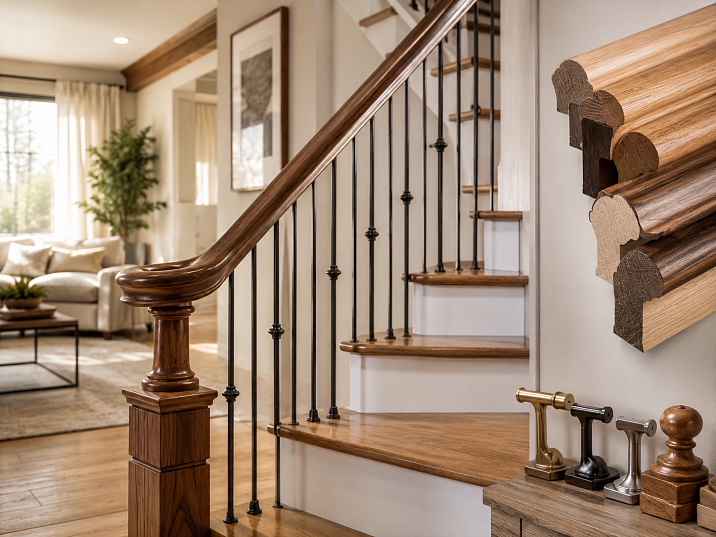
Wooden handrails for stairs should be purchased not as a separate random part, but as part of the stair railing. The handrail is in your hand every day, gives a sense of reliability, completes the appearance of the stairs, and connects balusters, posts, steps, landings, and the overall style of the house. If you choose it only by photo or by the first suitable size, you can get an uncomfortable grip, a material conflict, a profile error, or a visual gap between the handrail and other staircase elements.
A good wooden handrail solves several problems at once. It helps you walk safely up and down the stairs, supports your hand during ascent and descent, covers the top line of the railing, makes the structure visually complete, and adds a sense of real carpentry to the interior. In a private house, cottage, country interior, or classic staircase area, such a detail is as noticeable as balusters or a starting post.
In the STAVROS catalog you can buy wooden handrails for stairs and choose them not separately from the project, but together with other elements of the stair railing. This approach is especially important if the staircase is being built from scratch, restored, updated after renovation, or supplemented with new decorative details.
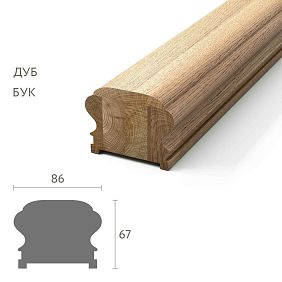
Choosing a handrail starts with the material, profile, size, mounting method, and compatibility. You need to understand what wood the adjacent elements are made of, what profile fits comfortably in the hand, what length is needed, how the handrail will connect to the balusters and posts, and whether it will be part of the railing or a wall-mounted element. Only after this does the purchase become informed, not random.




When to buy wooden handrails for stairs
A wooden handrail is needed not only for a new staircase. It is purchased when building a house, during renovation, restoration of an old staircase, replacement of a damaged element, updating the railing, selecting components for existing balusters, or creating a more expressive interior. In each scenario, the task is different, so the approach to selection will also differ.
If the staircase is being designed from scratch, it is better to choose the handrail together with the balusters, posts, and other components. Then all elements match in material, scale, style, and installation logic. The stair railing looks cohesive, not like a set of parts from different projects. This is especially important for wooden staircases, where every element is clearly visible: the hand glides along the handrail, the eye catches the profile, and the top line of the railing becomes part of the architecture of the space.
If the staircase already exists, but the handrail is worn, uncomfortable, or unsuitable after renovation, you need to assess the existing structure. Sometimes it is enough to replace only the top part of the railing. But more often, along with the handrail, related issues arise: whether the old balusters are suitable, whether the posts need to be changed, whether the material matches, how the new finish will look, and whether the fastening will support the updated structure.
During restoration, a wooden handrail can restore the correct appearance of the staircase. Old railings often lose their geometry, coating, color, and tactility. The handrail may be worn, cracked, uncomfortable to grip, or visually mismatched with the new interior. Replacing such an element helps update the staircase without a complete rebuild, if the rest of the structure is suitable for further use.
A separate scenario is selecting a handrail after installing balusters and posts. This is not the most convenient path, but it occurs often. In such a situation, you need to carefully check the profile, length, seating width, connection method, and style. The handrail should cover the top line of the railing so that the balusters and posts do not look out of place.
Another reason to buy a wooden handrail is the desire to make the staircase warmer and more expressive. Metal or plastic solutions can be practical, but wood gives a different feeling: it is warmer to the touch, softer visually, and pairs better with classic furniture, carved decor, solid wood, doors, moldings, and wooden interior elements.
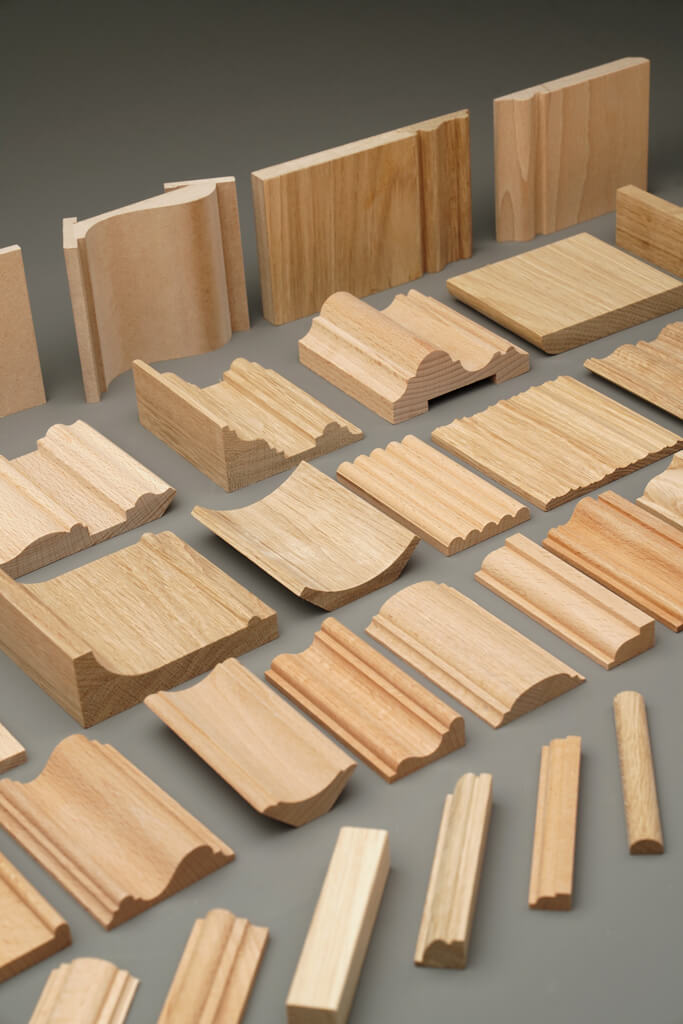
What is a wooden handrail and what role does it play on a staircase
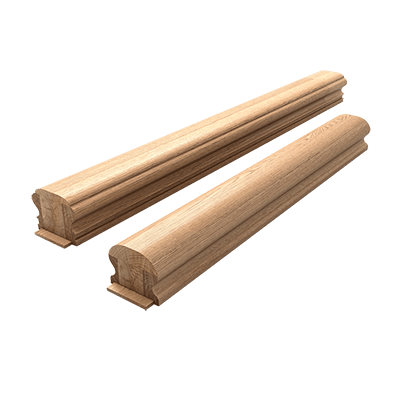
A handrail is the top element of a staircase railing that a person holds onto with their hand when ascending, descending, or moving along a landing. It can be part of a railing with balusters and posts or a separate wall-mounted element. But in any case, the handrail should be comfortable, durable, properly installed, and visually connected to the staircase.
The main practical function of a handrail is support. A staircase without a comfortable handrail feels less reliable, especially if there are children, elderly people in the house, or the flight of stairs is high. But comfort depends not only on the presence of a handrail. The installation height, profile, width, shape, surface smoothness, material, and the absence of sharp, uncomfortable edges in the grip area are important.
The second function is connecting. The handrail gathers the railing into a single line. Balusters can be beautiful, posts can be expressive, but without a properly selected handrail, the staircase looks unfinished. The top line of the railing should be even, logical, and connected with turns, landings, and terminations.
The third function is decorative. A wooden handrail is immediately visible. It runs along the entire length of the staircase, follows its movement, and sets the overall character. A smooth, laconic profile makes the staircase calmer. A more expressive profile adds a classic or carved look. Solid wood creates a feeling of naturalness and durability.
The fourth function is tactile. A handrail is not just looked at. It is touched every day. That is why the profile should be not only beautiful but also comfortable. If it is unpleasant to hold onto the handrail, the entire staircase feels less high-quality, even if it looks expensive visually.
Our factory also produces:


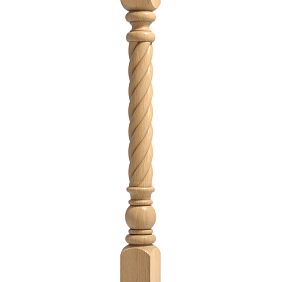


What types of wooden handrails are there
Wooden handrails can be divided by place of application, profile, material, purpose, and method of connection with other elements. It is important for the buyer not to get confused: a handrail for a staircase railing, a wall-mounted handrail, and a handrail in a set with balusters are close but not identical scenarios.
Get Consultation
Handrails for staircase railings
The handrail for the stair railing works together with the balusters and posts. It covers them from above, creates a gripping line, and completes the structure. Such a handrail must match in profile, width, height, material, and style. If the balusters are carved and the handrail is too simple, the top line may look weak. If the balusters are minimalist and the handrail is overly decorative, the staircase will appear overloaded at the top.
Compatibility is important for the railing. The handrail should not just sit on top of the balusters but be part of the structure. You need to understand how it is attached, how it connects to the posts, how it runs along straight sections and turns, and how the ends are finished. If the staircase is complex, with multiple flights and landings, it is better to address this issue in advance.
A buyer who wants to purchase wooden handrails for stairs should immediately look not only at the handrail itself but also at the adjacent elements. For a solid railing, you will need wooden stair components, to assemble the project without random mismatches in material and scale.
Wall-mounted handrails
A wall-mounted handrail is attached to the wall and helps to move safely along the staircase even where there is no full wooden railing. This option is often used along the wall, on narrow flights, in houses with an already finished staircase, or in situations where you need to add a convenient support without completely reworking the structure.
For a wall-mounted handrail, the installation height, grip comfort, distance from the wall, and fastening reliability are especially important. It should be within easy reach of the hand, not obstruct passage, not catch on clothing, and not look like a foreign element. If the interior already has wooden doors, steps, trim, baseboards, or furniture, it is better to choose the handrail taking these materials into account.
A wall-mounted option can be more minimalist than a handrail on balusters because it does not have to tie together the top line of the railing. But it still must be well-finished and comfortable. You cannot sacrifice grip for decorativeness here: a person holds onto it precisely while moving.
Handrails for a private house
In a private house, the staircase often becomes the central element of the hall, living room, or double-height space. The handrail in such an area is visible from different points: from below, above, the side, the landing, and adjacent rooms. Therefore, the choice of material, profile, and finish is especially important.
For a private home, a wooden handrail is chosen not only for its technical parameters. It must match the doors, floor, furniture, wall panels, ceiling elements, balusters, and posts. If the staircase is classic, the handrail can be more expressive. If the home is modern, the profile should be calmer. If the interior is country-style, wood helps maintain a warm, natural character of the space.
A handrail for a private home must be designed for daily use. Unlike a decorative element, the stair railing works constantly. Therefore, you need to consider not only how it looks in a photo, but also how the surface will feel in the hand after a year, how the finish will behave, how easy it is to care for the wood, and how the handrail will combine with the rest of the staircase.
Handrails in a set with balusters and posts
The most reliable way for a new project is to select the handrail together with the balusters and posts. This way, you can immediately assess the style, scale, railing height, and overall line of the staircase. The handrail should not be "on its own." It works in conjunction with the vertical elements.
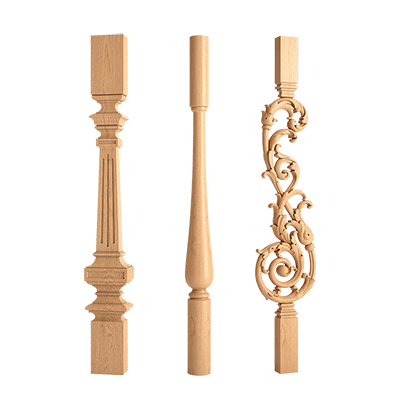
If the staircase is classic or carved, it is worth looking in advance at wooden balusters for staircases и Wooden Stair Posts. Balusters set the rhythm, posts fix important points, and the handrail brings everything together into a single top line.
This comprehensive approach helps avoid a common mistake: a person buys a beautiful handrail and then realizes it does not match the balusters in width, profile, or style. Or vice versa: the balusters are already installed, and it is difficult to find a suitable handrail. It is better to choose the set at once, especially if the staircase is being made for a home where appearance matters a lot.
Table of characteristics of wooden handrails for staircases
| Parameter | What to check | Why this is important |
|---|---|---|
| Product type | Wooden handrail for stairs, guardrail handrail, wall-mounted handrail | The mounting method, profile, and role in the structure depend on the type |
| Main section | buy wooden handrails for stairs | It's convenient to start selection with a profile category and compare options |
| Material | Solid wood; oak or beech should be verified in the specific product card | The material affects texture, strength, finish, and compatibility with the staircase |
| Profile | Grip shape, width, cross-section, top and bottom geometry | The profile determines hand comfort and the appearance of the railing |
| Size | Length, cross-section, and mounting parameters are specified in the product card | A size error leads to difficult adjustments or incompatibility |
| Compatibility | Balusters, posts, staircase elements, connection method | The handrail should work with the rest of the system, not separately |
| Installation height | Determined by the staircase design and normal ergonomics | Comfort and safety of movement depend on the height |
| Finishing | Current coating options should be checked before ordering | The coating affects color, tactility, maintenance, and service life |
| Installation | The mounting method depends on the design | You need to understand in advance who and how will install the handrail |
| Related elements | Balusters, posts, components, installation tips | Allows you to assemble a stair railing as a kit |
| Order conditions | Current parameters are clarified on the website or with a STAVROS manager | Helps avoid mistakes regarding availability, size, and compatibility |
The table shows why a handrail cannot be chosen solely based on its attractive shape. It must fit the stairs structurally, tactilely, and visually. Even an expensive material won't save the situation if the profile is uncomfortable, the length is unsuitable, and the connection to the balusters is not thought out.
Handrail material: oak, beech, and solid wood
The handrail material affects everything: appearance, feel in the hand, resistance to daily use, finishing options, and compatibility with other stair elements. The handrail is one of the most frequently touched wooden parts in a home. It is touched every day, so the material must not only be beautiful but also suitable for such wear.
Oak is chosen for its expressive texture, dense visual character, and feeling of durability. It looks good on stairs where wood should be prominent: classic halls, country houses, cottages, interiors with solid furniture, carved elements, natural doors, and wooden floors. An oak handrail can become a strong top line of the stairs and support the prestigious image of the entire railing.
Beech is perceived as calmer. It is often considered for products with neat geometry and further finishing. Beech can be appropriate where the handrail needs to be durable and wooden, but not necessarily too textured. It is well-suited for projects where clean form, painting, tinting, or a more restrained look are important.
Solid wood differs from imitations in that it works not only visually but also tactilely. The hand feels the surface, density, and warmth of the material. This is why a wooden handrail for stairs is perceived differently than a metal or plastic one. It fits better into interiors where there is natural wood, carved decor, wooden doors, furniture, and solid wood elements.
When choosing a material, you need to look at the entire staircase. If the steps are one shade of wood, the balusters another, the posts a third, and the handrail a fourth, the staircase may look disjointed. Sometimes contrast is acceptable, but it must be intentional. It is better to decide in advance whether the handrail will match the balusters, complement the steps, stand out against the railing, or tie together different materials.
Before ordering, check the actual material, finish, and parameters in the product card or clarify with a STAVROS manager. Do not assume a specific size, color, or coating in advance if they are not specified in the selected item. In staircase projects, precision is especially important: an error in material or profile can lead to reworking the entire top line of the railing.
How to choose the profile and size of the handrail
The handrail profile is the shape of its cross-section. It determines how comfortable it is to grip, how the handrail looks from above and from the side, and how it connects to balusters and posts. A beautiful profile that is uncomfortable to grip will quickly become annoying. A profile that is too massive can visually weigh down the staircase. One that is too thin may look weak and not match the scale of the railing.
A comfortable handrail should fit in the hand. This does not mean it has to be the same for all projects. In a classic staircase, the profile can be more rounded and expressive. In a modern interior, it can be more restrained. In a wall-mounted version, it should be convenient for a side grip. But in all cases, it is important that the hand does not press against sharp edges or slip off the surface.
The size of the handrail is related to the length of the flight, the number of turns, landings, posts, and connection points. If the staircase is straight, the task is simpler. If there are turns, winder steps, landings, top and bottom ends, you need to plan in advance how the handrail will run along the entire line. Buying "approximately by length" here almost always creates problems.
The width and height of the profile should match the balusters. If the balusters are thin and elegant, an overly massive handrail can look heavy. If the balusters are large and carved, a too narrow handrail will not complete the composition. Posts also influence the choice: they set the scale at the beginning, end, and turns of the staircase.
Installation height is a separate issue. It affects safety and comfort. The handrail should be where the hand naturally finds it when moving. If placed too low, it is uncomfortable to use. If too high, it no longer supports the hand. This is especially noticeable for wall-mounted handrails.
Before ordering, prepare the staircase dimensions, number of flights, data on balusters and posts, photos or a project. This makes it easier to understand which profile and format of handrail is needed. If the staircase is already partially assembled, it is important to measure the actual parameters rather than relying only on the drawing.
Handrail, balusters, and posts: how to assemble a staircase railing as a set
A handrail rarely works alone. In a complete staircase railing, it is connected to balusters, posts, landings, turns, and the lower part of the structure. If these elements are chosen from different stylistic worlds, the staircase looks random. Therefore, it is better to think not about buying one product, but about a set.
Balusters create rhythm. They repeat along the flight, set the vertical structure, and support the handrail. If the balusters are carved, the handrail should be expressive enough not to look like a random smooth plank on top. If the balusters are simple, the handrail can be calm or slightly more decorative, but it doesn't have to be complex.
Posts fix important points: the start of the stairs, turns, landings, and ends. They are often larger than balusters and have a stronger impact on the overall look. The handrail should match them in scale. If the post is massive, a too-thin handrail will look weak. If the post is elegant, a too-heavy profile will overload the line.
Components help assemble the stairs logically. Therefore, along with the handrail, it's worth looking at wooden stair components. This approach helps to think through not only the top line but also the adjacent elements that are responsible for the overall appearance and installation.
If the stairs should be particularly decorative, you can consider not only individual elements but also ready-made ideas in the direction Carved wooden staircases. This helps to see the stairs not as a set of parts but as a complete interior object.
Comparison table of handrail and staircase solutions
| Option | When it fits | Strong point | What to check before ordering |
|---|---|---|---|
| Handrail for railing with balusters | New staircase, restoration, replacement of the top line | Assembles balusters and posts into a single structure | Profile, length, compatibility, material |
| Wall-mounted handrail | Staircase along the wall, additional support, narrow flight | Provides support without a full railing | Installation height, mounting, distance from wall |
| Oak handrail | Classic and prestigious wooden staircases | Expressive texture and strong visual character | Match with balusters, steps, and trim |
| Beech handrail | Calmer projects, finishing in the desired color | Neat geometry and restrained appearance | Preparation for finishing, profile, purpose |
| Handrail included with balusters | New railing, comprehensive selection | Less risk of style mismatches | Scale, height, baluster spacing, connections |
| Purchasing a separate handrail | Replacing a damaged element | You can update the staircase without a complete overhaul | Match with old construction |
| Random wooden blank | Only for experienced manual finishing | May be cheaper as raw material, but requires work | Grip profile, mounting, finishing, safety |
This table helps to see the difference between a finished stair element and a random wooden part. A handrail is not just a long strip. It should be comfortable to grip, properly installed, compatible with the railing, and safe for daily use.
How to choose a handrail to match the staircase and interior style
The handrail style should complement not only the staircase but also the surrounding space. A staircase is rarely standalone. It is connected to the hall, living room, corridor, double-height space, doors, floor, walls, furniture, and lighting. If the handrail is chosen without considering the interior, it may look out of place even if it is of good quality.
In a classic interior, the handrail should usually be expressive but not rough. It can be combined with carved balusters, large posts, wooden panels, massive doors, and decorative moldings. Here, it is important not to simplify the top line so much that it gets lost against the rich details. In such a project, it is appropriate to look Carved wooden decoration and stair elements in a unified logic.
In neoclassicism, the handrail can be more restrained. It should maintain a noble form, but without excessive ornamentation. Calm profiles, neat balusters, posts without overload, and clean finishes work well. Here, the quality of proportions is especially important: extra heaviness quickly makes the staircase look old-fashioned.
In a modern interior, a wooden handrail can become a warm accent. Even if the staircase is minimalist, wood in the grip area makes it less cold. It is better to choose a simpler profile, without excessive carving, and tie the material to the floor, doors, furniture, or wall details.
In a country house, wood often feels natural. The handrail can support beams, stair treads, furniture, wooden doors, and the overall character of the interior. But even in a country style, you should not mix too many different shades of wood. It is better to decide in advance which material will be the main one.
If the interior is already saturated with decor, the handrail should be calmer. If the staircase itself is simple, the top line can become more expressive. A good choice is balance, not maximum ornamentation.
Practical selection for different customer situations
Need to build a new staircase in a private house
For a new staircase, the handrail is chosen together with the railing. First, the style, material, type of balusters, posts, handrail profile, and overall height are determined. You cannot buy a handrail separately from the project if it is not yet clear what the vertical elements will be and how they will connect to each other.
In such a situation, you need to look at the set immediately: handrails, balusters, posts, wooden components, and decorative solutions. This helps to avoid inconsistency. If the staircase is to become a noticeable part of the interior, it is useful to look at the direction Carved wooden staircases and understand how decorative the entire look should be.
Need to replace an old handrail
When replacing, it is important to evaluate the existing staircase. You need to understand what profile was used before, how it was attached, what dimensions remain, and the condition of the balusters and posts. The new handrail must be compatible with the old structure or require clear modifications.
A mistake is to buy a beautiful new element without checking the fit. It may not match in width, height, shape, or connection method. If the staircase is old, it is better to prepare photos and dimensions before ordering.
You need to select a handrail for already purchased balusters
Here, scale becomes the main factor. Balusters set the rhythm and height of the railing. The handrail should be wide and expressive enough to complete them from above. If the balusters are carved, the top line should support the decorative nature. If the balusters are simple, a calmer profile can be chosen.
In such a scenario, you should immediately open wooden balusters for staircases and compare their visual logic with the selected handrail. Even if the balusters are already in place, this review helps to understand which style the handrail should support.
You need to select a handrail for the posts
Posts have a stronger influence on scale than it seems. If the post is large and decorative, the handrail should look worthy next to it. If the post is thin and calm, an overly massive handrail can disrupt proportions. Therefore, Wooden Stair Posts it is better to view together with handrails, rather than after.
The connection point is especially important. The handrail must match the post not only in style but also in structural logic: where it ends, how it enters the joint, how it handles the turn, and how the top line looks on the landing.
Need to add a wall-mounted handrail
If the staircase runs along a wall, a wall-mounted handrail can improve convenience and safety. Here, the focus is on wall attachment, height, and hand clearance. The profile should be comfortable, and the surface pleasant to the touch.
A wall-mounted handrail does not have to match the balusters if they are not nearby, but it should blend with the interior. If the home has wooden elements, it is better to choose the handrail by material and finish so it does not look like a random strip on the wall.
Need to design a staircase in a commercial interior
In a commercial space, the handrail is used more often and intensively. Different people touch it, the load is higher, and cleaning is more frequent. Therefore, coating, durability, grip comfort, and installation precision are important. Decorative appeal is needed, but safety and practicality come first.
For a hotel, restaurant, salon, showroom, or public area, the handrail should look presentable and be comfortable. If the staircase becomes part of the room's image, it is worth considering the entire set: material, balusters, posts, decorative elements, finish, and installation.
What to buy together with the handrail
A handrail almost always requires accompanying elements. Even if only one part is purchased for replacement, you need to check how it will connect with existing balusters, posts, and fasteners. If the staircase is new, a comprehensive approach becomes mandatory.
For a complete railing, along with the handrail, you should consider wooden balusters for staircases. They create a vertical rhythm and support the handrail along the length of the flight. If the balusters are chosen correctly, the staircase looks cohesive rather than empty.
On turns, at the beginning and end of the march, they are needed Wooden Stair Posts. They fix important points and set the scale of the fence. The handrail must match them in shape and size.
For general selection, they are useful wooden stair components. This section helps to view the staircase as a system where each detail is connected to the neighboring one. If the interior is built on an array, you can additionally look Solid wood products, to connect the staircase elements with other wooden parts of the house.
For projects with a more artistic character, it will be useful Carved wooden decoration. It helps to support the style of the staircase if the handrail, balusters, and posts must work in a classic or decorative interior. And before installation, it is useful to study tips for installing decor, to understand the basic issues of preparation, fastening, and careful work with wooden elements.
Table: what to buy together with a wooden handrail
| What to add to the purchase | Why this is needed | Which scenario it suits | What to pay attention to |
|---|---|---|---|
| wooden balusters for staircases | To form the vertical part of the fence | New staircase, restoration, railing replacement | Step, height, style, compatibility with handrail |
| Wooden Stair Posts | To design the start, end, turns, and landings | Classic and carved staircases, private homes | Scale, height, connection with handrail |
| wooden stair components | To assemble the staircase railing as a kit | New construction, comprehensive element replacement | Material, dimensions, overall system |
| Carved wooden staircases | To see the staircase as a complete solution | Design project, cottage, grand staircase | General style, decorativeness, scale |
| Solid wood products | To connect the staircase with other wooden interior elements | House with wooden trim, furniture, doors | Wood species, texture, shade, finish |
| Carved wooden decoration | To support the decorative character of the staircase | Classic, neoclassical, restoration | Not to overload the staircase with details |
| tips for installing decor | To understand preparation and installation issues in advance | Self-preparation, working with a master | Does not replace design and professional installation |
Such a table helps the buyer not limit themselves to just one handrail. A staircase is a system. If you only buy the top part but don't consider the balusters, posts, fastening, and finishing, the result may be weaker than expected.
How not to confuse a wooden handrail with similar elements
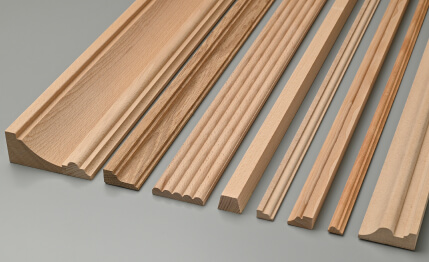
A wooden handrail is sometimes confused with a batten, molding, decorative strip, casing, or a regular wooden blank. At first glance, it may be a long wooden part, but its purpose is different. The handrail should be comfortable to grip, safe, designed for hand contact, and compatible with the staircase structure.
A regular batten does not replace a handrail. It may have an unsuitable cross-section, uncomfortable edges, insufficient thickness, or incorrect geometry. It would need to be modified, sanded, have its profile adjusted, and its fastening checked. For a staircase used daily, this is a risky path without experience in carpentry and understanding of the structure.
A decorative strip is also not equal to a handrail. It may beautifully cover a joint or decorate a surface, but it does not have to be comfortable for the hand. A handrail, however, must withstand constant contact, assist with movement, and not create unpleasant sensations.
Molding elements may be similar in length, but their purpose is different. They finish joints, edges, frames, and surfaces. A handrail is part of the staircase railing. If an unsuitable element is used, the staircase may lose convenience and safety.
It is also important not to confuse a handrail with a baluster or post. A baluster is a vertical element. A post secures important nodes. The handrail runs along the top and connects the structure. All these parts work together but do not replace each other. Therefore, when purchasing, you need to choose specifically the handrail category, not just similar wooden products.
Installation, preparation, and finishing: what to consider before ordering
The installation of a handrail depends on the staircase design. If the handrail is placed on balusters and posts, you need to understand in advance the connection scheme, railing height, support placement, turns, and the start and end of the line. If the handrail is wall-mounted, brackets, distance from the wall, height, and base strength are important.
The main mistake is buying a handrail before understanding the structure. Even if the material and profile are appealing, the product may not fit in length, cross-section, or connection method. Before ordering, you need to measure the staircase, identify sections, prepare photos or a project, check for turns and places where the handrail will be interrupted.
Surface preparation is also important. The wood must be treated considering its future use. The handrail is constantly touched by hands, so the surface must be smooth, pleasant, and safe. If the product requires a finish, it must be planned before installation. Coating an already installed handrail is more difficult: you can unevenly treat complex areas, stain adjacent parts, or have inconvenient access.
The finish must match the operating conditions. In a home with heavy staircase use, the handrail will experience constant contact. In a commercial space, the load is higher. Therefore, the coating, color, and maintenance should be discussed in advance. If the exact finishing options are not specified in the product card, it is better to clarify them with a STAVROS manager.
When working with a craftsman, it is important to agree on all details in advance: height, profile, joints, connections with posts, attachment points, trimming, turns, and finishing. The handrail runs along a long visible line, so any inaccuracy will be noticeable. Good installation makes the staircase calm and reliable. Bad installation ruins even high-quality material.
Mistakes when choosing a wooden handrail
Choosing only by photo
A photo shows the shape but does not convey the feel in the hand. The handrail may look beautiful but be too massive, too thin, or uncomfortable in profile. Before ordering, you need to look at the dimensions, cross-section, and purpose.
Not considering the grip profile
The profile is one of the main parameters. If the hand is uncomfortable, the handrail does not fully fulfill its task. Sharp edges, too wide a cross-section, or an unsuitable shape quickly become noticeable in daily use.
Buying a handrail separately from balusters and posts
The handrail must match the vertical elements. If you buy it separately, you can make a mistake in scale, style, or connection method. It is better to look at components immediately and assemble the railing as a single system.
Not checking the material
Oak, beech, and other solid wood options differ in texture, color, density, and visual character. If the handrail does not match the balusters, steps, or posts, the staircase may look disjointed. The material should be checked on the product card.
Ignore installation height
The handrail should be comfortable for movement. Too low or too high installation reduces comfort. It is especially important to position the wall-mounted handrail correctly, as it often serves as the main support for the hand.
Do not consider the final finish
The handrail is constantly touched. If the surface is poorly prepared or the coating is unsuitable, it will quickly become noticeable. It is necessary to decide in advance whether the product will be coated, tinted, varnished, or used as is.
Use a random wooden blank
The blank may not have a convenient profile and the necessary processing. For a staircase, it is better to choose an element specifically designed for a handrail. This reduces the risk of errors in grip, installation, and appearance.
Do not plan joints and turns
A staircase rarely consists of only one straight line. Landings, turns, ends, and connections to posts need to be planned in advance. If this is not done, installation will become more difficult, and the appearance will be weaker.
Forget about operating conditions
In a private house where the staircase is used daily, the requirements are one thing. In a commercial space, they are higher. The handrail must match the actual load, maintenance, and frequency of contact.
Not specifying parameters before ordering
Before purchasing, you need to check the current dimensions, material, profile, finish, availability, and compatibility. If the project is complex, it is better to contact a STAVROS manager in advance with the dimensions and description of the staircase.
Who wooden handrails are suitable for, and who should choose a different solution
Wooden handrails are suitable for those who want a warm, comfortable, and visually cohesive staircase. They are especially appropriate in private houses, cottages, country interiors, classic and neoclassical spaces, wooden staircases, stairwells, living rooms with a second light, and projects where wood is already present in the finish.
Such a handrail should be chosen if tactility and natural material are important. Wood feels pleasant in the hand, does not look cold, and pairs well with balusters, posts, steps, doors, furniture, and decorative elements. If the interior is built around solid wood, a wooden handrail helps maintain the overall logic.
Wooden handrails are suitable for restoration. They help replace a worn top element, update the staircase, connect old and new parts, and restore a neat appearance to the structure. This works especially well if the balusters, posts, or coating are updated along with the handrail.
It is better to consider a different solution if the staircase is entirely metal, glass, ultra-modern, and does not involve wooden elements. In some minimalist projects, a wooden handrail may look out of place if not supported by other materials. But even in a modern interior, a wooden handrail can be appropriate if it is connected to the floor, doors, or furniture.
Also, caution is needed if the staircase structure does not allow installation of the chosen profile without modification. In such a case, the issue of compatibility and installation is resolved first, and only then is a specific handrail selected.
Where to buy wooden handrails for a staircase
If you are deciding where to buy wooden handrails for stairs, it is important to look not just for a long wooden piece, but for a profiled stair element. The handrail should be comfortable for the hand, match the railing, complement the balusters and posts, have a clear material, and verifiable parameters.
At STAVROS, you can start your selection in the section buy wooden handrails for stairs. Next, you should look at adjacent elements: balusters, posts, fittings, solid wood products, and carved decor. This approach helps you not buy a handrail separately from the staircase, but assemble the railing in a unified style.
Queries like "where to buy wooden handrails for stairs" and "where to buy wooden handrails for staircase" usually appear when the buyer already understands that a wooden element is needed, but has not yet figured out the profile and set. In such a situation, it is better not to rush. First, determine the type of staircase, material, style, length, profile, installation height, and compatibility with vertical elements.
Before ordering, prepare dimensions, photos of the staircase, or a project. If the handrail is purchased for a new staircase, it is advisable to immediately know what the balusters and posts will be. If for replacement, you need to measure the old element and assess the existing fasteners. If for wall-mounted installation, check the wall base and the future height.
Ordering at STAVROS is convenient because the buyer can move from one part to the system: handrail, balusters, posts, fittings, carved decor, and solid wood products. This is especially important for staircases where accidental incompatibility is immediately visible.
FAQ: frequently asked questions about wooden handrails for stairs
Where to buy wooden handrails for stairs?
Wooden handrails can be selected in the STAVROS catalog in the section buy wooden handrails for stairs. Before ordering, you need to check the material, profile, dimensions, and compatibility with balusters and posts.
Which wooden handrails to choose for a staircase?
The choice depends on the type of staircase, material, profile, length, mounting method, and railing style. For a new staircase, it is better to select the handrail together with balusters and posts. For replacement, you need to compare the old structure and the mounting parameters.
What is better for a handrail: oak or beech?
Oak is chosen for its pronounced texture and stronger visual character. Beech is suitable for neat products with a calmer geometry and further finishing. The specific material should be checked in the product card of the selected item.
Can I select handrails together with balusters and posts?
Yes, this is the right approach for a new railing or major restoration. Along with the handrail, you should look at wooden balusters for staircases и Wooden Stair Posts.
What to check before buying a handrail?
Check the material, length, profile, cross-section, installation height, mounting method, compatibility with balusters and posts, as well as future finishing. If the staircase is complex, prepare a project or photographs.
Are wooden handrails suitable for a private house?
Yes, wooden handrails are often used in private houses, cottages, and country interiors. They pair well with wooden staircases, steps, balusters, posts, doors, and solid wood furniture.
Can a wooden handrail be used as a wall-mounted one?
Yes, if the selected profile and mounting method are suitable for wall mounting. It is important to correctly determine the height, distance from the wall, and reliability of the fastening. For complex cases, it is better to clarify the parameters before ordering.
How is a handrail different from a regular wooden batten?
A handrail is designed for a comfortable grip and use in a staircase structure. A regular batten may have an unsuitable cross-section, uncomfortable edges, and poor finishing. For a staircase, it is better to choose a profile element rather than a random piece.
Do I need to buy a handrail as a set with other elements?
For a new staircase, it is advisable. The handrail, balusters, and posts should match in style, scale, and material. For replacement, you can buy a separate handrail, but you need to check compatibility with the old structure.
How to choose a handrail profile?
Evaluate the comfort of the grip, width, shape, height, combination with balusters, and the overall style of the staircase. The profile should be pleasant in the hand and match the scale of the railing. A too massive or too thin option can disrupt the proportions.
What to buy together with the handrail?
Most often, together with the handrail, they look at wooden stair components, balusters, posts, solid wood products, and carved decor. This helps to assemble the railing without random mismatches.
Can I replace only the old handrail?
Yes, if the balusters, posts, and structure are in good condition, and the new handrail matches the profile, size, and mounting. Before purchasing, you need to measure the old element and check how it connects to the rest of the staircase.
Which handrail is best for a classic staircase?
For a classic staircase, a wooden handrail with a more expressive profile that matches carved balusters and posts is often chosen. It's important not to overload the structure and maintain proportions between the top line, vertical elements, and steps.
What is important for installing a wooden handrail?
You need to plan in advance the installation height, mounting, joints, connection to posts, trimming, turns, and final finishing. For preparation, it's useful to study tips for installing decor, and complex installation is best left to a specialist.
Summary: how to choose a wooden handrail without a random purchase
A wooden handrail is not just the top rail of a staircase. It is responsible for safety, grip comfort, the appearance of the railing, and the feeling of quality in the home. It is seen every day, held by hand, runs along the entire line of the staircase, and connects balusters, posts, steps, and the interior into one composition.
To choose correctly, you need to start with the task: a new staircase, restoration, replacement of an old handrail, wall-mounted installation, or selection of components. Then you should determine the material, profile, length, installation height, mounting method, and compatibility with balusters and posts. If the staircase is complex, it's better to prepare measurements in advance and discuss parameters before ordering.
STAVROS helps approach purchasing as a system. You can open a section buy wooden handrails for stairs, then select balusters, posts, wooden components, solid wood products, and carved decor. This route allows you to assemble a staircase not from random parts, but from elements that work together in material, scale, style, and purpose.