








































































Article Contents:
- Why a coffee table needs special legs
- Different height — different logic
- Connection with the sofa area
- Decorative function
- How to choose the leg height for a coffee table
- How to calculate correctly
- Low legs: 8–15 cm
- Medium legs: 15–25 cm
- Higher legs: 25–35 cm
- Practical table
- Leg shape: straight, round, turned, shaped
- Straight and tapered legs
- Turned legs
- Shaped legs
- Spherical and volumetric supports
- Legs for round, oval, and rectangular tables
- Round coffee table
- Oval coffee table
- Rectangular coffee table
- Wooden legs for a classic coffee table
- What 'classic' table legs mean
- Connection with other living room decor
- Color of legs in a classic interior
- Legs for restoring an old coffee table
- When it's enough to replace only the legs
- How to prepare for restoration
- For painting or with finish?
- Material and finish of legs for a coffee table
- Oak
- Oak
- Finish options and their application
- Connection with floor, baseboard, and furniture
- How to combine a coffee table with living room furniture
- Pairing with sofa and armchairs
- Pairing with TV stand and dresser
- Pairing with rug
- Bundle with window and light
- Additional wooden living room elements in one system
- Wooden moldings and overlays for furniture
- Wooden handles and fittings
- Wooden legs for various furniture items
- Common mistakes when choosing legs for a coffee table
- Mistake 1: Legs too high
- Mistake 2: Thin legs under a heavy tabletop
- Mistake 3: Random color
- Mistake 4: Style mismatch
- Mistake 5: Instability due to uneven floor
- Error 6: Incorrect number of legs
- Where to buy wooden legs for a coffee table
- STAVROS: specialized catalog of furniture legs
- What else does STAVROS offer for the living room
- Frequently Asked Questions
- What height of legs is needed for a coffee table?
- How many legs does a coffee table need?
- Which legs to choose for a round coffee table?
- Can you put high legs on a coffee table?
- How to match the color of legs to the tabletop and floor?
- Which legs are best for restoring an old coffee table?
- Where to buy wooden legs for a coffee table in Russia?
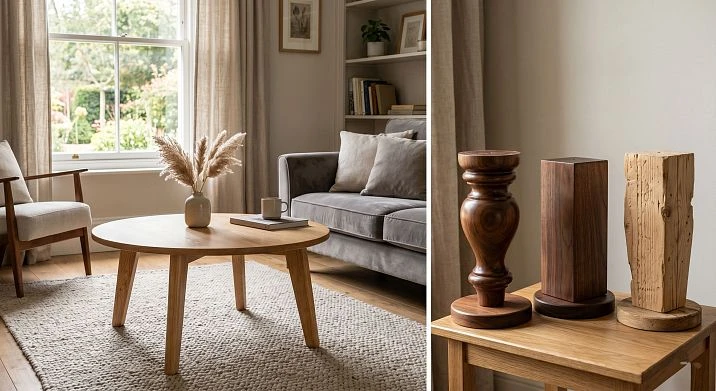
A coffee table is a detail that many take for granted. You place it next to the sofa, put the remote on it, set down a cup — and that's enough. But it is the coffee table that sits at the very center of the living room area, in the zone of constant visual contact. And it is its legs that act as the conductor of the entire sofa group: they connect the table with the sofa, the rug, the flooring, the TV stand, and the decor. One wrong decision — and the center of the living room "falls apart."
Wooden legs for a coffee table — this is a separate topic, unlike choosing supports for a dining table or selecting legs for a sofa or armchair. It has its own logic of height, its own geometry, its own proportions. And its own mistakes, which occur again and again. Whether you want to pick new supports for a ready-made table, restore an old one, or build a coffee table from scratch — this article will give you a comprehensive answer.
Why a coffee table needs special legs
The question is not rhetorical. Legs for a coffee table are indeed a separate category, and here's why.




Different height — different logic
A standard dining table stands at a height of 72–76 cm. A desk — 72–75 cm. A kitchen table — 86–90 cm. A coffee table is fundamentally different: its height is 35–55 cm, and in some design solutions, even 25–30 cm. This is not just a "lower table." It is a different functional category, where the legs work differently.
At such a low height, the legs visually occupy a larger share of the overall volume of the furniture piece. They are in plain sight. They are read instantly. A thin, elegant, turned leg on a coffee table is not a detail — it's an accent. Conversely, a massive square support on a small round table will turn a light piece into a heavy and clumsy structure.
Our factory also produces:
Connection with the sofa area
The coffee table lives next to the sofa and armchairs. This is its permanent habitat. So, legs for a coffee table they should be in dialogue with the legs of the sofa, armchairs, and ottomans. If the sofa has turned oak supports, a coffee table with similar turned legs will create a unified furniture family. If the armchair has conical beech supports, a table with a similar solution will close the sofa group into a cohesive ensemble.
Get Consultation
Decorative function
In the living room, the coffee table often serves as a decorative center: books lie on it, vases, candles, and decorative objects stand on it. Beautiful Legs for coffee table make the table itself a decorative object — even when there is nothing on it.
How to choose the height of legs for a coffee table
This is the first and most important parameter. The height of the legs determines the table's functionality, its proportions, and its fit with the sofa area.
How to calculate correctly
The optimal height of a coffee table is 5–15 cm lower than the seat height of the sofa or armchair. If the sofa has a seat height of 45 cm, the coffee table should be 30–40 cm high. With this ratio, it is comfortable to reach for a cup without bending over, and the table surface does not "block" the view of the sofa.
Now the height of the legs: if you have a tabletop with a thickness of 30–40 mm and you want a total table height of 38 cm, the legs should be 34–37 cm. The arithmetic is simple, but it needs to be done before purchase, not after.
Low legs: 8–15 cm
Tables on very low supports — with a height from floor to tabletop of about 25–35 cm — create a characteristic Asian or Scandinavian effect of "groundedness." Such a table looks pressed into the carpet, monumental, and calm. This works well for minimalist interiors where furniture is "pressed" to the floor.
Downside: it's uncomfortable to sit on a sofa at such a table — you have to bend down a lot.
Medium legs: 15–25 cm
The most versatile range for most living rooms. The final table height is 35–50 cm. Convenient to reach from the sofa, convenient to place a glass or book. Medium-height legs give the table lightness while maintaining stability. Most models in the category are offered in this range. Legs for wooden tables.
Higher legs: 25–35 cm
Such legs give a coffee table an airy feel. The table visually "floats" above the floor, especially if the legs are thin and tapered. This is a solution for Scandinavian, mid-century, and modern living rooms where upholstered furniture also has high supports.
tall wooden legs for furniture In the context of a coffee table — a bold but expressive solution. A table on long tapered legs made of natural oak with a thin tabletop of glass or light wood is a classic of Scandinavian design.
Practical table
| Leg height | Final table height | Best interior |
|---|---|---|
| 8–15 cm | 25–35 cm | Minimalism, Japanese style |
| 15–25 cm | 35–50 cm | Classic, Provence, modern classic |
| 25–35 cm | 45–60 cm | Scandinavian, mid-century, loft |
Leg shape: straight, round, turned, figured
The shape of the leg is the language furniture speaks. Before choosing, it's important to understand what exactly your coffee table should 'say' in the living room interior.
Straight and tapered legs
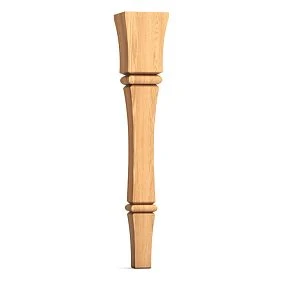
Straight legs with a square or rectangular cross-section are calm geometry for a calm interior. They don't claim to be an accent — they simply hold the tabletop reliably and don't interfere with the overall perception of the space.
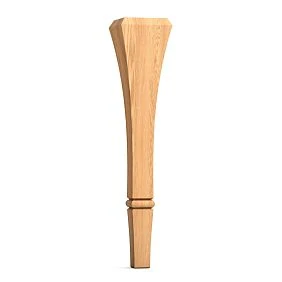
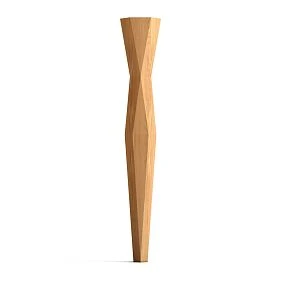
Tapered legs (narrowing towards the bottom) are a variation of a straight support, but with dynamics. The cone adds lightness. It was these legs that mid-century designers used in the 1950s–60s, and today this technique is back in fashion. The tapered silhouette works well with thin tabletops made of MDF, glass, plywood, or natural veneer.
Turned legs
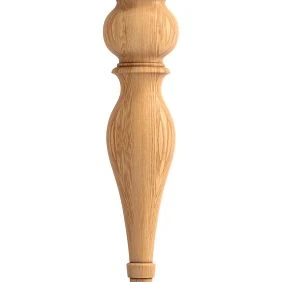
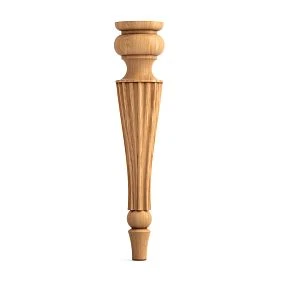
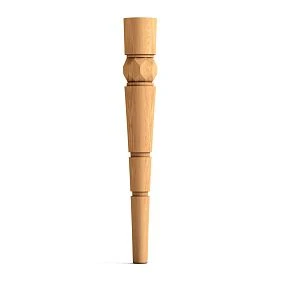
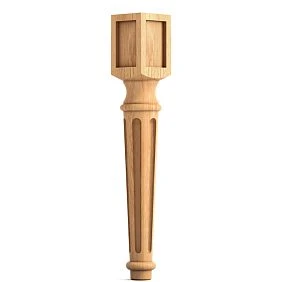
wooden furniture legs Turned legs are the result of lathe work: rollers, necks, spools, balusters, widening bases. A turned leg immediately references classical architecture, furniture from the 18th–19th centuries, and a neoclassical interior.
For a coffee table, turned legs are an ideal choice if the interior leans towards classic, neoclassical, baroque, or Provencal style. It's important to maintain scale: a turned leg for a small coffee table should be delicate — diameter 30–40 mm, without excessive profiles.
By the way, round wooden furniture support is a separate category in the classification of furniture legs. Cylindrical and semi-cylindrical supports create a special rhythm that harmoniously combines with round and oval tabletops.
Shaped legs
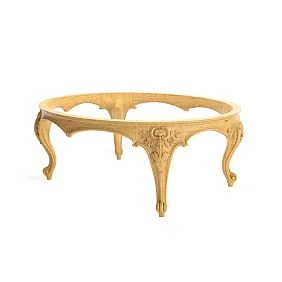
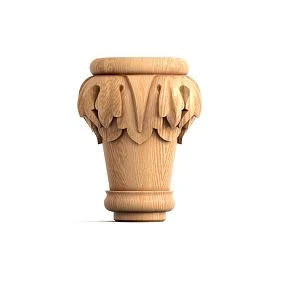
Curved supports — cabriole legs with an S-shaped curve, carved legs with leaf decor, legs with a "paw" base — this is decorative maximalism. They are only suitable for corresponding furniture: exquisite, rich, with carved overlays, expensive upholstery, and glass inserts. Placing a cabriole leg under a Scandinavian table made of light birch is nonsense. But under an antique or aged table with a carved top, it is impeccable.
Spherical and voluminous supports
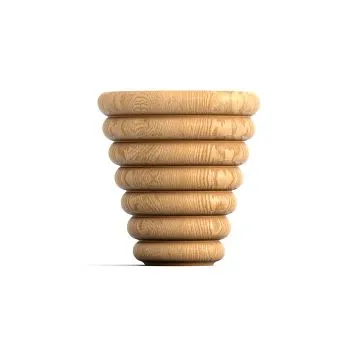
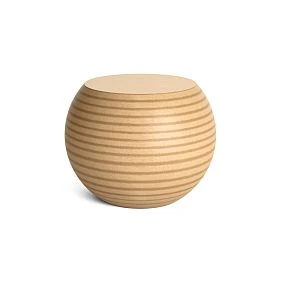
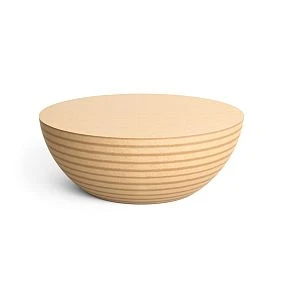
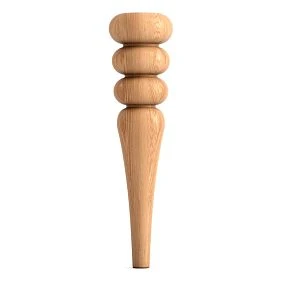
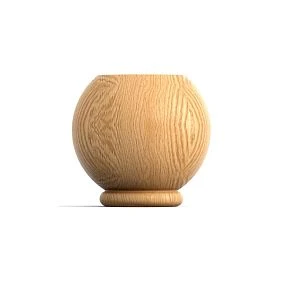
Spherical legs, wide barrel-shaped supports — a rare and expressive option. They create a heavy, stable, almost monumental silhouette. They work well under tabletops with a thick profile — made of solid wood, natural stone, or thick glass.
Legs for round, oval, and rectangular tables
The shape of the tabletop directly influences the choice of supports. This is not obvious, but a very important point.
Round coffee table
A round table requires either three or four legs. Three legs provide perfect stability on any floor — three points always form a plane. Four legs give visual symmetry, familiar to European furniture perception.
Especially good for a round table turned legs for a coffee table — they rhyme with the rounded shape of the tabletop. Conical supports are also appropriate. Square straight legs on a round table create a geometric contradiction — they can be used, but only intentionally, as a design technique.
Leg placement for a round table: with three legs — an isosceles triangle, with four — a square. The distance from the edge of the tabletop to the leg is no more than 10–15% of the diameter.
Oval coffee table
An oval table — an elongated shape that fits well into long sofa areas. Four legs are standard. For table lengths over 100 cm, six support points are recommended for even load distribution.
The shape of the legs for an oval table is the same as for a round one: turned or tapered, without pronounced geometric rigidity.
Rectangular coffee table
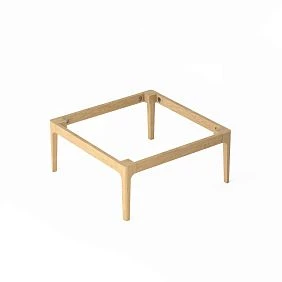
A rectangle is the most common shape. Four legs at the corners is the classic scheme. For lengths over 120 cm and a heavy tabletop (solid wood, glass, stone) — six legs.
For a rectangular table, both straight geometric legs and turned legs look organic, depending on the style. Square supports on a rectangular table create a strict geometry that works well in minimalism and modern classics. Turned legs are for classic and neoclassical styles.
Wooden legs for a classic coffee table
A classic coffee table is not just a "low table with legs." It is an object with its own architecture, proportions, and history. And the legs for it should be appropriate.
What "classic" legs for a table mean
Classical wooden furniture legs — это прежде всего точёный профиль. Валики, катушки, расширяющееся основание с «блюдцем» или «подошвой». Такой профиль берёт начало в архитектурных ордерах, в мебели эпохи барокко, классицизма и ампира.
Для современного классического интерьера достаточно деликатной точёной ножки без избыточной детализации: одна-две шейки, плавный переход к конусу, небольшое уширение к основанию. Высота — 18–25 см. Диаметр — 35–50 мм.
Связь с другим декором гостиной
Классические ножки журнального столика должны перекликаться с другими деревянными элементами интерьера. Если у дивана и кресел есть деревянные точёные опоры — столик с аналогичными ножками замкнёт диванную группу в единую мебельную семью. Если в комнате есть деревянные Moldings на мебели и декоративные накладки — ножки должны быть в той же породе дерева и близком оттенке отделки.
Wooden decor for furniture — резные накладки, розетки, угловые элементы — позволяет превратить обычный журнальный столик в произведение мебельного искусства. Комбинация точёных ножек из дуба с резной накладкой на торце столешницы — это уровень, который сразу виден и сразу оценивается.
Цвет ножек в классическом интерьере
Тонировка под орех — универсальное решение для классики. Тёмный каштан — для богатых интерьеров с тёмной корпусной мебелью. Лакированный натуральный дуб — для светлых неоклассических гостиных. Белая эмаль — для прованса и светлого классического интерьера.
Ножки для реставрации старого журнального столика
Реставрация журнального столика — отдельный коммерческий сценарий, и весьма популярный. Столик может быть хорошим, прочным, с красивой столешницей — но на потрёпанных или несовместимых с интерьером ножках. Именно замена опор нередко оказывается единственным нужным шагом.
When it's enough to replace only the legs
-
The tabletop is intact, without chips or serious damage
-
The frame or base is rigid and sturdy
-
The height or style of the old legs is unsatisfactory
-
The legs are different colors due to time, moisture, or unsuccessful painting
-
One or two legs are broken, and finding identical ones is not possible
In any of these cases Buy legs for furniture — the right solution. The cost of four new wooden supports is incomparably lower than the cost of a new table, and the result is visually indistinguishable.
How to prepare for restoration
First of all, determine the type of fastening. In old Soviet tables, the legs are often attached with screws into the end of the chipboard. In later models, threaded bolts are screwed through a mounting bushing. In designer pieces, metal mounting plates with bolted connections are used.
The second step is to measure the diameter or cross-section of the socket, as well as the distance between the mounting points. This will allow you to select legs with the required mounting element.
The third step is to determine the desired final height of the table. Subtract the thickness of the tabletop from it, and you will get the required height of the legs.
For painting or with a finish?
Buy furniture legs for a 200-room hotel project — this is not an ordinary deal, but a partnership requiring a special approach. In an unpainted form — the right choice for restoration. You choose the color, stain, or varnish yourself — exactly to match the tone of the tabletop and the rest of the interior. Unpainted legs made of solid oak or beech easily accept any color: white enamel, clear varnish, walnut tint, or "wenge" or "tobacco" stain.
Material and finish of legs for a coffee table
Choosing the material is a choice of durability, appearance, and feel under the hand. For a coffee table in the living room, wooden legs made of solid wood are the optimal solution in all respects.
Oak
Oak is a hard and durable species with an expressive large texture. Turned and geometric legs made of oak look expensive and solid. Oak accepts tinting, varnish, and oil well. After treatment, it acquires a depth of color that is unattainable for soft species. Oak legs are a choice for classic, neoclassical, and modern classic interiors.
Beech
Beech is a homogeneous species with a fine texture, ideal for turned and carved work. Profile details come out clear, without burrs. Beech legs are especially good for painting in white or light shades — the surface is smooth and uniform. For Provencal, country, and light neoclassical interiors, beech is the best material.
Finish options and their applications
Unpainted solid wood — maximum flexibility. You determine the final finish yourself. This is the best choice for restoration or when the exact shade is important to match the flooring.
Natural varnish is a transparent coating that preserves the natural color and texture. It works well with light interiors with natural shades.
Toning is a colored stain that gives wood the desired shade without losing texture. Popular options: natural oak, honey oak, walnut, tobacco, wenge.
White enamel or tinted paint — for Provence, country, neoclassical, and Scandinavian interiors. White table legs with a dark tabletop is one of the most striking and widely replicated techniques.
Patina is an imitation of aged decor. Gold or silver patina on a dark base creates an antique effect. Suitable for Empire, Baroque, and classic interiors with expensive furniture.
Connection with the floor, baseboard, and furniture
Wooden decoration and furniture legs work in one system. Coffee table legs should echo:
-
The shade of the flooring (parquet, laminate, solid wood)
-
The color and profile of the baseboard
-
The tone of the wooden legs of the sofa and armchairs
-
The shade of the wooden handles of cabinets and dressers in the living room
This does not require a literal match. But there must be logic: one palette, two or three shades in it — and no random contrast.
How to combine a coffee table with living room furniture
A coffee table is not an independent object. It is part of a system. And it is its legs that are the very 'assembly point' where the system either comes together or does not.
Pairing with the sofa and armchairs
О wooden legs for the sofa and armchair it is described in detail — here it is important to establish the principle: the legs of the coffee table should be in the same stylistic family as the legs of the sofa. This does not mean 'identical'. It means 'related': the same type of wood, the same shade, the same profile style.
Pairing with the TV stand and chest of drawers
The TV stand is the second most important piece of furniture in the living room after the sofa. If it has wooden legs, they should read in the same tone as the legs of the coffee table. The chest of drawers, bookcase, display cabinet — all are elements of a single ensemble. Furniture and Decor from the same line and the same type of wood — the best way to ensure this unity.
Pairing with the rug
A rug in the living room is the "frame" of the sofa group. A coffee table usually stands on the rug or on its edge. The legs of the table on the rug create a visual spot — especially if they are thin and light on a dark pile. This should be taken into account: on a variegated or dark rug, darker legs that do not "sink" against the background of the pattern work better.
Connection with the window and light
Natural wood legs play differently under different lighting. In bright daylight, they are lighter and more transparent. In evening light, they are deeper and warmer. Consider the orientation of the windows and the type of lamps when choosing the shade of the finish.
Additional wooden elements of the living room in one system
The legs of the coffee table are only part of the overall decorative program of the living room. For a complete interior solution, it is important to connect them with other wooden elements of the space.
Wooden moldings and overlays for furniture
Wooden moldings for walls and furniture are used for decorating facades of cabinets, doors, display cases, and case furniture. In the living room, moldings on a wall unit or sideboard are an excellent way to create a unified language with the turned legs of the coffee table.
Wooden handles and fittings
Wooden fittings and decor for furniture are another element of the system. Handles of cabinets, chests of drawers, and nightstands made of the same species and in the same shade as the legs of the coffee table create the feeling of a design project — even if the furniture was bought in different places.
Wooden legs for different pieces of furniture
If there are several pieces of upholstered and case furniture with wooden supports in the living room, it is important that they all follow the same logic. Details about supports for different types of furniture are in the article. wooden legs for chairs and tables: it covers high dining supports, which are fundamentally different from low coffee table supports.
Common mistakes when choosing legs for a coffee table
This block is a concentrate of practical experience. The mistakes are simple but occur constantly.
Mistake 1: Legs that are too high
The most common one. Carried away by the airiness of the Scandinavian style, a person chooses legs of 30–35 cm — and the coffee table ends up at a height of 55–60 cm, turning into a small dining table. It is inconvenient to reach from the sofa, it visually "competes" with the seat rather than complementing it. Always calculate the final height before ordering.
Mistake 2: Thin legs under a heavy tabletop
A tabletop made of solid wood or natural stone weighs significantly more than it seems. Thin turned legs with a diameter of 20–25 mm under a stone slab are a risk of deformation and destruction. For heavy tabletops, choose buy furniture support with a diameter of at least 45–50 mm made of hardwood (oak, beech).
Mistake 3: Random color
"Well, roughly similar" — that's what people think when choosing legs without comparing them to real samples. As a result, the legs are cold gray, the tabletop is warm honey, the parquet is reddish-brown. Three unrelated tones — and the interior "falls apart." Always check the color against a real sample of the floor or furniture.
Mistake 4: Style mismatch
Turned legs for a table made from an untreated slab board in loft style. Or tapered Scandinavian supports for an antique tabletop with a carved edge. This isn't eclecticism — it's bad taste. The shape of the leg should match the character of the tabletop and the overall style of the living room.
Mistake 5: Instability due to uneven floor
In real apartments, floors are rarely perfectly level. If the legs don't have adjustable glides, the table will wobble. When buying wooden legs for restoration or assembling a table, make sure the bases have soft glides that compensate for minor unevenness.
Mistake 6: Wrong number of legs
A round table with a diameter of 80 cm on two legs is unstable and potentially dangerous. A rectangular table 120×60 cm on four legs holds up well, but with six supports, it holds up perfectly. Don't skimp on the number of supports.
Where to buy wooden legs for a coffee table
When everything is thought out — height, shape, material, finish — all that remains is to find a reliable supplier with a real assortment and guaranteed quality. This is where it's important not to waste time searching through different stores.
STAVROS: specialized catalog of furniture legs
STAVROS is a manufacturer and distributor of wooden products for furniture and interiors. The catalog features a wide range wooden legs of different shapes, heights, and types of finishes — made from oak and beech, in unpainted form and with coating. Among them, there are solutions specifically for coffee tables: low, medium, turned, conical, spherical — for every taste and style.
furniture leg in the STAVROS catalog is not a "mass-market product." Each item is made from professionally dried solid wood that has undergone multi-stage sanding. Stable geometric parameters, precise mounting holes, and an even surface ensure not only a beautiful appearance but also durability in use.
buy wooden furniture legs can be ordered from a single piece — an important detail for those involved in restoration or looking to replace one broken support. Delivery across all of Russia. Warehouse program — always in stock.
What else does STAVROS offer for the living room
In addition to furniture legs, the STAVROS catalog includes a full range of wooden elements for the living room:
-
decorative elements for furniture — carved and milled overlays for facades, display cabinets, and dressers
-
Wooden decoration — medallions, rosettes, corner overlays, and belts
-
Wooden moldings — for furniture facades and doors
-
Furniture wooden handles — turned and shaped solid wood handles
-
Wooden moldings — baseboards, cornices, moldings, wall strips
All of this is produced within a unified quality system and compatible proportions. By ordering legs, handles, and overlays from one supplier, you guarantee stylistic and material unity of all wooden decor in your living room.
Frequently asked questions
What height of legs is needed for a coffee table?
The optimal final height of the table is 5–15 cm below the seat height of the sofa (usually 30–45 cm). The leg height is calculated as follows: desired table height minus tabletop thickness. For a standard living room with a sofa at a height of 45 cm, the optimal legs are 15–25 cm.
How many legs does a coffee table need?
Round table — 3 or 4 legs. Rectangular table up to 100 cm long — 4 legs. For lengths from 100 to 130 cm — 4–6 legs. For lengths over 130 cm and a heavy tabletop — 6 legs. Three legs provide ideal stability on uneven floors; four and six provide symmetry and a classic look.
Which legs to choose for a round coffee table?
The best choice is turned or tapered legs that rhyme with the round shape of the tabletop. Three legs at the corners of an equilateral triangle provide ideal stability. Four legs provide a classic scheme with visual symmetry.
Can you put high legs on a coffee table?
Yes, if the final height of the table does not exceed 55–60 cm. In this case, the style of the legs should match a 'light' look (tapered Scandinavian supports). High, heavy legs will make a small table unstable and disproportionate.
How to choose the color of the legs to match the tabletop and floor?
Three ways. First — to match the floor: legs and floor of the same shade, visually 'grounds' the table. Second — to match the tabletop: a monochrome piece. Third — contrast: dark legs on a light tabletop or vice versa. Contrast is acceptable if it is also present in other living room items, otherwise the table will stand out from the overall picture.
Which legs are best for restoring an old coffee table?
Unpainted wooden legs made of oak or beech with the required type of mounting. Before ordering, measure the sockets or threaded inserts of the old legs. Choose a height close to the original or deliberately changed. Finish the new legs to match the tabletop — and the table will get a second life.
Where to buy wooden legs for a coffee table in Russia?
STAVROS is a specialized manufacturer and supplier of wooden furniture legs made of solid oak and beech. Wide range of shapes and heights, unpainted and finished, order from one piece, delivery across the country.
STAVROS is a reliable partner for everyone who creates beautiful interiors: from private owners restoring their favorite table to professional designers and furniture workshops. In the STAVROS catalog you will find Legs for coffee table for every taste and style, as well as the entire range of wooden furniture decor — in a unified quality system, in the same wood species, in the same logic of proportions. Trust STAVROS — and your coffee table will become a true center of attraction in the living room.