Article Contents:
- Why chair legs should not be chosen as a decorative element
- What this means for the workflow
- What the manufacturer says about load capacity
- What dimensions you need to know before buying chair legs
- What to record in the project card
- Tolerance
- Leg height and seat height are not the same thing
- Example calculation
- About the floor clearance
- Glides
- Front and rear chair legs: do they have to be identical
- The main rule
- How to check
- Leg splay
- Turned wooden legs for armchair
- The distinctive turned shape
- About the pattern and light
- Real turned STAVROS models for armchairs
- MN-081
- MN-083
- What they have in common and how they differ
- Other models in the plan
- Carved legs for a chair
- How to combine carving
- About light and finish
- Cost of carving
- Carved models suitable for armchairs
- MN-052
- Other carved models
- How to use the MN-052 example
- Geometric legs for a modern armchair
- MN-054
- Other geometric models
- When geometry beats carving
- How to choose between a turned, carved, and geometric leg
- Selection order
- Beech or oak for armchair legs
- Wood species price using MN-052 as an example
- Glue-up grade
- Sanding level
- Unfinished legs or a ready-made finish
- What to do about the finish
- When ready-made ones are better
- Why you can't just put sofa legs on an armchair
- What to do when in doubt
- The mounting plate matters more than the decorative shape
- Fiber direction
- Indent from edge
- About glides and floor protection
- How to check a leg with a physical sample
- Sample and frame
- How many samples
- Conditions
- Four legs or a front and rear pair: specification
- Budget example
- What to record for reordering
- Chair legs and upholstery color
- How to check
- Replacing the legs on an old chair
- When to replace just one
- Different original legs
- A loose socket
- When legs are not needed separately
- How to choose between two paths
- Where to buy wooden chair legs
- Order terms
- What to clarify with the manager
- Workshop questions
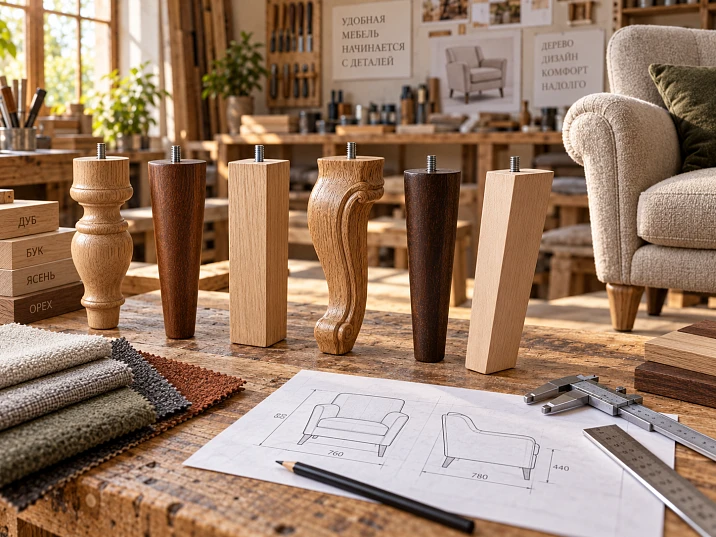
The chair is assembled, upholstered, and placed on the floor, but sitting in it ends up five centimeters lower than intended. The spring block with the soft padding turned out thicker than in the drawing, and the leg that provided the right seating height in the sketch no longer compensates for the difference. Reupholstering is expensive, so the only way to fix the situation is to replace the legs. Hence the rule: chair supports should be chosen before assembling the frame, not after upholstery.
A chair leg determines not only the appearance but also the seating geometry: seat height, clearance from the floor, body position, and visual tilt. Therefore, selection goes from the project to the catalog: first the required leg height and mounting plate parameters are calculated, then the shape (turned, carved, geometric), wood species, and finish are chosen, then a sample is checked on the frame. Below, the entire chain is broken down: chair type, body height, required leg height, position of front and rear supports, shape, material, fastening, sample, set, purchase. A general overview of all furniture legs is covered in separate materials, for example about furniture legs for a dresser, cabinet, and consoleand here we are talking only about the armchair.
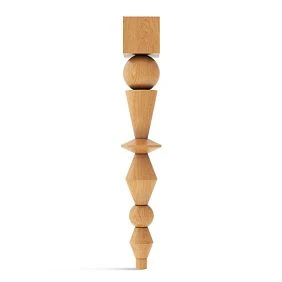
Why armchair legs cannot be chosen as a decorative element
The leg of a chest of drawers or cabinet raises the body above the floor, and a tolerance of a few millimeters is almost imperceptible. In an armchair, a person sits on the structure, and the height of the support adds up to the height of the seat. An error of 20 mm is felt immediately: the knees end up too high or too low, and getting up from the armchair becomes inconvenient.
If you change the height of the support, five things change:
-
the overall height of the seat;
-
the position of the body relative to the floor;
-
the visual mass of the armchair;
-
proportion between the body and the support;
-
sometimes the seating angle, if the front and rear legs are of different heights.
Moreover, an armchair leg works under load differently than a table leg. The load is not strictly vertical: a person sits down, leans forward, leans back, and the supports experience lateral forces. Therefore, the decorative form is secondary: first, structural compatibility with the frame, then appearance.




What this means for the order of work
Legs are selected before the final assembly of the frame. If the frame is already glued and upholstered, any error in height or mounting plate turns into rework. The correct sequence is: design, measurements, height calculation, article selection, sample, fitting on the frame, approval, series.
Our factory also produces:
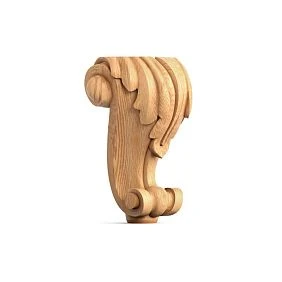
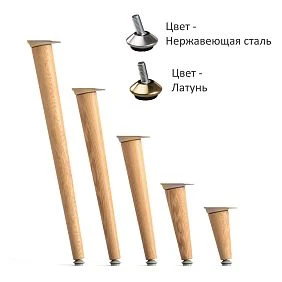
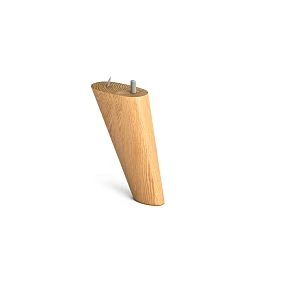
What the manufacturer says about load
In the FAQ section on STAVROS product cards, it is stated that all furniture legs withstand a vertical load of at least 100 kg. This is a general catalog claim. For individual models, the load may be limited: for example, the MN-233 leg from another line is explicitly marked "for small loads." Therefore, for a specific chair model, check the load on the product card and in the project, and do not rely on the general statement.
Get Consultation
What dimensions you need to know before buying legs for a chair
Do not open the catalog until the project parameters have been recorded. First, write down seven values:
-
chair body height without legs: from the lower plane of the frame to the top of the seat with the soft package;
-
required final seat height from the floor;
-
thickness of the soft package: springs or webbing, foam rubber, synthetic padding, upholstery;
-
required clearance from the floor to the lower plane of the frame;
-
dimensions of the mounting plate: where the leg attaches to the frame;
-
distance from the mounting point to the edge of the body;
-
location of the front and rear supports.
The main principle: the required geometry of the chair determines the article number, not the other way around. A beautiful leg that does not fit the dimensions is useless.
What to record in the project card
For each chair, keep a short card: model code, type (classic, modern, with or without armrests), target seat height, body height, required leg height with tolerance, mounting pad size, mounting type, number of supports. Such a card allows you to compare catalog candidates by numbers and preserves decisions for repeat orders.
Tolerance
Set the height tolerance in advance. For example, ±5 mm from the target seating height. Then from the catalog you can choose not just one specific leg, but any that falls within the range. Without a tolerance, you will either not find a suitable one or take the first one you come across and adjust the frame.
Leg height and seating height are not the same thing
The final seating height is made up of several layers: the frame, the seat base, the soft padding, and the legs. You cannot see a 150 mm leg and automatically conclude that the chair will become 150 mm higher. You need to take into account the actual frame construction, the mounting method, and whether the leg goes into the frame (on a stud) or supports it from below.
The formula for calculation is simple: leg height equals the target seat height minus the body height from the bottom of the frame to the top of the seat, taking the upholstery into account. There are nuances. If there is a mounting plate or a foot pad between the leg and the frame, add their thickness. If the seat "sinks" under load, use the loaded seating height, not the height in the unloaded state.
Example calculation
Conditional data. Target seat height 450 mm. Body from the bottom of the frame to the top of the seat together with the soft padding 330 mm. Then a leg of approximately 120 mm is needed.
In the STAVROS catalog, the carved leg MN-052 is available in three sizes: according to the size chart, A equals 95, 115, and 137 mm. If A is the height (verify this using the drawing in the product card), then the options yield a seat height of 425, 445, and 467 mm. The closest option to the target is 115 mm with a result of 445 mm, a deviation of 5 mm. The 137 mm option gives +17 mm, which is outside the ±5 mm tolerance. The 95 mm option gives −25 mm.
As you can see, the choice of three sizes narrows down to one, and this is a normal situation: for each model, the range is limited. Therefore, if none of the sizes falls within the tolerance, it makes sense to change the frame by a few millimeters or choose a different model.
About floor clearance
Clearance is the distance from the floor to the bottom plane of the frame. It depends on the leg height and affects two things: cleaning under the chair and visual lightness. Too little clearance makes the chair look squat, while too much leaves the body "hanging." Set the minimum allowable clearance based on the chair's purpose and check it on a sample.
Glides
A glide is a pad on the bottom end of the leg. The catalog offers round, square, and felt glides: FUR-021 (d=19 mm, 130 rubles), FUR-022 (d=30 mm, 170 rubles), FUR-027 (d=24 mm, felt, 55 rubles), FUR-028 (d=28 mm, felt, 70 rubles), FUR-023 (square 25 × 25 mm, 110 rubles). Prices at the time of checking. They add height, albeit a small amount, and protect the floor. Check the glide thickness in its product card and take it into account when calculating the height.
Front and rear chair legs: must they be identical?
Not necessarily. Three configurations are possible.
Four identical legs are suitable for simple geometry and a symmetrical design. This is the most economical option: one SKU, one entry in the specification.
Decorative front legs, more subdued rear legs. This solution is typical for classic chairs: the front legs are more visible, so they receive more attention, while the rear ones are made simpler or shorter.
Front and rear legs with different geometry. This is needed if the design requires a different position or visual angle: the rear legs may be set at an angle (splay), while the front legs are straight. In that case, the rear legs often differ in height and mounting method.
The main rule
Do not assemble a set from visually similar items without checking the actual geometry. Two legs that look identical in a photo may differ in height by 10–20 mm, in the diameter of the top, or in the position of the hole. On an armchair, this causes skewing or wobbling.
How to check
Lay out the selected legs on a table, insert them vertically, and compare the heights with a caliper. Place the top plates against the frame at the mounting points. If the legs are the same model but different sizes from the same range, make sure you have chosen exactly the right sizes for the front and rear positions.
Leg splay
For legs installed at an angle, the catalog offers mounting plates with a tilt. For example, the product page for the turned leg MN-233 from the adjacent line offers a 10-degree mounting plate (FUR-017, from 330 rubles). For similar solutions for armchair models, check the recommended hardware on the specific product page. It is best to discuss the details of angled mounting with a manager before ordering.
Turned wooden legs for an armchair
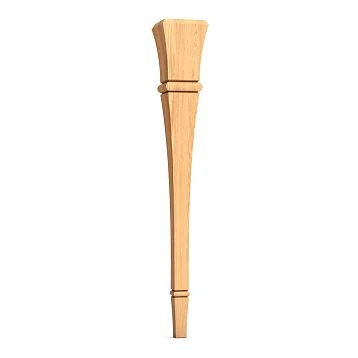
Turned legs are suitable when you need axial symmetry, a classic shape, beads, necks, transitions, and decorative rhythm. Lathe turning produces a round cross-section and repeating elements that create a play of light and shadow. Such a leg looks good on classic and neoclassical armchairs and on furniture in a calm decorative style.
The catalog is organized in the section Turned Legs. Filters allow you to select items by application: sofa, armchair, chest of drawers, cabinet, table, chair, and others. For an armchair, select items with the application “sofa, armchair” or “armchair,” but do not treat the filter checkbox as a guarantee: check the dimensions and load capacity.
Feature of the turned shape
The turned leg is round, so it has no "front" or "back" side, and there is no need to orient it according to the pattern. This simplifies assembly. However, the round cross-section of the upper part requires a round hole or one with a suitable fit, and the fastening method (dowel screw, screw) is determined by the design of the leg.
About pattern and light
Beads and transitions create shadows, but on an armchair viewed from a distance of two to three meters, small transitions blend together. For a large armchair in a spacious room, choose a profile with pronounced large elements. For a small armchair in an intimate interior, finer transitions will work.
Real turned STAVROS models for armchairs
Abstract reasoning is more useful when supported by specific product cards. Below are models verified against catalog data.
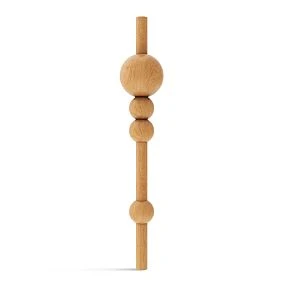
MN-081
Turned leg MN-081 is listed in the product card as a leg for a sofa and armchair. According to the description, it is a round cone-shaped leg with carved patterns on the surface, made of oak or beech, supplied unpainted. For fastening, a metric dowel screw or M8x60 self-tapping screw is recommended (FUR-001-1, 72 rubles), sets FUR-001 (117 rubles) and FUR-012 (152 rubles), and glides FUR-022 and FUR-028. The size and price table is hidden behind the "All sizes and prices" button, so check the height and price in the product card. The "Customers also buy" block shows other legs: MN-145 from 540 rubles, MN-146 from 590, MN-149 from 1,470, MN-186 from 1,280.
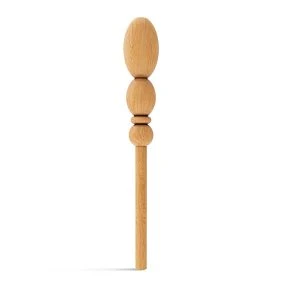
MN-083
Turned leg MN-083 is also intended for a sofa and armchair. In the description, it is called round cone-shaped, made of oak or beech, 100 mm high. The indication of a height of 100 mm is taken from the product card text, and check the exact dimensions and prices in the table. The recommended hardware is the same: FUR-001-1, FUR-001, FUR-012, glides FUR-022 and FUR-028. Nearby, turned MN-023 from 870 rubles and MN-028 from 1,170 are offered.
What they have in common and how they differ
Both models are cone-shaped, round, and intended for upholstered furniture. The differences are in the pattern and height. For comparison, write down A, B, C for both models from the tables and check them against the project. Do not choose based on the picture.
Other models by plan
Cards MN-082 and MN-093 are listed in the Word plan as turned legs for a sofa or armchair. During preparation of the article, their pages were not checked separately, so please verify dimensions, prices, and application in the cards themselves: MN-082 и MN-093. The price of MN-094 from 1,590 rubles appears in the adjacent block, but that is a different model.
Carved legs for an armchair
Carved supports make sense for a classic armchair, furniture with carved armrests, armchairs with button tufting, stylized furniture, and restoration projects. Carving creates volume and relief that interact with the upholstery and the frame wood. The section Carved legs for furniture contains supports with floral and other motifs.
How to combine carving
A carved leg must be coordinated with the rest of the armchair's decor. If the armrests and back are also carved, the leg's motif should repeat or support them. If the frame is smooth and the legs are carved, they will become the only accent, and the pattern should be restrained. Do not mix several competing ornaments.
About light and finish
A relief several millimeters deep almost disappears in diffused light, but in side light it produces a pronounced shadow. An armchair sits low, and the legs are more often in half-shadow, so the relief must be deep enough or the finish contrasting enough for it to read. Thick enamel clogs fine carving, so apply thin layers.
Cost of carving
Carved legs are noticeably more expensive than turned and geometric ones. For example, in the list of unpainted legs there are carved items from 8,370 rubles (MN-184) and from 14,200 rubles (MN-066), whereas turned ones start from 540 rubles (MN-145). The spread is explained by complexity and size. A carved set of four legs for an armchair can exceed the cost of the frame, so assess whether carving is needed.
Carved models suitable for an armchair
MN-052
Carved leg MN-052 named in the card title as a leg for a sofa and armchair. According to the description, its shape resembles a flower blooming on a thin stem, made of oak or beech, supplied unfinished. Dimensions and prices are given in the table.
| Dimensions A × B × E, mm | Material | Standard | Prestige |
|---|---|---|---|
| 95 × 75 × 53 | Beech | 2,550 ₽, in stock in St. Petersburg 5 pcs. | 3,240 ₽, 5–10 days |
| 95 × 75 × 53 | Oak | 3,170 ₽, in stock in St. Petersburg 4 pcs. | 3,750 ₽, 5–10 days |
| 115 × 91 × 65 | Beech | 3,340 ₽, 5–10 days | 4,130 ₽, 5–10 days |
| 115 × 91 × 65 | Oak | 4,380 ₽, in stock in St. Petersburg 8 pcs. | 5,060 ₽, in stock in St. Petersburg 1 pc. |
| 137 × 108 × 77 | Beech | 4,230 ₽, 5–10 days | 5,130 ₽, 5–10 days |
| 137 × 108 × 77 | Oak | 6,090 ₽, 5–10 days | 6,850 ₽, 5–10 days |
Data at the time of checking. The table shows several patterns that will be useful when choosing.
Oak is more expensive than beech at the same size and sanding level: in the 95 mm size and the "Standard" level, the difference is 620 rubles, or about 24 percent, while in the 137 mm size and the "Prestige" level, the difference is 1,720 rubles, or about 34 percent. The "Prestige" level is more expensive than "Standard": for 95 mm beech, the difference is 690 rubles, or about 27 percent; for 137 mm oak, 760 rubles, or about 12 percent. Stock availability in Saint Petersburg is limited to a few pieces, and for a set of four legs, and especially for a series, you will need to allow for a lead time of 5–10 days.
Fasteners are not included: the product page recommends the FUR-001-1 stud (72 rubles), the FUR-001 and FUR-012 sets, the FUR-021 (130 rubles) and FUR-027 (55 rubles) glides. In the table, the columns are named A, B, and E, and you can determine which one is height from the drawing on the product page.
Other carved models
The MN-071 and MN-008 product pages are listed in the Word plan as carved legs suitable for an armchair. While preparing the article, the MN-071 page did not open, and MN-008 was not checked separately, so please review the dimensions and application yourself: MN-071 и MN-008.
How to use the MN-052 example
Set the seat height, calculate the required leg height, choose the suitable one from three sizes, and check whether the top dimensions (B and E) fit within the frame footprint. If you need a series, plan the timeline right away: stock on hand will only cover single sets.
Geometric legs for a modern armchair
If the armchair is modern, minimalist, or Scandinavian, intricate carving may be unnecessary. In that case, consider geometric supports. In the section geometric legs straight, tapered, and faceted shapes with clean lines are collected.
A geometric leg has no decorative elements that draw attention, so proportions and the wood surface come to the fore. With a natural finish, the texture becomes one of the main visual factors. Sharp edges require high-quality sanding: any unevenness is visible.
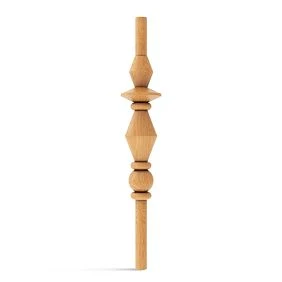
MN-054
Geometric leg MN-054 is titled in the card as a leg for a sofa and armchair. The description calls it a straight geometric shape made of solid oak or beech, supplied unfinished. For mounting, FUR-001-1, FUR-001 and FUR-012 sets, and the square glide FUR-023 (25 × 25 mm, 110 rubles) are recommended. Note the contradiction in the description: the text says the leg "does not require special fasteners," while the card suggests recommended hardware. Confirm the mounting method with the manager before ordering. Nearby in the suggestions block: geometric MN-196 from 1,580 rubles, MN-121 from 3,730, MN-227 from 1,710.
Other geometric models
Cards MN-049 and MN-133 are listed in the plan as geometric legs for a sofa or armchair. Their pages were not checked separately, so see the dimensions and application in the cards themselves: MN-049 и MN-133.
When geometry is better than carving
When the upholstery is expressive on its own (large pattern, velvet, bouclé), a simple leg does not compete. When the chair stands in an interior with straight lines. When the budget is limited: geometric legs are usually cheaper than carved ones. When the series is large and repeatability matters: a simple shape is easier to control.
How to choose between a turned, carved, and geometric leg
| Type | When to choose | What to look for |
|---|---|---|
| Turned | Classic, neoclassic, calm decorative profile | Size of transitions, height, top diameter |
| Carved | Pronounced classic decor, restoration | Coordination with other decor, relief depth, price |
| Geometric | Modern and laconic chair | Quality of edge sanding, proportions, wood species |
But style does not override geometry and the mounting method. First constructive compatibility, then decorative. A beautiful carved leg that does not fit the frame platform is worse than a simple turned one that fits perfectly.
Selection order
-
Filter the catalog by application: “armchair” or “sofa, armchair”.
-
Keep the models that fall within the height range.
-
Check the dimensions of the upper part and the mounting method.
-
From the remaining options, choose by style: turned, carved, or geometric.
-
Order a sample.
This order reduces the choice from hundreds of options to a few, and the decision is made based on numbers, while the style is selected from the remaining ones.
Beech or oak for armchair legs
Here we focus only on practical logic as it applies to an armchair. A detailed comparison of wood species is covered separately, so we won’t repeat it.
Beech is a dense, non-porous wood that the manufacturer recommends for products intended for enamel. It is good for enamel, dense painting, and projects where the texture is hidden. For an armchair with a painted frame, beech provides a smooth surface.
Oak is a dense, porous wood with a pronounced texture. It is chosen when the texture remains visible: oil, clear lacquer, tinting. Oak is especially appropriate when the armchair body contains visible oak parts: armrests, seat rail, backrest. In that case, the legs should match them in species and tone.
Price of the wood species using MN-052 as an example
On the carved leg MN-052, the difference between oak and beech at the same size and sanding level is 24 to 34 percent, as can be seen from the table above. For a set of four legs of size 115 mm in the "Standard" grade, beech costs 4 × 3,340 = 13,360 rubles, oak costs 4 × 4,380 = 17,520 rubles, a difference of 4,160 rubles. For a series of ten chairs, the difference grows to 41,600 rubles. If the legs are going under enamel, this difference is paid for invisible texture.
Glue-up grade
Don't forget about the grade: "under enamel" for opaque finishing and "under tinting" for semi-transparent. In the MN-052 table, beech is listed as "under enamel" and oak as "under tinting". This means that the choice of wood species there coincides with the choice of grade, and you don't need to choose it separately, but it's worth making sure this matches your finish.
Sanding level
"Standard" is machine sanding, "Prestige" is detailed hand sanding, in which the products do not require additional finishing. For carved legs under a transparent finish, "Prestige" saves time on refining the relief. For legs under thick enamel, where minor irregularities are hidden, "Standard" is often sufficient. Weigh the difference in price against the time for additional finishing.
Unfinished legs or a ready-made finish
For chair production, the unpainted option is often more convenient. The reasons are practical: you can paint the legs together with the frame, match the color of the armrests, replicate the tone of the wooden stretcher, and use your own paint and varnish system.
Section unfinished solid wood legs contains the main part of the catalog. All legs MN-081, MN-083, MN-054 and MN-052 from the verified ones are unpainted and are supplied without paint.
Finished legs with a coating are in the section legs with a ready-made finish. They are chosen when a ready-made component is needed and the existing color finish is suitable.
What to do about painting
The manufacturer provides a sequence for products under lacquer or enamel: dust removal after sanding, priming with an even layer, matting after the primer has fully dried, and a final coat of lacquer or enamel in two layers with interlayer drying. For a chair, it is better to finish the legs separately from the frame: this makes it easier to cover all sides and avoid staining the upholstery. Install them after the coating has fully dried.
Whether the manufacturer paints the products themselves depends on the order total: according to their terms, painting is available for orders starting from 150,000 rubles. For small workshops this is a high threshold, so plan your own painting.
When ready-made is better
If you need one or two armchairs and the workshop's painting system is not yet refined, ready-made legs will save time. If it is a series and the color is custom, take unpainted ones.
Why you can't just put sofa legs on an armchair
Some models really do fit both a sofa and an armchair. The card titles say so: "for sofa, armchair." But this does not mean that any sofa leg automatically fits an armchair.
Six points are checked:
-
the load on the specific structure: a sofa distributes weight across six or more supports, an armchair across four;
-
the dimensions of the mounting plate: an armchair has a smaller frame, and the plate for the leg may be narrower;
-
position relative to the edge: on an armchair the legs are located closer to the edges;
-
height: a sofa usually sits higher or lower than an armchair, according to the design;
-
visual scale: a leg that looks appropriate on a three-meter sofa may look massive on a small armchair;
-
number of supports: sofas sometimes have center legs, while armchairs typically do not.
The application must be confirmed by a specific model or a design calculation. The label "for sofa, armchair" in the card title means that the manufacturer allows such use, but it does not remove the need to check the dimensions for your construction.
What to do if in doubt
If you are unsure about the load, ask the manager for specific data on the model. The general claim of a load of at least 100 kg applies to the entire catalog, but for certain shapes (for example, thin geometric ones or those strongly tapered toward the bottom), the actual stability depends on the design of the assembly. Order a sample and test it on the frame.
The mounting plate is more important than the decorative shape
Before purchasing, check seven parameters:
-
size of the upper part of the leg;
-
contact area with the frame;
-
available space on the frame;
-
hole locations;
-
type of fastener;
-
direction of the frame grain at the mounting point;
-
offset from the edge.
Do not choose a fastener based on a photo. The options recommended in the product cards are: metric stud M8x60 (FUR-001-1) or kits FUR-001 and FUR-012. A stud length of 60 mm means the frame must have sufficient thickness for the fit. If the frame timber is thinner, the stud will either protrude outside or require a different solution.
Grain direction
A fastener screwed into the end of the timber along the grain holds worse than across it. Check in which plane the mounting hole is located in your frame, and if necessary use reinforcement: a mounting block or a mounting plate. These issues are decided by the chair designer, and the catalog part should simply not interfere.
Offset from the edge
A leg positioned too close to the edge of the frame creates a cantilever load on the edge and can split the timber. Use your frame design and the dimensions of the upper part of the leg from the table as a guide.
About glides and floor protection
A glide protects the floor and adds stability. Felt glides (FUR-027, FUR-028) are good for parquet and laminate, round hard ones for soft flooring. Choose based on the floor on which the chair will stand.
How to check a leg with a physical sample
For a workshop, the correct order is: one model, one leg, fitting on the frame, checking the height, checking the shape, finishing, approval, set. Especially if a small series of chairs is being produced.
There are seven things to check:
-
actual dimensions: measure with calipers and compare with the table;
-
the top plate: does it match the mounting point;
-
height: does it provide the required fit;
-
visual scale: how it looks on the chair;
-
position: whether the chair stands level;
-
finish: how the chosen system applies;
-
combination with upholstery: color and tone next to the fabric.
Sample and frame
It is best to try the leg on the actual frame, not on a mock-up. If the frame is not ready yet, make a temporary mock-up from timber of the required cross-section. Place the chair on four identical legs and check for wobbling. Then place the upholstery fabric next to it and evaluate the color.
How many samples
One leg is enough to check the height, but four are needed to check stability. If your sample budget is limited, order two legs and at least check the diagonal.
Conditions
The catalog ships items from a single piece, so you can take a sample without any commitment to a production run. In-stock items ship within three business days, made-to-order production takes 5–10 business days, and most items in the warehouse are stored unsanded. Keep these lead times in mind when planning.
Four legs or a front and back pair: specification
An entry like "wooden legs, 4 pcs." is useless for a repeat order. A correct entry includes the code, article number, position, and quantity.
| Code | Article | Position | Quantity |
|---|---|---|---|
| LEG-F | specific SKU | FRONT | 2 |
| LEG-R | specific SKU | REAR | 2 |
If all four are identical, there is one entry: LEG-01 × 4. Add to it the dimensions, wood species, glue grade, sanding level, finish system, hardware, and status (SAMPLE or APPROVED).
Example budget
A hypothetical calculation for one armchair on MN-052 legs, size 95 mm, beech, "Standard": four legs at 2,550 rubles each give 10,200 rubles. Fasteners: one FUR-001-1 stud (72 rubles) and one FUR-027 glide (55 rubles) per leg, totaling 127 rubles per leg, or 508 rubles per armchair. Total about 10,708 rubles for a set of legs with fasteners (assuming one stud and one glide per leg).
For a run of ten armchairs, that comes to 40 legs: 102,000 rubles for the legs and 5,080 rubles for the hardware. At the time of checking, there were five such legs in stock in Saint Petersburg, so the run would take 5–10 days to wait for. The same legs at the "Prestige" level would cost 3,240 rubles, and a set for ten armchairs would come to 129,600 rubles, that is, 27,600 rubles more. The figures are hypothetical: double-check prices and availability in the product page.
What to record for a repeat order
Article number, dimensions, wood species, glue grade, sanding level, finishing system with the number of coats, sample photos, approval date. In six months, this will allow you to order the same legs without re-fitting.
Chair legs and upholstery color
A design question, but it affects the choice of wood species and finish. The main schemes are as follows.
Legs to match the frame. A calm solution: the chair looks whole. Suitable for painted frames and for chairs with wooden armrests in the same tone.
Natural oak and neutral fabric. The material speaks for itself, the wood becomes the main accent. Here, the “for tinting” grade and a careful oil or lacquer finish are important.
Dark tinting and light upholstery. The contrast creates graphic quality: the chair seems to stand on expressive “legs.” Check that the tone of the legs does not blend with the floor.
Legs for enamel. They can be included in the overall color scheme: white or colored legs on a chair with matching fabric.
How to check
Place the fabric sample next to the finished trial leg in daylight. Assess the contrast and the combination of shades. The tone of the upholstery changes under different lighting, so look under the light in which the chair will stand.
But remember: the main task remains commercial, that is, choosing a leg that fits the project in height and seating, while color schemes are secondary.
Replacing legs on an old chair
A useful case for restorers and workshops refurbishing furniture. Before purchasing, check the condition of the chair:
-
all four old supports: are they identical, are they intact;
-
frame condition: are there any cracks at the attachment points;
-
old holes: are they worn out, has the fastening come loose;
-
damage: signs of rot, woodworm, old repairs;
-
height of the original legs: measure on intact ones;
-
mounting angle: are the legs vertical or angled;
-
mounting plate: size and shape.
If the original model cannot be found, it is sometimes better to replace the entire set rather than a single leg. The reason is that a new leg next to the old ones differs in tone, height, and wear, and the chair wobbles or looks mismatched.
When to replace one
If one leg is broken, the others are intact, and a model matching in height, diameter, profile, and mounting has been found to the nearest millimeter. In practice, this is rare, so consider the full set.
Different front and rear legs
Some chairs have different front and rear legs. Do not replace them with identical ones if this would compromise the fit: measure the front and rear legs separately and select matching ones.
Loose socket
If the socket is damaged, first restore it (with a bushing, epoxy compound, or insert), and then install the new leg. A new leg will not hold in a damaged socket. When the frame construction does not allow restoring the joint, contact a restoration specialist.
When legs are not needed separately
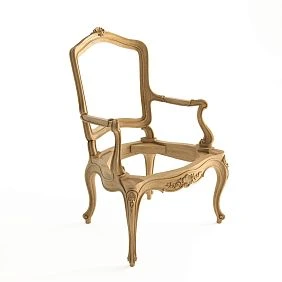
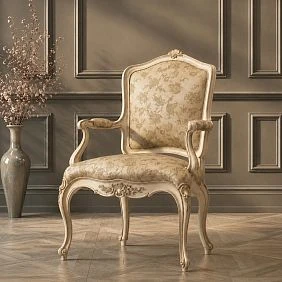
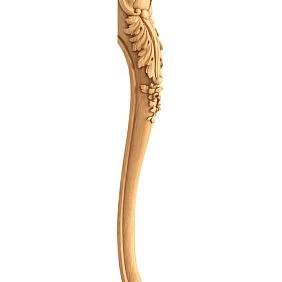
Sometimes the legs are part of the frame and are not purchased separately. Example from the catalog: Armchair frame STU-003 in the Louis XV style. This is a carved cabriole chair frame measuring 676 × 1010 × 688 mm, made of beech (162,120 rubles) or oak (201,370 rubles), with a "Prestige" sanding level, lead time 5–10 days. Its S-shaped cabriole legs with a double curve are integral to the frame: the parts are joined with a mortise-and-tenon joint and glued, and the item is supplied assembled.
This means that separate supports are not needed for such a frame, and the task of choosing legs does not arise. It arises when you make your own frame and want to use purchased supports. Both paths are valid: a ready-made frame with supports saves time, while your own frame with purchased legs gives you design freedom.
How to choose between the two paths
If you need a chair in a classic style and a suitable frame is available in the catalog, calculate: the price of the frame versus the cost of your own frame plus purchased legs. If the project is non-standard, take the second path and choose legs according to the method described here.
Where to buy wooden legs for an armchair
The purchase order follows the project: height and mounting plate, type and wood species, sample, set.
-
Wooden furniture legs: general catalog.
-
unfinished solid wood legs for enamel, tinting, and a unified finish.
-
legs with a ready-made finish for ready-made solutions.
Order conditions
Items are shipped from a single piece. Delivery is available across Russia and CIS countries via the transport companies CDEK and DPD; pickup is also possible; showrooms in St. Petersburg and Moscow, production in St. Petersburg. In-stock items are shipped within three business days; the rest are manufactured on average in 5–10 business days. Cutting items to size is not performed. Non-standard items and size changes are possible only for batch orders. Before ordering, check the current price and availability in the product card.
What to clarify with the manager
Availability of the complete set in a single delivery. The mounting method and hardware set for the selected model. Exact top dimensions and height. Possibility of reserving the SKU for a repeat order. If a non-standard height is needed, the terms of a batch order.
Workshop questions
Which wooden legs are suitable for an armchair?
Those that match your frame in height, top dimensions, and load capacity. In the STAVROS catalog, the turned MN-081 and MN-083, the carved MN-052, and the geometric MN-054 are marked for sofa and armchair. Check the dimensions and mounting in the product card.
Where to buy wooden legs for an armchair?
In the STAVROS catalog in the section Wooden furniture legs. Ordering is possible from a single piece, which is convenient for a sample.
How do I determine the required height of chair legs?
Subtract the height of the body from the bottom of the frame to the top of the seat with upholstery from the target seat height, and account for the thickness of the glide or plate. For example, with a target of 450 mm and a body of 330 mm, a leg of about 120 mm is needed. Set the tolerance in advance.
Can the same legs be used at the front and back?
Yes, if the design and fit allow it. For classic chairs, the front legs are often made more decorative than the rear ones, and angled rear supports require different heights and mounting.
Which is better for a chair: turned or carved legs?
Turned legs are suitable for classics and understated decor, while carved legs are for a pronounced classic style and restoration. Carved legs are more expensive: for example, MN-052 costs from 2,550 to 6,850 rubles per piece depending on size, wood species, and sanding.
How do I choose legs for a modern chair?
Look for geometric supports with straight lines, such as MN-054, and check the quality of sanding on the edges. A simple shape allows the upholstery and material to work without competition.
What to choose: beech or oak?
Beech for enamel and paint, oak for oil, lacquer, and tinting with an open texture. If the frame contains visible oak parts, choose oak. The price difference for MN-052 is 24–34 percent.
Can wooden legs be painted to match the frame color?
Yes, this is the standard process for unfinished legs. The sequence: dust removal, primer, sanding, two coats of finish with intercoat drying. Finish the legs separately from the frame and install them after they are completely dry.
Can I replace just one broken chair leg?
Yes, if the height, diameter, profile, and mounting match the others to the millimeter. If there is no exact match or the legs are worn, it is better to replace the entire set.
Should I order a sample leg before manufacturing a batch?
Yes, for a new SKU. A sample verifies the height, stability, top, and finish on the frame. Ordering from one piece allows you to do this without committing to a production run.
The specifications, dimensions, and prices of MN-052, the composition of the recommended hardware, ordering terms, and data on frame STU-003 have been verified against the STAVROS catalog cards at the time of preparation. Calculations are illustrative.