



























Article Contents:
- Confirmed specifications of MN-207 and MN-227
- Why the difference between models is not just 35 mm in height
- Direct comparison: wide MN-207 or compact MN-227
- When it makes more sense to choose MN-207
- Wide chest of drawers with a massive body
- Massive bedside table and long console
- Sofa, ottoman, or pouf with a pronounced base
- A project where the leg is an independent design element
- Bedside table and compact dresser
- TV cabinet and long low unit
- Small wardrobe and cabinet with narrow sides
- Minimalist facade that should remain the focal point
- Comparing only height
- Not making a kit mockup
- Not recalculating total furniture height
- Promising load without calculation
- Placing support under a weak bottom area
- Forgetting about central support for a long body
- Choosing finishing after purchase
- Paint without a test swatch
- Ignoring floor protection
- Using old holes without checking
- How is MN-207 different from MN-227?
- Which leg to choose for a wide dresser?
- Which model is best for a bedside table?
- Can MN-207 be placed on a small cabinet?
- Is MN-227 suitable for a long TV cabinet?
- What material are the models made of?
- What to choose — beech or oak?
- How many legs are needed for a dresser?
- Can the load of one leg be specified?
- Will the robot vacuum cleaner fit under the furniture?
- Which glides are suitable for MN-227?
- Which glides are suitable for MN-207?
- Do I need to paint the legs before installation?
- Can I use the old holes?
- Where to buy MN-207 and MN-227?

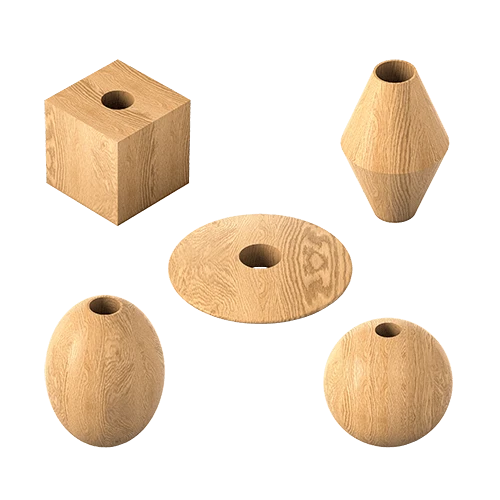
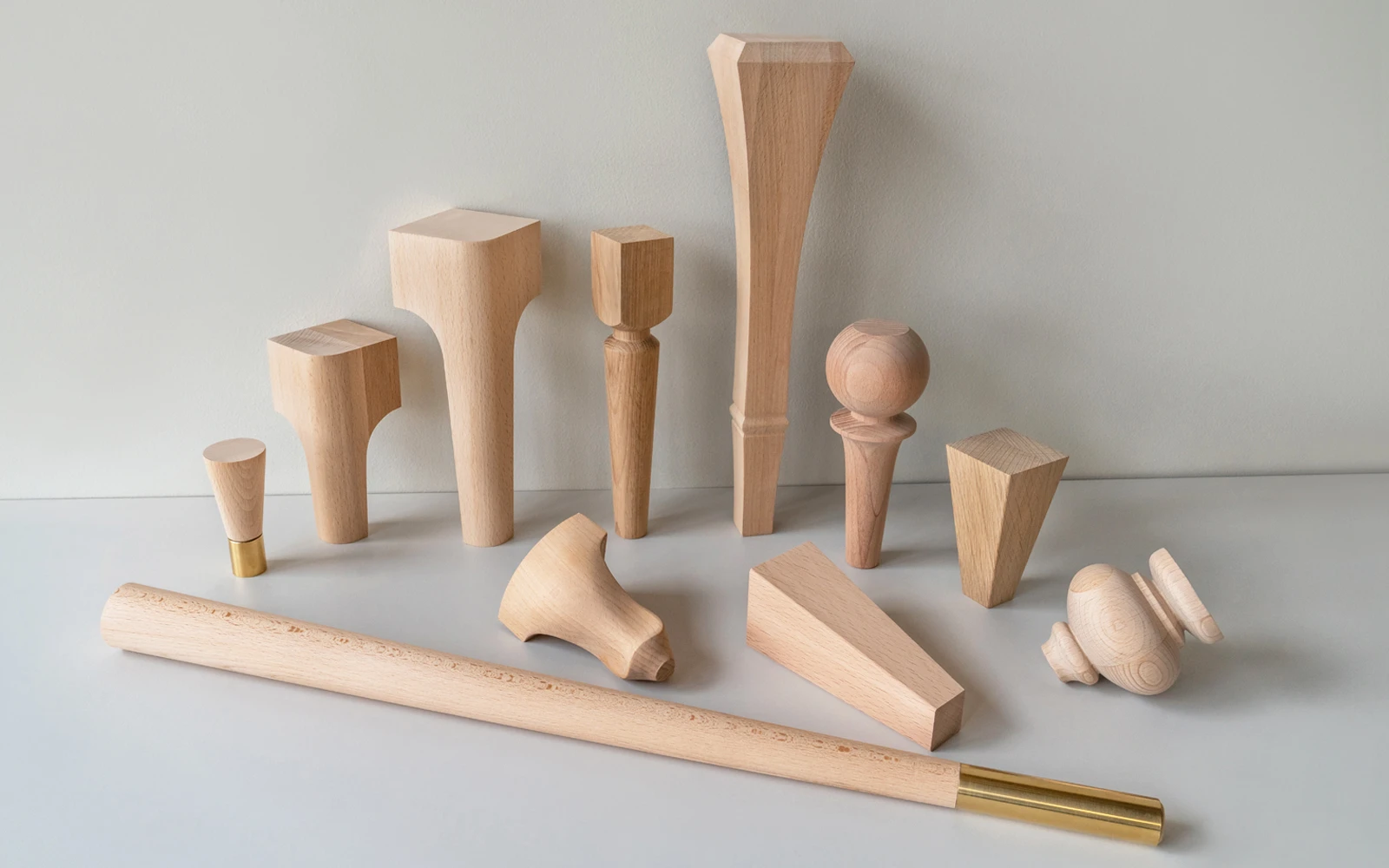
When a buyer decides to purchase wooden furniture legs for a new cabinet or to remodel existing furniture, they often first compare only the height. With the pair MN-207 and MN-227, this approach leads to a mistake. The models differ in height by only 35 mm: 180 mm for MN-207 versus 145 mm for MN-227. But their cross-sections are fundamentally different. The wide MN-207 occupies 150 × 150 mm, while the compact MN-227 is 70 × 70 mm. Therefore, one support becomes a noticeable part of the design, while the other neatly lifts the body and leaves the facade as the main focus.
MN-207 is suitable for a wide chest of drawers, a massive cabinet, a bench, a pouf, or a sofa with a visually heavy body. It needs enough space under the bottom panel because the large support should not accidentally protrude beyond the side panel or interfere with the mounting assembly. MN-227 fits more easily into a bedside table, a compact chest of drawers, a TV cabinet, or a small wardrobe. The 70 × 70 mm cross-section allows maintaining a light base and not conflicting with handles, panels, routing, or the facade pattern.
Both models are made from beech or oak and have a 'Prestige' sanding quality. For beech, preparation for enamel is confirmed; for oak, preparation for tinting. This makes the choice not only dimensional but also finishing: beech is reasonable to consider when the legs need to be combined with a painted body, and oak when it is important to show the natural texture. However, the specific coating system, shade, fasteners, and permissible load cannot be determined from a photo: they are checked against the product card, furniture design, and installation plan.
The article will help you understand which to choose — MN-207 or MN-227, how to recalculate the final height of a chest of drawers, how many legs a long body may need, why you cannot promise a load without calculating the bottom and fastening, when a central support is needed, and which glides to look at for MN-227. After such an analysis, it is easier to move from a general intention to buy furniture legs to a precise order: choose the model, wood species, quantity, finish, and prepare the body for safe installation.
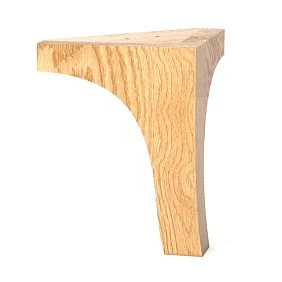
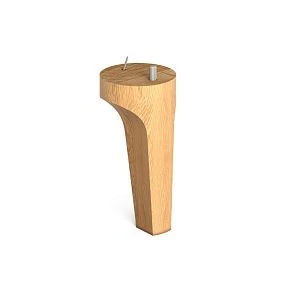
Short answer. MN-207, measuring 180 × 150 × 150 mm, is chosen for a wide and visually heavy body when the leg should be a noticeable geometric base. MN-227, measuring 145 × 70 × 70 mm, is suitable for a compact cabinet, small chest of drawers, TV cabinet, or wardrobe when the support should look lighter and not draw attention away from the facade.
You cannot compare models based solely on the 35 mm height difference. The cross-sectional area of MN-207 is 22,500 mm², while MN-227 is 4,900 mm². The wide support takes up approximately 4.6 times more space. Before ordering, you need to check the width of the bottom panel, distance from the edge, final furniture height, number of supports, cabinet strength, and selected finish.
Select MN-207 180 × 150 × 150 mm Select MN-227 145 × 70 × 70 mm Buy wooden furniture legs
Confirmed specifications for MN-207 and MN-227
| Parameter | MN-207 | MN-227 |
|---|---|---|
| Product type | Geometric wooden furniture leg | Geometric wooden furniture leg |
| Size | 180 × 150 × 150 mm; additional dimensions 141 × 25 mm | 145 × 70 × 70 mm |
| Height | 180 мм | 145 мм |
| Width and depth | 150 × 150 mm | 70 × 70 mm |
| Overall cross-sectional area | 22,500 mm² | 4 900 mm² |
| Material | Beech or oak | Beech or oak |
| Sanding quality | «Prestige» | «Prestige» |
| Preparation of beech | For enamel | For enamel |
| Oak preparation | For tinting | For tinting |
| Visual character | Wide noticeable support | Compact concise support |
| Confirmed base plates | Not specified in the diagram | FUR-021 and FUR-027 |
| Exact load | Determined only by calculation of the body, fastening and number of supports | Determined only by calculation of the body, fastening and number of supports |
The table shows why two models cannot be perceived as almost identical legs with a slight difference in height. MN-207 is only 35 mm higher, but its width and depth are more than twice the dimensions of MN-227. Four or more supports work under the body, so the difference is multiplied. Four MN-207 form large geometric points at the corners of the furniture, while four MN-227 look much calmer and leave more free space between them.
The size 180 × 150 × 150 × 141 × 25 mm for MN-207 must be checked as a whole, not just the height of 180 mm. Additional dimensions are important for understanding the shape and mounting part. The article cannot assign a universal fastening because the installation method depends on the bottom panel, embedded parts, location of power elements, and the design of the specific furniture. The same applies to MN-227: compactness does not eliminate the need to check the mounting location and base strength.
Before placing an order, it's useful to open the product cards and double-check the current parameters: buy geometric furniture leg MN-207 can be done after checking the platform 150 × 150 mm, and buy geometric furniture leg MN-227 — after checking the platform 70 × 70 mm. If no model fits the scale, it's better Buy wooden furniture legs to choose a different size than to try installing a deliberately disproportionate support.
Why the difference between models is not just 35 mm in height
The height is noticeable in the final level of the furniture, but the visual mass is also determined by the support area. For MN-207, the calculation is simple: 150 × 150 = 22,500 mm². For MN-227: 70 × 70 = 4,900 mm². Dividing 22,500 by 4,900 gives approximately 4.59. This means the cross-sectional area of the wide model is about 4.6 times larger. On the facade and in plan, this difference is perceived more strongly than the additional 35 mm in height.
Imagine a chest of drawers about a meter wide with four legs. Wide supports visually continue the side panels, create a heavy stable base, and can become part of the furniture's design. Compact legs leave more air between them, separate the body from the floor, and create the impression that the facade is lighter. Neither effect is automatically better. It must match the dimensions of the body, the thickness of the side panels, the depth of the furniture, and the character of the facade.
On a narrow cabinet, MN-207 can take up too large a portion of the bottom panel. If the support has to be shifted inward to avoid protruding beyond the body, the perception line changes and fastening may become more complicated. In such a case, MN-227 is positioned more freely. But under a long, massive chest of drawers, a small leg sometimes looks like a random dot, especially if the body has wide side panels, a heavy tabletop, and large handles. Then MN-207 supports the scale more convincingly.
It is useful to evaluate the difference not by one leg in hand, but by a set. Make two paper squares: 150 × 150 and 70 × 70 mm. Place four mock-ups under the cabinet at the intended locations. Look at the furniture from the front, side, and from the distance it is usually perceived in the room. This test quickly shows which model supports the facade and which either overloads it or looks too weak.
Our factory also produces:
Direct comparison: wide MN-207 or compact MN-227
| Criterion | MN-207 | MN-227 | Practical conclusion |
|---|---|---|---|
| Height | 180 мм | 145 мм | MN-207 raises the cabinet 35 mm higher before accounting for the mounting bracket |
| Cross-section | 150 × 150 mm | 70 × 70 mm | The main difference is the scale of the base, not just the height |
| Wide dresser | Usually looks more proportional | May appear too thin | Check with a mock-up of four supports |
| Bedside table | May overload a narrow cabinet | Usually fits in more easily | Compare the side panel width and the edge offset |
| TV stand | Suitable for a large body when calculating the number of supports | Suitable for a compact and visually light cabinet | A long body may require additional support |
| Sofa or bench | Can become part of the design | Maintains a more neutral base | Requires calculation of the frame, number and placement of supports |
| Role in design | Independent geometric element | Background minimalist support | Select together with the facade, handles, and side panels |
| Beech | Preparation for enamel confirmed | Preparation for enamel confirmed | Make a common test paint for a pair or set |
| Oak | Preparation for tinting confirmed | Preparation for tinting confirmed | Coordinate the shade with the body and adjacent wood |
| Floor protectors | Specified separately | FUR-021 and FUR-027 are listed as compatible | Select based on floor, size, and installation method |
This table does not assign a model based on a single furniture type. A wide dresser may have a thin minimalist facade and require neutral supports, while a small cabinet is sometimes specifically designed with large legs. The decision is made not by the item's name, but by the combination of dimensions, construction, and artistic task. Therefore, before ordering, it is more useful to answer five questions: how much space is available under the bottom panel, what the final height should be, how noticeable the legs should be, what material is chosen for finishing, and how the load will be transferred to the body.
Get Consultation
When it is more logical to choose MN-207
Wide chest of drawers with a massive body
MN-207 works well under a chest of drawers with wide side panels, a deep body, and a large front plane. A cross-section of 150 × 150 mm supports the scale and does not look like a random thin extension. The wide geometric leg is especially convincing when combined with straight fronts, large frames, a massive top panel, and prominent hardware. At the same time, the support should not mechanically replicate the thickness of the side panel: it is more important that the entire bottom line feels cohesive.
Before purchasing, measure not only the width of the chest of drawers but also the free mounting area under the bottom. It is necessary to check where the vertical walls, base elements, partitions, drawer guides, and structural strips are located. If the leg is placed under an empty section of a thin panel, a wide cross-section alone does not make the attachment reliable. The need for reinforcement is determined by a furniture maker or designer. The article cannot replace body calculations and should not promise a permissible load in kilograms.
Massive cabinet and long console
Under a wide cabinet, MN-207 creates a clear geometric support. But the length of the body changes the task. Four legs may not be enough not because the model is weak, but because the long bottom panel can sag between the extreme points. A fifth or sixth support, a central partition, or a reinforced frame is determined by the project. You cannot simply increase the number of legs without checking: the additional support must align with the structural node and touch the floor at the same level, otherwise the furniture will wobble.
For a console, the distance from the leg to the edge is critical. Too large an offset makes the overhang visually heavy and increases the load arm. Too small an offset may cause the large MN-207 to protrude beyond the front or side panel. A paper mockup of 150 × 150 mm and markings on the bottom panel allow you to find the position before purchase. For a wide body, you can also open the selection and choose wooden legs for a chest of drawers and cabinet, comparing MN-207 with other sizes.
Sofa, ottoman, or pouf with a pronounced base
MN-207 is present in the current trend of sofa supports and is suitable for projects where the leg should be visible. Under upholstered furniture, it is especially important to consider the frame. The external shape of the body does not show where the structural beams and inserts are located. The support must transfer the load to the load-bearing part, not just to the upholstery, thin plywood, or decorative panel. Therefore, the choice of model and mounting assembly are coordinated with the sofa's construction.
A wide leg can support a bench with a voluminous seat, a pouf with straight sides, or a sofa on a high base. A height of 180 mm increases clearance and changes the seating position. If the legs replace lower ones, the seat will rise and the familiar ergonomics will change. It is necessary to recalculate the seating height and check whether it is comfortable for the user to sit down. To compare available options, you can buy wooden sofa legs in the thematic category, without limiting yourself to a single model.
A project where the leg is an independent design element
MN-207 is chosen not only because of the size of the furniture, but also when the base should be readable at first glance. Four large geometric supports can set the lower rhythm, connect the body with rectangular handles, or repeat the shape of decorative frames. In such a project, the leg is not hidden deep under the body. However, the degree of protrusion and offset still obey safety, fastening, and overall proportions. The design effect does not cancel the technical check.
When it is more logical to choose MN-227
Bedside table and compact chest of drawers
The MN-227 with a cross-section of 70 × 70 mm fits more easily under a narrow body. A bedside table has a small width, so four large supports can occupy almost the entire lower plane and visually weigh down the item. A compact leg leaves free space between the supports, emphasizes the clearance above the floor, and does not conflict with the handle, milling, or veneer pattern on the facade. A height of 145 mm noticeably lifts the furniture.
For a bedside table, the final height relative to the mattress is important. If you replace the low base with MN-227, the top surface will rise. You need to check whether it will be convenient to pick up a phone, book, or glass of water. When designing new furniture, the body height can be reduced while maintaining the required overall level. When reworking a finished table, this is not possible, so the calculation is performed before purchasing the kit.
TV cabinet and long low body
The compact MN-227 supports a modern TV cabinet when the facade should look long and calm. The small cross-section does not break the bottom line. But the long body again requires checking the number of support points. Four legs at the corners can leave a large span in the center. If the bottom panel or internal partitions are not designed for this mode, a central support or another structural scheme is needed.
A height of 145 mm affects the TV's position if the screen is on a stand rather than mounted on the wall. After replacing the legs, the center of the screen will rise along with the body. Before ordering, it is useful to add up the height of the leg, the body, and the TV's standard stand, then compare the result with the eye level. One support parameter can change the comfort of the entire area, so the decision cannot be made based solely on a photo of the leg.
A small cabinet and a body with narrow side panels
Under a compact cabinet, MN-227 maintains a stable base. A cross-section of 70 × 70 mm is easier to place under a narrow side wall or a load-bearing partition. However, a tall cabinet imposes higher requirements for stability and protection against tipping. Replacing the base changes the center of gravity and should not be performed as a decorative operation without checking the body and furniture attachment to the wall, when it is provided for by the design.
If the cabinet originally stood on a plinth, installing individual legs changes the load transfer pattern. The bottom panel may not be designed for four local points. In such a situation, the base needs to be reinforced or another modification path chosen. MN-227 is compact but does not automatically solve the structural problem.
A minimalist facade that should remain the main focus
MN-227 is suitable for furniture where expressiveness is created by the proportions of the facade, color, veneer, or thin handles. The support performs its function and does not become an independent ornament. It is especially appropriate under smooth facades, light frames, and modern bodies with a large clearance. If the legs are painted in the color of the furniture, the base is perceived as even calmer. If a contrasting oak is chosen, even a compact model can become more noticeable, so the finish must be evaluated together with the size.
How to calculate the final height of furniture
The basic formula looks like this: body height + leg height + mounting unit height = total furniture height. The last term is often forgotten. If the support is installed through a plate, insert, adapter, or other unit, it can add height. The specific value is taken from the installation design. You cannot assume that a dresser will automatically rise exactly 180 or 145 mm without checking the attachment method.
For a new dresser, the calculation starts from the desired total height. Suppose the designer has determined a convenient level for the top panel. The height of the selected leg and mounting unit is subtracted from it, yielding the body height. Thus, MN-207 and MN-227 can lead to different sizes of drawers and facades. Choosing the support at a late stage can disrupt already agreed-upon proportions, so the model is best fixed before cutting the parts.
For ready-made furniture, it's the opposite: the body height is already set. The new support is added to it, and the result is compared with surrounding objects. For a bedside table, check the mattress; for a dresser, the convenience of access to the top surface and mirror; for a TV stand, the screen position; for a sofa, the seat height. If the result is inconvenient, you need to choose a different leg, rather than hoping to get used to it after installation.
The difference between MN-207 and MN-227 is 35 mm. On paper, this seems like a small value, but in furniture, 35 mm is noticeable. A dresser may rise relative to a windowsill, outlets, or wall decor. A stand may become higher than the mattress. Under a sofa, the clearance will increase, but at the same time, the seating will change. Therefore, it is useful how to calculate the height of wooden furniture legs using the extended guide and only then choose a specific model.
Clearance above the floor, cleaning, and robot vacuum
The buyer often chooses high legs for convenient cleaning. MN-207 creates a larger nominal lift, MN-227 a smaller one, but the actual clearance is not always equal to the leg height. It is affected by the support shape, the lower body line, the mounting assembly, decorative elements, and possible overhang. For a robot vacuum, you need to know its actual height, including protruding sensors, and leave a margin, rather than selecting furniture flush.
In addition to the vertical dimension, the width of the passage between the legs is checked. Four MN-207s take up more space and can narrow access under a compact body. MN-227 leaves a wider internal opening. But if a fifth support is installed in the center, the robot's trajectory changes. Therefore, the cleaning scheme depends not on a single leg, but on the complete arrangement of all points.
On a carpet, the issue is more complex. The support may partially sink into the pile, and the robot may not pass over the edge of the covering. The foot pad also changes contact with the floor. If furniture is placed on parquet, laminate, or other sensitive flooring, protection must be provided and it should be checked whether the body slides. For MN-227, the card offers compatible foot pads, but the final choice depends on the floor and installation method.
How many legs are needed: four, five, or six
Four corner supports are a common scheme, but not universal. The number depends on the length and depth of the body, the material of the bottom panel, the location of internal partitions, the weight of the furniture and its contents, as well as the attachment method. It cannot be stated that a specific leg will withstand a given number of kilograms without a full technical calculation. The weak link may not be the wood of the support, but the bottom, fasteners, or connection point.
For a compact bedside table, four MN-227s often seem logical if the design is intended for local points. For a long TV cabinet, the same four supports can leave a large span. A fifth central leg reduces the span but must be placed under the load-bearing part and exactly touch the floor. If it is slightly shorter, there will be no support; if longer, the body will start to rock on the central point.
Six supports are used for long bodies when two additional points are needed. They are placed not arbitrarily, but under partitions or a frame. With MN-207, six large legs can visually overload the facade, so the structural task is sometimes solved with a frame or another base system. With MN-227, additional points are less noticeable, but still change the rhythm. The technical and visual solution is made together.
Before ordering, create a bottom view diagram. Mark the side panels, partitions, guides, cutouts, cable entries, and mounting points. Place squares of 150 × 150 or 70 × 70 mm. After such a check, it becomes clear how many supports physically fit, which nodes require reinforcement, and whether the fasteners intersect with internal fittings.
Mounting platform and distance from the edge
The leg width does not automatically equal the size of the mounting platform, but the model's dimensions show how much space is needed under the body. The MN-207 should be positioned so that the shape does not accidentally protrude and conflict with the facade. The MN-227 is easier to shift, but too large an offset from the edge makes the furniture visually unstable and increases the overhang of the bottom panel. The exact position is determined by the design.
Corner placement is usually associated with the side panel and the front or rear power line. If the body is assembled from thin board without an insert, fastening in one layer may be insufficient. Reinforcement, a mounting strip, a metal plate, or another component is selected by a specialist. A universal screw or fastener length cannot be assigned for all dressers.
When remodeling old furniture, you cannot use old holes without checking. They may have been designed for a different base, be too close to the edge, or have lost strength. A new wide leg MN-207 may cover the old area, but this does not mean it is automatically suitable for re-fastening. First, evaluate the material and condition of the bottom.
The practical sequence of marking and stability checking is revealed in the material about how to install wooden legs on a dresser. It helps prepare the installation, but the parameters of the specific fastening are still checked against the selected model and body.
Beech for enamel or oak for tinting
Both models are available in beech and oak. In confirmed cards, beech is prepared for enamel, oak for tinting. This is not just a color choice. Opaque enamel hides most of the wood grain and helps unify the leg with the painted facade. Oak tinting preserves its texture and makes the support a material accent. Therefore, the same shape is perceived differently depending on the species and finish.
Beech under enamel is suitable for a dresser, nightstand, or cabinet where the body is painted in white, gray, black, or another agreed color. The legs can be made to match the body or stand out as a contrast. But you cannot choose a shade only by name. White enamel can be cold, warm, matte, or more glossy. Before painting, a test coat on prepared material and comparison under room lighting is needed.
Tinted oak is chosen when visible wood grain is needed. The shade is matched to the countertop, facade, frame, doors, or floor, but an exact match is not always necessary. Sometimes the overall temperature and saturation are enough. For a set of legs, a single batch and identical processing technology are important, otherwise the four supports may differ from each other.
You cannot automatically promise oil, varnish, or a specific stain if this system is not confirmed for the selected order. Current options are clarified in the product card or with a manager. An extended choice between materials is covered in the article beech for enamel or oak for tinting. It helps determine the finishing route before purchase, not after installation.
How finishing changes the perception of a wide and compact leg
On MN-207, color works on a large surface. Dark enamel or rich tinting enhances the visual weight and makes the supports even more noticeable. Light finishing softens the shape, especially if it matches the body. Therefore, a buyer who likes the geometry of MN-207 but does not need too heavy a base can consider a calm, uniform color. However, the 150 × 150 mm size will still remain noticeable.
MN-227 reacts to contrast differently. In the body color, it almost dissolves and creates a light gap. Contrasting oak texture makes even a small support readable and connects the furniture with the wooden details of the room. This is useful when the facade is minimalist, but the interior lacks warm material.
It is more convenient to finish the legs before final installation to treat all accessible surfaces and avoid staining the body. But the technology is determined by the chosen coating. Some systems require intermediate sanding, primer, drying time, and application conditions. The article should not replace the material manufacturer's instructions. The buyer's main task is to decide in advance what the final look should be and order the appropriate wood species and preparation.
Choosing for specific furniture
| Situation | What to Check | Most often considered | Why |
|---|---|---|---|
| Wide chest of drawers with large facades | Free area 150 × 150 mm, number of supports, bottom reinforcement | MN-207 | Large cross-section supports the body scale |
| Compact dresser | Side panel width, offsets, final height | MN-227 | Support does not overload the small facade |
| Bedside table | Height relative to the mattress, space for four legs | MN-227 | 70 × 70 mm cross-section fits more easily into a narrow body |
| Massive cabinet | Lower panel span, central support | MN-207 | Wide geometry looks more convincing |
| Long TV cabinet | Number of supports, screen position, cables | MN-227 or MN-207 by scale | The model is chosen together with the structural scheme |
| Small cabinet | Stability, wall mounting, power side panels | MN-227 | Compact base maintains a light appearance |
| Sofa with a heavy body | Frame, seat height, placement of embedded parts | MN-207 | The support can become part of the design |
| Bench or pouf | Seat height, number of points, finish | MN-207 or MN-227 | The choice depends on the seat volume and desired visibility |
| Facade for enamel | General test coating and body color | Beech MN-207 or MN-227 | Beech preparation for enamel confirmed |
| Facade with natural wood | Matching tone and grain | Oak MN-207 or MN-227 | Oak preparation for tinting confirmed |
The table shows directions, not strict prohibitions. MN-207 can be used under a small custom cabinet if large legs are part of the design. MN-227 can support a wide chest if the body is light and has enough supports. The solution is confirmed with a mockup, calculation, and connection to load-bearing parts.
What to buy together with MN-207 and MN-227
A furniture leg does not work separately from the body, floor, and finish. Therefore, the purchase set includes not a random set of accessories, but elements that address specific tasks: protect the floor covering, select the correct category of supports, prepare the material for enamel or tinting, and check installation. Only confirmed compatible items and actual pages can be used.
| What to add | Why | For which scenario | What to pay attention to | Link |
|---|---|---|---|---|
| Floor protector FUR-021 | Protect the contact with the floor and finish the bottom point | MN-227 on suitable hard flooring | Diameter 19 mm, compatibility, and installation method | buy round glide FUR-021 |
| Felt floor protector FUR-027 | Reduce the risk of scratches when in contact with sensitive flooring | MN-227 on parquet, laminate, or other suitable flooring | Diameter 24 mm, felt condition and compatibility | buy felt glide FUR-027 |
| Category of unpainted legs | Compare sizes, shapes and preparation | When MN-207 or MN-227 are not suitable | Height, cross-section, wood species and purpose | buy unpainted wooden furniture legs |
| Selection for chest of drawers, wardrobe and cabinet | Compare supports for case furniture | Project of chest of drawers, TV cabinet, wardrobe | Body size, quantity and mounting plate | choose wooden legs for a chest of drawers and cabinet |
| Selection for sofa | Check options for upholstered furniture | Sofa, bench, pouf | Frame, seat height, embedded parts | buy wooden sofa legs |
| Finishing guide | Choose beech or oak before ordering | Enamel or tinting | Test swatch and system compatibility | beech for enamel or oak for tinting |
| Installation guide | Prepare layout and stability check | Redoing or new assembly of a chest of drawers | Bottom strength, fasteners, support evenness | how to install wooden legs on a dresser |
FUR-021 and FUR-027 are listed as compatible for MN-227. This does not mean that any glide automatically fits any floor or installation method. Round FUR-021 has a diameter of 19 mm, felt FUR-027 — 24 mm. Before ordering, check the placement on the bottom surface of the leg, operating conditions, and how the furniture will be moved.
For MN-207 in the provided diagram, specific glides are not confirmed, so a position cannot be invented. A suitable option is clarified separately. This is an important principle of the entire article: if a characteristic or compatibility is not specified, it is better to honestly direct the buyer to verification than to create a false impression of a ready-made universal set.
Glides FUR-021 and FUR-027: how tasks differ
The round glide FUR-021 with a diameter of 19 mm is considered a compact contact element. Its task and method of application depend on the design. It should not protrude accidentally, disrupt stability, or concentrate load on an unsuitable point of the floor. Before purchasing, evaluate the geometry of the lower part of MN-227 and the recommendations on the product card.
The felt glide FUR-027 with a diameter of 24 mm is useful where soft contact with a sensitive coating is required. Felt helps reduce the risk of scratches during slight movement, but does not turn heavy furniture into an item that can be constantly moved without control. The glide wears out, collects dust, and requires periodic inspection. If the felt is damaged or contaminated with hard particles, floor protection deteriorates.
On a carpet, a soft glide may behave differently than on parquet. On an uneven base, any additional element affects the height. If four glides are installed unevenly, the body may wobble. Therefore, the entire set is mounted identically and checked on a level surface before fully loading the furniture.
How not to confuse models with similar furniture legs
MN-207 and MN-227 are geometric wooden legs without paint, prepared for further finishing. They should not be confused with metal, plastic, adjustable, or wheeled supports. Such products have a different design, a different adjustment method, and a different visual purpose. The search word "leg" combines too many different items, so read the product card completely.
These models should not be confused with legs for a dining table, chair, or bar counter. The height of 180 or 145 mm refers to low furniture bodies and upholstered furniture, not to a full tabletop support. The purpose is determined not only by height but also by the connection design, number of supports, and load calculation.
MN-207 differs from MN-227 not in ornament but in scale. If there is no object for comparison in the photo, the wide model may appear compact. Therefore, rely on numbers and a paper mockup. A 150 mm square is almost equal to the width of a small palm with margin and is noticeably larger than a 70 mm square. Four such elements under furniture give a completely different result.
Also, any wooden blank should not be considered equivalent to a ready-made furniture leg. The product has confirmed exact dimensions, wood species, and sanding quality. A random block will require self-processing, geometry checking, preparation for finishing, and development of fastening. The ready-made model simplifies selection but does not eliminate the design of the mounting assembly.
Practical preparation for installation
Before installation, the cabinet is emptied of its contents and the bottom panel is assessed. If the furniture is old, check for cracks, delamination, signs of moisture, and broken holes. New legs cannot be attached to a damaged base just because their footprint is larger than the previous one. If necessary, the structure is reinforced according to the design.
Marking is done symmetrically relative to the front and side panels, but symmetry should not conflict with internal partitions. Sometimes a visually pleasing position on the outside falls between structural components. In that case, the assembly needs to be modified, reinforcement added, or a different model chosen. MN-207 requires particularly careful checking due to its large cross-section.
Before final fixation, the legs are test-fitted without full load. The cabinet is placed on a level surface, diagonals are checked, and the absence of wobbling is verified. If one point does not touch the floor, the problem cannot be compensated for with a random shim without understanding the cause. The height of mounting points may differ, the panel may be warped, or the floor may be uneven.
Finishing is usually planned before installation to avoid covering areas and damaging the cabinet. But after painting, you must wait for the coating to fully cure according to the system's instructions. Early installation can leave marks or chips. Oak tinting is also checked on a test sample: end grains and different areas of the wood may absorb the compound unevenly.
After installation, the furniture is gradually loaded and the behavior of the cabinet is observed. The full weight of the contents affects the bottom and joints. If wobbling, creaking, changes in door gaps, or sagging appear, use is stopped and the structure is checked. This caution is more important than any general promises about the strength of an individual leg.
Errors when choosing MN-207 and MN-227
Comparing only height
The 35 mm difference does not reflect the main distinction. A cross-section of 150 × 150 mm versus 70 × 70 mm changes the visual scale, mounting footprint, and free space under the cabinet. A buyer who only looks at the height may order MN-207 for a cabinet that is too narrow, or MN-227 for a cabinet where it looks disproportionately thin.
Not making a mock-up of the kit
One leg on the screen does not show how four or six will look. Paper mockups take a few minutes of work and allow you to see the bottom rhythm. For MN-207 this is especially important: four squares 150 × 150 mm take up a noticeable area.
Do not recalculate the total height of the furniture
Replacing supports changes the level of the tabletop, fronts, seat, or TV. The leg and mounting assembly are added to the cabinet height. If the result is inconvenient, adjusting after installation is more difficult and expensive.
Promising load without calculation
You cannot determine a safe load just by the appearance of a wooden leg. The result depends on the number of supports, wood species, fastening, bottom panel, partitions, mass distribution, and dynamic impacts. Technical calculation is performed for the entire structure.
Placing a support under a weak area of the bottom
Wide MN-207 does not reinforce a thin panel by itself. If the fastening is not connected to a structural side panel, frame, or embedded part, local load can damage the cabinet. The same is true for MN-227.
Forgetting about central support for a long cabinet
Four corner legs leave a span. A long TV cabinet or chest may require a fifth or sixth support. Its position and height are calculated, not added after deflection appears.
Choosing the finish after purchase
Beech and oak give different routes. If the body is painted with enamel and oak is ordered for tinting, the project may require changes. The material decision is made together with the color and texture of the furniture.
Paint without a test swatch
The color on the screen does not show the actual result. Primer, enamel, tinting and lighting change perception. A test swatch helps to agree on the shade before processing the entire set.
Ignore floor protection
Even a well-sanded leg contacts the coating. For MN-227, FUR-021 and FUR-027 are confirmed. The glider is chosen based on the floor and tested in use. For MN-207, compatibility is checked separately.
Use old holes without checking
The old fastening unit may have loosened or not match the new geometry. Reuse is only allowed after evaluating the material and placement. Otherwise, the furniture may lose stability.
Who MN-207 is suitable for and who should choose a different model
MN-207 should be considered by the owner of a wide chest, massive cabinet, bench, pouf or sofa, where the leg should become part of the design. It is suitable for a body with a sufficient bottom platform and a project designed for large local supports. The model is also appropriate when a clearance of 180 mm is required before accounting for the mounting unit and such height does not disrupt ergonomics.
MN-207 may not be suitable for a narrow bedside table, compact cabinet or light facade if the 150 × 150 mm section takes up too much space and visually draws attention. It is also not suitable for a project where the bottom panel does not allow safe placement of a large unit without reinforcement. In such a case, it is wiser to choose MN-227 or another support from the category.
Who MN-227 is suitable for and who should choose a different model
MN-227 is convenient for a compact chest of drawers, bedside table, TV stand, small cabinet, and minimalist furniture. It suits a buyer who wants to raise the body, keep free space underneath, and not make the legs the main accent. The 70 × 70 mm cross-section fits more easily under narrow side panels.
MN-227 may look too thin under a very massive body with large facades. It also does not solve the problem of a long span without additional support. If the project requires expressive supports, a higher rise, or a large geometric base, consider MN-207 or other models.
How to buy furniture legs on STAVROS without mistakes
Start not with color, but with dimensions. Measure the width, depth, and height of the body, the free bottom area, and the intended offsets. Make mock-ups of 150 × 150 and 70 × 70 mm. Place them under the furniture in the quantity considered by the project. After that, it becomes clear which model matches the scale.
Then calculate the final height. Add 180 mm for MN-207 or 145 mm for MN-227 and the height of the mounting assembly to the body. Compare the result with the mattress, TV, mirror, windowsill, seat, or other furniture. If the level is not suitable, return to model selection before placing the order.
The third stage is construction. Determine the number of legs, attachment points, need for reinforcement, and central support. Do not order four supports out of habit if the body is long. Do not add six just for reserve if they do not fall into the load-bearing nodes.
The fourth stage is material. For enamel, consider beech with confirmed preparation; for tinting, oak. Agree on the color, gloss level, and sample. If a different configuration is needed, open buy unpainted wooden furniture legs and compare models.
The fifth stage is accompanying elements. For MN-227, check FUR-021 or FUR-027. For MN-207, do not substitute an unconfirmed accessory. Clarify compatibility, installation method, current configuration, and order conditions with the STAVROS manager.
The general commercial route reveals the material How to choose wooden legs for a chest of drawers and a bedside table. After making a general choice, return to the cards MN-207 and MN-227, because that is where the actual parameters of specific models are checked.
How to check proportions before ordering: a full-scale mockup
The most reliable way to see the difference between MN-207 and MN-227 without a physical sample is to make a full-scale mockup. For the wide model, cut a square of 150 × 150 mm from thick paper or cardboard, for the compact one — 70 × 70 mm. Prepare not one, but four or six elements, because a single leg does not show the real rhythm under the body. Attach the mockups with masking tape to the bottom plane or lay them out on the floor at the intended points.
First, look at the furniture directly from the front. Assess how the supports relate to the side panels and fronts. Then step back to the distance from which the chest of drawers or bedside table is usually seen from the room entrance. MN-207 may look harmonious up close but too heavy from afar. MN-227 sometimes seems sufficient in close-up photos but gets lost under a wide body. The side angle shows the depth and whether the leg protrudes beyond the furniture line.
The next stage is a height mockup. From boxes or wooden blocks, assemble a temporary support with a height of 180 or 145 mm. Do not place heavy furniture on it without a safe structure; the mockup's task is to show the level. You can lift only one edge of an empty lightweight body under the supervision of a specialist or mark the top line on the wall. Compare it with sockets, a mirror, a mattress, a TV, and a windowsill.
The mockup helps coordinate the project within the family or with the client. The words 'wide leg' are understood differently by everyone, but a 150 × 150 mm square shows the scale unambiguously. Photograph both options from the same point and under the same lighting. The comparison will be fairer than two different pictures from a catalog.
How to connect legs with the facade, handles, and tabletop
The legs are at the bottom, but they are perceived together with the entire facade. For a chest of drawers with wide framed doors, MN-207 can continue the large geometry. For a smooth bedside table with a thin profile, MN-227 will support lightness. If the handles are massive and contrasting, wide supports create a second strong element. This can be a conscious symmetry, or it can overload the furniture. Therefore, handles and legs are best evaluated on one sketch.
The tabletop also affects the base. A thick protruding top panel makes the body visually heavier and often requires more confident lower support. A thin tabletop and frameless facades allow compact legs. But there is no direct dependence: a designer may deliberately contrast a massive top and a thin base. It is important that the contrast is intentional, not accidental due to choice based on price or availability.
Color unifies elements. Beech under enamel allows making legs in the color of the facade and reducing their visual independence. Even MN-207 in a single light shade is perceived more calmly. Oak under tinting, on the contrary, emphasizes the material and can connect supports with a wooden tabletop. If the body is painted and the legs are oak, repeat the wood in at least one adjacent detail to make the contrast look meaningful.
For furniture with a plinth, switching to individual supports completely changes the character. The plinth creates a continuous line and hides the space under the body. Legs open the floor and make the object lighter. MN-207 forms four large points, MN-227 — thin ones. Therefore, replacing the plinth is not just a technical alteration, but a change in design and cleaning.
Altering ready-made furniture: what to check before removing the old base
Alteration is more difficult than new assembly because the body is already designed for the previous base. First, find out how the load is currently transferred. The plinth, frame, or old legs may rest on side panels and partitions. If they are removed, the bottom panel will be left without support. New supports need to be connected to the same load-bearing lines or reinforcement must be created.
Inspect the facades and gaps. If the body is already deformed, a new installation will not automatically fix the geometry. After raising on high legs, misalignment may become more noticeable. Doors and drawers should work before the alteration, and after installation, gaps are checked again.
Check the back panel and wall attachment. A tall cabinet or narrow stand changes stability after being raised. If the manufacturer provided for fixation, it is preserved or recalculated. Work especially carefully with furniture in a home with children. A decorative goal cannot be more important than protection against tipping.
Assess the condition of the finish. New beech or oak legs should match the old body. Matching an existing shade can be more difficult than choosing a color for new furniture. A test paint is mandatory, and sometimes it is more honest to make a deliberate contrast than to imitate mismatched wood.
Commercial interior: how to choose supports for a salon, showroom, and hotel
In a public space, furniture is used more intensively than at home. Chests of drawers, consoles, and cabinets can be bumped daily during cleaning, equipment movement, and staff work. Therefore, choosing MN-207 or MN-227 cannot be based solely on a project photo. Body calculation, stable fastening, and a clear maintenance scheme are needed.
MN-207 looks advantageous in a showroom where the base should be part of the display. The large leg is visible from afar and supports a massive demonstration body. MN-227 is suitable for a reception area, salon, or hotel room where furniture should look lighter and not create unnecessary protrusions.
Protective glides in commercial premises are checked more often. Felt can collect abrasive particles and itself become a cause of scratches. Furniture should not be regularly dragged across the floor just because a soft element is installed. For rearrangement, safe lifting is used and the condition of all supports is monitored.
When ordering a series of furniture, it is important to fix one wood species, preparation, and color. Different batches made without a common sample may differ. For dozens of legs, the unevenness of the shade is especially noticeable. An agreed standard and a test swatch reduce the risk.
How to order a set of legs in one batch
For one piece of furniture, the legs should be perceived as a single set. Even with the same article number, wood has natural differences, and the shade depends on preparation and coating. Therefore, four, five, or six supports are best ordered simultaneously, specifying in advance that they are intended for one body. This approach simplifies the coordination of wood species, sanding, and future finishing. Buying one missing leg later is possible only after checking, but an exact match of texture and color cannot be guaranteed in advance.
The quantity is determined before placing the order. For this, the furniture is shown from below in a diagram, marking the sides, partitions, and intended points. If the designer confirms four supports, four are included in the order. If a long body needs a fifth central or two additional legs, they are immediately included in the set. A spare position does not replace the calculation: an extra leg will not be useful if there is no structural node for it.
The material is fixed separately. You cannot accidentally order part of the set from beech and part from oak, even if everything is planned to be painted. The species look, are processed, and accept finishing differently. For an enamel project, a confirmed preparation of beech is chosen; for a tinted one, oak. If the designer wants to mix materials, this must be a conscious decision and confirmed by a sample.
Before payment, it is useful to draw up a short specification: model, quantity, wood species, intended finish, furniture purpose, and selected glides. For MN-227, it is separately indicated whether FUR-021 or FUR-027 is needed. For MN-207, the compatible glide is specified without substituting a random position. Such a specification reduces the risk that the body is already ready, but one of the important parameters of the legs has not yet been agreed upon.
When furniture is manufactured in a series, for example for hotel rooms, a salon, or several identical cabinets, it is reasonable to first assemble and finish one control item. On it, the height, stability, color, leg position, and floor condition are checked. Only after confirming the control sample are the remaining sets launched. This allows correcting an error on one unit rather than repeating it throughout the entire series.
What to check upon receipt and before final installation
After receipt, the article number, quantity, wood species, and dimensions are checked. For MN-207, the height of 180 mm and dimensions of 150 × 150 mm are checked; for MN-227, 145 mm and 70 × 70 mm. The geometry, surface, and completeness are inspected, without starting finishing until all items are matched with the order. If the legs are intended for one body, they are laid out next to each other and the natural differences in the wood are assessed.
Before painting or tinting, a test coating is done. It is needed not only for color but also to understand how the coating emphasizes geometry. On the wide MN-207, a dark tone can significantly enhance mass, while on the MN-227, it can create a neat contrast. After the sample is approved, the entire set is processed using one technology.
Installation begins only after checking the body and complete drying of the coating. The legs are placed according to the markings, ensuring equal height and stability on a level base. Furniture is not loaded fully at once. First, the empty body is checked, then drawers, shelves, and contents are gradually returned, observing gaps and the behavior of the bottom panel.
FAQ: questions about MN-207 and MN-227
How does MN-207 differ from MN-227?
MN-207 has dimensions of 180 × 150 × 150 mm and is a wide, noticeable support. MN-227 has dimensions of 145 × 70 × 70 mm and looks more compact. The height differs by 35 mm, and the cross-sectional area is approximately 4.6 times larger.
Which leg to choose for a wide dresser?
For a wide and visually heavy dresser, MN-207 is often considered because the 150 × 150 mm section supports the scale. But the final choice depends on the bottom panel, number of supports, and facade design.
Which model is better for a bedside table?
MN-227 usually fits more easily into a compact body. Before ordering, you need to add 145 mm and the mounting assembly to the table height and compare the result with the mattress.
Can MN-207 be placed on a small table?
It is possible only as a deliberate design technique, if the 150 × 150 mm platform fits, the fastening is calculated, and the mockup confirms the proportions. In most compact projects, MN-227 looks calmer.
Is MN-227 suitable for a long TV stand?
Matches the visual character, but a long body may require a fifth or sixth support or a reinforced structure. The quantity is determined by spans and load-bearing partitions.
What material are the models made from?
Both legs are available in beech or oak. For beech, preparation for enamel is confirmed; for oak, preparation for tinting.
What to choose — beech or oak?
Beech is chosen for opaque enamel and integration with a painted body. Oak is chosen for tinting and preserving the wood grain. The specific shade is verified with a test swatch.
How many legs are needed for a chest of drawers?
A compact body often only needs four with a suitable design. A long one may require a fifth or sixth support. Without dimensions and calculations, a universal quantity cannot be specified.
Can the load capacity of one leg be specified?
No, the safe load is determined for the entire piece of furniture. The fasteners, bottom, partitions, number of supports, and mass distribution are important, not just the leg material.
Will a robot vacuum cleaner fit under the furniture?
You need to compare the actual clearance with the robot's height and leave a margin. Consider the mounting assembly, the bottom line of the body, central supports, and foot pads.
Which glides are suitable for MN-227?
The card specifies FUR-021 with a diameter of 19 mm and felt FUR-027 with a diameter of 24 mm. The choice depends on the floor, installation method, and operating conditions.
Which glides are suitable for MN-207?
The specific position is not confirmed in the provided diagram. A compatible option should be clarified in the card or with a STAVROS manager.
Do the legs need to be painted before installation?
Pre-finishing usually allows for a neater surface treatment, but the technology depends on the chosen system. The coating must be completely dry and achieve its properties according to the instructions.
Can I use the old holes?
Only after checking their condition, position, and compatibility with the new assembly. Broken or holes too close to the edge cannot be considered reliable fastening.
Where to buy MN-207 and MN-227?
Both models are presented on the STAVROS website. Before ordering, open the cards, check dimensions, material, preparation, quantity, and current conditions.
Conclusion: choose based on the scale of the base, not just the height
MN-207 and MN-227 solve one common task — they lift furniture on wooden geometric supports, but do it differently. MN-207 with a height of 180 mm and a cross-section of 150 × 150 mm forms a large noticeable base. MN-227 with a height of 145 mm and a cross-section of 70 × 70 mm maintains a light and concise base. The height difference of 35 mm is important for ergonomics, but the cross-sectional area difference of about 4.6 times has a stronger impact on appearance and placement.
For a wide chest of drawers, a massive cabinet, a bench, or a sofa, MN-207 is often more suitable if the body is designed for large mounting points. For a bedside table, a compact chest of drawers, a TV cabinet, and a small wardrobe, MN-227 is more often chosen. But the name of the furniture does not replace the layout and calculation. Measure the platform, lay out four or six templates, recalculate the final height, and check the load-bearing parts.
The material is chosen together with the finish: beech is prepared for enamel, oak for tinting. For MN-227, you can additionally look at FUR-021 and FUR-027. The exact load, fasteners, reinforcement, and number of legs are determined for the entire body. This procedure prevents the purchase from turning into an experiment and ensures furniture where the supports match both the design and the structure.
On STAVROS, you can open the cards of both models, compare them with other unpainted legs, and choose a solution for a chest of drawers, cabinet, wardrobe, or sofa. A conscious choice between MN-207 and MN-227 begins with a simple question: should the leg become a prominent part of the image or quietly support the facade? After answering, it remains to confirm the dimensions, material, finish, and mounting unit — and only then place the order.