Article Contents:
- What is a wooden fillet
- Where are wooden fillets used
- Wall and ceiling joint
- Top of built-in cabinets
- Sideboards, chests of drawers, and classic furniture
- Door portals and openings
- Decorative panels and friezes
- Libraries and studies
- Country houses
- Kitchens and kitchen sets
- How a fillet differs from a cornice, baseboard, and molding
- Cornice — architectural top finish
- Baseboard — covering the bottom joint
- Molding — line and frame
- Fillet — smooth transition in the corner
- Visual comparison
- How to choose the size of a wooden fillet
- Ceiling Height
- Room scale
- Rounding Radius
- Furniture scale
- Profile depth and projection
- Ceiling coving
- When coving is better than a cornice
- Ceiling coving in a classic interior
- Ceiling coving in a country house
- Ceiling coving for painting
- Coving for furniture and built-in wardrobes
- Built-in wardrobe and ceiling
- Sideboard and chest of drawers
- Kitchen wall cabinets
- Library shelving
- Fillet for portal and opening
- Transition of trim into wall
- Wide opening without door
- Arched openings
- Material and coating of wooden fillet
- Solid beech
- Solid oak
- Coatings and finishing
- Production technology
- Wooden fillet in the molding system
- Mistakes when choosing a wooden fillet
- Where to buy wooden fillets
- About the company
- FAQ - answers to popular questions
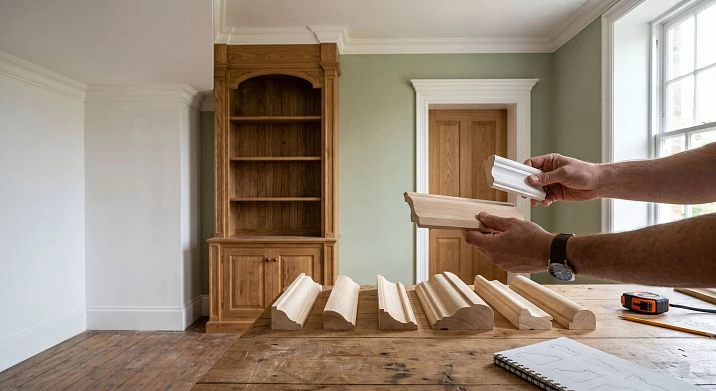
There are details that are not visible — but it is they that create a sense of completeness. A well-executed joint between wall and ceiling, a neatly closed top of a cabinet, a smooth transition of furniture into a niche — all this is not a coincidence, but the result of a correctly selected profile. A wooden fillet is one of those inconspicuous but fundamentally important elements of wooden moldings.
Many people confuse it with a cornice, some call it a baseboard, and others simply ignore it, not understanding why it is needed. Meanwhile, it is Wooden Crown Moldings in the interior that they solve the task that other profiles handle worse: they create a soft, neat, visually quiet transition between planes. They don't shout, they don't draw attention—but without them, any interior feels unfinished.
In this article, we will break down what a fillet is as an architectural profile, where it is used, how to choose the right size and shape, what mistakes are made when purchasing, and why solid wood is the optimal material here.
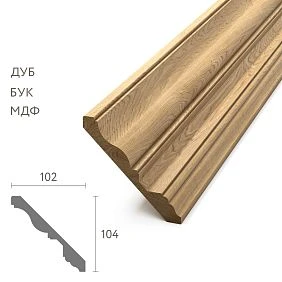
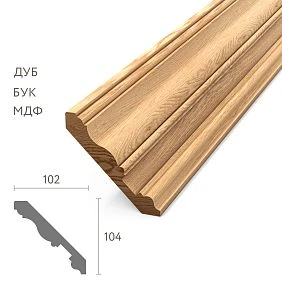
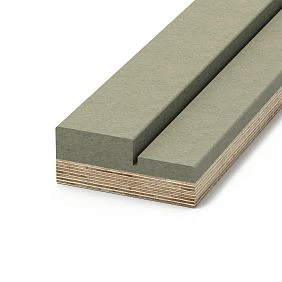
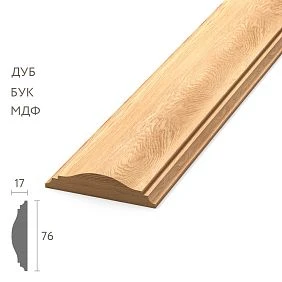
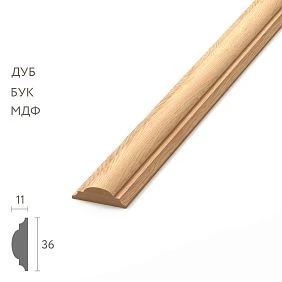
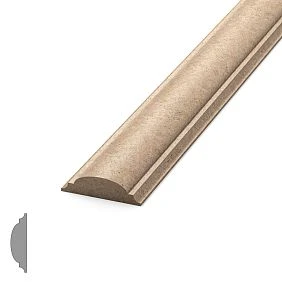
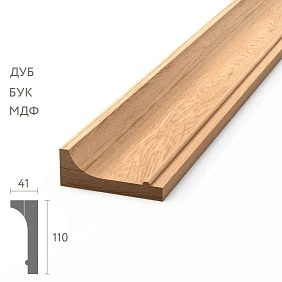
What is a wooden fillet
The word "fillet" has ancient Germanic roots and translates to "groove" or "rounding." In an architectural context, a fillet is a profile with a concave rounded or semi-oval cross-section, used to create a smooth transition between two adjacent planes.
If a cornice is a protruding finishing profile with a pronounced shape, and a baseboard is a lower wall-closing element, then the fillet occupies a different niche: it does not claim an independent decorative role but works in the joint area. Where one plane meets another at a right angle—wall and ceiling, cabinet and wall, furniture body and wall panel—the fillet softens this transition, making it smooth, architecturally sound, and visually tidy.
This subtle difference is fundamental. The cornice says: "Look, here is the boundary." The fillet says: "There is no boundary here—only a smooth transition." In this difference lies the entire essence of the tool.
wooden cornice in solid oak or beech—is a profile with a thin, laconic cross-section. The width can vary from 1.5 to 8 cm, the rounding radius from 10 to 40 mm. It is the radius that determines the character of the profile: a small radius gives a strict, almost geometric fillet, while a large one gives a soft one with a sense of organicity and calm.




Where wooden fillets are used
The use of wooden fillets in interiors is much broader than commonly thought. This profile is not limited to one installation point—on the contrary, it is multifunctional.
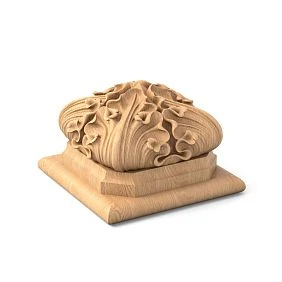
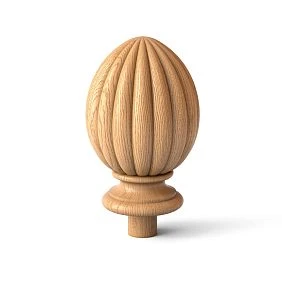
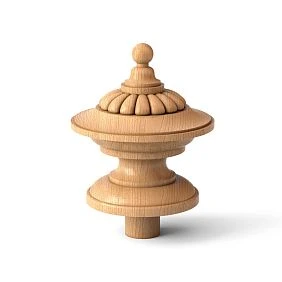
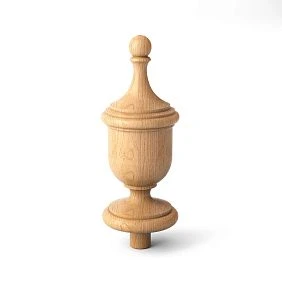
Our factory also produces:




Wall and ceiling joint
The most traditional place for a fillet is the horizontal joint between the wall and the ceiling. This is an area that requires finishing in any room: without a profile, cracks from shrinkage, joint irregularities, and differences in plaster thickness are inevitable. The fillet covers all of this, creating a clean horizontal line.
Unlike a massive cornice, the fillet here works delicately: it does not overhang the space, does not emphasize the transition, but simply makes it invisible. This solution is especially appropriate in bedrooms, studies, children's rooms, and other spaces where a calm atmosphere without unnecessary details is important.
Get Consultation
Top of built-in cabinets
One of the most commercially demanded scenarios for using a fillet is finishing the top joint of a built-in cabinet and the ceiling. When a sliding wardrobe or built-in closet is installed flush to the ceiling, a small gap always remains between the top edge of the cabinet body and the ceiling surface — a construction tolerance emphasizing that the furniture is not part of the wall.
The fillet closes this gap, creating the illusion of a monolithic built-in structure. It is this feeling of 'built-in' that distinguishes expensive joinery from a budget wardrobe. A small wooden profile with a rounded radius — and the cabinet turns into an architectural element of the room.
Sideboards, chests of drawers, and classic furniture
In classic furniture, the fillet is used as a delicate finishing profile for the top edge of a sideboard, chest of drawers, or cabinet. Where a larger cornice would be excessive, the fillet works exactly as needed: it adds completeness without claiming decorative dominance.
Door portals and openings
The fillet is used as part of a door portal — as a transition element between the casing and the wall plane. It softens the right angle of the connection, adding softness and plasticity to the portal framing. This is especially valuable in interiors where the priority is a calm, not overloaded with details atmosphere.
Decorative panels and friezes
When creating wall panels — vertical and horizontal — the galtel is used as an external or internal contour profile of the frames. It creates a soft transition between the panel and the background wall. It is this technique that allows you to assemble a wall panel that reads as an organic part of the wall, rather than as a rectangle attached to it.
Libraries and studies
In a classic study with bookshelves, the galtel is the final touch that completes the shelving unit at the top and creates a transition to the ceiling. wooden cornice here it may be too massive, the molding too flat, and the galtel exactly fits the intermediate niche: a soft, neat, elegant completion of the shelving unit without excessive decorativeness.
Rural homes
In wooden houses — made of timber, logs, or frame — a wooden galtel is organic by definition. It does not contradict the natural material of the walls and ceiling, but continues it. Wooden trim in a wooden house — it is a system into which the galtel fits as naturally as a log into a log house.
Kitchens and kitchen sets
In the kitchen, the galtel decorates the joint between the wall cabinet and the ceiling, the transition between the backsplash and the top shelf, or completes the upper edge of a kitchen niche. This is a small detail that, in the overall context of the kitchen set, makes it significantly neater and more expensive.
How the galtel differs from the cornice, baseboard, and molding
This question is one of the key ones. Confusion between these concepts is very common, and it leads to choosing the wrong tool for a specific task.
Cornice — architectural top finish
wooden cornice — is the upper finishing profile with an expressive shape: fillet, shelf, drip, projection. The cornice is the main decorative statement of the upper zone of the interior. It protrudes forward, creates a deep shadow beneath itself, and actively participates in the perception of space. The cornice does not soften the transition — it emphasizes it.
A cove, on the contrary, softens. It does not protrude but fits into the corner. Its task is not emphasis, but delicacy.
Baseboard — closing the bottom joint
Wooden baseboard — is the lower profile that closes the joint between the wall and the floor. Its task is symmetrical to the cornice, but in the lower zone. The baseboard can also have a rounded cross-section — in this case it is sometimes called a "cove", but this is an outdated construction usage of the term. In modern wooden millwork, cove and baseboard are different categories of products with different tasks.
Molding — line and frame
Wooden moldings — are flat or low-relief profiles that create horizontal or vertical decorative lines, frames, and panels on the wall. Molding is installed anywhere on the vertical plane — not in the corner area, but along the wall. Its task is to decorate and structure the surface, not to close a joint.
Cove — soft transition in the corner
The cove is the only one of the four profiles that works specifically in the corner area, at the junction of two planes. Its rounded cross-section organically fits into the right angle, filling it with a smooth curve. This is what makes the cove indispensable where delicacy is needed, not expressiveness.
Visual comparison
| Profile | Installation zone | Main function | Character |
|---|---|---|---|
| Cornice | Upper wall zone | Expressive finish | Architectural accent |
| Baseboard | Lower wall zone | Wall-floor joint closure | Practical and decorative |
| Molding | Any place on the wall | Frame, line, decor | Decorative |
| Cove molding | Corner joint | Soft transition profile | Delicate, transitional |
How to choose the size of a wooden cove molding
Size is not just numbers. It is the relationship of the profile with the space in which it works. An incorrect cove molding size — and it either gets lost or unexpectedly becomes a noticeable element where it should be invisible.
Ceiling height
The ratio is simple and logical: the lower the ceiling, the smaller the cove molding should be.
| Ceiling Height | Recommended cove molding width |
|---|---|
| Up to 2.5 m | 15–25 mm |
| 2.5–3.0 m | 25–40 mm |
| 3.0–3.5 m | 40–55 mm |
| Above 3.5 m | 55–80 mm |
On a low ceiling, a wide cove molding will look not like a soft transition, but like a disproportionate detail looming over the space. The more delicate the profile, the better it handles the task of an "invisible" transition.
Room scale
In a small room up to 15 square meters, a cove molding width of 15–25 mm is sufficient. In a spacious living room of 30 square meters or more, a profile of 40–50 mm looks organic and proportionate. The principle is the same as when choosing a cornice: the scale of the element should match the scale of the space.
Rounding radius
It is the radius that sets the character of the cove molding. A small radius (10–15 mm) gives an almost geometric corner with a slight rounding — strict, modern, laconic. A large radius (25–40 mm) creates a soft, smooth curve — classic, cozy, warm. For modern interiors and minimalism — a small radius. For classic and rustic styles — a large one.
Furniture scale
For furniture applications, a fillet is chosen smaller than an architectural one. For a built-in wardrobe 220 cm high, the optimal fillet width is 20–30 mm. For a sideboard 160 cm high, it is 15–25 mm. It is important that the fillet is perceived as a finishing touch, not as an independent decorative element.
Profile depth and projection
Unlike a cornice, a fillet has minimal projection — its profile fits into the corner rather than protruding from it. The typical depth of a fillet equals its width (for a quarter-round profile). Deep projection is atypical for a fillet — that is more of a cornice profile.
Fillet for the ceiling
Ceiling application of a wooden fillet is the most common and technically sound scenario. Here it performs three tasks simultaneously: it covers the construction gap at the wall-ceiling joint, creates a soft architectural transition, and adds a sense of completeness to the upper zone of the room.
When a fillet is better than a cornice
There are situations where a wooden cornice is too much. A ceiling height of 2.5 m in a small bedroom, a study with a low ceiling, a children's room, a living room in Scandinavian classic style — in all these cases, a massive cornice with a projection of 10–15 cm will create a feeling of tightness and decorative "pressure." Here, a fillet with a radius of 25–35 mm is the ideal tool: it marks the transition but does not emphasize it.
Ceiling fillet in a classic interior
In a classic interior, a fillet is often used as an additional profile within a more complex cornice system: the main cornice, below it a molding, and in the very corner a small fillet that completes the entire system with a soft rounding. This multi-tiered solution gives the ceiling depth without excessive heaviness.
Ceiling fillet in a country house
In a wooden country house, a solid beech or oak ceiling cove molding is a natural extension of the wooden architecture. Wooden trim It works as a system: cove molding at the top, baseboard at the bottom, wall moldings — and the wood becomes a single living space.
Ceiling cove molding for painting
If the project has the ceiling and walls in the same color, a cove molding for painting made of MDF or beech with a clean surface is the best choice. Painted to match the walls and ceiling, it becomes nearly invisible — exactly what is needed for a minimalist or neutral interior.
Cove molding for furniture and built-in cabinets
Furniture application of cove molding is a separate commercial segment that is actively developing today precisely because the finishing standards for built-in furniture have risen. Clients increasingly demand that the cabinet "grows into" the space rather than standing in it as a foreign object.
Built-in cabinet and ceiling
A built-in cabinet extended to the ceiling with cove molding is professional joinery work. Here, the cove molding is installed along the upper perimeter of the cabinet body, covering the gap between the cabinet and the ceiling. A gap of 5–15 mm is a construction standard, inevitable due to ceiling level variations. The cove molding completely hides it, creating a perfectly even horizontal line.
Sideboard and chest of drawers
For freestanding furniture — sideboards, chests of drawers, tall cabinets — the cove molding is installed along the top edge of the body as a finishing profile. Here, it is important that the cove molding is proportionate to the furniture: not wider than the item's scale allows, and not narrower than its height requires.
Kitchen wall cabinets
In the kitchen, a solid oak or beech cove molding is also a way to finish the joint between a wall cabinet and the ceiling or a decorative backsplash. The wooden profile adds naturalness and warmth to the kitchen—qualities that are especially valued in interiors with wooden fronts, solid countertops, or wooden floors.
Library shelving
For a bookshelf installed along a wall, a solid wood cove molding provides a neat finish for the top of the structure. The profile is attached between the top shelf of the bookcase and the ceiling, hiding the gap and creating the impression that the shelving is part of the room's architecture.
Cove molding for portals and openings
Using cove molding for portals is a more subtle and specific task that is often underestimated. Yet, it is here that cove molding achieves the type of neatness that cannot be attained with either a cornice or a molding.
Transition from casing to wall
Where a door casing meets the wall surface, a joint inevitably occurs. Filling it with putty is a standard solution, but not an architectural one. A wooden cove molding laid along this joint creates a smooth transition from the vertical casing to the horizontal wall, making the portal more finished and sculptural.
This works especially well in interiors where wooden casings and house carving: the wooden fillet naturally continues the wooden theme, creating a unified system of wooden framing.
Wide opening without a door
In open doorways between rooms, the fillet is used to finish the internal corner where the opening framing meets the wall. This is the final touch that turns an ordinary opening into a neatly designed architectural transition.
Arched openings
In arched openings, the fillet is installed along the inner radius of the arch, creating a soft wooden edge. This is a technically complex solution requiring a curved or segmented profile, but the result is a flawlessly finished arch with wooden warmth along the inner contour.
Material and coating of the wooden fillet
Solid beech
Beech is the most popular material for wooden fillets. Dense, homogeneous wood with fine pores provides perfectly clean profile milling. Beech fillet accepts any coating: varnish, enamel, tinting, oil. Beech is light in tone, making it versatile for painting in any color.
Solid oak
Oak — for those who want to see the wood as it is: with expressive texture, deep grain pattern, and noble brown tone. Oak fillet under clear varnish or oil is a living material that transforms over time, becoming deeper and warmer.
STAVROS company manufactures fillets from solid beech and oak in two quality options: "Standard" (machine sanding) and "Prestige" (detailed hand sanding, requiring no further finishing). For painting, the "under enamel" version with technological lamella gluing is suitable. For transparent coatings, the "under tinting" version with lamella selection by texture and color is used.
Coatings and final finishing
The choice of coating determines the final appearance of the fillet and its interaction with other interior elements:
-
Enamel — completely covers the wood grain, any RAL color, matte or glossy surface. An optimal solution for white and light interiors.
-
Clear varnish — preserves and protects the natural color and texture of the wood. Refreshed every 3–5 years.
-
Tinting — changes the shade of the wood, making it darker or cooler, while keeping the texture visible.
-
Oil and wax — matte, living surface, maximally natural feel. Easily refreshed without dismantling.
Production technology
STAVROS fillets are manufactured using 3D milling from solid beech and oak, with precise profile reproduction along the entire length. This ensures geometric stability across all linear meters of the order — a critically important property when installing around the perimeter of a room or along a long furniture contour.
Wooden fillet in the molding system
A fillet works most convincingly as part of a wooden molding system. A single fillet at the ceiling joint, without support from other wooden elements, looks lonely. The same fillet in a system is a different story.
Classic system:
-
Ceiling fillet — upper soft transition.
-
wooden cornice — when a more expressive finish of the upper zone is needed.
-
Wooden moldings — frames and decorative strips on walls.
-
Wooden baseboard — the lower finish of the wall.
-
Wooden moldings and baguettes — additional linear profiles, trims, and cover strips.
All elements are made from solid wood of the same species, with a consistent profile and finish. This is what a systematic approach to a wooden interior means.
Mistakes when choosing a wooden cove molding
Mistakes when choosing a cove molding are exactly those cases where a small detail leads to big disappointment. Let's break them down specifically.
Confusing a cove molding with a cornice or baseboard. This is the most common mistake. If you need a soft transition in a corner — it's a cove molding. If you need an expressive top finish — it's a cornice. If you need to cover the bottom joint with the floor — it's a baseboard. The tool must match the task.
Choosing a profile that is too small for a large room. A cove molding 15 mm wide in a spacious living room with 3.2 m ceilings will simply get lost. It will be so unnoticeable that its presence will have no effect. Proportionality is a key requirement.
Installing a massive cove molding in a low ceiling. The opposite mistake: a cove molding 60–70 mm wide with a 2.5 m ceiling is almost a cornice that presses down from above. For low ceilings — only thin profiles.
Do not consider adjacent moldings and architraves. If the architraves in the interior are made of oak with tinting, and the fillet is made of beech under white enamel, this is a conflict. All wooden elements must be from the same coating system and a similar ornamental culture.
Do not count linear meters. A fillet is a linear profile. The perimeter of the room, the total length of furniture edges, portal contours — all of this must be calculated in advance and add 12–15% reserve for cutting and joints.
Forget about corners and cutting. In room corners, the fillet is cut at 45 degrees. For external corners, there is also special cutting. Without a precise angle, the joint looks sloppy. Take this into account when calculating the footage.
Mixing different wood shades. Dark stained oak and light beech in the same room is a decorative contradiction. If different shades are planned intentionally, ensure they work within a unified color system of the interior.
Choose a profile without connection to furniture and doors. The fillet for a cabinet should be selected together with the facades and furniture handles. The fillet for the ceiling should be selected with door architraves and cornice, if present. A wooden interior is a system, not a set of random elements.
Where to buy wooden fillets
Everything needed for proper design of a wooden interior — from fillets and linear profiles to cornices, moldings, and architraves — is available in the STAVROS catalog:
-
Wooden fillets and baseboards — transition and finishing profiles for wall-ceiling, furniture-wall, cabinet-ceiling joints.
-
Wooden moldings and baguettes — linear profiles for systematic interior design: from the thinnest trims to expressive decorative edges.
-
Wooden moldings — for frames, panels and decorative lines on walls.
-
wooden cornice — for expressive completion of the upper zone.
-
Wooden baseboard — for the lower zone of walls and furniture.
-
wooden casings and house carving — for framing doorways and portals.
-
Full catalog of wood products — for forming a complete comprehensive order.
Manufacturing in Saint Petersburg from European beech and oak blanks. Options "Standard" and "Prestige" are available for sanding quality, as well as "enamel" or "stain" finishes. STAVROS accepts custom orders for batch production and provides consultation on selecting a molding system for a specific project.
About the Company
STAVROS is a Russian manufacturer of solid wood products for interiors and facades, with a history dating back to 2002. The company was founded by two artists and started with the restoration of palace interiors — including participation in the reconstruction of the Constantine Palace in Strelna, work with objects of the Hermitage, the Alexander Palace, and the Trinity Cathedral. Today, STAVROS offers a full range of wooden moldings and decor: fillets, baseboards, cornices, moldings, baguettes, architraves, and house carving from beech and oak. All products are manufactured using 3D milling with manual finishing, shipped from 1 piece, delivered throughout Russia and CIS countries.
FAQ — answers to popular questions
What is a wooden fillet?
A wooden fillet is a decorative transition profile made of solid wood with a concave rounded cross-section. It is used to create a smooth transition between two adjacent planes: wall and ceiling, furniture and wall, cabinet and ceiling. Unlike a cornice, a fillet does not emphasize the transition but softens it.
How is a fillet different from a cornice?
A cornice is a protruding finishing profile with a pronounced shape and forward projection. It creates an architectural accent. A fillet is a concave transitional profile without projection, which fits into a corner and creates a soft, smooth transition. The cornice emphasizes — the fillet conceals.
How is a fillet different from a baseboard?
A baseboard covers the bottom joint between the wall and floor. A fillet covers the top joint between the wall and ceiling, furniture and wall, or other corner transitions. These are different application zones and different architectural tasks.
Where are wooden fillets used?
At the junction of wall and ceiling, in the upper zone of built-in cabinets and sideboards, as part of door portals, in wall panel systems, in library shelving, in kitchens — everywhere a neat and unobtrusive transition between planes is needed.
Is a fillet suitable for the ceiling?
Yes, this is one of the main uses of a fillet. At the ceiling joint, it covers the construction gap and creates a soft architectural transition — especially appropriate where a massive cornice would be excessive.
Can a fillet be used on furniture?
Yes. A fillet is an excellent furniture profile for finishing the top edge of built-in cabinets, sideboards, library shelving, and kitchen units. It creates a sense of the furniture being 'built into' the space.
How to choose the size of a wooden fillet?
Consider the ceiling height and room scale. For ceilings up to 2.5 m — fillet width 15–25 mm. For high rooms — up to 50–80 mm. For furniture — smaller than for architectural use: 15–30 mm.
Can a wooden fillet be painted?
Yes. Beech fillet in the "enamel" finish perfectly accepts any RAL paint. Oak fillet looks beautiful under clear varnish or tinting, revealing the natural wood texture.
How to calculate the amount of fillet?
Measure the total length of all joints and surfaces where installation is planned. Add 12–15% for trimming, joints, and corner connections. For corner connections — account for cutting at 45 degrees.
Where to buy wooden fillets?
In the STAVROS catalog — a full range of wooden moldings, including beech and oak solid wood fillets, with Contact us to confirm shipping to your destination. More details: stavros.ru.