Article Contents:
- R-084 and R-085: characteristics that really influence the choice
- Why relief depth matters more than it seems in photos
- When compact R-084 looks more precise
- When deep relief R-085 is needed
- R-084 or R-085 at the same width
- Size 45 mm for a small facade
- Size 55 mm: the first common format of two models
- Size 74 mm for a chest of drawers, wardrobe, and cabinet
- Size 95 mm for a large furniture door
- How to match the size of the rosette with the width of the door
- How depth affects light and shadow
- Will a deep rosette interfere with the furniture handle
- Where to place the rosette relative to the handle
- One rosette or a symmetrical pair
- How to position rosettes on a two-door cabinet
- Oak or beech for a furniture rosette
- What to choose under enamel
- What to choose for tinting
- How to paint a wooden rosette without losing the relief
- How to use R-084 on dresser drawers
- R-084 for bedside table
- R-084 or R-085 for kitchen cabinet door
- How to choose a socket for a tall cabinet
- Carved socket for a sideboard
- Socket for furniture panel
- Socket for wall panel
- Socket for door leaf
- How to use sockets on a series of identical facades
- How to match a socket with molding
- When it's better to choose an elongated overlay instead of a square socket
- How not to confuse a socket with a regular overlay
- Can a socket be installed on ready-made furniture
- Paint before or after installation
- How to choose materials for installation
- How to prepare the facade
- How to glue a wooden socket without warping
- How to care for R-084 and R-085
- How to pack and transport a facade with a deep socket
- How to choose a socket for custom-made new furniture
- Socket for restoring a chest of drawers or sideboard
- Socket in a commercial interior
- How to avoid overloading the facade with deep relief
- How to check the selected size before ordering
- Practical selection table for R-084 or R-085
- What to buy together with a wooden socket
- How not to confuse buying a single part with a ready-made composition
- Common mistakes when choosing R-084 and R-085
- Who is R-084 suitable for
- Who is R-085 suitable for
- When it's better to avoid a socket
- How to buy R-084 or R-085 on STAVROS
- Why a finished socket is better than a random blank
- Control sample before large order
- Acceptance of finished furniture with sockets
- Table of 'what to buy together'
- Useful materials about wooden sockets
- How to create a specification for a furniture maker
- How to replace a damaged socket
- How to combine different sizes in one furniture collection
- Final check before adding to cart
- Why the same width does not mean the same visual scale
- How to choose a socket for repair without completely redoing the facade
- R-084 95 mm or R-085 95 × 95 × 46 mm: choice for a large facade
- FAQ: questions about wooden sockets R-084 and R-085
- How is R-084 different from R-085?
- Which wooden decorative socket should I buy for a small box?
- Can I install R-085 on a small facade?
- What size socket should I choose for a chest of drawers?
- Which socket is suitable for a tall cabinet?
- Can I compare R-084 and R-085 with a size of 74 mm?
- Will a deep socket interfere with the handle?
- Where should I place the socket relative to the furniture handle?
- Do I need one socket or a pair?
- How to position sockets on a two-door cabinet?
- Which is better under enamel: oak or beech?
- Which socket to choose for tinting?
- Can a socket be installed on finished furniture?
- Do I need to paint the socket before installation?
- How to glue a wooden socket to a facade?
- Can a socket be combined with a molding?
- When is it better to choose an elongated overlay instead of a socket?
- Is R-084 suitable for a kitchen facade?
- Where to buy R-084 and R-085?
- What should I check before ordering?
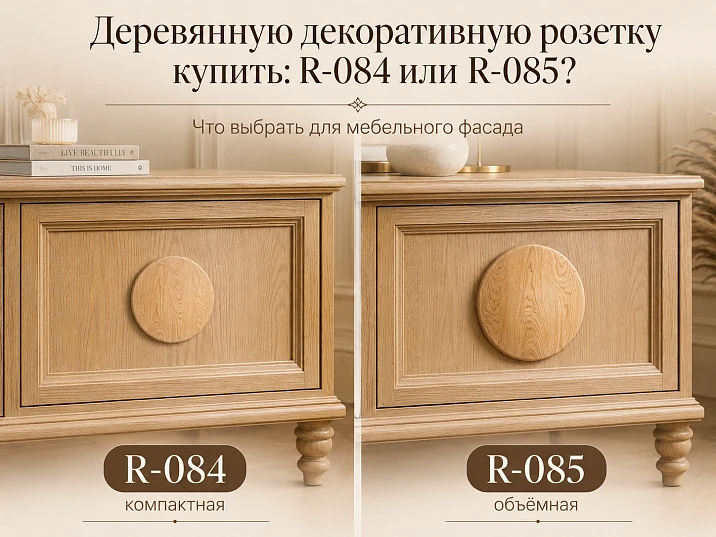
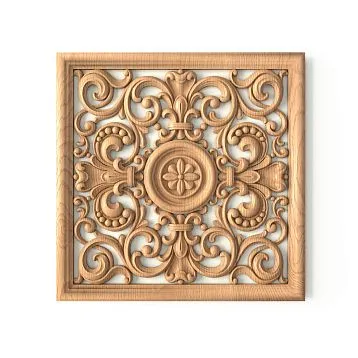
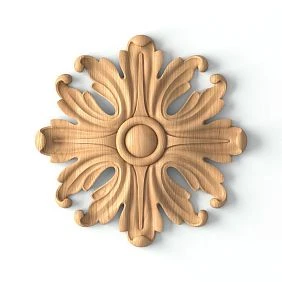
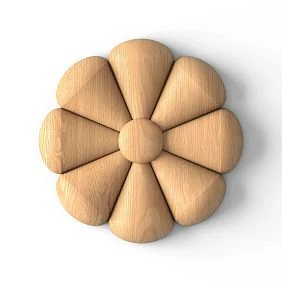
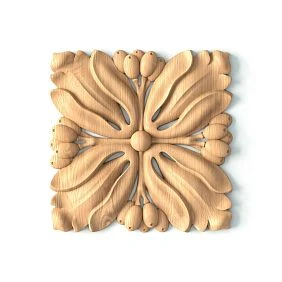
It is easier to buy a wooden decorative rosette when you already understand that the facade needs a square central decor. But after that, a more complex question arises: how much should the rosette protrude above the plane. On a small drawer, a deep relief may feel heavy and interfere with the handle. On a tall cabinet door, a too thin detail, on the contrary, will get lost. Therefore, the comparison of R-084 and R-085 revolves around depth, scale, and the behavior of the decor on specific furniture.
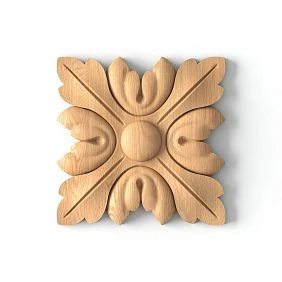
R-084 is a compact wooden rosette. The confirmed base size is 45 × 45 × 13 mm. The card also offers options 55 × 55, 74 × 74, and 95 × 95 mm, but the depth of these sizes is not specified in the provided data. It cannot be automatically assumed to be 13 mm: the actual thickness of each option should be checked in the size table of the product card or clarified with a STAVROS manager.
R-085 is a more voluminous rosette of the same modern series. For it, options 55 × 55 × 26, 74 × 74 × 37, and 95 × 95 × 46 mm are confirmed. With the same width as R-084, it creates a deeper chiaroscuro, protrudes more noticeably above the plane, and has a stronger impact on the placement of handles, moldings, and adjacent doors.
Both models are made from solid oak or beech and are selected for enamel or tinting. The material and finish are considered together: beech is convenient for opaque painting, oak is used when the natural texture needs to be preserved. Compatibility with specific oil, varnish, primer, paint, and glue should be checked before ordering.
Short answer. Choose R-084 for small drawers, cabinets, kitchen doors, series of identical facades, and situations where the rosette is located next to a handle. R-085 is suitable for large cabinet doors, sideboards, furniture portals, and panels where a deep relief and noticeable chiaroscuro are needed.
With the same width, R-085 requires more free space in depth. For size 74 mm, this is especially clear: R-085 has dimensions 74 × 74 × 37 mm, and the exact depth of R-084 size 74 × 74 mm must be checked in the card.
Buy compact wooden rosette R-084 Buy voluminous wooden rosette R-085 View all sizes of wooden rosettes
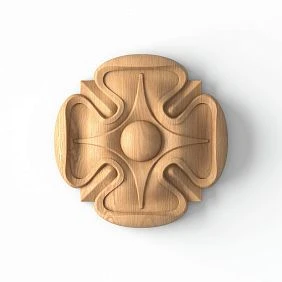
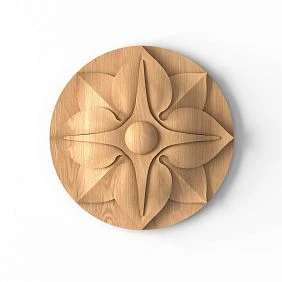
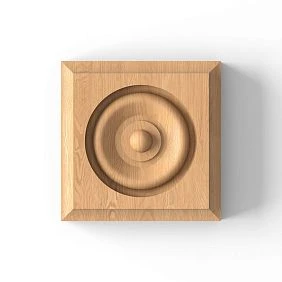
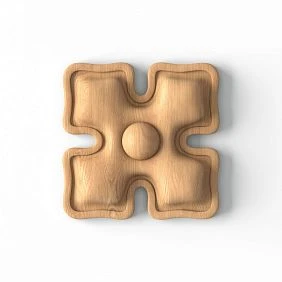
R-084 and R-085: characteristics that really influence the choice
| Parameter | R-084 | R-085 |
|---|---|---|
| Type | Compact square wooden socket | Volumetric square wooden socket |
| Material | Solid oak or beech | Solid oak or beech |
| Confirmed base size | 45 × 45 × 13 mm | The card also indicates a thickness of 22 mm; the exact size of the variant is checked in the current table |
| Other sizes | 55 × 55, 74 × 74, 95 × 95 mm; depth to be clarified | 55 × 55 × 26, 74 × 74 × 37, 95 × 95 × 46 mm |
| Character of relief | Restrained, compact | Deep, expressive |
| Main scenarios | Boxes, cabinets, small doors, repeating facades | Large wardrobes, sideboards, panels, furniture portals |
| Finishing | For enamel or tinting | For enamel or tinting |
| Main risk | May get lost on a large door | May interfere with the handle or adjacent leaf |
Models have overlapping sizes of 55, 74, and 95 mm. The buyer may choose the same width but get a completely different protrusion above the facade. Therefore, the comparison is based on two axes: frontal size and relief depth.




Why relief depth matters more than it seems in a photo
Width shows how much space the socket takes up on the plane. Depth determines the protrusion, shadow, and interaction with furniture. In a front photo, two elements of the same size may look similar, but from the side, the difference between a compact and deep relief becomes obvious.
R-084 keeps the facade calmer. This is convenient near a handle, on drawers, and on furniture where the decorative element is repeated many times. R-085 creates a noticeable volume and has a stronger impact on the entire central area.
The depth is also reflected in the packaging of the finished facade. A 95 × 95 × 46 mm socket requires protection from pressure and impacts. When assembling the cabinet, you need to ensure it does not come into contact with the adjacent door.
The relief should be chosen before marking the handle and moldings. Otherwise, an already purchased part may take up space intended for hardware.
Our factory also produces:
When the compact R-084 looks more precise
R-084 suits facades where the central decor should be noticeable but not dominant. The base size 45 × 45 × 13 mm works well on a small drawer, cabinet door, narrow panel, and compact panel.
On a series of identical drawers, a calm relief is especially useful. If a deep rosette is placed on each facade, the furniture may look overloaded. R-084 supports the style but leaves visual space for handles and body lines.
The compact model suits modern classics and transitional interiors, where carved decor is painted in the furniture color. After enamel, it is read through shadow but does not look like a separate massive part.
For a buyer who needs a compact decorative rosette for the facade, it is worth starting with the base size 45 × 45 × 13 mm, and then comparing the 55, 74, and 95 mm options using the current card table.
Get Consultation
When deep relief R-085 is needed
R-085 is chosen when the rosette should become an independent center. The depth of 26, 37, or 46 mm creates pronounced chiaroscuro and makes the element noticeable even on a tall cabinet door or large panel.
On the sideboard and furniture portal, a voluminous rosette connects the moldings, panel, and central axis. It fills the field where a compact detail would look random.
R-085 requires free space. A convenient gap is left between the rosette and the handle. On a double-door cabinet, check that the elements do not touch when opening.
For a large facade, you can Buy voluminous wooden rosette R-085 and choose a confirmed size of 55 × 55 × 26, 74 × 74 × 37, or 95 × 95 × 46 mm.
R-084 or R-085 with the same width
The most useful way to compare is to take one front size. At a width of 55 mm, R-085 has a depth of 26 mm. For R-084, the size 55 × 55 mm is confirmed, but its depth needs to be checked separately.
At a width of 74 mm, R-085 reaches a depth of 37 mm. This is a noticeable volume that creates a deep shadow and requires free space next to the handle. R-084 of the same front size will give a calmer character, but the exact parameter cannot be invented.
At a width of 95 mm, R-085 has a depth of 46 mm. Such a detail becomes an architectural part of the facade. For R-084, the size 95 × 95 mm suits a large plane, but the exact thickness is checked in the card.
The question "what width is needed" and the question "what depth is needed" are solved separately. First, the scale of the facade is determined, then the character of the relief is chosen.
Size 45 mm for a small facade
R-084 measuring 45 × 45 × 13 mm is the most specific compact option. It suits small drawers, bedside tables, narrow doors, and a series of facades where the decor repeats.
The 45 mm socket should not be placed too close to the edges. Leave a free field around it so that the square contour reads separately from the molding and handle.
On a tall door, this size may get lost. Even a good shadow cannot compensate for the lack of frontal scale if the element looks like a dot on a large plane.
For small furniture, 45 mm is more convenient than larger options because it saves space for hardware and does not complicate the opening of adjacent parts.
Size 55 mm: the first common format of two models
The 55 × 55 mm format is present in both models. For R-085, a depth of 26 mm is confirmed. For R-084, the exact thickness is checked in the current product card.
This size suits cabinet doors, a small chest of drawers, a kitchen facade, and a narrow wardrobe. R-084 will provide a restrained center, R-085 a noticeable relief at the same width.
If the handle is located directly under the socket, the compact model is safer. If the handle is shifted lower and the facade has a free central zone, R-085 can be considered.
A full-size mockup helps to understand if 55 mm is enough. In a photo, such an element often appears larger than on a real door.
Size 74 mm for a chest of drawers, wardrobe, and cabinet
The 74 × 74 mm format is universal for medium-scale furniture. It is noticeable on a cabinet door, wide dresser drawer, nightstand, and sideboard, but does not yet require a large free area.
R-085 measuring 74 × 74 × 37 mm creates strong chiaroscuro. It suits a classic facade, deep panel, and large handle if there is enough space between elements.
R-084 measuring 74 × 74 mm is chosen when the same frontal scale is needed but with a more subdued protrusion. The exact depth is checked in the card.
On a two-door cabinet, two 74 mm sockets can form a symmetrical pair. Before installation, evaluate the distance between them in the closed position.
Size 95 mm for large furniture door
The 95 × 95 mm size is designed for a large facade. On a small nightstand, such a socket occupies too large a share of the surface, but on a tall cabinet door, sideboard, and panel, it has sufficient space.
R-085 measuring 95 × 95 × 46 mm protrudes significantly from the plane. It is viewed from the side, checking gaps, handle, packaging, and transportation of the finished furniture.
R-084 measuring 95 × 95 mm can provide a large but more restrained accent. Since the depth is not confirmed in the provided export, it cannot be evaluated based on the base size of 45 mm.
The large format is especially sensitive to centering. A shift of a few millimeters is noticeable next to a molding frame and panel.
How to match the socket size to the door width
There is no universal percentage formula. The same door can have different panels, moldings, handles, and empty space. Therefore, it is more correct to create a full-size layout.
Mark the boundaries of the facade, the inner frame, the handle, and the intended rosette. Check if there is enough air around the decor. If the square almost touches the molding, the size is too large.
On a narrow, tall door, it is better to use a smaller width. On a low, wide facade, conversely, a small rosette may get lost.
For a furniture series, first approve one reference door, then transfer the size and position to the others.
How depth affects light and shadow
The deeper the carving, the stronger the contrast between protrusions and recesses. R-085 creates a pronounced shadow even with a monochrome finish. R-084 stays closer to the surface and looks softer.
Side lighting enhances volume. On a cabinet next to a window, a deep rosette will be more noticeable than under frontal diffused light. This is considered before purchase.
Dark tinting further emphasizes the recesses. White enamel makes the relief calmer in color, but the shadow still remains.
If the interior is already saturated with moldings and carvings, deep R-085 may overload the facade. Compact R-084 better maintains balance.
Will a deep rosette interfere with the furniture handle
The handle should remain comfortable to grip. If the socket is located too close, fingers may touch the relief. Pay special attention to R-085 with a depth of 37 or 46 mm.
The problem depends not only on the distance along the plane, but also on the handle protrusion. A low button and a deep socket can compete more strongly than a long bracket extended forward.
Make a side template: mark the depth of the socket and handle. Such a mockup shows the actual gap better than a front view drawing.
If there is little free space, choose R-084, reduce the size, or move the socket higher. A beautiful but uncomfortable facade cannot be considered successful.
Where to place the socket relative to the handle
On a drawer, the socket is often placed centered above the handle or in a separate decorative area. If the handle is already in the geometric center, the socket may compete with it.
For a button, a scheme is possible where the socket serves as a decorative background only with a confirmed design. Do not automatically drill or install hardware through a carved element without checking.
On a cabinet door, the socket can be located above the handle, inside a molding frame. The distance should maintain comfort and a clear hierarchy.
On a two-leaf facade, handles are placed near the central joint, and sockets are above or in the center of each leaf. A mockup helps avoid crowding.
One socket or a symmetrical pair
One socket fits a single door, a wide drawer, a central panel, and a furniture portal. It emphasizes the geometric center and does not break up the surface.
A pair is needed for two doors, two identical drawers, or symmetrical side panels. The size and depth must match, otherwise the light and shadow will be different.
On one wide facade, two sockets can look random if there is no constructive logic between them. It is better to use one central piece or an elongated overlay.
R-085 in a pair creates a strong volume and requires more free space. R-084 is easier to repeat on a series of facades.
How to place sockets on a two-door cabinet
There are two main schemes. The first is one socket on each door. The second is one central composition that visually unites both doors. The second scheme requires caution because the joint of the doors remains movable.
For paired placement, measure each door separately and set aside equal distances from the outer and inner edges. The centers must be at the same height.
The deep R-085 should not touch the adjacent door when opening. This is especially important for the size 95 × 95 × 46 mm.
If the doors are narrow, the compact R-084 often looks more precise. On a wide cabinet, you can use R-085 74 or 95 mm after checking with a template.
Oak or beech for a furniture socket
Both models are made from solid oak or beech. The wood type affects the texture and future finish. Oak is chosen when the wood grain should remain visible. Beech is suitable for opaque enamel.
Tinted oak helps connect the rosette with the wooden facade, frame, molding, and other details. With a transparent finish, the natural differences in the wood are preserved.
Beech under enamel allows achieving a uniform color with the furniture. On R-084, this supports calm modern classics well. On R-085, a solid-color enamel emphasizes volume through shadow.
Compatibility with any oil, varnish, primer, or paint cannot be guaranteed. The finishing system is checked based on product preparation and the material manufacturer's recommendations.
What to choose for enamel
For opaque painting, beech is often considered. It allows covering the natural texture and obtaining a rosette in the color of the facade.
On the compact R-084, enamel creates a neat relief without strong contrast. This option suits white, gray, colored furniture, and a series of identical drawers.
On the deep R-085, the paint must evenly cover the protrusions and recesses without smoothing the carving. Too thick a layer reduces detail.
Before finishing, a test sample is made or the technology is coordinated with the workshop. Color on deep relief appears darker in the shadows.
What to choose for tinting
For tinting, oak is chosen if it is important to preserve the wood structure. R-084 will give a calm central sign, R-085 will give a pronounced play of texture and shadow.
The tint must match the facade. Names like "walnut" or "dark oak" are not enough: it is better to use an actual sample.
Deep recesses of R-085 can perceive color more richly. Therefore, a test paint-out is especially important for the size 95 × 95 × 46 mm.
Finish varnish or oil is chosen only after checking compatibility with the socket preparation and the main facade.
How to paint a wooden socket and not lose the relief
The carving is revealed through transitions between protrusions and recesses. If the paint is applied too thickly, small edges become smoothed, and R-084 can become almost flat.
For R-085, the risk is different: material can accumulate in deep areas and create drips. The coating is applied evenly, controlling each side.
Painting before installation makes it easier to access the side surfaces. Painting after installation helps to unify the socket with the facade. The specific scheme is chosen before gluing.
A test paint-out shows how color and gloss level affect light and shadow. Matte enamel makes the relief softer, while glossier enamel emphasizes protrusions.
How to use R-084 on dresser drawers
On a dresser, sockets are often repeated vertically or horizontally. The compact R-084 is convenient because it does not overload a row of identical facades.
The 45 mm size is suitable for small drawers. For wide drawers, you can consider 55 or 74 mm, but the exact depth of the chosen option needs to be checked.
If the handle is centered, the rosette is placed above, below, or used only on the outermost drawers. Duplicating decor without free space is not advisable.
Before ordering, it's useful to mock up the entire dresser. One rosette may look appropriate, but five identical elements can be too overwhelming.
R-084 for a bedside table
A small table requires delicate decor. The basic R-084, sized 45 × 45 × 13 mm, usually preserves proportions better than the deep R-085.
On a door or drawer, the rosette can complement the handle shape and molding frame. But it should not occupy the entire central area.
If the tables are paired, the position and depth of the rosettes must match. Even a small difference is noticeable next to the bed.
Under enamel, R-084 can easily match the body color. Under stain, an oak part can complement the wooden tabletop or legs.
R-084 or R-085 for a kitchen door
In the kitchen, fronts are used frequently, and the handle must remain comfortable. Therefore, the compact R-084 is usually more practical for small doors and drawers.
R-085 can be used on tall cabinets, decorative side panels, and fronts that are not near the work area. The deep relief will require more careful maintenance.
Before installation, check not only the size but also the opening of adjacent doors, the position of the hinge, and the handle grip area.
For a kitchen to be painted, beech under enamel helps achieve a uniform color. The specific paint and primer system is coordinated with the furniture manufacturer.
How to choose a rosette for a tall cabinet
A tall door requires a noticeable scale. R-084 size 45 mm may get lost, so 74 or 95 mm are considered, or they switch to deep R-085.
R-085 74 × 74 × 37 mm is suitable for a medium-scale cabinet. The size 95 × 95 × 46 mm is needed for a wide tall door and sufficient free field.
The rosette is placed inside the panel or molding frame, maintaining equal margins. A position too close to the top edge makes the facade heavy.
If the cabinet has two doors, both parts are compared in closed and open positions. The depth should not interfere with movement.
Carved rosette for a sideboard
A sideboard allows for more expressive central decor, especially if the facades are tall and the moldings and cornices already create a classic architecture.
R-084 is suitable for narrow doors and small drawers. R-085 is appropriate on a central tall door or large panel.
The 74 mm size is often a compromise: it is noticeable but does not require as much space as the 95 × 95 × 46 mm option.
Tinted oak complements the buffet's natural wood. Beech under enamel suits painted furniture and modern classics.
Rosette on furniture panel
The panel already defines the inner field of the facade, so the rosette is positioned relative to its center, not just relative to the outer edge of the door.
If the panel is shallow, R-085 may protrude too sharply. R-084 better maintains a calm plane.
On a deep classic panel, the voluminous R-085 looks more natural, especially in the 74 or 95 mm size.
Before ordering, measure not only the entire door but also the inner field between the moldings. It determines the available size.
Rosette for wall panel
On a wall panel, the viewing distance is greater than on furniture. Therefore, the compact R-084 may get lost if the panel is wide and tall.
R-085 creates an expressive shadow and reads better in a living room, hallway, study, or commercial interior. But the size is chosen based on the entire panel, not an individual sample.
If the rosette is painted the same color as the wall, depth becomes the main source of expressiveness. Light should emphasize the relief, not hide it.
General ideas about where to use decorative solid wood rosettes, help to see a broader context, and the specific choice between R-084 and R-085 is made based on depth and size.
Rosette for door leaf
On a door, the rosette can become a central point decor inside the panel. Here it is especially important to check the handle, lock, and distance to the casing.
R-084 is suitable for narrow doors and calm finishes. R-085 requires a wide surface and sufficient clearance from the hardware.
A depth of 46 mm on a door is noticeable from the side and may obstruct passage if the element is located close to the edge. A full-size mockup is mandatory.
Installation on a finished painted leaf is performed only after checking the base, glue, and the ability to safely restore the coating.
How to use rosettes on a series of identical facades
Repetition enhances any decor. One deep R-085 looks like an accent, while ten identical elements already create a whole system.
For a series of drawers and small doors, R-084 is usually safer. It supports the rhythm but does not turn every facade into a separate center.
On large cabinets, you can alternate: R-085 on the main door, R-084 on secondary facades. But the difference must be planned in the project.
Before a mass order, one control facade is assembled and evaluated under real lighting.
How to match a rosette with molding
Molding creates a frame, and the rosette forms a focal point. These elements should not touch each other without a specially designed connection. Leave a free field between a square rosette and the inner edge of the frame.
Compact R-084 pairs more easily with thin molding. Deep R-085 requires a more prominent profile or a wide panel, otherwise the volume looks random.
Color and material can be combined: connect an oak rosette with a wooden molding through tinting, paint a beech one together with the facade. But the specific finishing system is checked in advance.
If the molding is already installed, measure the inner field. Choose the rosette size based on the free area, not the overall door width.
When to choose an elongated overlay instead of a square rosette
The rosette works best as a central focal accent. On a tall narrow panel or a long horizontal panel, a square may appear too small and fail to unify the entire area.
An elongated overlay helps fill the longitudinal zone, support the top line, or frame a wide door. It can be more precise when a furniture front needs directional movement rather than a center.
For such a task, you can choose an elongated overlay instead of a rosette and compare the sizes of overlay decor made of oak and beech.
Do not stretch the composition with multiple square rosettes if one elongated piece solves the problem more clearly.
How not to confuse a rosette with a regular overlay
A rosette has a compact central form and is usually perceived as an independent point. An overlay can be elongated, corner, paired, or intended for filling another area.
R-084 and R-085 are chosen when you need to emphasize the center of a door, drawer, panel, or board. They are not always suitable for edges, corners, or long lines.
In the product card, check the article number, front size, depth, material, and purpose. A similar floral pattern does not make the elements interchangeable.
A buyer's mistake occurs when a rosette is used as a small end piece for molding. There are other types of decor for that purpose.
Can I install a socket on finished furniture
Installation on a finished facade is only possible after checking the coating and base. Varnish, enamel, veneer, solid wood, and laminated surfaces require different solutions.
First, perform a dry layout and mark the center. On finished furniture, a marking error is especially noticeable because rework can damage the coating.
For R-085, additionally check the depth and opening. The finished door already has a handle and hinges, so there is less free space than in a new project.
The glue and surface preparation are selected based on the facade material, part weight, and operating conditions.
Paint before or after installation
Finishing before installation is convenient when you need to properly treat the side surfaces and deep relief of R-085. The part can be rotated and the coating controlled from all sides.
Finishing after installation helps to unify the socket with the facade in one color and hide a small transition along the contour. But access to deep areas becomes more difficult.
For oak under tinting, separate treatment is often more convenient because the wood grain must be uniform. Beech under enamel can be painted together with the facade using an agreed-upon technology.
The decision is made before gluing. After installation, changing the finishing method without risk is significantly more difficult.
How to select materials for installation
The glue is chosen based on the facade material, coating condition, socket size, and furniture usage conditions. There is no one universal composition for all projects.
To complete the set, you can open materials for installing a wooden socket and check suitable options for preparation, fixation, and finishing.
R-085 measuring 95 × 95 × 46 mm requires a particularly reliable solution due to its depth and volume. But fasteners or glue cannot be assigned without data on the specific base.
Excess glue should not come out onto the front relief. Before mass installation, it is useful to test the technology on one sample.
How to prepare the facade
The base must be level, clean, and strong. Weak old coating, dust, grease, and peeling paint reduce installation reliability.
The center is marked relative to the panel, molding frame, and handle. The geometric center of the entire door does not always coincide with the visual center of the decorative field.
On solid wood and MDF, the base behavior differs. Preparation is carried out according to recommendations for the specific material and future finishing.
Before gluing, the rosette is applied dry and evaluated from the front and side. For R-085, a side check is mandatory.
How to glue a wooden rosette without skew
The square shape makes the skew especially noticeable. Even a slight deviation from the vertical is visible next to straight moldings and edges of the facade.
Use temporary guides or a template that fixes the position until the glue sets. The method should not damage the coating.
Pressure is distributed evenly over the strong areas of the part. Do not press on thin carved protrusions.
After installation, check the position before the final strength is achieved. Correcting a skew after drying is significantly more difficult.
How to care for R-084 and R-085
Dust is removed with a soft brush or suitable attachment. R-085 requires more attention because deep recesses collect dirt faster.
Care products are chosen based on the finish coating, not just the wood species. Abrasives and hard brushes can damage enamel, varnish, or tinting.
In the kitchen, it is better to place the rosette outside the area of constant splashes and grease. The compact R-084 is easier to clean regularly.
For local damage, keep a sample of the color and finishing details. Random paint will create a noticeable spot on the central element.
How to pack and transport a facade with a deep socket
The finished facade with R-085 cannot be placed face down under load. The protruding relief must be in a protected area of the packaging.
Size 95 × 95 × 46 mm requires particularly deep protective space. Pressure on the center can damage the socket or facade.
When transporting, doors are secured so they do not move or touch each other with decorative elements.
If furniture is assembled on site, it is sometimes safer to transport sockets separately and install them after delivery. The solution depends on the project technology.
How to choose a socket for new custom furniture
In a new project, the socket is planned before manufacturing the facade. The designer immediately determines the size, depth, handle position, moldings, and finishing method.
R-084 is convenient for a series of small facades. R-085 is for the main door, central panel, or furniture portal.
The designer must see the side profile. One frontal size is not enough, especially for R-085 with a depth of 37 or 46 mm.
The specification includes the article number, size, wood species, finish, and installation diagram. This excludes replacement with a similar but different element.
Socket for restoring a chest of drawers or sideboard
During restoration, the structure and surface of the facade are restored first, then the decor is selected. The socket should not hide cracks, broken holes, or a weak base.
R-084 helps add a neat modern accent without significantly changing the furniture silhouette. R-085 is suitable for a classic sideboard with deep panels and large architecture.
Oak for tinting is matched to the existing wood based on a sample. Beech for enamel is suitable for painted furniture.
Before installation, check that the socket does not cover historical hardware and does not interfere with future handle maintenance.
Socket in a commercial interior
In a hotel, restaurant, salon, or showroom, decorative elements are viewed from a greater distance. R-085 better maintains readability on large panels and doors.
R-084 is suitable for posts, cabinets, and series of small facades where deep relief would hinder cleaning and intensive use.
For a serial project, a control sample is made first. It shows the actual color, shadow, ease of maintenance, and installation stability.
Spare sockets are stored together with the article and finish sample to replace a damaged part without mismatch.
How to avoid overloading the facade with deep relief
R-085 already forms a strong center. If there are large moldings, a carved handle, and several overlays nearby, the facade may become too busy.
On a small door, choose one main decorative technique. For example, R-085 without complex additional ornament or R-084 inside a molding frame.
Monochrome painting reduces color contrast but does not decrease physical depth. The shadow still makes the socket noticeable.
A full-size mockup and side template help evaluate the composition before purchase and painting.
How to check the selected size before ordering
Print a square of 45, 55, 74, or 95 mm and apply it to the facade. For R-085, additionally make a side template with a depth of 26, 37, or 46 mm.
Look at the mockup from a normal distance, open the door, grasp the handle, and check adjacent doors.
On a series of drawers, place the template on each facade. Repetition may change the impression more than the size of a single part.
Only after such verification do they select the article, wood species, and finish.
Practical selection table for R-084 or R-085
| Situation | Preferred option | Why | What to Check |
|---|---|---|---|
| Small dresser drawer | R-084 45 or 55 mm | Compact relief does not overload the row | Handle position and exact depth of the selected size |
| Bedside table | R-084 | Maintains a calm scale | Free space around the socket |
| Wide dresser front | R-084 or R-085 74 mm | You can choose the same width with different depths | Handle convenience and light-shadow character |
| High cabinet door | R-085 74 or 95 mm | Deep relief visible from a distance | Gaps, opening, and transportation |
| Kitchen facade series | Usually R-084 | Easier to maintain a calm surface and care | Coating, handles, and dirt zone |
| Large sideboard | R-085 | Expressed plasticity matches the scale | Panel, moldings, and overall architecture |
| Double-door cabinet | A pair of identical R-084 or R-085 | Symmetry connects the doors | Distance between parts in closed position |
| Wall panel | R-085 for large field, R-084 for compact | Size is chosen based on viewing distance | Lighting and free space |
What to buy together with a wooden socket
A socket rarely exists separately from the entire facade. The buyer may need moldings, handles, finishing materials, and other elements, but links in the article are only placed to confirmed categories from the diagram.
To compare different models, you can open the catalog of carved rosettes made of oak and beech. There you can conveniently check alternative sizes and patterns if R-084 or R-085 do not match the facade.
If the square center does not solve the problem, it is useful Buy wooden overlays for furniture to choose an elongated decor for a tall or wide panel.
For installation and finishing, open materials for painting and finishing decorThe glue and coating are selected based on the facade material, wood species, part weight, and usage conditions.
How not to confuse buying a single part with a ready-made composition
Card R-084 or R-085 refers to a specific socket of the selected size and material. It does not automatically mean a ready-made set with molding, handle, glue, and finish.
If a pair is needed for a two-door wardrobe, the quantity is calculated separately. One product card does not turn into two symmetrical parts.
The finish also requires verification. The phrase "for enamel or tinting" does not mean that any finish is already included or compatible without preparation.
Before placing an order, create a simple list: article number, size, depth, wood species, quantity, installation location, and future finish.
Common mistakes when choosing R-084 and R-085
The first mistake is choosing only based on the front photo. It does not show the actual protrusion above the facade. For R-085, a side template is needed.
The second is assuming that R-084 of all sizes has a thickness of 13 mm. The confirmed depth of 13 mm applies to the 45 × 45 mm option; other parameters need clarification.
The third is buying R-085 95 × 95 × 46 mm for a small door without checking the handle and gaps.
The fourth is using R-084 45 mm on a tall, wide door where it gets lost.
The fifth is placing the socket too close to the handle. A beautiful relief should not impair grip.
Sixth — do not account for repetition on a series of boxes. Several deep elements can overload a chest of drawers.
Seventh — choose the wood species separately from the finish. Oak and beech give different visual results.
Eighth — assign glue or paint without checking the facade and preparing the product.
Ninth — consider a rosette as a replacement for an elongated overlay on a long panel.
Tenth — install without dry layout and centering.
Who is R-084 suitable for
R-084 is suitable for owners of cabinets, chests of drawers, small wardrobes, kitchen furniture, and series of identical facades. It helps add central decor while maintaining a calm plane.
The model is especially useful next to a handle, in modern classics, and in projects where the rosette is painted in the color of the facade.
R-084 may not suit a large tall door if the size of 45 or 55 mm is lost. Then choose a larger option or switch to R-085.
Before ordering, you can view dimensions of wooden rosette R-084 and clarify the depth of the 55, 74, and 95 mm options.
Who is R-085 suitable for
R-085 is suitable for large cabinets, sideboards, furniture portals, tall doors, and wall panels. It is needed when the center should be noticeable and create deep chiaroscuro.
The dimensions 74 × 74 × 37 and 95 × 95 × 46 mm unfold on a wide open field. The model supports deep paneling and pronounced moldings well.
R-085 may not be suitable for a small drawer, narrow door, or facade with a closely placed handle.
Before purchasing, it is worth view the size options for R-085 and check the protrusion of each format on the side layout.
When it is better to avoid a rosette
If the facade already contains complex carving, a large handle, and a rich molding frame, an additional square center may be redundant.
On a very narrow panel, the rosette does not get an open field. In such a situation, it is better to choose an elongated overlay or maintain a calm surface.
For minimalist furniture, any carved decor can contradict the design intent. A conscious refusal is better than a random detail added just to fill the void.
If reliable installation or a safe gap when opening cannot be ensured, choose a smaller model or a different decor group.
How to buy R-084 or R-085 from STAVROS
First, measure the facade and the inner field between the moldings. Then make a front and side template. After that, choose the model, size, and material.
For a compact relief, open the R-084 card. For a deep center, use R-085. If neither format fits, go to the rosette catalog or the overlay category.
Before ordering, check the wood species, preparation option, depth, quantity, finish, and installation conditions. Current prices, availability, and lead times are viewed directly in the product card.
If the rosette is being selected for existing furniture, send the STAVROS manager a photo, facade dimensions, handle position, and coating details.
Why a finished rosette is better than a random blank
A finished R-084 or R-085 has a specific pattern, dimensions, and article number. This allows repeating the decor on multiple facades and ordering a replacement if necessary.
A random wooden blank requires additional work, leveling, and adjustment. The result may differ on each door.
The finished series offers a common pattern with varying depth. The buyer chooses not just a shape, but the character of the relief within familiar dimensions.
The commercial route becomes predictable: product card, choice of oak or beech, finishing, installation, and repeatability across all furniture.
Control sample before a large order
For a cabinet with many doors or a series of commercial furniture, it is useful to first buy one rosette and assemble a test facade.
The sample shows the real scale, color, shadow, handle convenience, and coating behavior. The screen and drawing do not provide such completeness.
If the result is satisfactory, the dimensions and position are fixed in the specification. Only then is the full quantity ordered.
The test facade is kept as a reference for the cabinetmaker, finisher, and installer.
Acceptance of finished furniture with rosettes
Check the centering relative to the panel, moldings, and handles. All identical facades must have identical offsets.
Check the side profile. The rosettes must not touch adjacent doors, the wall, or items inside the cabinet.
Open each drawer and door, grasp the handles. The decor must not interfere with normal use.
Compare color and gloss. Central details are especially noticeable, so the difference in finish immediately reveals an error.
Table "what to buy together"
| What to add | Why | For which scenario | What to Check |
|---|---|---|---|
| R-084 of the required size | Create a compact central relief | Drawers, cabinets, small doors | Depth of options 55, 74, and 95 mm |
| R-085 of the required size | Create deep chiaroscuro | Wardrobes, sideboards, large panels | Gaps, handle, and side protrusion |
| Other wooden rosettes | Compare drawing and scale | When R-084 and R-085 are not suitable | Size, material, and purpose |
| Elongated wooden overlays | Fill a long panel | Tall and wide fronts | Do not replace the point center with a random shape |
| Mounting and finishing materials | Prepare the front, glue and finish the decor | New and ready-made furniture | Compatibility with base and coating |
| Full-size template | Check width and depth before ordering | Especially for R-085 | Handle, molding, and opening |
Useful materials about wooden sockets
General material about a wooden socket as the center of an interior composition helps to see application on walls, ceilings, and furniture. Article about the use of carved sockets on furniture facades reveals a wider choice for cabinets and dressers.
The current comparison solves a narrower problem: with a chosen square shape, determine whether a compact R-084 or a deep R-085 is needed, and select the size without error in the protrusion above the facade.
How to write a specification for a furniture maker
The specification includes not just "74 mm socket", but the full article number, front size, confirmed depth, wood species, quantity, and future finish. For R-084, depths of 55, 74, and 95 mm are entered only after checking the current product card.
On the drawing, mark the center of each part, the distance to the handle, molding, and panel edge. For R-085, add a side cut so the furniture maker can see the actual protrusion and check the opening of adjacent doors.
If both models are used in one collection, each group of fronts is labeled separately. The overall series drawing does not make depths interchangeable: R-084 and R-085 produce different light and shadow and affect handle convenience differently.
Such a specification protects against a common mistake where the buyer selects the correct width but the wrong relief pattern.
How to replace a damaged socket
The saved article number and size allow ordering the same model. Before repurchasing, check the current product card and the finish of the existing furniture, because the new element must match not only in width but also in depth, wood species, and preparation.
Dismantling is done considering the glue and coating. Do not abruptly tear off the part: you can damage the enamel, veneer, or wood of the front.
Compare the new socket by pattern and protrusion. Even the same width of R-084 and R-085 does not mean interchangeability.
For an accurate color, it is useful to store the paint code, tinting sample, and a photo of the finished front in daylight.
How to combine different sizes in one furniture collection
In one collection, you can use R-084 45 mm on drawers and a larger R-085 on the main door. The difference should emphasize hierarchy, not look random.
The common pattern of models helps to connect the fronts, but the depth and scale are distributed according to the importance of the furniture. The main cabinet gets a more voluminous center, the sideboards get a calm one.
You cannot alternate sizes without a system on identical doors. Repeating fronts must have the same article numbers and position.
A single finish unifies the series but does not hide the difference in shadow. Therefore, the entire group of furniture is mocked up, not just one rosette separately.
Final check before adding to cart
Check the article number, size, and material. For R-085, verify the full dimensions 55 × 55 × 26, 74 × 74 × 37, or 95 × 95 × 46 mm.
For R-084, do not transfer the depth of 13 mm to custom sizes. Open the current card table and record the parameter separately.
Count the number of fronts, determine one rosette or a pair, add materials for installation, and coordinate the finish.
For the last time, apply the template to the furniture and check the handle, molding, opening, and free space. After this, the order becomes predictable.
Why the same width does not mean the same visual scale
The eye perceives not only the area of the front part, but also the shadow created by the relief. Therefore, the R-085, measuring 74 × 74 × 37 mm, looks more noticeable than the compact R-084 of the same width.
On a light facade, deep shadows emphasize volume even without contrasting paint. On a dark tint, the difference can become even stronger, especially with side lighting.
In a small room, a large deep decor is perceived as closer and heavier. In a spacious room, the same element may look proportionate.
That is why the choice cannot be reduced to a ruler. A full-size mockup and side profile give a more accurate representation than a card photo.
How to choose a socket for renovation without completely redoing the facade
When locally updating furniture, it is important not to disrupt the existing composition. R-084 is more often suitable for a soft update because it does not require a lot of free space and is easier to integrate next to an already installed handle.
R-085 should be used when the facade truly allows creating a new center. If there is already molding, a handle, and a panel around, a deep element may require re-marking.
First, apply a paper template and assess whether the socket covers old holes or defects. The decorative element should not mask damage that requires repair.
After checking, you can choose oak for tinting or beech for enamel and connect the new part with the existing finish.
R-084 95 mm or R-085 95 × 95 × 46 mm: choice for a large facade
The same width of 95 mm does not make these options equal in perception. R-084 is suitable when a large door needs a noticeable square center, but the facade should remain relatively calm. The exact depth of this size is checked in the product card, because the value of 13 mm only applies to the basic version 45 × 45 mm.
R-085 with dimensions 95 × 95 × 46 mm creates a pronounced sculptural volume. This rosette is suitable for a wide cabinet, sideboard, furniture portal, or large panel. It requires free space, more careful centering, and mandatory checking of the side protrusion.
If there is a molding nearby, the distance to its inner edge should allow the relief to be read separately. If a handle is located below, its projection is compared with the depth of 46 mm. On a double-door cabinet, the position of both rosettes is checked when fully opened.
The choice between the two 95 mm options depends not on the desire to get "more decor," but on the architecture of the facade. R-084 maintains a large frontal size without excessive plasticity. R-085 makes the central element the main one and requires a calmer surrounding.
Before making a final choice, it is useful to look at the facade in daylight and evening lighting: the deep R-085 noticeably changes with the direction of light, while the compact R-084 maintains a more even and calm perception.
Such control is especially important for serial furniture: one successful test door helps avoid repeating the mistake on the entire set of cabinets, nightstands, and chests of drawers.
FAQ: questions about wooden rosettes R-084 and R-085
How is R-084 different from R-085?
R-084 has a more compact and restrained relief. R-085 is noticeably deeper and creates a pronounced chiaroscuro. With the same width, the models protrude differently above the facade.
Which wooden decorative rosette should I buy for a small drawer?
Usually, R-084 in size 45 × 45 × 13 mm or the 55 mm option after checking the depth works best. It leaves more space for the handle and doesn't overwhelm the facade.
Can I install R-085 on a small facade?
Only after a full-size fitting. The depth of 26–46 mm may be excessive, interfere with the handle, and take up too much of the surface.
What size rosette should I choose for a chest of drawers?
For small drawers, 45 or 55 mm is usually considered; for wide facades, 74 mm. The 95 mm size is only suitable for a large field.
Which rosette is suitable for a tall cabinet?
Usually R-085 74 × 74 × 37 mm or 95 × 95 × 46 mm. R-084 can be chosen when a large frontal size is needed but with a more subdued relief.
Can I compare R-084 and R-085 in size 74 mm?
Yes. For R-085, the size is confirmed as 74 × 74 × 37 mm. For R-084, the width is confirmed as 74 × 74 mm, but the exact depth needs to be checked in the product card.
Will a deep socket interfere with the handle?
It might if placed too close. You need to check not only the distance on the plane, but also the protrusion of the handle and socket from the side.
Where to place the socket relative to the furniture handle?
Usually above or below the handle inside the panel. The distance should maintain a comfortable grip and not create tightness.
Do you need one socket or a pair?
One is suitable for a separate door and central panel. A pair is appropriate on two doors or symmetrical facades.
How to arrange sockets on a two-door cabinet?
One on each door at the same height or in another pre-designed scheme. Deep elements should not touch when opening.
Oak or beech better under enamel?
Beech is more often chosen under opaque enamel. Oak is more rational when you need to preserve the natural texture under tinting.
Which socket to choose for tinting?
Oak R-084 for a calm accent or oak R-085 for deep relief. The shade is checked against the facade sample.
Can a socket be installed on finished furniture?
Yes, if the coating and base allow reliable installation. First, check the glue, markings, handle, and opening.
Does the socket need to be painted before installation?
Both options are possible. Pre-finishing makes it easier to access side areas, while overall painting after installation helps unify the decor with the facade.
How to glue a wooden socket to the facade?
The glue is chosen based on the facade material, coating, size, and usage conditions. A universal compound cannot be assigned without testing.
Can a socket be combined with a molding?
Yes. The socket works as a center, the molding as a frame. Leave a free field between them and coordinate the scale.
When is it better to choose an elongated overlay instead of a socket?
On a tall narrow, wide horizontal, or extended panel where a square element does not tie the entire area together.
Is R-084 suitable for a kitchen front?
Yes, especially for small doors and drawers. You need to check the coating, handle, soiled area, and installation method.
Where to buy R-084 and R-085?
In the corresponding STAVROS cards. Before ordering, check the size, wood species, preparation for finishing, and quantity.
What should be checked before ordering?
Frontal size, depth, material, future finish, handle position, moldings, opening, quantity, and installation technology.
Summary: compact R-084 or voluminous R-085
R-084 is chosen when a furniture front needs a neat central decor without a strong protrusion. It is suitable for small drawers, cabinets, kitchen doors, a series of identical fronts, and projects where the socket is located near the handle. The confirmed base size of 45 × 45 × 13 mm provides a clear compact reference, while the depth options of 55, 74, and 95 mm must be checked separately.
R-085 is needed where the relief should become a noticeable part of the furniture. The sizes 55 × 55 × 26, 74 × 74 × 37, and 95 × 95 × 46 mm allow you to choose the volume for a cabinet, sideboard, panel, or furniture portal. The larger the option, the more carefully the handle, molding, gaps, and transportation are checked.
Oak is chosen for finishing while preserving the texture, beech for opaque enamel. The specific paint, varnish, oil, primer, and glue are coordinated with the product preparation and facade material. A full-size template and side profile help make a decision before purchase and avoid the most expensive mistake — a rosette that is correct in pattern but unsuitable in depth.
On the STAVROS website, you can open the R-084 and R-085 cards, compare available sizes, go to the catalog of wooden rosettes, and select materials for installation. This route allows you to assemble decor thoughtfully, rather than adjusting a random blank after furniture manufacturing.