




























Article Contents:
- What a buyer looks for when wanting to buy a wooden room divider for zoning
- Why not every wooden room divider is suitable for zoning
- KON-005 partition kit: what is this product
- What KON-005 consists of and why geometry matters
- KON-005, KON-004 or slats: how to choose without mistakes
- Where to use the KON-005 wooden partition
- Beech or oak: which material to choose for KON-005
- How to calculate the number of posts for a partition
- How to choose the spacing between posts
- How KON-005 works in different interior styles
- What to buy together with KON-005
- Mistakes when buying a wooden partition for a room
- Who KON-005 suits and when it's best to use it
- How to buy KON-005 on STAVROS
- FAQ
- Can I buy a wooden partition for zoning a room at STAVROS?
- Is KON-005 a complete ready-made partition?
- How is KON-005 different from a regular slatted partition?
- How is KON-005 different from KON-004?
- What to choose: beech or oak?
- Can I paint KON-005 to match the interior color?
- Is KON-005 suitable for a kitchen-living room?
- Can I use KON-005 in a salon, cafe, or showroom?
- How do I calculate the number of KON-005 sets?
- Can I use KON-005 as a sliding partition?
- Is KON-005 suitable for a small room?
- What should I check before ordering?

When you need to divide a room, a kitchen-living room, an office, or a commercial hall, you don't always want to build a solid wall. It takes away light, breaks the feeling of air, and often makes the space feel smaller. Therefore, the request "buy a wooden partition for room zoning" usually means not a desire to close off the room completely, but a need for a light, decorative, and well-thought-out boundary between zones. The buyer needs a partition that separates one function from another but does not turn the interior into a set of cramped rooms.
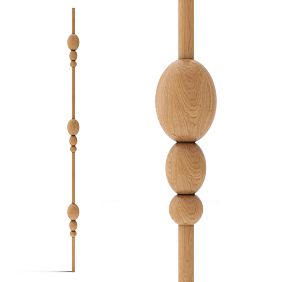
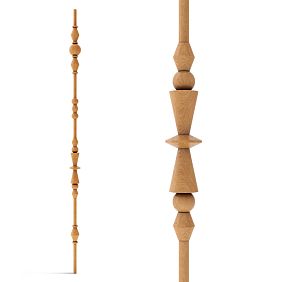
The KON-005 STAVROS set solves exactly this problem. It is not a screen, a sliding door, or a set of ordinary slats. It is a decorative wooden post 2800 mm high that can be used as part of an interior partition. If you place several posts in a row with a calculated spacing, you get an expressive vertical structure: it lets light through, preserves the view, but clearly shows where one zone ends and another begins.
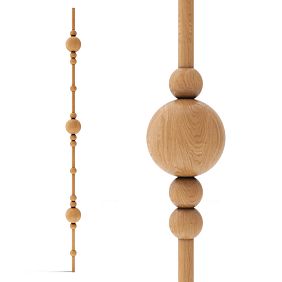
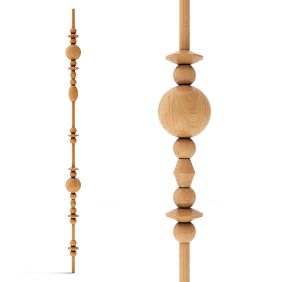
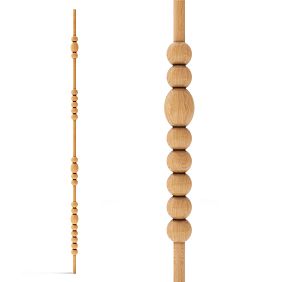
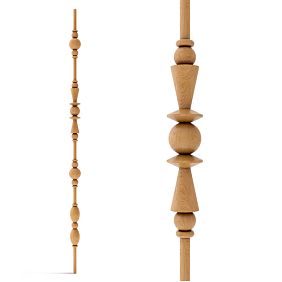
The main value of KON-005 lies in its geometric pattern. Unlike simple slatted solutions, the post is assembled from a wooden axis and shaped elements: disc, round, small separating, and elongated geometric parts. Due to this, the partition looks not like a technical grille, but like an interior composition made of solid wood. It can be selected for a living space, salon, showroom, cafe, office, or studio, where not only practicality but also visual character is important.
If a buyer is looking for where to buy a wooden partition for room zoning, it is important for them to understand several things right away: one KON-005 set is one decorative post, not the entire partition; for full width, you need to calculate the number of posts; the material and finish must match the interior; the attachment to the floor and ceiling must be thought out before ordering. Then the purchase will not become a random set of parts, but will turn into a clear zoning project.

What a buyer is looking for when they want to buy a wooden partition for room zoning
The request "buy a wooden partition for room zoning" sounds simple, but inside it there are many different scenarios. One buyer wants to separate the kitchen from the living room. Another is looking for a light boundary between the bedroom and the dressing room. A third is decorating a salon or showroom. A fourth wants to close off the entrance area without making the hallway dark. In all cases, what is needed is not a permanent wall, but a decorative structure that works more softly.
A wooden partition for zoning is bought not only for dividing space. It should support the interior style, connect with furniture, floor, walls, doors, moldings, and overall finishes. If you put up a random partition, it may look alien: too simple, too rough, too temporary, or too similar to an office grille. Therefore, the buyer compares slats, screens, sliding systems, ready-made posts, decorative elements, and modular sets.
KON-005 covers exactly the scenario of a decorative vertical partition made of wooden posts. This is a good option when you want to preserve air and light, but at the same time get not just straight slats, but an expressive geometric pattern. The post does not disguise itself as a wall. It works as an independent interior detail.
| What the buyer is looking for | What is important to him in practice | What task does KON-005 close |
|---|---|---|
| Buy a wooden partition for room zoning | Divide space without a load-bearing wall | Create a light vertical boundary from posts |
| Buy a wooden partition for room zoning | Get natural material and decorative appearance | Use posts made of beech or oak with geometric elements |
| Buy a wooden partition for zoning | Find a solution between slats, screen, and wall | Assemble the partition from separate kits to the required width |
| Buy wooden partition | Select general partition type | Narrow down to decorative stand KON-005 |
| Buy decorative wooden partition | Make zoning part of the design | Get an expressive pattern, not a simple vertical grille |
| Buy interior wooden partition | Divide zones inside the room | Mark the boundary without completely blocking light |
| Buy wooden slatted partition | Find an easy construction with verticals | Compare slats with the more decorative model KON-005 |
The customer journey here must be honest. If you need a sliding partition, KON-005 won't replace it. If you need a portable screen, that's also a different product. If you need to completely close off a room, a different construction is required. But if the task is decorative zoning, a vertical wooden border, an expressive stand, and the ability to assemble a partition of the desired width, the KON-005 kit becomes the precise product solution.

Why not every wooden partition is suitable for zoning
Wood itself doesn't make a partition successful. What matters is the type of construction chosen. Simple slats provide a minimalist rhythm. A screen is convenient as a temporary solution. A sliding system closes an opening but requires a mechanism and a different budget. A solid partition divides the space rigidly. A decorative stand works differently: it marks a zone and maintains lightness.
For a studio apartment, kitchen-living room, or open living room, a light-permeable partition is often needed. It shouldn't turn the space into closed cells. A person should see the continuation of the space but understand where the relaxation area is, where the kitchen is, where the desk is, where the hallway is. In this sense, KON-005 is closer to an architectural decorative element than to a household partition.
| Type of solution | When it fits | Why it doesn't always exactly fit the task | Where KON-005 is appropriate |
|---|---|---|---|
| Slatted partition | Minimalism, calm modern interiors | May look too simple and technical | When you want more expressive geometry |
| Screen | Temporary partition, removable housing, mobile zone | Does not give the feeling of a built-in interior solution | When a stationary decorative stand is needed |
| Sliding partition | Need to close the opening, change the degree of privacy | Requires a mechanism, guides, and other installation logic | When you don't need to close the opening, but need to mark the zone |
| Solid partition | Complete separation, isolation, separate room | Takes away light and visually cuts the space | When light, air, and decorative lightness matter |
| Simple stand without decoration | Restrained separation | May be too neutral | When a geometric decorative vertical is needed |
| Set KON-005 | Zoning of a room, kitchen-living room, study, salon, showroom | Requires calculation of the number of stands and mounting | When you need an expressive wooden partition from a set of posts |
That is why before purchasing, you should not just search for "buy wooden partition", but understand the type of result. KON-005 should not be compared to a screen as a mobile item. It should be correctly compared to decorative posts, slatted partitions, and other construction kit sets where each vertical becomes part of the overall composition.
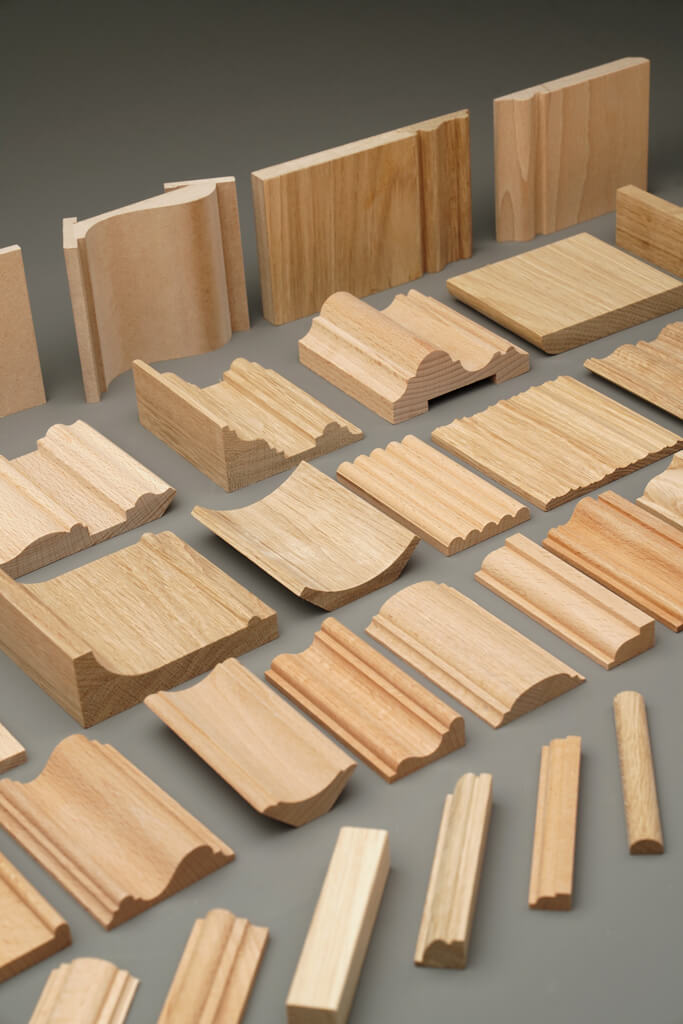
Our factory also produces:




KON-005 partition kit: what is this product
KON-005 is a kit for assembling one decorative partition post. The product card specifies the main parameters: size 2800 × 120 × 34 mm, material beech or oak, "Prestige" sanding quality, options for preparation for enamel and for tinting. The kit is supplied as a set of wooden elements for assembling a vertical post, which can then be used in an interior partition.
The main thing to understand before ordering: if a full-fledged wooden partition for zoning a room is required, one kit is usually not enough. One kit — one post. For a partition of the required width, the buyer calculates the number of posts, the spacing between them, the room height, attachment points, color, and finish. Therefore buying the KON-005 partition kit means buying the basic vertical unit of the future partition, not a finished wall entirely.
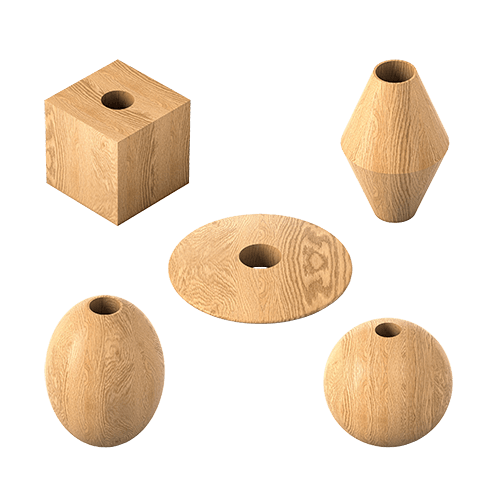
The KON-005 kit includes wooden moldings MLD-060 and geometric elements KN. According to the kit card, parts KN-005, KN-006, KN-007, KN-008, and KN-009 are used. Their task is to create a decorative rhythm on the vertical axis. The post does not look monotonous: it alternates elongated, disc-shaped, rounded, and small separating elements.
Thanks to this, KON-005 differs from ordinary slats. A slat is a line. KON-005 is a line with a three-dimensional pattern. In the interior, such a post is perceived more tangibly: you want to examine it, it casts shadows, works with side light, and supports furniture and architectural detailing. This is especially important in interiors where the partition should be not a background, but a noticeable part of the project.
| Characteristic | KON-005 |
|---|---|
| Product type | Kit of one decorative partition post |
| Main purpose | Zoning a room, kitchen-living room, hallway, studio, office, commercial space |
| Size | 2800 × 120 × 34 mm |
| Material | Beech or oak |
| Sanding quality | Prestige |
| Surface preparation | For enamel on beech, for tinting on oak |
| Structural logic | Wooden axis MLD-060 and geometric elements KN |
| Geometric details | KN-005, KN-006, KN-007, KN-008, KN-009 |
| Purchase format | One set = one decorative post |
| Compatibility | Constructor section, adjacent KON kits, wooden elements KN and MLD |
| What to check before ordering | Number of posts, pitch, room height, fixing method, material, finish, current availability and lead times |
KON-005 is convenient to choose for those who want to buy a wooden partition for zoning not as a faceless building structure, but as a decorative system made of solid wood. It can be painted in the color of the walls, furniture or an accent detail, and in oak — to emphasize the natural texture. But the exact option should be checked in the product card before ordering.
Get Consultation
What KON-005 consists of and why geometry matters
Geometry is the main visual feature of KON-005. If a simple slat works by repeating identical verticals, then this kit is built on alternating different wooden elements. As a result, the post gets not only height but also a plastic pattern: somewhere it is wider, somewhere thinner, somewhere it gives a disc pause, somewhere an elongated accent.
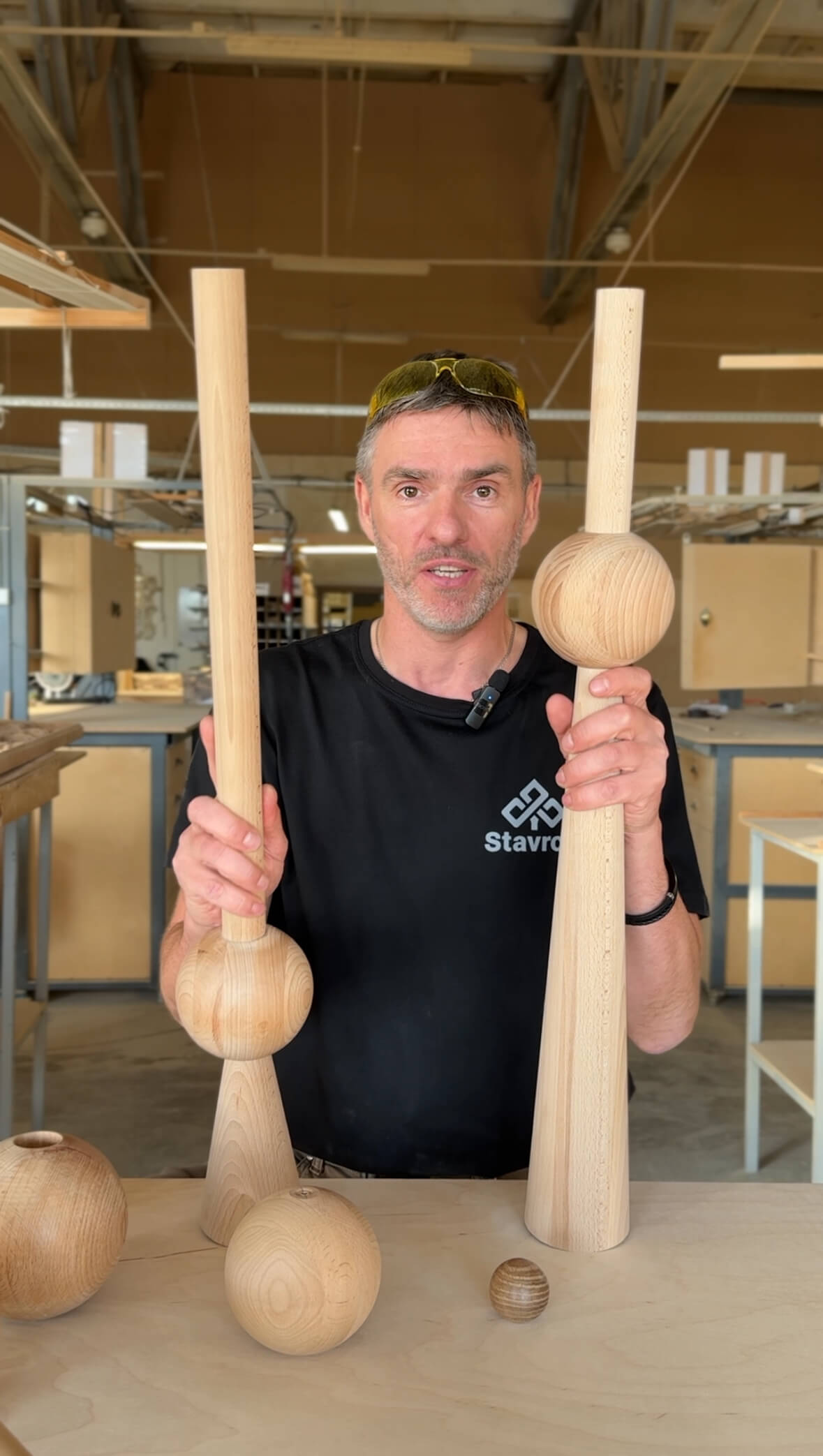
The set includes a wooden molding MLD-060, which acts as a central axis. Decorative elements KN are threaded or mounted onto it. The KON-005 card lists elements of different shapes: KN-005, KN-006, KN-007, KN-008, and KN-009. This combination makes the post more complex than a version made of identical spheres or simple cylinders.
| Element | Role in the post | What it gives the buyer |
|---|---|---|
| MLD-060 | Central wooden axis | Assembles elements into a vertical post |
| KN-005 | Round decorative element | Provides smooth transition and repeatability |
| KN-006 | Geometric element of smaller scale | Helps diversify the pattern |
| KN-007 | Disc-shaped part | Creates horizontal pauses and separators |
| KN-008 | Elongated geometric accent | Makes the stand more expressive and vertical |
| KN-009 | Small separator element | Helps connect large parts together |
For the buyer, this is important not only aesthetically. Geometry affects how the partition will be perceived in the room. Frequent identical slats create a calm background. KON-005 provides a more decorative pattern. It is suitable where the partition should be part of the design: next to beautiful furniture, in a walk-through area, between the living room and kitchen, in a salon, in a showroom, in a cafe.
If you need the quietest possible background, it is worth comparing KON-005 with other models or slatted solutions. If you want the wooden partition for zoning to be noticeable but not solid, KON-005 hits the mark more precisely. Its geometry not only decorates the stand — it helps create an interior rhythm.
KON-005, KON-004 or slats: how to choose without mistakes
It is easy for a buyer to get confused: the site has different KON kits, common themes about wooden partitions, and slatted solutions. But each option has its own character. A mistake occurs when a person is looking for a decorative partition but buys a too simple slat, or vice versa — chooses an expressive kit where a nearly invisible background is needed.
KON-005 differs from the KON-004 partition kit primarily in scale and pattern. KON-004 is more compact in profile, its size is listed as 2800 × 88 × 34 mm. KON-005 is wider — 2800 × 120 × 34 mm — and is built on a more expressive set of geometric details. Therefore, KON-004 is more logical where a lighter and more restrained vertical is needed, and KON-005 is where the partition should be more noticeable.
A slatted partition also solves the zoning task, but its visual language is different. A slat is a repetition of straight lines. It is good for minimalism, Scandinavian interiors, calm modern spaces. KON-005 is closer to a decorative wooden stand, where there is volume, shape, and pattern. Therefore, slatted partition for zoning it is appropriate as a comparison, but should not replace the model selection of KON-005.
| Option | What the buyer receives | When to choose | When it's better to look at another option |
|---|---|---|---|
| KON-005 | Decorative stand 2800 × 120 × 34 mm with geometric pattern | An expressive wooden partition is needed for a room, salon, showroom, or cafe | If you want the thinnest and most discreet vertical line |
| KON-004 | A more compact decorative stand 2800 × 88 × 34 mm | Need a lightweight partition without a strong visual accent | If the partition should be more geometric and noticeable |
| Simple slats | Calm vertical rhythm | Need a minimalist background | If you want decorative turned elements |
| Screen | Mobile time division | The structure cannot be attached to the floor and ceiling | If you need a built-in interior partition |
| Sliding system | Ability to open and close the opening | Need to physically block the space | If only a visual boundary is needed |
| Solid partition | Complete separation of zones | Need isolation | If it's important to preserve light and air |
For a wider selection, you can explore wooden constructor elements. This section presents partition kits and individual elements that can be used to assemble decorative posts, supports, and interior structures. This approach is convenient when a project is not limited to a single model but requires comparing several options.
Where to use the KON-005 wooden partition
KON-005 is suitable where zoning is needed without a solid partition. It cannot be considered a wall in the construction sense. It is not intended for complete soundproofing or hiding an area. Its purpose is different: to give the interior a vertical boundary, preserve light, and add a decorative wooden detail.
In a kitchen-living room, such a partition helps separate the cooking area from the sofa or dining area. This is especially useful in open-plan layouts where the kitchen, table, and lounge area are in one volume. Several KON-005 posts can mark the boundary without blocking the view. As a result, the room remains cohesive but becomes more organized.
In the living room, KON-005 can separate a workspace, reading area, TV zone, passage to the stairs, or part of the room by the window. If the wall is empty, the partition adds vertical rhythm. If there is wooden furniture nearby, the posts help tie the interior together with natural materials. Buying a decorative wooden partition for the living room makes sense when you want not just to divide but to decorate the space.
In the bedroom, such a post can work between the bed and the wardrobe, near the dressing table, at the entrance to the bathroom, or in the relaxation area. It gives a sense of soft privacy but does not create a heavy partition. This is especially valuable in bedrooms where solid structures can make the room feel cramped.
In a study, KON-005 helps define the work area, especially if the study is in a shared room. The partition does not isolate completely but creates a psychological boundary. It is easier for a person to perceive the workspace as a separate part of the space. The oak texture can emphasize the study character, while beech under enamel makes the solution calmer and more modern.
In the hallway or foyer, KON-005 can separate the entrance area from the living room. This is a successful scenario if the door opens directly into the common space. The posts provide a visual screen but do not darken the room. With the correct spacing between the posts, the entrance area becomes separate, while the interior does not lose its spaciousness.
In a salon, showroom, cafe, or restaurant, the partition also works as part of the brand impression. Natural wood and expressive geometry create a sense of thoughtfulness. The posts can separate a waiting area, seating, exhibition, meeting area, fitting room, or passage. In a commercial space, it is especially important that the partition looks not temporary, but a full-fledged part of the design.
| Room or object | Task | How KON-005 works |
|---|---|---|
| Kitchen-living room | Separate the kitchen and sofa area | Creates a light boundary without losing light |
| Living room | Highlight a workspace, TV area, or passage | Adds a decorative vertical rhythm |
| Bedroom | Separate a wardrobe, toilet area, or relaxation space | Provides soft privacy without a blank wall |
| Office | Designate the working part of the room | Creates a psychological boundary |
| Hallway | Separate the entrance from the living area | Preserves light and makes the entrance area neater |
| Salon | Separate the waiting area from the work area | Works as an interior accent |
| Showroom | Divide the exhibition | Helps manage the visitor's route |
| Cafe | Zone seating areas | Adds the warmth of wood and visual coziness |
Beech or oak: which material to choose for KON-005
The partition material affects not only the appearance but also the future finishing. Beech and oak behave differently in the interior. Beech is more often chosen when the stand is planned to be painted with enamel. Oak is chosen when natural texture, tinting, varnish, or oil is important. Both options are solid wood, but the buyer's result will be different.
Beech is convenient for interiors where the partition should be painted in the color of the walls, furniture, facades, or doors. Under enamel, it provides a smooth surface and allows the geometric pattern to become more architectural. A white, milky, beige, graphite, or colored beech partition can look like part of the overall finish, rather than a separate wooden object.
Oak is chosen where the wood should remain visible. Its texture is decorative in itself. An oak partition works well in offices, living rooms, restaurants, showrooms, interiors with natural materials, warm light, stone, leather, solid furniture, veneer, or parquet. If the partition should emphasize status and the natural wood pattern, oak looks more convincing.
| Material | When to choose | Possible finish | What it brings to the interior |
|---|---|---|---|
| Beech | Needs enamel painting | White, beige, graphite, wall or furniture color | Calm geometry and clean silhouette |
| Oak | Needs visible wood texture | Tinting, varnish, oil | Natural pattern and more expressive material |
| Beech for painting | Modern interior, neoclassicism, light solutions | Solid color | The partition becomes part of the room's architecture |
| Oak for tinting | Study, living room, premium commercial interior | Transparent and translucent coatings | The wood works as a decorative value |
| Painted partition | Need to match the color of the furniture or wall | Enamel | Easier to connect the posts with the interior |
| Partition with open texture | Need to emphasize naturalness | Oil, varnish, tinting | The posts look warmer and more substantial |
The main mistake is choosing material only by price or habit. If the interior is based on painted surfaces, oak may be excessive because its texture will be covered by enamel. If the interior relies on natural wood, beech under dense paint may look too neutral. Therefore, the choice of material should be linked to the future finish before purchase.
How to calculate the number of posts for a partition
For a full partition, you need to understand the width of the zone and the spacing between posts. One KON-005 set equals one post. If the opening width is small, one or two posts may suffice as a decorative accent. If you need to close a wide area between the kitchen and living room, several sets will be required. The smaller the spacing, the denser the visual separation. The larger the spacing, the lighter and airier the partition.
Calculation begins with measurement. You need to measure the width of the area where the partition will be placed and the height of the room. KON-005 has a height of 2800 mm, so it is especially important to understand in advance how the post will work at a specific ceiling height. If the room is lower or higher, a design solution for installation, trimming, extensions, or fastening will be required. Such nuances are best discussed before ordering, not after delivery.
The spacing between posts depends on the task. If the partition is only meant to mark a boundary, you can leave more air. If you need to block the view more, posts are placed closer together. However, too frequent spacing can overload the interior and make the structure visually heavy. This is especially important for KON-005 because each post is decorative in itself.
| Zone width | Possible calculation logic | Comment |
|---|---|---|
| Up to 800 mm | 1–2 posts | Decorative accent or design of a narrow area |
| 1000–1500 mm | 2–3 racks | Light zoning between areas |
| 1800–2500 mm | 3–5 posts | Full partition for kitchen-living room, studio, salon |
| More than 2500 mm | Individual calculation | A design approach is needed to avoid overloading the space |
| Non-standard height opening | Checking height and mounting | Mounting to the floor and ceiling needs to be planned in advance |
| Commercial object | Calculation based on traffic route and load | It is important to consider passages, safety, and cleaning |
You cannot design a partition based solely on a picture. In a visualization, several posts may look light, but in a real room, with an incorrect spacing, they will start to obstruct passage or block the view more than expected. It is better to create a diagram in advance: zone width, number of posts, distance between them, offsets from walls, and attachment points.
How to choose the spacing between posts
The spacing between posts determines the character of the partition. Frequent spacing creates a denser boundary. Medium spacing provides a balance between separation and openness. Sparse spacing marks the zone almost symbolically. For KON-005, this is especially important because each post is 120 mm wide and has an expressive geometric pattern. If placed too frequently, the interior may gain excessive decorative density.
For a kitchen-living room, medium spacing is often suitable. It separates the kitchen from the lounge area but does not turn the partition into a wall. For a hallway, posts can be placed slightly denser if you need to block a direct view of the entrance. For a salon or showroom, the spacing depends on whether you need to guide visitor traffic or simply highlight a separate zone.
For a bedroom and dressing room, a denser solution can be chosen if privacy is required. But it is important to remember: KON-005 does not completely enclose the space. If true isolation is needed, it is better to consider other structures. A decorative post helps create a sense of boundary, not replace a wall.
When calculating the spacing, furniture must be taken into account. The posts should not interfere with opening cabinets, doors, drawers, or movement around a sofa or table. In a commercial interior, you need to consider people's movement, bags, cleaning, safety, and the possibility of accidental contact. A beautiful spacing on a drawing is not always convenient in actual use.
Before ordering, it is useful to mark the future posts with painter's tape on the floor. This is a simple way to see how the partition will feel in the scale of the room. Sometimes after such marking, it becomes clear that fewer posts are needed than it seemed, or that the spacing should be wider.
How KON-005 works in different interior styles
KON-005 looks good where geometry is not random. Its elements create rhythm, so the partition should be tied to the room's style. In a modern interior, it can become a graphic accent. In neoclassicism, a wooden architectural detail. In art deco, a geometric decorative motif. In natural interiors, a warm vertical line of solid wood.
In a modern interior, beech under enamel allows the posts to be calm. If painted in the color of the walls, the partition will become textured but not too contrasting. If you choose a dark or accent color, it will work as an independent element. This technique is suitable for studios, living rooms, and kitchen-living rooms where you want zoning to be noticeable but not heavy.
In neoclassicism, KON-005 can be linked to baseboards, trims, cornices, furniture facades, and doors. Here it is especially important not to overload the interior. If the room already has a lot of carving, large decor, and active details, it's better to make the partition in a calm finish. If the interior is restrained, the geometry of KON-005 will add the necessary expressiveness.
In Art Deco, elongated and disc shapes work well. They support the idea of geometry, repetition, and vertical accents. Oak under tinting, dark shades, graphite enamel, or deep rich colors can make the partition part of a more dramatic interior. But in this style, precision is especially important: a random color or incorrect spacing between posts immediately simplifies the result.
In eco-interiors and spaces with natural materials, wood doesn't need to be hidden. Oak with visible texture can be the main choice. The partition will pair with plants, stone, textiles, wooden furniture, and warm light. In this scenario, KON-005 not only divides the room but adds natural texture to the vertical plane.
What to buy together with KON-005
KON-005 is the main rack kit, but for a real project, a single product card is often not enough. The buyer needs to consider adjacent elements, mounting, finishing, and possibly alternative kits or additional constructor parts. A good partition is assembled not only from beautiful racks but from the entire system of solutions around them.
First, you need to determine the number of sets. If multiple posts are required, the buyer should order not one set but as many as needed for the width of the area. For comparison, you can look at adjacent models: select KON-001 partition kit, view the KON-002 partition set or choose KON-003 partition kit, if a different scale of decorative elements is needed.
For a buyer comparing KON-005 with a more compact model, it is useful view KON-004 partition kit. This link is especially important if the room is small and the 120 mm width seems too active. If a more expressive geometric pattern is needed, KON-005 remains a strong option.
Also worth opening wooden constructor elements, if the project involves not only a partition but also adjacent racks, supports, decorative elements, furniture solutions, or additional details in the same style. Such a section helps not to limit oneself to one model and to assemble the interior more holistically.
If the buyer has not yet decided on the type of partition, you can compare the model article with the general material on how to choose wooden partition for zoning. But to purchase KON-005, it's important to return to the specific product card, because that's where the current dimensions, material, availability, and ordering conditions are listed.
Mistakes when buying a wooden partition for a room
The first mistake is buying a screen when you need a stationary decorative partition. A screen is convenient because it can be moved. But it rarely looks like an integrated part of the interior. If the goal is to create an architectural boundary between zones, KON-005 posts will feel more substantial and neat.
The second mistake is confusing slats with the KON-005 kit. A slat is a simple vertical line. KON-005 is a decorative post with geometric elements. If the buyer wants minimalism, slats may be enough. If an expressive wooden detail is needed, slats may seem too simple. Therefore, before purchasing, you need to honestly determine the desired visual effect.
The third mistake is not counting the number of posts. One kit does not cover a wide area. If you buy only one post for a large opening, you'll get a separate decorative element, not a partition. The number of kits needs to be calculated in advance based on the room width and the spacing between posts.
The fourth mistake is not considering the height of the room. KON-005 has a height of 2800 mm. If the ceiling is lower or higher, installation needs to be planned in advance. You cannot assume that the rack will automatically fit any room without checking. This is especially important for apartments with complex ceilings, suspended structures, beams, height differences, or non-standard openings.
The fifth mistake is forgetting about fastening to the floor and ceiling. A decorative partition must be stable. The method of fastening depends on the base, the project, and installation conditions. If the rack will be placed in a walk-through area, a salon, or a cafe, the issue of stability becomes especially important.
The sixth mistake is choosing beech or oak without understanding the finish. Beech for enamel and oak for tinting give different results. If the buyer first orders the material and then thinks about the color, they may incur extra costs or get the wrong visual effect. The material and finish should be chosen together.
The seventh mistake is not coordinating the color of the partition with the furniture. A wooden partition is in a vertical plane and is highly visible. If the color is not related to the walls, doors, kitchen, floor, or furniture, the structure may look out of place. Sometimes contrast is needed, but it must be intentional.
The eighth mistake is making the spacing between racks too frequent. The closer the racks are to each other, the more the partition blocks the space. But KON-005 is decorative in itself, so frequent placement can overload the room. This is especially noticeable in small spaces.
The ninth mistake is choosing a sliding system when only a visual boundary is needed. Sliding partitions solve a different problem: they close an opening. If you just need to separate a zone and let light through, stationary decorative racks may be more rational.
The tenth mistake is reading an article about a different set and automatically applying the conclusions to KON-005. For example, the article about KON-004 is useful for understanding the logic of the sets, but KON-005 has a different profile and a different pattern. You should not buy 'any set,' but specifically the one that fits the scale and style.
Who KON-005 is suitable for and when it is best to use it
KON-005 is suitable for a buyer who wants to purchase a wooden partition for zoning a room with a decorative character. This is not a solution for those seeking a maximally inconspicuous slat. The stand has a pronounced geometry, so it works best where the partition should be a visible part of the interior.
In a living space, KON-005 is especially good for a kitchen-living room, studio, spacious living room, bedroom with a dressing area, study, and hallway. It helps to separate functions without the feeling of a full renovation. A partition made of several stands can look like a thoughtful architectural detail, rather than a late attempt to place something between furniture.
In commercial interiors, KON-005 is suitable for salons, showrooms, cafes, restaurants, apartments, meeting areas, and lobbies. Where visitors notice details, wood enhances the impression. The partition not only divides the space but also shows that the interior is well thought out. This is especially important for brands that want to appear warmer and more prestigious without heavy partitions.
KON-005 may be unnecessary in a very small room if every detail already overloads the space. In such cases, it is better to look at more compact stands or slatted solutions. It also cannot replace a solid wall if privacy, soundproofing, or complete area closure is required. This is decorative zoning, not structural insulation.
If the buyer wants a sliding system, KON-005 is also not directly suitable. Its purpose is a stationary vertical composition. If mobility is needed, other types of partitions should be considered. If beauty, natural material, geometry, and the ability to assemble a partition of the desired width from stands are needed, KON-005 fits the task exactly.
How to buy KON-005 on STAVROS
It's best to start the purchase from the product page. You need to open buying the KON-005 partition kit, check the size 2800 × 120 × 34 mm, material, preparation for finishing, current availability, price, and ordering conditions. After that, you need to determine how many kits are required for your zone width.
Then you need to choose the material. If the partition will be painted to match the color of walls, facades, doors, or furniture, it's usually logical to look at beech for enamel. If natural texture is important, it's worth considering oak for tinting. Before ordering, it's better not to leave this question "for later" because the material affects the appearance, finish, and perception of the entire structure.
The next step is calculating the quantity. Measure the width of the zone and determine the desired spacing between the stands. If the partition will be between the kitchen and living room, you can choose a medium spacing. If you need to separate the entrance area, the spacing can be tighter. If the task is purely decorative, fewer stands may be needed. It is better to coordinate the exact calculation with a STAVROS manager, especially if the project is large or the room is non-standard.
After that, you need to think about installation. The article cannot invent universal fasteners because the type of floor, ceiling, and base is different for everyone. But the buyer needs to understand in advance how the posts will be fixed. If the room has a stretch ceiling, heated floor, complex covering, drywall structures, or commercial load, installation nuances should be resolved before placing the order.
Finally, it's worth linking the purchase with adjacent solutions. If KON-005 seems too expressive, compare it with KON-004. If a different scale is needed, look at KON-001, KON-002, or KON-003. If the project is broader than one partition, explore the constructor section. This approach helps not to buy a random post but to assemble an interior system where wood, rhythm, and finish work together.
FAQ
Can I buy a wooden partition for zoning a room at STAVROS?
Yes, on the STAVROS website you can choose sets of decorative posts for zoning. For the KON-005 model, a set card is used, designed for one vertical post. For a full partition, you need to calculate the number of sets based on the width of the zone.
Is KON-005 a ready-made partition as a whole?
No. KON-005 is a set of one decorative post with a height of 2800 mm. If you need a partition 1.5 or 2 meters wide, several sets will be required. The quantity depends on the spacing between posts and the zoning task.
How is KON-005 different from a regular slatted partition?
A slatted partition is built on the repetition of simple vertical lines. KON-005 has geometric KN elements on a wooden axis, so it looks more decorative and voluminous. It is not just a slat, but an expressive post with a pattern.
How does KON-005 differ from KON-004?
KON-004 is more compact in profile: its size is listed as 2800 × 88 × 34 mm. KON-005 is wider — 2800 × 120 × 34 mm — and has a different set of geometric elements. Therefore, KON-004 is better for a more restrained rhythm, and KON-005 is for a noticeable decorative partition.
What to choose: beech or oak?
Beech is more often chosen for enamel when the post needs to be painted to match the color of the walls, furniture, or doors. Oak is better suited for tinting, varnish, or oil if it is important to preserve the visible wood texture. The choice depends on the interior and future finishing.
Can KON-005 be painted to match the interior color?
Yes, the beech option for enamel is suitable for painting. Before ordering, you need to check the current parameters in the product card and decide in advance whether the partition will blend with the walls or stand out as an accent.
Is KON-005 suitable for a kitchen-living room?
Yes, this is one of the successful scenarios. Several posts help separate the kitchen area from the relaxation or dining zone, preserving light and air. The main thing is to correctly calculate the number of posts and the spacing between them.
Can KON-005 be used in a salon, cafe, or showroom?
Yes, KON-005 is suitable for commercial spaces where decorative zoning is needed. In a salon or showroom, the stands can separate service, waiting, or display areas. In a cafe, they can create more intimate seating areas. Installation and stability need to be considered especially carefully.
How to calculate the number of KON-005 kits?
You need to measure the width of the area and choose the spacing between the stands. One kit equals one stand. The smaller the spacing, the denser the partition. The larger the spacing, the more light and air will remain between the zones. For non-standard projects, it is better to coordinate the calculation with a STAVROS manager.
Can KON-005 be used as a sliding partition?
No, KON-005 is not a sliding system. It is a decorative stand for stationary zoning. If you need to open and close an opening, a different type of structure is required.
Is KON-005 suitable for a small room?
It is suitable if the partition is needed as a neat accent and the number of posts is calculated correctly. But in a very small space, the expressive geometry may be too active. In that case, it is worth comparing KON-005 with more compact models or slatted solutions.
What should be checked before ordering?
Check the kit size, material, preparation for finishing, current availability, price, lead times, number of posts needed, room height, spacing between posts, and mounting method. If the project is complex, it is better to clarify details with a STAVROS manager in advance.
Result: KON-005 is not just a partition, but a decorative zoning system
A wooden partition for room zoning should solve several tasks at once: separate zones, preserve light, support the interior style, and not look like a random insert. The KON-005 STAVROS kit is suitable for such scenarios because it works as a decorative vertical post made of solid wood with expressive geometry.
The buyer receives not a blank wall, not a temporary screen, and not a simple slat, but a construction element from which a partition of the desired width can be assembled. One set is one post, so before ordering it is important to calculate the quantity, spacing, material, finish, and installation method. Beech under enamel is suitable for painted interior solutions, oak under tinting is for spaces where the natural texture of wood is important.
STAVROS helps transition from the general request "buy a wooden partition" to a specific product solution: choose KON-005, compare it with adjacent sets, select the material, and assemble the partition for a room, kitchen-living room, office, salon, showroom, or cafe. If before purchasing you carefully check the dimensions, finish, number of posts, and installation conditions, the partition will look not like a random divider, but like a well-thought-out part of the interior.