





























Article Contents:
- Wooden overlay N-090.1: which five sizes can actually be ordered
- Why the N-090.1 dimension of 45×205 mm does not yet mean it will cover a defect of 40×180 mm
- How to measure old holes and chips before purchasing carved decor
- Why a photo of N-090.1 on a screen is not suitable for checking coverage
- How to make a paper template of wooden overlay N-090.1 before ordering six pieces
- Step 1. Get an image or drawing of the contour
- Step 2. Scale to 1:1
- Step 3. Cut along the shaped contour
- Step 4. Apply defects to the facade
- Step 5. Try several positions
- Step 6. Check the new handle
- Step 7. Photograph the approved position
- Option 1. Decor only on damaged facades
- Option 2. Identical overlays on all six doors
- Option 3. Overlays on four or two symmetrical facades
- Option 4. Different roles for central and side doors
- The hole falls into the open part of the ornament
- The facade is structurally damaged
- The size is disproportionate to the door
- The new handle clashes with the decor
- Furniture should remain minimalist
- The defect can be carefully restored without decor
- Scenario 3. Hole with a chip
- Scenario A — keep the facades
- Scenario B — replace the facades
- Can old holes be covered with a decorative wooden overlay?
- What sizes are available for N-090.1?
- What materials are N-090.1 made from?
- Why does the 45×205 mm size not guarantee that the plate will cover the holes inside the 45×205 rectangle?
- How can I tell if the hole will be covered before purchasing?
- Can I use a photo from the website as a template?
- What is better — ordering six plates at once or starting with one?
- What is the difference between "Standard" and "Prestige" for my project?
- Can N-090.1 be used on a painted MDF facade?
- Do I need to repair the old hole if the plate will completely cover it?
- How do I align N-090.1 with a new handle?
- Do I need to install identical overlays on all six fronts?
- Can I install different sizes of N-090.1 on adjacent doors?
- What to do if N-090.1 covers the holes but looks too large?
- When is a wooden baguette better than an overlay?
- Where can I see other wooden overlays?
- Where can I see other carved decor?

Six furniture fronts remain in place, the handles have already been replaced, but the surface shows old holes, chips around the fasteners, and traces of the previous hardware. Replacing all the doors just because of these local defects is expensive and often pointless. A practical idea arises: cover the damaged area with a decorative element and simultaneously make the restoration part of the new furniture design.
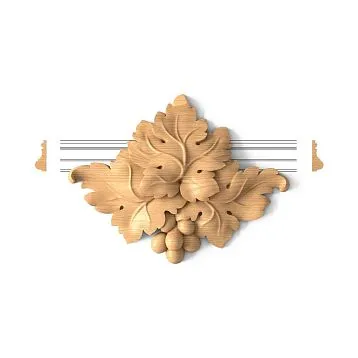
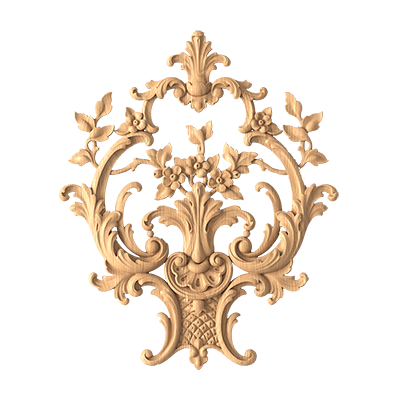
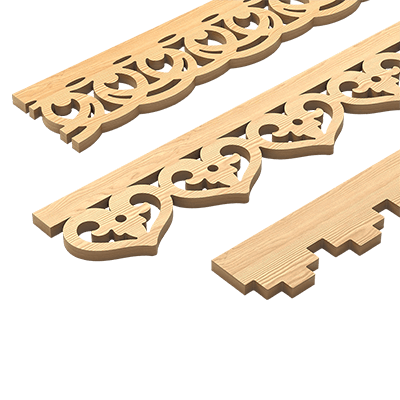
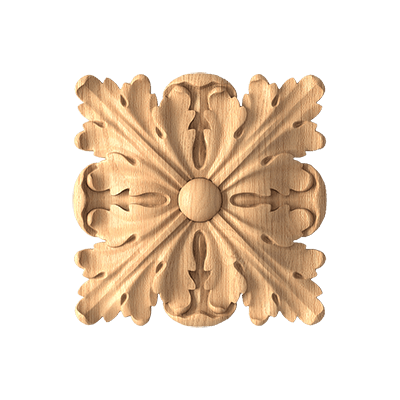
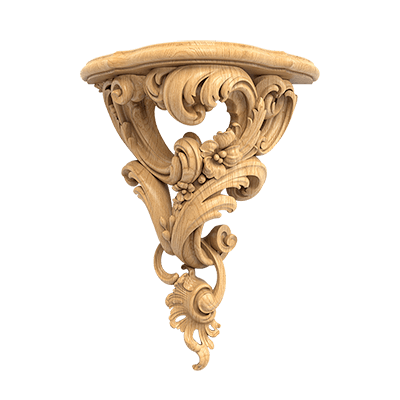
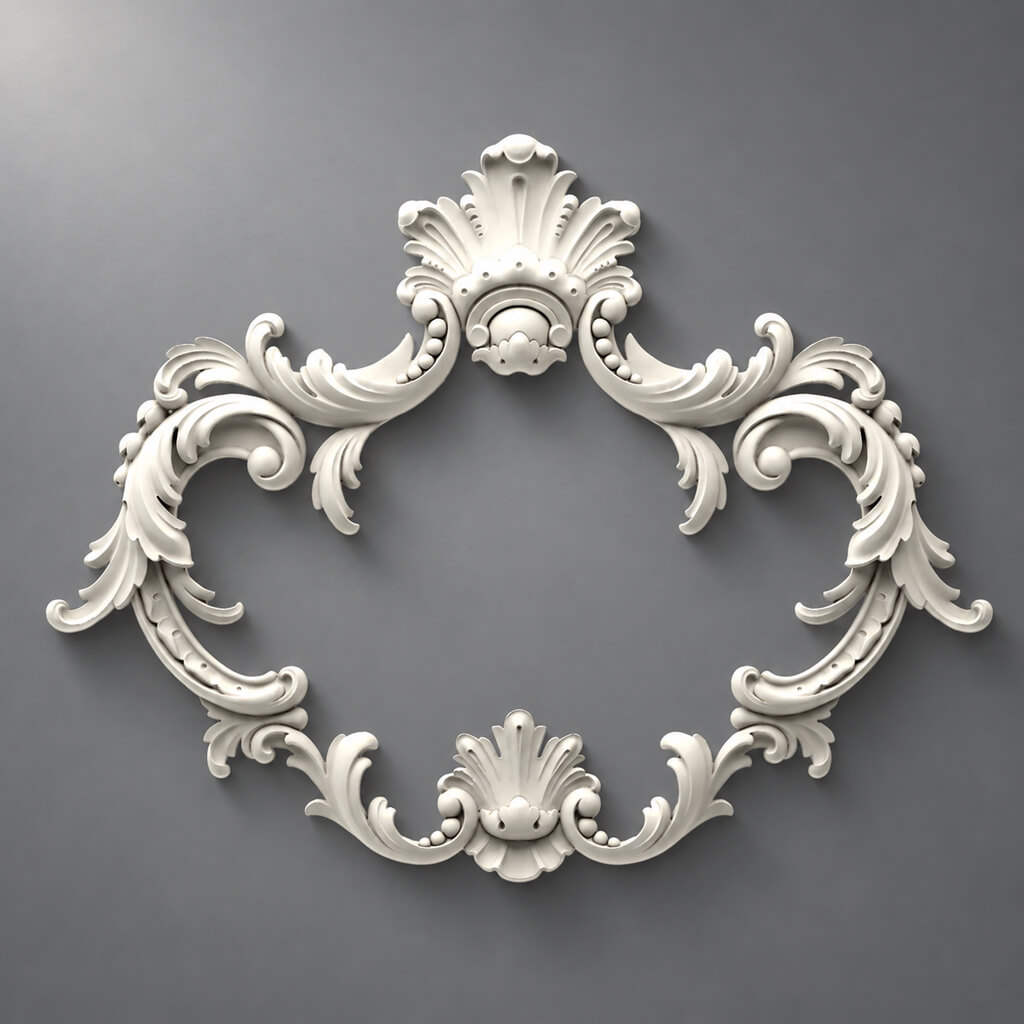
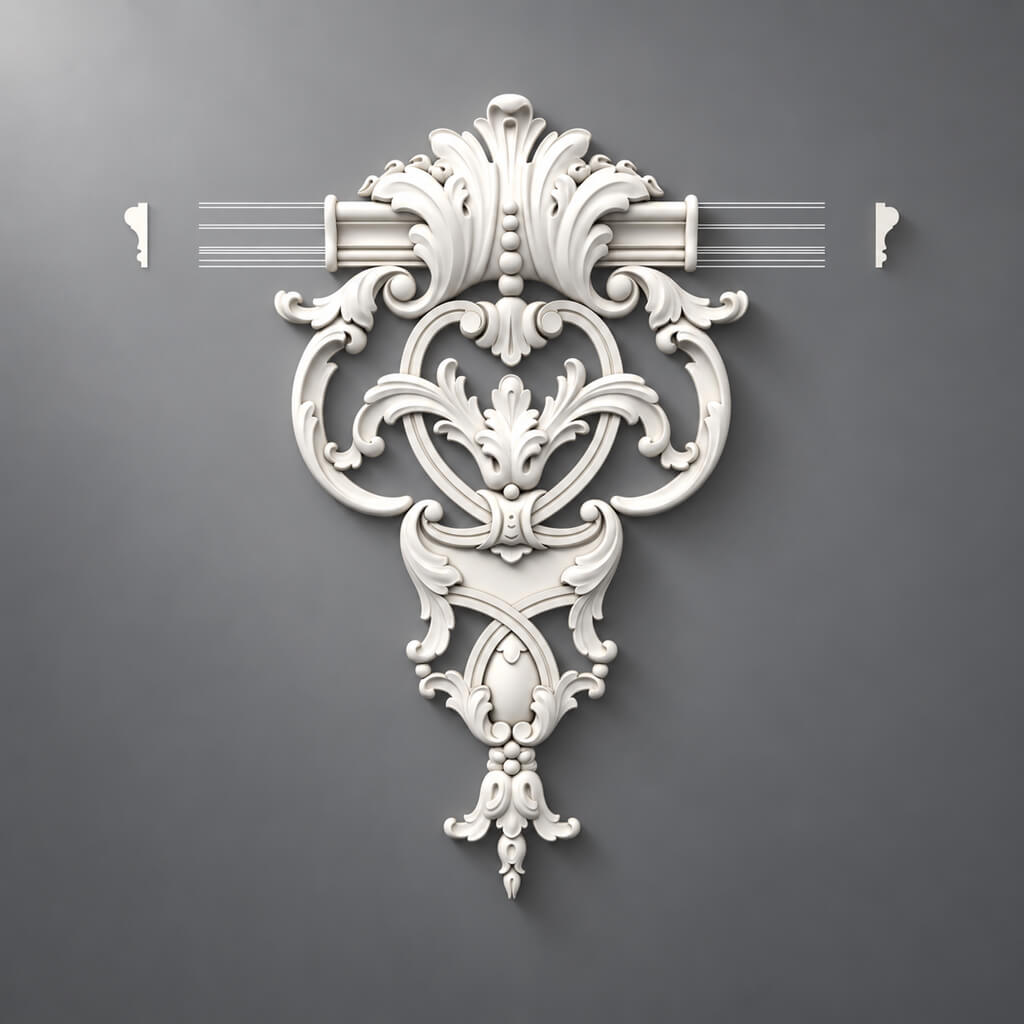
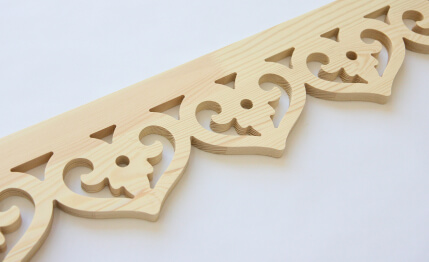
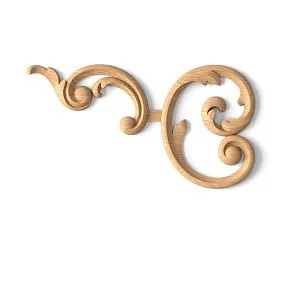
For this scenario, the logic of the carved wooden overlay N-090.1 itself fits: it is a decorative element made of beech or oak, available in five sizes. But you cannot choose it based on the principle "the defect is smaller than 45×205 mm, so the smallest overlay will definitely cover it." The size A×B shows the external dimensions of the product, not the solid area of wood inside that rectangle. The carved contour is shaped. The old hole may be within the dimensions of N-090.1 and still remain visible through the open part of the ornament.
This is the main question before purchasing. You need to check not only the width and height of the defective area, but also which part of the actual carved pattern each hole, chip, or trace of the old handle falls on.
Therefore, the correct sequence for six fronts looks like this:
measure the entire damaged area → get the actual contour of N-090.1 → make a 1:1 template → apply it to one front → check the new handle and composition → approve the material and size → only then order the set.
If the fitting shows that N-090.1 really covers the traces and matches the scale, you can buy a wooden overlay N-090.1 in the selected size, material, and sanding quality. If the hole falls into the open part of the ornament, you should not take an "almost suitable" option, but change the size, position, model of the decor, or the restoration method itself.

Wooden overlay N-090.1: what five sizes can actually be ordered
N-090.1 has five confirmed size variants. Beech and oak are available for each. The sizes increase proportionally, and the thickness of the element grows simultaneously.
| Size A × B × C | Material |
|---|---|
| 45 × 205 × 8 mm | Beech / Oak |
| 60 × 273 × 10 mm | Beech / Oak |
| 80 × 364 × 13 mm | Beech / Oak |
| 100 × 455 × 17 mm | Beech / Oak |
| 140 × 637 × 23 mm | Beech / Oak |
Grinding qualities "Standard" and "Prestige" are also provided. At the time of inspection, the card indicates that missing options are made to order in approximately 5–10 days. Commercial parameters may change, so they need to be re-checked in the card before payment.
It is important not to reduce the choice to a table of "which size is closer to the defect." For five versions, not only the dimension changes. Along with the increase in A and B, the visual role of the overlay on the facade changes. The 45×205 mm option may be perceived as a local decorative accent, while 140×637 mm is already a large compositional detail capable of defining the entire pattern of a tall door.
Therefore, for restoration, the question is not "which overlay is larger than the damage," but:
which size simultaneously covers the actual defect with its wood contour and remains proportional to the specific facade?
This difference is especially important if you need to decorate not one, but six doors. A mistake in size will repeat six times and turn local restoration into an expensive redesign of the entire piece of furniture.


Why the dimension of N-090.1 45×205 mm does not yet mean that it will cover a defect of 40×180 mm
Suppose the damaged area after the old handle fits into a conditional rectangle of 40×180 mm. The first thought is obvious: N-090.1 45×205 mm is larger in both coordinates, so it should cover the traces.
Such a comparison only works for a solid rectangular plate. For a carved decorative element, it is insufficient.
The size 45×205 mm sets the maximum external dimension. Inside it, the carved pattern has its own protrusions, narrowings, gaps, and open areas. If the old hole falls on a section where there is no wood, it will remain visible. At the same time, mathematically, the entire defect will still be "within 45×205."
Therefore, the check must be two-level.
Level 1 — overall dimensions. The defective zone should in principle fit within the outer dimensions of the selected overlay, taking into account its future position.
Level 2 — contour. Each critical point of the defect must fall exactly under a massive section of the carved pattern.
The second level is what solves the restoration task.
Let's imagine that after the handle, two holes remain, located 96 mm apart from each other. Both are within the 205 mm length. But one, with the chosen position of N-090.1, falls under a dense fragment of the ornament, while the other falls into an open area. From the outside, a neat carved piece will be visible, along with one old hole next to or inside the pattern. Formally, the size was chosen correctly, but in fact, the task is not solved.
Hence the practical conclusion: do not order a batch based solely on a size table.
Our factory also produces:





How to measure old holes and chips before purchasing carved decor
Measuring each hole separately is useful for understanding the geometry, but for choosing an overlay, a common defective zone is needed.
It should include everything that needs to be hidden:
-
centers of old holes;
-
chips around them;
-
coating cracks;
-
indentations from the mounting socket;
-
wear mark from the old handle;
-
different color under the removed hardware;
-
possible trace from a plate or washer;
-
local repair that will remain visible after touch-up painting.
First, find the leftmost damage and the rightmost. Measure the distance between them. Then determine the top and bottom points. This gives the outer rectangle of the defect. Record its dimensions, but do not consider this the final criterion.
Next, mark the position of each hole on a simple sketch of the facade. It is convenient to use a coordinate system: distance from the left edge of the door and from the top edge. Then template N-090.1 can be applied not randomly, but relative to actual points.
If the damage on six facades differs, each one needs to be measured. Do not assume that the old hardware was installed perfectly identically. On factory furniture, holes often repeat, but after repairs, manual installation, or previous modifications, slight shifts are possible.
For a batch of six items, it is useful to find the most inconvenient facade — the one where the holes are spaced wider, the chip is larger, or the new handle is located closer to the intended plate. If the chosen composition works on it, checking the others is easier.
Get Consultation
Why the photo N-090.1 on the screen is not suitable for checking overlap
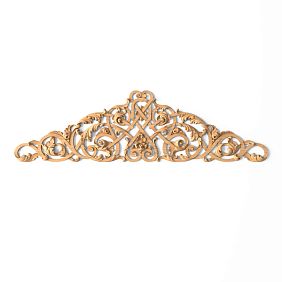
The image in the product card helps to assess the shape and nature of the ornament, but is not a measuring tool. On a phone, laptop, and large monitor, the same file is displayed at different scales. The user can zoom in, zoom out, open the image in the gallery, or see an automatically cropped thumbnail.
Therefore, you cannot place a ruler against the screen and decide that a specific curl of the overlay is 22 mm wide.
One of the following options is required:
-
an up-to-date drawing with dimensions;
-
a vector outline;
-
a technical image that can be correctly scaled;
-
a full-size 1:1 printout;
-
a physical sample;
-
an actual product purchased in a single unit for fitting.
The most reliable check for restoration is a physical template or a real overlay. It's not about choosing a color from a photo, but about precisely aligning the old holes with the wood grain pattern.
If only a drawing is available, the scale is controlled by a known dimension A×B. For example, for a 45×205 mm variant, after printing, measure with a ruler to verify that the outer length is indeed 205 mm and the width is 45 mm. If the printer automatically enabled "fit to page," the template may become smaller, and the fitting result will be incorrect.
How to make a paper template of the wooden overlay N-090.1 before ordering six pieces
The template should not be rectangular, but follow the actual contour of the decor. If you simply cut out a 45×205 mm sheet, the check loses its meaning: it will cover holes even where the real carved product will have empty space.
The working procedure is as follows.
Step 1. Obtain an image or drawing of the contour
Use the current material for N-090.1. The more accurately the real ornament is shown, the more useful the fitting will be.
Step 2. Scale to 1:1
Choose a specific size — for example, 45×205 mm. After printing, check both outer dimensions with a ruler. Do not trust the "100%" label in the printer settings without a control measurement.
Step 3. Cut along the shaped contour
It is necessary to remove open areas that will not be covered by wood on the actual product. If the pattern is complex, you can skip cutting out tiny details, but critical holes and large gaps must be shown accurately.
Step 4. Apply defects to the facade
Outline old holes and chips with painter's tape or mark them on transparent tracing paper. Do not paint over the surface with a marker.
Step 5. Try several positions
Shift the template up, down, right, and left within the compositionally acceptable range. Sometimes the same size covers a defect only after shifting by a few millimeters.
Step 6. Check the new handle
If the new furniture handle is already installed, open and close the door, grab it with your hand. The template should not fall into the working grip area.
Step 7. Photograph the approved position
The photo will be useful for transferring the markings to the remaining five facades.
This simple test can prevent the purchase of six unsuitable decorative elements.
When does it make sense to check N-090.1 45×205×8 mm first?
The most compact option logically should be checked first if the damage is local and the facade itself does not require a large decorative accent. But the condition "defect smaller than 45×205" remains only a preliminary filter.
The 45×205×8 mm variant is convenient when the new composition should look light and the main surface of the facade should remain visually calm. It has less impact on the overall cabinet design and is easier to fit next to the handle.
However, compactness also creates a limitation. The smaller the overlay, the less freedom there is to shift it relative to the holes. If one of the old marks falls into the gap of the pattern, moving it by 5–10 mm may fix the situation, but it may also disrupt symmetry relative to the facade.
Therefore, for the small N-090.1, precise fitting is especially important.
Practical rule:
defect < 45×205 mm → check the 45×205 template → if all marks are covered and the composition fits, do not increase the size without reason.
Buying a larger decorative piece just because it "will definitely cover everything" may solve a technical problem and create a design one.
When to switch to the wooden overlay N-090.1 60×273×10 mm
The next size makes sense to check if 45×205 mm does not fulfill one of three tasks:
-
does not cover part of the holes or chips;
-
looks too small relative to the facade;
-
requires an unfortunate offset for masking purposes.
The 60×273×10 mm option provides more area and a more noticeable decorative presence. However, increasing the size does not negate the contour rule. It also has exposed ornament sections.
For restoration, it is useful to compare two templates side by side. Do not ask abstractly "which is prettier." Look at the specific facade:
-
which one covers all traces;
-
where its visual center is located;
-
how it relates to the new handle;
-
how much free space remains on the sides;
-
whether the decor comes too close to the frame or edge of the door.
If the facade is narrow, 60 mm may occupy a significant portion of its width. If it is wide, on the contrary, such a size may feel more natural than a compact one.
Carved overlay 80×364×13 mm: how not to turn a renovation into overloaded decor
At the size of 80×364×13 mm, N-090.1 ceases to be just technical masking. It becomes an independent part of the composition.
This is not bad. If the cabinet is classic, the fronts are tall, and there are already cornices, moldings, or carved elements around, a larger overlay can look organic. But it cannot be chosen merely for guaranteed coverage of holes.
First, answer: why does a carved element 364 mm long appear on the front?
If the answer is "because a smaller one didn't cover the hole," the composition requires additional verification.
If the answer is "it covers the defect and simultaneously continues the style of the entire furniture," the decision is already thoughtful.
For six fronts, the size 80×364 is especially noticeable. Six identical vertical elements will create a rhythm. If one of them is two centimeters higher than the others, the error will be visible. Therefore, after approving the template, you need to prepare a unified installation template or marking base for the entire series.
N-090.1 100×455×17 and 140×637×23 mm: when a decorative element becomes the main accent of the front
Large versions are no longer "a small overlay above an old handle." A length of 455 or 637 mm allows using N-090.1 as a pronounced vertical motif on tall furniture, panels, doors, headboards, or wide fronts.
For restoring six ordinary doors, such sizes are justified only after checking the scale.
Let's take a facade 700 mm high. An overlay of 637 mm will occupy almost its entire height. Even if it technically fits, visually it will be a completely different product than before the repair. On a tall facade of 1800–2200 mm, the same size is perceived differently.
Therefore, large decor requires measuring not only the defect, but also the free field of the facade: the distance from the intended edge of the overlay to the frame, panel, handle, adjacent carving, and edges.
If after a trial fit the large N-090.1 looks like a random "patch that was made big," it is better to choose another repair method. If it turns all six doors into a cohesive composition, the restoration gains independent design value.
Six facades — one batch: why you should first test one overlay
When furniture has six identical doors, there is a desire to order six elements of the same size at once. This saves time only with the right choice. If the size or contour does not fit, the error multiplies by six.
It is more rational to act through a control sample.
One piece → physical trial → check of material and scale → approval of position → order of the remaining five.
If order conditions and timelines allow buying one N-090.1 separately, this is the strongest way to reduce risk. The physical product shows what paper will not:
-
the real depth of the carving;
-
thickness;
-
visual mass;
-
the behavior of light and shadow;
-
precision of fit to the facade;
-
type of wood;
-
actual size in hand and on furniture.
When trying on the first overlay, it is not necessary to fix it immediately. Place the facade horizontally or temporarily hold the element in a safe way without damaging the surface. Check several positions and take photos.
Only after this, approve the batch of six.
Can a wooden overlay be placed directly over old holes?
Sometimes an overlay can visually cover holes, but this does not mean the defect can be left without assessment.
The overlay serves a decorative function. It masks the damaged area but is not required to structurally restore the facade.
Before installation, check the condition of the material around the old fasteners. If the hole is clean, edges are stable, coating is not peeling, and the new overlay does not use this area for critical attachment, the task is one. If there are cracks, chipping, loose MDF, lifted veneer, or wood tearing around the hole, it is another.
The second case requires local repair before decorating.
Why? Because a closed defect continues to exist under the overlay. If the crack develops or the surface crumbles, the decorative element will not stop this process on its own.
You should also not use an old damaged hole as a random attachment point for new decor without checking. The N-090.1 installation system must be determined by the facade material, the condition of the base, and the chosen technology.
Why it is better to stabilize an old hole, even if it will be invisible
If there is only a cosmetic trace around the hole, careful surface preparation may be sufficient. If there is a chip, its boundaries need to be assessed. If the coating is peeling, the weak area is repaired according to the technology of the specific facade.
Here, a universal recipe of "fill the hole with glue" or "putty it with any wood paste" cannot be given. Facades can be made of solid wood, MDF, veneered panels, painted materials, or old varnish. For each base, the compounds and preparation differ.
The article should help make a decision, not provoke an experiment on expensive furniture. If the defect affects the door structure or an expensive finish, local repair is better left to a furniture maker or restorer.
After stabilization, the overlay works as decorative masking and a new element of the composition, rather than as a cover over a continuously deteriorating area.
Oak or beech: which N-090.1 to order for an existing facade
The N-090.1 card confirms two materials: beech and oak. The choice depends not on an abstract rating of wood species, but on how the decor will be finished and what is already present on the furniture.
If the overlay remains under a transparent coating, the wood species is visible. On oak furniture, it is logical to first check the oak option, on beech furniture — the beech one. But even the same species name does not guarantee a perfect shade match. Natural wood varies in grain and tone, and existing furniture may have changed color over time.
If the overlay is to be painted with an opaque enamel, the visual difference between wood species may become less significant. Then surface preparation, sanding quality, and technological compatibility with the finish come to the forefront.
If the facade is entirely made of MDF, and N-090.1 is used as a separate wooden piece, the choice of wood species can be linked to other visible wooden elements in the room—for example, molding, baseboard, cornice, or furniture legs.
Before ordering six pieces, it is useful to obtain one sample and test the chosen finish on it or on a technological sample of the same wood species.
"Standard" or "Prestige": how to choose sanding quality for furniture restoration
N-090.1 is available in two sanding qualities. The choice should be linked to the subsequent technology.
If the restoration is performed by a craftsman who will anyway carry out a full preparation cycle of carved decor for a specific finishing system, "Standard" may be a sufficient initial stage. But this needs to be agreed with the contractor.
If a higher readiness of fine carved areas and minimization of additional manual processing is required, it makes sense to consider "Prestige."
Particular attention to sanding is paid with transparent finishes. With opaque enamel, some minor differences are leveled out by preparation and priming, but under a transparent coating, surface defects, the direction of sanding marks, and uneven processing may be more noticeable.
It cannot be promised that choosing "Prestige" completely eliminates any preparation before the finish. The final cycle depends on the coating and project requirements. The correct wording for an order is to choose the quality and then agree with the finisher on what else will be needed before painting or lacquering.
How to position N-090.1 on six facades so that the repair does not look like a random patch
The strongest restoration is one that, once completed, is perceived as the intended design, not as an attempt to hide a defect.
If the holes remain in the same place on all six facades, the task is relatively simple: the overlays can be repeated in one position to create a rhythm.
If only two of the six doors are damaged, there are more options.
Option 1. Decoration only on the damaged facades
This works if these two doors form an independent symmetrical pair. For example, the central panels of a large cabinet.
Option 2. Identical overlays on all six doors
More expensive, but the defect completely disappears within the new design system. No one sees which facades were damaged.
Option 3. Overlays on four or two symmetrical facades
Allows creating a composition without necessarily decorating every element.
Option 4. Different roles for central and side doors
For example, a large accent only on the central pair, if the old holes allow such a layout.
Before ordering, draw the entire furniture front, not just one door separately. For six elements, the overall rhythm is important.
How to transfer the position of the first overlay to the other five fronts
After a successful trial fitting of the first N-090.1, a new problem must be avoided — different installation heights.
The simplest tool is a rigid marking template. It is made based on the edges of the front and the control points of the overlay. For example, the distance from the top edge of the door to the top point of the decor and from the side edge to the axis is fixed.
If the fronts are identical, the template is moved to each one. If the doors are mirrored or differ in opening direction, it must be decided in advance whether the same geometry is maintained or the overlays should be mirrored relative to the handles.
It is useful to work from a single base. Do not measure on the first front "from the top" and on the second accidentally "from the new handle": a small error in the hardware will transfer to the decor.
Before final installation, lay out all six fronts or photograph them frontally with temporarily attached templates. A rhythm error is clearly visible in the overall image.
Wooden overlay and new furniture handle: what should be at the center of the composition
After replacing the hardware on the front, two accents appear simultaneously: the new handle and N-090.1. If they are placed independently, they may compete.
First, determine the working function of the handle. A hand should fit it freely. The decor should not create a protrusion or obstacle in the grip area.
Then set the compositional axis. On a classic facade, the handle and the plate often logically work on the same vertical line. But this is not a universal rule. If the handle is long and horizontal, the carved element can be placed higher or lower.
Check four distances:
-
from the decor to the handle;
-
from the decor to the edge of the facade;
-
from the decor to the panel or frame;
-
from the handle to the natural grip area.
If, to mask an old hole, the plate has to be placed too close to the new handle, consider a different size or repair method.
The technical ability to cover a defect should not impair the usability of the furniture.
What to do if the old holes are positioned asymmetrically
This is a common problem after several handle changes. One facade may have a couple of holes left, another may have an old single hole, and a third may have an additional chip.
In such a situation, you cannot choose the position of N-090.1 separately for each door just to cover them. The decor will end up at different heights and will give away the repair.
First, determine a unified compositional position for all facades. Then check whether it covers the defects on each one.
If a hole is not covered on one facade, the options are as follows:
-
locally repair that specific mark and keep the overall position of the overlays;
-
choose a size of N-090.1 that, with the overall position, covers all facades;
-
change the overall composition;
-
abandon this decor in favor of another solution.
The worst option is six identical overlays installed at six different heights.
When it is better to use a wooden baguette instead of a single carved overlay
N-090.1 — local decorative element. If the damage has a different geometry, it may not be the best tool.
For example, old hardware could have left a long strip along the edge of the facade. Or the damage runs along the perimeter after removing the frame. Then the central overlay will look random, even if it technically covers part of the marks.
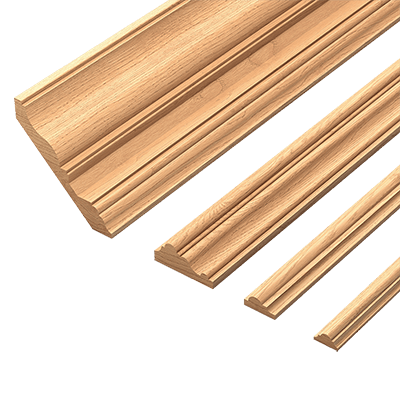
In such a situation, it is more reasonable to consider a frame solution and Buy wooden picture frame molding. A baguette can form a long line and work with the perimeter of the facade.
The comparison is simple:
local central area → check N-090.1;
long edge or perimeter → consider a baguette or other molding.
The choice should follow the shape of the defect and the composition, not the desire to necessarily use a specific product.
Wooden decorative elements: what to add to N-090.1 if the entire facade is being updated
Sometimes after a fitting it becomes clear that one overlay looks too lonely on old furniture. Then the project stops being a point masking and turns into a facade update.
In this case, you can look at others wooden decorative elements, but they need to be added according to the function.
For example:
-
the central overlay sets the main motif;
-
the baguette forms the frame;
-
the additional element supports symmetry;
-
the wooden decor is unified by one finish.
You should not buy several types of carving just because they are in the same catalog. Each element must have a clear role.
If N-090.1 is already large — 100×455 or 140×637 mm — additional details may overload the facade. If a compact size is used, a frame surround sometimes helps integrate it into the overall system.
How to coordinate N-090.1 with the panel, frame, and facade profile
Old furniture doors are often not flat. They have a frame, panel, routing, or level differences. This is critical for applied decor.
N-090.1 must rest on a suitable surface. If part of the element falls on a frame protrusion and part hangs over a recessed panel, installation cannot be considered automatically acceptable.
Before ordering, check the facade profile from the side. Measure the difference between the central plane and the frame. Apply the template not only frontally, but also imagine its actual thickness: from 8 to 23 mm depending on the size.
If a carved element crosses several surface levels, a different position, base preparation, or another decor may be required.
At this point, a physical sample is especially valuable. A paper template shows only the outline, but not the contact with the facade relief.
Thickness of N-090.1: why 8, 10, 13, 17, and 23 mm also need to be checked
When choosing for masking, it is easy to look only at A and B. But the third coordinate C affects perception and operation.
An 8-millimeter overlay protrudes less relative to the facade plane than a 23 mm thick option. On a door next to a handle, this can be crucial.
Check:
-
whether the decor touches the adjacent facade when opening;
-
whether it fits too close to the cabinet side;
-
whether the hand hits the protruding ornament;
-
whether it conflicts with the drawer;
-
Is there enough space between two adjacent doors?
Checking is especially important for the large size 140×637×23 mm. This is already a noticeable volumetric relief.
If the fronts open towards each other or have small gaps, a simple frontal drawing does not show a possible collision.
How to check door opening with a paper template and without installation
Paper does not reproduce thickness, but you can add conditional volume to the template. For a preliminary check, use thick cardboard or a safe model of the required protrusion.
Attach it in the most protruding area of the template and slowly open the door.
Check:
-
adjacent facade;
-
body;
-
a wall;
-
new handle;
-
the user's hand;
-
a possible opening limiter.
This does not replace precise installation, but it reveals an obvious conflict even before purchasing six items.
When it is better not to order N-090.1 at all
There are situations where refusing the overlay is the correct test result.
The hole falls into the open part of the ornament.
Even after changing the position and size, the defect remains visible. Then N-090.1 does not solve the central task.
The facade is structurally damaged.
A crack, delamination, weak attachment zone, or serious chip requires repair, not decorative masking.
The size is disproportionate to the door.
A small overlay looks like a random dot, a large one overloads the entire facade.
The new handle conflicts with the decor.
It is uncomfortable to grip or visually argues with the ornament.
The furniture should remain minimalist.
Adding a carved detail will solve the hole problem, but will change the item's style more than local restoration.
The defect can be carefully restored without decoration.
If professional repair can restore the surface to its original appearance, and the owner does not want to change the design, a masking overlay is not necessary.
The expert choice is not to "always buy N-090.1," but to understand whether it suits a specific restoration.
How to place an order for six N-090.1 after a successful fitting
Once one sample or template has been verified, the specification should be recorded unambiguously.
Example:
N-090.1 / 60×273×10 mm / oak / "Prestige" / 6 pcs.
Or:
N-090.1 / 45×205×8 mm / beech / "Standard" / 6 pcs.
Before payment, check again:
-
article number;
-
size A×B×C;
-
material;
-
sanding quality;
-
selected preparation/option in the card;
-
quantity;
-
current price;
-
production lead time;
-
Delivery terms.
For restoration, it is especially useful to attach a photo of the facade with the approved template to the order. This does not change the product specification, but helps preserve the project context during consultation.
If this exact model is required, go to carved overlay N-090.1 after the contour has already been checked.
Where to buy wooden overlays for furniture restoration
If N-090.1 fits, the logical path is the specific product card. If it does not fit in pattern or scale, there is no need to abandon the idea of wooden decor altogether. In the category, you can buy wooden overlays for furniture and compare other contours.
This is especially important for masking: another ornament sometimes covers old holes better with a smaller external size.
If restoration grows into a broader furniture update, you can buy decorative wooden elements and build a unified facade system.
For projects that require not only furniture overlays but also a wider range of carvings, a section is provided to buy carved wooden decor.
The commercial logic here should remain simple:
specific N-090.1 fits → buy the SKU;
form N-090.1 does not fit → compare other overlays;
the task is broader than one overlay → go to the general decorative section.
Practical checklist before ordering N-090.1 for six facades
Go through the entire list before payment.
-
All old holes are marked.
-
Chips and scuffs are included in the defect area.
-
Every facade was measured, not just one.
-
The most damage-complex facade was selected.
-
There is an actual outline of the selected size N-090.1.
-
The template was printed at 1:1 scale.
-
The outer dimension of the template was checked with a ruler.
-
Open parts of the ornament are cut out or precisely marked.
-
Every old hole falls under a wood area.
-
The new handle remains comfortable.
-
The plate does not conflict with the frame and panel.
-
The thickness of the element was checked.
-
The door opens freely.
-
The position on all six fronts will be identical or deliberately symmetrical.
-
Beech or oak has been selected.
-
Quality "Standard" or "Prestige" selected.
-
One sample is physically checked, if possible.
-
Finishing has been approved.
-
The current price and lead time have been re-verified in the card.
-
Only after this is the batch ordered.
Such a checklist turns a decorative purchase into a controlled restoration task.
How to create a defect map for all six fronts and not choose the size based on a single door
If the furniture consists of six fronts, assessing only one door is insufficient. Even when the old handle was the same model, the actual damaged area may differ: on one front the fastener came off cleanly, on another the edge of the hole chipped, on a third a round mark from the handle base remained.
It is convenient to create a simple defect map. Each front is assigned a number — F1, F2, F3, and so on. Then record not only the distance between holes, but also the overall size of the entire damaged area.
| Facade | Defect zone width | Defect zone height | Additional trace | Template check |
|---|---|---|---|---|
| F1 | Measure | Measure | chip / no | passed / no |
| F2 | Measure | Measure | scuff / no | passed / no |
| F3 | Measure | Measure | handle base trace | passed / no |
| F4 | Measure | Measure | crack / no | passed / no |
| F5 | Measure | Measure | local repair | passed / no |
| F6 | Measure | Measure | other | passed / no |
Such a table is not needed for the reader for the sake of bureaucracy. It quickly shows whether the task can be solved with one size N-090.1.
If on five facades 45×205 mm fits, and on the sixth one hole goes into an open area of the ornament, you cannot simply ignore the sixth door. You need to choose between two strategies: locally repair the exception or switch to a different size or pattern that works on the entire group.
At the same time, you cannot automatically choose the largest option based on the maximum defect. For example, one problematic f
Scenario 3. Hole with a chip
Here, first you need to understand whether the material is stable. If a fragment of the coating or base is torn out around the fastener, N-090.1 should not be perceived as a mechanical patch.
After professional preparation, the residual visual trace may become smaller. And then the size choice should be made after the repair, not based on the initial chip.
These three scenarios explain why in a restoration article, a map of actual damage is more important than the nominal center-to-center distance of the old handle.
How to compare the scale of five sizes of N-090.1 relative to a specific facade
There is no universal recommendation like "the overlay should occupy 20% of the door height" here. But you can use a relative calculation to compare options on one facade.
Suppose the door height is known and equals H. Then the proportion of N-090.1 by height is calculated as follows:
proportion = B / H × 100%.
For each size B takes the value 205, 273, 364, 455, or 637 mm.
If the facade is 900 mm high, we get approximately:
-
205 mm — about 22.8% of the height;
-
273 mm — about 30.3%;
-
364 mm — about 40.4%;
-
455 mm — about 50.6%;
-
637 mm — about 70.8%.
These percentages are not a standard and do not indicate which option is "correct." They show how sharply the scale of the decor changes when transitioning between items of the same pattern.
On the same facade, the 45×205×8 mm option remains a local detail, while 140×637×23 mm occupies most of the height and inevitably becomes the main motif.
This calculation is especially useful for remote selection: a person sees not only the millimeters from the card, but also the proportion of the real door.
Similarly, you can calculate the proportion by width:
A / facade width × 100%.
If the door width is 450 mm, a 45 mm wide overlay takes up 10% of the width, 60 mm — 13.3%, 80 mm — 17.8%, 100 mm — 22.2%, 140 mm — 31.1%.
And again: this is not a design standard, but a comparison tool.
Why the same pattern in five sizes cannot be evaluated only by a photo of the small version
The five sizes of N-090.1 belong to the same product, but on furniture they are perceived differently due to scale and thickness.
A small overlay with a thickness of 8 mm creates a relatively soft relief. The large 23-millimeter version protrudes more from the plane and casts a more noticeable shadow. Even with proportional scaling of the pattern, the spatial perception changes.
Therefore, after choosing a large size, it is useful to separately check the side view. A person who has seen only the compact version on the screen may underestimate the volume of 100×455×17 or 140×637×23 mm.
For a tall cabinet, this can be an advantage. For a shallow dresser near a passageway, on the contrary, it is an extra protrusion.
If the buyer chooses Buy carved overlays Specifically for restoration, photographs should help assess not only the ornament but also the scale relative to the furniture. Therefore, physically trying one sample remains stronger than on-screen comparison.
How to check the finish of a new overlay on an old facade before ordering the entire batch
Even a perfectly chosen contour can reveal restoration by its color.
The old facade has already been through use: the coating may have faded, yellowed, darkened, or developed a patina. The new beech or oak N-090.1 has fresh wood. If you immediately apply "the same color by name" to it, a match is not guaranteed.
For transparent and semi-transparent finishes, consider:
-
the actual shade of the old surface;
-
the wood species of the existing facade;
-
the wood species of N-090.1;
-
the composition of the old coating, if known;
-
test coating;
-
The effect of finishing varnish or oil on the tone.
It is better to test not on the front side of the finished batch, but on a separate material sample or on a control overlay.
For opaque enamel, the task is visually simpler, but technological issues remain: primer, intercoat sanding, adhesion, material compatibility.
If six overlays are to be painted together, it is better to prepare them as one batch. This minimizes differences between elements, and the craftsman can repeat the same technological cycle.
Why painting only the overlay and not touching the facade is sometimes insufficient
Imagine that the new decor perfectly matches the main paint, but around the old handle there remains a worn halo wider than the overlay. Formally, the holes are covered, but the repair trace is still visible.
Therefore, before ordering, it is necessary to determine the boundary of the future finish:
-
only N-090.1;
-
N-090.1 plus the local facade area;
-
the entire door;
-
all six facades.
The larger the repainting area, the more the project moves from simply masking holes to a full furniture update.
This is not a reason to abandon the idea. On the contrary, sometimes six identical carved elements and a new finish give a more cohesive result than trying to discreetly hide six different marks.
But the budget and scope of work need to be understood before purchasing the decor.
How to check the symmetry of a pair of doors if the handles are installed mirror-wise
On double-door sections, handles are often located closer to the central joint. After replacing them with N-090.1, they may be needed on both the left and right of the axis.
If you simply place both overlays in the same orientation relative to their own door, the overall composition sometimes does not look mirrored.
You need to look at the entire block of two facades. Draw the central axis of the cabinet and compare the distances from it to the key points of the decor.
If the N-090.1 ornament itself has a pronounced direction, additionally check whether the composition allows the same orientation or requires a different placement method. You should not independently declare the product as "left" or "right" if the card does not confirm such versions. This is specifically about visual fitting.
Full-size paper templates of the two elements allow you to resolve the issue without ordering.
What to do if a new handle is installed directly in the center of the future N-090.1
Sometimes after replacing hardware, a new handle is placed in the same functional spot where you want to add decor. This creates a conflict.
There are several solutions.
First, position N-090.1 above or below the handle and use it as a separate motif. This works if the old holes are in an area that such a shift still covers.
Second, choose a different size where the dense ornament section allows building a composition around the handle.
Third, reconsider the placement of the new hardware if it is not yet permanently fixed and the facade construction allows for changes.
Fourth, abandon N-090.1 if hiding the old holes requires compromising ergonomics.
The handle remains a functional element. Decor should not force a person to awkwardly grab the door every day.
Serial installation of six overlays: why a unified marking base is needed
After purchasing a batch, the stage begins where a good choice can be ruined—installation.
Six identical N-090.1 pieces should be perceived as a system. For this, their position is set from the same baseline.
If the facades are identical, it is more convenient to measure from the top and side edges of the door. If the doors have different heights but there is a common horizontal line in the cabinet composition, that line can serve as the base.
Before fixing, it is useful to:
-
assign a number to each overlay;
-
lay them out according to the facades;
-
check the shade and wood grain pattern;
-
install temporary templates;
-
photograph the entire cabinet;
-
only then proceed to final fastening using the chosen technology.
Numbering is especially useful with transparent finishes. Even within the same wood species, the grain pattern varies, and the craftsman can pre-distribute elements across facades so that the overall rhythm looks calmer.
Why you cannot choose fastening method N-090.1 based only on advice from a general article
The product card confirms dimensions, materials, and sanding quality, but the specific restoration facade is unknown to the article's manufacturer.
One customer installs decor on solid wood. Another on painted MDF. A third on a veneered panel. A fourth on an old lacquered surface.
A universal instruction like "apply such-and-such glue and press for so-and-so minutes" without material data would be unreliable.
Before installation, the fixing method is agreed upon with:
-
material N-090.1;
-
facade material;
-
existing coating;
-
future finish;
-
contact area of the specific carved contour;
-
mass of the selected size;
-
with the recommendations of the manufacturer of the selected adhesive or fastener.
For the large variant 140×637×23 mm, the contact issue is especially important: it differs noticeably from the compact element 45×205×8 mm.
The article should guide the buyer to the correct specification and verification, not replace the installation process map.
How to understand that restoration with N-090.1 is truly more cost-effective than replacing facades
There is no universal cost formula without specific prices, but the two scenarios can be compared by cost structure.
Scenario A — preserve the facades
Considered:
-
six N-090.1 or fewer pieces depending on the composition;
-
decorative finishing;
-
local repair of holes;
-
installation;
-
possible repainting of facades;
-
new fittings.
Scenario B — replace the facades
Considered:
-
manufacturing six new doors;
-
finish;
-
drilling for new fittings;
-
delivery;
-
installation and adjustment;
-
possible mismatch of the new coating with the old cabinet body.
If the existing facades are of good quality and the defect is local, decorative restoration may make sense. If the doors are already deformed, the coating is damaged over the entire area, and the holes are just one of the problems, buying carved overlays should not mask the need for more extensive repairs.
The decision is made after inspecting the furniture, not just based on the price of one part.
FAQ
Can old holes be covered with a decorative wooden overlay?
Yes, if the holes and surrounding marks are actually covered by the wood areas of the chosen ornament, and the facade itself remains structurally sound. The external dimensions of the overlay are not sufficient for confirmation.
What sizes are available for N-090.1?
Five variants are confirmed: 45×205×8, 60×273×10, 80×364×13, 100×455×17, and 140×637×23 mm.
What materials is N-090.1 made from?
The card confirms beech and oak.
Why does the 45×205 mm size not guarantee that the overlay will cover holes inside the 45×205 rectangle?
Because it is carved decorative trim. Inside the outer dimensions, there are areas where there is no wood contour. A defect can fall exactly there.
How can I tell if the hole will be covered before purchasing?
Use the actual product contour and make a 1:1 template. Then apply it to the facade and check each damaged point.
Can I use a photo from the website as a template?
Only after correct scaling based on real dimensions. The image size on the screen by itself does not correspond to the physical size of the product.
What is better — to order six overlays at once or first one?
For restoration, it is safer to first test one, if the order conditions allow. After a physical fitting, the remaining five can be approved.
What is the difference between "Standard" and "Prestige" for my project?
These are sanding quality options. The choice depends on the required surface readiness and subsequent finishing. The final cycle is better coordinated with the craftsman who will paint or tint the decor.
Can N-090.1 be used on a painted MDF facade?
The fact that the facade is made of a different material does not exclude decorative use, but the preparation, fastening, and painting methods must match the specific surface. The technology cannot be automatically transferred from solid wood to MDF.
Is it necessary to repair the old hole if the overlay will completely cover it?
If there are cracks, chips, loose material, or peeling coating around the hole, the damaged area must first be stabilized. The decor does not replace structural repair.
How to combine N-090.1 with a new handle?
First check the working grip area, then the compositional axis. The overlay should not interfere with the hand, block the handle fasteners, or look randomly shifted.
Do I need to install identical overlays on all six fronts?
Not necessarily. The decision depends on the symmetry of the furniture. But if the decor is placed on several fronts, the composition should look intentional, not show where the defects were.
Can I install different sizes of N-090.1 on adjacent doors?
Technically, different sizes exist, but in one symmetrical group of fronts, mixing sizes requires a very convincing compositional reason. For masking, it's better to first look for a unified solution.
What to do if N-090.1 covers the holes but looks too large?
Don't buy it just for masking. Consider a smaller size with a different position, another overlay, professional repair, or a different type of decor.
When is a wooden molding better than an overlay?
When the damage is elongated along the edge, located around the perimeter, or when the front requires a frame composition rather than a central carved accent.
Where to see other wooden overlays?
In the section buy decorative wooden overlays You can compare other models and contours.
Where can I see other carved decor?
In the general section to buy carved wooden decor Other types of carved elements are presented.
Result: first the contour, then the size, and only then the batch of six.
For the restoration of N-090.1 facades, you cannot select just one row from the size table. The most important conclusion of the article is simple: A×B is the outer dimension, not a guarantee of continuous coverage of the entire area within it.
First, they measure not one opening, but the entire defective area. Then they take the actual contour of the selected N-090.1 size and check it at a 1:1 scale. Each old opening and each chip must fall under the wooden part of the pattern. After that, they evaluate the new handle, free grip, symmetry, panel, overlay thickness, and facade opening.
If a batch of six doors is being checked, it is safer to first approve one sample or at least an exact template. Only after a successful fitting are the size, material, sanding quality, and quantity fixed.
If N-090.1 does not cover the defect without an unfortunate shift or looks disproportionate, it should not be ordered. In the STAVROS category, there are other Buy carved overlays, and a different pattern may better solve the same task.
The correct customer route:
defect → measurement → contour → 1:1 template → fitting → composition with handle → facade check → material → quality → one control overlay → batch of six.
Then carved wooden decor becomes not a random "patch," but a pre-verified way to preserve existing doors and turn traces of old hardware into part of the new furniture composition.