








































































Article Contents:
- Three roles of a decorative leg: neutral, supporting, and accent
- A neutral leg does not mean a random one
- A supporting leg connects the top and bottom of the furniture
- An accent leg sets the character of the piece
- Smooth facade
- Facade with molding frame
- Facade with carved overlays
- Facade with expressive handles
- Facade character selection matrix
- The accent should match the scale of the furniture
- Not every smooth facade requires expressive legs
- What to do if the client wants complex decor everywhere
- Cross-section
- Depth of Relief
- Number of transitions
- Color contrast
- Example with a compact nightstand
- The same legs under a wide dresser
- One piece of furniture — two characters of the base
- When a larger model doesn't fit
- When a turned shape will be supportive
- How MN-233 works in a composition
- Important design limitation
- Carved leg under a smooth facade
- Carved leg under a classic facade
- Compare not only the pattern, but also its scale
- Ornament direction
- When it is better to avoid carved legs
- How to tell that the handle has already become the main accent
- It is not necessary to choose the same shape
- Narrow moulded frame
- Wide multi-tiered frame
- Frame and ornament at once
- Option one: focus on the body
- Option two: focus on the base
- How to choose between the options
- The angle affects the overall dimensions
- When the angle enhances the decorative effect
- Legs matching the facade color
- Contrasting oak supports
- Contrast without a sharp color difference
- Beech legs
- Oak legs
- Why the wood species does not determine the decorative role automatically
- Quality of sanding
- For enamel and for tinting
- How to check the lighting effect
- When complex relief is not needed
- Commode
- Bedside table
- Console
- Coffee table
- Armchair and sofa
- Different sizes are acceptable
- How to maintain unity without uniformity
- Why you shouldn't buy solely for an expressive shape
- How to assess structural suitability
- How to prepare a mockup
- From what distance to view
- What the mockup does not show
- What to check on the sample
- When front and rear legs may differ
- How to maintain repeatability
- Example entry
- When an expensive decorative support is not justified
- Can legs become the main decoration of a smooth dresser?
- Why does a carved leg sometimes look unnoticeable?
- Should the ornament of a leg exactly repeat the carved overlay?
- Can large geometric legs be used for modern furniture?
- Why does a decorative leg look different after painting?
- Should you choose the same legs for a dresser and bedside tables?
- What to do if expressive legs clash with large handles?
- Can decorative legs be installed at an angle?
- How can I evaluate a leg before buying the full set?
- How can I tell if furniture legs are too large?
- When is it better to avoid decorative legs?
- How can I order identical decorative legs for repeated furniture?
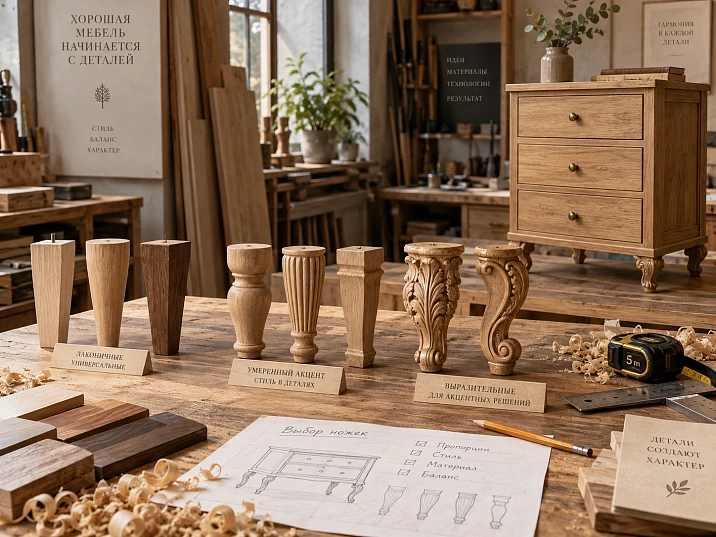
Two identical chests of drawers can have legs that are completely different in character. The first stands on thin straight supports that barely attract attention. The second stands on large turned pieces with pronounced profile transitions. The body and fronts have not changed, but the furniture is perceived differently: in the first case, the chest of drawers itself remains the main focus; in the second, the eye immediately turns to its base.
If the fronts are smooth, both solutions can look convincing. But add large carved overlays, shaped moldings, and noticeable furniture handles, and expressive legs sometimes begin to compete with the rest of the decor.
Decorative furniture legs should be chosen based on their role in the overall composition. They can almost disappear against the body, support the pattern of the front, or become the main accent of the piece. None of these options is universally best.
Before buying, it is useful to answer a simple question: what should a person notice first — the front, the shape of the body, or the supports?
The type of leg, its scale, cross-section, pattern, material, and finish depend on this decision. Moreover, it is not only a carved piece that can be decorative. A large geometric support, an expressive turned leg, or a simple wooden cone in a contrasting color can change the character of furniture no less than a complex ornament.
For the selection, it is important to see two levels at once: the artistic result and the structural constraints. The leg must match the facade, but also fit in size, mounting method, and operating conditions. A beautiful silhouette does not compensate for an unsuitable mounting area or an incorrectly calculated height.
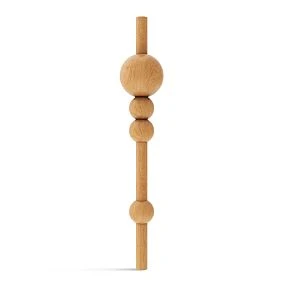
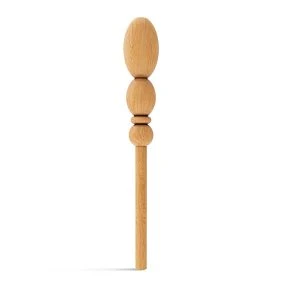
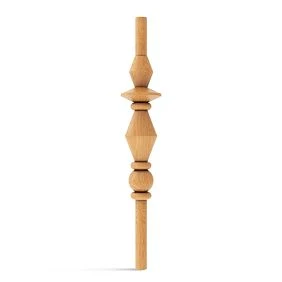
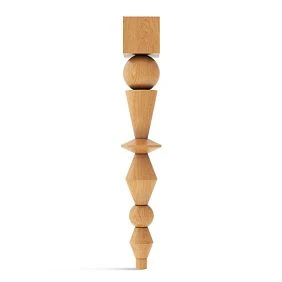
Three roles of a decorative leg: neutral, supporting, and accent
Not every furniture support should become a standalone decoration.
Sometimes the best result comes precisely when the leg is barely noticed. It completes the lower part of the piece, forms the necessary clearance, and does not distract attention from the facades.
In another project, the support should echo the character of the cabinet: smooth lines, geometric facets, or floral ornament.
The third option is an expressive leg that becomes the main decorative element of the furniture.
These tasks are conveniently separated.
| Role of the leg | How it is perceived | When appropriate | Main risk |
|---|---|---|---|
| Neutral | Barely distracts attention from the cabinet | Complex facades, active texture, large handles | A form that is too simple may fail to support the character of the furniture |
| Supporting | Repeats the lines, rhythm, or plasticity of the body | Panels, frames, moderate carved decor | Literal repetition of all motifs creates redundancy |
| Accent | Becomes one of the most noticeable details | Smooth fronts, laconic body, designer furniture | A leg that is too large or complex can visually overpower the body |




A neutral leg does not mean a random one
If the support should not attract attention, that is not a reason to choose the first model that fits in height.
A neutral leg still forms the lower boundary of the furniture. Its thickness, angle, and position relative to the body affect the silhouette.
For example, straight wooden legs under a chest of drawers with pronounced panels can support the vertical lines of the fronts. If they are made too thin, the lower part of the furniture will seem insufficiently connected to the main volume. If they are excessively wide, they will become more noticeable than intended.
Neutrality is achieved through consistency of size and shape, not through the complete absence of pattern.
Our factory also produces:
A supporting leg connects the top and bottom of the furniture
Let's imagine a chest of drawers with smoothly profiled frames on the fronts. In this case, turned legs with moderate rounded transitions can support the overall character.
It is not necessary to repeat every curve of the molding.
It is enough for the composition to convey a general plasticity: soft or strict, rounded or faceted, calm or dynamic.
The role of the supporting leg is especially visible on furniture where decorative elements are distributed across several levels: cornice, fronts, handles, base.
Get Consultation
An accent leg sets the character of the piece
For a smooth cabinet with a small handle, the lower part can become the main decoration.
Large turned forms, spherical elements, prominent geometric blocks, or contrasting oak legs can change the perception of the entire piece.
With this solution, it is not necessary to add complex overlays to the facade.
Often a calm body looks much more expressive when one group of details receives a deliberately strong artistic accent.
A decorative leg is not necessarily carved
The word “decorative” describes the role of the support in furniture, and not exclusively the method of its manufacture.
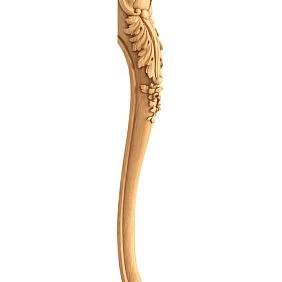
A carved leg becomes decorative thanks to ornament, relief, the direction of lines, and the character of the surface.
A turned one — thanks to changes in diameter, the placement of thickenings, narrowings, and profile transitions.
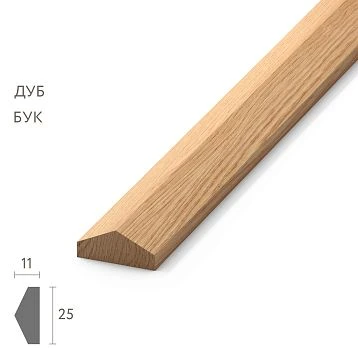
A geometric one — thanks to planes, facets, taper, inclination, and scale.
Even a simple form can become an accent if it is made in a noticeable size or highlighted with a contrasting finish.
For example, a massive wooden support with straight facets against the background of a smooth painted body can be perceived as more expressive than a small carved leg almost hidden in shadow.
Therefore, when selecting, you should not limit the search only to the category of carved items.
To compare different forms, you can start with the STAVROS wooden furniture legs catalog, and then separately consider turned, carved, and geometric designs.
First, assess the decorative richness of the facade
The most useful check is done before even opening the catalog of legs.
Look at the furniture from the front and determine which elements already attract attention.
These could be large panels, a deep frame of moldings, carved overlays, contrasting inserts, expressive handles, or the wood grain itself.
Each such detail occupies a specific place in the composition.
If the facade contains several active elements at once, a new complex leg will increase the decorative richness. Sometimes this matches the intent, for example in richly decorated classic furniture. But more often it is necessary to decide which element will be the main one and which will support it.
Smooth facade
A smooth surface leaves more freedom.
If the body has simple proportions and small handles, an expressive support can become its main decoration.
For a modern nightstand or chest of drawers, consider a large geometric or unusual turned shape.
At the same time, it is important to maintain consistency between the scale of the body and the legs.
Facade with molding frame
Molding creates its own rhythm of lines.
If the frame has a calm profile, the leg can support its shape.
If the frame is wide, multi-tiered, and casts a deep shadow, an additional complex pattern on the lower part may prove excessive.
In such a situation, it is better to compare several options: from a calm geometric support to a moderately turned one.
Facade with carved overlays
Here an ornamental dominant is already present.
A carved leg can continue the artistic theme, but it does not have to repeat the overlay literally.
Sometimes the general character of the lines and a similar scale are enough.
If the facade features a large central cartouche, elaborate carved legs may draw attention away from it. In that case, a supporting or neutral shape proves more appropriate.
Facade with expressive handles
A furniture handle can itself be a prominent decorative element.
On a small chest of drawers, four large handles are positioned in close proximity to one another. They already create a certain rhythm.
If legs with several large bulges are also installed beneath such a facade, the lower and central parts of the furniture may begin to compete.
It is useful to determine whether the handles and legs should be two equal accents or whether one group of details should remain more subdued.
Selection matrix by facade character
| What is already on the facade | Possible role of supports | What to Check |
|---|---|---|
| Smooth surface, small handles | Accent | Proportionality of the leg to the body |
| Simple panel, narrow molding | Supporting | Repetition of the overall character of the lines |
| Large central carved element | Neutral or supportive | Does the leg distract from the main ornament |
| Complex frames, overlays, carved handles | Predominantly calm | Is there an excess of relief |
| Active natural texture | Geometric or moderately turned | Do the wood grain and the leg profile compete |
| Solid-color modern body | Geometric or expressive turned | Is a single lower accent sufficient |
These are not strict style rules. The table helps formulate an initial concept, which is then tested on a mockup.
When decorative legs should become the main accent
Let's imagine a wide dresser with smooth fronts painted in a calm solid color.
It has a simple rectangular shape, small handles, and no additional carved overlays.
If such a body is placed on inconspicuous straight supports, the dresser's geometry will remain the main feature.
But you can choose another path.
Large turned legs with a pronounced change in diameter will create rhythm in the lower part. Or prominent geometric blocks will form a massive base.
The facade, meanwhile, can remain completely smooth.
This solution often looks more convincing than trying to simultaneously add complex handles, decorative frames, central overlays, and accent legs.
The accent must match the scale of the furniture
For a compact cabinet, a small shaped support can be quite noticeable.
On a wide dresser, the same leg will be perceived much more calmly.
Therefore, the absolute size of the item does not yet determine the degree of its expressiveness.
The connection with the dimensions of the body is important.
Not every smooth facade requires expressive legs
Smooth furniture can be conceived as a strict monolithic volume.
In that case, accent legs can disrupt the original idea.
For example, a long TV cabinet with a calm horizontal line sometimes looks better on a subtle base.
A decorative support is worth choosing when it genuinely reinforces the concept, rather than simply adding another noticeable detail.
When a decorative leg is better made more subdued
A classic chest of drawers may have several tiers of moldings, carved corner overlays, intricate furniture handles, and a profiled top.
If all these elements are equally active, it is difficult for the viewer to identify what is most important.
Adding another group of richly carved legs will not necessarily make the furniture more expressive.
The opposite result is possible: the body will begin to be perceived as a collection of separate ornaments.
Therefore, before making a choice, it is worth determining whether the decorative activity of the base can be slightly reduced.
For example, instead of a leg with deep botanical relief, use a turned support with smooth transitions.
Or choose a simple geometric shape painted in the color of the body.
At the same time, the furniture will not lose its decorative character. On the contrary, the existing facade elements will become more noticeable.
What to do if the client wants complex decor everywhere
Such a concept may be justified for historical, theatrical, or custom furniture.
But the richness needs to be organized, not distributed randomly.
Decide where the main compositional dominant is located.
Then determine which elements are subordinate to it.
If the main accent is a large carved facade, the legs can continue its ornamental character but have a less deep or calmer pattern.
If sculptural supports are to be the main feature, it is reasonable to make the facade decor more concise.
What is the visual weight of a furniture leg
Visual weight is the degree to which an element attracts attention within a piece of furniture.
It does not coincide with the actual mass of the wood and is not determined by height alone.
Perception is influenced by cross-sectional dimensions, shape, depth of relief, number of profile transitions, color, contrast with the carcass, and lighting.
For example, two legs 180 mm high can have different cross-sections.
One is relatively thin, with small rounded transitions.
The other is a wide geometric block with large flat surfaces.
At the same height, the first will look lighter, the second more massive.
At the same time, a large geometric support can have a very simple shape, while a small carved leg can have a more complex pattern.
Therefore, the concept of visual weight includes both dimensions and decorative activity.
Section
A wide support is usually more noticeable than a narrow one, especially on a small cabinet.
But actual perception depends on the entire shape. A leg with a wide top platform and a strong taper toward the bottom can look lighter than a straight block of the same maximum width.
Relief depth
Carved details create light and shadow.
The more the relief interacts with side lighting, the more noticeable the pattern.
However, deep carving does not always make the leg the main focal point. If it is positioned low and is constantly in shadow, the ornament may be perceived more weakly than expected from a photograph.
Number of transitions
On a turned leg, the rhythm is created by successively arranged thickenings and narrowings.
Several large transitions can be more noticeable than many small ones.
On furniture with a simple facade, such rhythm becomes an independent decoration.
Color contrast
An oak support with visible grain against a painted light-colored body usually stands out more than the same shape painted to match the furniture color.
Therefore, the same item code can play different decorative roles depending on the finish.
How to calculate the scale of the leg relative to the body
Comparing decorative supports only by their absolute dimensions is inconvenient.
The same leg can look large under a small cabinet and fairly understated under a wide dresser.
For a preliminary comparison, it is useful to use the ratio of the support's cross-sectional dimension to the body width.
Relative size = leg cross-sectional dimension / body width × 100%.
This is not a building standard or a universal rule of beauty.
The calculation is needed only to compare several options within a single composition.
Example with a compact cabinet
Let's assume the width of the cabinet is 460 mm.
Two geometric supports with cross-sectional dimensions of 70 and 150 mm are considered.
For the first one:
70 / 460 × 100 ≈ 15,2%.
For the second:
150 / 460 × 100 ≈ 32,6%.
The difference is noticeable.
The wide support will occupy a significantly larger share of the facade composition.
But the final result also depends on the position of the leg, the tapering of the shape, and the actual visible part.
The same legs under a wide dresser
Now the body width is 1200 mm.
For a 70 mm support:
70 / 1200 × 100 ≈ 5,8%.
For a 150 mm support:
150 / 1200 × 100 = 12,5%.
Relative to a wide cabinet, both legs are perceived differently.
Therefore, it is impossible to make a universal conclusion that a 150 mm wide support is always too large.
It may be excessive for one nightstand and quite appropriate for a large chest of drawers.
MN-207 and MN-227: how scale changes the character of a geometric support
For comparison, we can take two real STAVROS models.
Geometric Furniture Leg MN-207 has a dimensional configuration A × B × C × E × F = 180 × 150 × 150 × 141 × 25 mm.
Geometric Furniture Leg MN-227 is presented in the size A × B × C = 145 × 70 × 70 mm.
Both belong to geometric wooden supports, but differ in scale.
| Parameter | MN-207 | MN-227 |
|---|---|---|
| Type | Geometric | Geometric |
| Dimensions from the product card | 180 × 150 × 150 × 141 × 25 mm | 145 × 70 × 70 mm |
| Materials | Beech, oak | Beech, oak |
| Relative perception | Large geometric volume | More compact form |
| Possible compositional role | Accent or supporting | Supporting or neutral |
| What to be sure to check | Full drawing, installation, overhang | Installation area and actual height |
Dimensions are given according to the manufacturer's designations. Additional parameters E and F for MN-207 must be read from its drawing; they are not arbitrarily assigned dimensions.
One furniture form — two base characters
Let's imagine a smooth chest of drawers 1200 mm wide with a body height of 650 mm.
If the supports are compact enough, the eye first perceives the large rectangular body.
If you choose prominent geometric blocks, they will create a different character for the lower part.
However, one should not draw conclusions about the actual final height of the furniture solely from the A dimensions of two models. It is important to check what actual overhang each leg creates after installation.
At the selection stage, it is convenient to compare these models not only by the product photo but also by two full-scale outlines.
When a larger model is not suitable
MN-207 may appear visually too dominant for a small cabinet with already busy fronts.
But there is also a structural limitation: the mounting area of the cabinet must match the geometry of the product.
You cannot install a large leg just because it looks good in the visualization.
It is necessary to check the mounting location, the bottom panel, the side panels, and the overall contour of the support.
Turned decorative leg: expressiveness without carved ornament
A turned shape can be decorative in itself.
Smooth transitions, spherical elements, beads, elongated necks, and varying diameter create a rhythm of their own.
Such a pattern is especially well-suited to furniture with simple fronts.
For example, on a small cabinet with a smooth door, turned legs can define the entire character of the piece.
In such a project, it is not necessary to add carved overlays or large handles.
The silhouette of the support already performs a decorative function.
When a turned shape will be supportive
If the body has rounded moulded profiles or smooth lines on the fronts, turned legs can continue the overall plasticity.
At the same time, the number of transitions and the degree of expressiveness must be coordinated with the front.
A complex turned profile next to several decorative frames can create an excess of details.
In that case, it is better to compare models with a calmer pattern.
For selection, you can study turned wooden furniture legs.
MN-233: when the turned form itself becomes the decoration
A characteristic example of an expressive support — Turned furniture leg MN-233.
Its silhouette is formed by successively decreasing rounded elements. Visually, the form resembles a vertical sequence of wooden spheres.
This is a good example of decorativeness without traditional carving.
The model is available in several sizes.
| Size A, mm | Other sizes B × C × D, mm | Choice feature |
|---|---|---|
| 198 | 72 × 72 × 36 | Compact version for corresponding small items |
| 247 | 72 × 72 × 36 | More pronounced verticality |
| 443 | 72 × 72 × 36 | Significant contribution of the support to the overall height |
| 635 | 72 × 72 × 36 | Requires particularly careful verification of the design and application |
Dimensions must be compared with the drawing, and not all versions should be considered interchangeable.
How MN-233 works in a composition
On a smooth cabinet, the rounded elements create a noticeable rhythm.
If the facade has no other decorations, the leg can become the main decorative accent.
But next to deep carved overlays, multi-stepped moldings, and large shaped handles, its active profile may prove excessive.
For such a cabinet, it is worth first checking a calmer alternative.
Important design limitation
The manufacturer states that MN-233 is intended for certain frameless constructions and light loads.
The description also considers the possibility of vertical and inclined installation with an appropriate mounting solution.
This does not mean that all dimensions of this model are suitable for any furniture or any tilt angle.
Before use, it is necessary to check the purpose of the selected version, the mounting method, and the operation of the entire structure.
Particular caution should be exercised with tall versions if installation under a heavy cabinet is intended.
Carved decorative legs: when ornamentation is truly needed
A carved leg has a different character of expressiveness.
It attracts attention not only with its silhouette but also with the surface pattern.
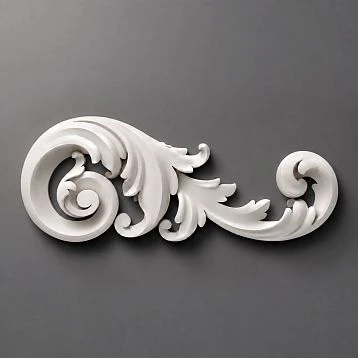
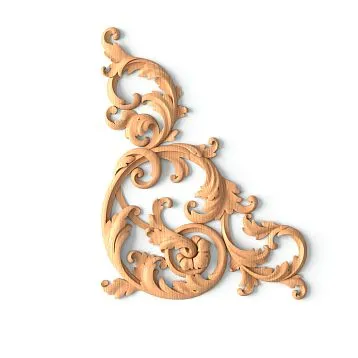
Plant motifs, scrolls, leaves, three-dimensional transitions, and other elements create complex light and shadow.
On classic furniture, such a support can become a natural continuation of the cabinet's decorative system.
But the degree of carved richness should be chosen consciously.
Carved leg beneath a smooth facade
This can be a possible accent solution.
The smooth body becomes a calm background for expressive supports.
Such furniture can be perceived as a piece with a deliberately emphasized base.
However, if the legs are small and almost hidden in shadow, the intricate ornament will be less noticeable.
Therefore, one should not choose a carved model solely based on a close-up photograph.
Carved leg beneath a classic facade
Here it is necessary to harmonize the artistic character.
If floral overlays are used on the facade, a leg with related plasticity can support the composition.
But a literal repetition of the same ornament is not necessary.
Sometimes a similar direction of lines, rhythm, and depth of relief is enough.
If the facade is decorated with especially complex carving, the leg can have a calmer shape.
Available for selection carved wooden furniture legs.
How to combine carved legs with facade overlays
The most common compositional mistake is to perceive each decorative element separately.
First, a beautiful central overlay is chosen.
Then corner elements are added.
After that, expressive handles are found.
And only at the end are carved legs chosen.
Each detail can be high-quality and stylistically appropriate, but together they create an overly busy facade.
To avoid this, it helps to view decor as an overall system.
Compare not only the pattern, but also its scale
If there is a large floral applique on the facade, a leg with an equally large ornament may begin to compete with it.
One option is to make the carving on the supports less pronounced.
Another is to keep the legs large but simplify the central decor.
The question is not whether the elements should be identical, but which part of the composition receives the main attention.
Direction of the ornament
Carved elements sometimes have a pronounced movement of lines.
For example, the ornament may rise vertically or spread out to the sides.
If the facade already has a strong vertical composition, legs with a similar direction can support it.
But if the decorative lines simultaneously diverge in different directions, the furniture may look restless.
This is especially noticeable in compact pieces, where the distance between the overlays and the supports is small.
When it is better to avoid carved legs
If the main beauty of the furniture lies in a large carved facade, a complex support is not necessary.
A neutral wooden leg allows attention to remain on the main pattern.
Such a choice does not mean abandoning the decorative nature of the furniture. It means a more precise distribution of accents.
The role of furniture handles in choosing decorative legs
Handles and supports are located in different parts of the piece, but are perceived together.
Especially on chests of drawers and cabinets, where there are few of them and each detail is clearly visible.
Imagine a smooth chest of drawers with four drawers.
If each front panel has a large ornate wooden handle, the front already has a repeating decorative rhythm.
When complex turned legs are added, another group of noticeable details appears.
This can be a meaningful solution if the shapes are coordinated.
But sometimes it is better to use calmer supports.
How to determine that the handle has already become the main accent
Evaluate the furniture from a normal viewing distance.
If the eye first stops on the handles rather than the front panels, their decorative role is significant enough.
Now mentally replace the legs with more expressive ones.
If attention begins to switch between two groups of details without an obvious compositional connection, it is worth simplifying one of them.
It is not necessary to choose the same shape
A turned leg does not require a round handle.
A geometric base does not mean that all handles must be square.
It is more important to harmonize the overall character: the softness of transitions, visual massiveness, rhythm, and finish.
Moderate contrast is acceptable if it helps the composition.
Moldings on the facade and decorative supports
A molding forms a line and relief on the furniture surface.
A leg works in space: it separates the body from the floor and forms the lower part of the silhouette.
These elements interact even if they do not directly touch.
Narrow molding frame
A thin frame usually creates a calm facade structure.
An expressive but not overly complex leg can work well under such a body.
For example, a geometric shape with a moderate taper or a turned one with several large transitions.
Wide multi-stepped frame
Such molding already creates a noticeable shadow and volume.
If it is complemented by very complex legs, the relief may begin to dominate the facades themselves.
Then it is worth checking a neutral or supporting base.
Frame and ornament at the same time
When a facade contains both molding and a central carved overlay, the legs should be considered as the third part of one system.
Their decorative role depends on which of the already existing elements is the main one.
There is no need to automatically add the same level of detail to the leg.
The same dresser: two opposite decorative solutions
Let's take a conventional dresser 1200 mm wide, with a body height of 650 mm and a depth of 450 mm.
The fronts are smooth, without moldings or overlays.
Four wooden legs are intended to be installed. Their exact geometry and mounting must match the construction of the body.
Option one: focus on the body
Relatively calm supports are chosen for the dresser.
They do not contrast with the fronts in color, their shape is simple, and the profile contains no complex decorative transitions.
The eye perceives first of all the overall volume, the width of the body, and the arrangement of the drawers.
The legs play a supporting role.
This solution is especially appropriate if the designer plans to add expressive handles or decorative frames.
Option two: focus on the base
The body is left smooth, and the handles are chosen to be understated.
But the legs become larger or acquire a pronounced turned profile.
The eye begins to read the furniture from bottom to top.
The supports become a distinctive part of the piece.
In this case, additional facade decor may not be needed.
How to choose between the options
Compare both solutions not by individual photos of the legs, but on a single image or mockup of the body.
Keep the same angle and scale.
Otherwise, a more striking catalog photo can influence the decision more strongly than the actual properties of the shape.
It is also useful to look at the chest of drawers from the side. Some legs appear compact from the front but have a significant side overhang.
Straight or angled leg: how the silhouette changes
A vertical installation usually creates a calmer rhythm.
The lines of the supports continue the verticals of the body.
An angle can give the piece a sense of movement and widen the lower part of the silhouette.
But this does not mean that any wooden leg can be installed at an arbitrary angle.
The mounting method must be provided by the manufacturer or specifically designed for the particular construction.
The angle affects the external dimensions
Let us imagine a conventional straight support 200 mm long, installed at an angle of 10 degrees to the vertical.
The vertical projection of its axis is approximately 197 mm.
The horizontal one is about 35 mm.
This example shows that the tilt changes both the height and the position of the point of contact with the floor.
A real shaped leg may have additional overhang that is not directly related to the axis.
Therefore, the full drawing must be used for the project.
When the tilt enhances the decorative effect
On smooth modern furniture, angled legs can become a noticeable accent even without a complex profile.
But with already richly detailed fronts, additional movement of lines is not always appropriate.
This is especially true for furniture where carved overlays have their own directional movement.
If the body already contains many diagonals, the tilt of the supports should be checked separately.
Leg color: matching the body or contrasting
The same wooden leg can play a different role depending on its color.
If it is painted to match the furniture, the body and base are perceived as a more cohesive composition.
If the visible oak texture is left against a solid-color front, the leg will stand out.
Therefore, it is better to decide on the finish at the same time as choosing the shape.
Legs in the front color
This option can reduce the visual independence of the supports.
Especially if the body and legs have a similar degree of gloss.
As a result, attention remains on the silhouette and relief rather than on color contrast.
This is useful when the leg shape is expressive, but the designer does not want to create another separate color accent.
Contrasting oak supports
Imagine a light painted chest of drawers on oak legs with an open grain.
The wood adds a warm color accent.
Even a simple geometric support becomes more noticeable.
But if the front already features contrasting wooden handles, decorative inserts, and several finishing materials, you need to check whether the composition is becoming too busy.
Contrast without a sharp color difference
A decorative leg can stand out not only by a dark or light shade.
Sometimes a difference in textures is enough: a smooth painted body and wood under a clear finish.
Such a transition is often perceived as calmer than a strong color contrast.
But the final result depends on the lighting and neighboring materials.
Beech and oak: how the material influences the decorative role
Solid wood legs are chosen not only for their strength characteristics.
The material determines the surface pattern and finishing options.
Beech and oak can be used in different projects, but they look different.
Beech legs
Beech has a relatively subtle texture.
It is often chosen for furniture under opaque enamel, when the main decorative role is played by the shape of the leg rather than the natural wood grain.
For example, a complex turned beech support painted to match the body retains the expressiveness of the profile but does not add a separate wood texture.
This option can be a good fit for furniture that already features moldings or carved fronts.
However, beech is not limited to opaque finishing. The specific technology depends on the project requirements and the quality of the selected item.
Oak legs
Oak is distinguished by a more pronounced natural texture.
If it remains visible, the wood itself becomes a decorative factor.
Even a geometrically simple oak leg can stand out against a painted cabinet.
For clear lacquer, oil, and tinting, it is advisable to agree on a sample in advance, because the shade and grain of natural wood can vary between parts.
Why the species does not automatically determine the decorative role
An oak leg can be neutral if its shade is close to the cabinet and its shape is understated.
A beech leg can become the main accent thanks to a large turned profile or contrasting enamel.
Therefore, the material should be evaluated together with size, shape, and finish.
Unpainted legs, sanding, and preparation for finishing
If the furniture workshop plans its own finishing, you can choose unpainted wooden legs.
However, "uncoated" and "prepared for a specific finish" are not the same thing.
STAVROS product cards include parameters for the quality of sanding and wood splicing.
It is important for the buyer to understand their meaning.
Sanding quality
The degree of surface preparation affects the scope of subsequent operations.
A complex carved or turned support requires especially careful treatment of recesses and transitions.
Before ordering, you need to check the selected sanding quality and determine whether additional finishing will be required.
For enamel and for tinting
At STAVROS, wood preparation designations are linked to the selection of lamellas during manufacturing.
The enamel version is intended for subsequent opaque coating.
For semi-transparent finishing, preliminary selection of wood by color and texture is more important.
Therefore, one cannot automatically assume that any beech or oak leg is equally suitable for a transparent finish.
If the wood must be...
For furniture placed next to a window, the same profile can look different in the morning and in the evening.
How to check the lighting effect
Don't limit yourself to a single image.
Look at the sample under normal room lighting.
Then evaluate it from the side and from the distance at which the furniture will be perceived in the room.
If a decorative leg is to become the main accent, its shape should remain legible in real conditions.
Sometimes a large turned profile turns out to be more noticeable than fine intricate carving.
When complex relief is not needed
If the furniture stands in a niche, the legs are almost hidden by neighboring objects and are in constant shadow, expensive intricate carving may not produce the expected visual result.
In such a situation, it is better to evaluate a simpler model that solves the structural and compositional task without unnecessary costs.
Which decorative legs suit different pieces of furniture
The same leg design can look different on a chest of drawers, console, coffee table, or armchair.
The reason is not only the size of the furniture, but also the distance and angle from which a person sees the legs.
Chest of drawers
On a chest of drawers, the legs are perceived primarily together with the fronts.
If the fronts are active, the legs should usually support their composition.
If the fronts are smooth, an accent base is possible.
For an initial selection, you can use the section legs for a chest of drawers, wardrobe, and nightstand.
Bedside table
On a small cabinet, each leg occupies a relatively large part of the composition.
A large, expressive shape can become the main decoration.
But you need to consider the height of the top surface, proximity to the bed, and free space.
The side overhang of the leg will be especially noticeable if the furniture is placed in a narrow passage.
Console
On a console, the supports often form a significant part of the vertical silhouette.
Therefore, a turned or sculptural leg can be the main artistic element.
But for a tall console, stability, mounting, and the purpose of the specific model are fundamentally important.
Coffee table
A low tabletop makes the legs clearly visible from the side.
If the table has a simple top surface, an expressive base can define its character.
However, a massive decorative leg can significantly change the perception of a light tabletop.
Armchair and sofa
On upholstered furniture, the supports are visible under the upholstery and can support the shape of the armrests, base, or wooden frame.
But here the decorative choice is especially closely tied to structural requirements.
Not every model that looks good under a nightstand is suitable for an armchair or sofa.
| Furniture | The possible role of the legs | What to look at first |
|---|---|---|
| Dresser with smooth fronts | Accent | Silhouette, scale, color |
| Dresser with carved decor | Supporting | Ornamental consistency |
| Bedside table | Accent or neutral | Proportions and proximity to the bed |
| Console | Expressive verticality | Stability, installation, profile character |
| Coffee table | Accent | Side view and base composition |
| Chair | Supporting | Connection to the frame |
| Sofa | Primarily supporting | Construction, load, visible part |
This table shows possible compositional roles, not universal load-bearing recommendations.
One decorative line for a furniture set
A workshop can simultaneously produce a chest of drawers, two nightstands, and a console for one room.
If legs are chosen for each item independently, a furniture collection sometimes loses its unity.
One piece gets carved supports, another — spherical ones, a third — massive geometric blocks.
Each model can be expressive, but together they do not necessarily form a unified system.
Therefore, for a set it is useful to choose a common character for the base.
This could be a single line of turned profiles, similar geometry of facets, or a unified finishing principle.
Different sizes are acceptable
A single furniture collection does not have to use legs identical in height.
A large dresser may require one size, while a compact cabinet may require another.
It is more important that the differences are justified by the function of the furniture and preserve a common artistic language.
If the manufacturer offers a family of shapes in several sizes, this can make selection easier.
But each size must be considered as a separate product variant.
How to maintain unity without uniformity
It is not necessary to repeat the exact shape of the leg on every piece.
Sometimes matching material and finish are enough, provided the profile has a related character.
For example, one furniture group can use smooth turned lines, while another uses calm geometry, if the overall composition of the interior requires it.
It is more important to avoid an accidental mixing of mismatched decorative solutions.
Decorative character does not cancel out calculating furniture height
A leg may match the front perfectly, yet make the finished piece inconveniently tall.
For example, the chest body is 720 mm high.
The chosen expressive support adds another 250 mm after assembly.
Final height:
720 + 250 = 970 mm.
If the project assumed the top surface at 850 mm, the difference is 120 mm.
This is a significant change.
Such a mistake is especially unpleasant if the cabinet has already been manufactured.
Therefore, before final approval of the decorative model, it is necessary to check the actual vertical projection of the installed support, the position of the handles and drawers, as well as the overall silhouette of the furniture.
If the leg is angled or partially recessed into the cabinet, the catalog length cannot be automatically equated to the actual projection.
Why you shouldn't buy solely for the expressive shape
A tall sculptural leg may look very attractive in a standalone photo.
But if it does not match the height of the furniture or requires significant modification of the mounting unit, the choice cannot be considered successful.
Then it is better to find a more compact model, change the cabinet design, or abandon this shape.
Visual massiveness does not mean structural strength
A large wooden leg may look more substantial than a narrow one.
But the permissible load cannot be determined from the appearance.
Load-bearing capacity depends on the material, shape, cross-section, load direction, connection to the body, and furniture construction.
This is especially important for tall supports and angled connections.
For example, a turned leg may have large rounded elements but a relatively small mounting section.
External scale does not remove the need to check the fastening and the manufacturer's limitations.
How to assess structural suitability
Start with the product page for the specific item.
Then review the installation drawing.
Determine how the load is transferred from the body to the leg and through which fastening elements.
Check whether the support matches the intended use of the furniture.
If the manufacturer specifies usage restrictions, they must not be ignored for the sake of a decorative result.
To select suitable elements, refer to the section STAVROS furniture fittings catalog.
But the presence of a mounting kit does not make every support universal.
Full-size mockup of a decorative leg
One of the most useful ways to compare is to make a contour mockup.
It allows you to evaluate the size of the leg next to the actual cabinet rather than in a separate image.
For this, thick cardboard, paper, or a printed profile is sufficient.
The main thing is to maintain a 1:1 scale.
How to prepare a mockup
-
Select several suitable models.
-
Take the dimensions from their drawings.
-
Build a side or front contour.
-
Cut it out of cardboard.
-
Place it against the cabinet at the intended installation point.
-
Compare the front and side views of the furniture.
-
Check the overall height and outward projection.
-
Assess the decorative role from a normal viewing distance.
If possible, it is useful to make mockups of two different options.
One — more subdued.
Another — more expressive one.
This makes it easier to understand whether the furniture needs a strong accent in the lower part.
From what distance to look
Up close, a person notices the quality of the carving, the transitions of the profile, and the surface of the wood.
But from a distance of several meters, they perceive primarily the overall silhouette.
Therefore, both modes need to be checked.
If the leg looks good only up close, and from a normal viewing point its decorative shape disappears, it is worth reconsidering the original task.
And conversely, a large leg may look striking from afar, but too massive next to a small facade.
What the mockup does not show
A cardboard outline does not replace checking the installation area, the quality of sanding, and the actual strength.
It is needed for compositional selection.
Technical parameters are confirmed separately.
One trial leg before ordering a set
If the workshop has not previously used the selected model, it is useful to first check one physical part.
This is especially justified for a new expressive shape or an expensive oak finish.
A trial specimen allows you to evaluate the true scale, surface condition, and ease of installation.
After receiving the sample, you can attach it to the cabinet, measure important dimensions, and perform a trial finish.
What to check on the sample
Shape. Does the actual silhouette match what is expected from the catalog?
Scale. Does the leg look too large or too small relative to the cabinet?
Relief. Is the pattern readable under normal lighting?
Installation. Does the top mounting plate fit the selected design?
Material. Does the wood match the project?
Finish. Can the required color and gloss level be achieved?
If the result is approved, you can proceed to ordering the full set.
But a trial decorative leg does not replace testing the assembled furniture for stability and strength.
The four legs must form a single set
With decorative supports, mixing different versions is especially noticeable.
Even if the legs are the same item number, they may differ in size, wood species, processing quality, or finish.
Therefore, the set should be checked before installation.
For four supports, what matters is the same design height, compatible mounting, coordinated placement, and matching appearance.
For carved directional models, the orientation of the pattern must be studied separately.
For angled supports — their position relative to the sides of the cabinet.
When front and rear legs may differ
For some types of furniture, the design provides for different front and rear supports.
This is especially common for individual armchairs, sofas, and classic designs.
Such a difference is acceptable if it is intended by the design.
But different legs must not be mixed randomly within a single set.
How to maintain repeatability
For a furniture workshop, it is useful to record the approved model in the specification.
If the order needs to be repeated several months later, the exact item code and finish parameters will help ensure compatible parts.
With a transparent finish, it is also advisable to keep a sample of the shade.
How to include decorative legs in a furniture specification
The entry “beautiful wooden legs — four pieces” does not allow production to be reliably repeated.
It lacks dimensions, material, finish, and mounting method.
It is better to use the full line.
| Parameter | What to fix |
|---|---|
| Furniture item | Dresser, nightstand, console, or another model |
| Position | Part designation in the project |
| Manufacturer | STAVROS |
| Article number | Exact model |
| Dimensions | Full specification according to the card |
| Material | Beech or oak |
| Surface preparation | approved option |
| Finishing | Enamel, varnish, oil, tinting |
| Color | according to the approved sample |
| Quantity | By furniture design |
| Orientation | If it matters |
| Installation | Mounting diagram |
| Decorative role | Neutral, supporting, or accent |
| Link | Selected product card |
The last line with the decorative role is useful for project documentation.
If, on a repeat order, the supplier offers an alternative model, the designer will be able to evaluate it not only by its dimensions, but also by the artistic task it is meant to fulfill.
Example entry
For the smooth custom-made cabinet, MN-233 was selected, size 198 × 72 × 72 × 36 mm, in beech.
In the production specification, you can indicate:
Supports — MN-233; size 198 × 72 × 72 × 36 mm; beech; selected quality of sanding and preparation; finish according to sample; quantity 4; mounting method according to the approved drawing.
Such an entry is sufficient for unambiguous identification of the main item, provided that the information about color and installation solution is retained in the relevant project documents.
How much do decorative furniture legs cost?
The cost depends on the shape, dimensions, material, and specific execution.
For a correct comparison, the full set must be taken into account.
For example, at the time of checking the STAVROS product page, the MN-233 model measuring 198 × 72 × 72 × 36 mm in beech was priced at 2,380 rubles per item.
When purchasing four identical supports, the cost of the legs themselves will be:
4 × 2,380 = 9,520 rubles.
This is a calculation for a specific configuration at the time of checking, not a fixed price for all MN-233 variants.
Fasteners, finishing materials, workshop labor, and delivery may be added to the cost of the set.
Therefore, a cheaper leg does not always mean a cheaper finished solution.
If the item requires additional complex processing, the final cost may approach the price of a more prepared option.
When an expensive decorative support is not justified
If the legs are practically invisible after the furniture is installed, complex expensive relief may not fulfill the expected artistic function.
In this case, it is wiser to consider a calmer option that matches the design.
There is no need to pay for ornamentation that does not contribute to the perception of the piece.
But for an open console or coffee table, where the legs occupy a noticeable part of the silhouette, the cost of an expressive shape may be justified by the concept itself.
Mistakes when choosing decorative legs
The first mistake is choosing legs separately from the facade.
In the catalog, each model looks self-contained. But after installation, it interacts with moldings, handles, overlays, and the proportions of the cabinet.
The solution is to compare the leg as part of the entire furniture piece.
The second mistake is considering only carved items decorative.
An expressive turned or large geometric shape can also become an accent.
The solution is to choose by compositional role, not by the name of the technique.
Mistake three — adding too many equal accents.
Large handles, complex overlays, wide frames, and richly carved legs can compete with each other.
The solution is to define the main element and make the rest supporting.
Mistake four — judging scale from a single photo.
Without the cabinet nearby, it is impossible to accurately understand the proportion.
The solution is to prepare a full-size outline.
Mistake five — ignoring color.
The same leg in the cabinet color and in a contrasting wood finish is perceived differently.
The solution is to coordinate shape and finish at the same time.
Mistake six — choosing an expressive tall leg without calculating the furniture.
After installation, the dresser may turn out to be uncomfortably tall, and the console may require a different mounting solution.
The solution is to check the actual overhang and construction before purchasing.
Mistake seven — mistaking visual bulk for confirmation of strength.
A large form does not mean universal load-bearing capacity.
The solution is to consider the product's purpose and check the mounting assembly.
Mistake eight — mixing different versions of the same model.
Size, material, and surface preparation must match the project specification.
The solution is to check the set before painting and installation.
Mistake nine — evaluating the leg only up close.
Fine relief elements can almost disappear under normal lighting.
The solution is to examine the sample from a distance typical for the room.
Where to buy decorative furniture legs
Selection can begin with the STAVROS wooden furniture legs catalog.
For furniture with an accent base, it makes sense to compare turned, carved, and geometric shapes.
If the main decor is already on the facade, first consider more subdued options that will support its lines.
When choosing a product, check not only the appearance but also the dimensions, material, mounting area, actual overhang, and application restrictions.
For a custom project, you can select unfinished supports and coordinate their finish with the cabinet. If a ready-made coating matches the concept, it is worth evaluating the corresponding versions with a factory finish.
Before ordering a set, it is advisable to check the drawing, and for a new shape, make a mockup or purchase a trial unit.
Additionally, you can explore STAVROS product samples and information about cooperation with furniture manufacturers.
Cost and delivery times must be confirmed for the specific size and material finish.
A good decorative leg does not have to be the most complex or the most noticeable. It should fulfill exactly the role the furniture needs: supporting the facade, connecting the elements of the composition, or becoming a meaningful accent.
Frequently asked questions about decorative furniture legs
Can legs become the main decoration of a smooth dresser?
Yes. If the body has understated facades and small handles, expressive turned, carved, or geometric supports can become the main accent. But first you need to check their size and installation suitability.
Why does a carved leg sometimes look unnoticeable?
The reason may be the lighting, the position of the support, or relief that is too shallow. Legs are located low and are often in the shadow of the body. Therefore, it is better to evaluate the pattern under real lighting.
Should the ornament on a leg exactly repeat the carved overlay?
No. Sometimes a related plasticity, a common direction of lines, or a similar depth of relief is enough. Literal repetition of the pattern is not necessary and can lead to excessive decorativeness.
Can large geometric legs be used for modern furniture?
It is possible if their scale matches the cabinet and the mounting plate suits the construction. A simple geometric shape can become a noticeable decoration thanks to its size and proportions.
Why does a decorative leg look different after painting?
The finish changes the shade, the degree of gloss, and the perception of the relief. An opaque enamel reduces the role of the natural texture, while transparent finishes can emphasize it. Before finishing a set, a test sample is useful.
Do you need to choose identical legs for a chest of drawers and bedside tables?
Not necessarily. You can use related shapes in different sizes or items with coordinated material and finish. Each piece should retain its own convenient height and structural suitability.
What should you do if expressive legs clash with large handles?
Compare two solutions: calmer legs while keeping the handles, or simplified handles with accent supports. Usually it is enough to reduce the activity of one group of details rather than completely abandoning the decor.
Can decorative legs be installed at an angle?
Only if the installation method is provided for by the specific model or confirmed by a design calculation. The tilt changes the working height, the outward projection, and the nature of the load on the joint.
How can you evaluate a leg before buying the full set?
Make a full-size contour mockup, attach it to the cabinet, and evaluate the furniture from several angles. A real sample is useful for checking the material, finish, and mounting.
How can you tell that furniture legs are too large?
Compare their cross-sectional dimensions with the cabinet dimensions and look at the composition as a whole. If the base draws more attention than intended by the design, it is worth trying a more compact shape. There is no universal acceptable percentage of width.
When is it better to avoid decorative legs?
If the complex relief will not be visible, the front is already saturated with accents, or a suitable shape model does not meet the mounting and load requirements, it is wiser to choose a calmer support or another structural solution.
How do you order identical decorative legs for repeatable furniture?
Save the item code, all execution dimensions, material, surface preparation, finish, quantity, and installation diagram. For a transparent coating, it is also advisable to keep the approved color sample.