Article Contents:
- Short answer: how many right and left overlays to order
- What do the letters R and L mean in the NPU-298 part numbers
- Why orientation matters more than it seems in the photo
- Why product listings are separated
- When two identical R's can actually work
- When NPU-298L is indispensable
- One corner of a furniture facade
- Corner of a wall panel
- Asymmetric mirror
- Repeat on different items
- How to check the pair on a facade
- How much space will remain between two pads
- Configuration table for one rectangular frame
- Why you first need to decide whether the cabinet is one composition
- Handles and central gap
- Frame without molding
- Frame with molding
- Calculation of molding around the mirror
- Front width 350–400 mm
- Facade width 450–500 mm
- Facade width 600 mm and more
- One pair on top
- Four corners
- Two doors side by side
- Above the console
- Behind the dresser
- In the Hallway
- At the Head of the Bed
- What differs
- When to choose polyurethane
- When to consider a tree
- Why you can't rely only on the number 298
- Four corners on each facade
- Only the two top corners
- One accent corner on each facade
- Is a reserve needed
- The simplest template
- More precise fitting
- What to evaluate
- Why a photo of templates is useful
- Furniture front
- Orientation
- Quantity
- Purpose
- Mistake 1. Buy four NPU-298R based on a photo
- Mistake 2. Consider rotation as a mirror reflection
- Mistake 3. Write in the order "NPU-298, four pieces"
- Mistake 4. Take a photo of the frame for the kit
- Mistake 5. Order 1R + 1L for four corners
- Mistake 6. Order 2R + 2L without a template
- Error 7. Not accounting for the 171 mm size
- Error 8. Using rectangle calculations as an exact contour
- Error 9. Placing corners at different heights
- Error 10. Starting gluing with one piece
- Error 11. Not checking the furniture handle
- Error 12. Not checking the door opening
- Error 13. Mixing NPU-298R and wooden N-298L
- Error 14. Buying molding only by width
- Error 15. Not calculating the molding length
- Error 16. Gluing onto peeling paint
- Error 17. Use random glue
- Error 18. Apply too much compound
- Error 19. Paint R and L with different batches without control
- Error 20. Do not label parts after painting
- Error 21. Design two doors as separate frames, although a common outline is needed
- Error 22. Make a common outline when each door should be read separately
- Error 23. Do not account for 10 mm thickness
- Error 24. Consider the allowance as a mandatory percentage
- Error 25. Order a series without one control facade
- One furniture door, two top corners
- One furniture door, four corners
- Two identical doors, top pair on each
- Two doors, four corners on each
- Mirror frame
- Wall panel
- One asymmetric corner
- Step 1. Determine the number of corners to be ordered
- Step 2. Place R and L on the template
- Step 3. Multiply the layout by the number of facades
- Step 4. Check the size
- Step 5. Choose the molding
- Step 6. Add mounting materials
- Step 7. Check the cards separately
- Step 8. Verify the price
- Step 9. Calculate delivery
- Step 10. Prepare a project for a complex composition
- What does R mean in the NPU-298R article number?
- What does L mean in NPU-298L?
- Are the dimensions of NPU-298R and NPU-298L the same?
- What material are the pads made of?
- Is the left pad included in the NPU-298R set?
- How many parts are needed for the two top corners?
- How many pads are needed for four corners?
- Can I buy four identical NPU-298R units?
- Can I rotate NPU-298R to get NPU-298L?
- Will two identical R units fit diagonal corners?
- How many R and L units are needed for two identical doors?
- Do I need to buy molding?
- Which molding should I choose?
- Is glue included in the kit?
- Can NPU-298 be installed on a painted door?
- Will the overlay fit a furniture front 350 mm wide?
- What will it look like on a front 500 mm wide?
- Can the decor be glued onto a mirror?
- How is NPU-298 different from N-298?
- Do I need to paint right and left parts at the same time?
- Can I paint first and then glue?
- Is a spare needed?
- How not to mix up R and L after painting?
- Where can I see other corner overlays?
- Can I use only one NPU-298L?
- How to calculate the frame for three facades?
- What to do if the overlays seem too large?
- How to check symmetry before purchasing?
- Can I order NPU-298R and NPU-298L in one purchase?
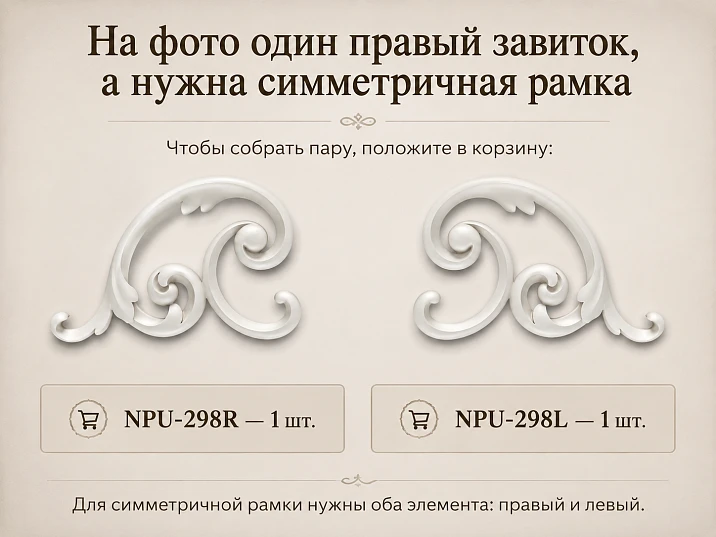
In the product photo, you can see one elegant curl directed to the right. It fits in size, the ornament looks good on a cabinet door, mirror frame, or wall panel, and the buyer adds four identical NPU-298R to the cart. The error is discovered during layout: the parts can be rotated, but full mirror symmetry cannot be achieved. The curls do not meet each other but repeat the same direction, as if the entire composition is twisted to one side.
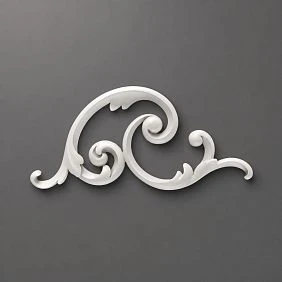
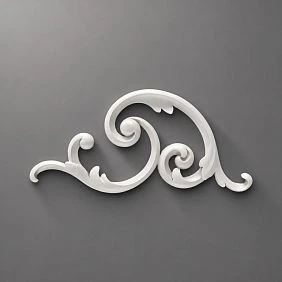
The reason is not a defect or incorrect installation. NPU-298R and NPU-298L are two separate product items with different pattern orientations. The letter R denotes the right version, the letter L denotes the left. The size and material of the parts are the same: each polyurethane overlay has dimensions of 171 × 80 × 10 mm. The difference lies precisely in the direction of the ornament.
For one accent corner, one part of the selected orientation is sufficient. For two symmetrical top corners, one right and one left overlay are usually required. For a classic rectangular composition on four corners, two NPU-298R and two NPU-298L are pre-calculated. If two identical doors are decorated with four corners each, the cart increases to four right and four left parts.
The word "preliminarily" is fundamental here. The 2R + 2L scheme follows from the mirror geometry of the ornament, but it is not an automatically assembled factory set. The NPU-298R and NPU-298L cards are separate, so the buyer chooses the quantity of each item themselves. Before payment and especially before gluing, the layout must be checked at full scale: print the outlines, cut out templates from paper or cardboard, unfold them at the required angles, and look at the pattern from a distance.
When the direction is already clear, you can buy the right overlay NPU-298R and immediately add to it the left pair in the quantity required for a specific door, facade, mirror, or wall frame. This approach avoids two extremes: ordering four identical curls and buying an extra full set where only one decorative corner is needed.
Short answer: how many right and left overlays to order
If there is no time for a long analysis, rely on the basic table. After that, still check the direction of the pattern with paper templates.
| Task | Preliminary order composition | What to check before payment |
|---|---|---|
| One accent corner | 1 NPU-298R or 1 NPU-298L | Which direction should the curl unfold |
| Two upper symmetrical corners | 1 NPU-298R + 1 NPU-298L | Do the elements form a counter mirror pair |
| Two lower symmetrical corners | 1 NPU-298R + 1 NPU-298L | Is the pattern not flipped relative to the top part |
| Two diagonal corners | Possible 2R or 2L after rotation | Is the desired ornament logic preserved |
| All four corners of the frame | Usually 2 NPU-298R + 2 NPU-298L | Direction of each curl after rotation |
| One door, decor only on top | 1R + 1L | Width of the facade and distance between overlays |
| Two identical doors, decor on top | 2R + 2L | Symmetry of each door and the overall axis of the cabinet |
| Two doors, four corners on each | 4R + 4L | Full layout of eight parts |
| Three identical facades, four corners each | 6R + 6L | Repeatability of the pattern on all facades |
| Frame around the mirror | Usually 2R + 2L | Mirror size, molding width, and free field |
| Wall panel with four corners | Usually 2R + 2L | Binding to furniture, outlets, switches, and baseboard |
The main rule can be written in one line:
The number of right overlays must match the number of right positions in the approved layout, and the number of left ones must match the number of mirror-opposite positions.
Do not count the product only by the number of corners. Four corners do not always mean four identical parts. First distribute the orientations, then transfer the quantity to the cart.




What do the letters R and L mean in NPU-298 article numbers
The R and L designations are not for color, size, batch, or mounting method. They describe the direction of the asymmetric ornament.
-
R — Right, right orientation.
-
L — Left, left orientation.
NPU-298R and NPU-298L have the same dimensions of 171 × 80 × 10 mm and are made of the same material — polyurethane. If you place the parts side by side with the front side up, it becomes visible that one mirrors the other.
It is this mirroring that allows creating compositions in which the curls are directed towards each other, diverge from the central axis, or equally support the four corners of a rectangular frame. If you replace the left overlay with the right one, the physical dimensions remain the same, but the pattern changes.
Our factory also produces:
Why orientation matters more than it seems in a photo
On a separate card, the buyer sees one part without its surroundings. The ornament is perceived as an independent beautiful curl. In a pair, the direction becomes obvious: two identical right elements may look not like symmetrical corners, but like a repetition of the same movement.
The error is especially noticeable on:
-
two upper corners of one door;
-
paired cabinet fronts;
-
mirror frame;
-
wall panel with a central axis;
-
composition above a console or dresser;
-
on the door leaf, where the handle and panels emphasize symmetry.
The stricter the geometry of the base, the faster the eye notices an irregular "hand" of the curl.
Get Consultation
Why product cards are separated
The right and left versions are sold separately because buyer needs differ. One person needs a single right corner. Another needs two mirrored pairs. A third needs six right and six left elements for a series of facades.
Combining them into a mandatory set would deprive the buyer of flexibility. Separate cards allow ordering the exact quantity but require careful specification.
After selecting the right orientation, you need to separately buy the mirrored left overlay NPU-298L. One item in the cart is not added automatically along with another.
Specifications of NPU-298R and NPU-298L without guesswork
| Parameter | NPU-298R | NPU-298L | Practical Meaning |
|---|---|---|---|
| Product type | Decorative overlay | Decorative overlay | Both parts belong to applied stucco decor |
| Material | Polyurethane | Polyurethane | Overlays can be included in a single composition |
| Size | 171 × 80 × 10 mm | 171 × 80 × 10 mm | Dimensions match |
| Orientation | Right | Left | The pattern differs mirror-wise |
| Pair purpose | Right part of the composition | Left part of the composition | For symmetry, both versions are usually needed |
| Product card | Separate | Separate | The quantity of each item is specified by the buyer |
| Rotation possibility | Can be checked by rotating the template | Can be checked by rotating the template | Rotation changes position but not the mirror "hand" |
| Application | Furniture, doors, frames, walls | Furniture, doors, frames, walls | The result depends on the layout and the base |
| Molding | Not included automatically | Not included automatically | The frame profile is calculated separately |
| Glue | Should not be considered included without confirmation | Should not be considered included without confirmation | The installation compound is added as a separate item |
| Paint and primer | Selected separately | Selected separately | The finish depends on the project |
| Finished frame | Not included | Not included | The customer receives individual corner pieces, not an assembled panel. |
The table shows the main difference: the products have the same material and size, but not the direction of the pattern. Therefore, the question "how many pieces to order" cannot be separated from the question "what orientation is needed in each corner."
One NPU-298R is one decorative element, not a finished frame.
Photos in the interior help to imagine the result, but do not determine the composition of a single product item. If the image shows four corners, moldings, a painted door, and a finished wall panel, this does not mean that all parts are included in the price of one NPU-298R.
When purchasing one right corner piece, you are choosing one decorative part measuring 171 × 80 × 10 mm. The following are not automatically included in the order:
-
left NPU-298L;
-
three more corner elements;
-
moldings between corners;
-
finished furniture door;
-
mirror;
-
wall base;
-
mounting adhesive;
-
primer;
-
paint;
-
markup and installation services.
This division is convenient when the buyer knows exactly the task. You can design one corner, assemble only the top pair, create an asymmetric accent, or repeat one motif on several different items.
The problem arises when an interior image is mistaken for a photo of a set. Before paying, ask yourself a simple question: how many individual product cards are involved in the composition? For a symmetrical frame, the answer is almost always more than one.
Can NPU-298R be rotated instead of buying NPU-298L
Physically, the right overlay can be rotated 180 degrees. From the upper right corner, it can move, for example, to the lower left. Therefore, two identical right parts are sometimes suitable for diagonally opposite corners.
But rotation and mirror reflection are different operations.
Imagine an arrow pointing to the right. If you rotate the sheet 180 degrees, the arrow will point to the left, but at the same time it will be upside down. Mirror reflection preserves top and bottom, changing only the right and left sides.
The same happens with the ornament. Rotating NPU-298R changes its position but does not turn the part into a full NPU-298L. The leaves, curves, and direction of the curl retain the original "hand."
When two identical R's can actually fit
The scenario is possible for a diagonal composition where one part is in the upper right corner and the second is in the lower left. After rotation, the elements can support diagonal movement.
But the result depends on the specific design. Before ordering two identical right-hand parts, print the outline twice and check it on the surface.
When NPU-298L is indispensable
The left-hand version is needed if:
-
a mirrored pair in the two upper corners;
-
a mirrored pair in the two lower corners;
-
symmetry about the vertical axis;
-
opposite direction of the curls;
-
a classic frame, equally readable from left and right;
-
repeating one pattern on multiple facades.
If the goal is described by the word "symmetrical," it is safer to work with an R/L pair right away rather than trying to get a mirror by simple rotation.
When one right or one left overlay is enough
Not every composition needs to be paired. A single NPU-298R or NPU-298L looks appropriate if asymmetry is planned in advance.
One corner of a furniture facade
The decor can be placed in the upper corner of the door and balanced with a handle, molding, or adjacent facade. Such a composition requires especially precise positioning: a single curl becomes the main accent.
Corner of a wall panel
On the wall, a single overlay can complete a molding line near a doorway, niche, or console. Here, the direction is chosen according to the movement of the entire composition.
Asymmetric mirror
A mirror frame does not have to have four identically styled corners. A single overlay can work as a decorative signature at the top.
Repetition on different items
Several identical right overlays can be placed on one corner of separate doors if the entire group is built on rhythmic repetition rather than mirror symmetry of each door.
Useful for such projects buy asymmetric polyurethane overlays after comparing the direction, sizes, and character of the ornament. The category helps to see which elements exist in the left and right versions, and which are designed for standalone use.
Set for two top corners: one R and one L
The clearest paired layout is two top corners of a door, mirror, or wall frame. Here, the curls either guide the eye toward the center or diverge from the central axis. In both cases, a mirrored pair is required.
Basic basket:
-
1 NPU-298R;
-
1 NPU-298L;
-
molding, if the frame continues with straight sections;
-
suitable mounting adhesive;
-
materials for preparation and final painting.
The amount of molding is calculated by the length of future straight sections. Overlays are counted individually. These two calculation methods cannot be mixed.
How to check a pair on the facade
-
Cut out two rectangles 171 × 80 mm.
-
Mark the right ornament on one and the left ornament on the other.
-
Attach the templates to the top corners.
-
Draw the intended molding line between them.
-
Check that enough free margin remains.
-
Look at the composition from a distance of two to three meters.
-
Photograph the layout straight on and at an angle.
The photo helps to see a skew that is not always noticeable up close.
How much space will remain between the two overlays
If the long side of 171 mm is oriented horizontally, the two overall rectangles occupy:
171 + 171 = 342 mm.
The free distance between them can be preliminarily estimated as follows:
Base width − 342 mm = free field between the overall dimensions of the overlays.
| Facade or frame width | Calculation | Free field |
|---|---|---|
| 350 мм | 350 − 342 | 8 мм |
| 400 мм | 400 − 342 | 58 мм |
| 450 мм | 450 − 342 | 108 мм |
| 500 мм | 500 − 342 | 158 мм |
| 600 мм | 600 − 342 | 258 мм |
| 700 мм | 700 − 342 | 358 мм |
| 800 мм | 800 − 342 | 458 мм |
On a base width of 350 mm, the pair will be almost closed in overall dimensions. At a width of 500–600 mm, a noticeable calm zone appears between the elements.
But the calculation is conditional: the ornament itself does not fill the entire 171 × 80 mm rectangle. The table helps estimate the scale, but does not replace fitting.
Four corners of one frame: why usually 2R + 2L is needed
For a rectangular frame with four decorative corners, the preliminary symmetrical scheme looks like this:
-
top-left corner — one orientation;
-
top-right — mirrored;
-
bottom-left — orientation after agreed rotation;
-
bottom-right — mirrored to it.
As a result, usually required:
2 NPU-298R + 2 NPU-298L.
This does not mean that the right piece must always be on the right. The name fixes the orientation of the ornament in the initial position, and the actual place is determined after rotating the templates.
To avoid confusion, do not label corners with words “R on the right, L on the left.” Better to number the positions:
-
corner 1 — top-left;
-
corner 2 — top-right;
-
corner 3 — bottom-right;
-
corner 4 — bottom left.
Then place a paper copy in each position and write down the article number. Such a list is more accurate than the household rule.
Configuration table for one rectangular frame
| Position | Preliminary article number | Quantity | Check |
|---|---|---|---|
| Top left corner | NPU-298L or R depending on the chosen direction | 1 | Where the curl opens |
| Top right corner | Mirror version | 1 | Symmetry relative to the center |
| Bottom right corner | Rotation of one of two orientations | 1 | Connection to the top corner |
| Bottom left corner | Mirror version | 1 | Overall frame closure |
| TOTAL | Usually 2R + 2L | 4 | Check with templates |
When the scheme is confirmed, you can order NPU-298R for the right corner of the frame and separately specify the required number of left elements. Do not leave the orientation only in verbal agreement: transfer R and L to the specification.
Two identical doors: the quantity doubles, but the layout does not change
If four corners are planned on each door, the calculation for two facades looks like this:
One door: 2R + 2L.
Two doors: 4R + 4L.
For three identical facades:
6R + 6L.
For four:
8R + 8L.
General formula:
Number of R = number of facades × 2.
Number of L = number of facades × 2.
The formula works only for a scheme with four corners on each facade. If the decor is placed only on top, one door requires 1R + 1L.
Why you first need to decide whether the cabinet is one composition
Paired doors can be styled in two ways.
Each door is an independent frame.
Each facade repeats four corners. With two doors, 4R + 4L are required.
Two doors — one common field.
Decor can only be placed along the outer perimeter of the cabinet. Then there are no inner corners at the door joint, or they are styled differently. The quantity decreases.
Therefore, counting only by the number of doors is not enough. First, draw the overall composition in the closed position.
Handles and central gap
On two doors, the handles and the joint line create a strong vertical axis. Corner overlays should support it, not conflict with it. If the curls are directed randomly, the error becomes more noticeable precisely near paired handles.
Frame for a mirror: decorative corners should not eat into the reflection
A mirror has two boundaries: the outer edge of the base and the edge of the reflective surface. NPU-298R and NPU-298L can be placed on the wall around the mirror, on a separate frame, or on a wide backing. In each case, the available space differs.
Before ordering, take four measurements:
-
the width of the mirror;
-
mirror height;
-
width of the substrate or frame;
-
distance from the edge of the reflection to the outer boundary.
The overlay occupies a footprint of 171 × 80 mm and protrudes by 10 mm. If the part partially covers the mirror, you need to decide in advance whether this is visually and technologically acceptable.
Frame without molding
Four overlays can exist as separate corner accents. A free surface remains between them. This option looks lighter and requires less linear profile.
Frame with molding
The molding connects the corners into a closed contour. Before ordering, you need to check:
-
profile width;
-
height of the relief;
-
point of contact with the overlay;
-
length of the four sides;
-
corner joints;
-
overall color;
-
base thickness;
-
distance to the reflective part.
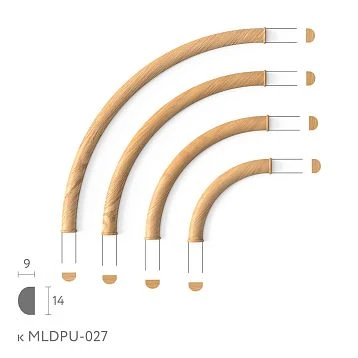
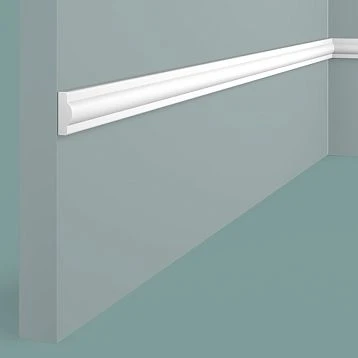
For a thin line, you can consider polyurethane molding MLDPU-001, and for a more pronounced contour — polyurethane molding MLDPU-002. These are options for trying on, not a promise of automatic matching with NPU-298. The profile and overlays need to be compared against an actual sample or drawing.
Calculation of molding around the mirror
If a rectangular frame has an outer width W and height H, the preliminary perimeter is:
P = 2 × W + 2 × H.
Corner zones are either subtracted or not subtracted from the result, depending on how the molding connects to the overlays. Without a drawing, it cannot be universally stated that the profile ends exactly at the 171 mm dimension. The ornament has a complex contour, so the length is determined after layout.
Furniture front: the part size should be compared not only with the door width
The query "decorative corners for furniture" seems simple, but a furniture front has handles, panels, routing, hinges, and technical gaps. NPU-298R may fit in overall width and simultaneously conflict with the inner frame.
Before purchasing, note:
-
outer contour of the front;
-
inner panel;
-
handle position;
-
holes for hardware;
-
gap between adjacent doors;
-
opening radius;
-
edge of the countertop or cabinet body;
-
decorative moldings;
-
zones of possible hand contact.
Facade width 350–400 mm
The two upper elements occupy 342 mm in dimensions. On a door 350 mm wide, the free gap is only 8 mm. The ornament may appear almost continuous.
Such a solution can be expressive, but requires a full-size fitting. If the curls extend into the central part, they may approach the handle or visually overload a narrow facade.
Facade width 450–500 mm
The free field in dimensions is 108–158 mm. Space appears for a handle, a central motif, or a calm surface.
Facade width 600 mm and more
A wide zone remains between the corners. The overlays are perceived as separate accents. Molding helps tie them into a frame, but its width should be chosen in proportion to the facade.
A customer who needs other shapes and sizes can choose and buy polyurethane overlays, comparing corner, vertical, round, rectangular, and asymmetrical models. This is more useful than trying to stretch an unsuitable NPU-298 over a too-large facade.
Door leaf: first check the opening, then draw the frame
On an interior door, the decor is visible in full height. A small symmetry error is more noticeable than on a cabinet. Additionally, the door moves: the overlays must not interfere with the frame, casing, handle, or adjacent wall.
Before ordering, check:
-
width and height of the leaf;
-
location of panels;
-
the opening direction;
-
gap to the frame;
-
position of the handle and lock;
-
distance from the overlay to the edge;
-
whether the decor falls into the constant touch zone;
-
Can the door be opened fully;
-
Does the composition look the same from both sides of the room.
One pair at the top
The calmest option is 1R + 1L in the upper part. It emphasizes the vertical of the door and does not overload the lower zone.
Four corners
The 2R + 2L scheme creates a full frame. It works well on a wide panel with a fairly free central field.
Two doors next to each other
For a double-door structure, you need to decide whether each leaf is designed separately or both leaves are perceived as one composition. The second scheme may require fewer corner pieces.
Wall frame: the size of NPU-298 is evaluated relative to the entire wall
On a wall, 171 mm are perceived differently than on a furniture door. A small overlay can get lost in a tall panel, and four elements can end up too close to the furniture.
Make markings with painter's tape:
-
mark the outer contour of the frame;
-
attach paper NPU-298 at the corners;
-
mark the molding;
-
place the furniture in the planned location;
-
check the outlets, switches, and light fixtures;
-
evaluate the composition in daylight and evening lighting.
Above the console
The frame should be related to the width of the countertop. If the decor is significantly narrower than the furniture, the composition looks random. If too wide, it competes with neighboring objects.
Behind the dresser
You can repeat the width of the body or make the panel slightly narrower. The corners should remain visible and not go behind table lamps, vases, or mirrors.
In the hallway
Check the passage. The 10 mm protruding relief should not fall into the area of constant contact with bags or outerwear.
At the head of the bed
Symmetry is especially noticeable relative to the center of the bed. The R/L pair helps direct the ornament toward the central axis.
For a more complex wall system, you can buy decor for a molding frame and match NPU-298 with elements designed specifically for connection with certain profiles.
MLDPU-001 or MLDPU-002: how to choose a molding between overlays
NPU-298R and NPU-298L can be used without a linear profile, but the buyer often wants a complete rectangular frame. Then a molding appears between the corners.
The choice cannot be made only by price or photo. Compare:
-
line width;
-
profile height;
-
overlay thickness 10 mm;
-
facade or wall size;
-
distance between curls;
-
depth of adjacent panels;
-
interior style;
-
future painting.
| Scenario | What to consider | Why |
|---|---|---|
| Small furniture door | MLDPU-001 | A more delicate line does not conflict with a narrow facade |
| Medium cabinet front | MLDPU-001 or MLDPU-002 | The choice depends on the scale and the panel |
| Large mirror | MLDPU-002 | A more pronounced contour can connect large corners |
| High wall panel | MLDPU-002 or another profile | A thin line may get lost |
| Frame without straight sections | Molding not needed | Corners work as standalone accents |
| Complex designer composition | Selection by sample | Need to check joints and relief |
It cannot be promised in advance that the edge of NPU-298 will perfectly match a specific molding without adjustment. These items are given as relevant options for developing the frame. The final result is confirmed by the layout.
Polyurethane or wooden version: NPU-298 and N-298 cannot be mixed randomly
The NPU-298R and NPU-298L have wooden analogues with a similar shape and the same principle of right and left orientation: N-298R and N-298L. However, the letter N without PU refers to a different product group and a different material.
The customer can buy wooden analogue N-298R и wooden analogue N-298L, if the project requires decor made of solid wood. But you cannot order three polyurethane parts and one wooden part just because the pattern is similar.
What differs
-
material;
-
mass;
-
surface character;
-
preparation for finishing;
-
behavior during processing;
-
method of matching with the base;
-
price;
-
article number;
-
product card.
When to choose polyurethane
NPU-298 is suitable when the entire frame is assembled from polyurethane decor and moldings, and the parts are planned to be painted in a single system.
When to consider wood
N-298R/N-298L are appropriate if the furniture or frame is made of wood and it is necessary to preserve material integrity or use a finish that highlights the wood.
Why you cannot rely only on the number 298
The number indicates a related pattern but does not cancel the letter part of the article. In the specification, you need to write it in full:
-
NPU-298R;
-
NPU-298L;
-
N-298R;
-
N-298L.
Abbreviating to "298, four pieces" does not allow understanding either the material or the orientation.
How to calculate the quantity for a series of facades
For repeated doors, it is convenient to use formulas.
Four corners on each facade
Let K be the number of identical facades.
Number of NPU-298R = 2 × K.
Number of NPU-298L = 2 × K.
Examples:
| Number of facades | NPU-298R | NPU-298L | Total overlays |
|---|---|---|---|
| 1 | 2 | 2 | 4 |
| 2 | 4 | 4 | 8 |
| 3 | 6 | 6 | 12 |
| 4 | 8 | 8 | 16 |
| 5 | 10 | 10 | 20 |
| 6 | 12 | 12 | 24 |
| 10 | 20 | 20 | 40 |
Only the two top corners
Number of NPU-298R = K.
Number of NPU-298L = K.
| Number of facades | NPU-298R | NPU-298L | Total |
|---|---|---|---|
| 1 | 1 | 1 | 2 |
| 2 | 2 | 2 | 4 |
| 3 | 3 | 3 | 6 |
| 4 | 4 | 4 | 8 |
| 6 | 6 | 6 | 12 |
| 10 | 10 | 10 | 20 |
One accent corner on each facade
If all elements have one orientation:
Number of selected version = K.
The second orientation is not needed if it is absent in the approved layout.
Is a reserve needed
The mandatory reserve percentage for NPU-298 is not set. For a single frame, you can order the exact quantity. For a master series or production, a reserve is sometimes added for trial painting, layout adjustment, or accidental damage. Such a reserve is specified as a separate line, not hidden in the main quantity.
A paper template shows more than a screen
A size of 171 × 80 mm is easy to imagine incorrectly. On a monitor, the product may appear larger or smaller depending on the image scale. A paper mock-up brings back real proportions.
Simplest template
Draw a rectangle 171 × 80 mm. Transfer the approximate direction of the curl inside. Make two versions: R and L.
For four corners, you will need four copies. Label them with a pencil so that after rotation you do not lose the original orientation.
More accurate mock-up
Use an image or drawing at 1:1 scale. Check the size after printing with a ruler. The printer may automatically shrink the page, so disable the "fit to page" option.
What to evaluate
-
ornament direction;
-
free space between corners;
-
distance to the edge;
-
the position of the handles;
-
intersection with the molding;
-
height of the relief relative to adjacent parts;
-
visibility from a distance;
-
symmetry relative to the center;
-
scale relative to the entire piece of furniture.
Why a photo of templates is useful
The eye quickly gets used to a small error. In a photo, misalignment, different corner heights, or wrong direction become more noticeable. Shoot strictly from the front.
What to put in the cart along with NPU-298R and NPU-298L
A finished composition requires not only corners. The set depends on the scenario, but basic positions can be summarized in a table.
| What to add | Why | When required | What to Check |
|---|---|---|---|
| NPU-298R | Right orientation of the curl | By the number of right positions | Size and direction |
| NPU-298L | Left mirror orientation | By the number of left positions | Match with R |
| MLDPU-001 | Thin frame line | For small facades and delicate composition | Joint with overlays |
| MLDPU-002 | More pronounced line | For large frames | Scale and height of relief |
| KUDO High Tack adhesive | Installation of decor | If it matches the base and instructions | Surface compatibility |
| Installation materials | Preparation, installation, and finishing | According to project technology | Full scope of work |
| Primer and paint | Unified finish | If painting is required | Material compatibility |
| Paper templates | Preliminary layout | Always before the series | Scale 1:1 |
| Design project | Complex wall or furniture composition | With a large number of elements | Dimensions and specification |
| Delivery | Receiving the entire batch | For remote ordering | Quantity and packaging |
For installation, you can buy adhesive for polyurethane decor. The choice of a specific composition still needs to be checked against the base material, surface condition, and the adhesive manufacturer's instructions.
Other related items are collected in the section where you can Buy materials for installation and finishing. Do not add primer, paint, or sealant accidentally: the finishing system must be compatible.
Base preparation: a flat surface is more important than the amount of adhesive
Even correctly calculated 2R + 2L will not give a neat frame if the surface is loose, dirty, or has a pronounced difference in level.
Before installation, check:
-
base strength;
-
absence of peeling paint;
-
absence of dust;
-
dryness of the surface;
-
flatness of the bonding area;
-
absence of grease and wax;
-
compatibility of the old coating with the adhesive;
-
Possibility of subsequent painting.
Furniture facade
Do not glue decor onto unstable
Orientation
R and L differ in the direction of the pattern, not in the possibility of installation only on the right or left.
Quantity
One card corresponds to one part, not to an automatically assembled mirror pair.
Purpose
This is a decorative overlay. It does not replace a structural corner, furniture fastener, or protective profile.
If other sizes and shapes are required, you can buy polyurethane corner overlays after comparing dimensions, ornament, and the availability of a mirror version.
Mistakes due to which a symmetrical frame does not assemble
Error 1. Buying four NPU-298R based on a photo
After laying out, the curls repeat one orientation.
How to fix: for a quadrilateral symmetrical frame, pre-count 2R + 2L.
Error 2. Mistaking rotation for mirror reflection
An unfolded right part does not become left in pattern.
How to fix: compare paper R and L side by side.
Error 3. Writing "NPU-298, four pieces" in the order
The suffix is not specified.
How to fix: separate lines NPU-298R and NPU-298L.
Error 4. Taking a photo of the frame as a set
One overlay without moldings and a pair goes into the cart.
How to fix: break the composition into separate cards.
Error 5. Order 1R + 1L for four corners
Two parts are not enough.
How to fix: count each corner position.
Error 6. Order 2R + 2L without a template
The quantity fits, but the direction in a specific composition may differ.
How to fix: label four positions.
Error 7. Not accounting for the 171 mm size
On a narrow facade, two overlays almost touch.
How to fix: subtract 342 mm from the base width.
Error 8. Use rectangle calculation as an exact outline
The ornament does not fill the entire overall dimension.
How to fix: complete the selection with a real fitting.
Error 9. Place corners at different heights
The composition seems skewed.
How to fix: common horizontal line and control points.
Error 10. Start gluing with one piece
The remaining corners have to be adjusted.
How to fix: dry layout of the entire system.
Error 11. Not checking the furniture handle
The curl is too close to the hardware.
How to fix: apply the handle to the facade template.
Error 12. Not checking the door opening
The decor touches the cabinet or wall.
How to fix: open the door with the temporarily attached template.
Error 13. Mixing NPU-298R and wooden N-298L
The material and surface differ.
How to fix: check all four positions by full article number.
Error 14. Buy molding only by width
The relief and joint do not match the overlay.
How to fix: check the profile on the sample.
Error 15. Not calculating the length of the molding
There are corners, but straight sections are missing.
How to fix: create a separate list of linear parts.
Error 16. Gluing onto peeling paint
The decor comes off together with the coating.
How to fix: prepare a solid base.
Error 17. Use random glue
The composition does not match the surface.
How to fix: check the instructions and compatibility.
Error 18. Apply too much composition
Glue comes out on the front part of the relief.
How to fix: follow the technology of the selected product.
Error 19. Paint R and L with different batches without control
The mirror pair differs in shade.
How to fix: finish the set with one system.
Error 20. Do not label parts after painting
Right and left versions are mixed.
How to fix: mark the back side before installation.
Error 21. Design two doors as separate frames, although a common outline is needed.
The quantity turns out to be overestimated.
How to fix: first draw the closed cabinet as a whole.
Error 22. Make a common outline when each door should be read separately.
Inner edges remain empty.
How to fix: align the logic of the facade group.
Error 23. Not taking into account the 10 mm thickness.
The relief interferes with the adjacent element or looks too protruding.
How to fix: make a side diagram.
Error 24. Consider the reserve as a mandatory percentage.
Extra details appear.
How to fix: add the reserve deliberately and as a separate line.
Error 25. Order a series without one control facade.
The error repeats on all doors.
How to fix: first approve one full-size layout.
Practical baskets for different projects.
One furniture door, two upper corners.
- 1 NPU-298R;
- 1 NPU-298L;
- molding as desired;
- installation kit;
- finishing materials.
One furniture door, four corners
- 2 NPU-298R;
- 2 NPU-298L;
- molding around the perimeter;
- Glue;
- materials for joints and painting.
Two identical doors, top pair on each
- 2 NPU-298R;
- 2 NPU-298L;
- molding on two frames or four top sections;
- installation and finishing materials.
Two doors, four corners on each
- 4 NPU-298R;
- 4 NPU-298L;
- molding as calculated;
- Glue;
- finishing materials;
- additional reserve — only by production decision.
Frame for a mirror
- 2 NPU-298R;
- 2 NPU-298L;
- selected molding;
- Glue;
- primer and paint;
- substrate or frame, if provided by the project.
Wall panel
- 2R + 2L per rectangular section;
- molding around the perimeter;
- mounting materials;
- paint;
- for complex layouts — project with dimensions.
One asymmetric corner
- 1 NPU-298R or 1 NPU-298L;
- Glue;
- finishing materials.
Who is the NPU-298R/NPU-298L pair suitable for
These overlays should be considered if:
- a mirror-symmetrical corner composition is needed;
- size 171 × 80 mm selected;
- 10 mm relief fits the installation location;
- the base has free corners;
- the decor is planned to be painted together with the frame;
- it is required to decorate furniture, a door, a mirror, or a wall panel;
- the buyer is ready to perform a preliminary layout;
- the quantity of R and L can be precisely fixed;
- the molding is selected separately;
- the base allows adhesive mounting using the chosen technology.
When it's better to choose a different decor
NPU-298 may not be suitable if:
- The facade is too narrow for two elements of 171 mm each;
- A fully symmetrical ornament is needed without R/L separation;
- A very small corner accent is required;
- The base does not allow a protruding relief of 10 mm;
- The door touches the frame;
- The furniture facade has dense milling;
- Natural wood needs to be preserved;
- The project requires wooden N-298R/N-298L;
- The buyer does not want a molding or corner composition;
- The surface is not suitable for reliable installation;
- a constructive, not decorative, corner is required.
In the catalog you can buy polyurethane molding for furniture and walls and choose a different type of decor if NPU-298 does not match the scale or task.
How to place an order for STAVROS without an orientation error
Step 1. Determine the number of corners to be framed
Do not start with the product. Start with the layout: one, two, or four corners on each base.
Step 2. Place R and L on the template
Label each position with the full article number.
Step 3. Multiply the layout by the number of facades
One frame is 2R + 2L. Two such frames are 4R + 4L.
Step 4. Check the size
Make sure that 171 × 80 × 10 mm fit without conflicting with handles, panels, and edges.
Step 5. Choose the molding
Consider MLDPU-001, MLDPU-002, or another profile, but confirm the joint.
Step 6. Add mounting materials
Choose adhesive, primer, and paint based on the substrate and finishing system.
Step 7. Check the cards separately
The right and left overlays are on different pages. The quantity of each is set separately.
Step 8. Verify the price
The current price should be viewed in the card of the selected orientation. You can find out the current price of NPU-298R, then separately check NPU-298L.
Step 9. Calculate delivery
For the series, the total number of parts and associated moldings is taken into account. Conditions can be checked on the page where ordering delivery of polyurethane overlays is offered.
Step 10. For a complex composition, prepare a project
When there are several frames, involving different moldings, mirrors, and furniture, it is reasonable to order a layout design for stucco decor with an accurate R/L list.
Cart checklist
Before payment, check:
-
full article number NPU-298R is specified;
-
full article number NPU-298L is specified;
-
the number of right parts matches the layout;
-
the number of left parts matches the layout;
-
size 171 × 80 mm verified with a template;
-
thickness of 10 mm is taken into account;
-
handles do not intersect with the decor;
-
the door opens freely;
-
molding selected separately;
-
molding length calculated;
-
the adhesive is suitable for the base;
-
painting materials are approved;
-
polyurethane and wooden versions are not mixed;
-
the reserve is listed as a separate line;
-
delivery is calculated for the entire order;
-
the scheme is saved until installation.
Frequently asked questions about NPU-298R and NPU-298L
What does R mean in the article number NPU-298R?
R means the right orientation of the pattern. This is not an indication of a mandatory place only in the right corner, but a designation of the direction of the pattern in its original position.
What does L mean in NPU-298L?
L means left mirror orientation. In size and material, the part matches NPU-298R.
Are the sizes of NPU-298R and NPU-298L the same?
Yes. Both pads have dimensions of 171 × 80 × 10 mm.
What material are the pads made of?
made of polyurethane.
Is the left pad included in the NPU-298R set?
No. It is a separate product card and a separate cart item.
How many parts are needed for the two top corners?
Usually one NPU-298R and one NPU-298L after checking the direction with templates.
How many pads are needed for four corners?
Preliminarily two NPU-298R and two NPU-298L.
Can I buy four identical NPU-298R?
Yes, if the project is truly based on repeating one orientation. For a classic mirror frame, four R usually do not provide correct symmetry.
Can I rotate NPU-298R to get NPU-298L?
No. Rotation changes the position of the part, but does not replace the mirror reflection of the pattern.
Will two identical R work for diagonal corners?
Possible after rotation and template check. The decision depends on the direction of the ornament.
How many R and L are needed for two identical doors?
If each has four corners, 4R + 4L are required. If the decor is only in the two top corners of each door — 2R + 2L.
Do I need to buy molding?
Not necessarily. Overlays can be used as separate corner accents. For a closed frame, molding is calculated separately.
Which molding to choose?
You can consider MLDPU-001 or MLDPU-002. The final choice depends on the scale of the base, relief, and joining method.
Is adhesive included in the kit?
Adhesive cannot be automatically included. The mounting compound is added as a separate item.
Can NPU-298 be installed on a painted door?
The possibility depends on the strength of the old coating and adhesive compatibility. A peeling surface needs to be prepared.
Will the overlay fit a furniture facade 350 mm wide?
Two elements occupy 342 mm in dimensions, so the free space will be about 8 mm. A full-size trial fitting is mandatory.
What will be the result on a facade 500 mm wide?
Between the dimensions of two horizontally placed overlays, about 158 mm will remain. The actual ornament occupies less than the rectangle, so the result is checked with a template.
Can the decor be glued onto a mirror?
The installation method depends on the surface and the adhesive. More often, overlays are placed on the frame, substrate, or wall around the mirror. The specific joint needs to be agreed upon.
How is NPU-298 different from N-298?
NPU-298 is made of polyurethane. N-298 is a wooden analogue. Materials cannot be mixed without a deliberate design.
Do right and left parts need to be painted at the same time?
For a uniform shade, it is better to finish the set with one system and in one cycle, or keep an exact specification of the coating.
Can I paint first and then glue?
Yes, but the finished layer needs to be protected from damage and adhesive. Joints may require local touch-ups.
Is a reserve needed?
No mandatory percentage is set. For a series, the reserve is determined by the craftsman or production.
How not to confuse R and L after painting?
Before finishing, label the back of each part and keep a position diagram.
Where can I see other corner overlays?
In the polyurethane corner trim section, you can compare other sizes and shapes.
Can I use only one NPU-298L?
Yes. For asymmetric decor or a single accent corner, a paired piece is not required.
How do I calculate the frame for three facades?
If each facade has four corners, you will need 6R + 6L. If only the top two, then 3R + 3L.
What should I do if the trims seem too large?
Do not reduce the product randomly, but choose a different smaller size item from the catalog.
How can I check symmetry before purchasing?
Print R and L at 1:1 scale, lay out all corners, and photograph the composition from the front.
Can I order NPU-298R and NPU-298L in one purchase?
Yes, both cards can be added to one cart by specifying the quantity of each orientation.
The exact cart starts not with the number four, but with the R/L scheme.
A symmetrical frame is not assembled from four randomly identical curls. NPU-298R and NPU-298L have the same material and the same size 171 × 80 × 10 mm, but differ in the direction of the ornament. Therefore, the buyer needs to count not only the corners, but also the orientations.
For one accent corner, one selected version is enough. For two symmetrical top corners, the base pair is 1R + 1L. For a four-sided rectangular composition, the preliminary set is 2R + 2L. For two identical frames, it is 4R + 4L. These numbers are transferred to the cart only after a full-size layout.
Do not try to replace a mirror part by rotating it if the project requires strict symmetry. Do not take a photo of a finished door or mirror as the contents of one card. Do not mix polyurethane NPU-298 with wooden N-298 without a conscious reason. Calculate molding, glue, and finishing as separate items.
When the scheme is confirmed, you can order a set of NPU-298R and NPU-298L, adding the exact number of right and left parts to the cart. STAVROS allows you to assemble not a conditional "four corners", but a clear specification in which each overlay takes its place. It is this precision that turns individual curls into a calm, integral, and truly symmetrical frame.