








































































Article Contents:
- R-032 or RPU-032: short answer before ordering
- What is a decorative rosette in furniture and interior
- Center of furniture facade
- Corner of molding frame
- Intersection of two profiles
- Paired door decor
- Repeating wall rhythm
- Nominal size describes the overall dimension
- Ornament scaling may vary
- The back side determines the contact area
- Edges affect the joint with the molding
- Orientation of the acanthus pattern
- How to check interchangeability
- Oak for tinting
- Beech for covering enamel
- Sanding "Standard"
- Prestige sanding
- Size 250 mm
- Natural differences of the batch
- Size 40 × 40 × 7 mm
- Sizes 50–100 mm
- Sizes 120–200 mm
- Monochrome wall composition
- Repetition on many frames
- Application on furniture and doors
- 40 × 40 × 7 mm
- 50–70 mm
- 80–100 mm
- 120–140 mm
- 170–200 mm
- 250 × 250 × 39 mm
- How to make a template
- Oak front for tinting
- Beech or MDF front for enamel
- One socket centered on the door
- Two rosettes on paired leaves
- Four rosettes at the corners of the facade
- Repetition on drawers
- Kitchen front
- Wooden door
- Painted MDF door
- Rosette above the handle
- Rosettes inside the panel
- Double-leaf door
- Door series
- RPU-032 in wall color
- R-032 as a wooden accent
- Four corners of one frame
- Intersection of vertical and horizontal
- Multiple frames on one wall
- One socket
- Two sockets
- Four sockets
- Series on multiple panels
- Combination of different sizes
- Central and corner rosettes
- Example: three wall frames
- Example: chest of drawers with six drawers
- Example: double-door wardrobe
- Example: door with four corners
- Example: mixed wall
- Reserve for wood
- Reserve for polyurethane
- Oak for tinting
- Beech for enamel
- Oak under dense enamel
- Beech under transparent tinting
- One species on all furniture
- How to choose sanding
- One color with the wall
- Contrast color
- Painting before installation
- Painting after installation
- Test swatch
- Different materials in one color
- Flat platform
- Glue and coating
- Temporary fixation
- Additional fasteners
- Wood species matching
- Fiber direction
- Glue on unfinished wood
- Install after finishing
- Paired doors
- Painted plaster
- Drywall
- MDF or wooden boiserie
- Brick and concrete
- Marking multiple frames
- Dismantling
- Build the outer and inner contour
- Check the diagonals
- Assemble one corner on the floor
- Determine the pattern orientation
- Transfer the template
- Dry layout
- All in wall color
- Wood inside a white frame
- Wooden frame and wooden rosette
- Painted wooden R-032 in polyurethane frame
- Mixing R-032 and RPU-032
- Living Room
- Bedroom
- Entry Hall
- Office
- Kitchen and dining room
- Commercial interior
- R-032 and sample set OR-032
- RPU-032 and ceiling rosette
- R-032 and regular overlay
- RPU-032 and corner molding element
- Same size and different article number
- Need one socket on the oak chest
- Need to design three white wall frames
- Need size 250 mm
- Need to replace wooden R-032 with RPU-032
- Need to paint the decor together with the MDF facade
- Need to preserve the natural accent in the white frame
- Need many identical elements for a commercial interior
- Consider models as exact copies
- Buy only by width
- Not considering the base material
- Choose oak for opaque enamel without comparing to beech
- Tint beech prepared for enamel
- Place the socket too close to the handle
- Don't count every decorative point
- Order without reserve
- Mount on a curved or peeling surface
- Paint with a thick layer
- How is R-032 different from RPU-032?
- What material is R-032 made of?
- What size does RPU-032 have?
- What is the full size of R-032?
- Does the pattern of the two models match?
- Can R-032 be replaced with RPU-032?
- Which option to choose for furniture?
- What is better for the wall?
- Which model fits the door leaf?
- Can R-032 be tinted?
- Is beech suitable under enamel?
- Can RPU-032 be painted in the wall color?
- What Adhesive to Use?
- Can an outlet be installed on a painted surface?
- How many elements are needed for one frame?
- Is an installation reserve needed?
- How to position the outlet relative to the handle?
- Where to download DWG?
- Can RPU-032 be used on MDF?
- Can R-032 be mounted on a wall?
- What to choose for crossing moldings?
- Can wood and polyurethane be mixed?
- What to choose for a series of dozens of frames?
- Where to buy R-032?
- Where to order RPU-032?
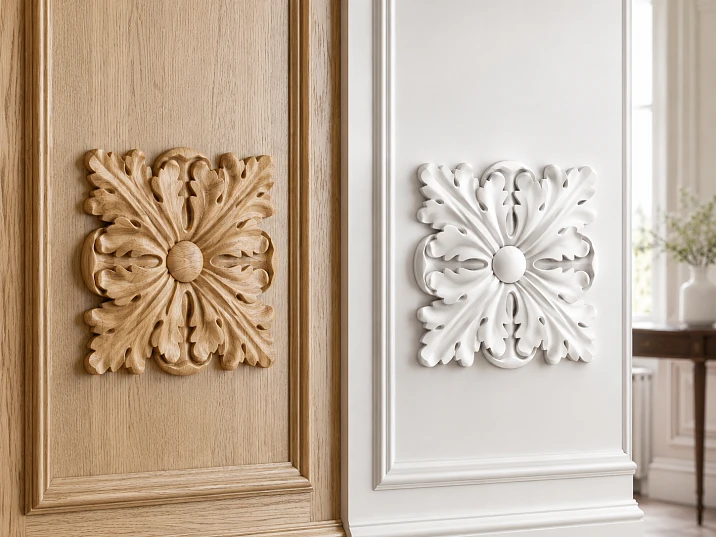
One article number, similar size range, and two fundamentally different materials — for furniture, door, and wall frame
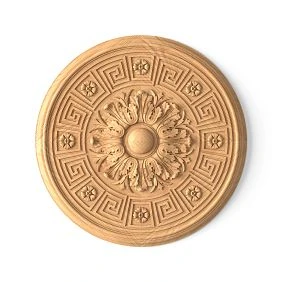
R-032 or RPU-032: short answer before ordering
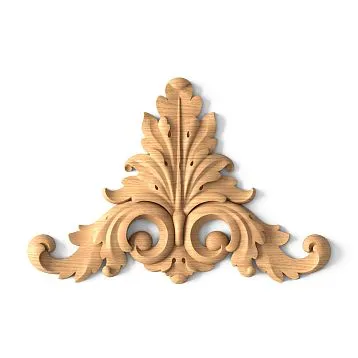
The wooden rosette R-032 is worth buying when the decor should become part of furniture, a door, a wooden frame, or a panel, and it is important to preserve the natural texture of oak or prepare beech for covering enamel. The model is available in sizes from 40 × 40 × 7 to 250 × 250 × 39 mm, in beech and oak, with "Standard" or "Prestige" sanding. Polyurethane RPU-032 is a reasonable choice for repeating wall frames, painted stucco compositions, door or furniture decor, where a lightweight, uniform material is convenient. Its range overlaps with the wooden R-032 in eleven sizes from 40 × 40 × 7 to 200 × 200 × 31 mm; additionally, the RPU-032 has a confirmed variant of 150 × 150 × 25 mm. But the same number and same dimensions do not yet prove a complete match of the ornament, edge, and back side: before interchangeability, compare DWG and physical samples.
Buy wooden rosette R-032 Buy polyurethane rosette RPU-032 View catalog of oak and beech rosettes View sizes and designs of polyurethane rosettes Order layout of sockets and moldings
Common sizes for both models: 40 × 40 × 7; 50 × 50 × 8; 60 × 60 × 10; 70 × 70 × 11; 80 × 80 × 13; 90 × 90 × 15; 100 × 100 × 17; 120 × 120 × 21; 140 × 140 × 24; 170 × 170 × 28; 200 × 200 × 31 mm.
Differences in size ranges: RPU-032 additionally has 150 × 150 × 25 mm, while R-032 has 250 × 250 × 39 mm.
R-032: beech under enamel or oak under tinting; sanding "Standard" or "Prestige".
RPU-032: polyurethane; the specific primer, paint, and glue are selected according to the material card and base.
Key limitation: models cannot be called exact copies without comparing drawings, relief, and reverse side.
A decorative rosette can be purchased for one furniture door, four corners of a wall panel, intersection of moldings, a door leaf, or a whole series of identical frames. At first glance, the choice between R-032 and RPU-032 seems like a choice between wood and polyurethane. In practice, the material is supplemented by size, relief depth, type of finish, base, number of elements, and installation method.
Current cards show an important detail: R-032 and RPU-032 have eleven matching sizes from 40 to 200 mm. This makes them a convenient article pair for comparison at the same scale. At the same time, RPU-032 is additionally available in size 150 × 150 × 25 mm, while the wooden model is available in size 250 × 250 × 39 mm. However, equal values of A × B × C do not guarantee that two parts have an identical pattern, the same edge contour, and one shape of the back plane.
For furniture, natural wood and coordination with the facade, molding, and handle are often more important. For a wall, repeatability, low weight, and the ability to paint several elements together with moldings are important. For a door, the choice depends on the material of the leaf, the existing frame, and whether the rosette should preserve the texture or blend into the overall enamel.
You can start the comparison with the main cards: choose R-032 from oak or beech и stucco rosette size 40 mm or another size from its range. For a complex composition, it is useful to download both DWG files and overlay the contours on each other.




What is a decorative rosette in furniture and interior
A decorative rosette is a small relief element that sets an accent point, completes a frame, covers the intersection of moldings, or supports the symmetry of a facade. It is not an electrical outlet or a mandatory structural detail. Its task is to assemble the composition and make the transition between profiles meaningful.
Our factory also produces:
Center of furniture facade
One rosette can be placed above a handle, between panels, or in the center of a door. On wooden furniture, R-032 can be perceived as part of carved architecture. On painted MDF, both models can be combined with the facade using common enamel after checking the preparation.
Get Consultation
Molding frame corner
Four identical elements create accent points and help avoid complex corner connections of decorative profiles. But the rosette should not simply cover an inaccurate cut: the size and pattern are chosen in advance, and the moldings approach it symmetrically.
Intersection of two profiles
In boiserie or wall paneling, a rosette can cover the place where vertical and horizontal moldings meet. For a polyurethane frame, RPU-032 is convenient in advance; for a wooden furniture grid, R-032. The actual thickness is compared with the profiles so that the center does not protrude as an accidental step.
Paired door decor
Two or four rosettes support the symmetry of a double door, tall panel, or portal. The material is chosen based on the door leaf and future finish. On an oak door, oak R-032 looks more natural; on a fully painted composition, both options are possible.
Repeating wall rhythm
Dozens of identical points on several frames require precise marking, a single batch, and a reserve. Polyurethane is convenient for a monochrome wall, wood for contrasting natural accents. Mixing materials is possible, but it must be part of the project.
Confirmed characteristics of R-032 and RPU-032
| Parameter | Wooden R-032 | Polyurethane RPU-032 | What this means for the buyer |
|---|---|---|---|
| Type | Carved decorative rosette | Molded decorative rosette | The same task is solved with different materials and finishing technologies. |
| Material | Beech or oak | Polyurethane | The wood retains its natural texture; polyurethane is rational for painted stucco composition. |
| Dimensions 40–100 mm | 40 × 40 × 7; 50 × 50 × 8; 60 × 60 × 10; 70 × 70 × 11; 80 × 80 × 13; 90 × 90 × 15; 100 × 100 × 17 mm | 40 × 40 × 7; 50 × 50 × 8; 60 × 60 × 10; 70 × 70 × 11; 80 × 80 × 13; 90 × 90 × 15; 100 × 100 × 17 mm | You can compare two materials at the same nominal scale. |
| Dimensions 120–200 mm | 120 × 120 × 21; 140 × 140 × 24; 170 × 170 × 28; 200 × 200 × 31 mm | 120 × 120 × 21; 140 × 140 × 24; 150 × 150 × 25; 170 × 170 × 28; 200 × 200 × 31 mm | Four sizes are common; 150 mm confirmed only for RPU-032. |
| Size 250 mm | 250 × 250 × 39 mm | Not specified | For maximum size, the selection shifts to a wooden model. |
| Preparation | Beech under enamel; oak under tinting | Priming and painting technology is clarified | The finish is chosen together with the material, not after installation. |
| Sanding | "Standard" or "Prestige" | Not applicable as a wooden option | For wood, you can select the degree of manual surface preparation. |
| Drawing | Acanthus ornament | Compare by card and DWG | It is impossible to promise a complete visual match based solely on number 032. |
| Reverse side | Check against DWG | Check against DWG | The bonding area and interchangeability depend on it. |
| External use | Not confirmed | Do not promise without documentation | The article discusses interior use. |
A wide overlap of size ranges makes comparison significantly more accurate than initially assumed from the original chart. The buyer can choose R-032 or RPU-032 in sizes 40, 50, 60, 70, 80, 90, 100, 120, 140, 170, or 200 mm; size 150 mm is available for RPU-032, and 250 mm for R-032. The material and finish remain an independent decision. For the wooden version of the 250 mm polyurethane size, there is no entry in the card.
Why the same number does not guarantee the same part
The article numbers R-032 and RPU-032 appear as wooden and polyurethane versions of the same ornament. Eleven common sizes reinforce this impression. But for actual replacement, not only external dimensions matter. Two elements 100 × 100 × 17 mm may have different heights of individual leaves, a different edge, unequal back surface area, and a different position of the pattern center.
Nominal size describes the overall dimension
The values A × B × C show width, height, and maximum depth. They do not explain how the relief is distributed within the square. One pattern may extend almost to the corners, another may leave a wider flat edge. Therefore, the same size does not guarantee the same installation footprint.
Ornament scaling may differ
In both lines, dimensions increase with thickness, but it cannot be stated without verification that each acanthus leaf is scaled identically. For a series of different sizes, this is especially important: a 40mm rosette on a drawer and a 100mm one on a door should look related, not coincidentally similar.
The back side determines the contact area
A wooden part may have one base shape, a polyurethane one another. If RPU-032 replaces R-032 on an already marked panel, the adhesive must work on the actual plane, not the overall square. Voids and protrusions are only visible on the drawing or sample.
Edges affect the joint with the molding
In a corner or cross composition, the profile approaches the rosette closely. The width of the flat area at the edge determines how neatly the molding ends. Even a slight curve will force a change in the cut line.
Orientation of the acanthus pattern
The ornament may have a distinct top, bottom, or diagonal direction. For four corners of a frame, it must be decided whether the elements rotate relative to the center or are all installed identically. The article number does not answer this question.
How to check interchangeability
Download two DWGs of the same size, overlay the front contours, compare the maximum depth, edges, and back plane. For a responsible project, two physical samples are useful. Only then can one talk about replacing wood with polyurethane without new marking.
Wooden R-032: when natural material matters more than repeatability
R-032 creates not just a relief, but a natural wooden point. On an oak facade, it can continue the texture; on a beech element under enamel, it becomes part of a unified painted architecture. Wood is especially convincing where the socket is viewed up close and perceived as furniture carving.
Oak for tinting
Oak R-032 retains a pronounced porous texture. Tinting emphasizes the relief and connects the socket with a door, facade, molding, or panel made of the same species. In deep areas, the color may become darker, so a sample is made on a carved piece, not just on a flat board.
Beech under covering enamel
Beech has a calmer pattern and is suitable for opaque finishes. In the card, it is listed as prepared for enamel. A white, colored, or dark composition can unite R-032 with an MDF facade, wooden molding, and furniture body.
Sanding "Standard"
Machine preparation is suitable for a project where the workshop plans its own finishing or covering coating. Before painting, check recesses, leaf edges, and ends. The complex relief cannot be aggressively sanded: the pattern must maintain clarity.
Prestige sanding
Hand preparation reduces the amount of finishing and is useful for tinted oak, closely placed furniture, and complex finish. It does not cancel incoming inspection and dry layout of the batch.
Size 250 mm
The maximum R-032 250 × 250 × 39 mm is suitable for large furniture, a wide panel, or an independent central accent. This is no longer a small point at the intersection of thin moldings. The template must confirm that the decor does not overwhelm the facade and leaves a free field.
Natural differences of the batch
Two oak rosettes may slightly differ in grain pattern and tone. For paired doors and a series of facades, items are laid out before finishing and distributed symmetrically. Under enamel, the differences are smaller; under transparent tinting, they are more noticeable.
For a furniture and door composition, you can Buy wooden rosette R-032, choosing the exact size, beech or oak, and the sanding level.
Polyurethane RPU-032: when series and overall color matter
RPU-032 offers a range from 40 to 200 mm, including an additional size of 150 × 150 × 25 mm, and is made of polyurethane. This makes the model especially logical for wall moldings, a series of frames, and a project where all elements must receive one covering color.
Size 40 × 40 × 7 mm
The most compact option is suitable for narrow moldings, a small furniture facade, and frequent repetition. Its depth of 7 mm creates relief without strong protrusion. Before ordering, you need to check the pattern on a physical sample: on a small scale, individual details are perceived differently.
Sizes 50–100 mm
This is a universal middle group for door panels, wall frames, and furniture facades. The choice depends on the width of the profile. The rosette should be more noticeable than the molding, but not overlap it compositionally.
Sizes 120–200 mm
Large polyurethane versions suit central panels, ceiling or wall accents, large doors, and furniture of corresponding scale. They are not simply "enlarged corner points": the depth increases to 31 mm.
Monochrome wall composition
RPU-032 can be included in a frame of polyurethane profiles and painted together with the wall after checking the primer and paint. The relief is read through light and shadow, not contrasting material. This approach suits living rooms, hallways, bedrooms, and commercial interiors.
Repetition on many frames
For three, five, or ten panels, it is important to get identical elements and a common pattern. Polyurethane is convenient for serial wall marking. But the quantity, reserve, and finish shade are still calculated before ordering.
Application on furniture and doors
The current card describes use on doors, furniture, ceilings, and walls. When installing on a movable facade, check the glue, flatness, and stability of the finish. Wall technology cannot be transferred to a door without considering vibration and contact.
For a paintable composition, you can Buy polyurethane rosette RPU-032 in sizes from 40 to 200 mm.
Comparative table: wood or polyurethane
| Task | Preliminary R-032 | Preliminary RPU-032 | What determines the final choice |
|---|---|---|---|
| Natural oak furniture | Preferable | Possible under a covering color | Is it necessary to preserve the wood texture. |
| MDF for enamel | Beech under enamel | Possible after soil inspection | Glue, preparation and expected tactility. |
| Polyurethane frame on the wall | Contrasting wooden accent | Uniform composition material | Monochrome or contrasting project. |
| Dozens of identical elements | Possible, but texture needs to be distributed | More convenient beforehand | Quantity, batch, installation, and finishing. |
| Size 250 mm | Confirmed | Not specified | For this scale, choose R-032 or another polyurethane article. |
| Tinting while preserving texture | Oak for tinting | Does not create a natural wood texture | Desired surface material. |
| Painting in wall color | Beech is possible, but requires wood preparation | Logical scenario | Compatibility of primer and substrate. |
| Close tactile contact | Natural wood | Painted polyurethane | What surface the user wants to feel. |
| Replacing one model with another | Only after comparison | Only after comparison | DWG, edge, pattern, and back plane. |
How to choose the size of a rosette for a facade and frame
The size range from 40 to 200 mm provides a rare opportunity to use one article motif in different scales. A small rosette suits the intersection of thin moldings, a medium one suits a furniture facade and door, and a large one suits an independent panel. An error occurs when the size is chosen only from the card and not checked on the actual surface.
40 × 40 × 7 mm
The most compact option is appropriate on a small drawer, narrow door molding, and in frequent repetition. On a facade 250–350 mm wide, it remains a neat dot. On a large door, the 40 mm size may get lost if there is no thin frame nearby to explain its scale.
50–70 mm
This group suits standard furniture doors, intersections of medium-width moldings, and small wall panels. The rosette is already noticeable but does not become the main focal point. For a chest of drawers and a nightstand, sizes 50, 60, and 70 mm are convenient to compare using paper squares.
80–100 mm
The medium-large format works well on a tall cabinet facade, door, central panel of a sideboard, and wall frame. The depth increases from 13 to 17 mm, so you need to check the protrusion relative to the handle, casing, and adjacent profile.
120–140 mm
Such a rosette becomes an independent decorative element. It suits large furniture, the central field of a door, and a wall composition with wide moldings. On a small nightstand, the size may look heavy and reduce the free space around the handle.
170–200 mm
Large options require a noticeable base area. They are used as the center of a panel, decor for a large portal, wide door, or ceiling composition. A relief depth of 28–31 mm cannot be considered a flat overlay: the lateral projection and shadow become an important part of the design.
250 × 250 × 39 mm
This size is confirmed only for wooden R-032. It suits a large central accent and requires a separate layout. On a wall or furniture, a 250 mm square is comparable to a small panel, so surrounding profiles and empty spaces must be large.
How to make a template
Cut a square of the required size from cardboard and mark a conditional pattern inside. To check thickness, add a side strip of several layers of cardboard. Apply the template to the facade along with the handle and moldings. This is faster and more reliable than choosing by photo scale.
Choice for furniture facade
The furniture facade is the most natural area for wooden R-032, but the polyurethane model can also be used with confirmed preparation and fastening. The decision depends on the facade material, finish, and number of identical elements.
Oak facade for tinting
Oak R-032 allows preserving the natural material in a decorative unit. The rosette and facade are tinted using the same system after a test color sample. The fibers do not have to match perfectly, but the shade and gloss level should complement each other.
Beech or MDF facade for enamel
Beech under enamel helps assemble a wooden composition without emphasizing texture. RPU-032 can also be painted in a common color after checking compatible primer. The choice between them is determined by the desire to preserve the wooden base, batch size, production technology, and tactile perception.
One rosette in the center of the door
The center is determined by the actual plane of the facade, not by the external dimension with the frame. If a handle is located below, sufficient space for gripping is left between the two elements. The rosette should not become an obstacle for fingers.
Two rosettes on paired doors
They are positioned mirror-symmetrically relative to the central gap. Size and height must match. For oak, two parts are distributed by tone; for polyurethane, they are painted in one cycle.
Four rosettes at the corners of the facade
This technique suits a large panel or furniture frame. The distance from each corner to the molding and handle must be checked. Four 100 mm elements create a significantly richer composition than one central rosette.
Repetition on drawers
On each drawer, one small R-032 or RPU-032 can be placed. But the relief should not interfere with gripping and cleaning. If the handle is nearby, it is better to first install paper templates of both elements.
Kitchen facade
For areas of regular contact, coating and maintenance are important. The durability of wood or polyurethane near a sink and steam cannot be automatically guaranteed. The rosette is placed away from direct splashes, and the finishing technology is clarified before ordering.
For furniture, you can choose a wooden profile for furniture or a door and match it in size with R-032. If a polyurethane mesh is needed, it is useful to select moldings for a wall frame.
Choice for a door
The door leaf moves, experiences vibrations and regular contact. Here, the material of the rosette must be coordinated not only with the style but also with the base. R-032 matches the logic of a wooden door, RPU-032 matches a painted stucco composition, but both require checking the mounting assembly.
Wooden door
R-032 made of oak or beech is easier to incorporate into a carved solid wood frame. Oak can be tinted together with the leaf, beech can be painted. It is better to coordinate the wood species with the molding and casing so that the texture does not look random.
Painted MDF door
Both models can become part of an enameled surface after proper preparation. Beech requires wood primer, polyurethane requires a compatible compound for stucco. One finish color does not mean the same priming process.
Rosette above the handle
The position is checked by hand. When turning and gripping, fingers should not touch the relief. For sizes 120 mm and larger, the distance is especially important.
Sockets inside the panel
The base must be flat. If the element partially falls on a drop, it will not get full support. It is better to change the size or position than to fill the void with a thick adhesive layer.
Double door
The pattern on two doors must be symmetrical. First, lay out all elements, mark the sides, and only then fix them. If the ornament has a direction, the rotation is coordinated according to the overall composition.
Door series
For several identical panels, create one template. Do not find the center with a tape measure from scratch each time: small deviations will be noticeable in a corridor or enfilade.
Selection for wall frame and boiserie
On the wall, the socket works in conjunction with moldings. It can be in a corner, in the center, at an intersection, or complete a vertical profile. The material determines whether the element will blend with painted stucco or stand out with natural wood.
RPU-032 in wall color
A polyurethane socket together with moldings creates a monochrome relief. This option is suitable for white, gray, beige, or colored walls. Details are read by shadow, so the quality of marking and joints is more important than contrast.
R-032 as a wooden accent
A wooden socket inside a painted frame can support a console, door, furniture, or flooring. Contrast works best when repeated at multiple points. A single random wooden detail on a white wall may look unfinished.
Four corners of one frame
Sockets are placed along the same axes. Moldings meet them at right angles or according to another approved pattern. First, assemble one corner on the floor to check the profile and edge of the socket.
Intersection of vertical and horizontal
The center of the element must align with both axes. If the moldings are of different widths, the socket may appear offset even with mathematically precise installation. A full-size mockup helps find the visual center.
Multiple frames on one wall
Sockets must be repeated with the same orientation and offsets. The polyurethane series is convenient for overall painting, the wooden one for the rhythm of natural accents. In both cases, a single batch and reserve are needed.
For a wooden composition, you can choose wooden decor for the molding frameFor a stucco system — Buy Polyurethane Molded Decoration.
One central element or a repeating series
The number of rosettes changes perception more than the material. One R-032 on a door works as an independent furniture accent. Twelve RPU-032 on three wall frames create rhythm and become part of the room's architecture. Before ordering, you need to decide not only "wood or polyurethane" but also the role of each element in the composition.
One socket
A single center suits a chest of drawers, a cabinet, a buffet door, a mirror frame, or a small panel. Here, the texture and quality of the relief are especially noticeable. The wooden R-032 reveals itself tactilely, the polyurethane one through painting and chiaroscuro.
Two rosettes
A paired scenario is needed for a double door, two cabinet fronts, or symmetrical wall sections. The height, orientation, and distance to the central axis must match. For oak, two parts are compared by grain pattern before tinting.
Four rosettes
Four corner points form a complete frame. The size is chosen relative to the width of the molding and the overall field. If the rosette is too large, the corners become heavy; if too small, it gets lost and looks like a mounting plug.
Series on multiple panels
Repetition requires one layout map. The central axes of all frames, the height of the corners, and the distances between elements must be coordinated. The polyurethane RPU-032 is convenient for painting in one color, but the wooden R-032 can also be repeated in a series when ordering one batch.
Combination of different sizes
In one interior, you can use 40 mm on small drawers and 100 mm on doors if the motif truly looks unified. First, compare DWG and samples of different scales. You cannot assume that increasing the size automatically preserves the same visual impression.
Central and corner rosettes
A large element of 120–170 mm can become the center of a panel, and four 40–60 mm elements can complete the corners. This hierarchy helps to use one article motif without monotony. For wood and polyurethane, it is better to decide in advance whether the entire composition remains in one material.
How to calculate the number of sockets
The calculation starts with a list of decorative points. There is no need to multiply the wall area or the length of the molding. Each rosette occupies a specific place: the center of the facade, the corner of the frame, the intersection or the completion of the profile.
Quantity = number of decorative points in one composition × number of identical facades or frames + reserve.
Example: three wall frames
In each frame there are four corners, in each corner one RPU-032. Net requirement:
3 × 4 = 12 rosettes.
One or two spare parts can be added to the batch after assessing installation, deadlines, and the possibility of future reordering. A universal reserve percentage is not assigned without project conditions.
Example: a chest of drawers with six drawers
One rosette in the center of each facade — six R-032. If the two lower drawers receive two rosettes each, and the four upper ones receive one each, eight elements will be required.
Example: two-door wardrobe
One socket on each door — two. If each leaf has an upper and lower panel with a separate center, four are required. First, draw the facade, then count the points.
Example: door with four corners
One panel receives four elements. For five identical doors — twenty. With this quantity, a template, a single batch, and checking installation time are especially important.
Example: mixed wall
Two large central panels with one 140 mm socket each and four side frames with four 50 mm sockets each. Order: two large and sixteen small. Different sizes are recorded in separate specification lines.
Reserve for wood
Spare R-032 is useful not only in case of damage. It serves as a tinting sample and can replace a part that noticeably differs in grain. For oak, the reserve is especially valuable in transparent finishes.
Reserve for polyurethane
Spare RPU-032 helps restore a wall composition after repairs, furniture rearrangement, or local damage. It is stored together with the paint code and layout diagram.
Oak or beech for R-032
The choice of wood species is related to the finish. In the product card, oak is offered for tinting, beech for enamel. This is not just a color preference, but a technological fork.
Oak for tinting
Oak is suitable for a project where you need to show natural pores and grain. On the relief, the tone is distributed unevenly: recesses appear darker, protrusions lighter. It is this chiaroscuro that makes the carved wooden rosette expressive.
Beech for enamel
Beech is chosen when the texture should not be the main effect. Opaque finish allows you to combine R-032 with a painted door, MDF facade, and wooden molding. The surface is prepared thinly so as not to lose the boundaries of the acanthus.
Oak under dense enamel
This option is possible only with an agreed technology, but the advantage of the oak texture will be hidden. Before ordering, it is worth comparing beech. The exception is a project where all elements must be structurally or restoratively made from the same wood species.
Beech under transparent tinting
Preparation 'for enamel' does not guarantee perfect uniformity for a transparent finish. If the buyer wants to see the wood, the quality of the gluing must be clarified and a sample obtained.
One wood species on all furniture
Oak R-032 with oak molding and facade creates the most natural composition. Beech under enamel is easier to combine with MDF and a painted body. Mixing wood species under a transparent coating is noticeable.
How to choose sanding
"Standard" is suitable for a workshop that performs additional finishing. "Prestige" is useful for close inspection, tinting, and complex patina. For a series of paired elements, it is better to order all rosettes with the same preparation.
Details can be found in the section on wood species and surface preparation.
Painting polyurethane RPU-032
RPU-032 is often chosen for painting to match the color of a wall, door, or furniture. But the phrase "polyurethane for painting" does not mean that any paint can be applied directly to the product. A compatible primer, a clean surface, and a test coat are required.
Same color as the wall
The rosette and moldings become an architectural relief. Matte paint softens small transitions, while semi-gloss shows joints and preparation quality more clearly. The specific composition is chosen based on the substrate and room conditions.
Contrast color
Dark RPU-032 on a light wall becomes an independent accent. With this solution, edges and symmetry are especially noticeable. It is better to paint one sample and attach it to the finished frame.
Painting before installation
Convenient for contrasting decor and access to the relief. After installation, local finishing of the joint will be required. The same composition and gloss level must be maintained.
Painting after installation
Suitable for a monochrome wall. The rosette and moldings are primed and painted as a single system. It is important not to flood the recesses with a thick layer.
Test paintout
It shows adhesion, color, gloss, and how the relief reads under side lighting. For a large batch, a sample is more essential than for a single part: the error will repeat dozens of times.
Different materials in the same color
Beech and polyurethane can be painted with the same topcoat after different primers. The same color does not guarantee the same gloss without a full test. Samples are compared after drying.
Installation on MDF and painted furniture facade
MDF provides a flat surface, but the finish coating can become a weak link. If the socket is glued on top of a fragile enamel, it will peel off along with the paint layer. Before installation, check adhesion, glue compatibility, and handle placement.
Flat platform
The entire back side must have stable support. Cannot be installed
Glue and coating
The composition must be compatible with the socket material and the facade enamel. Different solutions may be required for wood and polyurethane. Do not use one glue for uniformity if its technical documentation does not confirm both surfaces.
Temporary fixation
While the glue gains strength, the element should not shift. Tape or support should not damage the paint and relief. The holding time depends on the specific composition.
Additional fastening
The need for mechanical fixation is determined by the size, weight, mobility of the facade and the design of the product. Do not drill a rosette without a drawing: the hole may end up in the thin part of the ornament.
Installation on solid wood
Wooden R-032 naturally pairs with solid wood, but wood remains a material that reacts to humidity and temperature. The base must be dry, level, and prepared. Polyurethane RPU-032 can also be considered for painted wooden surfaces after checking the adhesive and finish.
Wood species matching
An oak rosette on an oak facade is easier to tint within the overall system. Beech under enamel suits painted solid wood. If the species differ under a transparent coating, the transition will be noticeable even with a close color.
Grain direction
On a square R-032, the wood grain may have its own orientation. For pairs and series, elements are rotated so that the fibers appear consistent. The decision is made before applying the tint.
Glue on unfinished wood
Excess can clog pores and alter the absorption of the tint. Do not spread the compound over the face. If finishing is done after installation, the joint must remain clean.
Installation after finishing
Finished tinting requires careful work without scratches or stains. The glue must adhere to the protective coating, not just the wood. For a critical facade, test a small sample.
Paired leaves
First, lay out two R-032s side by side, compare the texture and relief, then mark the left and right sides. After tinting, swapping them is not recommended.
Installation on the wall
The wall can be concrete, plastered, painted, paneled, or drywall. There is no universal recipe. RPU-032 is more often included in a stucco composition, R-032 in a wooden panel or contrasting accent.
Painted plaster
Check if the surface chalks or the paint peels. The adhesive will not strengthen a weak layer. Prepare the installation area according to the composition's instructions.
Drywall
Small elements can be fixed on a strong prepared surface. For large sizes and mechanical fastening, find a profile or embedded part in advance. Do not consider a sheet as a sufficient base for any size without calculation.
MDF or wooden boiserie
On panels, it is easier to achieve a flat plane and a uniform finish. Wooden R-032 supports natural material, RPU-032 supports a painted frame. Check the installation location relative to panel seams.
Brick and concrete
First, create a flat mounting surface. The wall relief should not transfer to the decorative element. The preparation method depends on the room's finish.
Marking multiple frames
The laser builds horizontals and verticals. For each outlet, mark the center, not just the outer square. Use one template on all panels so that corner points are at the same height.
Dismantling
A glued element usually cannot be removed without risk to the wall or the rosette itself. If the composition is meant to be disassembled, the mounting unit should be designed in advance. Do not promise seamless dismantling.
How to mark the four corners of a molding frame
Construct the outer and inner contour
The rosette must be connected to the molding, not just glued into a geometric corner of the wall. Draw the full frame, indicate the profile width, and only then assign the centers of decorative points.
Check the diagonals
Equal diagonals confirm rectangularity. If the frame is skewed, four identical rosettes will make the error more noticeable. It is too late to correct the geometry after installing the corner elements.
Assemble one corner on the floor
Apply the moldings to R-032 or RPU-032 and check how they fit the edge. The profile may need to be finished earlier or require shaped trimming. The first test unit saves material on the wall.
Determine the orientation of the pattern
Two logics are possible: all rosettes face the same way, or each is turned toward the center of the frame. The choice depends on the acanthus and the overall project. For a series, it must be consistent.
Move the template
Make a transparent or cardboard square with marked axes and molding junction points. It allows you to repeat four corners and several frames without new measurements.
Dry layout
Before gluing, temporarily secure the elements and photograph the wall. Check the composition with furniture, lights, and doors. A small rosette may get lost, a large one may overload the corner.
Monochrome composition or contrast of wood and stucco
Everything in the wall color
Polyurethane moldings and RPU-032 form a single relief. This option is visually calm and suitable for repeating panels. The shadow shows the pattern without color fragmentation.
Wood inside a white frame
R-032 is preserved under tinting, while the surrounding moldings are painted. The rosette becomes a point accent and connects the wall with wooden furniture. It is advisable to repeat the wood in at least several elements of the room.
Wooden frame and wooden rosette
This is a solid furniture or door system. The species, shade, and gloss are coordinated. R-032 is perceived as a carved node, not an applied contrast.
Painted wooden R-032 in a polyurethane frame
Externally, the composition can become monochrome, but material preparation differs. Beech and polyurethane receive compatible separate primers, then a common finish. A test coat checks if the gloss matches.
Mixing R-032 and RPU-032
On one wall, such a solution is possible only with a clear hierarchy: for example, wooden central rosettes and polyurethane corner ones. Randomly replacing several parts with another material will be noticeable upon touch and in side light.
Application in Different Rooms
Living room
RPU-032 is suitable for a series of wall frames behind the sofa or around the mirror. R-032 can support a wooden console, library, or door. Large sizes 120–200 mm are used as a separate center, small ones as repetition.
Bedroom
Compact rosettes can decorate the wall behind the headboard, fronts of nightstands or cabinets. Monochrome polyurethane creates a calm relief, wood adds warm accents. The size is chosen so that the decor does not compete with textiles.
Hallway
Rosettes on the door, cabinet, and wall panel connect several surfaces. In the area of frequent touches, the coating and ease of maintenance are checked. The protruding relief is not placed in a narrow passage at the level of bags and clothing.
Cabinet
Oak R-032 supports the library, panels, and a classic desk. RPU-032 is suitable for a painted wall between cabinets. One size can be repeated on doors and furniture if the scale is confirmed.
Kitchen and dining room
On a sideboard and display case, a wooden rosette looks natural. On kitchen fronts, wet cleaning, steam, and proximity to handles are considered. Polyurethane decor is used only after confirming the coating and adhesive for the specific area.
Commercial interior
In a hotel, restaurant, salon, or showroom, the RPU-032 series can decorate dozens of frames. Wooden R-032 is suitable for the counter, doors, and furniture. Before a large order, a control unit is assembled and cleaning, lighting, and maintainability are checked.
What to buy together with R-032 and RPU-032
A socket rarely works alone. For furniture, it needs a profile, handle, and coordinated finish. For a wall — moldings, primer, glue, and precise marking. For a door — a frame, casing, and checking the space near the hardware. The set is assembled by material and purpose, not by the external similarity of individual parts.
| What to add to the purchase | Why | For which scenario | What to Check |
|---|---|---|---|
| Wooden decor for a molding frame | Assemble a furniture or door composition in one material | R-032 on facade, door, boiserie | Wood species, size, thickness, and overall pattern |
| Wooden profile for furniture or door | Form a frame around R-032 | Chest of drawers, wardrobe, sideboard, door leaf | The joint with the edge of the socket and the overall finish |
| Moldings for wall frame | Create a grid around RPU-032 | Wall, wainscoting, niche, door portal | Profile width, thickness, and angle of abutment |
| Polyurethane stucco rosettes | Compare other patterns and sizes | RPU-032 does not match the ornament or scale | Dimensions, depth, and purpose |
| wooden decorative rosettes | Choose a different motif from oak or beech | Furniture, door, wooden panel | Size range, wood species, and sanding |
| Mounting and finishing materials | Prepare glue, primer, and finish | Both models and any base | Compatibility with wood, polyurethane, and surface |
| Layout of sockets and moldings | Calculate quantity and axes | Series of frames, doors, or facades | Transfer the layout, dimensions, and selected material |
| Combination of wooden rosettes and polyurethane decor | Understand the overall logic of mixing materials | Contrasting wall or furniture composition | Do not generalize conclusions without checking R-032 and RPU-032 |
How not to confuse R-032 and RPU-032 with similar products
R-032 and sample set OR-032
OR-032 is a set of wooden rosette samples, not a single finished R-032. It helps compare shape, size, and depth before ordering a batch. With confirmed material status, you can choose a wooden rosette based on a physical sample.
RPU-032 and ceiling rosette
RPU-032 is a compact decorative element in sizes from 40 to 200 mm. A large ceiling rosette around a chandelier serves a different purpose and may have an opening, a different profile, and a significantly larger scale. You cannot choose RPU-032 based solely on the word "rosette."
R-032 and a regular overlay
The rosette has a centric or square composition and fits the intersection point. An elongated overlay works vertically or horizontally. They do not replace each other without changing the frame.
RPU-032 and corner molding element
The corner can be specially oriented to the profile turn, and the rosette can be an independent central motif. If you need to connect two moldings, compare the edge and the pattern, not just the overall size.
Same size and different article number
Two rosettes 80 × 80 mm may have different patterns and depths. In the project, record the article number, material, and size, rather than just writing "rosette 80 mm".
Practical choice for specific situations
Need one rosette on an oak chest of drawers
Choose R-032 from oak for tinting. Compare the shade on a sample, check the facade size, and leave distance to the handle. Polyurethane only makes sense with intentional opaque painting.
Need to design three white wall frames
RPU-032 is convenient beforehand. For four corners of each frame, 12 elements are needed plus an agreed reserve. Moldings and rosettes are painted with one system after testing.
Need size 250 mm
In the current lineup, this option is confirmed for R-032. Make a full-size template and check if it overloads the panel. For a polyurethane alternative, a different confirmed article number is needed.
Need to replace wooden R-032 with RPU-032
Select the same nominal size, then compare DWG, edge, relief, and back side. Only matching 100 × 100 × 17 mm does not guarantee a seamless replacement.
Need to paint the decor together with the MDF facade
You can consider beech R-032 for enamel or RPU-032. The solution depends on the glue, preparation, and desired tactility. Make two test swatches next to the facade.
Need to preserve the natural accent in the white frame
Use oak R-032 for tinting and painted moldings. Repeat the wood color in furniture or a door so the accent does not look random.
Need many identical elements for a commercial interior
RPU-032 is more convenient for overall painting and serial marking. Before ordering a large batch, assemble one control unit and check maintenance.
Errors when selecting and ordering
Consider models as exact copies
Matching numbers and sizes do not confirm identical patterns. Two DWG files or physical samples are needed for replacement.
Purchase only by width
Size 100 mm has a depth of 17 mm, 200 mm — 31 mm. The protrusion affects the shadow, handle, and adjacent molding.
Not considering the base material
Glue for polyurethane on the wall and installation of an oak part on the facade are different tasks. The composition is chosen based on both surfaces.
Choose oak for opaque enamel without comparing beech
The texture of oak will be hidden. Beech may be more rational and already prepared for enamel.
Tint beech prepared for enamel
A transparent finish may reveal differences in wood and glue joints. Suitable preparation must be confirmed before ordering.
Place the socket too close to the handle
The relief will interfere with grip and maintenance. The mockup is checked by hand when opening.
Do not count every decorative dot
For three frames with four corners, you need 12 elements, not three. The specification is compiled based on installation locations.
Order without reserve
Damage to one part can stop a symmetrical composition. Reserve is discussed separately for the batch and installation.
Mount on a curved or peeling surface
Glue will not fix the base. The rosette will wobble, and the paint layer may peel off with it.
Paint with a thick layer
The relief loses clarity. Several thin layers are better than one heavy application.
Who is R-032 suitable for
- oak furniture for tinting;
- to the letter decor under enamel;
- of the wooden door and frame;
- to the furniture facade where natural texture is important;
- to the central accent up to 250 mm in size;
- to a paired composition of the same wood species;
- to a project with a choice of 'Standard' or 'Prestige' sanding;
- to a contrasting wooden point inside a painted wall.
When R-032 is better not to choose
- a completely uniform polyurethane stucco system is needed;
- dozens of elements must be painted together with the wall using the same technology;
- natural texture is not needed;
- the mounting unit is designed only for a different reverse side;
- the project requires guaranteed full interchangeability with RPU-032 without verification.
Who is RPU-032 suitable for
- wall frame made of polyurethane moldings;
- monochrome composition matching the wall color;
- series of identical panels;
- doors or furniture after confirming glue and coating;
- project requiring a size from 40 to 200 mm;
- commercial interior with repeating decor;
- for a customer who does not require natural wood texture.
When it is better not to choose RPU-032
- size 250 × 250 × 39 mm is required;
- the socket must be tinted like natural oak;
- the buyer expects a tactile wooden surface;
- the card and DWG do not confirm compatibility with the existing R-032;
- the glue or paint is not compatible with the base.
What to Check Before Ordering
- article R-032 or RPU-032;
- exact size A × B × C;
- availability of size 250 mm only for R-032;
- pattern and orientation of the ornament;
- edge shape;
- reverse side;
- DWG match when replacing;
- beech or oak for R-032;
- 'Standard' or 'Prestige' sanding;
- preparation for enamel or tinting;
- primer and paint for RPU-032;
- base material;
- glue and temporary fixation;
- distance to handle and molding;
- number of decorative dots;
- orientation of paired elements;
- reserve;
- test paint sample;
- current terms and conditions of the order;
- packaging and preservation of the relief during delivery.
How to buy R-032 or RPU-032 on STAVROS
First, determine the material and place of application. For furniture and doors with natural wood, open the card and buy the wooden rosette R-032, selecting the size, beech or oak, and sanding. For a paintable wall frame, open the card and order the polyurethane RPU-032 in the required size.
If you plan to replace one model with another, download both drawings of the same size and compare the outlines. For a series of facades or frames, create a quantity table and add a reserve. Suitable materials can be selected for installation and finishing.
A complex layout is better ordered for sockets and moldings. Before payment, check the current configuration, preparation, and deadlines. Terms of receipt are collected on the page check payment and delivery terms.
FAQ: questions about R-032 and RPU-032
How is R-032 different from RPU-032?
The main difference is the material. R-032 is made of beech or oak, RPU-032 is made of polyurethane. The models have eleven matching sizes from 40 to 200 mm, but RPU-032 additionally has 150 mm, and the pattern and back side still need to be compared using DWG.
What material is R-032 made of?
Beech and oak confirmed. Beech is recommended for enamel, oak for tinting.
What size does RPU-032 have?
The model is available in sizes from 40 × 40 × 7 to 200 × 200 × 31 mm. The lineup includes 40, 50, 60, 70, 80, 90, 100, 120, 140, 150, 170, and 200 mm.
What is the full size of R-032?
The wooden model is available from 40 × 40 × 7 to 250 × 250 × 39 mm. Its lineup includes an additional confirmed size of 250 mm, which is not present in the current RPU-032 card.
Does the pattern of the two models match?
Same number and size range do not prove a complete match. It is necessary to compare the front pattern, edges, depth of individual elements, and DWG.
Can R-032 be replaced with RPU-032?
Only after checking one nominal size against drawings and samples. Overall dimensions may match, but the back plane and edge may differ.
Which option to choose for furniture?
For an oak or wooden facade, R-032 is more often chosen. For painted MDF, both models are possible after checking the primer, glue, and desired tactility.
What is better for a wall?
For a monochrome polyurethane frame, RPU-032 is more convenient beforehand. If a contrasting natural accent is needed, oak R-032 can be used.
Which model is suitable for a door leaf?
Both can be used after checking the base and installation. R-032 blends more naturally with a wooden door, RPU-032 with a painted stucco composition.
Can R-032 be tinted?
The oak version is offered for tinting. Before the main finish, a test coat is done on a carved sample.
Is beech suitable for enamel?
Yes. In the product card, beech is listed as prepared for covering enamel. Thick layers should not flood the relief.
Can RPU-032 be painted in the wall color?
Yes, after selecting compatible primer and paint. First, check adhesion and appearance on a sample.
Which glue should I use?
The adhesive is selected based on the material of the rosette and the base. Different compositions may be required for wood, polyurethane, MDF, plaster, and painted surfaces.
Can a rosette be installed on a painted surface?
Yes, if the paint is firmly adhered and compatible with the adhesive. Any peeling layer must be removed or prepared.
How many elements are needed for one frame?
If rosettes are placed at four corners, four are needed. If only a central point is used, one is needed. The quantity depends on the approved scheme.
Is an installation reserve needed?
For a series of frames, doors, or facades, a reserve is useful. It helps replace a damaged part and maintain consistent material and size.
How to position the rosette relative to the handle?
Leave space for a free grip. The paper template of the rosette and handle is checked on both closed and open facades.
Where to download DWG?
The link to the drawings is in the cards R-032 and RPU-032. For interchangeability, download files of the same size and overlay the contours.
Can RPU-032 be used on MDF?
Yes, after checking the glue and the finish coating. The entire back side must lie on a flat surface.
Can R-032 be installed on a wall?
Yes, if the base is prepared and a suitable mounting assembly is selected. A wooden rosette is especially appropriate in boiserie or as a contrasting accent.
What to choose for crossing moldings?
For a polyurethane frame, use RPU-032 first; for a wooden one, use R-032. In both cases, check the edge and thickness relative to the profile.
Can wood and polyurethane be mixed?
Yes, if the combination has a clear logic. For example, a wooden central rosette and painted polyurethane moldings. Randomly replacing several parts with a different material looks untidy.
What to choose for a series of dozens of frames?
RPU-032 is convenient for a uniformly painted system. R-032 is also possible if the project requires natural wood accents and one batch is ordered.
Where to buy R-032?
In the card, you can Buy wooden rosette R-032 in beech or oak.
Where to order RPU-032?
In the card, you can Buy polyurethane rosette RPU-032 in the selected size.
Conclusion: the same scale does not negate the difference in materials
R-032 and RPU-032 are convenient to compare because they have eleven identical nominal sizes from 40 × 40 × 7 to 200 × 200 × 31 mm. RPU-032 additionally offers 150 × 150 × 25 mm, and the wooden version offers 250 × 250 × 39 mm. This allows you to choose the material without necessarily changing the nominal scale, but does not make the models automatically interchangeable.
R-032 is suitable for furniture, doors, and wooden frames where oak for tinting, beech for enamel, and natural tactility are important. RPU-032 is logical for paintable wall moldings, repeating frames, and a project where polyurethane is needed. Before ordering, you need to check the DWG, edge, back side, ornament, glue, and finish.
STAVROS allows you to choose both versions in several sizes, select moldings and materials, and then compile a precise specification. This approach helps not to buy a decorative rosette by a single article number, but to choose an element that truly suits the facade, door, or wall composition in terms of material, scale, and installation.