Article Contents:
- Why the TV Zone Needs Well-Designed Wall Decor
- The TV Visually Destroys the Wall
- The TV Zone Is the Second Visual Focal Point of the Living Room
- Decor Creates an Architectural Block
- Decor Should Respect the Screen, Not Compete with It
- What to Choose for the Wall Under the TV: Moldings, Frames, or a Ready-Made Set
- Moldings for a Simple Frame
- Ready-Made Set of Decorative Molding
- Decorative Panels for a Large Wall
- Polyurethane TV zone decor options
- Molding frame around the TV
- Vertical decorative elements on the sides of the TV zone
- Ready-made stucco decor kit for the TV wall
- Horizontal molding belt
- Which style to choose for the TV zone
- Neoclassicism
- Neoclassic Light
- Jatoba
- Versailles Light
- TV zone decor principles that must not be broken
- Rule 1: Decor does not overlap the screen area
- Rule 2: The central ornamental accent is not at the height of the screen center
- Rule 3: Outlets and cables — in the scheme before installation
- Rule 4: Decor is coordinated with the cabinet and console
- Rule 5: One style — one interior
- How to calculate TV zone decor based on wall size
- Step 1: Record TV dimensions and installation height
- Step 2: Measure wall width and define the working area
- Step 3: Determine decor format and width
- Step 4: Determine decor height and vertical position
- Step 5: Draw the layout on paper
- Step 6: Calculate the number of sets and additional elements
- Mistakes when decorating a TV wall
- Mistake 1: Decor too close to screen edges
- Error 2: TV diagonal not taken into account
- Error 3: Saturated decor distracts attention from the screen
- Error 4: No space left for sockets and cables
- Error 5: Small decorative elements on a large wall
- Error 6: Buying without a layout diagram
- Error 7: Decor is not connected to the furniture
- Where to buy polyurethane TV zone decor
- FAQ: Answers to Popular Questions
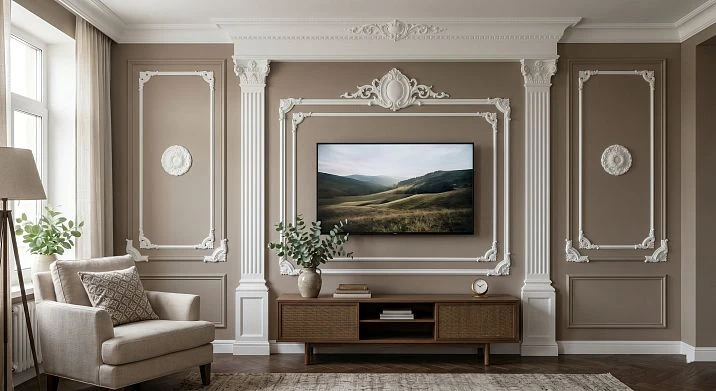
There is one feature of the TV zone that is rarely discussed openly. The TV is an appliance. A large black rectangle that hangs on the wall or stands on a cabinet. When it is off, it is just a dark spot. When it is on, it dominates the entire space. The wall around it either works for this focus or looks like a random background.
An empty wall under the TV is not a neutral solution. It is a 'nothing' solution. And in most interiors, it reads exactly like that: a wall that wasn't thought of. However, the opposite extreme — aggressive decor that competes with the screen — is no better.
Polyurethane TV zone decor — это третий путь. Продуманная архитектурная система: молдинги, рамки, вертикальные стойки или декоративные панели, которые собирают ТВ-зону в единый блок. Экран получает контекст. Стена обретает структуру. Интерьер становится законченным.
В этой статье — всё о том, как оформить стену под телевизор с помощью лепного декора из полиуретана: какие форматы работают, как выбрать коллекцию под стиль, как рассчитать и расположить декор, и каких ошибок не совершать.
Почему ТВ-зоне нужен продуманный настенный декор
Начнём с вопроса, который звучит риторически, но на самом деле требует конкретного ответа. Почему нельзя просто повесить телевизор и оставить стену как есть?




Телевизор разрушает стену визуально
Большой плоский экран — это тёмный прямоугольник на светлой плоскости. Он не «вписывается» в стену — он торчит из неё. Без декора вокруг телевизора стена распадается на два несвязанных элемента: прибор и фон.
Оформление ТВ-зоны с помощью молдингов и декоративных панелей решает эту проблему архитектурно. Декор не «украшает» экран — он интегрирует его в стену. Телевизор становится частью системы, а не предметом, брошенным на гладкую поверхность.
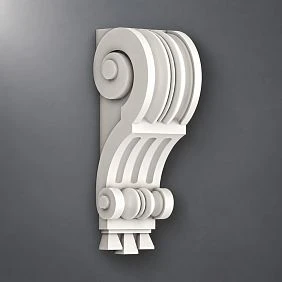
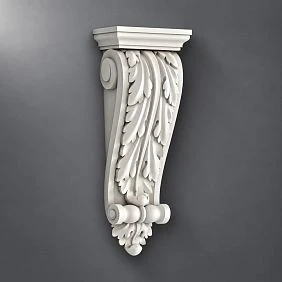
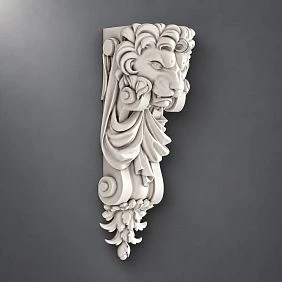
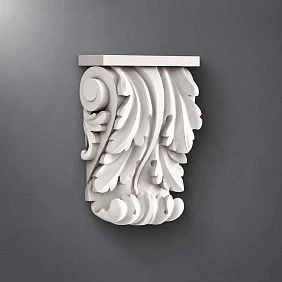
Our factory also produces:
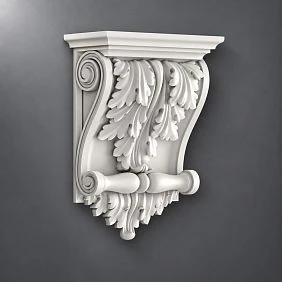
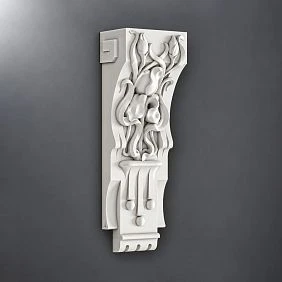
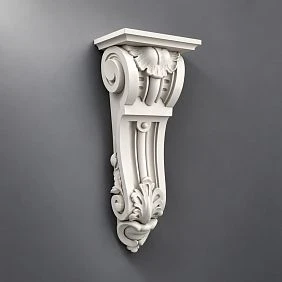
ТВ-зона — второй визуальный фокус гостиной
В большинстве гостиных два главных центра: стена за диваном и ТВ-зона. Первая — формирует характер комнаты. Вторая — задаёт функциональную ось. Обе требуют проработки.
If the wall behind the sofa is decorated, andthe wall decor with the TV is not thought out — an imbalance arises. One wall looks designed, the other — random. This is felt immediately, even if a person cannot articulate it.
Get Consultation
Decor creates an architectural block
Wall decor around the TV made of polyurethane — moldings, frames, vertical panels — turns the TV zone from a "place where the TV hangs" into an "architectural media block." This is what in professional design is called an "accent wall with a functional axis."
Decor should respect the screen, not compete with it
And here is the key principle that distinguishes a successful TV zone from an overloaded one. The wall decor under the TV should not be richer or more saturated than the screen itself. The only "main" element in the TV zone is the television. Everything else is architectural context.
That is why laconic formats work better for the TV zone: calm panel frames, vertical posts without central ornamental accents, horizontal molding belts. Saturated decor here is a mistake.
What to choose for the wall under the TV: moldings, frames, or a ready-made set
Three ways to design a TV zone. Each has its own logic and its own place of application.
Moldings for a simple frame
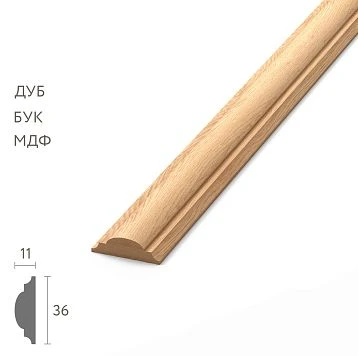
Moldings around the TV— a minimalist solution. One profile run along the perimeter of the screen area or slightly wider. No corner inserts, no ornamental overlays — just a clean outline.
When this works:
-
japandi interior or another minimalist style;
-
a small room where any extra element creates overload;
-
a TV zone in the bedroom, where decor should be as neutral as possible;
-
a preliminary solution when the interior is still being formed.
polyurethane wall moldingsin this layout, they are taken by linear meters — you need four segments around the perimeter + corner inserts.
Ready-made set of stucco decor
Ready-made molded decor kitsThis is a system solution. Moldings, corner elements, center overlays, and ornamental inserts are already matched to each other. The kit composition predetermines the panel's appearance — predictably and without the risk of incompatibility.
Ready-made wall decor for TVin the format of a collection kit — the optimal choice for:
-
a standard apartment living room, where speed and predictability of the result are important;
-
symmetrical solutions (two kits on each side of the TV);
-
rhythmic systems (several identical panels in a row).
Decorative panels for a large wall
TV zone decor kitin the format of a decorative panel — for spacious living rooms where the TV wall is 4–5+ meters wide, and the TV occupies only the central part. Here, the panels form the entire wall: the TV in the central zone, decorative vertical sections on the sides.
Polyurethane TV zone decor options
Let's look at specific formats — with a description of where and how they work.
Molding frame around the TV
A rectangular frame made of molding profile that surrounds the screen area. The TV ends up 'inside' the frame — framed by it, integrated into the wall.
Frame parameters:
-
frame width — 20–40 cm wider than the TV on each side;
-
frame height — 15–25 cm above the top edge of the TV and 15–25 cm below the bottom (considering the TV stand);
-
distance from the screen — at least 15 cm on each side, otherwise the frame looks 'too tight'.
Decorating the wall under the TV with moldingsin the frame format — one of the cleanest solutions. Effect: the screen is built into an architectural niche. Without a real niche, without finishing work — just moldings on a flat wall.
Nuance: corner inserts in the frame must match the molding profile in style. For 'Neoclassical' — neoclassical corner elements, for 'Japandi' — geometric ones. If you take a molding from one collection and corner inserts from another, the style will be disrupted.
Vertical decorative elements on the sides of the TV zone
This is a fundamentally different logic: not framing the screen, but its "placement" in the wall space. Two vertical elements on either side of the TV are symmetrical axes that visually "hold" the screen between them.
Why does this work on a wide wall? Because a wide wall without side vertical accents makes the TV appear "floating." Decor on the sides creates field edges — and the TV ends up in the center of this field, rather than abandoned in the middle of emptiness.
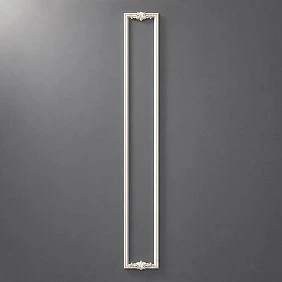
decorative polyurethane elementsIn a vertical format — unobtrusive but clear architectural axes. Height: from 60 to 90 cm depending on ceiling height. Placement: the center of each element is at the height of the TV center. Distance from the TV edge to the nearest decor edge: at least 20–25 cm.
This format is especially organic in neoclassical and classical interiors, where vertical pilasters and posts are part of the historical architectural grammar.
Ready-made set of stucco decor for the wall behind the TV
Set of stucco decor for the TV zone— the most commercially convenient format. This is something you can choose from a catalog, order, and install without additional design work.
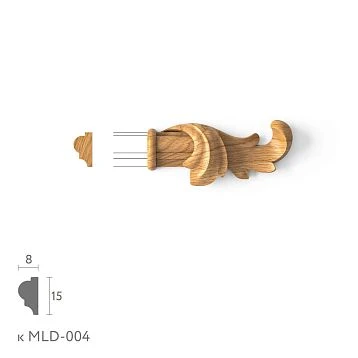
The standard set includes: molding strips (four segments for the frame perimeter), corner inserts (4 pcs.), ornamental insert or overlay (1–2 pcs.). All in a single style, all proportionally matched.
For the TV zone from STAVROS sets, formats with laconic corner inserts — without large floral ornament — are especially relevant. Central overlay in the frame under the TV: if included in the set, it is placed below the TV (in the space between the lower edge of the frame and the top line of the TV cabinet), not in the center where the screen will be.
Ready-made wall composition made of polyurethaneUnder the TV — this is systems thinking in action: one order, one installation, a finished result.
Horizontal molding belt
A separate format that is often underestimated. A horizontal molding running across the entire width of the TV zone at the height of the lower edge of the TV or the top line of the TV cabinet is a dividing element. It clearly splits the wall into a screen zone (above) and a functional zone (below: cabinet, console, outlets, cables).
This solution works in any style — from minimalist to neoclassical. In calm modern interiors — one horizontal molding without corner elements. In neoclassical or classical — a horizontal belt with corner accents at the ends.
The width of such a belt from edge to edge of the TV zone — either the width of the wall or the width of the work area with the media cabinet. In any case, the belt should be centered or run strictly from corner to corner — intermediate endings in the middle of the wall look unfinished.
Which style to choose for the TV zone
The decor of the TV zone should speak the language of the entire interior — and especially the language of the living room. Four main style scenarios with specific recommendations.
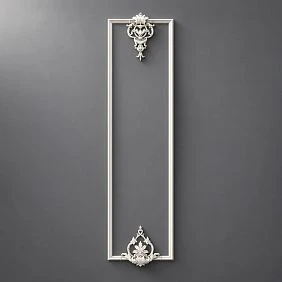
Neoclassicism
A neoclassical TV zone is not a "fireplace with high reliefs." It is an architecturally organized wall with a molding system: calm, symmetrical, without excessive decorative saturation.
ForTV zones in neoclassicismoptimal:
-
one rectangular frame panel covering the screen and cabinet area;
-
two vertical sets on the sides of the TV with neoclassical corner and ornamental inserts;
-
horizontal molding belt + vertical posts on the sides.
Set of stucco decor "Neoclassic"for the TV zone: we recommend levels CPU-1-1 or CPU-1-2. Saturated CPU-1-4 and CPU-1-5 for the TV zone are excessive — they are designed for large-scale formal walls, not for a zone with a screen.
It is fundamentally important: the central ornamental insert from the set should not be at the same height as the center of the screen. Its place is either below the TV (in the cabinet area) or on the sides of the screen as symmetrical vertical accents.
Color for a neoclassical TV zone: decor in the tone of the wall is the most restrained option, decor 2 tones lighter is a soft architectural relief, white decor on a light beige or gray wall is standard neoclassicism.
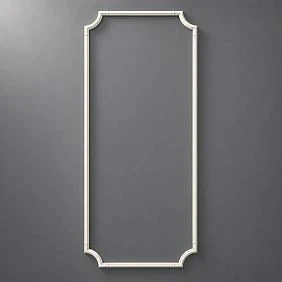
Neoclassic Light
If "Neoclassic" is an architectural statement, then "Neoclassic Light" wall decor is an architectural hint. A thinner molding profile, less relief, delicate corner inserts.
This is the best choice for a TV zone in:
-
a standard city apartment with a ceiling of 2.5–2.7 m;
-
a medium-sized living room (20–30 sq m), where a saturated "Neoclassic" would create overload;
-
interiors in "modern neoclassicism", where you want architecturality without palace allusions.
Light wall decor behind the TVfrom the "Neoclassic Light" collection in the format of two symmetrical vertical panels on either side of the TV — an absolutely precise solution for a modern apartment living room. Elegant. Proportional. Unpretentious, yet with an architectural feel.
The CPU-2-1 to CPU-2-5 sets cover the entire range of formats: from a compact frame to a rich vertical stand. For the TV zone — CPU-2-1, CPU-2-2, or CPU-2-3.
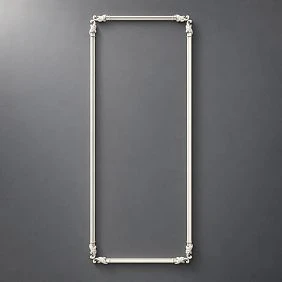
Japandi
The Japandi TV zone is a paradox in a good sense. The style demands silence, but the TV zone is a functionally active space. The task of the decor here is to create a structure that is almost invisible under uniform lighting but is felt as an organizing principle.
TV zone decor in "Japandi" styleis:
-
one horizontal molding strip at the level of the TV's bottom edge, painted in the wall color;
-
two minimalist vertical sets on either side of the TV without ornamental accents;
-
a simple frame made of thin profile, surrounding the screen area, in the wall color.
Minimalist TV zone decorfrom the "Japandi" collection — this is exactly it: pure geometry, soft relief, no ornamentation. Decor that architecturally organizes the TV zone without disturbing visual silence.
An important nuance for Japandi: the color of the decor = the color of the wall. No white moldings on a dark wall. Monochrome is a must.
Best combinations for a Japandi TV zone: wood + neutral walls + monochrome polyurethane decor. Additions: matte metal consoles, ceramic vases, live plants. No shine, no mirrored surfaces, no bright accents.
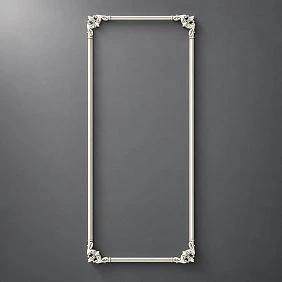
Versailles Light
"Versailles Light" — decor for the TV zone in the formal living room. This is a scenario where the TV zone is combined with a fireplace wall or simply serves as a "formal wall" in a home with representative aspirations.
An important caveat: "Versailles Light" in the TV zone only works under certain conditions. The ceiling must be no lower than 2.8–3.0 m. The living room area must be at least 35–40 sq. m. The TV size must be large (65–85 inches), otherwise the screen gets "lost" against the rich decor.
Classic wall decor for a TV from "Versailles Light" is a system where the TV is part of a formal wall composition. CPU-4-1 or CPU-4-2 in the format of two symmetrical panels on either side of the TV — an architectural frame for the screen in a formal style.
What else is characteristic of "Versailles Light" in the TV zone:
-
combination with a fireplace portal or architectural niche;
-
patination of the decor (gold, bronze) with expensive classic finishes;
-
mandatory symmetry on both sides of the TV;
-
wall color — neutral or warm: cream, ivory, light beige.
Decorative panels for the TV zonefrom "Versailles Light" — this is no longer just "wall decor for the TV", it's an architectural scene. An interior where the TV zone is perceived as a full-fledged formal wall.
Principles of TV zone decor that must not be violated
Before calculating dimensions — a few rules, violation of which leads to unsuccessful results.
Rule 1: Decor does not overlap the screen area
Moldings, frames, overlays — all of this should be around the TV, not in its area. The frame encloses the TV from the outside. Vertical posts — on the sides, outside the screen. Horizontal band — above or below the TV, but not at the same level as it.
Rule 2: The central ornamental accent is not at the height of the screen center
A medallion or central overlay from the set at the height of the TV center is a visual conflict of two "main" elements. The central overlay is placed either below the TV (in the gap between the bottom edge of the screen and the top line of the cabinet), or in completely separate side compositions.
Rule 3: Sockets and cables — in the diagram before installation
Moldings around the TVshould not cover electrical sockets and cable channels. This is both technically incorrect and aesthetically unpleasing. A wall diagram with socket locations is mandatory before ordering decor.
Rule 4: Decor coordinated with the cabinet and console
The TV zone is a system: screen + cabinet/console + wall. Wall decor must account for the cabinet height. A typical mistake: the lower horizontal line of the frame aligns with the cabinet plane or falls within its height. The lower horizontal line of the molding should be above the top surface of the cabinet or at the same level, but not below.
Rule 5: One style — one interior
Mixing profiles from different collections in one TV zone is not allowed. If you chose "Neoclassical" — all elements must be from "Neoclassical". If "Japandi" — only "Japandi". Mixing styles creates the impression that the decor was chosen as an afterthought.
How to calculate TV zone decor based on wall size
Accurate measurements are the foundation of successful installation. A calculation algorithm proven in practice.
Step 1: Record the TV dimensions and its installation height
Exact parameters: TV width, TV height, height of the screen center from the floor. Standard recommendation: the screen center should be at the eye level of a seated person, approximately 100–115 cm from the floor.
Step 2: Measure the wall width and determine the work area
The work area is not the entire wall, but the section you plan to decorate. For a standard urban TV zone, this is an area 200–280 cm wide with the TV centered. For a wide living room with a large wall, a work area of 3.5–4.5 m is possible.
Step 3: Determine the format and width of the decor
One frame around the TV: frame width = TV width + 40–80 cm (20–40 cm on each side).
Two vertical sets on the sides: place the center of each set at a distance of (TV width / 2 + 25–40 cm) from the center of the wall. For example: if the TV is 120 cm wide, the center of the left set is at a distance of 60 + 30 = 90 cm from the center of the wall.
Step 4: Determine the height of the decor and its vertical position
The frame completely encloses the TV: the top edge of the frame is 20–25 cm above the top edge of the TV, the bottom edge is 15–20 cm below the bottom edge of the TV or at the level of the top surface of the cabinet.
Vertical posts on the sides: the bottom edge is at the level of the bottom edge of the TV or 5–10 cm above the cabinet, the top edge is at the level of the top edge of the TV or 10–15 cm above.
Horizontal molding belt: at the height of the bottom edge of the TV or the top surface of the cabinet — as a dividing line.
Step 5: Draw the diagram on paper
Layout diagram — a scale drawing of the wall with decorative elements, TV, cabinet, outlets, cables, and lighting. This is not a designer whim — it's a way to avoid buying excess and installation conflicts.
Step 6: Calculate the number of kits and additional elements
One kit format = one frame panel (width and height determined from the diagram).
If the required frame width is greater than the length of molding planks in a standard kit — additional linear meters of molding from the same profile will be needed.
If vertical posts are needed — two kits. If a horizontal belt — separate molding planks of the required length.
TV zone decor size — always derived from the dimensions of the TV and the wall. Start with the TV, not the decor.
Mistakes when designing a wall for a TV
Concise. No fluff — just what most often goes wrong.
Mistake 1: Decor flush with the edges of the screen
A frame with a 5–7 cm gap from the TV is not a frame. It's a 'hoop'. There should be at least 15–20 cm between the molding profile and the edge of the TV. Otherwise, the decor does not create space around the screen, but compresses it.
Mistake 2: TV diagonal not taken into account
Buying decor for a 55-inch TV, but ending up with a 65-inch one is a classic story. If there's a chance the TV will be changed, it's better to immediately aim for a larger size and allow for a larger gap.
Mistake 3: Rich decor distracts attention from the screen
Rich ornamentation near the screen—especially in the upper part of the TV zone—creates 'competition' with the image on the screen. The eye doesn't know where to look. For the TV zone: the simpler and more concise the decor, the better the screen works.
Mistake 4: No space left for sockets and cables
A molding running through a socket, or a frame with no access to the cable channel underneath, is an installation and operational problem. A wall diagram with engineering elements is mandatory before ordering.
Mistake 5: Small decorative elements on a large wall
A small decorative medallion 20×20 cm on a 4 m wide wall is a 'lost' element. The scale of the decor must match the scale of the wall. For a wide TV wall—large or multi-element systems.
Mistake 6: Buying without a layout diagram
"I'll see what I like and buy it" — that's exactly how people end up with extra sets or missing pieces. Pre-order planning saves time and money.
Mistake 7: Decor is not related to the furniture
TV cabinet, console, floor-standing speakers, side chairs — all of this is part of the TV zone. Decor that doesn't relate to the furniture in height and width looks like a random element.Decorating the wall behind the TVstarts with furniture arrangement, not with choosing molding.
Read detailed practical guides on the technology of installing polyurethane decor:installing polyurethane moldingandinstallation of polyurethane molding.
Where to buy polyurethane decor for the TV zone
STAVROS offers a full range of solutions for decorating the wall behind the TV:
Polyurethane TV zone decor— the entire section of wall decor.
Set of stucco decor for the TV zone — ready-made system sets by collection.
Ready-made molded decor kitsfor a quick and predictable result.
Moldings around the TVlinear profiles for frames and horizontal bands.
decorative polyurethane elements— corner inserts, overlays, ornamental accents.
Set of stucco decor "Neoclassic"— calm symmetrical solutions for the TV zone.
"Neoclassic Light" wall decor— light decor for a modern interior.
"Japandi" decor set— minimalist system for a calm TV zone.
"Versailles Light" stucco decor set— for a formal classic TV zone.
FAQ: Answers to popular questions
Do I need to remove the TV to install the decor?
Preferably, especially if the decor is mounted close to the mounting area. This simplifies precise marking and allows you to work neatly near the bracket. If it's impossible to remove the TV, cover it with protective film and work with an offset.
Can TV zone decor be used in the bedroom?
Yes. The principles are the same, but the scale is usually more modest. For the bedroom — "Neoclassic Light" or "Japandi". One vertical set on each side of the TV or a simple frame in the color of the wall.
Which molding is better for a frame around the TV: wide or narrow?
For the TV zone — a medium profile, 30–50 mm. A wide profile of 70–90 mm creates a heavy frame that visually "presses" on the screen. A narrow 15–20 mm is barely noticeable and does not create an architectural effect. The sweet spot is 30–45 mm.
How to decorate a wall for a TV if cables are laid inside it?
No other way — only considering the cable routes. The cable layout is fixed before installation. If cables are laid vertically — vertical moldings are placed nearby, but not over the route. If horizontally — a horizontal molding belt may coincide with the route, but with an offset up or down.
Is backlighting needed along with molding decor for the TV zone?
Backlighting enhances the relief effect. Backlighting behind the TV (ambient light) does not compete with molding decor. Backlighting along the perimeter of the molding frame is possible but requires precise installation: the LED strip must be hidden in the gap between the molding and the wall or behind the lower horizontal part of the frame.
Can a molding frame for a TV zone be combined with wallpaper?
Yes. On wallpaper, moldings are attached with glue — the same technology as on a painted wall. The wallpaper must be applied before installing the decor, and the surface must be smooth and clean.
How long does polyurethane stucco decor last in a TV zone?
Polyurethane is a durable material. It is not afraid of temperature changes (including heat from a working TV), does not dry out, and does not yellow. With proper installation and painting, its service life is comparable to the lifespan of the wall finish, i.e., decades.