

























Article Contents:
- What is confirmed for NPU-010
- Why the article is not reduced to the advice "order one piece as a sample"
- First, confirm that the piers are indeed identical
- What can be checked with a 140 × 95 mm template without purchasing NPU-010
- When a physical sample is needed: relief, light, distance, and serial effect
- Shadow
- Actual surface
- Painting
- Mounting plane
- Customer approval
- Daylight
- Main artificial light
- Accent or side light
- Horizontal coordinate
- Vertical coordinate
- Size already rejected by template
- Client has seen NPU-010 in person
- Identical node already implemented
- Only one or two piers
- Final color and installation are already confirmed by the manufacturer's sample or a real mock-up
- The sample remains in the project
- The sample has become technical and is not used for final installation
- The template fully removed uncertainty and a physical sample is not needed
- Option 1: the sample is then installed
- Option 2: the sample remains technical
- Error 7. Turn the test NPU into a consumable, but subtract it from the final quantity
- Error 8. Add a reserve as a percentage without reason
- Can NPU-010 be verified only with a printout from the website?
- Is a separate trial NPU needed for each type of partition?
- What to do if NPU-010 fits on eight partitions but does not fit on two narrow ones?
- Can a test NPU be used after several fittings in final installation?
- Is it mandatory to paint the test NPU?
- What is more important: to see the sample next to the slats or on a clean wall?
- Can the entire batch be ordered, but only one NPU mounted first?
- How to calculate the order if NPU is installed through every other partition?
- Is a spare NPU needed for every ten pieces?
- Where to look at other overlays if NPU-010 did not pass the sample?

In commercial interiors, one mistake rarely remains just one.
If the wall repeats the pattern of slat panels → smooth partition → slat panels, and the same NPU-010 is planned on each smooth section, an incorrectly chosen scale will be repeated as many times as there are partitions on the site. In the visualization, the overlay may look convincing, but after installation it turns out that next to the deep vertical rhythm of the slats it is too small, the relief almost disappears after painting, or the chosen installation height does not work with the actual viewpoint.
Therefore, it is useful to divide the check into three levels.
Level 1 — full-size template 140 × 95 mm. It costs nothing in the product price and answers questions of scale, position, orientation, and repeatability.
Level 2 — one physical NPU-010. It is needed if, after the template, questions remain about the real 9 mm relief, shadows, surface, coloring, and mounting system.
Level 3 — batch. It is ordered only after not only the article number and color are approved, but also the exact installation scheme on all repeating sections.
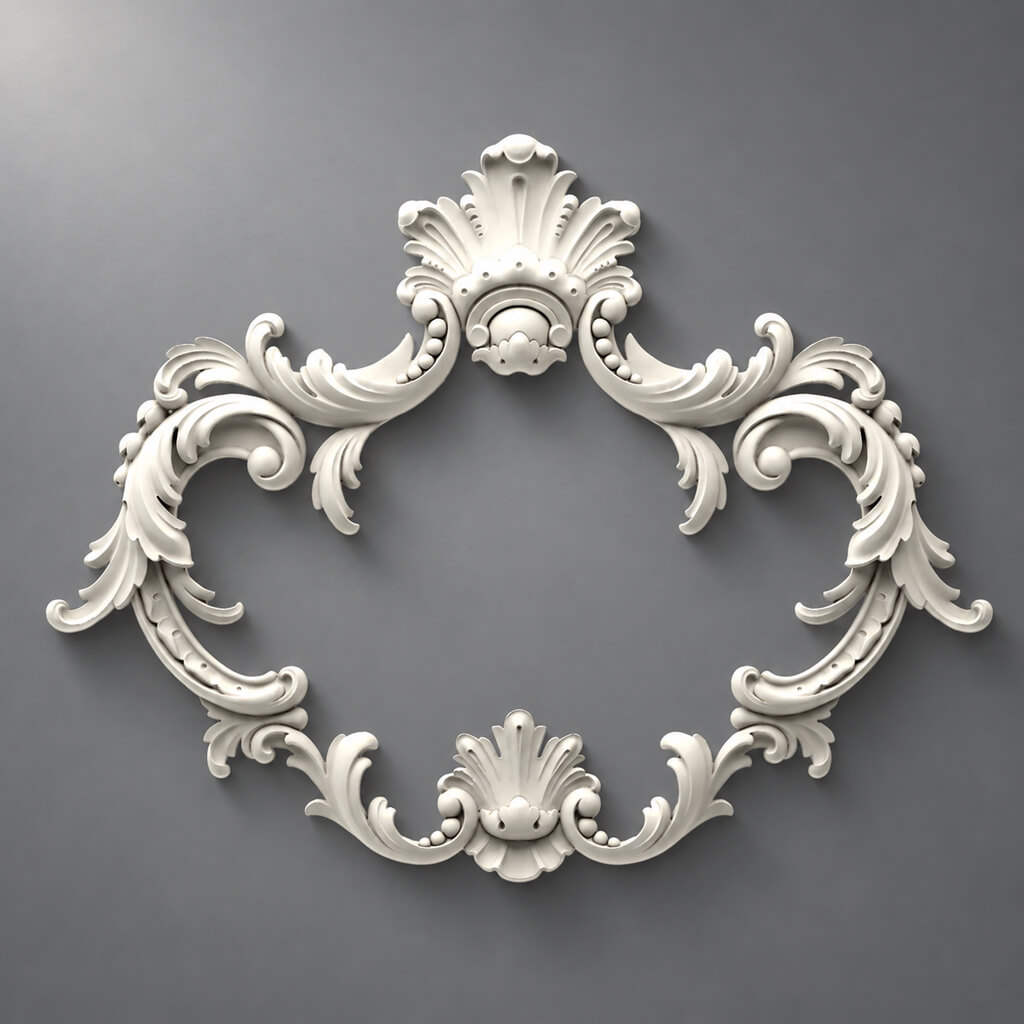
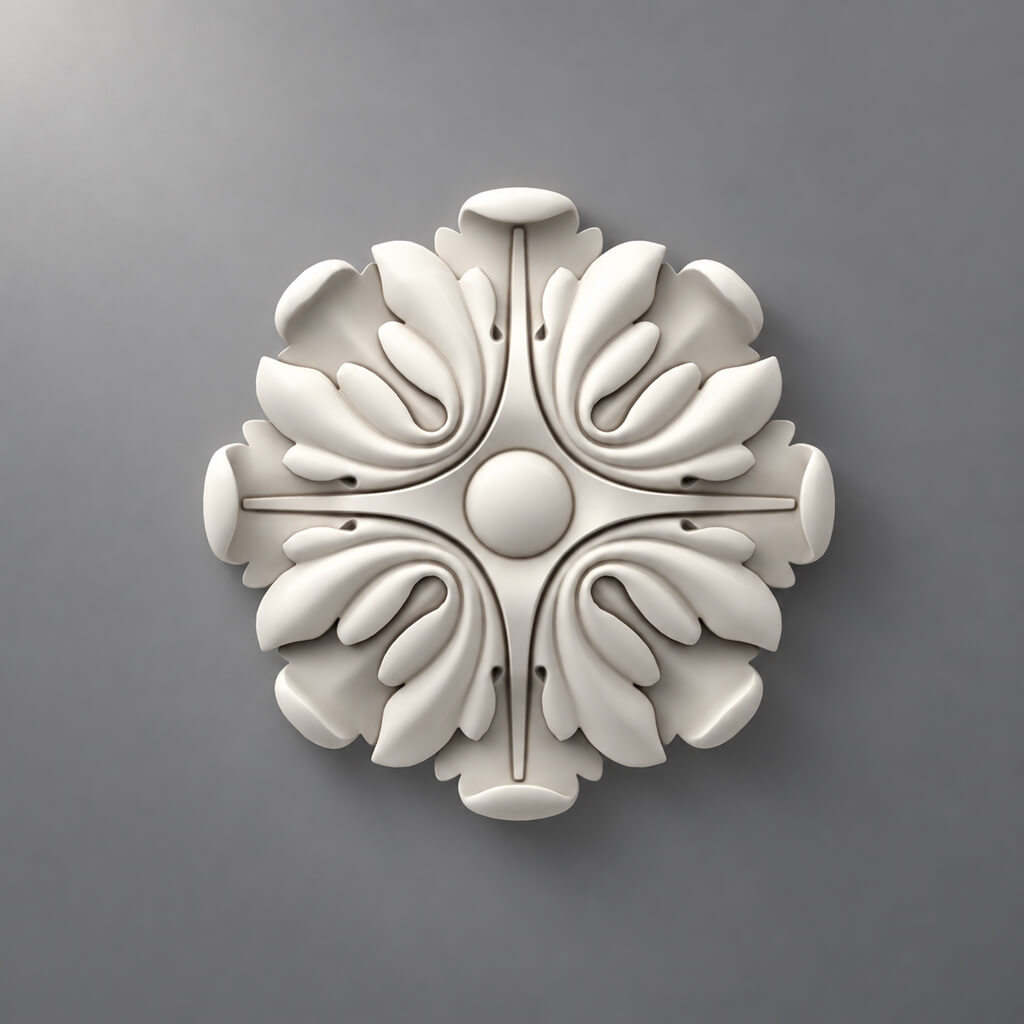
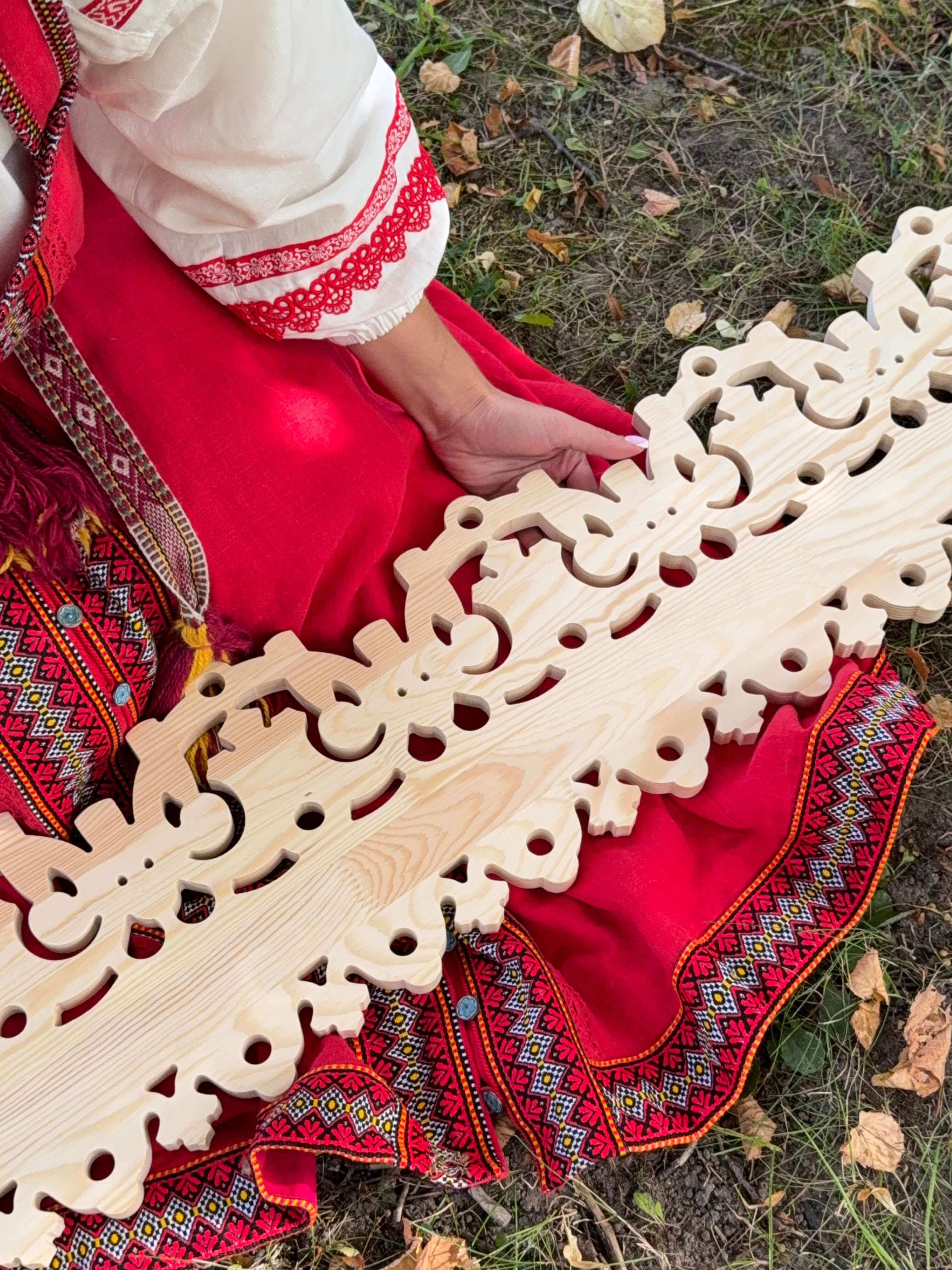
The current category listing of STAVROS shows NPU-010 as polyurethane stucco decor measuring 140 × 95 × 9 mm at a price of 1,090 ₽ per piece. In the STAVROS polyurethane overlay size system, parameter A denotes width, B — height, C — thickness. Therefore, for NPU-010, you can verify the actual footprint of 140 mm in width, 95 mm in height, and 9 mm in relief.
The direct answer is:
Do not buy the entire batch of NPU-010 based only on a render. First, check the 140 × 95 mm template on one real wall section. If the scale and position are suitable, but the project is sensitive to relief, light, or color, order one physical NPU-010, do a full-scale fitting and a test paint sample. Only after approval, fix the mounting axis and order the remaining set.
If even on the paper template 140 × 95 mm it is clear that the decor is too small, too large, or compositionally unnecessary, buying even one NPU-010 for a test is pointless.

What is confirmed for NPU-010
| Parameter | NPU-010 |
|---|---|
| Product type | stucco decor / decorative overlay |
| Material | Polyurethane |
| Width A | 140 мм |
| Height B | 95 мм |
| Thickness C | 9 мм |
| Current price from the latest category listing | 1,090 ₽/pc. |
| Quantity at the geometric verification stage | 0 pcs. — a template is sufficient |
| Quantity for full-scale approval | 1 pc., if it is really needed |
| Quantity after approval | according to the number of confirmed repeating sections |
The old cached version of the product card shows a price of 1,030 ₽, so a more recent price of 1,090 ₽ is used for calculations in the article, but the cost should still be rechecked before placing the actual order.
After passing the layout and full-scale approval, you can buy the stucco molding NPU-010 140 × 95 mm.
The product card confirms the typical interior use of NPU-010 for furniture, doorways, and more complex decorative schemes. But it cannot answer the main question of this article: how NPU-010 will look in a repeatedly repeating pattern specifically next to your slat panels.
That's what the approval stage is for.
Why the article isn't just the advice "order one piece to try"
STAVROS already has materials where a sample is used as a selection tool. For example, for slat panels, a separate OPAN sample helps check the profile, texture, relief, and color before the main purchase.
NPU-010 has a different scenario.
There's no special demo mini-sample here. The check works like this:
first a free full-size template → then, only if needed, a full NPU-010 → then the batch.
This is significantly different from the banal advice to buy one unit of any decor before every order.
A physical unit isn't always needed.
It's justified if the decision depends on something a flat mockup can't show:
-
the actual 9 mm depth;
-
relief behavior under side lighting;
-
actual color sample;
-
color transition with battens and wall;
-
visual density of the pattern;
-
compatibility of the selected mounting system with the substrate;
-
client's reaction to the actual material, not an image.
If all these parameters have already been approved on an identical previous project, and the new wall repeats a proven assembly, splitting the purchase may be unnecessary.
Our factory also produces:


First, confirm that the piers are indeed identical
The phrase "we have ten identical piers" often turns out to be overly optimistic.
Before replication, at least five parameters of each section must be checked:
-
actual width of the smooth field;
-
height of the zone;
-
distance to the edge of the slat panels on the left and right;
-
lighting;
-
main viewing points.
If one wall section is 420 mm, another is 435 mm, a third is partially covered by furniture, and a fourth falls under a wall sconce, a single mounting template may not work without adjustments.
Therefore, a list of sections is created first.
| Pier | Width | Light | Is there furniture/equipment | Can it be considered standard |
| №1 | actual measurement | daylight/artificial | No | Yes/No |
| №2 | actual measurement | another scenario | yes/no | Yes/No |
| №3 | actual measurement | another scenario | yes/no | Yes/No |
The article does not include a fictional "normal pier width." It depends on the actual object.
The table's task is to separate typical sections that can be replicated from exceptions where the placement of decor will need to be decided separately.
Get Consultation
What can be checked with a 140 × 95 mm template without purchasing NPU-010
A paper or cardboard template solves more problems than it seems.
It allows you to see:
-
how much space the NPU takes up relative to the pier;
-
how close it is to the rails;
-
whether the element is readable from a real distance;
-
is vertical or other orientation needed;
-
does the center of the decor fall on a logical axis;
-
does the repeat look the same across several piers;
-
does a series of ten elements not turn into too frequent an ornament.
For NPU-010, the template size is confirmed:
140 mm in width × 95 mm in height.
If you need to evaluate not just the rectangular footprint, it is better to print an image of the product at 1:1 scale and cut out the approximate outer silhouette.
The 140 × 95 mm rectangle shows the occupied area.
The silhouette shows the decorative mass.
These are different things: the ornament within the footprint can visually take up less space than the entire rectangle.
The first test is not centering, but three positions on one pier.
One should not immediately assume that NPU-010 must be located exactly at the geometric center of a smooth strip.
On the first typical section, it is useful to check three positions:
the center of the pier;
above the center;
below the center — if there is furniture, a console, or another horizontal nearby.
After that, they look at which alignment is explainable by the architecture.
If the section is from floor to ceiling, the geometric center may be too low or too high relative to the human eye and neighboring objects.
If the pier is located above a console, the decorative axis may depend on the furniture.
If there is a doorway nearby, the trim line matters.
Therefore, the mounting mark is chosen not "by taste on a single frame," but by a stable architectural connection that can then be repeated across the entire series.
How to understand that the template has already rejected NPU-010 and a physical sample is not needed
A physical purchase should answer a new question.
If the template has already shown that the size does not work, a real overlay will not fix the composition.
Signs that you can stop before purchasing:
-
NPU-010 gets lost between wide sections of slats;
-
140 mm in width leaves too much empty space around it, and the decor looks random;
-
on a narrow wall segment, 140 mm, on the contrary, takes up too large a share of the width;
-
in a repeating series, the element starts to look like too frequent a stamp;
-
the vertical mark does not align with any architectural line;
-
there is already a sconce, room number, switch, or another object nearby that is stronger;
-
Several patterns in a row overload the wall.
In these cases, it is more reasonable to switch to catalog of decorative polyurethane overlays and look for a different scale, rather than buying one NPU-010 "just in case."
This is an important commercial filter.
A trial unit is not a mandatory step. It is only needed after a successful geometric test.
When a physical sample is needed: relief, light, distance, and serial effect
The pattern is flat.
NPU-010 has a relief of 9 mm.
These 9 mm change perception more than is visible in the catalog photo.
A physical sample is needed if the project is sensitive to the following variables.
Shadow
With side lighting, the 9-millimeter relief creates its own shadow.
Next to slat panels, where there are already many vertical shadows, the decorative element can either become more expressive or get lost in complex light and shadow.
Actual surface
In the photo, the ornament appears more or less deep depending on the angle and image processing.
A physical sample allows you to see the relief without digital scaling.
Painting
If NPU-010 is to be painted in the wall color, it is the real sample that shows whether the ornament remains readable after finishing.
Mounting plane
A flat template does not show how the 9 mm relief interacts with adjacent slats, protruding profiles, trims, or furniture.
Client approval
In a B2B project, sometimes not only technical verification is important, but also approval of the actual sample by the responsible person.
For this, one physical unit really makes sense.
One sample needs to be moved around the object, not immediately glued permanently.
If there are many repeating piers on the object, one of the most useful strategies is not to fix the sample permanently at the first point.
First, it can be applied or temporarily positioned in several areas.
Checked:
-
the lightest pier;
-
the darkest;
-
area near the entrance;
-
area visible from a distant point;
-
area next to furniture;
-
area where the slat panels are most contrasting.
So one NPU-010 answers the question:
does the solution work the same under different conditions?
If a project has 20 piers of the same size, but half are lit by daylight and half only by artificial light, a single geometric test is not enough.
It is not necessary to buy several samples.
First, it is enough to move one part between characteristic zones while it is not yet part of the final installation.
What exactly to compare with slat panels
NPU-010 and slats use different types of rhythm.
Slats are a repeating linear relief.
NPU is a local ornamental accent.
They should be compared by four characteristics.
Scale. Does the overlay not look too small next to the large slat structure?
Depth. Does the 9-millimeter relief not disappear next to deeper lamellas?
Frequency. Does the repetition of NPU on each pier not become too frequent?
Contrast. Does one material not turn out to be visually significantly stronger than another?
The article does not introduce a rule:
"the overlay must be at least half the width of the pier."
There is no such standard.
Only full-scale comparison works.
Scale should be assessed as a series, not by a single overlay
One NPU-010 may look neat on a test section.
But when there are 12 such elements, the repetition changes the entire interior.
Therefore, after approving one template, you need to make a serial mock-up.
The simplest way:
-
take photos of several wall sections;
-
insert the same silhouette of NPU-010 onto each;
-
or physically attach paper templates to 3–5 adjacent areas;
-
view the rhythm from a distant point.
This is a separate test.
It answers not the question "is the size 140 × 95 mm suitable," but:
is the repeatability of this size suitable for the entire wall?
In a commercial interior, the serial effect is often more important than one beautiful detail.
Checking from the visitor's movement perspective is more important than close viewing
In a showroom, restaurant, office, or hotel corridor, a person rarely stops 30 cm from each wall section.
He sees the wall:
-
at the entrance;
-
in motion;
-
from a diagonal angle;
-
from the other side of the room.
Therefore, testing NPU-010 only up close is incorrect.
You need to determine:
the main far point;
the entry point;
Side movement route.
If from these points 140 × 95 mm turn into an almost invisible spot, the physical beauty of the relief does not compensate for the wrong scale.
If on the contrary — one element stands out too actively and repeats every 1–1.5 m, the series can become intrusive.
The article does not specify the exact step of the piers: it is measured on site.
9 mm of relief needs to be checked in three lighting modes
In relief decor, color and light are connected.
For NPU-010 it is useful to check:
Daylight
Shows the natural softness of the relief.
Main artificial light
Shows real evening use of the interior.
Accent or side lighting
The most indicative mode for shadows.
If there are tracks, sconces, or linear lighting nearby, 9 mm can produce a much more noticeable pattern than with frontal light.
In some projects, this is a plus.
In others, the pattern starts to compete with the shadows of the slats.
This is why the physical NPU-010 may be needed even after a successful paper mockup.
Painting and lighting: how to approve a finish that can be replicated across the entire batch
User semantics on the topic include the query "painting of moldings," and here it is indeed related to the purchasing decision.
Painting can:
-
make the NPU part of the wall;
-
strengthen the ornament;
-
weaken it;
-
connect the decor with the slats;
-
create a separate accent.
The most important mistake is to approve white NPU-010, and then paint the entire batch in a color that visually "eats" the relief.
If painting is planned in the project, the sample should be evaluated in the final finish system, not just in the factory state.
STAVROS has a separate material about painting polyurethane moldings, which can be used as a general technical reference. The specific paint and preparation must be compatible with polyurethane and the actual substrate of the object.
Monochrome paint-out is the first test, contrast is the second.
For repeating decor, it is usually reasonable to start with the calmest version.
Test 1 — NPU in the color of a smooth wall section.
Then the series is read through:
-
relief;
-
shadow;
-
form.
If the ornament disappears completely, you can check the second option.
Test 2 — moderate tonal contrast.
It shows whether color is needed to support the pattern.
Immediately making bright contrast on all wall sections is risky: repetition turns a small accent into a strong graphic system.
For a commercial project, even a slight difference in shades, repeated 20 times, is perceived much more strongly than a single sample on a table.
Do not approve a color on a single pier if the lighting across the object is different
Let's imagine:
-
Piers No. 1–6 are located near windows;
-
No. 7–12 are in the back of the hall.
The same NPU color can be perceived differently.
If there is only one physical sample, it needs to be examined sequentially in both areas.
It is not necessary to create two colors.
But you need to make sure that a single approved finish actually works under different lighting conditions.
If the difference is critical, the project ceases to be fully "standard": it may be necessary to split into two groups.
This should be done before the batch, not after installing half of the elements.
After approval, a reference node is needed: axes, layout, and pier typology
The most common mistake after a successful fitting is to photograph NPU-010 and assume that this is enough for installing the remaining sections.
For the series, a reference node is needed.
It records:
-
NPU-010 article number;
-
orientation;
-
color;
-
center height;
-
horizontal alignment;
-
distance to the batten zone;
-
mounting base;
-
position relative to the floor, furniture, or another permanent line.
This turns a design solution into a reproducible instruction.
If installation is performed by several craftsmen, a photo without dimensions leaves too much freedom.
One person will place the overlay 20 mm higher, another will center it according to the actual wall section, and a third will use the design dimension.
On one section, the deviation is almost imperceptible.
In a series of 20 elements, a "floating" line appears.
For a series, two independent mounting coordinates need to be selected.
To make NPU-010 repeat identically, each part needs at least two anchors:
horizontal;
vertical.
Horizontal coordinate
If the pier is truly symmetrical between two rack fields, a natural first test is the axis of its actual width.
For a pier width of S and NPU-010 width of 140 mm when centered:
side field = (S − 140) / 2.
For example, if the actual width of the pier is 420 mm:
(420 − 140) / 2 = 140 mm.
This results in a symmetrical node:
140 mm of smooth field → NPU 140 mm → 140 mm of smooth field.
This is not a universal ideal proportion. It is simply a convenient reference example.
If the left and right slat zones differ or the pier is intentionally asymmetrical, the geometric center may be an incorrect reference point.
Vertical coordinate
It is better to set it from a stable architectural line:
-
finished floor;
-
top of the panel;
-
the furniture line;
-
another confirmed level.
You cannot choose a random point that is difficult to replicate in other areas.
For B2B installation, the following wording is useful:
the center of NPU-010 is at mark X from the agreed baseline.
This way, the solution can be verified instrumentally.
The template for installers should record not only the part size
After approval of NPU-010, a production template can be made.
It should show:
-
outline 140 × 95 mm;
-
central axis;
-
top/bottom;
-
control vertical mark;
-
side references.
The template can be paper, cardboard, or made as a working layout map.
The main thing is that it answers the question:
where to place the next NPU without a repeated design decision?
If each pier has to be "caught by eye," the typical node is actually not approved.
Do not transfer the size from the first section if the other piers differ
Let's imagine a series:
-
eight piers of 420 mm;
-
two — of 390 mm;
-
one — 470 mm.
If on a typical 420-mm section the NPU is centered, the vertical axis can remain common, but the side margins will be different.
For 390 mm:
(390 − 140) / 2 = 125 mm.
For 470 mm:
(470 − 140) / 2 = 165 mm.
That is, the difference in the smooth field between the extreme cases is 40 mm on each side.
This can already be noticeable.
Therefore, before the batch, it is better to divide the piers:
type A — main;
Type B — narrow;
Type C — wide.
And check whether one NPU-010 is acceptable for all three.
If not, this needs to be known before purchasing.
Trial stage economics: cost of batch, sample, and two-stage purchase
The price of one NPU-010 per the latest category output is 1,090 ₽.
The batch cost increases linearly.
| Number of piers | Number of NPU-010 | Cost of products |
| 6 | 6 | 6 540 ₽ |
| 8 | 8 | 8 720 ₽ |
| 12 | 12 | 13 080 ₽ |
| 20 | 20 | 21 800 ₽ |
| 24 | 24 | 26 160 ₽ |
The table does not include installation, painting, delivery, and base preparation.
It shows something else: even a small item becomes a noticeable budget line when it is mass-produced.
If the NPU-010 doesn't fit the scale, an error on one sample costs at most the price of the test unit and the finishing work around it.
If you buy 24 pieces at once, the wrong article number already turns into a batch worth 26,160 ₽ just in decor costs.
Therefore, the trial stage is especially justified when there are many repetitions.
Buying one NPU-010 doesn't increase the final quantity if the sample is included in the final set.
Suppose the project needs 12 identical overlays.
Instant purchase option:
12 × 1 090 = 13 080 ₽.
Two-stage option:
1 sample + 11 after approval = the same 12 items = 13,080 ₽ at the current price, if the price doesn't change between orders.
That is, the trial purchase itself doesn't necessarily create an "extra thirteenth overlay."
But this is only true if the test part after inspection:
-
is not damaged;
-
is painted in the final color;
-
has not been used for a destructive test;
-
matches the approved execution.
If experiments were conducted on it with multiple paints, glue, or disassembly, the sample may remain a technical reference and not be included in the visible set.
Therefore, even before the test, it is worth deciding:
is this instance planned to be preserved for installation or deliberately used as a consumable sample?
Two-stage purchasing has a logistical cost, but it cannot be invented
The trial scheme has an obvious drawback: the order is divided into two stages.
May occur:
-
two deliveries;
-
two checkouts;
-
a pause between verification and batch;
-
a change in the current price;
-
a change in availability.
But the article does not substitute a fictitious delivery cost or time.
They need to be looked at for a specific order.
The point of a test instance is not always saving on the direct price of the product.
This reduces the risk of replicating an unsuitable solution.
For a batch of 3–4 cheap items, the logistics of a trial purchase may be unjustified.
For 20–30 repeating sections, the value of a physical approval is noticeably higher.
When a trial NPU-010 is needed, and when a template is enough
There are several scenarios.
The size has already been rejected by the template
Then a physical sample won't fix anything.
The client has seen NPU-010 in person
If they have already evaluated this exact item, relief, and required finish, repeating the physical introduction may be pointless.
An identical node has already been implemented
If NPU-010 is already installed on another site with the same proportions, lighting, and finish, a new trial purchase may not add knowledge.
Only one or two piers
With a very small quantity, the risk to the batch is low. A full-size template may be sufficient if the relief and color are already clear.
The final color and installation are already confirmed by the manufacturer's sample or a real stand.
If the physical properties are known, an additional unit is only needed for a new compositional question.
That is, a trial order is a tool to close uncertainty, not a mandatory ritual.
When a single trial NPU-010 is especially justified
A physical sample has high value if several conditions are met simultaneously:
-
there are many elements;
-
the project is commercial;
-
the relief must be visible from a distance;
-
there are active slat panels nearby;
-
the color is not yet approved;
-
there is side light;
-
the client approves the material in person;
-
the mounting surface is non-standard;
-
rework after installation will be expensive;
-
NPU-010 has not been used on such a site before.
The more points match, the more logical it is to buy one unit before the batch.
The sample must pass a test not just of "like / dislike".
To prevent physical inspection from turning into subjective discussion, a small protocol is useful.
| Check | Result |
| Scale 140 × 95 mm | pass / fail |
| Relief 9 mm | sufficient / insufficient |
| Daylight | passes / adjust |
| evening light | passes / adjust |
| Wall color | passes / change |
| Contrast with rails | passes / change |
| Installation height | Approved / no |
| Horizontal axis | Approved / no |
| Mounting base | Confirmed / no |
| Serial repeat | passes / overloads |
After such a test, the decision becomes reproducible.
No need to store SEO terms or internal ratings. This is a working project sheet.
Where to test the sample and how to check the mounting base
The first section you come across is not always a good test one.
A representative wall section is needed for a scalable solution.
Best candidate:
-
has a typical width;
-
is surrounded by the same rails as most sections;
-
is visible from the usual traffic point;
-
has typical lighting;
-
is not blocked by temporary furniture;
-
is not an extreme exception.
But one "average" section is sometimes not enough.
It is useful to additionally test the sample at the most complex typical location:
-
near strong side lighting;
-
next to dark slats;
-
at the farthest viewing point;
-
in the section with the minimum width from the allowed series.
If NPU-010 passes both the normal and critical scenarios, the solution scales much more reliably.
One physical sample does not have to remain on the test wall forever
Before approval, it is better to use the sample as a mobile reference.
Its task is to provide answers.
Therefore, it is not worth performing the final fixation prematurely if you still need to:
-
move the NPU to another pier;
-
compare the light;
-
check several heights;
-
show to the customer;
-
perform a paint test.
The method of temporary fitting is chosen so as not to damage the decorative element and the finished surface. The article does not prescribe a universal adhesive tape or any other specific composition: compatibility depends on the wall covering and the test scheme itself.
If the standard adhesive mounting is required for testing, it is better to decide in advance that this NPU will become either a finished part or a consumable sample.
The mounting surface must be the same as on the entire series
Let's imagine that the first pier is painted on prepared plaster, and part of the rest is made of painted MDF.
Geometrically, they are identical.
Mounting-wise, no.
One adhesive or one surface preparation should not automatically be transferred to different substrates.
Before mass production, not only dimensions but also materials should be grouped.
For example:
Type A — painted mineral wall;
Type B — painted furniture panel;
Type C — other decorative backing.
If NPU-010 is to be mounted on different substrates, adhesion testing is performed for each system separately.
The product card confirms polyurethane NPU-010, but does not provide a universal approval for any adhesive and any surface.
How to lock in the approved color sample for the entire batch
After approving the color, it is useful to save not a verbal description like "warm white", but precise project information:
-
manufacturer and paint name;
-
shade code;
-
gloss level, if significant;
-
application method;
-
number of coats according to the chosen system;
-
primer or preparation, if provided;
-
date or number of the approved sample.
The article does not specify a universal painting technology.
The reason is simple: it depends on the specific paint and varnish material.
But the color standard must be reproducible.
If the master paints the first NPU with one system, and the remaining 19 with a "similar white," the serial nature of the solution is compromised.
This is especially noticeable in side lighting.
Why you shouldn't make five different color swatches directly on one finished sample
Sometimes they try to divide one NPU-010 into zones:
-
white;
-
beige;
-
golden;
-
wall color;
-
Contrast.
For rough color searching, this is possible on a technical sample, but after several layers and repaints, the texture no longer reflects the finished result.
Therefore, a more reasonable order is:
-
first, select 1–2 directions based on paper swatches or tests on a separate substrate;
-
then apply the final candidate to NPU-010;
-
evaluate the actual texture in the approved finish.
If a parallel demonstration of two completely different finishes is needed for the client, it is better to decide in advance whether the second physical part is justified. It is not necessary to buy it automatically.
Rotating NPU-010 by 90° is a separate design decision
The STAVROS size system confirms:
A = 140 mm — width;
B = 95 mm — height.
This allows building a standard template in the original orientation.
Physically, the decorative element can be applied differently, but it does not follow that the ornament is designed for arbitrary rotation.
If the designer wants to use NPU-010 as a vertical element measuring 95 × 140 mm, this must be separately checked against the image, drawing, and real sample:
-
is there a pronounced top;
-
is there a bottom;
-
is there a directional branch or another motif;
-
does the turn look intentional.
For a series, it is especially dangerous to adopt an unusual orientation without checking: the error will repeat on all piers.
Serial rhythm: what to do if one element is good, but repeating it on every pier overloads
The original idea of the project is to repeat NPU-010 on every smooth field.
But a full-scale mock-up may show a different result.
For example, there are 12 identical piers.
Options:
-
12 NPU — on each;
-
6 NPU — every other one;
-
NPU only in key areas;
-
0 NPU — if the rails themselves form a sufficient rhythm.
This does not mean that the article turns into a new question of "how many pieces to install."
Here, the quantity changes after testing the serial density.
If one element looks good, but 12 patterns in a row are too frequent, you need to adjust the pattern before the batch.
The most expensive mistake is deciding that a successful single test automatically guarantees a successful repeat.
Through one partition: why the symmetry of the object becomes critical
If the series is shortened, for example from 12 to 6 elements, a new question arises — where the rhythm begins and ends.
The "every other one" scheme works better when:
-
the number of fields allows symmetrical distribution;
-
there is a clear center;
-
The extreme sections do not look randomly empty.
On a long wall with an odd number of piers, a separate layout may be required.
Therefore, this option should be checked on the full wall layout, not on a single pair of sections.
If the project does not require a rarer rhythm, it is simpler to keep the original rule of "one NPU per typical pier."
Batch calculation after approval: N−1, N or N+1
Let us denote:
N — the number of finished sections where NPU-010 is approved.
The sample remains in the project
First order:
1 pc.
After approval:
N − 1 pcs.
Summary:
N pcs.
The sample has become technical and is not used in final installation
First order:
1 test pcs.
After approval:
N finishing pcs.
Final purchase:
N + 1 pcs., but N remains in the visible set.
The template completely removed uncertainty and a physical sample is not needed
Ordered immediately:
N pcs.
These three scenarios are more useful than an arbitrary "take 10% more."
Example of a batch for 12 partitions
The project needs 12 identical NPU-010.
Price per unit is 1,090 RUB.
Option 1: the sample is then installed
First order:
1 × 1 090 = 1 090 ₽.
After approval:
11 × 1 090 = 11 990 ₽.
Total:
13 080 ₽.
Option 2: the sample remains technical
First test:
1 090 ₽.
Final set:
12 × 1 090 = 13 080 ₽.
Total purchased for:
14 170 ₽.
The difference is the cost of one technical NPU.
This is not a mandatory overpayment.
It only appears if the sample is deliberately used in such a way that it cannot be placed in the visible set.
What to do with the reserve after calculating the final quantity
First, the exact visible quantity is determined.
For example:
N = 20.
After this, the reserve issue is resolved separately.
It may be needed if:
-
the object is far away and repeated delivery of the slab
Error 7. Turn a test NPU into a consumable, but subtract it from the final quantity
Why it occurs: they forget that the sample is spoiled by the experiment.
Consequence: one visible overlay is missing at the site.
Check: assign the sample the status "final" or "technical" in advance.
How to avoid: use the formula N−1 only for a good final sample.
Error 8. Add a reserve as a percentage without reason
Why it occurs: a construction habit.
Consequence: the order increases without a clear purpose.
Check: for each additional piece, formulate its role.
How to avoid: count the final set and the reserve separately.
When not to buy NPU-010 and when the scheme is ready for replication
Rejecting a product is a normal outcome of the check.
NPU-010 is not needed if:
-
the 140 × 95 mm template looks too small;
-
the piers are too narrow;
-
the 9 mm relief is lost next to deep rails;
-
a series of several templates overloads the interior;
-
on the piers there are already lamps, numbers, switches, or other decor;
-
the same position cannot be repeated due to different geometry;
-
slat fields themselves provide sufficient composition;
-
the client wants such a contrasting finish that repetition becomes intrusive;
-
mounting bases across the site are too different for a unified system without a separate test;
-
a physical sample after painting does not confirm the render.
If the problem is only in scale, you can look at other decorative polyurethane overlays.
If it is better to abandon the stucco accent altogether, the smooth pier between the slats can remain an architectural pause — this is not an "unfinished" area.
When the scheme "one NPU-010 per pier" passes the check
It is reasonable to replicate the solution if the following are simultaneously confirmed:
-
most piers indeed belong to one type;
-
140 × 95 mm look convincing at scale;
-
the 9-millimeter relief is readable under real light;
-
color is approved;
-
repetition on several adjacent areas does not overload the wall;
-
the horizontal axis is reproducible;
-
the vertical mark is reproducible;
-
the mounting base is the same or separately verified for each type;
-
the test specimen has a clear status;
-
the number of finish zones has been recalculated after the final layout.
Then the party ceases to be an experiment.
It becomes a replication of an already approved node.
What to do if NPU-010 failed the test only by scale
There is no need to try to "enhance" a too-small overlay with random additions.
Bad reactions:
-
placing two NPUs side by side without a new composition;
-
adding a frame just to increase the visual area;
-
making a bright contrast so that the small element is at least visible;
-
lowering the overlay closer to the furniture without an architectural reason.
If the problem is scale, you need to look for a different scale of the product.
If the problem is weak color, test the color.
If the problem is serial density, change the repetition frequency.
The diagnosis must match the fix.
A general article about slats and moldings is needed as context, but does not replace this test
STAVROS already writes in detail about combining slat panels and polyurethane moldings in interiors. Such an article helps to understand the common language of materials: the linear rhythm of slats and the local relief of molded decor.
For broader compositional logic, you can open the material about slat panels and polyurethane moldings on the wall.
But it does not answer the narrow B2B question:
how to approve one specific NPU-010 and only then replicate it on repeating piers?
This is exactly what makes the new page standalone.
What to buy together with the batch after approval
After the decision on NPU-010, the buyer usually moves on to two adjacent tasks:
the stucco decor itself;
slat finishing.
Available for NPU:
For the slat background:
Links are needed at the moment of the corresponding decision, not in one advertising block.
The article does not specify specific adhesive, primer, and paint without knowing the substrate and the chosen finishing system.
Practical algorithm: from one layout to the entire batch
-
Recalculate all the piers.
-
Measure each one actually, if the finishing is already done.
-
Divide the areas into typical ones and exceptions.
-
Make a full-size template NPU-010 140 × 95 mm.
-
Check it on a typical wall section.
-
Compare the center, a higher and a lower position.
-
Check several adjacent templates as a series.
-
Look at the wall from the entry point and movement.
-
If the size doesn't work — stop without purchasing.
-
If the size fits, determine whether questions remain about the relief, light, or color.
-
If yes — order one NPU-010.
-
Do not fix it permanently until the on-site inspection is complete, if the technology allows.
-
Move the sample between the typical and the most complex areas.
-
Check the 9 mm relief under daylight and artificial light.
-
Approve the final color sample if painting is planned.
-
Check the repeat on a series, not just a single part.
-
Select two mounting coordinates.
-
Create a reference assembly and a marking template.
-
Determine the status of the test NPU: finish or technical.
-
Recalculate N — the number of visible finish zones.
-
If the sample is finish, order N−1.
-
If the sample is technical, order N finished elements.
-
If a reserve is needed, specify it on a separate line.
-
Before ordering, double-check the current price and delivery terms.
After such a cycle, you can order NPU-010 made of polyurethane not as an experiment anymore, but as an approved configuration for the facility.
Decision matrix: template, one NPU, or a batch at once
Situation Next step The size 140 × 95 mm has not been verified yet template only The template is clearly too small/large NPU-010 do not buy Geometry fits, relief already familiar possibly immediately a batch Geometry fits, relief unknown 1 physical NPU Color not approved physical sample + color swatch Lighting on the object varies greatly move 1 sample between zones Piers have different sizes first, the typology of areas One element is good, a series overloads change the frequency or refuse The sample remains final second order N−1 Technical sample second order N Visible areas 20 final set 20, reserve separately The node has already been implemented and approved earlier a trial unit may be redundant Result: one NPU-010 is needed not for a "trial", but to resolve a specific uncertainty
NPU-010 is a polyurethane molded decor measuring 140 × 95 × 9 mm. The fresh category listing from STAVROS shows a price of 1,090 ₽ per piece.
For repeated piers between slat panels, the most economical first step is not a product, but a full-size template of 140 × 95 mm.
He checks:
-
scale;
-
position;
-
repetition;
-
axis;
-
series density.
If the solution doesn't work here, there's no need to buy NPU-010.
A single physical piece becomes justified only after a successful template, when questions remain that cannot be resolved with flat paper:
-
9 mm relief;
-
shadow;
-
light;
-
real color;
-
mounting surface;
-
Approval by the customer.
After on-site approval, it is important not only to place a large order.
It is necessary to record:
reference pier → orientation → two mounting coordinates → final color sample → sample status → number of finish zones.
If there are 12 piers on the site and the trial NPU later becomes part of the finish set, the second order is 11 pieces, and the total cost of 12 items at the current price is 13,080 ₽.
If the trial sample remains technical, 12 new parts are still needed for the finish series.
The main value of this approach is not necessarily to buy "one, then many."
It lies elsewhere:
do not replicate a solution until everything that will be replicated has been verified.
FAQ
Can NPU-010 be verified just by printing from the website?
For scale and placement — yes, if the print is done at actual 1:1 size. For a 9 mm relief, shadows, color sampling, and installation, a printout will not replace the physical part.
Is a separate trial NPU needed for each type of wall pier?
Not automatically. One sample can be transferred between different areas. If the substrates or conditions differ so much that a separate installation test is required, this is decided on a case-by-case basis for specific types.
What to do if NPU-010 fits on eight wall piers but does not fit on two narrow ones?
There is no need to change the entire project for two exceptions. Fix the main type for the eight, and resolve the two narrow areas separately — without decor or with a different composition.
Can the test NPU be used in final installation after several fittings?
Yes, if it is not damaged, has the final finish, and the tests have not deteriorated its condition. If demolition, multiple paints, or destructive adhesion were tested on it, it is better to consider it technical.
Is it mandatory to paint the test NPU?
Only if the final project involves painting and the color affects perception. If the factory appearance will be used without changing the finish, a separate color sample is not needed.
What is more important: to see the sample next to the battens or on a clean wall?
For this topic — next to the real rails. The main risk is precisely in comparing the scale and relief of two different decorative systems.
Can I order the entire batch but first install only one NPU?
Yes, but this no longer reduces the risk of incorrect purchasing. This approach tests installation before replication but does not protect against buying an unsuitable item for the entire batch.
How to calculate the order if the NPU is placed through every other partition?
First, the specific layout of the entire wall is approved. After that
N— this is not the total number of partitions, but the number of actually decorated sections.Is a spare NPU needed for every ten pieces?
There is no universal standard in the article. The reserve is set separately based on the actual requirements of the object, logistics, and future maintenance, not by a mechanical percentage.
Where can I see other overlays if NPU-010 did not pass the sample?
In the section decorative polyurethane overlays STAVROS you can choose a different scale and pattern.
-