







































































Article Contents:
- Why a smooth wall doesn't always work anymore
- What wall slat panels provide: five key effects
- Effect 1: Vertical rhythm as spatial organization
- Effect 2: Illusion of height
- Effect 3: Acoustics
- Effect 4: Play of light and shadow
- Effect 5: Materiality
- How wall molding changes the perception of space
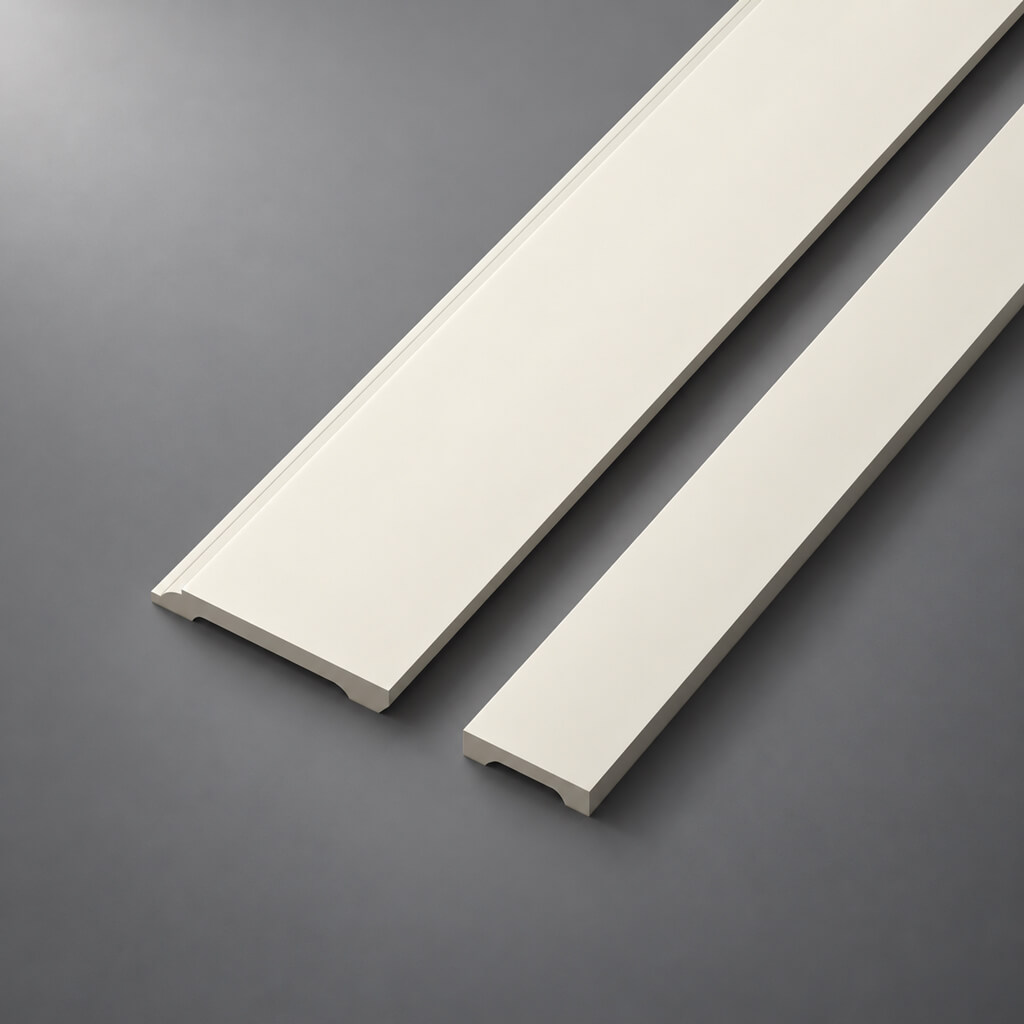
- Wall moldings: horizontal boundaries
- Molding frames: creating 'architectural panels'
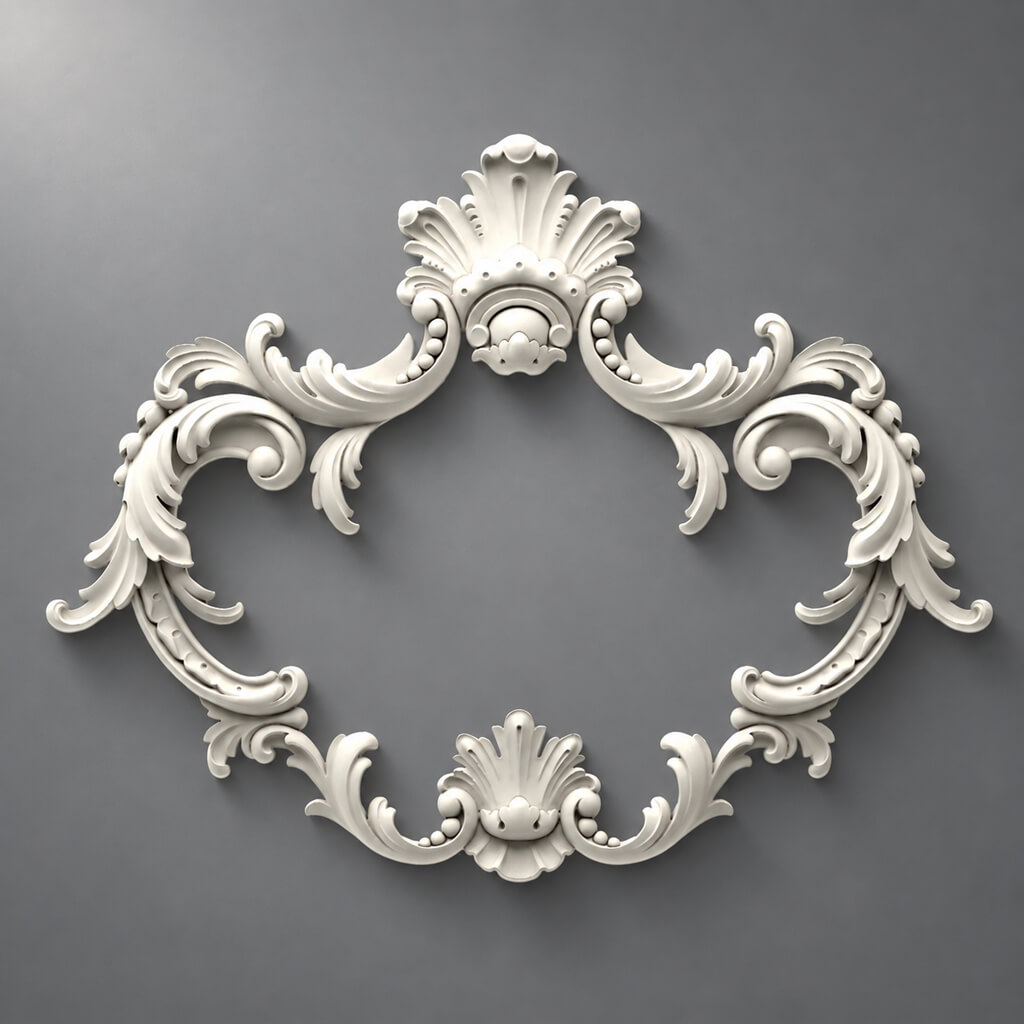
- Overlay elements: pilasters, consoles, keystones
- Technical parameters of polyurethane wall molding
- Polyurethane vs. gypsum vs. polystyrene
- Technical parameters of a high-quality PU element
- How to check quality in the store
- Where to use panels and where to use molding: the logic of role separation
- Recessed panels — for zones of continuous rhythm
- Molding — for boundaries, frames, and accent points
- Combined schemes for different rooms: specific solutions
- Living room: accent wall with framing
- Bedroom: slatted headboard and framed ceiling
- Study: wood and architectural rigor
- Hallway and hall: first impression through architecture
- Children's room: lightness, naturalness, minimal ornamentation
- How to maintain balance and avoid turning the interior into chaos
- The 'one voice, one whisper' principle
- The rule of proportionality
- The rule of color discipline
- The 'Complete Sentence' Rule
- Installation: what's important to know before starting work
- Work Sequence: What Comes First, What Comes Second
- Material Acclimatization
- Priming Molding is Mandatory
- Molding Adhesive is Specialized
- Lighting Scenarios: How Illumination Activates Relief
- Accent lighting on a slatted wall
- Indirect Light Behind the Cornice
- Light Behind the Slat Construction
- Material Selection: Buyer's Checklist
- Checklist for Slat Panels
- Checklist for Polyurethane Molding
- FAQ: Questions and Answers on the Topic
- About the Company STAVROS

A smooth white wall is a blank canvas. Beautiful, neutral, safe. And precisely because of that — boring. A person who has spent enough time in a white room begins to feel not peace, but absence. An absence of character, scale, depth. A wall as such is simply a boundary that separates 'inside' and 'outside'. But a wall as an architectural element is a completely different story.
Slatted wall panels and polyurethane wall molding are two tools that transform a plane from a boundary into a statement. One creates a vertical rhythm, a play of shadows in the gaps, tactile depth. The other establishes horizontal frames, accent points, architectural punctuation marks. Together — they create what interior photographers call 'this is impossible to convey in a photo': a sense of volume, complexity, and liveliness of space.
Let's break this down step by step. With examples, numbers, specific diagrams, and honest warnings.



Why a smooth wall doesn't always work anymore
There are spaces where a smooth painted wall is the absolutely correct solution. Small bathrooms, technical rooms, gallery spaces for art. A clean background.
But in a residential interior — in a living room, study, bedroom, hallway — a smooth wall often creates a sense of incompleteness. Not because 'something is missing for beauty,' but because a plane without relief deprives the space of scale.
Scale in an interior is not physical size. It is the feeling of proportionality between a person and the space. When there is a vertical rhythm of slats on the wall, the gaze gets a reference point. When there is a cornice and molding, the ceiling 'separates' from the wall — a sky appears above the architecture. When there is a pilaster by an opening, the opening becomes a 'gateway,' not just a hole in the wall.
Relief is the language in which space speaks to a person. A smooth wall is silent. Sometimes that's good. But in a living space — most often it's a missed opportunity.




What slatted wall panels provide: five key effects
Speaking pragmatically, a slatted wall panel solves several tasks simultaneously—and it is precisely this multifunctionality that makes it the most sought-after element in modern interior renovation.
Our factory also produces:



Effect 1: Vertical Rhythm as Spatial Organization
A row of vertical slats is rhythm. Rhythm in space works just like in music: it creates expectation and its fulfillment, order without monotony. The eye moves along the wall, reading this rhythm, and returns satisfied.
Narrower slats (35–45 mm) create a frequent rhythm—the wall is perceived as a 'fabric,' delicate and soft. Wider slats (70–100 mm) create a slower, 'weightier' rhythm. For high-ceilinged rooms—choosing the slat width is like choosing the tempo.
Get Consultation
Effect 2: Illusion of Height
Vertical lines of the slats 'raise' the ceiling—this is an optical effect proven by generations of designers. In an apartment with a ceiling height of 2.5–2.6 m, a slatted wall from floor to ceiling visually adds 15–25 cm of perceived height. The actual height hasn't changed—the perception has.
Enhancing the effect: slats in a tone close to the ceiling (white slats + white ceiling). The gaze does not 'stop' at the top edge of the structure but continues its movement upward.
Effect 3: Acoustics
A slatted construction with gaps is an acoustic panel. The gaps absorb high-frequency sounds, and the supporting system can be supplemented with sound-absorbing material (basalt wool, PEF). In a living room with a TV, a study with an audio system, or a children's room with active play—a slatted wall reduces reverberation.
Technically:slatted panels on the wallwith a 12–15 mm gap and mineral wool behind the structure reduce RT60 (reverberation time) by 15–25% in a room with a volume of 30–50 m³.
Effect 4: Play of light and shadow
Slats create texture. Texture in side lighting creates shadows. Shadows are depth that cannot be painted or imitated by wallpaper with 'wood imitation'. It's physics: light falls on a protrusion, behind the protrusion — a shadow.
With directed accent lighting (spots or track lights at a 30–40° angle to the surface), the slatted wall comes to life. Each slat casts a precise, thin shadow on the adjacent one. The wall ceases to be flat — it becomes three-dimensional.
Effect 5: Materiality
In an era of laminates, vinyl wallpapers, and 'imitation of anything,' real material is a rarity. MDF with a two-component coating, natural oak with UV varnish, thermally modified wood with hard oil — these are surfaces that carry information about the manufacturing process. Tactility. Smell. Surface temperature. This is materiality — something that cannot be reproduced by an image.
Slatted wall panelsmade of natural wood or high-quality MDF — is a statement that in this space, the real thing was chosen.
How wall molding changes the perception of space
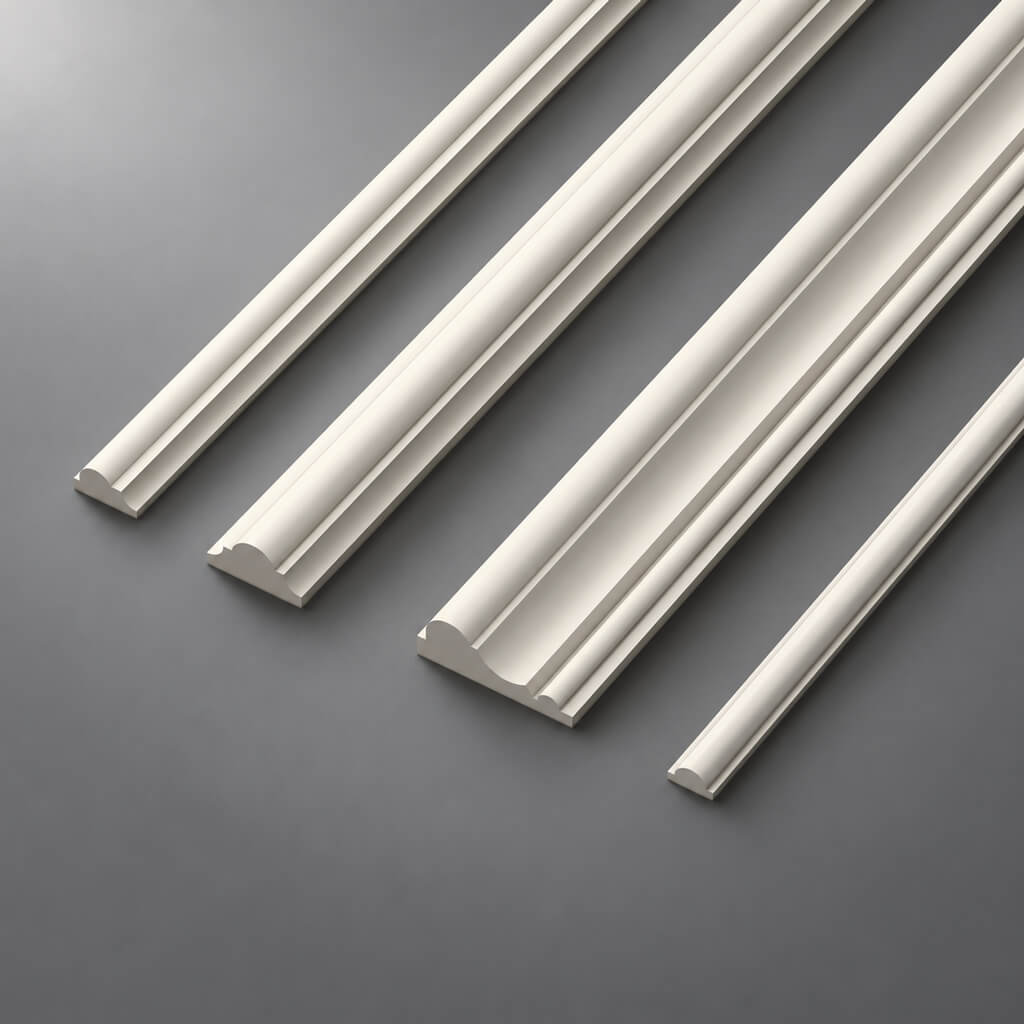
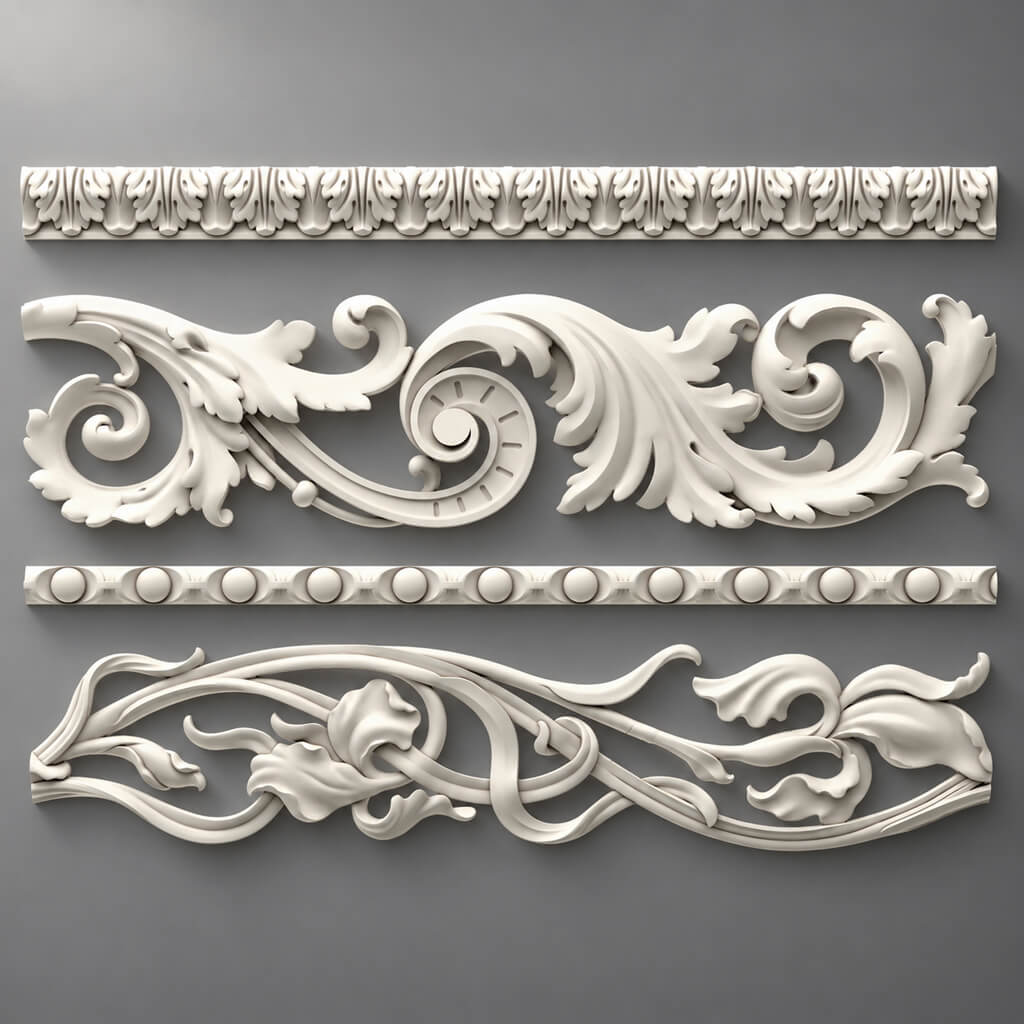
Polyurethane molding on wallsis a fundamentally different tool compared to slatted panels. Slats create a continuous rhythm. Molding creates accents, boundaries, frames.
If slats are poetry whose rhythm carries you along the wall, then molding is punctuation: a period, comma, exclamation mark. Without punctuation, even good poetry becomes unreadable.
Wall moldings: horizontal boundaries
A horizontal wall molding does two things simultaneously. Visually — it divides the wall into zones: lower (darker, more saturated), upper (lighter, neutral). Architecturally — it creates a 'belt' that ties all the walls of the room into a single horizontal line.
In a room with a slatted lower zone: a horizontal molding along the top edge of the slatted structure is the 'shelf line,' separating the wood or MDF from the plastered upper part of the wall. Without this molding, the top edge of the structure looks unfinished. With the molding — it's an architectural solution.
Molding frames: creating 'architectural panels'
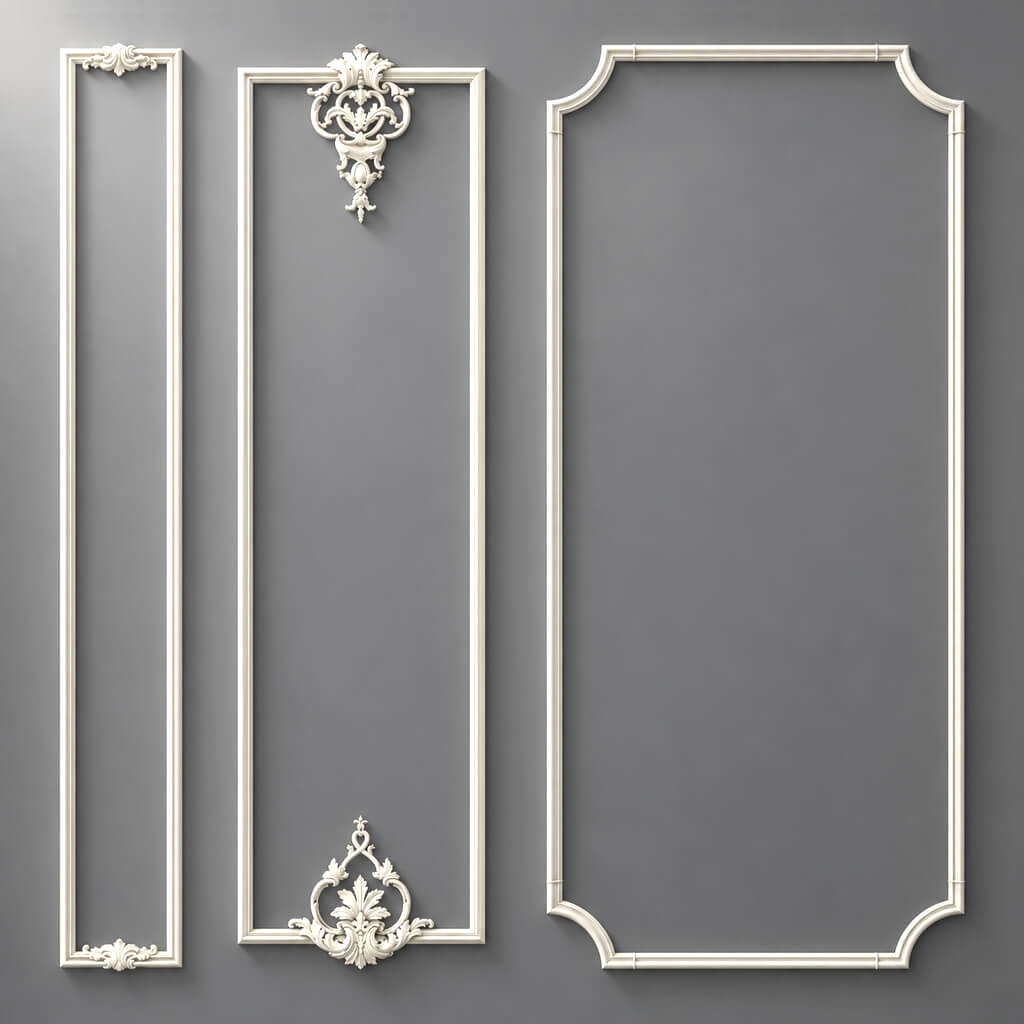
Rectangular molding frames on a wall are a classic interior technique known as 'panel layout.' It transforms a homogeneous wall into a structured surface, visually organized and 'readable.'
polyurethane wall molding for the living roomin the form of molding frames is the most in-demand application. Molding width: 25–50 mm. Relief depth: 10–20 mm. Frame width on the wall: 50–70% of the wall width. Frame height: 50–70% of the height of the wall zone it frames.
Applied elements: pilasters, corbels, keystones
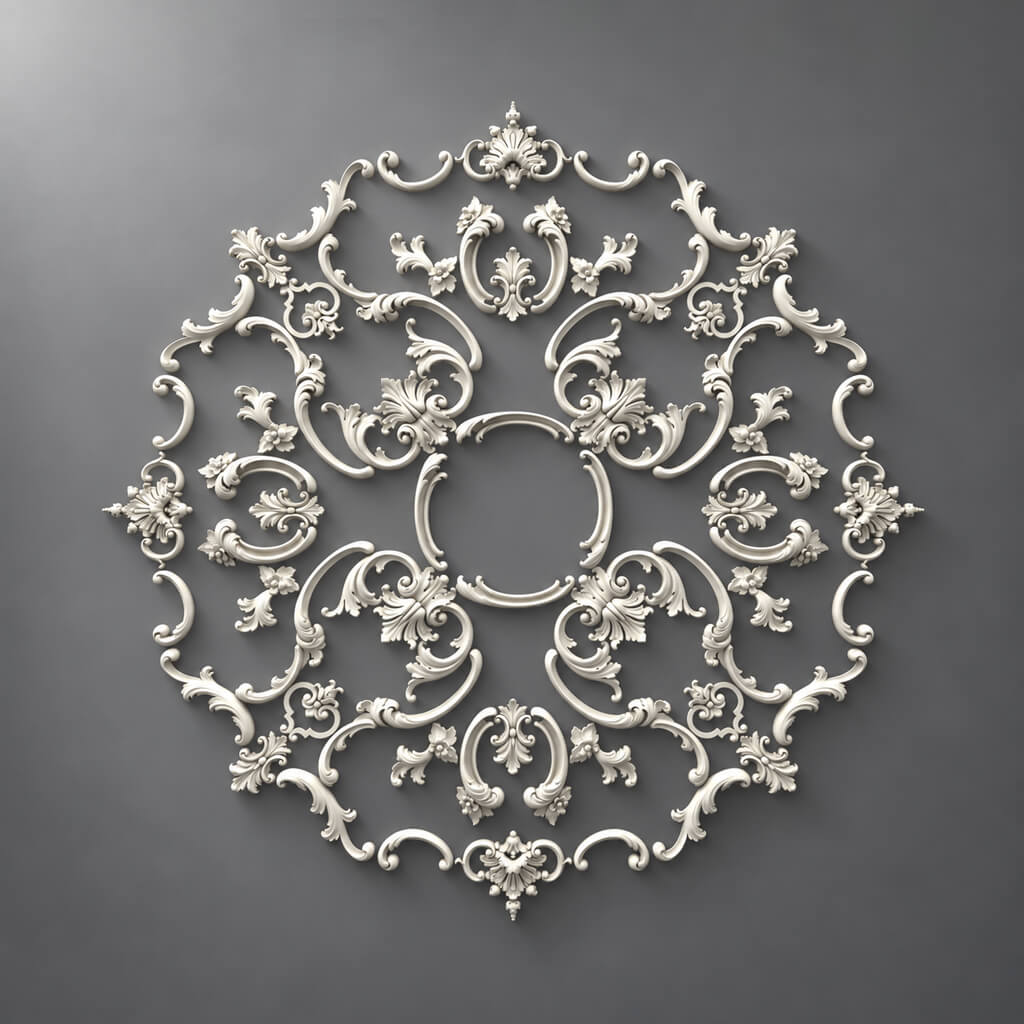
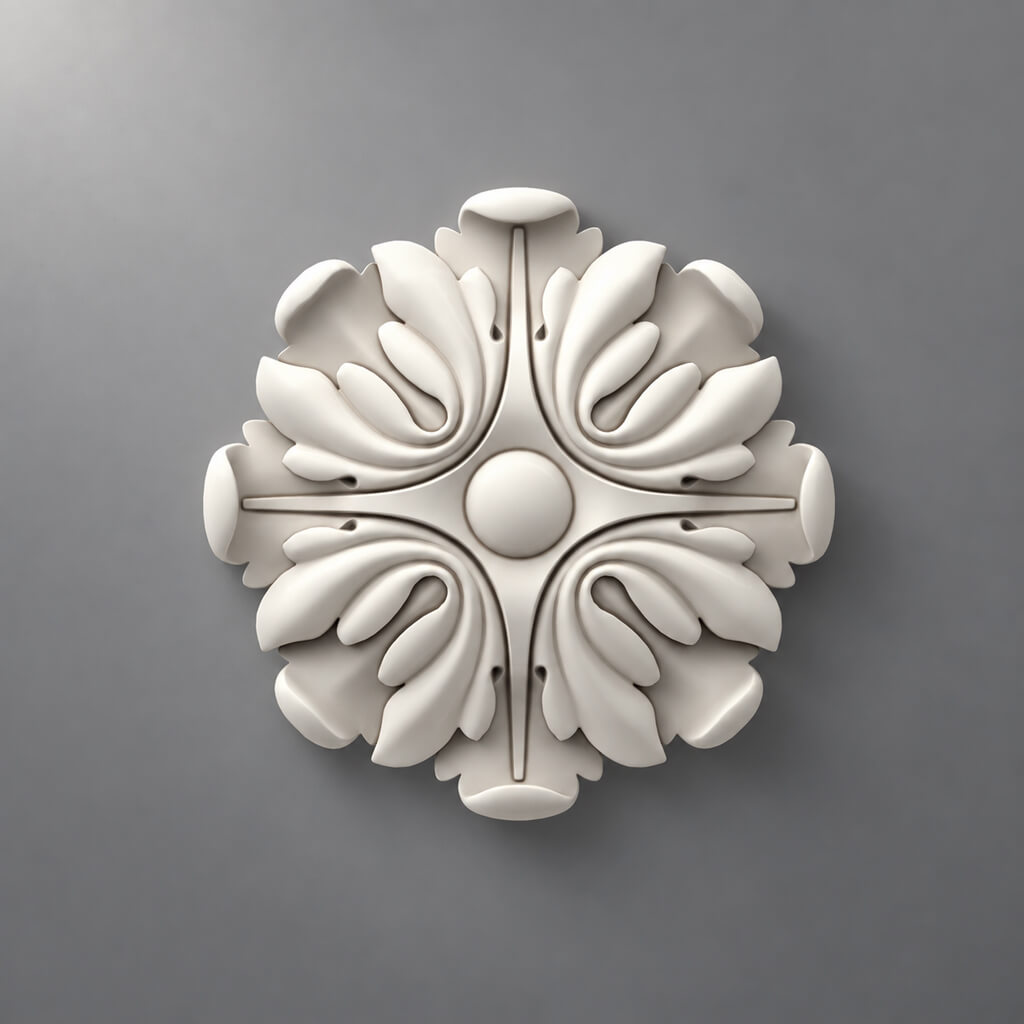
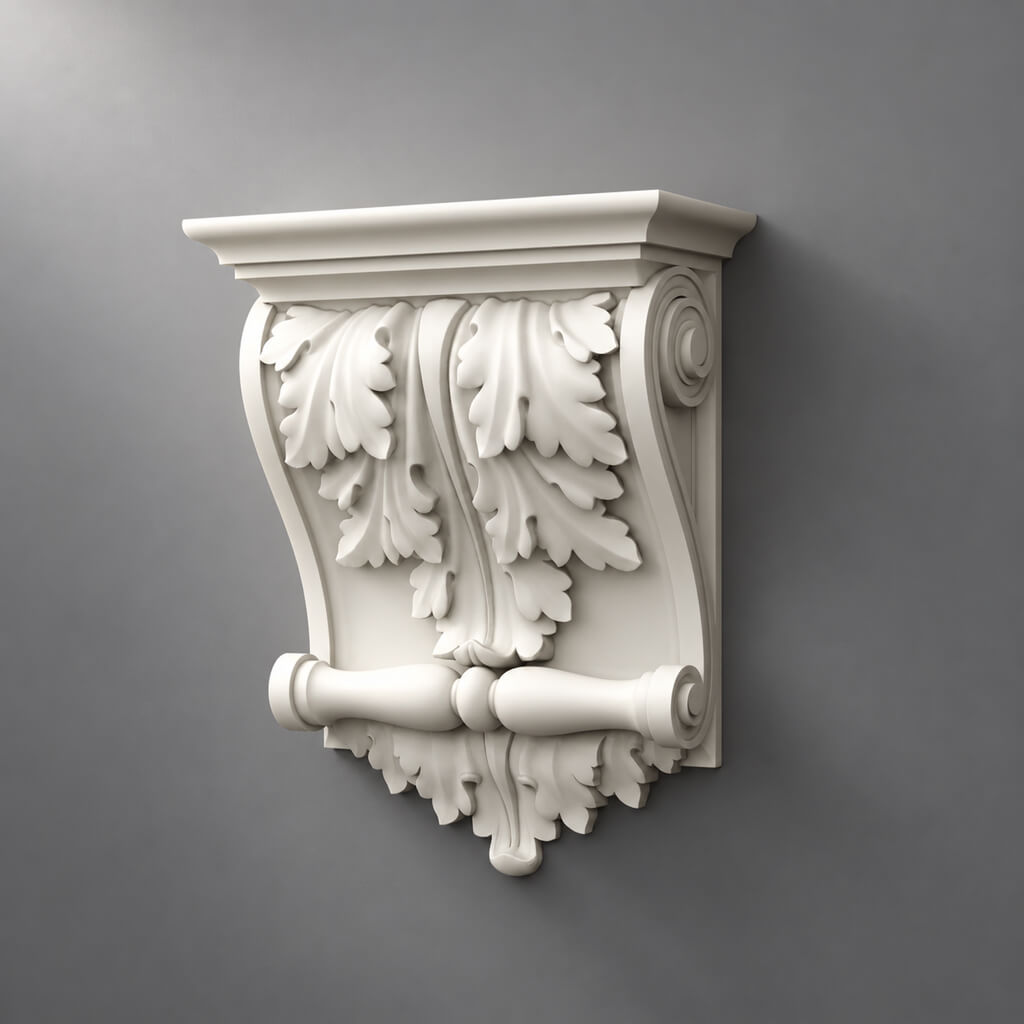
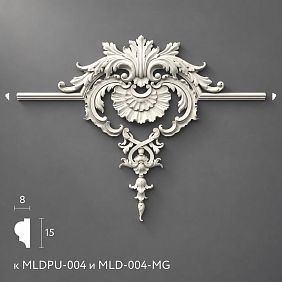
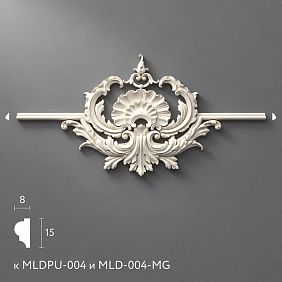
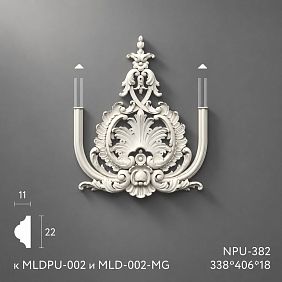
Polyurethane wall decorin the form of applied elements are architectural details that transform neutral planes into meaningful space.
Pilasters at the edges of a slatted structure: the slats 'stand' within a frame of pilasters — the structure gains a beginning and an end, becoming a complete statement.
Keystones above doorways: 'lock' the arch or rectangular opening, creating an accent above the entrance.
Decorative corbels under overhanging shelves: architectural justification for a shelf that is 'not just nailed on'.
Corner blocks: join moldings at internal and external corners more precisely than a 45° miter joint. Especially important for complex ornamental profiles.
Technical parameters of polyurethane wall molding
Before discussing application schemes, it is necessary to understand the material. Why polyurethane — and how does it differ from alternatives?
Polyurethane vs. plaster vs. polystyrene
| Parameter | Polyurethane | Gypsum | Polystyrene |
|---|---|---|---|
| Weight (80 mm cornice, kg/m) | 0,30–0,40 | 1,5–2,5 | 0,12–0,18 |
| Water absorption | <0,5% | 20–25% | <1% |
| Relief accuracy | High | High | Low |
| Mechanical resistance | Elastic, does not crumble | Brittle | Crumbles |
| Repaintability | Yes, acrylic paint | Difficult | Poor |
| Flammability | G1–G2 (self-extinguishing) | Does not burn | G4 (burns) |
| Service life | 20–30+ years | 10–15 years | 3–7 years |
Polyurethane moldings— the only material that combines sharp relief detail with moisture resistance, light weight, and self-extinguishing properties. For residential interiors — a professional choice without compromises.
Technical parameters of a high-quality PU element
-
Polyurethane density: 300–450 kg/m³
-
Elasticity modulus: does not deform when pressed with a finger
-
Factory color: white, for painting
-
Length of linear elements: 2.0 m (standard)
-
Geometry tolerance: ±0.5 mm over 2.0 m length
-
Installation adhesive: special PU adhesive or polyurethane mounting foam adhesive
How to check quality in the store
-
Squeeze the sample with your fingers: high-quality PU does not deform. Polystyrene crumples.
-
Bend the sample 30°: PU bends and returns to shape. Polystyrene breaks.
-
Examine the relief: clear, sharp edges of the ornament. Blurred edges are a sign of a worn-out mold.
-
Press against a flat surface: the back side should fit without gaps.
Where to use panels and where to use molding: the logic of role separation
A common mistake is to perceive slatted panels and molding as interchangeable decorative options: 'either one or the other.' In fact, they serve different architectural roles and are intended for different zones.
Slatted panels are for zones of continuous rhythm
Accent wall entirely: from floor to ceiling or up to the molding level. The slatted structure occupies the entire plane—this is its 'native' task.
Lower wall zone (wainscoting): from floor to a height of 1.0–1.6 m. Historically, the lower third or half of the wall was clad with wooden panels—for protection and aesthetics. Modern slatted wainscoting reproduces this idea with CNC production precision.
TV or fireplace enclosure: a niche or projection clad with slats. The structure 'frames' the appliance, turning it from an electronic device into an architectural element.
Niches and alcoves: a curved wall of a niche clad with slats—the effect of a 'theater box.'
Molding is for boundaries, frames, and accent points
Top edge of slat construction: molding as the 'cap' of the structure.
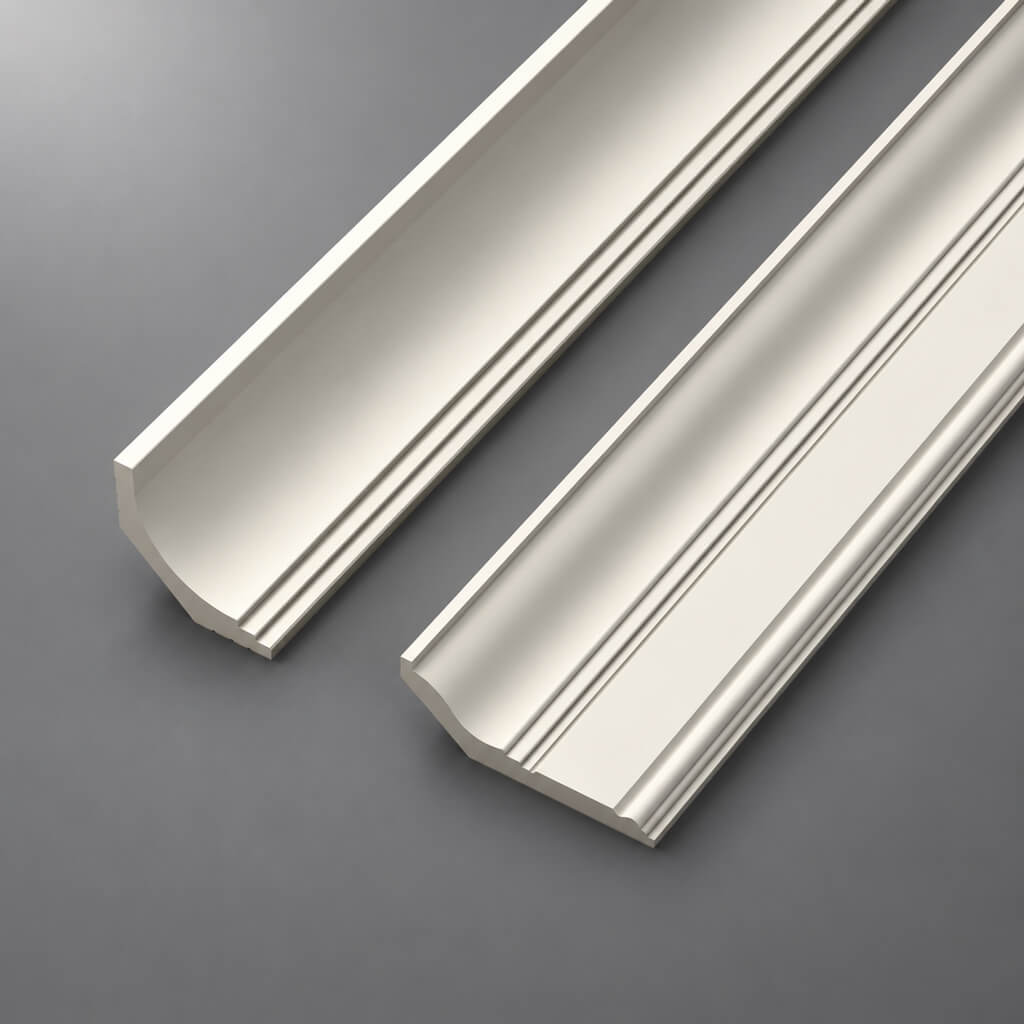
Ceiling perimeter: cornice as the boundary between wall and ceiling.
Framing of door and window openings: molding around the opening — classic 'architrave'.
Molding frames on walls: above the slat construction or on walls without slat panels.
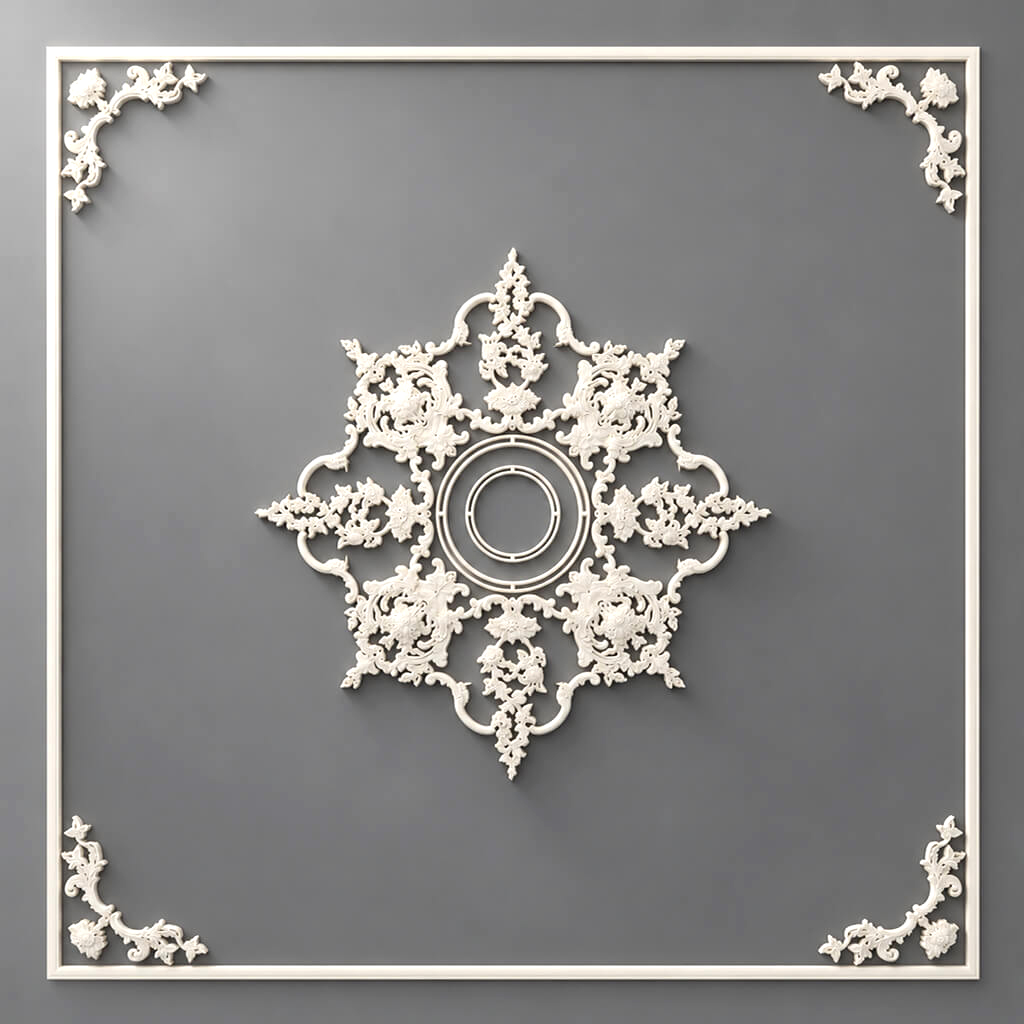
Ceiling rosettes: for chandeliers and central light fixtures.
Pilasters along the edges of slat constructions: vertical frame elements.
Combined schemes for different rooms: specific solutions
Time to move from principles to practice. Below are proven combined schemes for main rooms in apartments and houses.
Living room: accent wall with framing
Scheme A: 'Dark accent with white frame'
Wall slat panels: MDF MR, anthracite RAL 7016 or dark blue. Slat width 55 mm, gap 13 mm. Height: floor to ceiling.
Support system: metal profile, 25 mm gap. LED strip at the top edge of the support profile — indirect lighting in the gaps.
Molding: 80 mm white cornice, around the entire ceiling perimeter. 55 mm white pilasters on both edges of the slat structure — slats 'stand' in a white frame. Molding frames on adjacent light walls — white, 30 mm profile.
Result: a dark slat wall in a white architectural frame — a contrast that defines the entire living room.
Scheme B: 'Modern classic in neutral tones'
MDF slats for painting, linen tone NCS S 2010-Y20R. 70 mm cornice, same tone or one shade lighter. Molding frames on the wall above the slat structure — matching the wall tone.
Monochromatic effect: the interior is read through relief, not through color contrast. Expensive, complex, unique.
Scheme C: 'Natural wood in a white frame'
Oak slats with UV varnish, natural or 'smoked oak' tone. White cornice 75–85 mm. White molding frames above the level of the slat structure.
For this scheme, the cornice tone is critical: not cool white (bluish), but warm white or milky — otherwise a cool cornice 'conflicts' with warm wood.
Bedroom: slatted headboard and framed ceiling
Bedroom — an intimate space. More delicate scales are at work here.
Slatted wall behind the headboard:
Slats 40–50 mm in a light tone (ash with oil, light MDF). Gap 10–12 mm. Height: from floor to ceiling or from mattress level to ceiling.
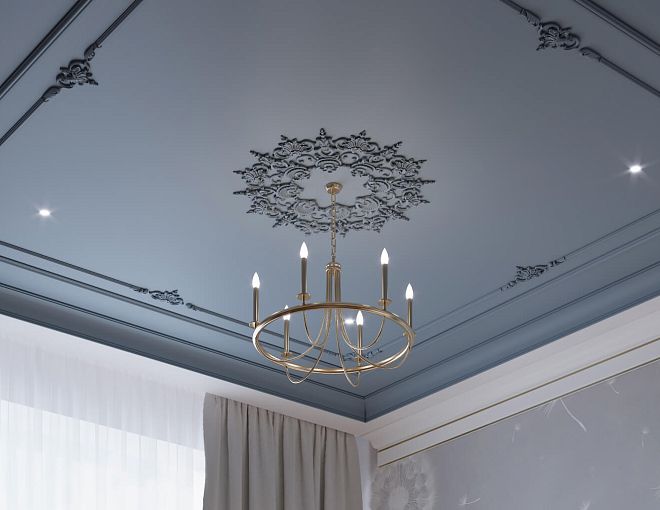
polyurethane wall molding for the living roomis also applied in the bedroom following the same principles: a 55–65 mm cornice around the perimeter. A 180–220 mm rosette for a pendant light above the center of the bed. No molding frames on the walls — the bedroom doesn't need complexity.
Lighting: sconces on the sides of the bed. They create side lighting — shadows in the gaps of the slatted wall come alive.
Coffered ceiling made of moldings:
Rectangular division of the ceiling with 30–40 mm moldings. Without actual recess — a 'flat coffer' created by relief. In a bedroom with a ceiling height of 2.7–2.8 m: three to four coffers in a row, two rows. Creates a 'library ceiling' feel without being overloaded.
Study: wood and architectural rigor
Study — a space for concentration. Schemes that gather the space, rather than scatter it, are at work here.
Slatted wall behind the workstation:
Vertical slats 55–65 mm made of tinted oak or dark-toned MDF. From the floor to the shelf line level (1.6–1.8 m). Above — shelves or a wall in a dark tone.
Horizontal molding along the 'shelf line': the boundary between the lower slatted zone and the upper one.Polyurethane wall decorIn the form of corner overlays on the inner corners of the slatted structure.
Ceiling: 80–90 mm cornice, profiled. Coffered division on the ceiling with 35 mm moldings — an 'archival' grid organizing the ceiling space.
Pilasters by the bookshelves:
Built-in bookshelves from floor to ceiling. At the edges — polyurethane pilasters: 'columns' giving the bookcase architectural status.
Entrance hall and foyer: first impression — through architecture
The entrance hall works for just a few seconds. That's exactly how much time you have to make an impression on someone entering — and that's why every detail here matters.
End wall of the entrance hall:
Slatted wall panels on the end wall — from floor to ceiling. Color: contrasting to the main tone of the hallway. Dark slats + light other walls. Or vice versa.
Molding: cornice around the perimeter, molding frame around the mirror on the slatted wall. The mirror is 'built-in' to the architecture — it doesn't hang, it belongs.
High hall of a country house:
Slatted lower zone 1.5–1.8 m high on all walls. Horizontal molding 'belt' on top. Above — walls in a neutral tone. 100–120 mm cornice at the 3.0+ m ceiling.
slatted panels on the wallin such a hall sets the tone for the entire house.
Children's room: lightness, naturalness, minimal ornament
The children's room is a special case. What's important here:
-
Eco-friendliness: E0 class MDF, water-based acrylic coating without solvents
-
Simplicity of forms: laconic cornice without ornament
-
Light tones: slatted panels in white, pastel, or natural wood
Molding in a child's room: only a smooth 45–55 mm cornice around the perimeter. No ornamental overlays or rosettes — children will fill the space with content themselves.
How to maintain balance and not turn the interior into chaos
This section is the most important. This is where most people make critical mistakes: starting with moderate decor, they end up with an overloaded space where every element screams for attention.
The 'one voice — one whisper' principle
In every room, one element should be the main decorative accent. The others should be subordinate.
If the main voice is a slatted wall, the molding should 'whisper': a smooth cornice, minimal moldings. If the main voice is an ornamental ceiling cornice with a rosette, the slats should be laconic: narrow, smooth, in a neutral tone.
Two 'loud' voices at the same time create visual conflict, not double beauty.
The rule of proportionality
Every element should correspond to the scale of the room.
| Parameter | Formula | Example |
|---|---|---|
| Cornice height | 1.5–2.5% of the room height | 2.7 m → 40–67 mm |
| Socket diameter | 10–15% of the ceiling's shorter side | Room 4×5 m → 400–600 mm |
| Slat width | 1.5–2.5% of the wall height | Wall 2.7 m → 40–67 mm |
| Molding frame width | 50–70% of the wall zone width | Zone 1,2 m → 600–840 mm |
Element larger than the permissible range — suppresses. Smaller — gets lost.
Rule of color discipline
Maximum three colors in an interior with slatted panels and moldings:
-
Neutral background (walls, ceiling): white, cream, light gray
-
Main decorative color (slats): wood tone or painted MDF
-
Molding: same tone as background, or white
Separate molding color (different from background and slats) — a fourth element that overloads. Exception: special designer concepts with a clearly structured system.
Rule of "complete sentence"
Architectural decor works when it is complete. A cornice without a baseboard — an incomplete sentence. A molding frame without corner joints — an incomplete sentence. A slatted structure without side finishing elements — the same.
Each decorative system must be complete: top element, bottom element, side borders.
Installation: what's important to know before starting work
DIY Batten Panels— a realistic option for a person with basic skills. But there are several fundamental points, ignorance of which reduces quality material to a poor result.
Work sequence: what comes first, what comes second
Rule: molding is installed before the slat construction. Cornice, moldings, rosettes — first. Ceiling and upper wall zones are painted before installing slats. After installing the slat construction, these zones become inaccessible.
-
Base preparation: putty, primer
-
Layout: laser level, plan for placement of all elements
-
Installation of ceiling rosettes
-
Installation of the cornice
-
Painting the ceiling and upper wall zone
-
Load-bearing system of slat construction (metal profile)
-
Installation of slats
-
Finishing elements of the construction (baseboard, side strips)
-
Sealing joints with acrylic sealant
-
Painting battens (if intended for painting)
Material acclimatization
MDF battens delivered from cold storage must acclimate for 24–48 hours at room temperature. Installation without acclimatization in winter guarantees warping upon heating.
Wooden battens: 48–72 hours of acclimatization.
Priming moldings is mandatory
Polyurethane elements must be primed with PU primer before painting. Without primer, acrylic paint will not properly adhere to polyurethane and will peel within 12–18 months.
Adhesive for moldings is specialized
Mounting adhesive for PU is not universal 'liquid nails'. Special composition: polyurethane adhesive foam or acrylic mounting adhesive for moldings. Without special adhesive, adhesion is insufficient, especially in above-average humidity.
Lighting scenarios: how accent lighting activates relief
Architectural decor lives in light. A smooth wall under any lighting remains a smooth wall. A batten structure and relief moldings under different lighting become fundamentally different surfaces.
Accent lighting on a slatted wall
Angle of incidence 25–40° to the surface. Source: spot or track light with adjustable angle. Shadows in gaps between slats: at 30° angle and 12 mm gap, shadow behind slat is 4–6 mm deep. Wall transforms from a plane into relief.
Color temperature: 2700–3000 K for warm wood tones. 3000–4000 K for cool MDF tones.
Indirect light behind cornice
LED strip behind cornice back shelf: light directed at ceiling, creates 'light halo'. Ceiling glows evenly, without visible source. Ceiling height is perceived as greater.
Strip power: 8–14 W/m. Color temperature: 2700–3000 K.
Light behind slatted structure
LED strip on load-bearing profile at structure's upper edge. Light shines through gaps or directed upward — behind structure. Effect: slats 'float' in glowing space. Effortless magnetism.
Material selection: buyer's checklist
Checklist for slatted panels
-
MDF class: E1 (dry residential) or MR E1 (wet areas)
-
Coating type: 2K polyurethane varnish or water-based acrylic
-
Geometry: width tolerance ±0.3 mm (caliper)
-
Straightness: deflection over 2.4 m no more than 2 mm
-
Ends treated (primer or varnish)
-
Documentation: declaration of conformity
Checklist for polyurethane moldings
-
Density: does not deform when pressed with a finger
-
Elasticity: bends without breaking at 30°
-
Relief: clear, sharp edges of the ornament
-
Back geometry: fits tightly to a flat surface
-
Length: 2.0 m standard, check compatibility
-
Inclusion of special adhesive in the supply
FAQ: questions and answers on the topic
Can slatted panels be installed on a wall over old wallpaper?
No. The load-bearing system is attached to a load-bearing base (concrete, brick, drywall on a metal frame). Wallpaper is not a load-bearing base. Removal of wallpaper is mandatory.
Slatted panels on the wall in the bathroom — is it possible?
Only thermally modified wood or MR MDF with 3–4 layers of 2K coating, provided forced ventilation is present. Without ventilation — no wooden material is recommended.
What is the difference betweenPolyurethane molding on wallsfrom ceiling molding?
Structurally — no difference. The difference lies in installation requirements: on the ceiling — mandatory clamping until the adhesive fully cures, additional fastening with dowels if necessary. On the wall — the weight places less load on the fastening.
How to choose the width of a slat for a wall with a height of 2.7 m?
Working range: 40–70 mm. Narrow slat (40–45 mm) — a more delicate, 'fabric-like' rhythm. Wide (60–70 mm) — a slower, 'weightier' rhythm. A personal choice, but do not exceed 2.5% of the wall height.
Is a molding needed along the top edge of the slatted structure if it does not reach the ceiling?
Mandatory. An open top end of the structure without molding is an unfinished solution. Molding creates a 'cap' that completes the structure.
Can slatted wall panels be combined with wallpaper?
Yes. The scheme 'slatted lower zone + wallpaper upper zone' is classic wainscoting. Boundary: a horizontal molding at a level of 1.2–1.6 m.
Which cornice to choose for a 2.5 m ceiling?
Smooth, without ornament, height 40–55 mm. An ornamental cornice at 2.5 m — feels oppressive. Only a laconic profile.
How to properly prepare a polyurethane element for painting?
-
Wipe with degreaser. 2. Apply PU primer in a thin layer. 3. Let dry for 2–4 hours. 4. Acrylic paint in 2 coats with intermediate drying.
About the company STAVROS
A wall with character is not an accident. It is the result of the right materials, precise manufacturing, and an understanding of how details work together. A slat cut with a 2 mm tolerance — is an ugly wall. A cornice made of polystyrene instead of polyurethane — is yellowing decor in three years. Molding without primer — is peeling paint.
STAVROS is a Russian manufacturer with a full production cycle: chamber wood drying, CNC milling with ±0.1 mm tolerance, two-component coatings in factory paint booths, casting polyurethane elements in silicone molds. Emission class E1. Full documentation.
For projects with slatted panels and molded decor in the STAVROS catalog:
-
DIY slatted panels on the wall— step-by-step guide from preparation to finish
-
Polyurethane moldings— full range: moldings, overlays, trims
-
polyurethane wall molding for the living room— overlay elements, rosettes, pilasters, consoles
-
Polyurethane wall decor— architectural details for any style
-
Moldings made of polyurethane— cornices, molding profiles, baseboards
-
Wooden slat panels— oak, ash, thermowood with factory coating
Samples — upon request. Free consultation on selecting elements, proportions, and color solutions for your specific project. STAVROS — because the volume of space begins with the right plane.