Article Contents:
- Wooden cornice KZ-010 66×51 mm: which items are actually available for ordering
- KZ-010 from MDF 2600 mm
- Beech cornice KZ-010 2400 mm
- Oak cornice KZ-010 2400 mm
- Theoretical number of packaging groups for MDF
- Theoretical number of packaging groups for solid wood
- What is the size of KZ-010?
- What is the length of KZ-010 made of MDF?
- What is the length of KZ-010 made of beech?
- What is the length of KZ-010 made of oak?
- Can I order KZ-010 for several apartments in one batch?
- Do you need to choose the material first or calculate the quantity?
- Why can't the calculation for 2600 mm be used for 2400 mm?
- How is KZ-010 packaged?
- Is the packaging for MDF and solid wood the same?
- Where can I see the current packaging conditions?
- Where can I buy the wooden curtain rod KZ-010?
- Where can I see the price of KZ-010?
- How do I arrange delivery for a long curtain rod?
- Do the slats need to be labeled by apartment?
- How should leftovers be accounted for between identical rooms?
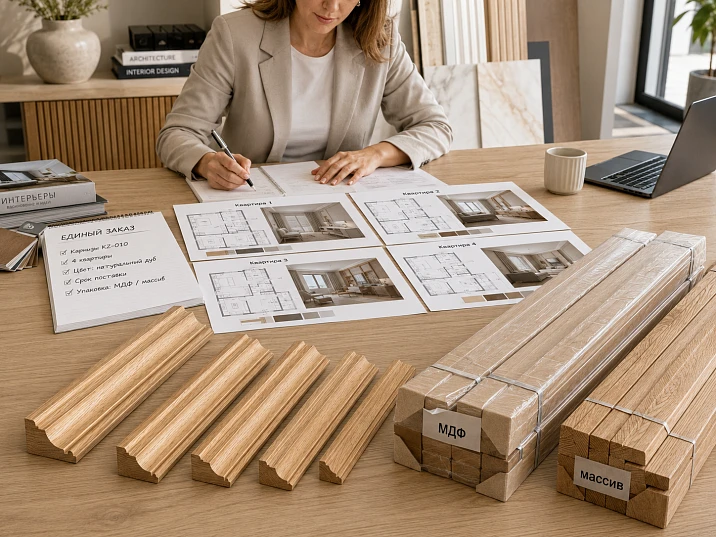
In four apartments, the same ceiling profile KZ-010 has been approved. The designer has already chosen the model, the rooms are repeated, the wall lengths have been measured, and the purchase list contains the usual line: "KZ-010 — N pcs." For a retail order of one room, this is sometimes enough. For a batch of four apartments, it is not.
Before payment, five things need to be linked into one system:
-
material KZ-010;
-
actual length of the product strip — 2600 or 2400 mm;
-
number of whole items after cutting;
-
rigid packaging rules;
-
method of assembling and delivering four apartments.
This is especially important for KZ-010, because the same model is sold in different materials and lengths:
-
MDF — 66×51×2600 mm;
-
beech — 66×51×2400 mm;
-
oak — 66×51×2400 mm.
The card also directly specifies a rigid packaging frame and different packing standards: for MDF — up to 5 items, for solid wood — up to 2 items per packing group. This means that the same number of slats from different materials can create a different number of rigid packing units.
Therefore, the correct sequence is as follows:
layout of each apartment → parts list → material → cutting 2600/2400 mm → number of whole KZ‑010 → preliminary number of packing groups → packing by apartments → confirmation of packing and delivery by the seller → payment.
After this check, you can buy wooden cornice KZ-010 already as a calculated batch, not as abstract footage.
The main idea of the article:
the list "KZ‑010 — 24 pcs." is not yet a ready order until the material, length, cutting, packing logic, and address-based packing are recorded in it.
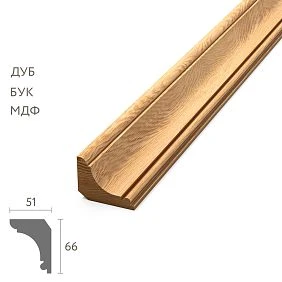
Wooden cornice KZ-010 66×51 mm: which positions are actually available for order
The current KZ‑010 card confirms three main versions:
| KZ‑010 version | Size |
|---|---|
| MDF | 66×51×2600 mm |
| Beech | 66×51×2400 mm |
| Oak | 66×51×2400 mm |
For all three options, one article number KZ-010 is used, but this is not one universal product unit. For large batches, the material and length must be specified.




KZ-010 made of MDF, 2600 mm
MDF has a length of 2600 mm. It is useful not by itself, but where specific pairs of parts fit within 2600, but no longer fit within 2400.
For example:
1650 + 900 = 2550 mm.
This combination fits within 2600 mm, but not within 2400.
So, if four apartments contain many repeating pairs of 1600–1700 + 800–900 mm, MDF can reduce the number of whole strips.
But the material is chosen before cutting. You cannot take MDF just because the stick is longer if the project requires natural wood.
Our factory also produces:

Beech cornice KZ-010 2400 mm
Beech has a length of 2400 mm. For an apartment with short and medium sections, this may be sufficient, but some combinations convenient for 2600 mm split into two sticks.
For four apartments this scales: one extra plank per apartment turns into four additional product units and changes the packaging scheme.
Get Consultation
Oak cornice KZ-010 2400 mm
In terms of cutting, oak follows the same 2400 mm logic as beech.
The difference arises in:
-
material;
-
finishing;
-
cost;
-
distribution of the natural pattern across rooms.
For a large oak batch, it is useful to pre-sort planks by tone and assign them to apartments before cutting.
Why one article number does not mean one packaging unit length
In the purchase list, you cannot simply write:
KZ-010 — 28 pcs.
More correctly:
KZ-010 / MDF / 66×51×2600 / 28 pcs.
Or:
KZ-010 / oak / 66×51×2400 / 31 pcs.
These two lines have different:
-
length;
-
cutting map;
-
packing standard;
-
logistics.
Four apartments and one KZ-010: first we calculate each layout, then combine the purchase
Serialization helps save money, but only after each apartment is broken down into specific mounting parts.
Don't start with:
perimeter of one apartment × 4.
Start with the segment list.
The training apartment contains:
-
living room;
-
bedroom;
-
corridor;
-
kitchen;
-
short partitions;
-
zones where the cornice is interrupted by a door, wardrobe, or other element.
For the calculation, we will take the following conditional set:
| Code | Detail | Finished length |
|---|---|---|
| A | Main wall of the living room | 2480 мм |
| B | second wall of the living room | 2320 мм |
| C | Bedroom | 1680 мм |
| D | Corridor | 880 мм |
| E | kitchen/pier | 820 мм |
| F | Short section | 620 мм |
Sum for one apartment:
2480 + 2320 + 1680 + 880 + 820 + 620 = 8800 mm.
For four identical apartments:
8800 × 4 = 35 200 mm.
This is a useful checksum, but not yet the number of planks.
Why part A=2480 mm immediately separates MDF and solid wood
For MDF 2600 mm, A can be solid.
For beech/oak 2400 mm, a solid plank is no longer enough:
2480 − 2400 = 80 mm.
This means that in solid wood either a direct joint appears, or the design layout needs to be changed.
This already shows why the material cannot be changed after the finished calculation.
Why B=2320 mm works differently
B fits into both 2400 and 2600.
But the remainder:
For 2400:
80 mm;
For 2600:
280 mm.
Both remainders are too short for most parts of the training apartment, so the extra length here has almost no effect on the quantity.
Why C+D are especially important
1680 + 880 = 2560 mm.
For MDF 2600:
the pair fits.
For the 2400 array:
2560 > 2400.
This means the same apartment already requires different maps.
E+F
820 + 620 = 1440 mm.
This pair easily fits in both lengths.
It is precisely such short combinations that are useful to transfer between apartments, rather than counting them in each room in isolation.
Buy wooden ceiling plinth: why material KZ-010 is chosen before the final quantity
Broad query buy a wooden ceiling plinth useful at the stage when the material of the ceiling molding is not yet fixed.
In the specific order KZ-010, the main rule is:
first the material, then the final quantity.
The reason is simple:
-
MDF = 2600 mm;
-
beech/oak = 2400 mm.
The difference of 200 mm affects not only the total purchase length, but also the ability to combine parts into one strip.
You cannot calculate MDF and then replace the material in Excel
If the table had:
1680+880 = 2560
and one MDF plank 2600,
then after replacing with oak 2400, this line ceases to exist.
You need to open another whip or rebuild the entire cutting layout.
You cannot calculate the array and then automatically switch to MDF
The reverse error is also possible.
A longer MDF may allow combining parts differently and reduce the quantity.
If you keep the old 2400 map, part of the 2600 mm advantage is simply lost.
Material affects finishing and packaging simultaneously
For a large batch, you cannot look only at the length.
Changing the material changes:
-
finish;
-
finishing preparation;
-
number of whole slats;
-
packing standard;
-
number of packages.
Therefore, the decision on the material must be frozen before the final order.
Cornice KZ-010 made of MDF 2600 mm: how to form a strip map for four apartments
Let's take the training layout from the previous section. For each apartment, the following parts are needed:
2480 / 2320 / 1680 / 880 / 820 / 620 mm.
First, we calculate one apartment.
A=2480 mm
Fits into one 2600 mm strip.
Nominal remainder:
120 mm.
B=2320 mm
Separate plank.
Remainder:
280 mm.
C+D
1680 + 880 = 2560 mm.
They fit into one plank 2600.
remains:
40 mm before accounting for actual cut and trimming.
This is a very tight layout. In practice, the craftsman must confirm the cutting lengths, not use the clean dimensions from the article as ready-made production.
E+F
820 + 620 = 1440 mm.
If counting the apartment in isolation, they will take up another plank.
It turns out:
4 MDF planks per apartment.
For four apartments:
16 planks.
But this is not yet the best serial cutting.
Why four apartments need to be combined into one pool
Instead of four separate pairs E+F, we get:
-
E=820 ×4;
-
F=620 ×4.
We are looking for a denser packing in 2600 mm.
For example:
820 + 820 + 620 = 2260 mm.
Two such strips are used:
-
all four E;
-
two F.
Two F remain:
620 + 620 = 1240 mm.
So, the entire short pool E/F can be laid in 3 strips, not four.
Total map result:
-
A ×4 → 4 planks;
-
B ×4 → 4;
-
C+D ×4 → 4;
-
common pool E/F → 3.
Total:
15 planks KZ‑010 2600 mm.
Comparison with isolated calculation:
16 − 15 = 1 plank.
Serial production of four apartments saves one whole rod only by redistributing short pieces.
Purchased length
15 × 2600 = 39,000 mm,
or 39 m of original KZ‑010.
Finish length of four apartments:
35.2 m
Nominal difference:
3.8 m
This is not a single remainder of 3.8 m. It is distributed among:
-
short tails after A;
-
remainders B;
-
technological reserve C+D;
-
short pool E/F.
Why this map should pass the control assembly
The combination is especially dense:
1680 + 880 = 2560 mm.
If the actual pre-cut lengths after corner cuts become:
-
1690;
-
890,
The result will be:
2580 mm.
The map still fits.
If the total blank length grows to 2610 mm, the combination breaks apart and the number of planks increases.
Therefore, before paying for a large batch, you need:
-
one reference set;
-
confirmed blank length;
-
only then the final quantity.
Exact anchor for MDF
After such a calculation, you can order KZ-010 from MDF 2600 mm already with a ready list of 15 full slats in the training scenario.
This is an example, not a universal quantity for four apartments.
Oak and beech KZ-010 2400 mm: why the old MDF calculation cannot simply be left as is
Now let's switch the same project to solid wood.
The cross-section remains KZ‑010 66×51 mm.
But the original length:
2400 mm.
The first conflict appears immediately.
A=2480 mm is longer than one slat
A solid piece from the standard KZ‑010 2400 mm cannot be made.
There are several design paths:
-
plan a direct joint;
-
divide the wall into two parts;
-
move the end point;
-
change the material back to MDF, if the design allows it.
For the calculation example, let's assume that A is divided into two equal parts:
1240 + 1240 mm.
This is not a universally best joint. It is used only to demonstrate purchasing logic.
B=2320 mm
Fits into one 2400 mm plank.
C=1680 mm
With D=880 it no longer combines:
1680 + 880 = 2560 mm > 2400.
But C can be combined with F=620:
1680 + 620 = 2300 mm.
Halves of A can be combined with D/E
1240 + 880 = 2120 mm.
1240 + 820 = 2060 mm.
That is, within one apartment, the following training map is obtained:
| Plank 2400 | Parts |
|---|---|
| №1 | B=2320 |
| №2 | C=1680 + F=620 |
| №3 | A1=1240 + D=880 |
| №4 | A2=1240 + E=820 |
Total:
4 planks of 2400 mm per apartment.
For four apartments:
16 planks.
Unlike MDF, the overall pooling in this specific scheme does not reduce the number below 16: each apartment is already assembled quite densely.
Why the number of planks is similar to isolated MDF, but the logic is different
MDF in an isolated calculation also gave four strips per apartment.
But:
-
A was solid;
-
C+D fit together;
-
short E/F occupied a separate whip.
For solid wood:
-
A is cut;
-
C connects with F;
-
halves of A absorb D/E.
The same number "4" hides completely different installation maps.
Why you can't first calculate 16 and then choose the material
If the material was MDF, the total batch after pooling is 15.
If it's solid wood, it's 16 with accepted joint A.
So the final number differs.
What if joint A is not allowed
Then the 2400 mm solid wood does not meet the original design of the 2480 mm solid piece.
The problem cannot be solved with extra packaging or allowance.
The architectural map needs to be changed.
This is a strong example where the procurement calculation reveals not "need more slats" but incompatibility of the designed part with the SKU length.
Why beech and oak are considered the same in terms of lengths
Both are confirmed in the 2400 mm format.
Therefore, the geometric map is one.
But with oak, the distribution of the natural pattern is especially important: paired sections in identical apartments can get different shades if the planks are not sorted before cutting.
Wooden cornice KZ-010: what is the packaging norm and why it matters for large batches
The KZ‑010 card contains information rare for a product article that directly affects B2B ordering:
-
rigid packaging frame;
-
for MDF — up to 5 items;
-
for solid wood — up to 2 items.
These values should not be interpreted as an automatic promise of a specific number of packages in the invoice. The actual packing of the order is confirmed by the seller.
But for preliminary logistics, they provide a very useful reference point.
Theoretical number of packaging groups for MDF
Training general map:
15 slats 2600 mm.
If packaging groups are assembled at the maximum rate of up to 5 items:
15 / 5 = 3 groups.
That is, the minimum possible preliminary structure:
3 rigid groups of 5 slats.
Theoretical number of packaging groups for the array
Training map:
16 slats 2400 mm.
Rate — up to 2 items.
16 / 2 = 8 groups.
It turns out:
8 packaging groups.
Main comparison
The number of product strips differs by only one:
-
MDF — 15;
-
solid wood — 16.
But the maximum packaging grouping gives:
-
3 MDF groups;
-
8 solid wood groups.
This is already a significant difference in organizing loading, labeling, storage, and receiving.
Why the word "up to" is fundamental
"Up to 5" does not mean that any order of 5 planks will necessarily be one package.
"Up to 2" does not mean that the seller is obliged to pack the array exactly in twos.
Actual packaging may be influenced by:
-
order composition;
-
finish;
-
transportation requirements;
-
technical conditions of the specific shipment.
Therefore, the article uses these numbers as a planning maximum, not as a ready-made transport waybill.
Frame 390 RUB: how to handle this figure
The card indicates a rigid packaging frame costing 390 RUB.
But before issuing the invoice, you don't need to multiply 390 by the estimated number of groups yourself and declare the packaging total as final.
Correct request to the manager:
"According to our preliminary map, 15 MDF and approximately 3 packaging groups at a rate of up to 5. Please confirm the actual number of rigid frames and the final packaging cost."
This way, the buyer uses the card data but doesn't substitute for the seller.
Buy MDF moldings: when a large batch of KZ-010 requires fewer packaging groups
Category buy MDF moldings useful for checking related MDF profiles, but in our article KZ-010 is already selected.
So the task isn't "why MDF is better," but what changes in the batch.
In the training scenario:
-
MDF — 15 slats;
-
solid wood — 16;
-
preliminary maximum packing groups — 3 versus 8.
Why one cannot conclude from this that "MDF is more profitable"
Packaging is only one part of the order.
Compare:
-
material;
-
appearance;
-
length;
-
number of joints;
-
number of slats;
-
packaging;
-
finishing;
-
delivery;
-
Installation.
For example, solid wood may be a mandatory design requirement, and then lower packing density simply becomes part of logistics.
When MDF truly gains a logistics advantage
If the project and finish allow MDF, and four apartments go in one shipment, the 2600 mm plank and higher packing rate can reduce:
-
the number of product strips;
-
the number of rigid groups;
-
the number of labeling units.
When the advantage disappears
If the object requests to pack each apartment separately.
Then 15 MDF panels can be distributed across four address sets, rather than three maximally dense groups.
That is, the object's logistics may be more important than the manufacturer's maximum packing standard.
Solid wood curtain rod: why packaging cannot be calculated according to MDF rules
For beech and oak, card KZ-010 specifies a separate standard — up to 2 items per packing group. This should be perceived not as "worse," but as a different product logic for long-length solid wood.
If the training batch after recalculation contains 16 slats of 2400 mm, the preliminary minimum with full packing in pairs:
16 / 2 = 8 packing groups.
For the buyer, this means more:
-
marking locations;
-
operations during receiving;
-
units of movement in the warehouse;
-
risk of confusing apartments if the address logic is not thought through.
Why can't we take the MDF formula of 5 pcs. and apply it to oak
Because the card directly separates materials.
Line:
«KZ‑010 — 16 pcs.»
does not give the right to calculate:
ceil(16/5)=4 packages.
For the array, its own norm is used.
Why the packaging norm affects the choice of supply scheme, but should not choose the material instead of the designer
If oak is approved by the project, eight preliminary packaging groups are just part of the order.
You cannot change oak to MDF just because:
-
fewer groups;
-
longer plank;
-
simpler warehouse.
Material is an architectural decision. Logistics must serve it.
What can be optimized without changing the material
-
common delivery address;
-
unloading sequence;
-
marking of packaging groups;
-
storage by apartments;
-
preparation of the cutting list;
-
single acceptance day.
That is, B2B efficiency is achieved not only by fewer locations.
Order KZ-010 for several apartments: divide the packaging by apartments or deliver as a single batch
There are two different levels of assembly, and they should not be confused.
Level 1 — factory/transport packaging of whole planks.
It is to this that the standards “up to 5 MDF” and “up to 2 solid wood” apply.
Level 2 — installation kits after cutting.
These are already parts:
-
A1;
-
B1;
-
C1;
-
apartment No. 1;
-
apartment No. 2.
The product card does not state that STAVROS performs address-based cutting and assembly of mounting parts for apartments. Therefore, such an operation cannot be attributed to the seller without separate confirmation.
Option A. A common batch to one warehouse or one workshop
The most logical scenario for centralized cutting.
For example, 15 MDF strips arrive at one point.
Preliminarily:
3 packaging groups of 5, if the seller confirms maximum bundling.
After acceptance, the workshop cuts:
-
parts of apartment 1;
-
apartment 2;
-
apartments 3;
-
apartments 4.
Short elements can move between original slats regardless of the apartment number.
This allows us to keep our pooling effect — 15 instead of 16 slats.
Option B. Each apartment receives a separate set of whole slats
If the material needs to be sent directly to four apartments and there is no central cutting, the scheme changes.
Isolated MDF map:
4 slats per apartment.
Each set fits within the 'up to 5' norm.
Preliminary result:
4 separate packaging groups — one per apartment.
And the total number of slats returns to:
16, not 15, because the short remainder of one apartment cannot be physically used in another before centralized cutting.
What the difference shows
The same product KZ-010 can have two correct purchasing models:
centralized cutting:
15 slats → approximately 3 groups;
isolated apartments:
16 slats → approximately 4 groups.
The difference arises from the method of manufacturing mounting parts.
For the array
In our training map, each apartment already requires 4 slats of 2400 mm.
Two slats per group:
2 packaging groups per apartment.
For four apartments:
8 groups.
Centralization here does not reduce the number of initial slats below 16 in the adopted map, so the packaging math remains approximately the same.
When individual apartment kits are stronger than the overall batch
if:
-
apartments are in different buildings;
-
different contractors;
-
no common warehouse;
-
installation happens on different dates;
-
the risk of mixing outweighs the savings from one MDF plank.
When a shared batch is stronger
if:
-
four apartments in one building;
-
one workshop;
-
one responsible buyer;
-
there is dry storage space;
-
cutting is done centrally.
Here, pooling and a smaller packaging structure can really simplify the project.
KZ-010 2400 and 2600 mm: procurement list and installation map are two different documents
Before delivery, the purchaser works with whole factory products.
After cutting, the installer works with parts.
These are two different accounting systems.
Procurement list
For MDF:
| Field | Example |
|---|---|
| Product | KZ‑010 |
| Material | MDF |
| Size | 66×51×2600 |
| whole products | 15 |
| preliminary packaging groups | 3 per norm up to 5 |
| Address | general warehouse |
For oak:
| Field | Example |
|---|---|
| Product | KZ‑010 |
| Material | Oak |
| Size | 66×51×2400 |
| whole products | 16 |
| preliminary packaging groups | 8 per norm up to 2 |
| Address | general warehouse |
Mounting map
After cutting:
| Apartment | Room | Detail | Finished length | Source whip |
|---|---|---|---|---|
| 1 | Living room | A1 | 2480 | MDF-P01 |
| 1 | Living room | B1 | 2320 | MDF-P02 |
| 1 | Bedroom | C1 | 1680 | MDF-P03 |
| 1 | Corridor | D1 | 880 | MDF-P03 |
| 2 | Living room | A2 | 2480 | MDF-P04 |
and so on.
Why documents cannot be mixed
If you write into the delivery note:
A1 2480, D2 880, F4 620,
this tells the carrier nothing about the quantity of whole 2600 mm products.
If you give the installer only:
KZ‑010 — 15 pcs.,
he does not know which parts to cut out.
What happens to the packaging after cutting
The factory rigid frame pertains to the transportation of whole products at the delivery stage.
After cutting, mounting parts may require their own protection and marking within the facility. This secondary packaging is organized by the contractor according to their process; the article does not assign it to STAVROS.
Buying a wooden cornice: general commercial selection and already approved KZ-010 are different stages
If the profile has not been selected yet, you can buy a wooden cornice after comparing the assortment.
In our task, KZ-010 is already approved.
Therefore, the category is needed only as:
-
control of neighboring options;
-
reserve, if the material/length no longer fits;
-
entry point for another object.
When there is no need to return to the catalog
If already confirmed:
-
KZ‑010;
-
material;
-
finish;
-
geometry;
-
Quantity.
You cannot change the article number just because another cornice is more convenient to pack without repeated designer approval.
When comparison is needed again
If real incompatibility is identified.
For example, array KZ‑010 2400 does not allow making the required solid piece of 2480 mm, and a direct joint is prohibited by the designer.
Then the problem is no longer about packaging.
Need to change:
-
material;
-
profile;
-
architectural breakdown.
KZ-010 price: why the cost of one plank does not equal the budget of the entire delivery
In the article, we do not fix the current price of KZ‑010 as permanent. Before payment, it must be checked via the anchor KZ-010 price.
For a large batch, the total cost formula is more important:
Total = Product + Finish + Packaging + Delivery + Cutting + Installation + Internal logistics.
Where:
Product — number of whole KZ‑010 × current price of the selected SKU.
Finish — preparation and finishing.
Packaging — actual cost of confirmed rigid frames.
Delivery — transportation of the batch.
Cutting — cutting by the selected contractor, if performed separately.
Installation — mounting.
Internal logistics — unloading, storage, distribution to apartments, if it is a separate project item.
Why you cannot compare MDF and oak using just one plank
Even if the current price is known:
-
MDF in the study card — 15 slats;
-
solid wood — 16;
-
Packaging groups differ.
You need to compare the final order of the selected material.
Why the 390 RUB packaging should not be automatically multiplied by the buyer
The card confirms the cost of the rigid frame is 390 RUB, but the actual number of paid frames in a specific order must be confirmed by the seller.
Before this, in the estimate you can write:
Packaging: to be clarified after confirmation of 3 preliminary groups.
And not:
3×390 — final.
Why the absence of a fixed price makes the article useful longer
Dimensions and packaging logic — the order structure.
Price is a variable commercial value.
After reading the article, the buyer can recalculate the estimate on the day of payment without rewriting the entire card.
Delivery of the long wooden cornice KZ-010: what to clarify before payment
Before payment, you need to open the section payment and delivery of wooden moldings and match it with a specific batch.
For four apartments, check:
-
address;
-
one or more unloading points;
-
number of packages;
-
length 2400/2600;
-
lifting method;
-
temporary storage space;
-
installation sequence;
-
carrier requirements.
One delivery to the common warehouse
Advantages:
-
easier to accept;
-
easier to recount;
-
more convenient centralized cutting;
-
can use the balance bank.
Disadvantages:
-
need a warehouse;
-
internal transport between apartments appears;
-
marking is required.
Direct deliveries to apartments
Advantages:
-
less internal movement;
-
each contractor receives their own set.
Disadvantages:
-
more delivery addresses/windows;
-
pooling parts is more complex;
-
higher risk of different dates and incomplete sets.
Why length 2600 is important for delivery
Even if there are fewer packaging groups, the physical long item 2600 must pass through:
-
elevator;
-
staircase;
-
a doorway;
-
corridor turn.
One cannot consider lower packaging density as the only logistics metric.
Why unloading must know the material
Array and MDF have different packaging groups according to the card.
In the application for the object, you need to write directly:
KZ‑010 MDF 2600
or
KZ‑010 OAK 2400.
Not just "cornices."
Wooden cornice KZ-010 and quality of finishing: we fix the material in the application before packaging
In a large batch, you cannot write:
KZ‑010, 16 pcs.
Even if the manager knows the article number.
It is necessary to record:
-
material;
-
length;
-
quality;
-
surface preparation;
-
future finish.
For a general check, the section is useful Materials and quality of STAVROS products.
MDF under enamel
If four apartments should have the same color, it is desirable:
-
use one approved system;
-
make a test paintout;
-
fix the color number;
-
finish the batch uniformly.
Beech
Suitable for natural/covering finish depending on the project.
But if four apartments must be visually identical, natural wood variation needs to be taken into account.
Oak
If natural oak is chosen, before cutting it is useful buy oak cornice KZ-010 only after confirming the batch, and then distribute the planks among apartments by tone.
Why material affects even packaging labeling
For oak, it is useful to preserve:
-
batch number;
-
apartment purpose;
-
P01/P02 plank;
-
the future part.
If the packaging is simply labeled "oak KZ-010", after opening and moving around the warehouse, the original sorting is quickly lost.
Wooden trim products in one object: KZ-010 cannot be mixed with other profiles in a common packing list
In four apartments, usually not only KZ-010 is purchased.
The following may go simultaneously:
-
floor skirting boards;
-
trim;
-
moldings;
-
other cornices.
General section wooden trim items helps to align the assortment, but the purchasing list must retain separate SKUs.
Why you cannot count all long-length items as one number
For example:
-
KZ-010 — 15 slats;
-
baseboard — 24;
-
casing — 36.
The total quantity of 75 items says nothing about the KZ-010 packaging.
Each product has:
-
its own length;
-
material;
-
packaging logic;
-
installation location.
What can be combined
At the project level:
-
one delivery;
-
one address;
-
common warehouse;
-
receiving committee.
What cannot be combined
-
quantity;
-
packaging standards;
-
remnants;
-
mounting parts.
KZ-010 offcut should not turn into a "common wood reserve" for another profile.
KZ-010 near the air conditioner: do not mix the technical unit with the procurement item
If in one of the four apartments KZ-010 runs near an already installed indoor unit, a separate calculation is needed. There is material for it KZ-010 near the air conditioner.
In a large batch, only one consequence matters:
a standard apartment ceases to be standard if one technical unit changes the length of a part.
Example
In apartments 1–3, part B:
2320 mm.
In apartment 4, due to the air conditioner, the cornice ends earlier:
1980 mm.
Then a common list cannot be left:
B×4 = 2320.
You need to:
-
B1=2320;
-
B2=2320;
-
B3=2320;
-
B4=1980.
Why this one difference can improve cutting
1980 mm can sometimes be combined with a short remainder that did not fit B=2320.
That is, an individual technical unit can not only increase, but also decrease the need.
Conclusion
Before the final batch, all four apartments need to be compared with the standard project and exceptions marked.
How to choose a wooden curtain rod for the interior if material KZ-010 has not been approved yet
If the client is still hesitating between MDF, beech, and oak, it is useful to return to the article once how to choose a wooden cornice for the interior.
But after the material is approved, you need to stop the general selection and move to the purchasing card.
Why you cannot count packaging before the material
Because:
MDF → up to 5 items;
solid wood → up to 2.
Any calculation of packaging groups before choosing the material is conditional.
Why you cannot choose a material only by packaging
Logistics should not dictate architecture.
But after the choice, the material must be reflected in all documents:
-
specification;
-
packaging;
-
delivery;
-
installation card;
-
finishing.
Packaging marking KZ-010: what to write on each group before unloading
For a large order, it is useful to prepare a clear marking scheme in advance. &l
KZ‑010 / MDF / 66×51×2600 / 15 whole slats / 4 apartments / common warehouse / preliminary 3 groups per norm up to 5 / centralized cutting.
Training example of oak/beech
KZ‑010 / oak or beech / 66×51×2400 / 16 whole slats / A=2480 divided according to approved joint / preliminary 8 groups per norm up to 2 / common warehouse.
What must be clarified with the manager
-
Current availability;
-
deadline;
-
actual assembly;
-
number of rigid frames;
-
final packaging cost;
-
delivery.
After that, you can order KZ-010 66×51 mm already according to the confirmed specification.
When buying KZ-010 in one batch is not necessary
A large purchase should not be an end in itself.
It is not necessary to combine four apartments if:
-
renovation timelines differ;
-
material is not approved;
-
part of the premises has not been measured yet;
-
one apartment is changing its finishing;
-
no common warehouse;
-
different contractors;
-
addresses are widely dispersed;
-
centralized cutting is not performed.
When to split into two batches
For example:
-
apartments 1–2 are ready;
-
3–4 in a month.
You can make two purchasing queues.
But you need to keep:
-
one SKU;
-
material;
-
finish;
-
labeling rules.
Risk for natural solid wood
Two deliveries of oak may visually differ.
If identical tone is critical, a single purchase of material may be more important than calendar convenience.
Compromise
Buy all material in one batch, but deliver/hand out to apartments in stages, if the seller and warehouse allow such organization.
Conditions need to be confirmed individually.
Reserve plank KZ-010: why one extra lath can create another packaging group
In a large purchase, reserve is usually added after the main cutting. For KZ-010 this is not enough: the reserve may cross the packaging norm boundary and change the entire preliminary structure of packages.
MDF: 15 main planks vs. 16 with reserve
Training central map:
15 slats 2600 mm.
With a maximum norm of up to 5:
15 / 5 = 3 groups.
If the buyer decides to add one whole spare bar:
16 items.
Then:
ceil(16 / 5) = 4 preliminary groups.
That is, one spare bar increases the total number of product items by only 6.7%, but the theoretical number of packaging groups — from three to four.
Array: 16 main versus 17 with reserve
Main map:
16 slats 2400 mm.
With a norm of up to 2:
16 / 2 = 8 groups.
One spare whip:
17 items.
Preliminarily:
ceil(17 / 2) = 9 groups.
Why the reserve must be agreed before the delivery request
If you first request transport for three MDF groups and then add a reserve 16th plank, the logistics request may change.
The same applies to:
-
storage locations;
-
number of marking labels;
-
internal unloading;
-
floor-by-floor distribution.
What reserve makes sense
Not "+10% out of habit."
The reserve should match the real risk:
-
border C+D=2560 for MDF;
-
joint of 2480-mm part in solid wood;
-
an external corner;
-
natural wood from one batch;
-
future repairs.
Can the reserve be made not as a whole strip, but as a leftover?
If a clean large fragment remains after cutting, it can perform part of the repair function.
But for replacing A=2480 or B=2320, a long whip is needed.
Therefore, the reserve is assessed by the most critical possible replacement, not by total leftovers.
Reserve for different materials cannot be calculated the same way
For MDF, the main risk may be associated with the dense combination of 2560 mm.
For solid wood — with the impossibility of a solid A=2480 and with natural variability.
So, one universal rule of "one spare plank per four apartments" may also be too rough.
What to write in the application
For example:
Main batch: KZ‑010 MDF 2600 — 15 pcs.
Installation reserve: 1 pc.
Total: 16 pcs.
Preliminarily, per the norm of up to 5 — 4 packaging groups. Please confirm the actual configuration and cost of the frames.
This way, the reserve immediately falls into the correct calculation level.
Summary table of batch KZ-010: what changes when choosing MDF, beech, or oak
For the training four apartments, the key differences can be summarized in one table.
| Parameter | MDF | Beech / oak |
|---|---|---|
| commercial length | 2600 мм | 2400 мм |
| training map of whole planks | 15 | 16 |
| part A=2480 | Solid | requires design joint |
| C+D=2560 | fit | do not fit |
| preliminary maximum packing rate | up to 5 | up to 2 |
| theoretical minimum of packing groups | 3 | 8 |
| Material | MDF | Solid wood |
| Finish | As per project | As per project |
| actual number of seats | confirmed by the seller | confirmed by the seller |
What this table allows you to decide before the invoice
The buyer already understands:
-
what material is actually calculated;
-
how many whole planks are required;
-
where the joint appears;
-
how many packaging groups to expect as a preliminary minimum;
-
what questions to ask the manager.
What the table does not solve
It is not:
-
an invoice;
-
a transport waybill;
-
a guarantee of a specific number of frames;
-
a ready-made production cutting layout of a real object.
Because the dimensions are for training purposes.
Why packaging is not an "extra trifle"
For 15 MDF and 16 solid wood, the number of items differs by just one plank.
And the preliminary packaging structure:
3 versus 8.
In four apartments, this already affects:
-
storage location;
-
acceptance time;
-
marking;
-
internal relocation.
Therefore, packaging should be a line in the procurement specification, not a surprise after payment.
If four apartments are not completely identical: how not to lose packaging and cutting savings
In a real building, apartments of the same type may have slight differences.
For example:
-
apartment 1 — without air conditioning;
-
apartment 2 — with a column;
-
apartment 3 — wardrobe up to the ceiling;
-
apartment 4 — a different doorway.
Do not create four independent calculations at once
First, highlight common details.
For example:
-
B=2320 is the same in all;
-
C=1680 is the same;
-
only A/F differ.
Then common elements are still counted as a pool.
Exceptions should be highlighted as separate lines
Not:
apartment 4 is "approximately the same."
But:
A4=1980 instead of 2480.
Why this helps with packing
The number of whole slats after the overall map may still remain close to 15/16, rather than returning to four fully separate sets.
When apartments need to be divided into two purchasing types
If the differences are systemic.
For example:
-
two apartments KZ-010 MDF;
-
two — oak.
These are already two different purchasing clusters.
Packaging is counted separately.
Control acceptance of batch KZ-010 before opening all rigid groups
When receiving a large batch, there is no need to open all packaging groups at once and turn the warehouse into a loose pile of long-length material.
First:
-
verify the number of packages;
-
verify the marking;
-
check the appearance of the packaging;
-
open one control group;
-
confirm the article number, material, length;
-
after that, continue receiving.
Why this is useful
If instead of part of the 2600 mm MDF another SKU arrived, the error is detected before the entire order is mixed up.
What to check on one plank
-
KZ‑010;
-
66×51 mm;
-
length;
-
material;
-
surface;
-
transport damage.
For natural wood
After opening the entire batch:
-
sort by tone;
-
assign groups to apartments;
-
only then send to cutting.
For MDF
More importantly:
-
geometry;
-
surface;
-
absence of damage;
-
unified preparation for finishing.
Final check before paying for the batch
Before requesting the final invoice, it is useful to compare three documents side by side: the apartment plan, the purchase list of whole KZ-010 items, and the preliminary packing scheme. They must match in material, length, and final quantity.
For the educational MDF scenario, this means: 15×2600 mm, common stock, preliminarily 3 groups per norm up to 5. If one spare plank is added, the line changes to 16×2600, and the preliminary number of groups becomes 4. This adjustment must be made before calculating delivery, not after.
For solid wood: 16×2400 mm, preliminarily 8 groups per norm up to 2. If one of the apartments refuses the agreed joint on the 2480-mm section, the quantity cannot be considered final: first, the architectural detail is reviewed.
Separately, check whether any parts in the installation map have been mistakenly assigned the length of the original plank. The entry "A1=2600" should mean a commercial stick only in the purchase list; in the installation map, A1 has its own finished/blank length.
The final order is ready when the manager can be sent one short phrase without the words "approximately," "roughly by meters," and "we'll sort it out by apartments later." It is at this moment that a large batch ceases to be a set of long-length items and becomes a manageable supply. For a multi-apartment project, this is also a convenient point for internal coordination: the designer confirms the material, the purchaser the quantity of whole items, the workshop the cutting, and the logistics the receiving scheme. If these four participants have different figures, it is too early to request the invoice.
Decision tree: how to fill out KZ-010 for four apartments without errors
Step 1. Has KZ-010 already been approved by the designer?
-
no → first select the product;
-
Yes → continue.
Step 2. Material selected?
-
MDF → count as 2600;
-
beech/oak → count as 2400.
Step 3. Are the four apartments really identical?
-
no → identify types and exceptions;
-
Yes → continue.
Step 4. Is there a list of specific parts, not just the perimeter?
-
no → create a cut-list;
-
Yes → continue.
Step 5. Has the general pooling of short parts been done?
-
no → recalculate;
-
Yes → continue.
Step 6. Have parts longer than the selected SKU been checked?
-
no → find;
-
Yes → continue.
Step 7. For array A=2480, is the joint consistent?
-
no → the massive variant is not ready in this geometry;
-
Yes → continue.
Step 8. Is the number of whole planks confirmed?
-
no → do not issue an invoice;
-
Yes → continue.
Step 9. Are packaging groups pre-calculated according to the card norm?
-
no → do it;
-
Yes → continue.
Step 10. Has the manager confirmed the actual assembly and frames?
-
no → request it;
-
Yes → continue.
Step 11. Is the scheme chosen: common warehouse or by apartments?
-
no → select;
-
Yes → continue.
Step 12. Are delivery and storage confirmed?
-
no → check;
-
Yes → pay.
FAQ about ordering wooden cornice KZ-010 in large quantities
What is the size of KZ-010?
66×51 mm in cross-section.
What is the length of KZ-010 made of MDF?
2600 mm.
What is the length of KZ-010 made of beech?
2400 mm.
What is the length of KZ-010 made of oak?
2400 mm.
Can I order KZ-010 for several apartments in one batch?
Yes. But first you need to combine the cutting, and then confirm packaging and delivery.
Do I need to first choose the material or calculate the quantity?
First, the material, because MDF has a length of 2600 mm, while beech/oak is 2400 mm.
Why can't the 2600 mm calculation be used for 2400 mm?
Some combinations of parts no longer fit. In the training example, C+D=2560 fits in MDF, but not in solid wood.
How is KZ-010 packaged?
The card indicates a rigid packaging frame. For MDF — up to 5 items, for solid wood — up to 2.
Is the packaging the same for MDF and solid wood?
No, the packing standards in the card differ.
Where can I see the current packaging conditions?
In the KZ-010 card and in the invoice/manager's confirmation before payment.
Where can I buy the wooden cornice KZ-010?
In the product card after calculating the material and quantity.
Where can I see the price for KZ-010?
In the current product card; the article does not fix it as permanent.
How to arrange delivery of a long curtain rod?
Agree on the address, number of pieces, length, unloading, carrying in, and storage before payment.
Do the planks need to be labeled by apartment?
Yes, especially if cutting is done centrally and assembly kits are formed after it.
How to account for leftovers between identical rooms?
Combine short pieces into a common pool before cutting. This is exactly what reduces MDF from 16 to 15 planks in the training example.
Can the packaging standard "up to 5" be applied to oak?
No. For an array, the card indicates up to 2 items.
Can 390 rubles be multiplied by the number of estimated packaging groups?
Not as a final invoice. The actual number of frames and packaging cost need to be confirmed with the seller.
What to do if one apartment differs?
Highlight the differing parts separately, and keep the repeating ones in the common pool.
Can 15 MDF boards be delivered directly to four apartments?
Different schemes can be organized, but if pooling requires centralized cutting, direct division by apartments may bring the need back to 16 planks.
When is it not necessary to buy in one batch?
If deadlines, materials, finishes, addresses differ, or there are no storage conditions.
What to send to the STAVROS manager for order calculation?
Article KZ-010, material, size, number of whole slats, number of apartments, selected assembly scheme, and delivery address.
Short conclusion
For four apartments, the line:
"KZ-010 — N pcs."
insufficient.
A correct request starts with the material.
For the training example:
-
MDF 2600 mm after general pooling — 15 slats;
-
beech/oak 2400 mm — 16 slats, if the project allows a joint on the 2480-mm part.
The KZ-010 card additionally separates packaging logic:
-
MDF — up to 5 items;
-
solid wood — up to 2 items.
Therefore, preliminarily, 15 MDF pieces yield at least about 3 packaging groups, and 16 solid planks — about 8, if maximum completeness is used. The actual number of places and rigid frames is confirmed by the seller when placing the order.
Main sequence:
four layouts → details → material → 2600/2400 → general cutting → whole planks → preliminary packaging groups → general or apartment delivery → manager confirmation → payment.
Thus, the buyer sees not only the number of cornices, but also the entire structure of the batch: what exactly is being purchased, how it is packaged, where it arrives, and how it turns into installation kits.