Article Contents:
- Short answer: if the hidden frame already supports the countertop, KRPU-047 is purchased only for architectural effect
- What exactly is KRPU-047
- Why the name "bracket" does not automatically make it a load-bearing support for your countertop
- The question "0 or 2" is more important here than the question "will the brackets fit at all"
- The size 286 × 230 × 93 mm should be considered as a volume, not as a beautiful silhouette from the catalog
- What to check under the countertop before buying a pair
- 1600 mm countertop: how to check the scale of two large brackets
- Why the distance between two KRPU-047 is more important than absolute symmetry
- Why two KRPU-047 can make a "floating" countertop look visually heavier
- A slat wall is not a neutral background for KRPU-047
- What happens to the rhythm of slats behind a large bracket
- A solid base behind the slats needs to be checked even for purely decorative mounting
- Why you shouldn't make polyurethane decor compensate for uneven slats with a thick layer of glue
- If under the countertop, the slats can be left uncovered altogether
- Two KRPU-047 next to bar stools: not just the wall needs checking
- Why one KRPU-047 is usually weaker than 0 or 2
- The symmetry of the pair should be calculated from the composition, not just from the edges of the tabletop
- The brackets should not interfere with the hidden frame, even visually
- Why 286 mm in height is already a noticeable architectural detail
- Side lighting can solve the issue better than any description
- How to prove that KRPU-047 really remains only decor
- A tabletop overhang of 300 mm cannot be directly compared with a single number from the KRPU-047 dimension without a drawing
- A full-size mockup of KRPU-047 is better made from three planes
- First check the real KRPU-047 in 3D, then assign the offsets
- Why the distance to the edge of the countertop cannot be chosen only by the rule of symmetry
- The hidden frame can itself set the axes of the pair
- Access to the fasteners of the hidden frame must be preserved
- Do not drill near the hidden frame by guesswork
- Thickness and material of the countertop change the visual weight of the pair
- Stone countertop and carved polyurethane: do not try to pass one material off as another without reason
- A wooden countertop next to wooden slats already creates a strong material connection
- When a smaller bracket is more rational than KRPU-047
- When it is better to choose a completely different type of decor
- Installation of the decorative pair must be independent of the load-bearing frame
- If the slat panel is already installed, do not disassemble it automatically
- A smooth insert behind KRPU-047 can resolve the conflict with the slats, but it becomes part of the design itself
- If one edge of the countertop touches a cabinet or side wall, the scheme "0 or 2" may change
- If the countertop is in a niche
- If the slat wall ends exactly at the edge of the countertop
- If there are outlets or a USB block under the countertop
- If there is LED lighting under the countertop
- If the bar countertop has rounded edges
- If three seating places are planned under the countertop
- Serial bar area: first approve one module
- In a series, the same principle matters more than the same millimeter offset
- Mistake 1. Thinking that the bracket must "support" the countertop because of its name
- Mistake 2. Buying two KRPU-047 before a full-size fitting
- Mistake 3. Evaluating only the frontal view
- Mistake 4. Ignoring the mounting base behind the rails
- Mistake 5. Placing the pair by mathematical symmetry without considering the chairs
- Error 6. Close service access to the hidden frame
- Error 7. Choose color after installation
- Error 8. Consider one bracket as a cheap trial version of a pair
- What to measure before ordering KRPU-047
- Practical algorithm: from finished countertop to solution 0 or 2
- Decision tree
- When a pair for 34,620 ₽ is justified
- When it's better to leave 0 KRPU-047
- What to put in the cart if the decision is made in favor of a pair
- Can I buy one KRPU-047 as a physical sample but not install it immediately?
- Should the decorative KRPU-047 physically touch the underside of the countertop?
- Can KRPU-047 be glued directly to acoustic felt between the slats?
- Can KRPU-047 be attached to the countertop itself instead of the wall?
- What to do if the countertop is removable?
- If one edge of the countertop is finished with a "waterfall" down to the floor, are two brackets needed?
- Can KRPU-047 be painted in advance before installation?
- What to do if the brackets become visually heavier after painting?
- Can KRPU-047 be placed on top of a flexible slat panel with a fabric base?
- If there is a warm baseboard or heating unit under the countertop, can a pair be installed?
- Are two KRPU-047 units needed if the countertop is very long, but the hidden frame fully handles it?
- Can KRPU-047 be used on a smooth wall next to a slat insert, rather than directly over the slats?
- Is it worth keeping one spare KRPU-047 in case of damage?
- Can you install a pair just to hide the metal frame?
- What matters more in the final choice — matching the rails or the countertop?
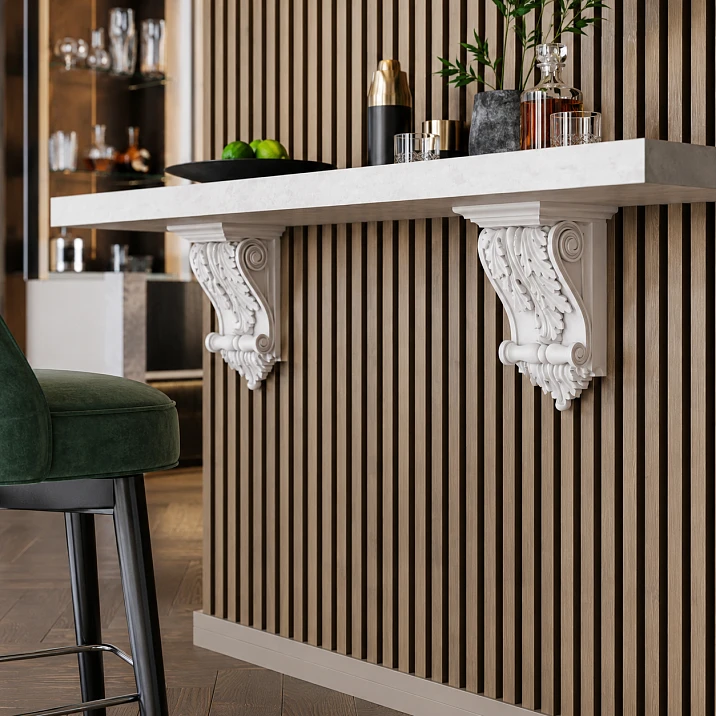
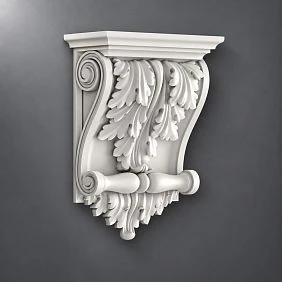
Short answer: if the hidden frame already supports the countertop, KRPU-047 is purchased only for architectural effect
If the bar countertop is already fixed on a separate hidden frame designed independently of the stucco decor, two KRPU-047 are not a mandatory part of its load-bearing scheme. In this article, they are considered as visible decorative consoles whose task is to change the perception of the countertop: instead of a light "floating" plane, create a more classic, architecturally supported image.
KRPU-047 is a large carved polyurethane bracket. The current STAVROS card indicates A × B × C = 286 × 230 × 93 mm, material — polyurethane, price — 17,310 ₽ per piece. In the STAVROS bracket catalog, the axes are deciphered as A — height, B — width, C — depth. This means that with standard vertical placement on the wall, for a full-size fitting, you need to account for dimensions of approximately 286 mm in height, 230 mm in width, and a protrusion of 93 mm from the mounting plane.
For a symmetrical pair, the current cost of the items themselves is:
2 × 17 310 = 34 620 ₽.
Therefore, the question "do you like the bracket in the photo" is too weak here. Before ordering, you need to check whether the pair of KRPU-047 makes the composition better enough to justify the large visual volume and the separate purchase.
For a countertop about 1600 mm long, it is useful to compare two mockups:
-
without decorative brackets — the hidden frame remains visually invisible;
-
with two full-size KRPU-047 silhouettes — one closer to each edge, but not at a random offset, rather after calculating symmetry, free space, and the rhythm of the slats.
If without brackets the countertop looks solid and modern, there is no need to buy a pair just because "it's empty under the countertop." If large consoles tie the countertop to classical or neoclassical room architecture, make it visually justified, and do not conflict with the slatted wall, two elements can be a justified decorative solution.
Buy carved decorative bracket KRPU-047 made of polyurethane




What exactly KRPU-047 is
For this topic, it is important not to mix terms. KRPU-047 is a carved decorative polyurethane bracket. It is in the STAVROS section "Brackets, Capitals," belongs to large ornamental elements, and has its own drawing and 3D model on the product page.
| Parameter | KRPU-047 |
|---|---|
| Product type | carved decorative bracket |
| Material | Polyurethane |
| A — height | 286 мм |
| B — width | 230 мм |
| C — depth | 93 мм |
| Price per 1 pc. | 17 310 ₽ |
| Price of a pair at the current price | 34 620 ₽ |
| Drawing / 3D model | available on the product card |
| Role in this article | decorative, not load-bearing |
The last line is a fundamental condition of the scenario, not a universal characteristic of all brackets. We assume that the countertop already has its own hidden metal or other structural frame, designed without KRPU-047.
The product card for a specific KRPU-047 does not specify the allowable countertop load and does not declare a calculated load-bearing capacity for a bar console. Therefore, the article should not replace the engineering frame with polyurethane decor and should not advise transferring the weight of the countertop, a person, or equipment onto KRPU-047.
Our factory also produces:
Why the name "bracket" does not automatically make it a load-bearing support for your countertop
In architecture, the word "bracket" is historically associated with supporting a protruding structure. On the STAVROS website, general articles also explain that modern polyurethane brackets can create a visual sense of support and be used in compositions under shelves and cornices.
But from the general name of the product, you cannot derive the calculated load of a specific model in a specific joint.
In our situation, there are two different layers:
The structural layer — the hidden frame, wall fastening, overhang calculation, countertop material, and actual loads.
The decorative layer — two KRPU-047, which visually "explain" why the countertop protrudes from the wall but do not participate in the adopted calculation.
This separation is useful for both design and safety. If the decorative brackets are removed after a few years, the countertop should remain just as stable because its load-bearing scheme does not depend on them.
Get Consultation
The question "0 or 2" here is more important than the question "will the brackets fit at all"
Usually, a buyer starts with the product: they like the model, the size fits, they want to use it under the countertop. But in this task, it is more correct to start with the quantity.
0 pieces means the countertop remains visually light, and the hidden structure corresponds to the modern principle of "minimum visible supports".
Two pieces create a symmetrical architectural pair. The countertop begins to be perceived as a console or a classic bar shelf with explicit support.
One piece for a 1600 mm countertop is rarely a neutral compromise. One large element creates strong asymmetry. It can only be appropriate in a deliberately asymmetric project: for example, when the other side visually rests on a side wall, cabinet, column, or another large object.
Therefore, the basic commercial fork really sounds like "leave 0 or buy 2," not "buy one now, the second later."
Dimensions and scale of KRPU-047 under a 1600 mm countertop
The size 286 × 230 × 93 mm should be considered as a volume, not as a beautiful silhouette from a catalog
KRPU-047 cannot be evaluated from a single frontal photograph. It is a large volumetric element. The STAVROS category decodes its coordinates as:
-
A — height 286 mm;
-
B — width 230 mm;
-
C — depth 93 mm.
The card also offers a DWG drawing and a 3D model. These are needed if precise alignment of the rear mounting plane, the contact point with the countertop, and the direction of each axis in a specific layout is required.
For the article, it is sufficient to draw a safe conclusion: before ordering, a full-scale fitting of the dimensions 286 × 230 × 93 mm is needed, not a flat picture on the screen.
A practical mock-up can be made from cardboard or foam board. It should show:
-
height 286 mm;
-
front scale 230 mm along catalog axis B;
-
depth 93 mm along axis C;
-
approximate contour of the carved element.
If the orientation of B and C relative to the wall and the bottom plane of the countertop has not yet been verified against the drawing, accurate installation calculations cannot be based on the assumption that "230 mm go along the wall" and "93 mm protrude forward." First, open the drawing/3D model or apply the actual product.
This order is especially important for a slat wall: an erroneous interpretation of one axis can lead to the conclusion that the bracket fits between the slats, although its actual mounting plane requires different space.
What to check under the countertop before purchasing the pair
Under the bar countertop, there is no abstract "empty space." There are several zones that can conflict with a large relief.
Before ordering, measure:
-
length of the visible countertop;
-
height from the floor to its lower plane;
-
actual overhang from the wall;
-
The thickness of the tabletop;
-
position of the hidden frame;
-
location of its fasteners and service points;
-
position of outlets, cables, lighting, and switches;
-
the height of the baseboard;
-
plane of the slat panel;
-
distance from the outermost slats to the intended brackets;
-
trajectory of bar stools and the legs of a seated person.
Of these dimensions, only the KRPU-047 size is known in advance. The rest are measured on the finished site.
It is especially important not to block access to the hidden frame with a decorative bracket. If the craftsman must have access to certain points for tightening fasteners or removing the countertop, the molded decor should not turn maintenance into dismantling the entire composition.
Countertop 1600 mm: how to check the scale of two large brackets
For example, let's take a countertop 1600 mm long, which the user has already secured on a self-made frame.
If in the selected mounting orientation the catalog size B = 230 mm is indeed positioned along the length of the countertop, the two brackets occupy along this axis:
2 × 230 = 460 mm.
After that, the remaining length is:
1600 − 460 = 1140 mm.
But these 1140 mm are not a single free gap. They need to be distributed between:
-
the left edge margin;
-
the distance between the two brackets;
-
right edge field.
For a symmetric scheme:
left field = right field.
If we denote the edge offset as E, the internal gap between the dimensions of the two brackets in this conditional orientation will be:
1140 − 2E.
For example:
| Edge offset E | Internal gap at B = 230 mm along the countertop |
| 100 мм | 940 мм |
| 150 мм | 840 мм |
| 200 мм | 740 мм |
| 250 мм | 640 мм |
This table does not assign mounting dimensions. It shows how the composition of the pair changes. If the official drawing shows a different orientation of B relative to the countertop, the calculation must be rebuilt according to the actual mounting projection.
The main action is not to choose a "nice offset" from the table, but to glue two full-size silhouettes under the countertop and look at them from a distance.
Why the distance between two KRPU-047 is more important than absolute symmetry
Two identical large elements automatically create rhythm. But a pair that is too close looks like one heavy central base, and one that is too spread out looks like two random details at the edges.
The optimal position depends not only on the 1600 mm tabletop.
It is influenced by:
-
location of hidden supports;
-
width of the slat field;
-
position of bar stools;
-
extreme verticals of adjacent furniture;
-
light;
-
tabletop pattern;
-
central axis of the composition.
If the tabletop is in front of a slatted wall, it is useful to check whether the brackets align with the rhythm of the slats or are deliberately positioned between strong verticals.
There is no need to force their centers to land on specific slats if it worsens the overall balance. But random displacement relative to a regular background is noticeably more visible than on a smooth wall.
Why two KRPU-047 can make a "floating" tabletop visually heavier
The hidden frame is valued precisely for the absence of visible supports. The surface seems to emerge from the wall.
KRPU-047 does the opposite: it deliberately shows the support.
This is neither a plus nor a minus in itself. It is a change of artistic language.
Without brackets, the tabletop is perceived as:
-
lighter;
-
more modern;
-
more technological;
-
closer to minimalism;
-
more strongly connected to the rhythm of the slats.
With a pair of KRPU-047, it becomes:
-
more architectural;
-
more classic;
-
visually more massive;
-
closer to a console or a front bar shelf;
-
more strongly separated from the modern slatted surface.
The buyer must decide which of the two looks they need. If the goal of the hidden frame was originally the effect of weightlessness, a couple of large carved elements can cancel out exactly that quality for which the frame was chosen.
KRPU-047 against a slatted wall: rhythm, base, and visual density
The slatted wall is not a neutral background for KRPU-047
Vertical slats already create a powerful graphic rhythm. Even if they are painted in the color of the wall, light and shadow make the surface active. If it is oak or contrasting MDF, the visual strength is even higher.
KRPU-047 belongs to a different type of pattern: large carved ornament, volumetric plasticity, classical console logic.
When two such elements appear against a background of slats, the viewer simultaneously sees:
-
vertical repetition of lamellas;
-
the horizontal of the tabletop;
-
two large ornamental spots;
-
shadows from the depth of the slats;
-
shadows from the carved relief.
This can provide an interesting contrast of "modern geometry + classic decor." But without a mockup, it is easy to get a conflict where each layer tries to be the main one.
STAVROS, in a general article on polyurethane brackets, separately advises coordinating the ornamental language of the bracket with the surrounding interior. For this narrow topic, such advice needs to be made practical: first compare a wall without KRPU-047 and a wall with two full-size silhouettes, rather than assuming that classic decor will automatically "enrich" the slatted surface.
How to use polyurethane brackets in the interior
What happens to the rhythm of the slats behind a large bracket
If the slatted panels continue directly behind the countertop, KRPU-047 partially overlaps their pattern.
This is an important visual effect.
On a free wall, the slats read as continuous verticals. Under the countertop, a large console creates an area where this rhythm disappears or breaks up.
For a pair, two such sections appear.
Need to check:
-
how many slats does one bracket visually cover;
-
whether well-readable verticals remain between two elements;
-
whether a solid heavy lower zone is not created;
-
whether the edge of the carved element does not collide exactly with the middle of a slat;
-
whether the two brackets interact with the panel pattern in the same way.
Without the actual slat pitch, the number of overlapped lamellas cannot be determined in advance. Therefore, do not substitute a typical pitch from another panel. Take a photo of the finished wall strictly frontally and overlay two contours of KRPU-047.
If after overlaying the slat rhythm almost disappears in the lower zone, the brackets change not a small detail but the entire wall composition.
The solid base behind the slats needs to be checked even for purely decorative installation
The phrase "brackets are only decorative" does not mean they can be glued onto any relief base.
The KRPU-047 itself must be securely fixed as an interior item. If the rear mounting surface falls on:
-
individual protruding slats;
-
deep gaps between slats;
-
soft acoustic underlay;
-
fabric base of a flexible panel;
-
uneven surface,
the bonding conditions differ from a smooth plastered wall.
It is necessary to find out what is not in front of the bracket, but behind it.
There are three basic scenarios possible.
Slats on a rigid solid substrate.
This is the most understandable option, but you still need to check whether the mounting surface KRPU-047 lies on a single plane or rests only on protrusions.
Individual slats with open gaps.
Here, you cannot assume that the large element has full contact with the base. A separate design solution will be required, or installation at this point must be abandoned.
A smooth mounting area is left under the countertop.
For a decorative pair, this is the most convenient scenario: the bracket works on a prepared surface, and the slat wall remains as a background above or between the elements.
If the finished interior falls under the second scenario and installing the pair requires dismantling the slats, creating embedded supports, and refinishing the wall, the cost of the solution is no longer limited to 34,620 ₽.
Why you cannot force polyurethane decor to compensate for the unevenness of the slats with a thick layer of adhesive
If the bracket touches only the protruding lamellas, voids may remain between them.
Adding more adhesive and "filling" the entire difference with it is not a universal solution. The mounting compound must work in the geometry and thickness for which it is intended.
An unpredictably thick layer can result in:
-
uneven fit;
-
noticeable lifting of one edge;
-
difficulty fixing before setting;
-
dark gaps;
-
pair misalignment;
-
impossibility of neatly removing the element during repair.
Even the decorative KRPU-047, measuring 286 × 230 × 93 mm, is large enough for poor fit to be visible.
First create a suitable base, then glue the decor. Not the other way around.
If under the countertop, the slats can be left uncovered altogether
There is a strong alternative approach: leave a clean slatted surface under the countertop without molding.
It is especially good if:
-
the hidden frame is fully functional;
-
the slats already create the desired volume;
-
the countertop has an expressive material;
-
the bar stools occupy the lower zone;
-
the interior is modern;
-
there is no other large classical decor around.
In this case, the "emptiness" under the countertop is actually not empty. The slatted texture and the shadow from the countertop itself are already present there.
Before purchasing, it is useful to photograph this area without stools, then with stools. Sometimes after the furniture appears, there is almost no visual space left for two more large objects.
Two KRPU-047 next to the bar stools: not only the wall needs to be checked
In real use, knees, legs, footrests, and backs of bar stools are under the countertop.
Even if the bracket is mounted against the wall and does not physically obstruct a person, it can visually conflict with the chairs.
Compare:
-
the width and material of the chair legs;
-
the shape of the footrest;
-
the color of the metal;
-
a classic or modern silhouette;
-
the position of the chairs relative to the pair of brackets.
If the bar stools have a thin black metal frame, large classic consoles add a completely different language.
If the chairs are massive, with carved wooden details or soft classic upholstery, KRPU-047 can connect the furniture to the wall.
An article about a pair of decorative brackets should consider the entire bar group, not just the empty wall.
How to build a composition from two KRPU-047
Why one KRPU-047 is usually weaker than 0 or 2
One large bracket seems like a way to "try decor cheaper." For a symmetrical bar countertop, this is often false economy.
If the countertop is about 1600 mm long with free edges and a hidden frame is not visible, one KRPU-047 creates a new central or side support that is structurally unnecessary. The eye begins to ask: why is the bracket alone, what does it support, and why is there no second side to the composition.
One element can be justified in individual cases:
-
the countertop visually adjoins a massive cabinet with one edge;
-
the other side is closed by a wall;
-
the project is intentionally asymmetrical;
-
there is only one large free zone under the countertop;
-
KRPU-047 is used not as a "pair of supports," but as a single decorative accent.
But if the countertop is open on both sides and has calm symmetry, the basic choice is indeed better formulated as 0 or 2.
It is useful to decide this before ordering. Buying one piece "to start with" may end up with either having to buy a second one, or the first item never finding a convincing place.
The symmetry of the pair should be calculated from the composition, not just from the edges of the tabletop.
Installing two brackets at the same distance from the edges is a clear starting point, but not always the final solution.
The slat wall already has a vertical grid. The room may have:
-
the central seam of the panels;
-
the axis of the pendant light;
-
the axis of the tabletop;
-
bar stools;
-
sockets;
-
side furniture.
Therefore, there are at least three ways to build a pair.
Symmetry relative to the tabletop.
The simplest option. The center of the pair coincides with the center of the 1600-millimeter plane.
Symmetry relative to the slat field.
Suitable if the slat insert is narrower and offset relative to the tabletop. Then the brackets support the wall composition specifically.
Symmetry relative to seating positions.
If there are two bar stools under the tabletop, large decorative elements should not accidentally fall exactly behind the center of a seated person or disrupt the intervals between seats.
On the mockup, it is useful to mark not only the tabletop and brackets, but also the actual chairs. Architectural decor under the bar plane exists in space, not in a two-dimensional facade.
Brackets should not interfere with the hidden frame, even visually.
The hidden system may have metal consoles, plates, or profiles that are only partially visible when viewed from below.
If KRPU-047 is added on top of an already finished assembly, check the side and bottom views.
Bad result:
-
the edge of the metal plate is visible due to the carved decor;
-
the bracket does not fully cover the frame, but only emphasizes it;
-
the decorative console and the actual metal support diverge along the axes;
-
one object looks like a "real support", the second — like decor glued nearby.
A good result does not have to mask the frame. It should at least not come into visual conflict with it.
If the actual metal console is in a different spot and visible from below, sometimes it is more honest to leave the hidden frame without stucco duplication.
Why 286 mm in height is already a noticeable architectural detail
The catalog height A = 286 mm is almost three dozen centimeters.
Under the tabletop, this is not a small curl. Even without calculating the area, it is clear that two such elements form a separate lower belt.
Check the distance from the bottom plane of the countertop to:
-
the baseboard;
-
the floor;
-
the chair seat;
-
the footrest;
-
other decorative elements.
If the countertop is positioned such that after placing the 286-millimeter dimension to the floor there remains a tight zone, the brackets may visually "lower" the bar surface.
If there is a tall free space under the countertop, the pair can instead fill it proportionally.
Do not take a typical bar counter height from the internet and insert it into the article. The actual finished object is measured.
A color matching the wall makes KRPU-047 a relief rather than a separate spot.
A large size does not necessarily mean strong contrast.
If the brackets are painted to match the smooth wall or base substrate, the viewer first sees the shadow and relief.
This helps to blend the classic ornament with modern slats more softly.
This option is especially useful to check if:
-
the slats are natural oak;
-
the countertop is stone or wood;
-
there are already many materials in the interior;
-
no additional color is needed.
But monochrome does not make the element small. The volume of 286 × 230 × 93 mm remains noticeable under side light.
A color matching the countertop makes the pair look like part of the furniture structure.
If KRPU-047 matches the countertop color, the viewer perceives it more strongly as a visible "support".
This can be useful for a classic look.
But there is a risk: polyurethane carved decor and the countertop material may have different textures. Trying to literally imitate stone or natural wood should be a thoughtful finishing task, not an automatic way to "link" the details.
Sometimes it is better to match only the color temperature rather than trying to make the materials visually identical.
Color matching the slats strengthens the connection with the wall.
Dark KRPU-047 on a dark slatted wall may partially dissolve into the vertical rhythm.
On a light wall with dark slats, the same color makes the brackets an extension of the accent zone.
This solution can beautifully tie the composition together, but it also makes the lower part of the slatted wall heavier.
If two large dark elements cover several verticals and dark chairs stand beneath them, the area may lose airiness.
A full-size colored mockup gives a more honest answer than choosing a shade from a product card.
Contrasting KRPU-047 requires more free space.
A white bracket on a dark wall, a black one on a light wall, a bronze one on painted slats — all of this makes the pair more noticeable.
The higher the contrast, the less you can count on the element to "blend in" next to chairs and a countertop.
A contrasting option is appropriate if KRPU-047 is to become one of the main decorative accents of the room.
If the task was simply to slightly fill the emptiness under the countertop, the contrast is likely too strong.
Side lighting can resolve the issue better than any description
A slatted wall is especially sensitive to side lighting. KRPU-047 also has a developed relief.
With one light source, two levels of shadows appear:
-
regular vertical shadows of the slats;
-
complex shadows of the carved ornament.
If the light comes along the wall, the bracket may look significantly larger than during the day in diffused lighting.
Check the layout:
-
in the morning;
-
in the evening;
-
with the backlight on;
-
from the entrance side of the room.
A pair for 34,620 ₽ should be convincing not only from one favorable angle.
Structure separately, decor separately: how not to interfere with the hidden frame
How to prove that KRPU-047 truly remains only decor
The initial condition of the article needs to be verified not with words, but with structural logic.
A simple test consists of three questions.
First: does the tabletop withstand all specified loads without KRPU-047?
If yes, the load-bearing function is already solved by the hidden frame.
Second: does installing the decorative bracket require connecting it to the metal system so that without it the frame stops working?
If not, the systems are independent.
Third: is it theoretically possible to remove both decorative elements without weakening the tabletop?
If yes, the role of KRPU-047 is indeed decorative.
If at least one question is answered negatively, the article about "decor 0 or 2" no longer describes your object. Then the bracket begins to participate in the structure, and its permissible load, fasteners, and base must be determined by the engineering design or the system manufacturer.
Such control is useful before ordering: it prevents a decorative purchase from being quietly turned into a load-bearing part just because it looks like a support.
The 300 mm tabletop overhang cannot be directly compared with a single figure from the KRPU-047 dimension without a drawing.
In the example, the tabletop protrudes 300 mm from the wall.
For KRPU-047, A = 286 mm, B = 230 mm, and C = 93 mm are known. But for an accurate comparison with the tabletop overhang, you need to look at which part of the product actually extends from the wall under the horizontal plane and where its mounting edge is located.
The category interprets C as depth, but this is not a reason to automatically write:
"93 mm support 300 mm countertops."
Such a conclusion would be immediately wrong by the logic of the article, because a decorative element does not calculate the structural overhang at all.
The right question is different:
how far does the carved volume visually extend from the wall relative to the 300-millimeter countertop overhang?
The answer is obtained from a drawing or 3D model. If the decorative bracket visually occupies only a small part of the depth under the countertop, it will be perceived more as a wall ornament. If the silhouette more deeply encompasses the lower plane, the "console" effect is stronger.
This is an aesthetic check, not a strength calculation.
It is better to make a full-size mockup of KRPU-047 from three planes
For a wall overlay, a paper silhouette is enough. For a bracket, this is not enough.
Assemble a simple three-dimensional model:
-
frontal dimension along confirmed axes;
-
side plane;
-
upper conditional plane;
-
overall dimensions up to 286 × 230 × 93 mm.
There is no need to reproduce every acanthus leaf. The task of the mockup is to show the mass.
Place two mockups under the tabletop and take photos:
-
strictly frontally;
-
at a 45° angle;
-
from the passage side;
-
sitting on a bar stool;
-
from below at tabletop level.
The last angle often changes the decision. From the height of a standing person, the bracket may look delicate, but from a seated position it appears large and close.
First check the real KRPU-047 in 3D, then assign offsets
The card includes a drawing and an OBJ model. This is useful not only for the designer.
Before installation, the pair must go through three stages:
1. Digital check.
View the profile and mounting geometry.
2. Full-size mock-up.
Check the weight of two elements under the countertop.
3. Full-scale fitting.
If you still like the solution, order one sample or use two real products for a dry layout before fixing.
For a project costing 34,620 ₽ per pair, a few minutes on a mock-up is economically more reasonable than buying "based on a pretty card."
Why the distance to the edge of the countertop cannot be chosen only by the symmetry rule
At the large carved bracket, the edge of the tabletop is a strong horizontal boundary.
If the element is placed too close to the end, it visually "props up the edge." This can look heavy.
If it is too far, the edge of the tabletop begins to seem suspended separately from the decorative support.
But there is no universal number in millimeters.
The offset depends on:
-
the length of the tabletop;
-
the thickness of its end;
-
material;
-
the shape of the edge;
-
the position of the chairs;
-
the hidden frame;
-
step of the rails;
-
other verticals of the interior.
Therefore, any numbers should be considered as layout options, not a ready-made standard.
The hidden frame can itself set the axes of the pair
Even when KRPU-047 is not under load, real metal supports can affect its position.
If two hidden consoles are placed symmetrically, it is convenient for the designer to check decorative brackets on the same axes. Then the "visible support" coincides with the real logic of the structure.
If this looks good, the composition gains inner truth: the viewer does not see the metal, but the visible decor stands where the structure actually works.
However, the coincidence is not mandatory.
If the metal support falls in an inconvenient place relative to the rails or the chair, the decorative pair can be shifted — provided it remains independent.
The main thing is not to create a false node where KRPU-047 partially covers the metal and hinders its maintenance.
Access to the hidden frame fasteners must be preserved
A bar countertop may require:
-
tightening of fasteners;
-
removal for repair;
-
adjustment;
-
access to the lighting cable;
-
maintenance of the socket underneath it.
If two large brackets cover key points, future work begins with dismantling the molded decor.
This is especially bad if KRPU-047 is painted together with the wall: removal damages the finish and increases the cost of simple maintenance.
Before installation, mark the service zones of the hidden frame on the wall. No decorative element should cover them without a deliberate reason.
Do not drill near hidden framing based on guesswork
If the structure is already installed, behind the slat wall there may be:
-
metal profiles;
-
embedded parts;
-
anchors;
-
electrical wiring;
-
lighting cables.
Additional mechanical fasteners KRPU-047 must not be placed in an unknown area just for the sake of visual symmetry.
If adhesive mounting is chosen and it matches the substrate and the manufacturer's instructions, interference with hidden structures is minimal.
If mechanical fastening is required, the location of hidden elements must be determined in advance. The decorative project must not damage an already functioning frame.
Countertop material, furniture style, and bracket scale
The thickness and material of the countertop change the visual weight of the pair.
The same KRPU-047 is perceived differently under different horizontal planes.
A thin, laconic countertop makes the hidden frame part of a minimalist idea. Two large carved brackets can turn out heavier than the horizontal itself.
A massive wooden countertop, a stone slab with a pronounced end, or a classically profiled edge give more visual mass on top. In such surroundings, the architectural pair is perceived more naturally.
Before ordering, write down:
-
tabletop material;
-
the thickness of the visible end;
-
end shape;
-
color;
-
shine;
-
the presence of a chamfer or profile.
Then compare these features with the character of KRPU-047.
There is no need to look for a formula like "countertop thickness should be X% of bracket height." For carved decor, such a standard is not confirmed. A full-scale check of scale is needed.
Stone countertop and carved polyurethane: do not try to pass one material off as another without a reason
If the top is made of marble, quartz, porcelain stoneware, or another stone material, KRPU-047 can be painted in a close color.
But similarity of color does not mean similarity of texture.
The stone has:
-
veins;
-
natural depth of pattern;
-
characteristic luster;
-
rigid geometry of the end face.
A carved polyurethane bracket is a different material and a different type of surface.
There are two honest design approaches:
Connect by color without imitating the material.
For example, the bracket remains a solid-color architectural decor.
Make an intentional decorative finish.
Imitation stone, patina, or another effect is performed as a separate professional technique.
A weak option is to randomly paint polyurethane "roughly like stone" and hope that the viewer perceives it as a continuation of the countertop.
A wooden countertop next to wooden slats already creates a strong material connection.
If the countertop and the slat wall are made of wood or visually similar wood materials, the interior already has a cohesive system.
Adding two classic polyurethane brackets introduces a third language.
This may be appropriate if the room has:
-
classic doors;
-
moldings;
-
cornice;
-
carved furniture;
-
brass details;
-
other brackets
When a smaller bracket is more rational than KRPU-047
Sometimes the answer "two brackets are needed" remains, but specifically KRPU-047 turns out to be too large.
Then you don't need to switch immediately to zero decor.
In the STAVROS category "Brackets, Capitals", models of different sizes are presented. Category filters show a wide range of sizes, so you can choose a more compact element with smaller height, width, or depth.
to buy decorative polyurethane brackets
Scenarios where reducing the scale is reasonable:
-
the countertop is short;
-
the bar area is narrow;
-
the slats are very active;
-
the chairs cover the lower part;
-
There are other decorative elements nearby;
-
KRPU-047 looks more massive than the countertop on the model.
When changing the model, the calculation and template are redone. You cannot transfer the indents calculated for the 286 × 230 × 93 mm size to another bracket.
When it is better to choose a completely different type of decor
If a pair of brackets lacks a compositional reason, perhaps a voluminous element is not needed under the countertop.
Alternatives depend on the task.
If you need to connect the bar area with a classic wall, you can develop the molding composition above the countertop.
If you need to complete the slatted field, you can work with the border of the panels.
If you want to emphasize the horizontal, it is better to check a thin decorative line rather than two massive consoles.
If the task is only that "it's empty below," emptiness can be the right part of a modern interior.
Installation and operation of the KRPU-047 pair in the finished bar area
Installation of the decorative pair must be independent of the load-bearing frame
When the hidden system is already calculated and working, the best installation of KRPU-047 is one that does not interfere with it unnecessarily.
This means:
-
do not move the actual attachment points of the countertop for the sake of decorative symmetry;
-
do not use KRPU-047 as a spacer;
-
do not wedge the countertop with it;
-
do not load the upper part of the bracket with the weight of the slab;
-
do not attach the decorative element to the metal console unless it is provided for by the project.
The KRPU-047 itself must still be securely fixed to a suitable base, because a large decorative element may experience accidental touches.
The product card shows mounting adhesive among related items, and general STAVROS recommendations provide for adhesive mounting of polyurethane decor. The specific composition and preparation must be selected based on the actual surface: painted wall, MDF, wood, or another base require a compatible system.
If the slat panel is already installed, there is no need to disassemble it automatically
A finished interior has value: it is already assembled, painted, and functional.
If it turns out that installing two KRPU-047 requires:
-
removing several slats;
-
cutting the underlayment;
-
creating new embedded anchors;
-
restoring the paint;
-
reworking the lighting,
the project ceases to be a simple decorative purchase.
Then you need to compare two outcomes:
A. Leave the bar area without brackets.
B. Perform a full rework for the architectural pair.
Sometimes option B is justified in a formal interior. But it must be chosen deliberately, not discovered after the goods have been delivered.
A smooth insert behind KRPU-047 can resolve the conflict with the slats, but it itself becomes part of the design.
If the bracket cannot be properly installed over the slatted relief, a separate smooth mounting zone is possible.
For example, under the countertop, a flat panel is left or created, and the slats continue around it.
Such a node has advantages:
-
the bracket gets a clear base;
-
its relief reads more cleanly;
-
there are no gaps between the lamellas;
-
easier to paint and maintain;
-
the pair looks like an independent architectural insert.
But a new boundary appears: "slat → smooth panel."
It also needs to be designed.
If for the sake of two brackets on a finished wall you have to create a large smooth rectangle, perhaps the visual cost of the intervention outweighs the decorative benefit.
The baseboard under the bracket cannot be ignored.
Height A = 286 mm means that the lower part of KRPU-047 may end up close to the baseboard depending on the countertop height.
Need to check:
-
where the lower ornament ends;
-
whether a normal wall area remains down to the baseboard;
-
whether the two reliefs intersect;
-
doesn't the bracket look "placed" on the baseboard;
-
is it possible to paint and clean this area normally.
If the baseboard is tall and complex, the pair can form a too dense lower node.
If the baseboard is minimal and painted in the wall color, the conflict is weaker.
The bar area requires checking for random touches.
Under a decorative shelf, the bracket rarely contacts people. Under a bar countertop, the situation is different.
Nearby moving:
-
knees;
-
shoes;
-
chairs;
-
bags;
-
cleaning equipment.
Even if the KRPU-047 dimension does not fall directly into the work area, a simple test must be performed.
Place a full-size mockup, sit on each chair, and several times:
-
stand up;
-
turn around;
-
push the chair in;
-
pull the chair out;
-
walk along the counter.
If the decorative element constantly ends up in the path, its position is poorly chosen.
This is especially important for a restaurant or a home area used by children.
The lower edge should not become a point of constant impact.
Large relief has protruding details.
If the lower part of KRPU-047 is near a shoe toe, footrest, or chair back when it is turned, even reliable mounting will regularly experience unnecessary impacts.
In this case, there are four solutions:
-
raise or shift the pair, if the composition allows;
-
increase the distance to seating areas;
-
choose a more compact bracket;
-
abandon decorative supports.
There is no need to reinforce the mounting to preserve an initially inconvenient geometry.
In a commercial bar, operation is more important than a perfect frontal shot.
In a restaurant or cafe, people constantly move chairs. Staff mop the floor, wipe the wall, and carry equipment.
Two KRPU-047 can look impressive in a photo of an empty interior, but be inconvenient for daily work.
Before ordering a commercial property, it is useful to check:
-
passage for a cleaning cart;
-
placement of chairs after closing;
-
access to sockets;
-
dusting of carved relief;
-
likelihood of impacts;
-
repairability.
If the pair hinders operation, smaller decor or absence of brackets is better than an expensive decorative scene.
Carved relief near the bar area will require regular cleaning.
Vertical slats themselves collect dust on horizontal micro-edges. KRPU-047 adds complex ornament.
If the countertop is used for coffee, drinks, and food, nearby appear:
-
dust;
-
splashes;
-
greasy marks;
-
random drops.
The more complex the bracket finish, the more careful the maintenance.
Smooth washable paint simplifies maintenance. Complex patina or multi-layer decorative finish requires more gentle cleaning.
This factor rarely decides a purchase in a residential living room, but for a daily bar it is quite practical.
Future repainting of a slat wall with two KRPU-047 will become more difficult.
If the brackets are painted to match the wall and mounted over or next to the slats, future renovation includes more junctions.
You will need:
-
protect the countertop;
-
go around the carved relief;
-
paint the areas between the slats;
-
keep clean edges;
-
it is possible to remove chairs and equipment.
If the interior is frequently updated, independent systems are more convenient: slats separately, countertop separately, decor separately.
This is another argument not to add a pair just to fill the emptiness.
Boundary layouts: when the base scheme 0 or 2 changes
If one edge of the countertop rests against a cabinet or side wall, the "0 or 2" scheme may change
The original theme assumes a free-standing bar countertop, where a pair looks logical.
But sometimes one side visually already has support:
-
tall cabinet;
-
kitchen side panel;
-
column;
-
partition;
-
massive panel to the floor.
In this case, two KRPU-047 can provide three visual supports: the existing massive side panel plus two carved elements.
Then you need to check the alternative with one bracket on the open side.
This is one of the few scenarios where 1 KRPU-047 can be more logical than two. It does not simulate symmetry, but balances an already existing support.
But such a project should be evaluated as a separate asymmetric composition. You cannot apply the standard scheme of two identical brackets to it.
If the countertop is in a niche
A bar surface between two walls is already visually supported by the niche.
Large brackets under it can become redundant, because the viewer already sees the architectural frame.
In a niche, KRPU-047 is appropriate only if:
-
classic interior;
-
wide walls;
-
the relief repeats in other places;
-
the consoles become part of the overall portal.
If the niche is narrow and modern, 0 brackets usually preserves more air.
If the slat wall ends exactly at the edge of the countertop
Then one decorative object may end up on the boundary of two materials.
For example:
-
behind the left part of the countertop — slats;
-
behind the right — painted wall.
The symmetrical pair KRPU-047 will land on different bases.
This is a technically and visually complex case.
A pair cannot be considered identical just because the brackets are the same. One will be perceived on an active relief, the other on a smooth plane.
Possible solutions:
-
move both onto the same type of base;
-
create a common smooth mounting zone;
-
abandon the pair;
-
make a different asymmetric composition.
This scenario shows why the wall is designed first, then the products are calculated.
If there are outlets or a USB block under the countertop
The bar area often has electrical wiring.
Two large decorative elements should not overlap:
-
socket frame;
-
block cover;
-
cable;
-
access to the plug;
-
space for the adapter.
When marking, draw the outer contours of all electrical fittings and the work areas around them on the wall.
If the beautiful position of KRPU-047 requires covering the socket, moving functional electrical wiring for the sake of a decorative pair is not an automatic solution. It is easier to choose a different scale or go without brackets.
If there is LED lighting under the countertop
Lighting changes the relief much more significantly than ordinary ceiling light.
If the light line runs along the bottom edge of the countertop, KRPU-047 may cast large shadows on the slats.
Two opposite effects are possible:
Good: the carving becomes voluminous and expensive.
Bad: two consoles create heavy dark spots and "break" the even light along the bar area.
Check the layout specifically with the backlight turned on. During the day, this conflict may be unnoticeable.
If the LED strip requires access to the power supply or profile, decorative elements should not cover the service unit.
If the bar countertop has rounded edges
Rectangular symmetry of the brackets and the soft shape of the countertop can give a different character.
A large classic ornament can support smoothness if its curls align with the silhouette.
But the position of the pair cannot be calculated only from the geometric length of 1600 mm. At the rounded end, part of the visual length is lost because the edge begins to curve along the radius.
You need to look from the front and diagonally.
If the bracket ends up under an area where the countertop noticeably narrows, it may look too close to the edge.
If three seating positions are planned under the countertop
Two brackets create two vertical accents. They can align with the boundaries of three seating positions and nicely divide the rhythm.
But they can end up right behind the knees of two seated people.
Therefore, real chairs are placed first, then KRPU-047 templates.
One cannot assume that decorative consoles should be placed at "quarters" of the countertop. The ergonomics of actual seats are stronger than an abstract grid.
Serial bar area: first approve one module
A restaurant may have several identical bar countertops along one long slatted wall.
If each one gets a pair of KRPU-047, the budget quickly grows:
Number of bar modules Quantity KRPU-047 Cost at 17,310 ₽/pc. 1 2 34 620 ₽ 2 4 69 240 ₽ 3 6 103 860 ₽ 4 8 138 480 ₽ Before ordering the series, one full prototype must be made:
-
two volumetric mock-ups;
-
real chairs;
-
real lighting;
-
cleaning check;
-
mounting check;
-
photos from key angles.
If the pair is justified after this, the solution can be scaled.
If not, the error stops at one layout, not at eight expensive products.
In a series, a consistent principle matters more than a consistent millimeter offset.
Several countertops may have different adjacent walls, outlets, or widths of slat sections.
Therefore, the same 150 mm offset on each module does not necessarily create the same impression.
The principle must be systematic:
-
consistent connection to the countertop;
-
consistent connection to the rhythm of the slats;
-
the same color;
-
same height;
-
consistent logic of the pair.
If one module requires a noticeable shift due to electrical work, it is better to decide in advance whether the deviation is acceptable or whether that module should be left without KRPU-047 altogether.
Mistakes that turn a decorative pair into an expensive rework
Error 1. Assuming that the bracket must "support" the countertop because of its name
Why it happens: the word "bracket" sounds structural.
Consequence: polyurethane decor begins to be included in the load-bearing scheme without confirmed load.
How to check: make sure the hidden frame fully supports the countertop independently of KRPU-047.
How to avoid: separate the engineering and decorative parts of the project before ordering.
Error 2. Buying two KRPU-047 before a full-size fitting
Why it happens: on the product page, the large bracket looks proportional because there is no real countertop and chairs nearby.
Consequence: after delivery, the pair seems too heavy.
How to check: place two full-size 1:1 mockups.
How to avoid: mockup first, then cart.
Error 3. Evaluating only the frontal view
Why it occurs: this particular angle is most often used in visualization.
Consequence: from the walkway, it is visible that the bracket protrudes too much, conflicting with the slats or the metal frame.
How to check: at least four angles plus a view from the seating position.
How to avoid: make decisions in the real movement trajectory.
Error 4. Ignoring the mounting base behind the slats
Why it occurs: the brackets are decorative and seem lightweight.
Consequence: the rear part rests on individual slats or gaps, making the installation unreliable or visually crooked.
How to check: measure the transverse dimension of the slat system and determine the actual support plane.
How to avoid: use a prepared base or another decor scenario.
Error 5. Placing a pair based on mathematical symmetry without considering the chairs
Why it occurs: two identical elements want to be spaced out "beautifully."
Consequence: the brackets end up behind knees, footrests, or where the chair constantly moves.
How to check: arrange the actual seating positions.
How to avoid: align the decorative grid with ergonomics.
Error 6. Blocking service access to the hidden frame
Why it occurs: the fasteners are not visible after renovation and are forgotten.
Consequence: a simple tightening or removing the tabletop requires dismantling the molding.
How to check: obtain a frame diagram or inspect access points from below.
How to avoid: leave service areas free.
Error 7. Choosing color after installation
Why it happens: it seems that white polyurethane can be "somehow integrated" later.
Consequence: it turns out that neither the wall color, nor the slat color, nor the countertop color gives the desired effect.
How to check: paint a mockup in two or three variants.
How to avoid: approve the finish before fixing.
Error 8. Considering one bracket as a cheap trial version of a pair
Why it happens: 17,310 ₽ is psychologically easier than 34,620 ₽.
Consequence: on a symmetrical countertop, one large element looks random, and then the second one is still purchased.
How to check: mock up a pair right away.
How to avoid: choose between ready-made compositions "0 / 2" if there is no real reason for asymmetry.
How to make a decision before ordering
What to measure before ordering KRPU-047
The list of measurements should be short but complete.
Parameter What to record What it affects Tabletop length actual, e.g., 1600 mm position of the pair Projection from wall actual, e.g., 300 mm volumetric perception Tabletop thickness actual Visual weight Height of the lower plane actual whether dimension A fits A KRPU-047 286 мм vertical scale B KRPU-047 230 мм transverse scale C KRPU-047 93 мм product depth Hidden frame position by object service and installation Slat pitch and depth by object base and rhythm Socket/lighting position by object free zones Baseboard height and protrusion bottom junction Chairs width and actual position Usage After filling in the table, you can build the layout. Before that, the discussion of "whether two look nice or not" remains too abstract.
Practical algorithm: from a finished countertop to a decision of 0 or 2
-
Confirm that the hidden frame is calculated and works without decorative brackets.
-
Measure the countertop, its height, overhang, and thickness.
-
Get a diagram or the actual position of the hidden supports.
-
Determine the type of slat panel and the base behind it.
-
Open the drawing and 3D model of KRPU-047.
-
Check the actual mounting orientation of the dimensions 286 × 230 × 93 mm.
-
Make two three-dimensional mockups.
-
Place real bar stools.
-
Compare symmetry across the countertop, the rails, and the seating positions.
-
Check access to the frame fasteners and the electrical system.
-
Sit at the counter and check your legs, the stool, and the walkway.
-
Look at the pair in daylight and evening lighting.
-
Make a mockup of the future color.
-
Photograph the version with two KRPU-047.
-
Remove the mockups and photograph the version without them.
-
Compare the photos not by the principle of 'where there is more decor,' but by the integrity of the interior.
-
If the pair is too large, check smaller brackets.
-
If it's better without the pair, don't buy KRPU-047.
-
If the pair noticeably improves the composition, only then place an order for two items.
Decision tree
Does the countertop structurally hold without KRPU-047?
No → this article is not suitable; a load-bearing scheme calculation is required.
Yes → continue.
Is there a suitable stable base for decorative mounting?
No → create a separate base, choose another decor, or leave 0.
Yes → continue.
Do two layouts 286 × 230 × 93 mm fit without conflicting with chairs, baseboard, electrical, and service?
No → smaller model or 0.
Yes → continue.
Does the pair improve the overall appearance compared to a hidden frame without decor?
No → 0 KRPU-047.
Yes → continue.
Is the active carved style consistent with the rails, tabletop, and furniture?
No → choose a different bracket or 0.
Yes → 2 KRPU-047 become a deliberate decorative order.
When a pair for 34,620 ₽ is justified
The price is justified not by the size of the product itself or the complexity of the carved pattern, but by the result in a specific interior.
A pair makes sense if several conditions are met simultaneously:
-
the tabletop is already technically reliable;
-
the lower zone is actually visible;
-
KRPU-047 is not blocked by chairs most of the time;
-
The base is suitable for installation;
-
Two elements provide clear architectural symmetry;
-
The classic relief is supported by other details;
-
The rails and brackets do not conflict in scale;
-
Maintenance of the frame remains possible;
-
The more compact model looks weaker;
-
The version without decor objectively loses on the full-scale mockup.
Then 34,620 ₽ is the cost of a specific visual solution, not an attempt to "add something under the countertop."
When it's better to leave 0 KRPU-047
The zero configuration is stronger if:
-
the floating countertop effect is part of the design;
-
the interior is minimalist;
-
the slats already fill the wall with relief;
-
chairs are constantly placed under the countertop;
-
the large ornament is barely visible;
-
installation requires disassembling finished panels;
-
the pair interferes with legs or cleaning;
-
the hidden frame needs regular maintenance;
-
there is no other classical decor nearby;
-
smaller brackets also do not improve the composition.
In that case, the absence of a purchase is a full-fledged design decision, not incompleteness.
What to put in the cart if the decision is made in favor of a pair
For the initial scenario, the purchase should be as simple as possible:
-
KRPU-047 — 2 pcs.;
-
size of each — 286 × 230 × 93 mm;
-
material — polyurethane;
-
current price of one — 17,310 ₽;
-
cost of a pair — 34,620 ₽.
Mounting and finishing materials are selected separately based on the base and the chosen technology. There is no need to automatically add random fasteners or calculate adhesive consumption without knowing the actual mounting surface.
After checking the drawing, base, and mockup, you can order KRPU-047 286 × 230 × 93 mm.
If the pair looks too large, first open catalog of decorative polyurethane brackets and choose a different scale. You don't need to buy the expensive KRPU-047 just because the article is dedicated to it.
Final recommendation
For a bar countertop at a slat wall that is already securely supported by an independent hidden frame, KRPU-047 is not needed as a mandatory structural support.
Its purchase is justified only when two large carved elements genuinely improve the architecture of the area.
The working logic is as follows:
0 KRPU-047 — if the floating countertop effect matters, the slats already create enough relief, the brackets are hidden by chairs, interfere with use, or require reworking the finished wall.
2 KRPU-047 — if the pair creates a clear symmetrical composition, supports a classical or neoclassical interior language, works well against the slats, has a suitable base, and does not interfere with the countertop structure.
For a countertop about 1600 mm with an overhang of about 300 mm, first check the actual mounting orientation of the 286 × 230 × 93 mm dimension against the drawing and 3D model, then place two full-scale mockups 1:1. Without this, any offsets remain assumptions.
The main buyer's question is not:
"Is KRPU-047 beautiful?"
But:
"Do exactly two KRPU-047 units make my already finished bar area better than a neat hidden frame without visible supports?"
If the answer after a full-scale test is confidently "yes" — buy a pair.
If the difference is doubtful — 34,620 ₽ is better not turned into a decorative experiment.
FAQ
Can one buy a single KRPU-047 as a physical sample but not mount it immediately?
Yes. One real element can be useful for checking the relief, color, scale, and mounting surface. But if the final composition is intended as a pair, do not fix the first bracket until checking the second position. A sample and a final "single support" are different solutions.
Should the decorative KRPU-047 physically touch the underside of the countertop?
This depends on the exact geometry of the product and the chosen assembly. If the bracket is visually brought to the countertop, it cannot be used as a wedge that takes load without calculation. A dry fit should show a neat abutment, but the structural work remains with the hidden frame.
Can KRPU-047 be glued directly to acoustic felt between the slats?
A soft or fabric surface cannot be automatically considered a suitable mounting base for a large decorative element. The specific panel construction must be determined, and a stable surface must be obtained according to the mounting technology.
Can KRPU-047 be attached to the countertop itself instead of the wall?
The product card provides a drawing and a 3D model, but the article does not confirm a universal mounting scheme to the bottom plane of any tabletop. Such an option needs to be designed separately, taking into account the material of the slab and the installation instructions. It should not include KRPU-047 in the load-bearing capacity calculation without confirmation.
What to do if the tabletop is removable?
Decorative brackets should be placed so that they do not block the intended removal path. If dismantling the tabletop each time requires damaging the stucco decor or wall finish, the joint should be reworked before installation.
If one edge of the tabletop is designed as a "waterfall" down to the floor, are two brackets needed?
The vertical side panel already creates a strong visual support. In such a scheme, a symmetrical pair may be redundant. First, check one decorative accent on the open side or a variant without KRPU-047. This is a separate asymmetric composition.
Can KRPU-047 be painted in advance before installation?
The finish can be prepared in advance if the chosen coating system is compatible with polyurethane and installation. However, after fixing, local treatment of joints and touch-ups may be required. For a pair, it is important that both elements have the same shade and degree of gloss.
What to do if the brackets become visually heavier after painting?
A contrasting or dark color increases the perceived mass. Before permanent installation, it is useful to check a painted sample. If the already finished color overloads the wall, a shade closer to the background can be considered, if the finishing technology allows repainting.
Can KRPU-047 be installed over a flexible slat panel on a fabric base?
The very fact that the panel is flexible does not confirm a suitable basis for such mounting. You need to understand where the rigid slats, backing, and load-bearing wall are. For a large decorative element, a stable mounting plane is important.
If there is a warm baseboard or heating appliance running under the countertop, can you install a pair?
The requirements of the heating equipment itself for free air exchange and service must be taken into account. KRPU-047 should not block the appliance or interfere with its maintenance. If the heating system manufacturer requires a free zone, it takes priority over decor.
Are two KRPU-047 needed if the countertop is very long, but the hidden frame fully handles it?
Length by itself does not create a decorative necessity. For a long countertop, two brackets may be too sparse, and increasing the quantity may be too heavy. The rhythm needs to be redesigned, not mechanically kept as 'two because usually a pair.'
Can KRPU-047 be used on a smooth wall next to a slat insert, rather than directly over the slats?
Yes, if that is where a stable base is achieved and the composition remains convincing. In that case, the brackets can be placed on smooth sections, while the slat area maintains a continuous rhythm. The position of the pair is still checked relative to the countertop.
Is it worth keeping one spare KRPU-047 in case of damage?
For a residential project, an additional element at ₽17,310 is a significant reserve. It only makes sense to buy it if there is a real risk of reordering, complex finishing, or a serial commercial project. There is no need to automatically increase the order from two to three pieces.
Can you install a pair just to hide the metal frame?
If the metal is really visible and spoils the interior, first you should check the possibility of properly styling or hiding the structure itself. KRPU-047 should not be used as random masking, especially if the metal elements do not match its geometry.
What is more important in the final choice — matching the slats or the countertop?
It depends on the hierarchy of the interior. If the slatted wall is the main accent, the pair should follow its rhythm. If the countertop is the central furniture object, it makes more sense to tie the brackets to it. Trying to perfectly subordinate them to all lines at once often gives a compromise result.
-