
























Article Contents:
- Turning staircase: how it differs and why it matters when choosing balusters
- Composition of the railing kit for a turning staircase: everything you need to know in advance
- Balusters — the main repeating element
- Starting and finishing posts of flights
- Turning posts of the landing
- Handrail — in linear meters for each section
- Lower under-baluster strips
- Fasteners and decorative elements
- Which balusters to choose for a staircase with a turn
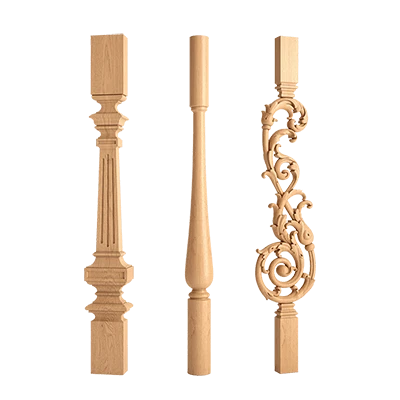
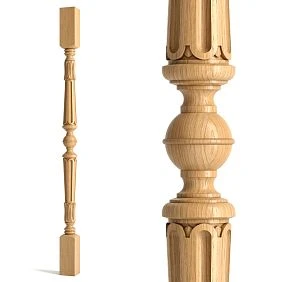
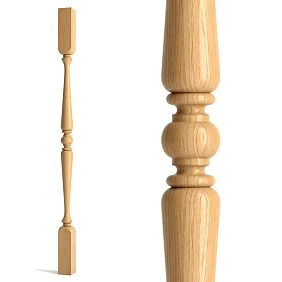
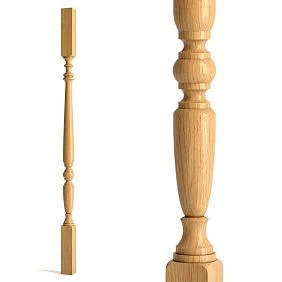
- Turned balusters: a universal choice for classic style
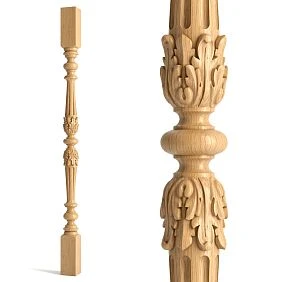
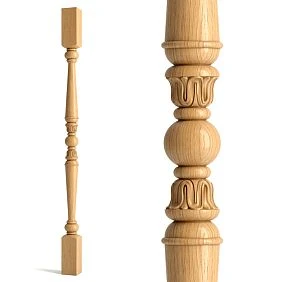
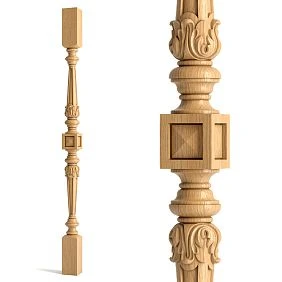
- Carved balusters: for grand and cottage staircases
- Square balusters: precision and modernity
- Flat balusters: lightweight railing for dacha and terrace
- Comparison of shapes for a spiral staircase
- Turned posts: architectural accent and structural center
- Why a turned post is special
- Types of posts for a staircase with a landing
- Visual role of the turned post
- Securing turned posts: cannot be underestimated
- Railings and handrail on a spiral staircase: three tasks at once
- How the handrail wraps around the corner
- Handrail height: same on all sections
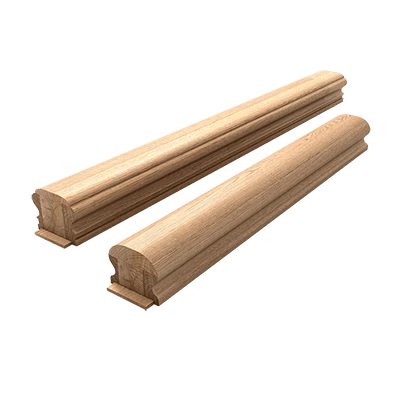
- Handrail profile matching the baluster style
- How to calculate the number of balusters for a staircase with a turn and landing
- Section 1: first flight (sloped)
- Section 2: landing (horizontal)
- Section 3: second flight (sloped)
- Section 4: balcony/second floor landing railing
- Summary calculation table for an L-shaped staircase
- How to count posts
- Handrail length
- Material for a spiral staircase: why it's important to choose one and stick with it
- Beech: the workhorse of quality railing
- Oak: when the staircase is the main interior feature
- Comparison of materials for a large-volume spiral staircase
- Mistakes when buying balusters for a spiral staircase
- Mistake 1: only counted the first flight
- Mistake 2: forgot the turning posts
- Mistake 3: didn't order the handrail turning blocks
- Mistake 4: posts and balusters from different series
- Error 5: different railing heights on the flight and landing
- Error 6: did not account for the flight angle when ordering balusters
- Error 7: chose carved balusters with regular posts
- Price of a kit for a staircase with a turn: how to calculate the budget
- Estimated cost by materials
- What affects the budget besides material
- Installation of a turning staircase railing: key differences
- Marking on a sloped flight
- Installing a turning post
- Joining the handrail at the turn
- About the Company STAVROS
- FAQ: Answers to Popular Questions
- Which balusters are suitable for a staircase with a turn?
- What to buy together with balusters for a staircase with a landing?
- How to calculate the number of balusters for a staircase with a turn?
- Are special posts needed at the turn?
- How does the handrail transition through the turn of the landing?
- Can balusters of different heights be used on the flight and landing?
- Where to buy a kit for a staircase with a turn?
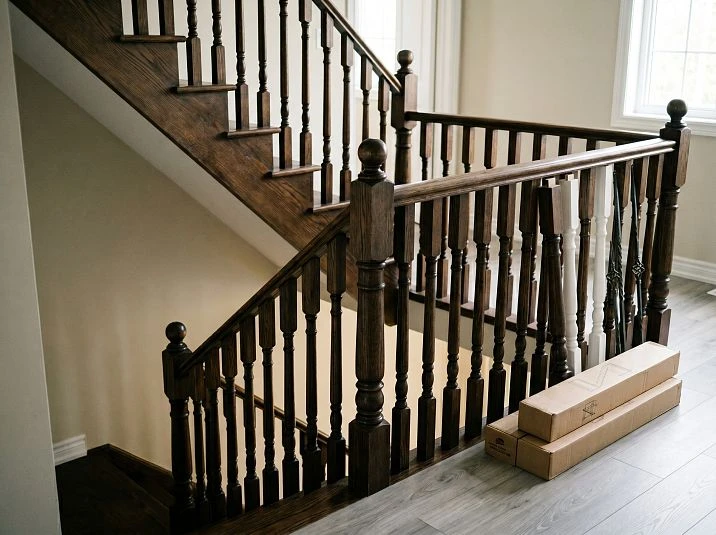
A staircase with a turn is a special architectural object. Not just a flight from floor to ceiling, but a structure that lives in space volumetrically: it turns, stops at a landing, goes up with a second flight. It is this complexity that makes it visually rich — and it is this that creates difficulties when choosing a railing.
A person building a straight staircase solves one problem: calculating balusters for one flight. Someone building an L-shaped or U-shaped staircase solves three or four problems simultaneously — and often misses one of them. The intermediate landing, the turn, the second flight, the second-floor balcony railing — these are all different sections, each with its own features.
balusters for staircase to buy Correct for a turning structure means imagining it as a whole in advance, calculating each section, selecting posts for turning points, and ensuring that all elements of the system speak the same language. This article is about that.
Turning staircase: how it differs and why it matters when choosing balusters
A straight staircase consists of one flight. A turning staircase has at least two flights separated by a landing or winder steps. By geometry, they are distinguished:
L-shaped staircase — a 90° turn. Two flights run perpendicular to each other, connected by a rectangular or square landing. The most common configuration in private homes.
U-shaped staircase — a 180° turn. The second flight is parallel to the first, reversing the direction of travel. The landing is more elongated and rectangular. Requires a larger stair opening.
Staircase with winder steps — the turn is achieved not by a landing but by wedge-shaped steps. The railing here is the most complex: each baluster sits on a step of different width, and the handrail line is a spatial curve.
Spiral (helical) staircase — a special case with non-standard balusters and handrail. Not covered in this article: it is a specialized order.
Each of these types creates decision points that do not exist on a straight staircase:
-
Where are the turning posts placed?
-
How does the handrail transition from one flight to another?
-
How to count balusters on the landing?
-
Does the style and height of the fencing match on all sections?
Answering all these questions before purchase means avoiding costly rework later.
Composition of the railing kit for a spiral staircase: everything you need to know in advance
A spiral staircase requires a more complete kit than a straight one. Let's break down the composition in detail.
Our factory also produces:
Balusters — the main repeating element
They are selected by shape, wood species, height, and tenon diameter. They are installed on all sections of the railing: flight 1, flight 2, landing, balcony railing (if any). On each section, a separate quantity calculation is made.
Buy wooden balusters for a spiral staircase — means ordering the entire volume in one batch, of one wood species. This eliminates tone variation during coating.
Get Consultation
Start and finish posts of flights
On each flight — at least two posts: at the beginning and at the end. An L-shaped staircase with a landing — at least 4 posts for the flights. A U-shaped one — 6 or more.
Turning posts of the landing
This is a key detail that is often overlooked. On the landing, there are one or two newel posts that receive handrails from two different directions. They are larger, more prominent, and structurally more important than the intermediate posts of the flights.
Buy balusters and posts for a wooden staircase From one series — the only way to ensure groove consistency and visual unity.
Handrail — in linear meters per each section
Handrail of the first flight + handrail of the landing + handrail of the second flight = total length. Plus turning blocks or curved elements at direction change points.
Bottom sub-baluster strips
One for each section. Allows precise spacing.
Fasteners and decorative elements
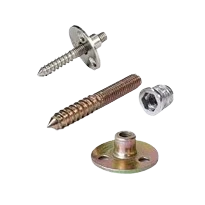
M8 studs for balusters, M10–M12 bolts for posts, finials, handrail end caps, handrail turning blocks.
buy staircase components Complete, including all mounting elements — the key to ensuring installation doesn't stop halfway due to a forgotten part.
Which balusters to choose for a staircase with a turn
A turning staircase is an object visible from several sides simultaneously. When a guest enters the hall, they see it from the front, at three-quarters, and partially from another angle. This means the choice of balusters must work from any perspective.
Turned balusters: a universal choice for classic style
The turned shape is symmetrical. It looks equally good from any side. For an L-shaped staircase in a classic home, turned balusters made of beech or oak with a medium-complexity profile (3–4 vases) are optimal.
The working height is 900 or 1000 mm on all sections. Important: the flight and landing must be the same height. You cannot install 900 mm on the flight and 950 mm on the landing — this looks sloppy and is immediately noticeable visually.
wooden balusters for stairs buy of turned shape in the required height and wood species — with the ability to select from the catalog using filters.
Carved balusters: for grand and cottage staircases
A staircase with a turn in a country cottage, estate, or home with rich decor is a place for carved balusters. The turning-milling relief creates a rich look that does not get lost from any angle.
For a turning staircase with carved wooden balusters turning posts with coordinated decor are especially important: carved or profiled, with a finial in the same style. Otherwise, the most beautiful baluster gets lost next to an "empty" post.
Square balusters: precision and modernity
A square baluster 45×45 mm is a straight line along its entire height. No vase, no curve. In a modern house with an L-shaped staircase and glass partitions, with an open second light — square balusters look absolutely organic.
square balusters for stairs They pair well with minimalist straight posts without decor and a rectangular profile handrail. In such a combination, the railing becomes part of the architectural graphics of the room.
Flat balusters: lightweight railing for a country house and terrace
If the turning staircase is a country or outdoor structure, Buy flat balusters made of beech under white paint — it is a light, airy railing with a lace silhouette.
A flat baluster 90–100 mm wide with a spacing of 180–190 mm gives a gap of 80–100 mm — safe even for children. At the same time, visually the railing remains light, without overload.
Comparison of shapes for a turning staircase
| Baluster shape | Best interior | Compatibility with the post | View from different angles |
|---|---|---|---|
| Turned (3–4 planters) | Classic, traditional home | Any with decor | Equally good |
| Carved | Cottage, front entrance | Only with profiled | Very expressive |
| Square | Modern, minimalism | Straight, concise | Graphic, strict |
| Flat | Dacha, veranda, country | Simple straight | Front view — beautiful, profile — neutral |
Turning posts: architectural accent and structural center
Talking about the railing of a turning staircase without mentioning the posts is like discussing a painting without mentioning the frame. The posts at the turn are not "just two more pieces of wood near the landing." They are the conceptual center of the entire structure.
Why the turning post is special
On a straight staircase, the post receives the handrail from one side. On a turn, it receives it from two sides. This means the post must have two grooves for the handrail, positioned at a right (or other required) angle. This is no longer a standard part — it is a blank specially machined for the turn angle.
Additionally, the turning post bears double the load: two handrails meet it, and balusters from two sections adjoin it. The cross-section of the turning post should be one step larger than that of intermediate posts:
-
If intermediate posts are 100×100 mm, the turning post is 120×120 or 130×130 mm
-
If intermediate posts are 90×90, the turning post is at least 100×100 mm
Types of stair posts for a staircase with a landing
Wooden stair posts are divided by function and location:
Starting post (bottom) — at the beginning of the first flight, at the zero step. Receives the lower end of the handrail of the first flight.
Intermediate post (at the landing, on the flight side) — the upper end of the handrail of the first flight and simultaneously the beginning of the landing railing.
Turn post (corner) — at the corner of the landing when turning 90° or 180°. Receives the handrail from two directions.
Starting post of the second flight — begins the railing of the second flight from the landing upward.
Top post (finish) — at the end of the second flight, at the level of the second floor ceiling.
For an L-shaped staircase with one landing — minimum 5 posts. For a U-shaped staircase with two turns — 6–8.
Visual role of the turn post
The turn post is the largest and most decorative element in the railing. It stands at the point that the eye finds first. For this, it is often made:
-
Higher (by 50–100 mm above the general handrail line) with a ball-shaped or figured cap
-
With profiled edges or turned decoration
-
Made from the same or larger blank, which emphasizes its "dominance" in the composition
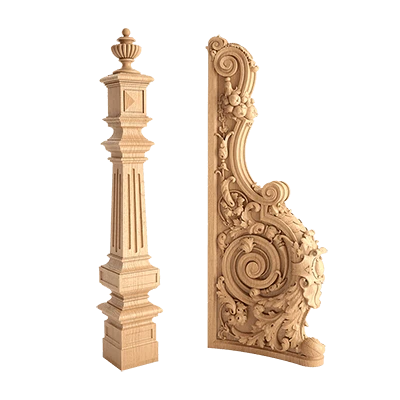
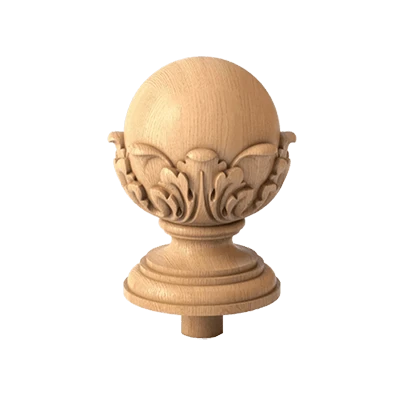
Buy carved wooden pillars for turning points, to which carved balusters are matched — this is a solution where a staircase with a turn becomes an architectural statement, not just a functional transition.
Fastening of turning posts: cannot be underestimated
The turning post takes the load from two handrails — that is, when pressure is applied to the railing, the force tends to tip it sideways. The fastening must prevent this.
Correct fastening of the turning post to the wooden landing:
-
Two through M12 bolts diagonally through the landing deck
-
Additionally — a metal support plate from below with a bolted connection to the support beam
-
If necessary — a steel angle bracket, hidden under the landing trim
For concrete floors or metal frames — chemical anchor ø12 mm with M12 threaded rod, embedment depth 100–120 mm.
Railings and handrails on a turning staircase: three tasks at once
Railings on a turning staircase solve three tasks simultaneously: guide movement, create visual continuity, transfer load to posts. And it is precisely at the turns — where the direction changes — that all three tasks become more complex.
How the handrail goes around the corner
On straight sections, the handrail is simply a straight piece of the required length. At the turn, there are several solutions:
Solid wood turning block — a blank cut to the required angle (usually 45° + 45° = full 90° turn). Attached with glue and screws to two straight handrail sections. The visible joint is at two points. With quality workmanship, it is almost invisible.
Bent-laminated turn — lamellas glued to the required radius. No visible joints, smooth transition, higher aesthetics. Suitable for classic and grand staircases. Made to order.
Mitered turn with metal connector — two straight handrail sections are joined at 45° with a metal sleeve inside. Technologically advanced, but the metal element may be visible. Acceptable for modern interiors.
Handrail height: uniform on all sections
For one space — one handrail height. 900 mm or 1,000 mm — on flight 1, on the landing, on flight 2, on the balcony railing. It is not allowed for the handrail to be 900 mm on the flight and 950 mm on the landing. This is immediately noticeable.
Handrail profile matching baluster style
For a turning staircase, it is especially important to match the handrail profile and baluster shape — because the railing is visible from different sides, and any mismatch in scale immediately catches the eye.
| Baluster shape | Handrail profile | Diameter/cross-section |
|---|---|---|
| Carved, complex turned | Classic semi-circular | ø60–70 mm |
| Turned simple | Semi-circular or oval | ø45–55 mm |
| Square | Rectangular with chamfers | 60×40 mm |
| Flat | Light semi-circular | Ø40–50 mm |
handrails and balusters made of wood From one system of one manufacturer — this guarantees 100% compatibility of the handrail groove and baluster tenon, no on-site adjustments needed.
How to calculate the number of balusters for a staircase with a turn and landing
Calculation for a spiral staircase involves several calculations for sections, which are then summed up.
Section 1: first flight (inclined)
The length is measured along the stringer — the inclined line along which the balusters stand. This is not the horizontal projection or the height.
Example: a flight with 12 steps, tread width 280 mm, riser height 180 mm. Diagonal step length: √(280² + 180²) = √(78400 + 32400) = √110800 ≈ 333 mm. Stringer length: 12 × 333 = 3,996 mm ≈ 4,000 mm.
With a baluster spacing of 150 mm: 4,000 ÷ 150 = 27 balusters per flight 1.
Section 2: landing (horizontal)
The platform is measured along the horizontal lines of the fence. An L-shaped platform typically has two fence sections.
Example: landing 1,200 × 1,200 mm. Railing along two sides: 1,200 + 1,200 = 2,400 mm.
With a spacing of 150 mm: 2,400 ÷ 150 = 16 balusters per landing.
Section 3: second flight (inclined)
Similar calculation. If the second flight is the same length — the same number of balusters.
Section 4: second floor balcony/landing railing
If it's an open balcony or mezzanine — a separate calculation along horizontal lines.
Summary calculation table for L-shaped staircase
| Section | Length (mm) | Spacing (mm) | Balusters (calculation) | Reserve +10% | Total |
|---|---|---|---|---|---|
| Flight 1 | 4 000 | 150 | 27 | +3 | 30 |
| Landing (2 sides) | 2 400 | 150 | 16 | +2 | 18 |
| Flight 2 | 3 200 | 150 | 21 | +2 | 23 |
| Second floor balcony | 3 600 | 150 | 24 | +2 | 26 |
| TOTAL | 88 | +9 | 97 |
Almost 100 balusters — that's the real scale of the kit for a two-story house with an L-shaped staircase and second-floor railing. It's important to understand this at the budgeting stage.
How to count posts
| Section | Number of posts | Type |
|---|---|---|
| Start of flight 1 | 1 | Starting |
| End of flight 1 / start of landing | 1–2 | Transitional |
| Landing corner (90° turn) | 1 | Turning |
| Start of flight 2 | 1 | Starting |
| End of flight 2 | 1 | Finish |
| Balcony railing (corners) | 2–4 | Corner pieces |
| TOTAL | 7–10 |
Handrail length
We sum all sections: flight 1 + landing horizontal + flight 2 + balcony + turning blocks (0.3–0.4 m each) + 5% reserve.
Example: 4 m + 2.4 m + 3.2 m + 3.6 m + 4 blocks × 0.35 m + 5% = 14.6 m.
buy balusters and handrails order everything in one specification — and you cover the entire staircase in one delivery.
Material for a turning staircase: why it's important to choose one and stick with it
A turning staircase has 80–100 balusters, 7–10 posts, 14–16 m of handrail. This is a large volume of wooden products. And this is where the issue of material uniformity becomes most acute.
Beech: the workhorse of quality fencing
Buy beech balusters for a spiral staircase — this solution simultaneously meets all requirements: strength, appearance, coating, price.
A hardness of 3.5 Brinell units means resistance to damage under intensive use. The fine, uniform texture of beech wood provides a perfectly smooth surface for any coating — especially white or colored paint, which is popular in modern interiors.
When ordering 100 beech balusters versus 100 oak balusters, the cost difference is 40–60 thousand rubles for the entire set. For a family building a house, this is a significant saving without loss of quality.
Oak: when the staircase is the main object of the interior
A spiral staircase in the grand hall of a private home, where everything is thought out: stone floor, stucco molding, dark wall panels. Here, oak balusters, posts, and handrail with a rich tint or clear varnish are the only solution that will not betray the design.
Oak under clear varnish is a pattern. Beneath it is not just a surface, but a subtle image that changes depending on the angle of light. 100 oak balusters along a spiral staircase is a spectacle.
Buy oak balusters for a grand spiral staircase — not just a purchase, but an investment in the home's image for decades to come.
Comparison of materials for a large-volume spiral staircase
| Parameter | Pine | Beech | Oak |
|---|---|---|---|
| Hardness (Brinell) | 2,5 | 3,5 | 3,7–3,9 |
| Under clear lacquer | Not recommended | Good | Excellent |
| Under paint | Satisfactory | Excellent | Good |
| For tinting | Weak | Good | Excellent |
| Price relative | ×0,4 | ×0,75 | ×1 |
| Durability under load | 10–15 years | 25–35 years | 40+ years |
| Uniformity within a batch | Low | High | High |
Mistakes when buying balusters for a turning staircase
Here, mistakes cost more than on a straight staircase — simply because the volume is larger.
Mistake 1: only counted the first flight
The most common. Bought 30 balusters "for the staircase". Arrived — it turned out that the landing and the second flight require another 50. Reorder — a different batch, a different shade under the stain.
Solution: calculate all sections before ordering. The landing, the second flight, the second-floor balcony — everything is included in the first order.
Mistake 2: forgot the turning posts
Bought standard posts for all points. At the turn of the landing, it turned out that a post with two grooves for the handrail at a right angle was needed — but there are none in the order.
Solution: when ordering posts, specify which ones are turning and at what angle (90°, 135°, 180°).
Error 3: did not order turning handrail blocks
We purchased the handrail in linear sections. On site, it turned out that 4 turning blocks at 90° were needed. Installation stopped. Reorder — one week wait.
Solution: when ordering the handrail, specify the quantity and angle of turning blocks.
Error 4: posts and balusters from different series
Balusters — one series from one manufacturer. Posts were 'found cheaper' from another. The groove of the post for the handrail — a different size. The handrail does not fit. Either rework or replace.
Solution: balusters, posts, and handrails buy from the same system.
Error 5: different railing height on the flight and landing
On the flight, balusters are 900 mm, on the landing 'found leftovers' of 950 mm. The handrail goes in a step. Visible to the naked eye.
Solution: uniform height of balusters on all sections of one staircase.
Error 6: did not account for the angle of the flight when ordering balusters
On an inclined flight, the lower tenon of the baluster must be cut to match the angle of the stringer. This is either done at the factory upon order or on site. When ordering "standard" balusters without specifying the angle of inclination, the lower end is vertical, while the step is inclined. The baluster stands "on the edge" of one rib, which is bad for both fastening and appearance.
Solution: when ordering, specify the angle of the flight (usually 25–38°) — the manufacturer will cut the lower end of the balusters to this angle.
Mistake 7: chose carved balusters with plain posts
Carved balusters have rich relief and expressive profiles. Posts are straight, without decoration. On a landing, this combination looks particularly dissonant: ornate balusters and "bare" posts at the most visible point of the structure.
Solution: Buy carved wooden pillars paired with carved balusters as a single ensemble.
Price of a kit for a staircase with a turn: how to calculate the budget
The budget for a turning staircase is always larger than it initially seems. Because the landing, second flight, and second-floor balcony double or triple the volume of elements.
Approximate cost by materials
Let's take a calculation example: L-shaped staircase, 97 balusters, 9 posts, 14.6 m of handrail, 4 turning handrail blocks.
| Element | Quantity | Pine | Beech | Oak |
|---|---|---|---|---|
| Square balusters | 97 pcs. | 68 000 | 136 000 | 184 000 |
| Posts 100×100 | 7 pcs. | 21 000 | 42 000 | 60 000 |
| Swivel posts 120×120 | 2 pcs. | 8 000 | 15 000 | 22 000 |
| Handrail ø50 | 14.6 linear meters | 14 600 | 26 300 | 43 800 |
| Handrail swivel blocks | 4 pcs. | 4 000 | 7 200 | 11 200 |
| Slats, fasteners, finials | — | 10 000 | 12 000 | 14 000 |
| TOTAL | ~125 600 | ~238 500 | ~335 000 |
Real prices for all items — in the catalog: Staircase Components for Sale.
What affects the budget besides material
Baluster shape: square — minimum. Simple turned — +30–40%. Carved — +200–250% to the cost of square.
Finishing: final sanding P180–220 — plus 10–15% to the product price. Fully justified: saves time during coating and gives a better result.
Complexity of posts: decorative, carved — significantly more expensive than simple ones. Swivel posts — more expensive than standard ones.
Swivel handrail elements: bent-laminated — 2–2.5 times more expensive than solid wood blocks.
Installation of a railing for a turning staircase: key differences
The installation technology of a turning staircase differs from a straight one in several points. You need to know about this in advance — to properly prepare the base and avoid surprises.
Marking on an inclined flight
On a straight flight, balusters stand vertically, but on an inclined surface. The step marking is done not horizontally, but along the stringer line. A step of 150 mm is 150 mm along the stringer, not horizontally.
For ease of marking, a sub-baluster strip with pre-drilled holes is used — it is applied to the steps along the stringer and serves as a template.
Installation of a turning post
The turning post is installed first — before the balusters, before the handrail. The entire system «diverges» from it in both directions. The post must be strictly vertical by level. A deviation from vertical even of 3–5 mm will be noticeable on the finished railing.
Joining the handrail at the turn
Straight handrail sections are cut at a 45° angle (for a 90° turn) and joined on a turning block. The joint is glued with wood glue and secured with a ø6×80 mm lag screw through the end of the block. The joint is filled with putty for painting or varnishing.
For a bent-laminated turn, simply join with glue and precise trimming: no visible seam.
A step-by-step master class on the entire installation technology is available in the professional material: Installation of Wooden Handrails and Balusters.
About the company STAVROS
STAVROS has been manufacturing wooden stair components since 2002. Specialization — a complete railing kit for any type of staircase, including L-shaped and U-shaped turning structures: balusters, starting and turning posts, straight and curved handrails, fasteners, finials, and bottom rails.
Own production cycle: raw material selection, chamber drying to 8–10%, CNC turning and milling, multi-stage sanding. Compatibility systems: handrail groove and baluster tenon from the same series — no adjustment needed. Turning posts — for the ordered angle, with the required number of grooves.
Over 50 baluster models: carved, turned, square, flat. Wood species: pine, beech, oak, ash. Handrail turning blocks and curved elements — custom-made for any angle. Free calculation of the full specification based on your staircase parameters. Contact us to confirm shipping to your destination., pickup from Moscow and St. Petersburg.
FAQ: Answers to popular questions
Which balusters are suitable for a staircase with a turn?
Any wooden balusters of the required height and shape — the main thing is that they are from a single series for all sections: flight 1, landing, flight 2. The height and diameter of the tenon are the same throughout the staircase.
What to buy together with balusters for a staircase with a landing?
Turning posts (with grooves for two handrails), handrail with turning blocks or curved elements, bottom rails for each section, fasteners — M8 studs and M12 bolts for posts.
How to calculate the number of balusters for a staircase with a turn?
Calculate each section separately: flight 1 (along the stringer length ÷ step), landing (along horizontal lines ÷ step), flight 2, balcony. Add them up, then add 10% reserve.
Are special posts needed at the turn?
Yes. A turning post must have two grooves for the handrail at the required angle. A standard post with one groove is not suitable for a turn.
How does the handrail transition through the landing turn?
Via a solid wood turning block (for 90° or 135°) or a bent-laminated element without a visible joint. The choice depends on aesthetic requirements and budget.
Can balusters of different heights be used on the flight and landing?
No. On one staircase, the railing height must be uniform across all sections. Different heights create a step in the handrail at transitions, which looks bad and is technically incorrect.
Where to buy a kit for a staircase with a turn?
In the STAVROS catalog — a full range for any configuration of a turning staircase: balusters, turning and starting posts, handrails, turning blocks, fasteners. Free calculation based on your staircase parameters.