Article Contents:
- A dacha is a special scenario. And the balusters here are special.
- Where balusters are needed in a dacha and wooden house
- Internal staircase to the second floor
- External porch
- Terrace and veranda
- Balcony and second floor railing
- Gazebo and garden structures
- What shape of balusters to choose for a dacha
- Flat balusters: dacha favorite
- Square balusters: strictness and durability
- Turned balusters: the golden mean
- Carved balusters: when a dacha becomes an estate
- Which material to choose: wood, species, humidity
- Pine: affordable, workable material
- Beech: the middle ground between price and quality
- Oak: for those building for the long haul
- Humidity: what they don't mention when selling
- What to buy with balusters: a systematic view of the railing
- Handrail
- Support columns
- Bottom sub-baluster rail
- Fasteners
- Post Caps
- Balusters for outdoors: what changes with outdoor use
- Species for outdoors
- Shape for outdoors
- Outdoor fasteners
- Gap between the bottom end and the step
- Protective coating
- How to calculate the number of balusters and posts for a dacha
- Calculation for stairs
- Calculation for a porch
- Calculation for a terrace
- Calculation of posts
- Calculation table
- Price of balusters for a dacha: what makes up the budget
- What affects the price of one baluster
- Estimated Prices
- Budget for a complete dacha set
- Mistakes when buying balusters for a dacha
- Mistake 1: bought only balusters, without railings and posts
- Mistake 2: didn't account for outdoor use
- Mistake 3: bought the cheapest without checking moisture content
- Mistake 4: bought balusters without calculating all zones
- Mistake 5: chose a shape without considering installation
- Mistake 6: didn't count the fasteners
- Mistake 7: forgot about post caps
- Where to buy balusters for a dacha and a wooden house
- About the Company STAVROS
- FAQ: Answers to Popular Questions
- Which balusters are best to buy for a country house?
- Can wooden balusters be used outdoors?
- What to buy together with balusters for a country house?
- Which balusters are cheaper for a country staircase?
- Where to buy balusters for a wooden house with delivery?
- How many balusters are needed for a country staircase?
- Do balusters need to be sanded before painting?
- How to choose posts for flat balusters for a country house?
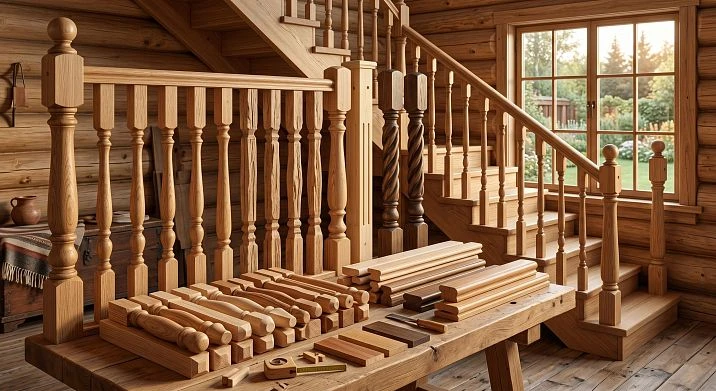
A dacha is a special space. There is no room for pretentiousness, excess, or random details. But it is here that it is especially noticeable when something is done with soul — and when it is done hastily, just to 'get it done.' A staircase with a solid railing, a porch with neat handrails, a terrace with a smooth wooden handrail — all of this creates a feeling of completeness, of a homeowner's thoroughness. And this feeling begins with properly chosen balusters.
Balusters for a country house — these are not just wooden sticks under the handrails. They are an element that unites the staircase, porch, and terrace into a single architectural picture. Choosing them correctly means not overpaying for the unnecessary, not saving on the important, and getting a railing that will last for decades.
In this article — an honest, practical discussion about which balusters are needed for a wooden house and dacha, how to choose a shape for a specific task, what to buy together, and how to avoid typical mistakes when placing your first and only order.
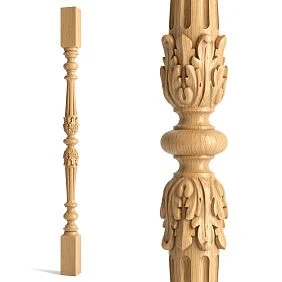
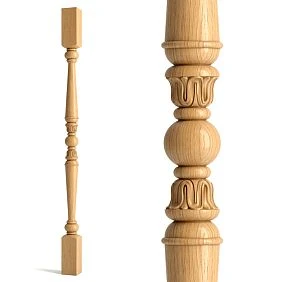
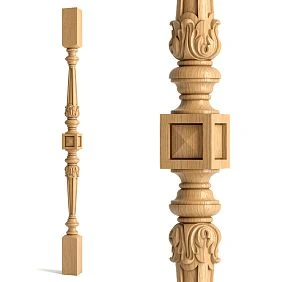
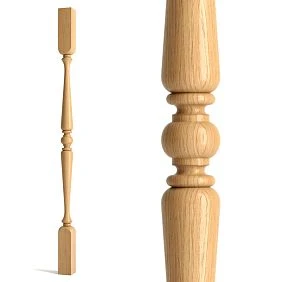
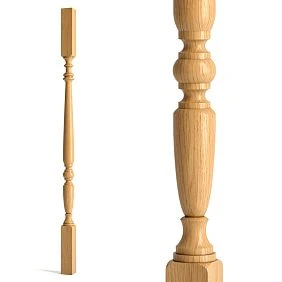
A dacha is a special scenario. And the balusters here are special too.
A city apartment and a country house are different contexts. A dacha is a third one, with its own logic. Here there are different requirements, different priorities, and different operating conditions.
What is important when choosing balusters for a dacha and a wooden house?
Practicality of shape. Complex carving requires careful painting and regular maintenance. For a dacha, where the railing is also outdoors, a shape with a minimum of hard-to-reach places is important — flat, square, or simple turned.
Affordability. A dacha often involves large volumes: a staircase in the house, an external staircase from the porch, terrace railing, veranda handrails. With 80–120 balusters for the entire volume, the difference in price per unit multiplies significantly.
Compatibility with wooden architecture. Timber, logs, clapboard cladding — wooden texture everywhere. Metal and plastic elements always look alien in such a context. Natural wood is the only organic choice.
Ease of installation. Many dacha owners install the railing themselves. This means the shape of the baluster should be predictable in installation, and the fastening system should be understandable without special tools. The full step-by-step technology is described in the guide on installation of wooden railings and balusters.
Resistance to outdoor conditions. The porch and terrace are areas where wood meets rain, frost, and direct sunlight. The choice of wood species and protective coating is critical here.
All these requirements come together into specific recommendations, which we will break down for each application area.




Where balusters are needed in a country and wooden house
Before calculating the quantity and choosing the shape, it is important to understand the full scope of the task. In a country house, balusters are needed in several fundamentally different places.
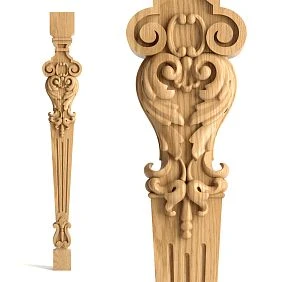
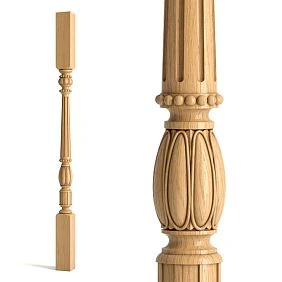
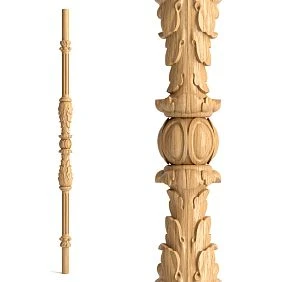
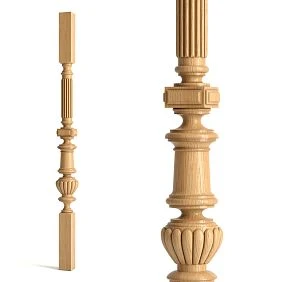
Our factory also produces:
Interior staircase to the second floor
The most prominent place in the house. The staircase here is part of the interior; it is visible from the hallway, living room, and foyer. The railing should be neat, finished, and harmonious with the wooden interior.
All types of balusters are suitable for an interior staircase: square, turned, carved, flat. The choice is determined by the interior style and budget. The wood species is beech or oak under varnish or tinting, pine under opaque paint.
Buy balusters for a wooden staircase taking into account interior use means prioritizing appearance and surface finish quality over maximum weather resistance.
Get Consultation
Exterior porch
One of the most common scenarios for a country house: a small porch with 3–5 steps and railings on one or both sides. Here you need balusters that:
-
Resistant to moisture when properly treated
-
Easy to install outdoors
-
Look organic with a wooden house facade
For a porch, flat or square balusters made of pine or beech for exterior paint or antiseptic are best. Buy flat balusters for a porch is a practical and aesthetic solution that looks good and is easy to maintain.
Terrace and veranda
On a terrace, the railing is often longer than on a staircase. 5–8 meters of perimeter is 30–50 balusters along just the long side. For a terrace, the unit price is especially important: multiply the cost of one baluster by 40–50 pieces and you'll immediately understand the budget.
wooden balusters for terrace — rectangular or square shapes, simple geometry. Painting with exterior paint or impregnation in 2–3 coats provides long-lasting protection.
Balcony and second floor railing
In houses with open balconies and mezzanines on the second floor, the railing is both part of the interior and architectural appearance. Here, more decorative solutions are appropriate — turned or flat balusters with a more pronounced profile.
Gazebo and garden structures
For a gazebo, summer kitchen with a veranda, or garden canopies on posts, fencing is also required. Carved wooden pillars for a gazebo combined with simple balusters and a handrail — this is a light and expressive solution that fits into any garden context.
What shape of balusters to choose for a dacha
Shape is the first thing you see. It is the shape that sets the character of the fencing, determines the labor intensity of installation and maintenance, and affects the price.
Flat balusters: a dacha favorite
Flat wooden balusters — this is a wide plank of solid wood with a cut-out decorative contour. Thickness — 20–28 mm, width — 80–120 mm, height — 900–1000 mm.
Why are flat balusters so popular for a dacha?
First: appearance. A flat baluster, for all its simplicity, creates a very lively, warm image. A figured contour is not a complex turned shape, but it is no longer just a block. Fencing with flat balusters looks like a well-thought-out solution, especially against the backdrop of a wooden house.
Second: painting. A wide surface is the easiest to paint — with a roller, in one motion. No recesses, no brushes with thin bristles for hard-to-reach places. Two passes with a roller — and the baluster is ready.
Third: price. A flat baluster is cut from a board without a turning operation — this is significantly simpler in terms of technology, and therefore more affordable in price. When ordering 50–80 pieces, the difference in cost between flat and turned balusters adds up to a significant amount.
Fourth: compatibility with wooden architecture. A wooden house, hewn from timber or logs, features a textured surface and natural lines. A flat baluster with a soft, shaped contour fits perfectly into this context.
Buy flat baluster — is the right choice for a porch, terrace, outdoor fencing, and interior staircase in a simple wooden house.
Square balusters: strictness and strength
square balusters for stairs — is a solid block of 45×45 mm or 40×40 mm. Absolutely straight, without tapering, without decoration.
Does this sound boring? No. In the right context, it is very modern.
A house made of profiled timber with minimalist finishing, strict straight architectural lines, large windows — square balusters here look like an author's solution: deliberately simple, confident, restrained.
Technical advantages of a square baluster for a country house:
-
Maximum transverse bending strength (no neck means no vulnerable spot)
-
Simple installation: a square tenon does not rotate in the groove
-
Easy sanding before painting
-
Minimum price in its class
Square pine balusters for white exterior paint are one of the most budget-friendly and practical solutions for a country house porch.
Turned balusters: the golden mean
Between a laconic square and a complex carved baluster, there is a wide zone — these are turned forms of varying expressiveness.
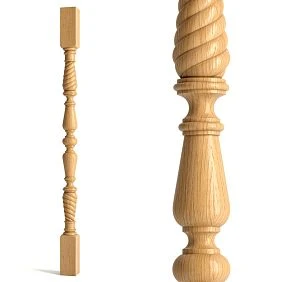
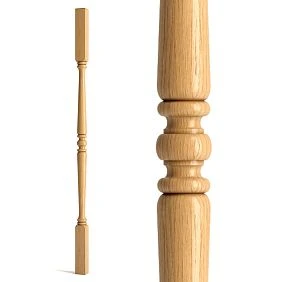
A simple turned baluster with two or three vases is already decor. Expressive enough for the railing to look elegant, and simple enough for the paint to lay evenly and the price to remain reasonable.
For a country house that the owner wants to make cozy and elegant, but without Baroque excesses — medium-complexity turned balusters made of pine or beech for painting are the optimal balance of price, appearance, and finishing labor.
Buy wooden balusters in a turned design with a simple profile — and the country railing will gain character without extra costs.
Carved balusters: when the dacha is an estate
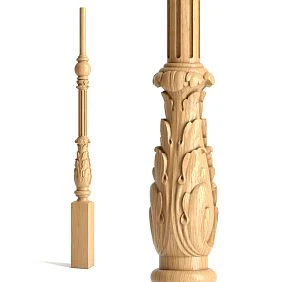
Buy carved wooden balusters for a country house — this is an option for those who are building not just a dacha, but a real country home with a well-thought-out style. Carving on the wooden facade, trim, shutters, carved porch columns — if all this is present, then the balusters should be in the same register.
Carved balusters on an open porch require special attention to the protective coating: every recess of the relief is a place where moisture can linger. Good impregnation-antiseptic with a final painting in 2–3 layers is a mandatory condition for durability.
Which material to choose: wood, species, moisture
For a summer house and a wooden house, choosing the material for a baluster is a choice not only of appearance, but also of durability in specific conditions.
Pine: affordable, workable material
Pine is the most common material for summer house balusters. The reason is simple: price and availability.
Under opaque paint or antiseptic, pine works well. The surface accepts the coating normally if properly primed and allowed to dry before the final coat.
Weak points of pine:
-
Resins at temperature changes (especially relevant for outdoor use)
-
Softer than beech and oak, therefore more often receives mechanical damage
-
Under clear varnish looks less expressive: yellowish tone with coarse uneven texture
For porches, terraces and outdoor railings under paint — pine remains a pragmatic choice.
Beech: the middle ground between price and quality
Beech is a hard deciduous wood (3.5 on the Brinell scale), resin-free, with a uniform dense structure. It behaves perfectly under paint: the paint lays evenly, without spotting. Under tinting, it gives a neat, calm result.
Buy wooden balusters Beech for an internal staircase in a wooden house is the right balance of price and quality. Under white enamel, light gray or cream paint, beech balusters provide a smooth, flawless surface.
Beech is a deciduous species and requires more thorough protection from atmospheric moisture than conifers. For outdoor railings, an additional layer of antiseptic primer is mandatory.
Oak: for those building for the long haul
Buy wooden balusters Oak is an investment in a railing that will outlast several home renovations.
Oak (3.7–3.9 on the Brinell scale) is the most resistant of available species to mechanical loads. It contains tannins that naturally resist rot. Under a clear oil or varnish coating, oak provides that noble grain pattern for which it is valued in furniture and parquet.
For a grand internal staircase in a wooden house or for a house porch that is meant to have a representative appearance, oak is unrivaled.
Moisture: what they don't talk about when selling
Balusters made from raw or poorly dried wood begin to warp, crack, and 'move' after installation and painting. Tenons are pulled out of grooves, the handrail deforms, and paint cracks along the wood's splits.
Chamber drying to 8–10% moisture is a standard that eliminates this problem. When purchasing, always ask: how were the blanks dried? This is not an idle question.
What to buy together with balusters: a systematic view of the railing
The most common mistake when buying is to think only about balusters. The result is that a week later you have to buy a handrail, then posts, then fasteners. And often from different places, different batches, with small inconsistencies that turn installation into a puzzle.
The right approach is to order a complete set from one place.
Handrail
Sold by linear meter. Selected according to the groove profile: the baluster tenon must fit exactly into the handrail groove. If you take balusters with a round tenon, use a handrail with a round groove. Square tenon — square or rectangular groove.
A handrail made of the same wood species as the balusters guarantees the same tone under any coating.
Supporting posts
Buy balusters and posts for a wooden staircase in one order — a mandatory condition for a systematic railing. For a dacha, 2–4 posts for the flight part plus 2–3 for the terrace are usually sufficient.
Wooden stair posts selected by style and cross-section: for square and flat balusters — straight posts 80×80 or 100×100 mm; for turned and carved balusters — posts with corresponding decor.
Bottom baluster rail
Mounted on the steps under the balusters. Conceals fasteners, aligns spacing, protects the base of the balusters from direct contact with the step. On an outdoor staircase, it also protects the bottom end from moisture accumulation.
Fasteners
M8 studs with nuts and wide washers, PVA glue (for interior work) or moisture-resistant construction adhesive (for outdoor use). Do not skimp on fasteners: stainless steel or galvanized studs are a must outdoors.
Post finials
Decorative caps, pyramids or balls for posts. Outdoors, finials additionally protect the post end from direct water ingress. This is a small element, but it completes the fence's appearance.
Staircase Components for Sale systematically — it's one order instead of five separate purchases.
Balusters for outdoors: what changes with outdoor use
Outdoor use is a fundamentally different operating mode. Wood outdoors is exposed to moisture, ultraviolet light, temperature fluctuations from -30°C to +35°C, and biological effects (fungus, blue stain).
Wood species for outdoors
For porches and terraces, the optimal choice is larch (natural resin content provides inherent protection), oak (tannins), or pine with mandatory deep impregnation.
Beech for outdoors requires special protection: a hardwood species more sensitive to moisture than conifers. If using beech on an open veranda — three coats of quality antiseptic impregnation and regular renewal every 2–3 years.
Shape for outdoors
The fewer hard-to-reach places — the better. Flat and square balusters are the best choice for outdoors: no recesses where water can accumulate.
wooden balusters for terrace in square or rectangular design — technically the most advantageous choice for open space.
Outdoor fasteners
Galvanized or stainless steel studs. Regular metal fasteners rust within a season or two and leave rusty streaks on the wood. This is not only unsightly but also destroys the wood structure around the fastening point.
Gap between the bottom end and the step
Outdoors, you cannot mount a baluster flush against the step surface without a gap. A gap of 5–8 mm filled with sealant or construction adhesive ensures ventilation of the end and prevents rot. Without this, the bottom end begins to deteriorate after just 1–2 winters.
Protective Coating
For outdoor use — only specialized compounds:
-
Antiseptic impregnation (base layer) — deep penetration into the structure
-
Outdoor primer — porosity leveling
-
Outdoor finish paint or varnish — water-repellent barrier
-
Renewal of the finish layer: every 2–3 years with regular inspection
Check the coating condition annually: first signs of peeling are a signal to renew before water reaches the wood.
How to calculate the number of balusters and posts for a dacha
For a dacha house, the calculation often covers several areas at once: stairs + porch + terrace. It's more convenient to calculate by area and then sum them up.
Calculation for stairs
Step 1. Measure the length of the stair stringer (along the inclined line, not the horizontal projection).
Step 2. Determine the installation spacing:
-
Families with children under 12: 120–130 mm (clearance no more than 150 mm — safety standard)
-
Standard spacing: 140–160 mm
-
Wide spacing: 160–180 mm
Step 3. Length (mm) ÷ spacing (mm) = number of balusters per flight.
Step 4. Add 10% spare.
Example for a country house: span 2,400 mm, step 150 mm. 2,400 ÷ 150 = 16 balusters. Reserve: +2 pieces. Total: 18 balusters.
Calculation for a porch
Usually 2–3 steps on two sides, plus a landing. For each side: landing length ÷ step = balusters. Porch 1,500 mm × 2 sides = 3,000 mm. 3,000 ÷ 150 = 20 balusters + 2 reserve.
Calculation for a terrace
Length of the open perimeter (without walls) ÷ step. Terrace 5,000 mm along the front: 5,000 ÷ 150 = 34 balusters. Reserve +4. Total: 38 balusters.
Calculation of posts
One post for each corner, start and end of each railing, turning point.
| Zone | Minimum posts |
|---|---|
| Staircase 1 flight | 2–3 |
| Porch 3-4 steps | 4–6 |
| Terrace 5×4 m | 6–8 |
| Standard country house (all together) | 12–17 |
Calculation table
| Zone | Length (mm) | Spacing (mm) | Balusters | +10% reserve | Total |
|---|---|---|---|---|---|
| Stairs | 2 400 | 150 | 16 | +2 | 18 |
| Porch (2 sides) | 3 000 | 150 | 20 | +2 | 22 |
| Terrace | 5 000 | 150 | 34 | +4 | 38 |
| TOTAL | 70 | +8 | 78 |
Price of balusters for a country house: what makes up the budget
Balusters price for a country house is not a fixed value. It depends on several factors, understanding which will help create an honest budget.
What affects the price of one baluster
Wood species. Pine is basic, beech is 40–60% more expensive, oak is 2–2.5 times more expensive than pine. For a country house under paint, pine is a working choice. For an internal staircase under varnish, beech or oak.
Shape. A flat baluster is cut from a board — minimum operations. A square one is a simple cut. A simple turned one is a single-pass turning operation. A complex turned one is a long program. A carved one is a lathe plus a router. Each step adds 20–40% to the price.
Grinding class. Standard processing — P80–120. Finish for varnish — P180–220. Price difference — 10–15%, but for balusters under a transparent coating, finish grinding is mandatory.
Height. Standard — 900 mm. Balusters 1000 mm and higher — non-standard, price 10–20% higher.
Order volume. For batches of 50 pieces or more, the manufacturer gives a 5–15% discount. Order everything at once — the staircase, porch, and terrace in one batch.
Estimated prices
| Type | Pine | Beech | Oak |
|---|---|---|---|
| Flat, 900 mm | from 600 rub. | from 1,600 RUB | from 2,200 rub. |
| Square 45×45×900 | from 700 rub. | from 1,400 RUB | from 1,900 RUB |
| Simple turned ø45×900 | from 900 rub. | from 1,900 RUB | from 2,600 rub. |
| Turned complex ø50×900 | from 1,400 RUB | from 2,800 RUB | from 3,500 RUB |
| Carved milling-turning | from 2,400 RUB | from 4,500 RUB | from 5,800 RUB |
Current Balusters buy price — in the STAVROS catalog with filtering by type, shape, and wood species.
Budget for a full country house set
Let's take a typical country house: 78 flat pine balusters, 14 posts, handrail 15 linear meters, fasteners.
| Element | Quantity | Unit price | Total |
|---|---|---|---|
| Flat pine balusters | 78 pcs. | 700 rub. | 54,600 RUB |
| Posts 80×80×1200 pine | 14 pcs. | 1 800 RUB | 25 200 RUB |
| Handrail pine | 15 linear meters | 700 RUB/m | 10,500 RUB |
| Fasteners, strips | kit | — | 5,000 RUB |
| TOTAL | ~95,300 RUB |
For the beech option — multiply by approximately 2, for oak — by 2.5–3.
This is a real, honest budget for a properly calculated country fence in three zones.
Mistakes when buying balusters for a country house
Each of them is a real story. Each one costs either money, nerves, or rework.
Mistake 1: bought only balusters, without handrails and posts
"We'll find posts on site, buy handrails later." Later — a different wood species, a different batch, a different shade. Under the same paint — a slightly different color. Insignificant, but noticeable. Especially in the light.
Solution: buy balusters and handrails together with the posts — as one item, from one batch.
Mistake 2: didn't account for outdoor use
Bought balusters for the porch without considering atmospheric load: without antiseptic treatment, with regular metal fasteners. After two winters — rusty streaks, cracks on the ends, beginning of rot at fastening points.
Solution: for outdoor use — specialized treatment before installation and proper fasteners.
Mistake 3: bought the cheapest without specifying moisture content
Bought cheap pine. After installation and painting — within a month got the first cracks along the balusters. Raw wood dries quickly in heated indoor conditions and cracks.
Solution: specify the moisture content of the workpiece (should be 8–12%).
Error 4: bought balusters without calculating all zones
Calculated the staircase, bought it. Then realized — we also need a porch and terrace. Reorder — a different batch. Slightly different shade.
Solution: calculate the entire volume at once, order as a single batch.
Error 5: chose a shape without considering installation
Bought carved balusters for a country porch and decided to paint them ourselves. Three hours on 20 balusters with a brush, painting every recess. Result — not very even, and it took a lot of time.
Solution: for DIY painting — flat or square balusters. For carved ones — hire a painter or use a sprayer.
Error 6: didn't count the fasteners
Calculated the balusters and handrail. Fasteners 'we'll get at the store'. The studs didn't fit the diameter, the washers were too small, the glue was wrong. Three trips to the hardware store and a lost day.
Solution: order buy staircase components together with the main elements from the manufacturer.
Error 7: forgot about post caps
We installed the fence — it looked beautiful. A year later, cracks and water stains appeared on the ends of the posts. An open post end outdoors means direct exposure to precipitation on the most vulnerable element.
Solution: post caps are a mandatory element for outdoor fencing.
Where to buy balusters for a summer house and wooden home
Buy balusters for a summer house directly from the manufacturer — this is the only strategy that works without unpleasant surprises.
Why from the manufacturer?
-
One batch for the entire set: stairs, porch, terrace — identical tone under any coating
-
Controlled humidity: kiln drying to 8–10% — no warping or cracks after installation
-
Component compatibility: baluster tenons fit precisely into the grooves of the handrails of the same system
-
Free calculation: based on your staircase, porch, and terrace parameters — a complete specification without overpayment or shortage
-
One order: balusters, posts, handrails, fasteners, and finials in a single delivery
handrails and balusters made of wood from a unified series — it's not just ordering convenience. It's a guarantee of results.
About the company STAVROS
STAVROS is a Russian manufacturer of solid wood products since 2002. Over two decades of work — thousands of completed projects: from country house porches to grand staircases in suburban mansions.
The production cycle includes chamber drying of blanks to 8–10% moisture, processing on CNC lathes and milling machines, and multi-stage sanding. Balusters and posts from the catalog are ready for immediate installation and coating — no additional surface preparation required.
Assortment: over 50 models of balusters (flat, square, turned, carved), support posts from simple to decorative-carved, handrails in a range of profiles. Wood species: pine, beech, oak, ash. All elements are produced in coordinated series with guaranteed compatibility.
Pickup from Moscow and St. Petersburg. Delivery by transport companies throughout Russia. Free calculation of a kit for a specific project — based on your staircase, porch, or terrace parameters.
FAQ: Answers to popular questions
Which balusters are best to buy for a country house?
For a country house staircase, porch, and terrace — flat or square wooden balusters made of pine or beech. A simple shape means easy painting, good durability, and a reasonable price. For an interior staircase in a wooden house — turned balusters made of beech or oak.
Can wooden balusters be used outdoors?
Yes. With proper preparation: antiseptic impregnation, primer, finishing paint for exterior use. Stainless steel or galvanized fasteners. A gap of 5–8 mm at the base with sealant. Inspection of the coating every 2–3 years.
What to buy together with balusters for a country house?
Handrail, support posts, bottom baluster rails, fasteners (studs, nuts, washers), post caps. All from the same batch, from the same manufacturer.
Which balusters are cheaper for a country staircase?
Flat and square pine balusters are the most affordable. When ordering 50 or more pieces, a batch discount applies. Calculate everything at once: staircase, porch, terrace — one batch is more profitable than three separate orders.
Where to buy balusters for a wooden house with delivery?
In the STAVROS catalog: flat, square, turned, and carved balusters, posts, handrails, and fasteners. Contact us to confirm shipping to your destination. Free kit calculation.
How many balusters are needed for a country staircase?
Length of the flight (mm) ÷ 150 mm (step) = number of balusters. Plus 10% reserve. For the porch and terrace, calculate each area separately using the same scheme.
Do balusters need to be sanded before painting?
Factory-sanded balusters of class P120–150 are ready for painting. For final varnish — check if final sanding P180–220 was done. If not — manual finishing before coating takes 5–10 minutes per baluster.
How to choose posts for flat balusters for a country house?
Straight posts 80×80 or 100×100 mm without excessive decor. The style of the post should match the simplicity of the flat baluster — this is an organic, restrained combination for a wooden house and country house.