Article Contents:
- Buying building materials wholesale starts with a bill of materials, not with an online store shopping cart
- Which wooden finishing materials to include in the general bill of materials
- Wooden baseboard
- Wooden molding
- Wooden curtain rod
- Architraves and battens
- 2400 mm array
- MDF 2600 mm
- At 2000 mm
- At 2400 mm
- At 2600 mm
- One order and one delivery
- Multiple procurement queues
- Full statement, but staged receipt
- Product
- Plan
- Commerce
- Document version
- Error in the initial measurement
- Cutting error
- Damage
- Project change
- Scenario A: four walls of 3 m each
- Scenario B: five sections of 2.4 m each
- Is it enough to calculate the total linear meters of trim?
- Why can't you just add 10%?
- What matters more in the list: meters or pieces?
- Why does PLT-006 sometimes have a different quantity for the same linear meters?
- Why should KZ-001 be recorded together with the length?
- Can one large purchase be split into stages?
- What should be accepted at the site first?
- Where can I view the range of mouldings?
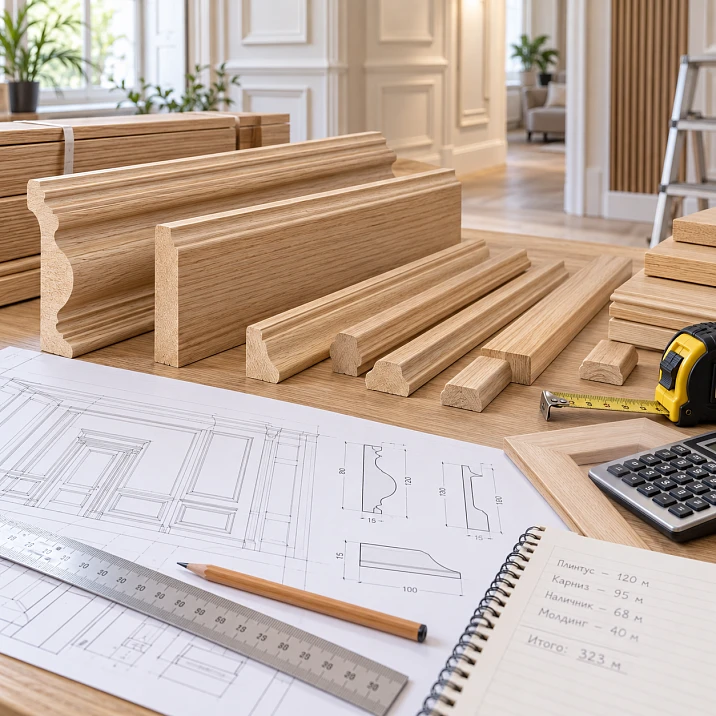
Wholesale purchasing of building materials for finishing works does not start with the "add to cart" button, but with the project's procurement schedule. If it only lists "skirting board — 78 m, moulding — 126 m, cornice — 42 m", that is not enough to place an order. Linear metres show the total requirement, but the supplier ships specific products of a certain length, material and profile. After cutting, the quantity almost always needs to be counted in pieces.
This is especially important for wooden mouldings. The same product code can have different commercial lengths depending on the material. For example, PLT-006 variants in solid beech and oak come in lengths of 2400 mm, while MDF comes in 2600 mm. KZ-001 comes in lengths of 2000, 2400 and 2600 mm depending on the version. Therefore, the line "80 metres needed" does not yet answer the question of how much can actually be ordered.
The working sequence is as follows:
project → rooms → product codes → material → profile size → commercial length → cutting plan → number of whole products → reserve → purchase sequence → acceptance.
If the profile has not yet been selected, the starting point can be the general section Wooden trim, where 92 moulding products are currently listed.
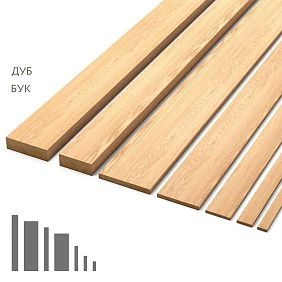
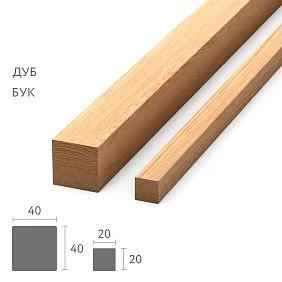
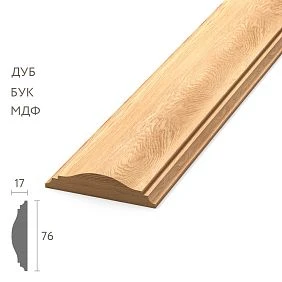
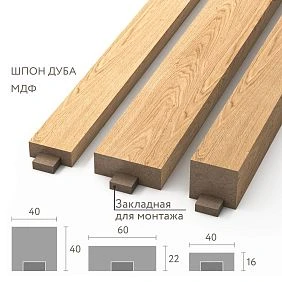
Wholesale purchasing of building materials starts with the schedule, not with the online store's cart
Each room requires a separate line.
Minimum set of fields:
| Field | What to enter | | --- | --- | | Room | living room, bedroom, hallway, study | | Product type | skirting board, moulding, cornice, architrave, batten | | Item code | exact SKU | | Material | beech, oak, MDF — per the product card | | Profile size | full size | | Product length | 1000, 2000, 2400, 2600 mm, etc. | | Net linear metres | actual requirement | | Number of items | whole number | | Reserve | based on cutting plan, not a rough guess | | Order stage | batch 1 / 2 / 3 | | Installation location | specific wall, frame, portal |
Bad specification:
moulding — 126 m
Good:
MLD-___ / oak / size ___ / length 2400 mm / study / frames R1–R8 / 22 pcs. + 1 spare
In the second case, the purchaser can verify the order before payment, the site manager can accept it, and the installer can understand the purpose of each strip.




Which wooden finishing materials to include in the general schedule
In the STAVROS catalogue, trim combines several product types. For a procurement schedule, it is better not to mix them in one group.
Our factory also produces:

Wooden baseboard
Calculated along the lower contour of the room. The calculation includes walls, doorways, niches, built-in furniture and actual termination points.
Get Consultation
Wooden moulding
Calculated for each decorative composition: frames, verticals, horizontal lines, surrounds of openings and furniture.
Wooden cornice
Calculated along the upper contour, but the result is not determined by the perimeter alone. The length of one plank, the angles and the joint locations must be taken into account.
Architraves and battens
They cannot be automatically added to the moulding footage. These are separate items with their own dimensions, lengths and installation locations.
This keeps the schedule verifiable: one product type — one calculation logic.
How to divide an object into zones before calculating material quantities
It is better to calculate a large object not as a single sum, but by rooms.
For example:
- G1 — living room;
- H1 — hall;
- B1 — bedroom 1;
- B2 — bedroom 2;
- C1 — study;
- K1 — kitchen.
Within each zone, its own lines are created:
G1-P1 — baseboard along the main wall
G1-M1 — frame molding 1
G1-K1 — cornice along the ceiling contour
The advantage of such a system becomes apparent at the purchasing stage. If one molding in the living room has changed, there is no need to recalculate the entire project. The specific line G1-M1 is adjusted.
For wholesale purchasing, this matters more than the overall “square footage for the house.”
Wooden skirting board: it's not just the perimeter you need to calculate
Basic formula:
perimeter − areas without skirting = net length.
For example:
- perimeter — 43.6 m;
- door and other excluded areas — 5.2 m.
We get:
43.6 − 5.2 = 38.4 m.
Now let's assume that after the cutting plan, the designer allowed an 8% reserve.
38.4 × 1.08 = 41.472 m.
If PLT-006 made of solid wood with a length of 2400 mm is used:
41,472 / 2,4 = 17,28.
This means a minimum of 18 planks is required.
Total commercial meterage:
18 × 2.4 = 43.2 m.
This example shows why buying building materials in bulk doesn't end with calculating linear meters.
PLT-006: one SKU, but different length depending on the material
PLT-006 is especially useful as an example of a purchasing mistake.
In the current product page:
- MDF and moisture-resistant MDF — 100×16×2600 mm;
- beech and oak — 100×15×2400 mm.
That is, both the length and the thickness change at the same time.
If the specification states:
PLT-006 — 16 pcs.
it's unclear what exactly was ordered.
For the same 41.472 m:
Array 2400 mm
ceil(41.472 / 2.4) = 18 pcs.
MDF 2600 mm
ceil(41,472 / 2.6) = 16 pcs.
The difference is two whole planks.
Therefore, in the procurement list, the material, size, and length must be on the same line.
A practical example can be checked on the card wooden plinth PLT-006.
Wooden molding: how to calculate frames and wall compositions
For molding, the room's perimeter is almost useless.
Let's imagine six identical frames measuring 1200×1800 mm.
Perimeter of one:
2 × (1.2 + 1.8) = 6 m.
Six frames:
6 × 6 = 36 m.
If the selected molding has a length of 2400 mm, simple division gives:
36 / 2.4 = 15 planks.
But this is only the mathematical minimum.
Each frame requires four segments:
- two of 1800 mm;
- two of 1200 mm.
A single 2400 mm plank cannot yield both 1800 and 1200 mm at the same time.
Therefore, the actual cutting plan may require more than 15 pieces.
This is exactly where the purchasing list must include not only the total 36 m, but also the list of required segments.
If the profile is still being selected, you can open the section Buy wooden molding.
Molding cutting plan: why 36 meters may require 18 planks
Let's take the same six frames 1200×1800 mm.
You need to:
- 12 pieces of 1800 mm;
- 12 pieces of 1200 mm.
From a 2400 mm strip, you can get:
- one piece of 1800 mm and a remainder of 600 mm;
- or two pieces of 1200 mm.
For 12 long sides, a minimum of 12 planks is needed.
For 12 short sides:
12 / 2 = 6 planks.
Total:
12 + 6 = 18 planks.
Total purchase length:
18 × 2.4 = 43.2 m.
Although the net length of the frames is only 36 m.
The difference:
43.2 − 36 = 7.2 m.
This is not a "20% extra margin," but the result of a specific cutting plan.
This kind of calculation is what distinguishes a purchasing schedule from a simple list of linear meters.
Wooden cornice: converting the perimeter into the number of whole pieces
For a cornice, the upper contour of the room is calculated first.
Let's say the room is 5×4 m.
Perimeter:
2 × (5 + 4) = 18 m.
If a cornice with a length of 2400 mm is used:
18 / 2,4 = 7,5.
Minimum:
8 strips = 19.2 m.
But eight is not necessarily the final quantity. The four corners require mitre cuts, and the joint locations must be coordinated.
For a specific calculation, it is convenient to use Wooden Cornice KZ-001, because one SKU is available in multiple lengths.
Before choosing a specific model, you can open the section buy a wooden cornice and compare the available profiles by size, material, and length.
KZ-001: why length should be a separate column in the statement
The current KZ-001 product page has several line items:
- MDF — 2600 mm;
- beech — 2000 and 2400 mm;
- oak — 2000 and 2400 mm.
The profile is the same, but the purchasing logic depends on the specific length.
For the same 18 m:
At 2000 mm
18 / 2 = 9 planks.
At 2400 mm
ceil(18 / 2.4) = 8 planks.
At 2600 mm
ceil(18 / 2.6) = 7 planks.
But a longer plank is not automatically better. You need to look at the walls, corners, and actual leftovers.
Therefore, you cannot simply write in the specification:
KZ-001 — 8 pcs.
You need to:
KZ-001 / material ___ / length ___ / quantity ___
Wholesale purchase of building materials: why linear meters still don't show the order quantity
A linear meter is a unit for measuring demand.
A purchase is a specific number of product units.
For example:
| Item | Net linear meters | Item length | Theoretical minimum | | --- | ---: | ---: | ---: | | Skirting board | 78 m | 2.4 m | 33 pcs. | | Molding | 126 m | 2.4 m | 53 pcs. | | Cornice | 42 m | 2.4 m | 18 pcs. |
Even this table is not final yet.
The skirting board needs to be checked against the walls and openings.
Molding — by individual frames.
Cornice — by corners and joints.
Therefore, the "theoretical minimum" column is useful only as a check. The number that goes into the order is the one after cutting.
How to determine the allowance for skirting board, molding, and cornice
Using the same percentage for the entire order is convenient, but not always reasonable.
For a straight skirting board, the main risk is the length of the walls and the number of joints.
For a framed moulding, it is the cutting layout structure.
For a cornice, it is the corners and long continuous lines.
Let's assume a net requirement of 22 m with a plank length of 2.4 m.
With a formal 10% allowance:
22 × 1.10 = 24.2 m.
In pieces:
ceil(24,2 / 2,4) = 11.
That is, the purchase is:
11 × 2.4 = 26.4 m.
Actual stock relative to clean length:
26.4 − 22 = 4.4 m, or 20%.
Therefore, the percentage is only an intermediate guideline.
The final quantity is determined by the cutting plan.
When it is mathematically enough, but practically it is not
The wall is 4.7 m long.
Two planks of 2.4 m each give:
4.8 m.
Formally, there is enough material with a remainder of 100 mm.
But if the installation scheme requires trimming both ends, these 100 mm may disappear before installation.
Another example: two walls of 2.35 and 2.35 m.
Each one needs almost a full 2.4 m plank.
Total length of walls:
4.7 m.
Two planks:
4.8 m.
The math again says "enough."
But if there is end damage or a complex cut, there is effectively no reserve.
Therefore, a large purchase must account for actual cut lengths, not just the arithmetic sum.
What is more cost-effective: one large order or purchasing in stages as the project progresses
Wholesale purchases of building materials do not necessarily mean delivering the entire volume to the site at once.
There are three viable schemes.
One order and one delivery
Suitable if:
- the site is ready to receive the material;
- secure storage is available;
- installation starts soon;
- the entire specification is finally approved.
Multiple procurement queues
For example:
- queue 1 — first-floor baseboards;
- queue 2 — moldings;
- queue 3 — cornices and the second floor.
This means less material is stored on site.
Full schedule, but phased delivery
The entire requirement is calculated in advance, and shipment is tied to the construction schedule.
This scenario must be agreed separately with the seller. Reservation or phased shipment cannot be considered an automatically available service without confirmation.
How to create a procurement schedule so you don't mix up similar profiles
For each SKU, it's useful to add not only the name, but also visual verification.
Example:
| Field | Value | | --- | --- | | SKU | MLD-___ | | Photo | link/attachment | | Drawing | current version | | A×C×L | ___ | | Material | oak | | Room | office | | Line | C1-M3 | | Net footage | ___ | | Number of items | ___ | | Reserve | ___ |
This way, the buyer doesn't confuse two similar moldings just because they have similar widths.
This is especially useful on a project where 8–12 different profiles are used simultaneously.
Oak, beech, or MDF: the material must be recorded in each line of the schedule
You cannot write:
PLT-006 — 18 pcs.
Or:
KZ-001 — 8 pcs.
if one SKU exists in multiple materials and lengths.
Material affects:
- the commercial length;
- the price;
- the thickness in certain models;
- the finish;
- the subsequent cutting.
Therefore, the minimum purchasing line is:
SKU + full size + material + length + quantity.
And only after that — finish, room, reserve, and queue.
Buying building materials wholesale: how not to mix up reserve and main quantity
It is useful to have two separate columns in the statement:
main quantity
и
reserve.
For example:
| Room | Main | Reserve | Total | | --- | ---: | ---: | ---: | | Living room | 18 | 1 | 19 | | Study | 11 | 1 | 12 | | Hallway | 9 | 1 | 10 |
If the stock is mixed in a common pile, the first crew may take the entire reserve for one room.
Formally, the material was on site, but for the remaining zones the stock disappeared.
This is especially unpleasant with the same SKU that is used in several rooms.
What to check before paying for a wholesale purchase
Before payment, the purchaser must go through not one list, but four checks.
Product
- article number;
- the material;
- size;
- length;
- quantity.
Project
- room;
- installation line;
- cutting map;
- reserve.
Commerce
- current price;
- availability;
- production time;
- packaging;
- delivery.
Document version
- revision number;
- date;
- who approved it;
- whether there is a newer drawing.
After this, the procurement list becomes a document rather than a draft table.
How to accept long-length wooden trim on site
Acceptance is done line by line according to the order.
Check:
- article number;
- the material;
- full size;
- length;
- quantity;
- packaging condition;
- visible damage;
- compliance with a specific procurement queue.
If one bundle has the required item code but a different length, it cannot be considered equivalent without recalculating the cutting plan.
For example, replacing 2400 with 2000 mm can increase the number of joints and completely change the cutting map.
Acceptance by room: a simple way not to lose part of the order
For a large project, it is convenient to label groups:
G — living room
C — study
H — hall
In the acceptance report:
| Zone | SKU | Length | Ordered | Accepted | Damaged | | --- | --- | ---: | ---: | ---: | ---: | | G | PLT-___ | 2400 | 19 | ___ | ___ | | C | MLD-___ | 2400 | 12 | ___ | ___ | | H | KZ-___ | 2000 | 10 | ___ | ___ |
This way, after unloading it is clear which item was not received in full.
If everything is recorded in one line as “32 packs,” the check loses its meaning.
What to do if there is not enough material during installation
First, you need to understand the cause of the shortage.
Error in the initial measurement
Recalculate the specific area.
Cutting error
Check whether the remaining long offcuts can be used.
Damage
Separate the process-related shortage from defects or transport damage.
Project change
Create a new revision of the list rather than adding “+5 m more” to the old one.
After that, you're not buying an abstract linear meterage but the exact SKU of the same configuration.
Why an urgent purchase of five meters can halt an entire stage
A small shortage creates a chain:
new calculation → stock check → order → packaging → delivery → acceptance → installers return.
If the profile is out of stock and made to order, the schedule can shift more than it seems from the number "5 m."
Therefore, a reasonable reserve is cheaper not always in material cost, but in the cost of organizational risk.
But the reserve must be calculated, not assigned as a universal percentage.
Ready-made structure of a request for wooden trim calculation
It's better to send an already structured request to the supplier or manager:
Object: ___
City: ___
Date the material is needed: ___
Premises: ___
SKUs: ___
Material by each SKU: ___
Sizes and lengths: ___
Net footage: ___
Number of whole items: ___
Reserve: ___
Delivery sequence: ___
Contact of the person responsible for acceptance: ___
If there is no product code yet, this must be explicitly noted:
the item is not approved — selection is required.
This way, the manager does not treat the preliminary profile as final.
The same requirement of 12 m can result in a different number of strips
The total linear meters alone do not show how convenient the cutting will be.
Let's imagine two sections.
Scenario A: four walls of 3 m each
Total length:
4 × 3 = 12 m.
If the profile is 2400 mm long, each three-meter wall cannot be covered with a single strip. A joint will be required. Simple division:
12 / 2.4 = 5 strips
provides only the mathematical minimum, but does not guarantee a convenient layout along four walls.
Scenario B: five sections of 2.4 m each
Total length as well:
5 × 2.4 = 12 m.
Here, five whole items already match the geometry of the sections without an intermediate remainder in length.
In both cases, the net requirement is 12 m. But the procurement task is different. Therefore, it is useful to store in the bill of materials not only the total for the room, but also the list of individual segments.
How to handle changes after the procurement bill of materials is approved
After the order is approved, the designer may change one frame, the foreman may relocate a doorway, and the installer may request a different profile length. If such changes are made verbally, the old and new versions quickly get mixed up.
It is better to use revisions:
Bill of materials 04 — approved on 09/10/2026
Bill of materials 05 — molding C1-M3 changed, quantity 11 → 13 pcs.
Only the latest revision is included in a new order.
If part of the material has already been paid for, the statement separately notes:
- ordered;
- received;
- still to be ordered;
- cancelled;
- replaced with another SKU.
This way, wholesale purchasing does not turn into several disconnected tables.
Why similar profiles cannot be combined into one line for convenience
On a large project, people sometimes write:
white moldings — 84 pcs.
This is visually convenient, but risky for purchasing.
Two moldings may differ by just a few millimeters, material, or length, yet for installation they are not the same item. Therefore, each SKU gets its own line, even if the color and room match.
The summary total can be placed below:
total moldings — 84 pcs.
But it is used only as a quantity check, not as a basis for ordering.
What to keep after completing the purchase
After delivery and installation, it is useful to keep the final schedule together with one short sample of each significant profile.
The sample is labeled with:
- article number;
- the material;
- finish;
- room;
- project date.
If local repairs are needed in a few years, the owner will be able to identify the original profile not from an old photo, but from the actual marked part and the latest bill of materials.
When a bulk purchase of building materials is not yet ready for payment
You should not pay for a large order if:
- profiles were selected based only on renders;
- there are no exact SKUs;
- the material is unknown;
- the lengths of the strips have not been checked;
- meters have not been converted into pieces;
- there is no cutting plan for the frames;
- the reserve is set as “10% for everything”;
- no room assignment;
- the installation schedule is still changing;
- the delivery is not tied to the current project revision.
A large order does not fix uncertainty. It only turns it into a large volume of material.
Mistakes when buying wooden trim in bulk
Mistake: buying only by total linear meters.
The reason is the desire to simplify the calculation. The consequence is the wrong number of strips. The solution is to count whole items.
Mistake: not specifying the material.
For one SKU, the length and size may depend on the variant. The solution is a complete product line.
Mistake: calculating molding by the total perimeter of the frames without cutting.
Part of the leftover cannot be used. The solution is a list of actual cut pieces.
Error: using a single percentage of reserve for the entire linear footage.
Baseboard, molding, and cornice are cut differently. The solution is a reserve after the cutting map.
Error: treating a strip of a different length as the "same item".
Cutting and the number of joints change. The solution is that length must be a separate receiving parameter.
Error: mixing the reserve of several rooms.
One crew can consume the reserve of the entire site. The solution is that the reserve is assigned to a zone.
Error: not recording the revision of the bill of quantities.
The purchaser orders according to the old project. The solution is one active version with a date.
Questions before wholesale purchasing
Is it enough to calculate the total linear meterage?
No. The meterage must be converted into a specific number of items of the selected length.
Why can't we just add 10%?
Because the actual reserve depends on the cutting plan, and after rounding up to whole planks the actual percentage may be different.
What is more important in the specification: meters or pieces?
Both values are needed. Meters control the requirement, pieces — the actual order.
Why can PLT-006 have a different quantity for the same meterage?
Because solid wood versions are 2400 mm long, while MDF ones are 2600 mm; the profile thickness also differs.
Why should KZ-001 be recorded together with the length?
It has different versions: 2000, 2400, and 2600 mm.
Can one large purchase be split into phases?
Yes, if the commercial scheme and shipment schedule are confirmed by the seller.
What should be accepted at the site first?
Item code, material, size, length, and quantity for each line of the specification.
Where can I view the range of mouldings?
In the general STAVROS catalog, and after selecting the product type — in the corresponding product category.